India wades into Afghan peace talks

(Russian Foreign Minister Sergey Lavrov greeting Taliban officials at Moscow peace conference, November 2018)
By M. K. BHADRAKUMAR | Indian Punchline | February 1, 2019
The Ministry of External Affairs spokesman’s remark on Thursday in New Delhi that “it is important that the presidential election in Afghanistan takes place as per the schedule” is the first major Indian comment on the current peace talks in Qatar between the United States and the Taliban.
Whether that was an off-the-cuff remark or not remains unclear, but if it has been a considered statement, it puts India at odds with the peace talks in Qatar, which is working toward commencing the intra-Afghan dialogue, forming an interim government in Kabul and declaring a nation-wide ceasefire. Arguably, India’s strong advocacy of the charade of a presidential election in Afghanistan at this juncture is tantamount to the debunking of what is happening at the Qatar talks.
The point is, the Indian stance is virtually identifying with the ‘rejectionist’ camp of Afghan opinion, which fears that the reconciliation with the Taliban will mean the end of the road for them. This camp principally consists of President Ashraf Ghani and his circle – his newfound associate Amrullah Saleh, in particular – who are justifiably nervous about their own political future if the peace talks at Qatar advance toward the formation of an interim government.
But why should India try to bolster their career prospects? It may create misperceptions that India has ulterior motives. Clearly, the conditions in Afghanistan do not allow the holding of the presidential election. Even if the election is held, its credibility will be in serious doubt. The result of the election is almost inevitably going to be hotly contested. Quite obviously, the recent parliamentary election tells a sordid story. The political legitimacy of the “victor” in any presidential election will remain highly suspect. Even Ghani’s government was formed 5 years ago only after protracted efforts by the US to work out a compromise formula of power sharing.
In fact, much of the present crisis in Afghanistan is to be directly attributed to the weak government in Kabul that lacked political legitimacy and popular support, and to its leadership that is widely perceived as an American concoction. What is the point in repeating such a futile experiment? As it is, Afghanistan is hopelessly fragmented and another Ghani as its next figurehead and another puppet regime in Kabul can only spell doom for the country.
The fact of the matter is that the Afghan government is not at all representative of the nation. The latest Russian initiative to convene a conference of the Taliban representatives and prominent Afghan politicians in Moscow next week underscores the political undercurrents in Afghanistan today. Reuters has quoted a Russian official as saying, “Senior Taliban leaders and prominent Afghan politicians will travel to Moscow for a day-long summit. At this sensitive stage, it was best to not have Afghan government officials at the table.”
Interestingly, the Afghan personalities who may take part in the conference in Moscow on this coming Tuesday include former President Hamid Karzai. Whatever the Russian motivations might be in taking such an initiative, it only highlights that Ghani’s camp is fast becoming irrelevant to any serious intra-Afghan dialogue involving the Taliban and other Afghan groups.

(Pakistan Foreign Minister Shah Mehmood Qureshi with Russian Special Representative on Afghanistan Zamir Kabulov, Islamabad, Jan 29, 2019)
It goes without saying that the Russian initiative is in tandem with Pakistan following the visit by the Russian special representative on Afghanistan Zamir Kabulov to Islamabad on January 29. Ironically, Russia is facilitating the first round of intra-Afghan dialogue with Pakistan’s tacit support and Taliban’s readiness to participate in it. Ghani is not going to like that he has been bypassed and ignored. But then, if the international community has not so far questioned his locus standii, it was out of decorum and/or courtesy, but a time has come when Russians obviously decided that enough is enough.
Ghani was entirely an American creation and he lacks a support base. His tactic is to gather around him a cabal of figures who, like him, also stand to lose in peace settlement. He may try to be a ‘spoiler’ but ultimately, he will be overtaken by events and cast aside. Simply put, he is of no more use to the Americans who will discard him sooner rather than later. The case of Saleh is equally pathetic. The Americans built up Saleh for certain specific assignments related to security and they may cut him loose once he ceases to be of use to them. Unsurprisingly, Ghani and Saleh are now left with no option but to blow the nationalist bugle to rally support among patriotic Afghans, but that won’t impress anybody – neither the Afghans nor the international community.
Why should India get embroiled in the shenanigans of the ‘rejectionist’ camp in Kabul? True, the Modi government too would have a sense of ‘betrayal’ – that after having been the US’ loyal supporter in Afghanistan, India finds itself in a cul-de-sac. But the fault lies entirely with Delhi. The Modi government viewed Afghanistan through the prism of India-Pakistan tensions and Kashmir and the zero sum mindset has damaged Indian interests and brought about the current isolation.
Without doubt, President Trump intends to withdraw the troops from Afghanistan. And without American support, the roof will come crashing down on the head of Ghani, Saleh, et al, within no time. Delhi should be realistic about its capabilities and, more importantly, be mindful of its limitations. Does India have the grit and the resources to swim against the current? Only fools rush in where angels fear to tread.
Let bygones be bygones. Delhi should not compound the folly. The prudent thing will be to refrain from being a ‘spoiler’ at this sensitive juncture. Let the peace talks proceed ahead. What is needed on India’s part is strategic patience. Its Manichean fear that Pakistan is about to conquer Kabul has no basis. Pakistan knows Afghans only too well not to harbor any such illusions.
On the other hand, Afghanistan is India’s neighbor and there is abiding goodwill toward our country on the part of the Afghan people. A new beginning is always possible and India can safeguard its core interests by building bridges with the new regime.
Senate Approves Bill Opposing ‘Precipitous’ US Pullout From Afghanistan, Syria
Sputnik – 01.02.2019
WASHINGTON – The Senate has voted to advance legislation opposing any “precipitous withdrawal” of US forces from Syria and Afghanistan, following President Donald Trump’s announcement that he would be pulling all US troops out of the country.
The Senate voted 68-23 to limit debate on an amendment introduced by Senate Majority Leader Mitch McConnell that calls on the United States to remain in Syria and Afghanistan until all terrorist groups such as al-Qaeda and the Daesh are defeated there.
McConnell’s move was backed by almost all Republicans in the Senate, with only three of them — John Kennedy, Mike Lee and Ted Cruz — voting against the motion to advance the amendment.
Trump is reportedly considering plans to withdraw around 7,000 of the 14,000 US troops deployed to Afghanistan after ordering the Defense Department to pull out all 2,000 US soldiers stationed in Syria.
However, Senator Bernie Sanders criticized Trump’s move and supported congressional intervention to help create a more gradual troop withdrawal plan in a statement on Thursday.
“Congress must play a role, consistent with its Constitutional authority over war, in developing a troop withdrawal plan that is coordinated with our allies, that continues to provide humanitarian aid and that supports political settlements in these countries”, Sanders said.
The amendment will be introduced to a wide-ranging Senate bill on the Middle East, the “Strengthening America’s Security in the Middle East Act”. The sweeping legislation must still go up for a vote in the Senate, along with the US House.
If passed, the legislation would impose new sanctions against Syria, boost defense spending in the region and punish activists who call for economic boycotts of Israel to protest its policies in Palestine, among other measures.
The move marks a rare break between Senate majority Republicans and President Donald Trump who has said he plans to pull US troops out of both countries. The 68 votes in favor of the motion mean it could be re-passed with two-thirds of the 100 senators overriding any presidential veto by Trump.
On December 19, President Trump announced that the US would be withdrawing its troops from Syria over a period of several months. According to Trump, the US coalition’s mission, the defeat of Daesh (ISIS), had been secured.
The US and NATO initially launched military operations in Afghanistan in 2001 after the 9/11 terror attack. While most of the US troops had left the country by the end of 2014, NATO launched a new mission in 2015, called Resolute Support, to provide training and assistance to Afghan security forces.
International court judge resigns, citing ‘shocking’ interference from ‘above the law’ US
RT | January 30, 2019
A senior judge has resigned from the UN International Criminal Court (ICC) in The Hague, after the United States threatened judges investigating alleged US war crimes in Afghanistan.
The judge, Christoph Flügge, has worked with the International Criminal Court (ICC) and the International Criminal Tribunal for the Former Yugoslavia (ICTY) since 2008. More recently, he got involved with preliminary investigations into claims that US military service members and CIA operatives tortured prisoners in Afghanistan.
Flügge told German newspaper Zeit that he handed in his resignation after open threats from US officials, including a speech by hawkish national security adviser John Bolton last September, where Bolton “wished death” on the Court.
“If these judges ever interfere in the domestic concerns of the US or investigate an American citizen, he said the American government would do all it could to ensure that these judges would no longer be allowed to travel to the United States – and that they would perhaps even be criminally prosecuted,” Flügge told Zeit, in an interview translated by The Guardian.
“The American security adviser held his speech at a time when The Hague was planning preliminary investigations into American soldiers who had been accused of torturing people in Afghanistan,” Flügge explained. “The American threats against international judges clearly show the new political climate. It is shocking. I had never heard such a threat.”
Bolton’s speech was delivered in September to the conservative Federalist Society in Washington, DC. It came a year after the ICC began investigating claims that at least 61 detained persons in Afghanistan had been tortured by American troops and another 27 by the CIA at secret prisons in Afghanistan and abroad, according to prosecutor Fatou Bensouda.
Bolton called the investigation “utterly unfounded” and “unjustifiable,” and promised to “protect our citizens and those of our allies from unjust prosecution by this illegitimate court.”
The senior US official also vowed to defend Israeli citizens from the court. US “friend and ally” Israel was at the time accused of perpetrating war crimes against Palestinian civilians. He warned that the US would disregard arrest warrants, ban judges and prosecutors from entering the country, and even try them in American courts.
Flügge said his colleagues were “stunned” that “the US would roll out such heavy artillery,” but added “it is consistent with the new American line: ‘We are No 1 and we stand above the law’.”
American disregard for the ICC is not a new phenomenon. After much debate, President Bill Clinton signed the Rome Treaty that established the International Criminal Court, but the Congress never ratified it. Clinton’s successor George W. Bush symbolically ‘un-signed’ the treaty in 2002, when the war in Afghanistan was in full swing.
Later that year, the Congress passed the American Service Members’ Protection Act, which obliged the president to prevent any ICC prosecution of US armed forces “to the maximum extent possible,” and even authorized military force to free any US service members from ICC custody. Bolton, incidentally, was Bush’s under-secretary of state at the time.
The court has come under fire from more countries than just the US. Russia withdrew its signature from the Rome Treaty in 2016, after the court criticized the reunification of Crimea. China, India, Saudi Arabia, and Turkey are among the other nations that never signed the treaty.
US revisits Vietnam Syndrome in Afghanistan after 17 years of war and destruction
By Finian Cunningham | RT | January 30, 2019
It is America’s longest war, costing huge amounts of “blood and treasure” as US leaders claim. Yet, the signs are that Washington is finally accepting an historic defeat in Afghanistan comparable to the ignominious Vietnam War.
Intensive negotiations between American officials and Taliban insurgents have produced the “biggest tangible step” towards ending the nearly 18-year war in Afghanistan, according to the New York Times.
More talks are scheduled in the coming weeks to firm up details, but already it is reported that the US is to withdraw its remaining 14,000 troops from the Central Asian country over the next year without any guarantees of reciprocation by the enemy.
That unilateral pullout is not yet officially admitted by Washington, but analysts believe the US has tacitly accepted the long-held demand by the Taliban for foreign troops to get out.
At the height of the war, US forces numbered up to 100,000 personnel. The remnant American military therefore have no way of countering the growing insurgency. Even with an additional 8,000 NATO troops and thousands of private contractors also present in Afghanistan supporting the US-backed government in Kabul, the sordid game is up.
Zalmay Khalilzad, US Special Representative for Afghanistan Reconciliation, during the latest round of talks held in Doha, Qatar, sought to portray an “agreed framework for a peace deal” being contingent on the Taliban delivering on three items: a ceasefire; entering into negotiations with the government in Kabul; and a vow to never allow Afghanistan to become a haven for terror groups.
But media reports cite Taliban officials as giving no firm commitment to those US demands, while it appears Washington has accepted its troops are to be repatriated regardless. In other words, the American side is looking for a face-saving, apparent bilateral “deal” when the reality is Washington knows its war is over.
Ryan Crocker, a former US ambassador to Afghanistan, puts it acerbically. Washington is only polishing the optics, while finessing “the terms of surrender.”
He compares the American withdrawal from Afghanistan to the disorderly retreat and defeat that US forces incurred at the end of the Vietnam War in the mid-1970s. “Then, as now, it was clear that by going to the table we were surrendering; we are just negotiating the terms of our surrender,” opined Crocker in the Washington Post.
The defeat of US military might in Indochina gave rise to the Vietnam Syndrome which entailed a grave loss in national confidence and international standing. The war in Afghanistan has already exceeded the duration of the Vietnam debacle by nearly eight years. While the death toll among American forces is a lot less, the financial cost of Afghanistan is potentially ruinous. Up to $2 trillion of taxpayer money is estimated to have been poured into waging war in that country, yet the strategic achievements are arguably zero.
Not only that, but the launching of “Operation Enduring Freedom” in October 2001 by the GW Bush administration was the catalyst for a global so-called “war on terror” which engulfed several countries. The total financial cost for those wars is reckoned to be around $5 trillion – or nearly a quarter of America’s spiraling national debt.
In cost of human lives, the Afghan war and its derivative “anti-terror” operations elsewhere have resulted in millions of deaths and casualties, millions of refugees and the decimation of whole nations, which have further spawned conflict and the spread of terrorism. Suicide rates and pathological self-destruction among US veterans who served in Afghanistan (and Iraq) are off the charts and will have long-term detriment on American society for generations to come.
The Afghan Syndrome is going to haunt the US for decades in the same way the Vietnam forerunner did.
What’s more despicable is the utter waste and futility. When Bush ordered the troops into Afghanistan at the end of 2001, it was supposed to be in revenge for the terror attacks on the US on September 11. Never mind that the evidence linking those attacks to Afghanistan was tenuous at best.
The Taliban regime, which had been in power from 1996, was toppled by the US. But three presidents later, the Taliban now are reckoned to control over half the territory in Afghanistan, and can carry out deadly attacks on US-backed local forces seemingly at will on a daily basis, including in the capital Kabul.
Now it seems only a matter of time until the Taliban will be back in power with the US and allied NATO forces gone.
Richard Haass, a former senior US State Department planner, commented: “The Taliban have concluded that it is only a matter of time before the United States grows weary of stationing troops in a far-off country and spending $45 billion a year on a war that cannot be won… they have little need to compromise.”
The irony is that the Taliban grew out of the tribal militants that the US cultivated and armed to the teeth at the end of the 1970s when Afghanistan was governed by a Soviet-backed administration.
The American policy was gleefully calculated in Washington to give the “Soviets their Vietnam.” The proxy war was indeed a heavy loss for the Soviet Union, but in the longer-term it looks like Uncle Sam ended up getting another Vietnam in terms of creating the longest war ever for Washington, the unfolding ignominious defeat and the global blowback from Islamist terrorism it engendered.
Washington may be pretending it has reached a “framework deal for peace” in Afghanistan. But the brutal truth is Washington has lost another epic war.
The Taliban have always maintained they are not going to negotiate with the US-backed administration in Kabul, headed by President Ashraf Ghani. Like his predecessor, Hamid Karzai, the Taliban view Ghani and his government as a corrupt, venal puppet of the Americans.
The fact that the US sidelined the Kabul regime by talking directly with the Taliban is a crucial concession by Washington. By doing so, the US is effectively admitting that the insurgents are in the driving seat. All the talk out of Washington about supporting “intra-Afghani dialogue” and finding a “comprehensive peace settlement” is window-dressing rhetoric.
US President Donald Trump last month ordered about half of the American troops in Afghanistan – some 7,000 – to withdraw. Trump is said to be growing impatient with the huge financial drain of the never-ending war. His order to pull out forces before the latest round of negotiations in Qatar will have been taken by the Taliban as further proof the Americans know they are beaten.
Astoundingly, prominent voices in Washington are arguing that, in spite of the human calamity and cost of Afghanistan, US troops should remain there indefinitely. Senate Republican leader Mitch McConnell wants to pass legislation forbidding a withdrawal. The Washington Post’s editorial board – which reflects the foreign policy establishment view – admonished: “The Trump administration’s tentative deal with the Taliban could return Afghanistan to chaos.”
“Return to chaos”?
Afghanistan – known as the Graveyard of Empires – from centuries of defeating great powers is showing that the Americans are up their necks in chaos.
McConnell Mulls Introducing Amendment to Stop US Pullout from Syria, Afghanistan
Sputnik – 30.01.2019
WASHINGTON – Senate Majority Leader Mitch McConnell said on Tuesday he plans to introduce legislation to prevent what he called a “precipitous” withdrawal of US forces from Syria and Afghanistan before terrorist groups such as Al-Qaeda and the Daesh are defeated there.
“My amendment would acknowledge the plain fact that al Qaeda, ISIS[Daesh], and their affiliates in Syria and Afghanistan continue to pose a serious threat to our nation”, McConnell said in remarks on the Senate floor.
McConnell said his amendment, which he plans to introduce to a wide-ranging Senate bill on the Middle East, would “recognize the danger of a precipitous withdrawal from either conflict, and highlight the need for diplomatic engagement and political solutions to the underlying conflicts in Syria and Afghanistan”.
He stressed that his amendment would ensure the continued commitment of US forces until “vile terrorists” suffer an enduring defeat in both countries.
Moreover, McConnell emphasized that if the US exit the two countries before defeating the terrorists, the two conflicts would “reverberate in the United States”.
The comments mark a rare break between the Republican Senate majority leader and President Donald Trump, who has signaled that he intends to pull US troops out of both countries.
McConnell said he would introduce the amendment to the “Strengthening America’s Security in the Middle East Act”, a sweeping package of measures that would impose new sanctions against Syria, boost defense spending in the region and punish activists who call for economic boycotts of Israel to protest its policies in Palestine, among other measures.
The bill cleared a first Senate hurdle on Monday in a 74-19 vote, and the chamber is expected to decide on the final version of the legislation in the coming days.
In December, the US-based media reported that Washington planned to withdraw around 7,000 troops deployed in Afghanistan. The reports came in the wake of Trump’s announcement regarding his intention to pull the US troops out of Syria since, according to him, the Daesh had been defeated.
The White House, however, has dismissed the claims about Afghanistan, saying that Donald Trump had no such plans.
US Caught Helping ISIS Commanders Escape from Prison in Afghanistan
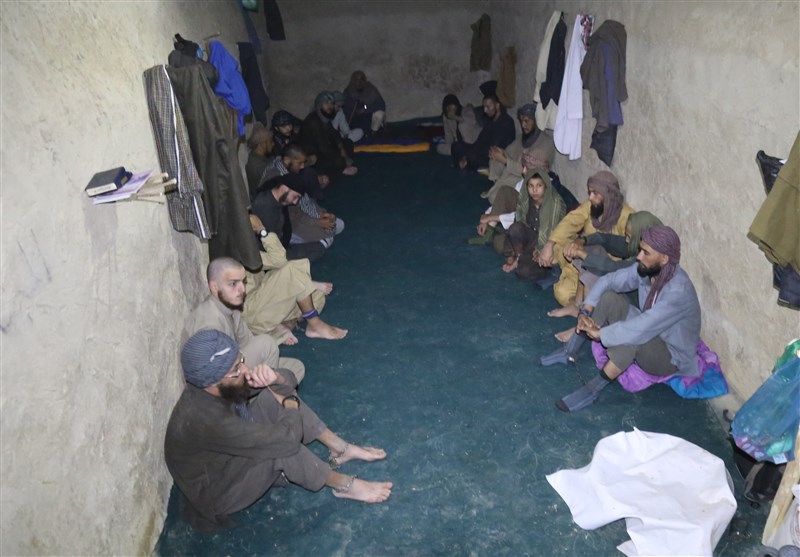
Tasnim News Agency | January 28, 2019
Kabul – A large number of prisoners, all of them senior members of Daesh (also ISIS or ISIL) terrorist group, broke out of a Taliban prison in northwest Afghanistan after US troops helped them escape through a covert operation.
According to Tasnim dispatches, American forces operating in Afghanistan carried out a secret military operation in the northwestern province of Badghis two weeks ago and helped the Daesh inmates escape the prison.
The report added that 40 Daesh ringleaders, all of them foreigners, were transferred by helicopters after American troops raided the prison and killed all its security guards.
Abdullah Afzali, deputy head of Badghis provincial council, confirmed the news.
Informed sources have given a detailed account of the US operation to rescue the Daesh forces and the developments that helped Americans pinpoint the location of the prison in the mountainous areas.
Aminullah, a man from Uzbekistan, was one of the Daesh commanders held captive in the Taliban prison. His success to escape from the prison led to the dismissal of the Taliban prison guard and his punishment.
Justifying the 17-Year War
By Jacob G. Hornberger | FFF | January 25, 2019
When I first learned about the Thirty Years War in a history class in college, I was both fascinated and amazed. How in the world could a war go on for 30 years? That just seemed incomprehensible to me.
Not anymore. The U.S. war on Afghanistan has now been going on for 17 years. And if the American people follow the advice of Michael E. O’Hanlon, a senior fellow at the Brookings Institution, it’s a virtual certainty that the United States will easily surpass the Thirty Years War and, maybe, the Hundred Years War, which needless to say, also amazed and fascinated me when I learned about its existence.
I can just see Americans 83 years from now breaking the 100-year-war record and exclaiming in celebration, “We’re Number One! We’re Number One! KAG! KAG! Keep America Great!”
O’Hanlon’s advice comes in the form of an op-ed in yesterday’s New York Times. It’s entitled “Our Longest War Is Still an Important War.” In his op-ed, O’Hanlon says that it is important that U.S. troops remain occupying Afghanistan, perhaps even in perpetuity.
Why does O’Hanlon feel this way? The thrust of his piece is a variation on the theme that has guided the so-called war on terrorism ever since the 9/11 attacks way back in 2001— that it’s better for U.S. forces to kill the terrorists over there before they come over here to get us.
Not surprisingly, O’Hanlon ignores a very important point about this “war on terrorism” — that it is U.S. interventionism that is the cause of anti-U.S. terrorism.
Why is that important? Because the continued and perhaps perpetual interventionism that he is endorsing produces the very thing that he’s using to justify the continued interventionism.
When U.S. forces kill five “terrorists” over there, they bring into existence ten more terrorists. Those ten new terrorists then become the justification for remaining over there instead of coming home after killing those original five terrorists. Then, once they kill the ten, twenty more come into existence, which is then used to justify staying over there so that they can kill the twenty.
That’s how the “war on terrorism” has become perpetual, which President George W. Bush even suggested would happen way back in 2001.
Interventionists, of course, hate it when we libertarians point out this obvious fact. Recall that famous Republican presidential debate when Ron Paul pointed out that “they” came over here to kill us because the feds were over there killing them. His Republican opponents went ballistic, as did the mainstream press. No one is supposed to say that.
You see, the official position is that the terrorists just spring up and strike a nation, sort of like the flu. Or that they just hate America for its “freedom and values.” I suppose they would say that the Swiss, whose government simply minds its own business, are just plan lucky to have been spared the terrorist flu.
The reality is that the cause of anti-American terrorism is U.S. interventionism. Thus, if you stop the interventionism, the anti-American terrorism stops.
But that’s the last thing interventionists want. Interventionists don’t have any problems with the militarism, the national-security statism, the massive spending, the empire of domestic and foreign military bases, the invasions, the occupations, the CIA, the NSA, the assassinations, coups, partnerships with dictatorial regimes, secret surveillance, and the installing of pro-U.S. regimes around the world.
Interventionists and the national-security establishment always need official enemies. Recall that throughout the Cold War, the official enemy was Russia and the rest of the Soviet Union, along with “godless communism” and the supposed worldwide communist conspiracy to take over the world, which, they said, was based in Moscow.
When they ostensibly lost their official enemy in 1989 with the end of the Cold War, that’s when they began killing people in the Middle East, including during their invasion of Iraq and the subsequent killing of Iraqi children with sanctions. That’s when Iraqi dictator Saddam Hussein because the official enemy. He was coming to get us, they said, with WMDs.
Then after the blowback of the 9/11 attacks, it was the terrorists, who morphed into the Muslims, who, we learned, were engaged in a centuries-long conspiracy to make the United States a part of a worldwide caliphate based on Sharia law.
Most recently, we’ve come full circle with Russia being made once again into an official enemy, along with terrorists and Muslims and, well, also illegal immigrants and drug dealers.
I wish that I could tell you that was all. If you really want to get scared, read O’Hanlon’s article. It turns out that there are so many more bugaboos out there, which have caused him to embrace a continuation of the 17-year war in Afghanistan. Apparently, there’s al-Qaeda, the Islamic State, “related groups,”and, get this — even ISIS-K! According to O’Hanlon, that stands for ISIS-Khorasan. I’ll bet you hadn’t heard of that last one. Scary!
How can any American citizen buy into this nonsense? Bring the troops home, now. All of them. And discharge them. Interventionists have done enough damage to our nation and to the people of Afghanistan (and Iraq, Syria, Libya, and so many other countries). It’s time to return to founding principles, especially America’s founding principle of non-interventionism.
Pakistan wriggles out of IMF clutches
By M. K. BHADRAKUMAR | Indian Punchline | January 13, 2019
The visit by Saudi Arabia’s Energy Minister Khalid A Al-Falih on Saturday to Gwadar to inspect the site allocated for a multibillion oil refinery in the port city suggest that Riyadh and Islamabad are giving the final touch to reaching agreement for a Saudi Aramco Oil Refinery in Pakistan. Reports say that Saudi Arabia will be investing $10 billion in the proposed project.
Without doubt, this is a major development in the region. The Saudi-Pakistan relationship, which has been traditionally close and fraternal, is moving on to a new level of dynamism. The Saudi investment decision can be taken as signifying a vote of confidence in the Pakistani economy as well as in Prime Minister Imran Khan’s leadership. It comes on top of the $6 billion package that Saudi Arabia had pledged last year (which included help to finance crude imports) to help Pakistan tide over the current economic difficulties.
The visiting Saudi minister Khalid al-Falih told reporters in Gwadar, “Saudi Arabia wants to make Pakistan’s economic development stable through establishing an oil refinery and partnership with Pakistan in the China Pakistan Economic Corridor.” This remark highlights that Saudi Arabia is openly linking up with the China-Pakistan Economic Corridor (CPEC). China has welcomed this development, but countries that oppose the CPEC such as the US and India will feel disappointed.
From the Indian perspective, the Saudi investment in Gwadar becomes a game changer for the port city, which was struggling to gain habitation and a name. Inevitably, comparisons will be drawn with Chabahar. India has an added reason to feel worried that its Ratnagiri Refinery project, which has been described as the “world’s largest refinery-cum-petrochemical project” is spluttering due to the agitation by farmers against land acquisition. The Saudi Aramco was considering an investment in the project on the same scale as in Gwadar. Will Gwadar get precedence over Ratnagiri in the Saudi priorities? That should be the question worrying India.
The Saudi energy minister disclosed that Crown Prince Mohammed bin Salman will be visiting Pakistan in February and the agreement on the Gwadar project is expected to be signed at that time. Of course, it signifies that Saudi Arabia is prioritizing the relations with Pakistan. The fact remains that Saudi Arabia has come under immense pressure of isolation following the killing of Jamal Khashoggi.
There is much uncertainty about the dependability of the US as an ally and security provider. Riyadh is diversifying its external relations and a pivot to Asia is under way. Suffice to say, under the circumstances, a China-Pakistan-Saudi axis should not look too far-fetched. There is also some history behind it.
To be sure, Iran will be watching the surge in Saudi-Pakistani alliance with growing trepidation. The Saudi presence in Pakistan’s border region with Iran (such as Gwadar) has security implications for Tehran. Iran has been facing cross-border terrorism.
Tehran cannot but take note that Imran Khan has not shown any interest in reciprocating the overtures it made when he came to power. He is yet to visit Iran. The expectation in Tehran was that Imran Khan who often voiced the political idiom of justice and resistance as an opposition leader would have empathy with Iran. But, as it happened, Imran Khan appears to be far more comfortable as prime minister with the crown princes of Saudi Arabia and the UAE.
Simply put, Tehran misjudged Imran Khan. But Imran Khan’s priorities today are quite understandable. He wants the Gulf Sheikhs to make big investments in the Pakistani economy. He senses that left-wing slogans have served their purpose when he was seeking power but they become liabilities today. Why should he put Pakistan as a torchbearer of resistance politics? In his interview with WaPo, he didn’t mince words in implying that he intended to follow neo-liberal economic policies.
Besides, in strategic terms, one important fallout of the Saudi bailout of Pakistani economy is that there may be no more need for Islamabad to approach the International Monetary Fund for a rescue package. The earlier indication was that Pakistan might seek a $8 billion bailout package. From present indications, the help from Saudi Arabia, China and the UAE will enable Pakistan to avoid seeking IMF assistance. (The UAE and Pakistan formalized a $6.2 billion bailout package last week in Islamabad.)
The US had openly threatened that any IMF bailout would be conditional on a close scrutiny of the CPEC projects. Ironically, it proved counterproductive. As a result, in geopolitical terms, Washington’s capacity to leverage Pakistani policies is significantly diminishing. The impact will be most keenly felt in Afghanistan.
India baits US while Pakistan tells Trump, ‘There’s nothing like free lunch’
By M. K. BHADRAKUMAR | Indian Punchline | January 12, 2019
Breaking a prolonged period of several months, the Pakistani allegation of Indian involvement in terrorist attacks has surged. This appears during the first detailed media briefing by the Pakistani authorities in Karachi on January 13 on the results of the investigation over the terrorist strike on the Chinese consulate in the city last November.
Pakistan has blamed the Balochistan Liberation Army for staging the terrorist attack. Graphic details have been given claiming that the attack was “planned in Afghanistan” from where the Balochi terrorists travelled to Karachi.
India’s alleged role has been described variously in the Pakistani press as rendering “assistance” to the terrorists and “funding” them. One report mentions that the attack was “carried out with the assistance of Indian intelligence agency.” Indeed, immediately after the attack on November, a Pakistani security official had suggested that India “orchestrated” it. An AP report at that time had mentioned that Pakistan was investigating whether the Baluch separatist commander Aslam Achhu, who masterminded the attack, was in India.
The Pakistani assessment is that the Karachi attack was well planned over months and intended to cause rift in the China-Pakistan ties as well as to undermine the China-Pakistan Economic Corridor (CPEC) by highlighting the volatility of the city. It stands to reason that Pakistan would have shared with the Chinese any details in this regard.
The salience that must be noted here is that Pakistan has not finger-pointed at Kabul authorities directly or implicitly. In the past, the Pakistani allegation used to be that Indian and Afghan agencies collaborated in such enterprises.
Some other things stand out as well. The timing of the Pakistani disclosure is significant. First and foremost, it comes amidst signs of US-Taliban talks intensifying. A fourth round was expected to take place on Wednesday, but was called off by the Taliban on grounds of “agenda disagreement” with the Americans, in a clear snub to the US special representative Zalmay Khalilzad. Elsewhere, Taliban spokesman also told Reuters, “We (Taliban) have the feeling that Zalmay Khalilzad doesn’t have enough power to make important decisions.” Evidently, there is a fly in the ointment.
Interestingly, a former Pakistani diplomat Zamir Akram, who is an old India hand, wrote yesterday counseling that Pakistan should not harbor “unrealistic expectations” out of the Trump administration, as there may not be a “real change in policy towards Pakistan.” To quote Akram, “Washington continues to view relations with Islamabad through the prism of Afghanistan and not on the basis of relations with Pakistan in and of itself.”
He added, “Our Prime Minister should also resist the temptation, which his predecessors did not, of accepting a meeting with the American President as a “reward” in itself — a meeting devoid of any substantive outcome for Pakistan. This has been a usual American tactic mainly reserved for light-weight leaders who can be fobbed off with an Oval office photo-opportunity. Any meeting with Trump must lead to concrete results otherwise it would not be worth the effort.”
Amongst other things, Akram voiced disquiet that Washington is disrupting the India-Pakistan strategic parity in favor of India, and that “Pakistan’s relations with China and CPEC in particular are emerging as contentious issues in Pakistan-US relations.” He said that in an environment of “a convergence in US-India relations but a growing divergence in the Islamabad-Washington equation,” Pakistan must diversify its foreign relations, and in particular, it “must further strengthen strategic partnership with China for which successful implementation of CPEC, despite American and Indian opposition, must be ensured.”
Zamir concluded by underscoring that a political settlement in Afghanistan should provide for an outcome that served Pakistan’s interests “in terms of ending Indian use of Afghan territory to promote terrorism in Pakistan, recognition of Pakistan’s security interests in Afghanistan, return of Afghan refugees and removal of US sanctions. We have the leverage to attain this, given the American reliance on Pakistan, not just for the dialogue with the Taliban but also due to the air and ground access we provide to the US for its presence in Afghanistan.” (Express Tribune )
Plainly put, strategic (nuclear) parity in South Asia, restrictions on Indian activities in Afghanistan, Pakistan’s security interests in Afghanistan, return of Afghan refugees and removal of US sanctions on Pakistan – they are still on the table. If Trump’s game plan is to swing a settlement riveted on Pakistani acquiescence with a reduced US military presence in Afghanistan (enabling him also to flaunt “troop withdrawal” by election year 2020) by pandering to PM Imran Khan’s vanities, it may not work.
Given India’s hardline policies toward Pakistan, it is improbable that Islamabad will compromise on its agenda to purge the Indian presence in Afghanistan. Therefore, the media disclosure on the terrorist attack in Karachi at this juncture must be taken as a signal to Washington as much as to Delhi. Most certainly, it coincides with the US Special Representative Zalmay Khalilzad’s visit to Delhi, where he enjoys a fabulous reputation for being an inveterate anti-Pakistani Afghan-American.
Unsurprisingly, chaffing under the Taliban’s snub, Khalilzad was assured of a warm reception in Delhi. The press reports based on briefings suggest that Indian officials tore into Pakistan warning the Trump administration about Islamabad’s machinations. Clearly, Delhi sized up that it has in Khalilzad a most receptive audience.
Alongside, there has also been a sudden burst of enthusiasm to inject some verve into the US-Indian ties, which have been languishing during recent years. It is entirely conceivable that India may place some orders for weaponry from American vendors, which would of course please Trump immensely.
To be sure, Trump’s travails in withdrawing US troops from Syria may turn out to be a picnic in comparison with what is in store in Afghanistan.
New Poll: US Military Occupations Supported By Far More Democrats Than Republicans
By Caitlin Johnstone | Medium | January 10, 2019
A new Politico/Morning Consult poll has found that there is much more support for ongoing military occupations among Democrats surveyed than Republicans.
To the question “As you may know, President Trump ordered an immediate withdrawal of more than 2,000 U.S. troops from Syria. Based on what you know, do you support or oppose President Trump’s decision?”, 29 percent of Democrats responded either “Somewhat support” or “Strongly support”, while 50 percent responded either “Somewhat oppose” or “Strongly oppose”. Republicans asked the same question responded with 73 percent either somewhat or strongly supporting and only 17 percent either somewhat or strongly opposing.
Those surveyed were also asked the question “As you may know, President Trump ordered the start of a reduction of U.S. military presence in Afghanistan, with about half of the approximately 14,000 U.S. troops there set to begin returning home in the near future. Based on what you know, do you support or oppose President Trump’s decision?” Forty percent of Democrats responded as either “Somewhat support” or “strongly support”, with 41 percent either somewhat or strongly opposing. Seventy-six percent of Republicans, in contrast, responded as either somewhat or strongly supporting Trump’s decision, while only 15 percent oppose it to any extent.
These results will be truly shocking and astonishing to anyone who has been in a coma since the Bush administration. For anyone who has been paying attention since then, however, especially for the last two years, this shouldn’t come as much of a surprise.
This didn’t happen by itself, and it didn’t happen by accident. American liberals didn’t just spontaneously start thinking endless military occupations of sovereign nations is a great idea yesterday, nor have they always been so unquestioningly supportive of the agendas of the US war machine. No, Democrats support the unconscionable bloodbaths that their government is inflicting around the world because they have been deliberately, methodically paced into that belief structure by an intensive mass media propaganda campaign.
The anti-war Democrats, after Barack Obama was elected on a pro-peace platform in 2008, went into an eight-year hibernation during which they gaslit themselves into ignoring or forgiving their president’s expansion of George W Bush’s wars, aided by a corporate media which marginalized, justified, and often outright ignored Obama’s horrifying military expansionism. Then in 2016 they were forced to gaslight themselves even further to justify their support for a fiendishly hawkish candidate who spearheaded the destruction of Libya, who facilitated the Iraq invasion, who was shockingly hawkish toward Russia, and who cited Henry Kissinger as a personal role model for foreign policy. I recall many online debates with Clinton fans in the lead up to the 2016 election who found themselves arguing that the Iraq invasion wasn’t that bad in order to justify their position.
After Clinton managed to botch the most winnable election of all time, mainstream liberal America was plunged into a panic that has been fueled at every turn by the plutocratic mass media, which have seized upon unthinking cultish anti-Trumpism to advance the cause of US military interventionism even further with campaigns like the sanctification of John McCain and the rehabilitation of George W Bush. Trump is constantly attacked as being too soft on Moscow despite having already dangerously escalated a new cold war against Russia which some experts are saying is more dangerous than the one the world miraculously survived. Trump’s occasional positive impulses, like the agenda to withdraw US troops from Syria and Afghanistan, are painted as weakness and foolishness by the intelligence veterans who now comprise so much of corporate liberal media punditry. And their audience laps it up because by now mainstream liberals have been trained to have far more interest in opposing Trump than in opposing war.
And how sick is that? Obviously Trump has advanced a lot of toxic agendas which need to be ferociously opposed, but how warped does your mind have to be to make a religion out of that opposition which is so all-consuming that it eclipses even the natural impulse to avoid inflicting death and destruction upon your fellow man? How viciously has the psyche of American liberals been brutalized with mass media psyops to drive them into this psychotic, twisted reality tunnel?
There was one group in the aforementioned survey which was not nearly as affected by the propaganda as armchair liberals. To the statement “The U.S. has been engaged in too many military conflicts in places such as Syria, Iraq and Afghanistan for too long, and should prioritize getting Americans out of harm’s way,” military households responded 54 percent that this statement aligns with their view. Turns out when it’s your own family’s blood and limbs on the line, people are a lot less willing to commit to endless violence. Sixty percent of Republicans agreed with this statement, while only 41 percent of Democrats did.
Could these statistics have something to do with the fact that younger veterans are statistically much more likely to be Republicans than Democrats? Is it possible that a major reason Trump beat Hillary Clinton, and a major reason Republicans are now far less bloodthirsty than Democrats, is because mothers, fathers, sisters and brothers are tired of flag-draped coffins being shipped home containing bodies which were ripped apart for no legitimate reason in senseless military entanglements on the other side of the world? Seems likely. And it also seems likely that the mass media propaganda machine is having a harder time steering people toward war once they’ve personally tasted its true cost.
Modi-Trump bromance ends on sour note
By M. K. BHADRAKUMAR | Indian Punchline | January 3, 2019
The highly disparaging remarks by the US President Donald Trump on Wednesday regarding Prime Minister Narendra Modi and India’s role in Afghanistan come as a shocking revelation. Trump was talking to the press following his first cabinet meeting of 2019 at the White House in Washington. No Indian PM has been reduced to look silly like this by any American president in history.
Trump’s remarks came in the course of his rambling speech regarding the failure of the war in Afghanistan. He spoke every bit as an embittered man who realizes that the war has been lost. Part of the reason why he summarily put Modi on the mat could have been that Trump also realizes the great urgency of extracting Pakistan’s cooperation in the Afghan endgame. Trump’s thesis was that foreign leaders take America for a ride.
In this vein, Trump mocked Modi for funding a library in Afghanistan under Indian aid and bragging about it repeatedly in private conversations. (Trump apparently mistook for a library the Indian-built parliament building in Kabul, which Modi inaugurated in a grand ceremony on Christmas Day in 2015.) Anyway, Trump claimed that Modi was “constantly telling me he built a library in Afghanistan.” He then rubbished Modi’s vanity, saying, “You know what that is? That’s like five hours of what we spend (in Afghanistan.) And we’re supposed to say (to Modi), ‘Oh, thank you for the library’. I don’t know who’s using it in Afghanistan.”
This is the first time the US belittled the Indian assistance to Afghanistan, which is estimated to be close to 2 billion dollars. The American mantra has been that India was rendering invaluable help to Afghanistan. But now that the war is about to end, we are probably getting a candid version of what the Americans really thought of the quality of the Indian aid.
Elsewhere, Trump said that India had a free ride in Afghanistan – like Russia and the Gulf states – because the US was fighting their war against terrorist groups. Therefore, Trump said in a snide remark that it is for India and Russia to do the fighting in Afghanistan. But he recalled that the Russians once tried to fight extremist groups in Afghanistan and failed and the Soviet Union went bankrupt as a result. The outcome was that the USSR “shrunk” into the Russian Federation.
Trump asked with indignation: “Why isn’t Russia, India, Pakistan there?” Why should America be there, “which is 6000 miles away?” He bemoaned that the Pentagon “didn’t do a good job” in Afghanistan. Referring to the former Defence Secretary James Mattis, he noted, “I am not happy with what he did in Afghanistan.” Trump alleged that he provided for a generous budget for the Pentagon but the result in Afghanistan is “not too good.”
Interestingly, Trump hinted that Pakistani Prime Minister Imran Khan is delivering in a big way to help the US end the war. Trump disclosed, “I look forward to meeting the folks from the new leadership in Pakistan. We will be doing that in not-too-distant future.”
Clearly, Trump has taken note of the sea change in the Pakistani stance lately on Afghanistan after Imran Khan came to power, especially Imran Khan’s changed position that in some form – maybe, in some reduced form – the US military presence should continue in Afghanistan for a conceivable future. Simply put, the US and Pakistan are re-bonding again as ‘natural allies’ over Afghanistan.
Trump feels gratified that Pakistan has delivered the Taliban, finally, to the negotiating table. No doubt, the revival of the US-Saudi Arabia-UAE-Pakistan caucus to finesse the Taliban’s role in the future Afghan political scenario meets with Washington’s requirement. For Trump, the priority is that the US must somehow end the 17-year old war in Afghanistan before his campaign gets under way for the presidential election in the US next year.
Arguably, Trump’s acerbic remarks about Modi contained a subtle warning against any Indian attempt to be a ‘spoiler’ in the emergent scenario. On the other hand, Imran Khan becomes an irreplaceable partner for Trump. We may expect a state visit – or at least an official visit – by Imran Khan to the US in the near future.
On the geopolitical plane, things are falling in place in a familiar pattern. The US seeks transactional relationships and in the immediate future in the South Asian region Pakistan is of greater use. Evidently, Indian analysts have been daydreaming about the “Quad” and what not.
Trump’s fascination for India has been all about Modi’s utility for the ‘America First’ project. But Trump probably sees Modi now as a brunt-out case. Indeed, the Western press increasingly casts doubts on Modi’s chances of returning to power in the 2019 poll. (See a commentary by the Voice of America titled India’s Modi Facing Tough 2019 Election Year)
Featured Video
Seyed M. Marandi: US-Iran War Inevitable: Kuwait and Bahrain May Fall
or go to
Aletho News Archives – Video-Images
From the Archives
Oil and the Israel Lobby
Reknowned economist M. Shahid Alam offers this excellent critique of Noam Chomsky’s defective analysis of the relative influence of Oil versus the Israel lobby over US foreign policy: … continue
Blog Roll
 Aletho News
- ICC ignored ‘very well-documented’ NATO crimes – ex-Libyan minister
- SNSC secretary dismisses US response to Iran’s conditions as ‘inadequate’
- Sanaa says Taiz roads open, secure for residents, warns Saudi forces
- Iraqi resistance group urges Saudi leadership to admit defeat, lift Yemen siege
- Trump’s Retreat: How Al-Aqsa Flood Took Down the US Empire
- Israel’s Military Actions in Lebanon Grossly Violate International Law — Lavrov
- Seyed M. Marandi: US-Iran War Inevitable: Kuwait and Bahrain May Fall
- Leaders Condemn Ansarallah Attack on Saudi Arabia While Ignoring Illegal War Against Yemen
- Leaked: Britain’s Covert Iraqi Psyops Network
- Yemeni Armed Forces Warn Airlines Against Using Saudi Airports, Exempt Mecca and Medina
- If Americans Knew
- After Oct 7, IDF policy allowed civilian casualties for even the lowest-ranking targets
- Israel’s Destruction of Southern Lebanon Intensified After the Cease-Fire
- The Last-Minute Decision That Gave Israel Its Name
- The American Conservative: How Trump Made the World Go Nuclear
- Meet the US generals and admirals advancing Israeli policy
- Opinion: Why news organizations should boycott Israel
- The Israeli witch hunt of Sami Abu Shehadeh exposes the lie of the ‘Jewish and democratic’ state
- No state has a ‘right’ to exist – least of all Israel
- Testimonies about Gaza’s civilian death toll expose Israel’s atrocities – Daily Update
- How Israel Conquered the Latin American Right
- No Tricks Zone
- New Study Suggests Large Regions Of The Pacific Ocean Have Been Cooling For The Last 80 Years
- Germany’s Green Energy Debacle: High Energy Costs Force Kahla Porzellan to Close After 182 Years!
- New Study: 50 Years Of The Most Aggressive ‘Net Zero’ Policies Can Only Affect The Global Climate By 0.03°C
- US September “Heat” Was No Record…Many Records Set Decades Ago
- Latest European Green Energy Debacle; Portugal’s Largest Flagship Solar Park Insolvent!
- Green Energy Debacle: German Expert Professor Fritz Vahrenholt Warns Of Severe Economic And Social Consequences
- Two More Paleo Reconstructions Affirm Meters-Higher Sea Levels Across Ireland, Brazil 7000-6000 Years Ago
- New Study: Earth And Venus Surface Warmth Largely Explained By Convection And Lapse Rate, Not CO2 Or Radiation
- 2025 Nature Paper Claiming Worsening Global Drought Gets RETRACTED …Heavily Flawed
- New Study: ‘Global Drought Shows No Detectable Recent Acceleration Under Climate Warming’

