Saudi Arabia takes charge of Afghan peace talks
By M.K. Bhadrakumar | Asia Times | December 31, 2018
The Taliban leadership has finally issued an official statement on the talks with US special representative Zalmay Khalilzad in Abu Dhabi 10 days ago. The deftly worded statement dated December 29 says:
“Some media outlets have published rumors that the representatives of the Islamic Emirate will hold talks with those of the Kabul administration in Saudi Arabia. These rumors are baseless. The position of the Islamic Emirate concerning talks with the Kabul administration remains the same and has not changed. We are advancing [the] negotiations process with the United States under a strong and extensive plan to bring an end to the occupation of our country Afghanistan. It is hoped that the negotiations process is not dealt with carelessly nor anyone given false hopes. As the United States has entered into the negotiations process with the Islamic Emirate, therefore, it must be advanced in a serious manner and not used as propaganda material.”
Evidently, after due deliberation, the Taliban leadership said they were unable to accede to the Saudi-Emirati joint proposal for talks between the Taliban and the Afghan government.
Talks in Saudi in January
However, the Taliban statement is completely silent on the twin proposal put forward by the Saudis and Emiratis at Abu Dhabi – namely, on a three-month ceasefire. The Taliban would not reject the idea but would presumably revisit it depending on the progress of ongoing talks with the US special representative Zalmay Khalilzad. The ceasefire proposal went alongside the US media leak that 7,000 American troops might be withdrawn from Afghanistan.
However, the Taliban intends to continue with their talks with Khalilzad. The next round will take place in Saudi Arabia in January. The Taliban statement claims that it is “advancing” the negotiations with Khalilzad “under a strong and extensive plan to bring an end to the occupation.” The wording seems to imply that the Taliban keeps an open mind on a compromise based on a scaled-down American troop presence in Afghanistan in the near term.
The Taliban’s rejection of talks with the Afghan government will cause anger and consternation in Kabul. There is some evidence that Kabul watches with disquiet the intensifying negotiations between the US and the Taliban. Ghani recently appointed two figures who are known to be anti-Taliban and have a lineage going back to the Northern Alliance as the new defense and interior ministers in his cabinet, signaling a potent reset of the power calculus. Equally, Ghani also harbors political ambition to secure another term as president.
Suffice to say, the Taliban’s rejection of talks with Kabul or a ceasefire needn’t be taken as a red line. Taliban may change its stance on participating in intra-Afghan dialogue at a future point. The point is the Saudi role in hosting the next round of US-Taliban talks surged following a telephone conversation between King Salman and Ghani on Saturday.
Ghani reportedly praised the “prominent” role by King Salman and agreed that the next meeting of the US and Taliban on Saudi soil would be “a good step and start for subsequent processes.” The King, in turn, promised to use his offices to consolidate peace and stability in Afghanistan.
Of course, wherever Saudi Arabia goes, the Middle Eastern conundrum will cast shadows. The Saudi surge to take charge of the Afghan peace talks will most certainly cause heartburn in some regional capitals – in Doha and Tehran, and possibly in Ankara as well.
Pakistani diplomacy is working overtime to smoothen wrinkles. Foreign Minister Shah Mahmood Qureshi has just visited Doha. He was in Tehran a week ago. Earlier, Pakistani army chief General Qamar Bajwa also visited Doha (which used to host a Taliban representative office in recent years). And Pakistani Prime Minister Imran Khan is reportedly planning to visit Turkey on January 3-4.
Smart move
From the Saudi angle, it is a smart move that to underscore that the strategic partnership between the two countries remains resilient, notwithstanding the scars left by the killing of Jamal Khashoggi. Indeed, from the US perspective too, the Saudi role is irreplaceable, given the longstanding relationship between Riyadh and the Taliban movement dating back to the end of the 1980s. As for the Taliban leadership, it simply cannot overlook the religious sanctity attached to the Custodian of the Two Holy Places.
All in all, while the Taliban feels emboldened by the developments since the Abu Dhabi talks, the upcoming talks in Saudi Arabia will be crucial, as they will set the tempo of the peace talks at a juncture when there are distinct signs that the 17-year conflict is set to conclude.
The bottom line is that the Taliban (and Pakistan) would know that it is unrealistic to hope to capture power and, importantly, to retain it without the cooperation and support of the western powers, especially the US.
Troop withdrawal
Having said that, time is running out for the Trump administration, too. The postponement of the Afghan presidential election (originally scheduled for April) will deepen political uncertainties in Kabul. And this is happening at a time when the Taliban has proved its mettle in the battlefield and is in control of vast areas of the country. Over and above, there is the near-certainty that POTUS might order a troop withdrawal from Afghanistan at some point through 2019.
Interestingly, the White House has refuted the media leak regarding a unilateral troop drawdown in Afghanistan. “The President [Trump] has not made a determination to drawdown US military presence in Afghanistan and he has not directed the Department of Defense to begin the process of withdrawing US personnel from Afghanistan,” Garrett Marquis, a spokesman for the National Security Council, said in an emailed statement to Bloomberg.
The crisply worded clarification leaves the door open for a future decision by Trump on the issue.
Iran challenges Saudi role in the Afghan endgame
By M. K. BHADRAKUMAR | Indian Punchline | December 31, 2018
As surely as night follows day, in the wake of Saudi Arabia assuming the lead role in the Afghan peace talks, Tehran has unveiled an analogous peace process involving the Taliban. (See my article in Asia Times Saudi Arabia takes charge of Afghan peace talks.)
The Iranian Foreign Ministry spokesman Bahram Qassemi made a dramatic announcement today that Tehran has hosted a delegation from Taliban to discuss possible ways to end the conflict in Afghanistan. Qassemi disclosed that the talks, which were held at the level of Iran’s Deputy Foreign Minister Abbas Araqchi on Sunday, were “extensive” and that they were “coordinated” with the Afghan government. He didn’t elaborate.
Qassemi explained: “Since the Taliban are in control of more than 50 percent of Afghanistan, and given the insecurity, instability and other issues that the country is dealing with, they [the Taliban] were interested in talks with Iran.” He flagged that Iran, which has long borders with Iran, “always sought a constructive role to maintain peace in the region.”
Qassemi said the visit by the Taliban delegation to Tehran followed the recent consultations of Iran’s Supreme National Security Council Ali Shamkhani to Kabul on December 26. He said the Taliban leaders had expressed interest in meeting Shamkhani and the Afghan authorities were “fully aware” of the meeting and the negotiations. Qassemi added that Tehran principally aimed to “facilitate” dialogue between the Afghan groups and the Kabul administration so as to advance the peace process. He said Araqchi is planning a visit to Kabul shortly for follow-up discussions.
It is highly improbable that the Saudi and Iranian tracks shall ever meet. The best hope will be that they do not collide. What can happen is that the Afghan endgame may remain open-ended without any conclusive end in sight in a near future. But the silver lining is that the regional states such as Russia and India may no longer have to accept as fait accompli the outcome of the quadripartite process involving the US, Saudi Arabia, the UAE and Pakistan.
Equally, the non-Afghan groups now get a breather, who are worried that a peace settlement reached by the quadripartite process may ignore their legitimate interests. Influential Afghan groups from the non-Pashtun regions of the north, west and the central highlands are watching with dismay that a settlement might be imposed on their country. Curiously, the very same extra-regional powers and Pakistan who incubated the Taliban in the early 1990s, launched it on the Afghan landscape and made possible its conquest of Kabul in 1996 are now reappearing as the charioteers of peace and reconciliation with the Taliban.
What worries Tehran most is that the US, Saudi Arabia and the UAE are veterans in using the Islamist groups as geopolitical tools. There is some evidence that the ISIS fighters who were defeated in Syria and Iraq are being transferred to Afghanistan. The regional states face the spectre of ISIS undermining peace and stability. The recent regional tour of Pakistani Foreign Minister Shah Mahmood Qureshi exposed these faultlines. (See my blog Pakistan’s Afghan jig irks regional states.)
Arguably, what Tehran may have done is to create space for the Taliban to withstand pressure from the quadripartite process. Tehran is explicitly opposed to any settlement in Afghanistan that may allow continued American military presence in the region. Tehran factors in that the US, Saudis and Emiratis are jointly advancing the project on regime change in Iran and will not hesitate to use Afghanistan as springboard to foster cross-border terrorism to destabilize Iran. Simply put, Tehran fears that the US objective in Afghanistan is to create a Syria-like situation in the region that will engulf Iran in violence and anarchy.
The emergent contradiction can be reconciled in only one way – by Pakistan living up to its stated position, namely, to give primacy to regional consensus on any Afghan settlement. However, Pakistan’s hands are tied after having accepted the multi-billion dollar bailouts recently (amounting to a total of US$ 12 billion) from the Saudis and the Emiratis to cope with its economic crisis. Pakistan had a choice of approaching the IMF but the US made things difficult. That in turn turned out to be a smart American ploy to involve its Saudi and Emirati allies who promptly loosened the purse strings to rescue Pakistan. Suffice to say, Pakistani leadership is no longer free to defy the Saudi-Emirati diktat on Afghan settlement.
On the contrary, many regional states — Iran, Qatar, Turkey, in particular — view Saudi Arabia and the UAE through an entirely different prism, imbued with horror. They watch with dismay that the real winner in all this will be Saudi Arabia.
Indeed, it is a masterstroke by the Saudi regime to assume the role of peacemaker at a juncture when its international image is severely damaged following the brutal killing of Jamal Khashoggi. Ironically, Saudis are undertaking a rescue act to help the US wriggle out of a 17-year old war. Make no mistake, Riyadh is displaying its importance as the US’ irreplaceable regional ally in the Muslim Middle East. It expects better sense to prevail in the US Congress and the American media who have been clamoring for punishing the Saudi regime for the murder of Khashoggi.
Afghan Taliban Were in Tehran for Peace Talks: Iran
Al-Manar | December 31, 2018
Iran said Monday that the Afghan Taliban have visited Tehran for a second round of peace talks in just a few days aimed at bringing an end to 17 years of conflict.
Iran has made a more concerted and open push for peace in neighboring Afghanistan since US President Donald Trump indicated there would be a significant withdrawal of American troops.
“Yesterday (Sunday), a delegation of Taliban was in Tehran and lengthy negotiations were held with Iran’s deputy foreign minister… (Abbas) Araghchi,” said spokesman Bahram Qassemi at a televised press conference on Monday.
That came just days after Ali Shamkhani, secretary of Iran’s Supreme National Security Council, visited Kabul and told reporters that talks had been held with the Taliban in Afghanistan.
“The Islamic Republic has always been one of the primary pillars of stability in the region and cooperation between the two countries will certainly help in fixing Afghanistan’s security issues of today,” Shamkhani told Tasnim news agency.
Qassemi said Iran’s priority was “to help facilitate negotiations between Afghan groups and the country’s government.”
Notes On The Withdrawals
By Michael Tracey | Medium | December 23, 2018
Trump announced the withdrawal of US troops from two warzones, which prompted the resignation (and now, firing) of James Mattis. It’s one of the most consequential weeks of the presidency thus far, so rather than try to come up with a grand cohesive Take on it all, here are some scattered thoughts.
- The media doesn’t know how to grapple with an event that genuinely does represent Trump contending with an intractable establishment, which is partially understandable given recent overheated bleating about the Deep State — a phenomena that does plainly exist but has been misrepresented by the dumber portion of MAGA boosters. “Establishment,” likewise, is a fuzzy buzzword, and almost nobody ever claims to be part of it. Trump himself can reasonably be said to be The Establishment considering he is the President. However, this is a specific instance in which Trump really is in direct confrontation with very particular “establishment,” namely the institutional national security apparatus, which exists largely unfettered across administrations. Survey the scene and there’s not a single person in this entire apparatus who apparently supports the Syria withdrawal.
- So what does the media do? They act, essentially, as vehicles for the grievances of said national security apparatus. Take a look at some of the coverage from the major outlets: NYT, WaPo, AP, etc.
- OK, who exactly is “outraged,” and why does their sentiment justify featured placement in an Associated Press headline? It’s the national security establishment figures who are outraged, for them Mattis is a patron saint. These are the people AP, NYT, and WaPo reporters rely on to inform their natsec coverage. This NYT example is less subtle, and far more egregious:
- Really? Robert Kagan, to the uninformed reader, might just be some innocuous “expert” offering his wisdom, but Kagan is one of the most significant neoconservative foreign policy luminaries ever, competing ignominiously for that distinction with Bill Kristol. And it’s his ideology which is being transmitted to unwitting readers by way of the NYT. People who hate Trump will be susceptible to the message, because what he’s saying portrays Trump in a very negative light, but they’re also consuming loads of stubborn interventionist pablum along with the typical anti-Trump dopamine hit.
- Collectively, the theme of all mainline media coverage in reaction to the withdrawals is some combination of “chaos,” “disarray,” “tumult,” etc. Never is it ever considered that the very fact of multiple endless military deployments in hot warzones is also “chaotic.” And destructive. And insanely expensive. And unpopular with the wider public. None of these facts amount to “chaos” in the minds of fretting journalists, because what they’re being informed by is the sentiments of the “natsec” apparatus Trump has just acted against. (Oh yeah BTW the Syria deployment is also illegal and unauthorized, and has been since Obama launched it on false pretenses, but again, that’s definitely not chaotic.)
- On a slightly different note, it’s also worth harkening back to the time, earlier this year, when John Bolton was appointed National Security Advisor. I joined in the dismay, considering Bolton is one of the most fervent unreconstructed hawks in the entire country, and has *even today* not stopped defending the Iraq invasion. I attended a speech of his in DC about a month before the appointment when he did so, once again… in 2018. His Iran antagonism is a virulent obsession, and he called for a first strike on North Korea in February.
- But what happened subsequently? Bolton’s wishes have been totally overruled at every turn, most notably at two spectacular junctures. The first was Trump’s Korea diplomacy initiative, when Bolton was made to sit meekly at the negotiating table with Kim’s generals, whom he’d not long before declared should be wiped out with a preemptive strike. Then this week, the Syria withdrawal is among the most epic humiliations conceivable, as Bolton has specifically and publicly declared that US troops would not be leaving Syria until Iranian influence was repelled (i.e., essentially never).
- So those are crucial facts to consider about Bolton’s influence in the administration. I still think it’s dangerous to have him anywhere near the locus of military power, because who knows what leverage he might wield in the event of some unforeseen crisis. But he’s clearly not anywhere close to calling the shots, or the last 9 months of the Trump presidency would have gone much differently. (If he had any personal pride he’d resign in the wake of the Syria withdrawal, but Bolton’s principal priority is proximity to power, not personal consistency or pride. Unlike, evidently, Mattis.)
- In sum: the initial freakout when Bolton was appointed at least had basis, because he’s a dangerous person, but the freakout over the policies which he’s (ironically) presided over have engendered an even greater freakout, by several orders of magnitude. And those policies have tended to be dramatically less belligerent and militaristic than what you’d expect from an Administration in which Bolton resides. (The two leading examples again being Korea and Syria/Afg withdrawals.) So you have to wonder what the freakout is really about then. Maybe it’s just simple knee-jerk Trump hatred. (Yeah, it’s that.)
- There’s a running fight in certain Online Circles about whether Trump is a “non-interventionist.” My point was always that Trump clearly evinced greater non-interventionist tendencies than Hillary Clinton, but that 2016-specific observation has been exaggerated by certain bad faith agitators into a bogus charge that I claimed Trump is some pure, peace-loving anti-war voice. Obviously that’s NEVER been the claim. Any assessment of Trump’s scatter-shot “non-interventionism” has to coexist alongside the acknowledgment that Trump has dropped large quantities of bombs in pre-existing warzones, and killed lots of civilians in the process. That’s bad. At the same time, Trump has now declared his intention to end two wars that were started by previous administrations, and has not started any new ones. He’s done so over the strident objections of his own staff, advisors, and 95% of his own party. Clearly the “instincts” I noted, and then was ruthlessly ridiculed for noting, had some basis in reality, or we would not be where we are.
- Trump, during the campaign, frequently complained about the trillions squandered in the Middle East. Hillary Clinton never did (because she was partly responsible for it). Therefore, the comparative assessment was warranted. Nobody ever assumed Trump’s complaint would automatically translate into a swift, seamless change in US policy, or that the US would now become a beacon of wholesome anti-interventionism. It took two years, but Trump has now taken tangible steps to actualize those complaints, at significant political risk.
Afghanistan: Negotiations or a US Military Defeat?
By Salman Rafi Sheikh – New Eastern Outlook – 24.12.2018
While the Trump administration may think otherwise and even take the credit for initiating dialogue with the Taliban on an unprecedented level with a view to pulling the US out of Afghanistan, there can hardly be any doubt that negotiations, after 17 years of continuous war, are nothing short of an uncomfortable acceptance of their inability to defeat the Taliban militarily. How else do we define a military defeat? In the very act of negotiations is implicit an American admission of the ultimate fact that it has become impossible for it to retain its politico-military hold on Afghanistan through its planted government in Kabul and the US-raised and trained Afghan security forces, despite the continued huge financial support and the support of the US/NATO high-tech military forces in the country. It is for this reason that the US had even to drop its previously adamant refusal to hold direct talks with the Afghan Taliban.
If there is no military defeat for the US and even if the US still has got forces on the ground, the question of holding direct talks with the Taliban points to the increasing inability of the US forces to force the Taliban into submission. Importantly enough, the current phase of talks has been initiated by the US, not the Taliban. The Taliban had repeatedly refused to endorse Kabul’s offers of talks, and only agreed to do talks if the US was willing to engage directly. Therefore, with the US now fully engaged in “peace dialogue”, the US military’s self-proclaimed notion of invisibility stands fully exposed.
While some may argue that dialogue is necessary to end the war through non-military means, it is hard to miss the point that the US military still remains deeply entrenched in the war. For example, apart from the fact that there are thousands of soldiers on the ground, the US air force dropped more bombs on Afghanistan in 2018 than in any other year of the war in 17 years. The number of bombs dropped do not only show that the war basically remains intense, but also that the US military is desperate to change the course of the war to its advantage, an ambition highly unlikely to materialise; hence, the ever more emphasis on dialogue with the Taliban.
And while the US can’t avoid a military defeat, it can still hope to avoid humiliation in Afghanistan. And, for this purpose it is prepared to utilise all available means, including asking Pakistan for help. Even though the Trump administration, ever since it came into power, has cut all military aid and coalition support fund to Pakistan and bi-lateral relations have never been so frosty ever since the beginning of ‘war on terror’, the ever-increasing helplessness against the Taliban has once again forced the US to ‘ask’ for help.
Pakistan, fully aware as it is of the ground realities of Afghanistan and the way the US has already lost the war, is unlikely to ‘help’ the US in turning the table in its favour. In fact, in response to president Trump’s letter to Pakistan’s prime minister, Imran Khan, Khan was quick to rebut Pakistani involvement in any relationship with the US “where Pakistan is treated like a hired gun — given money to fight someone else’s war. We should never put ourselves in this position again.”
The request for help came only two weeks after president Trump had actually accused Pakistan of ‘not doing a damn thing’ in Afghanistan for the US. But the letter he wrote only two weeks after this blatant accusation signified increasing US desperation in Afghanistan and its willingness to still cast Pakistan in a friendly role even though it, as the US claims, never did a damn thing for the US. How wise it is for the US to ‘ask’ for help from a country that it thinks has worked against it through-out the war? How else to explain this wayward and self-contradictory approach than by placing it in the context of an imminent military defeat and US desperation to somehow avoid it by making a face-saving deal with the Taliban?
All this proves that no matter how powerful the US military might be, or how hard it might have worked, or how many years it might have committed to building an Afghan army in its own image, and no matter how much air and logistical support that army might have received, it has failed to militarily defeat the Taliban, who are currently directly and indirectly controlling about 44 per cent of the districts and have even established, as reports have shown, a parallel system of governance and administration in many parts where the Afghan officials work in close cooperation with the Taliban.
More than anything else, this reality exhibits another defeat in terms of the failure of its so-called ‘counter-insurgency’ program’s ability to roll back and replace the Taliban networks on the ground. It also means that the US-planted socio-political governance system in Afghanistan has almost reached the brink of a “political defeat”, much like the imminent defeat of the US military and its trained Afghan forces, which are losing more troops every year than the government can recruit, presenting yet another dilemma which the US forces have failed to resolve even after years of training and advising the Afghan security forces.
All this comes down to a single and indisputable reality: the US must withdraw and let the Afghans decide their future. Instead of finding a way to impose its demands on the Afghans, the best course for the US would be to liaise with other regional countries, including Pakistan, Russia and China, to develop such power sharing formula as would ensure an inclusive political system. Of course, any platform of negotiations and any peace plan that is developed without the Afghans themselves directly involved in its making would be meaningless in terms of reconciling the warring factions within the country. The sooner the US accepts this eventuality, the fewer of the US forces, the Afghan troops and innocent lives would be lost.
Trump’s Holiday Gift to America: Hope for a Little More Peace on Earth?
By Thomas L. Knapp | Garrison Center | December 27, 2018
In March, US president Donald Trump promised the American public that US troops would be leaving Syria “very soon.”
Nine months later, he threw Washington’s political establishment into turmoil by finally ordering the withdrawal he’d promised. Politicians like US Senator Lindsey Graham (R-SC), who’d never once in four years bestirred themselves to authorize the previous president’s decision to go to war there in the first place, railed against Trump’s decision to bring the bloody matter to a close.
Instead of backing down in the face of opposition, Trump doubled down. Or, rather, decided to draw down the 17-year-long US military presence in Afghanistan.
Then he jetted off for a surprise Christmas visit to Iraq … eliciting, with his usual theatrics, calls from Iraqi lawmakers for US withdrawal from THAT country. I suspect he may concede to that demand as well.
Nothing’s written in stone, and both US foreign policy and Donald Trump are prone to sudden and unexpected turns. But the holiday season is a time of hope. Maybe, just maybe, nearly three decades of US war in the Middle East are coming to the beginning of their end.
Adding to that hope, let’s turn an eye further east.
After significant saber-rattling and then a sudden turn toward personal diplomacy, Trump stood back and let events on the Korean peninsula take their course even as he continued the bellicose rhetoric and sanctions noises demanded of him by Graham and company.
As a result, North and South seem on the brink of ending a 68-year war. They’ve begun removing land mines and guard posts along the Demilitarized Zone. They’ve broken ground on a railway connecting the two countries.
Is it possible that Trump, as some of his supporters like to say, has been playing 4D chess while the rest of us distracted ourselves with checkers?
I’d really like to think so, and I do hope so.
As an advocate for ending US military adventurism, I’ve doubted Trump every step of the way. During his presidential campaign, he alternated between talking peace and pronouncing himself the most militaristic of the GOP’s presidential aspirants.
I’ve generally found it safer to believe the worst, rather than the best, things politicians say about themselves. But at moments like these, his bizarre zigs and zags on the global 4D chess board suddenly seem in retrospect to have taken American foreign policy in the right direction.
If he brings home substantial numbers of the American fighting men and women now in harm’s way around the globe, he will have secured his legacy and deserve the thanks of a grateful nation. I wish him every success in that endeavor.
Peace on Earth, goodwill toward men, and Happy New Year.
Syria Withdrawal Enrages the Chickenhawks
A Christmas present for the American and Syrian people
By Philip Giraldi • Unz Review • December 25, 2018
President Donald Trump’s order to withdraw from Syria has been greeted, predictably, with an avalanche of condemnation culminating in last Thursday’s resignation by Defense Secretary James Mattis. The Mattis resignation letter focused on the betrayal of allies, though it was inevitably light on details, suggesting that the Marine Corps General was having some difficulty in discerning that American interests might be somewhat different than those of feckless and faux allies like Israel and Saudi Arabia that are adept at manipulating the levers of power in Washington and in the media. Mattis clearly appreciates that having allies is a force multiplier in wartime but fails to understand that it is a liability otherwise as the allies create an obligation to go to war on their behalf rather than in response to any actual national interest.
The media was quick to line up behind Mattis. On Friday, The New York Times featured a lead editorial entitled “Jim Mattis was right” while neocon twitter accounts blazed with indignation. Prominent chickenhawk mouthpieces David Frum and Bill Kristol, among many others, tweeted that the end is nigh.
During the day preceding Mattis’s dramatic announcement, the press went to war against the Administration over Syria and also regarding other reports that there would be troop reductions in Afghanistan. The following headline actually appeared on a Reuters online article the day after the announcement by the president: “In Syria retreat, Trump rebuffs top advisers and blindsides U.S. commanders.” It would be difficult to imagine stuffing more bullshit into one relatively short sentence. “Retreat,” “rebuffs” and “blindsides” are not words that are intended to convey any sort of even-handed assessment of what is occurring in U.S. policy towards the Middle East. They are instead meant to imply that “Hey, that moron in the White House has screwed up again!”
Consider for a moment the agenda that Reuters is apparently pushing. It is supporting an illegal and unconstitutional invasion of Syria by the United States that has a stated primary objective of removing a terrorist organization which is already mostly gone and a less frequently acknowledged goal of regime change for the legitimate government in Damascus and the expulsion of that government’s principal allies. Reuters is asserting that staying in Syria would be a good thing for the United States and also for its “allies” in the region even though there is no way to “win” and no exit strategy.
Reuters is presumably basing its assessment on the collective judgments of a group of “top advisers” who are warmongers that the rest of the world as well as many Americans consider to be psychopaths or possibly even insane. And then there are the preferences of the “blindsided” generals, like Mattis, who have a personal interest in career terms for maintaining a constant state of warfare. If you want to really know how what the military thinks about an ongoing war ask a sergeant or a private, never a general. They will tell you that they are sick of endless deployments that accomplish nothing.
The New York Times lead story headline on Thursday also let you know that its Editors were not pleased by Trump’s move. It read “U.S. Exit Seen as a Betrayal of the Kurds, and a Boon for ISIS.” They also editorialized “Trump’s Decision to Withdraw From Syria Is Alarming. Just Ask His Advisers.”
The Washington Post was not far behind. It immediately ran an op-ed by the redoubtable neocon chickenhawk Max Boot, whom Caitlin Johnstone has dubbed “The Man Who Has Been Wrong About Everything.” The piece was entitled Trump’s surprise Syria pullout is a giant Christmas gift to our enemies making a twofer with an incredible “Fuck the EU” Victoria Nuland’s piece entitled “In a single tweet Trump destroys U.S. policy in the Middle East,” which appeared simultaneously. That anyone would regard Boot and Nuland as objective authorities on the Middle East given their ultimate and prevailing loyalty to Israel has to be wondered at, but then again Fred Hiatt is the editorial/opinion page editor and he is of the same persuasion, both ethnically and philosophically. They are all, of course, devoted Zionists and the big lie about what is going on in the region is apparently always worth repeating. As Joseph Goebbels put it in 1941 “… when one lies, one should lie big, and stick to it… even at the risk of looking ridiculous.”
Comments relating to the articles, op-eds and editorials in the Post and Times bordered on the hysterical, sometimes suggesting that readers actually believe that Trump was following orders from Russian President Vladimir Putin. And what was stirring at Reuters, The Times, and the Post was only the tip of the iceberg. The mainstream television news providers united in condemning the audacity of a president who might actually try to end a war while the only favorable commentary on Trump’s having taken a step that is long overdue came from the alternative media.
One might profitably recall how Trump has only been praised as “presidential” by the Establishment twice – when he staged cruise missile attacks on Syria based on faulty intelligence. The Deep State wants blood, make no mistake about it and it is not interested in “retreat.” And Trump will also get almost no support from Congress, with only longtime critics of Syrian policy Senators Rand Paul and Mike Lee as well as Congresswoman Tulsi Gabbard praising the move initially.
The arguments being made to criticize the Trump initiative were essentially cookie cutter neocon soundbites. The Reuters piece in its first few lines of text asserts that the reversal of policy “stunned lawmakers and allies with his order for U.S. troops to leave Syria, a decision that upends American policy in the Middle East. The result, said current and former officials and people briefed on the decision, will empower Russia and Iran and leave unfinished the goal of erasing the risk that Islamic State, or ISIS, which has lost all but a sliver of territory, could rebuild.” The article goes on to quote an anonymous Pentagon source who opined that “… Trump’s decision was widely seen in the Pentagon as benefiting Russia as well as Iran, both of which have used their support for the Syrian government to bolster their regional influence. Iran also has improved its ability to ship arms to Lebanese Hezbollah for use against Israel. Asked who gained from the withdrawal, the defense official, who spoke on condition of anonymity, replied: ‘Geopolitically Russia, regionally Iran.’”
Another so-called expert Charles Lister of the Middle East Institute was also cited in the article, saying “It completely takes apart America’s broader strategy in Syria, but perhaps more importantly, the centerpiece of the Trump administration policy, which is containing Iran.”
Israel is also turning up the heat on Trump, claiming that the move will make it more insecure. Prime Minister Benjamin Netanyahu pledged to increase air attacks on Iranian targets in Syria as an added security measure to make up for the American betrayal. Normally liberal American Jews have joined the hue and cry against Trump on behalf of Israel. Filmmaker Rob Reiner tweeted on Thursday that the president is a “childish moronic mentally unstable malignant narcissist” who is “committing Treason” against the United States.
The real story, lost in the wailing and gnashing to teeth, is that even after conceding that Donald Trump’s hyperbolic claim that the United States had defeated ISIS as the motive for the withdrawal is nonsense, there is still no good reason for Washington to continue to keep troops in Syria. The U.S. in reality did far less in the war against the terrorist groups infesting the region than did the Russians, Iranians or the Syrians themselves and, as a result, it will have less say in what kind of Syria emerges from the carnage. That is almost certainly a good thing for the Syrian people.
But let’s assume for sake of argument that the U.S. invasion really was about ISIS. Well, ISIS continues to hold on to a small bit of territory near the Euphrates River and is reported to have between one and two thousand remaining fighters. There are other estimates suggesting that between 10,000 and 20,000 followers have dispersed and gone underground awaiting a possible resurgence by the group. The argument that ISIS will reorganize and re-emerge as a result of the American withdrawal assumes that it is the 2,000 strong U.S. armed forces that are keeping it down, which is ridiculous. The best remedy against an ISIS recovery is to support a restored and re-unified Syria, which will have more than enough resources available to eliminate the last bits of the terrorist groups remaining in its territory.
So we go to fallback argument B, which is “containing Iran.” “Containment” was a U.S. policy devised by George Kennan in 1947 to inhibit the expansion of a powerful and sometimes aggressive soon-to-be nuclear armed Soviet Union, which was rightly seen as a serious threat. Iran is a second world country with a small military and economy with no nuclear arsenal and it neither threatens the United States nor any of its neighbors. But Israel supported by Saudi Arabia does not like Iran and has induced Washington to follow its lead. Withdrawing from Syria recognizes that Iran is no threat in reality. Positioning American military forces to “counter” Iran does not reduce the threat against the United States because there was no threat there to begin with.
And then there is the argument that the U.S. departure empowers Iran and Russia. Staying in Syria is, on the contrary, a drain on both those countries’ limited resources. The more money and manpower they have to commit to Syria the less they have to become engaged elsewhere and it is hard to imagine how either country would exploit the “victory” in Syria to leverage their involvement in other parts of the world. Both would be delighted if a final settlement of the Syrian problem could be arrived at so they can get out.
And as for the United States, the military should only be deployed anywhere to defend the U.S. itself or vital interests. There is nothing like that at stake in Syria. So, is American national security better or worse if the U.S. leaves? As Russian and American soldiers only confront each other directly in Syria, U.S. national security would in fact be greatly improved because the danger of igniting an accidental war with Russia would be dramatically reduced. There have reportedly already been a dozen incidents between U.S. and Russian troops, including some involving shooting. That has been a dozen too many. Even the possibility of starting an unintended war with Iran would potentially be disastrous for the United States as well as for everyone else in the region, so it is far better to put some distance between the two sides.
And finally, it is necessary to go to the argument for disengagement from Syria that is too little heard in the western media or from the usual bonehead politicians named Graham and Rubio who pronounce on foreign policy. How has American intervention in the Middle East and south and central Asia benefited the people in the countries that have been invaded or bombed? Not at all. By some estimates four million Muslims have been killed as a consequence of the wars since 2001 and millions more displaced. More than eight thousand U.S. military have died in the process in wars that had no purpose and no exit strategy. And the wars have been expensive – $6 trillion and counting, much of it borrowed. War without end means killing without end and it has to stop.
Withdrawing from Syria is the right thing to do, though one has to be concerned that there might be some secret side deals with Israel or Turkey that could actually result in more attacks on Syria and on the Kurds. Donald Trump is already under extreme pressure coming from all directions to reverse his decision to leave Syria and it is quite possible that he will either fold completely or bend at least a bit. It is to be hoped that he will not do so as a Christmas present to the American people. And he might want to think of a Christmas present for 2019. One might suggest a complete withdrawal from Afghanistan.
Philip M. Giraldi, Ph.D., is Executive Director of the Council for the National Interest, a 501(c)3 tax deductible educational foundation that seeks a more interests-based U.S. foreign policy in the Middle East. Website is www.councilforthenationalinterest.org, address is P.O. Box 2157, Purcellville VA 20134 and its email is inform@cnionline.org.
Troops Out of Syria and Afghanistan? That’s a Good Start!
By Ron Paul | December 24, 2018
We all had a big shock this week when, seemingly out of the blue, President Trump announced that he was removing US troops from Syria and would draw down half of the remaining US troops in Afghanistan. The president told us the troops were in Syria to fight ISIS and with ISIS nearly gone the Syrians and their allies could finish the job.
All of a sudden the Trump haters who for two years had been telling us that the president was dangerous because he might get us in a war, were telling us that the president is dangerous because he was getting us out of a war! These are the same people who have been complaining about the president’s historic efforts to help move toward peace with North Korea.
There was more than a little hypocrisy among the “never Trump” resistance over the president’s announcement. Many of the talking heads and politicians who attacked George W. Bush’s wars, then were silent for President Obama’s wars, are now attacking President Trump for actually taking steps to end some wars. It just goes to show that for many who make their living from politics and the military-industrial complex, there are seldom any real principles involved.
Among the neoconservatives, Sen. Lindsey Graham’s reaction was pretty typical. Though it seems Sen. Graham is never bothered when presidents violate the Constitution to take the US into another war without authorization, he cannot tolerate it when a president follows the Constitution and removes US troops from wars they have no business being involved in. Sen. Graham is now threatening to hold Congressional hearings in attempt to reverse the President’s decision to remove troops from Syria.
Neoconservatives are among the strongest proponents of the idea that as a “unitary executive,” the president should not be encumbered by things like the Constitution when it comes to war-making. Now all of a sudden when a president uses his actual Constitutional authority to remove troops from a war zone the neocons demand Congressional meddling to weaken the president. They get it wrong on both fronts! The president does have Constitutional authority to move US troops and to remove US troops; Congress has the power and the obligation to declare war and the power of the purse to end wars.
Most of the Washington establishment – especially the “resistance” liberals and the neocons – are complaining that by removing US troops from these two war zones President Trump has gone too far. I would disagree with them. I call President Trump’s announcement a good start. Americans are tired of being the world’s policemen. The United States does not “lose influence” by declining to get involved in disputes oceans away. We lose influence by spending more on the military than most of the rest of the world combined and meddling where we are not wanted. We will lose a whole lot more influence when their crazy spending makes us bankrupt. Is that what they want?
We should pay attention to Washington’s wild reaction to Trump’s announcement. The vested interests do not want us to have any kind of “peace dividend” because they have become so rich on the “war dividend.” Meanwhile the middle class is getting poorer and we’re all less safe. Let’s hope President Trump continues these moves to restore sanity in our foreign policy. That would really make America great again!
Psychoanalysing NATO: The Diagnosis
By Patrick ARMSTRONG | Strategic Culture Foundation | 21.12.2018
In previous essays I argued that NATO tries to distract our attention from its crimes by accusing Russia of those crimes: this is “projection“. NATO manipulates its audience into thinking the unreal is real: this is “gaslighting“. NATO sees what it expects to see – Moscow’s statements that they will respond to medium range missiles emplaced next door are re-jigged as the “threats” which justify NATO’s earlier act: this is “confirmation bias“. And, finally, NATO thinks Russia is so weak it’s doomed and so strong that it is destroying the tranquillity of NATOLand: this is a sort of geopolitical “schizophrenia.” (I must acknowledge Bryan MacDonald’s marvellous neologism of Russophrenia – a condition where the sufferer believes Russia is both about to collapse, and take over the world.)
I wrote the series partly to amuse the reader but with a serious purpose as well. And that serious purpose is to illustrate the absurdities that NATO expects us to believe. NATO here being understood as sometimes the headquarters “international staff”, sometimes all members in solemn conclave, sometimes some NATO members and associates. “NATO” has become a remarkably flexible concept: Libya was a NATO operation, even though Germany kept out of it. Somalia was not a NATO operation even though Germany was in it. Canada, a founding NATO member, was in Afghanistan but not in Iraq. Some interventions are NATO, others aren’t. The NATO alliance today is a box of spare parts from which Washington assembles its “coalitions of the willing“. It’s Washington’s beard.
NATO and its members are inexhaustible sources of wooden language and dishonesty. Take Washington’s demand that Iran get out of Syria while US forces stay there. Syria has a recognised government, that government invited Iran in; no one invited the USA and its minions in. A child could see the upside down nature of this: it’s a housebreaker demanding the host evict the guests and hand over their bedrooms. This, apparently, is what NATO calls the “rules-based order“. Here’s the American official insisting it’s all legal: “our forces are there under a set of legal and diplomatic documents… “; but he only mentions one and it’s an American one. Putin is condemned for saying “Whatever action a State takes bypassing this procedure are illegitimate, run counter to the UN Charter and defy international law“. We are expected to solemnly nod our heads rather than contemptuously laugh when unilateralism is meretriciously named “rules-based”. These inversions of reality are routinely fed to us by NATO and its mouthpieces.
A very recent revelation of NATO’s gaslighting is the Integrity Initiative (such a gaslighting name!) busy trolling away with a couple of million from the British taxpayer. Its remit, apparently, includes infiltrating political movements of an ally and it “defends democracy against disinformation” by smearing its own political actors with disinformation. Does Russia do this? Well there’s RT and Sputnik and “Russians” did spend nearly $5000 on Google and $7000 on Facebook fixing the US election. And almost one dollar on Brexit ads. And one should never forget the insidious effect of Masha and the Bear. But don’t dare laugh at these preposterous assertions: the BBC earnestly assures us that humour is Putin’s newest weapon. Against this mighty effort, there can be no vigilance too strong! The only way to protect our values is to trash them: defend freedom of thought by secretly planting fake stories, defend democracy by smearing the opposition as Russian stooges. Pure gaslighting, defended by projection and confirmation bias: “This kind of work attracts the extremely hostile and aggressive attention of disinformation actors, like the Kremlin and its various proxies“.
NATO hyperventilates about “Russia’s military activities, particularly along NATO’s borders“. Only in NATO’s counterfeit universe could this be imagined; in the real world Russia’s military is inside its own borders. Once again, the proper response is a contemptuous sneer rather than solemn head nodding.
NATO collectively and severally manifests a detachment from reality. Its website is full of pious assertions about being a defensive alliance that brings stability wherever it goes, replete with valuable values. And it always tells the truth. The reality? No rational person would regard Moscow’s concern about a military alliance creeping ever closer as “aggressive”. There is less stability in Libya, Iraq and Afghanistan than before NATO entered them. Fooling around in Yugoslavia, Georgia and Ukraine have sparked actual shooting wars. NATO’s activities in Syria (illegal by any standards of international law, be it remembered) have not brought stability. More civilians killed, Raqqa obliterated, hospitals methodically destroyed. All “tragic accidents” of course; but don’t look here! look at Russia! Only in its imagination is NATO a bringer of stability. As to its values, they’re mutable – it’s good to break up Yugoslavia, invade Iraq and Afghanistan and destroy Libya but Crimeans taking the opportunity to return to Russia is a heinous crime. NATO’s so-called values are whatever NATO does. And as to NATO’s promises: well it did expand, didn’t it? (Here’s NATO’s official weasel-wording: “Personal assurances from individual leaders cannot replace Alliance consensus and do not constitute formal NATO agreement”. And suddenly its narrative jumps to President Clinton. Wrong POTUS, actually; NATO’s caught gaslighting again.) Its intervention in Libya was very far from what the UN resolution approved: it was an armed intervention against the government on false pretences.
Here’s what NATO’s so-called “stability projection” has actually produced: riots in France, partly connected with the influx of “migrants” coming from the Libya that NATO destroyed. But, we are supposed to believe it has nothing to do with NATO, it’s Putin! Only an idiot could believe that.
NATO had a purpose when it was formed, or at least it thought it did. It is true that, at war’s end where the Soviet Army stood “elections” were held and socialist or communist parties came to power and stayed in power. (Austria being an exception). There were at least two ways that one could understand this extension of Soviet power. One was that they were the actions of an expansionist hostile power that fully intended to go all the way to Cape Finisterre if it could and, if not prevented, would. In such a case the Western Allies would be fully justified in forming a defensive alliance to deter Soviet expansion. Another possible interpretation was that, after such a hard victory in so fearfully destructive a war, Moscow was determined that never again would its neighbours be used as an assembly area and start line for the forces of another Hitler. Such an interpretation would call for quite another approach from the Western Allies. We all know which of the two interpretations was followed. I have speculated elsewhere that Reinhard Gehlen may have had a strong influence on that decision. But, for whatever reason, the NATO alliance was founded on that first assumption and it shaped the world in one direction rather than another.
Since the USSR broke up, taking with it NATO’s original raison d’être, NATO members, sometimes under the NATO flag and sometimes not, have helped break up Yugoslavia and Serbia, invaded Afghanistan, Iraq (twice), Syria, destroyed Libya, incited a war in Georgia, carried out a coup d’etat in Ukraine and participated in the civil war there. That’s not stability. And, where NATO has set foot, it stays. KFOR is still bringing “peace and stability” in Year 19 and Kosovo is home to a huge US base. Afghanistan is in Year 17. Iraq is in Year 15. Syria is Year 7 and set to run forever. Ironically Latvians, Estonians and Lithuanians are back in Afghanistan; different flag, same place. That’s not stability either.
And still the wooden language rolls out. But turn off your brain when you read it.
POLITICAL – NATO promotes democratic values and enables members to consult and cooperate on defence and security-related issues to solve problems, build trust and, in the long run, prevent conflict.
MILITARY – NATO is committed to the peaceful resolution of disputes. If diplomatic efforts fail, it has the military power to undertake crisis-management operations. These are carried out under the collective defence clause of NATO’s founding treaty – Article 5 of the Washington Treaty or under a United Nations mandate, alone or in cooperation with other countries and international organisations.
Has post-USSR NATO ever peacefully resolved a dispute? Anywhere? Any time? It’s always military power. What did Article 5 (an attack on one is an attack on all) have to do with NATO’s war on Libya? Did it attack one of them? How about Serbia? One can (fraudulently) argue that someone in Afghanistan attacked the USA but who did in Iraq? As to “democratic values”, well, it will be amusing to watch NATO’s reactions to Ukraine President Poroshenko trying to avoid the election. And nobody likes to mention the pack of organ harvesters and drug runners NATO gave a whole country to.
If NATO were a human individual on the couch, a case could be made that it is living in a fantasy world in which everything is reversed.
Woe unto them that call evil good, and good evil;
that put darkness for light, and light for darkness;
that put bitter for sweet, and sweet for bitter!
Delenda NATO est!
Trump Syria Withdrawal Decision Requires Congressional Hearings – Senator Graham
Sputnik – December 21, 2018
WASHINGTON – President Donald Trump’s plan to pull all American forces out of Syria needs to be examined by Congress to determine the impact on US national security, Senator Lindsey Graham said on Friday.
“It is imperative Congress hold hearings on withdrawal decision in Syria — and potentially Afghanistan — to understand implications to our national security,” Graham said on Twitter.
Any hearings, as suggested by Graham, would likely be held when the new Congress convenes in January.
Trump announced plans this week to pull 2,000 US troops out of northern Syria, where they have been backing Kurdish rebels in the US-allied Syrian Democratic Forces (SDF). The president has also ordered the withdrawal of about half of the 14,000 US forces in Afghanistan, according to media reports.
The planned withdrawals – which are opposed by many Republicans and Democrats in Congress — prompted the resignation of Defense Secretary James Mattis on Thursday.
More: ‘Trump Plunging Country Into Chaos’: GOP, Dems Slam Trump for Mattis Resignation
Ex-Diplomat: US Elites Alarmed That Trump May Accomplish Promised Foreign Policy
Sputnik – 21.12.2018
WASHINGTON – The US troop withdrawal from Syria and the resignation of Defense Secretary James Mattis has the establishment fearful that President Donald Trump might finally implement the foreign policy he campaigned on, former diplomat Jim Jatras told Sputnik.
“Terror has again gripped the establishment that the Trump who was elected president in 2016 might actually start implementing what he promised,” Jatras, who was also once a US Senate foreign policy adviser, said on Thursday.
Trump needed to also overhaul the rest of his top-tier defense and national security advisers and chiefs, Jatras said.
“This will be a critical time for the Trump presidency. If he can get the machinery of the Executive Branch to implement his decision to withdraw from Syria, and if he can pick a replacement to General Mattis who actually agrees with [his own] views,” Jatras said. “It is imperative that he pick someone for the Pentagon — and frankly, clear out the rest of his national security team — and appoint people he can trust and whose views comport with his own.”
Trump in a tweet earlier in the day commenting on his decision to withdraw US troops from Syria, said it was “time to come home and rebuild.”
On Thursday, Mattis stepped down citing the fact his views no longer aligned with Trump’s a day after the White House announced that US troops were leaving Syria.
Earlier on Thursday, the Wall Street Journal reported that Trump has ordered the US military to withdraw some 7,000 troops from Afghanistan in the coming weeks.
The president made promises during his campaign to stop expending money and lives on foreign wars to rebuild the United States.
Afghan Taliban say will hold fresh talks with US officials in UAE on Monday
Press TV – December 17, 2018
The Afghan Taliban militant group says it is set to hold a fresh round of talks with US officials this time in the United Arab Emirates (UAE), despite earlier reports that suggested the meeting would take place in neighboring Pakistan.
Taliban spokesman Zabihullah Mujahid said in a Twitter post that delegates from Saudi Arabia, Pakistan and the UAE will also attend Monday’s discussions.
The militant group has already held two meetings with US special peace envoy Zalmay Khalilzad in Qatar.
The latest round was held last month at the Taliban’s political headquarters in the country, where the Taliban said they failed to reach any agreement with the United States, citing dissatisfaction with a deadline set by Khalilzad to end the war.
The militant outfit issued a statement last month, demanding the lifting of sanctions against its leaders, the release of prisoners and the recognition of its office in Qatar.
The Taliban, however, have so far refused to deal directly with the government in Kabul, which they consider as “illegitimate.”
The militants also view the presence of foreign forces, including those of the US, in Afghanistan as the main obstacle to peace. They have said they are open to negotiations on issues such as mutual recognition with the Afghan government, constitutional changes and women’s rights.
Kabul, on the other hand, is strongly opposed to any recognition of the Qatar office, which was established at the request of Washington in 2013 to “facilitate peace talks.”
The Taliban’s latest announcement came despite earlier reports that the new round of talks could take place in Pakistan.
Pakistani Prime Minister Imran Khan had said Saturday that Islamabad facilitated the new round of discussions at Washington’s request.
Khan’s announcement prompted a reaction from the Afghan government, with its Foreign Ministry hailing the move as Islamabad’s first practical step towards the peace process in Afghanistan.
The Taliban’s five-year rule over at least three quarters of Afghanistan came to an end in the wake of a US-led invasion in 2001, but 17 years on, the militant group continues to flex its muscles against the government and the foreign troops remaining on Afghan soil.
Since the onset of the US-led invasion, Afghanistan has never been as insecure as it currently is.
The Taliban have strengthened their grip over the past three years, with the government in Kabul controlling just 56 percent of the country, down from 72 percent in 2015, a recent US government report showed.
Taking advantage of the chaos, the Takfiri Daesh terror group has also established a foothold in the war-torn country.
Having failed to end the militancy campaign, Washington has over the past months stepped up its political efforts to secure a truce with Taliban.
Featured Video
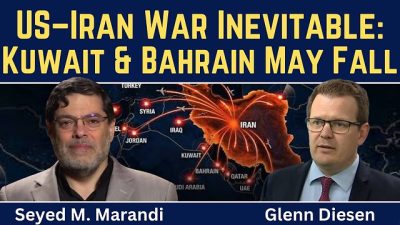
Seyed M. Marandi: US-Iran War Inevitable: Kuwait and Bahrain May Fall
or go to
Aletho News Archives – Video-Images
From the Archives
Oil and the Israel Lobby
Reknowned economist M. Shahid Alam offers this excellent critique of Noam Chomsky’s defective analysis of the relative influence of Oil versus the Israel lobby over US foreign policy: … continue
Blog Roll
 Aletho News
- ICC ignored ‘very well-documented’ NATO crimes – ex-Libyan minister
- SNSC secretary dismisses US response to Iran’s conditions as ‘inadequate’
- Sanaa says Taiz roads open, secure for residents, warns Saudi forces
- Iraqi resistance group urges Saudi leadership to admit defeat, lift Yemen siege
- Trump’s Retreat: How Al-Aqsa Flood Took Down the US Empire
- Israel’s Military Actions in Lebanon Grossly Violate International Law — Lavrov
- Seyed M. Marandi: US-Iran War Inevitable: Kuwait and Bahrain May Fall
- Leaders Condemn Ansarallah Attack on Saudi Arabia While Ignoring Illegal War Against Yemen
- Leaked: Britain’s Covert Iraqi Psyops Network
- Yemeni Armed Forces Warn Airlines Against Using Saudi Airports, Exempt Mecca and Medina
- If Americans Knew
- After Oct 7, IDF policy allowed civilian casualties for even the lowest-ranking targets
- Israel’s Destruction of Southern Lebanon Intensified After the Cease-Fire
- The Last-Minute Decision That Gave Israel Its Name
- The American Conservative: How Trump Made the World Go Nuclear
- Meet the US generals and admirals advancing Israeli policy
- Opinion: Why news organizations should boycott Israel
- The Israeli witch hunt of Sami Abu Shehadeh exposes the lie of the ‘Jewish and democratic’ state
- No state has a ‘right’ to exist – least of all Israel
- Testimonies about Gaza’s civilian death toll expose Israel’s atrocities – Daily Update
- How Israel Conquered the Latin American Right
- No Tricks Zone
- New Study Suggests Large Regions Of The Pacific Ocean Have Been Cooling For The Last 80 Years
- Germany’s Green Energy Debacle: High Energy Costs Force Kahla Porzellan to Close After 182 Years!
- New Study: 50 Years Of The Most Aggressive ‘Net Zero’ Policies Can Only Affect The Global Climate By 0.03°C
- US September “Heat” Was No Record…Many Records Set Decades Ago
- Latest European Green Energy Debacle; Portugal’s Largest Flagship Solar Park Insolvent!
- Green Energy Debacle: German Expert Professor Fritz Vahrenholt Warns Of Severe Economic And Social Consequences
- Two More Paleo Reconstructions Affirm Meters-Higher Sea Levels Across Ireland, Brazil 7000-6000 Years Ago
- New Study: Earth And Venus Surface Warmth Largely Explained By Convection And Lapse Rate, Not CO2 Or Radiation
- 2025 Nature Paper Claiming Worsening Global Drought Gets RETRACTED …Heavily Flawed
- New Study: ‘Global Drought Shows No Detectable Recent Acceleration Under Climate Warming’

