Afghan forces abandon western district after Taliban pressure
RT | December 12, 2018
Afghan forces have abandoned a remote district in the west of the country, leaving the area to Taliban insurgents. The government had failed to re-supply dozens of troops stationed there, provincial officials said on Wednesday.
The Shebkoh district of Farah province, bordering Iran, has been under Taliban siege for months.
Mosa Nazari, deputy governor of Farah, said Afghanistan’s military leadership faced difficulty reinforcing the troops and it had been decided to withdraw in order to avoid casualties.
“The plan to leave the district was there for months and it was finally decided,” Nazari told Reuters.
The forces withdrew all ammunition and vehicles to the provincial capital of Farah, he said.
The Taliban said in a statement the government abandoned the district after a heavy firefight overnight, and the group seized an amount of ammunition.
The Nobel Peace Prize in Support of War
By Terje Maloy | OffGuardian | December 6, 2018
On December 10, the 2018 Nobel Peace Prize Award Ceremony will be held in Oslo, the capital of Norway. This analysis will try to look at how the prize fits in the bigger picture, but first, some general background is appropriate:
Norway is a member of NATO and has close ties to the United States and Great Britain. The political, economic and bureaucratic elites are firmly integrated in transatlantic networks, a nexus of economic connections, think tanks, international institutions, media and a thousand other ties that bind. They tend to identify with the liberal wing of the empire, (i.e. the Democrats, not the Republicans), but will work with any US administration. The members of the Norwegian Nobel Committee are selected by the Norwegian parliament, and the Committee is nominally independent.
Despite being considered – and where the population considers itself – a ‘peace nation’, there are few countries that have eagerly joined more wars than Norway, from the attack on Yugoslavia in 1999, Afghanistan 2001, the occupation of Iraq, Mali, Libya 2011 and the ongoing occupation of Syria. Norway spends large sums of money supporting the joint Western effort to control the rest of the world through comprador intermediaries in non-governmental organizations.
This analysis will discuss some (overlapping) points about the Nobel Peace Prize:
- The prize reinforces certain grand narratives, the most important one being We are the good, and thus have the right to decide the fate of the rest of the world.
- It creates symbols for regime change operations. It beatifies modern day ‘good natives’ complaining about cruel treatment and pleading for the West to do something to liberate them (but are often remarkably unable to see Western abuses).
- It reinforces general reasons to start wars, by making specific themes very important at the same time they are being used to justify military action.
- It reinforces the narrative that enemy fights with illegal and cruel weapons. The focus on chemical weapons, as opposed to napalm or sanctions, is one example.
- It sanctifies peace treaties that are more like unilateral surrenders, advantageous to Western imperialism and capitalist interests.
- For a bunch of peaceful people, the prize winners are remarkably eager for war and bloody interventions.
- Some other points + Conclusion.
1. WE ARE THE GOOD, AND THUS HAVE THE RIGHT TO DECIDE THE FATE OF THE REST OF THE WORLD
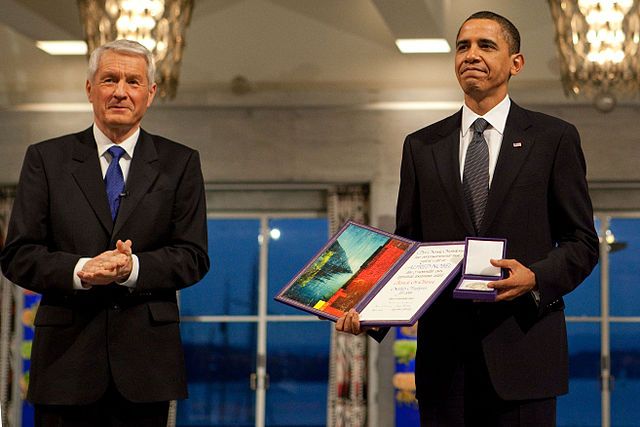
(Photo: / White House, Samantha Appleton /Public Domain)
The Nobel Peace Prize gets its prestige and press coverage because it reinforces several big narratives. If it should deviate too much from what the powerful want, it would be ignored. Of prime importance is the notion that we are the good, and we have a monopoly on interpreting reality and to decide what is important. (‘We’ in this context being people in the West, and by extension their governments and leaders). During the Cold War, the prize had a similar function. It would be interesting to take a closer look at it, but for practical purposes this analysis will mostly be limited the last 30 years. Once you start to notice certain basic themes, they are rather obvious. To put it pointedly, the Nobel Peace Prize tries to aid regime changes to achieve the Empire’s aims where it is possible to avoid direct war, but it will aid in confirming the narrative that our troops are good guys.
This explains why Western leaders so often get the prize. The point is creating an impression that there exists a more humane possibility within our current unjust world system. When they receive it, what they have actually done is not an issue. Hence the award to people like Jimmy Carter (winner 2002); as president he instigated several bloody covert interventions in Central-America, Africa and of course the Islamist fighters in Afghanistan, but has since then opposed direct US wars; or Al Gore (winner 2007), who when he was vice president didn’t shy away from using the military as a foreign policy tool (see part 7). The prize to Barack Obama (winner 2009) can be placed here.
But the main use of the prize is to create support in Western liberal opinion for interventions that would otherwise be naked imperialistic aggression.
2. A FOCUS FOR REGIME CHANGE OPERATIONS
Where a Nobel Peace Prize is awarded to a dissident of a non-western country, the CIA or the Pentagon (see point 3) often has a task force working on cracking the exact same country.
The winners have varying degrees of internal appeal in the targeted country, but the main purpose in choosing these people is not to boost their standing internally, but to justify attempts at regime change to Western liberal public opinion. Without the focus on these martyrs, these operations would look suspiciously like old style colonial domination.
Hence the beatification of Aung San Suu Kyi (winner 1991) coincided with a concerted campaign to get control over a recalcitrant, but very strategic country. Suu Kyi is in many ways typical of the people the Committee prefers. She is a known entity, having conspicuously strong personal connections to the former colonial power – Oxford educated, married to a British citizen, her children are British citizens, etc. Signaling in which direction her political compass was oriented, she asked the world to use the old colonial name Burma instead of Myanmar. She asked for harsh measures against her own country (for its own good) fitting hand in glove with the US strategy actually used. In fact, all means would be permissible to use against this regime imprisoning a modern day saint.
The Nobel Prize to Suu Kyi played an invaluable role in creating huge support, especially on the liberal left, for the draconian economic sanctions against an otherwise fairly obscure country. And maybe many of her Western supporters actually did believe that the US and UK could fund her with large sums of money and create entire NGO-networks for her with the expressed goal of subverting a sovereign nation’s government, and her intentions to still be pure and progressive.
Myanmar is immensely rich in natural resources and is positioned between China and the Indian Ocean, and China and India. Any significant land connection between these two 21st century great powers would have to go through Myanmar to avoid the Himalayas. It is also of great Chinese interest as a transit country to the Indian Ocean. Therefore, the country was targeted with a multi-approach regime change operation.
A massive press campaign was arranged over several decades, a plethora of NGOs financed, whilst “former” CIA-agents now turned missionaries were working with the ethnic guerilla forces to create military pressure. In the usual attempt to concentrate all opposition into a joint force, extreme right wing religious fanatics became the spearhead in this campaign. The sanctions imposed on Myanmar, precluded any economic development and doomed the population to a life of crushing poverty.
One could interpret the recent calls to take the prize back from Suu Kuy as disappointed buyers not getting what they paid for.
We can go forward to 2010, when a Chinese citizen, Liu Xiaobo, won the prize. There were no surprises for what future was envisaged for China:
It took Hong Kong 100 years to become what it is. Given the size of China, certainly it would need 300 years of colonisation for it to become like what Hong Kong is today. I even doubt whether 300 years would be enough.”
The lines between creating justification for a covert regime change operation and next step, a direct war, is blurry. But when required, the Prize Committee can step in to keep the focus of world opinion on the right narrative.
3. CREATING REASONS FOR WAR: WOMEN’S RIGHTS
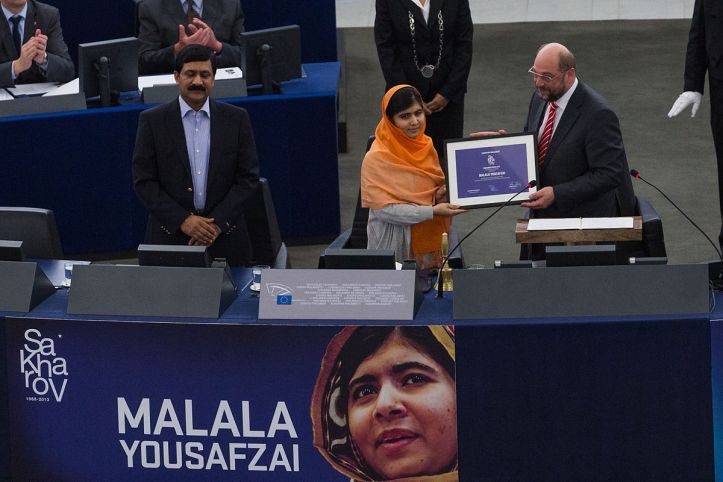
Malala Yoysafzai receives the Sakharov prize © Claude Truong-Ngoc / Wikimedia Commons
In 2003, just after the blitzkrieg on Iraq and at the very height of the George Bush’s talk of continuing the offensive to a few more countries, the committee chose to give the prize to Shirin Ebadi. By beatifying an Iranian at that time, the committee very well knew that they increased the danger of war.
Ebadi is a champion of women’s rights, a recurrent theme in NATO’s efforts to justify their wars. We know that targeting women in the West with this type of messaging has been a major effort for the organization for a long time. By giving the prize to her, they in effect created support in Western (female) public opinion for a war/regime change that would kill an untold number of Iranian women and destroy the lives of the rest, a repeat on a larger scale of what happened in Iraq.
The 2018 prize went to the fight against sexual violence in war. This happens to coincide with the very image NATO wants to promote of itself – who can forget Angelina Jolie and NATO’s General Secretary Jens Stoltenberg writing a joint article in 2017 titled “Why NATO Must Defend Women’s Rights,” where they point out that “NATO has the responsibility and opportunity to be a leading protector of women’s rights” and “can become the global military leader in how to prevent and respond to sexual violence in conflict”. How convenient that the Nobel Committee shares the same view.
A more analytic approach would point out such facts that US/NATO-interventions have made the situation for women infinitely worse in places such as Iraq, Libya and Afghanistan. An intervention to topple the legal government in Syria would certainly have created the same result.
In addition, a bit broader view would point out how allegedly stopping sexual violence against women has justified many wars of aggression. The stereotypes of cruel foreigners have not advanced noticeably from depictions of swarthy Spaniards groping blonde women in the Spanish-American war, to the claim that Gaddafi was handing out Viagra to mercenaries to rape women, as Susan Rice, the US Permanent Representative at UN told the Security Council. Amnesty International, later reported it had “not found any evidence or a single victim of rape or a doctor who knew about somebody being raped.”
Other notorious examples of how this has been used in war propaganda include Serbian rape camps during the Yugoslav wars. Allegations of mass rape were a key element of NATO’s propaganda campaign during the 1999 bombing of Yugoslavia. Clare Short, Britain’s international development secretary, claimed that the rapes were “deliberately performed in front of children, fathers and brothers.” After the war was over, there were some retractions, including from the Washington Post, which reported that “Western accusations that there were Serb-run rape camps […] all proved to be false.”
Malala Yousafzai (winner 2014), the young Pakistani girl who became a symbol of the war against the Taliban, is another figure that fits this pattern. The indefinite occupation of Afghanistan is, among plenty of other vicarious reasons, justified by improving women’s rights. This overlooks the fact that no improvement can be made under a government installed with the help of foreign bayonets. The situation for Afghan women has not improved since the occupation, but then again, the claim was only meant to create support for the war in public opinion.
The importance of creating the perception of fighting for women’s rights has long been realized in military circles.
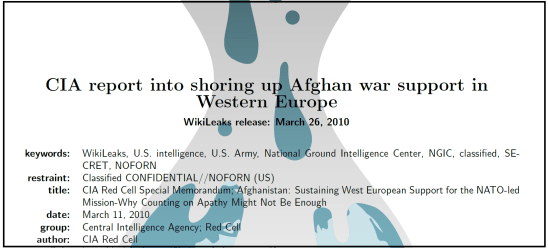
An internal CIA-document from 2010 (a few years before Malala received the prize from the Nobel Institute for her struggle against the Taliban), published by WikiLeaks, discusses how to best market the war in Afghanistan, To show how similar the Nobel Committee and the military/intelligence apparatus think, it is worth quoting the following passage:
Afghan women could serve as ideal messengers in humanizing the ISAF role in combating the Taliban because of women’s ability to speak personally and credibly about their experiences under the Taliban, their aspirations for the future, and their fears of a Taliban victory. Outreach initiatives that create media opportunities for Afghan women to share their stories with French, German, and other European women could help to overcome pervasive skepticism among women in Western Europe toward the ISAF mission.
4. THE ENEMY FIGHTS WITH ILLEGAL AND INHUMANE WEAPONS, AND IT IS IMPERATIVE TO STOP THEM
By highlighting certain themes, in this case ‘illegal weapons’, they reinforce the narrative in Western public opinion that certain things are very urgent and real problems, when in fact they are of relatively minor significance.
Poison gas is a clear example. The OPCW won the prize in 2013. Given the general situation in the Middle East, several million dead in Iraq after the US invasion and at least 400.000 dead in the covert invasion of Syria, gas is a minor factor, and even if we take the frequent claims of ‘gas massacres’ at face value (which of course we shouldn’t), is only responsible for an infinitesimal fraction of these dead.
But to reinforce a false narrative, this focus has been invaluable. The prize creates acceptance for the narrative that gas is a uniquely important and evil weapon, where it is fully justified to do anything necessary, including attacking countries, to stop the possible use of it. At the moment of writing this, Nov 24, 2018, the US just accused Iran of hiding a chemical weapons program.
Some weapons that are killing far more people in far more gruesome ways than poison gas, like napalm, would never be put on this list. And we could compare gas to sanctions, the West’s favorite and most effective weapon of mass destruction, killing the weakest, the sick, children and old people slowly, while destroying entire peoples’ right to a decent life. No other or weapon of mass destruction has killed as many people since WW2.
5. SANCTIFYING PEACE TREATIES THAT ARE NEGOTIATED SURRENDERS TO WESTERN INTERESTS

Yasser Arafat receives the prize in 1994, together with Israeli Foreign Minister Shimon Peres, Israeli Prime Minister Yitzhak Rabin CC BY-SA 3.0 File:Flickr – (GPO)
The most noticeable feature when the prize goes to creators of peace treaties, is that the treaties are more like a negotiated surrender than a just peace.
Colombia’s president Juan Manuel Santos (winner 2016) received the prize for victoriously having put the finishing touches to a long US-led counter-insurgency campaign against leftist guerilla forces. Now the reactionary oligarchy has a safe grip on the country, and can continue their neoliberal agenda, which isn’t that different from the old reactionary order. The death squads murdering leftist and human rights activist continue their activities with impunity.
The country had an extremely tarnished image in human rights issues and needed a quick touch-up to make it palatable. The most conspicuous thing the 2016-award is that the president got the prize just before Colombia became a global partner of NATO. The planning of the PR-requirements for this to happen smoothly must have been already well under way when the prize winner was decided. Remember the prize is directed at Western public opinion, and has little to do with an actual just peace in Colombia.
Yasser Arafat (co-winner 1993) got the prize so he would be tied to a peace plan with a chimerical two-state solution the Israeli side had no intention of honoring. The peace offer didn’t even include a stop in construction of Israeli settlements. No clearer signal of Israeli intentions could have been given. This is a continuation of the joint prize to Sadat and Begin in 1978, for the peace treaty between Egypt and Israel, where Israel succeeded in making a separate peace with the biggest Arab country, and could thereafter concentrate on consolidating its grip on the West Bank.
While Nelson Mandela (co-winner 1994) undoubtedly was a worthy winner, the transition deal the ANC negotiated for South Africa only transferred formal political power, and left unjust economic power structures intact. The assets of multinational companies were guaranteed, and the neoliberal policies implied in the deal doomed the large majority of the population to continued poverty.
Michail Gorbachev (winner 1990) got the prize for a unilateral and wholesale surrender of every Soviet position, both economic and political; he didn’t even keep them as bargaining cards. Trusting Western oral promises, this naiveté is unprecedented in a leader of a great power. His bad decisions made a managed transition to a mixed system impossible and abandoned the former socialist states to Western looting and a social collapse they still haven’t recovered from. No wonder he still is so popular in the West that gave him the medal as a sign of appreciation.
Finnish Martti Ahtisaari got the prize in 2008, «for his efforts on several continents and over more than three decades, to resolve international conflicts». This is very true. Left out is what should be added to the sentence, to resolve international conflicts – as a total Western victory.
Ahtisaari is directly linked to the creation of the NATO-protectorate of Kosovo. By 1999, NATO had decided to splinter Yugoslavia one more time. A 78 day aerial bombing campaign had little effect, so they sent in the diplomats. It was suggested that an envoy from a ‘neutral’ country would be more efficient. Here is how Ahtisaari handled the situation, telling the Serbs what ‘we’ would do (my emphasis):
Ahtisaari opened the meeting by declaring, “We are not here to discuss or negotiate,” […]. Ahtisaari says that Milosevic asked about the possibility of modifying the plan, to which he replied, “No. This is the best that Viktor and I have managed to do. You have to agree to it in every part.” [..] As Milosevic listened to the reading of the text, he realized that the “Russians and the Europeans had put us in the hands of the British and the Americans.”
Milosevic took the papers and asked, “What will happen if I do not sign?” In answer, “Ahtisaari made a gesture on the table,” and then moved aside the flower centerpiece. Then Ahtisaari said, “Belgrade will be like this table. We will immediately begin carpet-bombing Belgrade.” Repeating the gesture of sweeping the table, Ahtisaari threatened, “This is what we will do to Belgrade.” A moment of silence passed, and then he added, “There will be half a million dead within a week.”
The Serbians signed the treaty.
6. NOT A PEACEFUL VERY BUNCH OF PEOPLE
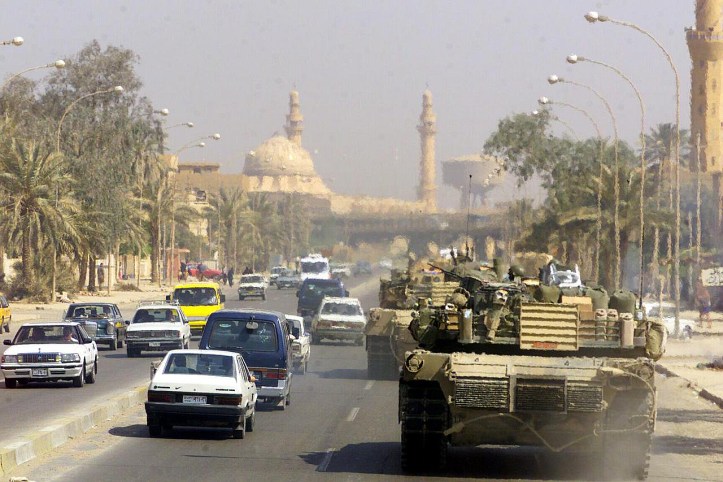
US Marine Corps tank in Baghdad, 2003 (Photo: USMC/ Public Domain)
For recipients of a peace prize, a remarkable number of them support wars.
The invasion of Iraq in 2003 was a war of aggression under the trumped up pretext of disarming Iraq of Weapons of mass destruction. It was a blatant breach of both international law and the United Nations Charter. What did the Nobel Prize Winners think of it?
Here we have Elie Wiesel (winner 1986): “I now know I was wrong, but better that than to have stood idly by”.
Jose Ramos-Horta (winner 1996) claimed approvingly that the only truly effective means of pressure on the Iraqi dictator [is] the threat of the use of force.
Liu Xiaobo (winner 2010) was clear, the “decision by President Bush is right!”. But then again, Liu had the remarkable opinion that “the major wars that the US became involved in are all ethically defensible,” including the wars in Afghanistan and Vietnam.
Former vice president Al Gore (winner 2009) had argued aggressively in favor of war in Iraq in 1991 and 1998, Bosnia in 1995 and Kosovo in 1998, and believed the 2003 Iraq war was legal based on earlier UN resolutions.
The Cold War winner Lech Walesa (1983) was an opponent of the invasion, but at least he knew where to put the blame: “It’s not the United States that is to blame for the war, but rather the EU, and in particular Germany and France. They knew the war was coming and they failed to prevent it.”
The Dalai Lama (winner 1989) was wily enough to hedge his bets, but decidedly did not condemn the war: “it’s too early to say, right or wrong”, He also supported the US/NATO military intervention in Afghanistan and the attack on Yugoslavia.
There is a similar level of support among prize winners for a direct intervention in the ‘civil’ war in Syria, a US/NATO regime change plan on the drawing board for at least 10 years before it started. The push for a no-fly zone in Syria on a Libyan model, which could then be used as a fig leaf for a full-scale assault, was immense for several years. What did the Nobel Prize winners think of this possibility?
(Keep in mind that the ‘action’ they call for, can only be either an aerial bombing or ground troops.)
Kailash Satyarthi (winner 2014) did not say anything about the fact that it was the 3 Western powers on the Security Council which started this war by spending billions of dollars arming and financing armed Islamist gangs. Stopping this support would seem to be the obvious way to stop the war, but instead we get: “The UN Security Council (UNSC) has the military power to bring this unceasing genocide to a halt.”
His co-winner Malala Yousafzai who seems to have envisaged a similar future for Syria as for Afghanistan, a Western intervention: “When I look at Syria, I see the Rwandan genocide. When I read the desperate words of Bana Alabed in Aleppo, I see Anne Frank in Amsterdam… We must act. The international community must do everything they can to end to this inhumane war”
This was echoed by former UN-leader Kofi Annan (winner 2001). Defining Aleppo as only the small part of the city occupied by Islamist gangs, he called for ‘action’. How this ‘action’ would differ from what he describes, is not clear: “The assault on Aleppo is an assault on the whole world. When hospitals, schools and homes are bombed indiscriminately, killing and maiming hundreds of innocent children, these are acts that constitute an attack on our shared, fundamental human values. Our collective cry for action must be heard, and acted upon, by all those engaged in this dreadful war.”
This wish was supported by Medecins sans Frontiers, recipient of the 1999 Nobel Peace Prize. It was the first to report the alleged gas attack in Ghouta on 21. August 2013, which the Obama-administration wanted to use as a pretext for a military assault. As it admitted, the MSF’s decision to issue a press release on the incident—which had not taken place in an MSF hospital, but in its “silent partner” facilities in rebel-controlled areas—was highly political.
MSF was well aware that their announcement of chemical weapons use would be immediately seized upon by the US to claim that Syrian President Assad had crossed a red line, and to start a bombing campaign.
The organization was here true to its roots, as the civilian part in the French military/intelligence effort to support an independent state in the oil producing parts of Nigeria, in the Biafran war of independence in 1967-1970.
Amnesty International, (winner 1977) was not much better, with its call for unspecified ‘action’: “The international community’s catastrophic failure to take concrete action to protect the people of Syria has allowed parties to the conflict, most notably the Syrian government, to commit war crimes and crimes against humanity with complete impunity, often with assistance of outside powers, particularly Russia… the international community had said ‘never again’ after the government devastated Eastern Aleppo with similar unlawful tactics. But here we are again.”
Anyway, Amnesty has a soft spot for endless NATO-interventions. In 2012, after 11 years of dismal occupation, the organization paid for advertising posters in the US applauding NATO’s actions in Afghanistan — “Keep the progress going”, purportedly doing something for women’s rights.
Tawakkol Abdel-Salam Karman is a Yemeni journalist and human rights activist that won the prize in 2009 wanted ‘protection’, writing: “Instead of protecting residents in Aleppo from brutalities of Russia, Iran and Bashar Al Assad’s regime, the world tended to mediate to provide safe corridors for the displacement of civilians,” adding, “these also are partners in crime.”
Colombian President Juan Manuel Santos (2016) voiced support for the missile attacks on Syria in March 2018.
Such bellicosity (or just as often, coy bellicosity) is nothing new in the type of people selected as winners. Henry Kissinger (winner 1973) was the most infamous war hawk to win the prize during the Cold War, but as long as it was the right side doing the fighting, plenty of others identified with this one sided world view. We can recognize all the themes mentioned above in Michael Parenti’s description of the 1975 Peace Prize winner:
Andrei Sakharov was a darling of the U.S. press, a Soviet dissident who regularly sang praises to corporate capitalism. Sakharov lambasted the U.S. peace movement for its opposition to the Vietnam War. He accused the Soviets of being the sole culprits behind the arms race and he supported every U.S. armed intervention abroad as a defense of democracy. Hailed in the west as a «human rights advocate,» Sakharov never had an unkind word for the horrific human rights violations perpetrated by the fascist regimes of faithful U.S. client states, including Pinochet’s Chile and Suharto’s Indonesia, and he aimed snide remarks at the «peaceniks» who did. He regularly attacked those in the West who opposed U.S. repressive military interventions abroad.
7. Some other points + Conclusion
You don’t have to be an prop for US/NATO power projection to win the prize, but it helps.
The prize was originally intended to be given to the person who has done most to foster peace between nations. In a subtle twist, in many cases it has changed to banning aspects of warfare, barely ever addressing war itself. Broaching such a subject honestly would be impossible without addressing the elephant in the room, US/Western imperialism. The award has had many winners who are variants of this year’s theme, sexual violence in war (which also touches on point 3, the NATO-narrative of defense of women). The focus here is on a more civilized form of war, not abolishing war as such as a means of settling disputes.
No one (apart from some military brass) is actually pro-landmines, but the Peace prize to the Campaign Against Land Mines in 1997 coincided with the increased Western interventions in places where these weapons would be a hindrance to the success of the occupation It was not in the interest of NATO forces to have their opponents using these ‘poor man’s weapons’, creating the casualties so feared by the military in modern wars, which again might increase opposition at home to war. The coalition suffered most of their casualties from IEDs, a sort of land mine, in Iraq, while having limited use of mines themselves.
There is a certain unpredictability as to who the prize will be awarded to, making it not as obviously beholden to the immediate needs of the powerful, even though the long term trend is clear. For example, there has been no Russian winner for quite a while now, and the White Helmets have not yet got the award, maybe as they are too obviously only a PR-front.
When Jean-Paul Sartre declined the Nobel Prize in Literature, he said that the prize ‘is for Western writers or Eastern rebels’. On a similar note, we might say that the Nobel Peace Prize is for Western elites or Eastern rebels.
That the selection of winners conforms to US views does not mean that there is a direct influence, although some recommendations to the Committee probably weigh heavier than others. Rather this pattern is a sign of how well socialized the Norwegian Nobel Committee members are in the transatlantic world view, where ‘our’ requirements override any genuine wish for peace.
Military defeats push Kabul into talks with Taliban as US seeks way out from Afghan stalemate
RT | December 5, 2018
Direct talks with the Taliban are crucial for the Kabul government to survive amid crushing defeats by the militants, Afghanistan experts told RT amid expectations that end of the 17-year war is looming.
Afghanistan returned to headlines this week, with a government-affiliated official making an unconventional peace gesture towards the Taliban. Ehsan Taheri, spokesman for the High Peace Council – a body that mediates peace between the government and the militants – said Kabul is ready to talk directly to the Taliban. He promised there will be no prerequisites to discuss any issue “crucial for the future of Afghanistan.”
“There’s no doubt the Afghan government relies on speeding up talks with Taliban” as the situation on the ground deteriorated over the past two years, Nikita Mendkovich, an expert with Russian International Affairs Council, told RT.
The Taliban have managed to gain upper hand in various parts of the country, and the Western-backed Afghan National Army risks being defeated in the coming years, he explained. And while Kabul’s offer of peace sounds promising at a glance, analysts say it has more to do with the survival of the current government than anything else.
The militants are able “to take matters into their own hands” without providing any security guarantee to the Afghan government, the expert noted.
That aside, Afghanistan is preparing to hold presidential elections, putting the sitting President Ashraf Ghani in a precarious position. Because he is unpopular with sizeable part of the population and regional elites, he must demonstrate “some results.”
“A peace deal or at least a long-term truce with Taliban would be a bargaining chip for Ghani to remain in power,” according to Mendkovich. However, the main reason for Kabul to accelerate the peace process is still rooted in “military defeats” sustained by the Afghan army and NATO forces.
Meanwhile, Omar Nessar, a researcher with Russia’s Institute for Oriental Studies, said he doesn’t see how a peace deal might become reality.The Taliban are demanding that NATO troops leave the country, which in turn is “unacceptable” for Western sponsors of Kabul.
The Taliban “doesn’t need peace talks right now as they continue to gain foothold in Afghanistan,” Nessar stressed. The Afghan leadership is a too week actor to talk with, but the Americans may try to ask Kabul to negotiate on their behalf in order to “save the image of the government.”
Afghan stalemate: Winning peace to lose war?
On the military front, the reality looks as murky as it was over the past years. On Tuesday, Marine Lt. Gen. Kenneth McKenzie who is set to take the lead of US Central Command (CENTCOM), gave oxygen to a claim there was no easy way out from the 17-year Afghan war.
“I do know that today it would be very difficult for [the Afghan security forces] to survive without our and our coalition partners’ assistance,” McKenzie said, noting that if the US forces are to leave “precipitously right now,” the Kabul government might fall.
McKenzie said that in light of a steep rise in casualties, the US must step up its efforts to help Afghan forces to recruit and train much-needed reinforcements, describing the current rate of losses as unsustainable. “They’re fighting hard, but their losses are not going to be sustainable unless we correct this problem.”
Asked to provide his take on this, Nessar said that while the US “is tired of the war” it cannot leave Afghanistan in full. A complete troop withdrawal would mean acknowledging a military defeat in the war on Taliban, he stated.
“The US cannot win war, it tries to win peace,” Mendkovich commented. Asked if the US could employ a peace deal with Taliban to get out of the war, he suggested a complete troop pullout is unlikely. US air bases and military compounds are “strategic assets” instrumental to “create threats” against neighboring China, Russia and Iran, and the Americans don’t want to lose them.
Trump Foreign Policy: Doing the Same Thing and Expecting a Different Result
By Ron Paul | December 3, 2018
After a week of insisting that a meeting with Putin on the sidelines of the G20 meeting in Argentina was going to happen, President Trump at the last minute sent out a Tweet explaining that due to a Russia/Ukraine dispute in the Sea of Azov he would no longer be willing to meet his Russian counterpart.
According to Trump, the meeting had to be cancelled because the Russians seized three Ukrainian naval vessels in Russian waters that refused to follow instructions from the Russian military. But as Pat Buchanan wrote in a recent column: how is this little dispute thousands of miles away any of our business?
Unfortunately it is “our business” because of President Obama’s foolish idea to overthrow a democratically-elected, pro-Russia government in Ukraine in favor of what his Administration believed would be a “pro-Western” and “pro-NATO” replacement. In short, the Obama Administration did openly to Ukraine what his Democratic Party claims without proof the Russians did to the United States: meddled in a vote.
US interventionism in Ukraine led to the 2014 coup and many dead Ukrainians. Crimea’s majority-Russian population held a referendum and decided to re-join Russia rather than remain in a “pro-West” Ukraine that immediately began discriminating against them. Why would anyone object to people opting out of abusive relationships?
What is most disappointing about President Trump’s foreign policy is that it didn’t have to be this way. He ran on a platform of America first, ending foreign wars, NATO skepticism, and better relations with Russia. Americans voted for this policy. He had a mandate, a rejection of Obama’s destructive interventionism.
But he lost his nerve.
Instead of being the president who ships lethal weapons to the Ukrainian regime, instead of being the president who insists that Crimea remain in Ukraine, instead of being the president who continues policies the American people clearly rejected at the ballot box, Trump could have blamed the Ukraine/Russia mess on the failed Obama foreign policy and charted a very different course. What flag flies over Crimea is none of our business. We are not the policemen of the world and candidate Trump seemed to have understood that.
But now Trump’s in a trap. He was foolish enough to believe that Beltway foreign policy “experts” have a clue about what really is American national interest. Just this week he told the Washington Post, in response to three US soldiers being killed by a roadside bomb in Afghanistan, that he has to keep US troops fighting in the longest war in US history because the “experts” tell him there is no alternative.
He said, “virtually every expert that I have and speak to say if we don’t go there, they’re going to be fighting over here. And I’ve heard it over and over again.”
That is the same bunkum the neocons sold us as they lied us into Iraq! We’ve got to fight Saddam over there or he’d soon be in our streets. These “experts” are worthless, yet for some reason President Trump cannot break free of them.
Well here’s some unsolicited advice to the president: Listen to the people who elected you, who are tired of the US as the world’s police force. Let Ukraine and Russia work out their own problems. Give all your “experts” a pink slip and start over with a real pro-American foreign policy: non-interventionism.
NATO’s Greatest Enemy is Itself
By Ulson Gunnar – New Eastern Outlook – 18.11.2018
Accidents happen. For Norway at the conclusion of NATO’s Trident Juncture 2018 military exercises, such an accident occurred with its Lockheed Martin Aegis-equipped frigate, HNoMS Helge Ingstad.
After a collision with an oil tanker, the frigate’s captain ordered the ship aground to prevent a total loss. The quick thinking may have saved the lives of Norwegian sailors and made salvaging operations easier. Thankfully no lives were lost and only eight injuries are being reported by the Western media.
The NATO exercises the Helge Ingstad was participating in simulated an invasion of Norway. As the Council on Foreign Relations made clear in their article, “NATO’s Trident Juncture Exercises: What to Know,” the imaginary invaders were obvious stand-ins for Russia.
The CFR piece would claim:
The aggressor in the simulation is fictitious, but the setting and the scale of the exercises point clearly in one direction. Tensions between NATO and Russia, which shares an Arctic border with Norway, are running high. In the last five years, Russia has annexed Crimea, destabilized eastern Ukraine, provided military aid to a brutal regime in Syria, meddled in Western elections, and either walked away from or allegedly violated major multilateral security treaties.
Of course none of what the CFR alleges is true and many of the accusations leveled against Russia by the article have long been abandoned by even most in the Western media.
The fact that Norway lost an expensive ship in the middle of this NATO exercise to prepare for a Russian invasion that will never happen suggests that the greatest threat much of Europe faces is from NATO itself, not Moscow.
NATO is a Cancer, Not a Shield
The amount of money required to host NATO members in Norway to prepare for a Russian invasion that will never happen would seem detrimental to Norwegians as well as other European nations spending money to move their forces and their equipment (40,000 personnel, 120 aircraft and 70 ships) to and from the exercise areas.
Training is important and maintaining a strong military as well as a credible deterrence is also important for all nations, both Western Europe and Russia included. But such preparations should be proportional to the prospective threats any nation or bloc of nations face. Such preparations should also clearly be made to create a deterrence rather than a provocation.
NATO’s Trident Juncture appears to be more of an exercise to enforce NATO expansion eastward toward Russia’s borders than any genuine preparation for a “Russian invasion” that even Norway’s leadership says is highly unlikely.
Such exercises and the agenda they serve benefits a handful of special interests, primarily in Washington (Lockheed Martin included), at the expense of NATO’s European members.
NATO, driven primarily by Washington and immense corporate interests who hold sway over it, has become a tool used to extend American ambitions around the globe. Few could provide a credible explanation as to what NATO’s nearly two decade-long occupation of Afghanistan has to do with defending Europe.
For Norway specifically, Afghanistan has become the grave for at least 10 of its service members and a blackhole that has swallowed several billion dollars in Norwegian expenditures.
Likewise, it was US-led NATO that destroyed the North African nation of Libya (with Norwegian assistance), transforming it into a hotbed of terrorism and triggering a refugee crisis that flooded European territory and continues to be a source of socioeconomic tension today.
In this instance, NATO directly compromised European security, and Norway’s taxpayers helped underwrite the disaster.
It is clear that NATO is not protecting Europe. It is using Europe to advance American ambitions around the globe, far beyond any reasonable jurisdiction a defense alliance aimed at protecting Europe should have. As NATO uses Europe, it is consuming funds that could be better used domestically for the European people. The net result of NATO’s activities undermine rather than uphold European security.
NATO’s Trident Juncture is simply an extension of this process, aimed at ratcheting up tensions with Russia and only further undermining European peace and stability in the process.
Other Ways NATO Undermines European Peace and Prosperity
Beyond military alliances and defense preparations, there are also alternatives for creating a deterrence to war and military aggression. These alternatives include economic cooperation. Here, such cooperation between Europe and Russia is complicated by US-led efforts to economically isolate Russia and sabotage trade and investment between Russia and its neighbors to the west.
By conducting provocative exercises aimed at Russia, tensions are only further encouraged and US efforts to place a wedge deeper between Russia and the rest of Europe further advanced.
What we’re left with is a Europe compelled to view its neighbor to the east as an enemy for lack of any viable alternative not met with Washington’s ire.
NATO, a supposed defense alliance, instead promotes tensions, exports wars and consumes the blood and treasure of member-states for foreign military adventures thousands of miles from European shores. Considering this, NATO, not Russia, seems to be the greatest threat facing Europe today.
US Budgetary Costs of the Post-9/11 Wars: $5.9 Trillion Spent and Obligated
Through FY2019
By Prof. Neta C. Crawford | Watson Institute, Brown University | November 14, 2018
The United States has appropriated and is obligated to spend an estimated $5.9 trillion (in current dollars) on the war on terror through Fiscal Year 2019, including direct war and war-related spending and obligations for future spending on post-9/11 war veterans (see Table 1).
This number differs substantially from the Pentagon’s estimates of the costs of the post-9/11 wars because it includes not only war appropriations made to the Department of Defense – spending in the war zones of Iraq, Syria, Afghanistan, Pakistan, and in other places the government designates as sites of “overseas contingency operations,” – but also includes spending across the federal government that is a consequence of these wars. Specifically, this is war-related spending by the Department of State, past and obligated spending for war veterans’ care, interest on the debt incurred to pay for the wars, and the prevention of and response to terrorism by the Department of Homeland Security.
If the US continues on its current path, war spending will continue to grow. The Pentagon currently projects $80 billion in Overseas Contingency Operations (OCO) spending through FY2023. Even if the wars are ended by 2023, the US would still be on track to spend an additional $808 billion (see Table 2) to total at least $6.7 trillion, not including future interest costs. Moreover, the costs of war will likely be greater than this because, unless the US immediately ends its deployments, the number of veterans associated with the post-9/11 wars will also grow. Veterans benefits and disability spending, and the cost of interest on borrowing to pay for the wars, will comprise an increasingly large share of the costs of the US post-9/11 wars.
Table 1, below, summarizes the direct war costs – the OCO budget – and war-related costs through FY2019. These include war-related increases in overall military spending, care for veterans, Homeland Security spending, and interest payments on borrowing for the wars. Including the other areas of war-related spending, the estimate for total US war-related spending allocated through FY2019 is $4.9 trillion.[3] But because the US is contractually and morally obligated to pay for the care of the post-9/11 veterans through their lifetimes, it is prudent to include the costs of care for existing post-9/11 veterans through the next several decades. This means that the US has spent or is obligated to spend $5.9 trillion in current dollars through FY2019.[4] Table 1 represents this bottom-line breakdown for spent and obligated costs.
Table 1. Summary of War Related Spending, in Billions of Current Dollars, Rounded to the Nearest Billion, FY2001- FY2019[5]

Figure 1. US Costs of War: $5.9 Trillions of Current Dollars Spent and Obligated, through FY2019[10]
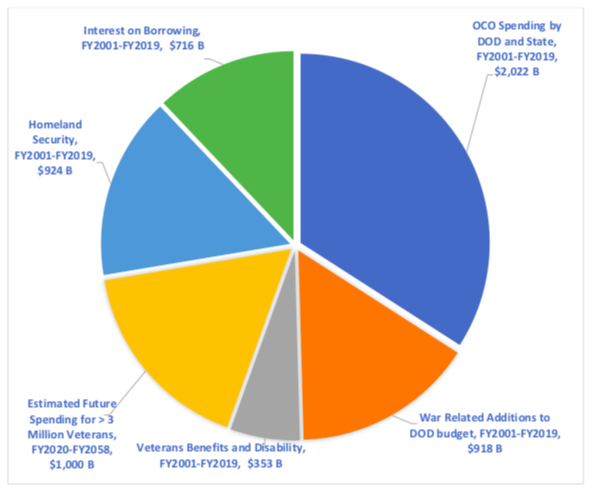
Further, the US military has no plans to end the post-9/11 wars in this fiscal year or the next. Rather, as the inclusion of future years spending estimates in the Pentagon’s budget indicates, the DOD anticipates military operations in Afghanistan, Pakistan, Iraq and Syria necessitating funding through at least FY2023. Thus, including anticipated OCO and other war-related spending, and the fact that the post-9/11 veterans will require care for the next several decades, I estimate that through FY2023, the US will spend and take on obligations to spend more than $6.7 trillion.
To read the full PDF report by Professor Neta C. Crawford, click here.
India has historic role in Moscow format on Afghanistan
By M. K. BHADRAKUMAR | Indian Punchline | November 6, 2018
Many a slip between the cup and the lip may be possible when it comes to the Afghan peacemaking, but with the caveat added, prospects for the second Moscow conference on Afghanistan slated for coming Friday have significantly improved with the expected participation by officials of Afghanistan’s High Peace Council (HPC), a government body responsible for reconciliation efforts with the militants, and a five-member Taliban delegation led by Sher Mohammad Abbas Stanakzai, head of the Taliban’s political council in Qatar attending the event.
This is a signal diplomatic victory for Russia. One may say that an Afghan ‘Astana Process’ (similar to the one on Syria) is taking off.
The Kabul government has done some tight rope walking, given the immense US pressure on it to dissociate from the Moscow event. Afghanistan will now be formally represented by the HPC instead of the foreign ministry. The ‘formula’ is a ‘win-win’ – Kabul has acceded to Moscow’s request without annoying the Americans.
But this is just as well because the foreign ministry in Kabul is virtually defunct and the Ashraf Ghani government has become all but relevant. And it also accommodates the Taliban’s steadfast refusal to sit at a table with the ‘puppet’ government in Kabul.
Among the regional states, Iran, China, Pakistan, Tajikistan, Uzbekistan and Turkmenistan have apparently confirmed their participation. Delhi seems to be agonizing over a decision. It has hitherto maintained that it will attend only if Afghanistan takes part. The big question is whether Delhi will now take a pragmatic decision, since the HPC is after all a government body.
The decision to sit across a table facing the Taliban representatives may cause some heartburn for the hardliners in the Indian establishment, but then, this is how all insurgencies end.
Of course, for a variety of reasons, it will be extremely short sighted on the part of the Modi government to boycott the Moscow event. One, a truly regional process involving all the major protagonists is taking shape, finally, in the search for an Afghan settlement. India’s interests lie in partaking of it.
Two, the Moscow format is in friendly and trusted hands, because Russia is a close friend and strategic partner and it will never be party to anything that hurts India’s core interests. Moscow’s approach to the fight against terrorism is similar to Delhi’s – unwavering, principled, uncompromising. Indeed, in the joint statement issued after the recent Modi-Putin summit in Delhi, India specifically voiced its support for the Moscow format on Afghanistan.
Three, the forthcoming conference provides a useful occasion for India to interact with the Taliban who are definitely going to be in the power structure in some form or the other in a near future in Afghanistan. Early birds catch the worm, as they say.
Four, it is in India’s interests to contribute to any regional consensus regarding Afghanistan. By now, it is abundantly clear that the US says nice things about India’s role in Afghanistan but does nothing to bring India to the high table.
Five, the Moscow format provides a unique opportunity for India to harmonise with Pakistan and China. Quite obviously, the Moscow format is at its core SCO+2 (Iran and Turkmenistan).
Finally, this pivotal moment is somewhat like the last train leaving the station. It is better to be on board than left stranded on the platform with nowhere to go.
Importantly, the decision-makers in Delhi must be able to anticipate the outcome of the Moscow conference. In a nutshell, an intra-Afghan dialogue is commencing with the regional states acting as facilitators.
In the final analysis, this process is only going to supplement whatever efforts are under way by the Americans to get the Taliban to the negotiating table. Clearly, it isn’t the Russian intention to undercut the peace talks.
Having said that, the HPC is a composite body representing the plural Afghan society and the Americans can never hope to bring about an intra-Afghan dialogue, having been an interventionist power since 2001.
The bottom line is that India has always believed in the raison d’etre of an intra-Afghan dialogue as the pathway leading to a settlement. Any settlement that is imposed on the Afghans by external parties will be unworkable. Therefore, as a stakeholder in the stability, unity and independence of Afghanistan, India must whole-heartedly welcome the dialogue commencing at the Moscow conference.
Afghan delegation to attend multilateral peace talks in Russia
Press TV – November 5, 2018
An Afghan delegation will attend international talks on the war-torn country, which are scheduled to be held in the Russia capital Moscow this month.
The spokesman for the High Peace Council, Sayed Ihsan Taheri, said on Monday that the council would send four representatives to the meeting, which will focus on kick-starting peace talks between Kabul and the Taliban.
The HPC is a government body responsible for reconciliation efforts with militants.
The Afghan Foreign Ministry, however, did not say whether it would dispatch a delegation to the conference or not.
“We are still negotiating with the Russian officials,” spokesman Sebaghtullah Ahmadi said, adding, “We welcome any peace effort that is Afghan-led.”
Moscow has also invited representatives from the United States as well as Iran, India, China, Pakistan and five former Soviet republics in Central Asia to take part.
Russia said Saturday it would host the event on November 9 in the Russian capital. The meeting was initially scheduled to take place in September.
Taliban pledge to attend Moscow talks
Senior Taliban officials confirmed on Monday that the Afghan Taliban will join multilateral peace talks hosted by Russia on Friday.
A five-member Taliban delegation led by Sher Mohammad Abbas Stanakzai, head of the Taliban’s political council in Qatar, will attend.
“The majority of our top leaders showed the willingness to participate in the Moscow peace talks though some of them also expressed their reservations and said it would not give them any benefit on the ground in Afghanistan,” said a Taliban member.
Some Taliban members said the delegation would raise their demands for a withdrawal of all foreign forces, the release of all prisoners and the lifting of a ban on travel.
“This is a very good opportunity and we would like to participate and raise our genuine issues,” said another Taliban official. “We would urge these world powers to help resolve the Afghan issue as per international laws and principles.”
The Moscow talks will be held as newly-appointed US adviser to Afghanistan Zalmay Khalilzad reportedly met with the Taliban representatives in Qatar in October with the declared aim of bringing the militant group to the negotiating table.
Zahid Hussain, a Pakistani defense analyst and author of two books on militancy in the region, earlier said the appointment of Khalilzad as a special adviser in Afghanistan could complicate his job. “He has been very critical of Pakistan in the past and his appointment will not help move things forward.”
Afghan people still face insecurity 17 years after the United States and its allies invaded the country as part of Washington’s so-called war on terror.
Although the Taliban militant group was removed from power as a result of the invasion, the country remains occupied and many areas are still threatened by insecurity.
US takes leap of faith toward Taliban
By M. K. BHADRAKUMAR | Indian Punchline | October 31, 2018
According to reports, the Taliban disclosed on Tuesday that five former Guantanamo inmates from their leadership hierarchy have joined their political office in Qatar. This dramatic development signals that the talks between the Taliban and the US are getting under way seriously in search of an Afghan settlement.
The five former Guantanamo inmates were top figures in the Taliban regime in the 1990s and close confidantes of late Mullah Omar – former interior minister Mullah Khairullah Khairkhwa, former army chief Muhammad Fazil, former governor of Balkh and Laghman Noorullah Noori, Taliban’s deputy intelligence chief Abdul Haq Wasiq and Taliban’s communication chief Nabi Omari.
They were released from Guantanamo Bay by the Barack Obama administration after 12 years of incarceration in 2014 in exchange for US Army Sgt. Bowe Bergdahl, who was held hostage by the Taliban for nearly five years. The five Taliban leaders were shifted from Guantanamo Bay to Qatar where they have been in protective custody of local authorities. If they are indeed joining the Taliban’s political office in Doha, it can only be with the approval of the Qatari authorities and the acquiescence of the US.
The stunning part is that these five Taliban leaders once carried the stigma in the US eyes of having been closely associated with the al-Qaeda. Indeed, Washington had all along anticipated that a time would come when the hardcore Taliban leadership would need to be constructively engaged. That alone explains why the (Afghan) Taliban was thoughtfully excluded from the US State Department’s list of Foreign Terrorist Organizations. Washington took the plea that the Afghan Taliban is an insurgency with control over vast swaths of territory and aspirations to govern the country. It conveniently left the door open to negotiate with them and reconcile them, hopefully, when the time came.
Evidently, the Trump administration assesses that that time has come. The induction of the dreaded 5 Taliban leaders with al-Qaeda links to mainstream peace talks follows the recent visit of the new US special representative Zalmay Khalilzad to Pakistan and Qatar. Khalilzad is a diplomat in a hurry and is raring to negotiate peace even if it involves interlocutors who might have been closely associated with the al-Qaeda in the 1990s.

(Guantanomo Bay detention camp)
Indeed, it shows Khalilzad’s cold realism and pragmatism as a veteran diplomat, while on the other hand also the sense of urgency within the Trump administration that a settlement must be negotiated as quickly as possible.
There is no evidence that the Kabul government has been consulted or is party to this development in Qatar. Khalilzad will be proceeding on a ‘need-to-know’ basis, since Afghan polity is hopelessly fragmented and it must be a bitter pill for the Kabul elite to accept that the five Guantanamo Bay inmates are back in political circulation as top protagonists.
On the contrary, Khalilzad is working in close consultation with Islamabad. The release of the former No 2 in Taliban hierarchy Mullah Baradar by Pakistan last week (at Khalilzad’s instance) synchronizes with the development in Qatar. Clearly, Pakistan is positioning Mullah Baradar also in anticipation of the commencement of the fateful talks in Qatar in a very near future.

(Mullah Baradar)
Time is running out, because Afghanistan is due to hold presidential election in April 2019. The US is intensely conscious that another puppet government elected through a farcical election charade and post-election gerrymandering will lack legitimacy and even spell doom for the country. The sensible thing will be to bring the Taliban to the forecourt and get them involved in the upcoming political contestation.
How that is going to be possible in the limited time ahead remains to be seen. In all respects, a tricky and dangerous transition looms ahead – ominously reminiscent of the UN-sponsored transition in 1992 from communist rule to the Mujahideen, which collapsed in spectacular failure.
Once the Qatar talks begin in right earnest, the last ounce of legitimacy left in the Kabul set-up will drain away. The pressure will increase on filling the power vacuum that will inevitably arise. However, compared to 1992, the good part is that while the Afghan Mujahideen were split into rival groups, with some such as the Jamiat way out of the orbit of Pakistani control, that is not the case with the Taliban. Pakistan is in a position to shepherd them in the right direction.
But Pakistan will expect the US to reciprocate by taking into consideration its sensitivities and interests – especially, the revival of the old full-bodied relationship between the two countries. Read an opinion piece, here, in today’s Dawn newspaper underscoring the criticality of Washington and Islamabad moving in tandem in search of a ‘joint solution’ through the coming 6-month period in order for Khalilzad’s talks to be fruitful and productive.
The Lies of our (Financial) Times
By James Petras | Dissident Voice | October 4, 2018
The leading financial publications have misled their political and investor subscribers of emerging crises and military defeats which have precipitated catastrophic political and economic losses.
The most egregious example is the Financial Times (FT) a publication which is widely read by the business and financial elite.
In this essay we will proceed by outlining the larger political context that sets the framework for the transformation of the FT from a relatively objective purveyor of world news into a propagator of wars and failed economic policies.
In part two we will discuss several case studies which illustrate the dramatic shifts from a prudent business publication to a rabid military advocate, from a well-researched analyst of economic policies to an ideologue of the worst speculative investors.
The decay of the quality of its reportage is accompanied by the bastardization of language. Concepts are distorted; meanings are emptied of their cognitive sense; and vitriol covers crimes and misdemeanors.
We will conclude by discussing how and why the ‘respectable’ media have affected real world political and market outcomes for citizens and investors.
Political and Economic Context
The decay of the FT cannot be separated from the global political and economic transformations in which it publishes and circulates. The demise of the Soviet Union, the pillage of Russia’s economy throughout the 1990s and the US declaration of a unipolar world were celebrated by the FT as great success stories for ‘western values’. The US and EU annexation of Eastern Europe, the Balkan and Baltic states led to the deep corruption and decay of journalistic narratives.
The FT willingly embraced every violation of the Gorbachev-Reagan agreements and NATO’s march to the borders of Russia. The militarization of US foreign policy was accompanied by the FT conversion to a military interpreter of what it dubbed the ‘transition to democratization’.
The language of the FT reportage combined democratic rhetoric with an embrace of military practices. This became the hallmark for all future coverage and editorializing. The FT military policies extended from Europe to the Middle East, the Caucasus, North Africa and the Gulf States.
The FT joined the yellow press in describing military power grabs, including the overthrow of political adversaries, as ‘transitions to democracy’ and the creation of ‘open societies’.
The unanimity of the liberal and right-wing publications in support of western imperialism precluded any understanding of the enormous political and economic costs which ensued.
To protect itself from its most egregious ideological foibles, the FT included ‘insurance clauses’, to cover for catastrophic authoritarian outcomes. For example they advised western political leaders to promote military interventions and, by the way, with ‘democratic transitions’.
When it became evident that US-NATO wars did not lead to happy endings but turned into prolonged insurgencies, or when western clients turned into corrupt tyrants, the FT claimed that this was not what they meant by a ‘democratic transition’ – this was not their version of “free markets and free votes”.
The Financial and Military Times (?)
The militarization of the FT led it to embrace a military definition of political reality. The human and especially the economic costs, the lost markets, investments and resources were subordinated to the military outcomes of ‘wars against terrorism’ and ‘Russian authoritarianism’.
Each and every Financial Times report and editorial promoting western military interventions over the past two decades resulted in large scale, long-term economic losses.
The FT supported the US war against Iraq which led to the ending of important billion-dollar oil deals (oil for food) signed off with President Saddam Hussein. The subsequent US occupation precluded a subsequent revival of the oil industry. The US appointed client regime pillaged the multi-billion dollar reconstruction programs – costing US and EU taxpayers and depriving Iraqis of basic necessities.
Insurgent militias, including ISIS, gained control over half the country and precluded the entry of any new investment.
The US and FT backed western client regimes organized rigged election outcomes and looted the treasury of oil revenues, arousing the wrath of the population lacking electricity, potable water and other necessities.
The FT backed war, occupation and control of Iraq was an unmitigated disaster.
Similar outcomes resulted from the FT support for the invasions of Afghanistan, Libya, Syria and Yemen.
For example the FT propagated the story that the Taliban was providing sanctuary for bin Laden’s planning the terror assault in the US (9/11).
In fact, the Afghan leaders offered to turn over the US suspect, if they were offered evidence. Washington rejected the offer, invaded Kabul and the FT joined the chorus backing the so-called ‘war on terrorism which led to an unending, one trillion-dollar war.
Libya signed off to a disarmament and multi-billion-dollar oil agreement with the US in 2003. In 2011 the US and its western allies bombed Libya, murdered Gaddafi, totally destroyed civil society and undermined the US/EU oil agreements. The FT backed the war but decried the outcome. The FT followed a familiar ploy; promoting military invasions and then, after the fact, criticizing the economic disasters.
The FT led the media charge in favor of the western proxy war against Syria: savaging the legitimate government and praising the mercenary terrorists, which it dubbed ‘rebels’ and ‘militants’ – dubious terms for US and EU financed operatives.
Millions of refugees, resulting from western wars in Libya, Syria, Afghanistan and Iraq fled to Europe seeking refuge. FT described the imperial holocaust – the ‘dilemmas of Europe’. The FT bemoaned the rise of the anti-immigrant parties but never assumed responsibility for the wars which forced the millions to flee to the west.
The FT columnists prattle about ‘western values’ and criticize the ‘far right’ but abjured any sustained attack of Israel’s daily massacre of Palestinians. Instead readers get a dose of weekly puff pieces concerning Israeli politics with nary a mention of Zionist power over US foreign policy.
FT: Sanctions, Plots and Crises — Russia, China and Iran
The FT like all the prestigious media propaganda sheets have taken a leading role in US conflicts with Russia, China and Iran.
For years the scribes in the FT stable have discovered (or invented) “crises” in China’s economy- always claiming it was on the verge of an economic doomsday. Contrary to the FT, China has been growing at four times the rate of the US; ignoring the critics it built a global infrastructure system instead of the multi-wars backed by the journalist war mongers.
When China innovates, the FT harps on techno theft — ignoring US economic decline.
The FT boasts it writes “without fear and without favor” which translates into serving imperial powers voluntarily.
When the US sanctions China we are told by the FT that Washington is correcting China’s abusive statist policies. Because China does not impose military outposts to match the eight hundred US military bases on five continents, the FT invents what it calls ‘debt colonialism” apparently describing Beijing’s financing large-scale productive infrastructure projects.
The perverse logic of the FT extends to Russia. To cover up for the US financed coup in the Ukraine it converted a separatist movement in Donbass into a Russian land grab. In the same way a free election in Crimea is described as Kremlin annexation.
The FT provides the language of the declining western imperial empires.
Independent, democratic Russia, free of western pillage and electoral meddling is labelled “authoritarian”; social welfare which serves to decrease inequality is denigrated as ‘populism’ —linked to the far right. Without evidence or independent verification, the FT fabricates Putinesque poison plots in England and Bashar Assad poison gas conspiracies in Syria.
Conclusion
The FT has chosen to adopt a military line which has led to a long series of financially disastrous wars. The FT support of sanctions has cost oil companies billions of dollars, euros and pounds. The sanctions, it backed, have broken global networks.
The FT has adopted ideological postures that threaten supply chains between the West, China, Iran and Russia. The FT writes in many tongues but it has failed to inform its financial readers that it bears some responsibility for markets which are under siege.
There is unquestionably a need to overhaul the name and purpose of the FT. One journalist who was close to the editors suggests it should be called the “Military Times” – the voice of a declining empire.
‘We’d take out Russia’s nukes,’ US NATO envoy says, claiming ‘banned’ missiles are being developed
RT | October 2, 2018
The US would look into ways of “taking out” new Russian missiles if they become operational, the US envoy to NATO said, accusing Moscow of developing a weapon that “violates” the Soviet-US nuclear arms treaty.
US Ambassador to NATO Kay Bailey Hutchison didn’t miss an opportunity to fire a warning shot in the direction of Russia when accusing it of building new nuclear missiles that would allegedly be pointed at Europe. Should such missiles be completed, she said at the Tuesday briefing, “at that point, we would be looking at the capability to take out a [Russian] missile that could hit any of our countries.”
Hutchison then doubled down on the threat, saying: “Counter measures [by the United States] would be to take out the missiles that are in development by Russia in violation of the treaty.” She added: “They are on notice.”
Hutchison was referring to the Intermediate-Range Nuclear Forces Treaty (INF), which bans the use of all nuclear and conventional missiles, as well as their launchers, that have ranges of between 500km and 5,500km. The US has claimed that Moscow is not complying with the INF treaty, an accusation that Russia has repeatedly rejected.
“We have been trying to send a message to Russia for several years that we know they are violating the treaty, we have shown Russia the evidence that we have that they are violating the treaty,” Hutchison maintained.
The Russian Foreign Ministry blasted the statements made by the US envoy as “aggressive and destructive,” adding that they will get a detailed response from Russian military experts. NATO doesn’t understand the degree of its responsibility and the danger posed by such aggressive rhetoric, the ministry said.
Hutchison’s comment came several weeks after President Donald Trump signed the US National Defense Authorization Act (NDAA) for 2019. The document contains, among other things, allegations that Moscow violated the INF Treaty.
Moscow, in turn, accuses the US and “some of its allies” of knowingly violating the INF by deploying Mk-41 launching systems close to Russian borders. These can be easily repurposed for firing banned ground-based cruise missiles, it says, while Washington denies the accusations.
Under the 2019 NDAA, US legislators allocated $58 million to counter Russia’s alleged non-compliance with the INF Treaty. The measures to counter the alleged activities include a “research and development program on a ground-launched intermediate-range missile,” which, somehow, should not itself violate the treaty.
Russian lawmakers have also promised countermeasures. “If the missile announced by Congress indeed makes it into the American arsenal, we will have to develop and adopt the same thing. Russia has the military and technical capacities for that,” Viktor Bondarev, the head of the defense committee of Russia’s Federal Council, has said.
Featured Video
Seyed M. Marandi: US-Iran War Inevitable: Kuwait and Bahrain May Fall
or go to
Aletho News Archives – Video-Images
From the Archives
Oil and the Israel Lobby
Reknowned economist M. Shahid Alam offers this excellent critique of Noam Chomsky’s defective analysis of the relative influence of Oil versus the Israel lobby over US foreign policy: … continue
Blog Roll
 Aletho News
- ICC ignored ‘very well-documented’ NATO crimes – ex-Libyan minister
- SNSC secretary dismisses US response to Iran’s conditions as ‘inadequate’
- Sanaa says Taiz roads open, secure for residents, warns Saudi forces
- Iraqi resistance group urges Saudi leadership to admit defeat, lift Yemen siege
- Trump’s Retreat: How Al-Aqsa Flood Took Down the US Empire
- Israel’s Military Actions in Lebanon Grossly Violate International Law — Lavrov
- Seyed M. Marandi: US-Iran War Inevitable: Kuwait and Bahrain May Fall
- Leaders Condemn Ansarallah Attack on Saudi Arabia While Ignoring Illegal War Against Yemen
- Leaked: Britain’s Covert Iraqi Psyops Network
- Yemeni Armed Forces Warn Airlines Against Using Saudi Airports, Exempt Mecca and Medina
- If Americans Knew
- After Oct 7, IDF policy allowed civilian casualties for even the lowest-ranking targets
- Israel’s Destruction of Southern Lebanon Intensified After the Cease-Fire
- The Last-Minute Decision That Gave Israel Its Name
- The American Conservative: How Trump Made the World Go Nuclear
- Meet the US generals and admirals advancing Israeli policy
- Opinion: Why news organizations should boycott Israel
- The Israeli witch hunt of Sami Abu Shehadeh exposes the lie of the ‘Jewish and democratic’ state
- No state has a ‘right’ to exist – least of all Israel
- Testimonies about Gaza’s civilian death toll expose Israel’s atrocities – Daily Update
- How Israel Conquered the Latin American Right
- No Tricks Zone
- New Study Suggests Large Regions Of The Pacific Ocean Have Been Cooling For The Last 80 Years
- Germany’s Green Energy Debacle: High Energy Costs Force Kahla Porzellan to Close After 182 Years!
- New Study: 50 Years Of The Most Aggressive ‘Net Zero’ Policies Can Only Affect The Global Climate By 0.03°C
- US September “Heat” Was No Record…Many Records Set Decades Ago
- Latest European Green Energy Debacle; Portugal’s Largest Flagship Solar Park Insolvent!
- Green Energy Debacle: German Expert Professor Fritz Vahrenholt Warns Of Severe Economic And Social Consequences
- Two More Paleo Reconstructions Affirm Meters-Higher Sea Levels Across Ireland, Brazil 7000-6000 Years Ago
- New Study: Earth And Venus Surface Warmth Largely Explained By Convection And Lapse Rate, Not CO2 Or Radiation
- 2025 Nature Paper Claiming Worsening Global Drought Gets RETRACTED …Heavily Flawed
- New Study: ‘Global Drought Shows No Detectable Recent Acceleration Under Climate Warming’

