Keir Starmer arson mysteries multiply
By Kit Klarenberg | Al Mayadeen | June 20, 2026
On June 15th, two young Ukrainian men were found guilty in London of conspiring to carry out arson attacks on two homes and a car intimately connected to British Prime Minister Keir Starmer. Little-reported, curious details of the trial, and a post-conviction propaganda blitz led by the BBC blaming Russian intelligence actors for inspiring and directing the pair’s incendiary crimes, raise a number of ominous questions about precisely what happened, why, and for whom the alleged perpetrators were truly working.
On May 8th 2025, a Toyota vehicle previously owned by Starmer was set ablaze in north London, not far from where he’d previously resided. Three days later, flats in Islington Starmer managed years previously were similarly put to the torch, then on May 12th, a home where he once resided, now leased to his sister-in-law was also set ablaze. That same day, 22-year-old Ukrainian national Roman Lavrynovych was arrested by British police for his purported role in the arson.
Despite the Prime Minister being personally targeted in a highly organised, repeated and potentially lethal manner, major news outlets within and without the country exhibited bizarrely muted interest. Starmer describing the incidents in parliament on May 14th that year as “an attack on all of us, on democracy and the values that we stand for” – condemnation from Conservative and Liberal Democrat politicians echoed – elicited some headlines. However, basic facts about the case, and discussion of its obvious potential national security implications, remained unforthcoming.
This seeming omerta endured when, on May 17th, 26-year-old Ukrainian-born Romanian national Stanislav Carpiuc was arrested at Luton airport for his role in the attacks, attempting to flee. Four days later, 34-year-old Ukrainian national Petro Pochynok was arrested, accused of conspiring with Carpiuc, Lavrynovych, “and others unknown to damage by fire property belonging to another.” The names and nationalities of two further individuals arrested in the case – a 48-year-old on June 2nd that year, and a 19-year-old in January 2026 – were never released.
Police investigations into these anonymous suspects were eventually dropped, without fanfare. Who they were, why they became subjects of interest, and the grounds for their elimination from enquiries, hasn’t been revealed and wasn’t discussed at trial. There were apparently no “others unknown” with whom Carpiuc and Lavrynovych colluded after all. Pochynok was acquitted, successfully arguing he was “deceived” by the pair and had no idea they intended to start fires with his help. Notably, all three were charged with mere arson, not national security offences.
This aspect is striking, given when the trial commenced on April 28th, prosecution lawyers immediately declared the trio’s arson assault was directed by a Russian-speaking Telegram user, for cash. The December 2023 National Security Act grants British authorities sweeping powers to severely punish people who break the law at the behest of “hostile states”. Repeatedly since the Starmer-linked attacks, British citizens have been jailed for national security offences after being recruited to commit crimes, including arson, via Telegram by supposed Russian actors.
All along, alarm has been sounded about Iranian intelligence using Telegram for similar purposes, in particular “[hiring] anyone who can harm Israeli interests or individuals” in Britain. Yet, a coordinated criminal conspiracy targeting the Prime Minister, which required access to sensitive private information on Starmer not readily available to average citizens, allegedly orchestrated by a malign foreign actor, mysteriously didn’t qualify as national security-related. Moreover, jurors and the public alike were strictly prohibited from learning anything about the group’s alleged recruiter.
‘Wholly Irrelevant’
On the trial’s first day, dropping the bombshell that Lavrynovych was “recruited, instructed and promised with payment for the fires that he was told to start” by a Russian-speaking source known as “EL Money”, the lead prosecutor promptly ordered jurors to leave the entire issue alone. “It is not part of your considerations to decide who ‘EL Money’ is and what reason he might have had to co-ordinate the actions of these defendants,” they said, before adding:
“It does not matter whether they knew that the property they were targeting was connected to the Prime Minister or whether that formed part of their motivation.”
As such, the trial centred solely around the extremely limited question of whether the accused committed arson. All other avenues of inquiry weren’t up for discussion or investigation in open court. While the financial motivation of the three accused was explored, the identity, connections and motives of the individual – or individuals – who commissioned and directed the attacks on Starmer was effectively inadmissible. This was despite Lavrynovych’s defence hinging on claiming to have felt intimidated by the unknown Telegram contact, and therefore acting under duress.
The BBC reports how during the trial in the jury’s absence, Lavrynovych’s lawyers applied for prosecutors to hand over wider information held by authorities on EL Money. This included whether he was associated with intelligence services or a state informant, and where he was based. They argued the actions of EL Money were “redolent of tradecraft” – in other words, cloak-and-dagger techniques employed by spies. But the judge flatly rejected the application, inexplicably ruling these burning queries to be “wholly irrelevant” to issues before the jury.
Nonetheless, it did emerge at the trial that EL Money sent messages to Lavrynovych on May 12th, following the final arson, notifying him “there is news, you’ll get crypto” and “you need to throw away the clothes.” Subsequently, EL Money warned him, “you attacked the home of a very high-ranking person in Britain,” and “you need to leave the city.” Lavrynovych was arrested hours later, indicating he was already in law enforcement’s crosshairs by this time. How he came to police attention isn’t clear.
Apparently, the central coordinating role of EL Money in the attacks on Starmer wasn’t ascertained until after Carpiuc and Lavrynovych were in custody, and legal proceedings well-underway. At a pretrial hearing in late May 2025, prosecution lawyers said the arrested Ukrainian pair’s conspiracy was “unexplained”. A contemporary Financial Times report noted counter-terror cops leading the probe were “keeping an open mind about motive.” Nameless government officials stressed “many different versions of the events” remained under investigation, “and nothing had been ruled out at this stage.”
‘No Evidence’
How prosecutors settled on the “version of events” they dramatically presented in court, before directing jurors to disregard considerations of EL Money entirely, is likewise unknown. Only a small number of messages the user exchanged with Lavrynovych – in which EL Money notably communicated in perfect Russian and Ukrainian – were presented in court. However, within just hours of the pair’s conviction, the BBC released a dedicated Panorama documentary, and 3,500-word long-read on the “Russian connection” behind the Starmer-linked arson.
Miraculously, “using open-source tools,” Britain’s state broadcaster was able to ‘crack the case’ to an extent police purportedly couldn’t. The BBC named EL Money as a “Russian diplomat, schooled in information warfare by spies and propagandists, who is close to the highest levels of power in Moscow.” Posing as EL Money, the 23-year-old supposedly sought to bribe numerous Ukrainians in Britain into perpetrating a variety of criminal activities, via dedicated local jobs groups, while also oddly deploying “deeply offensive Russian terms for Ukrainian people.”
“Messages from the [EL Money] account in various Telegram channels show him glorifying [Vladimir] Putin and Russia, attacking the Ukrainian people and promoting Russian narratives,” the BBC claimed. Its investigation acknowledged the trial of Carpiuc, Lavrynovych and Pochynok “was strange, mainly because the true author of the drama was never revealed,” with the conundrum of EL Money’s identity “deliberately avoided.” Suspicion can only abound as to why the British state broadcaster unravelled this crucial riddle, rather than courts and/or law enforcement.
Even more suspiciously, the BBC quoted a senior British counter-terror police chief as saying while the aim of the attacks on Starmer’s properties was “to intimidate and create fear for the Prime Minister and to attack the UK,” law enforcement had “not been able to prove the identity of [EL Money] or who he was working for.” They categorically declared, “we’ve got no evidence to suggest this was a state-backed threat.” But Britain’s state broadcaster is seemingly better informed than the police.
“Sources have told us that authorities in the UK and in Ukraine have privately concluded Russia was behind the arson attacks,” the BBC boasted. One might reasonably ask why Kiev has apparently taken it upon herself to solve a British criminal case, although Ukraine’s SBU is certainly an authority on recruiting chaos agents via Telegram, and other messaging apps. The heavily CIA and MI6-infiltrated agency has, over many years, exploited this technique to blackmail and bribe Russians into perpetrating serious crimes at home.
These scandalous activities have been universally ignored by the Western media. By contrast, numerous major news outlets have boldly seized on the BBC blaming Russia for the arson attacks. The Financial Times published a slick investigation the same day, replete with photos, videos, and graphics, documenting EL Money’s contacts with and payments to Lavrynovych. Shady investigative website The Insider went so far as to release extensive biographical information and photos of the 23-year-old Russian named by the BBC as EL Money.
Other outlets have produced quotes from Lavrynovych’s trial testimony, in which he states EL Money “wanted to see [the arson] on the news.” Of course, the attacks barely registered in the media contemporaneously, and what was said at the trial by defendants, their lawyers, prosecutors and the judge went unreported until now. In all the post-trial rush to convict Russia, not a single source has mentioned how British police themselves admit they possess “no evidence” indicating the arson attacks were sponsored by any state. Make of that what you will.
Hungary blasts ‘fake news’ about Putin-Trump meeting
RT | October 22, 2025
The Western media will continue to spread “fake news” aimed at derailing a summit between Russian President Vladimir Putin and his US counterpart, Donald Trump, Hungarian Foreign Minister Peter Szijjarto has warned.
Several outlets reported on Tuesday, citing unnamed White House officials, that plans for the meeting in the Hungarian capital had been put “on hold.”
Responding to the claims, Szijjarto took to X to warn that from the moment the meeting was announced following a phone call between Putin and Trump last week, “it was obvious that many would do everything possible to stop it from happening.”
“The pro-war political elite and their media always behave this way before events that could prove decisive between war and peace,” he added.
According to the foreign minister, it will be the same in the run-up to the talks in Budapest. “Until the summit actually takes place, expect a wave of leaks, fake news, and statements claiming that it will not happen,” Szijjarto said.
Russian Deputy Foreign Minister Sergey Ryabkov had earlier called the claims “infodumps,” intended to disrupt diplomatic progress on settling the Ukraine conflict. “EU and NATO countries are seeking to torpedo everything,” he said.
EU officials have publicly claimed that they would welcome another Putin-Trump meeting. However, El Pais has reported that behind closed doors, Brussels – which continues to support Ukraine and urge increased pressure on Russia – views the summit as a “political nightmare.”
On Tuesday, the Financial Times cited an unnamed EU diplomat as saying “no one likes it,” and that “we are all grinning through our teeth whilst saying this is fine.”
In the same article, the FT claimed that the talks in the Hungarian capital have been “canceled,” and that a White House official has said there are no plans for a Putin-Trump summit “in the immediate future.”
Russian presidential aide Kirill Dmitriev rejected the report, accusing the FT of “twisting” the comments by its source. “Preparations continue” for the Budapest summit, he wrote on X.
ABC fact checking is a ‘black box’
Who are the fact checkers, what are their qualifications and how do they decide what is true or false?

Maryanne Demasi, reports | April 22, 2024
Australia’s public broadcaster, the Australian Broadcasting Corporation (ABC), proudly announced in 2022 that it had partnered with the Trusted News Initiative (TNI), an international alliance of major news corporations and Big Tech firms, to counter the growing threat of “fake news.”
It was part of sweeping reforms in the media to deliver ‘trusted’ news to global audiences and protect the public from the harms of misinformation and disinformation online.
Spearheaded by the British Broadcasting Corporation (BBC), partners include Reuters, Associated Press, Financial Times, The Washington Post, and ABC Australia, along with social media and tech giants – Meta (Facebook/Instagram), Microsoft (LinkedIn) and Google (YouTube) to name a few.
When ABC announced its new alliance with TNI, Justin Stevens, ABC News Director said, “We’re pleased to join the Trusted News Initiative and, in the process, provide Australian audiences with a deeper and better-informed view of our region and the world.”
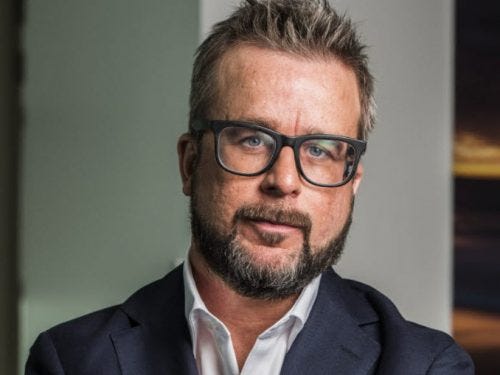
Justin Stevens appointed ABC News Director in April 2022
During the pandemic, the alliance promised to focus on preventing “the spread of harmful vaccine disinformation,” and “the growing number of conspiracy theories,” targeting online memes that featured anti-vaccine messaging or posts that downplayed the risk of covid-19.
But critics have grown increasingly uneasy about the alliance. They say governments are being protected by journalists, instead of being held to account for their pandemic policies and they’re concerned the alliance has shaped public discourse by controlling people’s access to information and censoring content that diverges from the status quo.
Weaponising fact checking
Deploying fact-checkers is one way that TNI members control the dissemination of public information. When they label a statement ‘false’, ‘wrong’, or ‘misleading’, it’s used by social media platforms to legitimise the censorship of that content by deprioritising, hiding, demonetising, or suppressing it.
Debunking content is time consuming and costly. Fact-checkers are invariably junior journalists or intern researchers, with little to no understanding of complex scientific issues or public health policies, and often appeal to governments for the ‘truth’.
When the authors of the Great Barrington Declaration opposed government enforced lockdowns, fact checkers ran hit pieces on the authors – the notable academics were then shadow-banned, censored and deplatformed from social media.
In the case of the ABC, its original in-house fact checking unit was axed in 2016 because of Federal budget cuts, but was revamped the following year when the ABC teamed up with RMIT University in Melbourne to form the RMIT ABC Fact Check and RMIT FactLab departments.
The ABC paid more than $670,000 to RMIT between 2020 – 2023 as part of its joint fact-checking venture but they quickly gained a reputation for being flawed. For example, concerns about the suppression of the lab leak theory were labelled as “false” even though they were true.
ABC’s fact checkers were also accused of being biased by SkyNews because they had used their influence to censor disfavoured political views in the Voice to Parliament referendum.
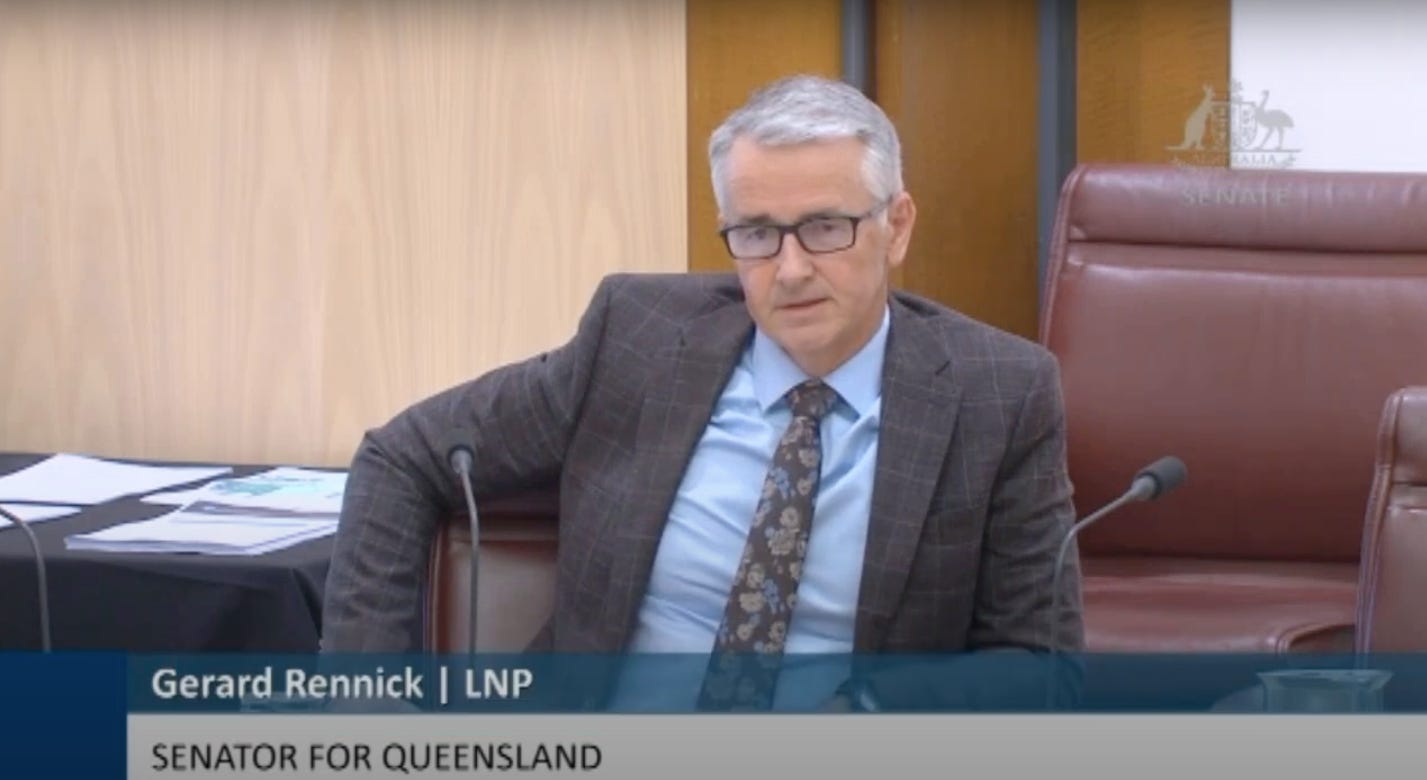
Queensland Senator Gerard Rennick grilled ABC’s Managing Director David Anderson at a Senate Estimates hearing about the network’s dodgy fact-checking practices last year.
“Who is fact-checking the fact-checkers?” asked Senator Rennick.
“You’ve made some outrageous claims on these fact-checks that aren’t correct, and you haven’t actually backed them up with any facts,” added Rennick, accusing the ABC of bias for predominantly fact-checking politically conservative voices in the media.
Sources say these controversies have prompted the ABC to cut ties with RMIT whose contract ends in June 2024.
New fact-checkers, same problems?
An ABC spokesperson said the network is now building its own internal fact-checking team, called “ABC NEWS Verify,” which appears to have similarities to the “BBC Verify” initiative.
“ABC NEWS Verify will be our centre of excellence for scrutinising and verifying information in online communities,” said the spokesperson outlining the various tasks of fact checkers. “Establishing a dedicated team will enhance and focus our efforts, creating a hub for verification best practice.”
I asked the ABC if it had any internal policy document outlining the criteria its fact-checkers would use to deem content as ‘misinformation’ or ‘disinformation’ but the spokesperson responded saying “no it doesn’t.”
Andrew Lowenthal, an expert in digital rights and a Twitter Files journalist, said the ABC’s failure to explain how it intends on fact-checking claims was “seriously ridiculous.”
“That the ABC is seeking to decide what is misinformation without laying out any criteria demonstrates just how farcical and political ‘fact-checking’ has become,” said Lowenthal.
“Without transparent and publicly available criteria the program will quickly turn into a partisan advocacy initiative,” he added.

Andrew Lowenthal, Twitter Files journalist
Lowenthal’s Twitter Files investigation confirmed the Australian government was monitoring Covid-related speech of its citizens and requesting that posts were flagged and censored if they deemed them to be misinformation.
“In that investigation, the government’s Department of Home Affairs was relying on Yahoo! News and USA Today, among others, to justify their take down requests or they’d hire journalists without scientific credentials. We need dialogue, not diktats, to determine what is true,” said Lowenthal.
Senator Rennick agreed, saying the ABC’s process lacks transparency. “Who are these people that claim to be the fact-checkers in the first place and what are their credentials? Sounds to me like it’s a black box,” said Rennick.
“Often when fact checkers come out with their reports, they don’t give the other person they’re fact checking, a right-of-reply. Also, they rarely disclose the conflicts of interest of the so-called ‘experts’ they use to fact check claims,” he added.
Michael Shellenberger, author, journalist and founder of Public, has written extensively on the “censorship industrial complex.”
“That’s what the trusted news initiative [TNI] was all about…a strategy to use fact checking initiatives to demand censorship by social media platforms,” said Shellenberger.
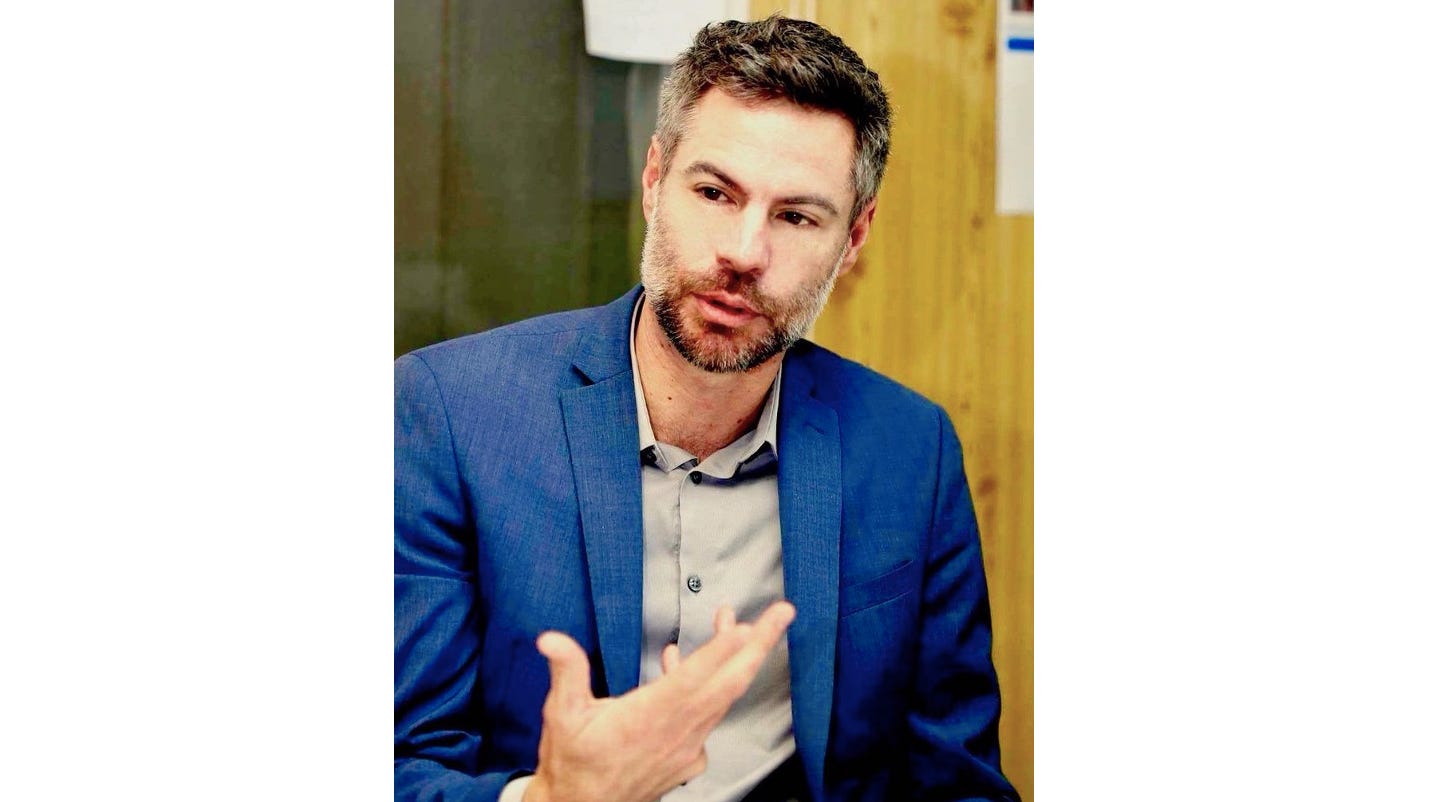
Michael Shellenberger, author of San Fransicko (HarperCollins 2021) and Apocalypse Never (Harper Collins 2020)
“They can pretend that’s not what it’s about, but the fact that the news media are participating in this, is grotesque. It’s a complete destruction of whatever reputation and integrity they used to have,” he added.
“Organisations like BBC and ABC… they used to have reputations for independence and integrity, but they’ve now decided to destroy their entire reputation on the mantle of them being the deciders of the truth. The Central Committee. That’s totalitarianism that’s not free speech.”
The ABC says its new ABC NEWS Verify will have no connection to TNI.
Impartiality and credibility?
TNI’s broad principles of working in lockstep towards a single narrative, has meant that legacy media operate largely as a mouthpiece for government propaganda, offering little critique of public health policies…and ABC has been no exception.
During the pandemic, the broadcaster repeatedly came under fire after its medical commentator Dr Norman Swan made countless calls for harsher lockdowns, mask mandates and covid boosters – policies that strongly aligned with the government but had little scientific backing.
Swan’s commentary rarely provided an impartial perspective and he was eventually called out for failing to publicly disclose his financial interest in seeking government contracts related to covid-19.
In addition, Ita Buttrose, who was ABC Chair until last month, was seen fronting Pfizer’s advertising campaigns for covid products. ABC defended Buttrose saying, “Given she was not involved in editorial decisions, there was no conflict of interest.”

Ita Buttrose, former ABC Chair, March 2019 – March 2024
The ABC denies its alliance with TNI has impacted its editorial independence but Shellenberger says the entire purpose of joining TNI is to ensure they become the single source of truth.
“They’ve stopped doing real reporting, and they’re just out there wanting to be paid to regurgitate and act like publicists for the government. It’s grotesque. It’s not journalism, it’s propaganda,” said Shellenberger.
Resisting the tyranny
Some journalists have been resisting what they perceive to be ‘tyranny’ in legacy media and the widespread suppression of free speech.
In June 2021, a group of around 30 journalists rallied together to denounce TNI’s “censorship and fearmongering” and accused the alliance of subjecting the public to a distorted view of the truth.
The group known as ‘Holding the Line: Journalists Against Covid Censorship’ shared concerns that reporters were being reprimanded by their superiors and freelancers were being blacklisted from jobs for not following the “one official narrative.”
Presidential hopeful Robert F Kennedy Jr has filed a lawsuit against TNI alleging that legacy media organisations and Big Tech have worked to “collectively censor online news” about covid-19 and the 2020 presidential election.
The lawsuit states:
“By their own admission, members of the “Trusted News Initiative” (“TNI”) have agreed to work together, and have in fact worked together, to exclude from the world’s dominant Internet platforms rival news publishers who engage in reporting that challenges and competes with TNI members’ reporting on certain issues relating to COVID-19 and U.S. politics.”
A group of 138 scholars, public intellectuals, and journalists from across the political spectrum have since published The Westminster Declaration.
In essence, it’s a free speech manifesto urging governments to dismantle the “censorship industrial complex” which has seen government agencies and Big Tech companies work together to censor free speech.
In Australia, the journalist’s union MEAA has called on ABC’s newly appointed Chair Kim Williams to “restore the reputation of the national broadcaster by addressing concerns about the impact of external pressures on editorial decision making.”

Kim Williams, current Chair, ABC Network Australia
Williams, who took over from Buttrose last month, has warned his journalists that “activism” is not welcome at the ABC and that if they fail to observe impartiality guidelines, they should consider leaving the network.
Will the ABC course-correct with Williams at the helm? Now that trust in legacy media is at historical lows, the ABC’s partnership with TNI does little to assuage fears that the network has passed the point of no return.
NB: I was a TV presenter/producer at ABC TV (2006-2016) and wrote about my experiences with censorship at the network here and here.
Financial Times Censors Criticism of Vaccine Article
BY TOBY YOUNG | THE DAILY SCEPTIC | JULY 5, 2022
Earlier today, the Financial Times removed a comment from a reader calling himself ‘Mykonos Mike’ underneath an article about why COVID-19 infection and vaccination are only partially effective – and, in some cases, completely ineffective after a certain period of time has passed – when it comes to reducing a person’s likelihood of becoming re-infected, infecting others, and ending up with a severe bout of the disease. The reason given for removing the comment, in spite of the fact that it was the most liked and commented on, was “violating our community guidelines”, although, needless to say, no more detail was provided.
In light of this, we thought it was only right to republish Mykonos Mike’s comment in full.
Is this the long winded drivel to explain how people who have taken four doses of a 95% effective vaccine can get infected multiple times? The science in the pandemic has been so wrong it entered fairy tale wonderland story telling level, almost from the beginning. This is volume 15 of series four of the story. I’ll provide a spoiler – nobody cares anymore. And the decisions made in relation to this virus were ineffective and have created massive social and economic problems that will last decades. Time to start calling it as it is FT, the media are hugely complicit in this nonsense. Governments, scientists, health authorities and pharmaceutical companies need to answer very direct questions.
You can read the FT article Mike is commenting on here. Here’s an excerpt.
A surge in COVID-19 hospital admissions driven by the BA.5 subvariant of Omicron, accompanied by the inability of vaccines to prevent reinfection, has prompted health policymakers to rethink their approach to boosters.
U.S. regulators last week recommended changing the design of vaccines to produce a new booster targeting Omicron — the first change to the make-up of shots since their introduction in late 2020. Research into immune imprinting, whereby exposure to the virus via either infection or vaccination determines an individual’s level of protection, is now driving the debate over the make-up of COVID-19 vaccines.
Immunologists say that, more than two years into the coronavirus pandemic, people have acquired very different types of immunity to the SARS-CoV-2 virus, depending on which strain or combination of strains they have been exposed to — leading to big differences in COVID-19 outcomes between individuals and countries.
“The effect is more nuanced than ‘more times you have it, less protection you get’,” said Professor Danny Altmann of Imperial College London, who is investigating the phenomenon with colleagues. “It’s more helpful to consider it as progressive fine-tuning of a huge repertoire. Sometimes this will be beneficial for the next wave, sometimes not.” …
A study of 700 U.K. healthcare workers by the Imperial team, published last month in the journal Science, found that Omicron infection had little or no beneficial effect of boosting any part of the immune system — antibodies, B-cells or T-cells — among people who had been imprinted with earlier SARS-CoV-2 variants.
The Daily Sceptic has addressed the claims being made about this study and the supposed loss of natural immunity with Omicron here.
China accuses US of disinformation
RT | March 15, 2022
In response to Western media reports that Moscow requested military aid from Beijing to conduct its operation in Ukraine, the Ministry of Foreign Affairs of China has accused US officials of spreading disinformation with sinister intent.
“The United States has been spreading false information against China on the Ukraine issue recently, with sinister intentions,” Foreign Ministry spokesperson Zhao Lijian said on Monday, answering a foreign reporter’s question on whether China will assist Russia with arms.
“China’s position on the Ukraine issue is consistent and clear, and we have always played a constructive role in persuading peace and promoting talks,” he added. Zhao also called on the belligerent parties to exercise restraint and de-escalate tensions rather than fueling them, while insisting that all countries should push for a diplomatic solution.
On Sunday, the Financial Times reported that Moscow asked China “for equipment and other kinds of unspecified military assistance” to support its military operation in Ukraine. The report added that the White House was concerned “Beijing may undermine western efforts to help Ukrainian forces defend their country” if it chooses to grant the alleged request.
Earlier, Washington threatened to shut down Chinese chip manufacturers if Beijing assists Moscow in overriding US sanctions.
Kremlin spokesperson Dmitry Peskov said that Russia has sufficient military resources to conduct the operation in Ukraine without requesting aid from other countries.
“Newspapers write a lot these days. You shouldn’t take it as a primary source. Russia has an independent potential to continue the operation, as we said, it is developing according to plan and will be completed on time and in full,” he stated.
The US and its EU allies have imposed unprecedented sanctions on Moscow in response to the military operation in Ukraine. Russia announced its decision in late February, following a seven-year standoff over Kiev’s failure to implement the terms of the Minsk agreements, and Moscow’s eventual recognition of the Donbass republics in Donetsk and Lugansk. The German- and French-brokered protocols were designed to regularize the status of the two regions within the Ukrainian state.
Moscow has now demanded that Ukraine officially declare itself a neutral country that will never join NATO. Kiev insists the Russian offensive was completely unprovoked and has denied claims it was planning to retake the two republics by force.
FT Says “Anti-Vax Sentiment” in the West Being Fueled by Russia & China
Advocates governments using “psychological operations” against their own people
By Paul Joseph Watson | Summit News | January 13, 2022
In a report that advocates governments using “psychological operations” against their own population, the Financial Times asserts, with no proof, that Russia and China are responsible for pushing “anti-vax sentiment” and criticism of lockdown measures in the west.
The article quotes Mikael Tofvesson, head of the Swedish Navy’s new Psyops division, who says “foreign aggressors” are trying to “sow division by targeting areas of public concern such as crime, Covid vaccinations, the government’s response to the pandemic, and immigration.”
“The most important task in psychological defence is to inoculate the population against believing false information,” states the article, which is written by Elisabeth Braw of the American Enterprise Institute, a neo-con think tank.
Such measures were deployed in the United Kingdom during the first lockdown, when scientists in the UK working as advisors for the government admitted using what they now admit to be “unethical” and “totalitarian” methods of instilling fear in the population in order to control behavior during the pandemic.
One scientist with the SPI-B admitted that, “In March [2020] the Government was very worried about compliance and they thought people wouldn’t want to be locked down. There were discussions about fear being needed to encourage compliance, and decisions were made about how to ramp up the fear.”
Of course, contrary to the claims in the article, the primary goal of psychological operations, whether directed against an enemy or a domestic population, is to instill fear and change behavior – telling the truth is hardly a priority.
Far from dispelling “false information,” psychological operations routinely rely on using false information to influence and manipulate “the enemy.”
“Psychological operations have long been a part of military operations, and are typically defined as the use of propaganda and other methods to influence the attitudes and behavior of foreign adversaries,” writes Allum Bokhari.
“What the FT is advocating — and what many have long suspected — is the use of these techniques by western military, security, and intelligence forces against their own citizens.”
“Hostile states including Russia, China and Iran have increased their use of disinformation and online propaganda to amplify anti-vax sentiment and foment political tensions in Europe and the US,” Braw claims.
However, the report contains no evidence whatsoever that Russia and China are responsible for any coordinated attempt to sow doubts about COVID-19 vaccines or lockdown measures.
Indeed, the mere fact that the newspaper complains about “disinformation” in the context of COVID-19 conspiracy theories is pretty rich given that the constantly invoked ‘Russian collusion’ charge is itself a baseless conspiracy theory.
In reality, concerns about vaccine side-effects, giving vaccines to children and mandating vaccines and COVID passports as part of the growing bio-security police state are perfectly valid concerns shared by millions of people across the west.
The FT is a staunchly globalist newspaper of record for the international elite and is routinely represented at the annual Bilderberg conference.
It can hardly be trusted to represent the interests of the common man.
Western media use images of PRO-government rally, protest in Miami to illustrate Cuban unrest as Havana warns of ‘soft coup’
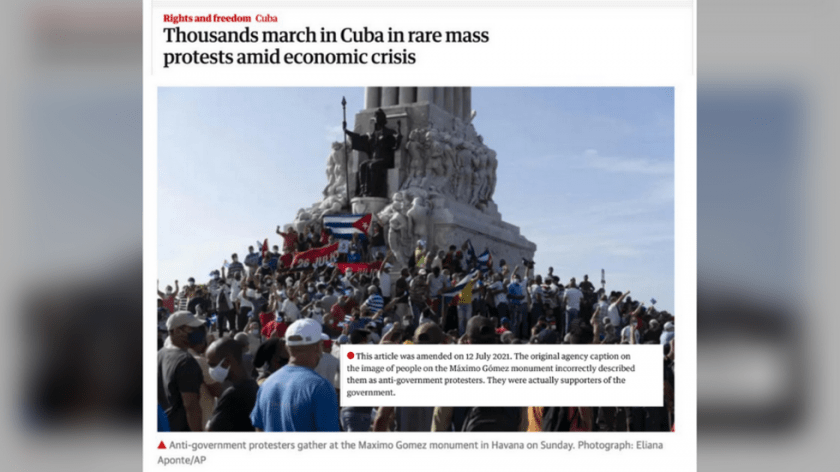
The Guardian and a number of other Western news agencies used erroneously captioned photos of a pro-government protest in Havana, Cuba, presenting it as an opposition rally instead.
© TheGuardian.com / screenshot
RT | July 14, 2021
Several Western news outlets have used an erroneously captioned photo showing a pro-government rally in Cuba, deeming it an opposition protest, while CNN opted for an image of a Miami demonstration instead, raising eyebrows.
Captured by Associated Press photographer Eliana Aponte during a demonstration in support of the government in the Cuban capital on Sunday, the photo has made the rounds in the Western corporate press as unrest grips the Caribbean nation. However, multiple outlets have incorrectly described the image as an “anti-government protest,” including the Guardian, Fox News, the Financial Times, the New York Times, the Washington Times and Voice of America. The latter outlet, the US-government funded VOA, committed the error on two separate occasions.
GrayZone journalist Ben Norton and Alan MacLeod of MintPress News were among the first to note the error, sharing screenshots of several examples. MacLeod suggested the outlets may have simply “copied and pasted” the AP’s original photo caption, replicating the error across multiple agencies.
Both journalists pointed out the red-and-black flags hoisted by demonstrators in the photo, which read “26 Julio,” a reference to Fidel Castro’s 26th of July movement. The organization played a major role in the Cuban Revolution and later formed into a political party, with the two-colored flag becoming a common symbol of support for Cuba’s communist government.
Of the six news outlets cited above, only the Guardian had issued a correction at the time of writing, stating that it amended its story because the “original agency caption on the image… incorrectly described them as anti-government protesters. They were actually supporters of the government.”
The AP image is not the only photo to be misrepresented in Western media coverage. On its Instagram page, CNN also strongly implied that another photo showed Cuban protesters, with its caption reading, in part, “Thousands of Cubans protested a lack of food and medicine.” The image in question was taken by an AFP photographer, and a search through the agency’s photo gallery shows the rally was actually held in Miami, Florida. CNN appears to have omitted the first portion of the AFP caption, which made clear the protest was based in the US.
The photo mix-ups in corporate media have been compounded by a wave of false and misleading posts by observers online, with many users sharing photos of gatherings in Egypt, Spain and Argentina while claiming they depict unrest in Cuba – some racking up thousands of shares.
The anti-state protests kicked off in earnest on Sunday, seeing large crowds of demonstrators take to the streets in Havana and elsewhere to demand urgent action on food, medicine and power shortages. The government, however, claims the rallies are fueled by hostile foreign powers, namely Washington, and involve only a small number of ‘counter-revolutionaries’. President Miguel Diaz-Canal said US sanctions were to blame, arguing that Washington’s “policy of economic suffocation” aimed to “provoke social unrest” in Cuba.
Diaz-Canal also alleged that a “campaign against the Cuban revolution” had kicked off on social media platforms, saying they are “drawing on the problems and shortages we are living.” According to internet monitoring firm NetBlocks, Cuba’s state-run web provider ETECSA has moved to restrict access to certain sites and apps since the bout of unrest erupted on Sunday.
The head of the Cuban Communist Party’s ideological department, Rogelio Polanco Fuentes, also claimed that the country is experiencing an attempt at a “color revolution” or a “soft coup,” drawing a comparison to a failed US-backed uprising in Venezuela back in 2019.
Washington, for its part, has offered rhetorical backing to the protesters, with State Department spokesman Ned Price telling reporters on Tuesday that the government is looking at ways to “support the Cuban people,” though he did not elaborate.
Havana has so far offered few details on the number of arrests made or injuries sustained during the protests, though the Cuban Interior Ministry confirmed that the first death occurred during an anti-government action on Monday. Opposition groups, meanwhile, have alleged that a spate of arrests has targeted protesters, journalists and other activists.
Russiagate all over again: Secret EU report blames Russia for coronavirus ‘confusion, panic and fear’
By Nebojsa Malic | RT | March 17, 2020
When all else fails, blame Russia. That seems to be the EU approach to deflecting blame from its response to the coronavirus pandemic, no doubt because it has worked so well for Democrats in the US or London in the Skripal affair.
As Brussels finally got around to locking down the EU borders on Tuesday, London’s Financial Times ran a ‘bombshell’ story blaming “Russian pro-Kremlin media” for a “significant disinformation campaign” to stoke “confusion, panic and fear” in the West and “aggravate the coronavirus pandemic crisis.”
This is based on a nine-page report by the strategic communications division of the European External Action Service, the EU’s de facto foreign ministry. The EEAS did not officially comment on the FT story.
First things first: “strategic communications” is bureaucrat-speak for public relations, meaning that this report – assuming it is authentic – was produced by the EEAS propaganda division. Secondly, it consists of generalities, cliches and tropes already worn out from four years of “Russiagate” hysteria in the US, down to these alleged efforts being “in line with the Kremlin’s broader strategy of attempting to subvert European societies from within by exploiting their vulnerabilities and divisions.”
It’s almost as if the PR flacks in Brussels plagiarized the work of James Comey, Jim Clapper and John Brennan from the infamous US “intelligence community assessment” blaming Russia for the 2016 election – down to segueing into a diatribe against RT instead of offering evidence.
Whether the EEAS report does so or not, the FT story takes just such a deceptive leap, going on about “Russian state-linked false personas and accounts” before abruptly bringing up the entirely unrelated subject of RT Spanish, whose number of social media shares recently put it “ahead of some big western media outlets.”
How dare they, as Greta Thunberg might say.
This isn’t the first attempt to blame Russia for “disinformation” about the pandemic. The US State Department bandied about one such conspiracy theory just last month. It seems to be the go-to tactic of Western propagandists to deflect criticism from their own governments, whether it’s Theresa May using the “highly likely” Skripal affair to distract from Brexit woes or the US establishment trying to leverage it against President Donald Trump via “Russiagate.” It doesn’t appear to matter that both ultimately failed to achieve their objectives; propaganda always doubles down.
Their insistence on conflating RT with the Russian government deserves a separate analysis, but suffice to say that various Western hacks just can’t seem to comprehend that a news organization will perforce cover a major news topic – which the covid-19 pandemic most certainly is, literally on the global level.
Those looking for “confusion, panic and fear” can find an abundance of them in the pronouncements of their own government officials and health experts, as well as mainstream Western news outlets.
There indeed is an epidemic of fake news about the coronavirus – witness the recent “marshall law” hoax in the US – but what the Eurospooks and FT either missed or chose to ignore is that it has targeted Russia too.
Completely ignoring their erstwhile rhetoric about universal values and global solutions, governments and media across the West are using the pandemic to settle internal political scores, while projecting blame on Moscow in order to deflect it from themselves.
Much like the coronavirus, hypocrisy apparently knows no bounds.
Nebojsa Malic is a Serbian-American journalist, blogger and translator, who wrote a regular column for Antiwar.com from 2000 to 2015, and is now senior writer at RT. Follow him on Twitter @NebojsaMalic
Must… have… oil…
Climate Discussion Nexus | March 11, 2020
The implosion of investment in Canadian energy, most recently the cancellation of the Teck Frontier oilsands mine and Warren Buffett bailing on Quebec’s giant Énergie Saguenay LNG plant, brings home that if all this airy talk of transitioning away from fossil fuels actually lands, it will land on us very hard. (Mind you poor shy Canada finally got the world’s attention, if it’s any consolation.) As Anjli Raval warns in a major piece in The Financial Times, other countries are expanding their capacity as we crush ours because “The world runs on oil.” It accounts for 34% of world energy consumption, followed by its hydrocarbon cousins coal (27%) and natural gas (24%). But, as climate activists are often reminded in vain about their own lifestyles and protest accessories, “the fossil fuel has also quietly seeped into other aspects of our lives: from paint, washing detergents and nail polish to plastic packaging, medical equipment, mattress foams, clothing and coatings for television screens. Last year, global demand reached a record 100 million barrels a day”. And in Canada we’re part of the demand. Just increasingly not the supply.
Raval’s piece is not triumphal. Far from it. She says oil is bad. Bad bad bad. “Even as our thirst for oil seems insatiable, it is becoming politically and environmentally toxic. As the world wakes up to the catastrophic impact of climate change, from rising sea levels and drought to wildfires and crop failure, scientists have warned of a need to rapidly shift away from fossil fuels. Yet when it comes to oil demand, there is little sign of this happening. Our usage has jumped 62 per cent over the course of a few decades — up from 61.6 million b/d in 1986.” Almost as if we didn’t believe all that talk we keep… emitting.
Raval says “How the world can provide abundant energy supplies while dramatically reducing emissions has become one of the defining issues of our time. The challenge is huge. In order to keep global warming ‘well below’ a 2 C increase, the IEA says the world would need to stomach a fall in oil consumption to 67 million b/d by 2040. Environment analysts argue that we need to learn to survive on far lower levels — about 10 million b/d — and ultimately remove it from our energy system entirely.” Ah. Analysts. Cousins of experts.
If the challenge is huge, the response is not. She notes that “Governments are beginning to take some action, from incentivizing the purchase of low emissions vehicles to funding cleaner energy research.” But doing actual stuff that might matter is a lot harder because, wait for it, oil is vital. “While coal and gas are starting to be displaced by lower-cost renewables in electricity generation, oil has a stranglehold over the transport sector, and the petrochemicals industry is a fast-growing consumer of refined products. Aside from the commercial interests of oil-producer nations and corporations, there is a practical question: How will the world function without a material on which we depend so deeply?… Throughout history, energy has been at the heart of how civilizations have prospered.”
In keeping with the realism of half of the piece, she’s very clear that crude oil did wonders to advance prosperity, a sentiment with which we entirely agree. Then she goes unreal: “Yet humanity’s improved well-being has come at the expense of the planet’s. The earth has warmed by 1 C since pre-industrial times and is likely to heat up by another 2 C by the turn of the century — overshooting the targets of the 2015 Paris climate agreement.”
If so, what happens? Well, we all might sort of die. “A 2018 UN Intergovernmental Panel on Climate Change report showed warming beyond 1.5 C risked irreversible changes — from the mass extinction of species to extreme weather and ecosystem changes that threaten global stability.” Scary yet vague. We’re not quite ready to open the sixth seal. But we still commend the piece because it is quite realistic about the situation if not the future.
“Even after the world began moving from coal to other fuels, coal did not disappear. With the emergence of each new source, we have simply added it to the mix rather than replace old ones.” And she quotes Greta Thunberg (who else?) on the urgency of getting not to “net” zero but “real zero”. (Sort of like Canada’s energy industry the way things are going.) But Raval warns, “Cars, trucks and other road vehicles make up more than 40 per cent of global oil usage. When you add in aircraft, ships and trains, transport accounts for about 60 per cent. So any attempt to reduce our oil habit hinges on this sector.” Buildings and industry are also big, so pretty much the stuff that we do that makes us warm, fed and happy or at least entertained. So maybe we can go for “offsets such as planting trees.” It’s gonna take quite a few.
Next Raval makes a daffy claim indeed. She quotes “Jason Bordoff, who heads the Centre on Global Energy Policy at Columbia University” that “Ultimately, the world has to make value judgments about what temperature target it wants to hit.” Value judgements?
To hear the great and good tell it, we already did. We know what temperature target we want to hit. And we’re also arrogant enough to think we don’t just know the ideal temperature (for some reason it’s what we had in 1950, not 1850 or 1150), we also know how to hit it. Except for the tricky bit where we risk turning First World countries into Third World countries and kill vast numbers in Third World countries gone Fourth World by shutting off their path out of poverty because otherwise bad things will happen.
No really. Raval says “The world’s addiction to oil is often compared with tobacco. But while smoking is something people can choose to do, using energy is not…. Yet the cost of climate change could be far greater — and the world is running out of time.”
The piece does at least make plain just how high the cost of giving up oil would be in theory unless and until we find something better. Meanwhile in Canada we’re toying with demonstrating it in practice.
Russian Embassy Slams FT Over Using Unverifiable Data on Kerch Strait Traffic
Sputnik – 18.05.2019
The Russian embassy in the United Kingdom said that the Financial Times news outlet used isolated allegations and unverifiable information in its article claiming that the recently-built bridge over the Kerch Strait allegedly affected vessel traffic in the area.
“We were struck by the unusually low level of journalism demonstrated by your 17 May piece on the Crimea Bridge (‘Russian bridge throttles Ukraine ports’). The authors allowed themselves to be manipulated by isolated allegations and unverifiable figures provided by various Ukrainian interlocutors, while completely ignoring the official statistics of the Kerch Strait traffic. 25,521 ships crossed the Strait from April 2018 till April 2019, with only 8 percent of them having been inspected,” the embassy’s Press Office wrote in its “letter to the Editor of the Financial Times.”
The press service added that 43 percent of the inspected vessels sailed to or from Russian, not Ukrainian ports. An average inspection lasts less than an hour, while the majority of inspections are carried out while the vessels are waiting for caravans to be formed under the local pilotage rules, according to the letter.
“The construction of the Kerch Bridge, 35 meters [115 feet] high, has not resulted in any measurable deterioration of navigation conditions, as the Strait’s depth, at 9.5 meters, does not allow for taller (and thus heavier) ships to cross. The Kerch Strait has always been and remains open to traffic, including for Ukrainian military ships, provided they fulfil the notification procedure, unchanged since Soviet times,” the embassy argued.
The letter concluded by noting it was “regrettable that a paper like the FT should be used as a propaganda tool by those who seek pretexts for reckless military posturing around Crimea.”
In late April, the Ukrainian border service claimed that Russia voluntarily impeded the passage of ships to Ukrainian ports through the strait. The Ukrainian authorities claimed that almost all vessels faced inspections on their way to Ukrainian ports, noting that these checks were longer than usual and the vessels sometimes even were allowed to pass at the very end of the line.
The situation on the Sea of Azov escalated in spring 2018, when Ukrainian border service detained the Nord vessel sailing under the Russian flag. The crew was allowed to return to Russia only six months after the detention while the captain is still in Ukraine. Moreover, last August, another Russian vessel was detained in a Ukrainian port and has since been not allowed to leave.
The Russian authorities have blasted the actions of Ukraine as “naval terrorism” and responded to them by boosting checks at the part of the Sea of Azov under the Russian jurisdiction. The Crimean border service, which is a part of the Russian Federal Security Service, has insisted that it carried out checks in line with international law of the sea and had never received complaints from ship owners.
Featured Video
The Search for Truth: Charlie Kirk’s Assassination One Year Later
or go to
Aletho News Archives – Video-Images
From the Archives
The 9/11 “Double-Cross” Conspiracy Theory
BY LAURENT GUYÉNOT • UNZ REVIEW • SEPTEMBER 6, 2022
Is it true that “9/11 was an inside job”? Yes, insofar as Israel is “inside” the U.S. But for the 9/11 truthers who have identified Israel as the main perpetrators, “9/11 was an inside job” is at best a half-truth, and at worst an integral part of the Zionist operation, like a secondary flag sewn as a lining under the false flag of Islamism. Victor Thorn (1963-2017) wrote in his book 9/11 made in Israel: The Plot Against America (2011): “In essence, the ‘9-11 truth movement’ was created prior to Sept. 11, 2001 as a means of suppressing news relating to Israeli complicity. . . . The slogan ‘9-11 was an inside job’ was quite possibly the greatest example of Israeli propaganda ever devised.” In milder terms, it is “controlled opposition”.
A genuine truth movement would have pointed to Israel as the prime suspect from the start. From day one, it was obvious who would benefit. … continue
Blog Roll
 Aletho News
- Europe’s mounting social chaos… chickens coming home to roost for proxy war against Russia
- US-Russia Diesel Deal Becomes Massive Defeat for Ukraine
- Hormuz and the Looming Economic Catastrophe
- Dhubab offensive, media blitz and the rapid unraveling of Saudi-backed coalition’s new gambit
- Putin Conveys to Trump Iran’s Vision on Possible Conflict Resolution – Kremlin
- The Search for Truth: Charlie Kirk’s Assassination One Year Later
- ‘Harsh reality’: Iran says France seeks monopoly on power and intimidation, not peace for all
- When Will This White House Madness End?
- Huckabee aide goes to ‘unusual lengths’ to portray ‘Israel’ positively
- Trump Announces Diesel Supply Deal With Putin Following Phone Call
- If Americans Knew
- Israeli forces kill another child in Gaza – Daily Update
- Gaza ceasefire exists in name only, say more than 100 organizations
- Nearly 2 Million in Gaza Need Urgent Shelter Assistance as Winter Looms: IOM Chief Warns
- Suppressing Palestinian resistance: US charity under fire for AI monitoring of Gaza classrooms
- Thousands Are Held in Israeli Torture Camps. This Is What Happens Inside
- Israel puts Gaza’s sick, injured, newborn in peril – Daily Update
- Report claimed Mark Levin used by Israeli government to influence Trump
- Over 2,000 Gazans have died awaiting medical evacuation amid Israel’s continued siege
- How a U.S. Diplomat Suppressed and Altered Reports Critical of Israel
- 5 Palestinians Die from Israeli Strikes in Gaza as Relentless Attacks Continue
- No Tricks Zone
- New Study: 50 Years Of The Most Aggressive ‘Net Zero’ Policies Can Only Affect The Global Climate By 0.03°C
- US September “Heat” Was No Record…Many Records Set Decades Ago
- Latest European Green Energy Debacle; Portugal’s Largest Flagship Solar Park Insolvent!
- Green Energy Debacle: German Expert Professor Fritz Vahrenholt Warns Of Severe Economic And Social Consequences
- Two More Paleo Reconstructions Affirm Meters-Higher Sea Levels Across Ireland, Brazil 7000-6000 Years Ago
- New Study: Earth And Venus Surface Warmth Largely Explained By Convection And Lapse Rate, Not CO2 Or Radiation
- 2025 Nature Paper Claiming Worsening Global Drought Gets RETRACTED …Heavily Flawed
- New Study: ‘Global Drought Shows No Detectable Recent Acceleration Under Climate Warming’
- Economic Masterminds: German Socialists Suggest Taxing Productivity Gains Stemming From Using AI
- The South China Sea Has Not Been Cooperating With The Climate Change Narrative

