Bolton wants to sanction ICC judges who probe US war crimes
Press TV – September 10, 2018
White House National Security Adviser John Bolton wants to sanction International Criminal Court (ICC) judges who probe alleged war crimes committed by Americans in Afghanistan, according to reports.
Bolton on Monday will declare the ICC in The Hague “illegitimate” in an attempt to pressure the court which is planning to investigate the alleged US war crimes, according to a draft of his speech obtained by Reuters.
“The United States will use any means necessary to protect our citizens and those of our allies from unjust prosecution by this illegitimate court,” Bolton will say.
Bolton will threaten to punish ICC judges if they proceed with the proposal, the news agency said.
“We will not cooperate with the ICC,” he will say. “We will provide no assistance to the ICC. We will not join the ICC. We will let the ICC die on its own. After all, for all intents and purposes, the ICC is already dead to us.”
The chief prosecutor of the ICC has called for a formal investigation into war crimes in Afghanistan following the US-led invasion of the country in 2001.
“Following a meticulous preliminary examination of the situation, I have come to the conclusion that all legal criteria required to commence an investigation have been met”, said Fatou Bensouda in a statement last year.
“There is a reasonable basis to believe that war crimes and crimes against humanity have been committed,” Bensouda added.
She said US forces and CIA agents might have committed war crimes by torturing detainees in Afghanistan under a system of approved torture techniques, which included simulated drowning.
Human Rights Watch has welcomed the possibility of holding perpetrators to account for what it called horrendous human rights abuses against Afghans.
The United States — under Republican George W. Bush’s presidency — and its allies invaded Afghanistan on October 7, 2001 as part of Washington’s so-called war on terror. The offensive removed the Taliban regime from power, but after more than one and a half decades, the foreign troops are still deployed to the country.
After becoming president in January 2009, President Barack Obama, a Democrat, vowed to end the Afghan war — one of the longest conflicts in US history – but he failed to keep his promise.
Trump, who has spoken against the Afghan war, has dubbed the 2001 invasion and following occupation of Afghanistan as “Obama’s war.”
But Trump has also announced to deploy thousands of more troops to the war-torn country. Trump has said that his views have changed since entering the White House and that he would continue the military intervention “as long as we see determination and progress” in Afghanistan.
Kabul Confirms to Sputnik It Won’t Attend Moscow Conference on Afghanistan
By Ksenia Shakalova – Sputnik – 23.08.2018
MOSCOW – The conference in Moscow will be held amid a conditional ceasefire between the Taliban movement and the Afghan government, which was announced by Afghan President Ashraf Ghani on Sunday.
“We are not going to attend [the Moscow conference]… The peace process should be led by Afghanistan only, only by the Government of the Republic of Afghanistan,” Afghan Foreign Ministry spokesman Sibghatullah Ahmadi told Sputnik on Thursday.
Ahmadi added that it was an independent decision that had nothing to do with Washington.
The spokesman also said that the government already had its own peace council that was working on negotiations with the Taliban.
“Of course we will lead the peace process, but by the way, we have very close relations with Russia and Russia is a big country and a powerful country in the region and one of our friends. And we have very good relations with Russia,” Ahmadi concluded.
On Tuesday, Russia said it had invited officials from 12 countries, including the US, to attend the Moscow-format consultations on Afghanistan. Moscow also confirmed that the Taliban movement expected to participate in the upcoming conference.
A US Department of State official, commenting on the talks, stated that Washington would not take part in the meeting, doubting that the talks would help to establish peace in Afghanistan.
Trump Regime Continues Supporting ISIS
By Stephen LENDMAN | August 18, 2018
US support for ISIS is an open dirty secret – undiscussed by media scoundrels, pretending it’s not so.
Washington actively arms, funds, trains, and directs ISIS and other terrorists – backing the scourge they pretend to oppose.
Obama and Trump’s vow to degrade and destroy ISIS was and remains a bald-faced lie, using these and other cutthroat killers as proxy fighters in Syria and other countries where they’re deployed – their presence unjustifiably justifying illegal US occupation of northeast and southwest Syrian territory.
Last November, Russia’s Defense Ministry said the following:
“The Abu Kamal liberation operation conducted by the Syrian government army with air cover by the Russian Aerospace Force at the end of the last week revealed facts of direct cooperation and support for ISIS terrorists by the US-led ‘international coalition.”
“Americans peremptorily rejected to conduct airstrikes over the ISIS terrorists on the pretext of the fact that, according to their information, militants are yielding themselves prisoners to them and now are subject to the provisions of the Convention relative to the Treatment of Prisoners of War.”
US-led “coalition’s aviation tried to create obstacles for the aircraft of the Russian Aerospace Forces in this area to safely shield militants of the Islamic State.”
“There is indisputable evidence that the United States pretends it is waging irreconcilable struggle against international terrorism in front of the international community, while in reality it provides cover for the combat-ready Islamic State groups to let them regain strength, regroup themselves and advance US interests in the Middle East.”
Washington directly aids ISIS and other terrorist fighters, deploying them where Pentagon commanders want them used, relocating them to new conflict zones in Syria and other countries.
Iran has credible documents showing US support for ISIS. Its armed forces deputy chief of staff Major General Mostafa Izadi earlier said “(w)e are facing a proxy warfare in the region as a new trick by the arrogant (US-led) powers against the Islamic Republic,” adding:
“We possess information showing direct support by US imperialism for (ISIS) in the region which has destroyed Islamic countries and created a wave of massacres and clashes.”
Separately, Iranian Parliament Speaker Ali Larijani condemned Washington for “align(ing) itself with ISIS in the region.”
So-called Syrian Democratic Forces (SDF) are infested with ISIS and other terrorists. Washington’s objective in Syria remains regime change – why the Obama regime launched naked aggression in the country, continued by Trump regime dark forces in charge of Washington’s geopolitical agenda.
A new Security Council report showed renewed ISIS strength in parts of Syria controlled by US forces and allies, saying:
ISIS terrorists have “breathing space to prepare for the next phase of its evolution into a global covert network.”
Aided by the Trump regime and allied forces, they control “small pockets of territory in the Syrian Arab Republic on the Iraqi border.”
Russia’s General Staff earlier accused the Pentagon of training ISIS and other terrorists at its illegally established At Tanf base in southwest Syria – calling it a staging ground for US armed struggle against the Syrian government.
ISIS and other terrorists infest the Rukban refugee camp controlled by US Forces, holding tens of thousands of defenseless Syrians hostage, using the camp to recruit anti-government terrorists.
On August 15, AMN News said US-led forces “transported over 250 trucks filled with weapons (and other military hardware) to the Euphrates River Valley this morning” – intended for Syrian Democratic Forces terrorists in Deir Ezzor province, adding:
Washington is “expand(ing) (its) bases and airports in northern and eastern Syria” – indicating US forces will remain in the country, not leave, as Trump earlier said.
Separately on August 18, AMN News said Washington and its allies “sent reinforcements to their military bases in the towns of Tal Tamer, Al-Houl, and Al-Shaddadi.”
Syria’s liberating struggle continues, no end of it in sight as long as US regime change intentions remain unchanged.
Trump’s sanctions on Iran dig deeper grave for US forces in Afghanistan
By Finian Cunningham | RT | August 16, 2018
The dramatic, and seemingly unstoppable, surge of Taliban offensives across Afghanistan is proof that the US is fast becoming the latest foreign power to succumb to failure in a land known for for being the “graveyard of empires”.
But unlike past empires defeated in Afghanistan, the US stands out as singularly contributing to its own ill-fate through excessive blundering and its legacy of criminal duplicity.
In particular, Washington’s obsession with confronting neighboring Iran and plotting regime change in Tehran could well be the tipping point in Afghanistan. The point, that is, where the US tips itself into a strategic, military grave it has been digging in Afghanistan over the past two decades.
After 17 years of US military occupation costing the US taxpayer trillions of dollars, the Taliban insurgents seem to be able to launch spectacular attacks at will against the Washington-backed government in Kabul. By any measure, that portends a historic defeat for Washington’s imperial ambitions. And not just in Afghanistan.
Over the past week, a strategic city, Ghazni, only 150 kms south from the capital was under Taliban occupation for several days before the militants appeared to make a tactical retreat to surrounding areas.
Then in the capital, Kabul, on Thursday, the Taliban mounted a gun battle on a military-intelligence training base, as if to underline the ineffectualness of US-backed security forces. A military intelligence base caught in a surprise attack?
Further north, in Faryab province, an Afghan National Army base was reportedly over-run by militants with the apparent loss of 30 troops and the remaining 70 captured. Provincial elders said the base was easily captured by the Taliban because it lacked reinforcements, ammunition and food. So much for US support.
Recall that Afghanistan was supposed to be the “Soviet Union’s Vietnam”. That was how US planners like Zbigniew Brzezinski gleefully referred to Afghanistan and their nefarious scheme to inflict on the Soviets what the US had ignominiously suffered in Vietnam only a few years earlier. In 1979, Soviet troops were lured into the Central Asian country to prop up an allied government in Kabul coming under attack from US-backed tribal fighters, the Mujahideen.
Like British imperial troops a century before, the Soviets suffered defeat in the rugged mountains of Afghanistan at the hands of fearless fighters.
Of course, the Soviets were not just up against Afghans. The CIA had weaponized the Mujahideen with Stinger anti-aircraft missiles and other sophisticated munitions. Along with Britain’s MI6, the Saudis and Pakistani military intelligence, the Afghan insurgents were turned into a jihadist army which later evolved into the Al Qaeda terror network.
The irony is, however, that the “Soviet Vietnam” has now turned into another US quagmire – an American Vietnam redux.
Following the September 11 terror attacks in 2001 on New York City and Washington DC, the George W Bush administration rushed into Afghanistan in an act of revenge against Al Qaeda – the very organization that the Americans had earlier helped create.
Nearly 17 years later, the US military is still bogged down in Afghanistan with no viable exit plan in sight. The war is officially America’s longest war, surpassing the duration of the Vietnam War (1964-75).
Although US casualties are much less than was incurred in Southeast Asia, the financial cost of Afghanistan to the US economy is crippling, estimated to be up to $5 trillion, along with the Iraq war. That’s a quarter of the US total national debt of $21 trillion.
US military operations were officially supposed to end in 2014 during the Obama administration. When Donald Trump ran for the presidency in 2016, one of his winning pledges to voters was to scale back US wars. Last year, however, Trump acceded to Pentagon advice to revamp military involvement in Afghanistan, albeit under the guise of “training and support” for local forces.
As this past week’s audacious attacks by the Taliban demonstrates, the US-backed government forces are fighting a losing war. Vast areas of the country are outside of their control. Even the capital appears vulnerable to heavily-mounted raids.
Moreover, the situation can only get worse for the US and its Afghan surrogates.
What may be a decisive factor is the Trump administration’s criminal policy of aggression towards neighboring Iran. In myopic fashion, Washington’s desire to squeeze Iran with “crushing” economic sanctions is liable to rebound, by significantly worsening the security conditions in Afghanistan for US-backed forces.
That’s because as the US imposes tougher sanctions on Iran, following Trump’s abandonment of the international nuclear treaty in May this year, the deteriorating Iranian economy will have a direct deleterious impact on Afghanistan. Thousands of migrant Afghan workers rely on Iran for employment. Their salary remittances are reportedly a major lifeline for families back in Afghanistan.
With the Iranian economy already faltering under US sanctions, droves of unemployed expatriate Afghan workers can be expected to pack up and leave, cutting off the remittances that sustain much of Afghanistan’s economy.
A further impact from Washington’s sanctions on Iran is that landlocked Afghanistan will not be able to avail of Iranian sea ports for imports and exports. Trump is threatening secondary sanctions on any country continuing to do business with Iran. Unless, the US gives Afghanistan a waiver, it will be cut off from commercial ties with Iran and its trading routes to the Indian Ocean.
So, as the US-imposed economic pressure on Iran intensifies through ratcheting up of sanctions – Washington wants a total oil embargo by November – the inevitable result will be worsening social conditions in Afghanistan for the general population there. That lamentable outcome, it is reasonable to assume, will only boost popular support for the Taliban, making the US-backed Afghan forces even more insecure and ineffectual in their operations.
A third factor is that Iran could exercise a more malicious option by increasing military support covertly to the Taliban. Iran is reckoned to have developed a formidable arsenal of advanced missile technology. This week, for example, Tehran showcased a new radar-evading ballistic missile.
Given that the Americans are trying to destroy the Iranian government through vicious economic measures, it would not be at all surprising if Tehran fought back by supplying the Taliban fighters with devastating fire power to hit US forces.
Thus, by running a sanctions vendetta against Iran in the calculation that the economic pain might elicit social unrest and regime change, Washington is likely to end up inflicting serious blowback on its military campaign in Afghanistan.
America’s longest overseas war could turn out to be its most ignominious and wasteful. That’s saying something given the dozens of dirty wars that the US has engaged in over the past century. The repercussions for US global standing cannot be underestimated.
It not only ran a nearly two-decade war in Afghanistan, which was arguably illegal from the very outset, resulted in tens of thousands of casualties and was financially ruinous for the US economy, but the supposed almighty US power will have been defeated in the graveyard of empires largely by its own criminality, stupidity and arrogance.
Finian Cunningham (born 1963) has written extensively on international affairs, with articles published in several languages. Originally from Belfast, Northern Ireland, he is a Master’s graduate in Agricultural Chemistry and worked as a scientific editor for the Royal Society of Chemistry, Cambridge, England, before pursuing a career in newspaper journalism. For over 20 years he worked as an editor and writer in major news media organizations, including The Mirror, Irish Times and Independent. Now a freelance journalist based in East Africa, his columns appear on RT, Sputnik, Strategic Culture Foundation and Press TV.
Taliban Praises Recent Talks With Washington as ‘Very Helpful’
Sputnik – August 13, 2018
The Arch enemies entered into talks following the successful implementation of a three-day ceasefire in June for the Muslim holiday of ‘Eid al-Fitr.’
A Senior Taliban official has described peace talks held last month with the US as “very helpful” in envisaging a path out of Afghanistan’s seventeen year old war.
The leader, from an organisation within the Taliban called ‘Quetta Shura,’ has been quoted as saying that both sides intend to hold the next round of talks in September, and that these “will be more specific and focused on key issues.” He also added that, “once the breakthrough is started it will be stunning for all.”
The comments come on the heels of a string of reports since the end of July, which describe an unprecedented face-to-face meeting held in the Qatari capital, Doha, between a Taliban delegation and officials from the US State Department, led by senior diplomat Alice Wells. Representatives from the Islamist insurgency were quick to laud discussions at that time too, describing them as “very positive.”
While Washington officials with detailed knowledge of the negotiations remain tight-lipped, Taliban delegates who were in attendance let a few of the specifics loose: allegedly, a key US demand is for Washington to maintain a military presence in Afghanistan while peace talks are ongoing. While initially hostile to such a suggestion, reports suggest that the insurgency’s leadership council has since suggested that it could be open to the idea on the condition that the US plays an active political role in the peace process.
The Taliban has long refused to hold discussions with Ashraf Ghani’s government in Kabul until it is given the opportunity for direct talks with the US. However, leading talks for reconciliation between the central government in Kabul and the Taliban has long been anathema to Washington, which has maintained that it would not heavily involve itself in “Afghan-led, Afghan-owned” negotiations. Echoing that sentiment in early July, Secretary of State Mike Pompeo proclaimed that the Trump administration would “support, facilitate and participate in peace discussions, but peace must be decided by the Afghans and settled among them.”
Yet, as time has ticked by, reports suggest that President Donald Trump has grown impatient with the tactical stalemate on the ground and NATO’s inability to retake chunks of territory controlled by the Taliban. According to the Special Inspector General for Afghanistan Reconstruction, as of January 30 2018, approximately 56.3% of Afghanistan was under the Taliban’s sway. Frustration at such a reality may have culminated in the US president’s decision to dispatch envoys to Afghanistan in early July to open up channels for backdoor diplomacy.
The US’ sudden willingness to sit down with the Taliban has likely been bolstered by the group’s apparent commitment to extirpating foreign terrorist groups from Afghan territory — namely Daesh. This month, a Taliban onslaught reportedly caused 200 Daesh fighters to surrender in the North of the country. Additionally, the group are advancing on a Daesh stronghold in the eastern province of Nangarhar, where a large-scale battle is expected to take place.
Despite the optimism among the Taliban’s echelon, fighting with the Afghan Security Forces continues unabated. In the early hours of Friday, the group’s fighters launched an assault for control of the eastern city of Ghazni. According to the country’s 1TV television station, so far 100 people have been killed. In an effort to repel the advance, the US Air Force launched a series of air strikes on Taliban positions, raising questions as to how likely it is that these old foes are ready to sit down at the negotiating table.
Taliban cross the Rubicon
By M K Bhadrakumar | Indian Punchline | August 12, 2018
The Uzbekistan Foreign Ministry announced in a terse statement on Saturday that a Taliban delegation led by the head of its political office in Doha, Sher Mohammad Abbas Stanakzai visited Tashkent last week and the two sides “exchanged views on prospects of the peace process in Afghanistan.”
The Taliban has been somewhat more forthcoming with details. A press statement said that the 5-day visit (August 6-11) took place on the basis of a “formal invitation” from Tashkent and talks were held with Foreign Minister Abdul Aziz Kamilov and the Special Representative of the President of Uzbekistan for Afghanistan Ismatulla Irgashev. The press release added that the two sides “discussed current and future national projects such as security for railroad and power lines,” apart from exchanging views “about the withdrawal of foreign forces and how to achieve peace in Afghanistan.”
The Uzbeks have had direct dealings in the past with the Taliban. Kamilov himself is known to have visited Afghanistan and negotiated with the Taliban government in the late 1990s. Irgashev, too, is a familiar face to the Taliban, having served as deputy foreign minister under Kamilov. But this is the first time that a Taliban delegation has been invited to visit Tashkent for formal talks at the Uzbek Foreign Ministry.
This is an extraordinary development. It significantly enhances Taliban’s regional profile and standing and is precedent setting.
The relations between Tashkent and the Afghan government led by Ashraf Ghani have been exceptionally warm of late. The bilateral exchanges intensified in the past year with Uzbek companies picking up lucrative contracts in northern Afghanistan. The US has actively encouraged such collaboration. Most certainly, Washington promoted the Tashkent Conference on Afghanistan on March 27, which was attended among others by Russian Foreign Minister Sergey Lavrov and the US Undersecretary of State Thomas Shannon. The event was intended to marshal some degree of regional consensus behind an “Afghan-led, Afghan controlled” peace process without any preconditions regarding the presence of US troops in Afghanistan.
As a gesture of gratitude, President Donald Trump rewarded Uzbek President Shavkat Mirziyoyev with an invitation to visit the White House on May 16, the first-ever visit of that kind. Indeed, things have been going splendidly well in the US-Afghan-Uzbek triangle. During a visit to Kabul on July 9 Kamilov discussed with Ghani several big investment projects such as a free trade zone spread over 3000 hectares on the Uzbek-Afghan border, a $500 million railway project to connect Mazar-i-Sharif with Herat (linking northern and western Afghanistan), establishment of 6 textile factories in Afghanistan by Uzbek companies and so on.
However, the Uzbeks have a reputation for making their foreign policy moves very cautiously and therefore, the meeting in Tashkent last week should not be seen as signifying a shift in the Uzbek policies toward Afghanistan.To be sure, Tashkent has closely coordinated with Kabul and Washington. Interestingly, Kamilov also had made a phone call to Lavrov on July 31. The crisply worded readout from the Russian Foreign Ministry merely said that the two ministers “exchanged opinions on topical bilateral matters and cooperation between Russia and Uzbekistan on the international agenda.” Quite obviously, consistent with the Uzbek style of diplomacy, Tashkent touched base with Moscow before the Taliban arrived.
Ostensibly, therefore, Tashkent is following up on the offer made by Mirzoyiev after the Tashkent conference in March when he had said: “We stand ready to create all necessary conditions, at any stage of the peace process, to arrange direct talks between the government of Afghanistan and Taliban movement.” Clearly, Washington has encouraged Tashkent to be a peace broker between the Afghan government and the Taliban. Following the first-ever direct talks between the Taliban and US officials at Doha last month, a second round is expected in September. The meeting at Tashkent comes in between.
However, it is highly improbable that the Taliban will accept Ghani as its interlocutor. Tashkent must be quite aware of the strong undercurrents in regional politics as well. Therefore, trust Tashkent to have made its own calculations in self-interest, too.
The point is, there is dire necessity today for Tashkent to maintain a direct line to the Taliban. The security situation in the Amu Darya region bordering Uzbekistan is steadily deteriorating. The growing presence of Islamist State-Khorasan (ISK) in northern Afghanistan worries Uzbekistan, since its ranks have a preponderance of fighters drawn from the radical Islamic Movement of Uzbekistan, which is sworn to establish an Islamic Caliphate in Central Asia.
Meanwhile, Ghani’s ill-advised standoff with the ethnic Uzbek leader in Amu Darya, Rashid Dostum (who was forced into exile in Turkey for a year and was prevented from returning. Dostum’s prolonged absence seriously destabilized the northern region, which also worked to the advantage of the ISK. Ghani finally made peace with Dostum and beseeched him to return – and eventually went overboard by giving him a grand ceremonial welcome on arrival in Kabul last month. But the ground realities in northern Afghanistan have changed phenomenally. The old stability that Dostum provided has disappeared.
There was a time in the 1990s when the Uzbek leadership of late president Islam Karimov had regarded Dostum as its Praetorian guard in the Amu Darya region. He used to be lionized and lavishly funded by the Uzbek intelligence during his regal visits to Tashkent. But Tashkent summarily dumped him once the US moved into Afghanistan in 2001 and co-opted him as their warlord. (The US too subsequently dumped him.)
In sum, Dostum is today a freewheeling entity available to the highest bidder and is no more the uncrowned king of the Amu Darya. And yet, he is still locked in a blood feud with the Taliban dating back to 2001 when in a bloody massacre he slaughtered a few thousands Taliban fighters who had surrendered in the northern provinces following the US intervention and were assured of safe passage to Pakistan.
Tashkent seems disinterested in Dostum. On the other hand, the Taliban have emerged today as the most promising counterweight to the ISK in the Amu Darya region. In such murky situations, Tashkent never loses clarity of purpose. Realism always prevails. Conceivably, Tashkent is beginning to see the Taliban as the most meaningful Afghan interlocutor for today and tomorrow – and, perhaps, forever.
Of course, for Taliban, this is like hitting the jackpot. The invitation from the foreign minister of an important neighboring country to hold direct talks is a novel experience. It is a game changer, no doubt. The Taliban have crossed the Rubicon in their long search for gaining international legitimacy.
Marching for Peace: From Helmand to Hiroshima
By Maya Evans | Dissident Voice | August 5, 2018
I have just arrived in Hiroshima with a group of Japanese “Okinawa to Hiroshima peace walkers” who had spent nearly two months walking Japanese roads protesting U.S. militarism. While we were walking, an Afghan peace march that had set off in May was enduring 700km of Afghan roadsides, poorly shod, from Helmand province to Afghanistan’s capital of Kabul. Our march watched the progress of theirs with interest and awe. The unusual Afghan group had started off as 6 individuals, emerging out of a sit-in protest and hunger strike in the Helmand provincial capital Lashkar Gah, after a suicide attack there created dozens of casualties. As they started walking their numbers soon swelled to 50 plus as the group braved roadside bombs, fighting between warring parties and exhaustion from desert walking during the strict fast month of Ramadan.
The Afghan march, which is believed to be the first of its kind, is asking for a long-term ceasefire between warring parties and the withdrawal of foreign troops. One peace walker, named Abdullah Malik Hamdard, felt that he had nothing to lose by joining the march. He said: “Everybody thinks they will be killed soon, the situation for those alive is miserable. If you don’t die in the war, the poverty caused by the war may kill you, which is why I think the only option left for me is to join the peace convoy.”
The Japanese peace walkers marched to specifically halt the construction of a U.S. airfield and port with an ammunition depot in Henoko, Okinawa, which will be accomplished by landfilling Oura Bay, a habitat for the dugong and unique coral hundreds of years old, but many more lives are endangered. Kamoshita Shonin, a peace walk organizer who lives in Okinawa, says:
People in mainland Japan do not hear about the extensive bombings by the U.S. in the Middle East and Afghanistan, they are told that the bases are a deterrent against North Korea and China, but the bases are not about protecting us, they are about invading other countries. This is why I organised the walk.
Sadly, the two unconnected marches shared one tragic cause as motivation.
Recent U.S. war crimes in Afghanistan include the deliberate targeting of civilian wedding parties and funerals, incarceration without trial and torture in Bagram prison camp, the bombing of an MSF hospital in Kunduz, the dropping of the ‘Mother of all bombs’ in Nangarhar, illegal transportation of Afghans to secret black site prisons, Guantanamo Bay prison camp, and the extensive use of armed drones. Elsewhere the U.S. has completely destabilised the Middle East and Central Asia, according to The Physicians for Social Responsibility, in a report released in 2015, stated that the U.S. interventions in Iraq, Afghanistan and Pakistan alone killed close to 2 million, and that the figure was closer to 4 million when tallying up the deaths of civilians caused by the U.S. in other countries, such as Syria and Yemen.
The Japanese group intend to offer prayers of peace this Monday at Hiroshima ground zero, 73 years to the day after the U.S. dropped an atomic bomb on the city, instantly evaporating 140,000 lives, arguably one of the worst ‘single event’ war crimes committed in human history. Three days later the U.S. hit Nagasaki instantly killing 70,000. Four months after the bombing the total death toll had reached 280,000 as injuries and the impact of radiation doubled the number of fatalities.
Today Okinawa, long a target for discrimination by Japanese authorities, accommodates 33 U.S. military bases, occupying 20% of the land, housing some 30,000 plus U.S. Marines who carry out dangerous training exercises ranging from rope hangs suspended out of Osprey helicopters (often over built-up residential areas), to jungle trainings which run straight through villages, arrogantly using people’s gardens and farms as mock conflict zones. Of the 14,000 U.S. troops currently stationed in Afghanistan, many to most would have trained on Okinawa, and even flown out directly from the Japanese Island to U.S. bases such as Bagram.
Meanwhile in Afghanistan the walkers, who call themselves the ‘People’s Peace Movement’, are following up their heroic ordeal with protests outside various foreign embassies in Kabul. This week they are outside the Iranian Embassy demanding an end to Iranian interference in Afghan matters and their equipping armed militant groups in the country. It is lost on no-one in the region that the U.S., which cites such Iranian interference as its pretext for building up towards a U.S.-Iran war, is an incomparably more serious supplier of deadly arms and destabilizing force to the region. They have staged sit-in protests outside the U.S., Russian, Pakistani and U.K. embassies, as well as the U.N. offices in Kabul.
The head of their impromptu movement, Mohammad Iqbal Khyber, says the group have formed a committee comprised of elders and religious scholars. The assignment of the committee is to travel from Kabul to Taliban-controlled areas to negotiate peace.
The U.S. have yet to describe its long term or exit strategy for Afghanistan. Last December Vice President Mike Pence addressed U.S. troops in Bagram: “I say with confidence, because of all of you and all those that have gone before and our allies and partners, I believe victory is closer than ever before.”
But time spent walking doesn’t bring your destination closer when you don’t have a map. More recently U.K. ambassador for Afghanistan Sir Nicholas Kay, while speaking on how to resolve conflict in Afghanistan said: “I don’t have the answer.” There never was a military answer for Afghanistan. Seventeen years of ‘coming closer to victory’ in eliminating a developing nation’s domestic resistance is what is called “defeat,” but the longer the war goes on, the greater the defeat for Afghanistan’s people.
Historically the U.K. has been closely wedded to the U.S. in their ‘special relationship’, sinking British lives and money into every conflict the U.S. has initiated. This means the U.K. was complicit in dropping 2,911 weapons on Afghanistan in the first 6 months of 2018, and in President Trump’s greater-than-fourfold average increase on the number of bombs dropped daily by his warlike predecessors. Last month Prime Minister Theresa May increased the number of British troops serving in Afghanistan to more than 1,000, the biggest U.K. military commitment to Afghanistan since David Cameron withdrew all combat troops four years ago.
Unbelievably, current headlines read that after 17 years of fighting, the U.S. and Afghan Government are considering collaboration with the extremist Taliban in order to defeat ISKP, the local ‘franchise’ of Daesh.
Meanwhile UNAMA has released its mid-year assessment of the harm done to civilians. It found that more civilians were killed in the first six months of 2018 than in any year since 2009, when UNAMA started systematic monitoring. This was despite the Eid ul-Fitr ceasefire, which all parties to the conflict, apart from ISKP, honoured.
Every day in the first six months of 2018, an average of nine Afghan civilians, including two children, were killed in the conflict. An average of nineteen civilians, including five children, were injured every day.
This October Afghanistan will enter its 18th year of war with the U.S. and supporting NATO countries. Those young people now signing up to fight on all sides were in nappies when 9/11 took place. As the ‘war on terror’ generation comes of age, their status quo is perpetual war, a complete brainwashing that war is inevitable, which was the exact intention of warring decision makers who have become exceedingly rich of the spoils of war.
Optimistically there is also a generation who are saying “no more war, we want our lives back”, perhaps the silver lining of the Trump cloud is that people are finally starting to wake up and see the complete lack of wisdom behind the U.S. and its hostile foreign and domestic policies, while the people follow in the steps of non-violent peace makers such as Abdul Ghafoor Khan, the change is marching from the bottom up.

Okinawa to Hiroshima Peace Walk (Photo by Maya Evans)
Maya Evans coordinates Voices for Creative Nonviolence UK and has visited Afghanistan 9 times since 2011. She is a writer and a Councillor for her town in Hastings, England.
Taliban claims victory over ISIS fighters in NW Afghanistan
RT | August 1, 2018
More than 150 Islamic State (IS, formerly ISIS) fighters surrendered to Afghan security forces in the northwestern province of Jawzjan after they were defeated and driven out by the Taliban, government officials and Taliban said on Wednesday.
The defeat represents a major setback for the group. IS first appeared in eastern Afghanistan around four years ago and gained a foothold in southern Jawzjan, where it fought for control of smuggling routes into neighboring Turkmenistan, Reuters reports.
“The evil phenomenon of [IS] has completely been eliminated and people have been freed from its tortures in Jawzjan province of Afghanistan,” Taliban spokesman Zabihullah Mujahid said.
The Taliban launched an offensive several weeks ago in Jawzjan against the group, which they oppose as much as they do the Western-backed government in Kabul.
Featured Video
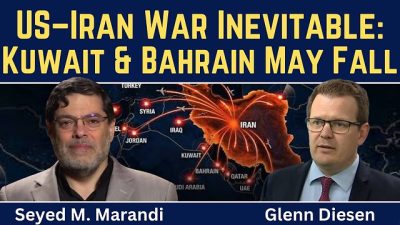
Seyed M. Marandi: US-Iran War Inevitable: Kuwait and Bahrain May Fall
or go to
Aletho News Archives – Video-Images
From the Archives
Oil and the Israel Lobby
Reknowned economist M. Shahid Alam offers this excellent critique of Noam Chomsky’s defective analysis of the relative influence of Oil versus the Israel lobby over US foreign policy: … continue
Blog Roll
 Aletho News
- ICC ignored ‘very well-documented’ NATO crimes – ex-Libyan minister
- SNSC secretary dismisses US response to Iran’s conditions as ‘inadequate’
- Sanaa says Taiz roads open, secure for residents, warns Saudi forces
- Iraqi resistance group urges Saudi leadership to admit defeat, lift Yemen siege
- Trump’s Retreat: How Al-Aqsa Flood Took Down the US Empire
- Israel’s Military Actions in Lebanon Grossly Violate International Law — Lavrov
- Seyed M. Marandi: US-Iran War Inevitable: Kuwait and Bahrain May Fall
- Leaders Condemn Ansarallah Attack on Saudi Arabia While Ignoring Illegal War Against Yemen
- Leaked: Britain’s Covert Iraqi Psyops Network
- Yemeni Armed Forces Warn Airlines Against Using Saudi Airports, Exempt Mecca and Medina
- If Americans Knew
- After Oct 7, IDF policy allowed civilian casualties for even the lowest-ranking targets
- Israel’s Destruction of Southern Lebanon Intensified After the Cease-Fire
- The Last-Minute Decision That Gave Israel Its Name
- The American Conservative: How Trump Made the World Go Nuclear
- Meet the US generals and admirals advancing Israeli policy
- Opinion: Why news organizations should boycott Israel
- The Israeli witch hunt of Sami Abu Shehadeh exposes the lie of the ‘Jewish and democratic’ state
- No state has a ‘right’ to exist – least of all Israel
- Testimonies about Gaza’s civilian death toll expose Israel’s atrocities – Daily Update
- How Israel Conquered the Latin American Right
- No Tricks Zone
- New Study Suggests Large Regions Of The Pacific Ocean Have Been Cooling For The Last 80 Years
- Germany’s Green Energy Debacle: High Energy Costs Force Kahla Porzellan to Close After 182 Years!
- New Study: 50 Years Of The Most Aggressive ‘Net Zero’ Policies Can Only Affect The Global Climate By 0.03°C
- US September “Heat” Was No Record…Many Records Set Decades Ago
- Latest European Green Energy Debacle; Portugal’s Largest Flagship Solar Park Insolvent!
- Green Energy Debacle: German Expert Professor Fritz Vahrenholt Warns Of Severe Economic And Social Consequences
- Two More Paleo Reconstructions Affirm Meters-Higher Sea Levels Across Ireland, Brazil 7000-6000 Years Ago
- New Study: Earth And Venus Surface Warmth Largely Explained By Convection And Lapse Rate, Not CO2 Or Radiation
- 2025 Nature Paper Claiming Worsening Global Drought Gets RETRACTED …Heavily Flawed
- New Study: ‘Global Drought Shows No Detectable Recent Acceleration Under Climate Warming’

