COVID SHOTS FLAGGED FOR PARALYTIC SYNDROME
The Highwire with Del Bigtree | June 2, 2022
MEMO | June 22, 2022
Tanzania’s Maasai people have faced a violent crackdown from police over the past two weeks, amid plans to evict them from their ancestral homeland in parts of the Serengeti National Park to make way for trophy hunting and conservation zones.
Human rights organisations and the Maasai people have accused Tanzanian police of using teargas, live bullets and beating protestors who oppose the planned development in the Ngorongoro district near the village of Ololosokwani.
So far, at least 700 Maasai villagers have fled across the border to neighbouring Kenya as refugees, while dozens have been wounded by police. The response by the Tanzanian authorities has been condemned by the African Commission on Human Rights and Peoples’ Rights who called on the government to halt the ongoing forcible evictions and to open independent investigations into the violence against the Maasai people who should be consulted and allowed to review plans to establish the conservation area.
According to a report by Al Jazeera last week, the protests erupted after police began to demarcate 1,500 square kilometres (540 square miles) of land to make way for the reserve, to be operated by a UAE-owned company.
The government denies accusations that it is trying to evict the Maasai from their ancestral land, and has claimed they will still have access to 2,500 square kilometres of it.
The East African Court of Justice is to rule on a legal challenge to the planned evictions, but is likely to rule in favour of the controversial move, which could displace up to 70,000 people but will be a major contribution to the country’s vital tourism sector.
By Lucas Leiroz | June 22, 2022
Apparently, Volodymir Zelensky’s popularity in Ukraine is very low. The Ukrainian leader called for a virtual diplomatic meeting with African heads of state, but the event failed completely. Almost all African leaders declined to participate, hampering Zelensky’s plans to make the meeting a pro-Kiev propaganda stage. Meanwhile, the Russian government’s popularity is growing in Africa, where citizens take the streets in support for the special military operation in Ukraine and ask for Russian help in combating terrorism.
On June 20, the Ukrainian president met with representatives of the African Union in order to discuss matters concerning the current conflict situation in Eastern Europe and the role of Africa on the world arena. Of the fifty-five heads of state invited to the meeting, only four attended. The other countries sent only diplomats or ministers, with the heads of state and government not willing to attend, even with the meeting being virtual.
The heads of state who attended the meeting were Macky Sall of Senegal, Alassane Ouattara of Côte d’Ivoire, Mohammed el-Menfi, President of the Libyan Council, and Denis Sassou Nguesso of Congo. It is important to note that Sall is the current president of the African Union, which is why his presence was essential for the event to take place. Therefore, his attendance does not necessarily mean an expression of his real desire – even more considering his recent conversations with Russian President Vladimir Putin and the effort to increase Russia-Africa cooperation.
The virtual meeting was operated in secret, behind closed doors. According to official sources, Zelensky reiterated the Ukrainian position on the conflict, calling the Russian operation an unjustified “aggression”. He also commented on the current food crisis affecting Africa as a result of the conflict’s impact on the grain market. According to Zelensky, the African continent is Russia’s “hostage” because food shortages would be the result of such “aggression” and would only end when Russia decided to retreat.
Commenting on the event, Macky Sall took the most neutral and impartial stance possible, demonstrating that the Africa Union did not adhere to Zelensky’s appeals, but was concerned only with African states’ interests and the proper functioning of international law.
“Africa remains committed to respecting the rules of international law, the peaceful resolution of conflicts and the freedom of trade”, he said in a publication in his Twitter account.
It is interesting to note how Zelensky’s attempt to convince African leaders to adhere to the Kiev-Western narrative absolutely failed. Not only did most African heads of state refuse to listen to the Ukrainian leader, but there was no adherence to the pro-Kiev speech on the part of those who attended the conference. For the African Union, the meeting was just a diplomatic formality, with no real gains or changes in position – which reveals that Zelensky’s plans did not work as expected.
This failure, however, was predictable for any realistic analyst. For African leaders, it is really hard to believe the fallacious narrative that Ukraine is a simple “victim” of an “unjustified aggression”. African countries are used to centuries of Western interventionism and violence and the peoples of this continent react to this with strong distrust of everything that Western nations support. As Zelensky is the ally of the US and Europe, he will likely be viewed with suspicion by countries that suffer so much from Western colonialist mentality and praxis.
In addition, there are other factors that need to be mentioned. Zelensky’s arguments that the food crisis is caused exclusively by Russia are no longer able to convince public opinion and state authorities. It is evident that, more than the conflict itself, the crisis has been caused by the sanctions against Russia, which motivates emerging countries to be enthusiastic about the end of these sanctions. Also, there are many reports that Kiev is exporting grain to the US and Europe in exchange for weapons, which is unacceptable.
Furthermore, there has recently been a strong wave of popular support for the operation in Ukraine from citizens of several African countries, especially in the regions most affected by terrorism. After the abandonment that Africa has suffered from the West in terms of security policies and defense cooperation, seeking Russian support has become the greatest hope for the members of the African Union, which is why recently there have been popular demonstrations in support of all Moscow’s actions, alongside requests for help to solve Africa’s internal problems.
In fact, in international relations, nothing matters more than cooperation. Zelensky will not be able to garner African support if he does not show interest or conditions to cooperate with Africa. Kiev currently has nothing to offer African countries, as it is economically broken and militarily virtually neutralized. On the other hand, Russia shows itself as a pillar for African food security and as a hope against terrorism in the continent. It is absolutely expected that in this context the African Union will decline its ties with Kiev and seek to approach the side that offers the best opportunities for cooperation.
Lucas Leiroz is a researcher in Social Sciences at the Rural Federal University of Rio de Janeiro; geopolitical consultant.
Rich, privileged (white) eco-fanatic says her group is thinking about “how to blow up” huge African oil pipeline!
By P Gosselin – No Tricks Zone – 14. June 2022
Most of Europe’s climate activists come from rich families, who lavish in all the amenities the fossil fuel economy offers. No exception to this are Sweden’s Greta Thunberg, and Luisa “Longhaul” Neubauer of Germany.
Not only are they spoiled rich, leading pampered lives, but they’re also becoming dangerously fanatic it appears and even feel entitled to tell poor countries what they can and cannot have.
Recently Longhaul Luisa, spokesperson for Fridays for Future Germany, posted Sunday on Instagram with her Fridays for Future mates joking how right now they are planning on how to blow up” an African oil pipeline that will immensely improve the lives of among the world’s most needy.
“Of course we are thinking about how to blow up” the longest crude oil pipeline in the world, she professed on Instagram on Sunday.
Much needed Uganda-Tanzania pipeline
In the posted video, Neubauer is referring to the East African Crude Oil Pipeline (EACOP). The EACOP is currently under construction and, once completed, will transport crude oil from Uganda to Tanzania. It will be around 1,400 kilometers long and deliver around 216,000 barrels of oil per day.
White activists kicking Africans in the face?
We assume that Luisa and her crazed FFF radical group would be content to see poor Africans be denied even just a tiny fraction of the pampered life she herself is privileged to follow. She tells of the pipeline in the video: We’re going to stop that one.”
Press TV – June 8, 2022
Ukraine has rejected calls from Russia to de-mine its ports around the Black Sea to resume grain shipments, accusing Moscow of trying to “attack” the port of Odessa, the largest seaport in the crisis-stricken country.
Sergiy Bratchuk, a spokesman for Odessa’s regional administration, in a statement on Wednesday, noted that Russia “dreams of parachuting troops” into the city and that Moscow’s army “wants to attack” Odessa.
“The moment we clear access to the port of Odessa, the Russian fleet will be there,” Bratchuk said. He had earlier said that any exports from Odessa must be “escorted by NATO countries.”
His remarks followed a statement by Russian Foreign Minister Sergei Lavrov on Wednesday about de-mining the Ukrainian ports.
“To solve the problem, the only thing needed is for the Ukrainians to let vessels out of their ports, either by de-mining them or by marking out safe corridors, nothing more is required,” Lavrov said.
Speaking alongside Turkey’s Foreign Minister Mevlut Cavusoglu, Lavrov said the main problem was that Ukrainian President Volodymyr Zelensky had “categorically refused” to resolve the issue of the mined ports.
“If they’ve now changed their position, then on our side there are no complications, let’s see how the preliminary agreements we discussed yesterday and today can be put into practice,” Lavrov stressed.
Defense ministers of Russia and Turkey discussed a potential grain export corridor from Ukraine on Tuesday, according to reports.
Russia’s Sergei Shoigu and Turkey’s Hulusi Akar evaluated “all measures that can be taken regarding the safe shipment of grains, sunflower, and all other agricultural products,” according to the Turkish ministry.
Turkey, a NATO member, shares a sea border with both Russia and Ukraine in the Black Sea. Ankara has offered its services to accompany maritime convoys from Ukrainian ports.
Ukraine, one of the world’s biggest exporters of grain, has not been able to export the commodity since the onset of the conflict in the country in late February. Kiev and the West accuse Russia of creating the risk of global famine by shutting Ukraine’s Black Sea ports.
The West has also accused Russia of blocking Ukrainian grain exports from the Black Sea.
Russia, however, says no action was required on the Russian side because it had already made the necessary commitments to solve the problem.
Moscow has also denied responsibility for the international food crisis, blaming Western sanctions.
The West’s unprecedented sanctions against Russia have sent the prices of grain, cooking oil, fertilizers, and energy skyrocketing.
In a separate statement on Wednesday, the Kremlin said that for Russian grain to be delivered to international markets, sanctions on the country must be lifted.
Kremlin spokesman Dmitry Peskov said there have been “no substantive discussions” about lifting the sanctions.
Russia and Ukraine together produce virtually 30 percent of the global wheat supply.
President Vladimir Putin of Russia also reassured earlier this week that his government would “guarantee” peaceful passage to ships leaving Ukraine’s ports.
Ukraine, which is a major exporter of corn, barley, sunflower oil, and rapeseed oil, used to export most of its goods through its main ports on the Black and Azov seas. But it has been forced to export by train or via its small Danube River ports since February.
Since the war in Ukraine, wheat and corn prices have jumped 41 percent and 28 percent, respectively,
Experts warn that rising food prices and shortages in the fragile emerging markets in Africa and West Asia could lead to a humanitarian disaster.
Last month, the Russian Ambassador to the United States Anatoly Antonov said difficulties in the global food market have been building up for a long time, but “the crisis was further exacerbated due to the introduction by Washington and its satellites of illegitimate sanctions against Russia.”
Russia launched a military operation in Ukraine in late February, following Kiev’s failure to implement the terms of the Minsk agreements and Moscow’s recognition of the breakaway regions of Donetsk and Luhansk.
At the time, Russian President Vladimir Putin said one of the goals of what he called a “special military operation” was to “de-Nazify” Ukraine.
By Ramzy Baroud | MEMO | May 31, 2022
The distance between Ukraine and Mali is measured in thousands of kilometres, but the geopolitical distance is much closer. So close, in fact, that it appears as if the ongoing conflicts in both countries are the direct outcomes of the same geopolitical currents and transformation underway around the world.
After the Malian government accused French troops of carrying out a massacre in the West African country, on 23 April the Russian Foreign Ministry declared its support for Malian efforts, pushing for an international investigation into French abuses and massacres in the country. “We hope that those responsible will be identified and justly punished,” said the ministry.
In their coverage of the conflict in Mali, Western media have largely omitted the Malian and Russian claims about French massacres; instead, they gave credence to French accusations that the Malian forces, possibly with the help of “Russian mercenaries”, have carried out massacres and buried the dead in mass graves near the recently evacuated French army base in Gossi, in order to blame France.
Earlier in April, Human Rights Watch called for an “independent, credible” inquiry into the killings, though it negated both accounts. It suggested that a bloody campaign had indeed taken place, targeting mostly “armed Islamists” between 23 and 31 March.
Media whitewashing and official misinformation aside, Mali has indeed been a stage for much bloodletting in recent years, especially since 2012, when a militant insurgency in the north threatened the complete destabilisation of an already unstable and impoverished country. There were reasons for the insurgency, including the sudden access to smuggled weapon caches originating in Libya following the West’s war on Tripoli in 2011. Thousands of militants who were pushed out of Libya during the war and its aftermath found safe havens in the largely ungoverned Malian northern regions.
With that in mind, though, the militants’ success — they managed to seize nearly a third of the country in just two months — was not entirely linked to western arms. Large swathes of Mali have suffered from prolonged governmental neglect and extreme poverty. Moreover, the Malian army, often beholden to foreign interests, is much hated in these regions due to its violent campaigns and horrific human rights abuses. No wonder the northern rebellion found so much popular support in these parts.
Two months after the Tuareg rebellion in the north, a Malian officer and a contingency of purportedly disgruntled soldiers overthrew the elected government in Bamako, accusing it of corruption and of failure to rein-in the militants. This paved the way for France’s military intervention in its former colony in the guise of “fighting terrorism”.
The French war in Mali, starting in 2013, was disastrous from the Malians’ point of view. It neither stabilised the country nor provided a comprehensive scheme for pacifying the rebellious north. War, human rights violations by the French themselves, and more military coups followed, most notably in August 2020 and May 2021.
However, its intervention was fruitful from France’s viewpoint. As soon as French troops began pouring into Mali, France began to tighten its control over the Sahel countries, including Mali, leading to the signing of two defence agreements, in 2013 and 2020. That’s where the French West African “success story” ends.
Although Paris succeeded in digging itself in deeper, it gave no reason to the Malian people or government to support its actions. As the French became more involved in the life of Malians, ordinary people throughout the country, north and south, detested and rejected them. This shift was the perfect opportunity for Russia to offer itself as an alternative to France and the West. The arrival of Russia on this complex scene allowed Bamako to engineer a clean break from its total reliance on France and its Western, NATO allies.
Even before France formally ended its presence in the country, Russian arms and military technicians were landing in Bamako. Attack helicopters, mobile radar systems and other Russian military technology quickly replaced French arms. It is no wonder that Mali voted against the UN General Assembly resolution to suspend Russia from the Human Rights Council.
As a result of the Ukraine war and western sanctions starting in late February, Russia has accelerated its political and economic outreach, particularly in the Global South, with the hope of lessening the impact of the west-led international sanctions. In truth, though, Moscow’s geopolitical quest in West Africa began earlier than the Ukraine conflict, and Mali’s immediate support for Russia following the war was a testament to Moscow’s success in the region.
France officially began its withdrawal from Mali last February, but Paris and other European capitals have been increasingly aware of what they perceive to be a “Russian threat” in West Africa. How, though, can the West fight back against this threat, real or imagined, especially in light of the French withdrawal? The further destabilisation of Mali is one option. It was, perhaps, no coincidence that Bamako declared on 16 May that it had thwarted a military coup in the country, claiming that the coup leaders were soldiers “supported by a Western state”, presumably France. If the “coup” had succeeded, would this have meant that France — or another “western country” — was plotting a return to Mali on the back of yet another military intervention?
Russia, meanwhile, cannot afford to lose a precious friend like Mali at this critical time of western isolation and sanctions. In effect, this means that Mali will continue to be the stage for a geopolitical cold war that could last for years. The winner of this war could potentially claim the whole of West Africa, which remains hostage to global competition well beyond the national boundaries in the region.
Meanwhile India discovers irregularities in WHO financial audit
By Shabnam Palesa Mohamed | Take Back Power | May 27, 2022
Africa Day, 25 May, has made an impact. In a rare show of African power and solidarity, several African member states objected to proposed International Health Regulations amendments, discussed at the World Health Assembly 75 this week – a move many believe might shake up the World Health Organization’s dominance.
A well placed source shared: “The resolution on IHR amendments was not passed at the WHA, as African countries were concerned that there was inadequate consultation amongst member states, and the process was being rushed. Botswana read the statement on behalf of the 47 AFRO members and I was personally present.”
According to Reuters, “if Africa continues to withhold support, it could block one of the only concrete reforms expected from the meeting, fraying hopes that members will unite on reforms to strengthen the U.N. health agency’s rules as it seeks a central role for itself in global health policy.”
The IHR seeks to define and detail WHO members’ obligations around public health emergencies and other health matters. The United States government proposed 13 controversial IHR amendments, which give the WHO DG Tedros unilateral power to declare actual or potential health emergencies and expect a response in 48 hours.
The draft proposal yet to be formally decided also aims to change article 59 of the IHR, and would accelerate the implementation of future amendments.
Bear in mind, a few countries at the WHA submitted draft resolutions to the IHR, which would need, at least according to the WHO process, four months to be considered. These countries are Australia, Bosnia and Herzegovina, Colombia, European Union and its Member States, Japan, Monaco, Republic of Korea, United Kingdom of Great Britain, Northern Ireland and the United States of America.
The African #WHA75 delegation expressed reservations about these IHR amendments, saying all reforms should be tackled together as part of a “holistic package” at a later stage.
“The African region shares the view that the process should not be fast tracked…,” Moses Keetile, deputy permanent secretary in Botswana’s health ministry, told the assembly on Tuesday on behalf of the Africa region.
“We find that they are going too quickly and these sorts of reforms can’t be rushed through,” said a concerned African delegate in Geneva. The U.S. mission in Geneva did not respond to a Reuters request for comment.
BRIMI emerges: Brazil, Russia, Iran, Malaysia and India
Brazil and Russia form part of the BRICS initiative with Brazil, Russia, India, China and South Africa. Iran and Malaysia are reported to have also expressed reservations to the proposed IHR amendments, while Russia and Brazil seem set to make big moves on international health policies, or possibly even exit the WHO. Meanwhile, India raised audit concerns on irregularities with WHO financials.
A civil society World Health Assembly monitor shared “Just for your interest, from the external audit done by India team, who yesterday during the financial comittee stated that they feel very disappointed that their audit has been ignored by WHO.”
Time line, duplication, and waste of funding resources
The IHR amendments discussions are parallel to talks on a potential new pandemic treaty (#PandemicAccord) , raising concerns over duplication and waste of funding handed to the WHO.
Given the trajectory, it appears that both the IHR amendments and the new pandemic accord, if successful, will converge on the world in 2024, unless countries decide to curtail the WHO’s power and take charge of their health.
This 2024 date was highlighted in the working group on IHR amendments: “Delegates welcomed the final report of the Working Group on strengthening WHO preparedness and response to health emergencies which, among other things, proposed a process for taking forward potential amendments to the IHR (2005). They agreed to continue the group, with a revised mandate and name (the “Working Group on IHR amendments” (WGIHR)) to work exclusively on consideration of proposed IHR amendments. Member States also requested the Director-General to convene an IHR Review Committee to make technical recommendations on the proposed amendments that may be submitted. The Working Group will propose a package of targeted amendments for consideration by the Seventy-seventh Health Assembly.”
“Several developing countries have said that the WHO has too many platforms for negotiation, and it is simply not manageable,” said Nithin Ramakrishnan, consultant for the Third World Network.
US senators start to push back on WHO overreach
According to the Daily Caller
Republican senator Ron Johnson … introduced legislation Thursday that would push back against the World Health Organization’s (WHO) overreach and ensure the Senate has power over its pandemic treaty.
The Daily Caller first obtained the legislation, titled the No WHO Pandemic Preparedness Treaty Without Senate Approval Act, which was spearheaded by Johnson and has 15 cosponsors. The bill mentions the WHO creating an intergovernmental negotiating body (INB) and, if passed, would require any agreement produced by the INB to be submitted to the Senate as a treaty in an effort to provide more transparency on the administration.
The lawmakers believe they need to start fighting to prevent the WHO from creating an INB.
“The World Health Organization, along with our federal health agencies, failed miserably in its response to COVID-19. Its failure should not be rewarded with a new international treaty that would increase its power at the expense of American sovereignty. What the WHO does need is greater accountability and transparency,” Johnson told the Daily Caller prior to officially introducing the legislation.
“This bill makes clear to the Biden administration that any new WHO pandemic agreement must be deemed a treaty and submitted to the Senate for ratification. The sovereignty of the United States is not negotiable,” Johnson continued.
Also in the US, Senator Sen. Rick Scott, R-Fla., is introducing legislation aimed at curtailing the power of the World Health Organization (WHO). This is welcome but ironic, as the amendments were proposed by the US Department of Health and Human Services. The bill, introduced Thursday, would prevent U.S. officials from being bound to orders or Republican directives given by the WHO or it’s branches. “In addition, it would require U.S. officials to oppose changes to the WHO charter until the House and the Senate agree to adopt the change in a joint resolution of Congress.”
Fact checkers spinning denial of sovereignty threat
Meanwhile, there is a clear spin attempt from establishment media against opposition to the IHR amendments and the WHO in general. A FactCheck article states “The World Health Organization can make recommendations after the declaration of a global emergency, but it has no control over any nation’s decisions. Yet conservatives in the U.S. falsely claim that amendments proposed by the Biden administration to existing global health regulations, and a new WHO pandemic treaty, will threaten U.S. sovereignty.”
It is not clear whether the writer fully understands the implications of the proposed IHR amendments, a new #PandemicAccord, sanctions for non-compliance, or the clear erosion of personal autonomy, national sovereignty, and democratic values.
The WHO and the IHR were spotlighted at the World Council for Health’s successful Better Way Conference, and a video presentation by WHO expert Dr Astrid Stuckelberger will soon be released. Dr Stuckelberger reminded the audience that the WHO is a small part of a much bigger UN/WEF machine.
Two years after the disastrous mismanagement of Coronavirus, it’s time the world thinks about and acts on a better way for health than giving power away to the WHO, which ignores its own standards on necessity, reasonableness, and proportionality.
That time is now. KeNako.
Press TV – May 25, 2022
A senior Iranian health ministry official says the country has publicly declared its opposition to a US-led proposal to reform the International Health Regulations (IHR).
Mohammad Hassan Niknam, a special aide to the Iranian health minister, said on Wednesday that an Iranian delegation attending the World Health Organization’s annual assembly in Geneva had rejected a proposal put forward by the United States and other countries to speed up the implementation for future IHR reforms from 24 to 12 months.
“The Islamic Republic of Iran officially distanced itself from accepting any commitment on this proposal during the assembly,” said Niknam.
Media reports on Tuesday suggested Iran and Malaysia had expressed reservations about the IHR reforms while a delegate representing African countries had entirely rejected the move.
Niknam said, however, that Iran has publicly announced that it is opposed to fast tracking future IHR reforms.
He said Iranian health minister Bahram Einollahi had declared the opposition during his speech to the WHO assembly while delegates representing the country in committee discussions had also opposed the move.
The Iranian health system has suffered from the impacts of American sanctions on the country during the spread of the coroanvirus pandemic.
Iran was forced to rely on home-grown capacities to tackle one of the largest outbreaks of the disease in the Middle East as the sanctions hampered its access to foreign supplies of vaccines, medicines and medical equipment.
US officials have repeatedly claimed that Iran’s humanitarian needs have been exempt from the sanctions. That comes as foreign suppliers and banks have refused to process Iranian requests for medical supplies under pressure from Washington.
Free West Media | May 14, 2022
Chinese biotech firm Kexing Holdings has made a fortune selling Sinovac’s Chinese vaccine. A few days ago, however, it became known that the bonus payments were withheld and most of the workforce has been laid off. Exports of Chinese vaccines (Sinovac, Sinopharm, CanSino) were 97 percent lower in April than in September 2021.
The Chinese outlet Caitong News reported, citing Kexing employees, that the company made a profit of 82 billion yuan (around 11.6 billion euros) last year. At the same time, the company announced that the year-end bonus payment for the past year would be “postponed”.
Shortly thereafter, Kexing suddenly announced massive layoffs. According to Kexing officials, the company has given staff two options: resign themselves and collect an indefinite severance pay, or take indefinite leave. In the latter case, with 80 percent of Beijing’s minimum wage as compensation.
According to the report, Kexing (Sinovac) has already laid off up to 70 percent of its staff. After the last wave of layoffs was completed in April of this year, the year-end bonuses were then distributed to the remaining employees on April 25. There is no statement or justification for the layoffs by Kexing. However, according to Japanese media reports, China’s vaccine exports have fallen sharply.
Thus, Nikkei Asia, citing UNICEF, reported that the vaccine against Covid-19, which is manufactured by three Chinese companies Sinopharm, Sinovac and CanSino, exported a total of 6,78 million doses in April this year. This is a drop of 97 percent compared to the peak exports in September 2021.
Massive drop in exports also for other Covid jabs
Global demand for vaccines has fallen sharply this year. Not only the exports of Chinese vaccines have fallen sharply due to their ineffectiveness against the Omicron variant.
Exports of Moderna’s and Pfizer’s mRNA drugs are also down 57 and 71 percent, respectively, compared to September last year, according to the report. Pfizer’s exports are nevertheless still eight times those of the three Chinese companies combined.
In South Africa, vaccine production has been grinding to a halt due to the fact that there are no orders.
Vaccine production in Africa almost halted
In South Africa, for example, the pharmaceutical company Aspen, which produces its own filling of the vaccine from Johnson & Johnson and sells it under the name Aspenovax, reported that there were no orders.
“It is feared that the production of the vaccine in South Africa will have to end. There is simply no demand for it. Not a single order has come in for weeks,” German daily Süddeutsche Zeitung reported.
The risk is “very high that the company will actually stop producing Johnson & Johnson vaccines,” the head of the African health authority (African Centers for Disease Control and Prevention) is quoted as saying in the report. Only around 12 percent of the population in Africa have been vaccinated twice. About 40 percent of the vaccine doses shipped to Africa were not used.
The over-supply of free Covid-19 vaccine doses — donated by high-income countries — had closed the gap that Aspen was meant to fill in the market.
According to another German daily, the Tagesanzeiger, millions of BioNTech vaccine doses will have to be disposed of in June.
The comparatively young population of Africa is hardly affected by Corona and faces completely different challenges, such as malaria or the impending starvation catastrophe. Against the background of the threat of starvation or an infection with malaria, which affects millions of people and kills hundreds of thousands every year, there is simply no room for media hysteria around the Corona virus.
By Vijay Jayaraj | RealClear Energy | April 28, 2022
Climate activists’ ill-founded opposition to fossil fuels threatens to stop a major pipeline project in East Africa and stymie economic growth in Uganda and Tanzania — home to some of the world’s poorest people.
Uganda is betting big on its fossil fuel reserves. In February, China National Offshore Oil Corporation (CNOOC) and France’s TotalEnergies agreed to invest $10 billion to develop two Ugandan oil reserves. But the landlocked country needs the East African Crude Oil Pipeline project (EACOP) to transport its product to a port in Tanzania.
The 895-mile-long pipeline from Uganda’s Lake Alberta region to the seaport of Tanga will be the longest electrically heated crude oil pipeline in the world and will carry 216,000 barrels per day. The project received a green light for construction after the completion of an Environment and Social Impact Assessment.
The Africa Report says that the investment will be huge: “(A)bout $10 billion will be invested in the sector (oil and gas) before first oil is produced in 2025, mainly on the pipeline, refinery, and infrastructure. The government has been commissioning road construction in the region where oil will be produced, in Buliisa and Hoima districts, and an airport is also being constructed in the region.” The project is expected to generate around 10,000 jobs even after the construction phase.
The Government of Uganda expects massive employment of its citizens during construction: “This will be through direct employment of about 14,000 people by the companies, indirect employment of about 45,000 people by the contractors, and induced employment of about 105,000 people as a result of utilization of other services by the oil and gas sector. Of the direct employment, 57 percent are expected to be Ugandans, which is expected to result in an estimated $48.5 million annual payment to Ugandan employees.”
However, the global war against fossil fuel has now reached Ugandan soil and extremists are determined to stop this lifesaving, economically critical project.
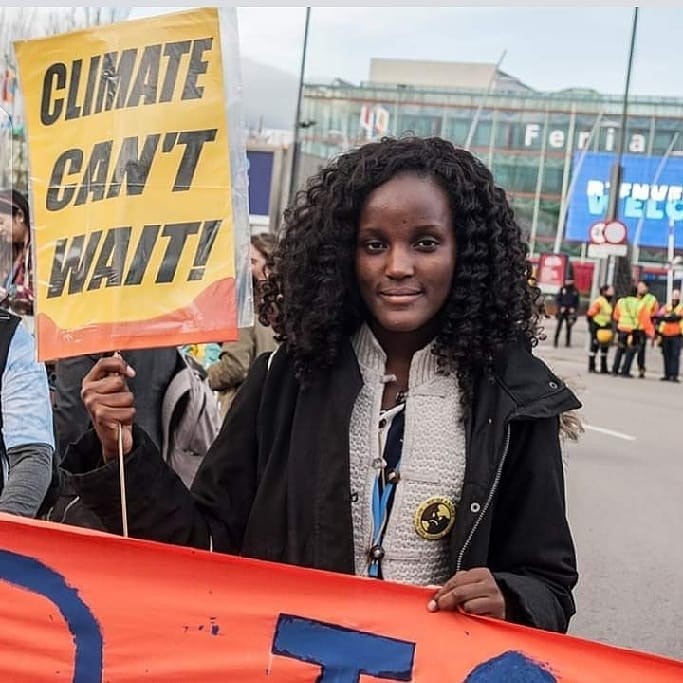
Vanessa Nakate of StopEACOP rants against the pipeline in a recent column in the New York Times, saying the project would bring poverty and destruction to the people of Africa. She also references extreme weather in implying the pipeline will worsen the climate.
During a visit to the ultra-rich Vatican, Vanessa says: “It is evident that there is no future in the fossil fuel industry…. we know the impacts on our food. We know the impacts on our water. We know the impacts on our livelihood…… the climate crisis is already affecting so many people not only in Uganda, but the African continent.”
But her reasons for opposing the pipeline are scientifically inaccurate and logically senseless.
She points to a forecast by the Intergovernmental Panel on Climate Change (IPCC) that predicts African droughts. But IPCC, by its own admission, has indicated that extreme weather events have no significant correlation with rising global average temperatures. Neither has there been any significant increase in the frequency of extreme cyclones, droughts, rainfall, and fires. Even if droughts and cyclones were to increase, a better socio-economic condition would enable people to adapt more effectively.
Contrary to Vanessa’s hyperbole, the world is experiencing near optimum temperatures for global food production and the advancement of human society, much as it did 1,000 years ago during the Medieval Warm Period and 2,000 years ago during the Roman Warm Period. Globally, we now have better access to clean water, better access to nutritious food, people with higher income, and a very rapid increase in life expectancy rates. How are we in a crisis if climate is aiding the improvement of every metric used to measure the quality of people’s lives?
It is shocking how Vanessa ignores the plight of millions of her own people dwelling in persistent poverty and in need of affordable, dependable energy sources like coal, oil, and gas. It is less shocking if we understand the DNA of climate extremists, which has them deny the reality of energy needs and promote unreliable, primitive, and expensive wind turbines that even economic giants like Germany and the U.S. hesitate to adopt completely.
Climate extremists like Vanessa are fostering the continuation of abject poverty in Africa — a continent with the lowest level of electrification and highest rates of poverty in the world. Vanessa claims that the pipeline is another colonial project subjecting Africans to slavery. But, it is Vanessa and her ilk who are the colonialists and would-be slave masters.
Vijay Jayaraj is a Research Associate at the CO2 Coalition, Arlington, Va., and holds a Master’s degree in environmental sciences from the University of East Anglia, England. He resides in Bengaluru, India.
By Chris Morrison | The Daily Sceptic | May 5, 2022
It was never going to work. Telling African countries to stop developing their economies by banning cheap, reliable fossil fuel is little more than an eco-imperialist dream. Writing in Monday’s Daily Telegraph, Uganda President Yoweri Museveni lauded the discovery of oil in Lake Albert, but noted it was a battleground for the green NGOs and activists who claim that Armageddon is nigh at every opportunity.
“We are accustomed to these lectures, but we are tired of hearing them,” he added.
For the last decade, the West through the IMF and the World Bank has imposed a moratorium on support for African fossil fuel development – initially coal and more recently oil and gas as well. Museveni notes that in Africa the population is set to double by 2050, “and it is becoming increasingly clear that our energy needs cannot be met with a sudden shift to more expensive and less reliable solar and wind alone”.
Rich Western eco elites, of course, argue that the world must rid itself of fossil fuel as soon as possible. They believe the world is facing climate breakdown, although as articles in the Daily Sceptic show on a regular basis, that belief is backed by surprisingly few scientific facts. These Western elites effectively seek a command-and-control economy based on Net Zero, and a neo-pagan return to ancient Gaia goddess worship that elevates nature as sacred and denigrates humanity as destructive of it.
It might all play better in Africa if so-called global warming could be detected.
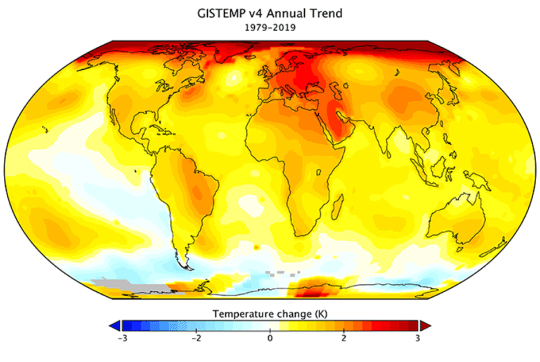
Atmospheric warming over the last 40 years has been more pronounced over the northern hemisphere, despite regular scare stories appearing about equatorial regions becoming uninhabitable. The GISS temperature database is run by NASA, and as with similar datasets it has been subject to considerable recent modifications, with the past cooled and later results warmed. Without these retrospective data adjustments, global recorded warming ran out of steam nearly two decades ago. Nevertheless, the contrast between the north, painted in fiery red, and most of Africa is clear from the GISS map (above).
The Lake Albert project is going ahead following a $10bn investment from the China National Offshore Oil Corporation and Total Energies of France. It includes the building of a 900 mile pipeline to the port of Tanga. According to Real Clear Energy, the project will provide $48.5m in annual payments to Ugandan employees living in one of the least developed countries in the world. But opposition is fierce. Writing in the New York Times the local green agitator Vanessa Nakate of StopEACOP said the project would bring “poverty and destruction to the people of Africa”. It is claimed by her activist group that building the East African crude oil pipeline would tip the world closer to “full blown climate catastrophe”.
It is comments such as these which mostly surface in mainstream media, rather than those of the President of Uganda. It might also be thought that most Africans are less impressed with other solutions advanced in the West to solve any problems caused by growing populations. Sir David Attenborough is on record as stating humans are a plague on the Earth, and it was “barmy” to send food to Ethiopia to solve the famine crisis. In Attenborough’s view, sending flour bags to under-developed countries was pointless.
In public in the West, many African politicians pay lip service to the aims of COP, not least because plenty of aid cash is on offer. Others take a more challenging and outspoken view. N.J. Ayuk is the Executive Chairman of the African Energy Chamber and he recently called the idea that you could develop Africa with handouts, “preposterous and sickening”.
He continued: “You cannot take people of any colour and exempt them from the requirements of civilisation – including work, free markets, behavioural standards, personal responsibility, fossil fuels, financial literacy and all the other basic things that the clever intelligentsia disdain – without ruinous consequences to them and society at large.”
In his view, no country has ever been developed by fancy wind and green hydrogen. Africans see oil and gas as a path to success and a solution to their problems. “The demonisation of oil and gas companies will not work,” he added.
Writing in 2015, the former Chancellor of the Exchequer Nigel Lawson commented that something deep inside the human psyche makes it receptive to apocalyptic warnings. By a cruel irony, he said, too many climate scientists and their hangers-on have become the high priests of a new age of unreason. Asking developing countries to abandon the cheapest available sources of energy is, at the very least, asking them to delay the conquest of malnutrition, to perpetuate the incidence of preventable diseases and to increase the number of premature deaths.
“Global warming orthodoxy is not merely irrational. It is wicked,” he concluded.
or go to
Aletho News Archives – Video-Images
By Dr. Elias Akleh* | Sabbah Report | May 24, 2010
A build up of heightened tension in the Middle East is escalating in the last few weeks. American and Israeli postures towards Lebanon, Syria, and Iran have become more threatening. Listening to speeches of political leaders one hears talks only about war not peace. Iranians and Israelis are continuously training hard for a possible showdown. Both sides are conducting extensive war games every month. This led Syrians to claim that Israel is preparing for a soon-to-come another war. The Jordanians also are warning that current stalemate of the peace process is an indication of a war breaking out this summer. The Russian President and his army chief hinted, a few months ago, that the US and Israel were planning for an attack on Iran.
Indeed Iran is, as it has been for last few years, the target of most of the threats and accusations of supporting terrorism. Escalating incitement against Iran the American Defense Department sent last month (April) to Congress a report on Iran’s military claiming Iran could develop intercontinental ballistic missiles capable of reaching the US by 2015.
Ignoring the fact that N. Korea, India, Pakistan, and Israel are proven to have nuclear weapons while Iran does not, the US Secretary of State Hillary Clinton chose in her speech, to the nuclear Non-Proliferation Treaty review conference at the UN, to focus on Iran’s alleged nuclear ambitions putting the whole world at risk as she put it. According to Clinton Iran’s acquisition of nuclear weapons, rather than Israel’s more than 200 nuclear bombs, is destabilizing the Middle East. She called on the world’s nations to rally around US efforts to hold Iran, not other nuclear countries, to account.
The accusation that Usama Bin Laden is living comfortably in Iran had received a boost after the broadcast of a documentary called “Feathered Cocaine”. This echoed the June 2003 claims of the Italian newspaper Corre de la Sierra that Bin Laden was in Iran according to some intelligence report, and according to Richard Miniter’s book “Shadow War”. … continue
 Aletho News If Americans Knew No Tricks Zone
 Aletho News