The Media & the WWF Torture Scandal
News organizations have turned their own journalists into WWF cheerleaders
By Donna Laframboise | Big Picture News | March 20, 2019

Click for source
Earlier this month, BuzzFeed published a three-part exposé about violent goons, funded and equipped by the World Wildlife Fund (WWF), who persecute indigenous communities. In the words of the BuzzFeed journalists, the WWF
works directly with paramilitary forces that have been accused of beating, torturing, sexually assaulting, and murdering scores of people. As recently as 2017, forest rangers at a WWF-funded park in Cameroon tortured an 11-year-old boy in front of his parents…
UK politicians have called on the government to respond to these “appalling and deeply disturbing” allegations. US senator Patrick Leahy has likewise demanded an “immediate and thorough review” of the support the WWF receives from American authorities.
BuzzFeed reports that the UK Charity Commission will be asking the WWF “serious questions.” Also in the UK, explorer Ben Fogle has stepped away from his public relationship with this organization, due to these “very serious human rights allegations.”

Longtime WWF supporter, actress Susan Sarandon, says she expects an “in-depth investigation” to take place.
Likewise, the Leonardo DiCaprio Foundation has called on the WWF to “provide the public with a full and transparent accounting of their findings.” (In 2016, DiCaprio – who sits on the WWF’s Board of Directors in the United States, symbolically ‘shared‘ his 2016 Golden Globe award “with all the First Nations peoples represented in this film and all the indigenous communities around the world.”)
Despite the celebrities, the prominence of the WWF brand, and the serious nature of these allegations, much of the media has chosen to ignore this story. Could that have anything to do with the fact that news organizations have spent the past decade turning their own journalists into WWF cheerleaders?
Here in Canada, our largest circulation newspaper, The Toronto Star, has served as an official sponsor of the WWF’s annual Earth Hour (see this 2008 discussion, and this from 2012).
Think about that cozy, inappropriate relationship – and then ask yourself why The Star has yet to tell its readers about the WWF torture scandal.
Since its Australian beginnings, Earth Hour was a deliberate media creation. Rather than reporting neutrally on current affairs, rather than applying an equally skeptical eye to all large multinational entities (WWF, come on down), news organizations instead promote certain events, certain entities, and certain environmental perspectives.
The flip side of that pathological arrangement is that these same news organizations also have the power to decide what isn’t news. Every single day, they decide what not to tell the public.
Attempt to prosecute Assad at ICC is aimed at undermining Syrian peace process
Historian John Laughland explains why the International Criminal Court’s attempt to indict President Assad of Syria reveals its dictatorial and warmongering tendencies.
RT | March 18, 2019
The announcement that “a group of Syrian refugees and their London lawyers” have found “a neat legal trick” to press for an indictment against Syrian President Bashar Assad by the International Criminal Court demonstrates, yet again, the dangerous corruption of international justice, against which I have been warning for over a decade.
The Syrian war is nearly over, thanks to the military successes of the Syrian army and its Russian and Iranian allies. Exhaustion on both sides has probably helped. Diplomatic overtures have started to re-integrate Syria into the international system, starting at the regional level: the United Arab Emirates have re-opened their embassy in Damascus; the Sudanese president, Assad’s near namesake, Omar Al-Bashir, has visited Syria, as have senior Egyptian officials; Syrian officials have attended pan-Arab summits; even Israel is maintaining its dialogue with Russia over Syria. In short, the situation is being slowly normalised as Syria herself embarks on the painful search for internal peace.
The attempt to get Assad prosecuted is an attempt to stamp out these seedlings of peace before they take root. Any prosecution against Assad would scupper, or at least severely damage, this slow acceptance that the Syrian president is part of the solution. When even the British government has accepted that Assad is here to stay, and that peace must be made with him, his implacable enemies fear that their prize is about to slip out of their grasp. They do not want peace, if that means keeping Assad.
We know that the goal is to sabotage any peace process because this kind of indictment is old hat in international criminal law. At the end of the Bosnian Civil War in 1995, indictments were issued against the Bosnian Serb leaders, especially Radovan Karadzic, specifically in order to remove them from the Dayton peace talks. Antonio Cassese, then president of the International Criminal Tribunal for the former Yugoslavia, said in 1995, just after the indictment was issued against Karadzic, that it had been issued for that reason: “The indictment means that these gentlemen will not be able to participate in peace negotiations” (quoted in the Italian daily L’Unità, 26 July 1995). Incidentally, Cassese had himself encouraged the prosecutor to bring these prosecutions even though he, as a judge and president of the tribunal, was supposed to be neutral.
The “legal trick” is designed to overcome the fact that Syria is not a state party to the Rome statute of the International Criminal Court and therefore not subject to its jurisdiction. Assad’s enemies are seeking to sidestep the fact that Syria is beyond the ICC’s reach by seeking to apply to Syria a principle which, unfortunately, the ICC itself applied to Burma last year. In September, the ICC judges agreed that a case could be brought against Myanmar (Burma), even though that country is not a state party to the Rome statute, because the crimes it had allegedly committed – deportation – had caused people to flee into Bangladesh, which is a state party. By analogy, Syria’s enemies hope that the presence of Syrian refugees in Jordan, a state party to the ICC statute, will enable them to go after Assad. They seem not to care that this is the first time anyone has ever mentioned “deportation” in Syria, although Damascus has been accused of all manner of other crimes.
The ruling on Myanmar and Bangladesh illustrates everything that is wrong with international justice. Not only did the decision to apply jurisdiction to the Burmese authorities break the fundamental principles of international law, as expressed in the “treaty on treaties,” the 1969 Vienna Convention, which says that the principle of free consent is “universally recognized” and whose Article 34 says, “A treaty does not create either obligations or rights for a third state without its consent,” it also broke an even more fundamental principle by specifically claiming the right to define its own powers (referred to, in English texts, with the French and German expressions la compétence de la compétence and Kompetenz-Kompetenz). The Court described this as “a well-established principle of international law according to which any international tribunal has the power to determine the extent of its own jurisdiction.” In reality, it is no such thing.
On the contrary, the powers of all organisations are determined by law. Even sovereign governments are restricted by national laws in their powers. The idea that an international organisation has the legal right to determine its own powers, and to extend its jurisdiction to states that have not accepted it, is about as blatant a violation of the rule of law as one can imagine. In the past, such claims were equivalent to declarations of war, because a claim like this can only be settled by force. For example, on July 23 1914, Austria demanded the right for its police to carry out investigations inside Serbia for the assassination of the Archduke Franz-Ferdinand in Sarajevo on June 29. It sent an ultimatum to Belgrade to this effect, which Serbia refused. The result was the First World War, launched by Vienna in the name of the right to punish the perpetrators of that crime.
The ICC has already discredited itself massively after the Laurent Gbagbo fiasco. Having collaborated in the politically-motivated indictment of the president of Côte d’Ivoire in 2011 – a collaboration which gave legitimacy to the French military operation to oust him, just as it gave legitimacy to the NATO attack on Libya by also indicting Colonel Gaddafi at the same time – the Court was forced to acquit Laurent Gbagbo eight years later, in January of this year.
By seeking to extend its lamentable rule to Syria, and thereby to disrupt a barely embryonic peace there, the ICC risks destroying its reputation even further. For the rules limiting the jurisdiction of international organisations to states which have consented to accept them are not some arcane technicality of international law. Instead, they reflect the most basic principle of politics, which is that those who wield power need to be constitutionally linked to those over whom they wield it. International organisations which are not based on such consent violate that very basic principle flagrantly, and therefore start to resemble the very dictatorships they pretend to combat.
John Laughland, who has a doctorate in philosophy from the University of Oxford and who has taught at universities in Paris and Rome, is a historian and specialist in international affairs.
Read more:
‘Mask is off’: US shifts to open coercion & manipulation against ICC, analysts tell RT
Israel pushing for Africa foothold with military training: Report
Press TV – March 4, 2019
A report says Israeli commandos are training local forces in more than a dozen African nations where Israeli arms exporters are already accused of being complicit in war crimes.
Israel’s Channel 13 on Sunday showed footage of Israeli officers coaching Tanzanian troops in hand-to-hand krav maga, hostage operations and urban combat, saying there is a dramatic rise in Tel Aviv’s military activities in Africa.
Prime Minister Benjamin Netanyahu has made inroads into Africa a key part of his agenda, becoming the first Israeli leader to visit the continent in 50 years in 2016.
“I’ve been in Africa four times in the last two years, that’s gotta tell you something,” Netanyahu said in a speech at an event in February.
Over the past two years, he has traveled to several African states in a bid to convince them to stop voting against the Israeli regime at the United Nations.
Israel is also said to be seeking to take advantage of insurgency and Takfiri militancy gripping parts of Africa to sell advanced military equipment to conflict-ridden states in the continent.
Tel Aviv’s policy to spice up ties with Africa, the report said, also features combined efforts by Israeli foreign ministry, military, Mossad spy agency and the regime’s so-called security agency, Shin Bet.
The report named Ethiopia, Rwanda, Kenya, Tanzania, Malawi , Zambia, South Africa, Angola, Nigeria, Cameroon, Togo, Ivory Coast and Ghana as among the African countries that Israel was seeking to stake out a niche.
Israel’s military cooperation with the African states possibly emanated from the fact that many of those nations take part in peacekeeping missions on the border between the occupied territories, Syria and Lebanon, it said.
It would be advantageous to Israel if these forces were led by Israeli-trained soldiers, said the report.
An Israeli delegation has reportedly been traveling to countries in Africa and “carefully” weighing requests for further military collaboration.
The delegation is taking into account how likely Israeli military expertise could be used in committing mass atrocities in the continent, the report said.
Israeli media reported in November that Tel Aviv was actively working to establish diplomatic ties with Sudan, as part of wider efforts to upgrade relations with central African countries.
The Israeli TV channel also reported that Israel’s ministry of military affairs recently summoned retired Maj. Gen. Israel Ziv for a hearing after the US accused him of selling $150 million in weapons to both sides of the civil war in South Sudan.
Israeli weapons which ended up in South Sudan extended the duration of the deadly civil war there, the Jerusalem Post newspaper has reported.
Last year, the US Treasury Department placed sanctions on the Israeli businessman for his role in the civil war in South Sudan.
A recent report by the London-based Middle East Eye said the head of Mossad met his Sudanese counterpart in Germany last month as part of a secret plan by Saudi Arabia, Egypt and the UAE to oust President Omar al-Bashir.
In January, Bashir was quoted to have lamented that he had been advised to normalize ties with Israel because a normalization would help stabilize growing unrest sweeping Sudan.
Israel opens first ever embassy in Rwanda
MEMO | February 22, 2019
Israel’s government on Friday opened its first ever embassy in Rwanda, a step seen as promoting its presence on the continent of Africa, Israel’s Broadcasting Authority reported.
The new Israeli Ambassador to Kigali, Ronny Adam, presented his credentials to the Rwandan foreign ministry, Anadolu Agency reports.
Following a meeting with Rwandan President Paul Kagame, Adam signalled the intention of Kigali and Tel Aviv to boost cooperation in different fields, Israel’s Broadcasting Authority reported.
Israeli Prime Minister Benjamin Netanyahu visited Chad on Jan, 20, where he announced the official resumption of ties with N’Djamena following a meeting with Chadian President Idriss Deby.
In recent years, Israel has sought to improve relations with African states.
Israel currently maintains embassies in 10 of 54 African countries, namely, Senegal, Egypt, Angola, Ghana, Ivory Coast, Ethiopia, Nigeria, South Africa, Kenya and Cameroon.
The International Criminal Complicity
On Intimidation, Cowardice & Corruption (at the International Criminal Court)
“Drill and uniforms impose an architecture on the crowd. An army’s beautiful. But that’s not all; it panders to lower instincts than the aesthetic. The spectacle of human beings reduced to automatism satisfies the lust for power. Looking at mechanized slaves, one fancies oneself a master” -Aldous Huxley
By Ronald Thomas West | February 22, 2019
The United Nations is an experiment in democracy founded on the Western principles of international law. Angela Merkel’s conflating globalism with multilateralism (these are NOT the same thing) notwithstanding, the United Nations is a global body established by multilateral treaties. This does not establish ‘globalism’ but serves as a platform for facilitating relationships between sovereign nations. The International Criminal Court is an example of this, where the ‘Rome Statute’ (the multilateral treaty establishing the court) had been ‘midwifed’ from within the UN but created a court (the ICC) that is ostensibly independent. However the UN Security Council may refer cases to the ICC, the UN has no authority over the court and no power to extend or curtail the courts jurisdiction, which is solely over those nations which had opted to enter into the treaty (Rome Statute) creating the court.
However, if the institutions of the United Nations are notoriously politicized and corrupt, and they most certainly are [1] it follows the UN’s closely aligned institutions might be expected to show similar symptoms.
We have recently seen these symptoms (read on) but it should be noted the ICC had been undermined from its inception, particularly by the USA in what appears on its face to have been a geo-strategic policy of fraudulent engagement of the Rome Statute process. In short, the USA participated in the setting up of the court but used its considerable influence to prevent the court adopting a principle of universal jurisdiction. With the court at its formation limited to jurisdiction over nations entering into the Rome Statute treaty, the USA would appear to have disingenuously joined the court (signed on) but never seriously pursued ratification (the legal necessity of a democratic nation’s parliamentary body affirming the state executive signature) and therefor never came under the court’s jurisdiction.
What had been created is a social oxymoron in actuality; a core body of nations (Europe, EU & NATO nations, particularly) determined never to self-prosecute but to use the prosecutorial vehicle provided by the Rome Statute as post-colonial geopolitical device aimed at African states in ongoing state of neocolonialism. Consequently the court has seen to the prosecutions of politicians from Congo, Kenya, Sudan and Ivory Coast but not the French role in Rwanda’s genocide or Paul Kagame, a USA darling:
“He’s [Kagame] actually gotten a free ride from the ICC despite all the evidence of his army creating, sponsoring militias in Congo since 2002. Militias sponsored by Kagame’s troops have plundered, killed civilians and recruited child soldiers in the Congo yet Kagame and his commanders have not been indicted by the ICC” [2], [3], [4]
Relevant to the French immunity (impunity), this raises a question concerning whether European states signatory to the Rome Statute, that is a “coalition of the willing” should have been liable for what amounts to a ‘crime against humanity’, or an estimated 500,000 to 1,000,000 dead civilians having resulted due to infrastructure destruction (e.g. disease via water contamination), when Iraq had been invaded despite the invading states’ leaders (notably Tony Blair) knowing that invasion’s premise was false. Are the EU & NATO states’ accountability waived by the ICC?
It hardly seems a ‘crime of aggression’ need be adopted to hold states responsible for their acts where existing statutory law should be adequate.
This brings us to a recent case filed by this reporter which points to corruption. For the purpose of defining corruption in the case at hand, identified by the court’s filing reference ICC OTP-CR-295/18 [5] it is asserted (by this reporter) any case of acquiesce in the face of intimidation is a form of corruption, where cases are shelved as opposed to pursued in good faith. A recent example of this is demonstrated in the resignation of an ICC judge citing two instances where the ICC had been subject to threats or subverted. [6]
In the first instance, Turkey arrested an ICC judge with Turk nationality under the pretext of ties to Gulen, an excuse often used by the current Salafi leadership of Turkey to rid itself of principled Sufi members of Turkey’s civil service. [7] The UN Secretary General, rather than confront Turkey with a principled stance no UN member state will unilaterally set precedent with the removal of ICC judges, allowed the precedent to stand.
The other instance causing his resignation (mentioned by Judge Flugge) is the well publicized (policy) threats against the ICC by USA National Security Advisor, John Bolton, in his speech to the Federalist Society. [8]
According to Christopher Black, a longtime barrister working the several international tribunals, including the ICC, the USA plays strongly:
“First of all through key personnel they have placed in the ICC, for example the prosecutors, some judges who are willing to do what they want…
“A judge in my case was threatened by Americans working there that if certain passages in the judgement acquitting the general I was defending were not removed he would face physical problems. This is the type of gangsterism they use to get their way in these tribunals”
Also specific to the USA, at a separate tribunal, according to Black:
“Not only was a judge in my case at the Rwanda tribunal pressured but I myself was threatened by the CIA while I was there to stop raising questions and presenting evidence they [the US side] did not like” [9]
The preceding suggests Turkey may have arrested the judge with Turkish nationality as a quid pro quo on behalf of a 3rd party to dispense with a judge perceived as a threat. In any case it’s clear the ICC is compromised.
Bearing the preceding in mind, in the case filed by this reporter, to begin it should be noted it was the ICC itself that invited my filing, when the Office of the Prosecutor had responded, on 3 July 2018, to a letter I’d emailed to a German international law attorney on, 30 June 2018, copied to the ICC.
In both the letter and the complaint a clear line of evidence had been provided pointing to Turkey had (false-flag attack, in league with al Qaida) arranged the indiscriminate murder of well over 1,000 civilians at Ghouta, Syria in August of 2013. According to a Turkish parliamentarian, Eren Erdem, citing Turkish state produced investigative files in his possession, the chemicals used to produce the Sarin gas in this attack had been sourced in Europe. Turkish MP Erdem is on record stating:
“All basic materials are purchased from Europe. Western institutions should question themselves about these relations. Western sources know very well who carried out the sarin gas attack in Syria. They know these people, they know who these people are working with, they know that these people are working for Al-Qaeda. [What] I think is Westerns are hypocrites about the situation”
In this regard it is noted the court’s Office of the Prosecutor takes on the responsibility of assembling evidence:
“At the ICC, most evidence is collected and secured by the Office of the Prosecutor (OTP)” [10]
In the present case (ICC OTP-CR-295/18) the filing party (Ronald Thomas West) had assembled ample evidence to justify initiating a preliminary investigation that should have triggered the court looking into whether there had been the associated crime of ‘aiding and abetting’ committed within ICC jurisdiction. To bolster this, the case had been made an additional, associated crime of aiding and abetting had been demonstrated where German intelligence had misinformed German politicians of the facts actually surrounding the Ghouta sarin attack, so far as to blame Assad.
This last (immediate preceding) would not necessarily constitute a prosecutable crime (depending on what the judges might be inclined to believe on a given day) but there is more. This reporter had provided the necessary evidence to the concerned politicians correcting the record; indisputable evidence Turkey’s intelligence agency was providing sarin to al-Qaida militants within a timeline consistent with the Ghouta attack. [11]
This evidence submitted to the German executive (office of the Federal Prosecutor) and oversight (parliamentary leadership of all parties represented in the federal parliament) was never acted on; the German political establishment closed ranks across the political spectrum to deny the government of Syria honest assessment of the Ghouta attack. The false-flag crime accordingly sustained as a successful political ploy in regime change endeavors by EU and NATO states where those very states have become complicit in aiding and abetting a war crime with the act of material concealment of the actual perpetrators identity (a NATO state.) [12]
The German politicians (and related institutions) had been provided with the evidence on 2 December 2015. By the time this (very same) evidence had been provided to the ICC in a formalized complaint on 4 July 2018, thirty one months had passed without action by the Germans, satisfying the requirement Germany should have had opportunity to redress the wrong.
On 6 February 2019, one week after the resignation of Judge Christoph Flugge, the ICC Office of the Prosecutor replied to this reporter with:
“The Office of the Prosecutor has examined your communication and has determined that more detailed information would be required in order to proceed with an analysis of whether the allegations could fall within the jurisdiction of the Court. The Prosecutor has determined that, in the absence of such information, there is not a basis at this time to proceed with further analysis”
Essentially what the ICC has done is, to shelve the case with a demand this reporter who’d made the filing (at their invitation) provide information beyond simple and clear evidence aiding and abetting of a war crime is ongoing by a state within the jurisdiction of the court. This general, non-specific language, in the common vernacular, are called ‘weasel words.’
Why? Clearly the ramifications of adopting the practice of prosecuting the politicians empowering false flag geopolitical engineering by intelligence agencies is frightening and no doubt opposed by politician & spy alike.
Were the ICC to proceed in this case (whether it were a successful prosecution or acquittal), not only would it likely topple Angela Merkel, but it likely brings into reach Davis Cameron and his spy chief Alex Younger, also Francois Hollande and his spy chief Bernard Bajolet… and so on.
In the case of Germany, there is a safe assumption: There will be no prosecution of these crimes due to a German constitutional loophole larger than the Brandenberg Gate … “for the good of the state.” Because at the end of the day, it is (a commonly used German expression) “just not possible” to rock the boat with Turkey or cross the USA.
Why the International Criminal Court matters (in the present moment) has little to do with justice and much to do with exposing the corruption of foundational principles across the spectrum of international institutions.
*
The ICC had been provided a nearly identical draft of this (preceding) with opportunity to comment. [13] Prior to releasing this for initial publication at the Ft Russ news website, two weeks have passed and no reply has been forthcoming. The ICC also declined to clarify the nature of “more detailed information [that] would be required” and has remained silent on my asking whether the German authorities had been contacted with request for information and if so, the nature of any reply.
Noteworthy is the ICC does not deny the “allegations” (the evidence is too strong) nor does the ICC altogether dismiss the possibility of jurisdiction (they have jurisdiction over complicit parties within the EU, only are either intimidated and afraid or too corrupted to exercise it, probably a combination) rather finds a ‘weasel words’ excuse to shelve a case that would call out the hypocrisy of the European signatories to the Rome Statute based on the criminality of the EU/NATO intelligence agencies.
The net result is, as of this moment the false-flag sarin attack at Ghouta, Syria (and murder of well over 1,000 innocents) during the month of August 2013 remains a successful sleight-of-hand attack blamed on the wrong party and the crime of aiding and abetting the perpetrators, it could be argued, extends to the International Criminal Court itself, in case where refusal to correct the public record protects the guilty parties. I would describe this as ‘international criminal complicity’ when a UN associated judicial body becomes aware of an easily rectified element of a major war crime, as simple as recognizing an evidence based false-flag, and instead chooses to sit on its hands.
The pity of it all is, if there were courage to pursue jurisdiction over those complicit parties within the Rome Statute’s signatory states, a precedent would be established perhaps leading (over time) to further precedent where anyone complicit in war crimes and crimes against humanity could be arrested when stepping on any Rome Statute nation’s soil and progress made in realizing accountability.
Ronald’s Maxim
In any democracy, ethics, self restraint, tolerance and honesty will always take a second seat to narcissism, avarice, bigotry & persecution, if only because people who play by the rules in any democracy are at a disadvantage to those who easily subvert the rules to their own advantage
References:
[1] http://www.innercitypress.com/index.html
[2] http://www.therwandan.com/the-icc-has-given-africas-most-prolific-genocidaire-a-free-ride/
[3] https://www.bbc.com/news/world-europe-41283362
[4] https://www.politico.com/magazine/story/2014/02/rwanda-paul-kagame-americas-darling-tyrant-103963
[7] https://www.dw.com/en/from-ally-to-scapegoat-fethullah-gulen-the-man-behind-the-myth/a-37055485
[9] https://www.rt.com/news/450611-us-icc-manipulation-experts/
[10] https://link.springer.com/content/pdf/10.1007%2F978-3-642-35076-4_4.pdf
[11] https://ronaldthomaswest.com/2018/04/15/what-can-be-known-vs-what-will-be-known/
[12] https://ronaldthomaswest.com/2018/10/12/a-breaking-point-in-geopolitical-torsion/
[13] copy of this post & relevant questions requesting information were sent to the ICC on 9 February 2019
Israel seeking Africa foothold with renewed Chad ties
Press TV – January 21, 2019
Israel has for some time been trying to expand its influence across the African continent. Prime Minister Benjamin Netanyahu’s recent visit to Chad is being viewed as a step in this direction. The two sides have now announced the normalization of their diplomatic ties amid reports of Israel supplying the Central African state with weapons.
Netanyahu, and Chadian President Idriss Deby have “announced the renewal of diplomatic relations between Chad and Israel,” a statement from Netanyahu’s office said Sunday.
Relations between Tel Aviv and the Muslim-majority country were cut in 1972.
Speaking at a joint press conference in N’Djamena on Sunday, Deby told Netanyahu that the purpose of the visit was to bring the two sides closer and to cooperate.
For his part, Netanyahu said that Israel was announcing “a renewal of diplomatic ties with Chad and making a breakthrough for the Arab and Muslim world.”
He said the restoration of diplomatic ties was “a result of strenuous work of recent years.”
Deby, who won a disputed fifth term in April 2016, visited the occupied Palestinian territories and met with Netanyahu in November, becoming the first Chadian leader to visit Israel, 47 years after the two sides severed ties.
Back then, Israeli media cited sources in N’Djamena as saying that Deby’s visit was focused on “security” and that Tel Aviv had already been supplying weapons and other military equipment to Chad.
Over the past two years, Netanyahu has been seeking to secure a foothold in Africa. He has traveled to several African states in a bid to convince them to stop voting against the Israeli regime at the United Nations in favor of Palestinians.
Amid warming relations with Chad, Israel is seeking to normalize relations with Sudan, among other African states.
Israel is also said to be seeking to take advantage of insurgency and Takfiri militancy gripping parts of Africa to sell advanced military equipment to conflict-ridden states in the continent.
Tel Aviv and the Persian Gulf Arab governments have also taken further steps towards normalization.
Only two Arab states, Egypt and Jordan, have open diplomatic relations with Israel. Tel Aviv has recently stepped up its push to make clandestine ties with other Arab governments public and establish formal relations with them.
Israeli PM visits Chad ‘to restore relations’
MEMO | January 20, 2019
Israel’s Prime Minister Benjamin Netanyahu headed to Chad on Sunday for talks aimed at restoring diplomatic relations between Tel Aviv and N’Djamena.
“I am now leaving on another historic and important breakthrough, to Chad, a huge Muslim country bordering Libya and Sudan,” The Times of Israel newspaper quoted Netanyahu as saying in statements ahead of travelling to Chad.
“There will be big news,” Netanyahu said, hinting at the formal resumption of diplomatic relations between the two countries.
Chad severed diplomatic relations with Israel in 1972.
Netanyahu described his visit to Chad as “part of the revolution we are doing in the Arab and Muslim world”.
The Israeli premier claimed that Iran and the Palestinians have attempted to “prevent Israel’s diplomatic push”.
“It greatly worries, even greatly angers [them],” he said.
The resumption of bilateral ties between Chad and Israel is expected to be announced in a joint press conference between Netanyahu and Chadian President Idriss Deby.
Israeli Channel 10 reported Saturday night that Netanyahu is expected to offer his government’s support for Deby to prevent militants’ infiltration to Chad coming from Libya.
Netanyahu’s delegation to Chad includes senior officials from the defense and finance ministries, in an indication of his target to boost military and trade ties with Chad.
The Chadian President had made a rare visit to Israel in November.
Amnesty International’s Troubling Collaboration with UK & US Intelligence
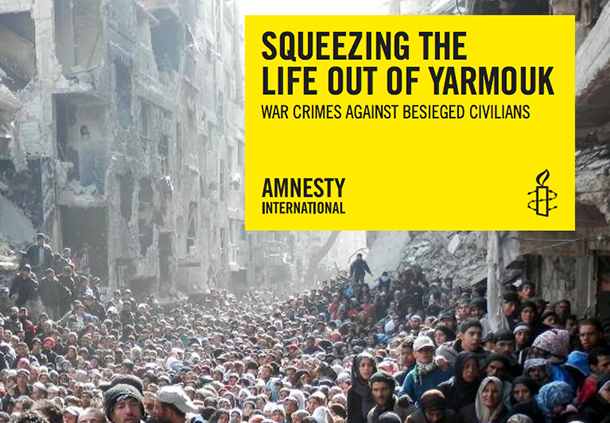
Propaganda image from the cover of AI’s report entitled, ‘Squeezing the Life Out of Yarmouk: War Crimes Against Besieged Civilians’,
one of many designed to fit hand-in-glove with the joint US and UK covert regime change operation deployed against Syria since 2011.
By Alexander Rubinstein | Mint Press News | January 17, 2019
Amnesty International, the eminent human-rights non-governmental organization, is widely known for its advocacy in that realm. It produces reports critical of the Israeli occupation in Palestine and the Saudi-led war on Yemen. But it also publishes a steady flow of indictments against countries that don’t play ball with Washington — countries like Iran, China, Venezuela, Nicaragua, North Korea and more. Those reports amplify the drumbeat for a “humanitarian” intervention in those nations.
Amnesty’s stellar image as a global defender of human rights runs counter to its early days when the British Foreign Office was believed to be censoring reports critical of the British empire. Peter Benenson, the co-founder of Amnesty, had deep ties to the British Foreign Office and Colonial Office while another co-founder, Luis Kutner, informed the FBI of a gun cache at Black Panther leader Fred Hampton’s home weeks before he was killed by the Bureau in a gun raid.
These troubling connections contradict Amnesty’s image as a benevolent defender of human rights and reveal key figures at the organization during its early years to be less concerned with human dignity and more concerned with the dignity of the United States and United Kingdom’s image in the world.
A conflicted beginning
Amnesty’s Benenson, an avowed anti-communist, hailed from a military intelligence background. He pledged that Amnesty would be independent of government influence and would represent prisoners in the East, West, and global South alike.
But during the 1960s the U.K. was withdrawing from its colonies and the Foreign Office and Colonial Office were hungry for information from human-rights activists about the situations on the ground. In 1963, the Foreign Office instructed its operatives abroad to provide “discreet support” for Amnesty’s campaigns.
Also that year, Benenson wrote to Colonial Office Minister Lord Lansdowne a proposal to prop up a “refugee counsellor” on the border of present-day Botswana and apartheid South Africa. That counsel was to assist refugees only, and explicitly avoid aiding anti-apartheid activists. “Communist influence should not be allowed to spread in this part of Africa, and in the present delicate situation, Amnesty International would wish to support Her Majesty’s Government in any such policy,” Benenson wrote. The next year, Amnesty ceased its support for anti-apartheid icon and the first president of a free South Africa, Nelson Mandela.
The following year, in 1964, Benenson enlisted the Foreign Office’s assistance in obtaining a visa to Haiti. The Foreign Office secured the visa and wrote to its Haiti representative Alan Elgar saying it “support[ed] the aims of Amnesty International.” There, Benenson went undercover as a painter, as Minister of State Walter Padley told him prior to his departure that “We shall have to be a little careful not to give the Haitians the impression that your visit is actually sponsored by Her Majesty’s Government.”
The New York Times exposed the ruse, leading some officials to claim ignorance; Elgar, for example, said he was “shocked by Benenson’s antics.” Benenson apologized to Minister Padley, saying “I really do not know why the New York Times, which is generally a responsible newspaper, should be doing this sort of thing over Haiti.”
Letting politics creep into mission
In 1966, an Amnesty report on the British colony of Aden, a port city in present-day Yemen, detailed the British government’s torture of detainees at the Ras Morbut interrogation center. Prisoners there were stripped naked during interrogations, were forced to sit on poles that entered their anus, had their genitals twisted, cigarettes burned on their face, and were kept in cells where feces and urine covered the floor.
The report was never released, however. Benenson said that Amnesty general secretary Robert Swann had censored it to please the Foreign Office, but Amnesty co-founder Eric Baker said Benenson and Swann had met with the Foreign Office and agreed to keep the report under wraps in exchange for reforms. At the time, Lord Chancellor Gerald Gardiner wrote to Prime Minister Harold Wilson that “Amnesty held the [report] as long as they could simply because Peter Benenson did not want to do anything to hurt a Labour government.”
Then something changed. Benenson went to Aden and was horrified by what he found, writing “I never came upon an uglier picture than that which met my eyes in Aden,” despite his “many years spent in the personal investigation of repression.”
A tangled web
As all of this was unfolding, a similar funding scandal was developing that would rock Amnesty to its core. Polly Toynbee, a 20-year-old Amnesty volunteer, was in Nigeria and Southern Rhodesia, the British colony in Zimbabwe, which was at the time ruled by the white settler minority. There, Toynbee delivered funds to prisoner families with a seemingly endless supply of cash. Toynbee said that Benenson met with her there and admitted that the money was coming from the British government.
Toynbee and others were forced to leave Rhodesia in March 1966. On her way out, she grabbed documents from an abandoned safe including letters from Benenson to senior Amnesty officials working in the country that detailed Benenson’s request to Prime Minister Wilson for money, which had been received months prior.
In 1967 it was revealed that the CIA had established and was covertly funding another human rights organization founded in the early 1960s, the International Commission of Jurists (ICJ) through an American affiliate, the American Fund for Free Jurists Inc.
Benenson had founded, alongside Amnesty, the U.K. branch of the ICJ, called Justice. Amnesty international secretariat, Sean MacBride, was also the secretary-general of ICJ.
Then, the “Harry letters” hit the press. Officially, Amnesty denied knowledge of the payments from Wilson’s government. But Benenson admitted that their work in Rhodesia had been funded by the government, and returned the funds out of his own pocket. He wrote to Lord Chancellor Gardiner that he did it so as not to “jeopardize the political reputation” of those involved. Benenson then returned unspent funds from his two other human-rights organizations, Justice (the U.K. branch of the CIA-founded ICJ) and the Human Rights Advisory Service.
Benenson’s behavior in the wake of the revelations about the “Harry letters” infuriated his Amnesty colleagues. Some of them would go on to claim that he suffered from mental illness. One staffer wrote:
Peter Benenson has been levelling accusations, which can only have the result of discrediting the organisation which he has founded and to which he dedicated himself. … All this began after soon after he came back from Aden, and it seems likely that the nervous shock which he felt at the brutality shown by some elements of the British army there had some unbalancing effect on his judgment.
Later that year, Benenson stepped down as president of Amnesty in protest of its London office being surveilled and infiltrated by British intelligence — at least according to him. Later that month, Sean MacBride, the Amnesty official and ICJ operative, submitted a report to an Amnesty conference that denounced Benenson’s “erratic actions.” Benenson boycotted the conference, opting to submit a resolution demanding MacBride’s resignation over the CIA funding of ICJ.
Amnesty and the British government then suspended ties. The rights group then promised to “not only be independent and impartial but must not be put into a position where anything else could even be alleged” about its collusion with governments in 1967.
Amnesty’s role in the death of Black Panther Fred Hampton
But two years later, senior Amnesty officials engaged in far more troubling coordination with Western intelligence agencies.
FBI documents, released by the Bureau in the spring of 2018 as a part of a series of disclosures of documents pertaining to the assassination of President John Kennedy, detail Amnesty International’s role in the killing of Black Panther Party (BPP) Deputy Chairman Fred Hampton, the 21-year-old up-and-coming black liberation icon — a killing that was widely believed to be an assassination but was ruled officially as a justifiable homicide.
Amnesty International co-founder Luis Kutner attended a November 23, 1969 speech of Hampton’s delivered at the University of Illinois.
During the speech, Hampton described the BPP “as a revolutionary party” and “indicated that the party has guns to be used for peace and self-defense, and these guns are at the Hampton residence as well as BPP headquarters,” according to the FBI document.
“Kutner has reached the point where he would like to take legal action to silence the BPP,” the FBI wrote. “Kutner concluded by stating that he believed speakers like Hampton were psychotic, and it is only when they are faced with a court action that they stop their “rantings and ravings.”
The FBI internal report on Kutner’s testimony cited above was issued on December 1, 1969. Two days later, the FBI, alongside the Chicago Police Department, conducted a firearms raid on Hampton’s residence. When Hampton came home for the day, FBI informant William O’Neal slipped a barbiturate sleeping pill into his drink before leaving.
At 4:00 a.m. on December 4, police and FBI stormed into the apartment, instantly shooting a BPP guard. Due to reflexive convulsions related to death, the guard convulsed and pulled the trigger on a shotgun he was carrying – the only time a Black Panther member fired a gun during the raid. Authorities then opened fire on Hampton, who was in bed sleeping with his nine-month pregnant fiancee. Hampton is believed to have survived until two shots were fired at point-blank range towards his head.
Kutner formed the “Friends of the FBI” group, an organization “formed to combat criticism of the Federal Bureau of Investigations,” according to the New York Times, after its covert campaign to disrupt leftists movements — COINTELPRO — was revealed. He also went on to operate in a number of theaters that saw heavy involvement from the CIA — including work Kutner did to undermine Congolese Prime Minister and staunch anti-imperialist Patrice Lumumba — and represented the Dalai Lama, who was provided $1.7 million a year by the CIA in the 1960s.
While Amnesty International’s shady operations in the 1960s might seem like ancient history at this point, they serve as an important reminder of the role that non-governmental organizations often play in furthering the objectives of governments of the nations where they are based.
Alexander Rubinstein is a staff writer for MintPress News based in Washington, DC. He reports on police, prisons and protests in the United States and the United States’ policing of the world. He previously reported for RT and Sputnik News.
Who or What Brought Down Dag Hammarskjöld?
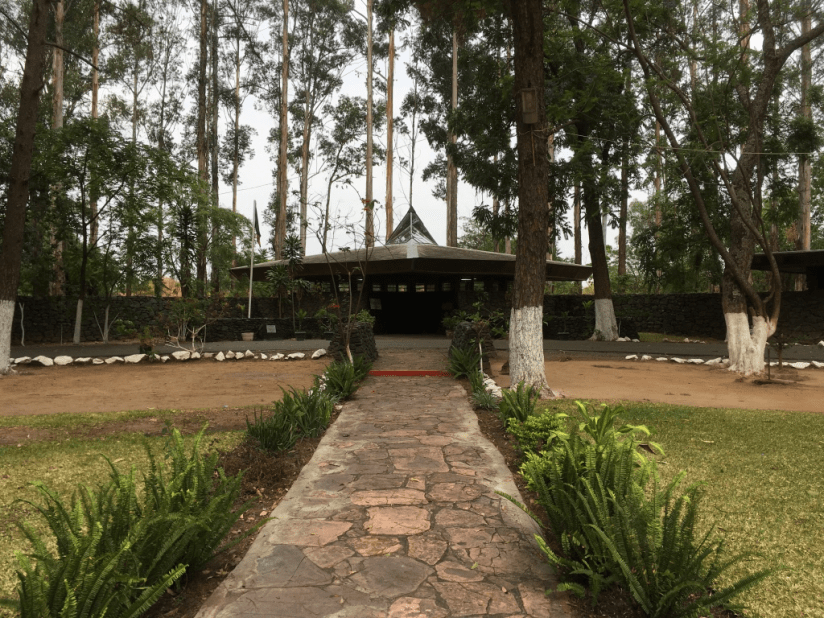
Ndola, Zambia, showing the roof of the memorial museum and Dag Hammarskjöld’s DC-6 as it would have appeared coming through the trees onto the crash site.
By Joseph Majerle III – Matthew Stevenson | CounterPunch | January 11, 2019
Background to the Crash
A plane carrying the Secretary General of the United Nations, Dag Hammarskjöld, crashed while approaching the Ndola (Zambia) airport on September 18, 1961. The exact time of the crash is unknown, although it was around midnight. The DC-6, named Albertina, had flown a circuitous route from Kinshasa, the capital of the Congo, to Ndola, a large town in what was then Northern Rhodesia. The purpose of the flight was to bring Secretary Hammarskjöld to a meeting with Moise Tshombe, the president of the breakaway republic of Katanga, in which many western (British, French, Belgian and American) investors had large stakes in various mineral deposits.
Those corporate interests had supported independence for Katanga after the Congolese leadership, notably Prime Minister Patrice Lumumba, had advocated closer relations with the Communist bloc. (Lumumba, himself, was assassinated in January 1961, in what some researchers now believe was part of a Central Intelligence Agency plot to get rid of him.)
For his part, Hammarskjöld believed that the Congo ought to remain one country, and toward that end he was flying to Ndola (just over the border of Northern Rhodesia from Katanga) to have ceasefire talks with Tshombe, in the hope of mediating a settlement to the conflict. Instead, his plane crashed in the darkness, killing fifteen of the sixteen passengers and crew aboard the DC-6. One security officer for Hammarskjöld survived for about eight days.
Since the fatal crash, various investigative instruments, including UN committees and independent aviation groups in the United Kingdom and Sweden, have looked into the cause of the crash. The initial investigation, conducted by colonial authorities in 1961, concluded that the pilots of the DC-6 (an experienced Swedish crew) had misjudged the night landing on an unfamiliar approach and flew the plane into the ground. A UN inquiry at the same time, however, failed to reach the same conclusion, although it was at a loss to explain the crash.
More recent inquiries, including one chaired by Stephen Sedley and with Hans Corell and Richard Goldstone as co-panellists, have come to more nuanced conclusions, saying that earlier investigators lacked a true picture of the situation on the ground and in the air around Ndola that night to come to definitive conclusion about what happened to the Albertina. It has led to new inquiry, originally supported by then Secretary General Ban Ki-Moon and approved by the UN Security Council, to reopen the investigation under the direction of the former chief justice of Tanzania, Mohamed Chande Othman, although for the moment the budget approved for such an exercise is little more than $300,000 (and the information needed is literally all over the world).
All of the recent re-examinations of the crash have concluded that the first conclusions of pilot error might well be in inaccurate. For example, the 2013 UN Hammarskjöld Commission, for example, concluded: “There is persuasive evidence that the aircraft was subjected to some form of attack or threat as it circled to land at Ndola, which was by then widely known to be its destination.” The 2017 report of Judge Othman concludes:
Based on the totality of the information that we have at hand, it appears plausible that an external attack or threat may have been a cause of the crash, whether by way of a direct attack causing SE-BDY to crash or by causing a momentary distraction of the pilots. Such a distraction need only have taken away the pilots’ attention for a matter of seconds at the critical point at which they were in their descent to have been potentially fatal. There is a significant amount of evidence from eyewitnesses that they observed more than one aircraft in the air, that the other aircraft may have been a jet, that SE-BDY was on fire before it crashed, and/or that SE-BDY was fired upon or otherwise actively engaged by another aircraft. In its totality, this evidence is not easily dismissed.
Both reports cite evidence that British, American, French, South African, or Belgian governments might hold but which remain unreleased, and they urge its release for the purpose of understanding exactly what happened to Hammarskjöld’s plane.
On November 8, 2018, when Judge Othman last updated the UN on the progress of his investigation, he concluded (with some frustration): “… the fact that certain Member States have not responded to repeated requests in 2018… or to engage with this process at all, has a crucial bearing on the success or failure on the full implementation of the above General Assembly resolution.”
It is where this case has gone—from the crash zone outside Ndola to the files of the great powers—but many countries, notably the United States and South Africa, have refused to cooperate or done so grudgingly.
* * *
In addition to the various international investigations of the crash, a professor at the University of London’s Institute of Commonwealth Studies, Dr. Susan Williams, has published a book about what could have happened to Hammarskjöld’s plane. The title of the book is Who Killed Hammarskjöld? The UN, the Cold War and White Supremacy in Africa, and it was originally published in 2011, laying the ground for the later UN inquiries.
In the book Dr. Williams lays out the facts of the plane crash and outlines various theories—including pilot error of the kind imagined after the plane went down—that could explain the crash. She also talks about the possibility that French or Belgian mercenaries had access that night to trainer Fouga Magister jets or other attack aircraft, and that one or several of those planes might have shot at SE-BDY or tried to force the Albertinato the ground (perhaps by shining spot lights into the cockpit or by dropping flash bombs). She examines the case for pilot error, noting that the pilots had flown a long way across the world, beginning on September 12, 1961, when they picked up the Secretary General in New York City). She discusses the possibility that the pilots mis-programmed the altimeter on the DC-6 or that someone placed a bomb on the doomed flight.
Dr. Williams also examines theories that have speculated on possible CIA interference with the Hammarskjöld mission, making the point that the anti-communist CIA had strong vested interests in wanting his African diplomacy to fail. Dr. Williams ends her book strongly hinting that her belief is that western mercenaries were more likely than pilot error to have brought down the Hammarskjöld plane, and she outlines many incongruent aspects of the fatal night in Ndola, such as the closure of the local airport (even though it was expecting the Hammarskjöld plane) and the local witnesses on the ground spoke about hearing or seeing a large flash and bang before the “big plane” came down.
The Williams book is not a polemic for any one theory about the Hammarskjöld plane crash. Instead, as a serious academic, she prefers to indicate the range of possible fates for the flight and to leave it to the reader to come to his or her own conclusions.
* * *
In my case, after reading the Williams book in 2017, I decided to visit the Hammarskjöld crash site outside Ndola and to compare what I would see and hear there on the ground with the words in the book. I had been planning for some time to visit Africa and to write about it, but having the Williams book in hand gave my visit to Zambia a direction and purpose, even though I am not an air-crash investigator or even a licensed pilot. Still, I decided it would be easier to read the many Hammarskjöld reports if I could visualize how far from the airport the plane had crashed and what local residents were saying on the ground about the plane.
Given the vagaries of African travel, I was not able to spend as much time on the ground in Ndola as I had planned. My train, from Dar es Salaam to the Zambian city of Kapiri Mposhi, was three days late, and I had other appointments in southern Africa, which made it hard to spend more than a day in Ndola. Nevertheless, I did get to the crash site, and there I met with some local investigators and museum officials, all of whom had their own ideas about what might have happened to the Albertina. (Most dismiss out of hand that pilot error was the cause.)
In particular, I learned that one local researcher had spoken with more than twenty eyewitnesses to the crash. Many of them were convinced that several smaller planes had swarmed around the larger DC-6 on its landing approach and that, prior to the crash, many people living in the bush near the crash site saw large flashes of light, consistent with the dropping of a bomb or bombs onto the Albertina. But because these witnesses were African natives of the area, their testimony was largely ignored by colonial authorities in Northern Rhodesia when in fall 1961 the first inquiry was held.
For my part, I came away from the crash site unable to believe that Hammarskjöld’s experienced Swedish crew had simply flown the Albertina into the ground. Maybe if the landscape of the crash site had been mountainous or even hilly, I could have imagined a sophisticated group of pilots—at night in Africa—making some fundamental errors of navigation. But two things made me think otherwise. First, the terrain around the crash site, while not a completely flat plain, is devoid of any serious hills. All I saw as I drove up to the crash site in a taxi and as I walked around the memorial were open fields and small clusters of forest land, none of which were very dense. The Albertina did not crash into the jungle or a mountain; it came down in the outskirts of Ndola where now there is open farmland that is part of a broad African plain.
Second, I doubted that the Swedish pilots misread the altitude of the plane, especially on a clear night. These were professional pilots, and that’s a rookie mistake. Nevertheless, early investigators in Northern Rhodesia concluded that the Albertina was the victim of what in the airline world is called Controlled Flight Into Terrain (CFIT). But standing at the somber Ndola memorial to the lost flight, I came to the conclusion that something other than pilot error had driven the plane into the ground on that fateful evening. To me it felt like an ambush.
I also concluded, while poking around the memorial in Ndola, that my brother-in-law, Joseph Majerle III, is the one person I know who could make sense of the technical details in the Williams book and in some of the many Hammarskjöld reports. Joe, as I call him, works in aviation in Alaska, and in his long career he has visited many crash sites and repaired many damaged planes. He is also a voracious reader of history, especially about aviation matters. Joe has also spent much of his adult life talking with other pilots about various aircraft and their deficiencies. If anyone could help me sort out the complexities of the Ndola crash, it would be Joe, and shortly after I got back from Africa, I mailed him a copy of the Williams book.
Joe read the book twice, took ample notes, discussed his thinking with other pilots in Alaska (some of whom are still flying on the DC-6), and answered my questions in several long emails, which I have copied here but which I also have edited (although only for the sake of clarity).
What follows might best be understood as a colloquy on the Williams book between two people who are struggling to make sense of a crash that happened more than fifty years ago.
* * *
Why does the Hammarskjöld crash still matter? It matters because Secretary General Hammarskjöld had undertaken his mission just as many countries in Africa were seeking their independence from the colonial world. Hammarskjöld was ahead of his time in pushing back against what today we might call the deep state—that confluence of interests between corporate investors, intelligence agencies, and governmental power brokers, all of whom were eager to siphon profits out of the breakaway territory of Katanga. Hammarskjöld thought that Katanga (and its extensive mineral wealth) belonged in the newly independent Republic of the Congo, and the purpose of his mission was to oppose independence for Katanga, which otherwise would fall under the spell of various French, British, Belgian and American multinational corporations.
If you believe—as I do—that Hammarskjöld was the victim of a plot, it can be concluded that the truth about his death has been covered up to shift the blame away from the usual suspects, including the CIA and various mercenary organizations that were then arming themselves across southern Africa. Hammarskjöld and his liberal internationalism were getting in the way of corporate profits, if not Cold War politics, and it was decided—somewhere, somehow—to cut him down to size. Maybe the plotters did not intend to kill him? Maybe they simply wanted to scare him away? But the facts about the Hammarskjöld crash have never been fully available, in part because invaluable transcripts (picked up in particular by US government eavesdropping on that night) have never been released.
What follows are the questions that I posed to Joe, and his responses, based on his reading of the Williams book and his lifetime as a pilot and in aviation. Neither of us pretends that what follows is anything approaching a “last word” in the Hammarskjöld investigation. At the same time it shows how much several concerned citizens, and a budget of $1500 (the cost of my African train travels), can discover. Let’s hope that the new UN investigation can take the Hammarskjöld matter much further. The Secretary’s exemplary life and work demand that the truth of his death be known. — Matthew Stevenson
* * *
Stevenson: Is it possible that pilot error was responsible for the crash of the Albertina?
Majerle: The facts that investigators admitted to in their original reports tell a different story from their conclusions. To me, their conclusions are laughable. This crash was not pilot error.
Per the chart at the beginning of the Williams book, it shows the crash site very close to the turn-back circle (on a safe instrument approach) of the official instrument approach path, which means that the Swedish pilots knew exactly where they were. I don’t think any accident investigation board in the world would dispute that that they were properly executing the published instrument approach procedure for Ndola airport.
The official report admitted that they were at least nominally executing the instrument approach properly, except that they were 1700 feet lower than they were supposed to be, and that was the pilots’ error.
On page 70, according to A. Campbell Martin, the controller on duty, the last communication received from SE-BDY (the code for the Albertina) was confirmation of 1021 millibars—the altimeter setting—which is something I and every pilot I have ever flown with has never failed to reset at the instant we are told the new number.
To me it is inconceivable that the Albertina pilots didn’t know their altitude at that time. If the controller had said he never got around to telling them the current millibars setting, they would have had a basis to sow doubt on that subject, even though that would have been a flimsy excuse in itself, for the following reason.
Explain to me how it is unlikely that the Albertina pilots flew the plane into the ground.
The radio (radar) altimeter came into widespread use in military and commercial airplanes by the end of WW2, even in single-seat fighters such as the P-38. I would bet that, without exception, every DC-6 was equipped with one when it left the factory. And it is the device you base your instrument approach on, if you have one, because a radio altimeter is more accurate and has large graduations up to 1000 feet AGL (Above Ground Level).
Even if the Albertina pilots didn’t have a current altimeter setting, they would have been using their radar altimeter anyway, assuming it was in working order. If not, I think it’s very likely the pilot would have informed the controller of that fact. Which, again, points to the fact that they knew exactly where they were, in all three dimensions.
In the book Dr. Williams writes that an evasive strategy to “lose height, veer and head for the airfield as quickly as possible… may possibly offer some explanation for the low height of SE-BDY as it made its approach to Ndola—about 1700 feet lower than it should have been.”
This conclusion is at the heart of her book and research, and any new investigation needs to focus on what she has written here.
To me it indicates that the Albertina pilots were already planning to evade an attack by getting low enough to prevent another airplane from getting beneath SE-BDY, which to an attacker is the easiest and most preferred way to shoot down another airplane—and there would have been no better way to do that at night than basing it on a radar altimeter.
Explain some of the discrepancies between the official crash report, and the data that Dr. Williams includes in her book, especially in regard to the crash site.
The official report stated that the ground scar at the wreck site was 150 yards long, which is 450 feet. The published stall speed of the DC-6 with flaps down is 92 mph, which is almost exactly 135 feet per second. That is the absolute slowest speed at which it would stay in the air—not the speed at which you would make an approach.
The original Jeppesen approach plate chart for the Ndola airport would have contained a sidebar that would have given the time, in seconds, required to reach the airport at several different approach speeds, usually spaced by 30 mph and 60 mph increments, which simplifies the mental calculations the pilot would need to make or eliminates them if it’s practical for the aircraft to fly at one of the stated speeds exactly.
I would estimate that, in this situation, for a light-to-moderately loaded DC-6, the pilots would have used either 150 or more probably 180 mph, which would be 220 or 264 feet per second of forward velocity.
If, as the official report says, the pilots misjudged their altitude and just flew the plane into the ground while making their final approach, it is beyond a stretch of the imagination that 80-to-90 thousand pounds of airplane would come to a stop in no more than 2.04 seconds, and that every last piece of it would be contained in a mere 450 feet.
This is just very basic math that a 4th-grader could do nine out of ten times and get right. It is an insult to human intelligence to suggest that that’s what happened.
Have you ever examined the crash site of a DC-6 airliner?
Many years ago I had opportunity several times to walk over the crash site of a DC-7 [very similar to the DC-6] that crashed shortly after takeoff due to an out-of-control engine fire in which the pilots tried to crash-land into a recently logged parcel of land.
The fuel dealer told me that he watched as an engine caught fire almost as soon as the plane started its takeoff run, but apparently the pilots didn’t realize it until they were committed to fly. But after clearing the end of the runway, they immediately angled off and headed for the clear-cut area, obviously in an effort to get the plane back on the ground.
It had been nine years since it happened when I first saw the site, and in that rain forest the vegetation had regenerated quite a bit, but the wreckage path of the DC-7 was still obvious. The crew had left the gear and flaps down in takeoff configuration, obviously intending to put it down at as slow a speed as possible in this off-airport area.
My recollection of the debris path was that it was at least 1200 feet long, with no standing trees throughout the path. The largest piece of wreckage at the end of the path was stopped and literally wrapped around what was at least a 6 foot diameter tree, in the flight engineers compartment. Control cables and wiring bundles were literally wrapped all the way around that tree. I would guess that the site is still that way today.
There are some fairly close parallels between that crash and Hammarskjöld’s. The DC-6B and DC-7 are very similar airplanes; sharing the same basic wing and fuselage with the DC-7 employing another short section of fuselage, more powerful engines and a higher gross weight due to the extra power, and with a higher cruise speed also because of the power. But they are both listed on the same type rating for pilots. Sitting side by side, you would have to study them carefully to see the differences.
In these two cases, both planes made it to the ground before impacting any real solid objects; in Hammarskjöld’s case it was the anthill and in the Yakutat crash it was tree stumps. In both cases, the immovable objects turned the airplanes sideways while they still had a lot of momentum, which began the breakup process while the kinetic energy just kept them going.
If they had been able to continue moving straight ahead they might have had a chance, more so for the passengers aft of the cockpit bulkhead. There isn’t a lot of metal in the nose ahead of the pilots compartment to crush and absorb energy.
The DC-7 was known to be overloaded with fresh salmon but would have been light on fuel. Hammarskjöld’s plane would have had a lighter cabin load but would have had considerably more fuel. I would assume that the DC-7 was somewhat heavier overall, but probably not by an amount that would have required a significant speed difference to stay airborne.
What I am getting at here is that in both these cases the airplanes probably hit the ground at roughly equivalent speeds. And the DC-7’s ground scar was about three times as long as Hammarskjöld’s, and still had some energy when it wrapped itself around a tree.
If Hammarskjöld’s pilots had inadvertently flown the aircraft into the ground, I think it is reasonable to assume that it would have traveled much farther before all the pieces came to rest.
This did not happen, which to me indicates that the physics of the official reports are all wrong—at least when matched to their conclusions.
What can we conclude from the configuration of the Hammarskjöld plane as it hit the ground?
The official report stated that the landing gear was down and locked, and the wing flaps were extended to the 30 degree position. I would have loved to cross examine the local accident board and ask them which pilots they know that would be 8-to-9 miles out on an instrument approach and have 30 degrees of flaps down at that point, to say nothing of having the gear down.
Thirty degrees of flap down on a DC-6 is a lot of flap; probably about optimal for a low speed approach over obstacle-free terrain to make a short-field landing. Maximum flap down angle on a DC-6 is 50 degrees, which you would normally only use to bleed off a lot of excess altitude, and it would require a lot of engine power with which to maintain altitude.
In my experience no pilot would drop the landing gear until about the point that you had crossed the “final approach fix,” in this case the non-directional (radio) beacon, which is at four miles or so from the end of the runway.
At four miles out the pilots would have had plenty of time to drop the gear and double check it before reaching the runway end roughly 90 seconds later. Experienced crews normally do that as late as they can just to get there sooner. This accident board didn’t even know how to lie to make the facts fit their case.
Recently I had opportunity to talk to a friend of mine that flew DC-6s about thirty years ago. He currently owns and flies two DC-4’s, a freighter and a fuel tanker, around the state.
He confirmed to me—as I thought earlier—that a DC-6 pilot would have flown that instrument approach at 156 to 160 knots (180 to 184 miles per hour) and would absolutely not have had gear and flaps down 8 or 9 miles from the runway.
And if he found his wing on fire, unless on short final to a runway, his only thought would be to get it on the ground.
What do you think happened?
To me, all of the admitted evidence (in UN reports and in the Williams book) adds up to one thing. The crew made a desperate attempt to save their lives by getting the airplane on the ground, most probably because they knew they had a wing fuel tank on fire.
A gasoline fire at night, to my experience, is very bright and from the cockpit side windows of a DC-6 you can see to the inboard nacelle without straining your neck. If it was a wing fire, the pilots would have known it. It would have taken all of their strength not to panic and just continue to do what needed to be done.
And here I take issue with one of the advisers to Dr. Williams—a Mr. Kjell Peterzén—who is quoted in the book as saying: “There is no way he would have gone down into the darkness and the woods…” I can name six incidents here in Alaska since 1977 in which pilots have descended into the woods, or whatever was below including a mountain ridge, to deliberately crash burning airplanes in an attempt to save their own lives.
In one of these cases—coincidentally it was a DC-6—the pilot hesitated because he didn’t want to have to do that, even though the cockpit voice recorder picked up other crew members urging him to get the airplane “on the ground, NOW!” But he didn’t. The wing folded up and moments later they all crashed to their deaths.
In all of the other cases the pilots understood how few seconds they had to live if they didn’t “put it on the ground.” Remarkably, most of the crews survived, although some had bad injuries.
I would say—at least from my corner of the world—that pilots will attempt a crash into the unknown if they understand how quickly an airplane made from aluminum can disintegrate in a raging fire.
Aluminum, of the kind used in the making of the Hammarskjöld DC-6,yields at 925 degrees Fahrenheit and liquifies at 1225 degrees Fahrenheit. When the fire gets much above the 1225 degrees Fahrenheit point, the metal itself actually ignites and burns up, which is why there is normally so few pounds of airplane left after one has burned uncontrollably.
Pilots know this, and will respond instinctively when they see, for example, one of their wings on fire.
What’s your reaction to the conclusion that the Albertina was simply flown into the ground, so-called Controlled Flight Into Terrain (CFIT)?
As for all of the talk about pilot error and CFIT, I still cannot believe that no-one ever mentions the fact that they had gear and flaps down when they were still at least three minutes from the runway, which you just wouldn’t do, unless you’re planning to land “very soon.”
I thought it curious when I read in the Williams book: “It was as if the aircraft was making a perfect landing…” That conclusion is a very astute observation. That doesn’t happen in CFIT situations.
In my experience, CFIT planes start breaking little things and leaving little pieces over a long area before you start seeing the larger pieces and more ground disturbance. If you see something that looks like a landing attempt was being made, it usually is. And this explains why the crash site itself was so contained in such a small area.
In the Williams book, Virving states that “an explosion a few yards from the aircraft could have dislodged vital control wires from their pulleys…” My reaction to that thesis: “Ah, no, generally not.”
All type certificated aircraft are required to have a cable guard at every pulley station to retain them and to prevent that very thing from happening. In all my time working on airplanes (some forty years), I have never seen that happen unless the whole pulley mounting structure was ripped away from the primary structure, in which case the pulley and guard assembly would still be hanging on the cable. But that requires the wing or fuselage or tail component itself to be massively damaged. In this case, the airplane was obviously under control when it started hitting the sapling trees—in order to be “making a perfect landing.”
It has occurred to me that, in a sense, the British investigators were right when they said that it was a CFIT accident. But they left out the part that it was an INTENTIONAL controlled flight into terrain accident.
Right now, it seems really hard to believe that the original 1962 UN report did not ever advance that notion, i.e., that no-one they consulted ever suggested that as a possibility. To me it seems obvious.
In any new UN investigation (led by Judge Othman) of the Hammarskjöld crash, one of the keys to discovering the truth about what happened could be found on intercepted transcripts of the voice communication from the Albertina, which, as Dr. Williams reports, were picked up at a CIA listening post on Cyprus. How would that have been possible in 1961?
In the Williamsbook, someone who was at the airport that night states that while waiting for Hammarskjöld’s plane to arrivehe “heard an airplane start up but never took off.”
I would speculate that what he heard would have been one of the USAF DC-3’s (C-47) that were parked that night at Ndola, and which explains how a CIA listening post in Cyprus would have intercepted the Albertina’s voice communications.
Here’s some background: At least some of the military C-47’s that were kept in service after World War II had radio rooms, for lack of a better word, that had gear that could transmit or receive (or both) on every frequency from LF through UHF. These rooms were state of the art. All of this gear and their trays, mount brackets, and bulkheads weighed over a thousand pounds.
In 1978 I did some work on a DC-3C that had recently been surplussed, sold, and converted from a VC-47D. I had opportunity to see all that analog electronic stuff on a shelf for about a dozen years after that and was always impressed.
I would suggest that the source of the radio conversation that Charles Southall listened into on Cyprus originated from a keyed HF microphone held into a headset speaker on the VHF frequency of Ndola airport by the crew of an idling USAF C-47.
They would have needed to have an engine generator online to run an inverter because some of that radio equipment was using AC voltage. And if it was going to take very long, they would have run down the batteries without a generator operating.
One of the persistent theories about the Hammarskjöld crash is that mercenaries, perhaps flying Fouga CM.170 Magister or other aircraft, might have intercepted SE-BDY on its approach, and either bombed it or caused the larger plane to crash. There is speculation that a De Havailland Dove might have been involved. What do you think?
About the speculation that aDe Havilland Dove might have been modified to drop small bombs from above the DC-6, I think not. That configuration has been tried since WW I with virtually nosuccess; when it worked it was a fluke.
In WWII, the Germans experimented with it a little and the Japanese more, and all with a very low success rate. The Dove also could have only kept up with the DC-6 in the landing pattern; the DC-6 was capable of roughly twice the Dove’s speed.
The Percival P.56 Provosts that were on the Ndola field at that time and had forward firing armament could have had some chance against the Albertina, but, as I recall, they were not thought to have flown that night.
But a single tracer round from even a 30-caliber gun at even 500 yards range could punch through the DC-6’s relatively thin aluminum skin and ignite a fuel vapor chamber that would break seams loose in the resulting explosion and doom any airplane. The Fouga Magister was known to have two such guns with a tracer in every fifth clip of the ammo belts.
Dr. Williams cites some of the Fouga’s performance and range specs, although other sources that I know give them as considerably lower. But, still, if you ask me, this operation was well within its capabilities.
When I visited the Ndola museum and spoke with some of the guides, they explained that the Hammarskjöld plane was flying away from the airport, in the direction of the plane replica at the site, which is headed west. You think it was heading toward the Ndola airport. Why?
I’m sure you heard the guide correctly; the problem is that the guide probably does not understand what happened. Which is really not at all surprising; even if the guide was someone that had seen it before the pieces were hauled away, the crash site would have appeared to be mostly chaos in a big charred spot with a lot of garbage laying around at random, especially if they weren’t familiar with airplanes.
Can you describe the crash site?
The UN chart tells the story, which is corroborated by Björn Virving’s account of the crash site. [Virving, a Swedish citizen, was an observer to the early investigation of the crash.]
Abeam the ant hill, way ahead of the main body of wreckage where it came to rest, was the warning horn, the primary function of which is to alert the pilots to the fact that the landing gear is still up if the throttles are retarded and is below a certain airspeed, and it is mounted in the cockpit area.
Coming a bit closer to the main body of wreckage (MBW), identified items are almost all from the fuselage nose area, except for a small piece of heavy spar section and wing fairing (fillet)—the spar section almost certainly being from the left wing.
Included in the distant cockpit area wreckage is the radio (radar) altimeter, I have just noticed for the first time. This is where the pilots’ bodies start to appear also. So there is no doubt now that it had a radar altimeter.
At the point about dead abeam the MBW, the airplane was pivoting on its belly to the left, the left wing was folding back and the fuselage ahead of the wing was splitting open and folding to the left also. The right hand horizontal stabilizer was probably catching on the tree stumps left after the right hand wing mowed the trees down and twisting the tail-cone loose before being sheared off completely.
The tail control cables evidently held and didn’t fail in tension in this case; otherwise the tail-cone section would have ended up near the right hand tailplane.
The left wing, compromised not only by impact with the ant hill but with the alleged inflight fire, is folded back to lie alongside the aft fuselage with to me, surprisingly, its engines in approximately their correct positions. I could easily have imagined them to be found up near the ant hill. The other surprising thing is that the main landing gear stayed under it, in place, which is almost unheard of in a wheels down landing out in the woods.
The chart doesn’t show, or at least so far I haven’t found, where the main nose gear strut came to rest. Associated parts are right where I’d expect them to be in the first third of the wreckage path. The DC-6 pilots I know say that the nose gear is a bit fragile; if it digs in to soft ground it will fold up or tear off and needs to be treated carefully.
If the Albertina hadn’t had the misfortune to hit he anthill, the skinny trees would probably have arrested its forward movement in a fairly short distance and the passengers, if they were strapped in, would have had a pretty good chance of walking away.
If the chart is to scale, and it appears to be, the airplane had already lost a lot of its momentum, i.e., it didn’t travel more than about eighty feet or so past the ant hill, which is not very far for a one hundred foot long fuselage. It might even have come to a stop still standing on all three gear. Just about like a Navy plane (on an aircraft carrier) missing the arresting cables and running into the net barrier.
The UN chart shows the Ndola runway orientation to be magnetic 100 – 280, or only 10 degrees from east-west. It says that the aircraft was on a heading (it should say “course,” because a heading is a course when corrected for wind) of 120 degrees, which would have been aiming them toward the non-directional beacon, to line them up with the runway. As I have said, they were very close to where the instrument approach procedure wants you to be for the procedure turn.
Can you hypothesize Hammarskjöld’s last moments? Alone of the passengers he was found propped up against an ant hill at the crash site, and he was not burned in any way.
In my view, Hammarskjöld himself was probably standing in the cockpit bulkhead doorway, behind the flight engineer, who sits behind and in between the pilots, facing forward in the DC-6, and all three of them would have been strapped into their seats.
After bouncing over the ant hill, the nose would have broken open as it would have been the first thing to hit the ground, and Hammarskjöld, not being fastened in, would have just been thrown out or fallen out through the opening.
The still-moving, burning remainder of the airplane just kept on moving past him, and was arrested by the trees as it swung around. It all fits, really, and has been seen to happen that way many times in history.
Can you sum up your thinking about what happened to Hammarskjöld’s plane, SE-BDY?
I would surmise that SE-BDY (Albertina) was attacked at the beginning of the procedure turn to return the plane to the non-directional beacon bearing. (To me the attacking planes had to have had the capacity to shoot bullets or tracers. I don’t believe anyone tried to bomb the DC-6.)
The pilot then quickly decided to finish the turn back toward where he knew there to be light and to get the plane on the ground as soon as he could, knowing that the runway, some three minutes away, was way too far to expect a burning wing to get him to.
In my opinion, the pilots (by name—Captain Per Hallonquist, Captain Nils-Erik Åhréus and Second Pilot Lars Litton) came very, very close to pulling it off and should be commended for their bravery and professionalism. They knew what they were doing.
What would you like to see the new investigation of the crash look into?
Keep in mind that all of the evidence from the crash site, at this point, has been compromised, by age or the dictates of the earlier crash examiners, who came to the wreckage only with the intent to blame the pilots for the accident. What we got from the first 1962 inquiry into the crash was a political judgment—not the informed thinking of experienced pilots or crash investigators. Since that time, most of the primary evidence has been lost to time.
Most of all I would like to see the Swedish crew and especially its pilot in command exonerated for blame in this crash. As I said before, the pilots acted heroically and professionally in trying to land a burning plane on the ground in order to save the lives of their passengers. Instead of being recognized for their valor, the crew, themselves victims, was blamed for the crash.
I would love to believe that physical evidence of the crash might help new investigators come to some conclusions about the crash, but the fact is that the plane was made of a zinc alloy aluminum that will have turned to mud and paste after more than fifty years under ground. I am not optimistic that the physical evidence will reveal anything new in the inquiry.
Instead, investigators should turn their attentions to old photographs, video, and audio recordings that might be found in archives around the world, and from these files try to reconstruct the last moments of the doomed flight. They might also make a microscopic reexamination of the original report for just the kinds of contradictions that even a reader like myself picked up in some of the files quoted in the Williams book. There have to be a lot more inconsistencies in the files that professionals of today would find.
If the files of the listening post on Cyprus were to have any transmissions from the flight deck (personally, I don’t think they exist), we might learn more details of what was said once it was discovered that their left wing was on fire. But cockpit recorders were not around in those days.
Please sum up what you think happened
In conclusion, let me state again what I think happened: I think one of the mercenary aircraft, operating around Ndola on that night, fired a tracer bullet into the fuel tanks of the Hammarskjöld plane, causing the left wing to catch on fire. Fearing that the left wing would fold up into the fuselage of the plane, the pilots did the only thing that was available to them: to configure the plane for a controlled (so to speak) crash landing in the short amount of time available to them. That action explains the 30 degrees of flaps setting on impact (nine miles out from the Ndola runway!), the relative slow speed at impact (they were just above the stall speed), and the compact crash site (not consistent with CFIT). The pilots had no choice but to put the plane “on the ground… now!” and that they did, skillfully, in my mind.
Had they succeeded and been able to tell their own story at the inquests, we would now have a clearer picture of what happened on that fatal approach. Because the crew was killed on impact or in the subsequent fires, it was left to colonial administrators—in places such as Northern Rhodesia—to whitewash the crash scene and to blame the pilots, who along with Hammarskjöld and his team were also the victims. Exonerating the pilots would go a long way in correcting an injustice that has lingered since 1961.
Finally, I hope the publishers of Dr. Williams’ book encourage her to release yet another edition of the book. (An updated edition did come out in late 2016.) Perhaps she might be able to integrate into her book the more recent findings of Judge Othman? I would hope so. As much as anyone outside the UN system, Dr. Williams has kept alive the tragic story of what happened to Secretary Hammarskjöld in Ndola, and I commend her for all of the excellent work she has done to uncover the truth. If someone wants to know more about this case, her book, Who Killed Hammarskjöld? The UN, the Cold War and White Supremacy in Africa, is the best place to begin.
Matthew Stevenson is the author of many books, including Reading the Rails and, most recently, Appalachia Spring, about the coal counties of West Virginia and Kentucky. He lives in Switzerland and was in Africa at the crash site in 2017.
Joseph Majerle has worked in aviation for the last forty-one years, both as a mechanic and a pilot, and he has worked on a number of historic planes. He lives in Alaska.
Sudan Debunks Netanyahu Boasts of ‘Normalization,’ Denies Airspace Access
Sputnik – 07.01.2019
In December 2018, the Israeli Prime Minister boasted that Israeli planes can freely fly through Sudan airspace thanks to a “normalization” of bilateral relations.
Sudanese president Omar al-Bashir announced Saturday that his administration has denied the use of country’s airspace for flights toward Israel, denouncing an earlier statement by Netanyahu that Israeli planes could fly over Sudan to South America.
A request to use Sudanese airspace did not come from Tel Aviv directly, however, coming instead from Kenya.
“We received a request to use our airspace on the route to Tel Aviv. The request did not come from El Al, but from Kenya Airways — we refused,” al-Bashir said in an interview with a local Sudanese television network. El Al is Israel’s largest airline and the flag carrier of the self-described Jewish state.
In December 2018, Netanyahu made a statement about Sudanese airspace, boasting how Israel has improved international ties with predominantly-Muslim countries. The statement was made after Netanyahu renewed diplomatic relations with Chad, which had been severed in 1972.
“At this time, we can overfly Egypt. We can overfly Chad, that has already been set. And to all appearances, we can also overfly this corner of Sudan,” he said, pointing to a map.
Neither Netanyahu nor a spokesman elaborated on when exactly Israeli planes would start using Sudanese airspace.
Speaking on Sudanese television, Omar al-Bashir said that Sudan “will not be the first nor the last to normalize relations with Israel.” Earlier on Thursday, al-Bashir said that he “has been advised” to normalize relation with the Jewish state.
The Sudanese president blamed the “Zionist lobby that controls Western countries,” for sanctions imposed on his nation, alleging that Tel Aviv has a plan to destroy its Arab neighbors, while pointing out that Israel has supported rebels fighting against the Sudanese government and is behind what the African described as an economic and diplomatic siege.
Al-Bashir also noted that the Israeli Air Force has bombed Khartoum, the nation’s capital, on two occasions in 2012 and 2014. Media outlets reported the attacks by Tel Aviv on military facilities in Khartoum, and Sudan has held Israel responsible for the attacks.
Israel, with diplomatic incentive from Washington DC, has recently been working on improving ties with Sunni Muslim countries, a bloc led by Saudi Arabia, over fears of a threat from Shiite-Muslim Iran.
Netanyahu personally visited Oman to promote an international railway project. In November 2018, the president of Chad visited Israel, for the first time in 46 years, after diplomatic ties were reestablished.
Why do Raptors associate with blood-stained dictator?
By Yves Engler · December 23, 2018
It is time to call a technical foul on Toronto Raptors General Manager Masai Ujiri for his ties to one of the world’s most ruthless dictators. Through his Giants of Africa charity Ujiri has bestowed legitimacy on Paul Kagame even as local newspapers document the Rwandan president’s violence.
Before their December 5 game against the Philadelphia 76ers the Raptors celebrated Nelson Mandela as the Giant of Africa. A report produced for the two-day charity fundraiser noted, “since Giants of Africa’s first Mandela Tribute event held in 2014, we are grateful to have had many influential guests participate in our initiative.” Kagame and Barack Obama were the only two politicians listed.
At an NBA meeting in New York in September Kagame thanked Ujiri and Raptors governor Larry Tanenbaum, lauding the Giants of Africa initiative as “another step for Africa in our development.” In August Kagame opened a training camp in Kigali with Ujiri and NBA Commissioner Adam Silver while two months earlier the Raptors GM met the Rwandan leader at the G7 Summit in Quebec City.
Last year Ujiri travelled to Kigali to unveil a new basketball court with Kagame. In 2015 the president’s son, Ian Kagame, attended the inaugural Giants of Africa camp in the Rwandan capital. During that visit the president hosted the Raptors GM for dinner. According to a Globe and Mail story, the one-time head of Ugandan military intelligence told “Ujiri that he’d woken in the middle of the night to watch Raptors’ playoff games.”
As this mutual love affair developed there were questions about the team’s association with a ruthless dictator. During the NBA All-Star weekend in February 2016 the Toronto Star contacted Ujiri about Kagame speaking at numerous events, including a documentary screening about Giants of Africa camps at the TIFF Bell Lightbox. The Raptors GM told the paper “there is no controversy.”
A month before Kagame’s visit to the NBA All-Star weekend the Globe and Mail reported: “Village informers. Re-education camps. Networks of spies on the streets. Routine surveillance of the entire population. The crushing of the independent media and all political opposition. A ruler who changes the constitution to extend his power after ruling for two decades. It sounds like North Korea, or the totalitarian days of China under Mao. But this is the African nation of Rwanda — a long-time favourite of Western governments and a major beneficiary of millions of dollars in Canadian government support.”
Previously Toronto Star Board Chair John Honderich published a commentary in his paper headlined “No freedom for press in Rwanda.” The 2007 story noted that the government “ordered the summary firing of the Sunday editor of the country’s only daily for publishing an unflattering photo of the president … the president’s office only wants their man shown in command and in the middle of the photo … All this happened days after a fledgling new newspaper, called The Weekly Post, was shut down by the government after its first issue.”
Ujiri’s public “friendship” with Kagame has been taking place amidst growing recognition of Kagame’s violence. A 2015 National Post headline noted: “Rwandan intelligence agents harassing opponents in Canada, border service says” while the Star published stories that year titled: “Toronto lawyer claims he’s target of death threat from Rwandan government” and “Four other Canadians believe they’re being targeted by Rwanda.” Since 2014 the Globe and Mail has published at least eight front-page reports about Kagame’s international assassination program and responsibility for blowing up the plane carrying Rwandan President Juvénal Habyarimana, which triggered mass killings in April 1994. Two months ago the Globe added important details to the abundance of evidence suggesting Kagame is the individual most responsible for unleashing the hundred days of genocidal violence by downing a plane carrying two presidents and much of the Rwandan military high command.
For that incident alone Kagame has as much African blood on his hands as any other individual alive. But, the undisputed “military genius” also played an important role in toppling governments in Kampala in 1986 and Kinshasa in 1997. After the latter effort Rwandan forces reinvaded the Congo, which sparked an eight-country war that left millions dead between 1998 and 2003. In October 2010, the UN Office of the High Commissioner for Human Rights released a report on the Congo spanning 1993 to 2003 that charged Rwandan troops with engaging in mass killings “that might be classified as crimes of genocide.”
Since then Rwandan proxies have repeatedly re-invaded the mineral rich eastern Congo. In 2012 The Globe and Mail described how “Rwandan sponsored” M23 rebels “hold power by terror and violence” there.
Kagame is not a Giant of Africa. He’s a ruthless dictator with the blood of millions on his hands. The Raptors disgrace themselves and the memory of Nelson Mandela by associating with him.
Featured Video
Bombing Hitler’s Hometown
or go to
Aletho News Archives – Video-Images
From the Archives
The Biggest Threat to Peace in Middle East
By Dr. Elias Akleh* | Sabbah Report | May 24, 2010
A build up of heightened tension in the Middle East is escalating in the last few weeks. American and Israeli postures towards Lebanon, Syria, and Iran have become more threatening. Listening to speeches of political leaders one hears talks only about war not peace. Iranians and Israelis are continuously training hard for a possible showdown. Both sides are conducting extensive war games every month. This led Syrians to claim that Israel is preparing for a soon-to-come another war. The Jordanians also are warning that current stalemate of the peace process is an indication of a war breaking out this summer. The Russian President and his army chief hinted, a few months ago, that the US and Israel were planning for an attack on Iran.
Indeed Iran is, as it has been for last few years, the target of most of the threats and accusations of supporting terrorism. Escalating incitement against Iran the American Defense Department sent last month (April) to Congress a report on Iran’s military claiming Iran could develop intercontinental ballistic missiles capable of reaching the US by 2015.
Ignoring the fact that N. Korea, India, Pakistan, and Israel are proven to have nuclear weapons while Iran does not, the US Secretary of State Hillary Clinton chose in her speech, to the nuclear Non-Proliferation Treaty review conference at the UN, to focus on Iran’s alleged nuclear ambitions putting the whole world at risk as she put it. According to Clinton Iran’s acquisition of nuclear weapons, rather than Israel’s more than 200 nuclear bombs, is destabilizing the Middle East. She called on the world’s nations to rally around US efforts to hold Iran, not other nuclear countries, to account.
The accusation that Usama Bin Laden is living comfortably in Iran had received a boost after the broadcast of a documentary called “Feathered Cocaine”. This echoed the June 2003 claims of the Italian newspaper Corre de la Sierra that Bin Laden was in Iran according to some intelligence report, and according to Richard Miniter’s book “Shadow War”. … continue
Blog Roll
 Aletho News
- German journalist threatened with homelessness as German court upholds EU sanctions in landmark free speech case
- US Tells Allies That Ukraine-Bound Arms Could be Sent to Middle East
- Organized terrorism: Iran condemns killing of its diplomats in Lebanon
- Why could Gaza enter the regional war?
- Hamas official rejects Mladenov Plan linking disarmament to Gaza reconstruction
- Two Primary Elections for the Soul of ‘America First’
- Japan Clings to US Vassalage Despite Energy Crunch Caused By Iran War
- US Seeks Control Over Global Energy Infrastructure – Kremlin
- US senators target Orban government for standing up to Zelensky
- The deep-rooted culture of corruption in Ukraine
- If Americans Knew
- Researchers at Human Rights Watch Resign Over Blocked Report on Palestinian Refugee Return
- Jewish Groups Are Backing a War Americans Don’t Want
- Eric Fingerhut Thinks He’s the President of the Jews
- Top Jewish Philanthropists, Rabbis Urge Israeli President to Take Action Against ‘Jewish Extremists’
- Don’t Be Fooled. Zionist Leaders Have Always Wanted to Control Southern Lebanon
- Israel’s widespread use of torture is a core element of its genocide against the Palestinian people
- In Israel’s War on Iran, Many Middle East US Bases Rendered “All But Uninhabitable”
- ‘Burn the lawn’: Israel pursues ‘Rafah model’ in southern Lebanon
- A genocide here, an amputation there
- Reports: Iran mobilizing 1M fighters, Israel-US run low on ammo, Israeli army faces shortage – Not a ceasefire Day 168
- No Tricks Zone
- Devastating Assessment Of Comirnaty Vaccine By Former Senior Pfizer Europe Toxicologist
- New Study: CO2 Is ‘Effectively Negligible’ As An Explanatory Climate Change Factor Since 2000
- Former Pfizer Toxicologist Dr. Helmut Sterz Tells Bundestag Hearing Pfizer Vaccine Should Have Never Been Approved
- Energy Expert: Germany’s Nuclear Phaseout Was A “500 Billion Euro Mistake”
- New Research: South Australia’s Mid-Holocene Sea Surface Temperatures Were 4°C Warmer Than Today
- Storing Green Energy To Last Germany 10 Days Would Require A 60-Million Tonne Battery
- New Studies: UK Sea Levels Were 4 Meters Higher Than Today During The Mid-Holocene
- Destructive Green New Deal: German Energy And Metal Group Warns Of Drastic Crisis
- New Study Documents A 20-Year Pause In Arctic Sea Ice Decline – Driven By Internal Variability
- Wake-up Call: Survey Shows Majority Of Germans Now Favor Postponing Climate Targets!
 Aletho News