The recent Facebook and Cambridge Analytica fiasco deepened public concern about the political power and allegiances of Big Tech corporations. Soon after the story went viral, 3,100 Google employees submitted a petition to Google CEO Sundar Pichai protesting Google’s involvement in a Pentagon program called “Project Maven”.
Last week, the Tech Worker’s Coalition launched a petition protesting tech industry participation in development for war, urging Google to break its contract with the Department of Defense (DoD). Will Pichai respond?
Google has a lot to answer for. In March 2016, then US Secretary of Defense, Ash Carter, tapped then Alphabet CEO Eric Schmidt to chair the DoD’s new Innovation Advisory Board. The Board would give the Pentagon access to “the brightest technical minds focused on innovation” – culled from Silicon Valley.
More recently, details about Project Maven emerged. The project uses machine learning and deep learning to develop an AI-based computer vision solution for military drone targeting. This innovative system turns reams of visual data – obtained from surveillance drones – into “actionable intelligence at insight speed.”
Because there are many more hours of surveillance footage than a team of humans can view, most of the footage cannot be evaluated by Pentagon workers. Using AI, Project Maven steps in to make sure no footage goes unwatched. The AI performs analytics of drone footage to categorize, sift and identify the items the DoD is looking for – cars, people, objects and so on – and flag the sought-after items for a human to review. The project has been successful, and the Pentagon is now looking to make a “Project Maven factory”.
Reports of Google’s participation in Project Maven comes amidst news they are bidding alongside Amazon, IBM and Microsoft for a $10 billion “one big cloud” servicing contract with the Pentagon. Eric Schmidt, who is no longer CEO of Google or Alphabet, but who remains a technical advisor and board member at Google’s parent company Alphabet, claims to recuse himself of all information about Google AI projects for the Pentagon, because he also chairs the DoD’s Innovation Advisory Board.
Schmidt’s central role in this story underscores controversy about Google’s close relationship to the US military. In 2013, Julian Assange penned an essay highlighting Google’s sympathy for the US military empire in his essay, The Banality of ‘Don’t Be Evil’– a criticism of Schmidt and Jared Cohen’s co-authored book, The New Digital Age.
In 2015, Schmidt hosted Henry Kissinger for a fireside chat at Google. He introduced Kissinger as a “foremost expert on the future of the physical world, how the world really works” and stated Kissinger’s “contributions to America and the world are without question.”
For many, Henry Kissinger’s “contributions” are drenched in the blood of the Global South. Declassified documents show that during the Vietnam/Indochina War, Kissinger, then a national security advisor, transmitted Nixon’s orders to General Alexander Haig: use “anything that flies on anything that moves” in Cambodia. According to a study by Taylor Owen and Ben Kiernan (Director of Genocide Studies at Yale University), the United States dropped more tons of bombs on Cambodia than all of the Allies during World War II combined. Cambodia, they conclude, may be the most bombed country in history. By all reason, Kissinger should be tried for genocide.
Carpet bombing Cambodia is just one of many crimes carried out by Dr. Kissinger. During his time in government, he bolstered “moderate” white settler-colonial forces in Southern Africa to subvert the black liberation struggle for independence and self-determination. The US deemed Nelson Mandela, the African National Congress and other, less-recognized black liberation groups as “terrorist” and “communist” threats to US interests. The apartheid regime subjugated the black majority not only inside South Africa, but in brutal wars across the border in countries like Angola and Mozambique. More than 500,000 Africans died in Angola alone.
US corporations profited from business in the region, and provided white supremacists the arms, vehicles, energy resources, financial support and computer technology used to systematically oppress black people. IBM was a primary culprit, supplying the apartheid state with the bulk of computers used to denationalize the black African population and administer the state, banks, police, intelligence and military forces.
On April 6, 2018, Kissinger welcomed one of today’s new tech leaders, Eric Schmidt, to keynote the annual Kissinger Conference at Yale University. This year’s theme was Understanding Cyberwarfare and Artificial Intelligence. After praising the ROTC and Ash Carter (both in attendance), Schmidt told the audience it is a “tremendous honor to be on the same stage as Dr. Kissinger, and we all admire him for all the reasons we all know.” In his speech, he spoke of how the US must develop AI to defend against today’s familiar adversaries: the “nasty” North Koreans, the Russians, the Chinese. A couple of Yale students were kicked out for protesting.
In decades past, human rights advocates famously challenged the development of technology for racial capitalism. Activists, including students and workers, pressured IBM, General Motors and other corporations to stop aiding and abetting apartheid and war.
Today, a new wave of technology is being tapped by military and police forces. IBM has partnered with the City of Johannesburg for early efforts at “smart” policing, while Africa and the Middle East are targets of the US drone empire. Activists advocating democracy and equality inside Africa and the Middle East are staunchly opposed to these developments.
The bi-partisan effort to police Trump-designated “shithole” countries with advanced weaponry has Big Tech on its side. Google’s involvement with Project Maven constitutes active collaboration in this endeavor.
An activist campaign about Silicon Valley’s collaboration with the US military could be unfolding. However, it’s going to take grassroots pressure across the world to make technology work for humanity.
Michael Kwet is a Visiting Fellow of the Information Society Project at Yale Law School.
April 30, 2018
Posted by aletho |
Full Spectrum Dominance, Timeless or most popular, War Crimes | Africa, Eric Schmidt, Google, Henry Kissinger, Human rights, United States |
Leave a comment
The US military has started construction for a huge military base in the African country of Niger, which officials say will be used for airstrikes and intelligence operations by unmanned aircraft in West Africa.
US Air Force personnel have been constructing hangars and runways for drones in central Niger for some time now, The Associated Press reported Monday, stating that the base was being built outside of Agadez upon a request by Niger’s government.
It was not clear how many drones the USAF was going to deploy to the base, which unnamed officials said was going to be the “largest troop labor construction project in US history” with an estimated cost of more than $110 million.
The report did not mention how the base was going to help American military plans in Africa, which for the large part have remained secret.
Niger has been playing a key role in those plans as the Pentagon has doubled the number of its troops in the country to around 800 over the past few years.
Additionally, US Army Green Berets have been training Nigerien military forces near the nascent military base.
“Already the US military presence here is the second largest in Africa, behind the sole permanent US base on the continent, in the tiny nation of Djibouti, on the Horn of Africa,” the AP noted.
More light is expected to be shed on the US military’s missions in Niger once the Pentagon concludes a high-profile investigation into a deadly ambush in October of last year that killed four American soldiers near Niger’s border with Mali.
It was a month after this attack that Nigerien Defense Minister Kalla Mountari said his country was open to allowing US drone strikes against terror outfits such as Daesh.
The growing US presence in Niger has stirred concern among the officials of the poor, former French colony.
“We are afraid of falling back into the same situation as in Afghanistan, with many mistakes made by American soldiers who did not always know the difference between a wedding ceremony and a training of terrorist groups,” Nigerian government official Amadou Roufai told AP.
According to the report, the US will use the base to operate the MQ-9 Reaper drone, arguably the most advanced drone in the Pentagon’s arsenal.
With a range of around 1,150 miles (1850km), the aircraft can provide strike support and intelligence gathering capabilities across West and North Africa.
The aircraft can carry GBU-12 Paveway II bombs and four Hellfire air-to-ground anti-armor and anti-personnel missiles.
Once completed, the base would add to the US military’s inventory of over 800 bases in more than 70 countries.
April 25, 2018
Posted by aletho |
Militarism, Subjugation - Torture | Africa, Niger, United States |
Leave a comment
Russian Foreign Ministry spokeswoman Maria Zakharova
MOSCOW – Britain may well be described as the holder of the world’s genocide record, Russian Foreign Ministry spokeswoman Maria Zakharova told a news briefing on Thursday in response to claims by UK ambassador in Moscow Laurie Bristow to the effect Russia was allegedly behind a number of contract killings.
“Britain is the world’s worst genocider,” she said. “The thought of how many millions of innocent people were put to death in the British colonies is terrifying.”
Zakharova recalled that according to various estimates, British colonists exterminated up to 90%-95% of the aborigines in the process of colonizing Australia.
In the 1870s, Britain conducted genocide against the Zulus in Cape Colony, and in 1954-1961, against the Kikuyu people in Kenya, she recalled.
“In retaliation for the killing of 32 white colonists the British authorities exterminated 300,000 members of the Kikuyu people and drove another 1.5 million into concentration camps,” she said.
In all, Zakharova made public 17 pages of archive information describing Britain’s unseemly actions in the world scene over many years.
April 20, 2018
Posted by aletho |
Ethnic Cleansing, Racism, Zionism, Timeless or most popular | Africa, Australia, Russia, UK |
Leave a comment
Are the federal taxes coming out of your wages and due this week killing you? Sadly what’s rhetorical for US tax payers is gravely literal for people of eight countries currently on the shooting end of the US budget.
This year at least 47% of federal income taxes goes to the military (27%, or $857 billion, for today’s bombings and occupations, weapons, procurement, personnel, retiree pay & healthcare, Energy Dept. nuclear weapons, Homeland Security, etc.); and 20%, or $644 billion, for past military bills (veterans’ benefits — $197 billion; and 80% of the interest on the national debt — $447 billion).
A ceasefire, drawdown and retreat from the country’s unwinnable wars would reduce this tax burden, and didn’t the president promise to end the foreign “nation-building” that’s breaking the bank? Of course, that was a Trump promise, so:
Seven US airmen were killed on March 15 when a US Pave Hawk helicopter crashed in western Iraq, with 5,200 soldiers and as many contract mercenaries fighting there.
When VP Mike Pence visited Afghanistan last December he said with perfect meaninglessness: “we are here to see this through.” About 11,000 US soldiers are currently seeing it, and the Pentagon will be sending thousands more this spring. US bombing runs have almost tripled since the Obama/Trump handover, and Pence claimed “we’ve put the Taliban on the defensive” — but during Pentagon chief Jim Mattis’s visit the Taliban shot dozens of rockets at the Kabul airport where the general’s plane was parked.
The 16-year-old war in Afghanistan is now broadly understood to be militarily unwinnable, so a ceasefire and withdrawal would be a quick way to save billions of tax dollars. But US B-52s bombers flying from Minot Air Base in North Dakota are still creating new terrorists every day; the 3,900 US bombs and missiles exploded on the country in 2017 caused countless of civilian casualties.
In Syria, dozens of Russian soldiers were killed Feb. 7 and 8 by US-led forces fighting near Al Tabiyeh. Master Sgt. Jonathan J. Dunbar was killed by an IED blast March 29 in Manbij. The US now has about 2,000 soldiers at war in Syria, and in January then Sec. of State Rex Tillerson promised they will be there long after the war with the Islamic State is over. Although Trump said March 29, “we’ll be coming out of Syria, like, very soon,” Pentagon officials leaked news April 2 that dozens of additional troops will be sent in the coming weeks, CNN reported. The United States’ World War could hardly be more confounding or self-defeating as US ally Turkey has begun bombing US-supported Kurdish fighters inside Syria.
In Pakistan January 25, the Ministry of Foreign Affairs charged that remote-controlled US bombing had targeted an Afghan refugee camp, worsening relations with that government even beyond Trump’s cutoff of “security aid.”
Saudi Arabian aircraft, refueled en route by US tanker aircraft, have killed 4,000 civilians in Yemen, according to UN estimates. Suspending arms sales to the Saudis would end its war and begin to alleviate the Saudi-made humanitarian disaster in Yemen, and a cease-fire and stand-down would allow for the urgent relief required to prevent famine.
An end to today’s US bombing and/or military occupation of eight countries — Syria, Pakistan, Afghanistan, Iraq (all ongoing), Somalia (bombed Apr. 1), Libya (8 airstrikes since Jan. 2017), Niger (Oct. 4 battle, four dead; 500 US soldiers in country, now with armed drones), and Yemen (127 bomber & drone strikes in 2017) — would save billions, save lives, slow the wartime creation of terrorists, and reduce anti-US sentiment everywhere. In January, an extensive Gallop survey found 70% of the people interviewed in 134 countries disapprove of US foreign policy — 80% in Canada, 82% in Mexico.
To paraphrase Dr. King, who was assassinated by the FBI 50 years ago this month (“Orders to Kill: The Truth Behind the Murder of Martin Luther King,” by William F. Pepper), “The great initiative in these wars is ours. The initiative to stop them must be ours.”
John LaForge is a Co-director of Nukewatch, a peace and environmental justice group in Wisconsin, and edits its newsletter.
April 6, 2018
Posted by aletho |
Militarism | Afghanistan, Africa, Middle East, United States |
Leave a comment
One of the darkest stains on President Barack Obama’s record is his active support for enslaved child soldiers in the name of the “national interest,” an abomination which blackens not only the president’s legacy but also that of Hillary Clinton.
As she battles toward the Democratic presidential nomination, Clinton has been preaching “love and kindness” to mainstream voters who view her as a humane alternative to the walking human rights violations named Trump and Cruz. “I’m going to keep saying it,” she said again during her Super Tuesday victory speech, “I believe what we need in America today is more love and kindness.”
However, too many of Clinton’s actions have demonstrated a glaring absence of love and kindness. Ranking high among these is her support for child soldiers. As Obama’s former secretary of state, she signed off on presidential policies that used American taxpayer dollars to provide training and military hardware to armies in which enslaved children are forced to kill, rape, torture, plunder and die, and it seems as if none of the self-proclaimed human rights advocates who support her care. Or maybe they just don’t know. For those who don’t know, here’s a little background info:
In his last year in office, President George W. Bush signed into law the Child Soldiers Prevention Act of 2008 (CSPA), which prohibits US military aid to nations whose armies include child soldiers among their ranks. CSPA contains a “national interest” waiver clause allowing the president to ignore the military aid ban if it is determined that granting such assistance to nations which violate the law serves the national interest.
In 2010, Obama issued a presidential determination granting CSPA waivers to Chad, Democratic Republic of Congo (DRC), Sudan and Yemen. The president sent his memo to Secretary of State Hillary Clinton, arguing that it was “in the national interest” in the war against terrorism to continue providing training and equipment to these countries’ armed forces even though they use child soldiers. He assured that his action was a one-off. Clinton implemented the waivers without any public objection.
The following year, Obama shocked human rights advocates around the world when he once again granted sanctions waivers to the same four countries. There was less surprise in 2012 when Obama granted, and Clinton implemented, waivers for South Sudan, Libya, Yemen and, partially, DRC. This, shortly after Obama delivered a rousing speech to the Clinton Global Initiative—an address attended by Hillary Clinton—in which he condemned the use of child soldiers, saying, “when a little boy is kidnapped, turned into a child soldier, forced to kill or be killed, that’s slavery. It is barbaric, and it is evil, and it has no place in a civilized world.”
Unless, of course, it is determined that such barbarism is in the “national interest.”
In 2013, Obama granted waivers to Chad, South Sudan, Yemen and, partially, DRC and Somalia. In Chad, US-backed government forces were known to forcibly conscript children as young as 8 years old as recently as 2007. In South Sudan, the United Nations found that more than 9,000 child soldiers, many of them not even teenagers yet, were fighting on both sides of a brutal civil war. In DRC, where a decades-long conflict has claimed millions of lives, widespread child rape is a weapon of war used to terrorize targeted populations into submission. US-backed Congolese armed forces routinely kidnap girls as sex slaves.
By 2014, no one was surprised when Obama again granted CSPA waivers to five countries using child soldiers—Rwanda, Somalia, Yemen, DRC (partial) and Central African Republic (partial). He did so again last year, adding Nigeria and South Sudan to the list of exempted nations. All told, Obama has granted “national interest” waivers to authorize around $1 billion in military aid, including training and arms sales, to countries where child soldiers are exploited.
Rep. Jeff Fortenberry (R-NE), who authored CSPA and serves as vice chairman of the House Foreign Affairs Subcommittee on Africa, Global Health, and Human Rights, has called Obama’s repeated decision to provide taxpayer-funded military aid to countries whose armies enslave children as soldiers “an assault on human dignity.”
“Children belong on playgrounds, not battlegrounds,” asserted Fortenberry. “It is unconscionable that the United States of America continues to facilitate the militarization of children, whose innocence is stripped as they are forced to fight and kill—and are subjected to the real likelihood that they will be killed themselves.”
However, Obama has repeatedly calculated that America’s “national interest” trumps the lives of children forced to kill and die, to rape and be raped and to endure and commit other horrific crimes that no adult, let alone child, should ever have to face. Hillary Clinton, who served as Obama’s secretary of state from 2009 to 2013, signed off on the president’s first three rounds of CSPA waivers without objection, just as she supported the Bush-Obama war against terrorism—including the disastrous Iraq invasion—that has claimed and maimed hundreds of thousands of innocent men, women and children. Yet Clinton’s support for child soldiers hasn’t even been mentioned in any of the debates, town hall meetings or even by her Republican rivals. Shining light on this most despicable of practices simply does not serve the “national interest,” it seems.
April 2, 2018
Posted by aletho |
Militarism, Timeless or most popular, War Crimes | Africa, Hillary Clinton, Human rights, Obama, United States |
Leave a comment
Following up the Lake Chad post, this is a highly relevant contribution by science writer, Fred Pearce, in Yale 360 last October:

The Hadejia-Nguru wetland was once a large green smudge on the edge of the Sahara in northeast Nigeria. More than 1.5 million people lived by fishing its waters, grazing their cattle on its wet pastures, and irrigating their crops from its complex network of natural channels and lakes. Then, in the 1990s, the Nigerian government completed two dams that together captured 80 percent of the water that flowed into the wetland.
The aim was to provide water for Kano, the biggest city in northern Nigeria. But the two dams dried up four-fifths of the wetland, destroying its natural bounty and the way of life that went with it. Today, many of the people who lost their livelihoods have either headed for Kano, joined the Islamic terrorist group Boko Haram that is terrorizing northeast Nigeria – or paid human-smugglers to take them to Europe.
For the past three years, Europe has been convulsed by a crisis of migrants, some from Syria and the war-torn Middle East, but also hundreds of thousands coming from the arid Sahel region of Africa, including Nigeria, Mali, and Senegal. They are fleeing poverty and social breakdown caused by insurgent groups such as Boko Haram. But environmentalists and others in the region say that behind this social chaos lies serious water mismanagement in the drought-prone region.
Big dams intended to bring economic development to the Sahel are having the opposite effect. By blocking rivers, they are drying out lakes, river floodplains, and wetlands on which many of the poorest in the region depend. The end result has been to push more and more young people to risk their lives to leave the region.
The Manantali Dam is estimated to have caused the loss of 90 percent of fisheries and up to 618,000 acres previously covered by water.
Last year, I traveled with Wetlands International, a Dutch-based environmental NGO, along the valley of the River Senegal, which forms the border between Senegal and Mauritania. Farmers, herders, and fishermen told of their battles against the ecological breakdown that has followed the building of the Manantali Dam, which is located upstream in Mali and was completed in 1987. The dam holds back a large part of the river’s seasonal flood flow to generate hydroelectricity for cities and provide irrigation water for some farmers. But there have been more losers than winners.
Seydou Ibrahima Ly, a teacher in the bankside village of Donaye Taredji in Podor district, said that when he was young, “the river had a flood that watered wetlands where fish grew.” But “now there is no flood because of the dam… Compared to the past, there aren’t many fish. Our grandparents did a lot of fishing, but we don’t.” With their livelihoods gone, more than 100 people had left his village, he said. “In some villages, they are almost all gone.”
“The migrants know the boats [traveling to Europe] are dangerous, but they have a determination to go and find a better life,” said Oumar Cire Ly, deputy chief of neighbouring Donaye village, which has also seen an exodus of its young people.
Farmers once planted their crops in the wet soils as the waters receded. Pastoralists grazed their animals where forests and wildlife flourished. But the dam and its related projects are estimated to have resulted in the loss of 90 percent of the fisheries and up to 618,000 acres of fields that were previously covered by water from the rising river during the wet season, a system of natural irrigation known as flood-recession agriculture.
The Senegal River Basin Development Organization – the intergovernmental agency that is responsible for the dam project and is known by its French acronym, OMVS – conceded in 2014 that eliminating the river’s annual flood “has made flood-recession crops and fishing on the floodplain more precarious, which makes the rural production systems of the middle valley less diversified, and therefore more vulnerable.”
This is clearly at odds with the organization’s mandate to “ensure food security for all people within the river basin and region.” But Amadou Lamine Ndiaye, the OMVS’s director of environment and sustainable development, told me his agency regarded wetlands such as river floodplains primarily as a source of revenue for tourists, rather than as a lifeline for rural communities.
As many as a million Nigerians have lost livelihoods because of dams that once fed a wetland that flowed into Lake Chad.
Worse still is the crisis affecting the region around Lake Chad, which until half a century ago was Africa’s fourth largest lake, straddling the border between Nigeria, Niger, Chad, and Cameroon. The lake has lost more than 90 percent of its surface area since then. Initially, this was largely due to persistent droughts in the Sahel that often dried up the rivers supplying it with water. Since 2002, rainfall has improved markedly, but Lake Chad has not recovered.
That is because of dams on the rivers flowing into the lake from the wetter south, mainly in Cameroon and Nigeria. The Maga Dam in Cameroon has diverted 70 percent of the flow of the Logone river to rice farms. This has both dried up part of the floodplain pastures that once supported 130,000 people, and dramatically reduced inflow to Lake Chad.
In northern Nigeria, up to 1 million people have lost livelihoods because of dams on the River Yobe that once fed the Hadejia-Nguru wetland and flowed on into Lake Chad. In both cases, says Edward Barbier, an environmental economist at Colorado State University, the dams have had an overall negative effect on local economies, as losses to fishermen, pastoralists, and others exceeded gains from irrigation agriculture.
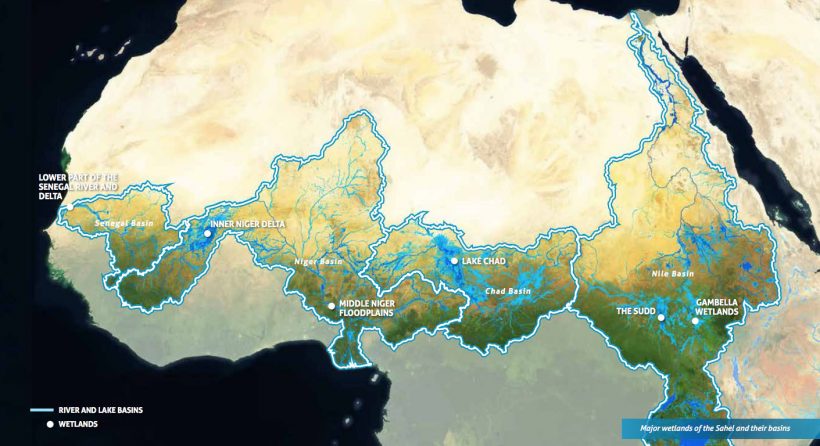
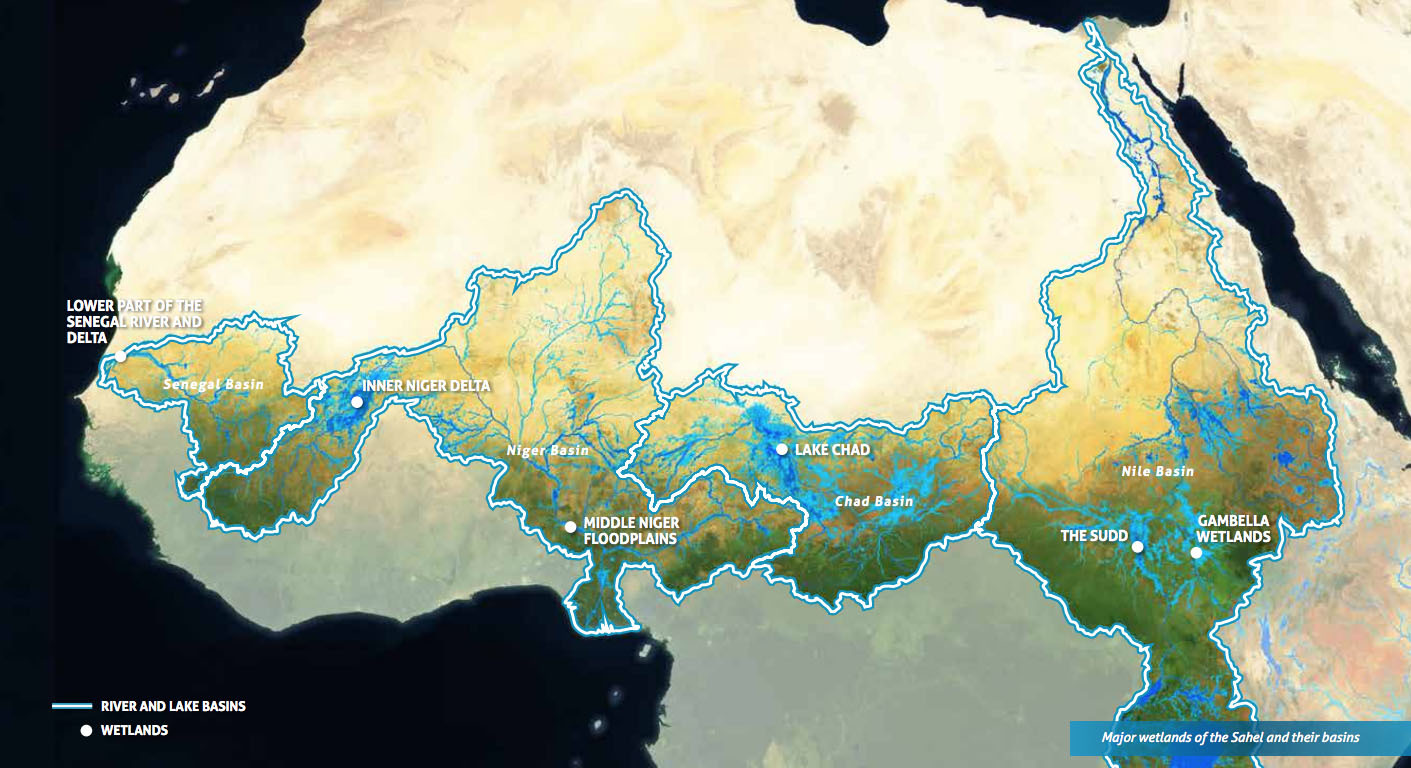
The major wetlands and water basins of the Sahel region in Africa. Wetlands International
https://e360.yale.edu/assets/site/SahelWetlands_WetlandsInternational.jpg
The poverty is driving social breakdown and conflict all around the lake. Mana Boukary, an official of the Lake Chad Basin Commission, an intergovernmental body, told Duetsche Welle two years ago: “Youths in the Lake Chad Basin are joining Boko Haram because of lack of jobs and difficult economic conditions resulting from the drying up of the lake.”
The UN humanitarian coordinator for the Sahel region, Toby Lanzer, told a European Union-Africa summit that it was also fueling migration: “Asylum seeking, the refugee crisis, the environmental crisis, the instability that extremists sow — all of those issues converge in the Lake Chad basin.”
A Nigerian government audit of the lake basin in 2015 agreed. It concluded that “uncoordinated upstream water impounding and withdrawal” were among factors that had “created high competition for scarce water, resulting into [sic] conflicts and forced migration.” More than 2.6 million people have left the Lake Chad region since mid-2013, according to the International Organization for Migration.
At their greatest extent, wetlands cover one-tenth of the Sahel, the arid region stretching for 3,400 miles across northern Africa, immediately south of the Sahara desert. They are wildlife havens, especially notable for their birdlife. The Inner Niger Delta in Mali, for instance, is one of the world’s most important seasonal stops for migrating birds, hosting about 4 million waterbirds from Europe each winter. In addition, these wetlands are a source of sustenance for the region’s poor and the main sources of the region’s economic productivity outside the short wet season from June to September.
Dried-up wetlands are often blamed on climate change when the real cause often is more human interference in river flows.
Yet the decline of the wetlands and the resulting social and economic consequences remains a largely untold story. That is partly because dried-up wetlands are routinely, and often incorrectly, blamed on climate change, when the real cause is often more direct human interference in river flows. It is also partly because many development agencies still mostly think of dams as infrastructure development that furthers economic activity and wealth – and partly because many environmental groups concentrate on the ecological impacts of dried wetlands, while ignoring the human consequences.
In this climate of ignorance, more wetlands are under threat. The next victim is likely to be the Inner Niger Delta, a wetland in northern Mali that covers an area the size of Belgium. The delta forms where West Africa’s largest river, the Niger, spreads out across flat desert near the ancient city of Timbuktu.
The delta is a magnet for migrating European waterbirds. It is also currently one of the most productive areas in one of the world’s poorest countries. It provides 80 percent of Mali’s fish and pasture for 60 percent of the country’s cattle, and it delivers 8 percent of Mali’s GDP and sustains 2 million people, 14 percent of the population, says Dutch hydrologist Leo Zwarts. Its fish are exported across West Africa from Mopti, a market town on the shores of the delta.
In recent years the Mali government has been diverting water from the River Niger at the Markala barrage just upstream of the delta, to irrigate desert fields of thirsty crops such as rice and cotton. These diversions have cut the area of delta flooded annually by up to 7 percent, says Zwarts, causing declines in forests, fisheries, and grazing grasses. Some people have left the delta as a result, though it is unclear whether they have been among the Malians regularly reported to be in migrant boats heading from Libya to Italy.
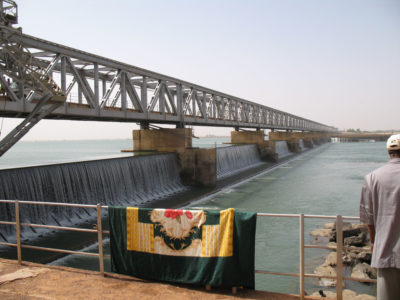
The Markala Barrage in Mali, which diverts water from the River Niger for irrigating crops such as rice and cotton. Fred Pearce/Yale e360
But this trickle of people from the delta could soon become a flood. In July this year, Mali’s upstream neighbour, Guinea, announced the go-ahead for Chinese firms to build a giant new hydroelectric dam, the Fomi Dam, in the river’s headwaters. Construction could begin as soon as December.
The Fomi Dam’s operation will replace the annual flood pulse that sustains the wetland’s fecundity with a more regular flow that the Mali government intends to tap for a long-planned tripling of its irrigation along the river. Wetlands International estimates that the combined impact of the dam and irrigation schemes could cut fish catches and pastures in the delta by 30 percent.
“Less water flowing into the delta means a lower flood level and a smaller flood extent”, says Karounga Keïta of Wetlands International in Mali. “This will have a direct impact on food production, including fish, livestock, and floating rice.” He fears that the inevitable outcome will be further human migrations from the wetland.
The links in the chain from water management through wetland health to social breakdown and international migration are complex. Wetland loss is certainly not the only reason for the human exodus from the Sahel. And migration is a long-standing coping strategy for people living in a region of extreme climate variability.
But the parlous state of the wetlands of the Sahel is changing the region. In the past, wetlands were refuges in times of drought or conflict. They were safe, and the water persisted even in the worst droughts. But today, with their waters diminished, these wetlands have become sources of outmigration. Now, migrations that were once temporary and local are becoming permanent and intercontinental.
https://e360.yale.edu/features/how-africas-big-water-projects-helped-trigger-the-migrant-crisis
Note his comment that “dried-up wetlands are often blamed on climate change when the real cause often is more human interference in river flows. “.
And that “since 2002, rainfall has improved markedly, but Lake Chad has not recovered.”
I have every sympathy for countries like Nigeria and Cameroon. They are between the proverbial rock and hard place,
They have growing populations, with ever growing expectations. For this they need, among other things, food and water supplies. On the other hand, these very things impact on the environment which ultimately sustains them.
There are no easy answers.
But blaming it all on climate change does nobody any favours.
April 1, 2018
Posted by aletho |
Economics, Science and Pseudo-Science, Timeless or most popular | Africa, Boko Haram, Human rights, Lake Chad, Nigeria |
Leave a comment
A US senator has revealed that Washington is struggling with its mission to break militant group al-Shabab’s hold on Somalia.
Some 500 US troops are working with the Somali military and other African partners to eradicate al-Shabab from their strongholds in Somalia. “Our doctrine is…to disrupt, clear, hold. We’re finding it difficult to hold,” Jack Reed, top ranking Democrat on the Senate Armed Services committee, told Defense One in a story published Friday. “We have specialized units who are very good at disrupting al-Shabab together with our special operators, but we’re certainly not at the ‘clear and hold phase,’ we’re at the phase of disrupting al-Shabab, keeping them off balance.”
A quarter-century since 18 US service members died after a Black Hawk helicopter crashed in Mogadishu, long-term stability in Somalia seems as distant a hope as it did then, Reed said. The US pulled its troops from the humanitarian mission launched in the country in 1992 shortly after the deadly 1993 incident, and only returned officially in 2013.
But today, despite a US presence that was substantially boosted in 2017, when the number of troops were doubled to the Pentagon’s current declared 500 and commanders were given more freedom to call in airstrikes, the Somali government is struggling to hold territory from what AFRICOM estimates as 3,000 to 6,000 al-Shabab fighters and a few hundred Daesh soldiers.
US troops are officially in Somalia to provide direct assistance to local armed forces, through train and equip and advise and assist missions. But US airstrikes, which have grown much more numerous with US President Donald Trump’s loosening of restrictions, have clear and deadly consequences, most recently on February 26, when a US strike killed two al-Shabab militants and wounded one, according to AFRICOM.
But it’s not enough. “In terms of building a stable entity, a country that can take care of its own forces, that’s a long way off,” Reed told Defense One. Al-Shabab still executes suicide and other attacks daily, and faces little resistance outside the capital, where Reed said the federal government influence is nearly nil.
And US partners in the region are growing tired. The African Union Mission in Somalia (AMISOM) has “pulled back a bit, they’re more located on forward-operating-bases, they’re not going out a lot,” Reed said, having been burned by a series of fatal encounters with militants. AMISOM is also withdrawing troops with the aim of handing over all responsibility to Somalia’s army by 2020 — though the AMISOM heads of state are unhappy about that. The leaders of East African nations contributing some 20,000 troops to the AMISOM peacekeeping mission in Somalia warned the UN that the planned drawdown would “reverse gains.”
The heads of state of Kenya, Uganda, Burundi, Djibouti and Ethiopia issued a statement from their Friday meeting in Kampala with Somali President Mohammed Abdullahi Mohamed that the time frames and troop levels envisioned by the UN Security Council’s drawdown resolution were “not realistic and would lead to a reversal of the gains made by AMISOM,” the Independent reported.
Some 1,000 troops were withdrawn last year, and 1,000 more are scheduled to leave the country by October, according to the Independent. Meanwhile, three Burundian troops were the most recent to lose their lives when they were ambushed by al-Shabaab Friday.
If the drawdown continues as planned, the US will not fill the void, Reed said.
“We train some specialized units, but I think the notion of going in, like what was done in Afghanistan, to try to train a national army that will fully replace — I don’t think that’s on the table,” he said. “That has to be done, but maybe it could be done by somebody else, maybe we could participate in doing it, but taking that on as we did in Afghanistan or as we did in Iraq?”
March 4, 2018
Posted by aletho |
Illegal Occupation, Militarism, Timeless or most popular | Africa, Al-Shabaab, Somalia, United States |
Leave a comment
On February 17 it will be 7 years since the start of the events in Libya which led to the overthrow of its leader – Muammar Gaddafi. These years have been full of dramatic and often bloody events, which, according to a number of different indices (effective sovereignty, stability, commercial activity etc.), have left the country much worse off.
Since 2014 the country has been in chaotic situation- divided into two sectors, with opposing capitals in Tripoli and Tobruk, each of which have their own government, parliament, and security services. The balance of power between them is changing.
In the last year the area controlled by the National Army, led by Marshal Khalifa Haftar (i.e. the eastern, or Tobruk, sector) has expanded. That sector includes the ‘oil crescent’ (the oil wells and the main ports for oil exports). The Government of National Accord, headed by Fayez al-Sarraj, has an unsteady hold over the country.
For three years the United Nations and a number of neighboring Arab countries have tried, without success, to persuade the two opposing parties to comply with the peace agreement that they signed in Morocco (which called for the creation of unified national transitional state structures, elections to the new parliament etc.) The Shkirat Agreement expired at the end of 2017.
Many experts consider that the negotiators meeting to discuss issues arising from the treaty lack the authority to make any decisions, and the military groups who they represent are heterogenous, each split into a number of camps, divided along regional and tribal lines.
To save the negotiating process, the UN special representative for Libya, Hasan Salam has presented a three-stage plan for the next year. He proposed that the Shkirat Agreement be amended, the Tripoli-based government be restructured, a constitution be drawn up and elections be held in the new parliament.
The question is, how can fair, impartial and democratic elections be held, when there are two governments? And how important are elections to the average Libyan, living in a delicate security situation and suffering from disorder and social and economic problems?
The falling value of the Libyan dinar and annual inflation of 30% are causing a fall in his standard of living. Before the revolution a dinar could be exchanged for three dollars and at its highest level Libyans looked down on the ‘green dollar’ with contempt. Now one dollar can be exchanged in the market for 9 Libyan dinars.
This is genuinely resulting in an increase in prices, as the majority of goods, especially food, are imported. Libyans are faced with the curse of cash shortages, queues in banks, power cuts, deteriorating services etc.
All these problems are the result of the collapse of Libya’s economy and manufacturing sector. According to Mustafa Sanalla, the president of the National Oil Corporation, Libya has lost $180 billion since 2011 because of the actions of various militias in the regions where oil is extracted, refined and transported.
In 2017 Libya received $14 billion from oil sales, three times more than in the previous year. But in 2010, the year before the revolution, oil exports brought approximately $47 billion into the national budget. It is true that recently the amount of ‘black gold’ extracted has increased to 1 million barrels a day, but this is still below the pre-revolution level of 1.6 million barrels a day.
Out of the 150 countries listed in Forbes Magazine’s rating of the ‘Best Countries for Foreign Business’, Libya occupies the last but one position.
As a result of the above situation, people’s attitudes towards the ideals of the February revolution are changing. Today, in Libya’s political and media circles, a clear divide is being observed between so-called ‘Februarists’ and ‘Septemberists’.
The ‘Februarists’ are those who fully support the February 17 revolution, and are convinced that the ‘rebels against a despotic regime’ won a just victory.
Those who support the former Gaddafi regime are known as ‘Septemberists’, as it was the September Revolution that brought Gaddafi to power. The latter camp, shaking their heads in wonder, ask themselves whether it was worth shedding so much blood, losing lives and suffering a huge material loss, merely to end up in Libya’s current fragmented state.
Both of these schools of thought have their own liberal, Islamist, and secular factions. That is why many local political analysts are urging them to find common points of agreement, steer clear of extreme positions, and put the interests of their country above their own selfish political calculations and concerns.
For example, Fatima Hamroush a former minister in Libya’s first post-revolution government, called for the creation of an emergency cabinet made up of politicians with a wide range of affiliations, including former associates of Gaddafi (). That is despite the fact that Dr. Hamroush was at one time a fierce critic of the previous regime.
It appears possible that a political consensus, arrived at in accordance with the law, might be able to fill the current institutional vacuum. But Libyan society is still divided by the powerful shocks it suffered in a war involving NATO and other foreign powers, and during the period of sectarian conflict which followed.
Political circles are pulled apart by disagreement, and are kept hostage by mutual resentments, suspicions and hostilities that have built up over a number of years.
Yury Zinin, Leading Research Fellow at the Moscow State Institute of International Relations (MGIMO).
February 17, 2018
Posted by aletho |
Economics, Timeless or most popular, Wars for Israel | Africa, Hillary Clinton, Libya |
Leave a comment
On February 13, 1960, France carried out its first nuclear test in Algeria’s southern Reggane region. According to official statistics, 17 nuclear tests were carried out in total over the next 6 years. The area remains affected, and local scientists say that radioactive contamination has caused genetic mutations and irreversibly changed the region.
There are no official statistics on the number of victims. The only figures can be found in the records kept by the French representative of the local church, which lists 42,000 victims of nuclear tests. Three years ago, the French Ministry of Defense issued a statement, putting the number at 27,000 people. The victims include French soldiers as well as local Algerians who lived in the surrounding areas.
However, these figures do not take into account the untimely deaths of the descendants of these people, who were affected by cancer and other nuclear radiation-related illnesses. To this day, the contaminated areas pose a danger to life and health.
A representative of the ‘Desert Detainees’ (a community of people who served sentences in prisons located in the desert regions of Algeria from 1992 to 1996), Nureddin Mauhub, said that many prisoners were exposed to radiation while serving their sentences in jails in the desert.
Nuclear engineer Ammar Mansuri told the newspaper Arabi al-Jadid, that in fact, there were more nuclear tests carried out in Algeria.
“France conducted 13 underground nuclear tests, 4 ground tests, 4 plutonium tests and 35 other tests,” he said.
According to him, the nuclear tests documentation was passed on to the Algerian government only 10 years ago.
Some of the documents are still classified. For these reasons, no systematic observations or studies have been conducted in the area in the past century. Therefore, no timely measures were taken to reduce the negative impact on the environment. It is difficult to say how the level of contamination has changed over the past decades and what to expect in the future.
The Algerian government claims that the contaminated area is more than 100 square km, according to the Al-Arabi al-Jadid website. However, problems aren’t limited to this exclusion zone. The desert winds carry contaminated particles to formally clean areas. There’s now a need to study the level of radiation in the desert to accurately determine the boundaries of the contaminated area.
February 15, 2018
Posted by aletho |
Environmentalism, Militarism, Timeless or most popular | Africa, Algeria, France |
Leave a comment
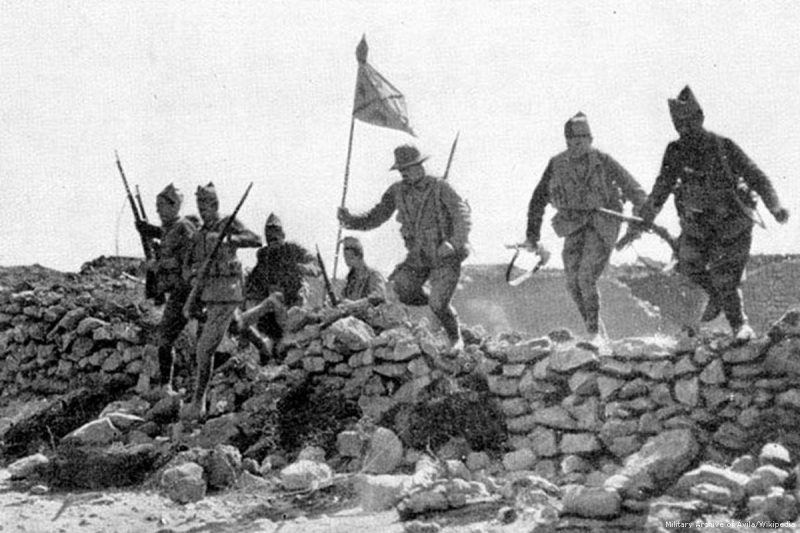
Spanish soldiers are seen during the Rif War in 1922 [Military Archive of Ávila/Wikipedia]
Spain has said it will respond to the Amazigh World Assembly’s (AMA) request concerning the use of chemical weapons by King’s Alfonso XIII military during the Rif War from 1921-1926 but has fallen short on agreeing to apologise for its actions.
Spain’s Foreign Minister Alfonso Dastis confirmed that the request had been made to Madrid and “as a result of the request of the King, the [AMA] were received in the Spanish embassy to submit their demands and also examine possible ways of cooperation.”
Speaking during a parliamentary meeting, Dastis answered questions from Joan Tarda, a member of the Esquerra Republicana, who has been pushing for the Spanish government to admit its use of chemical weapons in the Rif war.
However, though showing his willingness to hear the AMA’s demands, Dastis fell short of expressing his country’s readiness to apologise for its use of chemical warfare on civilians.
The conflict lasted from 1920 to 1927 between Berber rebels led by Mohamed Ibn Abd Al-Karim Al-Khattabi against Spanish colonial forces in Morocco’s Rif region. Following the defeat of Spanish troops in the Annoual battle in July 1921, Spain reportedly used chemical and toxic gas indiscriminately against the Rif civilian population in order to inflict maximum damage. The chemical attacks were a violation of the 1919 Treaty of Versaille which prohibited the use of chemical weapons.
The AMA filed a request calling on Spanish authorities to officially apologise to the Rif people and to compensate the victims and families for the tragedy. A similar request by AMA was last made in 2015 to King Felipe VI.
The Moroccan Centre for Common Memory, Democracy and Peace echoed calls by AMA and called on the Spanish Minister of Foreign Affairs to honour previous pledges to respond to the requests of Moroccan civil society organisations calling on Spain to recognise its culpability.
As a result of the chemical warfare, many of those in the Rif have suffered the highest rates of cancer than in any other region in Morocco with 80 per cent of cases of larynx cancer in Morocco found in the Rif region.
February 15, 2018
Posted by aletho |
Timeless or most popular, War Crimes | Africa, Morocco, Spain |
Leave a comment
France is planning to spend $33 billion (€27bn) to upgrade its arsenal of nuclear weapons as part of a massive $370 billion (€300bn) military spending over the next few years to meet the NATO military alliance’s requirements, the French defense chief has announced.
Speaking to the media on Thursday, French Defense Minister Florence Parly said Paris wanted to increase its military budget so that it can “hold its own” as a key power in Europe.
“The government’s goal is twofold: reach the target of spending two percent of GDP on defense by 2025, while also ensuring we manage our public finances,” Parly said.
France spends $42 billion (€34bn) or 1.8 percent of its GDP for military purposes, slightly less than the two-percent threshold set by NATO.
Under the new plan, President Emmanuel Macron’s government increases overall spending by $2 billion (€1.7bn) a year starting from 2019 until 2022, when it will reach $53 billion (€44bn). Then the budget would be bumped up by $3.6 billion (€3bn) a year between 2023 and 2025.
By then, Paris is supposed to have completed the expensive revamp of its nuclear arsenal, with work on a third-generation nuclear submarine program and a new generation of airborne nuclear missiles already underway today.
“We are going to make up for past shortfalls and build a modern, sustainable, protective army” that would allow France “to hold its own,” said Parly.
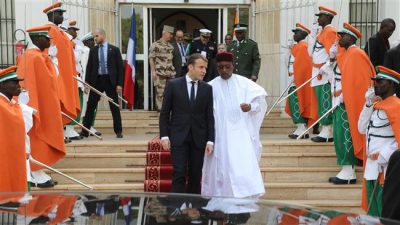 French military forces are currently deployed to West Africa on a declared mission to fight militant groups.
The French president says the country is ready to enhance its military presence in the Sahel region if needed.
The country is also a main contributor to a US-led coalition that has been targeting alleged terrorist positions in Iraq and Syria since 2015.
The years-long operations have put strain on France’s military forces and equipment.
With thousands of troops overseas, the new program allows the defense department to perform a host of upgrades on equipment, from bullet-proof vests to combat uniforms.
There will also be a 34-percent increase in spending on “modernizing weaponry,” which includes buying new Scorpion armored vehicles, four Barracuda attack submarines and three multi-mission frigates, as well as a new fleet of Griffon multi-role armored vehicles.
There are also plans to develop new spy satellites, light surveillance aircraft, new Rafale fighter jets and armed drones. Air tankers are also on the long list of upgrades.
The development is a major reversal in France’s military strategy over the past years and is expected to please US President Donald Trump, who has put NATO allies under pressure to increase their military budgets.
February 8, 2018
Posted by aletho |
Economics, Militarism | Africa, France, NATO |
Leave a comment
President Trump’s recent defeat in his effort unilaterally to alter the status of Jerusalem in defiance of international law highlights the nature of the relationship between the United States and African countries. The U.S. ambassador to the United Nations let it be known before the vote on the General assembly resolution that Donald Trump will take personally any opposition to his policy on Jerusalem. The President himself has made allusions to countries that take American billions and then do what they like. In effect, the United States is monetizing loyalty to President Trump.
American frustration with the United Nations is not new. There were similar immoderate reactions to resolutions that went against State Department policy in the 1960s when Burkina Faso (then called Upper Volta), Nigeria, Ghana and Guinea, four of the thirty-six African countries that voted for the resolution to uphold international law on Jerusalem’s status (outnumbering African abstainers and no-shows combined) showed independence of thought from the United States. Then, as now, American money had been wrongly assumed to guarantee deference to the State Department. [1]
Among the many issues in contention in the 1960s were i. admission of Communist China to the General Assembly, ii. African arms proliferation, and perhaps most important of all, iii. régime-change in Congo by the removal of Patrice Lumumba, Congo’s newly elected leader in favour of his opponents backed by Belgium, the UK and the United States.
During the Congo crisis, the U.S paid a substantial proportion of the cost of the UN peace-keepers in Congo (40% according to David N. Gibbs and 50 % according to Secretary of the Treasury, Robert Anderson) and grew increasingly disgruntled with its inability to dominate the situation.[2]
“Secretary Herter said he had the strong feeling that our interests have not been advanced by the way the UN operation in the Congo had been conducted. In response to a question from the President, Secretary Herter said both the Secretary General of the UN and Dayal, the UN Representative in the Congo, were responsible for this situation. […]
“The President said one of our most serious problems soon would be the determination of our relations with the UN. He felt the UN had made a major error in admitting to membership any nation claiming independence. Ultimately, the UN may have to leave U.S. territory. (Foreign Relations of the United States, 1961–1963, Volume XX, Congo Crisis, Document 4, Editorial Note.)[3]
U.S. policy towards the UN became aggressive. The Administration felt itself to be in a strong enough position to demand staff changes at UN Headquarters and to determine the composition of United Nations Operation, Congo (UNOC) in order to attain its objective of dictating political developments in that country. Having encouraged Congolese Chief of State Kasavubu to denounce elected Prime Minister Lumumba in a radio broadcast, resulting in Lumumba’s seeking refuge under UN military guard, American officials became concerned that Special Representative of the UN Secretary General to Congo, Rajeshwar Dayal, was in favour of Lumumba’s reinstatement (UN troops had blocked four attempts to abduct Lumumba by Congolese troops loyal to the opposition.)
Meanwhile African countries in favour of reinstating Lumumba attended a conference in Casablanca and discussed withdrawing their troops from UNOC in protest of Lumumba’s treatment. In a telegram to the U.S. mission to the UN dated January 12, 1961, the Department of State said:
“You should approach SYG [acronym for UN Secretary General] soonest with view obtaining his full assessment current situation in Congo. In course discussion you should make following points:
U.S. greatly concerned that situation in Congo has seriously deteriorated despite fact UNGA [United Nations General Assembly] has accepted Kasavubu authority and UN has nearly 20,000 troops stationed in Congo. Pro-Lumumba elements, with outside support contrary to UN resolutions, extending their influence to substantial part of Congo territory. We are especially disturbed at reports, as yet unconfirmed, that participants Casablanca Conference secretly agreed there should be coup d’etat in March in which their troops would be used outside UNOC framework to assist in restoring Lumumba to power, confronting UN with fait accompli. We believe SYG should be reminded strongly that if Congo falls under Communist domination while UN sharing major responsibility for security of country, the results in U.S. public and Congressional opinion likely to be extremely damaging to UN. We therefore request he consider taking all necessary steps to rectify situation. Following are concrete suggestions we hope he will consider urgently:
+ Replace Dayal soonest (emphasis added). As result series of incidents, we have no doubt Dayal’s sympathy for return Lumumba and that his conduct of UNoperations reflects this bias. We believe his removal too long delayed, and that Dayal’s activities have contributed substantially to deterioration of situation in Congo.
+ Now that Guineahas requested withdrawal its troops from UNCommand, we believe SYG should consider encouraging withdrawal of those other contingents who have proved most unreliable and who threatened withdrawal anyway. In particular, Ghana, the UAR and perhaps even Morocco.
+ To fill future requirement, believe SYG should again consider urgently requesting troops from more reliable countries, such as French-African States, Latin America, etc. and increasing contingents from reliable countries already furnishing forces.”[4]
During this time the U.S. reconsidered its relationship with the UN. It was uncomfortable with the new African membership which displayed a trait of voting independently of the American position. More than ten African countries attained independence in 1960 alone.
“The President said one of our most serious problems soon would be the determination of our relations with the UN. He felt the UN had made a major error in admitting to membership any nation claiming independence. Ultimately, the UN may have to leave U.S. territory. (emphasis added)”[5]
By the time the National Security Council (NSC) was being told this, the Department of State together with the Central Intelligence Agency and the U.S. ambassador to Congo, Clare Timberlake had established contact with one Colonel Joseph Mobutu, commander of the Congolese army loyal to the administration in Leopoldville. Mobutu, not yet a strongman in 1960, had witnessed an abortive attempt by President Kasavubu, coached by the U.S., to unseat the elected Prime Minister of Congo by means of a parliamentary vote of no-confidence. Mobutu approached the CIA Station in Leopoldville and expressed his determination to keep Communism out of Congo. As a result, he was co-opted as the U.S. main contact in Congo eventually gaining Western support for his palace coup and going on to rule for thirty-two undemocratic and resource-draining years.
Newly independent African countries were recognized as a matter of course, as and when they gained independence. Two types of leaders are discernible to U.S. officials; the ‘moderate’ or ‘pro-Western’ or more accurately, the amenable to U.S. promptings and proposals and the ‘irresponsible’, ‘radical’, ‘xenophobic Nationalists’ who insisted on political positions in their own domestic, pan-African and Afro-Asian interests and not necessarily the U.S. national interest.
By January 1960, President Eisenhower had already reconciled himself to the possibility of working with dictators “although we cannot say it publicly, […] we need the strongmen of Africa on our side.”[6] The advantage was that through them he could side-step the Pan-African movement and the Afro-Asian Bloc in the UN.
Among the ‘responsible’ was President Houphouët-Boigny of Ivory Coast who was not only merely neutral in the Cold War but positively anti-Communist. He was also anti-pan Africanist Kwame Nkrumah who he portrayed as having illusions of grandeur, (“He believes that he is descended to earth to liberate the African masses.”) and Lumumba (who he described as being ‘changeable’ by reason of his limited education and inexperience). He undertook to counsel them both as well as Sékou Touré of Guinea (another country out of American favour) and assured American officials they could all be brought back to the fold.
Boigny pledged to keep his country free of Soviet influence but said this would need to be facilitated by the U.S. An arrangement is described under which Boigny was to be accompanied to the UN General Assembly by several Entente economic experts to demonstrate the Western support he enjoyed. Boigny planned to develop an African Front to oppose the Afro-Asian Bloc.
In return he was promised,
“the United States will extend sympathy and material support to him personally (emphasis mine) and to the four associated states [likely Dahomey (now in Benin), Niger, Upper Volta (Burkina Faso) and Togo which were forming an entente to be led by Boigny]. “We hope thereby to strengthen one of the most staunchly pro-Western African leaders to continue his guiding influence on the future not only of these states but of others in the region.”[7]
Mali and Guinea on the other hand were judged to be slipping (towards the Sino-Soviet Bloc.) Liberia, at the time America’s only true satellite in Africa, was not strategically important on the same level as Ghana, Nigeria or Congo but the state of its capital city was said to be an embarrassment to the U.S., requiring urgent cosmetic enhancement.
Support for military and other African dictators solidified as American foreign policy through the 1970s. President Nixon’s Bureau for African Affairs justified the supply of arms to military dictators on the basis that they were unlikely to be used to attack neighbours and that they were necessary to maintain internal order, i.e. to keep the régime in power.[8]
It should be noted that despite Ivory Coast’s long history of neo-colonial collaboration with America and France under Boigny’s long tenure as President (he doubled the life expectancy of the average Ivorian), UNICEF economic indicators for the 21st century show that country’s human development outcomes to be at par with poorer, landlocked countries and countries that followed a different path. Life expectancy there is lower than in most countries and a good five years shorter than in Ivory Coast’s neighbours.[9] This is because while Ghana’s Nkrumah, Senegal’s Dia, Congo’s Lumumba, Togo’s Olympio and others sought aid to develop their countries, Boigny like Mobutu sought and received financial support for himself. Both built multi-million dollar monuments to themselves (Boigny: a basilica in his hometown surpassing St Peter’s in the Vatican in size and Mobutu’s Gbadolite palace complex (airport, hotel and cinema included), again in his home town built and furnished with materials imported from Italy and France.
Relations with other African Leaders
Prime Minister Abubakar Balewa of Nigeria visited President Eisenhower a week after his country gained independence.[10] Balewa was an avowed anti-Communist. However he was clear that while he wanted to emulate American-style democracy and institutions he had no interest in joining any ‘power bloc.’ He said while some smaller nations were turning to the Eastern Bloc for assistance, Nigeria would not. He then requested bilateral aid arrangements which Eisenhower agreed to consider. President Eisenhower assured him, “…we put great interest and stock in Nigeria…we will be depending on Nigeria heavily.” before describing the type of infrastructural loans Nigeria could expect from the UN Special Fund for Africa.
Nigerian development and U.S.’ voting positions in the UN General Assembly are discussed in the same conversation and the same exchange – they were one and the same thing; one was unlikely to be offered without the satisfaction of the other.
Later in the conversation in answer to Prime Minister Balewa’s question, President Eisenhower stated that should Nigeria vote in favour of Red Chinese representation at the UN it would “constitute such a repudiation of the U.S. that we would be in a hard fix indeed.” [11] In the event Nigeria did vote against the U.S. position and the U.S. began to doubt whether Nigeria could be relied upon to champion another matter important to them: an arms limitation agreement governing African countries.
“It has been suggested that Nigeria might be the most suitable country to provide African initiative for the exploration of this possibility. However, the behavior of the Nigerian delegation in the current General Assembly now causes some doubt in this regard.”[12]
The bluntly-spoken Prime Minister Sylvanus Olympio of Togo said in his deliberations with U.S. officials that he preferred multilateral aid to avoid the “power politics and trouble” that he believed came with bilateral aid.
In a courtesy call to the White House in 1960, President Dia of Senegal expressed willingness to have close relations with the U.S. saying he had no anxiety about political, economic, cultural or ideological domination by the U.S. He then made arrangements for a technical assistance programme to be drawn up by his aides who were to remain behind in Washington for the purpose. [13]
Recently Senegal has voted twice in support of international law governing Palestine. In 2016 together with three other non-African countries it moved a Security Council resolution that Israel “immediately and completely cease all settlement activities in the occupied Palestinian territory, including East Jerusalem.”
If President Trump carries out his threats, Senegal is likely to face the type of ‘power politics and trouble’ Togo has been anxious to avoid since the 1960s. In December 2017, Togo was the only African country to vote with the USA and Israel. Benin (Dahomey), once part of the Boigny-led entente, abstained.
With current voting patterns, it remains to be seen whether backing dictatorial régimes on the African continent will remain viable as U.S. foreign policy. While the potential availability of American development assistance did not prevent most African countries from standing on their own principles in the 1960s, the active promotion of dictatorship undermined and eventually killed the pan-African movement. However, the entry of China as a new development partner may free African leaders to govern independently of Western (and hopefully Chinese) domination.
Uganda, one of the remaining strongman states is a major recipient of American military largesse and host to American military personnel. But Uganda also collaborates closely with China and abstained from the vote. Rwanda and Equatorial Guinea, Cameroon, Lesotho and Malawi also abstained. The no-shows, which arithmetically at least, are as good as abstentions, were all African and included Central African Republic, Democratic Republic of the Congo, Guinea-Bissau, Kenya, Sierra Leone, Swaziland, and Zambia. All, except Swaziland have deep economic ties with the People’s Republic of China.
Notes.
[1] Other African supporters of international law were Algeria, Angola, Botswana, Burundi, Cape Verde, Chad, Comoros, Congo, Dijbouti, Egypt, Eritrea, Gabon, Gambia, Guinea, Liberia, Libya, Madagascar, Mali, Mauritania, Mauritius, Morocco, Mozambique, Namibia, Nigeria, Senegal, Seychelles, Sierra Leone, Somalia, South Africa, Sudan, Tanzania, Tunisia and Zimbabwe.
[2] At the 456th meeting of the NSC.
[3] See also Foreign Relations 1958-1960, Volume XIV , Doc. 29, Report of the Conference of Principle Diplomatic and Consular Officers of North and West Africa[3], Tangier, May 30-June 2, 1960.
[4] FRUS, 1961–1963 Volume XX, Congo Crisis Doc. 5. Telegram From the Department of State to the Mission to the United Nations, Washington, January 12, 1961, 8:22 p.m.
[5] FRUS, 1961–1963 Volume XX, Congo Crisis, Doc. 4.
[6] See FRUS 1958-1960, Africa, Vol. XIV General Policy, page 75, Doc. 21, Memorandum of Discussion at the 432nd Meeting of the National Security Council January 14, 1960.
[7]FRUS 1958-1960 v.14 Newly Independent States, Doc. 65 Memorandum from Secretary of State Herter to President Eisenhower, August 5, 1960.
[8] FRUS, 1969–1976 Volume E–6, Documents on Africa, 1973–1976, Document 4, Memorandum From the Deputy Assistant Secretary of State for African Affairs (Ross) to the Under Secretary of State for Security Affairs (Tarr), Washington, April 10, 1973.
[9] UNICEF, http://www.unicef.org/infobycountry/
[10] FRUS 1958-1960, Africa, Vol. XIV General Policy Doc. 38, Instruction from the Department of State to Various Diplomatic Posts and Missions, November 25, 1960.
[11] FRUS 1958-1960 v.14 Newly Independent States Document 77, Memorandum of Conference with President Eisenhower, October 8, 1960.
[12] “Nigeria had voted against U.S. positions regarding Chinese representation, the allocation of the Cuban complaint to the Political Committee, and the Ethiopian resolution against nuclear weapons. (Memorandum from Herz to Kellogg, November 7; Department of State, AF/AFI Files: Lot 69 D 295, Arms for Africa”
[13] FRUS 1958-1960 v.14 Newly Independent States, Doc.88. Memorandum of Conversation, December 9, 1960.
Mary Serumaga is a Ugandan law graduate who has worked in public sector reform and spent several years in advocacy, and as a volunteer care worker for asylum-seekers. Her essays have been published in Transition (Hutchins Press), The Elephant, Pambazuka News, Foreign Policy Journal, Africa is a Country, the Observer (Uganda) and King’s Review. The Committee for the Abolition of Illegitimate Debt website carries her articles on debt.
December 27, 2017
Posted by aletho |
Ethnic Cleansing, Racism, Zionism, Illegal Occupation, Solidarity and Activism, Timeless or most popular | Africa, Israel, Jerusalem, Palestine, United States, Zionism |
Leave a comment

 Aletho News
 Aletho News