China Acquires Israeli Dead Sea Cosmetics Company for $77 Million
Sputnik – April 11, 2016
On Sunday, Vice President and CEO of Fosun Group, Liang Xinjun, signed an agreement to purchase Ahava with Executive Director of Gaon Holdings Guy Regev. The deal amounted to $77 million.
The ceremony took place in the presence of high-ranking Israeli officials at the David Citadel Hotel in Jerusalem and was witnessed by Israeli government officials and representatives of both companies.
Under the terms of the agreement, Fosun will acquire the holdings from all Ahava’s shareholders including Gaon Holdings, Shamrock Israel Growth Fund Advisors, Kibbutz Mitzpe Shalem, and Kibbutz Kalia.
Vice-President of Fosun, Liang Xinjun, said he was pleased with the results of agreement and hopes to bring Ahava into the Chinese market.
Chinese companies and corporations have been active in the Israeli market over the last few years. In 2011, China National Chemical Corporation acquired Adama, which produces pesticides, for a price of $2.4 billion and in 2015 the Chinese company Bright Food acquired a controlling stake in Israel’s largest producer Tnuva, which is heavily involved in dairy goods.
In addition, China is already the world’s largest importer of cosmetics and health products based on minerals from the Dead Sea.
Experts believe that China’s geopolitical presence in Israel will only continue to grow. In particular, due to the construction of the state-owned China Harbor seaport of Ashdod on the Mediterranean Sea.
The country’s first private port will not appear before 2021. The project cost is estimated at over one billion dollars. The purpose of the project is to connect Ashdod with the southern Israeli city of Eilat and transport goods to Europe, bypassing the Suez Canal.
Natural resource exploitation in the Dead Sea area – The case of Ahava
Alhaqhr | October 28, 2014
This is the first in a series of new Virtual Field Visits focusing on the topic of business and human rights. This video will highlight corporate complicity in the exploitation of natural resources in the Dead Sea area of the Occupied Palestinian Territory.
Tourism as a tool to erase Palestinian identity
By Jessica Purkiss | MEMO | March 22, 2014
At the entrance of a Dead Sea resort located in the West Bank, Palestinian man Hazem paid his 70 shekels admission fee to the women sitting behind the desk. “Can we camp here?” he asked. Surveying the group of internationals, she said, “Are there any Arabs in your group?” Hazem, born and bred in the West Bank city of Beit Sehour, confessed his origin to the women who replied, “We don’t let Arabs stay the night.”
Past the entrance desk, the small stretch of beach is dotted with groups of Palestinian men smoking arguila- flavoured tobacco- and heating coals for BBQ’s. All of them have paid the same entrance fee. The women behind the desk collecting their fees is Israeli and only speaks Hebrew and English, and the shop on site sells Israeli flags and Jewish relics. While this resort stands on the chunk of the Dead Sea that lies in the West Bank, the Palestinian side and its resources have been appropriated by Israel. This means all the Palestinians that visit the resort, in fact any of the three resorts in the occupied Dead Sea area, have to pay Israel to do so.
The Dead Sea, which is famous for its skin benefits, is a goldmine for those able to tap into its resources, with the extraction of mud proving to be an extremely lucrative business. Friends of the Earth Middle East claim that there are 50 cosmetic factories on the Western shore, both in the occupied Dead Sea area and in Israel proper, The Israeli cosmetic company Ahava Dead Sea Laboratories ltd. is located on the settlement of “Mitzpe Shalem,” in the occupied West Bank, and is the only cosmetic company to be licensed by Israel to mine mud in the area.
In 2007 Ahava’s annual revenues were 142 million USD. As of 2011, 60% of Ahava’s revenues were from exports, shipping its world famous creams and lotions mainly to European countries and to the United States. Despite Ahava sales propping up the settlement regime- two of the settlements in the area have considerable shares in the company- it owns three international subsidiary companies in Germany, the UK and the US.
While the annexation of the Dead Sea has clear economic benefits, the revenues of Ahava should not act as smokescreen for the gains of the Israeli authorities beyond the economic side. Encroachments of Palestinian spaces and heritage under the name of tourism are much more than this, with the Dead Sea as just one example. They are an attempt to strip Palestinian identity from these spaces.
As a PLO Negotiation Affairs department statement read, “Despite its small size, Palestine has an abundance of historical, religious and cultural heritage sites. Every inch of this land has a story to tell, every hill the scene of a battle, and every stone a monument or a tomb. One cannot understand the geography of Palestine without knowing its history and one cannot understand its history without understanding its geography.”
Herodion, Herod the Greats monumental palace built around 23-20 BC and perched on the highest hill in the area, is another example of the above. From the top of the site, the Palestinian city of Bethlehem, which lies just 5km away, is clearly visible. The Palestinian taxi-driver who dropped us off at Herodion, tells us we are in Israel now. Driving past the military base and paying entrance fees to an Israeli man, whose desk sits in a shop selling “I love Israel” and “Visit Israel” t-shirts, it’s easy to see his point.
However, Herodion lies on Palestinian territory, but like the Dead Sea, has been appropriated by Israel. The site is managed by the Israel Nature and Parks Authority (INPA). While the stated aim of the governmental body is protecting nature, landscape and heritage in Israel, the organisation has recruited conservation for political gains. For example, there are already five “national” parks in East Jerusalem and more on the way, while West Jerusalem does not have even one. These parks, operated INPA enables the state to appropriate private Palestinian land while avoiding the international rebukes which overt settlement building brings about. Under Israeli law the state does not even have to compensate the owners for land on which national parks are built.
When asked where they think they are, some of the tourists who have shuttled off buses run by Israeli tour companies at Herodion, simply didn’t know. One woman from the US remarked, “Judging from the Israeli soldiers and the Hebrew, I would say Israel.” While her husband walked away muttering Israel defiantly, the woman returned and said in a whisper, “I suppose we are where the person with the biggest weapons wants to tell us we are. That’s not right, but I think that’s how it is.”
To the naive tourist just off the coach, he is in Israel. And while, to this same naive tourist, whether he is Israel, “Judea and Samaria” or the Palestinian territories seems unimportant when at a historical site that stretches back thousands of years, Israel is asserting its connection with the land, while simultaneously wiping the other’s connection off the map. To this tourist, the systematic obliteration, Judaization, annexation and confiscation of Palestinian sites turns Palestine into simply a collection of sites in the desert owned by Israel, surrounded by Arab “villages.”
Israel’s Ministry of Tourism map has aimed to do precisely this. In 2009, the ministry completely wiped the West Bank and any Palestinian areas from its materials. Mandatory Palestine was portrayed without any borders or demarcations, while all maps omitted Palestinian areas and towns. Today, instead of defining a line that is the West Bank, the Ministry of Tourism has shaded the areas under the control of the Palestinian Authority in pink, and the area of joint control in a lighter shade of pink, leaving around 60% of the West Bank which falls under area C to blur into Israel.
After visiting Herodion, most of the tourists are likely to move onto nearby Bethlehem. Like Herodion, many tourists, having booked holy land tours from home, believe they are in Israel. Either way, they tend to make only short organised day trips to visit the holy sites, spending the bulk of their money in Israel. Whilst Bethlehem pulls in thousands of tourist annually, Palestine hasn’t been able to fully utilize the area. According to reports by the PA’s Ministry of Tourism and the Bureau of Statistics, in 2007 509,000 tourists came to Bethlehem, but only 88,000 stayed in the city’s hotels, while Palestinian Authority Tourism Minister Kholoud Daibes contends that Israel collects 90% of pilgrim-related revenue.
Meanwhile, Palestinian tours guides or transportation companies have not been able to enter Israel since 2000. From over 240 tourist guides licensed to work all over Palestine and Israel, only 42 have permits to guide in Israel, which are renewed periodically and without guarantee. These restrictions on movement severely hinder the development of a domestic tourism industry. For Israel, this means the sphere in which tourists may meet Palestinians that are not the terrorists from the headlines, and be introduced to another side of a narrative is successfully limited.
To the Palestinians, this systematic obliteration, Judaization, annexation and confiscation of Palestinian sites, are attempt to take away their connection to the land and its history, in the process impinging on their right to self-determination, freedom, independence, and ebbing at the construction of their national identity.
Related article


Ahava blockaders Supreme Court appeal fails, but campaign remains victorious
By Tom Anderson and Therezia Cooper | Corporate Watch | February 7, 2014
 An appeal to the Supreme Court by two campaigners against the Ahava store in London has been unsuccessful.
The campaign
Ahava manufactures its products at the Israeli settlement of Mitzpe Shalem in the occupied West Bank. The settlements of Mitzpe Shalem and Kibbutz Kalia are shareholders in the company (see here).
Ahava, a multinational Israeli Dead Sea products company, was forced to close its flagship store Monmouth Street, central London in 2011 after two years of concerted campaigning by grassroots groups.
The case
The two campaigners, Matt Richardson and Gwen Wilkinson, had locked themselves to a concrete barrel inside the Ahava store on Monmouth street with the aim of stopping the shop from doing business. The store closed for the day. Police arrived and cut them free. They were arrested for aggravated trespass under Section 68 of the Criminal Justice and Public Order Act.
In their defence they argued that the store’s business was unlawful on the basis that the shop was:
-
aiding and abetting a war crime by aiding the transfer of Israeli civilians into the Occupied Palestinian Territories
-
The products in the shop were criminal property as they were the proceeds of a war crime
-
The products had fraudulently claimed the benefits of the Eu-Israel Association Agreement
-
The products had been labelled Israeli when they were in fact from a settlement
In the Magistrate’s Court the defendants were not successful. They were given a conditional discharge and a fine. In an appeal to the High Court the judge upheld their conviction.
The campaigners were appealing against their conviction to the Supreme Court and on the following point of law: “Should the words ‘lawful activity’ in section 68 Criminal Justice and Public Order Act 1994 be limited to acts or events that are ‘integral’ to the activities at the premises in question?”
The court ruled that the answer to that question is “yes” and that the convictions should be upheld. Importantly the judgement says that for activists to use the defence that businesses are unlawful in aggravated trespass cases then the unlawful business must be integral to the business obstructed. Ie it might follow that if activists lock themselves to the gate of a pharmaceutical company that is involved in illegal animal testing then it is only a defence in court to argue that the company’s business isn’t lawful if the business you disrupt is ‘integrally’ involved in the unlawful activity.
The judgement can be viewed here, and here
The option of appealing to the European Court is still open to the defendants
Implications
The ruling is an example of the English court system attempting to close avenues for lawful resistance to corporate crime. In reality, corporations are multinational enterprises that commit crimes across continents. The defence that was the subject of the appeal has often been a chance for ordinary people to express their anger against these crimes.
Its important not to overestimate the importance of this ruling – it only actually adjudicated on the application of the defence in aggravated trespass case. It does not rule out the use of similar defences in criminal damage cases like those used by the Raytheon 9 and the EDO decommissioners, who were found not guilty after breaking into arms factories linked to the supply of arms to Israel and destroyed machinery and computers in order to stop war crimes.
Direct Action
Its also important to remember that the Ahava campaigners were successful in their campaign. The store closed down, not as a result of a court victory but as a result of a concerted grassroots campaign. The victory came after two years of regular demonstrations, blockades of the store, legal challenges as well as acts of direct action which included activists daubing slogans on the windows, super-gluing the locks during the night and throwing paint bombs at the shop front. This combination of public demonstrations, legal challenges and clandestine direct action proved a successful formula.
Japanese Distributer Ends Contract With AHAVA
By Saed Bannoura | IMEMC News | February 27, 2012
DaitoCrea, Japanese agent of the Israeli cosmetics firm, AHAVA, announced on their Webpage that it has ended all sales of AHAVA products for what it attributed to “financial reasons”. The Boycott Divestment and Sanctions (BDS) movement said that decision is the outcome of direct action and protests.
The company stopped all AHAVA sales starting on January 31, 2012. The victory was that of the persistent efforts of a 2-year campaign conducted by the BDS movement that calls for boycotting all Israeli products made in Israel’s illegal settlements in occupied Palestine.
The Forum added that its activists informed the firm, by direct action and advocacy, of the illegality of AHAVA goods and the suffering it inflicts on the Palestinian people.
An Executive at the DaitoCrea told the Palestine-Forum campaign that the company had no idea about the background of AHAVA when they started dealing with them, and had no idea about the location where AHAVA products are made.
AHAVA – Israel products are made in a settlement in the occupied Palestinian West Bank; settlements are illegal under International Law.
AHAVA uses Dead Sea minerals and resources while the Palestinians are kept out of the Dead Sea area due to Israel’s illegal policies.
The campaign informed the distributor that AHAVA labels their products as “Made In Israel” while in fact it is made in an illegal Israeli settlement in the occupied territories.
In May 2010, the campaign held a meeting with officials of the Japanese Ministry of Foreign Affairs and they stated that in is not appropriate for AHAVA to labels its goods as made in Israel while they are made in a settlement.
In 2010, the MUJI beauty products in Japan decided to cancel its plans to open stores in Israel for what they described as “financial reasons”. The BDS movement said that the decision was made after a seven-month campaign against opening the store.
THE BDS movement in different parts of the world is active on different levels, including the boycott of Israeli settlements goods, information about the illegal Israeli occupation, and on cultural and intellectual levels to raise awareness on the Israeli violations against the Palestinian people.
These violations affect every aspect of the life of the Palestinians, and deprive them from their rights in their homeland and their right to their natural resources.
Related articles
- Israeli SodaStream: Maybe Green, Definitely Not Clean (alethonews.wordpress.com)
- BDS movement’s strength shown by pro-Israel groups launching defensive “BUYcott” days (alethonews.wordpress.com)
- There’s no beauty at this exhibition (londonbds.org)
- A visit to London’s World Travel Market (londonbds.org)
- London BDS 2011 year in review (londonbds.org)
- The INDEPENDENT: Natural History Museum attacked over links to ‘illegal’ Israeli company (londonbds.org)
Featured Video
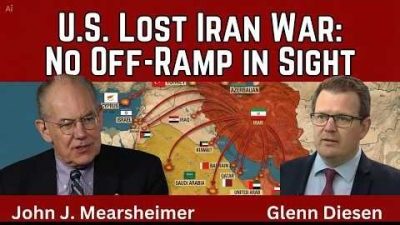
John Mearsheimer: US Already lost Iran war – No off-ramp in sight
or go to
Aletho News Archives – Video-Images
Frlom the Archives
70 Neocons Petition Congress To Effectively Allow Israel To Say When The US Should Attack Iran
By Damian Lataan | January 10, 2014
Seventy senior Israeli-centric neoconservatives have written an open letter to Congress imploring them to do more to ensure Iran complies with the conditions of any agreement finally reached with the P5+1 over Iran’s nuclear program.
While the neocons are ostensibly asking Congress to ensure compliance, it is clear that their real aim is to convince members of Congress to support the bill currently passing through the Senate which calls for tighter sanctions against Iran in the event of any waywardness on Iran’s part.
The neocons are eager to see the bill currently passing through the Senate with enough support to make it veto-proof, not so much because they are concerned about Iran’s so-called nuclear weapons program – there’s still not a skerrick of hard evidence that Iran has a nuclear weapons program – but, rather, because embedded within the bill is this clause:
… if the Government of Israel is compelled to take military action in legitimate self-defense against Iran’s nuclear weapon program, the United States Government should stand with Israel and provide, in accordance with the law of the United States and the constitutional responsibility of Congress to authorize the use of military force, diplomatic, military, and economic support to the Government of Israel in its defense of its territory, people, and existence…
Essentially, the clause is an automatic trigger for the US to attack Iran at any time the Israelis choose to launch a first strike – regardless of whether President Obama is in favour or not.
Partial list… continue
Blog Roll
 Aletho News
- John Mearsheimer: U.S. Already Lost Iran War – No Off-Ramp in Sight
- UK Parliament Plans ISP Blocking and Age Verification Powers
- World cannot remain silent as US and Israel attack ‘heritage of humankind’: Iran
- Emirati billionaire rebukes US senator over call for Gulf states to join war with Iran
- Op. True Promise 4: Iran’s missile blitzkrieg dismantles US war machine in West Asia
- Aramco CEO warns ‘catastrophe’ imminent if Strait of Hormuz remains shut
- What If Iran Says No?
- Trump Threatens to ‘Hit’ Iran ‘Twenty Times Harder’ Over Strait of Hormuz Oil Flows
- Spare the hypocrisy: Baghaei slams Ursula’s support for US
- Iran War Supporters Invent a New and Absurd Justification: It Is All About China
- If Americans Knew
- Israel Decided the War, But Trump’s America Fights and Pays the Bill
- Conscientious Objector Group: Phone ‘Ringing Off Hook’ As Huge Mobilization Underway
- U.S. support for Israel continues to plummet, despite media’s best efforts
- Threats and missiles fly, death tolls soar in Iran, Lebanon, Gaza – Not a ceasefire Day 151
- Lebanon: Israel’s White Phosphorous Use Risks Civilian Harm
- Corporate Media Go All Out To Support The US-Israeli War On Iran
- US-Israel war on Iran is creating a steady growing number of amputees
- Israel planned this war on Iran for 40 years. Everything else is a smoke screen
- The wrong question about the war in Iran
- ‘Your Tax Dollars Being Used to Raise Your Gas Prices’: US-Israel Bomb Major Iranian Oil Depots
- No Tricks Zone
- New Study Documents A 20-Year Pause In Arctic Sea Ice Decline – Driven By Internal Variability
- Wake-up Call: Survey Shows Majority Of Germans Now Favor Postponing Climate Targets!
- Televised! Leading German Political Candidate Tells Schoolchildren CO2 Makes Sun Hotter!
- New Study: A Century Warming Of 1.1°C Is ‘Commonplace’ And ‘Not Unusual’ During This Interglacial
- New Study: ‘Internal Noise’ And Volcanic Forcing Can Trigger 10-15°C Warming Within Decades
- Glaciers Worldwide Are Suddendly Surging, Experts Blame Warming!
- Surprising Discovery: Sahara Is Greening…Billions Of Trees Where Once Thought To Be Barren
- New Research Reaffirms Clouds, Aerosols, And Surface Solar Radiation Are ‘Driving The Climate System’
- Germany: Electric Car Catches Fire At Charging Station, Sets Off Local “Inferno”, Widespread Damage
- New Study: Canada’s New Brunswick Was 1°C Warmer Than Today During The Medieval Warm Period
 Aletho News