Majority in Turkey against war with Syria: Opinion poll
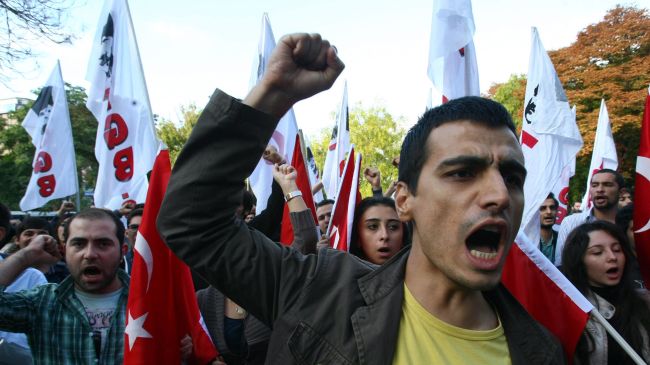
An anti-war protest was held in the Turkish capital Ankara on October 9, 2012
Press TV – October 14, 2012
A recent opinion poll has revealed that more than 75 percent of the Turkish people are against a war with neighboring Syria.
The opinion poll was conducted by Metropol, an agency close to the Turkish government, and surveyed 3,000 respondents.
Analysts believe that this majority is increasing further and there is a sharp mismatch between the government’s policies and the Turkish public opinion.
This comes as massive anti-war protests have taken place in many Turkish cities during the past weeks.
The row between Turkey and Syria escalated after Ankara held Damascus responsible for a mortar shell that killed five civilians in the southeastern town of Akcakale on October 3.
Ankara promptly responded with retaliatory fire that continued through the next days, and Turkish lawmakers also authorized the government to use military force against Syria when it deemed necessary.
Tensions have been running high between Syria and Turkey, with Damascus accusing Turkey along with Saudi Arabia and Qatar of backing a deadly insurgency that has claimed the lives of many Syrians, including security and army personnel.
Turkey has beefed up its military presence on its border with Syria over the past weeks, stationing tanks, anti-aircraft missiles, and additional troops in the area.
Turkish Prime Minister Recep Tayyip Erdogan warned on October 9 that Turkey’s armed forces would not hesitate to strike back in response to any attack on the Turkish soil after Turkey’s parliament authorized cross-border military action against Syria “when deemed right” On October 4.
NATO mortar ‘gift’ from Turkey to Syrian rebels – Turkish newspaper
RT | October 9, 2012
The mortar used to attack the Turkish town of Akcakale is a design specific to NATO and was given to Syrian rebels by Ankara, according to Turkey’s Yurt newspaper. The mortar killed one adult and four children from the same family on Wednesday.
An article by the paper’s Editor-in-Chief, Merdan Yanardag, states that the newspaper received information from a reliable source, which claimed that Turkey itself sent the mortars to rebels in the so-called “free army.”
“Turkey is a longtime member of the North Atlantic Treaty Organization and they’re going to act in conjunction with other NATO powers, so it’s unsurprising that this has happened,” editor of the Pan-African news wire, Abayomi Azikiwe, told RT.
NATO has so far shunned any military involvement in the conflict, but Azikiwe says the alliance is deeply involved in every decision that Turkey makes.
“Ankara isn’t taking any military actions or contemplating any type of military strategy without being in full cooperation with NATO forces,” he said.
Turkey retaliated at Syria for a sixth consecutive day on Monday, after a mortar from Syria landed in Turkey’s Hatay province.
And as Turkey fights to defend its border towns, the country’s president says the country’s military will take any action necessary.
“The worst-case scenarios are taking place right now in Syria … Our government is in constant consultation with the Turkish military. Whatever is needed is being done immediately as you see, and it will continue to be done,” President Abdullah Gul said in a statement on Monday.
But it’s not only leaders within Turkey that are stating their opinions on the conflict.
Earlier on Monday, UN Secretary General Ban Ki-moon warned of the consequences that the conflict could bring to the region.
“The escalation of the conflict along the Syrian-Turkish border and the impact of the crisis on Lebanon are extremely dangerous,” Ban said at the opening of the World Forum for Democracy in Strasbourg, France.
The exchange of fire began last Wednesday, when Syrian mortar shells killed a woman and four children from the same family in Akcakale.
Many fear the situation will lead to regional conflict, with political analyst Dan Glazebrook, saying that Ankara aims to drag NATO into a war with Syria.
“On the one hand the [Turks] are trying to give cover to the rebels to continue their fight, as they know that the rebels are getting defeated on the ground so they are bombarding Syria as a way to help the rebels not lose too many of their positions,” Glazebrook told RT. “But I think also they may be hoping that they can somehow nudge, provoke NATO into taking action as well, into prompting a kind of blitzkrieg that is actually the only thing really that would enable the rebels to win now at this state.”
Related articles
- usually the FSA mortars are described as russian-made and stolen from the syrian army (niqnaq.wordpress.com)
- Nato has ‘plans in place’ to back Turkey in Syrian war (morningstaronline.co.uk)
Featured Video

Yemen joins the war – Red Sea could be blocked next – Saudi regime at risk
or go to
Aletho News Archives – Video-Images
From the Archives
A superpower and “the world’s sickest warrior state”
By Paul J. Balles | March 8, 2010
Living through five or six major wars has hardened me to what I thought were the extremes of inhuman cruelty and brutality.
Two things made those extremes almost bearable: the brutality always revealed – at least according to the media coverage – the viciousness of the enemy. It was therefore quite understandable when our “brave men and women” pulverized the enemy.
Films of Japanese torturing captive Americans somehow justified holding Japanese Americans in internment camps during World War II; and only a small percentage of Americans found the bombing of Hiroshima and Nagasaki unreasonably vengeful at best, at worst, depraved.
The media giants in America portrayed the North Koreans as barbaric beasts with their captives, quite unlike their southern counterpoints – our allies during the Korean War. No one ever felt the need to explain how the South Koreans were a civilized breed while the North Koreans were absolute savages, at least according to the official line.
In Vietnam, our warriors justifiably (or so the media made us believe) dropped napalm on the North Vietnamese who had the gall to hide in villages and tunnels to ravage our invaders. At least it was accepted practice until some rogue photojournalist filmed a young girl screaming down a Vietnamese road in flames. … continue
Blog Roll
 Aletho News
- America Racing to Strategic Defeat in Iran: Lt Col Daniel Davis
- FTC Warns Visa, Mastercard, PayPal, Stripe Over Political Debanking
- Russian tanker approaches Cuba despite US oil blockade
- Marandi: Yemen joins the war – Red Sea could be blocked next – Saudi regime at risk
- Pro-Palestinian French member of European Parliament denied entry to Canada
- Pakistan to Host US-Iran Talks
- How Indonesia’s tilt toward the US left it stranded in the Strait of Hormuz
- US has no choice but to retreat from Iranian borders: Top commander
- Iran Retaliation Strikes Chemical Plant Near Dimona
- AWACS’ Destruction is a Major Loss for US Military – Ex-DoW Analyst
- If Americans Knew
- Israeli police block Catholic cardinal from entering Church of the Holy Sepulchre on Palm Sunday
- Israel is assassinating journalists again, more than any other nation, anywhere, ever – Not a ceasefire Day 170
- Over 300 US service members wounded, majority have brain injuries – Not a ceasefire Day 169
- Researchers at Human Rights Watch Resign Over Blocked Report on Palestinian Refugee Return
- Jewish Groups Are Backing a War Americans Don’t Want
- Eric Fingerhut Thinks He’s the President of the Jews
- Top Jewish Philanthropists, Rabbis Urge Israeli President to Take Action Against ‘Jewish Extremists’
- Don’t Be Fooled. Zionist Leaders Have Always Wanted to Control Southern Lebanon
- Israel’s widespread use of torture is a core element of its genocide against the Palestinian people
- In Israel’s War on Iran, Many Middle East US Bases Rendered “All But Uninhabitable”
- No Tricks Zone
- New Study Finds Warming Saves Lives…Cold Temperatures 12 Times More Deadly Than Excess Heat
- German Science Blog Accuses PIK Climate Institute Of Hallucinating Climate Tipping Points
- Devastating Assessment Of Comirnaty Vaccine By Former Senior Pfizer Europe Toxicologist
- New Study: CO2 Is ‘Effectively Negligible’ As An Explanatory Climate Change Factor Since 2000
- Former Pfizer Toxicologist Dr. Helmut Sterz Tells Bundestag Hearing Pfizer Vaccine Should Have Never Been Approved
- Energy Expert: Germany’s Nuclear Phaseout Was A “500 Billion Euro Mistake”
- New Research: South Australia’s Mid-Holocene Sea Surface Temperatures Were 4°C Warmer Than Today
- Storing Green Energy To Last Germany 10 Days Would Require A 60-Million Tonne Battery
- New Studies: UK Sea Levels Were 4 Meters Higher Than Today During The Mid-Holocene
- Destructive Green New Deal: German Energy And Metal Group Warns Of Drastic Crisis
 Aletho News