Wealthy Gulf states may arm Syrian rebels to ‘get the Russians to back off’ – US officials
RT | September 27, 2016
With the Syria ceasefire in tatters, there is a growing possibility that wealthy Gulf states might arm Syrian rebels, looking to shield themselves from Syrian and Russian warplanes, with shoulder-fired anti-aircraft missiles, according to a report.
One US official, speaking on condition of anonymity, told Reuters that Washington has kept high numbers of man-portable air defense systems (MANPADS), considered to be a threat to low-flying aircraft, out of Syria by uniting Western and Arab allies behind sending training and infantry weapons to moderate opposition groups while the US conducted talks with Russia.
Fed up with dancing to Washington’s tune, Gulf allies or Turkey may sooner or later silently agree to wealthy individuals supplying MANPADS to opposition groups in Syria, another US official said.
“The Saudis have always thought that the way to get the Russians to back off is what worked in Afghanistan 30 years ago – negating their air power by giving MANPADS to the Mujahideen,” an unnamed US official told Reuters.
“So far, we’ve been able to convince them that the risks of that are much higher today because we’re not dealing with a Soviet Union in retreat, but a Russian leader who’s bent on rebuilding Russian power and less likely to flinch,” the official added, referring to Russian President Vladimir Putin.
Asked if Washington planned to do “anything other than pursue a diplomatic solution” to halt the violence in Syria, State Department spokesman Mark Toner said anyone pouring more weapons into the conflict will only add more fuel to the fire.
“I think that those who may be deluded into thinking there’s a military solution also have to realize, and we’ve alluded to this before, that there are those – and not the United States – but there are those who back various groups and opposition groups within Syria who also may seek to arm them. And again, what you have as a result is just an escalation in what is already horrific fighting. As I said, things could go from bad to much worse,” Toner said.
Another administration official, who spoke on condition of anonymity to Reuters, noted, however: “The opposition has a right to defend itself and they will not be left defenseless in the face of this indiscriminate bombardment.”
The official stated that some other US “allies and partners” have been also involved in the US-Russia talks on the conflict in Syria.
“We don’t believe they will take lightly to the kind of outrages we’ve seen in the last 72 hours,” the administration official said, noting that he would not comment on “the specific capability that might be brought into the fight.”
On Monday, the German newspaper Kölner Stadt-Anzeiger published an interview with an Al-Nusra commander in Syria, identified as “Abu Al-Ezz,” who said that US allies were providing Al-Nusra with tanks and artillery.
“The Americans are on our side,” Al-Ezz reportedly said, adding that Al-Nusra has allegedly been receiving funding from Saudi Arabia, Qatar and Kuwait, and has obtained tanks and artillery from Libya via Turkey. The group especially appreciated the US-supplied TOW anti-tank missiles, he alleged.
While admitting that its allies in the region may be arming Al-Nusra militants, the US government has categorically denied that it is providing any aid to them.
“That’s complete poppycock. Whatever he’s saying, no.
“We would never provide Nusra with any kind of assistance at all,” State Department spokesman Toner told reporters on Monday.
Asked why the US has been unable to persuade the “moderate opposition” in Syria to separate itself from Al-Nusra, Toner replied that it was the rebels’ responsibility, and that they would need a seven-day ceasefire to do so.
Tensions escalated after US-led coalition jets bombed Syrian government forces’ positions near the eastern city of Deir ez-Zor, killing 62 troops on September 17. The incident dealt a serious blow to the Syrian ceasefire deal, which Moscow and Washington agreed to earlier this month, with the Syrian Army General Command saying the airstrike “paved the way” for Islamic State (IS, formerly ISIS/ISIL) militants.
The bombing was stopped only after the Russian military contacted the US side several times, saying that they were attacking the wrong targets.
Washington acknowledged the airstrike against the Syrian troops and even apologized for the mistake.
The speaker of the People’s Council of Syria said on Monday that Damascus has a recording of conversations between the American military and Islamic State terrorists ahead of the US-led coalition airstrike that hit Syrian troops near Deir ez-Zor.
“The Syrian Army intercepted the communications between the Americans and Daesh [Arabic pejorative for Islamic State] ahead of the attack on Deir ez-Zor,” Hadiya Khalaf Abbas said, as cited by Sputnik Arabic.
During his speech at the UN General Assembly over the weekend, Syrian Foreign Minister Walid Muallem also stated that the bombing of Syrian troops by the US-led coalition was a deliberate attack, not a mistake as Washington claims.
On September 19, a humanitarian convoy consisting of 31 trucks was attacked while heading to Aleppo. According to the Red Cross, 20 civilians and one aid worker died as a result. Initial reports by the organization claimed the convoy had been targeted by an airstrike. The US State Department was quick to blame Damascus and Moscow for the attack which led the UN to suspend aid deliveries to Syria. The day after the attack, the UN backtracked on its earlier claims that the convoy was hit by military planes.
The Russian Defense Ministry stated that Russian and Syrian warplanes did not launch airstrikes on the aid convoy that was attacked en route to Aleppo. The ministry added that only militants who control the area had information regarding the location of the convoy.
Read more:
‘Americans are on our side’: Al-Nusra commander says US arming jihadists via 3rd countries
5,000 terrorists entered Aleppo via Turkey in 2 months: Assad
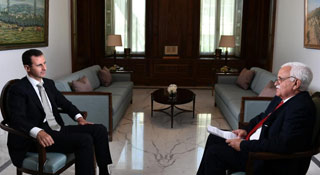
Prensa Latina | July 21, 2016
Prensa Latina transmits below the full text of the exclusive interview with Syrian President Bashar Al Assad:
PRENSA LATINA: Mr. President, thanks for giving Prensa Latina this historic opportunity of conveying your point of views to the rest of the world about the reality in Syria, because as you know, there is a lot of misinformation out there about your country, about the foreign aggression that is taking place against this beautiful country.
Mr. President, how would you evaluate the current military situation of the external aggression against Syria, and what are the main challenges of Syrian forces on the ground to fight anti-government groups? If it is possible, we would like to know your opinion about the battles or combats in Aleppo, in Homs.
President Assad: Of course, there was a lot of support to the terrorists from around the world. We have more than one hundred nationalities participating in the aggression against Syria with the support of certain countries like Saudi Arabia and Qatar with their money and Turkey with the logistical support, and of course with the endorsement and supervision of the Western countries, mainly the United States, France, and the UK, and some other allies.
But since the Russians decided to intervene in supporting legally the Syrian Army in fighting the terrorists in Syria, mainly al-Nusra and ISIS and some other affiliated groups, the scales have been tipped against those terrorists, and the Syrian Army has made many advancements in different areas in Syria.
And we are still moving forward, and the Syrian Army is determined to destroy and to defeat those terrorists. You mentioned Homs and Aleppo.
Of course, the situation in Homs, since the terrorists left Homs more than a year ago, the situation has been much, much better, more stable.
You have some suburbs of the city which were infiltrated by terrorists. Now there is a process of reconciliation in those areas in which either the terrorists give up their armaments and go back to their normal life with amnesty from the government, or they can leave Homs to any other place within Syria, like what happened more than a year ago in the center of the city.
For Aleppo it is a different situation, because the Turks and their allies like the Saudis and Qataris lost most of their cards on the battlefields in Syria, so the last card for them, especially for Erdogan, is Aleppo.
That is why he worked hard with the Saudis to send as much as they can of the terrorists – the estimation is more than five thousand terrorists – to Aleppo.
PRENSA LATINA: Through the Turkish borders?
President Assad: Yes, from Turkey to Aleppo, during the last two months, in order to recapture the city of Aleppo, and that didn’t work.
Actually, our army has been making advancement in Aleppo and the suburbs of Aleppo in order to encircle the terrorists, then, let’s say, either to negotiate their going back to their normal life as part of reconciliation, or for the terrorists to leave the city of Aleppo, or to be defeated. There’s no other solution.
PRENSA LATINA: Mr. President, which are the priorities of the Syrian Army in the confrontation with the terrorist groups? What is the role that the popular defence groups are playing in the theatre of operations?
President Assad: The priority of the Syrian Army, first of all, is to fight ISIS, al-Nusra and Ahrar al-Cham and Jaish al-Islam. These four organizations are directly linked to Al Qaeda through the ideology; they have the same ideology, they are Islamic extremist groups who want to kill anyone who doesn’t look or doesn’t feel or behave like them.
But regarding what you called the popular militia groups, actually, at the beginning of the war, the terrorists started an unconventional war against our army, and our army is a traditional army, like any other in the world, so the support of those popular defence groups was very important in order to defeat the terrorists in an unconventional way.
That was very helpful to the Syrian Army, because those fighters, those national fighters, they fight in their regions, in their cities, in their villages, so they know the area very well, they know the region very well, I mean the pathways, the terrain, let’s say, very well.
So, they can be very huge assets for the Syrian Army. That is their role.
PRENSA LATINA: Mr. President, how does the resistance of the Syrian people take place in the economic front to foreign aggression, I mean the economy, and please, what is your opinion on which sectors of the Syrian economy have remained functioning despite the war, economic blockade, looting, and so forth?
President Assad: Actually, the war on Syria is a full-blown war; it is not only supporting terrorists. They support the terrorists, and at the same time they launched a political war against Syria on the international level, and the third front was the economic front, in which they dictate to their terrorists, to their surrogate mercenaries, to start destroying the infrastructure in Syria that helped the economy and the daily needs of the Syrian citizens.
At the same time, they started an embargo directly on the borders of Syria through the terrorists and abroad through the banking systems around the world. In spite of that, the Syrian people were determined to live as much normal life as they can.
That prompted many Syrian businessmen or the owners of, let’s say, the industry, which is mainly medium and small industry, to move from the conflict areas and unstable areas toward more stable areas, on a smaller scale of business, in order to survive and to keep the economy running and to keep the needs of the Syrian people available.
So, in that regard, most of the sectors are still working. For example, the pharmaceutical sector is still working in more than 60 percent of its capacity, which is very important, helpful, and very supportive to our economy in such circumstances.
And I think now we are doing our best in order to re-expand the base of the economy in spite of the situation, especially after the Syrian Army made many advancements in different areas.
PRENSA LATINA: Mr. President, let’s talk a little bit about the international environment, please, give me your opinion about the role of the United Nations in the Syrian conflict, the attempts of Washington and its allies to impose their will on the Security Council and in the Geneva peace talks.
President Assad: Talking about the role of the United Nations or Security Council could be illusive, because actually the United Nations is now an American arm, where they can use it the way they want, they can impose their double standards on it instead of the Charter.
They can use it like any other institution within the American administration. Without some Russian and Chinese stances in certain issues, it would be a full American institution.
So, the Russian and Chinese role has made some balance within these institutions, mainly regarding the Syrian issue during the last five years. But if you want to talk about their role through their mediators or their envoys, like recently de Mistura, and before that Kofi Annan, and in between Brahimi, and so on. Let’s say that those mediators are not independent; they reflect either the pressure from the Western countries, or sometimes the dialogue between the main powers, mainly Russia and the United States.
So, they’re not independent, so you cannot talk about the role of the United Nations; it is a reflection of that balance. That is why so far, there is no United Nations role in the Syrian conflict; there is only Russian and American dialogue, and we know that the Russians are working hard and seriously and genuinely in order to defeat the terrorists, while the Americans always play games in order to use the terrorists, not to defeat them.
PRENSA LATINA: Mr. President, how do you see at the present time the coexistence among Syrian ethnic and religious groups against this foreign intervention? How do they contribute or not in this regard?
President Assad: The most important thing about this harmony between the different spectrums of the Syrian fabric, is that it is genuine, because that has been built up through the history, through centuries, so for such a conflict, it cannot destroy that social fabric.
That is why if you go around and visit different areas under the control of the government, you will see all the colors of the Syrian society living with each other.
And I would say, I would add to this, that during the conflict, this harmony has become much better and stronger, and this is not rhetoric; actually, this is reality, for different reasons, because this conflict is a lesson.
This diversity that you have, it is either to be a richness to your country, or a problem. There’s no something in the middle. So, the people learned that we need to work more on this harmony, because the first rhetoric used by the terrorists and by their allies in the region and in the West regarding the Syrian conflict at the very beginning was sectarian rhetoric.
They wanted people to divide in order to have conflict with each other, to stoke the fire within Syria, and it didn’t work. And the Syrians learned that lesson, that we had harmony; we had had harmony before the conflict, in the normal times, but we have to work more in order to make it much stronger.
So, I can say without any exaggeration that the situation regarding this part is good. In spite of that, I would say the areas under the control of the terrorists – and as you know those terrorists are mainly extremist groups affiliated to Al Qaeda – in which they worked very hard in order to indoctrinate the young generation with their dark ideology, and they succeeded in some areas, this dark ideology with the killing and beheading and all these horrible practices.
With the time, it is going to be more difficult to deal with this new generation of young people who have been indoctrinated with Al Qaeda and Wahabi doctrine and ideology. So this is the only danger that we are going to face regarding our society, harmony, and coexistence that you just mentioned.
PRENSA LATINA: Mr. President, I would like to go again to the international arena. What is in your opinion the role of the U.S.-led international coalition in relation to the groups that operate in northern Syria, in particular regarding the Kurds group. I mean the bombing of the American airplanes and the coalition in the northern part of the country. What to do you think about that?
President Assad: You know, traditionally, the American administrations, when they had relations with any group or community in any country, it is not for the sake of the country, it is not for the interest of the people; it is for the agenda of the United States.
So, that is what we have to ask ourselves: why would the Americans support any group in Syria? Not for Syria. They must their agenda, and the American agenda has always been divisive in any country. They don’t work to unite the people; they work to make division between the different kinds of people.
Sometimes they choose a sectarian group, sometimes they choose an ethnical group in order to support them against other ethnicities or to push them in a way that takes them far from the rest of the society.
This is their agenda. So, it is very clear that this American support is not related to ISIS, it is not related to al-Nusra, it is not related to fighting terrorism, because since the beginning of the American intervention, ISIS was expanding, not shrinking. It has only started to shrink when the Russian support to the Syrian Army took place last September.
PRENSA LATINA: Mr. President, what is your opinion about the recent coup d’état in Turkey, and its impact on the current situation in that country, and on the international level, and on the Syrian conflict also?
President Assad: Such a coup d’état, we have to look at it as a reflection of instability and disturbances within Turkey, mainly on the social level. It could be political, it could be whatever, but at the end, the society is the main issue when you have instability.
Regardless of who is going to govern Turkey, who is going to be the president, who is going to be the leader of Turkey; this is an internal issue. We don’t interfere, we don’t make the mistake to say that Erdogan should go or should stay. This is a Turkish issue, and the Turkish people have to decide.
But what is more important than the coup d’état itself, we have to look at the procedures and the steps that are being taken by Erdogan and his coterie recently during the last few days, when they started attacking the judges; they removed more than 2,700 judges from their positions, more than 1,500 professors in the universities, more than 15,000 employees in the education sector. What do the universities and the judges and that civil society have to do with the coup d’état?
So, that reflects the bad intentions of Erdogan and his misconduct and his real intentions toward what happened, because the investigation hasn’t been finalized yet. How did they take the decision to remove all those?
So, he used the coup d’état in order to implement his own extremist agenda, Muslim Brotherhood agenda, within Turkey, and that is dangerous for Turkey and for the neighboring countries, including Syria.
PRENSA LATINA: Mr. President, how do you evaluate the Syrian government’s relations with the opposition inside Syria? What is the difference between these opposition organizations and those based outside Syria?
President Assad: We have good relations with the opposition within Syria based on the national principles. Of course, they have their own political agenda and they have their own beliefs, and we have our own agenda and our beliefs, and the way we can make the dialogue either directly or through the ballot boxes; it could be a different way of dialogue, which is the situation in every country.
But we cannot compare them with the other oppositions outside Syria, because the word “opposition” means to resort to peaceful means, not to support terrorists, and not to be formed outside your country, and to have grassroots, to have real grassroots made of Syrian people.
You cannot have your grassroots be the foreign ministry in the UK, Franceor the intelligence in Qatar and Saudi Arabia and the United States. This is not opposition, this is called, in that case, you are called a traitor.
So, they call them oppositions, we call them traitors. The real opposition is the one that works for the Syrian people and is based in Syria and its agenda derived its vision from the Syrian people and the Syrian interests.
PRENSA LATINA: Mr. President, how do you evaluate the insistence of the U.S. and its allies that you leave power in addition to the campaign to distort the image of your government?
President Assad: Regarding their wish for me to leave power, they have been talking about this for the last five years, and we never responded even with a statement.
We never cared about them. Actually, this is a Syrian issue; only the Syrian people can say who should come and go, who should stay in his position, who should leave, and the West knows our position very well regarding this.
So, we don’t care and don’t have to waste our time with their rhetoric. I am here because of the support of the Syrian people. Without that, I wouldn’t be here. That is very simple.
About how they defame, or try to demonize certain presidents, this is the American way, at least since the second World War, since they substituted British colonization in this region, and maybe in the world, the American administrations and the American politicians haven’t said a single honest word regarding anything.
They always lie. And as time goes by, they are becoming more inveterate liars, so this is part of their politics. So, to demonize me is like how they tried to demonize President Vladimir Putin during the last two years and they did the same with the Cuban leader Fidel Castro during the last five decades.
This is their way. So, we have to know that this is the American way. We don’t have to worry about it. The most important thing is to have good reputation among your own people. That is what we have to worry about.
PRENSA LATINA: Mr. President, what is your opinion on Syria’s relation with Latin America, particularly the historical links with Cuba?
President Assad: In spite of the long distance between Syria and Latin America, we are always surprised how much the people in Latin America, not only the politicians, know about this region. I think this has many reasons, but one of them is the historical similarities and commonalities between our region, between Syria and Latin America.
Latin America was under direct occupation for long time ago but after that it was under the occupation of the American companies, and the American coup d’états and the American intervention.
So, they know what is the meaning of being independent or not to be independent. They understand that the war in Syria is about independence.
But the most important thing is the role of Cuba. Cuba was the spearhead of the independence movement within Latin America and Fidel Castro was the iconic figure in that regard.
So, on the political level and the knowledge level, there is a strong harmony between Syria and Latin America, especially Cuba. But I do not think we work enough to improve the other part of the relation; to be on the same level mainly on the educational and the economic level.
That was my ambition before the crisis and that is why I visited Latin America, Cuba, Venezuela, Argentine and Brazil, in order toinvigorate this relation. Then, we had this conflict started and it was a big obstacle to do anything in that regard, but I think that we have not to restrain the relation on the historical and the political levels. That is not enough. You have so many other sectors, people should know more about each other. The long distance could be an obstacle, but it shouldn’t because we have strong relations with the rest of the world, east and west.
So, it is not an obstacle in these days. So, I think if we overcome this crisis and this war, we should work harder in order to invigorate the different sectors of this relation with Latin America and especially with Cuba.
PRENSA LATINA: Mr. President, would you tell me your opinion about the electoral process in the United States mainly for the president? Now, there are two candidates; the Republican one is Mr. Donald Trump and the Democrat one is Mrs. Hillary Clinton, what is your opinion about this process, about the result of this process and how it could impact the conflict here, in the war in Syria?
President Assad: We resumed our relation with the United States in 1974. Now, it has been 42 years since then and we witnessed many American presidents in different situations and the lesson that we have learned is that no one should bet on any American president, that is the most important thing. So, it is not about the name.
They have institutions, they have their own agenda and every president should come to implement that agenda in his own way, but at the end he has to implement that agenda.
All of them have militaristic agendas, and the only difference is the way. One of them sends his army like Bush and the other one sends mercenaries and proxies like Obama, but all of them have to implement this agenda.
So, I do not believe that the president is allowed completely to fulfill his own political convictions in the United States, he has to obey the institutions and the lobbies, and the lobbies have not changed and the institutions’ agenda has not change.
So, no president in the near future will come to make a serious and dramatic change regarding the politics of the United States.
PRENSA LATINA: Mr. President, one final question: what message would you send using this interview with Prensa Latina to the governments and people of Latin America, the Caribbean, and also why not the American people, about the importance of supporting Syria against terrorism?
President Assad: Latin America is a very good and important example to the world about how the people and their governments regain their independence.
They are the backyard of the United States as the United States sees, but this backyard was used by the United States to play its own games, to implement its own agenda and the people in Latin America sacrificed a lot in order to regain their independence and everybody knows that.
After regaining their independence, those countries moved from being developing countries, or sometimes under-developed countries, to be developed countries. So, independence is a very important thing and it is very dear for every Latin American citizen.
We think they have to keep this independence because the United States will not stop trying to topple every independent government, every government that reflects the vast majority of the people in every country in Latin America.
And again, Cuba knows this, knows what I am talking about more than any other one in the world; you suffered more than anyone from the American attempts and you succeeded in withstanding all these attempts during the last sixty years or more just because the government reflected the Cuban people.
So, holding strongly to this independence, I think, is the crucial thing, the most important thing for the future of Latin America. Regarding Syria, we can say that Syria is paying the price of its independence because we never worked against the United States; we never worked against France or the UK. We always try to have good relations with the West.
But their problem is that they do not accept any independent country and I think this is same for Cuba. You never tried to do any harm to the American people but they do not accept you as an independent country.
The same is true for other countries in Latin America and that’s why you always have coup d’états mainly between the sixties and the seventies.
So, I think preserving the independence of a certain country is not only an isolated case; if I want to be independent, I have to support the independence in the rest of the world. So, the independence anywhere in the world, including Latin America, will support my independence. If I am alone, I will be weak.
Supporting Syria will be mainly in the international arena. There are many international organizations, mainly the United Nation, in spite of its impotence, but at the end, their support could play a vital role in supporting Syria and, of course, the Security Council; it depends on who is going to be the temporary member in the Security Council, and any other organization supporting Syria will be very important.
PRENSA LATINA: Mr. President, we know you are a very busy person, that is why I appreciate very much your time that you have dedicated to Prensa Latina interview in this moment. I hope this would not be the last interview that we have with you.
President Assad: You are welcome anytime.
Russia questions “artificial” delay in Syrian peace talks
The BRICS Post | June 5, 2016
Russian Foreign Minister Sergey Lavrov, in a phone conversation with his US counterpart John Kerry, has expressed concern over “artificial” delays in the Syrian peace talks.
The UN-backed parties have not set a date for the resumption of the peace talks after the High Negotiations Committee suspended its participation over the intensifying of regime air strikes in recent weeks.
“They have discussed the situation in Syria in development of the telephone conversation they had a day earlier,” the Russian Foreign Ministry said. “Besides stressing the urgent task to separate the “moderate” opposition from Jabhat Al-Nusra, as the U.S. has promised earlier, Lavrov has expressed concern of the attempts to delay resuming of political talks for various artificial reasons, which was seen clearly during the UN Security Council briefing on Syria on June 3,” said a Russian Foreign Ministry statement.
The phone call was initiated by the US side.
Lavrov’s comments came amid a major Russian-backed offensive against the de-facto home of the Islamic State that aided the Syrian army’s push into Raqqa province on Saturday.
The Syrian army had made territorial gains and inflicted heavy casualties on the militants, state media reports said.
The UK-based Syrian Observatory for Human Rights said on Saturday at least 26 Islamic States militants had been killed along with nine from the Syrian and allied forces.
Meanwhile, more than 1,000 militants have begun an offensive against Syrian army positions southwest of Aleppo, the Russian ceasefire monitoring centre in Syria said in a statement on Saturday.
The chief peace negotiator of Syria’s main opposition bloc said last week that he was resigning over the failure of the UN-backed Geneva peace talks to bring a political settlement to the Syria crisis.
Leaked Memo: Jordan’s King Reveals UK SAS Forces On The Ground In Syria, Israel Supports Nusra
By Brandon Turbeville | Activist Post | May 10, 2016
According to a leaked memo obtained by the Guardian in late March, 2016 King Abdullah of Jordan apparently briefed US officials on the fact that Jordanian Special Forces would be deployed to Libya to work alongside the British SAS. In that same briefing, Abdullah also allegedly stated that British SAS had been active in Libya since early 2016.
As Randeep Ramesh wrote for the Guardian at the time,
According to the notes of the meeting in the week of 11 January, seen by the Guardian, King Abdullah confirmed his country’s own special forces “will be imbedded [sic] with British SAS” in Libya.
According to the memo, the monarch met with US congressional leaders – including John McCain, the chairman of the Senate armed services committee, and Bob Corker, the chairman of the Senate foreign relations committee. Also present was the House of Representatives speaker, Paul Ryan.
King Abdullah said UK special forces needed his soldiers’ assistance when operating on the ground in north Africa, explaining “Jordanian slang is similar to Libyan slang”.
Abdullah also allegedly pointed out that the British had been instrumental in setting up a “mechanized battalion” in Southern Syria made up of “local tribal fighters” (aka terrorists) and lead by a “local commander” for the purposes of fighting against the Syrian government forces.
The Jordanian king also stated that his troops were ready to fight side by side with the British and Kenyans for the purposes of invading Somalia.
According to the Guardian,
The full passage of the briefing notes says: “On Libya His Majesty said he expects a spike in a couple of weeks and Jordanians will be imbedded [sic] with British SAS, as Jordanian slang is similar to Libyan slang.”
The monarch’s apparent openness with the US lawmakers is an indication of just how important an ally Jordan is to the US in the region. Since the 1950s Washington has provided it with more than $15bn (£10.5bn) in economic and military aid.
However, the Jordanians had become frustrated over perceived US inaction over the Middle East in recent months. Five years of fighting in Syria have dramatically impacted on Jordan, which has absorbed more than 630,000 Syrian refugees, and the king has repeatedly called for decisive action to end the conflict.
Interestingly enough, the King also allegedly admitted that Turkey and specifically Recep Erdogan is hoping for the victory of “radical Islamists” in Syria and that Israel is tacitly supporting al-Qaeda/al-Nusra in Syria.
Ramesh summarizes the King’s alleged statements by writing:
- The Turkish president, Recep Tayyip Erdoğan, “believes in a radical Islamic solution to the problems in the region” and the “fact that terrorists are going to Europe is part of Turkish policy, and Turkey keeps getting a slap on the hand, but they get off the hook”.
- Intelligence agencies want to keep terrorist websites “open so they can use them to track extremists” and Google had told the Jordanian monarch “they have 500 people working on this”.
- Israel “looks the other way” at the al-Qaida affiliate Jabhat al-Nusra on its border with Syria because “they regard them as an opposition to Hezbollah”.
In March, Stratfor analysts reported that UK Special Forces were already in Libya and that they were “escorting MI6 teams to meet with Libyan officials about supplying weapons and training to the Syrian army and to militias against the Islamic State. The British air force bases Sentinel aircraft in Cyprus for surveillance missions around [the Isis Libyan stronghold] Sirte as well.”
The presence of Western/NATO Special Forces in Syria is by no means a revelation at this point. These forces have been present in the embattled Middle Eastern country for some time.
In October, 2015, it was announced by the White House that 50 Special Forces troops would be sent to Syria. This announcement came days after it was reported that U.S. Special Forces commandoes were working with Kurdish forces to “free prisoners of the Islamic State” in Syria. Later, the presence of U.S. Special Forces in Syria was tacitly acknowledged in 2015 when the U.S. took credit for the killing of Abu Sayyaf.
Reports circulated in October, 2014 that U.S. soldiers and Special Forces troops were fighting alongside Kurdish battalions in Kobane. An article by Christof Lehmann published in March 20, 2015 stated,
Evidence about the presence of U.S. special forces in the Syrian town Ayn al-Arab a.k.a. Kobani emerged. Troops are guiding U.S. airstrikes as part of U.S support for the Kurdish separatist group PYD and the long-established plan to establish a Kurdish corridor.
A photo taken in Ayn al-Arab shows three U.S. soldiers. One of them “Peter” is carrying a Bushnell laser rangefinder, an instrument designed to mark targets for U.S. jets, reports Ceyhun Bozkurt for Aydinlik Daily.
The photo substantiated previous BBC interviews with U.S. soldiers who are fighting alongside the Kurdish separatist group PYD in Syria.
The photo of the three U.S. troopers also substantiates a statement by PYD spokesman Polat Can from October 14, 2014, reports Aydinlik Daily. Can admitted that a special unit in Kobani provides Kurdish fighters with the coordinates of targets which then would be relayed to “coalition forces”.
The first public U.S. Special Forces raid in Syria took place in July, 2014 when Delta Force personnel allegedly attempted to rescue several Americans being held by ISIS near Raqqa. Allegedly, the soldiers stormed the facility but the terrorists had already moved the hostages. While the raid would provide evidence that U.S. Special Forces were operating in Syria in 2014, many researchers believe the story is simply fabricated by the White House to provide legitimacy to the stories of murdered hostages and thus the subsequent pro-war propaganda that ensued as well as to promote the gradual acceptance of U.S. troops on the ground in Syria.
In 2012, an article published in the Daily Star by Deborah Sherwood revealed that SAS Special Forces and MI6 agents were operating inside Syria shortly after the destabilization campaign began in earnest. Sherwood writes,
Special Forces will help protect the refugees in Syria along the borders.
Last week as the president ignored an international ceasefire, plans were being finalised to rescue thousands of Syrians.SAS troops and MI6 agents are in the country ready to help rebels if civil war breaks out as expected this weekend.
They also have hi-tech satellite computers and radios that can instantly send back photos and details of refugees and Assad’s forces as the situation develops.
Whitehall sources say it is vital they can see what is happening on the ground for themselves so Assad cannot deny atrocities or battles.
And if civil war breaks out the crack troops are on hand to help with fighting, said the insider.
. . . . .
“Safe havens would be an invasion of Syria but a chance to save lives,” said a senior Whitehall source.
“The SAS will throw an armed screen round these areas that can be set up within hours.
“There are guys in the communications unit who are signallers that can go right up front and get involved in close-quarter fighting.”
In addition, in March 2012, it was reported by Lebanon’s Daily Star that 13 French intelligence agents had been captured by the Syrian government, proving not only that Western Special Ops presence in Syria did, in fact, exist but also that it existed essentially from the start.
Brandon Turbeville – article archive here – is the author of seven books, Codex Alimentarius — The End of Health Freedom, 7 Real Conspiracies, Five Sense Solutions and Dispatches From a Dissident, volume 1 andvolume 2, The Road to Damascus: The Anglo-American Assault on Syria, and The Difference it Makes: 36 Reasons Why Hillary Clinton Should Never Be President.
Turkish ground op in Syria unlikely due to presence of Russian air force – Lavrov
RT | May 5, 2016
A foreign military is unlikely to launch a ground operation in Syria due to the Russian Airspace Forces there, Russian Foreign Minister Sergey Lavrov said in commenting on the readiness Turkey has expressed to send troops to Syria “if necessary.”
“I do not think that anyone will decide to play dangerous games and carry out any provocations due to the fact that there are Russian Aerospace Forces stationed [in Syria],” Lavrov said when asked about the possibility of a Turkish or Saudi Arabian incursion.
The Foreign Minister stressed that “it’s necessary to educate, those who are trying to advocate” a military invasion because it “would be a direct aggression,” according to Sputnik.
“But I don’t think that they have any justification, at least some excuse [for a military invasion], because the ceasefire [in Syria] is strengthening after all,” he added.
Earlier on Wednesday, Turkish Prime Minister Ahmet Davutoglu told Al-Jazeera that Ankara is ready to send ground troops to Syria “if it becomes necessary… to provide for our own security.”
Lavrov said that a third party had tried to manipulate the US into shielding terrorists from the Al-Nusra Front group in Syria.
“During the negotiations, our US partners actually tried to draw the borders of this ‘zone of silence’ to include a significant portion of positions occupied by Al-Nusra [Front]. We managed to exclude this as absolutely unacceptable,” he said.
“This indicates that someone wants to use the Americans. I do not believe that it is in their interest to shield Al-Nusra [Front],” the FM stressed.
Lavrov pointed to evidence linking the Turkish government with Islamic State (IS, formerly ISIS/ISIL) and Al-Nusra Front, which were excluded from the Syrian ceasefire deal brokered by Russia and the US in February.
Turkey is believed to be trading oil and artifacts with the jihadists, allowing them to cross the border freely and supplying them with arms.
Ankara has been pushing for the removal of Syrian President Bashar Assad since the beginning of the conflict in Syria, which it views among its prime geopolitical rivals. According to Lavrov, the nature of Ankara’s relations with Washington is different from Moscow’s cooperation with Assad’s government in Syria.
“Assad is not our ally, by the way. Yes, we support him in the fight against terrorism and preserving the state of Syria. But he is not an ally in the sense that Turkey is the ally of the United States,” Lavrov told Sputnik.
The Russian FM blamed Ankara for pressuring the EU to accept the idea of “safe zones” to host refugees on the Turkish-Syrian border, despite the idea being rejected by the US.
“They are still talking about safety zones. Unfortunately, the European Union is also starting to take the concept of security zones as a given under blackmail from Turkey,” he said.
“At least, when [US President Barack] Obama was in Hannover, [German Chancellor Angela] Merkel said at a press conference that ‘we support the idea of security zones,’ which Obama immediately publicly disowned, but it sounded symptomatic,” the FM said.
The minister also returned to the topic of Russia’s Su-24 jet that was downed on an anti-terrorist mission in Syria by the Turkish Air Force in November of last year.
“Our assessment is absolutely clear: the Turkish leadership has committed a crime and an error,” he said in describing the tragedy that President Putin has called “a stab in the back” and led to Moscow imposing a series of sanctions on Ankara.
Lavrov was confident that similar incidents were “no longer possible because all measures have been taken to avoid any accidents, and the Turks are aware of this.”
‘Ankara shows imperialistic behavior’
Moscow has noticed “neo-Ottoman” tendencies in Turkey’s international stances, and not just when it comes to the situation in Syria, Lavrov said, referring to the country’s historical predecessor, the Ottoman Empire.
Turkey is behind all of the talk about “safe zones” and a “Plan B” for Syria, which reveals its “expansionist aspirations,” Lavrov noted, adding that Ankara still maintains a military presence in Iraq despite the express wishes of the Iraqi government, which never authorized Turkish forces to enter and has repeatedly demanded that they leave.
Turkey appears motivated to “extend its influence and expand its territory,” he explained. As an example, Lavrov noted that Turkey had violated Greek airspace 1,800 times last year, while NATO remained tight-lipped.
“This kind of explicitly expansionist behavior, can’t lead to anything good,” the Russian FM stressed.
ALEPPO, SYRIA: Remember Benghazi Before You Buy the Latest Propaganda…

The Burning Blogger of Bedlam | May 1, 2016
Aleppo now continues to be the focus of a renewed and nasty propaganda war, with US and Western officials claiming the Syrian regime has been bombing civilian or moderate opposition targets in breach of the ceasefire. Both points – firstly that these are ‘moderate’ opposition targets, and secondly that the Syrian regime has been breaching the cease fire agreement – are refuted, meaning essentially that there’s no real way to know the truth of the matter.
More than 200 civilians, including 35 children, are reported to have been killed as violence erupted again this week, apparently leaving the ceasefire agreement in doubt.
We all know the drill by now, however. When Western officials and corporate media report that an MSF hospital has been destroyed by unknown aircraft, this is basically code for ‘We Did It – But We’re Going to Blame Assad’. We’ve seen all of this strategy before, with the Houla massacre or with the chemical attacks in 2013.
The hospital bombing in recent days, which has sparked outrage, has been blamed on the Syrian government by most Western media, including the comedy act of the US State Department. Both Russian and Syrian officials have refuted this accusation, which in fact is a sequel to the bombing of hospitals that occurred in February, which Washington blamed on Russia, but which Russia accused the US of having carried out.
Just as previous instances, most Western media has fallen into line with the US State Department, running the by-now-familiar stories of ‘Assad, the Butcher’, etc. Even The Guardian, I am disappointed to see, has followed this line, providing a one-sided story and portraying events in Aleppo purely as a regime massacre. It’s worth nothing, however, that their main source appears to be the ‘White Helmets’ (see Vanessa Beeley’s analysis of White Helmets and war propaganda here).
What isn’t highlighted, however, is that for the last several days the government-held parts of Aleppo (and the 2,000,000 inhabitants and refugees there) seem to have been under bombardment with improvised gas-canister mortars and rockets from the al-Nusra (Al-Qaeda) side.
The idea that Aleppo is filled with ‘moderate’ opposition is generally refuted. And if you’re experiencing deja vu, it’s probably because you remember that the US, Britain, France, Saudi Arabia, Qatar and co have played this game before, like when they insisted the Libyan government forces under Gaddafi were carrying out ‘massacres’ in Tripoli and Benghazi when in fact they were simply attempting to retake territories that had been seized by Al-Qaeda and other foreign-backed jihadists/mercenaries.
And just as the much-referenced Benghazi massacre was in fact a Western government/media fiction, we would do well to question the Aleppo narrative now.
According to Russian officials on April 12th, some 10,000 al-Nusra militants were surrounding Aleppo, planning to blockade the city. Russian officials have confirmed that the rebels in Aleppo are primarily al-Nusra (Al-Qaeda – and exempt from the ceasefire) and have asked the United States to prove otherwise. Far from proving otherwise, even US government officials appear to have been acknowledging in recent days that Syrian Army targets in Aleppo are primarily Al-Qaeda – and therefore exempt from the ceasefire agreement.
A week and a half ago, Col. Steve Warren, the US military spokesman in Baghdad, told reporters at the Pentagon that it was “primarily al-Nusra who holds Aleppo, and of course, al-Nusra is not part of the cessation of hostilities”. This implied fairly clearly that the Syrian government would not be breaching the ceasefire agreement if it tried to attack them.
In February, the Apostolic Vicar of Aleppo, had confirmed that “foreign terrorists” and not Syrians were trying to prolong the conflict, saying that “foreign jihadists have been given the green light to intensify the bombing of civilians.”
Mons. Georges Abou Khazen, reported “We have been under continuous bombardment in Aleppo with civilian deaths, injuries and destruction… and these attacks are being carried out by the so-called ‘moderate opposition groups’.” The prelate crucially pointed the finger at the front defended by Saudi Arabia, Turkey and the West. Crucially, he also suggested that the escalation represented the desire to “derail the peace negotiations” by “regional forces” that he believed were trying to prevent Aleppo being liberated from terrorist control.
In all likelihood, it has been al-Nusra escalating the fighting, quite likely encouraged by their foreign backers, in the full expectation that government forces would have to retaliate – and that this retaliation could then be spun into a ‘vicious regime attack’ narrative.
This latest round of propaganda is presumably attempting to derail the peace initiative, so that the much-talked-about ‘Plan B’ can be initiated – ‘Plan B’ (which is essentially ‘Plan A, Part 2’) is basically to resume arming and backing rebel groups. Which seems to have been going on anyway – even during the ceasefire – with the US recently allegedly delivering 3,000 tons of weapons and ammunition to anti-regime fighters (including al-Nusra/Al-Qaeda), most of who aren’t Syrians anyway.
And so on it goes.
Obama’s Legacy: al-Qaida’s Protector-in-Chief
A Black Agenda Radio commentary by executive editor Glen Ford | April 27, 2016
President Obama continues to play his three card monte game in Syria, pretending to wage an all-out war against ISIS, while at the same time helping al-Nusra, al-Qaida’s terrorist army in Syria, blend in with the other jihadists armed and financed by the United States and its allies. With Russian help, the Syrian Army may soon be in position to march against the ISIS capital, in Raqqah, and to drive al-Qaida from the country’s second largest city, Aleppo. If that happens, it would signal the final unraveling of a nearly four decades-long U.S. policy of using fundamentalist Islamic jihadists as foot soldiers for U.S. imperialism, in partnership with Saudi Arabia. That’s what is driving the Saudi monarchy crazy, because, if the jihadists are defeated in Syria, they are certain to turn on their Saudi paymasters and the other infinitely corrupt monarchies in the Persian Gulf. What goes around, eventually comes around.
And, that’s why President Obama is sending 250 more Special Forces troops into Syria, supposedly to train more of those phantom “moderate” rebels that the Pentagon last year admitted do not exist. The real number of U.S. troops in Syria and Iraq is certainly much higher than the U.S. is admitting. These U.S. soldiers are attempting to rearm and unite all of the smaller terrorist groups that are integrated with al-Qaida – that is, everyone except ISIS.
The Russians aren’t fooled one bit by Obama’s terrorist shell game. Russian Foreign Minister Sergey Lavrov has resisted U.S. Secretary of State John Kerry’s proposals to carve Syria up into so-called “zones of interest,” a phony kind of cease-fire that would prevent the Syrian government from taking back its national territory. Lavrov is telling the U.S. that any so-called rebels that are caught fighting alongside al-Qaida will be killed, just like al-Qaida, and that the national sovereignty and territorial integrity of Syria is not subject to negotiation.
The Russians and the Syrian government not only have international law firmly on their side, but also the relevant United Nations Security Council resolution, which calls on the entire world to fight against both ISIS and al-Qaida’s Nusra Front. The U.S. voted for the resolution, and President Obama has repeatedly stated that Washington respects Syria’s national sovereignty. Obama is lying, of course – but then, the U.S. war on terror is probably the greatest lie of the 21st century, and a big part of the 20th century, too.
The U.S. presence in Syria is totally illegal – which is why Obama has to cloak it in terms of American self-defense against ISIS, despite the fact that ISIS grew by leaps and bounds until the Russians intervened and forced the Americans to pretend to wage war against it. The U.S. troops’ main job is to arm the various brands of al-Qaida fighters with heavy weapons, and to act as a “trip wire,” daring the Russians to bomb areas of the country where American troops are active. In other words, he is prepared to go to war with Russia to defend the terrorist armies he has unleashed on Syria.
Obama will end his term in office as the protector-in-chief of al-Qaida. What a legacy for the First Black President.
Glen Ford can be contacted at Glen.Ford@BlackAgendaReport.com.
Breaking down the US-Russia ceasefire plan for Syria
RT | February 22, 2016
Following Moscow and Washington’s announcement of a joint ceasefire deal for Syria, the war-torn country may be on the verge of the biggest peacemaking breakthrough since fighting broke out there five years ago. Here is how the proposed truce should work:
When does it start?
The ceasefire will become official at midnight Damascus time on Saturday, February 27 (or on Friday at 22:00 GMT). Those who subscribe to the agreement have to publicly declare that they will desist from hostilities by a deadline 12 hours before the ceasefire comes into effect, and inform the White House or the Kremlin.
Who does it apply to?
It is clearer which parties it doesn’t apply to: “‘Daesh’ [Islamic State], ‘Jabhat al-Nusra’ [an al-Qaeda offshoot], or other terrorist organizations designated by the UN Security Council,” according to the Joint Statement. The Syrian government, as well as the oft-mentioned “moderate opposition” factions and the Kurds, will have to take it upon themselves to put down arms – or face consequences.
If the sides agree, what will be expected of them?
Participants are obligated to “cease attacks with any weapons, including rockets, mortars, and anti-tank guided missiles” and “refrain from acquiring or seeking to acquire territory from other parties to the ceasefire.” They must also allow “unhindered and sustained” access to humanitarian assistance missions and employ only “proportional force” in self-defense against those not party to the agreement.
How will the ceasefire function in practice?
Moscow and Washington will “work together to exchange pertinent information,” such as up-to-date maps indicating which sides have agreed to the ceasefire, and where they are located. The parties that are confirmed to have agreed to the ceasefire conditions should no longer come under fire from either side. The firepower is then expected to be concentrated on Islamic State and other jihadists.
How will it be monitored?
A Task Force will be set up, co-chaired by Moscow and Russia, which will “promote compliance and rapidly de-escalate tensions,” serve as an arbiter to “resolve allegations of non-compliance,” and refer “persistent” truce-breakers to senior officials to “determine appropriate action, including the exclusion of such parties from the arrangements of the cessation of hostilities.” A direct hotline will be set up between Moscow and Washington to avoid internal squabbles and improve contact inside the Task Force. The statement also leaves a role for public institutions and journalists in keeping the peace, promising that the ceasefire “will be monitored in an impartial and transparent manner and with broad media coverage.”
Read more:
Peace talks between Damascus & opposition to start January 29 – UN Syria envoy
RT | January 25, 2016
Talks between Damascus and the Syrian opposition will begin on January 29, the UN’s Syria envoy Staffan de Mistura has told journalists in Geneva. The negotiations will focus on a broad ceasefire, stopping Islamic State militants and increasing aid, he added.
De Mistura said the process of finalizing the list of participants “is still ongoing,” particularly regarding clarification of the opposition groups which will not be considered “terrorist.”
He added that the UN will start sending invitations on Tuesday. “I’m going to send the invitations given by the mandate of the UN Security Council,” he said.
The peace talks were originally due to start on Monday, but were postponed.
“We want to make sure that when and if we start, to start at least on the right foot. It will be uphill anyway,” de Mistura said.
He added that the “proximity talks” between the two sides are expected to last six months. According to the UN official, “this will not be Geneva-3.”
The Geneva II peace conference which took place in 2014 focused on bringing the two sides – the government and opposition – to the negotiation table to agree on forming a transitional government.
De Mistura told reporters that the sides will not talk directly to each other and will be mediated by negotiators.
The first part of the talks will last from two to three weeks, the envoy said, adding that the focus will be on negotiating a ceasefire, stopping Islamic State (IS, formerly ISIS/ISIL) and increasing humanitarian aid.
“The condition is it should be a real ceasefire and not just local,” de Mistura said. “Suspension of fighting regarding ISIL and al Nusra is not on the table. However (there are) plenty of other suspensions of fighting that can take place.”
Among the priorities will also be the issues of governance, a constitutional review and future UN-backed election.
“The participation will be as inclusive as possible, including women, civil society and other marginalized groups,” said Mistura, answering a question concerning the composition of the delegations.
The Syrian government has said that Damascus’s delegation will be headed by the Syrian ambassador to the United Nations, Bashar al-Jaafari.
The disagreement over which opposition groups will take part in the peace talks and who will represent them has been impeding the start of negotiations.
On Wednesday, a Syrian opposition coalition, the so-called ‘High Negotiations Committee,’ named an Islamist chief as their top negotiator. The decision to appoint Mohammed Alloush, the leader of Jaysh al-Islam (Army of Islam), a powerful jihadist group operating in the suburbs of Damascus, as one of the negotiators drew criticism, even from among other members of the Syrian opposition.
Russia refuses to blacklist Hamas as terrorist
“Occupation is in itself a form of terrorism”
Palestine Information Center – December 31, 2015
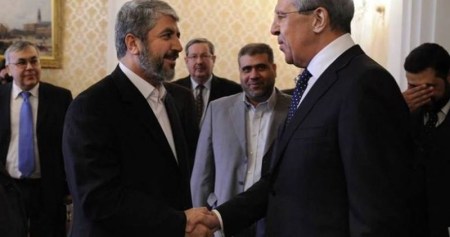
MOSCOW – Russia and the United States agree that Daesh, al-Qaeda and Jabhat al-Nusra are terrorist organizations but differ over blacklisting Hezbollah and Hamas, the Russian Foreign Ministry said.
Speaking to the Interfax news agency on Tuesday night, Russian Deputy Foreign Minister Gennady Gatilov said: “Our opinions coincide as regards to the main terrorist organizations. These are ISIS, al-Qaeda and Jabhat al-Nusra.”
But “we are not even discussing Hezbollah and Hamas with the Americans,” he added.
Moscow has routinely held senior-level contacts with Hamas officials and leaders.
Commenting on the Russian position, political analyst Abdul Sattar Qassem said: “Hamas cannot be compared to Daesh or al-Qaeda. It can only be viewed in terms of its resistance to the Israeli occupation.”
“The Israeli occupation and the USA are the real terrorists. They are fighting all those who stand in their way,” he added.
“Blacklisting Hamas as terrorist is unacceptable for Moscow. There is no evidence to corroborate the fact that Hamas is a terror group,” he said.
“Israel has been misleading the world into believing that Hamas is targeting Israeli civilians, which is not in fact the case,” the analyst stated.
“Hamas is a movement of national liberation that defends its people. It does not seek to wage wars for the sake of wars. It is engaged in a fight against an entity that colonized its motherland,” he explained.
However, “does Russia dare blacklist Israel as a terrorist entity for the crimes it has perpetrated against the Palestinians?” Qassem wondered. “It is not enough that Russia refuses to dub Hamas a terror group. It should dare include Israel on its terror list.”
“There is no colonizing power in the world but Israel. Occupation is in itself a form of terrorism,” the analyst further stated.
Featured Video
No Threat Can Force Iran’s Surrender /Trita Parsi & Lt Cl Daniel Davis
or go to
Aletho News Archives – Video-Images
From the Archives
What is the Israeli Lobby in Australia Doing in Interfaith Dialogue?
By Ali Kazak | Dissident Voice | October 11, 2015
For years Israel and its lobby around the world have been trying to normalise their relations with Arabs and Muslims without solving the Palestine Question.
One of the methods they resorted to in the last few years is using human rights and community organizations such as interfaith dialogue and Multiculturalism to achieve this objective and to: isolate the Palestinians, marginalise the Palestine question, end Israel’s isolation, and prevent criticism of Israel, knowing that these organisations will be the first to stand against Israel’s violations, racial and religious discrimination.
The group responsible for this task in Australia is The Australia/Israel & Jewish Affairs Council (AIJAC); its Director of International & Community Affairs, Jeremy Jones is in charge of lobbying religious community organizations, specifically Muslims and Christians. Consequently he convened the Faith Communities for Reconciliation, founding participant in the Australian Partnership of Religious Organisations and the Australian National Dialogue of Christians, Muslims & Jews.
AIJAC is a private political propaganda group. It is recognised as the main Israeli lobby in Australia. It coordinates its activities and works intimately with the Israeli embassy in Canberra and different institutions in Israel. It is privately funded by some Jewish businessmen. It monitors closely Australian politicians, the media, ethnic and religious groups, (especially Arabs and Muslims), unions and academics on their stands towards Israel and the Palestine question. … continue
Blog Roll
 Aletho News
- Theodore Postol: Iran’s Missiles & Drones Were Underestimated
- Iran To Target Military Industrial-Tech Complex That Facilitated Gaza Genocide
- Collapsing Empire: The Resistance Disarms ‘Israel’
- Suicide Should Not Be a Government Service
- Rethinking America’s greatest threat: Iran vs. Israel-Firsters
- Iran accuses adversaries of false flags to strain Turkey ties
- Poland rules out sending Patriot missiles to US/Israel amid war on Iran
- Tehran approves new Hormuz plan with major restrictions
- No Threat Can Force Iran’s Surrender /Trita Parsi & Lt Cl Daniel Davis
- UK’s New Pandemic Plan Would Turn Big Tech Into a Mass Location Tracking Network
- If Americans Knew
- Ann Coulter Rips Into Fox News for Iran War Coverage, Compares to False Rigged 2020 Election Reporting
- Joe Kent Urges Americans To Call White House and Congress To Object To Sending Troops Into Iran
- DNC Resolution to Reject AIPAC Funding Puts Democratic Leaders in the Hot Seat
- Swedish foundation to build 400 schools as over 650,000 Gaza children remain without education for 2 years
- Israeli army admits photshopping image of slain Lebanese journalist
- This is how Israel is systematically killing health workers under the cover of war in Lebanon
- Carrying life under fire: Israeli invasion of Lebanon leaves pregnant women facing deadly risks
- Champagne all around for the new death penalty (for Palestinians) law – Not a ceasefire Day 172
- Why are Palestinian books struggling to be seen on Amazon?
- The Line Between Affinity and Conspiracy
- No Tricks Zone
- New Study Finds Warming Saves Lives…Cold Temperatures 12 Times More Deadly Than Excess Heat
- German Science Blog Accuses PIK Climate Institute Of Hallucinating Climate Tipping Points
- Devastating Assessment Of Comirnaty Vaccine By Former Senior Pfizer Europe Toxicologist
- New Study: CO2 Is ‘Effectively Negligible’ As An Explanatory Climate Change Factor Since 2000
- Former Pfizer Toxicologist Dr. Helmut Sterz Tells Bundestag Hearing Pfizer Vaccine Should Have Never Been Approved
- Energy Expert: Germany’s Nuclear Phaseout Was A “500 Billion Euro Mistake”
- New Research: South Australia’s Mid-Holocene Sea Surface Temperatures Were 4°C Warmer Than Today
- Storing Green Energy To Last Germany 10 Days Would Require A 60-Million Tonne Battery
- New Studies: UK Sea Levels Were 4 Meters Higher Than Today During The Mid-Holocene
- Destructive Green New Deal: German Energy And Metal Group Warns Of Drastic Crisis
 Aletho News