Tehran Was Always America’s and Thus the Islamic State’s Final Destination
By Tony Cartalucci – New Eastern Outlook – 10.06.2017
Several were left dead and many more injured after coordinated terror attacks on Iran’s capital of Tehran. Shootings and bombings targeted Iran’s parliament and the tomb of Ayatollah Khomeini.
According to Reuters, the so-called “Islamic State” claimed responsibility for the attack, which unfolded just days after another terror attack unfolded in London. The Islamic State also reportedly took responsibility for the violence in London, despite evidence emerging that the three suspects involved were long-known to British security and intelligence agencies and were simply allowed to plot and carry out their attacks.
It is much less likely that Tehran’s government coddled terrorists -as it has been engaged for years in fighting terrorism both on its borders and in Syria amid a vicious six-year war fueled by US, European, and Persian Gulf weapons, cash, and fighters.
Armed Violence Targeting Tehran Was the Stated Goal of US Policymakers
The recent terrorist attacks in Tehran are the literal manifestation of US foreign policy. The creation of a proxy force with which to fight Iran and establishing a safe haven for it beyond Iran’s borders have been long-stated US policy. The current chaos consuming Syria and Iraq – and to a lesser extent in southeast Turkey – is a direct result of the US attempting to secure a base of operations to launch a proxy war directly against Iran.
In the 2009 Brookings Institution document titled, “Which Path to Persia? Options for a New American Strategy toward Iran,” the use of then US State Department-listed foreign terrorist organization Mujahedin-e Khalq Organization (MEK) as a proxy for instigating a full-fledged armed insurgency not unlike that which is currently unfolding in Syria was discussed in detail.
The report explicitly stated:
The United states could also attempt to promote external Iranian opposition groups, providing them with the support to turn themselves into full-fledged insurgencies and even helping them militarily defeat the forces of the clerical regime. The United states could work with groups like the Iraq-based National council of resistance of Iran (NCRI) and its military wing, the Mujahedin-e Khalq (MeK), helping the thousands of its members who, under Saddam Husayn’s regime, were armed and had conducted guerrilla and terrorist operations against the clerical regime. although the NCRI is supposedly disarmed today, that could quickly be changed.
Brookings policymakers admitted throughout the report that MEK was responsible for killing both American and Iranian military personnel, politicians, and civilians in what was clear-cut terrorism. Despite this, and admissions that MEK remained indisputably a terrorist organization, recommendations were made to de-list it from the US State Department’s Foreign Terrorist Organization registry so that more overt support could be provided to the group for armed regime change.
Based on such recommendations and intensive lobbying, the US State Department would eventually de-list MEK in 2012 and the group would receive significant backing from the US openly. This included support from many members of current US President Donald Trump’s campaign team – including Rudy Giuliani, Newt Gingrich, and John Bolton.
However, despite these efforts, MEK was not capable then or now of accomplishing the lofty goal of instigating full-fledged insurrection against Tehran, necessitating the use of other armed groups. The 2009 Brookings paper made mention of other candidates under a section titled, “Potential Ethnic Proxies,” identifying Arab and Kurdish groups as well as possible candidates for a US proxy war against Tehran.
Under a section titled, “Finding a Conduit and Safe Haven,” Brookings notes:
Of equal importance (and potential difficulty) will be finding a neighboring country willing to serve as the conduit for U.S. aid to the insurgent group, as well as to provide a safe haven where the group can train, plan, organize, heal, and resupply.
For the US proxy war on Syria, Turkey and Jordan fulfill this role. For Iran, it is clear that US efforts would have to focus on establishing conduits and safe havens from Pakistan’s southwest Balochistan province and from Kurdish-dominated regions in northern Iraq, eastern Syria, and southeastern Turkey – precisely where current upheaval is being fueled by US intervention both overtly and covertly.
Brookings noted in 2009 that:
It would be difficult to find or build an insurgency with a high likelihood of success. The existing candidates are weak and divided, and the Iranian regime is very strong relative to the potential internal and external challengers.
A group not mentioned by Brookings in 2009, but that exists in the very region the US seeks to create a conduit and safe haven for a proxy war with Iran, is the Islamic State. Despite claims that it is an independent terrorist organization propelled by black market oil sales, ransoms, and local taxes, its fighting capacity, logistical networks, and operational reach demonstrates vast state sponsorship.
The Ultimate Proxy, the Perfect Conduit and Safe Haven
The Islamic State reaching into Iran, southern Russia, and even as far as western China was not only possible, it was inevitable and the logical progression of US policy as stated by Brookings in 2009 and verifiably executed since then.
The Islamic State represents the perfect “proxy,” occupying the ideal conduit and safe haven for executing America’s proxy war against Iran and beyond. Surrounding the Islamic State’s holdings are US military bases, including those illegally constructed in eastern Syria. Were the US to wage war against Iran in the near future, it is likely these assets would all “coincidentally” coordinate against Tehran just as they are now being “coincidentally” coordinated against Damascus.
The use of terrorism, extremists, and proxies in executing US foreign policy, and the use of extremists observing the Islamic State and Al Qaeda’s brand of indoctrination was demonstrated definitively during the 1980’s when the US with the assistance of Saudi Arabia and Pakistan – used Al Qaeda to expel Soviet forces from Afghanistan. This example is in fact mentioned explicitly by Brookings policymakers as a template for creating a new proxy war – this time against Iran.
For the US, there is no better stand-in for Al Qaeda than its successor the Islamic State. US policymakers have demonstrated a desire to use known terrorist organizations to wage proxy war against targeted nation-states, has previously done so in Afghanistan, and has clearly organized the geopolitical game board on all sides of Iran to facilitate its agenda laid out in 2009. With terrorists now killing people in Tehran, it is simply verification that this agenda is advancing onward.
Iran’s involvement in the Syrian conflict illustrates that Tehran is well aware of this conspiracy and is actively defending against it both within and beyond its borders. Russia is likewise an ultimate target of the proxy war in Syria and is likewise involved in resolving it in favor of stopping it there before it goes further.
China’s small but expanding role in the conflict is linked directly to the inevitability of this instability spreading to its western Xianjiang province.
While terrorism in Europe, including the recent London attack, is held up as proof that the West is “also” being targeted by the Islamic State, evidence suggests otherwise. The attacks are more likely an exercise in producing plausible deniability.
In reality, the Islamic State – like Al Qaeda before it – depends on vast, multinational state sponsorship – state sponsorship the US, Europe, and its regional allies in the Persian Gulf are providing. It is also sponsorship they can – at anytime of their choosing – expose and end. They simply choose not to in pursuit of regional and global hegemony.
The 2009 Brookings paper is a signed and dated confession of the West’s proclivity toward using terrorism as a geopolitical tool. While Western headlines insist that nations like Iran, Russia, and China jeopardize global stability, it is clear that they themselves do so in pursuit of global hegemony.
ISIS Was “Allegedly” Behind the London Bridge Attacks, Who Is Behind ISIS?
By Michel Chossudovsky | Global Research | June 6, 2017
London’s tabloids have gone into high gear with vivid descriptions of the attacks and the tragic loss of life. Seven killed and 48 wounded.
“ISIS has claimed responsibility for the depraved attack in London Bridge as chilling video shows three jihadis calmly strolling past a pub while in the midst of the van and knife rampage that killed seven and critically injured 21.” ( The Sun, June 5, 2017)
ISIS has claimed responsibility, Is there a pattern?
Without exception, Al Qaeda or ISIS were allegedly behind the Paris, Brussels, Berlin, Manchester and London Bridge terror attacks, which served to spearhead a wave of Islamophobia across Western Europe, while also providing a pretext for the introduction of drastic police state measures:
“The twisted killers are seen calmly walking through Borough Market moments before they launched a stabbing attack on pubgoers while shouting “this is for Allah”, having already driven a van into crowds.” The Sun, June 5, 2017)
The statement of Prime Minister May (three days before the UK elections) points in the direction of an organized hate campaign against Muslims:
[The Manchester and London attacks] …are bound together by the single, evil ideology of Islamist extremism that preaches hatred, sows division, and promotes sectarianism. It is an ideology that claims our Western values of freedom, democracy and human rights are incompatible with the religion of Islam. It is an ideology that is a perversion of Islam and a perversion of the truth.
… It will only be defeated when we turn people’s minds away from this violence – and make them understand that our values – pluralistic, British values – are superior to anything offered by the preachers and supporters of hate. (emphasis added),
“Perversion of the Truth”? Lies, fabrications, omissions. What the British media in chorus fails to mention is that both ISIS and Al Qaeda are creations of US intelligence, recruited, trained and financed by the US and its allies including Saudi Arabia, Qatar, Turkey, Israel and Jordan.
The Islamic State (ISIS) was originally an Al Qaeda affiliated entity created by US intelligence with the support of Britain’s MI6, Israel’s Mossad, Pakistan’s Inter-Services Intelligence (ISI) and Saudi Arabia’s General Intelligence Presidency (GIP), Ri’āsat Al-Istikhbārāt Al-’Āmah ( رئاسة الاستخبارات العامة).
The origins of Al Qaeda date back to the Soviet-Afghan war. The Koranic schools in Afghanistan used to train Al Qaeda recruits were financed by the CIA, using textbooks published by the University of Nebraska. That’s where the “evil ideology of Islamist extremism” referred to by PM May originated: The “Global War on Terrorism” is a lie, “Islamic terrorism” is a product of US foreign policy which claims to be spreading “Western civilization”:
… the United States spent millions of dollars to supply Afghan schoolchildren with textbooks filled with violent images and militant Islamic teachings, part of covert attempts to spur resistance to the Soviet occupation.
The primers, which were filled with talk of jihad and featured drawings of guns, bullets, soldiers and mines, have served since then as the Afghan school system’s core curriculum. Even the Taliban used the American-produced books,..
Picture above is translated as follows: “Jihad – Often many different wars and conflicts arise among people, which cause material damages and loss of human life. If these wars and disputes occur among people for the sake of community, nation, territory, or even because of verbal differences, and for the sake of progress…”
This page is from a third-grade language arts textbook dating from the mujahidin period. A copy of the book was purchased new in Kabul in May 2000.

… Published in the dominant Afghan languages of Dari and Pashtun, the textbooks were developed in the early 1980s under an AID grant to the University of Nebraska -Omaha and its Center for Afghanistan Studies. The agency spent $ 51 million on the university’s education programs in Afghanistan from 1984 to 1994.” (Washington Post, 23 March 2002)
The ISIS is a terrorist paramilitary entity created by US intelligence. It has nothing to do with the tenets of Islam. The ISIS and Al Qaeda terrorists are the foot soldiers of the Western military alliance in Syria who are fighting a secular government. While America claims to be targeting the ISIS, in reality it is protecting the ISIS.
Britain’s Role in the “War on Terrorism”
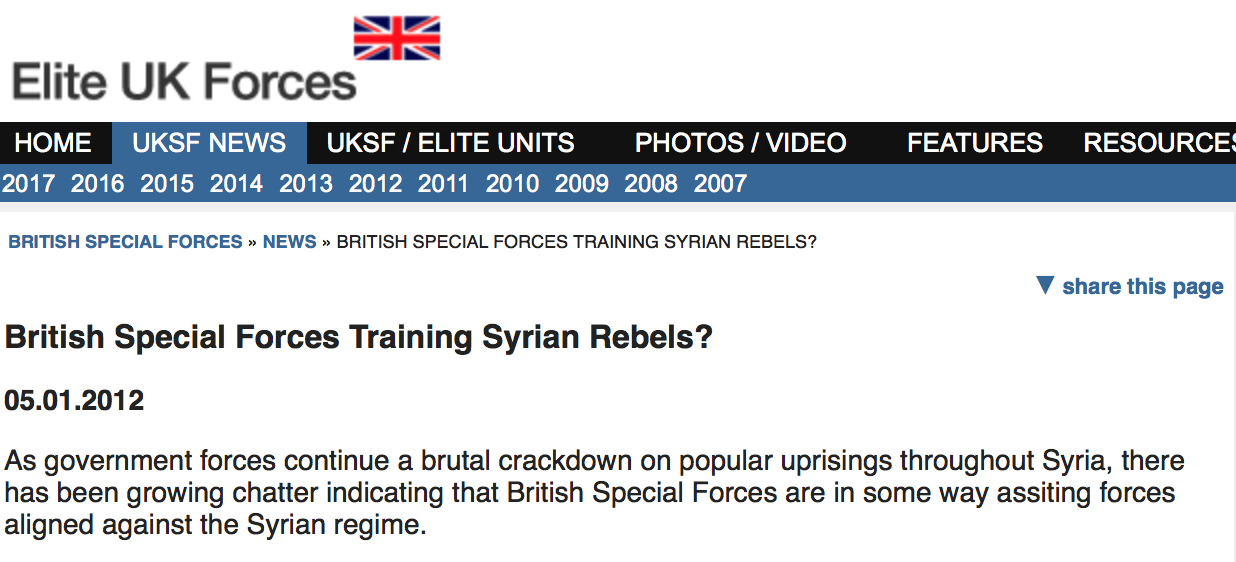
There is evidence that British SAS Special Forces were dispatched to Syria in 2011 to integrate the ranks of the so-called moderate Al Qaeda rebels. Special Forces often hired through a private mercenary company on contract to NATO or the Pentagon were embedded within most paramilitary rebel formations, According to Elite UK Forces (the website of the SAS)
Reports from late November last year [2011] state that British Special forces have met up with members of the Free Syrian Army (FSA), the armed wing of the Syrian National Council. The apparent goal of this initial contact was to establish the rebel forces’ strength and to pave the way for any future training operations.
More recent reports have stated that British and French Special Forces have been actively training members of the FSA, from a base in Turkey. Some reports indicate that training is also taking place in locations in Libya and Northern Lebanon. British MI6 operatives and UKSF (SAS/SBS) personnel have reportedly been training the rebels in urban warfare as well as supplying them with arms and equipment. US CIA operatives and special forces are believed to be providing communications assistance to the rebels.
British MI6 were actively involved, collaborating with the CIA:
As the unrest and killings escalate in the troubled Arab state, agents from MI6 and the CIA are already in Syria assessing the situation, a security official has revealed.
Special forces are also talking to Syrian dissident soldiers [Al Qaeda].
They want to know about weapons and communications kit rebel forces will need if the Government decides to help.
“MI6 and the CIA are in Syria to infiltrate[rebel ranks] and get at the truth,” said the well-placed source.
“We have SAS and SBS not far away who want to know what is happening and are finding out what kit dissident soldiers [Al Qaeda] need.” Syria will be bloodiest yet, Daily Star, January 1, 2012 (emphasis added)
The air campaign launched by Obama in 2014, which had the full support of the United Kingdom, was intent upon destroying Syria and Iraq rather than “going after the terrorists”. There is ample evidence that the Islamic State is protected by the US-led coalition.
The inflow and delivery of weapons and supplies are coordinated by the Pentagon in liaison with America’s allies.
US military aid is channelled to Al Qaeda as well as to ISIS-Daesh.
The US has also used the illegal weapons market to channel vast amounts of weapons and military hardware to the Syrian “rebels”.
The State sponsors of ISIS-Al Qaeda are now heralded as the victims of ISIS-Al Qaeda, an absurd proposition. Those who are funded and supported by Western intelligence services are now said to be fighting back.
The ISIS nonetheless has a certain degree of independence in relation to its State sponsors. That is the nature of what is called an “intelligence asset”. But an “intelligence asset” is always on the radar of the intelligence services.
The British government through its intelligence services is known to have covertly supported several Al Qaeda affiliated entities including the Libya Islamic Fighting Group (LIFG) which was linked to the Manchester bombings.
The “Liberation” of Tripoli was carried out by “former” members of the Libya Islamic Fighting Group (LIFG), which is affiliated to Al Qaeda. These “former” Al Qaeda affiliated brigades constituted the backbone of the “pro-democracy” rebellion, which was supported by NATO.
Within the ranks of the LIFG rebels, US Navy SEALS, British SAS and French legionnaires disguised in civilian rebel garb, were reported to be behind major operations directed against key government buildings including Gadhafi’s Bab al-Aziziya compound in central Tripoli.
“Highly-trained [British Special Forces] units, known as ‘Smash’ teams for their prowess and destructive ability, have carried out secret reconnaissance missions to provide up-to-date information on the Libyan armed forces.” (SAS ‘Smash’ squads on the ground in Libya to mark targets for coalition jets, Daily Mirror, March 21, 2011)
And in the wake of NATO’s war Libya, these pro-democracy LIFG Al Qaeda affiliates have joined the ranks of the ISIS.
Washington’s Regime Change for Syria: Install the Islamic State
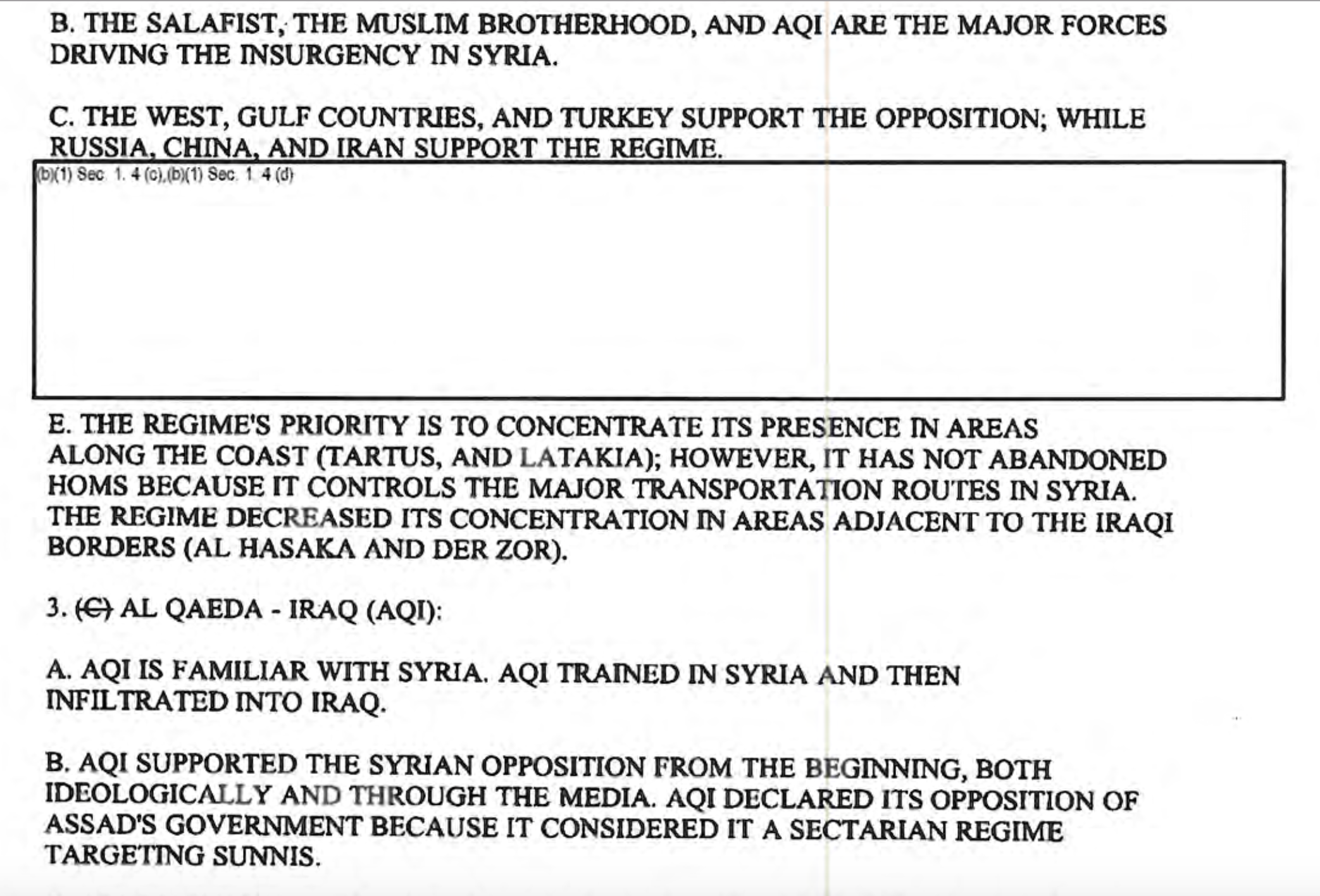
It is worth noting that the release of the Hillary Clinton email archive as well as leaked Pentagon documents confirm that the US and its allies are supportive of ISIS.
Moreover, a 7-page Defense Intelligence Agency (DIA) document dated August of 2012, points to US complicity in supporting the creation of an Islamic State.(Excerpt below)
Concluding Remarks
Despite the evidence, it is very difficult for people to accept the fact that their own government is supporting terrorism.
Most people will dispel this as an impossibility. But it is the forbidden truth.
The established consensus is that the role of a government is to protect its people. That myth has to be sustained.
The media’s role is to ensure that the truth does not trickle down to the broader public.
If that were to occur, the legitimacy of Western heads of State and heads of government would collapse like a house of cards.
The governments of the countries whose citizens are the victims of terror attacks are supporting ISIS-Daesh through their intelligence services.
Copyright © Prof Michel Chossudovsky, Global Research, 2017
Trump-Saudi orb-gazing summit not helping Sunni alliance
By Sharmine Narwani | RT | June 1, 2017
The glowing orb stunt should have been a sign that all was not what it seems. Theatrics, in the world of politics, usually suggest an illusion needs to be spun for audiences somewhere.
A week after US President Donald Trump’s eyesore of a visit to Riyadh, Saudi Arabia, the pressing question now is “why?” What was the purpose of convening leaders and representatives of 55 Arab and Muslim nations to greet a US head of state amidst so much pomp, ceremony and an excruciating amount of flashing cameras?
The Riyadh summit had several goals, most of which specifically served Saudi and American political interests.
The American leader’s potential gains were clear: he would score points at this impressive international showing of Muslim leaders who would help counter his anti-Muslim reputation at home. Trump would also be well-compensated in the form of the largest US arms deal in history, a booty he could claim would boost his home economy. The negotiations would take place in the Middle East, at the heart of his fight against “radical Islamic terrorism.” Trump would also leave with a blank check for Palestinian-Israel “peace,” bestowed by a Saudi king who has no authority to negotiate anything on behalf of Palestinians. And finally, the US president would piggyback the legitimacy of 55 Arab and Muslim states to craft a Middle East policy that targeted Iran, its allies and the Muslim Brotherhood (MB) – even though no consensus whatsoever was reached at the summit.
In their eyes, the Saudis scored even bigger. The cash-and-credibility-hemorrhaging Saudis are losing ground in their list of international fights – in Syria, Yemen, Iraq and against Iran. Here was an opportunity to convene leaders and representatives from 55 Arab and Muslim nations (only 33 heads of state showed up) to underscore Saudi Arabia’s position as the custodian of Sunni Islam. For the power-mad Saudis, nothing would showcase their primacy better than the presence of a US president on his first official foreign trip. They forgot, however, that legitimacy is derived from one’s own populations, not from a Western head of state sword-dancing next to one’s king. After the summit, Riyadh would go on to unilaterally craft a declaration, unseen and unapproved by the VIP guests, that claimed to outline the gathering’s foreign policy priorities.
But most importantly, this summit would allow the Saudis – who are terrified at the potential repercussions coming their way from decades of funding global terrorism – to very publicly take cover under the Trump presidency. And the US president, who knows very well that the Saudis are the epicenter of global terror, offered up America’s protection and complicity to secure his doggy bag of treasures.
This generous give-and-take between the Saudis and Americans took place on the day of the summit, amidst much back-slapping. Then, a few days later, the fallout began.
First, Saudi vs. Qatar
This past week, a flurry of media headlines alerted us to the first fissure between summit participants. News reports began emerging that Qatari leader Sheikh Tamim bin Hamad al-Thani had deviated from the Saudi talking points by supporting engagement with Iran and defending resistance groups Hezbollah and Hamas.
Saudi Arabia and the UAE retaliated swiftly to this slight by blocking Qatari media outlets, recalling their ambassadors and launching a war of words against Doha.
Why the swift and punishing response toward a fellow member of the six-nation Gulf Cooperation Council (GCC)?
Qatar has long struggled to get out from under the shadow of its much larger Persian Gulf neighbor Saudi Arabia and has spent the past dozen years building up media networks, like Al Jazeera, and investing in major Western corporate, think tank, educational and sports brands to project power well beyond its regional stature. The tiny sheikhdom’s biggest coup, however, was to secure the establishment of the US military’s largest regional base on its territory, which allowed Doha to continue provoking its Saudi competitor with little risk of consequence.
Then in 2011, the Qataris put their full weight behind “Arab Spring” efforts to overthrow a slew of Arab governments. Most of the Qatari-backed incoming regimes and opposition activists, however, were Islamists, mainly of the MB variety, which is reviled by Saudi Arabia and the UAE.
The Saudis were initially caught off-guard by the swift events sweeping the region, but quickly rallied to mount a region-wide counterrevolution to reverse the political gains of the Qatari- and Turkish-backed MB groups. Saudi operatives funneled manpower, money, and weapons to reestablish Riyadh’s influence. They revived their famed jihadi networks to flood Syria and other places with extremist militants that could tip the balance of power back in its direction.
It wasn’t just Qatar and the MB in Saudi sights – the regional uprisings, particularly in Syria, Yemen and Bahrain, threatened to shift the region in a direction that benefited Iran, Saudi Arabia’s biggest regional adversary.
In Riyadh ten days ago, the Saudis thought they had struck gold. After eight years of dealing with a somewhat unsympathetic Obama administration, here was Trump acquiescing to their every whim. The Saudi declaration issued at the end of the summit – as well as speeches delivered during the event – struck out at Iran, the Muslim Brotherhood, Hezbollah and Hamas, and promised American cooperation in isolating them. The Saudis were on a high, but they were also mostly alone.
A broad divergence of interests
Aside from the Saudi-Qatari spat, there are countless other differences among summit participants that will scuttle Riyadh’s ambitions.
The anti-MB UAE has stood firmly by Riyadh’s side in condemning Doha but diverges – even within its own borders – on assuming an aggressive position against Iran. Call it Dubai-versus-Abu Dhabi if you will. Dubai, with its large Iranian expat population and significant trade with the Islamic Republic, is less worried about its Persian neighbor. As a 2009 Wikileaks cable from the US embassy in Abu Dhabi puts it: “While MbZ (Crown Prince of the Emirate of Abu Dhabi Mohammad bin Zayed) is a hardliner on Iran, there are accommodationists within his own system, especially in Dubai, where the ruler, Mohammed bin Rashid Al-Maktoum (Prime Minister of the UAE) takes a position that is much closer to Qatar’s.”
Other GCC states are even more loathe to confront Iran. Oman has repeatedly ignored Saudi demands to toughen its stance against Iran and remains a key Iranian diplomatic partner in the region. The two states participated in joint naval exercises in the Gulf of Oman as recently as April, and it was Muscat that hosted the initial secret US-Iran meetings which kick-started the 2015 Iranian nuclear deal.
GCC member-state Kuwait also remains relatively neutral on Iranian matters. Up to 40 percent of Kuwaitis are Shiites, and the country has avoided much of the sectarian strife that afflicts Saudi Arabia and now Bahrain. It is to Kuwait that Qatar’s emir has now turned to negotiate peace with the Saudis and UAE in the aftermath of last week’s fallout. The Qataris, who have dealt opportunistically and not ideologically in their regional relations, share the world’s largest gas reserve with Iran, a further incentive to maintain a neutral stance on Tehran.
In fact, most of the Sunni states that attended the Riyadh summit are flat-out furious about the violent sectarianism and extremism that has emerged in the past few years. And many of them blame the Saudis for it.
Last August, an unprecedented conference of 200 leading Sunni clerics from around the world was held in Grozny to determine “who is a Sunni.”Excluded from the gathering were representatives of both the Wahhabi sect (Saudi Arabia and Qatar’s official religion) and the Muslim Brotherhood. The Islamic world is looking to tackle the deviance and sectarianism that has borne groups like ISIS and Al-Qaeda – not indulge it, as would be the case if they embraced the Saudi ‘vision’ in Riyadh.
But in an effort to bulldoze through a “Sunni consensus” under the umbrella of “Saudi-American power,” the Saudis ignored every gorilla in that summit room. Not only do many of the meeting’s participants blame the Saudis for unleashing the jihadi genie, but most of them also wouldn’t for a minute look to Saudi ‘leadership’ if it weren’t for Saudi cash. Case in point, Sunni regional giants Turkey and Egypt. Turkish President Recep Tayyip Erdogan didn’t even show up to Riyadh, citing other engagements. Egyptian President Abdel Fattah al-Sisi did attend – he was one of three invited to press his palms upon the ‘glowing orb’ to inaugurate the Saudi counterterrorism-something-or-other.
But more than anything, Sisi was invited to Riyadh as an important set extra – to visually demonstrate that the great Arab state of Egypt was passing the mantle of leadership to Saudi Arabia’s King Salman.
Where the Saudis viewed former Egyptian President Hosni Mubarak as a stalwart ally, they see Sisi as nothing of the sort. Sisi may agree with Riyadh on the evils of the Muslim Brotherhood, but he has absolutely no tolerance for Saudi Arabia’s support of terrorist groups throughout the region and has been a right royal pain on the issue of Syria.
Egypt may hanker after the Saudi billions – which it has received in spades for its anti-MB efforts – but Egyptians have little affection for the Saudis and have sparred publicly and privately in recent years and months. Whereas Riyadh could once count on Egyptian troops to support its military incursions, today Cairo has rejected participation in the Saudi-led war against Yemen – alongside another staunch Saudi ally, Pakistan.
The Saudis recently hired Pakistan’s former army chief General Raheel Sharif to head up their 39-nation “Muslim NATO” construct to fight terrorism, but now rumors are rife that he will resign amidst a national uproar over his decision. Pakistanis, like other straight-thinking Muslims, are uncomfortable about the prospect of a military alliance that appears to have been conceived primarily to fight Iran – and Shiites.
Dead On Arrival
On the surface, the purpose of the Riyadh summit was to amass a coalition of like-minded Arab and Muslim partner-states, under a Saudi-American banner, to wage war against terror. In fact, this is a Saudi and American-led initiative created not to tackle terror, but to ‘reframe’ it to encompass political adversaries.
Look out for pundits and politicians spinning these new narratives that Iran, Hezbollah, and the Muslim Brotherhood are equally as dangerous as ISIS and Al-Qaeda – never mind that the former have been around for decades without triggering the global security meltdown spawned by the latter.
In Riyadh, the Americans and Saudis made a great show of jointly announcing two additions to their “terrorism” list – one was a senior Hezbollah official, the other a senior member of ISIS.
This is not the war against terror that the heads of states gathered in Riyadh anticipated. This is a sectarian war, conceived by a sectarian state that has funded, armed and organized the very global terrorism it purports to fight. And every single US administration since the events of 9/11 has acknowledged this direct Saudi role in terror.
In Riyadh, the show went on anyway. But there’s not a person in that room who didn’t understand the game. Forget the ‘Sunni consensus’ after Riyadh. Of the 55 nations represented at the summit, the Saudis will be lucky to retain five.
Sharmine Narwani is a commentator and analyst of Middle East geopolitics. She is a former senior associate at St. Antony’s College, Oxford University and has a master’s degree in International Relations from Columbia University. Sharmine has written commentary for a wide array of publications, including Al Akhbar English, the New York Times, the Guardian, Asia Times Online, Salon.com, USA Today, the Huffington Post, Al Jazeera English, BRICS Post and others. You can follow her on Twitter at @snarwani
ISIS Touches Down in the Philippines
By Tony Cartalucci | New Eastern Outlook | 28.05.2017
Mayhem broke out across the southern Philippine city of Marawi where militants besieged it and hoisted flags of the so-called “Islamic State.” Located on the southern island of Mindanao, the city is only slightly removed from Al Qaeda affiliate Abu Sayaff’s primary area of operation on nearby Jolo and Basilan islands.
The UK Independent in an article titled, “Isis-linked militants take priest and churchgoers hostage in Philippines,” would report:
President Rodrigo Duterte declared martial law in the south because of the militants’ siege on the city on Tuesday and abandoned a trip to Russia to deal with the crisis.
Mr Duterte vowed to place southern Mindanao island, where Marawi is situated, and its 22 million residents under military rule for up to a year if necessary.
The article would also report:
Troops are battling to contain dozens of militants from the Maute group, which pledged allegiance to Isis in 2015, after they escaped a botched security raid on a hideout and overran streets, bridges and buildings.
Two soldiers and a police officer are among those killed and at least 12 people have been wounded in the violence, seeing Maute fighters set fire to a school, a church and a prison.
The security crisis represents a seemingly inexplicable expansion of the Islamic State in Asia – even as the US and its allies claim the organization is being rolled back across the Middle East and its revenue streams are contracting in the wake of defeat.
US-Saudi Sponsored Terrorism Seeks to Coerce Asia
Both the Maute group and Abu Sayaff are extensions of Al Qaeda’s global terror network, propped up by state sponsorship from Saudi Arabia and Qatar, and fed recruits via a global network of likewise Saudi and Qatari funded “madrasas.” In turn, Saudi Arabia and Qatar’s state sponsorship of global terrorism for decades has been actively enabled by material and political support provided by the United States.
This arrangement provides for Washington both a global mercenary force with which to wage proxy war when conventional and direct military force cannot be used, and a pretext for direct US military intervention when proxy warfare fails to achieve Washington’s objectives.
This formula has been used in Afghanistan in the 1980s to successfully expel the Soviet Union, in 2011 to overthrow the Libyan government, and is currently being used in Syria where both proxy war and direct US military intervention is being applied.
Maute and Abu Sayaff activity fits into this global pattern perfectly.
The Philippines is one of many Southeast Asian states that has incrementally shifted from traditional alliances and dependency on the United States to regional neighbors including China, as well as Eurasian states including Russia.
The Philippine president, Rodrigo Duterte, cancelling his meeting with Russia is a microcosm of the very sort of results Maute and Abu Sayaff are tasked with achieving in the Philippines. Attempts by the US to justify the presence of its troops in the Philippines as part of a wider strategy of encircling China with US military installations across Asia would also greatly benefit from the Islamic State “suddenly spreading” across the island nation.
Likewise, violence in Malaysia and Thailand are directly linked to this wider US-Saudi alliance, with violence erupting at each and every crucial juncture as the US is incrementally pushed out of the region. Indonesia has likewise suffered violence at the hands of the Islamic State, and even Myanmar is being threatened by Saudi-funded terrorism seeking to leverage and expand the ongoing Rohingya humanitarian crisis.
That US-Saudi sponsorship drives this terrorism, not the meager revenue streams of the Islamic State in Syria and Iraq, goes far in explaining why the terrorist organization is capable of such bold attacks in Southeast Asia even as Russia and Iranian backed Syrian troops extinguish it in the Middle East.
US-Saudi Links to Abu Sayaff and other Terrorists in the Philippines
A US diplomatic cable leaked by Wikileaks dated 2005 would state:
Philippine officials noted their continuing concern about Saudi-origin terrorist financing coming into the Philippines under the cover of donations to mosques, orphanages, and madrassahs. Although three Saudi nationals suspected of being couriers had been detained on separate occasions, Saudi Ambassador Wali had intervened in each case to secure their release.
Yousaf Butt of the Washington-based US National Defense University would reveal in a Huffington Post article titled, “How Saudi Wahhabism Is the Fountainhead of Islamist Terrorism,” that:
It would be troublesome but perhaps acceptable for the House of Saud to promote the intolerant and extremist Wahhabi creed just domestically. But, unfortunately, for decades the Saudis have also lavishly financed its propagation abroad. Exact numbers are not known, but it is thought that more than $100 billion have been spent on exporting fanatical Wahhabism to various much poorer Muslim nations worldwide over the past three decades. It might well be twice that number. By comparison, the Soviets spent about $7 billion spreading communism worldwide in the 70 years from 1921 and 1991.
The leaked cable and reports by Western analysts when taken together, reveal that Saudi-funded madrasas in the Philippines are directly fueling terrorism there.
The answer to why is simple.
For the same purposes the US used Saudi-funded terrorism in Afghanistan in the 1980s and in Libya and Syria beginning in 2011 – the US is using Saudi-funded terrorism to coerce the government of the Philippines amid Washington’s faltering “pivot to Asia” which began under US President Barrack Obama and now continues under President Trump.
Countering US-Saudi Sponsored Terrorism
With US President Trump announcing a US-Saudi alliance against terrorism – the US has managed to strategically misdirect public attention away from global terrorism’s very epicenter and protect America’s premier intermediaries in fueling that terrorism around the world.
The Philippines would be unwise to turn to this “alliance” for help in fighting terrorism both the US and Saudi Arabia are directly and intentionally fueling.
Instead – for Southeast Asia – joint counter-terrorism efforts together and with China and Russia would ensure a coordinated and effective means of confronting this threat on multiple levels.
By exposing the US-Saudi role in regional terrorism – each and every act of terrorism and militancy would be linked directly to and subsequently taint the US and Saudi Arabia in the hearts and minds of Southeast Asia’s population.
This paves the way for a process of exposing and dismantling US-Saudi funded fronts – including Saudi-sponsored madrasas and US-funded NGOs – both of which feed into regional extremism and political subversion. As this unfolds, each respective nation would be required to invest in genuine local institutions to fill sociopolitical and economic space previously occupied by these foreign funded fronts.
Until then, Asia should expect the US and its Saudi partners to continue leveraging terrorism against the region. If unchecked, Asia should likewise expect the same progress-arresting instability that has mired the Middle East and North Africa for decades.
Only Iran, Syria helped Lebanon when it was occupied by Israel

Press TV – May 25, 2017
Secretary General of the Lebanese Hezbollah resistance movement, Sayyed Hassan Nasrallah, says when southern Lebanon was occupied by Israel, no country in the world except Iran and Syria helped the country to end occupation.
Nasrallah made the remarks while delivering a speech in commemoration of the 17th anniversary of the liberation of the southern Lebanon from the Israeli occupation.
Addressing the nation from the southern city of Hermel, Nasrallah said resistance has gotten strong enough not to wait for support from the rest of the world or from inside the country or outside.
Lambasting the world’s indifference toward the occupation of Lebanon by Israel, he said when Lebanon was occupied no country in the world, neither the Organization of Islamic Cooperation, nor the Arab League, nor the United Nations or America helped Lebanon.
“Only the Islamic Republic of Iran and Syria helped Lebanon against Israeli occupation,” the Hezbollah chief added.
He noted that the only time that resistance was helped against Israel was under former president, Émile Lahoud, parliament speaker, Nabih Berri, and former prime minister, Selim al-Hoss.
Sayyed Hassan Nasrallah described the close cooperation between Lebanese army troops and Hezbollah fighters as the main reason behind the 2000 victory over the Israeli regime’s aggression and winning back the occupied lands of southern Lebanon.
He stressed that during the occupation, Western countries stood by Tel Aviv throughout the 15 years in which the Lebanese territories were occupied by Israel’s military forces.
He also praised the steadfastness of the Lebanese nation in the face of Israel and foreign-sponsored Takfiri militant groups.
Riyadh meeting aimed to threaten Iran, resistance
Referring to a recent meeting among leaders of several Muslim countries in the Saudi capital, Riyadh, which was also attended by US President Donald Trump, the Hezbollah chief said anything that was said and decided during the Riyadh meeting would have no effect on the situation in Lebanon, because since the new president has come to office, good consensus has been reached inside the country over a host of issues.
Pointing to participation of an official Lebanese delegation in the Riyadh meeting and that the al-Mustaqbal party had hailed the final statement of the Riyadh summit, he said, “We have reached an understanding in Lebanon to differ over political matters, but follow the same line on economic and security matters.”
He added that the final statement of the Riyadh summit was not acceptable for the resistance movement and it would have no effect on the situation in Lebanon.
Nasrallah also noted that Muslim leaders attending the Riyadh summit had no information whatsoever about the meeting’s final statement, and had emphasized that they will not take heed of the statement.
The Riyadh summit was simply organized in order to glorify US President Donald Trump, the Hezbollah chief said, adding that the meeting sought to threaten the Islamic Republic of Iran as well as the resistance in Iraq and neighboring Syria.
‘Saudi Arabia is the center of world terrorism’
Taking Saudi rulers to task for inviting Trump to the Riyadh summit, Nasrallah described Trump as the US president, who has disrespected Islam as well as Arab nations the most during his presidential campaigning.
He added that Saudi Arabia simply invited Trump to get his support in the face of rising global criticism of Riyadh’s role in fostering terrorism.
“The entire world knows that Saudi Arabia is behind the spread of terrorist Takfiri ideology,” he said adding that the Saudi-backed terrorists were wreaking havoc across the world and that their damage was not limited to a single country or the Islamic world, but had spread to the Western countries as well.
“Saudi Arabia is the center of world terrorism. It is responsible for the creation and supplying arms and munitions to al-Qaeda, Taliban and Daesh terrorist groups. The kingdom’s Wahhabi ideology is fanning the flames of sectarianism and sedition in the Muslim world,” he said.
Nasrallah slams Bahrain’s “heinous assault” on peaceful protesters
Elsewhere in his remarks, the secretary general of Hezbollah censured Bahrain’s Al Khalifah regime for the brutal crackdown on peaceful pro-democracy protests in the tiny Persian Gulf kingdom.
He termed the assaults against supporters of the country’s prominent Shia cleric, Sheikh Isa Qassim in the northwestern village of Diraz as “heinous,” calling for the immediate release of the 77-year-old cleric, who is the spiritual leader of the country’s dissolved opposition bloc, the al-Wefaq National Islamic Society.
Riyadh trying to isolate Tehran due to is support for resistance
Turning to Saudi Arabia’s military onslaught against Yemen, Nasrallah hailed the Yemeni nation’s steadfastness, emphasizing that the Riyadh regime is perpetrating crimes against humanity in the impoverished country through starving and slaughtering ordinary people.
The Hezbollah leader underlined that Saudi Arabia was haplessly seeking to isolate Iran, because of its support for anti-Israel resistance movement, including in Yemen.
He added that Saudi officials had paid billions of dollars to US statesmen in this regard forgetting all about the plight of poor Muslims.
Noting that Saudi Arabia’s aggression of Yemen was a clear political and military failure, Nasrallah advised Saudi authorities to put hostility towards Iran aside and engage in negotiations with the Islamic Republic.
He also leveled strident criticism against Arab leaders for their disregard of the important role that Iran is playing against terrorism in the Middle East region.
Nasrallah also dismissed allegations against the Hezbollah resistance movement as “repetitive,” stressing that members of the group were unfazed by ongoing threats and were fully prepared to defend their land, nation and the future of their children.
The Hezbollah chief stressed that the resistance movement in the region was stronger than ever, adding that Daesh terrorists will soon be defeated in both Iraq and Syria.
CNN calls massive car bombing that killed 126 Syrians a “Hiccup”
By Alex Christoforou | The Duran | April 18, 2017
At least 126 people, including 68 children, were killed and dozens of others sustained injuries on bus attack which happened this last Saturday.
Little media attention has been given to the horrific attack which saw a bomber blow up an explosive-laden car, ripping through multiple buses carrying evacuees from Kefraya and Foua villages in Idlib, as they were waiting in al-Rashidin district to enter the city of Aleppo.
CNN reporter Nick Patton Walsh covered the attack, referring to the massive car bombing as a “hiccup”.
68 “beautiful babies” were murdered in this ISIS-Al Qaeda attack.
US President Trump has yet to issue a statement or call for a Tomahawk missile strike against the “moderate rebels”.
US/EU sanctions against ISIS-Al Qaeda sponsors Saudi Arabia, Qatar and Turkey have yet to be enforced.
Featured Video
Racist Seinfeld Dances for Joy as Bibi Unveils His New Map
or go to
Aletho News Archives – Video-Images
TV Drama Review
Japanese drama projects Japan’s wartime atrocities onto Chinese characters

Global Times | October 25, 2026
By portraying Chinese characters as perpetrators of ruthless violence while casting Japanese Self-Defense Forces (SDF) intelligence operatives as defenders, the season 2 of the Japanese drama Vivant has recently drawn criticism from Chinese netizens, who argue that its depiction turns historical reality on its head while ignoring Japan’s wartime atrocities.
The TBS drama series – a spy suspense story in which an alleged unofficial intelligence unit of the SDF operates across the globe — has attracted a passionate fanbase. Its currently airing season 2 opened with a household rating of 18.8 percent, the highest for a TV drama this year, according toa commentary article by Japanese media Toyo Keizai.
What draws attention is the portrayal of the enemies in the series, the article noted. Scenes in which the Chinese organization subjects kidnapped members of the SDF unit to brutal torture are repeated with unrelenting intensity.
It is rare for Japanese TV dramas to explicitly portray a real-life country as the enemy, the article noted.
Japanese Prime Minister Sanae Takaichi also made a reference to the drama, saying that she has been recording Vivant and hopes to binge-watch it over the year-end and New Year holidays, according to Japanese media outlets.
China’s CCTV News report on Sunday revealed that the drama features scenes in which Chinese personnel cut off the fingers of and stab Japanese intelligence operatives in the abdomen. Such acts bear striking similarities to the torture inflicted on Chinese nationals by invading Japanese troops during the World War II.
The drama distorts the truth by attributing these atrocities to modern Chinese characters. Beneath the surface, it subtly glorifies Japan’s cross-border overseas operations, blurs the functional boundaries of the SDF and implicitly promotes an expansionist narrative, per CCTV News. … continue
Blog Roll
 Aletho News
- EU facing trillion-euro debt hole while seeking more cash for Kiev
- How US, Europe, Persian Gulf states exhausted missile stockpiles, splurged billions to defend Israel
- Up in arms… Koreans reject U.S. empire’s plan to make South Korea the next Ukraine
- Iran, Turkey, Pakistan, Saudi Arabia could advance region-led security framework in Tehran: FM spox
- Netizens condemn Japanese drama for projecting Japan’s wartime atrocities onto Chinese characters
- Racist Seinfeld Dances for Joy as Bibi Unveils His New Map
- A West Bank War for Netanyahu’s Election Campaign, Could It Backfire?
- Yemen denounces European Parliament’s ‘hypocritical’ push to blacklist Ansarullah
- Qalibaf: UAE’s UN bid aims to ‘clear the runway’ for ‘Greater Israel’, whitewash genocide
- Pakistan reopens Iran border after boosting security: Report
- If Americans Knew
- An error has occurred; the feed is probably down. Try again later.
- No Tricks Zone
- Sudden Stratospheric Warming, Powerful El Niño Combination May Lead To Extreme Europe Cold, Energy Crisis!
- Two New Studies Find Thwaites Glacier Melt Cannot Be Driven By Human Activity Or A Warming Ocean
- E-Cars Reduce CO2 Emissions By Only 41% Compared To Internal Combustion Engine Vehicles
- Predictions Made By Renowned Climate Professor Over Past Decades Have Been Proven To Be Poor
- New Study Suggests Large Regions Of The Pacific Ocean Have Been Cooling For The Last 80 Years
- Germany’s Green Energy Debacle: High Energy Costs Force Kahla Porzellan to Close After 182 Years!
- New Study: 50 Years Of The Most Aggressive ‘Net Zero’ Policies Can Only Affect The Global Climate By 0.03°C
- US September “Heat” Was No Record…Many Records Set Decades Ago
- Latest European Green Energy Debacle; Portugal’s Largest Flagship Solar Park Insolvent!
- Green Energy Debacle: German Expert Professor Fritz Vahrenholt Warns Of Severe Economic And Social Consequences

