It’s Likely That Algeria Will Play An Important Role If West Africa Descends Into War
BY ANDREW KORYBKO | AUGUST 1, 2023
“West Africa Is Gearing Up For A Regional War” as it bifurcates into two clearly defined blocs over whether to invade or defend Niger, which experienced a potentially game-changing patriotic military coup last week. The preceding hyperlinked analysis explains the rapidly emerging military-strategic dynamics more in detail, but they can be summarized as setting the stage for what might soon become the next proxy battleground in the New Cold War.
NATO supports a Nigerian-led ECOWAS invasion to reinstall Niger’s ousted leader while Russia backs Burkina Faso and Mali, which have de facto merged into a federation and jointly announced that any attack on that neighboring nation will be regarded as a declaration of war against both of them. Those two are trilaterally cooperating with Guinea, which is also under military rule like they are and just threw its political weight behind the Nigerien junta, but it’s unclear whether it’ll militarily defend it too.
The Interim President of regional military powerhouse Chad earlier traveled to Niamey in an attempt to broker a compromise that could avert war, but he appears to have been unsuccessful, though his country also hasn’t yet committed to supporting either side of this potentially coming conflict. This places Chad in a kingmaker position since its decision whether and when to intervene could greatly determine the outcome.
Amidst these fast-moving developments, Russian publicly financed international media flagship TASS confirmed on Tuesday that the Algerian Chief of Staff arrived in Moscow the day prior to meet with his host’s Defense Minister. They also added that the President visited St. Petersburg in June to attend the International Economic Forum there, during which time he met with President Putin to clinch an enhanced strategic partnership deal, while the Prime Minister was there last week for the Africa Summit.
It deserves mentioning that Russia is Algeria’s top military partner and has remained so for decades, with this relationship persisting in spite of Moscow neglecting most of Africa until just a few years ago. The Stockholm International Peace Research Institute (SIPRI) confirmed in this spring’s “Trends In International Arms Transfers” report that a whopping 73% of Algeria’s military imports from 2018-2022 were from Russia, which testifies to the enduring strength of their military ties.
Accordingly, Algeria has one of the largest, best-equipped, and most modern militaries anywhere in Africa, which is why it’s rightly regarded as among the continent’s most powerful countries. For that reason, its Chief of Staff’s latest visit to Russia in the current regional context isn’t any small matter since it suggests that Algiers intends to coordinate with Moscow regarding the wider war that might be about to break out upon the expiry of ECOWAS’ ultimatum this Sunday to reinstall Niger’s ousted leader.
Although Algeria and Russia both condemned the Nigerien coup late last week, each of their respective statements were shared prior to ECOWAS making its ultimatum that was subsequently supported by France and the US, both of which have troops in that country. The previously mentioned Burkinabe-Malian joint statement importantly warned that an invasion of Niger risks repeating the Libyan scenario by destabilizing the entire region and thus exacerbating terrorist threats to everyone.
This is an accurate assessment that justifies Russia and Algeria working together to avert that worst-case scenario and jointly coordinating their response to it if this conflict ends up becoming inevitable, thus explaining why the Algerian Chief of Staff decided to visit Russia right after his Prime Minister just did. The reason for his visit is clearly to discuss the planned NATO-backed Nigerian-led ECOWAS invasion of Niger, which also happens to border Algeria for those readers who aren’t aware.
It’s likely that Algeria will play an important role if West Africa descends into war by virtue of its geography and military prowess. At the very least, Algiers might refuse to allow French warplanes to transit through its airspace, thus forcing them to risk being fired at if they violate this possible order or find another route to Niger via Libya (which might also be formally closed off to them) or somewhere else. The point is that Algeria can greatly complicate France’s military logistics in any upcoming conflict.
Not only that, but this North African nation could allow Russia to transit through its airspace (provided that NATO doesn’t impede this through dangerous brinksmanship over the Mediterranean) to reliably supply the de facto Burkinabe-Malian federation with arms, food, and whatever else it might need. In a sense, this would be spiritually similar to the erstwhile Soviet Union’s intervention in support of Ethiopia during the Ogaden War when it was invaded by Somalia, though of course key differences exist.
Moving along, the other role that Algeria could play is a direct one, though it can’t be taken for granted that its leadership will feel comfortable with this since it could fear that any significant deployment towards or into Niger could be taken advantage of by its long-time Moroccan nemesis. If it decides to do so, however, then moving its forces – including air defense systems – closer to the frontier could possibly deter France and Nigeria. Should those two still attack Niger, then Algeria might intervene in its support.
The Burkinabe-Malian joint statement warning about a repeat of the Libyan scenario scares Algeria since it struggled against terrorism during what’s regarded as its “Black Decade” from 1991-2002, not to mention more recently but to a much lesser extent since the NATO War on Libya in 2011. Its objective national interests are therefore served by at the very least complicating France’s military logistics in any upcoming conflict even if it ultimately decides not to get directly involved like Burkina Faso and Mali will.
Additionally, many might not know that Algeria has consistently espoused a revolutionary ideology throughout the decades despite the radical changes in the world order since its independence. This explains why it retained ties with Russia despite the latter’s difficult decade after the USSR’s dissolution and also didn’t cut off relations with Syria over the past decade either even though the Arab League did. Algeria’s leadership thus also has an ideological interest in complicating an imperialist invasion of Niger.
Taken together, these security and ideological interests account for why the Algerian Chief of Staff just flew to Moscow. His country wants to coordinate with its strategic partner in responding to this regional crisis as well as the wider war that might soon break out. While Algeria’s role isn’t as important as Nigeria’s could be in leading the NATO-backed ECOWAS invasion of Niger nor Chad’s in possibly being the kingmaker, it’s still pretty significant and shouldn’t be ignored or downplayed.
Why Arabs Bolster Energy & Security Cooperation With Russia in Defiance of Western Sanctions
By Ekaterina Blinova – Samizdat – 19.01.2023
Arab countries have not joined the anti-Russian sanctions, despite pressure from the West, as Russian Foreign Minister Sergey Lavrov stressed during his press conference this week. What’s behind the Arab world’s resilience?
“The policy of the West in the East has gone bankrupt,” political analyst Vladimir Ahmedov told Sputnik.
“[Middle Eastern players’] trust in the United States, the leading western European states – the former colonizers who had colonies in this region – has already been largely lost,” the specialist in the modern history of Arab countries and senior research fellow at the Institute of Oriental Studies of the Russian Academy of Sciences continued.
New major players have entered the global arena: China, India, Iran, Turkey, Egypt, and Saudi Arabia, the scholar emphasized.
Ahmedov believes that the sanctions imposed against Russia are dictated by purely political considerations of a narrow circle of the western political elite. Meanwhile, the system of international relations and the world order has been undergoing changes, and the indirect proof of this is the position taken by the Arab countries, according to him.
“Russia’s policy in the East at the present time, and Russia’s policy in the world in general, has changed in comparison with the 1990s and the beginning of the 2000s,” the researcher continued. “Now it is a resolute policy aimed at defending [Russia’s] national state interests and the national interests of third countries. It impresses the countries of the East and, above all, the countries of the Middle East, which have been waiting for such a policy for a long time. This policy is in great demand in the East and therefore it meets with approval and understanding.”
In light of this, Russia’s efforts to mediate the Israeli-Palestine conflict as well as those in Syria and Iraq – mentioned by Lavrov during his Wednesday presser – are steps in the right direction, according to the scholar. In addition, Russia’s military presence in Syria serves as a stabilizing factor, he added.
Meanwhile, the West’s Ukraine strategy looks like nothing so much as its previous Middle Eastern policies. The West is using Ukrainians much in exactly the same way it previously used Arabs in order to reach its geopolitical objectives, and Middle Eastern players are well-aware of that, according to the researcher.
“Russia is not fighting against Ukraine or the fraternal Ukrainian people, but against the West, which wants to dismember Russia, belittle its role, minimize it, and so on,” Ahmedov said. “And [the Western policy] does not meet with any approval from the political elites of the East, who themselves suffered from it previously.”
Opportunities in the Middle East and North Africa
“The region of the Middle East and the Arab world in general is of tremendous importance in the world system in terms of geography, demography, a powerful energy market, the world’s oil and gas pantry and as a very important transport artery. Therefore the attention to this region will only grow,” Ahmedov emphasized.
The region develops its position by becoming an influential energy actor, echoed Ramy El Kalyouby, a visiting lecturer at the School of Orientalism of the National Research University Higher School of Economics (HSE).
“Gulf countries profited a lot from oil prices increase, and at some moment the Kingdom of Saudi Arabia’s oil revenues jumped to more than $1 billion daily,” El Kalyouby told Sputnik. “Egypt is also getting its chance to become an important gas supplier to the EU after discovering a few huge fields in the Mediterranean.
The academic singled out Egypt, the world’s biggest wheat importer. According to El Kalyouby, Russia can help Cairo replace a deficit of Ukrainian wheat, open its markets for Egyptian fruits and vegetables, and provide more tourists.
“There is also a project of a Russian industrial zone in Egypt that would help Russia to get around sanctions by changing the origin of products, and also to profit from the African Union free trade zone,” the lecturer highlighted.
Last year, the construction of Egypt’s first nuclear power plant was launched on July 20 in El Dabaa, Matrouh Governorate, by Russia’s State Atomic Energy Corporation Rosatom.
The El Dabaa NPP is meant to be the cornerstone of Egypt’s energy diversification policy, allowing Cairo not only to cover its own electricity needs, but also to provide energy to its neighbors. On November 19, the main construction phase for Unit 2 of the NPP began in the northern African country.
“Gulf countries could cooperate with Russia in the regulation of the oil market, although this becomes more difficult, as Russia provides important reductions on Urals oil,” El Kalyouby continued, adding that “Russia also remains a key actor in Syria as a mediator between Damascus and Ankara.”
Regional Security
Nonetheless, the Middle East and Northern Africa (MENA) region is continuing to suffer from local conflicts stemming from the bitter consequences of the Arab Spring, according to Ahmedov. The scientist noted that the reformatting of political systems of these countries is still going on while the common regional security system has not been formed yet.
Russia shares the same “geopolitical space” with the countries of the region and its objectives there include not only maintaining working ties with Middle Eastern players but also to protect its “soft underbelly” from extremist and terrorist elements reinvigorated by the Arab Spring havoc, the researcher explained.
In addition, Russia’s experience as a power broker in the region could come in handy for the West, since the latter has proven incapable of solving regional conflicts on its own, continued the scientist. According to him, European countries have no other alternative but to deal with Russia in the Middle East in the future if they want to ensure their security in the Mediterranean and Southern Europe.
Ahmedov noted that while Moscow cannot ensure a complete comprehensive settlement and stabilization of the situation in the Middle East, it can help regional players reach these goals.
“Russia can make a certain contribution to ensuring the system of regional security with the participation of other states,” he said. “We have excellent relations with Iran. And in this regard, of course, the Arab countries are interested in Russia in terms of softening the Iranian policy towards the Arab countries, which causes concern today in the Arab world. We have excellent relations with Turkey, which also plays a very important role as a major regional actor or player in this region, just like Iran. And therefore, in this case, we have a lot of advantages that we can realize. We have long-standing ties with Palestine since Soviet times. And therefore, in this case, we have a lot of advantages that we can realize.”
Russia has a long and successful record of work in the region, according to the scientist: in the 1960-1980s the USSR provided the primary industrialization of many MENA countries, including Iraq, Syria, Egypt, Algeria, Sudan, and Yemen. While developing ties with the region, Russia can build upon its expertise and best practices of the past, Ahmedov concluded.
Algeria Applies for BRICS Membership
Samizdat – 07.11.2022
“Algeria [has] made an official application to join BRICS,” media reported, citing Foreign Ministry special envoy Leila Zerrouki.
The president of the North African nation previously said that Algeria may be interested in joining the bloc, adding that it largely meets the conditions for entering BRICS.
This comes after Iran and Argentina earlier this year also announced they were seeking membership in the group. Moreover, BRICS International Forum President Purnima Anand noted that Turkey, Egypt, and Saudi Arabia may “very soon” follow them in applying.
BRICS is an informal association of major developing economies that was formed in 2006 to enhance cooperation between the member nations and elaborate common approaches to global economic challenges. The countries in the bloc represent around 40 percent of the global population and around a quarter of the world’s GDP.
US lawmakers call for sanctions against Algeria
Ties between Moscow and Algiers have been stronger lately, with Algeria gearing up to join the BRICS group in the near future
The Cradle | October 1, 2022
Twenty-seven members of Congress sent a letter addressed to US Secretary of State Anthony Blinken on 30 September calling for sanctions to be imposed against Algeria over its arms deals with Russia.
In the letter, the 27 US lawmakers, led by Republican Congresswoman Lisa McClain, showed concern over what they referred to as a growing relationship between Moscow and Algiers.
The arms agreements in question, which were signed last year, were reportedly worth around $7 billion and included the sale of Russia’s Su-57 warplanes to Algeria, which Moscow has not provided to any other state.
According to the concerns highlighted in the letter, the deal makes Algeria the third largest recipient of Russian weapons in the world.
The lawmakers have called for the sanctions to be imposed under the Countering America’s Adversaries Through Sanctions Act (CAATSA), passed by Congress in 2017.
Under this act, sanctions are imposed on any country to engage in transactions with either the intelligence or defense departments of the Russian government.
“This recent Algeria-Russia arms purchase would clearly be categorized as “a significant transaction” under CAATSA. Yet, no sanctions available to you have been crafted by the State Department,” the letter to Blinken states.
“Therefore, we ask that you immediately begin implementing sanctions against those in the Algerian government who are involved in the purchase of Russian weapons,” it concludes.
Some have speculated that Israel may be behind this targeting of Algeria from within the US Congress, for the reason that Tel Aviv would not want a bolstered Algerian military south of the Mediterranean, especially given the North African country’s stance against the occupation and support for the Palestinians.
Algeria and Russia have historically enjoyed a smooth relationship. The Soviet Union was the first country to establish diplomatic relations with Algeria following its independence from French colonial occupation in 1962.
Relations have been stronger between the two countries recently, with both working for Algeria to eventually become a member of the Brazil, Russia, India, China, and South Africa (BRICS) group of emerging economies.
The BRICS group of emerging economies represents a beneficial alternative to the dominant US and western-led economic system, especially for countries negatively affected by western sanctions.
Algeria to discuss joining BRICS with Russia
The BRICS bloc represents an alternative to western economic hegemony, and can serve as a powerful tool to bypass economic sanctions
The Cradle | September 11, 2022
According to media reports on 8 September, the newly appointed Russian ambassador to Algeria, Valeryan Shuvayev, announced that the North African country’s president, Abdelmajid Tebboune, will likely visit Moscow before the end of the year to discuss mutual cooperation between the two countries.
Tebboune’s potential visit will center around Algeria’s desire to join the Brazil, Russia, India, China, and South Africa (BRICS) group of emerging economies.
The BRICS group of nations represents the world’s most prominent economies outside of the western hemisphere.
In his first media appearance outside of the Russian embassy in Algeria, Shuvayev stated that President Tebboune sent a letter to Russia’s President Vladimir Putin regarding his country’s desire to join BRICS.
In May, Russian Foreign Minister Sergey Lavrov visited Algeria and met with President Tebboune, as well as his Algerian counterpart, Ramtane Lamamra, where they discussed a boost in relations between both countries, and the intention to sign a number of agreements in the near future that will further enhance the relationship between Moscow and Algiers.
Two months later, in late July, Tebboune referred to the BRICS group as a significant “economic and political power” which is of interest to the North African state and added that his country holds the necessary criteria to be included into the organization.
In mid-August, former Algerian Industry Minister, Ferhat Ait Ali, said during an interview: “This bloc seeks to attract countries that are neither poor nor very rich, but rather countries that [can serve as an] alternative to Western hegemony.”
The BRICS group “includes two historical allies and partners for Algeria to trust in… namely China and Russia, and other partners who have no problem in the progress of our economic system in parallel with theirs,” the former Algerian minister added.
Algeria and Russia have historically enjoyed a smooth relationship. The Soviet Union was the first country to establish diplomatic relations with Algeria following its independence from French colonial occupation in 1962.
The BRICS group of emerging economies represents a beneficial alternative to the dominant US and western-led economic system, especially for countries negatively affected by western sanctions.
In June, the Islamic Republic of Iran submitted an application to become a member of the BRICS group. Tehran’s Foreign Ministry spokesperson, Saeed Khatibzadeh, said at the time that the bloc’s member countries represent 30 percent of the world’s GDP and 40 percent of the global population.
What is Behind Algeria’s Severance of Diplomatic Ties with Morocco?
By Vladimir Odintsov – New Eastern Outlook – 29.08.2021
“Algeria has decided to sever diplomatic relations with the Kingdom of Morocco as of August 24,” Algerian Foreign Minister Ramdan Lamamra told a news conference, accusing the neighboring kingdom of “hostile actions.” Although the termination of diplomatic relations has already taken effect, consulates in each country will nevertheless remain open, Ramtane Lamamra said. Algeria is considering suspending air traffic with Morocco, according to the newspaper Algérie Patriotique.
Algeria accused Rabat (capital of Morocco) of threatening stability and security at the instigation of Israel. Morocco is increasing its military presence on the borders, and some regional observers have assessed that tensions could lead to military clashes.
Morocco’s foreign ministry said it regretted the “unjustified decision” and said it would remain a “reliable and loyal partner” to the Algerian people.
Relations between Algeria and Morocco have been tense for the past few decades, with the border between the countries closed since 1994. One of the reasons for the tensions is disagreement over Western Sahara: Morocco considers this territory its own, and Algeria has supported the Polisario Front for decades, insisting on the establishment of the Sahrawi Arab Democratic Republic (SADR). This dispute is also reflected in the current history of the breakdown of diplomatic relations: Algeria has also accused official Rabat of failing to honor its bilateral commitments on the Western Sahara issue.
Further escalation of tensions between the two states over this issue largely occurred late last year for two reasons. In November, after years of relative quietness, the pro-independence Polisario Front announced that it was re-arming. In December 2020, the United States recognized Moroccan sovereignty over Western Saharain exchange for improved relations between Rabat and Israel. The problem of Western Sahara is now challenging to solve, as both countries have strong positions. Algeria’s capacity to assist Polisario Front remains. This conflict will last for many years, and this should be the starting point.
Moreover, in mid-August, Algeria accused Morocco of “supporting two terrorist movements” operating on Algerian territory: the Movement for the Autonomy of Kabylia (MAK) and the opposition Rashad movement. Algerian authorities believe the activists of these organizations were involved in the forest fires last month in northern Algeria. These fires have already killed about 90 people, and the country’s government has repeatedly claimed that arson was the cause of the disaster. Algeria had previously reported the arrest of 61 people on suspicion of involvement in the fires in the country, stressing that the detainees belong to two specified terrorist groups backed by Israel and Morocco. According to local media reports, some of those arrested admitted their membership in the MAK. Algeria had already recalled its Ambassador from Rabat in July after a Moroccan diplomat in New York expressed support for the right of the Kabylian people to self-determination. For those reasons, Algeria’s Supreme Security Council had already considered reviewing relations with Morocco on August 18.
Overall, the Israeli factor has played a significant role in the current context of deteriorating relations between the two countries in North Africa. Last year, Morocco became one of the Arab countries that concluded peace agreements with Israel under Washington’s influence. As part of an agreement to normalize relations, the US, which mediated the talks, agreed to recognize Morocco’s sovereignty over Western Sahara, which caused resentment in Algeria and increased criticism of Washington. At the end of July this year, Algeria opposed Israel’s accession to the African Union as an observer country for the first time since 2002, carried out with Morocco’s support. Earlier, in 2002, Israel was expelled from the union on the initiative of Libya.
Moreover, the Algerian authorities, who do not officially recognize Israel, reacted negatively to the remarks of the Israeli Foreign Minister Yair Lapid during his recent visit to Morocco. He expressed concern about the role of Algeria in the region, “veiled threats” to Algeria, and pointed out his fears about Algeria’s rapprochement with Iran.
Algerian Foreign Minister Ramdan Lamamra has also accused Morocco of using Pegasus spyware to spy on several Algerian officials. According to him, “Morocco has massively and systematically committed acts of espionage against Algerian citizens and officials.”
But behind all these accusations, there is a clear opposition of the current Algerian authorities to Washington’s attempts through Israel and Morocco to prevent Algeria from strengthening its leading role in the Maghreb and cause political instability in the country. An undoubtedly real impetus for the aggravation of Algeria’s relations with Morocco was the African Lion 2021, a military exercise conducted by the US command in North Africa from June 7 to June 18, 2021. Military Watch, an American magazine specializing in military analysis, reported that these ground and air maneuvers simulated an attack in Algerian territories on two fictitious countries, Rowand and Nehone.
Therefore, the British publication Rai Al Youm noted for a reason that these military exercises were undertaken in preparation for an invasion of Algeria. The US believes that Algeria threatens its influence in Africa because it has gas, oil, water, and areas suitable for agriculture. In addition, Algeria covers an area of 2 million square kilometers, has extensive reserves of mineral resources, and its control of the Sahel region of Africa and its people is hard to beat. A European military expert said this in an interview with Rai Al Youm.
Under these circumstances, the Algerian leadership learned lessons from Colonel Muammar Gaddafi’s fatal mistakes. It became more critical of the policies towards Algeria on the part of the United States, Israel, Morocco, and several other states that had supported Washington’s plans to overthrow the Gaddafi regime it hated in the past. For this reason, Algeria has made it an absolute priority to create a strong army equipped with advanced land, air, and naval weapons and to develop military cooperation with Russia. As Rai Al Youm noted, the Algerian authorities have not trusted the West since the victory of the revolution over French colonialism. They are well aware of the plots being prepared against them. Algeria does not want to be the next target after Syria. Especially, according to Algeria, in the context of the ongoing preparations for the invasion and destruction of the countries in the League of the Arab States and the Persian Gulf countries. The United States, Great Britain, and France, which previously stood behind the conspiracies against Libya, Syria, and Iraq, sent NATO aircraft to bomb these countries, hiding behind loud statements about the “protection of democratic values.”
Jacob Cohen: “The Zionists Have Become Masters in The Art of Propaganda”
Interview realized by Mohsen Abdelmoumen | American Herald Tribune | June 12, 2020
Mohsen Abdelmoumen: What is your analysis of the annexation of the West Bank this July 1?
Jacob Cohen: The Zionist regime is not crazy enough to annex the entire West Bank, because then it would have to naturalize all Palestinians. It only wants to annex the “useful” West Bank, i.e. the Jordan Valley, thus preventing a possible Palestinian State to control its own borders and the large Jewish settlement blocs. It would thus continue to have a submissive and cheap labor force at its disposal, and the cooperation of a docile Palestinian police force to maintain colonial order.
It is not sure that this annexation will take place on July 1. Zionists are pragmatic people and know how to step back to jump better.
But in any case, annexation or not, the Zionists will never give up these territories they claim. The Jordan Valley is already implicitly recognized to them by all the great powers, even Russia, to ensure “the security of Israel”. And no one can imagine that the Zionist regime would bring 700,000 settlers below the Green Line.
These are the main lines of a possible Israeli-Palestinian agreement, and the Palestinian Authority pretends to believe, madly or stupidly, that it could recover the whole of the West Bank.
How do you explain that twenty ministers of the Israeli government are of Moroccan origin? Israeli security and defense companies are based in Morocco. How do you analyze these facts? Is not Morocco a real launching pad for the normalization policy advocated by the Zionist entity of Israel?
Only ten ministers have a distant connection with Morocco, which they do not care about. It is the Judeo-Zionist lobby in Morocco, led by the “sayan” (Mossad agent) André Azoulay, advisor to the monarchy for forty years, who does everything to maintain the illusion of perfect understanding between Morocco and its former Jewish citizens. Everything is done in Morocco to rekindle an almost extinguished flame. This to allow the visit of Israelis to Morocco, tourists, artists, businessmen, to push towards an official normalization of Israeli-Moroccan relations.
It is true that Morocco, since the installation of Mossad in that country in the 1950s to send Moroccan Jews to Israel, and the agreement obtained from Hassan II in 1961 for this purpose, is Israel’s de facto ally and support for its legitimization in the Arab world. In 1986, in the middle of the Intifada, the King received with great pomp the Israeli leaders Rabin and Peres.
Furthermore Morocco, on the other hand, which needs American diplomatic support to ensure its stranglehold on Western Sahara, does everything possible to please Israel, whose influence on American institutions is known.
How do you explain the strategic redeployment of the Zionist entity of Israel throughout Africa?
This redeployment had begun in the fields of construction and agriculture as early as the 1960s, after African independences. A redeployment stopped by the June 1967 war and the military occupation of vast Arab territories. The non-aligned movement at the time was still very influential.
The Oslo Accords restored some good repute to the Zionist regime, because it was assumed that it would give a State to the Palestinians in the long run.
Africa from the 1990s was no longer this non-aligned bloc sensitive to a form of international justice. It had joined the globalist circuit and security issues had become paramount.
Israel had become an important and feared partner. Did it not contribute to the amputation of the southern part of Sudan? Its networks in East Africa are very active and their strike force is well known.
Finally, little by little, the Zionist regime has managed, something inconceivable 20 years ago, to win the diplomatic support of many African countries in crucial votes in international institutions.
Algeria is one of the few countries that does not recognize Israel. Doesn’t Algeria still remain a permanent target of the Zionist entity of Israel?
All Arab countries are a permanent target of the Zionist entity. Even countries that submit are not definitively spared. Thus, even Morocco is not immune to Mossad’s attempts to stir up separatism in the Berber areas. If for no other reason than to keep the pressure on this country and make it understand that it has an interest in keeping its nose clean.
Let us remember the fate of Iraq and Syria, which the Zionist regime contributed to destroying.
Algeria will not escape the Zionist vindictiveness, which will try to reach it in one way or another. But this country is far away, not very sensitive to foreign influence, sitting on a large income, with a long history of national resistance, and a strong sense of patriotism. This is what makes it one of the few countries to stand up to the Zionist entity. And because of its geographical position and size, it is a country that is essential to regional security and therefore preserved.
We know the weight of the Zionist lobby in the United States through AIPAC. What is the weight of the Zionist lobby in Europe?
No difference except from a formal point of view. In the United States, the Zionist lobby has a legal existence, with its recognized networks of influence, its buildings in Washington and elsewhere, its congresses, where any candidate for an important post, be it senator or president, must appear and express his support to Israel.
Whereas in Europe, the lobby is more discreet but no less effective. Practically all European countries have banned the BDS movement, and adopted the definition of anti-Semitism proposed by a Jewish organization fighting against the “Shoah”. With this in particular that any criticism of Israel is equated with anti-Semitism. European countries have not even been able to implement their resolution to label products that come from the Zionist settlements in the West Bank.
In France, at the CRIF (note: Representative Council of Jewish Institutions in France) dinner, the entire establishment of the French Republic, including the President, bowed down and received instructions from the Judeo-Zionist lobby.
The European Union has set up a body to combat anti-Semitism headed by the German Katharina Von Schnurbein. How do you explain the fact that the European Union is setting up a body to defend Israel’s interests with European taxpayers’ money and that there is no hesitation in condemning all those who are against the criminal and fascist policies of Israel by calling them anti-Semites?
“Antisemitism” has been an extraordinary discovery of the Judeo-Zionist lobby in Europe. Of course, we know the history of the Second World War. But for the past 30 years or so, this lobby has been working hard to make it the greatest scourge of the 21st century. A few arranged or staged attacks, a few so-called verbal aggressions, a few desecrations that come in at the right time, a swastika lost here or there, and all the media networks are being used to make it look like there’s a resurgence of anti-Semitism. European governments are under pressure. They cannot afford any weakness.
But from criticism of Israel, we move on to anti-Semitism. The argument is fallacious, but it works. When you criticize Israel, you stir up “hatred” against that country and European Jewish citizens, and thus anti-Semitic aggression. Therefore, Israel should not be criticized. Anti-Zionism becomes an offense because it is equated with anti-Semitism. Pro-Palestinian demonstrations are banned because they lead to anti-Semitism.
Anti-Semitism has become a kind of blank cheque given to the Zionists to do whatever they like in Palestine without being worried, condemned or criticized.
You are a great anti-Zionist activist and a defender of the just cause of the Palestinian people. In your book “Le printemps des Sayanim” (The Spring of the Sayanim), you talk about the role of the sayanim in the world. Can you explain to our readership what sayanim are and what exactly is their role?
The “sayanim”, in Hebrew “those who help”, are Jews who live outside Israel and who, by Zionist patriotism, collaborate with the Mossad in their fields of activity.
They were created as early as 1959 by the Mossad chief at the time, Méir Amit. They’re probably between 40,000 and 50,000. Victor Ostrovsky, a former Mossad agent and refugee in Canada, talks about it for certain cases. He estimated that in the 1980s, in London alone, there were 3,000 sayanim.
What is their utility? Mossad recruits sayanim who work voluntarily in all major areas. For example, the media: these Jewish journalists or press bosses around the world will orient information in such a way as to favor Israel at the expense of Arabs.
In the United States, the Jewish power in the film industry is well known. Just an example. In 1961, Hollywood produced the film “Exodus” with Paul Newman, which tells the story of the birth of Israel in 1948 from a Zionist point of view. This film has shaped Western consciousness for at least a generation.
The same could be said for the financial institutions based in New York and dominated by Judeo-Zionists.
In France, advertising, publishing, the press, television, university, etc. are more or less controlled by “sayanim”.
It is therefore easy to understand the Zionist lobby’s strike force, a strike force that remains moreover invisible.
Isn’t Zionism, which is the direct product of the Talmud and the Jewish Kabbalah, an ideology that is both racist and fascist?
If we take Zionism in its political sense, that is, in the nationalist vision of the political movements of the 19th century, it was a secular and progressive ideology. It had seduced tens of thousands of activists, particularly in Russia and Poland, who sought to realize their revolutionary ideal outside the progressive movements of the time. They wanted to transform the Jewish people, to make it “normal”.
Despite these characteristics, these activists, upon arriving in Palestine, had excluded the Arabs from their national project from the outset. The seeds of racism were already planted. The Arabs had to be expelled or got rid of somehow. Even the kibbutzim, the flagships of “Zionist socialism”, did not admit Arabs within them.
Wars and conquests, especially of the “biblical” cities in the West Bank, have plunged Israeli society into a messianic fascism and racism that is no longer even hidden. The latest “Law on the Nation of the Jewish People” clearly establishes racist elements, such as the possibility for a Jewish municipality to refuse Arab inhabitants, even though they have Israeli nationality.
Doesn’t the just cause of the Palestinian people need a more intense mobilization in the face of the criminal offensives of the fascist Israeli colonial army? Don’t you think that the role of BDS is very important to counter Israeli fascism?
For the reasons I mentioned earlier, the Zionist regime has managed to stifle, at least in part, the legitimate demands of the Palestinian people. As far as the media and relations with the governments of the major powers are concerned, the balance is tipped in favor of Zionism. That’s a fact. Even the majority of Arab countries, for reasons that cannot be confessed, are turning away from it.
BDS is an extraordinary weapon, but as I said, it is increasingly banned in the West because it is considered as an ” anti-Semitic ” movement. It’s absurd, sure, but it’s so. Example: Germany withdrew a European prize from a woman writer because she had tweeted pro-BDS a few months before.
How do you explain that at a time when freedom-loving Westerners support BDS, Arab countries such as Saudi Arabia, Emirates, Qatar, etc. are normalizing their relations with the Zionist entity of Israel as part of the “deal of the century” spearheaded by Jared Kushner?
Historically, these monarchies have never supported the Palestinians, or at least with lip service, because they feared the revolutionary potential of the Palestinian movements in the 60s and 70s. The Arab world was then divided between “conservatives” and “progressives”. Following the example of Hassan II mentioned above, these monarchies were just waiting for the historic opportunity to normalize their relations with the Zionist regime. It is in their interest, the interest of the castes in power. We have seen what could happen to nationalist or progressive Arab regimes (Iraq, Syria, Libya). They were given a choice: fall in line and collaborate with Israel or some “Daesh” or separatist movements will drop on them. These monarchs do not have the suicidal instinct for a Palestine that has become an increasingly evanescent myth.
What is your opinion about the infamous blockade that the Palestinian people are suffering in Gaza while the world is in the midst of the Covid-19 pandemic?
The Zionist regime is submitting the people of Gaza to a concentration camp quasi-regime. Why quasi? Because the Zionist conqueror remains just below, cynically and intelligently, the level that could no longer leave the world indifferent. The blockade is not hermetic, allowing to pass through it in dribs and drabs at the occupant’s discretion, just enough to not sink. The fishing area is reduced or increased so as to keep this sword of Damocles on any fisherman who dares to go out. Electricity is limited to a few hours a day. Information from the inside is reduced, travels are limited. Israel even took the liberty about two years ago of banning European parliamentarians from entering the Gaza Strip. All the more so as Egypt’s complicity makes it possible to maintain this situation, and the Palestinian Authority withhold all payments to officials in Gaza. The world is given the impression that the Gazans are struggling, indeed, but that they had something to do with it, because they launch a few rockets from time to time and Hamas is considered a “terrorist” organization. The Zionists have become masters in the art of propaganda, with the complicity of Western governments. And Gaza is paying a terrible price.
You have been threatened and attacked on several occasions, including by the LDJ (Jewish Defense League), for supporting the cause of the Palestinian people and for being anti-Zionist. How do you explain the fact that in France, a country that prides itself on being a State governed by the rule of law and which is a champion of human rights and freedom of speech, fascist militias like Betar (note: radical Zionist Jewish youth movement), LDJ, CRIF, which defend the interests of Israel can act with impunity?
First there is the history of the Second World War and the Vichy regime, which leaves a sense of guilt, a feeling cleverly exploited by the Judeo-Zionist lobby with the multiplication of films on the Shoah which are shown over and over again on French channels.
Then there is the action of the “sayanim” very presents in the media and other institutions, and who terrorize, the word is not too strong, all those who deviate even a little. Take Dieudonné (note: French humorist, actor and political activist), he has been made the devil to such an extent that he can be assassinated with impunity. On the other hand, saying two or three wrong words to Eric Zemmour (note: French political journalist, writer, essayist and polemicist) in the street, and the President of the Republic calls him on the phone for 40 minutes.
Finally, there is great cowardice on the part of French intellectuals, journalists and politicians who do not say what they think. The fear of the CRIF is paralyzing them. Remember Etienne Chouard, a very famous intellectual who became well known during the referendum on Europe in 2005 and for his support for Yellow Vests. He was summoned to explain himself about the gas chambers on the site “Le Média“. The unfortunate man tried to clear out. He’s been bombarded with insults. He went to apologize on “Sud Radio“. He has since lost all credibility.
How do you explain the fact that all the media remain silent about the crimes of the Zionist entity of Israel and do not give voice to people like you? Where is the freedom of speech those western countries brag about? In your opinion, doesn’t the mass media serve an oligarchy?
Modern media are not supposed to track down the truth and proclaim it. See the way they treated covid19 and big-pharma. See also the coverage of Presidents Trump and Putin by these media, or the Syrian case. The major media belong either to the State (public radio and television) or to the financial oligarchies, all of which are, as I have shown, close to the interests of the Zionist lobby. So, when they boast about being free and promoting freedom of speech, they’re just self-promotion by brazenly lying. Moreover, the tendency in the name of this “freedom to inform” is to track down the so-called fake news, in fact the information that don’t fit the mould. And as long as this balance of power lasts, the crimes of the Zionist entity will be silenced or diminished, and the rights of the Palestinian people will be ignored.
In your opinion, weren’t the Oslo Accords a big scam that harmed the Palestinians by depriving them of their rights?
The Oslo Accords were one of the finest diplomatic scams of the century. With the Palestinians’ consent. In a SM (sadomasochistic) relationship, the master and the slave freely assume their role. The Zionist master found in Arafat the ideal slave to play the role.
I say this with great sadness and rage. But the reality is there. Arafat disappeared from the international scene in 1992. When Rabin beckons him, he no longer holds back. He was about to come back into the limelight.
It’s Rabbi’s stroke of genius. Israel was in a very difficult, let’s say catastrophic situation. The Intifada showed an over-armed and brutal army of occupation in the face of stone-throwing kids. The Palestinian cause was at the top. If Rabin had contacted Barghouti, the leader of the Intifada, the latter would have had strict and inflexible demands: Independence or nothing.
Arafat has given up everything. On all the sensitive issues, the refugees, Jerusalem, the settlements, the borders, the independent State, Rabin told him: “we will see later”. And Arafat agreed.
And furthermore, he delivered 60 % of the West Bank under the total sovereignty of Israel. This is the Zone C, on which the major cities of occupation are built.
Ultimately, Arafat could have realized after 2 or 3 years that he had been manipulated, that the Zionists will never give him a State, and slam the door, and put the occupier back in front of his responsibilities. But no, he continued until his death and Mahmoud Abbas is continuing along the same path, which lead to the progressive strangulation of what remained of Palestine.
But for Rabin, and the Zionist regime, the gain was fantastic. Israel was no longer the occupant. The whole world was pretending to proclaim the need for 2 States. It was just a matter of being patient and negotiating. The Zionist regime has thus restored much of its international credibility and legitimacy.
We saw the United States and the whole world shocked by the way George Floyd was murdered by a police officer. However, Palestinians suffer the same abuses on a daily basis, as this hold (a technique known as strangulation) is often used by the Israeli army, Tsahal. How do you explain the fact that nobody protests this? The world was rightly moved by the murder of George Floyd, why does it not react when Palestinians are murdered?
We keep coming back to the same problem. It is the media that make the news. And who controls the media? The Palestinians do not have a voice for the reasons mentioned above. Because when the media decides to inflate a problem, they do.
Who is Jacob Cohen?
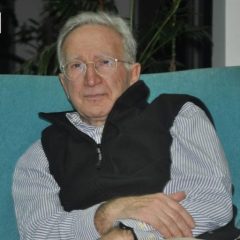 Jacob Cohen is a writer and lecturer born in 1944. Polyglot and traveler, anti-Zionist activist, he was a translator and teacher at the Faculty of Law in Casablanca. He obtained a law degree from the Faculty of Casablanca and then joined Science-Po in Paris where he obtained his degree in Science-Po as well as a postgraduate degree (DES) in public law. He lived in Montreal and then Berlin. In 1978, he returned to Morocco where he became an assistant lecturer at the Faculty of Law in Casablanca until 1987. He then moved to Paris where he now focuses on writing. He has published several books, including « Le commando de Hébron » (2014), « Dieu ne repasse pas à Bethléem » (2013), « Le printemps des Sayanim » (2010), « L’espionne et le journaliste » (2008), « Moi, Latifa S. » (2002).
He has a blog and performs on YouTube where he discusses various topics.
Mohsen Abdelmoumen is an independent Algerian journalist. He has written for several Algerian newspapers such as Alger Républicain and in different sites of the alternative press.
Algeria wants to become a satellite of Western interests in Africa
By Lucas Leiroz | June 1, 2020
The current geopolitical situation in North Africa and the Sahel can be radically changed and hardened if the new Algerian constitution allows the army to participate in operations outside its national borders. Paris and Washington are already supporting this change.
Article 95 of the new Constitution under review will open up the possibility for the “National People’s Army” to participate in “efforts to maintain peace at the regional and international level”. None of the five previous Algerian constitutions since independence from France in 1962 offered this possibility. As it appears in the constitutional project, the decision of this eventual military participation abroad must be approved by two thirds of the Parliament and it would not depend on the unilateral decision of the president, who is also the commander-in-chief of the Armed Forces.
According to the text, Algeria would always act in response to the mandate of the UN, the Arab League or the African Union. The interpretations of the measure, however, go far beyond what is formally written on paper. In this specific case, a careless interpretation and an imprudent decision could generate terrible risks.
Algeria participated in two of the Arab-Israeli and Libyan wars against the United States’ incursions. In peace missions, the African country also sent forces to Cambodia, Ethiopia-Eritrea, Haiti and Lebanon.
Some opposition voices interpret the new initiative more as “an act of servitude to the imperialist powers” than as an “evolution of the concept of national security”, which must be taken into account in the study of the project. After all, is Algeria really guaranteeing its own interests by sending troops abroad in advance? Or would it be serving foreign interests as well?
Several specialists on military topics are criticizing the reform and point to it as absolutely anti-strategic in a particularly delicate “transition” period in the history of the country and the entire region. Others add to this circumstance the concern about the global pandemic of COVID-19. In the specific case of the country, the new coronavirus has left the streets free from the protests that were calling for a regime change since February 22, 2019.
The new Algerian constitutional project appears to be particularly interesting for French interests in the country, from different perspectives. For example, one of the innovations brought by the new law is the possibility for citizens with dual nationality to occupy high positions in the public administration, which has never been possible since the country’s independence and will particularly benefit France, due to the large number of French people in the region.
On a military level, Paris is particularly interested in Algerian aid in the Mali issue, since France is the foreign country most active in fighting this country’s jihadists. Now, under an international mandate, Algiers could send troops to Mali and, due to its clear interest in seeking closer ties with France (as seen in the constitutional project), everything indicates that the country could occupy a position of satellite of the French interests in Africa. It is also necessary to remember that, due to the geographical proximity, many times, Mali terrorists have made incursions into Algerian territory, which also raises the Algerian interest in the fight against the jihadists. Recently, the government of Emmanuel Macron provided a symbolic aid of 400,000 euros to Algeria. Finally, everything indicates a convergence of interests between Algeria and France.
By its part, the United States is taking the opportunity to show solidarity with Algeria. Washington recently sent two million dollars in aid to fight the coronavirus in Algeria. Amid the global dispute for medical and health diplomacy, Washington does not want to give space to Russia and China – which has also joined the group of Algeria’s main arms suppliers; Algeria is Africa’s main arms buyer, with 6% of its product for this sector.
Lately, bilateral trade between the United States and Algeria has increased significantly, with Washington interested in being more deeply involved in current issues in North Africa. Indeed, the new Constitution, if passed, will be the perfect opportunity for Americans. The same means that try to favor French interests can serve for American ones; and, possibly, they should favor even other world powers that come to invest in political and economic questions of Africa.
In fact, if Algeria ends its non-interventionist doctrine, the diplomatic impact on North Africa and the Sahel could be considerable. The new Algerian leadership seems ready to regain the international weight it lost in the Buteflika era. Being closer to France and opening such possibilities for Washington is a current strategic path for Algeria to become a western military satellite in Africa, increasing its role in international relations. The consequences of such decision will be revealed soon.
Lucas Leiroz is a research fellow in international law at the Federal University of Rio de Janeiro.
Arab Spring returns home to uncertain welcome
By M. K. BHADRAKUMAR | Indian Punchline | April 12, 2019
The Arab Spring has returned to the Middle East after nearly six years in exile. It was in July 2013 that reversing the tide of democracy in Egypt that swept away the dictatorship of Hosni Mubarak, army chief General Abdel Fattah el-Sisi led a coalition with the backing of Saudi Arabia and the UAE to remove the elected President of Egypt, Mohamed Morsi, from power and suspended the the country’s constitution of 2012.
The Arab Spring never quite recovered from that trauma. There is a nifty aphorism of obscure origin that ‘History does not repeat itself but it often rhymes.’ The return of the Arab Spring to Algeria and Sudan in the recent weeks fits into that description. The similarity with the past lies in the undeniable fact that the Arab Spring is riding the wave of anti-regime protests in both Algeria and Sudan, triggered spontaneously by enormous public hatred of the regimes for their brutal repression, corruption, indifference to poverty and the intolerable conditions of day-to-day life.
In Sudan, the tipping point came four months ago over the government decision to triple the price of bread. In Algeria, the proverbial straw that broke the camel’s back came in February when then President Abdelaziz Bouteflika announced that he would seek a fifth-term in office, whereupon tens of thousands took to the streets.
In the sheer spontaneity of the Arab Spring revolt in Sudan and Algeria, time seemed to stand still since 2013. First in Algeria, after some six weeks of protests, and in Sudan within days, after four months of protests, the dictators got ousted. But in reality, things are never quite the repetition of the past — protests this time around are on a significantly higher scale. Lessons may have been learnt from the tragic example of Egypt where a heroic popular struggle that brought the Muslim Brotherhood and Mohammed Morsi to power ended in the blood-soaked 2013 coup led by General Sisi. The tragic saga of the Arab Spring in Egypt showed that entrenched ruling elites do not relinquish power simply because of militant mass protests.
Thus, both in Algeria and Sudan, there is popular resistance to the all-too-familiar pattern repeating — the army generals stepping in as the apparent saviours to remove the unpopular, detested dictators from power — Algerian President Abdelaziz Bouteflika and Sudanese President Omar al-Bashir — but then, only to usurp power and establish military dictatorships, as had happened in Egypt. In Algeria, the protestors are openly shouting ‘No repeat of the Egyptian scenario.’ In Sudan, the exhortation to the protestors is: ‘Stay put and guard your revolution. To comply with the curfew (imposed by the generals) is to recognise the clone rescue government (led by the army.)’
However, the spectre that is haunting the masses in both Algeria and Sudan is the danger of bloody counterrevolution. Leadership is lacking among protestors and they lack the machinery or cadres to coordinate opposition to military-police repression. Meanwhile, the entrenched elite is co-opting the middle class and trying to lull protestors to sleep with (false) promises of a democratic capitalist future. The military junta in Algeria is promising to convene a constituent assembly to rewrite the constitution, while the counterpart in Sudan has voiced its intention to hold democratic elections in two years.
In Sudan, there is also the added factor of foreign interference. Egyptian President Abdel Fattah el-Sisi openly said this week, “We cannot afford a leadership emerging in … Sudan that tolerates, or even worse condones, militant Islamic activity. This is why … we are keeping a close eye on any possible transition of power in Sudan.” The reference is to the Muslim Brotherhood.
Of course, it is a phoney argument, since the Brothers in Sudan have historically rejected union with the Egyptian branch (forming an alliance instead with the Sudanese Ansar-Ummah political bloc in support of Sudanese independence.) Sisi’s real worry is that if Sudan takes the democratic path, Muslim Brotherhood that has dominated Sudanese politics will surge to take the elected leadership, as had happened in Egypt in 2011, and that would rekindle the clamour for democracy in his country too.
Alex de Waal at the Fletcher School of Law and Diplomacy at Tufts University writing for the BBC assesses that “the cabal (that usurped power in Sudan) is aligned with Egypt, Saudi Arabia and the United Arab Emirates. Meanwhile, Qatar and Turkey have lost out. The new leadership dissolved the ruling National Congress Party and reportedly arrested many veteran Muslim Brothers.”
“They are busy telling Western countries that the Islamists had planned a coup, which needed to be forestalled by the army takeover, and that the protesters demanding democracy are also Muslim Brothers in disguise. It’s not a very convincing story, but it points to future tensions because the Islamists still have a strong following in Sudan.”
Sadly, in the emergent “multipolar world order”, there are hardly any takers for democracy or the Arab Spring — except, arguably, Turkey, Qatar and Iran — especially if it smacks of political Islam The big powers feel cozy with dictatorships. On Wednesday, the US and Britain issued a statement effectively backing the pre-emptive military coup in Sudan. At a meeting with Sisi on April 9 (who was on an official visit to the US at the invitation of President Trump), US Secretary of State Mike Pompeo thanked the dictator “for his leadership in advancing Egypt’s and the region’s security and stability, including through counterterrorism efforts and countering the Iranian regime’s malign influence.”
Kremlin Urges No Foreign Interference in Algeria
Al-Manar | April 3, 2019
The Kremlin on Wednesday said it hoped for a transition of power in Algeria without foreign “interference” after President Abdelaziz Bouteflika resigned in the face of massive street protests.
“We expect that the internal processes that are happening in this country and are exclusively the internal affair of Algeria will take place without the interference of any third countries,” Kremlin spokesman Dmitry Peskov told reporters.
He added that Russia has “mutually beneficial, friendly relations” with Algeria and that the two countries share “many joint projects in the economic sphere.”
Bouteflika, 82, had ruled the former French colony for two decades and had long been accused of clinging to power.
The veteran leader faced mounting pressure to step down following his decision to seek a fifth term, despite rarely being seen in public since suffering a stroke in 2013.
His decision to stand aside was announced on state television late Tuesday.
Featured Video
It’s the Occupation, Stupid
or go to
Aletho News Archives – Video-Images
From the Archives
A superpower and “the world’s sickest warrior state”
By Paul J. Balles | March 8, 2010
Living through five or six major wars has hardened me to what I thought were the extremes of inhuman cruelty and brutality.
Two things made those extremes almost bearable: the brutality always revealed – at least according to the media coverage – the viciousness of the enemy. It was therefore quite understandable when our “brave men and women” pulverized the enemy.
Films of Japanese torturing captive Americans somehow justified holding Japanese Americans in internment camps during World War II; and only a small percentage of Americans found the bombing of Hiroshima and Nagasaki unreasonably vengeful at best, at worst, depraved.
The media giants in America portrayed the North Koreans as barbaric beasts with their captives, quite unlike their southern counterpoints – our allies during the Korean War. No one ever felt the need to explain how the South Koreans were a civilized breed while the North Koreans were absolute savages, at least according to the official line.
In Vietnam, our warriors justifiably (or so the media made us believe) dropped napalm on the North Vietnamese who had the gall to hide in villages and tunnels to ravage our invaders. At least it was accepted practice until some rogue photojournalist filmed a young girl screaming down a Vietnamese road in flames. … continue
Blog Roll
 Aletho News
- Pro-Palestinian French member of European Parliament denied entry to Canada
- Pakistan to Host US-Iran Talks
- How Indonesia’s tilt toward the US left it stranded in the Strait of Hormuz
- US has no choice but to retreat from Iranian borders: Top commander
- Iran Retaliation Strikes Chemical Plant Near Dimona
- AWACS’ Destruction is a Major Loss for US Military – Ex-DoW Analyst
- Israel’s Iran Strategy Uses US Military & Gulf States as Its Pawns
- Iran: Trump wanted regime change, now just begging for Hormuz to open
- IRGC: Israeli, US universities in region legitimate targets after strikes on Iranian university
- Trump admits Iran hit USS Ford carrier: ‘We ran for our lives’
- If Americans Knew
- Israeli police block Catholic cardinal from entering Church of the Holy Sepulchre on Palm Sunday
- Israel is assassinating journalists again, more than any other nation, anywhere, ever – Not a ceasefire Day 170
- Over 300 US service members wounded, majority have brain injuries – Not a ceasefire Day 169
- Researchers at Human Rights Watch Resign Over Blocked Report on Palestinian Refugee Return
- Jewish Groups Are Backing a War Americans Don’t Want
- Eric Fingerhut Thinks He’s the President of the Jews
- Top Jewish Philanthropists, Rabbis Urge Israeli President to Take Action Against ‘Jewish Extremists’
- Don’t Be Fooled. Zionist Leaders Have Always Wanted to Control Southern Lebanon
- Israel’s widespread use of torture is a core element of its genocide against the Palestinian people
- In Israel’s War on Iran, Many Middle East US Bases Rendered “All But Uninhabitable”
- No Tricks Zone
- German Science Blog Accuses PIK Climate Institute Of Hallucinating Climate Tipping Points
- Devastating Assessment Of Comirnaty Vaccine By Former Senior Pfizer Europe Toxicologist
- New Study: CO2 Is ‘Effectively Negligible’ As An Explanatory Climate Change Factor Since 2000
- Former Pfizer Toxicologist Dr. Helmut Sterz Tells Bundestag Hearing Pfizer Vaccine Should Have Never Been Approved
- Energy Expert: Germany’s Nuclear Phaseout Was A “500 Billion Euro Mistake”
- New Research: South Australia’s Mid-Holocene Sea Surface Temperatures Were 4°C Warmer Than Today
- Storing Green Energy To Last Germany 10 Days Would Require A 60-Million Tonne Battery
- New Studies: UK Sea Levels Were 4 Meters Higher Than Today During The Mid-Holocene
- Destructive Green New Deal: German Energy And Metal Group Warns Of Drastic Crisis
- New Study Documents A 20-Year Pause In Arctic Sea Ice Decline – Driven By Internal Variability
 Aletho News