Obama knew about NSA spying on Merkel: Report
Press TV – October 27, 2013
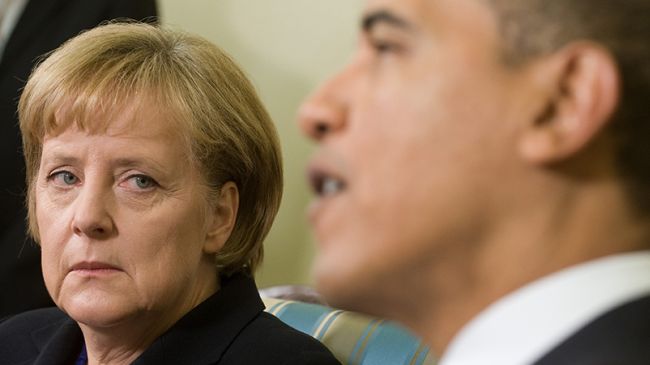
A new report has revealed that US President Barack Obama was personally aware of the National Security Agency’s eavesdropping on German Chancellor Angela Merkel.
NSA director Keith Alexander had briefed President Obama on the mobile phone tapping against Merkel in 2010, German newspaper Bild am Sonntag reported on Sunday.
“Obama did not halt the operation but rather let it continue,” according to the paper citing a high-ranking NSA official.
The newspaper also said the US spying agency eavesdropped on Merkel’s predecessor, Gerhard Schroder, after former US president George W. Bush launched the spying program in 2002, adding that Schroder’s refusal to support the Iraq war was a key reason behind the operation.
The new revelation comes one day after German magazine Der Spiegel said that the NSA’s Special Collection Service (SCS) had listed Merkel’s mobile telephone since 2002.
Washington’s ally has demanded explanations from the White House after disclosures about the huge and broad American electronic spying.
On Thursday, Germany summoned US ambassador John Emerson to discuss the tapping allegations.
“For us, spying on close friends and partners is totally unacceptable. This undermines trust and this can harm our friendship,” German Foreign Minister Guido Westerwelle said. “We need the truth now.”
In a phone call with Obama on Wednesday, Merkel said that she “unequivocally disapproves of such practices and sees them as completely unacceptable. There should be no such monitoring of the communication of a head of government. That would be a grave breach of trust.”
The White House, however, rejected the allegations, saying “the United States is not monitoring and will not monitor the communications of Chancellor Merkel.”
The global outrage over US government surveillance further spiked after The Guardian — citing a confidential memo obtained from American whistleblower Edward Snowden – revealed that the NSA is illegally eavesdropping on phone conversations of 35 world leaders.
The revelations have prompted Brazil and Germany to begin drafting a UN General Assembly resolution to restrain the NSA’s surveillance programs against other nations.
NSA docs prove Germany complicit in spying program: Report
Press TV – July 22, 2013
A report has revealed that German intelligence services themselves used one of US National Security Agency’s most valuable spying programs.
The new information was published by German weekly Spiegel on Sunday and was based on secret documents from the US intelligence service.
This report comes as another blow to German Chancellor Angela Merkel and her ministers, who all claim that they first learned about the NSA spying programs from press reports.
The documents show that Germany’s foreign intelligence service, the BND, and its domestic intelligence agency, the Federal Office for the Protection of the Constitution (BfV), both used an NSA surveillance program called XKeyScore.
The obtained documents also revealed that the XKeyScore program collected the major part of the up to 500 million phone calls and data activities monitored monthly by the NSA.
The XKeyScore program is able to reveal retroactively any terms the target person has typed into a search engine through collected metadata, i.e. information about which data connections were made and when, according to an internal NSA presentation from 2008.
The system is also capable of receiving a “full take” of all unfiltered data over a period of several days, including contents of communications.
Furthermore, the secret documents show that the BND head, Gerhard Schindler, had an “eagerness and desire” for Germany’s intelligence agencies to intensify cooperation with the NSA.
“The BND has been working to influence the German government to relax interpretation of the privacy laws to provide greater opportunities of intelligence sharing,” the NSA stated in January.
Elsewhere in the document, the NSA said that in Afghanistan the BND had proved to be the agency’s “most prolific partner” when it came to information gathering.
Moreover, the documents show that a 12-member high-level BND delegation was invited to the NSA at the end of April to meet with various experts on “data acquisition”, just a few weeks before first revelations by the NSA surveillance programs by Edward Snowden were published.
In June, Snowden, an American former technical contractor for the NSA and a former employee of the CIA, leaked documents showing the US spied on the European Union and monitored up to a half-billion German telephone calls and internet activities each month.
Related article
Merkel justifies NSA eavesdropping surveillance
RT | July 11, 2013
Despite “justified questions” to the American intelligence community regarding eavesdropping on German networks, the US remains Berlin’s “most loyal ally”, announced Chancellor Angela Merkel in interview to Die Zeit weekly.
Merkel has made her first detailed comment into the unraveling diplomatic scandal with the America’s National Security Agency (NSA) global telecommunication eavesdropping, including those of its European allies, Germany foremost among them.
It emerged recently that Germany happens to be the most-snooped-on EU country by the American National Security Agency (NSA). The NSA’s real-time online surveillance PRISM program allows US intelligence agencies to intercept virtually any communications over the internet, phone calls and makes possible direct access to files stored on the servers of major internet companies.
Merkel declared that she herself has learnt about the US surveillance programs, such as the NSA’s PRISM spy program, “through the current reporting” in the media.
In early July spokesman Steffen Seibert announced on the behalf of Chancellor Merkel that “The monitoring of friends – this is unacceptable. It can’t be tolerated,” adding that Merkel had already delivered her concerns to the US. “We are no longer in the Cold War,” Seibert added.
The German government subsequently summoned US Ambassador Philip Murphy to Berlin to explain the incendiary reports.
At the same time according to new revelations made by former NSA contractor Edward Snowden to Germany’s Spiegel magazine, the American NSA and Germany’s intelligence agencies are “in bed together.”
Seibert told Reuters this week that German’s Federal Intelligence Agency’s (BND) cooperation with the NSA “took place within strict legal and judicial guidelines and is controlled by the competent parliamentary committee.”
‘Intelligence is essential for democracies’
Merkel stressed that intelligence “has always been and will in future be essential for the security of citizens” of democratic countries. “A country without intelligence work would be too vulnerable,” Merkel said.
At the same time, she observed that there must be a “balance between maximum freedom and what the state needs to give its citizens the greatest possible security.”
Merkel emphasized that German-American special relationship should not be endangered by the incident.
“America has been, and is, our most loyal ally over all the decades,” Merkel said, but pointed out that Washington should clear up the situation with the US allegedly bugging the embassies of the European countries and the EU facilities, noting that “the Cold War is over.”
Stasi and NSA are not comparable
In acknowledgment of the Germany’s contemporary history, Merkel, who grew up in East Germany, refused to make any parallels between the methods of work of DDR’s secret police Stasi and America’s NSA.
“For me, there is absolutely no comparison between the Stasi and the work of intelligence agencies in democratic states,” she was quoted as saying. “They are two completely different things and such comparisons only lead to a trivialization of what the Stasi did to [East Germany’s] people,” said Merkel.
Rhetoric shift
In the face of the national elections in September, Angela Merkel has come under fierce criticism in connection with the NSA spying scandal for not protesting unequivocally enough, while various German politicians demanded to stop spying immediately.
Germany’s center-left opposition insists on questioning country’s officials with a view to find out what exactly they knew about the American surveillance of German communications before the eavesdropping scandal emerged.
Earlier Germany’s Interior Minister Hans-Peter Friedrich and Justice Minister Sabine Leutheusser-Schnarrenberger both declined any knowledge of the eavesdropping performed by the American US in German networks.
In the interview to Die Zeit Chancellor Merkel revealed that reports from German intelligence agencies are being delivered to her chief of staff, Ronald Pofalla who coordinates their work from the chancellery.
The head of the center-left opposition Social Democratic Party (SPD) Sigmar Gabriel told Spiegel Online that “Ms. Merkel is now trying to shift political responsibility to her chief of staff.”
“That’s an old game: [pretending] not knowing anything at first, trying to play down the problem and then finally pointing the finger at a staff member. But it’s not going to work because it’s clear that the dimensions of this scandal are so great that no person other than the chancellor can ensure that basic rights are defended in Germany,” the SPD leader claimed.
Today battling terrorism is impossible “without the possibility of telecommunications monitoring,” Merkel told the weekly. “The work of intelligence agencies in democratic states was always vital to the safety of citizens and will remain so in the future.”
In the meantime, Friedrich is meeting US Attorney General Eric Holder and White House counterterrorism adviser Lisa Monaco in Washington on Friday for talks dedicated to the NSA scandal. Though Merkel’s government is not likely to pedal the spying issue, Berlin surely expects explanation from Washington in regards of the ‘Snowdengate’ “for all the more-than-justified questions”, Merkel was quoted as telling Die Zeit.
Luxembourg PM resigns over spying scandal
RT | July 11, 2013
Luxembourg’s long-serving Prime Minister Jean-Claude Juncker officially announced he would resign following a spying scandal involving illegal phone-taps and other illicit activities.
The announcement comes as Juncker’s junior coalition partner called for the dissolution of the house and early parliamentary elections.
Juncker’s departure follows allegations the country’s security services abused their power under his watch, including illegally bugging politicians, purchasing cars for private use, and taking payments and favors in return for access to local officials from 2003 to 2009.
A report commissioned by Luxembourg’s parliament into the matter determined that Juncker failed to rein in the agency despite it being under his auspices. The July 5 document further said that the outgoing PM was “politically responsible” for failing to inform the parliamentary committee of control or justice authorities about the Luxembourg State Intelligence Service’s (SREL) alleged illegalities.
The report was commissioned after a Luxembourg weekly newspaper published a secretly-taped conversation from 2008 between Juncker and the head of SREL at the time, Marco Mille.
On tape, Mille revealed that his staff had secretly recorded a conversation involving Luxembourg’s Grand Duke – the monarchial head of state – and that the sovereign was in regular contact with Britain’s Secret Intelligence Service.
The ensuing parliamentary inquiry revealed extensive illicit activity: the existence of 13,000 secret files on people and businesses, illegal wire-taps on business leaders, and a counter-terror operation which was in actually a front to help a Russian oligarch pay US$10 million to a Spanish spy, and even a shadowy private dealership in luxury cars, AFP reports.
In June, the PM survived Luxembourg’s first no confidence vote in 150 years after the opposition Liberals and Greens accused Finance Minister Luc Frieden of pressuring the state prosecutor to stop legal proceedings against a group implicated in a series of 1980s bombings.
However, the specter of a fresh no confidence vote once again hung over Juncker, who became prime minister in 1995 and is the European Union’s longest-serving head of government, following the report.
The PM delivered a defiant speech to lawmakers on Wednesday in which he attempted to refute allegations that he has used the SREL to bolster both him and his Christian Social People’s Party.
Juncker initially refused to step down, claiming the PM should not be expected to resign over the alleged wrongdoing of a few intelligence agents.
“The intelligence service was not my top priority,” Juncker told parliament. “Moreover, I hope Luxembourg will never have a prime minister who sees SREL as [his or her] priority.”
However, Junker’s junior partner, Luxembourg Socialist Workers’ Party (LSAP) President Alex Bodry, called on the PM to take” full political responsibility” for the scandal.
“We invite the prime minister to take full political responsibility in this context and ask the government to intervene with the head of state to clear the path for new elections,” Bodry said.
Juncker, who said it would be impossible to take personal responsibility for the allegations leveled at him, ultimately resigned to avoid a vote of no confidence.
“I will convene the government tomorrow morning at 10am (08:00 GMT) and will go to the Palace to suggest snap elections to the Grand Duke,” he told parliament on Wednesday.
As head of state, only the Grand Duke can officially dissolve parliament.
In line with Junker’s recommendation, the government will continue its work until early elections are held on October 20. It remains unclear whether the outgoing PM intends to run.
Political responsibility as last resort
Luxembourg, a tiny state nestled between Belgium, France and Germany, is viewed as a major European financial hub, where some 40 percent of the country’s 500,000 residents are foreigners working in banks and other European institutions.
Juncker’s departure over intelligence service malfeasance was a major wave in one of Europe’s most politically-stable states.
As the outgoing PM admitted the intelligence service scandal left him “no other choice than to hand in the government’s resignation,” other European leaders are increasingly being scrutinized for the alleged role in sweeping surveillance activities.
UK Foreign Secretary William Hague, who oversees the Government Communications Headquarters (GCHQ), has recently come under fire for the agency’s Tempora surveillance program, as well as its collusion with US National Security Agency’s (NSA) sweeping spying programs.
Last week the European Union began investigating whether Britain had broken EU law following reports it had tapped international phone traffic and shared vast amounts of personal data with the US, an EU source told Reuters.
Viviane Reding, the vice-president of the European Commission and EU commissioner for justice, wrote to Hague asking him to clarify the “scope of the [Tempora surveillance] program, its proportionality and the extent of judicial oversight that applies.”
In Germany, where the US a reportedly combs through half a billion German phone calls, emails and text messages on a daily basis, NSA whistleblower Edward Snowden recently accused the country’s political leadership of ‘being in bed’ with the NSA.
On Wednesday Chancellor Angela Merkel defended Germany’s cooperation with US intelligence, dismissing charges its methods resembled those deployed in the former German Democratic Republic.
“For decades, intelligence services have been working together under certain conditions that are tightly regulated in our country, and this serves our security,” Merkel told the German weekly Die Zeit.
“For me, there is no comparison at all between the state security [Stasi] of the GDR and the work of intelligence services in democratic states,” she continued.
“These are completely different things and such comparisons only lead to a trivialization of what the state security did to people in East Germany,” she said.
With elections slated for September 22, the center-left opposition has pounced on the issue, claiming Merkel, whose office coordinates and oversees Germany’s intelligence services, must have known more about NSA operations.
Related article
- Veteran Luxembourg PM Juncker resigns in spy scandal (vietnamnews.vn)
‘German government sells the privacy of German citizens to the US’
RT | July 08, 2013
The recent NSA spying scandal showed the German government behaves towards US like a puppet regime, involving all major political parties just before the September elections, German journalist Manuel Ochsenreiter told RT.
RT: Let’s just discuss it now with the journalist Manuel Ochsenreiter who is joining us from Berlin. Mr. Ochsenreiter, to what extent do you think Germany may have cooperated with the NSA?
Manuel Ochsenreiter: Well, I think it’s a matter of fact that we know that the German authorities, the German mainstream politicians, the German government they all cooperate in a very intense way with US intelligence. I feel a little bit weird to use the term “cooperation” for this because when we look exactly at what is going on that they were spying on German citizens we have to say that the German government behaves towards the US government in this question more or less like a US puppet regime. No claim of sovereignty. No claim of independence. Of course, no claim of privacy, for the right to privacy of their own citizens. So, the German citizens are not at all protected by their own government. The German government sells the privacy of German citizens to the US government. And this is the really, really serious case, it’s a big scandal.
RT: Snowden claims top politicians were insulated in case of a scandal – yet now they seem to be outraged. What you are saying is that they might be doing this because of the public outrage. What’s got them more angry then, if that’s the case that they did not know, or that they did not know about the scale of the operations that they would too be spied on?
MO: To be honest I believe that they are angry that it became public, that now all the facts are open and the citizens can see what’s going on because I wouldn’t believe any word right now of a government politician. By the way, I’m also not fond of opposition politicians in the German parliament. We have to know that the government before the Merkel government was built by the GPD opposition. And they cooperated as well with the Americans as today’s government is doing. And when we listen very well to the words of mainstream politicians in Germany we hear right now a lot of justifications of this. Yes, let us say cooperation as they call it. They say it’s for our security, they say that this is a partnership, that this is a friendship but, of course, it’s not. It’s pure spying. And we have to watch a little bit back in the past we had in the 1990s the ECHELON project. It was also a USA spy project especially on Germany. And this spying project was especially for economic espionage. The German companies, the German economy was monitored by the US secret service. So, what we see here is that Germany is behaving more or less like, well, let me say like a state fully under control of the US without any independence. And the scandal’s not that US are doing that. The real scandal’s that the German politicians are not doing something against it…
‘German politicians should expel the US American military bases’
RT: Snowden did say that this went beyond agreements between the countries in terms of what they can share, what they can… in terms of sharing information. So, how is this affecting the politicians knowing that. They have been spied on far more than the agreement they had. So, yes, so, we say “yes” they did know about this. But to the extent that they have been spied on, I mean, this is going beyond spying on just their own citizens. It goes it is spying within politicians as well. How are they reacting to that? Is it going to create tension between the US and its allies now? Are they not seeing this? Are we just reading too much into something which is been happening anyway?
MO: We are knowing a very interesting time Germany because we have in September the elections. And I think the spying scandal is really really disturbing the election campaigns of all the mainstream parties because they all are involved in the scandal. So, what they are doing now is that they all try to give the impression that on the one side they knew about so-called cooperation but that they are completely surprised about how far it went. And to be honest I wouldn’t believe any word because we had already the experience in the past about how far the US governments go and how they treat their so-called allies or their so-called partners. So, if the German politicians… Let me finish with one sentence. If they are really so upset and so surprised as they act now then we have to see the consequences. And there are many consequences we could do with. For example, that the US ambassador is summoned to the Chancellor and is so criticized that there is diplomatic protest, that, for example, we make it to initiate that we have until today US barracks and US army troops on Germans soil. And we know that those military bases are also used for the NSA projects. So we invite the Americans to our country or our politicians invite them in our country to establish their military and intelligence bases there. So, if the German politicians want to do something it’s very easy to them just expel the US American military bases. Don’t make Germany any more do the military aircraft carried out in Europe of the US Americans. It would be easy but they will not do it, because they believe in this partnership which is not a partnership.
RT: So, how does the spying on the EU leaders sit, with the intelligence community cooperating. I mean, is that a sign that the US doesn’t trust its allies? Or it’s just keeping a close eye on its allies?
MO: I think this shows a lot about the attitude that the American government has towards the allies because we are never talking about the partnership we are talking about hegemonic politics. They want to be able to control a partnership or something else. Partnership is when two countries make an agreement with each other. But what we see here is that the US have gained control of those countries. I’m not sure that it will really bring mistrust in the EU bureaucracy because these people are used to that and I’m not sure if they are really upset about this because they know about this. But the interesting question is how long will the population be so tolerant to bear those problems. This is the interesting question.
RT: Just one more from you. In terms of destroying itself, I mean, we now have been focusing a lot on Snowden instead of what he’s actually been leaking. Do you think we are just kind of missing why politicians in the EU are trying to cover all of this up, by focusing on him rather then what actually Snowden keeps on releasing?
MO: Why? I don’t know. Perhaps, it might be interesting what Snowden has on his four laptops he took with him and I’m pretty much sure the information we got until now is not really 100% percent of what he has with him. I think you know he is in Moscow. Now, I think, the Russians are very interested in the content and the Germans again (I’m from Germany) my politicians, my government, they should be really interested in the content of the full-scale, of these espionage practices if they really want to know this. But I don’t see that right now. But I think in the near future we will get may be a lot of surprises how intense the spying is really.
Related articles
- Snowden: West ‘in bed with NSA’… (spiegel.de)
- European anger growing over extent of alleged U.S. electronic surveillance (mcclatchydc.com)
UK spying on Germany’s major data cable to US triggers media storm
RT | June 25, 2013
A wave of outraged comments have swept the German media after it was revealed Monday that British secret Government Communications Headquarters (GCHQ) wiretapped the dataflow of Germany’s major transatlantic cable.
The northern German public broadcaster NDR and Süddeutsche Zeitung newspaper reported late on Monday that Germany’s external intelligence service BND (Bundesnachrichtendienst) has been in the dark about GCHQ wiretapping Transatlantic Telephone Cable No. 14 (TAT-14) connecting Germany with the US via UK, in the framework of its Tempora data collection project.
The TAT-14 fiber optic cables entered service in 2001. It is operated by private consortium German Telekom and used by around 50 international communication companies for phone calls, internet connection, data transfer etc.
Countries like Denmark, France, the Netherlands, and the UK itself also use this cable for internet connection to North America.
The capacity of the 15,000km TAT-14 is enormous; it transfers hundreds of gigabytes of data per second in both directions. The report claimed British GCHQ has already had access to 21,600 terabytes of private and business German data transferred through the cable.
‘We haven’t asked NSA and GCHQ to protect us’
The initial reaction from official Berlin concerning Edward Snowden’s revelations about British intelligence straddling Germany’s major fiber optics cables without Berlin’s knowledge was rather moderate.
Senior German Interior Ministry official Ulrich Weinbrenner admitted to the Bundestag committee that it was known “in general form” that foreign tapping programs – like American PRISM and British Tempora – existed.
Having met American President Barack Obama last week, German Chancellor Angela Merkel cautiously commented that collecting information needs ‘proportionality’ and that “the free democratic order is based on people feeling safe.”
However, German government spokesman Steffen Seibert announced that Berlin wanted explanations from NATO allies “on what legal basis and to which extent” surveillance had been conducted.
The head of the Free Democratic Party parliamentary group, Rainer Brüderle, demanded an investigation.
“A comprehensive monitoring of citizens in the network cannot and will not be accepted ,” he told Passau Neue Presse.
“We need to step back here and say clearly: mass surveillance is not what we want,” said Jan Philipp Albrecht, a German Green member in charge of a planned overhaul of the European Union’s data protection laws.
“We urge the Federal Government and the EU Commission to initiate an infringement proceedings against the UK government,” which would have to deal with the matter, Albrecht said to Berliner Zeitung.
“The Federal Government and the Commission must take the issue of protecting fundamental rights seriously,” the rapporteur added in the Judiciary Committee.
Albrecht’ thoughts were echoed by CSU MEP Manfred Weber who told Berliner Zeitung that “If European law has been broken, such as in relation to the retention, the Commission must act.”
The harshest comment came from German Justice Minister Sabine Leutheusser-Schnarrenberger, who dubbed the total eavesdropping from a NATO ally a “Hollywood nightmare.”
Federal Commissioner for Data Protection Peter Schaar called on the federal government to proceed on an international level against data espionage from abroad.
“The federal government must insist that our emails will not be penetrated by foreign intelligence services,” he demanded according to Bild newspaper.
The methods used by the American NSA and British GCHQ agencies are “secret, but lawful” and “subject to proper UK statutory controls and safeguards,” stated UK Foreign Secretary William Hague.
But such statements have produced little effect on the public or within expert communities.
“How much and which data of German citizens and companies had been secretly accessed by the Anglo-American intelligence services NSA and GCHQ, for example by tapping glass fiber cables?” questioned Greens party parliamentarian Hans-Christian Ströbele, as quoted by Deutsche Welle (DW).
‘Not our laws’
“The shoulder-shrugging explanation by Washington and London that they have operated within the law is absurd. They are not our laws. We didn’t make them. We shouldn’t be subject to them,” Spiegel online columnist Jakob Augstein. “We have not asked the NSA and GCHQ to ‘protect’ us,” he said.
Gisela Pilz, a data protection expert with the parliamentary group of the liberal FDP, the junior partner in the governing coalition, agrees.
“We observe with a great deal of concern and dismay the amount of data that has been collected and stored,” she told DW.
Chancellor Angela Merkel’s coalition government was caught in the crossfire of criticism for not ensuring national digital security.
It is the responsibility of the German government to see that foreign agencies no longer process the data of German citizens and companies, Augstein stressed, because “a government that cannot make that assurance is failing in one of its fundamental obligations: to protect its own citizens from the grasp of foreign powers,” he concluded. “Germans should closely observe how Angela Merkel now behaves.”
The head of the Bundestag’s intelligence supervisory committee, opposition Social Democrats deputy Thomas Oppermann, called to speed up the elaboration of data privacy legislation currently being drafted in the EU.
Related articles
- ‘Brit brother’ taps Germany-US data cable (thelocal.de)
- A simple guide to GCHQ’s internet surveillance program Tempora (wired.co.uk)
- Germany blasts UK over cable trawl (realnewsnow.com)
Upon Israel’s Request, Germany To Void Submarines Deal With Egypt
By Saed Bannoura | IMEMC & Agencies | September 13, 2012
Chancellor of Germany, Angela Merkel, personally vowed to Israeli Prime Minister, Benjamin Netanyahu, to void a submarines deal its country signed with Egypt, and said that her government will not approve this deal with the Egyptian Army, Germany’s Der Spiegel reported.
Der Spiegel said that the German government granted a green light to this deal last February, and then Israel was informed on details of the deal as Merkel personally spoke to Netanyahu while German Defense Minister, Thomas de Maziere, kept in touch with his Israeli counterpart, Ehud Barak, to update him on the latest information.
Der Spiegel said that, at first, Israel did not express any reservations about the deal, but senior German political leaders were surprised to hear serious statements made by Israeli officials, who expressed their objection to the deal, after the Egyptian navy announced it.
The deal will likely now be presented to the special German Ministerial Council as the legal body in charge of weapons deal, in order to reconsider it, while several German officials said that the deal will be voided due to Israeli objections.
Furthermore, the Israeli daily, Haaretz, reported that the government of Israeli Prime Minister, Benjamin Netanyahu, has demanded Berlin not sign any weapons deals with Arab countries without prior consultation and coordination with Tel Aviv.
The Israeli Government said that such coordination with Tel Aviv, prior to any weapons deal with the Arab states, is essential to ensuring Israel’s military supremacy in the Middle East.
It is worth mentioning that Germany recently signed several agreements for the sale of tanks and submarines to Egypt, Algeria, Qatar and Saudi Arabia.
Haaretz reported that Israel wants to reach new understandings with Germany regarding the sale of weapons to Arab states in order to ensure that the Israeli Army remains the most powerful army in the region. The deals signed with Saudi Arabia and Qatar include the sale of Leopard Tanks, submarines to Egypt and other military equipment to Algeria.
It is worth mentioning that the Israeli Defense Ministry Diplomatic and Security Bureau Head, Maj.-Gen. (Res.) Amos Gilad, recently visited Berlin and asked Germany to coordinate with Tel Aviv all of its weapons sales with all Arab states. Israel said that Germany’s weapons sales to the Arab world have increased last year, and that several deals regarding the sales of tanks and submarines were singed.
Both Israel and the United States want to ensure that armies in Arab countries do not obtain weapons and technology that could pose a risk to the supremacy of the Israeli military, as they want Israel to remain, at all times, the most militarily powerful state in the region.
Also, a senior Israeli official told the Bild German Newspaper, Wednesday, that Israel is seriously concerned about the sale of the submarines to Egypt, and added that “Egypt today is not the same as Egypt during the rule of former President, Hosni Mubarak”.
The official was referring to the fact that that after the Egyptian revolution managed to overturn the rule of Mubarak, the Muslim Brotherhood garnered an overwhelming victory in the legislative elections, and due to the fact that the newly elected Egyptian President, Mohammad Morsi, is a member of the Muslim Brotherhood.
Yet, several Israeli security and political leaders recently stated that the security coordination between Tel Aviv and Cairo is now at its best since the signing of the Camp David peace accords between the two countries in 1978 and 1979.
Germany: Environment minister voices doubts about energy reforms
DW | July 16, 2012
Germany’s environment minister has admitted that the government faces an uphill climb if it is to achieve the targets it has set out for reducing carbon emissions while simultaneously stopping nuclear energy production.
Germany’s environment minister raised eyebrows on Sunday by conceding that some of the targets that are part of the government’s policy of phasing out the use of nuclear energy, while at the same time cutting emissions of greenhouse gases, may not be achievable.
“It has to be questioned whether we’ll really succeed in reducing electricity use by 10 per cent by 2020,” Peter Altmaier said in an interview with the Bild am Sonntag newspaper.
“If we are going to somehow achieve this, it will take tremendous effort, ” he said.
Altmaier also admitted that the government had a long way to go in efforts to convince a large number of Germans to switch from vehicles powered by internal combustion engines to electric cars.
There may be “significantly fewer” electric cars on the road by 2020 than the government had previously assumed, the minister said.
Chancellor Angela Merkel’s center-right coalition had previously said that it was on track to put a million electric cars on the road by 2020. Official figures put that number at just over 4,500 at the start of 2012.
Rising consumer costs a possibility
Altmaier also warned of the danger of rising energy costs for consumers.
“If we aren’t careful, the energy reforms could develop into a social problem,” he said, admitting that in efforts to replace nuclear energy with renewables, “the question of energy affordability had been overlooked.”
He also said that turning off a number of nuclear plants meant that power shortages could not be ruled out in the coming winter.
“Last winter there were a few critical moments, which we have learned from,” he said, adding that preparations were underway to ensure this doesn’t happened again. … Full article
Related articles
- German Environment Minister Peter Altmaier – ‘We Can’t Allow Electricity To Become A Luxury’ (freeinternetpress.com)
Report: Greek aid likely conditioned on arms deals
Press TV – April 20, 2012
Financial aid to cash-strapped Greece is suspected to have been conditioned on the country’s managing to clinch arms deals with Germany and France, a report reveals.
“Speculation is rife that international aid for the country was contingent on Greece following through on agreements to purchase military hardware from Germany and France,” The Guardian said on Thursday.
Germany’s biggest arms market in Europe is Greece with around 15 percent of its total arms sales heading there.

Earlier in January, German Chancellor Angela Merkel told a joint news conference with French President Nicolas Sarkozy in Berlin, “We must see progress on the voluntary restructuring of Greek debt.”
Merkel and Sarkozy both insisted to press ahead with a greater “fiscal compact” in Europe, and tougher penalties for the countries that violated the eurozone’s budget rules.
Greece’s Deputy Prime Minister Theodore Pangalos regretted during a May 2010 visit by Turkish Prime Minister Recep Tayyip Erdogan that Athens was spending so much money on arms.
He said the country was being “forced to buy weapons” and that the deals made him feel “national shame.”
Thanos Dokos, a leading Greek defense expert, said the country had 1,300 tanks, more than twice the number in the UK and far beyond its needs.
Greece has the highest debt burden in proportion to the size of its economy in the 17-nation eurozone. Despite austerity cuts and bailout funds, the country has been in recession since 2009.
In order to secure an EUR-130-billion bailout package funded mostly by the eurozone member states and the International Monetary Fund, the country had to adopt harsh austerity measures, including massive cuts to its private and public sector wages, pensions, as well as health and defense spending, which have worsened the economic recession, leading to thousands of job losses.
Related articles
- The Untold Story – Arms imports and the Greek debt crisis (antiworldnews.wordpress.com)
Featured Video

Yemen joins the war – Red Sea could be blocked next – Saudi regime at risk
or go to
Aletho News Archives – Video-Images
From the Archives
A superpower and “the world’s sickest warrior state”
By Paul J. Balles | March 8, 2010
Living through five or six major wars has hardened me to what I thought were the extremes of inhuman cruelty and brutality.
Two things made those extremes almost bearable: the brutality always revealed – at least according to the media coverage – the viciousness of the enemy. It was therefore quite understandable when our “brave men and women” pulverized the enemy.
Films of Japanese torturing captive Americans somehow justified holding Japanese Americans in internment camps during World War II; and only a small percentage of Americans found the bombing of Hiroshima and Nagasaki unreasonably vengeful at best, at worst, depraved.
The media giants in America portrayed the North Koreans as barbaric beasts with their captives, quite unlike their southern counterpoints – our allies during the Korean War. No one ever felt the need to explain how the South Koreans were a civilized breed while the North Koreans were absolute savages, at least according to the official line.
In Vietnam, our warriors justifiably (or so the media made us believe) dropped napalm on the North Vietnamese who had the gall to hide in villages and tunnels to ravage our invaders. At least it was accepted practice until some rogue photojournalist filmed a young girl screaming down a Vietnamese road in flames. … continue
Blog Roll
 Aletho News
- Russian tanker approaches Cuba despite US oil blockade
- Marandi: Yemen joins the war – Red Sea could be blocked next – Saudi regime at risk
- Pro-Palestinian French member of European Parliament denied entry to Canada
- Pakistan to Host US-Iran Talks
- How Indonesia’s tilt toward the US left it stranded in the Strait of Hormuz
- US has no choice but to retreat from Iranian borders: Top commander
- Iran Retaliation Strikes Chemical Plant Near Dimona
- AWACS’ Destruction is a Major Loss for US Military – Ex-DoW Analyst
- Israel’s Iran Strategy Uses US Military & Gulf States as Its Pawns
- Iran: Trump wanted regime change, now just begging for Hormuz to open
- If Americans Knew
- Israeli police block Catholic cardinal from entering Church of the Holy Sepulchre on Palm Sunday
- Israel is assassinating journalists again, more than any other nation, anywhere, ever – Not a ceasefire Day 170
- Over 300 US service members wounded, majority have brain injuries – Not a ceasefire Day 169
- Researchers at Human Rights Watch Resign Over Blocked Report on Palestinian Refugee Return
- Jewish Groups Are Backing a War Americans Don’t Want
- Eric Fingerhut Thinks He’s the President of the Jews
- Top Jewish Philanthropists, Rabbis Urge Israeli President to Take Action Against ‘Jewish Extremists’
- Don’t Be Fooled. Zionist Leaders Have Always Wanted to Control Southern Lebanon
- Israel’s widespread use of torture is a core element of its genocide against the Palestinian people
- In Israel’s War on Iran, Many Middle East US Bases Rendered “All But Uninhabitable”
- No Tricks Zone
- New Study Finds Warming Saves Lives…Cold Temperatures 12 Times More Deadly Than Excess Heat
- German Science Blog Accuses PIK Climate Institute Of Hallucinating Climate Tipping Points
- Devastating Assessment Of Comirnaty Vaccine By Former Senior Pfizer Europe Toxicologist
- New Study: CO2 Is ‘Effectively Negligible’ As An Explanatory Climate Change Factor Since 2000
- Former Pfizer Toxicologist Dr. Helmut Sterz Tells Bundestag Hearing Pfizer Vaccine Should Have Never Been Approved
- Energy Expert: Germany’s Nuclear Phaseout Was A “500 Billion Euro Mistake”
- New Research: South Australia’s Mid-Holocene Sea Surface Temperatures Were 4°C Warmer Than Today
- Storing Green Energy To Last Germany 10 Days Would Require A 60-Million Tonne Battery
- New Studies: UK Sea Levels Were 4 Meters Higher Than Today During The Mid-Holocene
- Destructive Green New Deal: German Energy And Metal Group Warns Of Drastic Crisis
 Aletho News