What the NML vs Argentina case means for the world
By Oscar Ugarteche | ALAI | July 29, 2014
At the end of June, 2014, a New York Second District Judge ruled in favour of a hedge fund, NML Capital, and against the Republic of Argentina. The issue at stake was if a hedge fund that bought debt paper three years after a debt restructuring, had or not the right to collect on the same terms as the rest of creditors. The ruling was, yes it has. The problem is that in the original debt restructuring creditors received new instruments with a strong haircut that made the payback possible for Argentina, while the old instruments do not have any debt reduction. In this way, the profitability of the hedge funds in buying, in 2008, those old unwanted instruments of a debt rescheduled in 2005, and unpaid since 2001, will be of 1,600%. The way the hedge fund works is through buying, at a very heavy discount, the debt paper that was not included in the rescheduling, and then suing the Argentine Government for full payment of capital plus all the interest due. Interest comes free when debt paper is under impaired value credit category. Elliott Associates, major shareholder of NML Ltd., has made a reputation for cornering Governments in times of need and getting away with it. Panama was the first one, Congo, Peru, Argentina amongst others. Their argument is that these lawsuits discipline the debtors.
The international relevance of this sort of activity is that it brings to the fore the nature and presence of US law and rulings in international finance. Most US dollar-denominated debt is issued under US law and subject to the Southern district courts of New York City, those near Wall Street. This means that if Botswana borrows from Uganda in US dollars, it is almost certain those contracts will be written under NY law. The ramifications of this are that any legal action between those two countries will be subject to New York law, with the implication that New York law becomes world law and is applied worldwide, becoming a mechanism of coercion. The enforcement of payment in the ruling is executed through bank account or asset embargoes. For example, in 2012 the Argentine frigate Libertad was seized in a port in Ghana under orders from the New York judge. She was released after some months under a ruling from the UN International Tribunal for the Law of the Sea because she holds diplomatic immunity.
The last ruling includes non-dollar denominated instruments signed under British and other laws, with the argument that the payment due to one creditor is equally due to all. Ecuador, a debtor that defaulted and bought its debt at a 70% discount in 2008 decided in May 2014 to buy back 80% of the held out debt plus interest and got it over with.[1] The huge return on investment for unpaid bondholders was less of a problem for Ecuador than the likelihood of having its accounts frozen after the new loans were disbursed, given it is a dollar denominated economy.[2]
Vulture Funds
Vulture funds are hedge funds specialised in buying debt paper from problem debtors who have solved or are in the process of solving a default problem. They jump over their prey, the struggling country, purchase his debt instruments not included in the final debt restructuring arrangement at a small percentage of face value and sue the country for full payment including interest. If the country is undergoing duress, the fund is perfectly happy to subject her citizen’s to more hardship in exchange for a huge profit. This is possible because debt papers before 2001 did not have collective action clauses (CAC) yet, which means that if most creditors agreed to a debt workout solution, this included only those who joined voluntarily. With a CAC, if a large portion of the creditors are in favour of a workout, all instruments are included.
The lack of CAC was made evident when Elliott sued Peru[3] in the 1990s and won the case in 2000. Peru had undergone the longest sovereign default in history, from 1984 to 1994, and came out with a debt restructuring that included a sharp haircut and new Brady bonds. Only four instruments were left at Swiss Bank Corp., the Peruvian manager of the Brady deal, belonging to Banco Popular, a bankrupt bank closed in 1992. These four instruments were sold by Swiss Bank, the agent for Peru’s debt, to Elliott not to Peru, after the Brady deal had been signed in what appeared to be a breach of contract on Swiss bank’s side. Elliott then sued Peru and apparently got a helping hand from a Peruvian lawyer who happened to be an official at the Ministry of Finance in 1994. There was much information passed in 1994 from the Ministry of Finance to the creditors leading to the trial of Finance Minister Camet, responsible for this operation. He died in 2013 serving prison term at home for this and other cases.
Elliott sued Peru for 100% of capital. It had paid 5% of the face price of the papers. On top it sued it for unpaid interest since 1984. The profitability on the Peruvian operation was 1,600%. Peru’s case was made using the Champerty Doctrine that says that no debt purchased with the sole purpose of harming a debtor should be taken into account by the US judiciary. Investors who become creditors through the purchase of debt instruments at a time when the debtor is undergoing hardship should not be taken into legal consideration. Nevertheless, the New York judge ruled against Peru. Amongst the group of investors was a former US ambassador to Peru. It remains unclear if the former ambassador was there on his own right or as a representative of the US State Department. The Peruvian Government lost the case and the appeal and as a result all Society for Worldwide Interbank Financial Telecommunication (SWIFT) dollar transactions were blocked. After that, Elliott sued Peru in the Belgian courts that ruled in favour of Elliott and prevented the use of Brussels based Euroclear.[4] It then proceeded to use Clearstream in Luxembourg, but knowing this would also be blocked. The argument of the Belgian Court was pari passu, all creditors should be treated equally.
The Argentine operation[5]
NML associates, a subsidiary used by Elliott to do the Argentine operation, purchased 50 million dollars of debt paper that had not entered the restructuring scheme in 2005 and has sued for 1,500 million USD. The holders of those unrestructured papers sold them to NML in 2008 after the 2005 swap was arranged and before the 2010 swap was finalised. They then started the legal proceedings that have lasted six years until finally the judiciary ruled in favour of NML. The Argentine debt is held with creditors in many jurisdictions and not all are subject to US law, theoretically. Equally there are dollar and non-dollar denominated instruments and agent banks operating outside the US. The ruling however starts from a peculiar reading of the principle of pari passu, equal payments must be made to all creditors either if they restructured or if they did not, regardless of the law applied in their contract. The Trustee in charge of making the payments is Bank of New York who must abide by this ruling and comply with the law.
This ruling essentially takes away the incentive to restructure sovereign debts normally done on the basis of debt reductions. Worse, it places legal creditors who underwent the restructuring procedure on the same basis as highly speculative investors who operate on bad faith buying the debt after the swaps are finalised, in the spirit of Champerty. The gravest consequence is that a New York ruling is converted into a global ruling for any Argentine assets held by anyone anywhere. An explanation was given that the ruling is not meant to be a precedent[6] which means the ruling was done as a specific punishment reminding the ruling of the Court of the Hague against Austria in 1931 when it decided it wanted to form a customs union with Germany. Then as now, if it is not a precedent, it is a punishment. The question is why.
Ways forward
Argentina’s position is that it is the right of a sovereign debtor to restructure its debt. It believes in the principle of non-intervention in foreign states and does not admit legal actions executed outside the natural range of the justice of the United States. In so doing it believes it is defending the property rights of the holders of Argentine bonds, especially those whose right is not governed by justice of the United States. But also of those who entered willingly and in good faith in the swap agreements of 2005 and 2010 and who this ruling has declared, for all purposes, invalid. Argentina is opening the fight by depositing the money at the Bank of New York so bondholders will collect. As the money belongs to the bondholders, they should be able to do so. This is the sense of a communique published in the international press in July, 2014, a week after the ruling was made public.
The vultures, being what they are, have a press campaign stating that Argentina does not want to pay any of its debt nor comply with US law. Argentina, on its side, has informed the clients it will pay through Euroclear which should protect them from the US international payment embargo, as book entry accounts in Euroclear enjoy unconditional immunity from attachment.
Finally
The international support given to Argentina is an expression of what is globally perceived as being an unjust ruling from a court that should not have extraterritorial functions over currencies and assets that are not US assets. The capture of a payment for Cuban cigars traded between Germany and Denmark under US law is an expression of the extraterritorial use of US law, which is unacceptable.[7] If the international system is going to evolve it must go in the direction of international law and international courts and not in the direction of local law with a local court with global ramifications. This implies a new financial architecture which, following the lines of the BRICS in terms of financial reforms, could mean the creation of a clearing house and greater use of non-dollar means of payments in international transactions. The creation of an international financial law process in the United Nations sphere, similar to that being developed for international trade law (UNCITRAL), is vital. This should come together with the development of the concept of international tribunals for debt arbitration in order to obtain reasonable debt workouts of sovereign defaults following the principles of fair and transparent arbitration that should begin with a debt audit, keeping the Champerty principle in mind.
There are major flaws in the international financial architecture that allow the supreme court of the leading debtor country in the world to rule over the lives of millions of people in another land in an unjust, unfair and non-transparent manner. The ruling affects the position of other bondholders in non-dollar denominated instruments issued under other legal domains and opens the possibility of embargoes worldwide. It also opens up the possibility of disavowing the debt to international bondholders, following the same logic in reverse.
The practice of extorting money from troubled nations in favour of a minuscule group of investors who purchase debt paper after debt negotiations with the rightful creditors are finished, with the sole purpose of extorting an unfair profit from it, is sanctioned by US law. This is called the Champerty Doctrine. This sort of practice was outlawed in New York by Judiciary Law §489 http://codes.lp.findlaw.com/nycode/JUD/15/489#sthash.TroVCUs0.dpuf. The rulings from the New York courts, however, seem to favour the vultures and the application of the rulings worldwide has dire consequences on the debtor.
The lesson from the NML-Argentina case is that non-OECD countries in the future should not issue debt instruments in US dollars nor be subject to New York law and courts, given the risk expressed above. Given the world power structure change, BRICS should continue to develop a new international financial architecture. International trade should equally not be settled in US dollars and a new non-OECD international clearing house should be started to prevent harassments from dubious US rulings. International capital is not going to give up its power to extort wealth from distressed countries.
Newcastle and Fortaleza, 15 July, 2014.
– Oscar Ugarteche, Peruvian economist, is the Coordinador del Observatorio Económico de América Latina (OBELA), Instituto de Investigaciones Económicas de la UNAM, México – http://www.obela.org. Member of SNI/Conacyt and president of ALAI http://www.alainet.org
[1] “Ecuador Sells $2 Billion in to Bond Market,” Bloomberg, 17 June, 2014, at http://www.bloomberg.com/news/2014-06-17/ecuador-plans-bond-market-return-today-five-years-after-default.html
[2] “Argentina’s Woes don’t Chill Ecuador’s New York Bond Sales”, Bloomberg, June 24, 2014 at http://www.bloomberg.com/news/2014-06-24/argentina-s-chilling-effect-on-new-york-debunked-by-ecuador-sale.html
[3] Congreso del Perú. Comisión Investigadora de la Corrupción. Caso Elliott. Junio, 2003. Fallo judicial. http://www.congreso.gob.pe/historico/ciccor/anexos/CASO%20ELLIOT%20ASSOCIATES%20LLP%20TOMO%20II.pdf
[4] Rodrigo Olivares-Caminal, “The Pari Passu Interpretation in the Elliott Case. A Brilliant Strategy but an awful (mid long term) outcome”, Hoftsra Law Review, 2011, Vol. 40, pp. 39-63.
http://www.hofstralawreview.org/wp-content/uploads/2013/09/BB.4.Olivares-Caminal.final_.pdf
[5]Conversations with various Argentine officials over the February to June 2014 period.
[6] “Don’t worry about an Elliott vs Argentina precedent”, January 11, 2013, http://blogs.reuters.com/felix-salmon/2013/01/11/dont-worry-about-an-elliott-vs-argentina-precedent/
[7] “US snubs out legal cigar transaction.” Copenhagen Post, February 27, 2012. http://cphpost.dk/news/us-snubs-out-legal-cigar-transaction.898.html
Wall Street Journal Uses Bogus Numbers to Smear Argentine President
By Jake Johnston and Mark Weisbrot | Center for Economic and Policy Research | August 6, 2014
Last week the Wall Street Journal had a front page article on the net worth of Argentina’s first family since 2003, the year Néstor Kirchner was elected president. Based on financial disclosures with Argentina’s Anti-Corruption Office, the Wall Street Journal reported that, “the couple’s net worth rose from $2.5 million to $17.7 million” between 2003 and 2010. Implying that such returns must involve some sort of corruption, the Journal writes, a “lot of people in Argentina want to know where that money came from.”
But there is a serious problem with the way the data are presented here. The Journal is reporting the Kirchners’ net worth in dollars, without adjusting for local inflation. This makes the increase look much bigger than it is, since Argentina had cumulative inflation of nearly 200 percent during these years, according to private estimates.

If the Wall Street Journal had taken inflation into account then the Kirchner’s net worth would have looked quite different. From $2.5 million in 2003, the Kirchners’ real net worth increased to around $6.1 million in 2010.
Simply adjusting for inflation takes away more than three-quarters of the Kirchners’ gain. Should the Journal have known this and adjusted for inflation? The question answers itself. We won’t speculate about anyone’s motives.
But inflation is not the only thing to take into account. The Argentine economy also grew very fast during this period, and was coming out of a depression in which asset prices were severely depressed. So when readers see this kind of an increase in nominal dollars, they are also not thinking about how much nominal asset prices in general increased in the Argentine economy during this time. A fair comparison for the increase in the Kirchners’ wealth would be to ask, how did they do as compared to someone who just put their money in the Argentine stock market in 2003 and left it there during these years?
In nominal pesos, using the Wall Street Journal analysis, the Kirchners’ net worth increased from 7.4 million pesos to nearly 70 million pesos between 2003 and 2010, an average annual increase of 37.7 percent in nominal (not inflation-adjusted) terms. The Argentine stock market, known as the Merval, increased at an average annual rate of 31.1 percent – in nominal terms — between 2003 and 2010. So, the Kirchners beat the market, but not by all that much. Where is the news here?
The importance of this kind of misrepresentation should not be underestimated. Many people will see the numbers at the top of the page, and in the graph accompanying the article, and assume that the Kirchners must have done something illegal in order to accumulate these gains. They will not have the inclination or time to do the research necessary to discover what is wrong with these numbers. The Journal, considered a credible news source, will be used by the opposition media – which is most of the media in Argentina – to accuse the president of corruption. Many people are cynical, and they will believe the accusations.
Russia backs Argentina’s call to curb Western dominance
Press TV – July 13, 2014
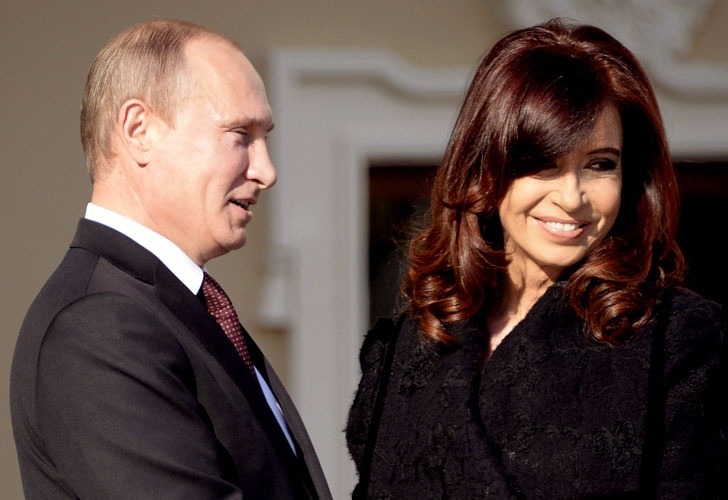
Russian President Vladimir Putin has endorsed a call by his Argentinean counterpart Cristina Fernandez de Kirchner to curb Western dominance in international politics.
Putin gave his support during a meeting with Kirchner in the Argentinean capital, Buenos Aires, on Saturday.
The Russian leader also said Moscow and Buenos Aires share a close view on international relations.
During the meeting, Kirchner emphasized that global institutions must be overhauled and made more multilateral, adding, “We firmly believe in multipolarity, in multilateralism, in a world where countries don’t have a double standard.”
In addition, the two leaders discussed military cooperation and oversaw their delegations signing a series of bilateral deals, including one on nuclear energy.
Putin’s visit to Argentina is part of his six-day tour of Latin America aimed at boosting trade and ties in the region, according to Russian state media.
The Russian leader’s trip will next take him to Brazil, where he is scheduled to attend the gathering of the economic alliance, BRICS (Brazil, Russia, India, China and South Africa), in Brazil on July 15 and 16.
Putin’s Latin American tour began on July 11 in Cuba, where he met with President Raul Castro and his brother, Fidel Castro. During his stay in the capital, Havana, Putin signed a law writing off 90 percent of Cuba’s USD 35-billion Soviet-era debt.
Following his visit to Cuba, Putin made a surprise visit to Nicaragua, where he held talks with President Daniel Ortega.
Argentina to appeal recent court ruling over AMIA case
Press TV – May 16, 2014
Argentina has vowed to appeal a decision by a federal court that rejected an agreement between the Latin American country and Iran over a joint probe into a bombing of a Buenos Aires Jewish center.
On Thursday, an Argentinean federal court struck down a 2013 agreement between the South American country and Iran to jointly investigate deadly attacks on a Jewish center in Argentina in 1994.
Alberto Nisman, a prosecutor in the investigation of the AMIA center explosion, in which 85 people were killed, had argued in his appeal to the court that the 2013 agreement constituted an “undue interference of the executive branch in the exclusive sphere of the judiciary.” The ruling by the federal court against the agreement said that it was illegal and ordered Argentina not to go ahead with it, according to the Reuters.
After the decision was announced, Argentina’s Foreign Minister Hector Timerman said that the ruling was “a mistake” and that the government will take the case to the country’s Supreme Court of Justice.
“I would like to say that the judges take stock in what their mistake means at a national level and at an international level,” Timerman said. “Regarding the decision, Argentina will appeal the mistake and, if necessary, take it to the nation’s Supreme Court of Justice,” he added.
Meanwhile, Justice Minister Julio Alak also said that a final decision was left to the Supreme Court. “The ultimate interpreter of the constitution will be the Supreme Court,” he said.
Under intense political pressure imposed by the US and Israel, Argentina formerly accused Iran of having carried out the 1994 bombing attack on the AMIA building. AMIA stands for the Asociacion Mutual Israelita Argentina or the Argentine Israelite Mutual Association.
Iran has categorically and consistently denied any involvement in the terrorist bombing.
Last January, Tehran and Buenos Aires signed a memorandum of understanding to jointly probe the 1994 bombing.
La Plata MEKOROT deal suspended
The agreement with MEKOROT in La Plata has been suspended! Now we continue, in the rest of Argentina…
Palestinian Grassroots Anti-apartheid Wall Campaign | March 7, 2014
CTA, ATE, Federación de Entidades Argentino-Palestinas (Federation of Argentinian-Palestinian Entities) and Stop the Wall announced the suspension of the shady business with Mekorot, a water treatment plant that would have fuelled Israeli apartheid in Palestine and sought to export it to La Plata in Argentina.
On January 11 2011, the governor of Buenos Aires province, Daniel Scioli, announced, after visiting Israel, that they would tender the building of a regional water treatment plant in La Plata. The contract worth US$170 million was awarded to a consortium of business conformed by the Israeli Water Company MEKOROT, ASHTROM BV (Spanish-Israeli firm) and the Argentinian “5 de Septiembre SA”, a company in which members of the Sindicato de Obras Sanitarias de Buenos Aires (SOSBA), which owns the 10% of the national and provincial Aguas de Buenos Aires (ABSA), participate.
Since 2011, Palestinian organizations, ATE-CTA unions, other civil society organizations and MPs mobilized against this contact. During more than 3 years, they informed the public about Mekorot’s criminal actions in Palestine and investigated the consequences that Mekorot would cause in Argentina.
In a joint effort, they denounced that public Argentinian money would benefit Mekorot and, through this, finance Israeli apartheid in Palestine. The accusations that Mekorot implements apartheid in Palestine are based on reports by Palestinian organizations, the United Nations, and Amnesty International.
Mekorot has been responsible for water right violations and discrimination since the 1950s, when the national water carrier was built which is diverting the Jordan river from the West Bank and Jordan to serve Israeli communities. At the same time, Mekorot deprives the Palestinian communities from access to water. The average consumption in the occupied Palestinian territories is about 70 liters per capita per day – well below the 100 liters per capita per day recommended by the World Health Organization -, while the Israeli consumption per capita per day is around 300 liters. Mekorot has refused to supply water to Palestinian communities inside Israel, despite a decision by the Supreme Court of Israel recognized their right to water. Mekorot is a proud partner of the Jewish National Fund “Blueprint Negev” plan, which will expel 40,000 Bedouin Palestinian citizens of Israel uprooting them from their homes and forcibly moving them to reserves while their lands will be used for Jewish-only settlements in the Naqab/Negev.
Mekorot’s support for illegal settlements is vital and has continued since 1967 when the company took monopoly control over all water sources in the occupied Palestinian territories and caters to the Jewish settlements to the detriment of Palestinian communities. Mekorot participates in the international crime of pillage of natural resources operating about 42 wells in the West Bank, which mostly cater to Israeli settlements. Mekorot also works closely with the Israeli army in the confiscation of irrigation pipes from Palestinian farmers and destruction of sources of water supply for Palestinian communities.
Beyond the street protests and work in the media, the more than 1000 pages of research and technical details compiled by ATE-CTA, served to substantiate questions in the provincial parliament and allow interventions in front of federal human rights organizations. In late 2012, the construction of Mekorot water plant was suspended.
The organizations insisted that Mekorot intended to export its model of discrimination, squandering of water and illegitimate profits developed in Palestine, now to the detriment of the population of Buenos Aires.
To start with, the entire bid was based on a work plan that had previously been designed by Mekorot, which expectably proposed the lowest price.
The expenditure of public money for water treatment plant and the consequent debt of the city with multinationals is unnecessary as the province of Buenos Aires has excellent aquifers. Puelches Aquifer is saturated and to stop drinking its water – as the Mekorot project envisaged – would have produced the elevation of the water table, bacterial contamination, basement flooding and damage to housing foundations. Reports from the ABSA state that the main problem of drinking water lies in the distribution network for which Mekorot wouldn’t have provided a solution.
For the installation in the region, Mekorot required an increase in water tariffs, until almost tripling the costs. The construction of the plant, also implied a further increase of service that would have exceeded 30% and would be paid by all the users in the region.
In terms of water quality, it would have been below the standards determined by the Argentine Food Code. Only part of the population would have had access to safe drinking water while poorer people would have received only tap water posing a risk to their health.
CTA, ATE, Federación de las Entidades Argentina-Palestinos and Stop the Wall thank to all social and political organizations, experts and individuals who contributed to the campaign ‘Mekorot Out of Argentina’. Together we won an important victory for justice in Palestine and the right to water! We continue to fight for our sovereignty over water, against the violence of multinationals and in solidarity with the Palestinian people for freedom, justice and the return of refugees to their homes.
We ask everyone to continue supporting the global movement of boycott, divestment and sanctions against Israel and to fight and prevent other Mekorot contracts in Argentina.
We ask everyone to join the International Week against Mekorot – from 22 to 30 March: “No to water apartheid, Yes for water justice!”
Related articles

Roger Cohen Defecates On Argentina, Gets Many Things Wrong
By Mark Weisbrot | CEPR Americas Blog | February 28, 2014
Roger Cohen, what a disappointment. He is not Tom Friedman or David Brooks, and shouldn’t be insulting an entire nation based on a clump of tired old clichés and a lack of information. Argentina is “the child among nations that never grew up” he writes, and “not a whole lot has changed” since he was there 25 years ago. OK, let’s see what we can do to clean up this mess with a shovel and broom made of data.
For Cohen, Argentina since the government defaulted on its debt has been an economic failure. Tens of millions of Argentines might beg to differ.
For the vast majority of people in Argentina, as in most countries, being able to find a job is very important. According to the database of SEDLAC (which works in partnership with the World Bank), employment as a percentage of the labor force hit peak levels in 2012, and has remained close to there since. This is shown in Figure 1.
FIGURE 1
Argentina: Employment Rate, Percent of Total Population
 Source: SEDLAC (2014).
We can also look at unemployment data from the IMF (Figure 2). Of course the current level of 7.3 percent is far below the levels reached during the depression of 1998-2002, which was caused by the failed neoliberal experiment that the Kirchners did away with – it peaked at 22.5 percent in 2002. But it is also far below the level of the boom years of that experiment (1991-1997) when it averaged more than 13 percent.
FIGURE 2
Argentina: Unemployment Rate
 Source: IMF WEO (Oct 2013).
How about poverty? Here is data from SEDLAC (Figure 3), which does not use the official Argentine government’s inflation rate but rather a higher estimate for the years after 2007. It shows a 76.3 percent drop in the poverty rate from 2002-2013, and an 85.7 percent drop in extreme poverty.
FIGURE 3
Argentina: Poverty and Extreme Poverty
 Source: SEDLAC (2014).
Most of the drop in poverty was from the very high economic growth (back to that in a minute) and consequent employment. But the government also implemented one of the biggest anti-poverty programs in Latin America, a conditional cash transfer program.
Finally, there is economic growth. In a terribly flawed article today, the Wall Street Journal reported on a soon-to-be published study showing that Argentina’s real (inflation-adjusted) GDP is 12 percent less than the official figures indicate. (As the article noted, the government, in co-operation with the IMF, implemented a new measure of inflation in January, which should resolve this data problem that has existed since 2007). If we assume that the 12 percent figure is correct, then using IMF data Argentina from 2002-2013 still has real GDP growth rate of 81 percent, or 5.6 percent annually. That is the third highest of 32 countries in the region (after Peru and Panama). And incidentally, very little of this growth was driven by a “commodities boom,” or any exports for that matter.
Despite current economic problems, the country that Cohen ridicules has done extremely well by the most important economic and social indicators, since it defaulted on most of its foreign debt and sent the IMF packing at the end of 2002. This is true by any international comparison or in comparison with its past. Many foreign corporations and the business press, as well as right-wing ideologues, are upset with Argentina’s policies for various reasons. They don’t really like any of the left governments that now govern most of South America, and Washington would like to get rid of all of them and return to the world of 20 years ago when the U.S. was in the drivers’ seat. But there’s really no reason for Roger Cohen to be jumping on this bandwagon.
Western coverage distorts Argentina’s media law
By Ramiro Funez | NACLA | January 28, 2014
Argentine President Cristina Fernández de Kirchner is currently battling allegations of corruption, and when Argentina’s Supreme Court upheld in October a media law that takes on press monopolies while promoting diversity in media ownership, journalists in the English-speaking North covered it as a blow to press freedom.
The Audiovisual Services Act, originally introduced by Kirchner in 2009, replaced the Radio Broadcasting Law of 1980, put in place by the military regime that ruled the country from 1976 to 1983. The junta used the 1980 law, which promoted the corporatization of news information, to speed up the privatization and monopolization of media in Argentina after independently reported stories undermined military rule, according to the Argentine Information Secretariat’s 1981 report, Argentine Radio: Over 60 Years on the Air
Although the return of constitutional rule in 1983 granted journalists more political freedoms, it largely ignored economic ones. Even after the collapse of the military dictatorship, the 1980 law allowed wealthy business owners, many of whom had been sympathetic to the regime and its pro-market stance, to dominate journalism in Argentina.
Clarín, founded in 1945 and today one of Argentina’s most recognized daily newspapers, fared well throughout the junta’s administration, eventually surpassing the sales of its main competitor, Papel Prensa. In 1999, the newspaper’s publisher reorganized itself as Grupo Clarín, managing to acquire over 200 newspapers and several cable systems across the country to become Argentina’s largest corporate media organization (Reuters, 10/32912). The organization currently has a market share of 47 percent and holds 158 licenses (Financial Times, 10/29/2013).
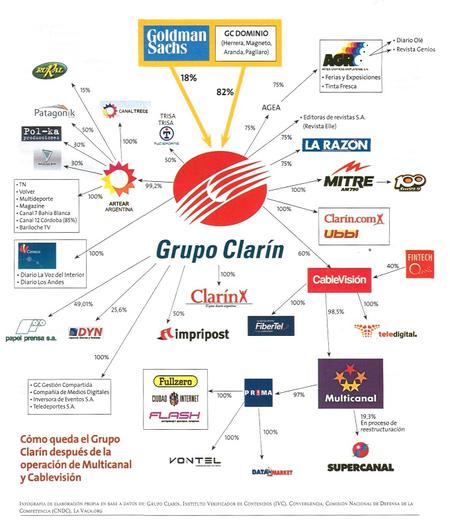
The Kirchner-backed media law places limits on the size of media conglomerates in an attempt to diversify ownership of news distribution: media companies will now be limited to a maximum of 35 percent of overall market share. The new law also imposes a national limit of 24 broadcast licenses per company, meaning the group will have to sell off dozens of operating licenses or have them auctioned by the state (Christian Science Monitor, 10/30/13).
Many Western reporters covering Argentina, however, dismiss the danger of concentrated corporate control of journalism, instead focusing on the perceived danger that government regulation of media could silence political opposition—echoing claims made by Grupo Clarín and other private conservative organizations.
U.S. news stories covering the Supreme Court’s decision to uphold the media law tended to read like press releases for Grupo Clarín, leading with the consequences it will have on the monolithic media conglomerate. That angle was an easy sell to corporate news outlets that have an interest in focusing on governmental limits on journalism without discussing the problems of a privatized, highly concentrated news market.
The Washington Post (11/1/13), for example, headlined its editorial on the topic “In Argentina, a Newspaper Under Siege,” presenting Grupo Clarín as the victim of a governmental attempt to silence opposition. “Sadly, however, Ms. Fernández and her cronies still pose a threat to the country’s democratic institutions,” the Post wrote:
That became clear Tuesday, when the Argentine Supreme Court, under heavy pressure from the president’s office, upheld a law aimed at destroying one of South America’s most important media firms, Grupo Clarín.
The company operates one of Argentina’s biggest newspapers, called Clarín, which has been one of the few media outlets to challenge Ms. Fernández’s policies. The law would force the company to auction off cable television and Internet businesses that provide most of its revenue, thus reducing potential funding for Clarín’s newsroom.
The article victimizes Grupo Clarín, giving readers the impression the Argentine government established the limits with the intentions of “destroying” the group. Yet the Post fails to mention that the United States also has a history of issuing similar outlet restrictions, like the Telecommunications Act of 1996 that placed a 35 percent limit on market ownership. Although the Federal Communications Commission (FCC) raised that limit to 45 percent in 2003 during a private reevaluation, the agency still has the power to regulate media ownership.
The Post editorial board also linked the media law to Kirchner’s attempts to nationalize major companies in other industries, including travel and energy, saying that she and her late husband, whom she succeeded as president, have sought to “concentrate power in their own hands.”
The Wall Street Journal (11/5/13) chimed in:
In the past few years, the government has shifted nearly all its public advertising money to media outlets that provide it with positive coverage—a move the Supreme Court has condemned, to little effect… Leading newspapers like Clarín and La Nación also say they are suffering from an ad boycott orchestrated by the government—an allegation the government denies.
The Journal ignores the fact that the Kirchner administration continues to direct public advertising to smaller conservative media groups within the Association of Argentine Journalism (CITE); diversified media ownership, rather than ideology or partisan affiliation, is the criterion for government subsidy. Despite the fact that there is an alleged “ad boycott orchestrated by the government,” both Grupo Clarín and La Nación continue to receive more revenue from private advertisers than any other media outlet in Argentina, according to a 2011 report published by the Comisión Nacional de Comunicaciones.
The Associated Press (11/4/13), reporting on Grupo Clarín’s recent decision to break itself up into six parts in order to comply with the law, presented the legislation as little more than a politically motivated attack on one corporation:
The licenses are essential to Clarin’s cable television networks, and synergy between the finances and news content of the group’s TV and radio stations, websites and newspaper are key to its power. Many government supporters want nothing less than Clarín’s defenestration as a viable opponent.
The Associated Press’s framing in the aforementioned article takes the side of Grupo Clarín: They write that Clarín’s unregulated licenses are “key to its power” without airing arguments against the corporate consolidation of public news information. They also make the assumption that Kirchner constituents “want nothing less than Clarín’s defenestration” without providing quotes from pro-media regulation activists in Argentina aside from government officials.
And the Miami Herald (10/23/13) published a column by Roger Noriega of the American Enterprise Institute, formerly of the George W. Bush State Department. Noriega argued that the law was aimed at “silencing the independent media” and that nothing less than “the fate of the free press” was at issue. “Of course, it is all too predictable that these divested media licenses will fall into the hands of compliant Kirchner cronies,” wrote Noriega. “This transparent tactic is lifted from the playbook of leftist caudillos in Venezuela, Ecuador, Bolivia and elsewhere.”
A quick sift through Noriega’s column reveals that his definition of “independent media” elides the dependency that media organizations like Grupo Clarín and La Nación have on funding from private corporations that have personal profit-making agendas—a dependency that forces both groups to embrace the political ideologies of their sponsors in order to maintain steady revenue. A truly “independent media” would be free of both government and corporate domination. It is also evident that his notions of a “free press” are founded upon free-market, neoliberal principles, championing corporate domination of political news coverage. His tactic of utilizing the term “free press” in correlation with unregulated, monopolized, and corporatized news media seems to hail straight from the playbook of McCarthyist lexicon, to borrow a few words from his comparison.
Overall, corporate journalistic monopolization and the concentration of news media is more of a threat to press freedom in Argentina than government regulation is. The domination of public discourse by media groups with private, corporate interests is dangerous to readers who are oftentimes unaware of the advertising revenue models of organizations like Grupo Clarín; in its obligations to maximize profits, it has strategic incentive to promote the interests of its commerical sponsors rather than the people of Argentina searching for objective news coverage.
Many Western journalists have painted Kirchner as an authoritarian leader desperate for control over news coverage in order to maintain a positive image, without realizing that in modern times, media ownership is just as influential as government suppression of speech. While many conservative Argentines have blindly sided with groups like Grupo Clarín in criticizing the government’s large advertising presence in news organizations that are friendly with the incumbent administration, they have failed to recognize that there is a difference in advertising intentions and content between the Kirchner administration and private corporations: the former publicizes information about social welfare programs available to citizens, while the latter promotes products whose profits benefit the small percentage of Argentines who have seemingly little at stake in quality social programming.
The Supreme Court of Argentina and the Kirchner administration have recognized that progressive interpretations of freedom of speech include democratic and popular control over mass information and national discourse. They have also recognized the need for public diversity in media ownership that fosters economic freedoms within journalism, allowing any citizen, regardless of ideology and economic background, to have just as amplified of an opinion as a corporate news organization does—all without violating political rights.
Organizations that have claimed otherwise, or that echo the cries of victimization made by Grupo Clarín, fail to analyze alternative qualities of freedom of speech.
Ramiro S. Fúnez is a Honduran-American political journalist and activist earning his master’s degree in politics at New York University. Follow him on Twitter at @RamiroSFunez.
Related article

Argentina to summon Israeli ex-envoy over AMIA comments
Press TV – January 4, 2014
Argentina is to summon former Israeli envoy to Buenos Aires to explain his recent comments that the Tel Aviv regime has killed most of the perpetrators behind the bombing of the AMIA Jewish community center in the Latin American country in the 1990s.
In an interview with Buenos Aires-based Jewish News Agency (Agencia Judía de Noticias) on Thursday, Itzhak Aviran, who was the Israeli ambassador to Argentina from 1993 to 2000, said Israeli security agents operating abroad have “killed most of those who had carried out the attacks.” Aviran also accused the Argentinean government of not doing enough “to get to the bottom” of the incident.
AMIA case special prosecutor Alberto Nisman said on Friday that “I am surprised at his statements. I have ordered a testimonial statement. I would like to know how he is sure about it, who were these people and which proof he has.”
“What he is saying is that the perpetrators of the attacks are identified by name and surname,” Nisman said, adding that the process to query the Israeli ex-envoy should not take longer “than a month, or a month and half.”
Israel has dismissed Aviran’s comments as “complete nonsense.”
Under intense political pressure imposed by the US and Israel, Argentina formally accused Iran of having carried out the 1994 bombing attack on the AMIA building that killed 85 people.
AMIA stands for the Asociacion Mutual Israelita Argentina or the Argentine Israeli Mutual Association.
The Islamic Republic has categorically and consistently denied any involvement in the terrorist bombing.
Tehran and Buenos Aires signed a memorandum of understanding in January, 2013, to jointly probe the 1994 bombing.
The Israeli regime reacted angrily to the deal a day after it was signed. “We are stunned by this news item and we will want to receive from the Argentine government a complete picture as to what was agreed upon because this entire affair affects Israel directly,” Israeli Foreign Ministry spokesperson Yigal Palmor said on January 28.
On January 30, however, Argentina said Israel’s demand for explanation over the “historic” agreement is an “improper action that is strongly rejected.”
Beyond the Military: Investigating the Civilian Role in the Argentine Dictatorship
By Tess Bennett | The Argentina Independent | December 17, 2013
Last Friday, after 13 months and 400 witness testimonies, the mega-lawsuit in Federal Court of Tucumán found 37 of 41 defendants guilty of crimes against humanity during the 1976-83 dictatorship in Argentina. In the historic trial, known as Jefatura II-Arsenales II, four civilians were among the accused: two were pardoned and two were convicted for their involvement in the dictatorship.
María Elena Guerra, a civilian and ex-police officer, and Guillermo Francisco Lopez Guerrero, a civil intelligence agent, joined a select few civilians who have been found guilty of crimes committed during the brutal seven-year military regime, in which some 30,000 people were kidnapped and killed or ‘disappeared’.
Since the trials were reopened in 2003, hundreds of members of the military have been sentenced to prison for crimes committed during the dictatorship. However, it was only in December last year that James Smart, a former government minister of the Province of Buenos Aires, became the first civilian to be convicted of crimes against humanity committed during the dictatorship. He was sentenced to life in prison for crimes committed in six clandesine detention centres.
These landmark rulings demonstrate how, after 30 years of democratic rule, the way Argentines, politicians, and the legal system examine crimes from this period has evolved, with the focus turning more recently to the role of businesses and civilians in the human rights atrocities of that period.
Human rights groups have long used the term ‘civic-military dictatorship’ to acknowledge the complicity and support of some civilian sectors. But the title has become increasingly common in recent years under the Cristina Fernández de Kirchner administration, opening the door for a number of emblematic trials investigating the role of these civilians, with the aim of bringing the impunity of the powerful to an end.
Causes of the Coup: A New Economic Model
Human rights groups argue that economic motives were behind the 24th March 1976 coup, saying it can no longer be argued that the objective was only to combat “subversion”. They believe so-called “captains of industry” collaborated with military leaders to perpetrate crimes against humanity for economic gain.
Last week, Banco de la Nación Argentina officially recognised Roberto Hugo Barrera as the 31st employee still missing – disappeared – after being kidnapped during the dictatorship. The institution has been an important player in the drive to highlight the economic motives behind the so-called ‘National Reorganisation Process’ implemented by the military junta.
Graciela Navarro, President of the Commission of the Banco de la Nación Personnel for Memory, Truth and Justice told The Argentina Independent that when identifying what occurred in 1976, it is first important to understand that there was no “war.”
“There were operations of some armed groups, but these were isolated. There was never a war here. It was always state terrorism,” she said, alluding to the still oft-used term ‘Dirty War’ by foreign press.
According to Navarro, certain civilian sectors used the military to implement a neo-liberal economic model. “It was necessary to implement an economic model of exclusion to benefit economic groups that utilised the Armed Forces as a instrument of social discipline – for repression, for fear, to deal with any resistance movement.
“The true causes of the coup were economic, because of this we say civic-military dictatorship,” she added.
Marta Santos, a former Central Bank employee and friend of one of the five known desaparecidos (missing) who worked at the institution, echoes this view.
“This dictatorship, this military force, needed the support of civilians in key parts of the state and in the private economy… In this sense we say that dictatorship was civic-military because it pursued neo-liberal economic interests of private [business] and the state,” says Santos, who today is part of a team working with the Central Bank to investigate if there are more unknown desaparecidos who worked there.
Civilians in Government
Santos says it is important to denounce civilian collusion with the military junta in the defence of democracy, to ensure these institutions can never again prop up a dictatorship. She names José Alfredo Martínez de Hoz as the prime example of civilian involvement.
Former president of the steel company Acindar – which operated one of the country’s first clandestine torture and detention centres on its premises in 1975 – Martínez de Hoz was economy minister from 1976 to 1981, in charge of ushering in a new economic paradigm based on the principles of neo-liberalism. During this period, it was common for businessmen close to the economy minister to assume key government roles, helping to fuse civil society to the military junta. His policies sowed the seeds for financial collapse, providing a brief period of prosperity but leading to a deep recession in 1981 and saddling the nation with a burdensome external debt that would cause problems long after the return to democracy.

José Martínez de Hoz – 1976
Martínez de Hoz was under house arrest when he died in March this year, being investigated for his alleged role in the kidnap of father and son, Federico and Miguel Gutheim. The family owned the cotton export company Sadeco, and were allegedly coerced into making business deals that favoured the dictatorship.
He was also linked to the kidnap of René Carlos Alberto Grassi, director de Industrias Siderúrgicas Grassi (a rival company of Acindar) and president of the Bank of Hurlingham, in September 1978. Grassi was held in Campo de Mayo for a year after his abduction, and eventually Industrias Siderúrgicas Grassi was absorbed by Acindar. One month before the abduction, Martínez de Hoz had asked to buy the Bank of Hurlingham and was declined.
From the early days of the dictatorship there was a strong repression of workers, but the kidnap of Grassi was significant; he did not pose a threat as an opposition force to the regime, his value was economic.
Martínez de Hoz was pardoned by Menem in 1990, though this was annulled 16 years later when the Gutheim case was reopened. Up until his death, he denied any involvement in the kidnappings and was a remorseless defender of the dictatorship-era economic policies.
The investigation of Martínez de Hoz is an early example of a civilian investigated for abuses committed during the reign of the military junta. In recent years, many more legal battles concerning civilian’s roles in the dictatorship have come to the surface.
Thirty Years of Reconstruction
Horacio Verbitsky, president of CELS and co-author of the 2013 book ‘Cuentas pendientes: los cómplices económicos de la dictadura’, which examines the links between economic powers and state repression, argues the economic influence of civilians who were complicit in the dictatorship continued throughout the first two decades of democracy. Verbitsky argues that economic powers could have endangered the stability of democracy, which limited the possibility of pursuing justice for their responsibility during the dictatorship.
Argentina’s first president after the return of democracy, Raúl Alfonsín, had the complex task of addressing human rights abuses in the face of a weak economy and massive external debt, which had ballooned from US$7.87bn in 1975 to US$43bn in 1982.
“It is not easy to build democracy in a setting where political culture and civic habits have been degraded by authoritarianism. Nor is it easy to build democracy in the midst of a deep economic crisis exacerbated by the need to repay a huge foreign debt that the old dictatorial regime had contracted and irresponsibly misspent,” Alfonsín said in 1992, after his term had ended prematurely in 1989.

Videla and other military chiefs are found guilty of crimes against humanity in 1985.
The neo-liberal economic paradigm that dominated the nineties – a time that corresponded with the amnesty offered to those responsible in the dictatorship – deepened the economic model launched in 1976, taking it to the economic and political crisis of 2001.
Graciela Navarro believes that since Nestor Kirchner took office in 2003 there have been two distinct periods relating to the last civic-military dictatorship, the first being the recovery of the memory of those who had been tortured or disappeared, and the end of impunity for military leaders. “When Cristina was elected,” Navarro believes, “it was possible to begin to examine the true causes of the coup, which were economic, and charge those who are responsible.
“The military has been judged,” adds Navarro, “but many civilians, if not them then their children, are owners of the large economic groups… this is difficult. These are the interests that Cristina is dealing with.”
Pending Cases
After years of impunity, Argentina’s legal system has begun to investigate the role of officials, powerful businessmen, and mulitnationals who may have collaborated with the military in state terrorism. According to the Centre for Legal and Social Studies (CELS), as of September 2013 there were a total of 261 civilians accused of involvement in the human rights abuses of the era.
Several high profile and emblematic cases involving civilians, and their business interests, are currently making their way through the legal system.
Papel Prensa: On 2nd November, 1976, three newspapers – Clarín, La Nación, and La Razón – obtained the majority shares in Papel Prensa, the company which produces newsprint for the industry, soon after owner, businessman and banker David Graiver, died in a plane crash in Mexico in August 1976. Graiver’s widow, Lidia Papaleo testified in 2010 that at that time she was stripped of the factory after receiving death threats against her and her young daughter. In March 1977, Papaleo was abducted and tortured until she was released on July 24, 1982.
The case concerning the sale of Papel Prensa was opened in August 2010 after President Fernández presented a report in the Casa Rosada titled “Papel Prensa: The Truth” denouncing the “illegal appropriation” of the business. Most recently, the case has been in the headlines after the discovery of official minutes from the dictatorship that mention Papel Prensa 13 times between September 1976 and November 1977.
According to Defence Minister Agustín Rossi, the minutes make it “clear that for the Junta, Papel Prensa was a part of the same theme as the detention of [ex-owners] the Graiver family… this appears clearly in the minutes.” Copies of the documents are now in the hands of Federal Judge Julián Ercolini, who has jurisdiction over the case.
Ledesma: Also working its way through the legal system is a case involving president of sugar company Ledesma, one of Argentina’s most powerful businesses, for his involvement in kidnappings during the ‘blackout night’, when over 400 people were kidnapped in the province of Jujuy following an electricity outage on 20th July, 1976.
President of Ledesma Carlos Blaquier and former general manager Alberto Lemos are accused of providing the vehicles that were used for transporting the victims. This month, the Federal Court of Salta confirmed that there is sufficient evidence that the company Ledesma collaborated in the kidnapping of their workers to dismantle the labour union. As a result, Blaquier and Lemos will be put on trial, which is set to begin in April 2014. The court upheld that Blaquier will be prosecuted as a “necessary participant” in twenty cases of illegal deprivation of liberty and Lemos is accused of being a “secondary participant” to the kidnappings.
Ford: During the dictatorship, the Ford Falcon became known as a vehicle commonly used by kidnappers. But the company is also accused of more direct involvement in the human rights abuses of the time.
In May, charges were laid against three ex-directors of Ford Motors Argentina for their role in the disappearance of 24 workers from the plant. Former plant manager Pedro Müller, ex-leader of labour relations Guillermo Galarraga, and ex-security chief Héctor Sibilla are accused of having given to military commanders in the area “personal data, photographs, and addresses” of workers at the factory between 24th March and 20th August, 1976.
The three men are also accused of having allowed the military to use the factory as a detention centre where they carried out the interrogation of the workers. According to Judge Alicia Vence, the workers were “tied up with their faces covered and beaten.”
Although 24 workers survived the kidnapping and torture, only twelve are still alive today. The formal legal process began in 2001 but the first reports of the events date back to 1984.
Mercedes Benz: The families of 17 workers from the Mercedes Benz plant who were kidnapped and tortured have bought a civil case against the parent company of the car maker, Daimler Chrysler, in the US. Mercedes-Benz Argentina is alleged to have identified workers who were kidnapped and sent to the clandestine torture centre, Campo de Mayo, during the dictatorship.
The investigation began in 2004 and has been rejected by US courts on previous occasions, with the US Supreme Court currently determining if the case falls under its jurisdiction. A decision is expected in the coming months on whether multinational corporations can be sued in US courts for alleged human rights abuses abroad.
In Argentina, the lawsuit for kidnapping and torture of the 17 workers, 14 of whom are still missing, was initiated by journalist Gabriela Weber in 2002 and in 2006 was transferred to Federal Court in San Martín under the charge of Judge Alicia Vence. So far no one has been formally charged or arrested.
The car maker is also accused of the appropriation of three children, and the adoption and substitution of identity of Paula Logares, the first grandchildren reclaimed by the Abuelas de Plaza de Mayo in 1987.
Latin America’s Anti-Intervention Bloc
In Latin America, opposition to military intervention in Syria reflects the wariness of a region long beset with U.S. interventions of its own
By W. Alex Sanchez | Foreign Policy In Focus | October 4, 2013

Argentine President Cristina Kirchner with Ecuadoran President Rafael Correa. (Presidencia de la República del Ecuador / Flickr)
As political attention has shifted from a potential U.S. military strike against Syria to a potential agreement on the dismantling of Syria’s chemical weapons arbitrated by Russia, all eyes are on the United States, the Middle East, and key actors in Europe.
But what has been the reaction in other parts of the world?
In Latin America at least, which holds two rotating seats on the UN Security Council, the reaction reflects the wariness of a region long beset with U.S. interventions of its own.
By and large, Latin American nations have opposed a military operation against Damascus. Regional blocs like the Union of South American Nations (UNASUR) and the Caribbean Community (CARICOM) have passed resolutions calling for negotiations and a cessation of hostilities.
A leading opponent of the “military option” is Argentina, which along with Guatemala currently represents the region at the Security Council.
Throughout the years of conflict in Syria, Argentina has maintained an anti-intervention and anti-military approach regarding the international community’s involvement. Specifically, the Argentine government has pushed for dialogue between the warring parties within Syria. Hector Timerman, the Argentine minister of foreign affairs, notes that his country has proposed initiatives such as “a weapons embargo, humanitarian assistance, and an emergency meeting of the General Assembly” to address the ongoing violence.
Allegations that the Syrian government used chemical weapons against civilians did not sway Buenos Aires’ stance. In August, Timerman declared that “Argentina will never propose or support a foreign military intervention. The Argentine people will not be complicit in new deaths.” An August communiqué released by his ministry emphasized that “for the Republic of Argentina, the conditions are not present for a foreign military intervention since in spite of the time that has passed and the hundreds of thousands of victims, all the mechanisms established by international law have not been utilized.”
In early September, Argentine President Cristina Fernandez de Kirchner met with UN Secretary General Ban Ki-Moon during the G-20 summit in Saint Petersburg, Russia. She reportedly proposed to the UN leader that the chancellors of the 15 member states on the Security Council travel to Syria to see if a ceasefire could be achieved. At the time of this writing, no further development has been reported on this proposal.
Argentina’s opposition to military intervention in Syria fits with its previous history of keeping out of foreign conflicts. Ariel Gonzalez Levaggi, executive director of the Centro Argentino de Estudios Internacionales (CAEI), a foreign policy think tank in Buenos Aires, explained that “Argentina has a tradition of neutrality that was modified in the 1990s but has continued during the era of Kirchner rule. The Argentine government was against the invasion of Iraq, the attack against Libya, and now Syria.”
It is worth noting that some Syrian expatriates in Argentina occupy positions in governmental offices. The extent to which this Syrian community is influential enough to affect Argentine foreign policy is under debate. In early September around 50 members of the Syrian community in Buenos Aires protested against U.S. military intervention outside the Syrian embassy.
Some Argentine analysts have declared that escalating the war in Syria could have detrimental effects for Argentina, particularly in terms of energy. In a September 7 article published in the Argentine daily La Nación, experts explained that an expanded war could increase the price of oil, which would hurt the South American state’s already dire economy. One analyst explained how, since 2009, Argentine exports to the Arab world have grown by 20 percent, and prolonged warfare could hurt Arab countries’ demand for Argentine exports.
Argentina’s anti-intervention stance is in line with the positions of most other South American governments. At a UNASUR summit in Suriname on August 30, they signed a declaration condemning “external interventions” in Syria and calling for a peaceful resolution to the conflict. CARICOM’s Secretariat passed a similar resolution in early September, condemning the use of chemical weapons in Syria but also urging the international community not to engage in military actions against the Assad regime.
Not all Latin American nations share this view, however. Guatemala, which holds the region’s other Security Council seat, has openly expressed its support for U.S. intervention in Syria. “We clearly and definitely support the decision that the U.S. president has taken so that chemical weapons, which cause mass deaths, will not be utilized again,” said President Otto Perez Molina on September 1. “That is Guatemala’s position.”
It is unsurprising that Guatemala is siding with Washington, as the country’s government has long had close relations with the United States. Guatemala receives significant amounts of aid from Washington ($110 million in 2011 and an estimated $95 million in 2012) and wants to see this kind of assistance continue. Agreeing with Washington’s foreign policy decisions is an easy way for the country’s right-wing government to maintain ties based on security initiatives (like Operación Martillo) and trade (CAFTA).
As a representative on the UNSC, therefore, Argentina has been accurately reflecting the stance against military intervention held by other South American and Caribbean governments. This fits with the country’s drive to forge a regional politics more independent of Washington. Guatemala’s stance, by contrast, harkens back to an earlier era when Washington’s dictates largely set the tone for the hemisphere.
Nevertheless, the final point that needs to be addressed is whether Argentina, or even a united South America and Caribbean, have had any relevance in the decision making process in Washington, Beijing, London, Paris, or Moscow regarding intervention in Syria. The short answer is no.
In Syria, Buenos Aires, Lima, Montevideo, and Kingston have had little influence (or none at all) in what the powers-that-be have decided. While the aversion of Western military strikes on Syria may be considered a relief, the way it was achieved exemplifies how little weight agencies like the United Nations—and particularly the non-permanent members of the Security Council and the Global South in general—continue to have in global security affairs.
W. Alejandro Sanchez is a Senior Research Fellow at the Council on Hemispheric Affairs. Follow Alejandro via Twitter.
Related article
Featured Video

Michael von der Schulenburg: Europe’s Self-Defeating Iran War Policy
or go to
Aletho News Archives – Video-Images
Frlom the Archives
Provoking a Path to Persia
The Saban Center’s prescient paper on war with Iran
By Maidhc Ó Cathail | October 20, 2011
In June 2009, the Saban Center for Middle East Policy published “Which Path to Persia?—Options for a New American Strategy toward Iran.” Writing in a tone strikingly reminiscent of the Project for a New American Century’s infamous pre-9/11 paper “Rebuilding America’s Defenses,” the six co-authors noted that, “It seems highly unlikely that the United States would mount an invasion without any provocation or other buildup.” For a think tank specifically established by media mogul Haim Saban to protect Israel, this could prove to be a formidable obstacle impeding their desired march—of U.S. troops—to Tehran.
“In fact, if the United States were to decide that to garner greater international support, galvanize U.S. domestic support, and/or provide a legal justification for an invasion, it would be best to wait for an Iranian provocation, then the time frame for an invasion might stretch out indefinitely,” Saban’s think-tankers ruefully observed.
“With only one real exception, since the 1978 revolution, the Islamic Republic has never willingly provoked an American military response, although it certainly has taken actions that could have done so if Washington had been looking for a fight. Thus it is not impossible that Tehran might take some action that would justify an American invasion. And it is certainly the case that if Washington sought such a provocation, it could take actions that might make it more likely that Tehran would do so (although being too obvious about this could nullify the provocation). However, since it would be up to Iran to make the provocative move, which Iran has been wary of doing most times in the past, the United States would never know for sure when it would get the requisite Iranian provocation. In fact, it might never come at all.”
Seemingly undeterred by Iran’s frustrating unwillingness to provide the requisite provocation, the analysts continued to examine this option… continue
Blog Roll
 Aletho News
- Iran attacks on UAE leaves RSF militia high and dry
- Hosting Washington’s war: Bahrain faces the consequences
- The US fell for its own Iran propaganda
- Seyed M. Marandi: Threat of Seizing Kharg Island & the Use of Nuclear Weapons
- Is there even an off ramp?
- Michael von der Schulenburg: Europe’s Self-Defeating Iran War Policy
- Sorry, The New Republic, Climate Change Isn’t Causing Somali Migration. Blame Civil Strife and Poverty.
- Expert Guts Claims That HPV Vaccine Reduces Cancer Risk
- No evidence Russia sabotaged Baltic cables – Finnish intel
- The Strategic Folly of a (Serious) US Ground Invasion of Iran
- If Americans Knew
- 6 more Americans killed, as Israel ‘mows the lawn’ in Iran – Not a ceasefire Day 154
- Are we on the precipice of World War III?
- ‘Catastrophic,’ Says UNICEF: 1,100+ Children Killed or Wounded in Mideast Since US-Israel Launched Iran War
- The Unbelievable Madness of Our War With Iran
- World Council of Churches calls on govts to hold Israel accountable for violations of intl law
- How to end the war on Iran that costs US taxpayers $1M per minute – Not a ceasefire Day 153
- Israeli strategic plans to “remake the Middle East” from the 1950s and since
- Honoring Gaza’s women who refused to let the world look away
- 97% of victims of war on Iran are Iranian, 98% of victims in war on Gaza are Gazans – Not a ceasefire Day 152
- Early Iran strikes cost $5.6 billion in munitions, Pentagon estimates
- No Tricks Zone
- New Studies: UK Sea Levels Were 4 Meters Higher Than Today During The Mid-Holocene
- Destructive Green New Deal: German Energy And Metal Group Warns Of Drastic Crisis
- New Study Documents A 20-Year Pause In Arctic Sea Ice Decline – Driven By Internal Variability
- Wake-up Call: Survey Shows Majority Of Germans Now Favor Postponing Climate Targets!
- Televised! Leading German Political Candidate Tells Schoolchildren CO2 Makes Sun Hotter!
- New Study: A Century Warming Of 1.1°C Is ‘Commonplace’ And ‘Not Unusual’ During This Interglacial
- New Study: ‘Internal Noise’ And Volcanic Forcing Can Trigger 10-15°C Warming Within Decades
- Glaciers Worldwide Are Suddendly Surging, Experts Blame Warming!
- Surprising Discovery: Sahara Is Greening…Billions Of Trees Where Once Thought To Be Barren
- New Research Reaffirms Clouds, Aerosols, And Surface Solar Radiation Are ‘Driving The Climate System’
 Aletho News