Argentine State Workers Join National Strike Against Macri
teleSUR – February 24, 2016
Argentine public sector workers will converge in front of the presidential palace Wednesday as part of a national strike to protest the policies of President Mauricio Macri.
Macri has fired approximately 10,000 state workers since the beginning of 2016, with even more layoffs expected in the coming months as government ministries continue to review contracts.
Wednesday’s national strike is being organized by the Association of State Workers, known as ATE, together with the Argentine Workers Union.
ATE President Hugo Godoy added that there would be marches and demonstrations in provincial capitals as well.
President Macri is ideologically disposed to reducing the public sector, arguing that private investment should be the source of new employment.
During an event where he announced the elimination of retention taxes on mining, Macri said the public sector employment generated during the previous five years, under the administration of his predecessor, was “unnecessary” and a product of “clientelism.”
Vice-President Gabriela Michetti has accused public sector workers of being “Kirchner militants,” referring to the supporters of the governments of the late Nestor Kirchner and his successor and wife, Cristina Fernandez de Kirchner.
Wednesday’s demonstrations will be an opportunity to observe the reaction of state security forces in light of a new security protocol implemented by the Macri government, which now allows police to break up protests.
Critics have said the security protocol opens the door to criminalization and repression of protest.
Son of Argentine Indigenous Leader Charged for ‘Threats’
Activist Sergio Chorolque was hit with charges just days after his mother was ordered to remain behind bars

Human rights advocates that support Chorolque have alleged the charges are motivated by him and his mother’s activism. | Photo: Diario Veloz
teleSUR – January 31, 2016
The son of a prominent Argentine indigenous activist was charged Saturday on allegations his advocates say are politically motivated.
Sergio Chorolque is accused of issuing death threats to a municipal worker, and could face up to two years imprisonment.
Human rights advocates that support Chorolque have alleged the charges are motivated by his and his mother’s activism.
Chorolque’s mother Milagro Sala has already been described by some human rights activists as the first political prisoner of the new government of President Mauricio Macri.
The well-known indigenous leader, founder of the 70,000 member Tupac Amaru organization, was arrested on January 16 in the Jujuy on charges of inciting violence after protesting in a month-long sit in against Governor Gerardo Morales, who ordered her arrest.
A judge cleared Sala of those charges on Friday, but before she walked out of jail she was handed down a new set of accusations and ordered to stay behind bars while investigations into charges of “illicit association, fraud, and extortion” are launched at the request of the Jujuy government, local media reported.
As authorities peg various charges on the popular social leader, now one of Sala’s children has been charged with leveling death threats against a labor activist.
According to the conservative Argentine newspaper La Nacion, Morales has had a tense and “estranged” relationship with Sala for years. Morales has also had an antagonistic relationship with the social organizations and collectives with which Sala is aligned. Before her arrest, Sala was protesting in support of various organizations at risk of losing their legal status and social benefits after Morales threatened to suspend them via decree.
Thousands Demand Freedom for Argentine Leader Milagro Sala

teleSUR | January 27, 2016
Milagro Sala was jailed 11 days ago for speaking out against President Mauricio Macri, sparking a wave of protests against criminalization of dissent.
Thousands of Argentines gathered in Buenos Aires’ central Plaza de Mayo Wednesday to protest the criminalization of social protest and demand freedom for Milagro Sala, a dissident lawmaker and Indigenous leader jailed for speaking out against President Mauricio Macri.
The protests come as Sala has been in prison for 11 days after being arrested in Argentina’s Jujuy province at the orders of Governor Gerardo Morales for criticizing the policies of Macri’s government. Outraged social movements have slammed the arrest as illegitimate and have vowed to continue protesting until the prolific social leader is free.
“For me personally she is an example of struggle, of life, of continuity of the defence of territories, defense of the people, defense of those who have less, building social inclusion—that’s what Milagro Sala is to me,” a demonstrator told teleSUR at the rally. “I demand freedom for Milagro Sala now!”
According to teleSUR correspondent Leo Poblete Codutti in Buenos Aires, the protest was a show of rage over the increase in criminalization of social protest in Argentina in recent weeks since Macri came to power.
During the demonstration, a documentary telling the story of Sala’s life and social struggles was shown in a tent set up in the middle of the protest.
Sala founded the Tupac Amaru organization based on the ideology of three important historical figures in Argentina: South American Indigenous liberator Tupac Amaru, revolutionary Che Guevara, and former First Lady Eva Peron. The 70,000 member-strong organization works on a number of political issues and with Indigenous communities.
Prior to her arrest, Sala had been participating in a sit-in, camping outside local government offices for over a month in support of various social organizations at risk of losing their legal status and social benefits after Governor Morales threatened to suspend them via decree.
According to Carolina Gairard, Argentine lawmaker with the Front for Victory, Sala’s arrest was illegitimate and illegal.
“She is the first political prisoner of Mauricio Macri,” Gairard told teleSUR during the CELAC Summit in Quito, Ecuador, on Tuesday. “And we hope she will be the last.”
Argentina’s New President Won’t Seek to Revive Deal with Iran
teleSUR | December 12, 2015
Argentina’s newly elected President Mauricio Macri will not appeal a court’s decision to strike down a deal with Iran over investigating a deadly 1994 bombing of a Buenos Aires Jewish community center, Reuters reported on Friday.
Former leader Cristina Fernandez had said she would appeal the ruling last year voiding the agreement she signed with Iran in 2013 to investigate the country’s suspected role in the bombing.
The memorandum would have launched a joint “truth commission” comprised of five independent judges from third-party countries to investigate the bombing. It would also have allowed for Iranian suspects in the case to be questioned.
Tehran denies any responsibility in the attack that killed 85. No one has yet been found responsible or tried in court over the incident.
Earlier this year, in April, a bill to compensate the victims was passed by parliament, after receiving unanimous approval from the Argentine senate. The legislation provides a one-time compensation of US$170,000 for the relatives of those killed in the attack. The hundreds who suffered “extremely grievous” injuries will receive 70 percent of that amount, while those who suffered “grievous” injuries will receive 60 percent of that amount, according to the Jerusalem Post.
The bombing of the AMIA Jewish center made headlines recently after the mysterious death of Federal Attorney Alberto Nisman who was investigating the case. The Argentine opposition has used his death to try to implicate Kirchner’s government, even though it was not in power in 1994.
5 Acts of Latin American Solidarity with Palestine
teleSUR – November 27, 2015
 As the world commemorates the United Nations’ International Day for Solidarity with Palestinians, it is important to remember that many countries in Latin America have been some of the most vocal supporters of Palestine and its people.
On several occasions Palestinian officials have expressed their gratitude to Latin American countries for their support, which at times is larger than support from neighboring Arab nations.
This support is translated through opening borders for Palestinian refugees and students, hosting high-level officials from Palestine as well as continually condemning the harsh treatment of Israel towards the Palestinian people through occupation, human rights violations, settlement construction and open discrimination against Palestinian citizens of Israel.
Last year, Palestinian Ambassador to Caracas Linda Sobeh Ali speaking to Venezuela’s President Nicolas Maduro said: “You and the people of Latin America have shown us more support than some of our Arab brothers. Thank you.”
1 – Syrian and Palestinian refugees welcomed by Argentina
In September 2015, Argentina government announced that Syrian and Palestinian refugees were welcome into the country at a time when European nations were militarizing its borders to deter entry to thousands of people fleeing the war-torn country. Refugees would receive a two-year residence permit as soon as they arrive into the country.
2 – Latin America united in support for Palestinians during Israel’s war on Gaza
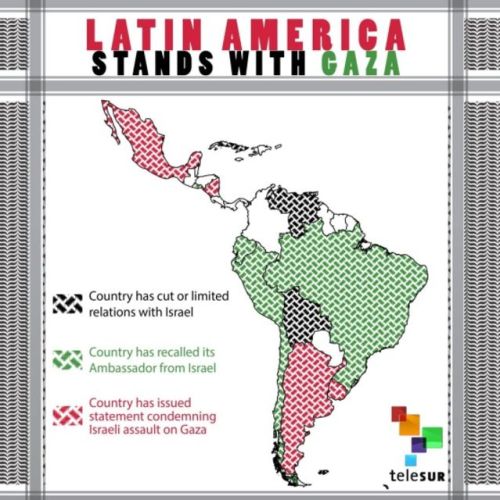
In August, Latin American leaders harshly condemned the Israeli government over its 50-day war against Gaza in summer 2014, including Rafael Correa of Ecuador, Nicolas Maduro of Venezuela, and Evo Morales of Bolivia. Several countries in the region downgraded relations with Israel, while others recalled ambassadors.
3 – Venezuela hosts congress on Palestinian Right of Return April 2015
In April 2015 Venezuela hosted the first Latin American Congress of the Global Campaign to Return to Palestine, being held until Friday in the capital of Caracas. The campaign was founded two years ago as an effort to coordinate the work of Palestinian solidarity activists at a global level. It gives particular attention to demand for the right-of-return of Palestinians who were forcibly displaced by militant Zionists during the foundation of the state of Israel.
4 – Chile hosts PLO official in a 5-day visit to strengthen ties with Palestine
In August 2015, Palestinian Liberation Organization official Saeb Erekat took a five-day visit to Chile where he visited the Arab School in Santiago, met with Chilean President Michelle Bachelet, the foreign minister, as well as representatives of the Jewish community in Chile. Chile is home to more than 400,000 Palestinians and Palestinian descendants.
5 – A ‘Song for Palestine’ solidarity event in Ecuador
In July 2014, social organizations of Ecuador convened on to present “A song for Palestine”, an expression of solidarity with the Palestinian people in the face of attacks by the Israeli Defense Force against the Palestinian people in Gaza.

Argentina: Mauricio Macri’s Dubious Dictatorship Ties
teleSUR English | November 23, 2015
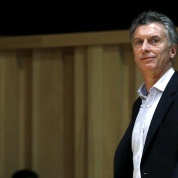 The election of Mauricio Macri in Argentina’s presidential race comes as a welcome victory to the country’s business elite and right-wing parties across Latin America, but the president-elect has some dubious ties that could signal a lasting legacy in the new head of state of darker times in Argentina.
Macri has been particularly criticized for his indirect ties to the last military dictatorship in Argentina in the late 1970s and early 1980s that cracked down on left-wing activists and political opposition.
While many of Macri’s powerful economic backers and corporate allies propped up the dictatorship that benefited them economically, Macri’s closest ties to the dictatorship are through his own family business Macri Society, known as Socma.
Macri, a long-time business magnate and former mayor of Buenos Aires, has been a director of his father’s Socma corporate conglomerate since a young age. The Macris are one of Argentina’s wealthiest families, and Socma was among the companies that directly benefited from the dictatorship.
In 1973, prior to the 1976 military coup that ousted the civilian Peronist government of President Maria Estela de Peron and installed a dictatorship, Socma owned seven companies. When the dictatorship ended 10 years later, in 1983, the Socma corporate empire had expanded to 46 companies.
Among Socma’s dozens of companies were various businesses that benefited the Macri family economically by providing services to the dictatorship regime, such as the solid waste management company Manliba, privatized under the dictatorship in 1979, and the postal company Correo Argentino, later nationalized in 2003 under former President Nestor Kirchner.
Macri also showed his sympathies for corporate complicity in dictatorship-era abuses earlier this year when he and his party opposed a government move to end impunity for dictatorship supporters.
Argentina’s Parliament decided in September to launch an investigation into how people and businesses participated in crimes committed by the 1976-1983 dictatorship. While the vote passed by a wide margin of 170-14, Macri and his Republican Proposal Party made up the minority of lawmakers opposing the bill.
The U.S.-backed Dirty War disappeared between 7,000 and 30,000 people in Argentina under the dictatorship regime.
Argentina’s right-wing newspaper La Nacion, which supported the dictatorship, hailed Macri’s election as signalling an end to “revenge” for the dictatorship years.
“The desire for revenge should be buried once and for all,” a La Nacion editorial said on Monday following Macri’s victory. The editorial referred the end to a “culture of revenge” under the governments of Nestor Kirchner and Cristina Fernandez in reference to their efforts to seek truth and justice for dictatorship-era crimes, including Kirchner’s 2003 repeal of amnesty laws for crimes against humanity.
Macri’s election marks the first victory for the country’s right-wing business elite through electoral means rather than military coup. He will be the third non-Peronist head of state in the more than three decades since the end of the dictatorship.
Right-Wing Alliances in Latin America
While corporate elites and dictatorship-supporters celebrate Macri’s election in Argentina, right-wing organizations across Latin America also welcome his victory as a win for their neoliberal political project in the region.
Macri has already made his foreign policy plans clear, vowing to reshape international ties to strengthen relations with the United States and European Union while requesting that Venezuela be suspended from the South American regional bloc Mercosur.
Macri’s relationship with the United States has been demonstrated in leaked diplomatic cables, published by WikiLeaks, in which he accused the U.S. of being “too soft” on the Kirchner governments and called on the U.S. to crack down on Cristina Fernandez de Kirchner.
Macri’s stance against the Venezuelan government was also clearly solidified when Lilian Tintori, wife of Venezuelan opposition leader Leopoldo Lopez, took to the stage with Macri during his victory celebration on Sunday night. Tintori hailed Macri’s win as the start of “political change in Latin America and Venezuela’s opposition was “delighted” by Macri’s win, Reuters reported.
Many of Macri’s supporters are those who hope to reinvigorate neoliberal free trade politics in Latin America and roll back the regional integration projects launched by former Venezuelan President Hugo Chavez.
For example, the Argentine think tank Thinking Foundation, focused on developing projects and strategies to get Macri’s party elected, has collaborated with the Spanish FAES Foundation, which promotes neoliberal politics and has strong ties to Spain’s conservative People’s Party.
The Thinking Foundation is also part of the Atlas Foundation, which in turn is part of the global Atlas Network, a think tank that promotes neoliberal free trade and market-based public policy through over 400 member think tanks worldwide.
Macri’s Majority Pro-Kirchner Opposition Government
Macri’s plans to shift Argentina to the right may still face resistance. The president-elect will be forced to govern without majority support from Congress.
In the Argentine Senate and House of Representatives, the majority of lawmakers are not representatives of Macri’s Let’s Change coalition, but of the pro-Kirchner alliance Front for Victory that backed Daniel Scioli’s bid for president. Of 257 seats in the Lower House, 114 are held by the Front for Victory. In the Senate, 42 of 72 senators are Front for Victory officials.
The era of “Kirchnerismo” under Cristina Fernandez and Nestor Kirchner may have come to an end with Macri’s election, but the Peronist movement that has long fought for social justice in Argentina now forms the official opposition.
While change under Macri is certain, the question that remains is what the long-term legacy of the Peronist movement and Kirchner governments will be in Argentina and Latin America.
Argentina’s New President Poised to Roll Back Gains for Multipolar World
Sputnik – November 23, 2015
On Sunday, Argentina held a runoff vote to pick its next president, resulting in a narrow victory for conservative Let’s Change coalition candidate Mauricio Macri over his center-left Front for Victory coalition opponent, Daniel Scioli. The question on everybody’s mind now is: what should Argentinians, and the world, expect from the new government?
An estimated 80% of Argentina’s 32 million eligible voters went to the polls on Sunday to elect their next president, in a runoff vote between the two leading candidates from the first round of voting, held in late October. With 51.5% of the votes cast in favor of conservative candidate Mauricio Macri, the favorite of the country’s big business and private media, the country is set for a hard right turn.In the run up to the election, analysts in both Latin America and across the loose global coalition of countries opposed to a unipolar world order had worryingly suggested that a Macri victory would result in a rollback to the policies pursued by Buenos Aires over the past decade aimed at challenging US hegemony, both in the region and around the world.
Daniel Scioli, the candidate of the Peronist, center-left Front for Victory electoral alliance, had promised to continue outgoing President Cristina Fernandez’ center-left-oriented politics domestically, and to pursue an independent foreign policy course abroad.
Throughout Fernandez’ tenure (she was elected in 2007) and that of her late husband, Nestor Kirchner (elected in 2003), Argentina had aligned itself with the string of left-wing Latin American governments emerging in the region in the early 2000s, while pushing for new economic and political ties with the BRICS countries, including Russia and China. Now, with Macri’s victory, the country’s multipolar outlook is under threat.
At the moment, Russian-Argentinian political and economic ties are believed to be at historic highs, characterized by the Russian ambassador to Buenos Aires as “excellent” and “extremely constructive and trusting.” Earlier this year, ahead of Fernandez’ official state visit to Moscow in April, Argentina’s Ambassador to Russia, Pablo Anselmo Tettamanti, went so far as to describe relations to be at the highest levels they have ever been in the countries’ 130-year-long history of bilateral relations.
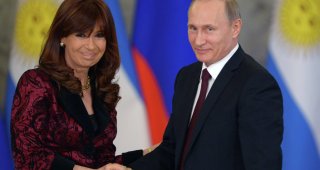 During her visit to Russia, President Fernandez met with President Vladimir Putin, signing over 20 memorandums on economic cooperation, said to amount to an “all-encompassing strategic partnership.”
The agreements included joint projects on the development of hydroelectric, nuclear and fossil-based energy in Argentina, including the construction of the sixth bloc at the Atucha nuclear power plant, along with a $2 billion memorandum on the construction of a new hydroelectric dam. Meanwhile, Russian energy giant Gazprom signed a memorandum on the exploration and development of gas fields with Argentine state gas company YPF, a deal amounting to $1 billion in investments. Russian company Uralmash was also tapped to build a plant manufacturing oil extraction equipment, amounting to an additional $1.9 billion in investments.
In the course of the visit, the two sides promised to conduct consultations on the use of each other’s national currencies for trade, pledging to increase cooperation in the military-technical sphere, accelerating construction of the GLONASS satellite navigation systems, and negotiating on the prospects of increasing bilateral food trade (presently amounting to about $1.3 billion).In the sphere of political cooperation, President Fernandez voiced her support for Moscow’s position that the situation in Ukraine could only be resolved by peaceful means, with the Russian president, for his part, pledging support for “Argentina’s striving for direct talks with Britain to achieve prompt resolution to the Mavinas [Falklands] Islands dispute.”
Visiting Moscow in July, Argentinian Vice President Amado Boudou emphasized that Argentina’s diplomatic moves toward improving relations with Russia were based on the fact that the two countries “share a very strong position with a common vision of the need for a multipolar world to ensure the existence of an inclusive and autonomous policy.”
Now, following Macri’s election victory, Argentina’s strategy of promoting regional integration in Latin America, and a multipolar world order, may be coming to an end. With Mexican economist Ariel Noyola Rodriguez suggesting only months ago that the Russian-Argentinian partnership signaled “Washington’s incapacity to sabotage the construction of a multipolar world,” it seems that the analyst may have spoken too soon.
With Fernandez (and her husband before her) becoming a major thorn in Washington’s side, the latter unhappy over the Peronists’ efforts to extract the country and the region from its subservient position in the US’s so-called ‘backyard’, the election of Macri, who promised to immediately improve relations with Washington, must come as a welcome change.
The conservative politican has already hinted that he would give less weight to Mercosur –the South American trade bloc aimed at ensuring regional economic integration and development, and shift the country’s diplomacy away from close cooperation with the leftist governments of Venezuela, Bolivia, Ecuador and Brazil.
And while his victory may not nullify the economic and other cooperation agreements reached with Russia, China, and other BRICS countries over the past decade, it does threaten Buenos Aires’ general trajectory of development –the country’s moves toward regional integration and a multipolar world independent of Washington’s influence.
For the Argentinian People: A Return to Neoliberalism?
As far as the Argentinian people are concerned, Macri’s victory is feared by his critics to mark a throwback to neoliberal dogmas which plagued the country prior to Kirchner’s 2003 election victory.
For their part, the British and American business press couldn’t help but gloat in the moment, with Financial Times suggesting it was “the beginning of a new political era for South America’s second-largest economy,” and The Wall Street Journal trash-talking Fernandez and her party, and suggesting that her economic policies, “uncivil rants against her political opponents, and a substantial loss of judicial independence and press freedom during kirchnerismo” contributed to Scioli’s defeat. Bloomberg Business, naturally, focused on the election’s effects on the markets, finding it crucial to point out that “in anticipation of a Macri victory, bond yields fell to an eight-year low and the local stock market rallied to a record high.”
But not everyone is convinced that this ‘new political era’ will bring positive changes, at least for ordinary Argentinians. In the run up to the voite, Scioli and his supporters warned that Macri’s proposals, which promised a return to neoliberal economic policies, would amount to “savage capitalism,” eroding social welfare and creating an economy which catered to a wealthy minority.
It’s worth recalling that before the Kirchners, Argentina was viewed as a textbook example of a developing country enveloped by the so-called Washington Consensus, a set of neoliberal economic dogmas which resulted in extremely high unemployment (over 25% in 2003), high poverty rates (nearly 55%), and a high Gini index.Under Kirchner and Fernandez, the country pursued social and economic policies that amounted to the creation of a mixed Keynesian economy, promoting government intervention where necessary, support for medium and small businesses, and a push for export growth via regional economic integration.
According to pan-Latin American news channel Telesur, these efforts resulted in the reduction of unemployment to 6.6% in 2015 (with 5 million jobs created over the past ten years), the reduction of poverty from over 50% to 6.5%, the creation of 50,000 small and medium-sized businesses, a major industrialization drive via the Industrial Parks National Program, increases in the share of GDP spent on education and pensions (from 3.6% and 4.1% in 2003 to 6.5% and 7.7% of GDP in 2013, respectively), and the near doubling of public investment, all the while reducing the national debt from 166% of GDP in 2003 to 41%.
In the areas of social policies, Kirchner and Fernandez began a comprehensive reform of the country’s justice system (making the Supreme Court independent), while annulling the ‘laws of pardon’ which gave immunity to the leaders of the country’s military dictatorship of 1976-1983 accused of crimes against humanity. The country also became the first in Latin America, and the tenth in the world, to pass equal marriage laws, in 2010.
Now, these gains, which came at a cost of high inflation (offset to an extent by annual negotiations between unions, employers and employees on adjusting wages) are under threat, with Macri’s critics saying his policies (including tax cuts, social spending cuts, and privatization schemes) will favor big business and the country’s oligarchs, sidelining the problems of social inequality, and reverting the country to its 90s’ era social and economic malaise.
Critics have also pointed to Macri’s promises of beginning negotiations with the predatory ‘vulture fund‘ creditors that rejected the debt restructuring which took place following the country’s default in 2002, giving an indication not only of his upcoming domestic economic policy, but also his possible subservience to the Western-dominated economic institutions which Argentina rejected under the Kirchners.Ultimately, only time will tell whether Argentina’s new government will continue to pursue policies based on economic and political pragmatism which have brought Buenos Aires closer to those countries looking to challenge global unipolarity (with some analysts already suggesting that they will).
As far as Argentina itself is concerned, it remains unclear how a return to the neoliberalism which devastated the country’s economy in the early 2000s will do it any good. As Russian social media users commenting on the election results lamented, it seems that too many Argentinians have forgotten the neoliberal catastrophe and ‘de-sovereignization’ of the 90s, processes which Russians themselves know all too well.
Rubio Follows the Big Money
By Jonathan Marshall | Consortium News | November 1, 2015
On the morning of Halloween, the New York Times broke the scary news that Republican presidential contender Marco Rubio had won a big jackpot: the endorsement of billionaire hedge fund investor Paul Singer. But aside from citing Singer’s praise for Rubio’s “message of optimism” and “work on the Senate Foreign Relations Committee,” the story offered little explanation of what could prove to be a decisive turning point in the GOP primary race.
On the policy front, Rubio clearly meets Singer’s requirement for a candidate who favors lower taxes on the rich and, even more important, a blank check for Israel’s right-wing government. With his hawkish stands on the Middle East, including fervent opposition to the Iran nuclear deal, Rubio had already won over another leading Republican “bundler,” New York attorney Phil Rosen, former chairman of American Friends of Likud and a believer that Israel’s conflict with the Palestinians “was, and will always be, a holy war.”
Rubio is a protégé of Florida billionaire Norman Braman, who has contributed at least six figures to support the expansion of Jewish settlements in the occupied territories. Rubio reportedly leads the all-important “Adelson primary,” the race to tap the virtually unlimited cash box of gambling billionaire Sheldon Adelson, the single most prominent U.S. supporter of Israeli Prime Minister Benjamin Netanyahu.
All that is music to Singer’s ears, but Rubio’s “work on the Senate Foreign Relations Committee” is about something else altogether: his political support for Singer’s efforts to drain more than $1.5 billion dollars from Argentina in payments on old bonds that lost most of their value after the country defaulted in 2001.
Singer’s Elliott Management bought that debt several years ago for less than $50 million, and then successfully sued in U.S. court to demand full recovery of the face amount — in the face of opposition from the Obama administration, most other bondholders, and, above all, Argentina’s government, led by President Cristina Fernandez de Kirchner.
Singer, who is famous for his bare-knuckles tactics against foreign governments, has gone after Kirchner’s government on all fronts. Most strategically, he supported the highly questionable claims by an Argentine prosecutor that the Kirchner government tried to cover up the involvement of the Iranian government in the 1994 bombing of the Jewish community center in Buenos Aires, which killed 85 people.
The issue was perfect for a smear campaign: targeting alleged Iranian terrorism and government anti-Semitism, Singer could undercut the legitimacy of the one entity standing between him and huge profits on his speculative bond purchases.
Singer’s Elliot Management is a major backer of American Task Force Argentina, which advocates for full repayment of the Argentine bonds and has spent millions of dollars lobbying Congress. It also spends big bucks to blacken Argentina’s reputation.
As Huffington Post reported in 2013, the group “has launched a broad attack on Argentina in its PR campaign. … Politico ad, paid for by ATFA, slammed the country as a safe haven for narcotics traffickers. Another ATFA ad accuses Argentine President Cristina Kirchner of making a ‘pact with the Devil,’ pointing to a legal memo between her country and Iran involving Argentina’s effort to prosecute Iranian defendants in a terrorism case.”
As one of its lobbyists told Huffington Post, “We do whatever we can to get our government and media’s attention focused on what a bad actor Argentina is.”
An investigation by Charles Davis for Inter Press Service showed that employees of Singer’s Elliott Management contributed more than $95,000 to Sen. Mark Kirk, R-Illinois, who wrote a letter denouncing President Kirchner’s agreement with Iran to investigate the 1994 bombing.
Rep. Michael Grimm, R-NY, who received $38,000 from Elliott Management employees, co-sponsored legislation demanding that Argentina’s bondholders receive full compensation, and called for an investigation of Argentina’s ties with Iran. Other recipients of Singer’s largesse — including AIPAC, The Israel Project and the American Enterprise Institute — also hammered the Kirchner government, virtually accusing it of anti-Semitism.
Last year, another member of Congress got in on the act: Sen. Marco Rubio. While grilling President Obama’s nominee as U.S. ambassador to Argentina, Rubio complained that Buenos Aires “doesn’t pay bondholders, doesn’t work with our security operations. . . . These aren’t the actions of an ally.”
Adding a dig at President Kirchner, he added, “We have this trend in Latin America of people who get elected but then don’t govern democratically. Argentina is an example of this.” His speech triggered an angry response from Kirchner’s Foreign Minister Hector Timerman — an Argentine Jew — calling Rubio an “extremist.”
This May, Rubio introduced a resolution in the Senate suggesting that Kirchner conspired to “cover up Iranian involvement in the 1994 terrorist bombing.” Rubio declared that the issues in the case “extend well beyond Argentina and involve the international community, and more importantly, U.S. national security.”
As Eli Clifton noted, “It turns out that Singer’s hedge fund, Elliott Management, was Rubio’s second largest source of campaign contributions between 2009 and 2014, providing the presidential hopeful with $122,620, according to the nonpartisan Center for Responsive Politics.”
When Kirchner herself had the temerity this spring to link Singer to various neoconservative attacks on her policies, citing a “global modus operandi” to coerce foreign states, the reliably neoconservative editorial page of the Washington Post published an editorial reply titled, “Argentina’s President Resorts to Anti-Semitic Conspiracy Theories.”
To which Jim Lobe and Charles Davis, citing a long list of Singer connections to Kirchner’s critics, replied, “follow the money.” That advice, made famous in the movie version of Watergate’s Deep Throat, remains the best guide to understanding billionaire funding of candidates in the 2016 election.
Argentina Accuses U.S. of Stonewalling Requests to Hunt down Ex-Spy Chief Hiding in Miami
By Noel Brinkerhoff | AllGov | October 2, 2015
The government of Argentina is getting fed up with the United States after repeated efforts to track down its ex-spy chief, believed to be hiding in Miami, have resulted in silence from Washington.
Argentinian officials have made eight formal requests to the Obama administration for help locating Antonio Stiuso, who led the now-disbanded intelligence secretariat until January, when he fled Argentina. According to media reports, Stiuso is in Miami but there has been no official confirmation of that.
Stiuso has been implicated in the death of prosecutor Alberto Nisman, who was killed in his home in January only days after he accused President Cristina Fernández of conspiring to cover up alleged Iranian involvement in a 1994 bomb attack on a Jewish community center in Buenos Aires that killed 85 people, according to The Guardian. Fernández in turn has accused Stiuso of orchestrating Nisman’s death to incriminate her and destabilize her government.
Argentina wants Stiuso handed over, and Fernandez’s government has warned the Obama administration that its lack of cooperation in the matter could jeopardize the two countries’ relationship.
“We ask ourselves sometimes: ‘Is the United States ready to allow the bilateral relations between it and Argentina to worsen for a man they all say has no importance, no strategic value for the United States?’” Anibal Fernández, Argentina’s cabinet chief of staff, told reporters.
Another official, Oscar Parrilli, head of Argentina’s Federal Intelligence Agency, said the U.S. ambassador to Buenos Aires may be summoned to explain “the absolute lack of response and in some ways complicity in this situation.”
A spokesman for the U.S. embassy in Buenos Aires said, according to Reuters, “We don’t comment on requests for assistance in criminal matters and we respond to these requests through established judicial channels.”
To Learn More:
Argentina Warns U.S. to Cooperate in Heightened Search for Fugitive Spy Chief (by Uki Goñi, The Guardian )
Argentina Intensifies Effort to get Ex-Spy Chief, Blasts U.S. (by Peter Prengaman, Associated Press )
Argentina Slams U.S. for Failing to Help in Hunt for Ex-Spymaster (Reuters )
The Shady History of Argentina’s Intelligence Secretariat (by Uki Goñi, The Guardian )
Argentina Government Accuses U.S. of Smuggling Spy Equipment (by Noel Brinkerhoff, AllGov )
Argentina Creates Indigenous Film School

teleSUR | August 19, 2015
As this year’s Indigenous Film Festival concluded over the weekend, the Argentine Governor of Chaco province, Jorge Capitanich, announced the creation of a national school for indigenous cinema.
“Today we confirm the (creation of) the Indigenous School of Cinema. Its a call on people to their own history, based on what they are capable of doing,” Capitanich said.
Indigenous films aim to portray modern and historic events from the perspective of colonized peoples who continue to suffer from extreme inequality.
The school will be created within the Culture Institute, and its creation falls under Law 26,522 Audiovisual Communication Services.
The Indigenous school will provide training in audiovisual basics and will promote production of local content in the different indigenous communities of Capitanich’s province.
The Indigenous Film Festival began in 2008, with the idea that movies are a social tool that go beyond entertainment and transform reality through social inclusion. The festival supports full rights for the indigenous peoples of the Americas and brings locally produced films to other regions.
Scioli Vows to Keep Argentina on Progressive Path as President

Argentina’s Daniel Scioli (R) during a press conference in Buenos Aires, Aug. 10, 2015. | Photo: teleSUR
teleSUR | August 10, 2015
After winning Sunday’s presidential primaries in Argentina, the ruling party candidate Daniel Scioli promised to continue progressive social programs if he wins the general election to be held on October 25, at a press conference Monday.
With more than 90 percent of Sunday’s votes counted, Scioli leads the race with more than 38 percent of the vote cast, against his closest rival, the opponent Buenos Aires mayor Mauricio Macri who reached 22 percent in the ballots.
At the press conference the candidate of current President Cristina Fernandez’s Front for Victory party said he is seeking to show all Argentinians who voted for him and also those who didn’t, that he will continue a project of government that has taken the country in the right direction.
“This is a new chapter, Argentina is free of debt and the social programs are the backbone of our programs, we will continue showing the people that their confidence in us is being rewarded.” Scioli said and revealed that his current strategy includes also an ambitious international agenda.
The candidate will travel to China and Russia in order to ratify agreements that have been reached in sectors like construction and education, but also substantial investments in general.
Scioli ended saying that his campaign will try now to reach “other political forces, independent and undecided voters to persuade them from their current position” ahead the October general elections.
Featured Video

Michael von der Schulenburg: Europe’s Self-Defeating Iran War Policy
or go to
Aletho News Archives – Video-Images
Frlom the Archives
Who Rules America?
The Power Elite in the Time of Trump
By James Petras | Axis of Logic | September 6, 2017
Introduction
In the last few months, several competing political, economic and military sectors – linked to distinct ideological and ethnic groups – have clearly emerged at the centers of power.
We can identify some of the key competing and interlocking directorates of the power elite:
- Free marketers, with the ubiquitous presence of the ‘Israel First’ crowd.
- National capitalists, linked to rightwing ideologues.
- Generals, linked to the national security and the Pentagon apparatus, as well as defense industry.
- Business elites, linked to global capital.
This essay attempts to define the power wielders and evaluate their range of power and its impact. … continue
Blog Roll
 Aletho News
- Michael von der Schulenburg: Europe’s Self-Defeating Iran War Policy
- Sorry, The New Republic, Climate Change Isn’t Causing Somali Migration. Blame Civil Strife and Poverty.
- Expert Guts Claims That HPV Vaccine Reduces Cancer Risk
- No evidence Russia sabotaged Baltic cables – Finnish intel
- The Strategic Folly of a (Serious) US Ground Invasion of Iran
- US-Israeli war of aggression on Iran meant to reshape region: Omani FM
- Iran Does Not Consider Israel Party to Talks to Need Mediators With It – Ambassador
- Macron’s aircraft carrier and warplanes to the Persian Gulf is a dangerous vanity project
- Meet The Ellisons: Zionists, Technocrats, Moguls
- US failures in Iran reveal Russia is key to South Korea’s strategic security
- If Americans Knew
- Are we on the precipice of World War III?
- ‘Catastrophic,’ Says UNICEF: 1,100+ Children Killed or Wounded in Mideast Since US-Israel Launched Iran War
- The Unbelievable Madness of Our War With Iran
- World Council of Churches calls on govts to hold Israel accountable for violations of intl law
- How to end the war on Iran that costs US taxpayers $1M per minute – Not a ceasefire Day 153
- Israeli strategic plans to “remake the Middle East” from the 1950s and since
- Honoring Gaza’s women who refused to let the world look away
- 97% of victims of war on Iran are Iranian, 98% of victims in war on Gaza are Gazans – Not a ceasefire Day 152
- Early Iran strikes cost $5.6 billion in munitions, Pentagon estimates
- Israel Decided the War, But Trump’s America Fights and Pays the Bill
- No Tricks Zone
- New Studies: UK Sea Levels Were 4 Meters Higher Than Today During The Mid-Holocene
- Destructive Green New Deal: German Energy And Metal Group Warns Of Drastic Crisis
- New Study Documents A 20-Year Pause In Arctic Sea Ice Decline – Driven By Internal Variability
- Wake-up Call: Survey Shows Majority Of Germans Now Favor Postponing Climate Targets!
- Televised! Leading German Political Candidate Tells Schoolchildren CO2 Makes Sun Hotter!
- New Study: A Century Warming Of 1.1°C Is ‘Commonplace’ And ‘Not Unusual’ During This Interglacial
- New Study: ‘Internal Noise’ And Volcanic Forcing Can Trigger 10-15°C Warming Within Decades
- Glaciers Worldwide Are Suddendly Surging, Experts Blame Warming!
- Surprising Discovery: Sahara Is Greening…Billions Of Trees Where Once Thought To Be Barren
- New Research Reaffirms Clouds, Aerosols, And Surface Solar Radiation Are ‘Driving The Climate System’
 Aletho News