In first, US endorses Israeli occupation of Golan, votes against 9 anti-Israel resolutions

Press TV – November 16, 2018
The US has, for the first time, endorsed the Israeli occupation of the Golan Heights by voting against an annual UN resolution that condemned the occupation and was unanimously approved along with several other resolutions against Tel Aviv.
The resolution titled “The occupied Syrian Golan,” adopted on Friday with 151 votes in favor, two against (Israel and the US), and 14 abstentions, condemns Israel for “repressive measures” against Syrian citizens in the Golan Heights.
The resolution, which was adopted during the 73rd session of the UN General Assembly’s Special Political and Decolonization Committee (Fourth Committee), expresses deep concern that the Syrian Golan, occupied since 1967, has been under continued Israeli military occupation.
The non-binding annual resolution takes issue with the “illegality of the decision” taken by Israel “to impose its laws, jurisdiction and administration on the occupied Syrian Golan,” which is illegal under international law.
The US’ vote against the annual resolution signaled a dramatic shift in Washington’s policy toward the territory, as it used to abstain in previous cases. The administration of Donald Trump had announced its changed policy ahead of the vote.
“If this resolution ever made sense, it surely does not today. The resolution is plainly biased against Israel,” outgoing US Ambassador to the UN Nikki Haley said in a statement.
During the debate, Syrian envoy Bashar al-Jafari vowed that Damascus would recapture the heights by peace or by war.
Israel seized the Golan Heights from Syria during the 1967 Six-Day War and has continued to occupy two-thirds of the strategically-important territory ever since, in a move that has never been recognized by the international community.
The Tel Aviv regime has built dozens of illegal settlements in the area since its occupation and has used the region to carry out a number of military operations against the Syrian government
Tel Aviv has also been pressing the US administration under Israel-friendly President Trump to recognize its claim to sovereignty over the occupied territory in defiance of international law.
Syria has repeatedly reaffirmed its sovereignty over the Golan Heights, saying the territory must be completely restored to its control.
Eight other resolutions against Israel
The resolution on the occupied Syrian Golan was one of the nine separate resolutions which condemned the Israeli regime.
Through these resolutions, the UN reinforced the mandate of its Relief and Works Agency (UNRWA), and renewed the mandate of its “special committee to investigate Israeli practices affecting the human rights of the Palestinian people and other Arabs of the Occupied Territories.”
Other resolutions included “Palestine refugees’ properties and their revenues”, “Persons displaced as a result of the June 1967 and subsequent hostilities”, “Applicability of the Geneva Convention… to the Occupied Palestinian Territory…”, and “Operations of the United Nations Relief and Works Agency for Palestine Refugees in the Near East”.
The member states also unanimously voted for a resolution titled “Assistance to Palestine refugees”.
Apart from the US, which voted against all the nine resolutions, only a few member states – including Canada and Australia – cast nay votes. The majority of member states voted for the resolutions.
View the resolutions and voting results here: https://t.co/WlLL5EBZ4q
— UN Watch (@UNWatch) November 16, 2018
Australia and its Israel Embassy: What are they Thinking?
By James O’Neill | OffGuardian | October 18, 2018
According to recent media reports, the Liberal candidate in the Wentworth (Sydney) by-election, former diplomat David Sharma said he “was open” to the idea that Australia’s embassy in Israel could be shifted from Tel Aviv to Jerusalem. In a separate tweet he went further and said Australia “should consider recognising Jerusalem as Israel’s capital. The ostensible reason is that it would be following the lead of the United States.
In separate reports, Prime Minister Scott Morrison is said to be making an announcement in Canberra on 16 October also suggesting that Australia should follow the US lead.
Sharma did qualify his suggestion that Australia’s embassy shift to Jerusalem “should be looked at in the context of a two-state solution (to Israel-Palestine)“.
It is possible that both Sharma and Morrison have timed their statements to coincide with the by-election by making a pitch for the Jewish vote in that electorate. According to census data, Wentworth has 12.5 percent of its population professing the Jewish faith, a significant figure in electoral terms. That is the kindest interpretation that can be placed on their remarks.
More likely, it is yet another example of Australia blindly following the United States in adopting a policy that is clearly in breach of international law. The Guardian and other mainstream media outlets have noted that the American policy has thus far only been followed by Guatemala. No mainstream media outlet has raised the issue of such a policy being in breach of international law. The special status of Jerusalem has been completely ignored.
Jerusalem is an international city under United Nations protection, and has been so since Resolution 181 of 1947, which declared Jerusalem a “separate entity.”
In June 1980, UN Security Council Resolution 476 was unanimously passed (i.e. including the US), declaring that “all actions by Israel, the occupying power, which purports to alter the character and status of the Holy City of Jerusalem have no legal validity and constitute a flagrant violation of international law.”
UNSC Resolution 478, also passed unanimously, called upon all “States to refrain from the establishment of diplomatic missions in the Holy City of Jerusalem.” UNSC resolutions are binding on all States. There is no room for ambiguity here, and even if Sharma and Morrison (and the Australian media) choose to ignore this issue, that is not an excuse. It has to be presumed that the legal advisors to the government in the Department of Foreign Affairs are cognisant of the legal implications of the government’s proposed shift in policy.
Sharma’s qualification that such a move would be in the context of a two state solution is absolutely meaningless. The Israeli government is totally uninterested in such a development, as its actions since 1948 make abundantly clear. Its ongoing theft of Palestinian land, the blockade of Gaza, the daily shootings of Palestinian men, women and children and its complete ignoring of multiple General Assembly resolutions over decades are all symptomatic of a violent, apartheid regime for whom international law is just an impediment to fulfillment of the Yinon Plan for a Greater Israel.
That Australia should even contemplate moving its embassy to Jerusalem beggars belief. UNSC resolutions are binding on member states. The fact that the United States chooses to ignore international law comes as no great surprise, even when, as with the Jerusalem resolutions they were a party to their formulation and voted for them.
The latest suggestions about Australia moving its embassy to Jerusalem puts them in the same dubious company as the US and Israel, both serial violators of international law. Does Australia really want to be in that company? Its voting record in the UN on Israel-Palestine issues tends to answer that question in the affirmative. This latest disregard for international law is consistent with Australia’s disregard for its international obligations toward the treatment of refugees on Manus and Nauru. It therefore marks a continuing downward slide from its earlier proud role as a supporter of a principled approach to foreign policy issues, and especially issues of international law.
This degradation of policy has not been matched with a reduction in the rhetoric of Australia’s professed belief in the “rules based international order.” The manifest hypocrisy of that position is now exemplified even more by the proposed shifting of the Australian embassy to Jerusalem. Australia’s policies are no more than a hollow sham.
James O’Neill is a Barrister at Law and geopolitical analyst. He may be contacted at joneill@qldbar.asn.au
NATO Coordinates Information War on Russia
Strategic Culture Foundation | 05.10.2018
The US, Britain and other NATO allies upped the ante this week with a coordinated campaign of information war to criminalize Russia. Moscow dismissed the wide-ranging claims as “spy mania”. But the implications amount to a grave assault recklessly escalating international tensions with Russia.
The accusations that the Kremlin is running a global cyberattack operation are tantamount to accusing Russia of “acts of war”. That, in turn, is creating a pretext for NATO powers to carry out “defensive” actions on Moscow, including increased economic and diplomatic sanctions against Russia, as well as “counter” cyberattacks on Russian territory.
This is a highly dangerous dynamic that could ultimately lead to military confrontation between nuclear-armed states.
There are notably suspicious signs that the latest accusations against Russia are a coordinated effort to contrive false charges.
First, there is the concerted nature of the claims. British state intelligence initiated the latest phase of information war by claiming that Russian military intelligence, GRU, was conducting cyberattacks on infrastructure and industries in various countries, costing national economies “millions of pounds” in damages.
Then, within hours of the British claims, the United States and Canada, as well as NATO partners Australia and New Zealand followed up with similar highly publicized accusations against Russia. It is significant that those Anglophone countries, known as the “Five Eyes”, have a long history of intelligence collaboration going back to the Cold War years against the Soviet Union.
The Netherlands, another NATO member, added to the “spy mania” by claiming it had expelled four members of Russian state intelligence earlier this year for allegedly trying to hack into the headquarters of the Organization for the Prohibition of Chemical Weapons (OPCW), based in The Hague.
There then followed predictable condemnations of Russia from the NATO leadership and the European Union. NATO was holding a summit in Brussels this week. It is therefore plausible that the timing of the latest claims of Russian “malign activity” was meant to coordinate with the NATO summit.
More sanctions against Moscow are expected – further intensifying tensions from already existing sanctions. More sinister were NATO warnings that the military alliance would take collective action over what it asserts are Russian cyberattacks.
This is creating a “casus belli” situation whereby the 29 NATO members can invoke a common defense clause for punitive actions against Russia. Given the rampant nature of the claims of “Russian interference” and that certain NATO members are rabidly Russophobic, it is all too easily dangerous for cyber “false flags” to be mounted in order to criminalize Moscow.
Another telltale factor is that the claims made this week by Britain and the other NATO partners are an attempt to integrate all previous claims of Russian “malign activity”.
The alleged cyber hacking by Russia, it is claimed, was intended to disrupt OPCW investigations into the purported poison-assassination plot against Sergei Skripal, the former Russian spy living in Britain; the alleged hacking was also claimed to be aimed at disrupting investigations into alleged chemical weapons atrocities committed by the Syrian government and by extension Syria’s ally Russia; the alleged Russian hacking claims were also linked to charges of Olympic athletes doping, as well as “interference in US elections”; and even, it was asserted, Russia trying to sabotage investigations into the downing of the Malaysian civilian airliner over Ukraine in 2014.
Up to now, it seems, all such wildly speculative anti-Russia narratives have failed to gain traction among world public opinion. Simply due to the lack of evidence to support these Western accusations. The Skripal affair has perhaps turned into the biggest farce. British government claims that the Kremlin ordered an assassination have floundered to the point of ridicule.
It is hardly coincidence that Britain and its NATO allies are compelled to shore up the Skripal narrative and other anti-Russian narratives with the ramped up “global cyberattack” claims made this week.
Photographs of alleged Russian intelligence operatives have been published. Potboiler indictments have been filed – again – by US law enforcement agencies. Verdicts have been cast by NATO governments and compliant news media of Russian state culpability, without Moscow being given a fair chance to respond to the “highly likely” claims. Claims and narratives are being accelerated, integrated and railroaded.
It is well-established from the explosive disclosures by Edward Snowden, among other whistleblowers, that the American CIA and its partners have the cyber tools to create false “digital fingerprints” for the purpose of framing up enemies. Moreover, the vast cyber surveillance operations carried out by the US and its “Five Eyes” partners – much of which is illegal – is an ironic counterpoint to accusations being made against Russia.
It is also possible in the murky world of all foreign states conducting espionage and information-gathering that attribution of wrongdoing by Russia can be easily exaggerated and made to look like a campaign of cyberattacks.
There is a lawless climate today in the US and other Western states where mere allegations are cited as “proof”. The legal principle of being innocent until proven guilty has been jettisoned. The debacle in the US over a Supreme Court judge nominee is testament to the erosion of due process and legal standards.
But what is all the more reprehensible and reckless is the intensification of criminalization of Russia – based on flimsy “evidence” or none at all. When such criminalization is then used to “justify” calls for a US-led naval blockade of Russian commercial oil trade the conditions are moving inevitably towards military confrontation. The blame for belligerence lies squarely with the NATO powers.
A further irony is that the “spy mania” demonizing Russia is being made necessary because of the wholly unsubstantiated previous claims of Moscow’s malfeasance and “aggression”. Illusions and lies are being compounded with yet more bombastic, illusory claims.
NATO’s information war against Russia is becoming a self-fulfilling “psy-op”. In the deplorable absence of normal diplomatic conduct and respect for international law, NATO’s information war is out of control. It is pushing relations with Russia to the abyss.
Supporters of Apartheid Israel Abuse Sydney Anti-War Student
By Tim Anderson | American Herald Tribune | September 2, 2018
Media, parliamentary, academic and other supporters of apartheid Israel have abused University of Sydney doctoral student Jay Tharappel for his outspoken support of Yemen, opposition to Israel and his consistent stance against the long wars 0n Syria and Korea.
Much of the western media falsely pretend that the massively internationalized war on Syria is a “civil war”. Most also refuse to recognize the simple fact that, over the past 65 years, the USA has never agreed to a peace agreement with North Korea.
The personal attacks on Jay reveal a shallow recognition of free speech in Australia. It is extraordinary that so much abuse has been heaped on one dissident voice. Demands for censorship of his political comments have come from various sources, but many of them supporters of the apartheid state of Israel.
First came the bully and smear media, from Murdoch’s Daily Telegraph, and from Channel Seven. The Murdoch tabloid, in a torrent of personal abuse, attacked Jay for rejecting the false chemical weapons claims against Syria, in April 2017. It then falsely claimed that Jay’s criticism of Murdoch journalist Kylar Loussikian was a racist attack.
In August 2018 Channel Seven manufactured another scandal about Jay, falsely claiming that a Yemeni badge he wore in China was ‘anti-semitic’. One part of that badge, seen on Jay’s shirt in one of my social media posts, said ‘death to Israel’.
The photo was simply one of the friends at lunch. Channel Seven, using the false translation “death to Israeli”, claiming it was a racist incitement. I posted in response that the Channel Seven piece ‘promotes ignorance, apartheid, and war’.
In fact ‘death to Israel’ is a political statement by the Yemeni group Ansarallah, which calls for an end to apartheid Israel, the regime that is reported to have killed a Palestinian child every three days for the past 18 years. The Australian government sells arms to the Saudis to bomb Yemen, as they ignore that terrible war and try to suppress any news about Yemen.
Later, the University of Sydney told the Sydney Morning Herald that I was “under investigation” for refusing to take down that photo of Jay and friends at lunch. After a Sydney Morning Herald [allegation] against me, I made a social media statement explaining my position.
For Channel Seven’s principal sources journalist, Bryan Seymour used two people (to represent “many in the Jewish and Muslim community”). First was a well-known supporter of Israel, Vic Alhadeff. Vic was previously a chair of the NSW Community Relations Commission but resigned in 2014 after posting in support of Israel’s bloody reign of terror in Gaza.
The other was Jordanian-Australian Jamal Daoud, who claimed to represent a Palestinian group but is best known for his repeated attacks on those who support Syria. He has abused many supporters of Syria as ‘spies’ and ‘prostitutes’. In 2017 he took an Israeli propagandist to Syria, and since then has been wanted for questioning in Syria. Earlier, in 2015, he began an online petition to challenge a security ban on him entering Lebanon.
The corporate media came back to abuse Jay after he wrote a thoughtful piece on his visit to North Korea (DPRK) in the student newspaper Honi Soit. The article defended independent Korea while it described in some detail what he had seen there. On social media pages, many appreciated the unusual article, while others responded with censorial outrage.
The Daily Telegraph added another abusive piece, which copied much of Jay’s article while adding invective. Even the state-owned ABC wrote in support of the demand that the article be taken down, simply because it was seen as too favorable to North Korea.
Why the hysteria over criticism of Israel? Well, both the Murdoch media and Channel Seven have deep business links with Israel’s occupation forces, including those who regularly demolish Palestinian homes in their ethnic cleansing purges.
Pro-Israel figures and some Jewish media in Australia predictably and falsely tried to conflate Jay’s and my opposition to Israel with anti-Jewish racism. I have made my position on Israel and racism very clear on many occasions, most recently in an article called The Future of Palestine.
A selection of pro-Israel types jumped on the bandwagon. They included federal Labor MP Tim Watts, who attacked Jay’s article and Honi Soit, saying ‘everyone associated with this article ought to be ashamed’.
Everyone associated with this article ought to be ashamed https://t.co/SJ1jDeMqrP
— Tim Watts MP (@TimWattsMP) August 26, 2018
When he was criticized for picking on a student newspaper he said, by way of justification, that he was trying to get at me (‘the professor’).
I’m picking on the professor that has long been enabling this dangerous rubbish
— Tim Watts MP (@TimWattsMP) August 26, 2018
In fact, Tim Watts is yet another supporter of apartheid Israel. In late 2015 he went on an Israeli-government paid junket to Israel, in a group led by conservative minister Christopher Pyne. The group seemed to toe the Israeli line because Palestinian minister Dr. Sabri Saidam described them as “rude” and “not well educated” on Palestine.
Subsequently, Tim Watts took his Israel connection seriously. He strongly recommended the book ‘My Promised Land’ by Ari Shavit, which explains how Israel created “something unique and quite endearing” in a tough neighborhood.
This “unique and quite endearing” creation was described by an authoritative 2017 report to the United Nations as an ‘apartheid state’ and therefore ‘a crime against humanity’. US academic lawyers Richard Falk and Virginia Tilley wrote that “the situation in Israel-Palestine constitutes an unmet obligation of the organized international community to resolve a conflict, partially generated by its own actions”.
Professor Ariadne Vromen, a professor in Government at the University of Sydney, and opponent of the BDS campaign against Israel, jumped in, inexplicably, attacking the former Syrian Ambassador to Australia Tammam Sulayman. Ambassador Sulayman is now Syria’s envoy to North Korea, and it was he who invited us to visit that country.
Ariadne claimed that Ambassador Tammam had failed her research design course, 15 years ago. “He didn’t pass first year”, she said. After some criticism, she removed her post.

Of course, it is inappropriate for academics to abuse students or former students, or to humiliate them for their grades or results. In this case, Ariadne’s comments were also false. When I enquired, Ambassador Sulayman spelled out to me the reason why he had left Ariadne’s class and his doctoral studies at the University:
“Of course I didn’t complete at that time with Ariadne because [his supervisor, another academic] started the war on me and I complained against her to the university. So I stopped everything … in my [thesis] preface I stated there is no linkage between the secular Baath party and al Qaeda … but she said ‘that does not exclude links between Saddam and al Qaeda’, and I said but we are talking about the Baath party … Then she started returning every paper I sent her … she is a clear Zionist … It is silly for [Ariadne] to say that I didn’t finish even one year without mentioning the reason.”
Professor Vromen’s abuse of a former student and ambassador is strange. Why would an academic jump in to abuse a former student, in the context of an abusive media campaign against another student? What is wrong with honest discussion?
Unfortunately, this is not an isolated incident. The University of Sydney is well known for harboring pro-apartheid-Israel academics. It hosts a research project backed by US Government-funded agencies, called ‘The Electoral Integrity Project’. That project rates the electoral democracy of many countries. As it happens, they rate Israel’s ‘democracy’ very highly (17/127), even though the Jewish state is notorious for its institutionalized racism.
In 2007-08 the University of Sydney accepted a large grant from the American Australian Association, to establish a ‘United States Studies Centre’. This was mostly Australian Government money but came at the suggestion of media mogul Rupert Murdoch. The idea of the Centre came from a desire to repair the damage done to the image of the USA in the wake of its 2003 invasion of Iraq. I wrote an article about this scandal, back in 2010.
Washington remains the major funder and arms provider to apartheid Israel, providing the racist state with more than three billion dollars every year, mostly in military subsidies.
SYRIA: The Emerging Reality of the U.S Coalition Regime Change War – On the Ground Reporting

Life and food return to Douma after liberation by SAA from Saudi-backed, UK-promoted Jaish Al Islam terrorists. (Photo: Vanessa Beeley)
By David Macilwain | 21st Century Wire | August 20, 2018
The withdrawal of US coalition support for “rebels” in Syria, portrayed as a failure to achieve noble and humanitarian goals by Western governments and media, should rather be seen as an admission of guilt. The rescuing of violent militants and “White Helmets” from Southern Syria by Israeli forces actually marked the failure of the covert project to forcibly replace Syria’s legitimate government with one of NATO’s choice, regardless of the democratic will and lives of the Syrian people.
Before we can ask “what if?” about the war on Syria, as Ramesh Thakur does in “The Strategist”, republished here on P&I, we need to understand what actually happened during the Western-sponsored seven-year long assault on the Syrian state, as seen from the perspective of those on the receiving end of this attack. Now that the Syrian Arab Army and its allies are finally prevailing in their defence of the country and its citizens, it is also time for Western commentators to stop repeating the same vapid accusations against the Syrian President, and instead start making accusations against their own “mis-leaders”.
Rather it appears that many in the West are entrenching their opposition to the Syrian government at the same time as millions of Syrians are confirming their support for it, and the armies that have fought off their enemies’ chosen alternative.
Ramesh Thakur’s partisan view on the “Syrian civil war” and the benign nature of the West’s intimate involvement in it is evidently shared by the Australian Strategic Policy Institute, and – one would imagine – by many of those in public office who act on its advice. The same innocence could not be assumed for ASPI sponsors, – defence contractors Lockheed Martin and Thales – who profit from that advice, nor presumably for Australian Intelligence agencies and their overseers in the government.
Back in May, and only weeks after the latest US/UK/French missile attack on Syria, I visited Damascus with my partner, and was able to verify the essential truth of reports from Syrian sources on the situation there, both in regard to the recent campaign to liberate Eastern Ghouta from armed militants, and more generally through personal contact with Syrians.
What we found however was both surprising and heartening; here was a country full of hope and passion, finally celebrating its imminent victory against one of the vilest and most devious enemies in history, led and supported by the most powerful and determined regimes in the world, including our own. Despite the harrowing cost to Syrian society, with over 80,000 regular Syrian soldiers killed, the people were strengthened and united behind their defence forces and their President.
In the seemingly endless fight against foreign-backed and foreign-armed insurgents, every Syrian now has a friend, relative or partner who has “died for his country”, killed, injured or tortured by these “barbarian invaders”. Even in Damascus an estimated 11,000 innocent people have been killed by “rebel” mortars and sniper fire from nearby suburbs.
Visiting a Government camp for the displaced residents of those same rebel-occupied Eastern suburbs of Damascus – Eastern Ghouta – brought home to us what this really means. The people sheltered and fed there – 15,000 in mid-May – had many stories to tell of the years they were held under siege in their communities by the violent militants of Jaish al Islam and Faylaq al Rahman, as well as of the behaviour of the so-called “White Helmets” who worked hand in hand with these terrorist groups. My colleague Vanessa Beeley, who visited the same camp a week earlier and conducted many interviews with Douma and Hamouriya residents has written comprehensively on their experiences; alone her report utterly condemns and exposes the lies and misinformation to which Australian and Western audiences have been subject on the “siege of Eastern Ghouta” and its denouement in the criminal Douma “gas attack” provocation.
Beeley had already exposed the incriminating truth of the previous US alliance campaign over East Aleppo, and the cooperation between the US/UK supported White Helmets and Al Qaeda that effectively prevented the city’s liberation for months in 2016.
It was likely at that point that Russia concluded that the US administration was “non-agreement-capable”, – a situation little altered by the subsequent change of US leadership. Progress towards a resolution of the conflict – in Astana – was then only made because the US was excluded, along with those Opposition groups that refused any compromise with the Assad government.
It is the nature of these Opposition groups, still supported by Western powers including Australia as some legitimate alternative to Syrians’ choice of government, which continues to elude most Western commentators. These groups were cultivated primarily by the Saudis, and reflect their extremist Wahhabi vision of ideal government as well as being associated with the worst terrorist groups operating in Syria. Had he not suffered a timely demise at the hands of Syrian security forces, the notorious terrorist and former leader of Jaish al Islam Zahran Alloush would have been in the running for Syria’s new leadership.
It is in this context that we ask “what if?” the Syrian government had been forcibly replaced by one of the West’s choosing; it belies both the intentions and the actions of the NATO – Saudi – Gulf state coalition, who ploughed billions in arms and support to these very immoderate groups to achieve their own objectives – which had nothing whatsoever to do with “humanitarian intervention” or “democratic reforms”.
By contrast, what actually happened in Syria, and in the main stronghold of Jaish al Islam in Douma, was all too easy to see on the ground. Our visit to Douma hospital, scene of the White Helmets’ most recent criminal fabrication, proved shocking even with what we already knew about the situation. Their claims of a chemical weapon attack, and staged “water-hosing” treatment for its alleged victims in the hospital’s emergency ward, continue to be endorsed by Western commentators like Thakur as well as governments, NGOs and the UN, despite being comprehensively exposed as false.
This remains the case even following the testimony of supposed gas victims seen in the staged video, brought to the Hague by Russia, and the findings of the OPCW showing no presence of chemical weapons residues at the site.
Many commentators have evidently now become impregnable bastions of the false Syrian chemical weapons narrative spread by their governments; in a previous article while discussing the Khan Shaikoun “gas attack” a year earlier, Ramesh Thakur quite wrongly concludes that the Syrian government was proven responsible.
While he cites the UNHRC and the UN-OPCW “evidence” as endorsement of this position, both bodies actually relied on second hand information from Opposition sources only, and refused Syria’s invitation to visit and inspect the Shayrat airbase from which they claimed the chemical weapons had come. Their duplicity was exposed when the US coalition sought to reinforce the mandate for the JIM at the Security Council over the Douma incident; Russia rightly vetoed this clearly disingenuous proposal.
In fact there was nothing for such a commission to investigate in Douma, as Russian and Syrian investigators had already found no toxic chemicals at the alleged site, and hospital staff denied knowledge of any such attack. But what proved really shocking to see at Douma hospital was the sophistication and extent of the tunnel system built beneath it. Canadian investigative journalist Eva Bartlett, who visited Douma just before we did, posted this article that includes video of her exploration of this extraordinary tunnel system, as well as corroborating interviews about the fabricated chemical weapons stories from many residents. The tunnel network not only allowed the armed militants of Jaish al Islam and Al Qaeda – along with their White Helmeted “partners” – to enter and take over the hospital whenever they wished, but protected them from Syrian and Russian bombs.
The belief amongst Syrians that these jihadist/terrorist groups were being assisted by foreign Special Forces, not just in constructing and equipping the tunnel system but in directing and coordinating the “underground resistance” was confirmed during the final evacuation of the Douma “jihadists” on buses to Northern Syria; special forces from Britain, Turkey and other countries were reportedly apprehended trying to escape with them. The MOD naturally denied this collusion, but events in Southern Syria last month, when hundreds of foreign fighters and White Helmets were “rescued” by their closest local ally Israel, seem to confirm and reinforce the Russian and Syrian claims.
While the Syrian people are remarkably forgiving, and focused on recovery and reconciliation within their own territory, few would not now lay blame for the death and devastation inflicted on the fabric of their society at the feet of the US-led coalition – of which Australia has been an integral part. Responsibility for the countless atrocities committed by the hundreds of violent sectarian militias, including Al Qaeda and Da’esh/Islamic State, lies squarely with those countries who conspired to assist them with rivers of weaponry and a tide of propaganda, like – in Trump’s words – “the world has never seen”; this was a conspiracy that began long before the “uprising” of March 2011.
Those who ignore the Syrian reality – that stares in the face of those who deign to look – and so allow this mountain of lies to remain even as another Western regime-change scheme gets under way, should also now prepare their defence; ignorance can no longer be an excuse.
***
David Macilwain is an independent observer and writer with a special focus on the war on Syria and its allies. He writes voluntarily for Russia Insider and the American Herald Tribune, from his home in the hills of NE Victoria. He visited Syria in May independently and at his own expense.
Mattis Rejects Viral Australian Report On Impending US Iran Strikes
By Tyler Durden – Zero Hedge – 07/27/2018
A day after an Australian ABC report went viral with the claim that the White House has drawn up plans to strike Iran’s alleged nuclear facilities as early as next month, Defense Secretary James Mattis said on Friday morning it’s a “complete fiction”.
The Australian Broadcast Corporation report cited high level defense and intelligence figures: “Senior figures in the Australia’s Turnbull government have told the ABC they believe the US is prepared to bomb Iran’s nuclear capability,” and perhaps most alarmingly added, “The bombing could be as early as next month.”
Fox News national security correspondent Jennifer Griffin questioned Mattis about the report on Friday:
I asked Mattis about report US preparing strikes against Iran.
MATTIS: “I have no idea where the Australian news people got that information. I am confident it is not something that is being considered right now. I think it is a complete, frankly, it’s fiction.”
The ABC report, based on statements from senior Australian officials privy to the “Five Eyes” intelligence sharing program that also includes the US, Britain, Canada, and New Zealand, included the following:
- Senior Government figures have told the ABC they believe the Trump administration is prepared to bomb Iran
- They say Australian defence facilities would likely play a role in identifying possible targets
- But another senior source, in security, emphasizes there is a difference between providing intelligence and “active targeting”
ABC further noted that secretive Australian defense and intelligence facilities would likely cooperate with the United States and Britain in identifying targets in a strike on Iran, based on unnamed sources.
However, officials were also quoted as distinguishing “a big difference between providing accurate intelligence and analysis on Iran’s facilities and being part of a ‘kinetic’ mission.” The intelligence source said further, “Developing a picture is very different to actually participating in a strike.”
The report came the same day that Qassem Soleimani, head of Iran’s elite IRGC Quds force, personally threatened President Donald Trump, saying “Come. We are ready. If you begin the war, we will end the war,” and as a White House policy meeting on Iran was convened by national security adviser John Bolton.
Previously, on Wednesday Iran’s Ministry of Foreign Affairs issued a statement through official sources, saying the US should forget about any and all negotiations so long as Iran remains under threat, which is a refrain of Iran’s consistent position since the US began pressuring European allies to not deal with the regime since the US pulled out of the 2015 JCPOA. Foreign ministry spokesman Bahram Qasemi said that “one-way negotiations” in the current political climate are impossible.
Time to Invite Russian Diplomats Back with an Apology
By James ONeill – New Eastern Outlook – 16.07.2018
On 4th of March 2018 former Russian double agent Sergei Skripal and his daughter Yulia were discovered on a park bench in Salisbury England in a distressed state. They were treated by passers-by, including a doctor, before being taken to Salisbury General Hospital.
The hospital initially treated the Skripals for a suspected drug overdose as the symptoms they exhibited were consistent with poisoning by fentanyl, a substance 10 times stronger than heroin, and with which the hospital had prior experience. The hospital’s initial diagnosis was confirmed in an article that appeared in the Clinical Services Journal on 27 April 2018. After the journal’s online article was publicized on social media, references to “fentanyl” were changed to “a substance.”
It was not the first or last time that the official story about what happened to the Skripals was changed.
Three days after the Skripals were found, the British government issued a “D” Notice. The ‘Notice”, officially a “request” but in effect a demand, forbade mention of Mr Skripal’s friend Pablo Miller. Why publicity about Mr Miller was to be suppressed is one of the features of this case, and apart from the initial report in the UK newspaper the Daily Telegraph, which led to the ‘D’ Notice, he has not been referred to again in the mainstream media.
On 12 March 2018 the British Prime Minister Theresa May made her first statement to the House of Commons in which she alleged that the Skripals had been poisoned with a nerve agent “of a type developed by Russia,” and that it was “highly likely” Russia was responsible.
The British government subsequently circulated a memorandum and power point presentation to 80 embassies setting out the argument that Russia was responsible for what happened to the Skripals, and seeking support for their intention to expel Russian diplomats as a punishment. The various allegations made in the PowerPoint presentation were at best contentious and some were demonstrably untrue. It is suffice for present purposes however to focus only on the claims of alleged Russian responsibility for the Skripal attacks.
A number of countries, including Australia, acceded to the British demand and expelled diplomats. The statement made by Prime Minister Malcolm Turnbull announcing that two Russian diplomats would be expelled made no attempt to establish the truth of the matter or indicate any desire to do so. His statement simply echoed the allegations made in the British document.
Turnbull said that the use of a chemical weapon to try to murder Sergei and Yulia Skripal reflected a “pattern of recklessness and aggression” by the Russian government that had to be stopped. Russia, he said was threatening no less than “the democratic world” in deliberately undermining the international rules based order. He went on to list a series of other alleged transgressions that echoed the claims made by the United Kingdom government.
One of the interesting features of this case is that not only was it a rush to judgement before the evidence could possibly have been gathered and analysed, but that the mainstream media and the politicians have not deviated from their initial claims, despite the wealth of evidence that has subsequently emerged.
Like the Red Queen in Alice in Wonderland, they demanded the sentence before the evidence had been presented, and also like Alice in the eponymous story, asked us to believe six impossible things before breakfast.
The diligent reader is able to readily ascertain just how lengthy that list of impossible things is. It is suffice for present purposes to mention only a few to demonstrate that the United Kingdom’s entire story is a fabrication that would be funny were its potential consequences not so serious.
The United Kingdom government claimed that the Skripals had been poisoned by “a military grade nerve agent” that they see it was a Novichok “of a type of developed by Russia.” From that combination of alleged facts, we were expected to infer that only the Russians could have been responsible.
”Novichok” is a sufficiently Russian sounding nomenclature to give superficial credence to at least part of the claim. The first difficulty however is that there is no “Novichok” nerve agent. The term simply refers to a class of organophosphate chemical weapons. It is true that this class of chemical weapon was developed in the former Soviet Union, as described in a book published by a former employee of the chemical centre, readily available on Amazon.
That manufacturing and research development centre was demolished pursuant to the Chemical Weapons Convention in 1999, as was described as the time in an article in the New York Times. Material from the demolition process was taken back to the United States. All of this information is readily available and politicians and journalists prior to their making claims about nerve agents “of a type developed by Russia” should have known it
The Novichok class of nerve agents may or may not have been initially developed by the Soviet Union, but that is a far cry from linking the substance allegedly used in Salisbury with that original program. A number of European governments have acknowledged that they possess the Novichok class of nerve agents.
A search of the United States Patent Office records however, reveals that between 2002 and November 2017 81 patents were applied for using the name “Novichok”. A patent filed in April 2013 includes a description of a delivery method, including bullet like projectiles that can target a single person.
Secondly, the former United Kingdom Foreign Secretary Boris Johnson told the Russian ambassador to the United Kingdom on 12 March 2018 that the nerve agent used on the Skripals was an A234. You are a number of problems with this claim quite apart from Mr Johnson’s general difficulty with the truth. The consulting surgeon at Salisbury Hospital, Dr Steven Davies had a letter to The Times newspaper published on 14 March 2018 in which he stated that “no patients have experienced symptoms of nerve agent poisoning in Salisbury.” In contradistinction to unsubstantiated claims that as many as 40 people had been affected, Dr Davies referred to only three patients receiving treatment in this context. This was presumably a reference to the two Skripals and a police officer.
A234 is a highly toxic substance, 8 to 10 times more powerful then VX (of a type developed by the UK) that had been used to kill a relative of North Korean leader Kim at the Kuala Lumpur airport. VX will kill within a few minutes, yet the A234 allegedly used on the Skripals failed to kill or even severely disable them or the third alleged victim, detective Sergeant Bailey.
A further and likely conclusive reason to reject A234 as the substance used, was that the report by the OPCW based on samples collected from Salisbury 17 to 18 days after the incident said that the substance in the samples was of “high purity”.
The scientific evidence, again readily ascertainable by a reasonably diligent journalist is that A234 and similar substances degrade rapidly. It is literally impossible for samples collected 17 to 18 days after the event to be of “high purity.” The purity also makes it impossible to identify the specific source of the manufacture, and furthermore guarantees that it originated in a properly equipped laboratory. That OPCW report effectively destroyed the last shreds of the UK government’s claims.
Given that Bailey and the Skripals have both made complete recoveries, it could not have been a “military grade” nerve agent that caused their plight. There is also the indisputable fact that whatever was used on the Skripals could not have come from Yulia’s suitcase, the air vents of their motor vehicle, or the front door knob of Mr Skripal’s house, or any of the other fantastical claims made at various times by the UK government for the simple reason that they were alive and well approximately six hours after leaving the house.
During that time the Skripals visited the cemetery, had a meal at Zizzi’s restaurant, and had an untroubled walk through the centre of Salisbury, captured by the CCTV camera. The fact that they both took ill, at the same time and in the same specific location, leads to the almost irresistible inference that they were attacked at or near the park bench where they were found in a distressed state.
For these various reasons, and a great deal of the others in the now considerable body of literature on this topic, we do not know with what they were attacked, nor by whom. At best we know approximately where and at approximately what time. A proper inquiry, as opposed to the wild and unjustified accusations and premature conclusions constantly reiterated in the mainstream media, would approach this question with an open mind. It has been abundantly clear that a proper enquiry is the furthest thing from the minds of the British government or their acolytes such as Australia.
A proper inquiry would also consider the relevance of motive. There has been no plausible suggestion, much less evidence, as to why the Russian government would wish to do the Skripals harm, and some solid reasons why the Russian government would be the least likely candidate to wish ill upon the Skripals.
This brings us back to Sergei Skripal, his history and the aforementioned D notices. One of those D notices inhibited publication of the details relating to Pablo Miller. That raises the obvious question, not pursued by the mainstream media unfettered by the D notice, as to why the British government would wish to protect Mr Miller’s identity and his links to Mr Skripal.
Miller and Skripal are friends, both living in Salisbury and known to socialize together. Their history goes rather deeper. Miller is a former MI6 officer and during the time that Skripal was a double agent in the employ of the Russian GRU Agency and selling Russian secrets to the British, Miller was his ‘handler.’
Miller worked in Moscow in conjunction with Christopher Steele, the assumed author of the infamous Trump dossier that collected together various allegations about Trump’s Russian activities, both business and personal.
That dossier was commissioned by the Democratic National Committee on behalf of Trump’s opponent in the 2016 presidential election, Hilary Clinton. The DNC commissioned Fusion GPS who in turn contracted with Orbis Business Intelligence. Christopher Steele was the principal of Orbis and Miller was one of his associates.
The American outlet Buzzfeed released the complete dossier on 10 January 2017 and on the same day the May government issued a D notice prohibiting the British press from revealing Steele to be the author. The Wall Street Journal however, published his name the following day.
According to the Czech magazine Respekt, Skripal had recent links to Czech intelligence and he travelled to both the Czech Republic and Estonia in 2016 and had met with intelligence officers from both countries.
This evidence strongly supports the inference that Skripal was still an active agent on behalf of the British who were known to be strongly opposed to the election of Donald Trump. Given Skripal’s knowledge of Russian intelligence, his links with the intelligence community in at least four countries, his close ties to both Miller and Steele going back to his GRU days, and at least according to one textual analysis of the dossier, it is entirely possible that Skripal was in fact one of the authors of the dossier.
These facts are now well established. At the very least it raises serious questions about who else might have a motive to give Mr Skripal a “message.” Whoever was responsible, the incident was certainly used by the UK government as part of a wider campaign to discredit the Russian government in general and President Putin in particular. In this endeavour, they have been willingly aided and abetted by the Australian government and mainstream media.
The failure of either to acknowledge the manifold flaws in the original allegations and to accept that the UK government’s version has been comprehensively discredited is an enduring disgrace.
At the very least the Russian government is owed an apology. That would go at least some way to acknowledging that the premature judgement and intemperate response has damaged Australia’s international image and its foreign relations.
Can Universities Lawfully Bully Academics into Silence?
By Jennifer Marohasy | June 19, 2018
Dr Peter Ridd has taken James Cook University to court protesting his sacking for what he says is, primarily, speaking-out about the lack of quality assurance in Great Barrier Reef science.
Dr Ridd spoke out initially about there being no quality assurance of Great Barrier Reef science – science that is arguably misused to secure billions of dollars of tax-payer funding. When the University tried to stop Dr Ridd doing this, Dr Ridd spoke out against University management – making all the documentation public including on his new website.
I would really like the court case to be about academic freedom and the science – to lay bare the evidence. But when I went to the first day of the hearing of an application in the Federal Circuit Court last Monday (11th June – the hearing continued on 12 June 2018) for an order for reinstatement of Dr Ridd’s employment pending determination at trial, it quickly became evident that there would be no testing of the actual scientific evidence relied upon by Dr Ridd to claim that scientific institutions like AIMS and ARC Centre “can no longer be trusted” and “spin their story”.
Yesterday (19th June), Judge Jarrett gave his reasons for making orders declining to reinstate Dr Ridd but allowing him to amend his primary application to include a claim for the university taking “adverse action” against him for exercising a workplace right (i.e. his intellectual/academic freedom pursuant to the enterprise agreement). On hearing the reasons I was concerned to discover that it may all come down to poorly worded clauses in an enterprise agreement. In particular, was Dr Ridd allowed to exercise his academic freedoms free of the constraint of the university’s ‘aspirational’ (according to His Honour) code of conduct, and was he permitted to say anything publicly about what many ordinary Australians would consider a straight-forward case of the university bullying him into silence?
On the first day of the preliminary hearing Barrister Ben Kidston for the applicant (Dr Ridd) argued eloquently about how the case was about ‘academic freedom’. He went-on for over an hour moving from the big picture to the detail with respect to specific clauses in a code of conduct and the enterprise agreement, and back again. All the while His Honour and the audience listened intently – no one interrupted. Again yesterday, His Honour cited the poorly worded specific clause which the university has been relying on to silence Dr Ridd, and observed that it was open to two interpretations.
His Honour didn’t mention the Union. The National Tertiary Education Union has an interest in the enterprise agreement and like Dr Ridd, they say that the relevant clause in the agreement shouldn’t be used to silence the employee but rather, amongst other things, that the obligation of confidentiality only applies to the University’s management of the disciplinary process. Any other interpretation means that university academics would be obliged to suffer any disciplinary action by the University (legitimate or otherwise) in silence – they would never be able to publicly defend themselves in the court of public opinion, court proceedings being the only practical option. One wonders if the Union realises the implications to its members.
Yesterday, when His Honour gave his reasons for declining the application by Dr Ridd for an injunction – for his temporary reinstatement as a Professor at James Cook University pending the trial – he didn’t deal with many of the arguments advanced for Dr Ridd e.g. the effect of the clause of the enterprise agreement which states that the code of conduct is not to “detract” from the intellectual freedoms, the interaction of the express right to disagree with the University‘s decisions and processes pursuant to his intellectual freedom and the purported obligation to keep disciplinary proceedings again him confidential, whether a conflict of interest, apprehended bias or actual bias, exists by reason of the university’s commercial relationship with AIMS, GBRMPA and ARC and the effect that this has on the obligation to afford Dr Ridd procedural fairness and natural justice in the determination of the disciplinary complaint (which concerned comments he made about those bodies).
That is not intended to be critical of His Honour. His Honour took a broad brush approach and did not descend into the detail of the arguments and the evidence, as all His Honour was required to do was to ascertain whether Dr Ridd had a prima facie case, and not to decide the case itself.
Yesterday, His Honour found that Dr Ridd had an arguable prima facie case in relation to the alleged breach of the enterprise agreement by JCU and that it took adverse action against him, but that the balance of convenience did not favour his reinstatement pending trial primarily because:
1. an award of damages would be an adequate remedy if Dr Ridd was successful at trial; and
2. the university paid Dr Ridd the equivalent of six month’s pay upon his termination – so he was not presently without income to support himself and (it seems) that a trial would likely occur before the expiration of that six month period; and
3. Dr Ridd had previously turned down an offer of an undertaking by the university to suspend the disciplinary proceedings pending determination of the proceeding. It is important to note that that undertaking would have required Dr Ridd to remain silent about the disciplinary proceedings that had been taken against him by the university.
Of course, in making this determination the Judge was entirely ignoring (as he was entitled to) the very nature of Dr Ridd – a man of integrity who will not be silenced even if costs him his job, his career and results in vicious bullying.
When Christopher Murdoch QC for the respondent (JCU) argued on the first day of the hearing he explained that the University’s core issue was the breaking of confidentiality, in particular Dr Ridd was not allowed to tell anyone that he had been censured. Never mind that he had been censured for daring to speak out against a culture where scientific integrity is perhaps sacrificed for profit.
So, when I blogged about this issue of Peter Ridd being censured and the need for everyone to contribute to his GoFundMe Campaign back in May, I very deliberately emphasised the importance of being able to speak out. The most important thing, I wrote, is to not be silenced.
I was also thinking of the famous Edmund Burke quote: The only thing necessary for the triumph of evil is for good men to do nothing.
Dr Ridd has done something. First, he detailed the scientific facts as an expert on these issues including in the scientific literature. For example, there is his article published in Marine Geology (Volume 346, pages 392-399) in which he explains that the only reason Glenn De’ath found an apparent decline in coral calcification rates was because he didn’t consider the age effect on coral growth. This is just one of many instances when Dr Ridd has detailed how scientists make spurious claims based on a flawed methodology. More recently Dr Ridd has explained the consequences of this in plain English on television.
None of this has made him popular with his colleagues most of whom rely on perceptions of imminent catastrophe at the Great Barrier Reef for their relevance and certainly their funding. Dr Ridd has done what the average Australian would consider to be the right thing. Most importantly he has not remained silent – surely, he will be vindicated at the final trial when all the evidence is heard and all the arguments made and considered.
University Professor Sacked for Telling-the-Truth

Peter Ridd as a first year undergraduate science student at James Cook University back in 1978 – forty years ago.
By Jennifer Marohasy | May 19, 2018
BACK in 2016, when I asked Peter Ridd if he would write a chapter for the book I was editing I could not possibly have envisaged it could contribute to the end of his thirty-year career as a university professor.
Considering that Peter enrolled at James Cook University as an undergraduate back in 1978, he has been associated with that one university for forty years.
Since Peter was fired on 2 May 2018, the university has attempted to remove all trace of this association: scrubbing him completely from their website.
But facts don’t cease to exist because they are removed from a website. The university has never challenged the veracity of Peter’s legitimate claims about the quality of much of the reef science: science on which billions of dollars of taxpayer-funded research is being squandered. These issues are not going away.
Just yesterday (Friday 18 May), Peter lodged papers in the Federal Court. He is going to fight for his job back! […]
Peter deliberately choose to frame the book chapter about the replication crisis that is sweeping through science.
In this chapter – The Extraordinary Resilience of Great Barrier Reef Coral and Problems with Policy Science – Peter details the major problems with quality assurance when it comes to claims of the imminent demise of the reef.
Policy science concerning the Great Barrier Reef is almost never checked. Over the next few years, Australian governments will spend more than a billion dollars on the Great Barrier Reef; the costs to industry could far exceed this. Yet the keystone research papers have not been subject to proper scrutiny. Instead, there is a total reliance on the demonstrably inadequate peer-review process.
Ex-professor Peter Ridd has also published extensively in the scientific literature on the Great Barrier Reef, including issues with the methodology used to measure calcification rates. In the book he explains:
Like trees, which produce rings as they grow, corals set down a clearly identifiable layer of calcium carbonate skeleton each year, as they grow. The thicknesses and density of the layers can be used to infer calcification rates and are, effectively, a measure of the growth rate. Dr Glenn De’ath and colleagues from the Australian Institute of Marine Science used cores from more than 300 corals, some of which were hundreds of years old, to measure the changes in calcification during the last few hundred years. They claimed there was a precipitous decline in calcification since 1990, as shown in Figure 1.2.
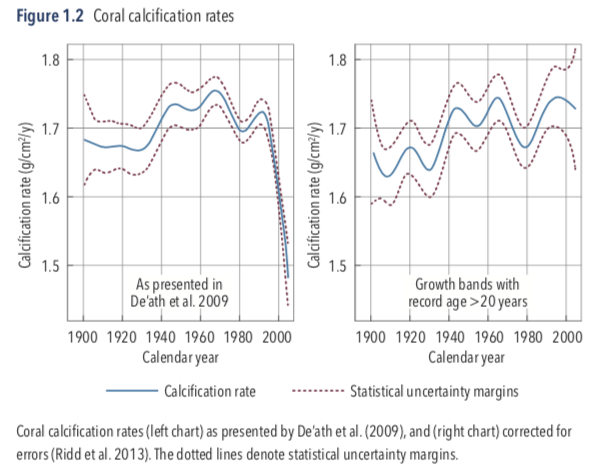
The LHS chart suggests a problem with coral growth rates – but the real problem is with the methodology. When corals of equivalent age are sampled, there has been no decline in growth rates at the Great Barrier Reef – as shown in the RHS chart.
However, I have two issues with their analysis. I published my concerns, and an alternative analysis, in the journal Marine Geology (Ridd et al. 2013). First, there were instrumental errors with the measurements of the coral layers. This was especially the case for the last layer at the surface of the coral, which was often measured as being much smaller than the reality. This forced an apparent drop in the average calcification for the corals that were collected in the early 2000s – falsely implying a recent calcification drop. Second, an ‘age effect’ was not acknowledged. When these two errors are accounted for, the drop in calcification rates disappear, as shown in Figure 1.2.
The problem with the ‘age effect’, mentioned above, arose because in the study De’ath and colleagues included data from corals sampled during two distinct periods and with a different focus; I will refer to these as two campaigns. The first campaign occurred mostly in the 1980s and focused on very large coral specimens, sometimes many metres across. The second campaign occurred in the early 2000s due to the increased interest in the effects of CO2. However, presumably due to cost cutting measures, instead of focusing on the original huge coral colonies, the second campaign measured smaller colonies, many just a few tens of centimetres in diameter.
In summary, the first campaign focused on large old corals, while, in contrast, the second campaign focused on small young corals. The two datasets were then spliced together, and wholly unjustifiable assumptions were implicitly made, but not stated – in particular that there is no age effect on coral growth…
Dr Juan D’Olivo Cordero from the University of Western Australia collected an entirely different dataset of coral cores from the Great Barrier Reef to determine calcification rates. This study determined that there has been a 10% increase in calcification rates since the 1940s for offshore and mid-shelf reefs, which is the location of about 99% of all the coral on the Great Barrier Reef. However, these researchers also measured a 5% decline in calcification rates of inshore corals – the approximately 1% of corals that live very close to the coast. Overall, there was an increase for most of the Great Barrier Reef, and a decrease for a small fraction of the Great Barrier Reef.
While it would seem reasonable to conclude that the results of the study by D’Olivo et al. would be reported as good news for the Great Barrier Reef, their article in the journal Coral Reefs concluded:
Our new findings nevertheless continue to raise concerns, with the inner-shelf reefs continuing to show long-term declines in calcification consistent with increased disturbance from land-based effects. In contrast, the more ‘pristine’ mid- and outer-shelf reefs appear to be undergoing a transition from increasing to decreasing rates of calcification, possibly reflecting the effects of CO2-driven climate change.
Imaginatively, this shift from ‘increasing’ to ‘decreasing’ seems to be based on an insignificant fall in the calcification rate in some of the mid-shelf reefs in the last two years of the 65-year dataset.
Why did the authors concentrate on this when their data shows that the reef is growing about 10% faster than it did in the 1940s?
James Cook university could have used the chapter as an opportunity to start a much-needed discussion about policy, funding and the critical importance of the scientific method. Instead, Peter was first censored by the University – and now he has been fired.
When I first blogged on this back in February, Peter needed to raise A$95,000 to fight the censure.
This was achieved through an extraordinary effort, backed by Anthony Watts, Joanne Nova, John Roskam and so many others.
To be clear, the university is not questioning the veracity of what ex-professor Ridd has written, but rather his right to say this publicly. In particular, the university is claiming that he has not been collegial and continues to speak-out even after he was told to desist.
New allegations have been built on the original misconduct charges that I detailed back in February. The core issue continues to be Peter’s right to keep talking – including so that he can defend himself.
In particular, the university objects to the original GoFundMe campaign (that Peter has just reopened) because it breaches claimed confidentiality provisions in Peter’s employment agreement. The university claims that Peter Ridd was not allowed to talk about their action against him. Peter disputes this.
Of course, if Peter had gone along with all of this, he would have been unable to raise funds to get legal advice – to defend himself! All of the documentation is now being made public – all of this information, and more can be found at Peter’s new website.
Featured Video
The Attack on Pearl Harbor Was No Surprise (Part V)
or go to
Aletho News Archives – Video-Images
From the Archives
Iran Delenda Est
By Stephen J. Sniegoski • Unz Review • July 25, 2019
After Carthage had been significantly weakened by Rome in the Second Punic War (218 to 201 BC), Cato the Elder, a leading Roman senator, is said to have ended all his speeches with the words: “Carthago delenda est!” (“Carthage must be destroyed!”). This destruction ultimately took place in the Third Punic War (149–146 BC). A somewhat similar situation exists today in the United States, where war hawks demand that Iran–which in no way could effectively attack the United States, or even conquer America’s Middle East so-called allies—be stripped of its ability to protect itself.
Of course, what makes the American situation different from ancient Rome’s is that Rome sought to eliminate Carthage for its own interests whereas the United States is largely acting to advance the military interests of Israel… continue
Blog Roll
Recent Comments
eddieb on The Old Testament and the Geno… papasha408 on Trump’s war posturing against… Coronistan on This is How We Should Have Res… Coronistan on NO MANDATES, NO PROFITS: MODER… Lutz Barz on Russia Vows to Protect Its Oil… loongtip on Russia Vows to Protect Its Oil… loongtip on Hamas never agreed to lay down… eddieb on Conspiracy Denial eddieb on WEF Calls for ‘Cultural Revolu… loongtip on Trump wanted to play peacemake… Coronistan on EU member to sue bloc over ‘su… loongtip on Vicious


 Aletho News
- From Iraq war crimes to Gaza’s ‘board of peace’: Why Tony Blair belongs in The Hague
- Epstein email reveals plan to pursue frozen Libyan assets with help from former MI6, Mossad figures
- Trump tells India to stop purchasing Iran oil, buy Venezuelan instead
- How Trump’s Iran Gambit Could Blow Up the Entire Persian Gulf
- Rafah crossing reopens under strict Israeli restrictions
- The Attack on Pearl Harbor Was No Surprise (Part V)
- How Human Rights Watch Shattered Yugoslavia
- Hamas rejects Israeli accusations as “lies meant to justify its massacres in Gaza”
- Interior ministry: Israeli strike on police building in Gaza shows disregard for mediators
- West’s hypocrisy over Iran and Gaza proves a regime-change operation in Tehran
- If Americans Knew
- Israel killed at least 32 Gazans on Saturday – Not a ceasefire Day 114
- Is Israel opening the Rafah border to depopulate Gaza? – Not a ceasefire Day 113
- NBA Star Stephen Curry’s Ties To Israeli Military Intelligence
- ‘Apocalyptic wasteland’: Biden admin. blocked warning on deteriorating Gaza situation after Oct. 7
- Why Israeli counterterrorism tactics are showing up in Minnesota
- Israel Went to Extremes to Return Ran Gvili’s Body. Why Doesn’t It Accord Dead Palestinians the Same Respect?
- Across the West, speaking for Palestine is now a crime
- A West Bank Bus Trip Through ‘the Best Documented Ethnic Cleansing in History’
- Mike Huckabee’s distorted theology does not speak for Christians worldwide
- CBS Evening News” With Tony Dokoupil Is Ellisons’ & Weiss’s Pro-Israel Show
- No Tricks Zone
- One Reason Only For Germany’s Heating Gas Crisis: Its Hardcore-Dumbass Energy Policy
- 130 Years Later: The CO2 Greenhouse Effect Is Still Only An Imaginary-World Thought Experiment
- New Study Affirms Rising CO2’s Greening Impact Across India – A Region With No Net Warming In 75 Years
- Germany’s Natural Gas Crisis Escalates … One Storage Site Near Empty …Government Silent
- Polar Colding…Antarctica Saw Its Coldest October In 44 Years!
- New Study: Sea Levels Rose 20 Times The Modern Rate During The Roman Warm Period
- As German Gas Storage Dips Dangerously Low…Shortage Hardly Avoidable
- New Study: Brazil’s Relative Sea Level Was 2+ Meters Higher And SSTs 3-4°C Warmer 6000 Years Ago
- Philosopher Schopenhauer: Climate Science Certainty Stems From Stupidity, Ignorance
- New Study: Species Extinction Rates Declining Since 1980 – ‘Climate Change Is Not An Important Threat’
 Aletho News