New Book: Covid Through Our Eyes
Review by Maryanne Demasi, PhD | September 28, 2025
 When Covid hit, governments, health agencies and the media marched in lockstep. Their united front was sold as “consensus.”
In reality, it was compliance by coercion. Dissenters were punished, questions suppressed, and the public was fed slogans instead of science.
Covid Through Our Eyes tears away that façade.
This collection of essays—written by doctors, scientists, lawyers, journalists, economists and ordinary Australians whose lives were upended—restores the voices silenced during the pandemic.
Each chapter forms part of a collective testimony. And in a final act of principle, not a cent of the book’s sales goes to the authors; all proceeds support Australia’s vaccine injury class action.
A chorus of voices
Editors Robert Clancy, an immunologist, and Melissa McCann, a physician, have gathered an extraordinary range of perspectives.
Among them, British oncologist Angus Dalgleish describes patients relapsing into aggressive cancers after years in remission. He argues that repeated boosters and chronic spike protein exposure created a “pro-cancer milieu.”
Vaccinologist Nikolai Petrovsky recounts how his homegrown vaccine, built on decades of expertise, was cast aside in favour of untested mRNA technology.
Statistician Andrew Madry lays out devastating evidence of excess mortality and the government’s refusal to investigate the causes.
Other contributors highlight phenomena dismissed at the time: immune system imprinting, shifts in antibody subclasses, and persistence of mRNA in the body.
Regulatory expert Philip Altman details how the Therapeutic Goods Administration ignored clear safety signals, choosing convenience over caution.
Lawyers and doctors tell of their battles in the courts and on the streets against vaccine mandates—small victories, bitter defeats, and governments that seemed more determined to silence critics than to defend their policies with evidence.
Clancy himself turns a sharp eye on Australia. Once a nation of independent scientists—from Burnet to Fenner, with pandemic plans crafted at the Commonwealth Serum Laboratories—by 2020 it had surrendered to bureaucracy.
He argues that recovery depends on restoring the doctor–patient relationship and returning vaccine development to proven antigen platforms, not experimental technologies rushed to market.
The media that failed
My own chapter in the book examines how mainstream media collapsed.
Newsrooms abandoned their adversarial role and parroted government lines. Contradictory evidence was buried. Scientists who asked questions were branded fringe. Patients who reported harm were cast as public health risks.
The press did not simply fail; it became an enforcer. That betrayal corroded trust, and the damage persists today.
Stories of loss
The most haunting chapters are personal.
Antonio DeRose, left in a wheelchair after transverse myelitis, describes doctors who refused to acknowledge the cause.
Queenslander Caitlin Gotze died six weeks after her second Pfizer dose, with her myocarditis misdiagnosed as asthma.
Actor and writer Katie Lees collapsed from clotting linked to AstraZeneca; her death was reduced to a single line on a regulator’s website.
These are stories of grief, stark reminders of what happens when agencies, designed to protect, instead deny responsibility.
This book matters
Covid may have slipped from the headlines, but its consequences have not.
Excess deaths remain unexplained. Injured families still fight for recognition. Trust has been squandered. And this nation has yet to hold a Royal Commission into Covid.
Covid Through Our Eyes is essential reading for anyone who wants to understand what really happened to Australians—a nation of people once known for their laid-back spirit, now grappling with a legacy of coercion and injury.
Buy it, read it, and judge for yourself.
Minister Bowen says costs of inaction definitely higher even though we don’t know the cost of doing something
It’s a Pantomine from beginning to end — the fakery never ends
By Jo Nova | September 16, 2025
Australia’s National Climate Risk Assessment has dropped on us yesterday like a mass-produced propaganda-bomb. Life and death depends upon “the science”, but the intense, dire and secret climate modeling was mysteriously delayed last month for no reason (except to get some spooky headlines), whereupon the Greens jumped up and down to get it released, and then patted themselves on the back saying Labor caved in. Yes, indeedy, the Government put out the report with perfect PR timing a few days before they plan to tell us how they are raising our emissions target from impossible to astronomical. If they released the “science” a month ago, people would have more time to pick apart the 274 pages of propaganda (or even read it).
Science is just a marketing tool for Big Government now, and the document is a fishing mission for catastrophe.
We know it’s not science because everything is 100% bad. It’s the purity that gives it away. In the real world, there are always trade-offs.
It’s all cost and no benefit
The document is a risk assessment which calculates the cost of inaction, but not the cost of action. Not surprisingly, the cost of inaction is always going to be “higher” (higher than nothing). It was apparently, exactly what the Minister wanted:
“One thing that is very clear from this climate assessment is that our whole country has a lot at stake,” Bowen said. “The cost of inaction will always outweigh the cost of action.” — The BBC
Nobody knows what the cost is, not the Minister of the Department of Better Weather and Energy. Though one guesstimate from a group called Net Zero Australia in 2023 tossed out numbers like $1.5 trillion by 2030 and $7-$9 trillion by 2050. That’s a lot of cost savings we need to make to make action make sense. Grown ups would like to discuss this, perhaps?
It’s all deaths and no lives saved
Heat waves will kill more people, but somehow warmer winters won’t reduce any deaths, even though moderate winter cold kills 6 times as many people as summer heat does.
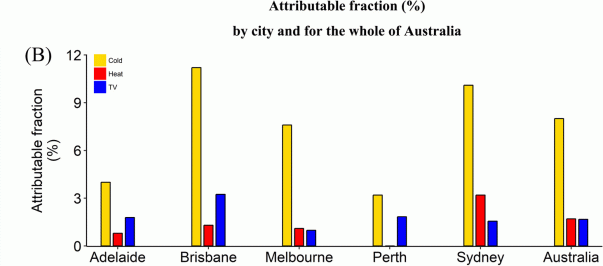
Attributable fraction of deaths: Heat, cold and temperature variability together resulted in 42,414 deaths during the study period, accounting for about 6.0% of all deaths. Most of attributable deaths were due to cold (61.4%), and noticeably, contribution from temperature variability (28.0%) was greater than that from heat (10.6%). (Cheng et al)
Heatwave mortality will increase by 444% in Sydney if the world warms by 3°C the report tells us, with no mention of the word “air-conditioning”.
If reckless spending to stop-storms-in-2100 makes energy unaffordable, heatwave mortality will increase even if the world doesn’t warm at all. No one will be able to afford air-conditioning.
The only mention of “benefits” in the whole document is that a few areas might benefit from reduced frosts — not that our expert modelers can say which areas, or which seasons that will happen in.
Like advertising, “everyone” will be better off if they just buy this weather controlling widget.
The 72-page report – released days before the government announces its emissions reduction targets for 2035 – found that no Australian community will be immune from climate risks that will be “cascading, compounding and concurrent”. — The BBC
The 274 page blockbuster has a nifty 74 page overview for anyone who only has a day or two to devote to the combinations and variations of modeled imaginary catastrophe. There’s nothing there that we haven’t seen a million times before.
Only 36 countries back Ukraine in key UN vote

RT | September 24, 2025
A joint statement by Ukraine and the EU condemning Russia has received the backing of only 36 out of the 193 UN member states. The US notably abstained.
Presented by EU foreign affairs chief Kaja Kallas and Ukrainian Foreign Minister Andrey Sibiga at the UN Headquarters in New York on Tuesday, the document describes Russia’s actions vis-a-vis Ukraine as a “blatant violation of the UN Charter.” It also calls on the global community to “maximize pressure” on Moscow, and to support Ukraine’s “territorial integrity within its internationally recognized borders.”
The joint statement was endorsed by the 26 EU member states, with the exception of Hungary, and also endorsed by Albania, Andorra, Australia, Bosnia and Herzegovina, Canada, Japan, Monaco, New Zealand, Norway, and the UK.
Back in February, the UN Security Council rejected a resolution drafted by Kiev and its European backers that contained similar anti-Russian rhetoric. A competing resolution promoted by the US was eventually adopted, with Washington, Moscow, and eight other members voting in favor and five European nations abstaining. That version avoided branding Russia as an aggressor and called for a “swift end” to the Ukraine conflict.
Moscow’s deputy envoy to the UN, Dmitry Polyansky, at the time described the outcome as a victory for common sense, claiming that “more and more people realize the true colors of the Zelensky regime.”
Moscow has consistently characterized the Ukraine conflict as a proxy war being waged against it by the West.
The Kremlin has repeatedly stated that the hostilities would end were Kiev to renounce its claims to the five regions that have joined Russia through referendums since 2014, reaffirm its neutral status, and guarantee the rights of the Russian-speaking population on its territory.
ACMA Pressures Tech Giants to Maintain State-Backed Fact-Checking in Australia
By Cindy Harper | Reclaim The Net | September 16, 2025
Australia’s communications regulator is once again pushing for tighter control over online speech, using the language of “misinformation” as justification for expanding censorship.
In its latest report on the voluntary Australian Code of Practice on Disinformation and Misinformation, the Australian Communications and Media Authority (ACMA) criticizes major platforms for stepping away from state-aligned fact-checking programs and chastises others for refusing to sign up to the code at all.
The regulator insists that “support for independent fact-checking in Australia appears to be stalling” and warns of “the potential impact of pulling away from, or limiting support for, independent fact-checking by signatories in Australia.”
This complaint exposes the real agenda: keeping tech companies tethered to outside arbiters of truth rather than trusting users to decide for themselves.
ACMA singles out Google, noting: “In July 2025, it was reported that Google would not renew its partnership with the Australian Associated Press’s fact-checking team.”
Meta is also put on notice after adopting a more open model in the United States, moving away from contracted fact-checkers in favor of community-driven notes.
Even though no such shift has been formally announced in Australia, ACMA underlines that Meta admits “4 of its 2025 commitments are contingent on it engaging third-party fact-checking organizations to fact-check content on their services.”
The report further scolds companies that never joined the code, declaring:
“It is disappointing that several major platforms have not signed up to the code. By electing not to submit their systems and processes to the same scrutiny as signatories, these platforms are sending a strong message to Australians that they are not supporting a coordinated industry-led approach to combatting disinformation and misinformation.”
ACMA then issues a direct demand: “We call on major non-signatories to sign up to the code to provide greater transparency to Australians about what they are doing to address disinformation and misinformation.”
What the regulator portrays as “voluntary” is in reality a pressure campaign: comply with outside “fact-checking” oversight or be publicly shamed as irresponsible.
By holding up third-party fact-checkers as the only credible safeguard, ACMA is endorsing a censorship regime where a handful of organizations act as gatekeepers of truth.
Community-led models that allow citizens to challenge and contextualize claims are sidelined, while central authorities are favored.
To those paying attention, ACMA’s report reads like an attempt to lock platforms into a system that elevates government-aligned “fact-checkers” above open discussion.
Australians have a right to free expression without bureaucrats or their preferred partners deciding what information is fit to see.
The louder ACMA complains about companies moving away from fact-checking, the clearer it becomes that the real “harm” being prevented is not misinformation itself, but the risk of ordinary people making up their own minds.
Australia Orders Tech Giants to Enforce Age Verification Digital ID by December 10
A safety law that reads like a blueprint for a surveillance state
By Cindy Harper | Reclaim The Net | September 8, 2025
Australia is preparing to enforce one of the most invasive online measures in its history under the guise of child safety.
With the introduction of mandatory age verification across social media platforms, privacy advocates are warning that the policy, set to begin December 10, 2025, risks eroding fundamental digital rights for every user, not just those under 16.
 eSafety Commissioner Julie Inman Grant has told tech giants like Google, Meta, TikTok, and Snap that they must be ready to detect and shut down accounts held by Australians under the age threshold.
She has made it clear that platforms are expected to implement broad “age assurance” systems across their services, and that “self-declaration of age will not, on its own, be enough to constitute reasonable steps.”
The new rules stem from the Online Safety Amendment (Social Media Minimum Age) Act 2024, which gives the government sweeping new authority to dictate how users verify their age before accessing digital services. Any platform that doesn’t comply could be fined up to $31M USD.
While the government claims the law isn’t a ban on social media for children under 16, in practice, it forces platforms to block these users unless they can pass age checks, which means a digital ID.
There will be no penalties for children or their parents, but platforms face immense legal and financial pressure to enforce restrictions, pressure that almost inevitably leads to surveillance-based systems.
The Commissioner said companies must “detect and de-activate these accounts from 10 December, and provide account holders with appropriate information and support before then.”
These expectations extend to providing “clear, age-appropriate communications” and making sure users can download their data and find emotional or mental health resources when their accounts are terminated.
She further stated that “efficacy will require layered safety measures, sometimes known as a ‘waterfall approach’,” a term often associated with collecting increasing amounts of personal data at multiple steps of user interaction.
Such layered systems often rely on facial scanning, government ID uploads, biometric estimation, or AI-powered surveillance tools to estimate age.
Privacy campaigners warn that these approaches risk normalizing the constant collection of sensitive personal data, building infrastructure that could easily be repurposed for broader tracking or profiling.
To support enforcement, eSafety has launched a self-assessment tool for companies to determine whether their services are covered by the law.
The Commissioner noted that the tool would help companies figure out if “any of their services may be excluded” under the legislative rules issued by the Minister for Communications.
However, most major social media platforms such as Facebook, Instagram, TikTok, Snapchat, YouTube, and X are almost certain to be included.
eSafety is also developing regulatory guidance to clarify what “reasonable steps” will mean in practice.
The Commissioner has made it clear that platforms must already be preparing to prevent children from manipulating settings to bypass restrictions, ensure that complaint mechanisms are functional and accessible, and plan for full implementation ahead of the December deadline.
Citing consultations with over 160 organizations and more than 50 young people aged 13 to 23, the Commissioner claims there is “strong community support for measures to better protect children online.”
She added, “Australians have told us they want strong, practical protections that keep children safe without compromising privacy or fairness. We have listened, and this feedback is shaping the guidance we are putting in place for industry.”
However, many in the privacy and digital rights communities question whether such a balance is possible when the state’s approach is to compel private companies to verify the age of every user, regardless of whether they’re children.
The phrase “without compromising privacy” rings hollow for those who recognize that age verification at this scale often relies on intrusive surveillance methods that compromise anonymity for everyone, not just young users.
The government maintains that only services with core social networking features are affected.
Online games and basic messaging apps may be excluded. But messaging functions embedded in social media platforms, like DMs on Instagram or group chats on Snapchat, will fall under the new restrictions. The definition is broad enough that many widely used platforms could be swept into the regulatory net.
Although the Commissioner has publicly insisted that safety and privacy “do not have to be mutually exclusive,” the architecture required to meet the government’s demands suggests otherwise.
Once systems are in place to scan faces, verify IDs, or track user activity for the sake of age assurance, they can be leveraged for other purposes by platforms or the state.
Australia’s move places it at the frontier of a growing global trend where safety rhetoric is used to justify mass surveillance.
Privacy advocates argue that introducing mandatory identification online not only limits access but also normalizes tracking in digital spaces that once allowed for anonymity, freedom of expression, and private communication.
Despite these concerns, the Commissioner urged platforms not to delay. “This is the time for companies to start mobilizing and planning for implementation,” she said, adding that “children, parents and carers are counting on services to deliver on their obligations and prepare their young users and the trusted adults in their lives for this monumental change.”
The End of the Free, Global Internet
By Brad Pearce | The Libertarian Institute | September 1, 2025
It appears that the free global internet, such as it was, which many of us loved and grew up with, is nearly dead. Long gone are the days of anonymous IRC chats or where only paranoiacs thought their emails were monitored. The growing standard is the government demanding websites know who you are all the time to “protect” you from a myriad of trivial things such as “hate speech” or videos of people eating too much.
As has become common, it is not any of the “authoritarian” states we hear about leading the way to the end of internet freedom, but instead the ethnic European parts of the former British Empire. The United Kingdom itself has just implemented legislation which demands all users upload ID to show they are over eighteen when using anything it deems “dangerous,” while Australia is restricting all of those sixteen and under from having social media accounts whatsoever, again to protect them primarily from thoughts the government dislikes. The British legislation is particularly dangerous as it is expected that sites based anywhere in the world comply with expansive moderation rules, while Australia’s law is a blanket ban on social media usage for an age category. In both cases, however, they kill internet anonymity and set a terrible precedent.
The internet has been under siege from many directions for many years. It is true that America’s regime change class found free internet useful for “Color Revolutions” and did at times use it to undermine foreign governments. As a consequence, it has historically acted as a defender of internet freedom when it advances other objectives. Thus, something like “The Great Firewall of China” which we were conditioned to care about, though it did not impact anyone outside of China.
The attacks on the internet have only grown more blatant, such as in Brazil where Judge Alexandre de Moraes has been on a rampage trying to “protect” the public from political speech he dislikes. In the United States, however, the bigger problem was originally just collecting enormous amounts of data secretly, which they did while encouraging people to use the internet however they wished—creating all the more data. The attempts at algorithmic mind control pushed by the Joe Biden administration and complacent—or enthusiastic—tech companies was again done while purporting to be for a free internet. Despite government hypocrisy and abuses, the internet remains the greatest communication tool in human history and we should protect it at all costs, while remaining mindful of government data collection activities, information control, and regime change operations.
The British and Australian laws are all the more nefarious as they impact almost all internet activity, and of course, they use the classic line “Won’t someone think of the children!” Age verification for pornography is one thing—that brings the internet in line with the laws of the physical world where you can’t walk into a store and buy that content without an adult ID; but this is much broader. As a recent Politico article explains, as well as pornography, there are age verification limits on, “hate speech, content promoting drugs and weapons, online harassment and depictions of violence… Large platforms restricted everything from X posts on Gaza to subreddits on cigars, and blocked content entirely in certain cases.” As Kym Robinson recently explained, they are rapidly medicalizing internet use and making it about physical and mental health, which for eKarens is an endless justification for meddling. In short, nearly anything fun or interesting could be considered adult content and the sites themselves are being made to police this or face significant fines, which intentionally creates a situation where cautious site owners will expand it past anything the government demands. No reasonable man can have any faith in any supposed privacy protections which are said to stop governments from accessing the ID used to age verify an account.
It’s easy as an adult to forget the experience of being a child, and imagine children lack the ability to understand anything about the world around them, when in fact they are learning such things at a rapid pace. It happens to be the case that I was twelve in the year 2000 when the first major law on this topic went into effect in the United States: the Children’s Online Privacy Protection Act [COPPA.] This law, in its original form, stopped kids under thirteen from having accounts on any website without a parent’s permission. To recover your email address your parent had to put in credit card information, which many were hesitant to do back then in an era where online shopping was still fairly rare. The thing about that though was the sites simply removed the option to sign up if you were under thirteen and had no verification option, so no one’s privacy was made worse; it was just annoying and condescending towards children.
What is notable about this is that at the time I wrote a persuasive speech for English class against this law. I have a reason to remember at age twelve that my classmates and I were able to understand the policy being unfairly implemented and I was able to write a formal argument against it. Now, being a parent instead of a twelve-year old, I certainly have some different views about what is appropriate for children, but the ability of children to understand what is going on around them is greater than commonly realized. The Australian Communications Minister tried to defend their ban on all social media use, including YouTube, for kids under sixteen by likening it to teaching your kid to swim in the pool before putting them in the ocean with the sharks and rip currents. In fact it is the exact opposite: it throws kids right in at sixteen with no experience when they are the most irresponsible and difficult to control.
What is the most nefarious about these “age verification” laws is that the United Kingdom and Australia both regularly arrest internet users for posts that they don’t like. The end of anonymity will kill the most valuable discourse coming from either country. Both of these countries in many ways seem completely defeated and devoid of the love of liberty, but in fact have thriving and creative “anon” communities still carrying the fire of freedom. The ability to express opinions and tell the world what is happening will all but disappear under a regime where you have to verify your age to use Spotify—not to mention how ridiculous it is to ban seventeen-year olds from using Spotify even if it impacted no one eighteen and above. Everything that has happened up to now shows that age verification laws in these countries will set the stage for an even larger crackdown on all unapproved thoughts.
Something I have noticed in my time on this Earth is that you can tell a lot by a man for how he uses the term “the Wild West.” It is generally either used by liberty lovers to mean, “You’re allowed to do what you want and it’s awesome,” or by sniveling Mandarins to mean “This is terribly dangerous and needs to be regulated.” I have long feared a future where the young say that the internet used to be like the Wild West and view this as scary and dangerous. Now, the younger generation seems to be coming up tired of the schoolmarm government, but it will be a hard fight to keep any of the internet’s Wild West charm as it is consumed by meddlesome nanny states.
If these laws in the United Kingdom and Australia are allowed to stand it will represent a major step in a perhaps irreversible process whereby the internet will become ever more broken up by the country of the user, and in most of them much less free. I would be able to take some comfort in the idea that this could send people back to the pubs to talk in person, but the Brits are also cracking down on pub banter, and I somehow doubt other states are far behind them.
The reek of desperation hangs over Albanese’s Iran conspiracy theories
By Samuel Geddes | Al Mayadeen | August 31, 2025
The Australian Prime Minister and his government are resorting to increasingly laughable measures to deflect public anger at their continued support for “Israel”.
A day after “Israel” had committed yet another massacre against journalists in Gaza, luring them with a strike on a hospital before eliminating them in a “double-tap” maneuver, the Labor government of Australia announced a major imminent foreign policy measure.
For a brief, fleeting moment, it appeared as though Anthony Albanese had listened to the demands of hundreds of thousands of protesters marching almost constantly throughout the country and was going to impose sanctions on the Israeli entity or even expel its ambassador over the Gaza slaughter.
Instead, the PM and his foreign minister, Penny Wong, engaged in a kind of public humiliation ritual, in which they asserted that Iran had “attacked” Australia by sponsoring the firebombing of a Melbourne synagogue and a Jewish delicatessen in Sydney through a convoluted web of criminal intermediaries.
Based on this “intelligence” provided by the national spy agency ASIO, the PM then announced the expulsion of the Iranian ambassador and his staff and the proscription of the Islamic Revolution Guard Corps, an institutional part of Iran’s political system, as a “terrorist organization”.
When questioned live on national television on the specifics of what he was claiming, Albanese cut the figure of a lying schoolboy caught in the act, refusing to disclose any level of detail beyond the assertions themselves.
Scarcely a day has gone by, and already members of the Israeli government are crowing that they were involved in pushing Australia to take this action. Whether the Mossad was a source of the “intelligence” provided to the Australian Prime Minister is unclear, but to this and almost every other query for the specifics of the claims underpinning this major foreign policy shift, Albanese has steadfastly refused to comment.
The public reaction to the government’s assertions, at least online, has been less than charitable. Elementary questions of why, amid the full spectrum of military, economic, and political pressure on the country, Iran’s leaders would choose to pay local vandals in Australia to firebomb a Melbourne synagogue and a Sydney deli, are curiously uninteresting to much of the country’s media, which is all too willing to accept the government’s assertions at face value.
What benefit would Tehran possibly achieve by doing this, in Australia, of all places? The only other country possibly more removed from the Islamic Republic’s circle of concern, at least physically, might be New Zealand.
Of course, many will, and already have, concluded that this charade has less to do with any actual facts than it does the government’s ham-fisted attempts to deflect growing public outrage at its obstinate refusal to impose sanctions on “Israel” or even censure it for its genocidal behavior.
For nearly two years, since Oct. 7, 2023, the foreign minister, Penny Wong, has made it a near-daily ritual that each successive Israeli atrocity, rather than being condemned, is deemed merely a source of “concern” to the government.
Albanese himself, when the question of sanctions against “Israel” is raised, clearly seems to resent even having to address the issue, at one point rhetorically questioning what sanctions Australia should impose, seeming blissfully ignorant of his obligations under the Genocide Convention.
The government’s total disengagement stands in marked contrast to the Australian public, which has kept up one of the most consistent routines of public protest in support of Gaza, anywhere in the world. Just weeks ago, despite attempts to ban it, a protest spanning the Sydney Harbour Bridge drew global media attention. Just the following week, hundreds of thousands of demonstrators took to the streets around the country.
As of this week, tens of thousands of university students are voting in a nationwide referendum on whether to condemn the government for its inaction and to demand diplomatic expulsions and sanctions against Israel.
In May, the Australian Labor government was returned to power in a landslide election victory. The Liberal party, the official right-wing opposition, is widely considered unable to win back government even in the next election three years away, facing potentially as much as a decade in the wilderness.
Given its lack of any political rival, the government’s obstinate ignoring of public opposition to genocide hardly seems motivated by electoral calculations. In the face of an unstable Trump administration bringing the US alliance into question, it is more content to fall back on politicized narratives of “national security” written by the intelligence community rather than reacting dynamically to a changed world.
Whatever the real reasons for this government’s industrial-scale obfuscation, it speaks to a profound moral rot at the heart of its politics, rather than it needs to invent excuses to expel an ambassador, but cannot bring itself to expel that of an entity committing the defining slaughter of the century in real-time.
These “Iran Bombings” in Australia Are a Setup for Further False Flags
By Andrew Anglin | Daily Stormer | August 26, 2025
As we get ready for the next round of the Iran war, Western governments need to come up with an explanation as to why we are going to war for Israel beyond “shielding Jews from blowback as a result of their genocide in Gaza.”
Enter: “Iranian backed terror.”
You have probably heard the claim in various Jewish media that Iran is a “state-backer of terrorism.” However, this claim, when dissected, does not refer to ISIS or al-Qeada style terrorism, but rather is a reference to Iran’s funding of various militias around the Middle East. For example, the media categorizes Iran’s support for Hezbollah and the Houthis as “backing terrorism.” Whatever you think of the militias Iran does back, this is something different than blowing up buildings or running people over with a big truck in Europe or America.
There have been some shaky claims of Iran sponsoring bombings in Saudi and Argentina in the 1990s, and in 2012, India said Iranians tried to kill an Israeli diplomat with a bomb. The same guy was accused of doing a bombing in Thailand, however, and after being extradited to Thailand from Malaysia, the Thai authorities refused to charge him and released him to Iran.
All of this is to say that this week’s accusations by the Australian Prime Minister that the Iranian government was behind the bombing of a synagogue and a Jewish deli in Australia are something different than we’ve seen before. The Melbourne synagogue was bombed on December 6th of last year. The Sydney deli, which burned up last October, was not even originally investigated as foul play by the cops. No one died in either “attack.”
As those who study the Jews are all too aware, Jewish very often commit hate crimes against themselves. Even before terrorism was a thing, Jews would regularly burn down their own properties to collect insurance money. The term “Jewish lightning” is in the lexicon to refer to anyone burning down their own property for the insurance, as Jews were so famous for this behavior (similarly to how a non-Jewish person viewed as greedy might be called “Shylock”).
It’s maybe worth noting that since the bombing, the rabbi from the synagogue in question has been on a donations tour, and with the announcement it was Iran, is on another tour asking for even more free money.
What’s more, if these were indeed intentional attacks from someone, their timing, in the middle of the Gaza genocide, could mean that literally anyone could be responsible. Although Moslems would probably be more likely, it is not hard to imagine a non-Moslem outraged at the scenes on TikTok doing something like this. On its face, blaming the Iranian Revolutionary Guard Corps for the bombing of a random deli and synagogue in Australia sounds ridiculous, and it seems they would be some of the last people on the list of suspects.
Even if you believe Iran was responsible for the attacks they were accused of in the 1990s and then the 2012 events, those were all political or military targets. The idea of a serious military organization ordering random restaurants and synagogues in a random country blown up is silly. Iran is capable of sending rockets at Israel, they are capable of cutting off Israel’s access to shipping lanes. It makes no sense they would sink to street level random acts of random violence, which would not need any central planning.
Further, the fact that the firebombing would not need to be centrally planned means that it would be impossible to trace it to Iranian authorities. What would even be the claim? That they found text messages from a general in the IRGC? And that it took them nearly a year to find these text messages?
The identities of the accused have not been revealed, but the claim by the government is that they are street criminals who also committed other crimes who the IRGC hired through their networks to carry out these very serious firebombings that had no political purpose and where no one even died.
Here’s the Thing
This announcement by the weasel Prime Minister Anthony Albanese that Iran ordered the bombing of these random civilian locations in a white, Western country has been a top news story all over the world. Although no one is likely to look too deeply into it, because again, literally no one died, this gets the idea that “Iran is funding terrorist attacks on civilians” into the minds of the masses of the people.
With the attacks on the World Trade Center in 2001, the FBI had previously coordinated an attempted bombing of the same buildings in 1993 as a kind of precursor. Then you had the second attack, with the airplanes, lead to an invasion of Afghanistan. Then, in the weeks and months after 9/11, someone was sending Anthrax all around to media and government people, which is when the media/government started talking about Iraq as working with the al-Qeada. In 2008, they then said it was actually some random white guy that did the anthrax. He was, conveniently, already dead.
This is the note that was with the Anthrax sent to Tom Brokaw:
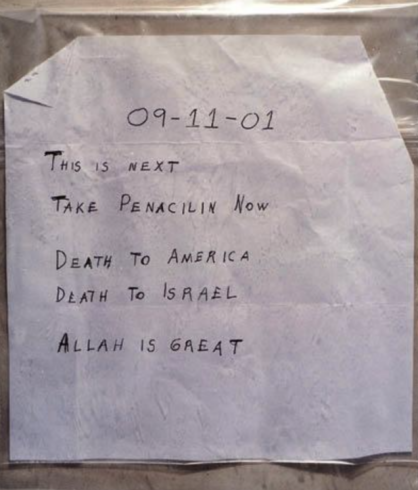
The FBI never really bothered to try to explain why a white guy would do that.
But refencing the Anthrax mailed around, Colin (pronuonced “Colon” for some reason) Powell brought white powder as a prop to his UN presentation on the need to. invade Iraq,
There was an ongoing triangle of disinformation and fake news passing from the New York Times, Dick Cheney, and Fox News. They were accusing Saddam of all kinds of things, just like they are with Iran right now, but the core of it was Cheney’s “Sinister Nexus of Terror.”
You still had the steam from 9/11 when they did the Iraq war less than two years later. But with Iran now, are we really supposed to do a massive war because of October 7th? Or is there going to need to be something more significant to motivate people?
I would very much expect that this Australian cafe and synagogue is the beginning of something bigger. With 9/11 and the Anthrax, when people were saying “oh they can’t be false flags, the government wouldn’t do that,” it was like “well, they started fake wars and killed like a million people, so why wouldn’t they blow up some buildings or send some powders?”
Looking back now, it feels like the “12 Day War” (the term they are using for the back and forth between Israel and Iran that involved Trump also dropping bombs on Iran) was a kind of probing event, where they wanted to see what Iran had. I think they were possibly a bit surprised at how capable Iran was. They were not the superpower capable of wiping Israel off the map that Scott Ritter had told everyone they were, but they were able to hit Israel and with missiles and cause real damage, and it was going to be impossible for Israel to keep going much longer before they were running out of their interceptor missiles.
Israel’s view on Iran has not changed, they are saying they are going to attack them again, and there is no way they can do it without the US, and involving the US on a large scale will probably take more than some all caps Trump tweets.
Obviously, at this point, huge numbers of people are going to be saying “false flag,” even if it is something on the scale of 9/11. So I don’t claim to know how this would work. If I was Donald Trump, I’d be worried the Mossad was going to assassinate me and blame Iran. That would get all the Trump supporters behind a war and it would leave leftists confused as to how they should feel, because if they said “false flag,” they might feel like they were defending Trump. Also, there has already been a “foreshadowing” event where Trump was allegedly scraped on the ear. And, I would add, that a personality like Trump getting shot would just generally be a bigger shock to the world than a bombing, which we’ve all already seen a lot of.
Or maybe I’m wrong and there is already enough noise and there doesn’t need to be some big event to justify further action in Iran. I guess the issue is that I don’t know really what it would take. If there needed to be an Iraq style invasion, then you would need some pretty big justification. But no one understands the logistics of this war. Like I said, I think the first thing was a test as much as anything.
But there are a lot of questions.
If there was large scale bombing of Tehran, could they do a “regime change” from the air? If so, could they keep shooting rockets without a “regime”? How stable is the domestic situation in the country? How do the Arabs, Azeris, and other minorities feel? (I think we know how the Kurds feel, lol. But the others, who knows? I don’t know. I do know that Persians are barely half the population.) Are there terrorists that can be moved in through Azerbaijan? What happened all those terrorists in Syria now that their guy is in charge? Can they be moved through Iraq and into Iran? It’s much more mountainous in Iran.
This is a lot different than when ISIS was able to just roll around wherever on the flats in the Iraqi/Syrian desert.
The mountains also provide a lot of cover for hydra-type break-off groups to operate if the government falls or is at least incapable of operating normally. I’m sure they have caves loaded up with drones and cheap missiles, and as we saw in the 12 Day War, the cost of shooting them down is too much for Israel to absorb. Even if they have infinity money from Big Daddy Donald, they can’t make that many interceptor missiles.
Those are some of the big questions. There are more questions. I’m sure the people within intelligence have better estimates than I would be able to come up with as to what the answers to these questions might be, but I think even US/Israeli intelligence can’t give definite answers regarding most of these factors.
What I do think is that slowly drilling away at it until the armor cracks like they did with Syria is not a potential strategy given that unlike Syria, Iran can hit Israel with missiles. So I’m sure what Bibi wants is the full force of the US military to be brought to bear in a full invasion type war. And for that to happen, it is most likely that something very extreme would have to precipitate it.
Iran FM says Australia’s envoy expulsion ‘appeasement’ of Israel
Press TV – August 26, 2025
Iran’s Foreign Minister has condemned Australia’s decision to expel Tehran’s ambassador over allegations of attacks on Jewish sites, describing it as an act of appeasement toward a “regime led by war criminals.”
In a post on X on Tuesday, Abbas Araghchi rejected Canberra’s allegation, citing Iran’s longstanding protection of its Jewish community.
“Iran is home to among the world’s oldest Jewish communities, including dozens of synagogues. Accusing Iran of attacking such sites in Australia while we do our utmost to protect them in our own country makes zero sense,” he said.
Araghchi said “Iran is paying the price for the Australian people’s support for Palestine”, referring to rising pro‑Palestine protests across Australia in the wake of the war in Gaza.
Earlier on Tuesday, Australian Prime Minister Anthony Albanese accused Iran of orchestrating two attacks on Jewish sites in October and December, allegations made without presenting evidence.
Media reports suggested the move could be aimed at countering Israeli criticism of Albanese’s government.
Tensions between Israel and Australia have already been running high after Canberra announced earlier this month it would join France and other nations in formalizing recognition of a Palestinian state at the UN General Assembly in September.
Israeli Prime Minister Benjamin Netanyahu reacted to that decision, accusing Albanese of “betraying Israel” and “abandoning Australia’s Jews” and labeling him a “weak politician.”
Araghchi said he was “not in the habit of joining causes with wanted War Criminals, but Netanyahu is right about one thing: Australia’s PM is indeed a ‘weak politician’.”
Issuing a warning to Australia, he added, “Canberra should know better than to attempt to appease a regime led by War Criminals. Doing so will only embolden Netanyahu and his ilk.”
Tehran has vowed reciprocal action in response to Australia’s move.
The Illusion of Israeli Self Sufficiency in Intelligence
By José Niño | The Libertarian Institute | August 26, 2025
Casual onlookers salivate at the supposed brilliance of Israel’s intelligence services. From Mossad’s assassinations abroad to daring sabotage campaigns in hostile territory, the Jewish state has been elevated in popular imagination as a scrappy David with unmatched cunning, capable of pulling off operations that leave even world powers like the United States in awe. Books, films, and mainstream pundits reinforce this myth, presenting Israel’s intelligence machine as self-sufficient and independent.
But when one peels back the layers, the narrative quickly unravels. Israel’s most celebrated operations—from targeted killings in Europe to sabotage inside Iran—were rarely the product of Israeli ingenuity alone. They relied on cooperation with the CIA, NSA cyberwarfare expertise, European intelligence networks, and even covert collaboration with Arab regimes that publicly denounce Israel while privately working with it. Much like its dependence on U.S. military aid and diplomatic cover, Israel’s intelligence empire survives not through independence but through reliance on Western logistics, intelligence sharing, and political approval. What is sold as the story of a bootstrapping nation is a case study in multinational complicity.
According to investigative reporting by Israeli journalists Melman and Ronen Bergman, Israel’s intelligence community relied heavily on intelligence partnerships with Western and allied nations to conduct clandestine activities in foreign territories.
The foundation of this intelligence cooperation traces back to the aftermath of the 1972 Munich Olympics massacre. According to Dr. Aviva Guttmann’s research, which Melman has covered extensively, the Berne Club—a secret European intelligence alliance founded in 1969—provided crucial support for Israel’s subsequent assassination campaign against Palestinian operatives. This multinational intelligence network initially included Switzerland, West Germany, France, the United Kingdom, Italy, Luxembourg, Austria, the Netherlands, and Belgium, and later expanded to include the United States, Canada, Australia, and other nations. Through an encrypted communication system called “Kilowatt,” thousands of cables were exchanged among eighteen Western intelligence services after the system was established in 1971. The network functioned as a secret clearinghouse for raw intelligence. Shared reports contained the locations of safe houses, vehicle registrations, the movements of high-value targets, updates on Palestinian guerrilla tactics, and analytical assessments, all of which provided Israel with crucial operational support for its clandestine operations.
Direct American involvement in Israeli operations became particularly evident during the George W. Bush administration. The February 2008 assassination of Hezbollah commander Imad Mughniyeh in Damascus was reportedly approved by President Bush himself after being briefed by then-CIA Director Michael Hayden. This was not merely intelligence sharing but active operational participation. “The Mossad agent would ID Mughniyeh, and the CIA man would press the remote control,” a Newsweek report noted. The CIA designed and built the bomb that killed Mughniyeh, tested it at a secret facility in North Carolina, and smuggled it into Syria through Jordan, while Mossad provided intelligence and logistical support.
When it came to confronting Iran’s nuclear program, the United States and Israel collaborated on the creation of the Stuxnet computer virus in a joint operation codenamed “Olympic Games.” The malware was designed to sabotage centrifuges at Iran’s Natanz uranium enrichment facility. According to Ronen Bergman, the virus was developed with input from Israeli cybersecurity experts alongside the U.S. National Security Agency. This operation represented a quadrilateral effort involving the CIA, NSA, Mossad, and Israel’s military intelligence agency, AMAN. It was conceived during the administrations of W. Bush and Israeli Prime Minister Ehud Olmert and ultimately executed in 2010 under President Barack Obama and Prime Minister Benjamin Netanyahu.
The scope of American involvement extended to Israel’s broader targeted killing policies. Ronen Bergman revealed that during Ariel Sharon’s tenure, a secret deal was struck with then-U.S. National Security Advisor Condoleezza Rice that committed Israel to “significantly reduce the construction of new settlements in exchange for American backing of the war with the Palestinians and of Israel’s targeted killing policy” of high-value Palestinian figures.
American intelligence cooperation facilitated Israel’s campaign against Iran’s nuclear program, with Melman documenting extensive Western knowledge of and potential involvement in the assassination of Iranian nuclear scientists between 2007-2012. The Obama administration was aware of the assassination campaign carried out by the Mujahideen-e-Khalq (MEK) terrorist organization, which was being financed, armed, and trained by Mossad. Joint Special Operations Command (JSOC) reportedly trained MEK members starting in 2005, and U.S. intelligence was providing crucial information for these operations. As one former senior intelligence official told investigative journalist Seymour Hersh, “the United States is now providing the intelligence” for assassinations carried out “primarily by MEK through liaison with the Israelis.”
Israeli dependency on foreign support went beyond Western allies to include collaborationist elements in the Arab world. Bergman revealed extensive details about Mossad’s regional cooperation during Meir Dagan’s tenure (2002-2010) as director of the Mossad, including secret partnerships with Arab intelligence services that publicly condemned Israel while privately cooperating with it. These arrangements involved joint operations with countries that “share more or less the same set of interests” despite public hostility, coordination in counter-terrorism operations across the Middle East, and partnerships that enabled many operations attributed solely to Mossad.
The pattern of foreign dependence continues in contemporary operations. An August 2025 ProPublica report by Yossi Melman and fellow journalist Dan Raviv showcased Israel’s enlistment of Iranian dissidents for executing missions inside Iran during “Operation Rising Lion.” They specifically outlined Mossad’s strategic shift from using Israeli personnel to cultivating a “foreign legion” of Iranian and regional operatives to carry out activities ranging from support functions to covert action.
This pattern of intelligence reporting by Melman and Bergman reveals that Israel’s reputation for independent intelligence capabilities obscures a reality of extensive foreign dependence, particularly on Western intelligence services, for conducting operations that extend Israeli influence and security interests globally.
Far from being a model of independence, Israel’s intelligence record underscores how deeply its operations are embedded in Western power structures. The myths of self-sufficiency and unmatched brilliance collapse under the weight of evidence: Mossad’s reach is extended only because Washington, European capitals, and even regional neighbors provide the pipelines of intelligence, technology, and manpower that make its operations possible.
The true scandal lies not in Israel’s dependency but in the willingness of other nations to abet its destabilizing campaigns by supplying the bombs, intelligence streams, and diplomatic cover that allow Tel Aviv to operate with impunity. To strip away the mythology is to confront the uncomfortable truth that Israel’s “miraculous” intelligence victories are collective endeavors, outsourced across continents, exposing not a triumph of independence but a parasitic reliance on collaborators who enable its shadow wars.
Preconditions, symbolic recognition and the ongoing erasure of Palestine
By Ramona Wadi | MEMO | August 12, 2025
September seems to be the month several Western countries have chosen to symbolically recognise the State of Palestine. The countdown to the hypothetical recognition, if it happens, will likely generate more attention than recognition itself. This is what Western diplomacy is all about, after all, when it comes to Palestine. The illusion of action.
Australia is one recent example. Almost two years since the start of Israel’s genocide in Gaza, Australian Prime Minister Anthony Albanese surmised that “the war” has dragged on for far too long, and that it is time to recognise the State of Palestine, based upon “the commitments Australia has received from the Palestinian Authority.”
According to Australian media, the PA guaranteed that it would “recognise Israel’s right to exist, demilitarise and hold general elections,” as well as exclude Hamas from future governance. While Australia would not be the only country seeking such guarantees, the fact is that the PA is guaranteeing that recognising the State of Palestine will not move beyond symbolic recognition.
Not only is Israel fast encroaching upon what remains of Palestinian territory – the latest being the plans to occupy Gaza. The PA is giving guarantees that do not allow a state to emerge from symbolic recognition. Democratic elections do not ban electoral rivals, as the PA plans to do with Hamas. Neither should democratic elections include the elimination of opponents as happened with Nizar Banat in 2021. Recognising Israel is validating, normalising and accepting colonial plunder and the entire colonial enterprise, including genocide. Demilitarisation leaves a colonised population with no options for defence.
For Albanese, however, “This is an opportunity to deliver self-determination to the people of Palestine in a way that isolates Hamas, disarms it and drives it out of the region once and for all.” He added, “The international community is moving to establish a Palestinian state, and it is opposing actions which undermine the two-state solution.”
Albanese’s statements do not even sugarcoat the surface of the international community’s complicity in Israeli colonisation of Palestine and genocide in Gaza. Recognising the state of Palestine without a real emergence of a Palestinian state does not help to establish a Palestinian state. The international community has, for decades, approved of Israeli international law violations that undermined the two-state compromise, which has been declared obsolete several years back. What the move does is merely extend a life line to the defunct diplomacy which the international community adopted to force Palestinians into subjugation to colonisation, giving Israel time to plan its next steps and normalise the outcome. Nothing can save international diplomacy after the role it played in maintaining Israel’s genocide in Gaza, especially pathetic demonstrations of symbolic recognition of a state that cannot function as a state due to Israel’s colonial enterprise and the diplomatic support colonialism received from former colonial powers.
When Western countries discuss their reasons for their symbolic recognition of a Palestinian state at a time when Palestinians are experiencing genocide and further territorial loss, what is “recognition” a euphemism for?
UK cautions it could fight China over Taiwan
RT | July 27, 2025
The United Kingdom could resort to military force against China in the event of an escalation over Taiwan, British Defense Secretary John Healey has said, though he emphasized that London continues to prefer a diplomatic resolution.
Speaking to The Telegraph during a visit to Australia, Healey said Britain would “secure peace through strength” if necessary – marking one of the clearest signals yet from a senior UK official regarding the possibility of direct confrontation with Beijing.
Healey made the remarks as the HMS Prince of Wales, a British aircraft carrier equipped with F-35 fighter jets, docked in the northern Australian city of Darwin. It is the first time in nearly 30 years that a British strike group has arrived in the region. The carrier is on a nine-month Pacific deployment, participating in Australia’s Talisman Sabre exercise and visiting ports in Japan and South Korea.
”If we have to fight, as we have done in the past, Australia and the UK are nations that will fight together. We exercise together and by exercising together and being more ready to fight, we deter better together,” Healey said when asked what London would do in case of an escalation around Taiwan.
The secretary then said he was speaking in “general terms.” According to Healey, London’s approach to Taiwan has not changed.
China considers the island of Taiwan part of its territory under the One-China principle, and insists on eventual reunification. According to the Chinese government, peaceful reunion is preferable, but it reserves the right to use force if necessary.
Taiwan has been self-governed since 1949, when nationalist forces retreated to the island after losing the Chinese Civil War. Most nations, including Russia, recognize Taiwan as part of China. The UK, as well as the US, also formally stick to the One-China principle while maintaining informal ties with Taiwan and supplying it with weapons and ammunition.
Last month, Beijing criticized a British warship’s passage through the Taiwan Strait in Chinese territorial waters. Such actions “deliberately cause trouble” and undermine peace in the area, it said.
Featured Video
Seyed M. Marandi: Negotiations Collapsed – Return to War
or go to
Aletho News Archives – Video-Images
From the Archives
Wartime internment camps in Australia
National Archives of Australia
World War I
During World War I, for security reasons the Australian Government pursued a comprehensive internment policy against enemy aliens living in Australia.
Initially only those born in countries at war with Australia were classed as enemy aliens, but later this was expanded to include people of enemy nations who were naturalised British subjects, Australian-born descendants of migrants born in enemy nations and others who were thought to pose a threat to Australia’s security.
Australia interned almost 7,000 people during World War I, of whom about 4,500 were enemy aliens and British nationals of German ancestry already resident in Australia.
Records of World War I internment camps
World War II
During World War II, Australian authorities established internment camps for three reasons – to prevent residents from assisting Australia’s enemies, to appease public opinion and to house overseas internees sent to Australia for the duration of the war.
Unlike World War I, the initial aim of internment during the later conflict was to identify and intern those who posed a particular threat to the safety or defence of the country. As the war progressed, however, this policy changed and Japanese residents were interned en masse. In the later years of the war, Germans and Italians were also interned on the basis of nationality, particularly those living in the north of Australia. In all, just over 20 per cent of all Italians resident in Australia were interned. … continue
Blog Roll
 Aletho News
- Seyed M. Marandi: Negotiations Collapsed – Return to War
- Tomorrow’s naval blockade showdown
- ‘Israel’ attacks civilians to hide its embarrassing military failures & out of pure sadism
- Any Foreign Military Vessel Approaching Hormuz Under Any Pretext ‘Will Be Dealt With Severely’: IRGC
- Diplomats slam US negotiators’ performance in Iran talks
- Trump Refuses Exit Ramp, War with Iran will Continue
- Trump Says US Naval Blockade in Strait of Hormuz Will Begin Shortly
- US, Iran end 21-hour talks without agreement
- US IRAN TALKS: Who Are the Crazy Ones Here? /Lt Col Daniel Davis
- Talks with the US end without a deal over excessive US demands: Iran
- If Americans Knew
- US-Iran ceasefire negotiations make zero progress – Daily Update
- Pro-Israel ‘Thinktanks’ and Individuals who Influence U.S. Foreign Policy
- Mearsheimer reveals how Israel dictates US policies on Iran, Gaza – video
- After killing 350+, Israel still has a “score to settle” with Lebanon before ceasefire – Daily Update
- Military aid to Israel emerges as the latest political litmus test for Democrats
- The only Palestinian children’s rights organization closes following years-long Israeli campaign against it
- ‘I Can’t Forget the Smell’: Lebanese Reel After Israel Kills Over 300 in Single Day
- DNC Shoots Down Resolutions Calling Out AIPAC and Limiting Arms to Israel
- TCN: Is Israel Blackmailing President Trump?
- Israel killed at least 303 Lebanese yesterday – who were they? Daily Update
- No Tricks Zone
- Cave Discovery Reveals Today’s Desert Climates Were Recently Far Warmer, Wetter, Teeming With Life
- German Expert: Heat Dome Led To Record Temps In Western USA…Warmer In 1934, 1936
- New Study: No Linear Warming Or Glacier Retreat Along Northern Antarctic Peninsula Since 1980s
- An Inconvenient Tree: Uncovered In Alps… Europe Much Warmer Than Today 6000 Years Ago
- New Study Reports A 60% Slowdown In Greenland’s Ice Loss Rate In The Last Decade
- Low Intensity Tornado Wrecks Major Solar Farm, Creating A Potential Toxic Dump
- New Study Finds Warming Saves Lives…Cold Temperatures 12 Times More Deadly Than Excess Heat
- German Science Blog Accuses PIK Climate Institute Of Hallucinating Climate Tipping Points
- Devastating Assessment Of Comirnaty Vaccine By Former Senior Pfizer Europe Toxicologist
- New Study: CO2 Is ‘Effectively Negligible’ As An Explanatory Climate Change Factor Since 2000
 Aletho News