Australia Spies On its Own Citizens
The Australian security state is collecting intelligence on a scale never seen before
By Murray Hunter | Asia Sentinel | November 11, 2013
Through rapid technology advances the Australian security apparatus has grown to an Orwellian scale. This has not necessarily been at the design of any elected government but something the Australian bureaucracy was forthright in promoting.
The executive government has only superficial control over the Australian surveillance system. It is fully integrated with the NSA apparatus which immediately brings up an issue about sovereignty. This is not about a country’s sovereignty over land, but knowledge. The international exchange of security information is a challenge to human rights of Australian citizens that has to be grappled with.
Consequently, it is not in the interests of the Australian or US intelligence community for any public or even parliamentary discussion. The idea that the parliament and executive are in total control of government is a myth.
Through technology and its innovative applications, the concept of privacy has been reframed to the point of anything a person does outside of the home or on a computer is public domain, captured through any of the large array of assets that can be utilized for surveillance.
This has allowed the creation of a new premise that has grown up through the administrative arm of the Australian Government, one of compliance. Australia seems to have adopted an almost fanatical compliance culture where the administrators believe that they are the natural custodians of Australia’s security interests, over the temporarily elected politicians of the day.
Some of the methods the Australian security state utilizes for intelligence gathering, storing, and collation are well documented and summarized below:
- The Australian Government database is a highly sophisticated group of electronic document and records management system(s) (EDRMS) for collating, storing, and matching data between various agencies and levels of governments. Consequently data collected by the Australian Taxation Office (ATO), social security (Centrelink), Medicare, immigration, customs, and police enforcement agencies are integrated with relational databases and query systems. This is supplemented by individual agency databases with extremely detailed information on citizens. They carry an almost complete personal history of residential details going back decades, income, occupation, spouses, children, social security benefits, medical, and travel information, etc. These systems can be accessed by almost anybody within the public service. Every agency within the government has become part of the intelligence collection network. According to academics Paul Henman and Greg Marston of the University of Queensland, these systems that enable agencies to determine client eligibility for services are highly intrusive and used with a prevailing deep suspicion of citizens in regards to their continuing eligibility for services.
- The most recent revelations in the news about the ‘five eye’ countries eavesdropping on their citizens phone conversations, emails, and other electronic communications has been astounding. Through meta-data collection systems like PRISM and ECHELON are highly likely to be also operating within Australia due to the close relationship between the NSA and Australian intelligence community. According to AFP assistant commissioner Neil Gaughan, Australian intelligence has a much better relationship with the telecommunications companies than the US intelligence agencies. However, this doesn’t appear to be a new occurrence. A reliable source working within one of the Australian telephone companies when manual exchanges were operating confirmed that ASIO and state special branches had secret rooms within the exchanges to run phone tapping operations.
- The NSW police are using an Automated Number Plate Recognition (ANPR) system which takes continuous snapshots of car number plates. This is supplemented by tracking cars when they go through tolls.
- Law enforcement agencies have announced that they are preparing to utilize drones for crime surveillance in the not too distant future.
- State and Federal Governments have been encouraging citizens to inform on other citizens they suspect of breaking the law. Government campaigns have been very successful in achieving all-time high numbers of informants in crime, social security, and taxation related matters.
The incredible power of the above described databases are exponentially enhanced when coupled with recent developments in cellular, RFID, internet, and other computer technologies. When private data in retail, banking, travel, health and insurance, etc., is linked to Intelligence collected by government, the value of data becomes massively enriched. Data collected by private organizations and utilized by security services include:
- The internet domain is under constant surveillance. Companies like Google, Yahoo, Facebook, and Twitter utilize tracking cookies to gather data on users. Australian security agencies employ private contractors like the National Open Source Intelligence Centre (NOSIC) to monitor, collate, and report on publically accessible information about individuals and organizations.
- Many business organizations such as shopping centres and banks now utilize CCTV. These assets can be utilized by security organizations to track and monitor individuals. This is now being supplemented with media access control (MAC) systems which can track smartphones. This technology is already being used in three Westfield shopping centres.
- Numerous private databases like electronic tenancy database which has detailed information. These include tenancy history, insurance company records that detail individuals insured assets, bank records, and university records. These can all be accessed by security agencies.
- Mobile phones can be used as a means to track people through inbuilt GPS on smartphones, triangulation, or through electronic data-collectors designed to identify individual mobile phones in public places.
- People’s purchase history and movements can be tracked through the use of credit, debit, and loyalty card purchases.
Emails, phones calls, places people go, and purchase history, in the context of other data collected has the latent potential to build up a profile on anybody. Data from social media like Facebook can enhance these profiles greatly by adding thought and behavior information. It’s the collection of small bits of information that can be collated into big pictures. Australian intelligence can retro-actively analyse anybody with the data they have access to.
Since 2007, when amendments to the Telecommunications (Interception & Access) Act 1974 were made during the last days of the Howard Government, government agencies have the power to search meta-data without the individual’s knowledge or any warrant.
CCTV cameras have been installed in many communities without the development of privacy policies on how they should be used. The law has yet to catch up with the ability to collect data.
Up until the 1980s most intelligence gathering was targeted monitoring of specific groups where ‘persons of interest’ were identified for intensive surveillance. ASIO and state special branches were videotaping activists primarily from the ‘left’. Surveillance was undertaken by ASIO and state special branches, where operatives used electronic means for eavesdropping, keeping index cards and files on ‘persons of interest’, recording mainly hearsay information.
Even then, red flags emerged. Peter Grabosky of the Australian Bureau of Criminology pointed out that ‘thought and discussion of public issues may be suppressed……and….excess use of (surveillance) may inhibit democratic and political freedom more subtly’. In addition, he believed that malicious accusations made from erroneous records produce false information which made innocent people suffer at the hands of the security agencies.
This problem can’t be corrected as these records are not assessable to be corrected for errors. The Mohamed Haneef arrest by the AFP in July 2007 where it was alleged he was connected with a terrorist cell in the UK, but later exonerated, hints at the security services being very territorial and ‘out of control’, where ASIO knew of Dr. Haneef’s innocence but didn’t advise the APF.
Faceless bureaucrats are the ones defining who were the enemies of the state. There appears to be a general inability to discriminate between healthy dissent in a political democracy and subversion.
Where no tangible threats existed to national security, lesser ones were perceived to be grave threats or even invented – remember “weapons of mass destruction” in Iraq.
The rise of surveillance should not be understood as purely a technological development. It should be seen as a broader economic, social, and political paradigm shift within society where the balance of power has shifted away from the people and towards the state. There also appears to be a shift of power away from executive government towards an unelected bureaucracy. What makes this even more perplexing is that we don’t even know who these people really are.
The Sydney Morning Herald just ran a story that intelligence data was passed on to assist the mining giant BHP. Moreover, the human rights website WEBMOBILIZE alleges in a recent article that the Australian security apparatus is being used to steal intellectual property from companies and passing it over illegally to competitors. Some of the organizations that have been alleged to receive unlawfully gained IP include the University of Melbourne, Ageis Media, Telstra, Sensis, Deakin University, Belgravia Health and Business Group, Channel Nine, Nine Entertainment, Nine MSN, Corporate health management, Fairfax media, the Herald Sun, The Guardian, Nintendo, and the Australian Labor Party (ALP)and Liberal National Party (LNP).
There has been little in the way of public debate, nor much concern shown by the major political parties.
The powers to detain anyone under section 34D of the Australian Security Intelligence Organization Act 1979 for up to seven days without the right to reveal their detention, resembles the mechanisms of a police state.
With an annual growth rate of more than 20% and budget of over $4 Billion p.a., ASIO has a new $500 Million building in Canberra and a secret data storage facility is being built at the HMAS Harman Naval Base, near Canberra, where details are except from public account committees. When other government programs are being cut, the deep philosophical question of why there is a need to continue the increase of funding for surveillance of the nation’s citizens requires national discussion.
Mass surveillance doesn’t seem to have much to do with terrorism as it has to do with keeping check on what people are doing. It seems to be more of an intimidating compliance mechanism, aimed at protecting public revenue, preventing and detecting crime, tax evasion, and fraud.
The rapid increase in staff within ASIO from 618 in 2000 to 1860 in 2010 has meant that the organization now primarily relies upon young and inexperienced analysts in their 20s and 30s. This means that Australia is at the mercy of a “Gen Y” culture that has grown up connected to the cyber world where a sense of privacy is very different to generations before them. Newly uncovered evidence suggests that ASIO has gone to great lengths to spy on people who have broken no laws.
Through Australia’s history Australian Security Agencies have blundered in the assessments they have made on many issues. The 2004 Flood report commenting on the “failure of intelligence” on Iraq stated that these weaknesses included “a failure to rigorously challenge preconceptions”, and the absence of a “consistent and rigorous culture of challenge to and engagement with intelligence reports”. Flood found an inconsistency in assessments and very shallow analytical abilities within the security agencies he examined. On many occasions, particularly during the Howard years, intelligence analysis was ‘bastardized” by political agenda. Those who criticized the political agenda ran the risk of being reframed from dissidents and classed as deviants who come under security surveillance.
The question here, can government with a long history of cover-ups be trusted?
The dream of a fair, just, and equitable Australian society where sovereignty is in the hands of its citizens may be one of the greatest myths. Australia’s surveillance on its own has eaten into and taken away many of the rights and liberties of Australians, turning society into one of mistrust.
This cannot be really satisfactorily answered relying only on public domain knowledge. We can only make guesses. However one undeniable fact is that there is presently a hidden and totally unaccountable part of government that is changing the nature of society. It is here where no media organizations are asking any questions.
We have entered into a new period of governance. We are now in an age of governance by surveillance of the masses by a few unknown elite and unaccountable people. Communist totalitarianism may have collapsed in Europe in 1991 with the fall of the Soviet Union, but the “free world’s” version of surveillance and intelligence would have made Stalin, Honecker, and Ceauşescu very jealous.
The lack of transparency is becoming indefensible. Without scrutiny the Australian security apparatus is the loose cannon of the Bureaucracy which will cause many reverberations like the destruction of peoples’ livelihoods through IP theft, or the ruining of peoples’ reputations through persecution.
There has never been a public mandate for the development of such an extensive surveillance program. Is the money being spent justified?
Australia Spied On Japanese Companies To Help Its Industries Negotiate Trade Deals
By Glyn Moody | Techdirt | November 12, 2013
As more information comes to light about the global snooping being conducted by the NSA and GCHQ, it is becoming clearer that much of it had little to do with combating terrorism, as a recent EFF article makes plain. But most damaging to the idea that massive surveillance was justified, because it was to protect people from extreme threats, is the revelation that commercial espionage was also being conducted. So far, the chief example of that is in Brazil, but The Sydney Morning Herald (SMH) now has information about large-scale industrial spying on Japanese companies carried out by Australian secret services:
BHP [BHP Billton — the world’s largest mining company] was among the companies helped by Australian spy agencies as they negotiated trade deals with Japan, a former Australian Secret Intelligence Service officer says.
A former diplomat has also confirmed Australian intelligence agencies have long targeted Japanese companies. Writing in The Japan Times, Professor Gregory Clark said Australian companies were beneficiaries of intelligence operations.
“In Australia, favoured firms getting spy material on Japanese contract policies and other business negotiations used to joke how [it had] ‘fallen off the back of a truck’,” Professor Clark wrote.
The article has more details, but doesn’t reveal how the materials were obtained. However, since Australia is part of the “Five Eyes” inner circle of snooping countries that also includes the US, UK, Canada and New Zealand, it seems likely that information of interest from those partners also found its way to Australian companies. SMH quotes Clark as saying:
Business information is a main target for [intelligence] agencies
It will be interesting to see if later releases from Snowden’s hoard of documents show any evidence of this Australian use of NSA materials for industrial espionage.Follow me @glynmoody on Twitter or identi.ca, and +glynmoody on Google+
Related article
New Snowden leak: Australia’s place in US spying web
RT | July 8, 2013
Ex-NSA contractor and whistleblower Edward Snowden has disclosed his first set of documents outlining Australia’s role in NSA surveillance programs, picking out four facilities in the country that contribute heavily to US spying.
The locations of dozens of the US’s and associated countries signal collection sites have been revealed by Snowden, who leaked classified National Security Agency maps to US journalist Glenn Greenwald, which were then published in the Brazilian newspaper O Globo.
The sites all play a role in the collection of data and interception of internet traffic and telecommunications on a global level.
Australian centers involved in the NSA’s data collection program, codenamed X-Keyscore, include Joint Defence Facility Pine Gap in central Australia and three Australian Signals Directorate facilities: the Shoal Bay Receiving Station in the country’s north, the Australian Defence Satellite Communications Facility on the west coast, and the naval communications station HMAS Harman outside the capital, Canberra.
New Zealand also plays a role, with the Government Security Communications Bureau facility at Waihopai, on the northern point of South Island, also contributing to the program.
X-Keyscore is described as a “national Intelligence collection mission system” by US intelligence expert William Arkin, according to Australian newspaper The Age. It processes all signals prior to being delivered to various “production lines” that deal with more specific issues including the exploration of different types of data for close scrutiny.
The different subdivisions are entitled Nucleon (voice), Pinwale (video), Mainway (call records) and Marina (internet records).
A spokesman for Australian Prime Minister Kevin Rudd declined to comment on the revelatory map, saying that it was not government practice to comment on intelligence matters, according to national broadsheet The Australian.
Australia is one of the “Five Eyes” – an alliance of intelligence-sharing countries which include of the US, United Kingdom, Canada, Australia and New Zealand.
When documents were published pertaining to the British signal intelligence agency, GCHQ’s “Tempora” program, Snowden reportedly commented that the other partners in the “Five Eyes” intelligence “sometimes go even further than the [National Security Agency] people themselves.”
“If you send a data packet and if it makes its way through the UK, we will get it. If you download anything, and the server is in the UK, then we get it,” he said.
In an interview published online last weekend in advance of its printing in German magazine Der Speigel this week, Snowden argued that the NSA was ‘in bed with the Germans’ commenting that the organization of intelligence gathering in countries involved with the organization is such that political leaders are insulated from the backlash, going on to denounce “how grievously they’re violating global privacy.”
Germany reacted to the report on Monday, with German chancellor Angela Merkel’s spokesman, Steffen Seibert, telling Reuters that the Federal Intelligence Agency’s (BND) cooperation with the NSA “took place within strict legal and judicial guidelines and is controlled by the competent parliamentary committee.”
The US and its affiliates have intelligence facilities distributed worldwide in a variety of US embassies, consulates and military facilities. In an earlier report by Der Spiegel, also based on revelations by Snowden, it was revealed that the NSA bugged EU diplomatic offices and gained access to EU internal computer networks.
Related articles
- Snowden links NZ to US spy programme (stuff.co.nz)
- Snowden reveals Australia’s links to US spy web (smh.com.au)
- Snowden releases information about Australian Intelligence gathering programs. (theage.com.au)
Mandatory Data Retention Defeated in Australia, For Now.
By Daniel Nazer | EFF | June 24, 2013
For the last few years, Australia’s security agencies have been pushing for the mandatory retention of the communications data of every citizen. If implemented, this policy would require private companies to keep communications metadata of all customers for two years. Essentially, it treats every person as a criminal suspect. Yesterday, a parliamentary committee issued a report declining to recommend data retention and strongly criticizing the government for failing to adequately explain and justify its proposal. In the wake of the report, the governing Labor Party announced it will not pursue data retention before the next election. So data retention in Australia has been defeated, for now.
The most recent push began last July, when the Attorney General’s Department submitted a list of security proposals, including data retention, to the Joint Parliamentary Committee on Intelligence and Security. The scheme met with overwhelming public opposition—98.9% of public submissions rejected data retention. Civil rights groups and individuals explained that the scheme sacrifices the privacy of all citizens. Contrary to the government’s claims, collecting metadata is highly intrusive as it reveals the most intimate connections between persons. In addition, the scheme would create a huge trove of data vulnerable to hacking while imposing significant costs on private companies dragooned to act as the government’s spies.
The government failed to rebut these objections. In a ham-fisted attempt to avoid criticism, the Attorney General’s Department initially refused to provide concrete details about its data retention scheme. The committee strongly criticized this lack of transparency:
[T]he Committee was very disconcerted to find, once it commenced its Inquiry, that the Attorney-General’s Department had much more detailed information on the topic of data retention. Departmental work, including discussions with stakeholders, had been undertaken previously. Details of this work had to be drawn from witnesses representing the [department].
Journalist Bernard Keane tweeted that he’d “never seen a government-controlled committee give a kicking to a department” like this report did. In addition to slamming the department for hiding the ball, the committee acknowledged public concern about privacy:
[A] mandatory data retention regime raises fundamental privacy issues, and is arguably a significant extension of the power of the state over the citizen. No such regime should be enacted unless those privacy and civil liberties concerns are sufficiently addressed.
The committee punted on the ultimate issue. It wrote that there was “a diversity of views within the Committee” as to the merits of a data retention regime and said it was “ultimately a decision for Government.” With an election scheduled for later this year, the governing Labor Party announced that it is dropping the unpopular scheme.
Green Party Senator Scott Ludlam cautioned that, even with the defeat of this proposal, Australia’s security agencies might achieve the same result by other means. He warned that, in light of the recent NSA Spying news, agencies may bypass domestic due process through the “wholesale importing of content and non-content data from colleagues in the U.S.” We need greater oversight of the security establishment to ensure that international cooperative agreements are not enabling the evasion of domestic legal restrictions.
Senator Ludlam also predicted that, regardless of who wins the next election, the data retention plan will be back. Security agencies will not abandon their campaign to treat every person like a criminal suspect. Privacy advocates in Australia and around the world need to keep up the fight.
Related articles
- Australian Data Retention Plan Swept Under The Rug…For Now [Updated] (gizmodo.com.au)
- Government backs down from data retention — for now (computerworld.co.nz)
Stamping Impunity on Israel’s War Crimes
By Vacy Vlazna | Palestine Chronicle | June 25 2013

Australia Post and Israel Post collaboratively issued two stamps.
Israel and Australia’s joint projects normalizing Israel’s war crimes and crimes against humanity has sunk deeper in the degenerate mire of hasbara (propaganda & lies);
“So projects that constitute normalization are not about freedom, justice or liberation, but about numbing our minds to the horror of the occupation, so we accept it as normal, as permanent, as an unchangeable fixed reality”! (1)
In May, Australia Post and Israel Post collaboratively issued two stamps commemorating the Australian Light Horse and the WWI Battle of Beersheba in Palestine. The $2.60 stamp features contemporary images of Australian Light Horsemen. The 60c stamp features the statue of an Australian Light Horseman in the Park of the Australian Soldier, funded by the Pratt Foundation, at Beersheba.
ANZAC heroic courage and endurance warrants commemoration but the issue of the stamps entailed a cynical rewriting of Australian war history that deflects ANZAC honor to deodorize Israel’s stinking reputation around the world; the recent BBC’s 2013 Country Rating Poll places Israel squarely amongst North Korea and Pakistan as the world’s most negatively viewed nations
The stamps’ description on the Australia Post shop site states:
“The capture of Beersheba allowed British Empire forces to break the Ottoman line near Gaza and then advance into Palestine, a chain of events which eventually culminated in the establishment of the state of Israel in 1948.”
Connecting the ‘capture of Beersheba’ to ‘the establishment of the state of Israel’ is an outright lie. Australian Communications minister, Steven Conroy, showing off his ready dexterity to bend over backwards for Israel, shamelessly repeated the lie:
“I don’t have any role in choosing what’s on stamps, but I do support this – it’s a wonderful tribute to the 4th Light Horse Brigade and recognizes a chain of events that eventually culminated in the establishment of the state of Israel in 1948.”
The real chain of events began in 1895 with the Zionist ambition to take over the whole of Palestine for a Jewish homeland which was accelerated in 1947 by Plan Dalet’s systematic ethnic cleansing of Palestine that destroyed over 500 villages, slaughtered thousands of villagers and forcefully deported over 700,000 indigenous Palestinians. Israel then unilaterally declared an independent state in breach of Article 22 of the Covenant of the League of Nations, still binding, that guaranteed independence for Palestine.
The Australian Zionist lobby has inflated the ANZAC lies. The Australia-Israel Chamber of Commerce announcing the special boardroom lunch to celebrate the launch piled on the hasbara:
“During WWI, Australian troops fought alongside the British army to conquer Israel from under ottoman rule…. The friendly Australian soldiers were remembered fondly by residents of the Jewish colonies of Israel. Warm ties were also formed with the Australian soldiers who were stationed in Israel during WWII.”
Fact: In 1917 (and during WWII) Israel did not exist. World War I and II were fought on Palestinian soil.
The claim by Australia Post managing director, Ahmed Fahour is highly questionable, “The Battle of Beersheba is something close to the hearts of both Israelis and Australians” when it was Palestinian fighters who helped the ANZACs …
“Defending the west and south west of the town, the 27th Division’s 67th and 81st Infantry Regiments, were deployed in the fortified semicircular line of deep trenches and redoubts strengthened by barbed wire. These regiments consisted mainly, of “Arab farmers from the surrounding region, and although inexperienced fighters they were defending their own fields.”(Massey, Graeme (2007). Beersheba: The men of the 4th Light Horse Regiment who charged on the 31st October 1917. Warracknabeal, Victoria: Warracknabeal Secondary College History Department.
… while Palestinian villagers struggled to survive the dire economic impact on their land and livelihoods of the mounted armies of the Imperial and Ottoman forces. The Turks had demolished orchards and all the cavalries ‘drank out wells and grazed their horses on standing crops’. Palestinian foodstuffs and livestock were requisitioned by the British military and consequently there was a shortage of basic food and commodities with awful disruptions to daily life.
One generation later, the same villagers were forcefully routed by Jewish terrorist militias to Gaza where they remain in desolate refugee camps under the illegal and inhumane Israeli siege.
The decision to include the image of the statue of an Australian Light Horseman in the Park of the Australian Soldier was Machiavellian sleight of hand. The Park professes to be “a permanent memorial to those who died in battle for the Jewish state.”
The Park funded by the Pratt Foundation was set up by Zionist Richard Pratt, the Australian Visy Industries billionaire who ripped off Australian customers by fixing prices and market sharing with the rival Amcor group. Visy’s underbelly has been linked to the Hells Angels reputed to have ties to criminal organizations in Australia and overseas.
Nevertheless, Australian political luminaries like Ex-PMs Kevin Rudd and John Howard have attended fundraisers at Pratt’s Melbourne mansion, Raheen; Bill Shorten- now a Minister in the Gillard government- was married there, and others such as exPM Bob Hawke, exPM Gough Whitlam, exPM Malcolm Fraser, ex state premier Nick Grieiner, former police commissioner Mick Miller have been on the Zionist’s lucrative payroll as consultants. Anthony Pratt, Richard’s successor hosted in July 2011, an Australian speaking tour of Israel’s darling, Tony Blair, the supposedly neutral envoy for the Middle East Quartet.
The Park of the Australian Soldier is included in ‘The Anzac Trail from the Be’eri Badlands to Be’er Sheva’ which is a project of the Jewish National Fund (JNF) which seizes Palestinian properties in East Jerusalem and razes, over and over, villages on the ancestral lands of impoverished Bedouins.
If you think that the hijacking of the rising sun’s glory is a preposterous fancy you may change your mind when you scratch the surface of the key-players, to find the web of corporate affiliations to Israel’s military and illegal occupation.
Ahmed Fahour Australia’s highest paid public servant, $2.78 million pa, prior to Australia Post, had a long executive career with Citigroup and its website ‘boasts the largest presence of any foreign financial institution in Israel and offers corporate and investment banking services to leading Israeli corporations and institutions, and global corporations operating in Israel’ including equity offerings for Delek.
Haim Elmoznino, CEO of Israel Post was deputy CEO of Delek Israel Fuel Corporation which supplies Israel’s military-industrial complex. Delek also fuels US warplanes. Delek was the exclusive distributer of Ford in Israel and according to Who Profits, “Ford F550 trucks were retrofitted by Hatehof for the Israeli army to armored personnel carriers for use by the IDF in the West Bank….and its vehicles are used by the ‘Caracal’ military … a combat unit which patrols the occupied section of the Jordan Valley, in the West Bank areas close to the Separation Wall and on the Israeli-Egyptian border.’
Sasi Shilo, Chairman of Israel Post, was, CEO of Netivei Hayovel in which Danya Cebus, a construction firm has a stake. Danya Cebus is a subsidiary of Africa Israel Investments Ltd:
“Africa Israel Chairman and founder Lev Leviev and his brother are responsible for the settlements of Zufim (Tsufim) and Zufim North on land belonging to the village of Jayyous in the northern West Bank. They are being built by a Leviev company called Leader Management & Development. The villageës water wells, greenhouses, and most of its agricultural land have been confiscated for these settlements. Among the largest investors in Africa Israel are Barclayës Global Investors (which has been purchased by BlackRock), and the Vanguard Group. In August 2009, Blackrock made a decision to divest from Africa Israel due to its involvement in the occupation.” (2)
Attending the stamp launch was Yaron Razon, Director of Israel Philatelic Service. who in a past life was CEO of Ma’ariv Magazines. Ma’ariv, according to The political line of Israeli papers (a reader’s guide) in +972, 2010, “ is extremely hostile to the Arab population and to human rights organizations, and recently, it shows a hospitable attitude to the settlement project (a recent double spread all but invited people to live in Tapuach, a settlement formally known as the stronghold of Kahane supporters). Among Israeli papers, Maariv is the most supportive of Avigdor Lieberman’s policies”
Also attending was Australia’s Attorney General Mark Dreyfus whose Zionist colors are for all to see in his 2012 speech (3) to the Zionist Council of Victoria where he reiterated the Australian governments ‘enduring support for Israel’ and pointed out how PM Gillard supported Israel’s wearisome mantra of its right to defend itself by perpetrating war crimes against Gaza in 2008/9 and by voting against the UN Goldstone Report which Dreyfus falsely declared was discredited.
Concerned Australians have bombarded the Postal Ombusdman, Australia Post and Minister Conroy with protests against the government’s commandeering of ANZAC and Palestinian history for the whitewashing of Israel state terrorism and demanding the withdrawal of the stamps because young ANZAC soldiers did not sacrifice their lives to give the stamp of approval to Israel’s impunity to daily violate international law and wreak inhuman suffering on Palestinian men, women, children and the elderly.
– Dr. Vacy Vlazna is Coordinator of Justice for Palestine Matters. She was Human Rights Advisor to the GAM team in the second round of the Acheh peace talks, Helsinki, February 2005 then withdrew on principle. Vacy was coordinator of the East Timor Justice Lobby as well as serving in East Timor with UNAMET and UNTAET from 1999-2001.
Notes:
(1) Samah Sabawi, Colonization of the Mind: Normalize This!
(2) Interfaith Peace Initiative.
(3) Mark Dreyfus Speech to Zionist Council of Victoria.
Spying on the World From Domestic Soil
By Katitza Rodriguez | EFF | June 21, 2013
The world is still reeling from the series of revelations about NSA and FBI surveillance. Over the past two weeks the emerging details paint a picture of pervasive, cross-border spying programs of unprecedented reach and scope: the U.S. has now admitted using domestic networks to spy on Internet users both domestically and worldwide. The people now know that foreign intelligence can spy on their communications if they travel through U.S. networks or are stored in U.S. servers.
While international public outrage has justifiably decried the scope and reach of these revelations, carte blanche foreign intelligence surveillance powers over foreigners are far from new. In the U.S., foreign intelligence has always had nearly limitless legal capacity to surveil foreigners because domestic laws and protections simply don’t reach that surveillance activity.
This legal framework, with no protection for foreigners and little oversight besides, has been exacerbated by the growth in individuals now living their lives online, who conduct their most intimate communications in cloud services that are hosted in the U.S. and across different jurisdictions. To make matters worse, the vast amount of Internet traffic globally is routed through the U.S. Last but not least, logistical barriers to powerful, mass surveillance have lowered and the application of existing legal principles in new technological contexts has become unclear and shrouded in secrecy, especially in a extra-territorial surveillance context. The US government’s FISA powers, which in 2008 opened the door to broad surveillance of communications where one side is an American and the other side is a foreigner, represent just an example of an increasing state capacity to conduct nearly limitless invasive extra-territorial surveillance from domestic soil.
International Backlash
On June 18, Germans rallied at a well-known Berlin Wall crossing point called Checkpoint Charlie. Under the motto: “Yes We Scan!” German activists protested against PRISM and NSA surveillance in response to President Barack Obama’s Berlin visit. Pictures of the rally show protest signs claiming that the Obama administration has become “Stasi 2.0” with the quote “All your data belong to us”.
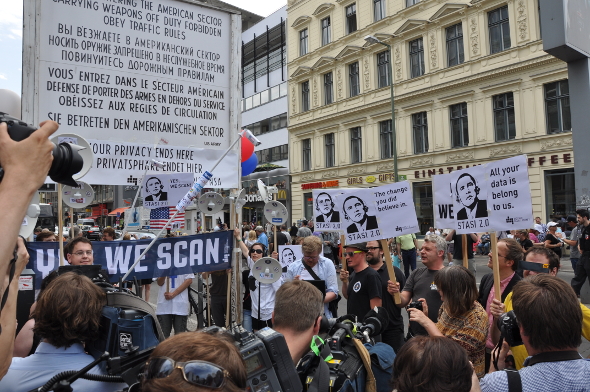
The Stasi 2.0 campaign was originally designed in 2007 to fight Germany’s mandatory data-retention law, a law implementing an EU Directive that force ISPs and telecom providers to continuously collect and store records documenting the online activities of millions of ordinary Europeans. Roughly 34,000 citizens filed a lawsuit against the mandatory data retention in protest. The campaign was successful and in March 2010 a German court declared the law unconstitutional and ordered the deletion of the collected data. Now, the Stasi 2.0 campaign has shifted focus on calling upon their government to protect them against overreach scope of NSA foreign surveillance practices, Sandra Mamitzsch from Digitale Gesellschaft told EFF.
Germany has also increased its capacity to conduct sweeping and invasive extra-territorial surveillance from its domestic soil. As we noted, the German government has leveraged its ability to remotely compromise computer systems in order to spy on its citizens. The government has used commercial malware to hack private data. While there has been no confirmation that Germany is deploying these investigative techniques against persons outside German territories, extra-territorial surveillance is feasible because infection occurs via email and other Internet transmissions.
Campaigns against the NSA spying overreach are now being planned for July 6 all around Australia. Australians can get involved here: http://ourprivacy.org.au/
Micheal Vonn, policy director at the B.C. Civil Liberties Association in Canada, told to the Global News in Canada: “[w]e fully intend to get some pointed questions to the Canadian government about knowledge, complicity, alliance with this program. And whether, in fact, very, very quietly, the Canadian security establishment has been harvesting the fruits of this program for some time.”
EFF is demanding Internet companies to join our cause and protect the privacy of their international customers calling on Congress to create a committee to uncover the truth about the NSA alarming allegations. You can take action here. Current foreign intelligence surveillance targetting foreigners must be challenged to ensure strong human rights safeguards, transparency and accountability across the world. A global dialogue on extra-territorial foreign intelligence surveillance among all nations is much needed.
EFF will continue blogging about the impact of the NSA leaks on Internet users abroad in our Spies Without Borders series. Next, we will examine what implications the government’s use of these FISA powers has for Internet users abroad, with an eye to other jurisdictions and the requirements of international law.
This is the 5th article of our Spies Without Borders series. The series are looking into how the information disclosed in the NSA leaks affect Internet users around the world whose private information is stored in U.S. servers, or whose data travels across U.S. networks.
Image: Digitale Gesellschaft, licensed under a Creative Commons BY SA 3.0 license.
Related article
Double Standards for Prisoners Vanished In Israel

By Yahya Dbouk | Al-Akhbar | February 15, 2013
The case of Ben Zygier, known as “Prisoner X,” has opened the door to questions about the possibility of Israel secretly detaining other prisoners and abductees.
Zygier, a Jewish-Australian citizen, died in an Israeli prison two years ago, in a case Israel went to extreme lengths to cover up, imposing media gag orders.
This is not the first time Israel has hidden information related to the whereabouts and conditions of prisoners. Consider, for example, reports of the three Iranian diplomats kidnapped by the Lebanese Forces during the Israeli invasion of Lebanon in 1982, who were reportedly moved to prisons in occupied Palestine.
Then consider the case of Lebanese prisoner Yahya Skaf. In addition to a wealth of reporting on his case, testimonies by other detainees all aver that he is still alive and being held in an Israeli prison. It’s a claim that Tel Aviv denies, maintaining that it lost Skaf’s body.
In the same vein, reports from various sources assert that Iranian General Mohammed Reza Asgari, who was kidnapped in Turkey in 2007, is being held in Israel.
Until recently, the global norm was to accept that Israel is a state where the rule of law is paramount. Any reports that questioned Israel’s democratic credentials were considered prejudiced or even anti-Semitic.
Yet if Tel Aviv was able to conceal the truth about Zygier for so long – the fact that he had committed suicide more than two years ago – then it’s entirely fathomable that Israel is withholding the truth about other prisoners like Skaf, Asgari, and the above-mentioned Iranian diplomats.
The answer is now clear and backed up by damning evidence: Israel has both the capability and the willingness to engage in such acts.
A simple hypothetical exercise. Let’s say the kidnapping, detention, and subsequent suicide of the Australian Prisoner X had happened to another detainee of a different nationality. How would the global media reaction differ? Would it have been as fervent as with the Australian Prisoner X?
Just look to the cases of the Lebanese and Iranian detainees, specifically with the three Iranian diplomats and General Asgari. Iran repeatedly declared that it had evidence as to their whereabouts, and the Iranian press reported extensively on the matter. Yet Israeli denials were enough to refute the Iranian account. Western and Israeli reports did not stop there, and Iran was even mocked as a source of fabricated news.
The same applies to cases involving Lebanese citizens, such as Skaf. Israel cannot possibly deny it has him, and that he had entered occupied Palestine. For one thing, Tel Aviv’s claims about Skaf and his lost body make little sense. If he had been a citizen of Australia, or other nations of similar stature, Israel’s account would have differed.
Israeli assertions that Tel Aviv had kept the Australian government in the loop on Prisoner X created more – not less – ramifications. Indeed, Israel is not only able to hide the facts and detain people in secret, but also to involve Western governments in the cover-up.
Sicily blocks construction of US defense satellite base
Gazzetta del Sud | January 11, 2013
Palermo The region of Sicily on Friday moved to suspend US defense plans to construct a satellite communications system on the Italian island after activists blocked construction crews. The move, announced by Sicily Governor Rosario Crocetta, came after protestors blocked trucks and cranes overnight in the town of Niscemi and later clashed with police near an American military base.
Builders at the site, which is part of a global satellite defense network called the Mobile User Objective System (MUOS), had allegedly rushed construction in recent days, according to the Sicily governor. “The regional government finds this sudden rush to complete the project truly extraordinary,” said Crocetta. Opponents to the project say it will be an environmental nuisance and threatens world peace. Other bases participating in MUOS are in Australia, Hawaii and Virginia.
Australian surveillance ‘out of control’: 20% increase in 1 year
RT | December 3, 2012
Access to private data has increased by 20 per cent by Australia’s law enforcement and government agencies – and with no warrant. Australians are 26 times more prone to be placed under surveillance than people in other countries, local media report.
In such a way, state structures accessed private information over 300,000 times last year – or 5,800 times every week, figures from the federal Attorney General’s Department showcase.
The data includes phone and internet account information, the details of out and inbound calls, telephone and internet access location data, as well as everything related to the Internet Protocol (IP) addresses visited, the Sydney Morning Herald reports.
Australian media report that every government agency and organization use the gathered telecommunications data, and those include the Australian Crime Commission, the Australian Securities and Investments Commission, the Australian Tax Office, Medicare and Australia Post.
New South Wales (NSW) Police became the biggest users of the private data, with 103,824 access authorizations during the last year – a third of all information accessed by the security forces.
The news triggered massive public outrage, with Australian Greens Senator Scott Ludlam telling Sydney Morning Herald, ‘‘This is the personal data of hundreds of thousands, indeed millions of Australians, and it seems that just about anyone in government can get it.”
He said the move demonstrated the current data access regime was “out of control” and amounted to the framework for a “surveillance state”.
The reports come as the federal government proposes even wider surveillance powers, including a minimum two-year standard for telephone and web providers – a measure causing public controversy.
The president for the local NSW Council for Civil Liberties, Cameron Murphy, told the Australian Financial Review that, according to the statistics, recent proposals to step up police surveillance powers and keep internet and phone data for two years or more was little more than a “fishing expedition”.
“It’s stunning and completely outrageous that so much interception is going on,” Murphy said. “What seems to be happening now is this is being done as a matter of first course and not as a matter of last resort.”
The statistics gathered by the council demonstrate that Australians are 26 times more likely to be placed under surveillance than in comparable countries.
However, a spokesperson for Attorney-General Nicola Roxon indicated that “these new statistics show telephone interception and surveillance powers are playing an even greater role for police so they can successfully pursue kidnappers, murderers and organized criminals.”
Ludlam, on the other hand, detailed what the expansion should be accompanied by.
“It’s incumbent on the parliament’s national security inquiry to recommend some form of warrant authorization be introduced, and that there be a review and reduction of the government agencies that can access the personal communications data of millions of Australians,” he said.
Related articles
- Spying ‘out of control’ (smh.com.au)
- Sharp rise in private data surveillance (theage.com.au)
- Access to private net, phone use up by 20% – without warrants (smh.com.au)
Featured Video

Stanislav Krapivnik: Russia-Iran Cooperation & Escalation in Ukraine
or go to
Aletho News Archives – Video-Images
Frlom the Archives
Are the Jews indigenous to Palestine?
By David Miller | Al Mayadeen | August 3, 2022
There is a rising tide of claims from apologists for the crimes of Zionism that they have been misunderstood. Palestinians might be indigenous to Palestine, but the Jews definitely are. What is called the ‘Israel-Palestine’ conflict, they say, is competition over the same small piece of land by two rival groups of indigenous people. But are the Jews indigenous to the Levant? And what are the consequences of the argument?
In fact, most of the power structure of the Zionist state is dominated by Ashkenazi Jews who have no ancestral link to Palestine. Overall despite very significant financial and infrastructural contributions from Western European countries (especially the US, UK and France, for example via the Rothschild family), Eastern European Ashkenazim have been at the centre of the Zionist power structure since the early years of the 20th Century. … continue
Blog Roll
 Aletho News
- Iran Red Crescent says 6,668 civilian sites targeted in US-Israeli attacks
- Maybe Attacking Iran Was Not Such A Good Idea
- UK readies deployment of Prince of Wales carrier amid war on Iran
- Iran warns of consequences after US strike on water plant
- US Bases in Middle East Fail to Secure Nations & Become Safety Risk – Expert
- Iranian Crisis Becomes Embarrassment for US Military That Can’t Protect Anyone – MidEast Analyst
- IAEA Never Had Reasons to Forgo Talks With Iran — Russian MFA Spox
- Iran pledges to ‘respect sovereignty of neighbors’, declares US-Israel assets ‘primary targets’
- USA and Israel: Who is the lord and who is the colony?
- Indian journalist reveals severe Israeli censorship after escape from occupied territories
- If Americans Knew
- US, Israel ravage Iran and Lebanon; 4 killed in Gaza – Not a ceasefire Day 148
- US troops were told war on Iran was ‘all part of God’s divine plan’, watchdog alleges
- Trump wants to run the show in Iran, but doesn’t know what he’s doing – Not a ceasefire Day 147
- ‘Dirty Work’ :The truth about how Israel was founded
- Mass Expulsion in Lebanon as Israel Expands War: “We Don’t Know Where to Go”
- Lies, distortions, and propaganda: how the U.S. mainstream media coverage on Iran hides the truth
- Palestinians in Gaza fear famine returning as Israel cuts off food amid Iran war
- AIPAC, other pro-Israel groups enter midterms with $100 million to spend
- Iranian girls killed by ‘double-tap’ strikes on Minab school
- Bari Weiss Is Going Full ‘Propaganda-Palooza’ With the Iran War
- No Tricks Zone
- Televised! Leading German Political Candidate Tells Schoolchildren CO2 Makes Sun Hotter!
- New Study: A Century Warming Of 1.1°C Is ‘Commonplace’ And ‘Not Unusual’ During This Interglacial
- New Study: ‘Internal Noise’ And Volcanic Forcing Can Trigger 10-15°C Warming Within Decades
- Glaciers Worldwide Are Suddendly Surging, Experts Blame Warming!
- Surprising Discovery: Sahara Is Greening…Billions Of Trees Where Once Thought To Be Barren
- New Research Reaffirms Clouds, Aerosols, And Surface Solar Radiation Are ‘Driving The Climate System’
- Germany: Electric Car Catches Fire At Charging Station, Sets Off Local “Inferno”, Widespread Damage
- New Study: Canada’s New Brunswick Was 1°C Warmer Than Today During The Medieval Warm Period
- Coal Power Back In Trend As Globe Tries To Keep Pace With Growing Demand For Power
- New Study: A 4°C Warmer Beaufort Sea Had ‘No Sea Ice’ 11,700 – 8200 Years Ago
 Aletho News