Sheikh Hasina speaks up on US plot
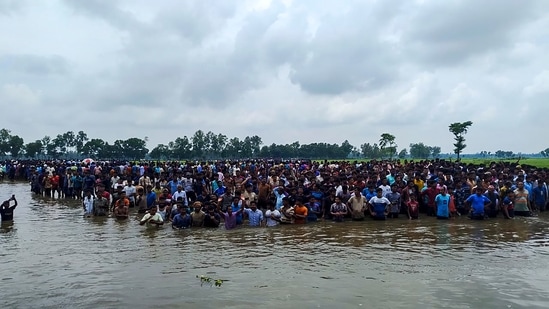
Bangladeshi Hindus fleeing to India for safety gather at the international border, Sitalkuchi, Cooch Behar, August 9, 2024
By M. K. BHADRAKUMAR | Indian Punchline | August 11, 2024
The exclusive report in today’s Economic Times carrying Sheikh Hasina’s first remarks after her ouster from power will come as a slap on the face of the nincompoops in our country who are waxing eloquently about developments in that country as a stand-alone democracy moment in regional politics.
Hasina told ET, “I resigned, so that I did not have to see the procession of dead bodies. They wanted to come to power over the dead bodies of students, but I did not allow it, I resigned from premiership. I could have remained in power if I had surrendered the sovereignty of Saint Martin Island and allowed America to hold sway over the Bay of Bengal. I beseech to the people of my land, ‘Please do not allow to be manipulated by radicals.’”
The ET report citing Awami League sources implied that the hatchet man of the colour revolution in Bangladesh is none other than Donald Lu, the incumbent Assistant Secretary of State for South and Central Asian affairs who visited Dhaka in May.
This is credible enough. A background check on Lu’s string of postings gives away the story. This Chinese -American ‘diplomat’ served as political officer in Peshawar (1992 to 1994); special assistant to Ambassador Frank Wisner (whose family lineage as operatives of the Deep State is far too well-known to be explained) in Delhi (1996-1997); subsequently, as the Deputy Chief of Mission in Delhi from 1997-2000 (during which his portfolio included Kashmir and India-Pakistan relations), inheriting the job, curiously enough, from Robin Raphel, whose reputation as India’s bête noire is still living memory — CIA analyst, lobbyist, and ‘expert’ on Pakistan affairs.
Indeed, Lu visited Bangladesh in mid-May and met with senior government officials and civil society leaders. And shortly after his visit, the US announced sanctions against then Bangladesh army chief General Aziz Ahmed for what Washington termed his involvement in “significant corruption.”
After his Dhaka visit, Lu told Voice of America openly, “Promoting democracy and human rights in Bangladesh remains a priority for us. We will continue to support the important work of civil society and journalists and to advocate for democratic processes and institutions in Bangladesh, as we do in countries around the world…
“We [US] were outspoken in our condemnation of the violence that marred the election cycle [in January] and we have urged the government of Bangladesh to credibly investigate incidents of violence and hold perpetrators accountable. We will continue to engage on these issues…”
Lu played a similar proactive role during his past assignment in Kyrgyzstan (2003-2006) which culminated a colour revolution. Lu specialised in fuelling and masterminding colour revolutions, which led to regime changes in Albania, Georgia, Azerbaijan, Kyrgyzstan and Pakistan (ouster of Imran Khan).
Sheikh Hasina’s disclosure could not have come as surprise to the Indian intelligence. In the run-up to the elections in Bangladesh in January, Russian Foreign Ministry had openly alleged that the US diplomacy was changing tack and planning a series of events to destabilise the situation in Bangladesh in the post-election scenario.
The Foreign Ministry spokesperson said in a statement in Moscow,
“On December 12-13, in a number of areas of Bangladesh, opponents of the current government blocked road traffic, burned buses, and clashed with the police. We see a direct connection between these events and the inflammatory activity of Western diplomatic missions in Dhaka. In particular, US Ambassador P Haas, which we already discussed at the briefing on November 22.
“There are serious reasons to fear that in the coming weeks an even wider arsenal of pressure, including sanctions, may be used against the government of Bangladesh, which is undesirable to the West. Key industries may come under attack, as well as a number of officials who will be accused without evidence of obstructing the democratic will of citizens in the upcoming parliamentary elections on January 7, 2024.
“Unfortunately, there is little chance that Washington will come to its senses and refrain from yet another gross interference in the internal affairs of a sovereign state. We are confident, however, that despite all the machinations of external forces, the issue of power in Bangladesh will ultimately be decided by the friendly people of this country, and no one else.”
Moscow and Beijing have nonetheless taken a scrupulously correct stance of non-interference. True to Russian pragmatism, Moscow’s Ambassador to Bangladesh Alexander Mantytsky noted that his country “will cooperate with any leader and government elected by the people of Bangladesh who is ready for equal and mutually respectful dialogue with Russia.”
That said, both Russia and China must be worried about the US intentions. Also, they cannot but be sceptical about the shape of things to come, given the abysmal record of the US’ client regimes catapulted to power through colour revolutions.
Unlike Russia, which has economic interests in Bangladesh and is a stakeholder in the creation of a multipolar world order, the security interests of China and India are going to be directly affected if the new regime in Dhaka fails to deliver and the country descends into economic crisis and lawlessness as a failed state.
It is a moot point, therefore, whether this regime change in Dhaka masterminded by Washington is ‘India-centric’ or not. The heart of the matter is that today, India is flanked on the west and the east by two unfriendly regimes that are under US influence. And this is happening at a juncture when signs are plentiful that the government’s independent foreign policies and stubborn adherence to strategic autonomy has upset the US’ Indo-Pacific strategy.
The paradox is, the colour revolution in Bangladesh was set in motion within a week of the ministerial level Quad meeting in Tokyo, which was, by the way, a hastily-arranged US initiative too. Possibly, the Indian establishment was lulled into a sense of complacency?
British Foreign Secretary David Lammy reached out to External Affairs Minister S. Jaishankar with a phone call on August 8 coinciding with the appointment of the interim government in Dhaka, which the UK has welcomed while also urging for “a peaceful pathway to an inclusive democratic future” for Bangladesh — much as the people of that country deserve “accountability.” [Emphasis added.]
India is keeping mum. The only way Bangladesh can figure a way out of the foxhole is through an inclusive democratic process going forward. But the appointment, ostensibly at the students’ recommendation, of a US-educated lawyer as the new chief justice of the Supreme Court in Dhaka is yet another ominous sign of Washington tightening its grip.
Against this geopolitical backdrop, a commentary in the Chinese daily Global Times on Thursday titled China-India relations easing, navigating new realities gives some food for thought.
It spoke of the imperative for India and China “to create a new kind of relationship that reflects their status as major powers… Both countries should welcome and support each other’s presence in their respective neighbouring regions.” Or else, the commentary underscored, “the surrounding diplomatic environment for both countries will be difficult to improve.”
The regime change in Bangladesh bears testimony to this new reality. The bottom line is that while on the one hand, Indians bought into the US narrative that they are a ‘counterweight to China’, in reality, the US has begun exploiting India-China tensions to keep them apart with a view to advance its own geopolitical agenda of regional hegemony.
Delhi should take a strategic overview of where its interests would lie in this paradigm shift, as the usual way of thinking about or doing something in our neighbourhood is brusquely replaced by a new and different experience that Washington has unilaterally imposed. What we may have failed to comprehend is that the seeds of the new paradigm were already present within the existing one.
The Caucasus and West Asia are joined at the hips
BY M. K. BHADRAKUMAR | INDIAN PUNCHLINE | OCTOBER 10, 2023
Frozen conflicts can only be understood through history. That is why the ‘erasure’ of Nagorno-Karabakh from the map by Azerbaijan is an incredibly tumultuous development for Transcaucasia and its surrounding regions.
The backdrop is the breakup of the Soviet Union, which left us with a rather odd map. Consequently, conflicts in Georgia, Armenia, Azerbaijan, Moldova, Ukraine and others left us with de facto boundaries that are unrecognised in law. There is an imperative need for a peace treaty that reflects the new facts on the ground.
At issue is the status of Nakhchivan, which still remains the landlocked exclave of Azerbaijan located near the Turkish border. Azerbaijan, emboldened by its annexation of Nagorno-Karabakh last month, is on the lookout for a direct land link to Nakhchivan, which Baku regards as unfinished business.
To attain this audacious objective, Azerbaijan — once again, with Turkey’s support — hopes to seize control of a hefty slice of Armenia’s territory, which is also that country’s borderland with Iran to the south. Unsurprisingly, both Yerevan and Tehran oppose any such move, which would otherwise mean that Armenia and Iran cease to be neighbours and get encircled by the Azeri-Turkish strategic axis.
Through dialogue and negotiations a mutually acceptable formula must be found for any land link — known as “Zangezur Corridor” — guaranteed under international law, which preserves Armenia’s territorial integrity and its border with Iran, even while providing Baku with free access to Nakhchivan.
What complicates matters is the geopolitics, involving the 3 immediate stakeholders — Armenia, Azerbaijan and Iran — and two other regional states — Russia, Turkey — as well as certain intrusive extra-regional powers and entities — the United States, European Union and NATO.
While Russia and Iran are also stakeholders, the same cannot be said for the extra-regional powers and entities who are meddling in a highly competitive regional environment. The “butterfly effect” of the Zangezur Corridor will be profoundly consequential to the Black Sea and Caspian regions and could impact the Middle East and Central Asia as well.
Among the regional states, Iran stands out for its anti-revisionist approach. During separate meetings last Wednesday in Tehran with visiting Armenian and Azerbaijani officials, Iranian President Ebrahim Raeisi reiterated amid persisting tensions over the Karabakh region Iran’s opposition to the opening of the Zangezur Corridor, saying Tehran is against geopolitical changes in the region.
Raesi reportedly stated that the Zangezur corridor would be “a NATO foothold, a national security threat for countries, and is thus resolutely opposed by Iran,” as his political chief of staff Mohammad Jamshidi put it. Tehran cannot but factor in that Israel has a strong intelligence presence in Azerbaijan.
Speculation is rife that Azerbaijan might use force to open the Zangezur Corridor, Iran’s opposition notwithstanding. Turkey, the region’s number one revisionist power is a mentor and ally of Azerbaijan with whom it claims ethnic affinities. Turkey harbours grand visions of expanding its economic reach and political influence through a land route that extends from its European border in Eastern Thrace to the Caspian Sea and over to its ancestral lands of Central Asia that border China.
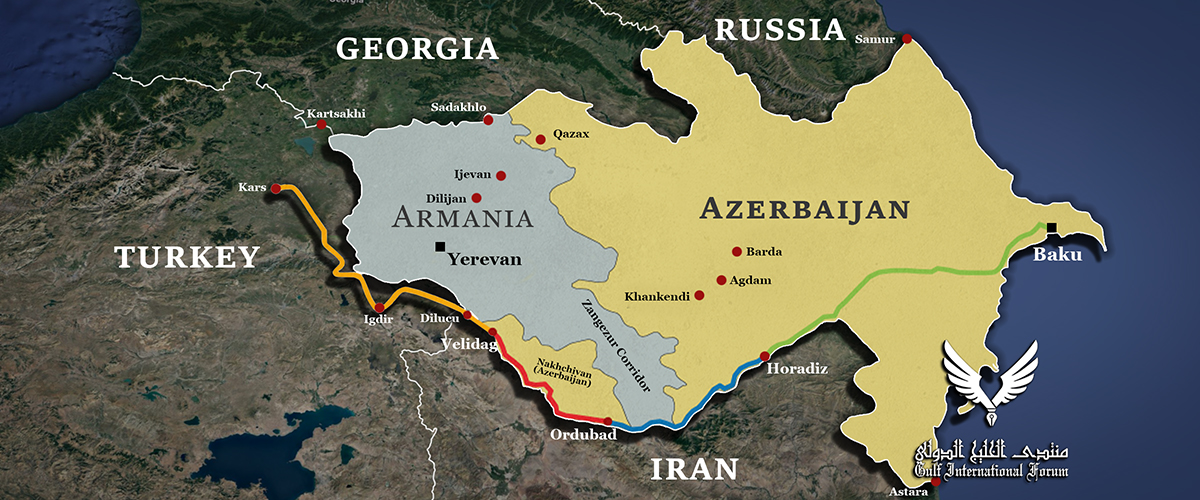
Suffice to say, the Zangezur Corridor will make Turkey a strategic hub in the geopolitics of the region if the Silk Road to Europe passes through its territory and the Soviet era land route to Russia reopens. Russia has separately promised to make Turkey an energy hub for export of its gas as well.
Much to Iran’s discomfiture, Turkey is exploiting Moscow’s dependence on Ankara in the conditions under western sanctions and the Ukraine conflict — Turkey controls the straits leading to the Black Sea from the Mediterranean— to muscle its way into the Caucasus and the Caspian, which has been traditionally Russia’s sphere of influence.
Meanwhile, Russia’s influence in the Caucasus suffered a setback as Armenia’s gradual drift toward Western benefactors following the colour revolution and regime change in Yerevan in 2018 has dramatically accelerated lately and taken an overt form. The Western powers are encouraging Armenia’s current leadership to leave the CSTO and seek the closure of the Russian bases on its soil where 5000 troops are garrisoned.
However, Armenia cannot do without Russia’s help. And Russia has strategic reserves to play itself back into the centre stage of the Caucasian chessboard. Of course, an optimal Russian comeback in the Caucasus will have to wait for its victory over the US and NATO in Ukraine, possibly by next year. Thus, Moscow seems confident that its pre-eminence in the Caucasus is a given.
Russia’s trump card, ultimately, is that much as the US and/or EU may try to get a toehold in the Caucasus, they are faraway powers and pretty much exhausted today with economic anxieties and growing war fatigue in Ukraine, amidst signs of disunity within the EU itself.
Indeed, a summit gathering close to 50 European leaders, dozens of aides and legions of journalists in Grenada, Spain, on October 5, which was billed as an opportunity to broker peace between Armenia and Azerbaijan, ended as a damp squib when Azerbaijan’s Ilham Aliyev and Turkey’s Tayyip Erdogan decided to skip the gathering and Azerbaijan accused France of bias in negotiations.
The bottom line is that in the power dynamic in the Caucasus, Iran is Russia’s natural ally and the two regional powers can be a factor of regional security and stability. This is important, since all sorts of dangers are lurking in the shade in the geopolitics of the Black Sea and Eastern mediterranean and Central Asia, and the darkening horizon presages storms ahead.
To flag a few ominous signs, the US has seized Israel’s escalating confrontation with Hamas and Hezbollah to resort to a major show of force in the Eastern Mediterranean — as if it is preordained. Such force projection cannot be an end in itself. Can it be coincidental that US-trained jihadi groups are also stirring up the Syrian pot lately?
Again, last week, a series of Ukrainian attacks in the Black Sea with Western-supplied cruise missiles forced Russian vessels to relocate from their main base in Sevastopol to the port of Novorossiisk 300 km to the east. British Defence Minister James Heappey promptly called it the “functional defeat of the Black Sea Fleet.”
Moscow is now reportedly planning to build a permanent naval base on the Black Sea coast in the breakaway Georgian region of Abkhazia.
Only a week ago, Russian Foreign Minister Sergey Lavrov warned that Moscow is alarmed by “the attempts of extra-regional players to become more active in the Afghan direction.”
Make no mistake, the US has not reconciled to the ascendance of Russian and Chinese influence in the Middle East or the Iran-Saudi rapprochement that led to an overall easing of tensions, especially Syria’s normalisation with its Arab neighbours, all of which which has drained America’s regional influence and weakened Israel.
Equally, with the spectre of a humiliating defeat in Ukraine haunting the Biden Administration, the temptation must be there to assert American hegemony. A confrontation with Iran is just what may suit Washington as ramp to cover its retreat from Ukraine’s battlefields.
Fundamentally, the US strategy is to get Russia bogged down on multiple fronts and prevent it from advancing Syria’s stabilisation optimally or consolidate its alliances with North African states — Egypt, Libya and Algeria — and expand its presence in the Sahel region which effectively thwarts NATO’s expansion plans in Africa.
Similarly, Iran’s surge as regional power has been to the detriment of Israel’s regional supremacy. Success of the US-Israeli strategy depends on piling pressure on Iran and Hezbollah, who were game changers in the Syrian conflict, and eroding the Russian-Iranian axis in West Asia, the Caucasus and the Caspian.
Armenia’s defection from the Russian orbit and the conflict situation currently developing in Gaza (and Lebanon) provide a window of opportunity to challenge Russia and Iran in the Levant. A vast armada of US warships is approaching the Eastern Mediterranean to intimidate Iran.
Meanwhile, the US hopes to undermine Saudi Arabia’s normalisation process with Iran and create contradictions within BRICS and OPEC Plus.
In sum, like in the famous play by the German modernist playwright Bertolt Brecht, The Caucasian Chalk Circle, we are currently witnessing a play within a play in the great game in Transcaucasia — an extraordinary blend of high theatricality, folk storytelling, music and even dialectical inquiry.
Nearly half of ethnic Armenians in Nagorno-Karabakh flee in fear: Armenia
Press TV – September 27, 2023
Nearly half of ethnic Armenians in Nagorno-Karabakh have fled the enclave in fear of reprisal from Azerbaijan, Armenia says, as part of an exodus caused by a military operation that brought the mountainous region back under Azerbaijan’s control.
Last week, Azerbaijan launched an operation designed to seize control of Nagorno-Karabakh, a landlocked region in the Caucasus that lies within Azerbaijan’s borders, to end a three-decade-old conflict between Baku and Yerevan over the region.
The long-troubled region has always been internationally recognized as part of Azerbaijan though it is mostly populated by ethnic Armenians, who have resisted Azerbaijan’s sovereignty over the territory.
The operation ended on September 20 and Azerbaijani military routed Armenian forces in 24 hours and made the separatists agree to lay down weapons, under a Russian-mediated ceasefire.
On Wednesday, Yerevan announced that 50,000 ethnic Armenians arrived in Armenia, out of the 120,000 ethnic Armenians living in the Nagorno-Karabakh, adding that they were “forcibly displaced”, fearing their rights and security will not be protected in Azerbaijan.
The massive exodus from the 4,400 sq km region started after Azerbaijan lifted its nine-month blockade on the enclave on Sunday.
Ethnic Armenians of the region said at least 200 people lost their lives in the fighting, including 10 civilians. Azerbaijan’s ministry of defense, for its part, released, earlier in day, a list with the names of over 150 Azerbaijani soldiers who it said were killed in the military operation.
In recent days, long queues of cars have formed on the road linking the region to Armenia.
On Monday, a fuel depot explosion claimed 68 lives of the refugees, with Armenian officials saying that they are still trying to identify the whereabouts of more than 100 people reported missing in the blast.
Azerbaijan has repeatedly said it will guarantee Armenians’ rights and integrate the region. The Azerbaijani foreign minister in his UN General Assembly address on Saturday said his country wants to integrate ethnic Armenians as “equal citizens” and denied any intention to harm them.
Armenia’s Prime Minister Nikol Pashinyan also said ethnic Armenians in Karabakh should not leave their homes unless it is absolutely necessary.
Russian peacekeepers are helping Azerbaijan disarm the Karabakh separatists.
The European Union and the United States, which have been mediating between Baku and Yerevan in recent months, have struggled to have an impact.
Nagorno-Karabakh and the failure of Armenia’s ‘colour revolution’
By Paul Robinson | Canadian Dimension | September 22, 2023
Thursday was Armenia’s independence day. This year, however, there was very little for Armenians to celebrate. Just one day earlier, the authorities of the region of Nagorno-Karabakh had in effect capitulated to Azerbaijan following a brief offensive by the Azerbaijani armed forces. The future of the region’s predominantly Armenian population remains uncertain, but the province’s complete integration into Azerbaijan is now inevitable and dreams of an Armenian Karabakh seem to be permanently shattered.
Despite its Armenian population, Nagorno-Karabakh became part of the Azerbaijani Soviet Socialist Republic as a result of a decision by the Soviet government in the early 1920s following the Bolshevik conquest of the Caucasus. Armenians, however, never reconciled themselves to this decision and when the Soviet Union began to unravel in the late 1980s, the people of Nagorno-Karabakh lobbied for their territory to be transferred to the Armenian Soviet Socialist Republic. After the dissolution of the USSR, newly independent Armenia and Azerbaijan fought what became known as the First Karabakh War, which resulted in an Armenian victory. Nagorno-Karabakh became de facto independent, while Armenia gained control of a swathe of Azerbaijani territory around it.
Subsequent diplomatic efforts to resolve the dispute between Armenia and Azerbaijan failed. Azerbaijan bided its time, built up its armed forces, and in 2020 launched the Second Karabakh War, recapturing part of Nagorno-Karabakh. Poised to recapture the rest, the Azerbaijanis halted their offensive after the Russian Federation brokered a ceasefire which saw the Armenians hand back the Azerbaijani territory around Nagorno-Karabakh. This kept what remained of the latter out of Azerbaijani control but dependent on a narrow corridor through Azerbaijani territory protected by Russian peacekeepers.
In this way, the Russians saved Nagorno-Karabakh from complete conquest. This did not, however, earn them much gratitude from Armenia’s Prime Minister, Nikol Pashinyan, who had come to power in 2018 as a result of what has been called a “colourless colour revolution.” Since the 2020 war, Pashinyan’s relations with Russia have gone from bad to worse, and following Russia’s 2022 invasion of Ukraine, Pashinyan and his government have sought to reduce their dependence on Moscow, hinting that they would leave the Collective Security Treaty Organization, of which both Armenia and Russia are members, and more recently announcing the holding of joint military exercises with the United States. Last year Pashinyan also caused a stir by seeming to recognize Azeri sovereignty over Nagorno-Karabakh.
Azerbaijan has now stepped in to exploit the situation, launching an attack on Nagorno-Karabakh that after just one day of fighting forced the Karabakh authorities to agree to completely disarm. The region’s reintegration into Azerbaijan is now bound to follow. Artin DerSimonian of the Eurasia Program at the Quincy Institute for Responsible Statecraft comments that Azerbaijan’s actions are a direct consequence of the fact that “the Russian army is pinned down in Ukraine” as well as of “Prime Minister Pashinyan’s unwillingness to directly engage Armenian forces in this fight.” Azerbaijan’s victory seems complete.
Pashinyan and his followers are attempting to blame Russia for this debacle, claiming that Moscow allowed Azerbaijan to recapture Nagorno-Karabakh in order to discredit Pashinyan, remove him from power, and install a pro-Moscow Armenian government. The thesis is an odd one. There is, after all, no good reason why Russia should fight Azerbaijan when the Armenian government itself has proven unwilling to do so. Absurdity has, however, never stopped people believing conspiracy theories, and this one may help Pashinyan deflect blame to some degree. Whether it helps him enough, though, remains to be seen.
For while some Armenians may blame Russia, many others point the finger at Pashinyan himself. Dr Pietro Shakarian, a postdoctoral fellow at the Higher School of Economics in St. Petersburg, argues that “Pashinyan’s premiership has been a disaster for the Armenian people.” Until recently, says Shakarian, “Pashinyan was able to cling to power by relying on an array of manipulative populist tactics. However… his recent recognition of Nagorno-Karabakh as part of Azerbaijan became widely viewed among Armenians as an unambiguous act of betrayal. … Today he is almost universally disliked in the country.”
Pashinyan came to power on the back of a wave of protests against the corruption of what was called the “Karabakh clan,” a group of Armenian politicians who originated from Nagorno-Karabakh and who had run Armenia for many years. These included Presidents Robert Kocharyan and Serzh Sargsyan. According to Dr. Benyamin Poghosyan, Chairman of the Centre for Political and Economic Strategic Studies in Yerevan, “hatred towards the ‘Karabakh clan’ started to be projected on Karabakh as a whole.” Consequently, many Armenians were reluctant to fight to defend it.
Beyond that, Pashinyan gave the impression of wanting to rid Armenia of the problem of Karabakh, viewing it as an impediment to his desire to turn Armenia politically westwards. Poghosyan notes that Pashinyan’s “primary goal is to normalize relations with Azerbaijan and Turkey, which will decrease the dependence on Russia and bring Armenia closer to the West. From this perspective, Nagorno-Karabakh was more a liability than an asset.” Pashinyan’s detractors, therefore, accuse him of betraying the people of Karabakh in pursuit of his broader pro-Western and anti-Russian political ambitions.
Dr. Shakarian comments that the loss of Karabakh puts into question “Russia’s whole position in the Caucasus.” “Many Western war hawks understand this,” and will seek to exploit it, he says. By contrast, Dr. Poghosyan is somewhat more ambiguous about the likely geopolitical consequences, arguing that it is harder for Armenia to turn westwards in practice than it is in theory. According to Poghosyan, “The only way for Armenia to move out of the Russian orbit and move towards the West is to accept some protection from Turkey and, in a midterm perspective, replace Russia with Turkey as a primary economic and security partner of Armenia. It will result in at least de facto Turkish and Azerbaijani control over the southern part of Armenia. … Will Pashinyan go for that? No clear answer exists.”
Equally unclear is Pashinyan’s political fate. Both Poghosyan and Shakarian express some doubt that the protestors who have now come out to demand Pashinyan’s resignation will be able to sustain their protests for long. Pashinyan himself, meanwhile, is insisting that he will remain in power. What is clear, though, is that like so many other so-called colour revolutions, the Armenian revolution of 2018 has not ended well.
Paul Robinson is a professor in the Graduate School of Public and International Affairs at the University of Ottawa and a Senior Fellow at the Institute for Peace and Diplomacy. He is the author of numerous works on Russian and Soviet history, including Russian Conservatism, published by Northern Illinois University Press in 2019.
Senior Israel delegation visits Azerbaijan 2 days before clashes in Karabakh
MEMO | September 21, 2023
Director General of Israeli Defence Ministry, Eyal Zamir, visited Azerbaijan two days before clashes erupted with Armenians in Nagorno-Karabakh, Israeli media reported on Wednesday.
Members of the Israeli delegation met with their Azeri counterparts, including Defence Minister, Zakir Hasanov, The Times of Israel said, pointing out that the visit came amid stepped-up Israeli arms supplies to Azerbaijan.
At least 32 people had been killed in the region before the clashes stopped. Azerbaijan described its attacks as an “anti-terrorist operation”.
It said it would continue until the separatist government of Nagorno-Karabakh dismantles itself and “illegal Armenian military formations” surrender.
On Wednesday, the two sides announced a ceasefire.
Israel is expanding bilateral ties with Azerbaijan. In March, Azeri Foreign Minister, Jeyhun Bayramov, opened Baku’s first-ever embassy in Israel.
Israel is one of Azerbaijan’s leading arms suppliers. According to the Stockholm International Peace Research Institute, Israel provided 69 per cent of Baku’s major arms imports in 2016-2020, accounting for 17 per cent of Israel’s arms exports over that period.
During the 2020 Nagorno-Karabakh conflict, Israel stepped up its weapons shipments to Azerbaijan, which emerged victorious in that war with Armenia.
Israel gets benefits from its relations with Azerbaijan through its location on Iran’s northern border and the fact that Israel buys over 30 per cent of its oil from Baku.
Azerbaijan, Nagorno-Karabakh Agree on Ceasefire Through Coordination of Russian Peacekeepers – MoD
Sputnik – 20.09.2023
Azerbaijan and representatives of the Armenian population of Nagorno-Karabakh have agreed on a complete cessation of hostilities through the mediation of Russian peacekeepers, the Russian Defense Ministry said on Wednesday.
“Through the mediation of the command of the Russian peacekeeping contingent, an agreement was reached between the Azerbaijani side and representatives of Nagorno-Karabakh on a complete cessation of hostilities. The implementation of these agreements will be carried out in coordination with the command of the Russian peacekeeping contingent,” the ministry said in a statement.
The Russian peacekeeping contingent in Nagorno-Karabakh is in contact with both Yerevan and Baku, discussing the prevention of bloodshed in the region, the Russian Defense Ministry said on Wednesday.
“The command of the Russian peacekeeping contingent is in close contact at the appropriate level with the Azerbaijani and Armenian sides, representatives of Nagorno-Karabakh. The prevention of bloodshed, compliance with the norms of humanitarian law in relation to the civilian population, as well as ensuring the safety of the Russian peacekeeping contingent are discussed,” the ministry said in a statement.
Russian peacekeepers continue to perform their duties in Nagorno-Karabakh in aggravated conditions, the ministry said, adding that 2,261 civilians, including 1,049 children, are currently located in a base camp of peacekeepers in Nagorno-Karabakh.
On Tuesday, Baku announced the launch of “local-level anti-terrorist activities” in Nagorno-Karabakh aimed at “restoring the constitutional order.” It also said Azerbaijani forces only targeted military objects in Nagorno-Karabakh, while Armenian state media reported multiple casualties among civilians as a result of Azerbaijani strikes. Yerevan described the operation as aggression and reiterated that it had no military presence in the disputed region.
In 1923, the region was granted the status of an autonomous area called the Nagorno-Karabakh Autonomous Oblast (NKAO) within the Azerbaijan Soviet Socialist Republic.
In 1988, a movement for reunification with Armenia began in Nagorno-Karabakh. On September 2, 1991, it declared independence from Azerbaijan and changed its name to the Nagorno-Karabakh Republic. From 1992 to 1994, Azerbaijan attempted to regain control over the self-declared republic, resulting in full-scale military hostilities in which up to 30,000 people lost their lives.
In 1994, the parties agreed to a ceasefire, but the status of the republic remained undetermined. In late September 2020, hostilities resumed in Nagorno-Karabakh. On the night of November 10, Azerbaijan and Armenia, with Moscow’s support, reached a comprehensive ceasefire agreement, maintaining their respective positions and exchanging prisoners of war and the bodies of the deceased. Russian peacekeepers were deployed in the region, including the Lachin Corridor.
In 2022 with the mediation of Russia, the United States, and the European Union, Yerevan and Baku began discussing the terms of a future peace agreement. In late May of this year, Armenian Prime Minister Nikol Pashinyan declared that Yerevan was ready to recognize Azerbaijan’s sovereignty within its Soviet-era borders, including Karabakh.
In September 2023, Russian President Vladimir Putin noted that the Armenian leadership had essentially recognized Azerbaijan’s sovereignty over Nagorno-Karabakh. Azerbaijani leader Ilham Aliyev said that Azerbaijan and Armenia could sign a peace agreement by the end of the year if Yerevan did not change its stance.
Washington Trying to Blackmail Armenians in Karabakh Into US-Brokered Talks: Here’s Why
By Ilya Tsukanov – Sputnik – 14.06.2023
The dispute between Armenians and Azerbaijanis over the landlocked mountainous region of Nagorno-Karabakh has been a source of severe tensions between the Caucasus nations, with several conflicts fought over the territory over the past 35 years. Moscow has worked tirelessly to mediate the crisis.
Washington is reportedly making a concerted, behind-the-scenes push to interfere directly in negotiations between Azerbaijan and the ethnic Armenian-led unrecognized Republic of Nagorno-Karabakh, including by blackmailing the Armenian side with the threat of a fresh round of violence in the region.
Informed sources cited by Russian media indicated that US officials – which until recently had limited their “mediation” efforts to talks between Azerbaijan and Armenia proper, are now trying to force their way into the sensitive negotiations between Baku and Stepanakert (Nagorno-Karabakh’s self-proclaimed capital).
“In the form of an ultimatum, Washington is forcing Nagorno-Karabakh representatives to agree to a meeting with the Azeri side in the near future in a third country under the supervision of American curators. Moreover, the Karabakh leadership has been told that if they refuse, they will be threatened with something close to an Azerbaijani ‘counter-terrorist operation’ in the region,’” the sources indicated.
The “ultimatum” has reportedly been received negatively in Stepanakert overall, but got support from Sergey Ghazaryan, the self-proclaimed republic’s foreign minister.
The past few weeks have seen a flurry of US and EU diplomatic activity in the Southern Caucasus, with Armenia and Azerbaijan’s foreign ministers meeting in Washington with Secretary of State Antony Blinken in early May, and Armenian Prime Minister Nikol Pashinyan and Azerbaijani President Ilham Aliyev holding talks in Brussels mediated by European Council chief Charles Michel the same month. In late May, Pashinyan, Aliyev, and Russian President Vladimir Putin held trilateral talks in Moscow. Pashinyan and Aliyev got into an argument much reported on in Western media about transport corridors during the Eurasian Economic Union Summit, with Putin intervening to quell the dispute.
US and EU mediators spoke of “significant progress” in the Armenian-Azeri talks, but few details were made public. However, on May 22, Pashinyan made the bombshell announcement that Yerevan would be ready to recognize Nagorno-Karabakh as part of Azerbaijan if the security of its ethnic Armenian population was guaranteed. This move was sharply criticized by some observers as a de-facto concession by Yerevan to leave the Karabakh issue “practically to the mercy of Western sponsors,” with autonomy guarantees for the region left off the table.
Moscow deployed a 2,000 troop-strong peacekeeping contingent to Nagorno-Karabakh three years ago after the September-November 2020 war, with these forces patrolling the Lachin corridor connecting Armenia proper to Nagorno-Karabakh. Russia’s strategy has revolved around seeking to maintain the status quo, ensuring the safety and security of the local civilian population, and preventing any further hostilities from breaking out.
Concerted Push to Eject Russia From Region
Retired Russian Foreign Ministry senior advisor Alexander Ananiev fears US and its allies and sympathetic actors in Yerevan and Baku have decided to try to remove Russia from its mediation role, and to eliminate Russia’s presence in the Southern Caucasus generally (including through the removal of the Russian military base in Armenia proper, and Yerevan’s withdrawal from Russian-led integration processes and defense agreements).
“Yerevan, with a geopolitical turn away from Russia, wants to receive the support of the West, but, in accordance with the ‘post-Soviet traditions’, not to lose anything from Russia in economics terms. For Baku, it’s important to distance itself from Moscow due to sanctions and the desire to gain a foothold as an important energy supplier to the European Union,” Ananiev wrote in a recent article in a major Russian international affairs journal.
‘Perfect’ Timing
Stanislav Tarasov, a veteran Russian political scientist specializing in Caucasus affairs, points out that the timing of the reported US “mediation effort” in Nagorno-Karabakh lines up perfectly with the signing of a major railway construction agreement by Russian and Iranian officials last month to bring the ambitious North South Transport Corridor one step closer to reality.
“The West offers nothing, have no solution of their own. They play on contradictions between Yerevan and Baku which Moscow is trying to neutralize or eliminate,” Tarasov told Sputnik.
“America’s interests are very simple. First, they would potentially like to use the South Caucasus as a springboard for ‘containing Iran.’ So far, this has not been achieved, although they did manage to carry out an operation to complicate ties between Azerbaijan and Iran. Second, they have managed to preserve a hotbed of regional tension via the Karabakh conflict. Third, the implementation of the North-South Corridor’s transit routes requires huge investments –investments which do not flow to an area facing the potential threat of war. This means Russia will seek to resolve this situation… while the West will try to destabilize it, so that Russia can’t break through the Southern Caucasus and unblock its communications,” the observer explained.

North South Transport Corridor (NSTC)
For Russia, the opening of new trade and transit routes is particularly vital today, Tarasov said, owing to the breakdown in economic relations with the West after the escalation of the Ukraine crisis, which deprived Moscow of key routes for global trade.
Consequently, “in order to block Russia in this region, the West began to put spokes in the wheels, including relating to the peace processes formed which emerged after the Second Karabakh War, but which, unfortunately, could not be fully resolved at the time,” he said.
The Devil’s In The Details When It Comes To Pashinyan’s Karabakh Peace Proposal
BY ANDREW KORYBKO | MAY 23, 2023
Armenian Prime Minister Pashinyan proposed recognizing Azerbaijan’s territorial integrity in full in exchange for it doing the same to his country, though the caveat is that he’ll only do so if the security of local Armenians there is guaranteed. This naturally raises the question of how to satisfy his requirement in a way that’s also acceptable to Azerbaijan, with one possibility being to prolong the deployment of Russia’s peacekeepers there.
It can’t be taken for granted that Azerbaijan would approve of this for the extended period of time that Pashinyan appears to be implying is required to guarantee their safety, however, since it appears to be growing frustrated with the status quo. Azerbaijan only agreed to the presence of these forces in November 2020 because it expected that they’d expedite the removal of Armenian forces in parallel with facilitating the reasserting of the state’s sovereignty over the rest of its territory.
That outcome hasn’t yet materialized, and instead, these South Caucasus rivals have even clashed several times along their internationally recognized border. Armenia also accuses Azerbaijan of violating the same Moscow-mediated ceasefire that it agreed to after self-described “activists” blocked the Lachin Corridor, while Azerbaijan accuses Armenia of doing the same by still launching attacks from Karabakh. These factors have combined to make many worry about whether another war might soon erupt.
As a self-respecting state, Azerbaijan regards it as offensive for Armenia to hint that it can’t guarantee the security of its citizens, which includes those Armenians who’ve been in Karabakh since Soviet times but not those who moved to the region as colonists after its occupation by neighboring Armenia. Its rising confidence and regional prestige as a result of its victory two and a half years ago reduces the chances that Azerbaijan would agree to prolong the deployment of Russia’s peacekeepers.
Those calculations indirectly pose a problem for Russian-Armenian relations since Moscow must prove its military-security worth to Yerevan in order to prevent its “defection” from the CSTO, with the scenario of it prolonging the deployment of its peacekeepers in Azerbaijan being the best way to do so. Armenia surprised Russia by participating in joint NATO drills last month, which was followed by its Deputy Foreign Minister revealing this month that it contemplated leaving the CSTO last September.
Pashinyan added earlier this week that Armenia’s withdrawal might indeed still happen if it concludes that the CSTO has “become a non-functional organization”, which prompted Kremlin spokesman Peskov to promise that Russia will retain relevant dialogue with its partner in an effort to prevent this. The unstated threat that was just conveyed by Yerevan is that it’ll ditch the CSTO and thus deal a major blow to Moscow if Russia can’t convince Azerbaijan to guarantee the security of Armenians there.
In the event that Armenia “defects” from this Russian-led military-security bloc, then it would immediately raise questions about Moscow’s reliability to its other partners such as those in Central Asia, thus possibly emboldening those countries to distance themselves from it too like the West wants. With Armenia out of the CSTO, it might then apply for expedited entry into NATO, which could possibly lead to it and Georgia joining together like was supposed to be the case with Finland and Sweden.
Russia must therefore do its utmost to avert this dark scenario from unfolding, to which end it’s pressed to politically resolve the Armenian-Azerbaijani conflict once and for all as soon as possible before Yerevan’s patience runs out. That said, it wouldn’t be in Armenia’s best interests to ditch the CSTO until it gets what it wants since otherwise it’ll be without Russia’s protection if Azerbaijan and/or Turkiye decide to invade its internationally recognized territory in order to resolve this conflict on their own terms.
Nevertheless, it might end up being the case that Armenia could secretly reach an agreement with the US for the latter to extend security assurances to it prior to that country’s membership in NATO upon it formally announcing its withdrawal from the CSTO and intention to join that enemy bloc. The precedent for doing so was already established last May after the US gave exactly these sort of assurances to Finland and Sweden until they joined NATO, which is still relevant to the latter since it hasn’t yet done so.
Russia’s challenge is therefore threefold since it must: 1) broker a sustainable peace deal between Armenia and Azerbaijan as soon as possible to preempt Yerevan’s “defection” from the CSTO on the pretext that this group is “non-functional”; 2) to which end Moscow must likely get Baku to agree to at least prolong the presence of Russian peacekeepers for the next few years; and 3) then ensure that Armenia still doesn’t “defect” from that bloc after it already gets what it wants from Russia.
Each of these tasks presents a formidable challenge in and of themselves, let alone having to be tackled all at once due to Armenia hinting that it’ll dump the CSTO if it doesn’t get what it wants sometime soon, and not to mention that this is happening amidst Russia’s ongoing special operation. Even so, if there’s any country whose diplomats are capable of rising to the occasion, it’s Russia’s. This doesn’t mean that they’ll succeed, but just that nobody should doubt that they’ll give this their best shot.
Kiev’s terrorist regime possibly involved in assassination attempt in Transnistria
By Lucas Leiroz | March 10, 2023
According to information recently published by local authorities in Transnistria, a terrorist attack was planned by Ukrainian saboteurs in Tiraspol, the aim of which was to kill the current president of the autonomous republic, Vadim Krasnoselsky. The case reveals that in fact Kiev maintains regular terrorist activities abroad, using sabotage tactics to eliminate civilians considered “enemies” of the Ukrainian neo-Nazi regime.
The plan was discovered by the intelligence services of the secessionist republic. According to Tiraspol’s officials, the Ukrainian scheme was discovered in time to avoid the tragedy. It is believed that not only President Krasnoselsky would be targeted by the saboteurs, but also some other top Transnistrian officials would be assassinated. The agents behind the maneuver were linked to the Ukrainian Secret Service.
In a statement published on March 9, the Ministry of State Security says that “criminal cases have been opened and are being investigated with regard to the crimes”, despite the threats having already been neutralized. With this, it is possible to say that there is evidence of other plots within the republic aiming at damaging the local political system. Certainly, more information about these criminal cases will be revealed in the course of the next few days.
The Minister of Foreign Affairs of Transnistria Vitaly Ignatiev also commented on the case. He stated that the situation is under control and that the president is working normally in his office, with assured security. Ignatiev also said that the republic will formally ask Ukraine to cooperate in the investigation of the sabotage attempt, providing all the necessary information to identify and capture those responsible for the failed attempt at terrorist attack.
Tiraspol’s authorities believe that Ukraine’s possible willingness to cooperate in punishing the saboteurs is the only way to prevent tensions from escalating. If Kiev refuses to cooperate, it will be making clear that in fact there was a deliberate operation by the regime to destabilize Transnistria, and not a unilateral action by some Ukrainian spies. More than that: by denying cooperation Kiev will also be saying that it does not regret having planned the attack and suggesting that it will continue to plot against Transnistria, thus becoming an existential threat to the Republic.
In this sense, Foreign Minister Ignatiev also stated that if nothing is done by Kiev to help with the investigations, the Transnistrian government will request that the issue be discussed at the UN Security Council – a measure that would certainly be supported by the Russian Federation, which has taken the greatest responsibility for peace in the republic, keeping troops in the region to prevent illegal advances by the Moldovan government or foreign invasions.
Ukraine is unlikely to cooperate as Kiev has long practiced a policy of open terrorism against its opponents, carrying out illegal operations abroad. The assassination of Daria Dugina, the Bryansk attack, repeated drone incursions into undisputed Russian territory, and the recent assassination attempt on businessman Konstantin Malofeev make Ukrainian terrorism evident. However, to better understand the motives for sabotaging Transnistria, it is necessary to go beyond Ukraine and investigate the interests of the sponsors of the neo-Nazi regime: the Western governments.
It is necessary to take into account that the West has recently implemented a strategy of multiplying fronts. Faced with NATO’s imminent defeat in its war against Russia using Ukraine as a proxy, the objective now is to generate as many combat fronts as possible to distract Russian forces, forcing Moscow to keep soldiers in several conflict zones simultaneously.
This explains the Western pressure for Georgia to invade Abkhazia and South Ossetia – as well as the ongoing color revolution against the pro-peace government. It is also possible to understand the Azerbaijani sabotage against Artsakh and Armenia. And even the recent tensions between Kosovar terrorists and Serbian authorities can be analyzed from this perspective. All these are conflicts in which Russia would intervene supporting one of the sides, so it is in the West’s interest to intensify tensions so that Moscow maintains several combat fronts and increases its losses.
As it is possible to see, NATO tries to open these new combat fronts only in countries that are not part of the alliance, thus guaranteeing that new confrontations are fought without the need to involve the regular troops of the western countries – which are preserved for an eventual situation of direct war against Russia or China.
Indeed, Moscow has been actively working with local Transnistrian authorities to ensure that law and order is respected in the autonomous republic. The Western attempt to open new combat fronts has already been understood by Russian strategists, who work precisely trying to prevent tensions from escalating to open confrontation. It is possible that new eruptions of military frictions will arise in the coming months, but first the Russian government will do everything possible for these cases to be resolved through intelligence and diplomacy.
Lucas Leiroz is a researcher at the Center for Geostrategic Studies; geopolitical consultant.
Isfahan incident may have been foreign provocation
By Lucas Leiroz | January 31, 2023
The Islamic Republic of Iran was the target of air strikes with drones in the early hours of January 29th. Many unconfirmed rumors about the attacks have been spread on the internet, but the most probable possibility is that the action was planned by Israelis and Azeris in order to dissuade Iran to take a less active stance in current key conflicts, considering that many factories of Shahed military drones, one of Iran’s most important weapons, were hit during the bombings.
Iran’s Ministry of Defense confirmed that some attacks occurred in the Isfahan region. Military drone factories were the main targets, which indicates that it was an assault aimed at destroying the Iranian war industry. Other regions also reported incidents, mainly Khoy, on the border with Azerbaijan, but without official confirmation from the Iranian government.
According to some anonymous sources, the drones used in the attacks probably came from an Israeli military base in Azerbaijan. During the strikes, some media outlets even published news stating that Tel Aviv had formally started a military operation inside the Iranian territory which has been described as “disinformation and “psychological warfare” by the Iranian authorities. Investigations are still being conducted and apparently there are Iranian officials both confirming and denying the Israeli involvement.
On the 30th, Iranian officials anonymously informed some Middle Eastern media outlets that data so far indicate that Tel Aviv is the side responsible for the attack. However, some other Iranian representatives on the same day have expressed skepticism about this possibility, claiming that, in such a circumstance, Tel Aviv would certainly be willing to admit its responsibility.
For example, Abbas Moghtadaei, deputy chairman of the Iranian Parliament’s Foreign Policy and National Security Commission, said during an interview to Russian press: “If Israel had done this, it would proudly show evidence of its operation to the whole world”.
However, many reasons indicate that in fact the country most interested in carrying out this assault on Iran would really be Israel. In addition to historic regional rivalries between Iran and Israel, Iran’s pro-Armenian stance on the Artsakh conflict and Tehran-Moscow cooperation regarding military drones have been seen recently as a “threat” by the Israeli government and its Western allies. Furthermore, interestingly, Israeli attacks against Iranian military and humanitarian convoys in Iraq and Syria have also occurred recently, which further points to the possibility of an Israeli wave of aggressions on Iran.
Some reasons could explain why Israel did not “confess” the attack publicly. First, it is necessary to understand that apparently the strikes had a lower effect than what was being planned by the aggressor forces. The damage caused to the drone industry was insignificant, visibly not enough to harm the Iranian-Russian or Iranian-Armenian military partnership. Pro-Israel media outlets even spread fake news trying to make the attacks seem bigger than they really were, but they failed due to concrete data, as normal life in Iran continued during the strikes, including air traffic. So, faced with an unsuccessful assault, perhaps Israel chose not to declare its involvement in the incursion.
Azerbaijani participation should also be considered. Although there was no official confirmation, there are reliable sources indicating that the drones used in the provocations were sent from an Israeli military base in Azerbaijan. Another interesting factor is that the Azerbaijani diplomats in Iran left the country after the incident, with the Azerbaijani Embassy in Tehran currently inactive. In fact, as rivalries in the region increase, Israel and Iran tend to have more and more friction – and obviously the Azeris would be interested in annihilating Iranian weapons such as the Shahed drones before it comes to an open war scenario.
What is really known is that, regardless of which country operated them, the attacks indeed happened and were certainly a response to the Iranian position in current conflicts. Shahed drones, used by Russian forces against military positions of the Ukraine’s neo-Nazi regime, are the focus of Western leaders’ concerns regarding Iran. Certainly, if a pro-Western country wanted to attack Iran, choosing drone factories as the main target would be a decision of high strategic value.
It remains to be seen how the Iranian government will react to the provocations it suffered. Tehran has historically been marked by its extreme caution in conducting military actions, responding slowly and asymmetrically to foreign affronts – and it is likely that it will also be the case this time. Of course, any measure against Israel needs to be very well planned, since Tel Aviv has nuclear weapons, but an expected scenario is increased Iranian activities on the Artsakh issue, as neutralizing Azerbaijan seems to be becoming a real necessity for the Persian country’s security.
Lucas Leiroz is a researcher in Social Sciences at the Rural Federal University of Rio de Janeiro; geopolitical consultant.
South Caucasus: A battle of wills and corridors
By Yeghia Tashjian | The Cradle | December 30, 2022
On 12 December, under the pretext of environmentalism, dozens of state-backed “eco-activists” from Azerbaijan blocked the only land corridor connecting Armenia to Nagorno-Karabakh.
The blockade created a humanitarian crisis for the 120,000 Armenians living in Nagorno-Karabakh, cutting them off from the outside world. This is not the first time Baku has taken such a provocative action. Azerbaijan has long been pushing for the creation of the “Zangezur corridor” to connect itself to close ally Turkiye through southern Armenia, thereby cutting off the strategic Armenia-Iran border.
Tehran has opposed this project and has engaged in military exercises on its border with Azerbaijan. In October, the Iranians opened a consulate in the city of Kapan in southern Armenia as a warning to Baku and its regional allies.
Blocking the Lachin corridor
Despite this, Azerbaijan, with the support of Turkiye, has continued to pursue its goal, which has included blocking the road where Russian peacekeepers are stationed in the Lachin corridor connecting Armenia to Nagorno-Karabakh.
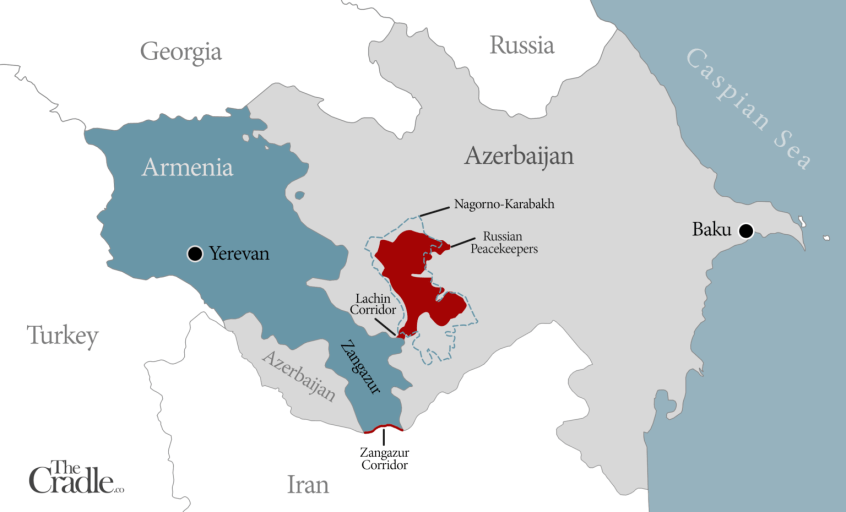
Map of Azerbaijan-Armenia conflict zones (Photo Credit: The Cradle)
In July 2022, Baku amended a contract with British company Anglo Asian Mining PLC, transferring three new mining sites inside Azerbaijan to the firm. One of these areas is located in the eastern part of Nagorno-Karabakh’s Martakert region, an area rich in gold, copper, and silver mines.
Nagorno-Karabakh’s Armenian population refused Azerbaijan’s efforts to send in monitoring groups, believing the move would give Baku control over the region’s economy and eventually lead to its annexation. In retaliation, Baku sent “environmentalists” to block the only corridor connecting Armenia to Nagorno-Karabakh.
Social media users have identified Azerbaijani state employees amid some of these “environmentalists” who periodically try to provoke Russian peacekeepers. The blockade has caused a humanitarian disaster in the region, with thousands of civilians unable to access basic necessities like medication and food via the only road connecting them to the outside world.
To compound tensions, Anglo-Asian Mining sent a letter to leading international organizations and states demanding that the “illegal exploitation” of the mines in Nagorno-Karabakh by Armenians be stopped. And yet Moscow continues to take a passive position, despite being a targeted party in the melee.
The Battle of Corridors
The blockade of the Lachin corridor did not come as a surprise, having been openly discussed in Azerbaijani media.
The only surprise was Russia’s inability to resolve the crisis. Earlier this month, Turkiye’s defense minister Hulusi Akar called on Armenia to “grasp the opportunity and respond positively to Turkiye’s and Azerbaijan’s peace calls” during joint military drills with Azerbaijan near the Iranian border.
He also commented on the “Zangezur corridor,” claiming that it was Baku’s “sincerest wish” to re-establish connections in the region and ensure “a comprehensive normalization throughout the region, including the relations between Azerbaijan-Armenia and Turkiye-Armenia.” Akar also vowed that Turkiye would continue to support Azerbaijan’s “righteous cause” against Armenia.
But on the second day of the protests organized by Azerbaijanis and the blockade on Nagorno-Karabakh, Azerbaijani media outlets made their intentions clear.
They called for the replacement of the commander of the Russian peacekeeping mission in Nagorno-Karabakh, Andrey Volkov, and for the control of the Lachin corridor to be transferred to Azerbaijan, along with the “full restoration of Azerbaijani sovereignty in the territories under the control of the peacekeepers.”
Some Azerbaijani activists also called for the removal of Russian forces and their replacement with UN-mandated forces.
Removal of Russian peacekeepers
It is unclear if Baku itself is willing to employ this language and demand the removal and replacement of Russian peacekeeping forces. According to some Azerbaijani experts, Baku is currently against the withdrawal of Russian peacekeepers by force, as this could lead to the annexation of Nagorno-Karabakh and the ethnic cleansing of Armenian Christians, which could tarnish President Ilham Aliyev’s image in the west and potentially result in US-EU economic sanctions.
Instead, Baku prefers to have the Russians stay, but in a restrictive capacity. It is easier for Azerbaijan to deal with a weak Russia, rather than with the Europeans, as they are familiar with the “Russian mentality,” says one expert. This suggests that Azerbaijan may prefer to continue using the Lachin corridor as a tool for negotiating with Moscow, rather than risking the removal of Russian forces.
Another Azerbaijani expert agreed that the current crisis is essentially between Azerbaijan and Russia – that the latter is unable to fulfill its “peacekeeping mission” and prevent the “Armenians of Karabakh from exploiting the natural resources in the region.”
But he also argues that the crisis is less about the mining and exploitation of resources, and more about pressuring the Russians to open the “Zangezur corridor,” which connects Azerbaijan proper to its Nakhichevan exclave, and lies on Iran’s strategic border with Armenia.
According to the expert, “Azerbaijan wants additional guarantees that it will have a safe connection with Turkiye, in exchange for Karabakh’s safe connection to Armenia.”
The story gets more complicated. In December, Azerbaijani media accused Armenians of inviting Iranian military experts to train Nagorno-Karabakh’s self-defense forces. The reports claim Iranians crossed the Lachin corridor and entered the territories controlled by Russian peacekeepers.
Despite Baku’s continuous barbs and provocations, it appears that Azerbaijan’s goal is not to fully remove or replace Russian peacekeepers, but rather to control their mission, monitor transit in the Lachin corridor, and use the corridor as a pressure card on Yerevan to open a “corridor” in Syunik linking Azerbaijan to Turkiye.
Therefore, from Azerbaijan’s perspective, the future of the Lachin corridor is now tied to the fate of the “Zangezur corridor.”
The view from Tehran
According to Dr. Ehsan Movahedian, researcher and instructor at the Allameh Tabataba’i University of Tehran, “the Republic of Azerbaijan is seeking a new adventure in the Caucasus region, and this issue requires diplomatic steps from the Islamic Republic of Iran and should be warning for the military authorities (in Tehran).”
One Iranian media outlet argues that if Stepanagert (the capital of Nagorno-Karabakh) falls:
“Unpleasant scenarios can be imagined for the South Caucasus region and its surrounding areas, including Iran. Removing an obstacle such as Nagorno-Karabakh paves the way for occupying Armenian territory and changing the map of the region, and in the long term for security attacks on the northwestern regions of Iran.”
The analyst, Mohammad Hossein Masumzadeh, says the only solution to halt Azerbaijan’s aggression “is offensive measures instead of the defensive approach governing the country’s regional policy in order to avoid irreparable risks.”
Some Iranian experts and former diplomats believe that the developments in the South Caucasus are related to domestic developments in Iran, where many ethnic Azeris, backed by Ankara and Baku, have called for separatist aspirations to dismantle the state from within.
Iran is concerned that the spread of Turkish influence on its northern border could impact its domestic politics in the future, as Azerbaijan has openly called for the “unification of Southern Azerbaijan (northern Iran) to the Republic of Azerbaijan.”
These do not appear to be empty threats. On 29 November, the “Organization for the Protection of the Rights of South Azerbaijanis” was established in Switzerland, announcing that it will submit documents and information to international organizations, including the UN, regarding the “rights of people in the Azerbaijani Province of Iran”.
On 2 December, the representative of “South Azerbaijan” at the UN, Araz Yurdseven, defended the idea of the independence of “South Azerbaijan” and accused Iran of committing “murders against the Iranian Azeris.”
Is the region heading for a new escalation?
Interestingly, many European and Azerbaijani experts viewed Armenian Prime Minister Nikol Pashinyan’s refusal to sign the final document of the Collective Security Treaty Organization (CSTO ) as a sign of Russian weakness, calling it “an unprecedented event that had never happened before.”
The CSTO is a Eurasian military alliance consisting of six post-Soviet states, which include Armenia, Russia, Belarus, Kazakhstan, Kyrgyzstan, and Tajikistan.
There are concerns that the region could be headed towards a new escalation. Azerbaijan has recently invited Turkish F-16 fighter jets to the region, which is being viewed as a preparation for conflict. The last time Baku invited the Turkish jets was in 2020, weeks before its war with Armenia.
Azerbaijan is also pressuring Russia to renegotiate the terms of their 10 November 2020 trilateral statement, which states that only Russian peacekeepers are responsible for controlling the Lachin corridor.
Azerbaijan is linking the blockade of the Lachin corridor to the opening of the Zangezur one. If Russia agrees to these concessions, it could lead to the isolation of Armenia, threaten its territorial integrity, and block an Iranian strategic border.
This would also shift the regional balance of power towards Turkiye, as Iran risks acting alone against Turkish-Azerbaijani pan-Turkic aspirations, which could eventually threaten Iran’s national security interests both regionally and domestically.
Resuming of Azeri-Armenian conflict would be quite suitable for the political West
Baku is trying to use the current geopolitical situation to fulfill its long-term goals
By Drago Bosnic | September 13, 2022
Over the last 24 hours, fighting broke out in multiple areas along the Armenia-Azerbaijan border. The conflict has escalated enough for Yerevan to ask its CSTO allies, in particular Russia, to intervene. This has been revealed just hours after Armenian Prime Minister Nikol Pashinyan held a late-night telephone conversation with Russian President Vladimir Putin. The Armenian government has since confirmed it has requested Russian military assistance to repel Azeri aggression and shelling, according to an official statement:
“During the meeting, further steps were discussed to counter the aggressive actions of Azerbaijan against the sovereign territory of Armenia that began at midnight. In connection with the aggression against the sovereign territory of the Republic of Armenia, it was decided to officially appeal to the Russian Federation in order to implement the provisions of the Treaty of Friendship, Cooperation and Mutual Assistance, as well as to the Collective Security Treaty Organization and the UN Security Council.”
Armenia is basing its official request on the Collective Security Treaty Organization military pact it has with Russia and four other former Soviet republics (Belarus, Kazakhstan, Kyrgyzstan and Tajikistan). Within the framework of its military cooperation with Yerevan, Russia previously sent a 2000-strong peacekeeping force to the disputed Nagorno-Karabakh (known as Artsakh to the indigenous Armenians) after the late 2020 war which saw much of the contested region taken by Azeri forces.
This escalation comes approximately a month and a half since the late July/early August clashes in the Nagorno-Karabakh Republic when Azeri forces attacked the remaining Artsakh defenders. After months of tensions, Azerbaijan accused Armenia of allegedly attacking its military units in the disputed region. Azeri Ministry of Defense claimed that Armenian soldiers supposedly opened fire at Azeri troops in Gadabay, Kalbajar and Khojavend. Initially, no casualties or material losses were reported as a result of the alleged attack, although the Azeri MoD later claimed at least one of their soldiers was killed. Azerbaijan then took what it called “retaliatory measures”. The Armenian side denied the accusations and stated that the situation in Nagorno-Karabakh is stable. Since 2020, nearly 2000 Russian peacekeepers have been deployed in Nagorno-Karabakh to enforce a ceasefire agreement signed after the large-scale Azerbaijani attack on Armenian forces late that year.
However, the latest escalation is the first large-scale incident when Azeri forces attacked Armenia proper. This is just one of many instances in which the Azeri side is claiming it’s “only defending” and is accusing Armenia of attacking its troops. Given the rather difficult position of both Armenia proper and the Armenian-populated Nagorno-Karabakh Republic, it would be strategically unwise to even contemplate escalation against Baku, especially when taking into account the clear superiority of Azeri forces in the last several years. In recent times, the oil and gas-rich Azerbaijan has been acquiring large quantities of advanced weapons from various countries, especially Turkey and Israel. At the same time, Armenia, a small landlocked country with scant resources, has been under a virtual blockade by both Turkey and Azerbaijan for over three decades and it cannot match the economic and military power of Azerbaijan alone, to say nothing of the virtually guaranteed support Baku gets from regional powers such as Turkey.
The Azeri side is most likely resuming its offensive in the region since Russia is preoccupied with its counteroffensive against NATO aggression in Europe. Baku is trying to use the current geopolitical situation to fulfill its long-term goals and it may very well be attacking Armenia directly to divert Yerevan’s attention and create an opportunity to capture the entire territory of the already surrounded Nagorno-Karabakh Republic.
However, this would require Azerbaijan to effectively go against Russia’s interests in the Southern Caucasus region. Moscow has repeatedly warned Azerbaijan against escalating the conflict with Armenia any further. Despite the successful geopolitical game Azeri leadership has been playing for years, balancing between Russia, Turkey and the political West, Moscow is unlikely to allow further attacks. Back in March, Russian Defense Minister Sergei Shoigu warned Baku that the Russian military is capable of conducting large-scale operations in multiple theaters, clearly implying that no unilateral Azeri action will be tolerated.
However, Baku seems to have the quiet backing of the EU. According to Radio Free Europe, the same day when the conflict escalated Azerbaijan announced it will increase natural gas exports to Europe this year by 30%. As Brussels is trying to reduce its dependence on Russian energy, the EU is neither willing nor in a position to condemn an Azeri attack on Armenia.
What’s more, the conflict would be quite suitable for the political West, particularly the US. First, it could further undermine relations between Russia and Turkey, which could also spill over to other regions, such as Syria. Second, it would require Russia to send additional troops to Armenia and possibly even Nagorno-Karabakh, which would divert Moscow’s attention and resources from its military operation against the NATO-backed Kiev regime. Either way, Russia is faced with a carefully coordinated destabilization on its entire western and southwestern flank and it will require nothing short of masterful strategic planning to tackle these issues without creating even more problems.
Drago Bosnic is an independent geopolitical and military analyst.
Featured Video
Yemen joins the war – Red Sea could be blocked next – Saudi regime at risk
or go to
Aletho News Archives – Video-Images
From the Archives
A superpower and “the world’s sickest warrior state”
By Paul J. Balles | March 8, 2010
Living through five or six major wars has hardened me to what I thought were the extremes of inhuman cruelty and brutality.
Two things made those extremes almost bearable: the brutality always revealed – at least according to the media coverage – the viciousness of the enemy. It was therefore quite understandable when our “brave men and women” pulverized the enemy.
Films of Japanese torturing captive Americans somehow justified holding Japanese Americans in internment camps during World War II; and only a small percentage of Americans found the bombing of Hiroshima and Nagasaki unreasonably vengeful at best, at worst, depraved.
The media giants in America portrayed the North Koreans as barbaric beasts with their captives, quite unlike their southern counterpoints – our allies during the Korean War. No one ever felt the need to explain how the South Koreans were a civilized breed while the North Koreans were absolute savages, at least according to the official line.
In Vietnam, our warriors justifiably (or so the media made us believe) dropped napalm on the North Vietnamese who had the gall to hide in villages and tunnels to ravage our invaders. At least it was accepted practice until some rogue photojournalist filmed a young girl screaming down a Vietnamese road in flames. … continue
Blog Roll
 Aletho News
- America Racing to Strategic Defeat in Iran: Lt Col Daniel Davis
- FTC Warns Visa, Mastercard, PayPal, Stripe Over Political Debanking
- Russian tanker approaches Cuba despite US oil blockade
- Marandi: Yemen joins the war – Red Sea could be blocked next – Saudi regime at risk
- Pro-Palestinian French member of European Parliament denied entry to Canada
- Pakistan to Host US-Iran Talks
- How Indonesia’s tilt toward the US left it stranded in the Strait of Hormuz
- US has no choice but to retreat from Iranian borders: Top commander
- Iran Retaliation Strikes Chemical Plant Near Dimona
- AWACS’ Destruction is a Major Loss for US Military – Ex-DoW Analyst
- If Americans Knew
- Israeli police block Catholic cardinal from entering Church of the Holy Sepulchre on Palm Sunday
- Israel is assassinating journalists again, more than any other nation, anywhere, ever – Not a ceasefire Day 170
- Over 300 US service members wounded, majority have brain injuries – Not a ceasefire Day 169
- Researchers at Human Rights Watch Resign Over Blocked Report on Palestinian Refugee Return
- Jewish Groups Are Backing a War Americans Don’t Want
- Eric Fingerhut Thinks He’s the President of the Jews
- Top Jewish Philanthropists, Rabbis Urge Israeli President to Take Action Against ‘Jewish Extremists’
- Don’t Be Fooled. Zionist Leaders Have Always Wanted to Control Southern Lebanon
- Israel’s widespread use of torture is a core element of its genocide against the Palestinian people
- In Israel’s War on Iran, Many Middle East US Bases Rendered “All But Uninhabitable”
- No Tricks Zone
- New Study Finds Warming Saves Lives…Cold Temperatures 12 Times More Deadly Than Excess Heat
- German Science Blog Accuses PIK Climate Institute Of Hallucinating Climate Tipping Points
- Devastating Assessment Of Comirnaty Vaccine By Former Senior Pfizer Europe Toxicologist
- New Study: CO2 Is ‘Effectively Negligible’ As An Explanatory Climate Change Factor Since 2000
- Former Pfizer Toxicologist Dr. Helmut Sterz Tells Bundestag Hearing Pfizer Vaccine Should Have Never Been Approved
- Energy Expert: Germany’s Nuclear Phaseout Was A “500 Billion Euro Mistake”
- New Research: South Australia’s Mid-Holocene Sea Surface Temperatures Were 4°C Warmer Than Today
- Storing Green Energy To Last Germany 10 Days Would Require A 60-Million Tonne Battery
- New Studies: UK Sea Levels Were 4 Meters Higher Than Today During The Mid-Holocene
- Destructive Green New Deal: German Energy And Metal Group Warns Of Drastic Crisis
 Aletho News