Scholz’s China trip raises hackles
BY M. K. BHADRAKUMAR | INDIAN PUNCHLINE | NOVEMBER 5, 2022
German diplomacy presented a riveting sight of “counterpoint” with Foreign Minister Annalena Baerbock hosting her G7 partners in Münster on November 3-4 even as Chancellor Olaf Sholz was deplaning from Berlin on a one-day visit to Beijing.
The photo-op showed the US Secretary of State Antony Blinken flanking Baerbock at the main table with Under-secretary of State Victoria Nuland — best known as the master of ceremonies at the 2014 “Maidan” coup in Kiev in 2014 — peering from behind.
Germany is catching up with photo journalism. Seriously, the photo couldn’t have arrested more meaningfully for the world audience the split personality of German diplomacy as the present coalition government pulls in different directions.
Quintessentially, Baerbock has highlighted her discontent with Scholz’s China visit by assembling around her the like-minded G7 counterparts. Even by norms of coalition politics, this is an excessive gesture. When a country’s top leader is on a visit abroad, a display of dissonance undercuts the diplomacy.
Equally, Baerbock’s G7 counterparts chose not to wait for Scholz’s return home. Apparently, they have a closed mind and the tidings of Scholz’s discussions in Beijing will not change that.
First thing on Monday, Scholz should ask for Baerbeck’s resignation. Better still, the latter should submit her resignation. But neither is going to happen.
In the run-up to Scholz’s China visit, he faced withering criticism for undertaking such a mission to Beijing with a business delegation of powerful German CEOs. Clearly, the Biden Administration looked to Baerbock and the influential “Atlanticist” circles embedded within Germany’s political economy to lead the charge.
Has Scholz bitten more than he could chew? The answer depends on a counter question: Is Scholz eyeing a legacy in the great tradition of his predecessors in the Social Democratic Party, Willy Brandt (1969-1974), Helmut Schmidt (1974-1982)?
Those two titanic figures took path-breaking initiatives toward the former Soviet Union and China respectively during defining moments in modern history, defying the shackles of Atlanticism that curbed Germany’s strategic autonomy and consigned that country as a subaltern in the US-led alliance system.
The cardinal difference today is that Brandt (who navigated Ostpolitik ignoring the furious American protestations over the first-ever gas pipeline connecting Soviet gas fields with Germany) and Schmidt (who seized the moment to cash in on US-China normalisation) — and Chancellor Gerhard Schroeder (1998-2005) too, who expanded and deepened expansion of business relations with Russia and struck an unprecedented working relationship with the Kremlin leadership, much to Washington’s irritation — were assertive leaders.
Put differently, it all depends on Germany’s collective will to break the NATO glass ceiling, which Lord Ismay, the Alliance’s first secretary-general, had succinctly captured as intended to “to keep the Soviet Union out, the Americans in, and the Germans down.” Currently, the interplay of three factors impact German politics.
First, the Indo-Pacific strategy. Make no mistake, the proxy war in Ukraine is a dress rehearsal for the inevitable confrontation between the US and China over Taiwan issue. In both cases involving the strategic global balance, the stakes are exceedingly high for the US’ global hegemony and the multipolarity in the world order.
Germany has a pivotal role in this epochal struggle, not only by virtue of occupying the highly volatile ground in the middle of Europe that also carries remains of history, but being the economic powerhouse in the continent at the threshold of becoming a superpower.
The angst in Washington is self-evident that Scholz’s China visit may weaken the US’ geopolitical design to repeat the impressive feat of western unity over Ukraine if tensions boil over in Asia-Pacific and China is forced to act.
Of course, no analogy is complete as China is unlikely to opt for a 9-month old, incremental special military operation by Russia to “grind” the Taiwanese military and destroy the Ukrainian state. It’ll be world war from day one.
The analogy is complete, though, when it comes to the sanctions from hell that the Biden Administration will impose on China and the brigandry of confiscation of China’s “frozen assets” (exceeding a trillion dollars at the very least) ensues, apart from paralysing China’s supply chains.
Suffice to say, “doing a Ukraine” on China holds the key to the perpetuation of US global hegemony, as China’s financial assets get appropriated to refuel America’s ailing economy and dollar’s status as world currency and neo-mercantalism and control of capital movement, etc. remain intact.
Second, one big diplomatic victory of the Biden Administration so far has been in transatlantic politics where it succeeded in consolidating its dominance over Europe by pitchforking to the centerstage the Russia question. The European countries’ Manichean fears of an historic resurgence of Russian power were stirred up.
Few expected a Russian resurgence so soon after President Vladimir Putin’s famous speech at the Munich Security Conference in February 2007.
The western narrative at that time was that Russia simply lacked the capacity to regenerate as a global power, as Russia’s military’s modernisation was unfeasible. Arguably, Chancellor Angela Merkel’s entire diplomacy toward Russia (2005-2021) was pinned on that facile narrative.
Thus, when Putin announced most unexpectedly at a meeting of the Defence Ministry Board in Moscow on 24th December 2019 that Russia has become world leader in hypersonic weaponry and that “not a single country possesses hypersonic weapons, let alone continental-range hypersonic weapons,” the West heard it with undisguised horror.
The Biden team cashed in on the profound disquiet in the European capitals to rally them and drum up “western unity” over Ukraine. But a hairline crack is now appearing over Scholz’s visit to Berlin. Blinken rushed in to push Scholz back into the fold.
Third, following the above, a fundamental contradiction has appeared today as the West’s “sanctions from hell” against Russia boomeranged on Europeans, pushing them into recession. Germany has been hit very hard, staring at the spectre of the collapse of entire sectors of its industry, consequent unemployment and social and political turmoil.
The German industrial miracle was predicated on the availability of cheap, unlimited, assured supply of energy from Russia and the disruption is creating havoc. On top of it, the sabotage of Nord Stream pipelines rules out a revival of the energy nexus between Germany and Russia (which German public opinion favours.)
To be sure, with all the data available from the sea bed in the Baltic Sea, Schulz must be well aware of the geopolitical consequences of what the US has done to Germany. But he is not in a position to create a ruckus and instead opted to internalise the sense of bitterness, especially as Germany is in a humiliating position of having to buy frightfully expensive LNG from American companies to replace Russian gas.
The only option left to Germany is to reach out to China in a desperate search to revive its economy. Incidentally, Scholz’s mission primarily aimed at the relocation of production units of BASF, the German multinational chemical company and the largest chemical producer in the world, to China.
It is highly improbable, though, that Washington will allow Scholz a free hand. Fortuitously for Washington, Scholz’s coalition partners — Greens and FDU — are unvarnished atlanticists and are willing to play the American game, too.
Brandt or Schroeder would have fought back, but Scholz is not a street fighter, although he senses the US’ grand design to transform Germany as an appendage of the American economy and integrate it into a single supply chain. Simply put, Washington expects Germany to be an indispensable cog in the wheel of the collective West.
Meanwhile, Washington holds a strong hand, as Germany’s corporate sector is also a divided house with many companies who are well-placed to benefit from the economic model shift that Washington is promoting, showing reluctance to support Scholz — albeit a corporatist chancellor himself.
The US is adept at leveraging such situations. Reportedly, some of Germany’s high-tech companies did not accept Scholz’s invitation to accompany him to Beijing, including the CEOs of Mercedes-Benz, Bosch, Continental, Infineon, SAP, and Thyssen Krupp.
EAT-Lancet Report is One-sided, Not Backed by Rigorous Science
Nutrition Coalition | January 29, 2019
[…]
Report Based on Fundamentally Weak Science
This report is disturbing on a number of fronts. Most importantly, its diet lacks the backing of any rigorous science. Indeed, it does not cite a single clinical trial to support the idea that a vegan/vegetarian diet promotes good health or fights disease. Instead EAT-Lancet relies entirely on a type of science that is weak and demonstrably unreliable, called epidemiology. This kind of science has been shown to be accurate, when tested in rigorous clinical trials, only 0-20% of the time.[1][2] One wouldn’t bet on a football team with such poor odds, so why bet on the public health this way?
Even the most recent U.S. Dietary Guidelines Advisory Committee, which clearly favored a vegetarian diet and recommended it to the entire U.S. public, found, in their review of the scientific evidence, that the power of this diet to fight any nutrition-related disease was “limited”— the lowest rank given for available data.
In the same vein, there is no rigorous (clinical trial) data on humans to show that red meat causes any kind of disease. This data can been seen in a 2-pager that The Nutrition Coalition published last week, in tandem with the EAT-Lancet report.
A One-sided Commission and No Disclosure of Potential Conflicts of Interest
The EAT-Lancet commission was portrayed as the product of 37 scientists from around the world. However, in reality, the authors represented a very narrow range of opinions: 31 out of the 37 (>80%) had established published records as being in favor of vegetarian/vegan or anti-meat diets. This includes seven from a Stockholm think tank (and EAT co-founder) dedicated to reducing/eliminating meat for environmental reasons. Thus, although readers are given the impression that the EAT authors have been objectively convened to comprehensively evaluate the science, the reality is that this group was one-sided from the start. Instead of grappling with the very real scientific controversies that exist on these topics, the group considered virtually none of the science that contradicts their views.
On diet and health, the lead commissioner was Walter Willett, professor at the Harvard Chan School of Public Health, and his extensive, significant potential conflicts of interest are published in a separate, 8-page document here.
It is also a matter of concern that none of the authors’ potential conflicts of interest were disclosed by The Lancet, an apparent violation of its standard disclosure policies.
The EAT Diet is Nutritionally Insufficient…
The EAT-Lancet diet is not only nutritionally deficient, it has been likened by some observers to the macrobiotic fad diets popular in the 1970s that resulted in severe protein and nutritional deficiencies.
UK researcher Zoe Harcombe, Ph.D., analyzed the EAT-Lancet diet and found it to provide only 17% of retinol (needed for eye health), 5% of our Vitamin D needs, 22% of sodium, 67% of potassium, 55% of calcium, and 88% of iron. Yet low as these numbers are, they would be worse still if one were to factor in the reality that most of these nutrients are less “bio-available” to humans when consumed from plant rather than animal sources.
The EAT diet is also deficient in Vitamin B12, which can only be obtained from animal foods. EAT’s note in the table below states that animal sources of protein can equally well be replaced with “plant proteins” but does not note that doing so would make the diet far more deficient in B12, which is crucial for the healthy growth and cognitive development of children, as well as the ongoing health of adults.
Thus, this diet is fairly sure to lead to malnutrition and ill health. Read Harcombe’s blog post on the subject here.
… And Inadequate in Protein
EAT-Lancet recommends .8g protein per kilogram of body weight, but many populations, including children, the overweight/obese, and most people over age 40, need more. Thus, the EAT-Lancet diet overlooks the majority of the world’s population.
EAT-Lancet also recognizes that animal foods contain the most complete proteins, ideal for human growth and health yet does not recommend that people consume these superior proteins in significant amounts. Instead, EAT recommends incomplete plant protein sources, such as beans and nuts.
Dietician and Nutritionist Diana Rodgers, points out in a blog post that in addition to being less complete, plant sources of protein come at a high cost, namely much higher calorie counts. She writes,
“To get the same amount [30 grams] of protein in a 4oz steak (181 calories) you’d need to eat 12oz of kidney beans (almost one pound!) plus a cup of rice, which equals 638 calories, and 122g of carbs.
“What about nuts? To get the 30g of protein from almonds, you would need to consume a little over 1 cup of chopped almonds, which is over 850 calories and 75g of fat. YIKES!”
The EAT Diet
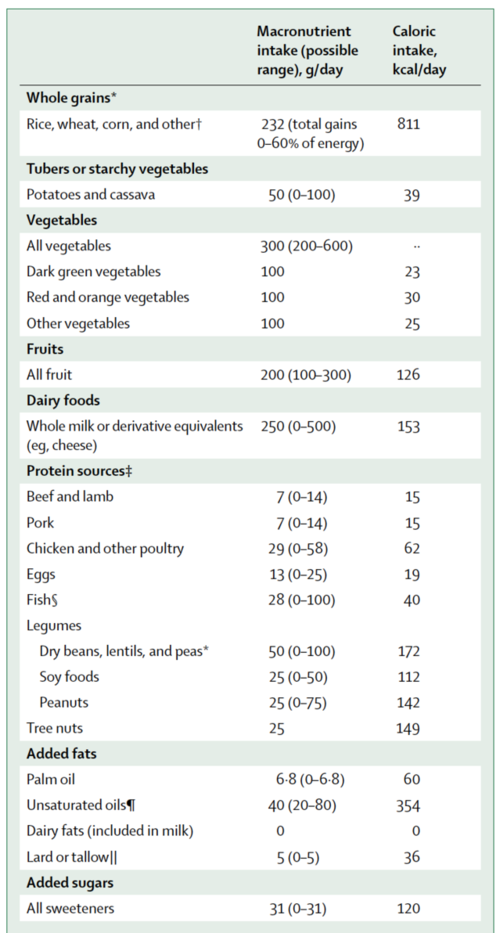
This Report is Not for Children, Teen Girls, the Aged, Malnourished, etc…And For Everyone Else, You Still Need to Buy Supplements
Georgia Ede, MD, in Psychology Today, digs into the report and uncovers a number of uncomfortable facts.
Among her findings:
—Although the report says complete proteins cause cancer, it provides no evidence for that statement.
—And:
“The authors admit that it [the report] falls short of providing proper nutrition for growing children, adolescent girls, pregnant women, aging adults, the malnourished, and the impoverished — and that even those not within these special categories will need to take supplements to meet their basic [nutritional] requirements.”
EAT Diet Recommends A Fudge Pop Tart’s Worth of Sugar/Day?
One would think from the report’s language that its recommendations are all about eating more fruits, vegetables, and whole grains, but in fact, EAT advises:
—Only 3% of calories from vegetables. Add the “potatoes/cassava” category, and the total creeps up to 5%
—Only 5% of calories from fruit
This does not appear to be a “more fruits and vegetables” report.
Rather, EAT promotes 8 teaspoons of sugar a day, which is about the equivalent of a fudge pop tart.
It also promotes 14% of calories as “unsaturated fats” which are defined as equal amounts of “olive, soybean, rapeseed, sunflower, and peanut oil.” Other than olive oil, these are all unnatural, industrial products that only entered the food supply about a century ago. Fourteen percent of calories in vegetable oils is far more than the average American now consumes.
Mostly, EAT recommends massive amounts of grains (rice, wheat, corn, soy, etc). According to EAT, these should comprise fully one third, or 32% of daily calories. Some 51% of a person’s daily calories should be consumed as carbohydrates, says EAT, according to Harcombe’s calculations.
Thus, we have a report recommending lots of wheat, rice, corn, soy and more sugar than most national guidelines. This diet is virtually toxic to people with diabetes or pre-diabetes and dangerously high in sugars for people struggling with obesity, heart diseases, fatty liver disease and other nutrition-related conditions.
If not for the public health, then whom does this diet serve?
The Corporate Interests Behind EAT-Lancet
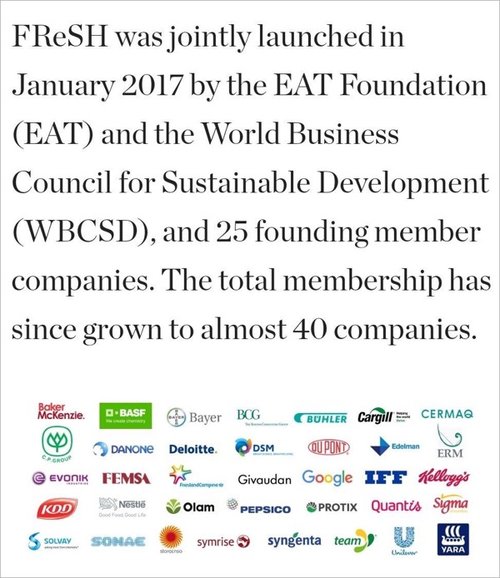
EAT-Lancet was launched simultaneously in 40 cities with a massive PR budget. Who funded all this? All we know is that EAT has an extensive array of corporate partnerships.
Tim Rees of Nutritional Therapy Online created a table of all the EAT-Lancet corporate funders. These include;
—Seven Big Pharma companies, with drugs for many nutrition-related diseases
—About 20 Big Food companies, including Kellogg’s, Nestle, and PepsiCo.
Note that the companies selling highly processed foods, like Nestle and Kellogg’s are essentially vegan. The vast majority of packaged foods sold on the inner aisles of supermarkets—cookies, crackers, chips (crisps), candy, cereals—are made up of the same basic ingredients: soy, corn, grains, sugars, and salt. This is vegan. These companies would presumably like nothing more than to put a big green V on their packages to give them a reason to advertise their foods as healthy.
Meanwhile, the pharmaceutical companies profit from selling drugs, insulin, and devices that sick people need. Would these companies be backing EAT if this diet were to genuinely improve health, reduce disease, and thus, shrink their profits? It’s hard to imagine.
Moreover, also supporting the EAT-Lancet report are:
—14 chemical companies, including BASF, the “world’s largest chemical company.”
What is the interest of these companies in supporting a report targeting animal agriculture as the main driver of global warming if not—perhaps—to displace attention away from their own polluting activities? Or perhaps they make the pesticides that grow crops.
One cannot know the answer to all these questions, but the massive level of corporate backing clearly raises serious questions about the interests behind this report, especially when there is no rigorous evidence to support the idea that this diet promotes human health and quite a bit of evidence to show that it causes harm.
The Globe-Trotting Billionaires Behind the Report
The founder and executive chair of EAT, vegan Norwegian billionaire, Gunhild Stordalen, says she has a passion for preventing climate change. Shortly after publication of EAT-Lancet, however, she was revealed to be the owner of a $26 million private jet which she and her husband regularly fly to exotic locations around the world—thus emitting vast amounts of their own greenhouse gasses (GHG) and causing some observers to wonder if Stordalen was unwittingly enacting a modern-day version of “let them eat cake.”
The Mirror UK published, “Globe-trotting billionaire behind campaign to save planet accused of blatant hypocrisy.”
On Twitter, one observer did some calculations:
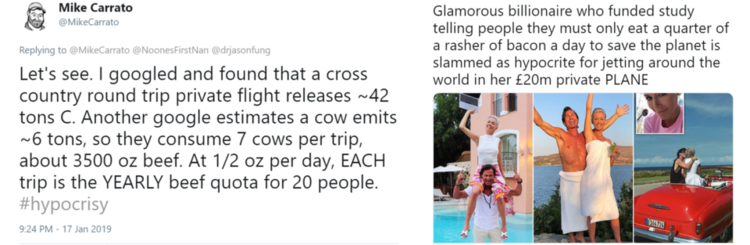
Thanks to Belinda Fettke and her article for this find.
One could ask, further, about the GHG emitted by the whole EAT-Lancet project. Thirty-seven authors from 16 countries were gathered together for at least two scientific meetings, followed in 2019 by at least 5 “launch” meetings by the Commission, as well as a further massive roll-out last week in 35 sites worldwide.
A second EAT-Lancet paper, released January 27th, involved 43 authors from countries around the globe, who were gathered for 9 “workshops” and 3 meetings in various locations worldwide. How much GHG was required to enable all this travel?
Although many researchers claim that planes, trains, and automobiles do not produce as much greenhouse gases as do cows, there are contrary views on this topic. For instance, as the Food and Agriculture Organization recently pointed out, the GHG of livestock have been calculated to include both direct and indirect costs, whereas the transport sector has been analyzed looking only at direct costs. I’m not an expert in the environmental issues here, but this does seem like a worrisome oversight.
One Other Significant Funder of EAT-Lancet: The Wellcome Trust
Among the complex network of funders behind EAT, the Wellcome Trust is a principal one, for the report’s scientific component (as opposed to the worldwide PR). The trust, with $29.2 billion in assets, is funded by the Wellcome family and its pharmaceutical fortune. This family also has a three-generation history in the 7th Day Adventist Church, including a member—the father of the trust’s founder—who was a church elder. The 7th Day Adventist Church promotes vegetarianism as part of its religious beliefs and has pursued an aggressive mission to spread these beliefs and practices around the world. This raises the disturbing question of whether a religious agenda might be informing the EAT-Lancet report.
EAT-Lancet Aggressive in its Policy Recommendations: Wants Near-Vegan Diet for All
EAT-Lancet states that “the scale of change to the food system is unlikely to be successful if left to the individual or the whim of consumer choice.” [Emphasis added.] Thus, the report advocates:
“hard policy interventions include laws, fiscal measures, subsidies and penalties, trade reconfiguration, and other economic and structural measures…. [C]ountries and authorities should not restrict themselves to narrow measures or soft interventions. Too often policy remains at the soft end of the policy ladder.”
Because meat taxes seems to be the intervention of choice, stay tuned for those… and other measures intervening in our daily choices about what to eat.
There’s a Better, Evidence-based Way Forward
In all, EAT-Lancet has every indication of being the product of international industrialist interests, from processed food companies, whose products provoke nutrition-related diseases, to pharmaceutical companies, whose profits are fueled by those diseases, to the world’s chemical companies, whose interests in environmental well-being are elusive. The common cause of these industries appears now to be scapegoating meat for all environmental and health ills. And they have found willing advocates in the committed, idealistic vegans and environmentalists who deeply believe in these solutions.
We should return to the fundamentals of good science. Establishing policy based on weak science leads to unintended consequences as we’ve seen time and again—with the mistaken policies recommending hormone replacement therapy, caps on cholesterol, and more. Such policies actually ended up causing far more harm than good, as the EAT diet seems bound to do.
What does the rigorous science say about the best way to reverse the epidemics of obesity and diabetes (and more) now crippling our nations? The rigorous evidence does not support a near-vegan diet. The answer must include animal foods, since they naturally contain the nutrients needed for healthy human growth and development.
Our way forward should be to gather a group of experts who could objectively identify the rigorous clinical trial data on healthy diets, and then work together to make those diets sustainable.
Footnotes:
[1] 0%, analysis specifically of nutritional epidemiology: https://rss.onlinelibrary.wiley.com/doi/pdf/10.1111/j.1740-9713.2011.00506.x
[2] 20%: https://www.ncbi.nlm.nih.gov/pubmed/16014596
Featured Video
John Mearsheimer: US Already lost Iran war – No off-ramp in sight
or go to
Aletho News Archives – Video-Images
Frlom the Archives
70 Neocons Petition Congress To Effectively Allow Israel To Say When The US Should Attack Iran
By Damian Lataan | January 10, 2014
Seventy senior Israeli-centric neoconservatives have written an open letter to Congress imploring them to do more to ensure Iran complies with the conditions of any agreement finally reached with the P5+1 over Iran’s nuclear program.
While the neocons are ostensibly asking Congress to ensure compliance, it is clear that their real aim is to convince members of Congress to support the bill currently passing through the Senate which calls for tighter sanctions against Iran in the event of any waywardness on Iran’s part.
The neocons are eager to see the bill currently passing through the Senate with enough support to make it veto-proof, not so much because they are concerned about Iran’s so-called nuclear weapons program – there’s still not a skerrick of hard evidence that Iran has a nuclear weapons program – but, rather, because embedded within the bill is this clause:
… if the Government of Israel is compelled to take military action in legitimate self-defense against Iran’s nuclear weapon program, the United States Government should stand with Israel and provide, in accordance with the law of the United States and the constitutional responsibility of Congress to authorize the use of military force, diplomatic, military, and economic support to the Government of Israel in its defense of its territory, people, and existence…
Essentially, the clause is an automatic trigger for the US to attack Iran at any time the Israelis choose to launch a first strike – regardless of whether President Obama is in favour or not.
Partial list… continue
Blog Roll
 Aletho News
- John Mearsheimer: U.S. Already Lost Iran War – No Off-Ramp in Sight
- UK Parliament Plans ISP Blocking and Age Verification Powers
- World cannot remain silent as US and Israel attack ‘heritage of humankind’: Iran
- Emirati billionaire rebukes US senator over call for Gulf states to join war with Iran
- Op. True Promise 4: Iran’s missile blitzkrieg dismantles US war machine in West Asia
- Aramco CEO warns ‘catastrophe’ imminent if Strait of Hormuz remains shut
- What If Iran Says No?
- Trump Threatens to ‘Hit’ Iran ‘Twenty Times Harder’ Over Strait of Hormuz Oil Flows
- Spare the hypocrisy: Baghaei slams Ursula’s support for US
- Iran War Supporters Invent a New and Absurd Justification: It Is All About China
- If Americans Knew
- Israel Decided the War, But Trump’s America Fights and Pays the Bill
- Conscientious Objector Group: Phone ‘Ringing Off Hook’ As Huge Mobilization Underway
- U.S. support for Israel continues to plummet, despite media’s best efforts
- Threats and missiles fly, death tolls soar in Iran, Lebanon, Gaza – Not a ceasefire Day 151
- Lebanon: Israel’s White Phosphorous Use Risks Civilian Harm
- Corporate Media Go All Out To Support The US-Israeli War On Iran
- US-Israel war on Iran is creating a steady growing number of amputees
- Israel planned this war on Iran for 40 years. Everything else is a smoke screen
- The wrong question about the war in Iran
- ‘Your Tax Dollars Being Used to Raise Your Gas Prices’: US-Israel Bomb Major Iranian Oil Depots
- No Tricks Zone
- New Study Documents A 20-Year Pause In Arctic Sea Ice Decline – Driven By Internal Variability
- Wake-up Call: Survey Shows Majority Of Germans Now Favor Postponing Climate Targets!
- Televised! Leading German Political Candidate Tells Schoolchildren CO2 Makes Sun Hotter!
- New Study: A Century Warming Of 1.1°C Is ‘Commonplace’ And ‘Not Unusual’ During This Interglacial
- New Study: ‘Internal Noise’ And Volcanic Forcing Can Trigger 10-15°C Warming Within Decades
- Glaciers Worldwide Are Suddendly Surging, Experts Blame Warming!
- Surprising Discovery: Sahara Is Greening…Billions Of Trees Where Once Thought To Be Barren
- New Research Reaffirms Clouds, Aerosols, And Surface Solar Radiation Are ‘Driving The Climate System’
- Germany: Electric Car Catches Fire At Charging Station, Sets Off Local “Inferno”, Widespread Damage
- New Study: Canada’s New Brunswick Was 1°C Warmer Than Today During The Medieval Warm Period
 Aletho News