“Saving Syria’s Children”: Response to the HuffPo
Corrections and clarifications to “Keith Allen Thinks The BBC May Have Faked ‘Apocalyptic’ Attack In Syria”
Saving Syria’s Children: Did The BBC Lie? from Robert Stuart on Vimeo.
By Robert Stuart | OffGuardian | May 13, 2019
News and opinion website The Huffington Post has written about my campaign to crowdfund a documentary about the 2013 BBC Panorama programme Saving Syria’s Children.
Keith Allen Thinks The BBC May Have Faked ‘Apocalyptic’ Attack In Syria was published on May 4th 2019. Some notes in response follow.
Stuart says he has spent nearly six years compiling “a mountain of evidence” that shows the BBC’s footage was “faked”. He claims the national broadcaster worked “cheek by jowl with Isis” to produce the Panorama documentary, which was broadcast in September 2013.
Evidence that sequences in Saving Syria’s Children were fabricated is set out on my blog. Readers are free to make their own topographical analogies.
During the programme’s making BBC Panorama reporter Ian Pannell and cameraman Darren Conway were embedded with then ISIS partner group Ahrar al-Sham – a group described elsewhere by the BBC as “hard-line Islamist”. Less than three weeks earlier Ahrar al-Sham, ISIS and other groups together killed over 190 civilians, including women, children and elderly men, and kidnapped over 200 mostly women and children.
In the programme’s climactic scenes of the aftermath of an alleged incendiary attack the BBC crew filmed at close quarters an ambulance prominently bearing the ISIS emblem and its militarily attired occupants, at least one of whom was armed.
In an interview with TalkRadio on Friday, Stuart claimed “the only source of [this attack] is the BBC”. However, the strike was also reported by NBC News who interviewed doctors who described the “apocalyptic” attack in detail, documented in painstaking detail by the Violations Documentation Centre in Syria (VDCS), and confirmed by Human Rights Watch.
The NBC News article cited features an interview with a single volunteer doctor named “Roula”. This is clearly Dr Rola Hallam. Dr Hallam and Dr Saleyha Ahsan were being followed by the BBC Panorama team of reporter Ian Pannell and cameraman Darren Conway as they visited hospitals run by the UK charity Hand in Hand for Syria. As such Hallam was central to the BBC reports in question and cannot be considered an independent commentator. [1] [2] [3] [4]
The Violations Documentation Centre in Syria report cited gives the time of the alleged attack as follows:
On 26 Aug 2013, at 02:00 pm, the Syrian air forces shelled ‘Iqraa’ Institution in Orm Al Kubra in Aleppo, which had been under the Free Army’s control for several months then.
The VDCS report also quotes Mustapha Haid, “Head of ‘Doulati Organization/My State Organization’”:
At 3 in the afternoon, On 26 Aug 2013, I was in Al Atareb City and I heard rumours about a ‘chemical attack’ on Orm Al Kubra and that tens of casualties were brought to Al Atareb Hospital.
However the BBC has categorically stated in complaints correspondence that:
The attack happened on the 26th of August at around 5.30pm at the end of the school day.[5]
The VDCS report quotes a second witness, Issa Obeid, “Head of Nursing Department in Al Atareb Hospital”, who provides a first-hand account of his actions at Atareb Hospital:
We washed the casualties with water and serums after taking off their clothes. We used ‘Florasline’ liniment on the burnt areas and provided the casualties with fluids and some of them were given tranquilizers like Morphine.
However on 26 August 2013 Issa (or Iessa) Obied would appear not to have been present at Atareb but to have been attending a battle first aid training course in Antakia, Turkey. [6]
Iessa Obied has been photographed posing with an arsenal of weaponry including assault rifles, an anti-aircraft gun and a shoulder-launched surface-to-air missile. [7] [8]

The Huffington Post reports that the strike was “confirmed by Human Rights Watch”. However Mary Wareham, Advocacy Director of HRW’s Arms Division, stated in a contemporary (August 2013) article that Human Rights Watch has “not investigated this incident“. [9]
HuffPost UK asked a team of ex-military and medical professionals who teach hostile environment training to view the full Panorama footage to comment on its authenticity.
Questions about Hostile Environment Awareness Training, the company cited by the Huffington Post, are raised by journalist Kit Klarenberg. “With the predictability of Chinese water torture, York’s once again written a propagandistic ad hominem hatchet job on an independent researcher, in this case @cerumol. Leaving aside his puerile insults, the ‘experts’ he apparently consulted are worthy of close investigation…”
They described it as “legitimate” and “consistent with chemical exposure”, adding the select footage in Stuart and Allen’s promotional video had been “cleverly” edited in a way to manipulate the viewer.
The BBC has been at pains to assert “that this was an attack using an incendiary device, rather than a chemical weapon.”
As noted on my blog a GMC registered doctor with burns experience has concluded that the scenes of alleged incendiary bomb victims arriving at Atareb Hospital in Saving Syria’s Children were “an act”. Further sceptical comment by medical professionals, including former UK and US military personnel, plus observations by lay people with experience of burns victims, is collated here. [10]
None of the BBC footage used in the crowdfunding video has been altered in any way, save for basic editing techniques such as freeze frame and fade.
Stuart also takes issue with the fact the documentary makers – reporter Ian Pannell and cameraman Darren Conway – worked alongside the armed Islamist groups that controlled the Aleppo region where Atarib is situated.
When required, all major media organisations negotiate access with whoever controls the area in question. Numerous journalists have risked their lives to report on what is happening inside Taliban-controlled Afghanistan, Hamas-controlled Gaza or Boko Haram-controlled Nigeria, for example.
It is clearly in the public interest for BBC audiences to be made aware that a portion of their license fee revenue has apparently been paid to a jihadist group co-founded by “one of Osama bin Laden’s most trusted couriers”.
The BBC rebutted the claims made by Stuart and Allen in a statement to HuffPost UK, saying there is “absolutely no evidence that any part of the programme was fabricated”.
It added: “Any such suggestion is offensive to the victims, medics and reporters.”
This statement was published on Facebook by BBC Panorama editor Rachel Jupp over two years ago in response to challenges made by film, television and radio producer Victor Lewis-Smith.
An RT report based on Stuart’s work was found to be in breach of Ofcom broadcasting rules and described as “materially misleading”.
Some important caveats in Ofcom’s finding against the RT programme in question have been noted by OffGuardian :
To be clear, according to OfCom’s own description of its remit, in the dispute between RT and the BBC, OfCom did not look into the BBC’s accuracy or credibility. Nor did OfCom investigate whether RT’s allegations of fakery were true or false. In fact the Broadcast Bulletin makes it clear OfCom ruled in favour of the BBC based solely on two things:
A) a finding that RT had broken “Rule 7 of the Code”, which requires a broadcaster to allow sufficient right of reply to anyone accused.
B) a finding that RT had infringed “Rule 2.2 of the Code” which requires a broadcaster not to present facts in a way likely to “mislead the viewer” – based on the fact RT had referred to Robert Stuart’s ongoing investigation into the BBC’s Panorama program as a “massive public investigation”, when OfCom thought the size of his investigation did not merit such an epithet.
Anyone can visit Robert Stuart’s website and decide for themselves if his investigation can fairly be described as “massive”, but the extent to which OfCom’s findings are themselves factual inaccuracies I’ll leave for others to explore. The most significant point here is that OfCom has specifically not cleared the BBC of suspicion of wrongdoing, and is not claiming to have done so.


Terrifying predictions about the melting North Pole!
By Larry Kummer | Watts Up With That? | April 30, 2019
Summary: We have had 30 years of bold but false predictions by climate scientists, met by silence from their peers. These make skeptics, and are one reason why the public does not support radical public policy actions. Here are 20 years of predictions about the melting North Pole.
A stream of predictions about an ice-free arctic ocean
Peter Wadhams, head of the Polar Ocean Physics Group at Cambridge, is famous for his predictions – and his amazing record of being wrong. Journalists report each prediction as if made by Einstein, not telling readers about Wadhams’ dismal record. That is how they report climate science and keep their readers misinformed.
“Within a decade we can expect regular summer trade there {across the arctic ocean}.” — “Arctic Meltdown,” a NASA press release on 27 February 2001.
Eighteen years later, no regular cargo crossing the arctic ocean. There are small numbers of specially built ships making the passage on the northern coasts (e.g., here, here, and here).
“By 2013, we will see a much smaller area in summertime than now; and certainly by about 2020, I can imagine that only one area will remain in summer.” — BBC, 13 May 2009.
Twice wrong. The 2013 average and minimum ice extent was roughly unchanged from that in 2009. In 2018, the minimum was 4.6 million square kilometers, only 12% down from 2009. I doubt 2020 will be much different.
“The entire ice cover is now on the point of collapse. …The extra open water already created by the retreating ice allows bigger waves to be generated by storms, which are sweeping away the surviving ice. It is truly the case that it will be all gone by 2015. The consequences are enormous and represent a huge boost to global warming.” — The Scotsman, 29 August 2012.
Not only was it not “all gone by 2015” but that quote appeared three weeks from the record low point on September 17.
“I have been predicting [the collapse of sea ice in summer months] for many years. The main cause is simply global warming …This collapse, I predicted would occur in 2015-16 at which time the summer Arctic (August to September) would become ice-free. The final collapse towards that state is now happening and will probably be complete by those dates.” — The Guardian, 17 September 2012.
Ditto. There was a great deal of excitement among alarmists about the 2012 low, and the usual linear extrapolation to a disaster coming really soon. Wadhams presented at the September 2014 Royal Society conference “Arctic sea ice reduction: the evidence, models, and global impacts.” A few climate scientists made mildly critical tweets about his presentation. Gavin Schmidt (Director of NASA’s Goddard Institute for Space Studies) was the most critical. He is, to the best of my knowledge, exceptional in his willingness to speak out about alarmist claims by his peers. See the tweets. But there is no evidence they called friendly journalists to protest journalists’ uncritical publication of Wadham’s predictions. But skeptical climate scientists often receive barrages of criticism from their peers, sometimes for repeating material in the IPCC’s reports and peer-review literature (e.g., Roger Pielke Jr. by scientists such as Gavin Schmidt – details here).
“Most people expect this year will see a record low in the Arctic’s summer sea-ice cover. Next year or the year after that, I think it will be free of ice in summer and by that I mean the central Arctic will be ice-free. You will be able to cross over the north pole by ship. …Ice-free means the central basin of the Arctic will be ice-free and I think that that is going to happen in summer 2017 or 2018. — The Guardian, 21 August 2016.
Twice wrong, again. The 2016 minimum was 23% above the 2012 minimum. The arctic was not ice-free in 2017 or 2018. Not even icebreakers cross over the North Pole.
“{T}he planet is swiftly heading toward a largely ice-free Arctic in the warmer months, possibly as early as 2020.” — Yale Environment 360, 26 September 2016.
The record minimum extent was in 2012. The previous minimum was 4.16 million km in 2007. The 2018 minimum was 4.95 million km. That is a 19% increase over 12 years. Wadhams had lots of headline-loving company among climate scientists. For example, Wieslaw Maslowsk – a research professor at the Navy Postgraduate School.
“Scientists in the US have presented one of the most dramatic forecasts yet for the disappearance of Arctic sea ice. Their latest modelling studies indicate northern polar waters could be ice-free in summers within just 5-6 years. …Professor Wieslaw Maslowski told an American Geophysical Union meeting that previous projections had underestimated the processes now driving ice loss. …’Our projection of 2013 for the removal of ice in summer is not accounting for the last two minima, in 2005 and 2007,’ the researcher from the Naval Postgraduate School, Monterey, California, explained to the BBC. ‘So given that fact, you can argue that may be our projection of 2013 is already too conservative.’” — BBC, 12 December 2007.
The “projection” of an ice-free summer in 2013 was not “too conservative.” It was too aggressive.  That is an example of successful clickbait by Robinson Meyer at The Atlantic on 29 December 2015. This is the alarmists’ usual trick of describing weather as “extraordinary” based on our brief instrument record, when it probably is not.
“It’s really hard to predict when we could see ice-free summers in the Arctic, but it could be as soon as in 20 to 40 years, Francis says.” — Jennifer Francis was then a professor at Rutgers, now a senior scientist at Woods Hole. Quoted in The Verge, 10 May 2018.
Now that is a safe prediction. If accurate, it will become famous in 2040 or 2060. If wrong, it will go down the memory hole with all the other wrong predictions about climate.
The real story
See the three lines in color showing the sea ice extents of 2007 (blue, middle), 2012 (dotted, bottom), and 2018 (thin grey, top), and the thick grey line of the 1981 – 2010 mean. Sea ice extent has been flattish for twelve years. For another perspective, the PIOMAS model shows that Arctic sea ice volume has been flattish for nine years. Click graph to enlarge.

From the National Snow and Ice Data Center.
BBC Accused Of Serious Errors And Misleading Statements In David Attenborough’s Climate Show
By Paul Homewood | Not A Lot Of People Know That | April 26, 2019
The GWPF has now formally submitted its complaint to the BBC about David Attenborough’s Climate Change – The Facts:
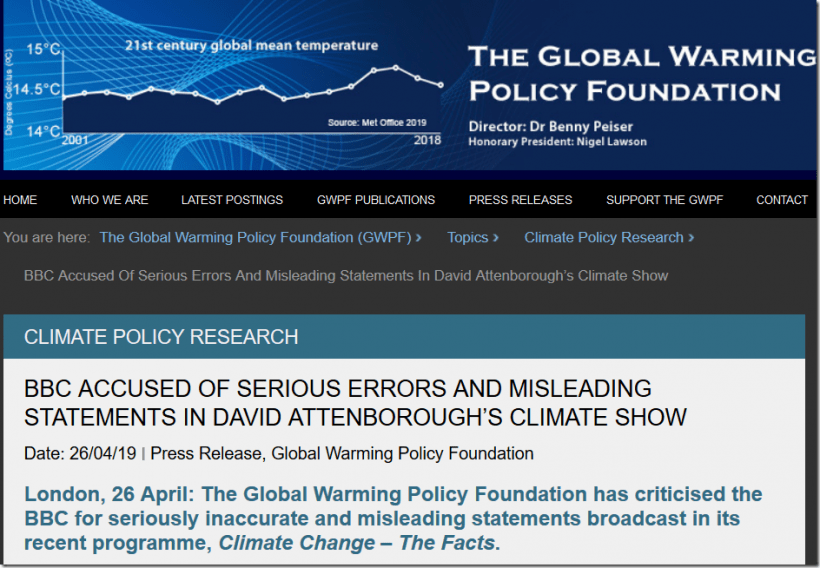
The BBC programme, presented by Sir David Attenborough, went far beyond its remit to present the facts of climate change, instead broadcasting a highly politicised manifesto in favour of renewable energy and unjustified alarm.
The programme highlighted suggestions that storms, floods, heatwaves and sea level rise are all rapidly getting worse as a result of climate change.
However, the best available data, published in the last few years by the Intergovernmental Panel on Climate Change (IPCC) and NASA, contradicts the BBC’s alarmist exaggeration of empirical evidence.
In its 5th Assessment Report (2013), the IPCC concluded:
“Current datasets indicate no significant observed trends in global tropical cyclone frequency over the past century … No robust trends in annual numbers of tropical storms, hurricanes and major hurricanes counts have been identified over the past 100 years in the North Atlantic basin.”
In its more recent Special Report on Global Warming of 1.5°C, published in 2018, these findings were reconfirmed. It stated that
“Numerous studies towards and beyond AR5 have reported a decreasing trend in the global number of tropical cyclones and/or the globally accumulated cyclonic energy… There is consequently low confidence in the larger number of studies reporting increasing trends in the global number of very intense cyclones.”
Regarding floods, the IPCC’s Special Report concluded:
“There is low confidence due to limited evidence, however, that anthropogenic climate change has affected the frequency and the magnitude of floods. “
There is also no observational evidence that the rate of sea level rise is getting worse. NASA satellite data shows that since 1993, there has been an annual mean sea level rise of 3.3mm, with no significant level of acceleration in the last three decades.
Suggestions by David Attenborough and Michael Mann that climate change is causing increases in wildfires in the US and globally are also misleading and not supported by any empirical evidence.
According to a survey published by the Royal Society the global area burned has actually declined over past decades, and there is increasing evidence to suggest that there is less fire in the global landscape today than centuries ago. These are vitally important facts that should have been mentioned if an accurate description of the impact of climate change on wildfires was to be maintained.
In his letter of complaint, Dr Benny Peiser, the GWPF’s director, has asked the BBC to acknowledge and correct the evident errors and misleading suggestions documented in the complaint and offer remedial measures as soon as possible.
The full complaint is available here (pdf)
Top 51 Fake News Russiagate ‘Bombshells’ Spread By The MSM
By Tyler Durden – Zero Hedge – 04/23/2019
Following the release of the Mueller report, the mainstream media tried to pull a fast one – absurdly claiming that their reporting for the last 2.5 years has been largely vindicated.
Except, they weren’t vindicated at all. In fact, they lied through their teeth, peddling falsehood after falsehood.
To that end, Breitbart‘s John Nolte isn’t about to let them get away with peddling even more fiction about their reporting, and has compiled a list of 51 instances where the MSM flat out lied, borrowing from the work of Sharyl Attkisson, Glenn Greenwald, and Sohrab Ahmari.
Top 51 Fake News ‘Bombshells’ the Media Spread About RussiaGate
The list below of 51 might sound like a lot, but it is a drop in the ocean when you recall the thousands and thousands of hours CNN, MSNBC, Meet the Press, This Week, PBS NewsHour, State of the Union, Good Morning America, Reliable Sources, and the Today Show devoted to anchors and pundits pushing the hoax that Trump colluded with Russia.
Not to mention, millions and millions of establishment media tweets and Facebook posts.
Rachel Maddow, Lawrence O’Donnell, Shepard Smith, Andrew Napolitano, Joe Scarborough, Chris Hayes, Chuck Todd, Joy Reid, Chris Matthews, Jake Tapper, Don Lemon, Chris Cuomo, Brian Stelter, Erin Burnett, et al., are alone responsible for thousands and thousands and thousands of hours of lies and conspiracy-mongering.
This list of 51 doesn’t count the half-million — half-MILLION — Russia collusion stories published over the past two years, almost all of which were premised on the idea that Trump did, indeed, collude with a foreign power to steal the 2016 presidential election.
This list cannot begin to count the countless times these 51 fake stories were repeated as fact throughout other news outlets, social media, and thousands upon thousands of cumulative broadcast hours.
What’s more, this list of 51 can’t begin to count the countless examples of fake news launched against Trump that have nothing to do with Russia — desperate and deliberate lies involving fish food and ice cream scoops…
Before we begin, credit where it’s due. This list would not have been possible without the lists already compiled by Sharyl Attkisson, Glenn Greenwald, and Sohrab Ahmari.
Michael Cohen went to Prague.
Trump directed Michael Cohen to lie, and Mueller has emails proving it.
Paul Manafort passed polling information to Kremlin.
Deputy Attorney General Rod Rosenstein forced out.
Federal investigators wiretapped Trump’s personal attorney Michael Cohen, have recordings of Trump.
Phony Russia dossier was initially funded by Republican group.
Donald Trump directed Flynn to make contact with Russian officials during the 2016 presidential campaign
Russian social media company provided documents to Senate about communications with Trump official.
- CNN:
Donald Trump Jr. conspired with WikiLeaks.
Robert Mueller subpoenaed Trump’s Deutsche Bank records.
Former Trump campaign chairman Paul Manafort worked with Russia intelligence-connected official as late as December 2017.
Trump Deputy National Security adviser K.T. McFarland lied about another official’s contacts with Russians.
- CNN:
Trump’s campaign was never wiretapped.
Manafort notes from Russian meeting refer to political contributions.
Seventeen intelligence agencies concur Russia hacked the 2016 presidential race.
- CNN:
Congress investigating Russian investment fund with ties to Trump officials.
Former FBI Director James Comey says Attorney General Jeff Sessions told him not to call Russia probe an investigation but “a matter.”
- CNN:
James Comey will testify he never told Trump he was not under investigation.
Putin admits he has compromising information about Trump.
Trump fired Comey after Comey asked for additional resources for the Russia investigation.
Numerous contacts between Trump campaign staff and “senior Russian intelligence officials.”
Among others, a Trump family member will be indicted on February 8.
Paul Manafort visited WikiLeaks’ Julian Assange on three occasions.
Trump campaign changed GOP platform on Ukraine.
Then-Attorney General Jeff Sessions lied about meeting with Russian Ambassador Sergey Kislyak.
Michael Cohen really did visit Prague.
- CNN:
Trump is lying when he calls Russia dossier “phony.”
RT had hacked into and taken over C-SPAN and C-SPAN “confirmed” it had been hacked.
Russia’s hacked the election systems of 21 American states.
Russian hackers penetrated U.S. electricity grid through a utility in Vermont.
“More than 200 websites” were “routine peddlers of Russian propaganda during the election season.”
Russia is the main suspect in the sonic attacks that sickened 26 U.S. diplomats.
Trump created a secret Internet server to covertly communicate with a Russian bank.
- CNN:
Donald Trump knew in advance of the Trump Tower meeting.
- CNN:
Mueller Report will show Trump “has helped” Putin “destabilize” the United States.
- NBC:
Russia supports Rep. Tulsi Gabbard (D-HI).
-
- CNN:
Sessions failed to disclose meetings he had with the Russian ambassador.
“There’s actually lots of evidence of Trump-Russia collusion.”
Trump revealed classified information to Russians.
House Majority Leader Kevin McCarthy (R-CA) said Russia paid Trump.
Mueller can show Trump campaign “had a connection to Russian intelligence.”
“Rudy Giuliani just told America that Trump’s campaign colluded with Russia.”
Evidence suggests Trump could be a Russian “asset.”
- NBC:
Russians began hacking Hillary Clinton’s emails on the day Donald Trump joked about it in July 2016.
Russia spy visited Trump’s Oval Office.
- CNN:
Phony Russia dossier has been “corroborated.”
- NPR:
Donald Trump Jr. lied under oath about Trump Tower deal in Moscow.
Russia successfully hacked voting systems in a number of states.
- CNN:
Trump is “bonkers” for claiming Hillary Clinton behind Russia dossier.
- CNN:
“Every intelligence expert, both under the Obama administration and under the Trump administration,” agrees with the assessment that Russia attempted to interfere in the 2016 presidential election.
- BBC:
Ukrainian president “authorized” an illegal payment of $400,000 to Michael Cohen for additional face time during a June 2017 meeting with President Trump.
David Attenborough’s BBC show would better have been called “Climate: Change The Facts”
Reviewing “Climate Change: the Facts” | April 21, 2019
… If you are going to present a film called Climate Change: the Facts the very least you should be doing is, well, presenting the facts. Well here they are, in two of the areas which made up such a hefty part of the film: wildfires and hurricanes. Are wildfires increasing? They are according to Attenborough. One of the scientists who takes part in the programme, Professor Michael Mann of Penn State University, goes as far as to say there has been a “tripling in the extent of wildfires in the Western US”. He is not specific about his evidence for this claim, nor said over what timeframe wildfires are supposed to have trebled, but it is not a fair assessment of the data collected by the US Environment Protection Agency (EPA). This shows no upwards trend in the number of wildfires in the US over the past 30 years.
But then again, go back further, to the 1920s, and you see that both the number of US wildfires and acreage burned in them has plummeted.
That is nothing to do with the climate – more down to firefighters getting better at tackling fires. But that reduction in wildfires – which, after all, were occurring naturally long before Europeans arrived in the US – has brought with it a problem: deadwood is not being cleared out at the rate which it used to be. As a result, when a wildfire does take hold, it tends to be a more powerful fire, which is one reason large acreages tend to get burned when fires do take hold. That was a large part of the debate which followed the wildfires in California last November.
But I know what will have entered the heads of many of Attenborough’s viewers: that wildfires are being caused by climate change and that is that. […]
The same will be true for hurricanes. If you are a child, for whom hurricanes are a novel phenomenon, watching the film will have given you the impression that hurricanes are pretty much a function of man-made climate change. A voiceover, indeed, makes the claim that climate change is causing ‘greater storms’. But again, the data on cyclone activity in the Atlantic, Gulf and Mexico and Caribbean does not support that idea. Figure one shows a very slight upwards trend in the number of hurricanes occurring in these waters but a flat or perhaps slightly downwards trend in the number of hurricanes making landfall in the US. There are two other methods of measuring hurricane activity which are used by the EPA. The first, the accumulated cyclone index (figure two) shows no obvious trend over the past 70 years. The second, the ‘power dissipation index’ shows an upwards spike in the early years of this century, followed by a reversion to mean since then.
Not that this seems to prevent documentary-makers like Attenborough resorting to footage of houses being demolished by winds and lorries being blown off bridges to show the supposed climate change we are already experiencing.
It is little wonder that terrified kids are skipping school to protest against climate change. Never mind climate change denial, a worse problem is the constant exaggeration of the subject. I had thought David Attenborough would be above resorting to the subtle propaganda which others have been propagating, linking every adverse weather event to climate change. But apparently not. — Ross Clark, The Spectator, 20 April 2019
… [W]e have already seen what can happen when ‘panic’ determines policy: the introduction of measures conceived by a need to be seen to be doing something under pressure from groups such as Extinction Rebellion.
Without making this clear, the film revealed one of the worst examples of this unfortunate effect. A powerful sequence showed an orangutan, fleeing loggers who have been eradicating Borneo’s rainforest.
This is disastrous for both wildlife and the climate because, as the film pointed out, a third of global emissions are down to deforestation, because giant trees lock up a lot of carbon.
But why are Borneo’s forests being cut down? The reason, as Attenborough said, is palm oil, a lucrative crop used in products ranging from soap to biscuits. Unfortunately, he left out the final stage of the argument.
Half of all the millions of tons of palm oil sent to Europe is used to make ‘biofuel’, thanks to an EU directive stating that, by 2020, ten per cent of forecourt fuel must come from ‘renewable’ biological sources. Malaysia says this has ‘created an unprecedented demand’.
To put it another way: misguided ‘action’ designed to save the planet is actually helping to damage it – although the EU has pledged to phase out palm oil biofuel by 2030.
Another example of a misconceived effort to save the planet is Drax power plant in Yorkshire which is fed, thanks to £700 million of annual subsidy, by ‘renewable’ wood pellets made from chopped-down American trees – while pumping more CO2 into the atmosphere than when it burnt only coal.
In theory, the trees it burns will be replaced – but a large part of its supply comes from hardwood forests that take 100 years to mature.
There are times when climate propaganda – for this is what this was – calls to mind the apocalyptic prophets of the Middle Ages, who led popular movements by preaching that the sins of human beings were so great that they could only be redeemed by suffering, in order to create a paradise on earth. Perhaps this is how Attenborough, nature journalism’s Methuselah, sees himself. But climate change is too important to be handled in this manner. It needs rational, well-informed debate. Too often, cheered on by the eco-zealots of Extinction Rebellion, the BBC is intent on encouraging quite the opposite. —David Rose, Mail on Sunday, 21 April 2019
… A former top executive at the BBC has warned that it is “at risk of being eaten” as new figures reveal that more than 880,000 television licences were cancelled last year. Cancellations among the under-75s rose from 860,192 in 2017-18 to 882,198 in the period from March 2018 to the end of February, new data shows. Mosey, 61, criticised the dumbing-down of news and “the nonsense put on social media by BBC” staff. —The Sunday Times, 21 April 2019
African Country Bans BBC, Voice of America for Spreading ‘Fake News’
Sputnik – 31.03.2019
The country’s media regulator accused the BBC of broadcasting content which “put national cohesion and reconciliation at stake,” while charging VOA with employing an opposition figure wanted in connection with violence that preceded a May 2015 coup attempt.
The landlocked Central African country of Burundi has banned the BBC and indefinitely suspended the Voice of America*, accusing the international UK and US outlets of spreading “lies” and disinformation.
In a statement put out on Friday, Burundi’s media regulator said it revoked the British Broadcasting Corporation’s license over the lack of “proper measures” following the airing of a documentary which authorities said contained falsehoods, including allegations that members of the intelligence services engaged in the detention and torture of dissidents.
Meanwhile, Voice of America saw its license pulled over its employment of Patrick Nduwimana, a radio journalist suspected of involvement in a failed coup attempt against President Pierre Nkurunziza in May 2015.
Both BBC and VOA had already received six month suspensions last May ahead of a constitutional referendum seeking to allow for the extension of Nkurunziza’s term in office by two terms.
The BBC blasted the Burundian government’s “unwarranted decision” against itself and the VOA, saying that the move “strikes a serious blow against media freedom.”
VOA director Amanda Bennett said the US government-funded broadcaster was “alarmed that reporters in Burundi are now forbidden to communicate with VOA,” and echoed the BBC’s sentiment that “these continuing threats to our journalists undermine press freedom in the country.”
Both the BBC and VOA continue to broadcast into Burundi using shortwave frequencies which can be picked up by ordinary radios.
Speaking to VOA by phone, Willy Nyamitwe, a senior advisor to President Nkurunziza, said the media outlets were banned for spreading ‘fake news’.
“Some international media are biased. Everybody knows some reports were fake reports, fake news,” he said. “So if people cannot even try to speak the truth…if some people are using some media outlets only to spread lies, what other comments do I have to do?” he asked.
Nyamitwe stressed that the country has “thousands of journalists” and dozens of “media houses, radio stations, TV stations, newspapers, media online” which continue to operate freely.
Hundreds of thousands of Burundians have been displaced and up to 1,200 killed in clashes with security forces between 2015 and 2017. In May 2015, rebel officer Godefroid Niyombare announced in a radio broadcast that President Nkurunziza and his government had been “dismissed” while the president was on a visit to Tanzania. The announcement led to heavy street fighting for control of state and private broadcasters, with five independent news agencies said to have been completely or partially shuttered in the aftermath of the violence.
Last May, Burundians overwhelmingly approved changes to the country’s constitution to approve Nkurunziza running for up to two more additional terms as president. The US and the EU dismissed the vote, alleging that it was marred by ‘intimidation, repression and violence’ against the opposition.
*Listed as a foreign agent in Russia.
Water Shortage? Blame Climate Change!
By Paul Homewood | Not A Lot Of People Know That | March 19, 2019
Water shortage? Why not blame it on global warming!
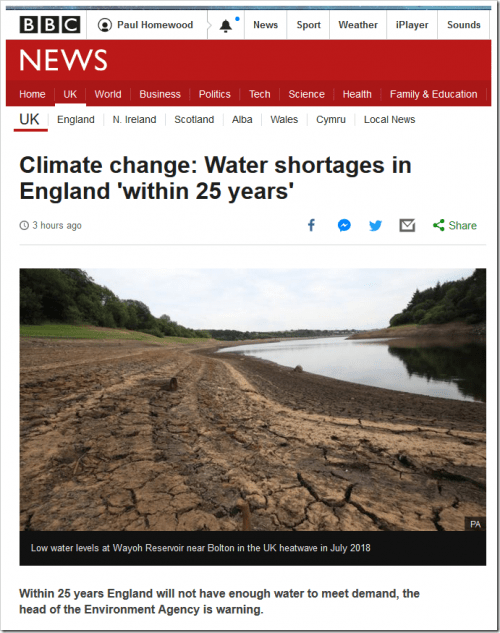
Within 25 years England will not have enough water to meet demand, the head of the Environment Agency is warning.
The impact of climate change, combined with population growth, means the country is facing an “existential threat”, Sir James Bevan told the Waterwise Conference in London.
He wants to see wasting water become “as socially unacceptable as blowing smoke in the face of a baby”.
“We all need to use less water and use it more efficiently,” he said.
Sir James Bevan was appointed chief executive of the Environment Agency – the public body responsible for protecting the environment and wildlife in England – in 2015 after a career as a diplomat.
He told his audience that, in around 20 to 25 years, England would reach the “jaws of death – the point at which, unless we take action to change things, we will not have enough water to supply our needs”.
Only one slight snag with Sir James’ little theory, there has been no reduction in rainfall levels in England, and droughts used to be much more severe and prevalent in the past:

https://www.metoffice.gov.uk/climate/uk/summaries/actualmonthly
Even commonly made claims that summers are getting drier do not stand up to scrutiny:

https://www.metoffice.gov.uk/climate/uk/summaries/actualmonthly
And just for good measure, the area of the country which is most vulnerable to water stress is also not becoming drier:

https://www.metoffice.gov.uk/climate/uk/summaries/datasets
And finally, summers in England are not getting hotter. The hottest summer still remains that of 1976. Indeed, last summer was the only one other than 1976 which was actually hotter than 1911!

https://www.metoffice.gov.uk/climate/uk/summaries/actualmonthly
There may be many reasons for water shortages, such as increased demand and leaks, but “climate change” certainly is not one of them.
But it is much easier for Sir James Bevan to blame global warming and ask us all to take less baths, than have to provide solutions to problems he can address.
BBC’s Age of Denial
By Paul Homewood | Not A Lot Of People Know That | March 16, 2019
I doubt if a day goes past now without a blast of global warming propaganda from the BBC.
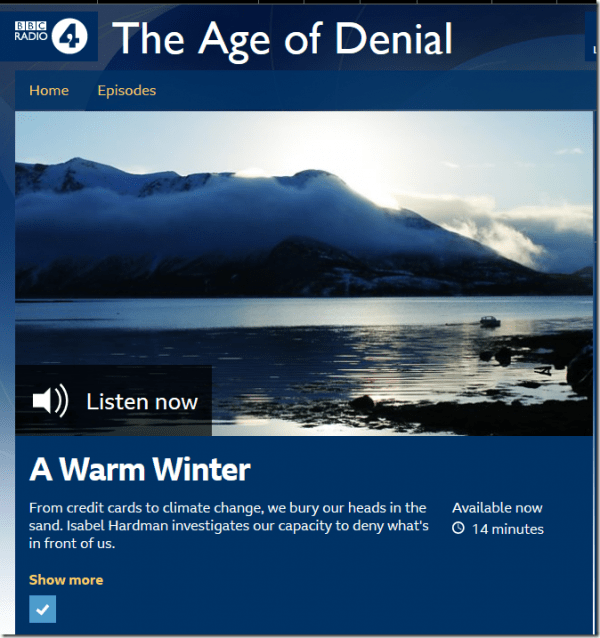
Isabel Hardman has a new five part series on Radio 4, called the Age of Denial.
Although it covers all forms of denial, it is clearly aimed at climate sceptics, as this opening episode makes obvious:
https://www.bbc.co.uk/programmes/m000357k
Hardman interviews Kari Marie Norgaard, a social scientist from Oregon, who has written a book about climate change denial.
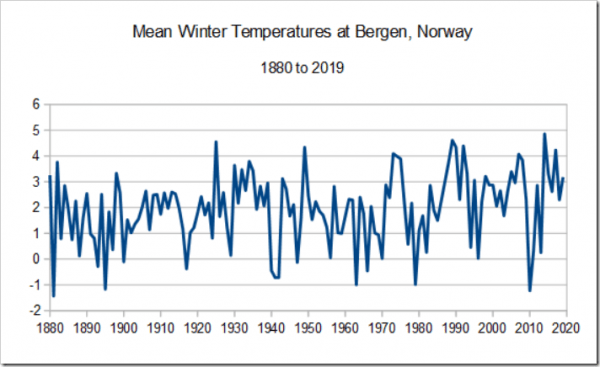
You can listen to the first five minutes, but to give the gist, Norgaard visited a small town in western Norway in the winter of 2000/01, to do research for a book she was writing. She found that the winter that year was a mild one, with the snow arriving late.
But what really stunned Norgaard was that none of the locals wanted to talk about “climate change”, which she was convinced was to blame.
Hardman and Norgaard then discuss various reasons why this should be so, which amounted to no more than a load of psychobabble.
For some reason, it did not occur to either to ask what the locals knew already. That it was just the sort of weather event that they, or their forefathers, had seen in the past.
Indeed, when we check the actual data at Bergen, the longest running site in the region, we find that those winter temperatures in 2000/01, far from being unusual, were the norm in the 1930s and 40s, and not infrequent at other times either:
https://data.giss.nasa.gov/cgi-bin/gistemp/stdata_show.cgi?id=634013170000&dt=1&ds=5
In the remainder of the episode, Hardman discusses various theories from other psychoanalysts. But it is all just a spurious intellectual attempt to create a condition called ‘Denialism’. No doubt so that climate sceptics can be conveniently labelled and then ignored.
In reality, you don’t need to be a psychologist to understand why so many people are suspicious of what they are told about climate change.
The answer lies in the fact that they see no evidence on the ground to support the barrage of apocalyptic warnings showered on them.
People who live near the coast can see with their own eyes that they are not about to be inundated by the sea.
Temperature rise has been so small in the last century that most people would not even be aware of it if they were not told about it.
As for extreme weather, older people know that there have always been floods, droughts, heatwaves and storms. Sadly it is the younger generation, who have no such experience, that is vulnerable to propaganda.
In short, people are far more knowledgeable than the sneering Isabel Hardman gives them credit for. And they know when they are being sold a pup.
Moreover, these ordinary people have far more pressing concerns in their daily lives than to be paranoid about climate change. Perhaps if Hardman came out of her metropolitan BBC bubble and talked to ordinary people, she might find this out for herself.
Rather than trying to package sceptics as people with psychological problems, she might ask why others have become totally paranoid about climate change. When I see school kids questioning the point of going to school when “their future could be ruined by climate change”, I truly despair.
What on earth are we doing to these youngsters? Do we really want them growing up so indoctrinated and unable to use their own faculties that they cannot even check the facts for themselves? Do we really want them to grow up so neurotic that they are scared of the weather?
Are we happy to see them marching around like a bunch of zombies, full of meaningless slogans about topics that they don’t have the slightest understanding about?
It is a sort of mass hysteria that has unfortunately been all too common during human history. It used to be a matter of burning witches, or human sacrifices by the Aztecs. Now it is demonising CO2.
Perhaps Isabel might like to devote her next series to this.
Pure: Ten Points I Just Can’t Believe About the Official Skripal Narrative
By Craig Murray | March 7, 2019
I still do not know what happened in the Skripal saga, which perhaps might more respectfully be termed the Sturgess saga. I cannot believe the Russian account of Borishov and Petrov, because if those were their real identities, those identities would have been firmly established and displayed by now. But that does not mean they attempted to kill the Skripals, and there are many key elements to the official British account which are also simply incredible.
Governments play dark games, and a dark game was played out in Salisbury which involved at least the British state, Russian agents (possibly on behalf of the state), Orbis Intelligence and the BBC. Anybody who believes it is simple to identify the “good guys” and the “bad guys” in this situation is a fool. When it comes to state actors and the intelligence services, frequently there are no “good guys”, as I personally witnessed from the inside over torture, extraordinary rendition and the illegal invasion of Iraq. But in the face of a massive media campaign to validate the British government story about the Skripals, here are ten of the things I do not believe in the official account:
1) PURE
This was the point that led me to return to the subject of the Skripals, even though it has brought me more abuse than I had received in my 15 year career as a whistleblower.
A few months ago, I was in truth demoralised by the amount of abuse I was receiving about the collapse of the Russian identity story of Borishov and Petrov. I had never claimed the poisoning, if any, was not carried out by Russians, only that there were many other possibilities. I understood the case against the Russian state is still far from established, whoever Borishov and Petrov really are, and I did not (and do not) accept Bellingcat’s conjectures and dodgy evidence as conclusive identification. But I did not enjoy at all the constant online taunts, and therefore was not inclined to take the subject further.
It is in this mood that I received more information from my original FCO source, who had told me, correctly, that Porton Down could not and would not attest that the “novichok” sample was made in Russia, and explained that the formulation “of a type developed by Russia” was an agreed Whitehall line to cover this up.
She wanted to explain to me that the British government was pulling a similar trick over the use of the word “pure”. The OPCW report had concluded that the sample provided to them by the British government was “of high purity” with an “almost complete absence of impurities”. This had been spun by the British government as evidence that the novichok was “military grade” and could only be produced by a state.
But actually that is not what the OPCW technical experts were attempting to signal. The sample provided to the OPCW had allegedly been swabbed from the Skripals’ door handle. It had been on that door handle for several days before it was allegedly discovered there. In that time it had been contacted allegedly by the hands of the Skripals and of DC Bailey, and the gloves of numerous investigators. It had of course been exposed to whatever film of dirt or dust was on the door handle. It had been exposed to whatever pollution was in the rain and whatever dust and pollen was blowing around. In these circumstances, it is incredible that the sample provided “had an almost complete absence of impurities”.
A sample cannot have a complete absence of impurities after being on a used doorknob, outdoors, for several days. The sample provided was, on the contrary, straight out of a laboratory.
The government’s contention that “almost complete absence of impurities” meant “military grade” was complete nonsense. There is no such thing as “military grade” novichok. It has never been issued to any military, anywhere. The novichok programme was designed to produce an organo-phosphate poison which could quickly be knocked up from readily available commercial ingredients. It was not part of an actual defence industry manufacturing programme.
There is a final problem with the “of high purity” angle. First we had the Theresa May story that the “novichok” was extremely deadly, many times more deadly than VX, in minute traces. Then, when the Skripals did not die, it was explained to us that this was because it had degraded in the rain. This was famously put forward by Dan Kaszeta, formerly of US Intelligence and the White House and self-proclaimed chemical weapons expert – which expertise has been strenuously denied by real experts.
What we did not know then, but we do know now, is that Kaszeta was secretly being paid to produce this propaganda by the British government via the Integrity Initiative.
So the first thing I cannot believe is that the British government produced a sample with an “almost complete absence of impurities” from several days on the Skripals’ doorknob. Nor can I believe that if “extremely pure” the substance therefore was not fatal to the Skripals.
2) Raising the Roof
Three days ago Sky News had an outside broadcast from the front of the Skripals’ house in Salisbury, where they explained that the roof had been removed and replaced due to contamination with “novichok”.
I cannot believe that a gel, allegedly smeared or painted onto the doorknob, migrated upwards to get into the roof of a two storey house, in such a manner that the roof had to be destroyed, but the house inbetween did not. As the MSM never questions the official narrative, there has never been an official answer as to how the gel got from the doorknob to the roof. Remember that traces of the “novichok” were allegedly found in a hotel room in Poplar, which is still in use as a hotel room and did not have to be destroyed, and an entire bottle of it was allegedly found in Charlie Rowley’s house, which has not had to be destroyed. Novichok was found in Zizzi’s restaurant, which did not have to be destroyed.
So we are talking about novichok in threatening quantities – more than the traces allegedly found in the hotel in Poplar – being in the Skripals’ roof. How could this happen?
As I said in the onset, I do not know what happened, I only know what I do not believe. There are theories that Skripal and his daughter might themselves have been involved with novichok in some way. On the face of it, its presence in their roof might support that theory.
The second thing I do not believe is that the Skripals’ roof became contaminated by gel on their doorknob so that the roof had to be destroyed, whereas no other affected properties, nor the rest of the Skripals’ house, had to be destroyed.
3) Nursing Care
The very first person to discover the Skripals ill on a park bench in Salisbury just happened to be the Chief Nurse of the British Army, who chanced to be walking past them on her way back from a birthday party. How lucky was that? The odds are about the same as the chance of my vacuum cleaner breaking down just before James Dyson knocks at my door to ask for directions. There are very few people indeed in the UK trained to give nursing care to victims of chemical weapon attack, and of all the people who might have walked past, it just happened to be the most senior of them!
The government is always trying to get good publicity for its armed forces, and you would think that the heroic role of its off-duty personnel in saving random poisoned Russian double agents they just happened to chance across, would have been proclaimed as a triumph for the British military. Yet it was kept secret for ten months. We were not told about the involvement of Colonel Abigail McCourt until January of this year, when it came out by accident. Swollen with maternal pride, Col. McCourt nominated her daughter for an award from the local radio station for her role in helping give first aid to the Skripals, and young Abigail revealed her mother’s identity on local radio – and the fact her mother was there “with her” administering first aid.
Even then, the compliant MSM played along, with the Guardian and Sky News both among those running stories emphasising entirely the Enid Blyton narrative of “plucky teenager saves the Skripals”, and scarcely mentioning the Army’s Chief Nurse who was looking after the Skripals “with little Abigail”.
I want to emphasise again that Col. Alison McCourt is not the chief nurse of a particular unit or hospital, she is the Chief Nurse of the entire British Army. Her presence was kept entirely quiet by the media for ten months, when all sorts of stories were run in the MSM about who the first responders were – various doctors and police officers being mentioned.
If you believe that it is coincidence that the Chief Nurse of the British Army was the first person to discover the Skripals ill, you are a credulous fool. And why was it kept quiet?
4) Remarkable Metabolisms
This has been noted many times, but no satisfactory answer has ever been given. The official story is that the Skripals were poisoned by their door handle, but then well enough to go out to a pub, feed some ducks, and have a big lunch in Zizzi’s, before being instantly stricken and disabled, both at precisely the same time.
The Skripals were of very different ages, genders and weights. That an agent which took hours to act but then kicks in with immediate disabling effect, so they could not call for help, would affect two such entirely different metabolisms at precisely the same time, has never been satisfactorily explained. Dosage would have an effect and of course the doorknob method would give an uncontrolled dosage.
But that the two different random dosages were such that they affected each of these two very different people at just the same moment, so that neither could call for help, is an extreme coincidence. It is almost as unlikely as the person who walks by next being the Chief Nurse of the British Army.
5) 11 Days
After the poisoning of Charlie Rowley and Dawn Sturgess, the Police cordoned off Charlie Rowley’s home and began a search for “Novichok”, in an attitude of extreme urgency because it was believed this poison was out amidst the public. They were specifically searching for a small phial of liquid. Yet it took 11 days of the search before they allegedly discovered the “novichok” in a perfume bottle sitting in plain sight on the kitchen counter – and only after they had discovered the clue of the perfume bottle package in the bin the day before, after ten days of search.
The bottle was out of its packaging and “novichok”, of which the tiniest amount is deadly, had been squirted out of its nozzle at least twice, by both Rowley and Sturgess, and possibly more often. The exterior of the bottle/nozzle was therefore contaminated. Yet the house, unlike the Skripals’ roof space, has not had to be destroyed.
I do not believe it took the Police eleven days to find the very thing they were looking for, in plain sight as exactly the small bottle of liquid sought, on a kitchen bench. What else was happening?
6) Mark Urban/Pablo Miller
The BBC’s “Diplomatic Editor” is a regular conduit for the security services. He fronted much of the BBC’s original coverage of the Skripal story. Yet he concealed from the viewers the fact that he had been in regular contact with Sergei Skripal for months before the alleged poisoning, and had held several meetings with Skripal.
This is extraordinary behaviour. It was the biggest news story in the world, and news organisations, including the BBC, were scrambling to fill in the Skripals’ back story. Yet the journalist who had the inside info on the world’s biggest news story, and was actually reporting on it, kept that knowledge to himself. Why? Urban was not only passing up a career defining opportunity, it was unethical of him to continually report on the story without revealing to the viewers his extensive contacts with Skripal.
The British government had two immediate reactions to the Skripal incident. Within the first 48 hours, it blamed Russia, and it slapped a D(SMA) notice banning all media mention of Skripal’s MI6 handler, Pablo Miller. By yet another one of those extraordinary coincidences, Miller and Urban know each other well, having both been officers together in the Royal Tank Regiment, of the same rank and joining the Regiment the same year.
I have sent the following questions to Mark Urban, repeatedly. There has been no response:
To: mark.urban@bbc.co.uk
Dear Mark,
As you may know, I am a journalist working in alternative media, a member of the NUJ, as well as a former British Ambassador. I am researching the Skripal case.
I wish to ask you the following questions.
1) When the Skripals were first poisoned, it was the largest news story in the entire World and you were uniquely positioned having held several meetings with Sergei Skripal the previous year. Yet faced with what should have been a massive career break, you withheld that unique information on a major story from the public for four months. Why?
2) You were an officer in the Royal Tank Regiment together with Skripal’s MI6 handler, Pablo Miller, who also lived in Salisbury. Have you maintained friendship with Miller over the years and how often do you communicate?
3) When you met Skripal in Salisbury, was Miller present all or part of the time, or did you meet Miller separately?
4) Was the BBC aware of your meetings with Miller and/or Skripal at the time?
5) When, four months later, you told the world about your meetings with Skripal after the Rowley/Sturgess incident, you said you had met him to research a book. Yet the only forthcoming book by you advertised is on the Skripal attack. What was the subject of your discussions with Skripal?
6) Pablo Miller worked for Orbis Intelligence. Do you know if Miller contributed to the Christopher Steele dossier on Trump/Russia?
7) Did you discuss the Trump dossier with Skripal and/or Miller?
8) Do you know whether Skripal contributed to the Trump dossier?
9) In your Newsnight piece following the Rowley/Sturgess incident, you stated that security service sources had told you that Yulia Skripal’s telephone may have been bugged. Since January 2017, how many security service briefings or discussions have you had on any of the matter above.I look forward to hearing from you.
Craig Murray
The lack of openness of Urban in refusing to answer these questions, and the role played by the BBC and the MSM in general in marching in unquestioning lockstep with the British government narrative, plus the “coincidence” of Urban’s relationship with Pablo Miller, give further reason for scepticism of the official narrative.
7 Four Months
The official narrative insists that Borishov and Petrov brought “novichok” into the country; that minute quantities could kill; that they disposed of the novichok that did kill Dawn Sturgess. It must therefore have been of the highest priority to inform the public of the movements of the suspects and the possible locations where deadly traces of “novichok” must be lurking.
Yet there was at least a four month gap between the police searching the Poplar hotel where Borishov and Petrov were staying, allegedly discovering traces of novichok in the hotel room, and the police informing the hotel management, let alone the public, of the discovery. That is four months in which a cleaner might have fatally stumbled across more novichok in the hotel. Four months in which another guest in the same hotel might have had something lurking in their bag which they had picked up. Four months in which there might have been a container of novichok sitting in a hedge near the hotel. Yet for four months the police did not think any of this was urgent enough to tell anybody.
The astonishing thing is that it was a full three months after the death of Dawn Sturgess before the hotel were informed, the public were informed, or the pictures of “Borishov” and “Petrov” in Salisbury released. There could be no clearer indication that the authorities did not actually believe that any threat from residual novichok was connected to the movements of Borishov and Petrov.
Similarly the metadata on the famous CCTV images of Borishov and Petrov in Salisbury, published in September by the Met Police, showed that all the stills were prepared by the Met on the morning of 9 May – a full four months before they were released to the public. But this makes no sense at all. Why wait a full four months for people’s memories to fade before issuing an appeal to the public for information? This makes no sense at all from an investigation viewpoint. It makes even less sense from a public health viewpoint.
If the authorities were genuinely worried about the possible presence of deadly noivchok, and wished to track it down, why one earth would you wait for four months before you published the images showing the faces and clothing and the whereabouts of the people you believe were distributing it?
The only possible conclusion from the amazing four month delays both in informing the hotel, and in revealing the Borishov and Petrov CCTV footage to the public, is that the Metropolitan Police did not actually believe there was a public health danger that the two had left a trail of novichok. Were the official story true, this extraordinary failure to take timely action in a public health emergency may have contributed to the death of Dawn Sturgess.
The metadata shows Police processed all the Salisbury CCTV images of Boshirov and Petrov a month before Charlie Rowley picked up the perfume. The authorities claim the CCTV images show they could have been to the charity bin to dump the novichok. Which begs the question, if the Police really believed they had CCTV of the movements of the men with the novichok, why did they not subsequently exhaustively search everywhere the CCTV shows they could have been, including that charity bin?
The far more probable conclusion appears to be that the lack of urgency is explained by the fact that the link between Borishov and Petrov and “novichok” is a narrative those involved in the investigation do not take seriously.
8 The Bungling Spies
There are elements of the accepted narrative of Borishov and Petrov’s movements that do not make sense. As the excellent local Salisbury blog The BlogMire points out, the CCTV footage shows Borishov and Petrov, after they had allegedly coated the door handle with novichok, returning towards the railway station but walking straight past it, into the centre of Salisbury (and missing their first getaway train in the process). They then wander around Salisbury apparently aimlessly, famously window shopping which is caught on CCTV, and according to the official narrative disposing of the used but inexplicably still cellophane-sealed perfume/novichok in a charity donation bin, having walked past numerous potential disposal sites en route including the railway embankment and the bins at the Shell garage.
But the really interesting thing, highlighted by the blogmire, is that the closest CCTV ever caught them to the Skripals’ house is fully 500 metres, at the Shell garage, walking along the opposite side of the road from the turning to the Skripals. There is a second CCTV camera at the garage which would have caught them crossing the road and turning down towards the Skripals’ house, but no such video or still image – potentially the most important of all the CCTV footage – has ever been released.
However the 500 metres is not the closest the CCTV places the agents to the Skripals. From 13.45 to 13.48, on their saunter into town, Borishov and Petrov were caught on CCTV at Dawaulders coinshop a maximum of 200 metres away from the Skripals, who at the same time were at Avon Playground. The bin at Avon playground became, over two days in the immediate aftermath of the Skripal “attack”, the scene of extremely intensive investigation. Yet the Borishov and Petrov excursion – during their getaway from attempted murder – into Salisbury town centre has been treated as entirely pointless and unimportant by the official story.
Finally, the behaviour of Borishov and Petrov in the early hours before the attack makes no sense whatsoever. On the one hand we are told these are highly trained, experienced and senior GRU agents; on the other hand, we are told they were partying in their room all night, drawing attention to themselves with loud noise, smoking weed and entertaining a prostitute in the room in which they were storing, and perhaps creating, the “novichok”.
The idea that, before an extremely delicate murder operation involving handling a poison, a tiny accident with which would kill them, professionals would stay up all night and drink heavily and take drugs is a nonsense. Apart from the obvious effect on their own metabolisms, they were risking authorities being called because of the noise and a search being instituted because of the drugs.
That they did this while in possession of the novichok and hours before they made the attack, is something I simply do not believe.
9 The Skripals’ Movements
Until the narrative changed to Borishov and Petrov arriving in Salisbury just before lunchtime and painting the doorknob, the official story had been that the Skripals left home around 9am and had not returned. They had both switched off their mobile phones, an interesting and still unexplained point. As you would expect in a city as covered in CCTV as Salisbury, their early morning journey was easily traced and the position of their car at various times was given by the police.
Yet no evidence of their return journey has ever been offered. There is now a tiny window between Borishov and Petrov arriving, painting the doorknob apparently with the Skripals now inexplicably back inside their home, and the Skripals leaving again by car, so quickly after the doorknob painting that they catch up with Borishov and Petrov – or certainly being no more than 200 metres from them in Salisbury City Centre. There is undoubtedly a huge amount of CCTV video of the Skripals’ movements which has never been released. For example, the parents of one of the boys who Sergei was chatting with while feeding the ducks, was shown “clear” footage by the Police of the Skripals at the pond, yet this has never been released. This however is the moment at which the evidence puts Borishov and Petrov at the closest to them. What does the concealed CCTV of the Skripals with the ducks show?
Why has so little detail of the Skripals’ movements that day been released? What do all the withheld CCTV images of the Skripals in Salisbury show?
10 The Sealed Bottle
Only in the last couple of days have the police finally admitted there is a real problem with the fact that Charlie Rowley insists that the perfume bottle was fully sealed, and the cellophane difficult to remove, when he discovered it. Why the charity collection bin had not been emptied for three months has never been explained either. Rowley’s recollection is supported by the fact that the entire packaging was discovered by the police in his bin – why would Borishov and Petrov have been carrying the cellophane around with them if they had opened the package? Why – and how – would they reseal it outdoors in Salisbury before dumping it?
Furthermore, there was a gap of three months between the police finding the perfume bottle, and the police releasing details of the brand and photos of it, despite the fact the police believed there could be more out there. Again the news management agenda totally belies the official narrative of the need to protect the public in a public health emergency.
This part of the narrative is plainly nonsense.
Bonus Point – The Integrity Initiative
The Integrity Initiative specifically paid Dan Kaszeta to publish articles on the Skripal case. In the weekly collections of social media postings the Integrity Initiative sent to the FCO to show its activity, over 80% were about the Skripals.
Governments do not institute secret campaigns to put out covert propaganda in order to tell the truth. The Integrity Initiative, with secret FCO and MOD sourced subsidies to MSM figures to put out the government narrative, is very plainly a disinformation exercise. More bluntly, if the Integrity Initiative is promoting it, you know it is not true.
Most sinister of all is the Skripal Group convened by the Integrity Initiative. This group includes Pablo Miller, Skripal’s MI6 handler, and senior representatives of Porton Down, the BBC, the CIA, the FCO and the MOD. Even if all the other ludicrously weak points in the government narrative did not exist, the Integrity Initiative activity in itself would lead me to understand the British government is concealing something important.
Conclusion
I do not know what happened in Salisbury. Plainly spy games were being played between Russia and the UK, quite likely linked to the Skripals and/or the NATO chemical weapons exercise then taking place on Salisbury Plain yet another one of those astonishing coincidences.
What I do know is that major planks of the UK government narrative simply do not stand up to scrutiny.
Plainly the Russian authorities have lied about the identity of Borishov and Petrov. What is astonishing is the alacrity with which the MSM and the political elite have rallied around the childish logical fallacy that because the Russian Government has lied, therefore the British Government must be telling the truth. It is abundantly plain to me that both governments are lying, and the spy games being played out that day were very much more complicated than a pointless revenge attack on the Skripals.
I do not believe the British Government. I have given you the key points where the official narrative completely fails to stand up. These are by no means exhaustive, and I much look forward to reading your own views.
The Salisbury Poisoning One Year On: An Open Letter to the Metropolitan Police
By Rob Slane | The Blog Mire | March 3, 2019
Dear Assistant Commissioner Basu,
It is now a year since the events in Salisbury that shocked the nation, and indeed the world. Since then, your organisation has conducted an investigation into the case, and has laid out a case about what happened in a series of statements, notably those made on 5th September (no longer available on your website), in which two suspects were formally accused, and another on 22nd November, following the screening of the Panorama documentary: Salisbury Nerve Agent Attack — The Inside Story.
To those who have a superficial interest in the case, the explanations you have presented for what happened on 4th March 2018 may appear credible, especially since the British media has largely repeated them verbatim, even when they have been self-evidently flawed and contradictory. Indeed the press has steadfastly refused (or been refused) to ask some very obvious and much needed questions about them. But to those who have spent time looking at the incident, the explanations you have set out contain glaring omissions, factual errors (see here for more detail), and at least one scientific impossibility (more on this below). What I wish to do in this letter, is to set out some of the most important, and which I believe you owe it to the public to explain.
Why have we heard nothing from Sergei Skripal?
The most glaring problem with your case is the disappearance of Mr Skripal himself — and yes “disappearance” is the right word. It is now 12 months from the original incident, and about 11 months since it was announced that he had recovered. During that time there have been zero public appearances and — curiouser and curiouser — not even one public statement put out in his name. Additionally, it is known with certainty that he has not been in contact with his mother back in Russia — not on her birthday, not at New Year and not at Christmas — which has caused her great distress. This is not just odd; it is highly disturbing, especially given that Mr Skripal was said to be in the habit of contacting his mother every week prior to 4th March.
If I were to ask how you can account for this, I would anticipate an answer that includes the claim that any such statements, appearances, and contact are deemed dangerous to his security. Certain reports in the media have indeed stated or implied this. However, it will not wash, for two reasons:
Firstly, are we seriously expected to believe that the UK Intelligence Agencies are incapable of protecting Mr Skripal’s whereabouts and his safety, whether in a statement, a pre-recorded video, or in a call to his mother? The idea is self-evidently ludicrous.
Secondly, these apparent “security concerns” were somehow overcome with Yulia Skripal. Not only was a statement released in her name upon departure from Salisbury District Hospital, followed by a Reuters video of her reading out a pre-prepared statement, but she was also allowed reasonably regular contact with her family, including her cousin and grandmother — up to 24th July last year (that is, up to the point that she told her cousin that she “now understood everything”). If Yulia’s security can be protected, there is no reason that Sergei’s security can not also be guaranteed.
It is also worth noting that neither Sergei nor Yulia have once endorsed your explanation of the incident. Sergei has been silent, and as for Yulia, far from endorsing your version, in none of her statements or phone calls has she ever pointed the finger of blame at the Russian state for an assassination attempt on her and her father. In fact, she has repeatedly expressed a desire to go back to live in Russia — a very strange desire given what you claim happened to her, wouldn’t you agree?
To all intents and purposes, both Sergei and Yulia Skripal have now disappeared without trace — he since 4th March 2018, and she since 24th July 2018. In the absence of any plausible reason for this, it is reasonable to consider them both as being held against their will, without consular access, without legal representation, and without the ability to contact their next of kin. Needless to say these are very serious issues, and if confirmed would put the United Kingdom in breach of a number of international legal obligations. Yet there are of course very obvious steps that could be taken to assure the public that this is not the case.
And so I simply ask you this: what credible reason can you give as to why nothing has been heard from Mr Skripal since 4th March? Why has he been unable to contact his mother? And what credible reason can you give as to why Yulia appears to have been denied contact with her family since 24th July?
Why won’t you show where the suspects were going?
Your organisation has repeatedly stated that the CCTV footage of the two suspects at the Shell Garage on the Wilton Road shows them “in the vicinity of” and “on their way to” Mr Skripal’s house (or “the Skripal’s house” as statements bizarrely keep referring to it. Who, may I ask, is “The Skripal”?). This is misleading on two counts.
Firstly, the footage actually shows them some 500 yards or so from 47 Christie Miller Road, which cannot be conceivably described as “in the vicinity” in terms of proving that they actually went to the house. This evidence would not convince a discerning jury.
Secondly, it does not show them “on the way” to Mr Skripal’s house either. It is possible that they did go there, but the CCTV footage does not show this, since it gives no indication that they were preparing to cross the Wilton Road, which they would have had to do to get to Christie Miller Road (either via the passage to Montgomery Gardens or via Canadian Avenue).
However, there is more than this. The camera that was used to take footage of the two men covers the area where they walked past the garage, but does not cover those two routes to 47 Christie Miller Road mentioned above. What you failed to inform the public, however, is that there is another CCTV camera on the Shell garage, just past this one, that does cover these routes. As the following picture shows, it is located on the right-hand side of the front of the building (circled), facing the Wilton Road, almost exactly opposite the path to Montgomery Gardens (note: the camera that was used to take the footage that was aired is on the corner of the left-hand side of the building, just out of shot):

Had the two men crossed the Wilton Road to go through the passage to Montgomery Gardens, or even via Canadian Avenue, this camera would have recorded it. Had this camera recorded them going through either route, although it still wouldn’t have been conclusive proof that they went to number 47 Christie Miller Road, much less what they may have done had they gone there, it certainly would have been far more credible than the footage you did release. Yet you have chosen not to show it. Can you tell us why, and also whether the footage taken by this camera on the right of the building backs up your claims that they were “on their way” to Christie Miller Road?
Wot no CCTV?
The issue of CCTV is not just confined to what was and wasn’t shown of the two men on the Wilton Road, however. It remains a curious fact that aside from this and the other footage of them on the bridge at Fisherton Street — which by the way were released nearly nine months after the event — you have not released one bit of proper footage of the Skripals or other related events that day.
This is extraordinary, for a couple of reasons.
Firstly, such footage most certainly does exist. For example, there exists “really clear footage” of Sergei and Yulia Skripal feeding ducks with some local boys on the afternoon of 4th March, next to the Avon Playground. The time of this footage was around 13:45 which — it should be noted — is approximately 20-30 minutes after the Skripals were said to have come into contact with a nerve agent on the door handle of their home (more on this below).
Secondly, in the early days of the investigation, a number of places in the city centre were mooted as possible locations for the poisoning (namely Zizzis, The Mill pub, and the bench itself). However, despite the fact that “really clear” CCTV footage of these areas undoubtedly exists, and despite the fact that the public were being asked to come forward with information, you showed not even a second of footage of the pair in that area. The public were therefore being asked to come forward with information about two people who were on CCTV and could be clearly identified by it, but without so much as a few seconds of this CCTV being shown so that they could see what they looked like, what they were wearing, and where they were going.
All this simply adds to the nagging suspicion that this CCTV shows things that would cast huge doubt on the explanations you have given. However, it is even worse than this. In the first few days after the incident, CCTV footage was released of a couple walking through the Market Walk at 15:47, and it was stated by more than one news outlet that the pair were the Skripals. Of course it wasn’t them, and yet — given some witness statements that followed — these people were undoubtedly somehow involved in the events that followed. Yet, important as they were, they were quickly forgotten about in the days after that grainy CCTV footage of them was released, and were subsequently never mentioned by the media or the police thereafter. Why is this, since witness testimony leads to the belief that they were something to do with what happened?
What we have, then, is what you have described as a “fast moving” and “complex investigation”, in which you repeatedly appealed to the public for information, and yet refused to show the public anything of the CCTV footage that exists, which may well have helped to jog memories and so aid you in your investigations. Furthermore, since the explanation you have given for what happened (poisoning at the door handle) implies that nothing of note happened in The Maltings (other than the collapse at the bench), reasons of “national security” simply cannot apply. Therefore, what reason can you give for not showing CCTV from The Maltings to the public when you were appealing for information?
The Skripals, the suspects, the ducks and the bin
I mentioned above the CCTV footage taken of the Skripals at 13:45 on 4th March at the Avon Playground, which is in The Maltings. This is one of the most interesting incidents in the whole case, for a number of reasons.
Firstly, as already stated, the footage shows Mr Skripal and his daughter feeding ducks, with Mr Skripal actually handing bread to three local boys, one of whom apparently ate a piece, but none of whom became contaminated. This clearly suggests that Mr Skripal was not contaminated with nerve agent at that time.
Secondly, it shows Yulia carrying a red bag, which may seem inconsequential, but for the fact that the female caught on CCTV in the Market Walk (who wasn’t Yulia) was also carrying a distinctive red bag. Not to put too fine a point on it, given Mr Skripal’s tradecraft, duck-feed plus distinctive red bag has a definite “signalling to someone” quality about it.
Thirdly, and most remarkably of all, given the nature of your claims, at the same time as they were feeding ducks, the two suspects — Petrov and Boshirov — were in close proximity. And when I say close proximity, I mean far closer than the distance from the Shell Garage to 47 Christie Miller Road, which you describe as being “in the vicinity”. How so?
According to the image you released of the two men at 13:08, they were standing at the entrance to Summerlock Approach, which happens to be the road that leads to the Sainsbury’s car park, which happens to be the car park where Mr Skripal parked his car approximately 32 minutes later. They were then seen on CCTV obtained by the media walking past Dauwalders (coin and stamp shop) on Fisherton Street at 13:48. Crucially, they were coming from the direction of the town.
What this means is that after being photographed at Summerlock Approach, instead of walking directly to the train station, as your timeline suggested, they went back into town, either by doubling back down Fisherton Street, or by walking in a loop through Summerlock Approach, across the car park, and through the Maltings, before heading back to Fisherton Street via Malthouse Lane.
Dauwalders, where they were seen at 13:48, is less than 200 yards from the Avon Playground, where the Skripals were filmed at 13:45. And so we have the intriguing prospect of the two alleged assassins passing less than 200 yards from the pair they are alleged to have tried to assassinate, within 3 minutes of one another. Furthermore, given that the two suspects were coming from the direction of town when they passed the shop, it is entirely possible (although by no means certain) that they had actually come from the area of the Maltings, and therefore that they had, just moments before, been in even closer proximity of the Skripals.
The fact that the two suspects were closer to the Skripals at between 13:45-13:48 than they were at 11:58 outside the Shell garage, is of course extremely interesting. But what is particularly troubling about this episode is what your organisation has done with this information.
Firstly, you have left it out of your timeline, never once mentioning that the Skripals had taken a detour to feed the ducks — and it is indeed a detour if you are walking from Sainsbury’s car park to Zizzis or The Mill — and never once mentioning that the two suspects were in that area at the same time (which is really odd, given that you are trying to make a case against them).
But secondly, although this incident was ignored in your timeline, as if it were trivial, it was obviously highly significant. The reason we can be sure of this is that on the day following the incident (5th March), a large number of military personnel were extremely focused on the bin next to the Avon Playground as these videos — here and here — make clear. Why that bin, which is a significant distance from the bench (50 yards or so), and why was it such an object of intense focus?
To leave this location out of your timeline, and to fail to inform the public of the close proximity of the suspects to the Skripals at the time of the duck feed, is frankly bizarre. What credible explanation is there for this?
The absolute impossibility of your door handle explanation
I mentioned at the start that alongside the factual errors, glaring omissions, and inconsistencies in your case, there is also an impossibility. That is the explanation that the assassination attempt was carried out using a nerve agent sprayed on the door handle of 47 Christie Miller Road.
Leaving aside the absurdity of what has been described as an “oily substance” being sprayed by an atomiser (how does that work?); leaving aside the ridiculousness of people actually spraying it without wearing proper protective clothing; leaving aside the silliness of supposing that the deed was done in broad daylight whilst Mr Skripal and his daughter were in the house; leaving aside the difficulties involved in having both victims touching the door handle on their way out of the house; and leaving aside the frankly preposterous notion that having apparently done their deed, instead of leaving Salisbury immediately, the two men then walked across town, and rather than dumping the open bottle of “Novichok” they had apparently used, they allegedly dumped a bottle they hadn’t used (remember, Charlie Rowley’s box was, according to him, cellophane wrapped) — leaving all those irrational propositions aside, as I say there is an absolute impossibility in what you are asking us to accept.
In the BBC Panorama programme, Salisbury Nerve Agent Attack — The Inside Story, which was clearly made with official approval (the ex-head of MI6 and the Deputy Assistant Commissioner of the Metropolitan Police, Dean Haydon, both appearing and helping in the reconstruction of what is supposed to have happened), it was claimed throughout the programme that the substance used was not only incredibly toxic, but that it could kill even with the tiniest of amounts. One of the men who worked on the original Foliant Project to create these substances, Vil Mirzyanov, was asked how much was needed to kill a person. He replied:
“To kill a person, you need only 1mg. To be sure, 2mg.”
Now this obviously gives rise to a problem, which is why didn’t it kill Mr Skripal and his daughter, since they were both allegedly contaminated with far more than 2mg of the stuff? The answer given on the programme was supplied by Mr Mirzyanov, who said:
“Maybe the dose was not high enough. Salisbury was rainy and muggy. Novichok breaks down in damp conditions, reducing its toxicity. It’s the Achilles Heel of Novichok.”
Although this might sound plausible, it runs up against the buffers of the statement released on 4th May by the OPCW, who said this about the samples they collected at sites in Salisbury, including the door handle:
“The samples collected by the OPCW Technical Assistance Visit team concluded that the chemical substance found was of high purity, persistent and resistant to weather conditions.”
These statements, taken together, mean that your explanation is an absolute impossibility. If 2mg of “Novichok” is enough to certainly kill a person, as Mr Mirzyanov stated (corroborated by Deputy Assistant Commissioner Haydon who said there was enough in the bottle to kill thousands), then Mr Skripal and his daughter should be dead. If the reason they aren’t dead is because “Novichok” breaks down in damp conditions, then it is impossible for the OPCW to have found a substance that hadn’t broken down, which was of “high purity”, and which is resistant to weather conditions.
There is simply no way you can square these things. If it didn’t kill the Skripals because it had broken down in damp conditions, then the OPCW can’t have found a high purity substance that is persistent and resistant to weather conditions. But since the OPCW claim that this is exactly what they found, then it can’t have broken down in damp conditions and lost its toxicity, can it? One or the other, but not both.
Unless you can prove that a substance can lose its toxicity in just over an hour due to dampness (from the time it was allegedly sprayed to the time it was allegedly touched), only to regain its toxicity and be found to be resistant to weather conditions two weeks later, no rational person can possibly be expected to believe this explanation. It is obvious nonsense, utterly impossible, and discredits your entire account of what happened on 4th March.
In Conclusion
Along with other members of the public, I would love to be able to believe that your investigation has been based on all the evidence available, and that its conclusions (so far) are credible. Sadly, however, this is not possible, as the above issues (and plenty of others) demonstrate.
It was quite obvious from the outset, when the Government came to a conclusion before any evidence had been properly assessed, that any subsequent investigation had already been politicised. There was therefore little hope that the investigation would be impartial, and that if evidence was found to contradict the Government’s assessment, that it would be presented.
However, there was always a glimmer of hope that your organisation would refuse to bow to this politicisation, and instead conduct a truly independent investigation. Amongst other things, this would have involved:
- Mr Skripal and Yulia being allowed to give their account of what happened that day to the media, and the media allowed to freely ask questions
- A thorough account of the two suspects’ movements, rather than two highly selective bits of footage that imply where they went, but which leave out the footage that shows where they did actually go
- The release of CCTV footage showing what happened in The Maltings in order to appeal for witnesses to come forward
- Important information, such as the duck feed and the close proximity of the suspects to the Skripals at that time, being given out to the public, and included in the timeline
- An explanation of the poisoning that is actually scientifically credible
But since these elements have not been a part of your investigation, the public can have no confidence in your explanation and assessment of what happened on 4th March 2018, and has every right to suspect that they are part of what essentially appears to be a politically-driven cover up. That really is a great shame, not only in terms of understanding what really happened in the Salisbury and Amesbury incidents, but also in terms of the denting of trust in your organisation, and the authorities in general, in the long-term. I would like to hope that this potential denting in confidence in your organisation’s integrity in handling this case, which surely cannot give you cause for celebration, would lead you to take the initiative in now providing a more credible account of what took place.
As Mainstream Journalists acknowledge Douma Attacks were “Staged,” Syria Regime-Change Network tries to Save Sinking Ship
“Humanitarian” regime-change network increasingly desperate to protect its influence and the power of its narratives, not just in Syria but in future conflicts.
By Whitney Webb and Vanessa Beeley | MintPress News | February 18, 2019
LONDON — Over the past few days, notable journalists and other figures in mainstream media have acknowledged that the alleged chemical weapons attack that occurred last April in the Damascus suburb of Douma, Syria was likely “staged” by “activist” groups such as the White Helmets. Their comments and investigations have largely vindicated the many journalists and academics who cast aspersions on the precipitous Western media campaign to blame that alleged attack on the Syrian government. Many of the dissenting voices were derided as “conspiracy theorists” or ignored entirely by mainstream sources.
Yet, now that these revelations are being voiced by acceptable figures in mainstream media, those who have built their careers on promoting the White Helmets and regime change in Syria are working to discredit these new dissenting voices. Among those on the counter-attack are individuals connected to the oligarch-funded “humanitarian” regime-change network that was the subject of a recent MintPress exposé.
The alleged Douma attack — notably used as the justification for a military attack launched against Syria by the U.S., the U.K. and France — returned to the news cycle earlier this month following a report from James Harkin, a journalist who has written for The Guardian, Harper’s and the Financial Times, and is currently the director of the Center for Investigative Journalism. Harkin’s report, which was published in The Intercept, cast doubt on the prevailing mainstream narrative surrounding the events that occurred in Douma last April.
Harkin, in visiting Douma and the surrounding area, confirmed past reporting by other independent journalists that no sarin gas had been used — which was also confirmed by the OPCW (Organisation for the Prohibition of Chemical Weapons) interim report — and claimed that the scenes filmed at the Medical Point in Douma, which were widely circulated by the mainstream media as evidence that a chemical weapons attack had occurred, had likely been staged. Harkin lamented the staging of the hospital scenes as a casualty of “Syria’s propaganda war.”
Elements of Harkin’s rather rambling report were rapidly corroborated by BBC producer Riam Dalati, who revealed on Twitter that he had proof, after a six-month investigation, that those same hospital scenes had been staged.
Dalati had previously been the cause of some consternation among the pro-regime-change pundits when he had tweeted, immediately after the alleged Douma chemical attack, that he was “sick and tired of activists and rebels using the corpses of dead children to stage emotive scenes for Western consumption.” Dalati was referring to the image of two children wrapped in a “last hug” that went viral on social media, eliciting sympathy for the “chemical attack” narrative.
Dalati pointed out that the two children had been photographed on separate floors in the building before being artfully arranged into the “last hug” position by the producers of this scene, which was picked up by the majority of corporate media and used to give the impression that the Syrian Arab Army had used chemical weapons against their own civilians as they were concluding final amnesty negotiations with Jaish Al Islam, the extremist group then occupying Douma.
Shortly after deleting the aforementioned tweet, Dalati protected his Twitter account before reiterating his observations in a less inflammatory tweet, while explaining that his first tweet had been “correctly deemed in breach of [BBC] editorial policy thru [sic] use of ‘sick/tired’ and by not providing context…”
Dalati had notably been a member of the production team of the notorious September 2013 BBC Panorama documentary “Saving Syria’s Children” — a report that was forensically investigated by independent researcher Robert Stuart, who concluded that “sequences filmed by BBC personnel and others at Atareb Hospital, Aleppo on 26 August 2013 purporting to show the aftermath of an incendiary bomb attack on a nearby school are largely, if not entirely, staged.”
So, Dalati, no stranger to controversy, appears to have once more broken with the ranks of mainstream media by admitting that the White Helmet “chemical attack” scenes in Douma Medical Point were “without a doubt” staged. One might ask why it took Dalati six months of investigation to arrive at the same conclusion as acclaimed journalist Robert Fisk and other on-the-ground journalists did just days after the attack occurred. At the time, those journalists had been labeled by Dalati and others as “conspiracy theorists.”
However, the recent statements made by Dalati and Harkin’s recent report have hardly created a consensus regarding the alleged chemical weapons attack in Douma within the mainstream media. Instead, much the opposite has happened, with journalists and “experts” who have linked their professional reputations to the credibility of groups like the US/UK incubated and financed White Helmets now going on the offensive in an effort to trivialize the recent revelations regarding the events of April 7, 2018.
Following the renewed interest in the Douma incident as a result of Harkin’s report and Dalati’s subsequent tweets, Tobias Schneider — a research fellow at the Global Public Policy Institute (GPPI) — accused people like Harkin and Dalati of “squabbling over the intricacies” of the alleged chemical weapons attack in Douma, later calling these independent investigations and statements “madness.”
We must presume that Schneider’s Twitter accusation would also be directed at genuinely independent journalists and academics who presented evidence to counter the dominant Douma narratives produced by the usual suspects in corporate media and groups like the White Helmets affiliated to Jaish Al Islam, the brutal armed group in control of Douma. Among those are journalists who actually visited Douma immediately after the attack — Vanessa Beeley, Eva Bartlett, Robert Fisk of the Independent, Uli Gack from ZDF, Germany and Pearson Sharp of OAN (One America News Network). Also, potentially in Schneider’s crosshairs are the members of the Working Group on Syria, Propaganda Media (WGSPM) established by Professor Piers Robinson who produced an extensive briefing scrutinizing the media anomalies in the Douma attack.
Unwilling to stop there, Schneider also announced that the GPPI would be publishing the first analytical study “on the logic underpinning the Syrian regime’s systematic use of improvised chlorine bombs in particular” that would use “the broadest dataset compilable and break down tactical, operational, strategic patterns” in order to claim that, despite a lack of evidence for chemical weapons use in Douma last year, other separate incidents form a pattern that would incriminate the Syrian government in the events alleged to have taken place last April. The report has now been published and has been picked up by the usual purveyors and promoters of the “chemical attack” narratives that are designed to criminalize the Syrian government.
A look into Schneider’s background and the organization that employs him hardly paints a picture of an objective observer of the evidence surrounding this hot-button issue. Quite the contrary, Schneider and the GPPI are directly connected to the “humanitarian” regime-change network that was exposed in a recent MintPress series for its efforts to exploit the death of the late MP Jo Cox in order to manufacture consent for regime change in Syria and whitewash both the U.K.-government connections to the White Helmets and the White Helmets’ own troubling track record in facilitating and even directly committing war crimes.
Who is Tobias Schneider?
According to his bio at the GPPI website, Tobias Schneider is a research fellow at GPPI who focuses on “insurgency and counterinsurgency in the contemporary Middle East,” among other related issues. Prior to working with GPPI, Schneider worked as a consultant on Syria and Yemen for the World Bank, an influential financial institution that a WikiLeaks document recently confirmed; is used as a “financial weapon” by the United States military.
He has also worked at the Center for European Policy Analysis (CEPA), a pro-NATO think tank located in Washington. CEPA’s stated mission is “to promote an economically vibrant, strategically secure, and politically free Europe with close and enduring ties to the United States.” Its international advisory board includes former Secretary of State Madeleine Albright, who once stated that the death of half a million Iraqi children from U.S. sanctions was “worth it;” and Brian Hook, current Director of Policy Planning at the U.S. State Department and Senior Policy Advisor to Secretary of State Mike Pompeo. Zbigniew Brzeziński — former National Security Adviser in the Carter administration who is best known for his role in arming and creating the terror group Al Qaeda — was also a board member up until his death in 2017.
Currently, however, Schneider — in addition to serving as a GPPI research fellow — is an expert for the Atlantic Council’s “Rebuilding Syria” initiative. The Atlantic Council is a Washington-based think tank with strong ties to the U.S. military and NATO, and receives significant amounts of funding from American arms manufacturers, U.S. intelligence agencies, and foreign governments. This think tank, and its “Rebuilding Syria” initiative in particular have been particularly zealous in promoting regime change in Syria and in marketing hybrid groups like the White Helmets. This is hardly surprising given that the U.S. and U.K. governments have given millions of dollars to both groups and were instrumental in the creation of the White Helmets as a refined “propaganda construct”, their description by journalist, John Pilger.
Schneider also has made appearances at events hosted by “Friends of Syria”APPG (All Party Parliamentary Groups) the U.K. group that includes several MPs — including Jo Cox prior to her death — and has extensively promoted U.K. military intervention in Syria, with a particular emphasis on emotional appeals largely based on White Helmet testimony and footage. Chair of Schneider’s panel was Andrew Mitchell, Conservative MP, former UK secretary of state for international development 2010-2012 and alongside Jo Cox, a fervent supporter of regime change in Syria and an unquestioning White Helmet acolyte.
Global Public Policy Institute’s place in regime-change network
Beyond Schneider’s conflicts of interests by virtue of his work history and current associations, the organization that employs him — the Global Public Policy Institute — is directly connected to an oligarch-directed and oligarch-funded regime-change network that specializes in manufacturing “humanitarian” justifications for Western military adventurism abroad. The main oligarchs who drive this network, as detailed in a recent articles series at MintPress, include Jeffrey Skoll, George Soros, Pierre Omidyar, and Ted Turner — philanthrocapitalists aligned with the neoliberal, globalist agendas of the U.S/U.K alliance.
In addition to its stated mission of “improving global governance,” in line with globalist designs, the GPPI is funded by the German and U.K. governments as well as the Open Society Foundations of controversial Hungarian-American billionaire George Soros, whose many organizations have been intimately involved in promoting the White Helmets and related narratives that push for increased Western military intervention in Syria. Soros’ influence in the GPPI is demonstrated by the position his son, Alexander Soros, holds on the GPPI’s advisory board.
Another notable member of the GPPI advisory board is Anne-Marie Slaughter, president and CEO of the New America Foundation, which is funded by the Omidyar Network, the Skoll Global Threats Fund, the Bill and Melinda Gates Foundation, Open Society Foundations, and the U.S. State Department, among others.
However, the most damning connection between the GPPI and the “humanitarian” regime-change network used by Western governments and oligarchs is the GPPI’s director, Thorsten Benner. Benner. According to Benner’s GPPI bio, he previously worked with the German Council on Foreign Relations in Berlin, the UN Development Programme in New York, and the Global Public Policy Project in Washington, before co-founding GPPI.
Most notably, however, Benner is a director at More in Common, the international initiative founded, after the murder of Labour MP Jo Cox, by members of the Jo Cox Four — exposed by the authors of this present article to be at the center of the aforementioned “humanitarian” regime-change network — to exploit Cox’s death to push for Western military intervention in Syria.
Other directors of More in Common include Sally Osberg, former president of the Skoll Foundation; Will Somerville, former member of the U.K. Prime Minister’s Strategy Unit under Tony Blair and current U.K. program director of Unbound Philanthropy. Somerville is also a Senior Fellow at the Migration Policy Institute, which is funded by the Open Society Foundations, Bill and Melinda Gates Foundation, Ford Foundation, Rockefeller Foundation, the World Bank, Walmart, the U.S. Department of Homeland Security and the U.K. government.
In addition, two other directors of More In Common, who also co-founded the group, are Tim Dixon and Gemma Mortensen. Both Mortensen and Dixon have been directly connected to regime-change efforts in Syria and elsewhere. Interested readers can find much more information about Dixon, Mortensen, More in Common and the “humanitarian” regime-change network to which they are connected here, here and here.
Our narrative and we’re sticking with it
As the Syria conflict appears to be winding down with the regime-change effort having failed in its effort to overturn Syria’s current government, perhaps more critical attention by those in mainstream and independent media has come to focus on the manufactured narratives used by powerful interests and governments to make a case for military intervention to the public.
With these efforts having failed, we have perhaps begun to see several mainstream journalists break from the pack, perhaps as these individual journalists have little personal investment in backing the push for regime change in Syria. However, those journalists and “experts” who have staked their professional reputations on these narratives — such as the ubiquitous chemical weapon attacks blamed on the Syrian government — and who systematically protect the White Helmets as serial “do-gooders” — are scrambling to keep those narratives together lest they be revealed for the hollow manipulation of cherry-picked facts, images and videos that they are.
Schneider’s report is unlikely to impress the far more independent and qualified experts and journalists who have consistently questioned the Syria “chemical weapons” narrative — which has taken on the mantle of “weapons of mass destruction,” a previously debunked government and media canard that took us to war in Iraq. Schneider’s GPPI initiative, however, may just be a stitch in time to suture the leaks that are now emanating from the mainstream media and in particular from the BBC, a traditional bastion of protection for U.K. government foreign policy directives on Syria.
Dalati may genuinely be a rogue maverick, sickened by what he has seen. He may also be working at the behest of the BBC directors — to limit the damage to the BBC’s reputation were the OPCW to release its final report any time soon. Imagine that the OPCW final report errs toward a conclusion that no chemical attack took place in Douma: where would that leave the BBC and colonial media establishment? The trust gap would widen exponentially. Time will tell, but one thing is for sure, Schneider’s report is indicative of the distress signals being emitted by the “humanitarian” regime-change network floundering on the rocks of its own failed campaign to destabilize Syria and overthrow the majority-elected Syrian government.
When Professor Piers Robinson of the Working Group on Syria, Propaganda and Media (WGSPM) heard of Schneider’s intention to produce the report, he told MintPress News:
It is extraordinary that, on the one hand, careful analysis of evidence in the case of Douma is being trivialized as ‘madness,’ while on the other, Schneider is suggesting that his think tank is about to publish careful and rigorous analysis regarding alleged chemical weapon attacks. He seems to be saying, in effect, that careful and detailed analysis and discussion regarding individual attacks is irrelevant to knowledge and understanding. This reflects very poorly both on him as a researcher and on the think tank that he works for.”
In his tweets, Schneider did indeed appear to trivialize serious research into the alleged Douma chemical attacks. This is extraordinary when one considers that the rush to judgment of corporate media, NATO-aligned think tanks and France/UK/US (FUKUS) government spokespersons led to the unlawful bombing of Syria only one week after the staged hospital scenes had appeared. Russia was accused of producing an “obscene masquerade” by bringing actual Syrian civilians to the OPCW headquarters in the Hague — to testify that no chemical weapons attack had taken place. The “obscene masquerade” had already taken place in Douma and had been marketed as truth by the media outlets invested in their governments’ destructive Syria campaign.
Schneider is very probably just another in a long line of willing instruments of the billionaire industrial complex, deployed to extinguish the failing “chemical weapons” narrative fire that threatens to consume their credibility for years to come. Douma and the exposure of all those who built and financed the edifice of lies surrounding this event may just be what brings the entire war machine grinding to a halt in Syria and beyond.
As much as Schneider and his backers continue to protect the propaganda producers — the White Helmets — the evidence building against this multi-million funded construct is overwhelming. The White Helmet concept will surely go down in history as one of the most elaborate propaganda heists that failed, thanks to the concerted efforts of very few to expose the true agenda of the group — an agenda which is driven by the same government agencies and predatory capitalists that have sponsored Schneider’s report.
Whitney Webb is a staff writer for MintPress News and has contributed to several other independent, alternative outlets. Her work has appeared on sites such as Global Research, the Ron Paul Institute and 21st Century Wire among others. She also makes guest appearances to discuss politics on radio and television. She currently lives with her family in southern Chile.
Vanessa Beeley is an independent journalist, peace activist, photographer and associate editor at 21st Century Wire. Vanessa was a finalist for one of the most prestigious journalism awards – the 2017 Martha Gellhorn Prize for Journalism – whose winners have included the likes of Robert Parry in 2017, Patrick Cockburn, Robert Fisk, Nick Davies and the Bureau for Investigative Journalism team. You can support Vanessa’s journalism through her Patreon Page.
Featured Video
Prof. Ted Postol: Iran Already Achieved Nuclear Deterrence Against Israel
or go to
Aletho News Archives – Video-Images
From the Archives
How the occupied mentality syndrome works
Saudi Arabia on the American chessboard – Part 3
By B. J. Sabri | American Herald Tribune | June 27, 2016
Read part 2: “The occupied mentality Syndrome“
Previously I argued whether Saudi Arabia’s repeated involvements in U.S. interventions and wars stem from free national will or in response to a specific condition. For starters, in Saudi Arabia there is no national will. In Saudi Arabia, the national will is the will of the Al Saud clan. Still, when a major Arab state allies itself with a superpower that committed unspeakable crimes against humanity in almost every Arab country, then something is wrong. This fact alone should compel us to examine the U.S.-Saudi relation for one exceptional reason. As a result of the U.S.-Saudi wars, hundreds of thousands of people in Afghanistan, Iraq, Iran, Libya, Syria, Yemen, and Somalia have lost their lives. Millions became displaced in their own homelands. And millions more rendered refugees.
Attributing the Saudi policies to the bonds of “partnership” with the U.S. is frivolous. There are no bonds between these two thugs except those of business, military deals, secret plots, and wars. Proving this point, bonds such as these have no space for the American and Saudi peoples to share significant cultural or societal exchanges. If partnership is not the reason for the Saudi contribution to the U.S. strategy of empire and imperialism, then another reason must exist.
This leads to three possibilities. … continue
Blog Roll
 Aletho News
- NIAID/NIH and USDA Fund Bioengineered Chimeric Influenza Viruses Built Using Pandemic H1N1 Components: Journal ‘Science Advances’
- Hezbollah hits Israeli warship off Lebanon’s coast, sets it aflame
- Iran slams US strikes on B1 bridge, Mahshahr petrochemical plants as ‘blatant acts of state terrorism’
- In letter to UN chief, Araghchi warns of dire consequences of US-Israeli attacks on Iran’s nuclear facilities
- Why the CIA conspiracy to invade Iran with Kurdish militias failed
- Why Are Upbeat US Claims About Mission to Rescue Pilot ‘Highly Questionable’?
- Aircraft destroyed during US ‘rescue’ of downed F-15 pilot cost more than $100 million each
- Washington University removes professor who condemned US-Israeli war on Iran
- Russia Warns of Retaliation as UK Authorizes Seizure of Vessels
- Serbia thwarts plot to bomb Russia-Hungary gas pipeline – Vucic
- If Americans Knew
- In Iran, Israel-US take aim at “reason, research, and freedom of thought” – Daily Update
- US loses planes over Iran, Israel downgrades Lebanon war goals – Daily Update
- Israel Is Blocking Palestinians from Easter at Church Where Jesus Resurrected
- Plot to assassinate Palestinian activist follows harassment campaign promoted by Zionist groups and elected officials
- Prominent New York synagogue hosts presentation on why U.S. Jews should support the ethnic cleansing of Gaza
- Tapper vs. Piker: Is the CNN Anchor Auditioning for David Ellison?
- Shouldn’t Democrats Be Able to Condemn Genocide?
- Israel-US kill negotiators, destroy civilian structures, but Iran’s military capabilities still largely intact – Daily Update
- ‘War crime’: Global condemnation as Israeli ministers celebrate death penalty law targeting Palestinian prisoners
- 7 Ways Israel Is Turning Lebanon Into Gaza
- No Tricks Zone
- An Inconvenient Tree: Uncovered In Alps… Europe Much Warmer Than Today 6000 Years Ago
- New Study Reports A 60% Slowdown In Greenland’s Ice Loss Rate In The Last Decade
- Low Intensity Tornado Wrecks Major Solar Farm, Creating A Potential Toxic Dump
- New Study Finds Warming Saves Lives…Cold Temperatures 12 Times More Deadly Than Excess Heat
- German Science Blog Accuses PIK Climate Institute Of Hallucinating Climate Tipping Points
- Devastating Assessment Of Comirnaty Vaccine By Former Senior Pfizer Europe Toxicologist
- New Study: CO2 Is ‘Effectively Negligible’ As An Explanatory Climate Change Factor Since 2000
- Former Pfizer Toxicologist Dr. Helmut Sterz Tells Bundestag Hearing Pfizer Vaccine Should Have Never Been Approved
- Energy Expert: Germany’s Nuclear Phaseout Was A “500 Billion Euro Mistake”
- New Research: South Australia’s Mid-Holocene Sea Surface Temperatures Were 4°C Warmer Than Today
 Aletho News