EU Wildfire Trends 2024
By Paul Homewood | Not A Lot Of People Know That | February 23, 2025

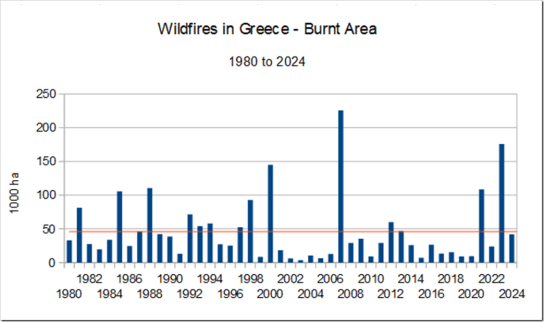
Wildfire activity in southern Europe was below average last year, according to the latest data from the EU. The trend is clearly downwards since 1980, contrary to the disinformation spewed by the establishment media.
The BBC’s Matt McGrath, for instance, recently claimed that a warmer world increased the chances of devastating wildfires occurring, while the Guardian’s Damien Carrington also falsely stated that “globally, scientists agree that climate change is increasing the global risk of wildfires starting and spreading”.
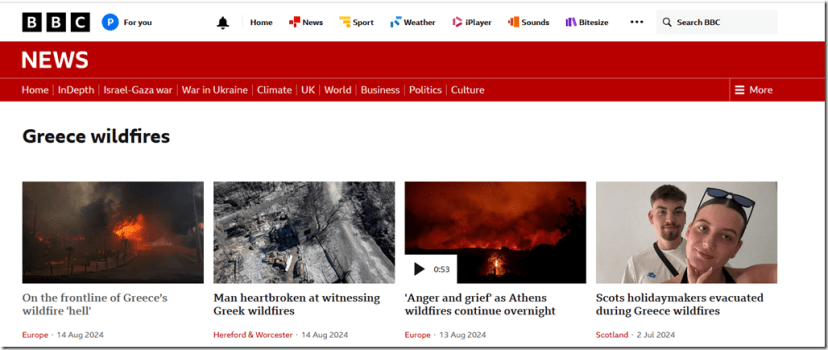
Last summer the BBC went into full propaganda mode over some fires in Greece, even though the burnt area was actually below average:
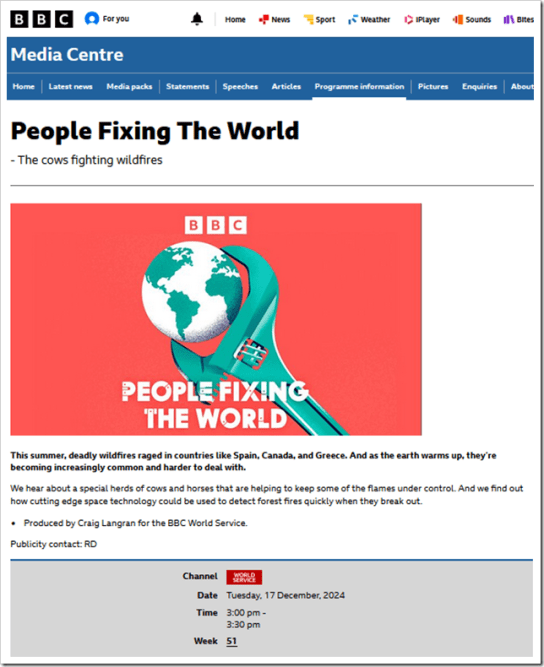
And in December, a BBC World Service broadcast falsely claimed that a warmer earth was making “deadly fires in Spain and Greece increasingly common”.
The BBC – the place where facts go to die!
Sources
1) Data for 2024 is from Copernicus: https://forest-fire.emergency.copernicus.eu/apps/effis.statistics/seasonaltrend
2) Earlier data id from the EEA: https://www.eea.europa.eu/data-and-maps/daviz/burnt-forest-area-in-five-4/#tab-chart_5
and EFFIS:
https://effis.jrc.ec.europa.eu/reports-and-publications/effis-related-publications
BBC Rides to the Rescue as Scientists Inconveniently Find the Gulf Stream Isn’t Getting Weaker
By Chris Morrison | The Daily Sceptic | February 6, 2025
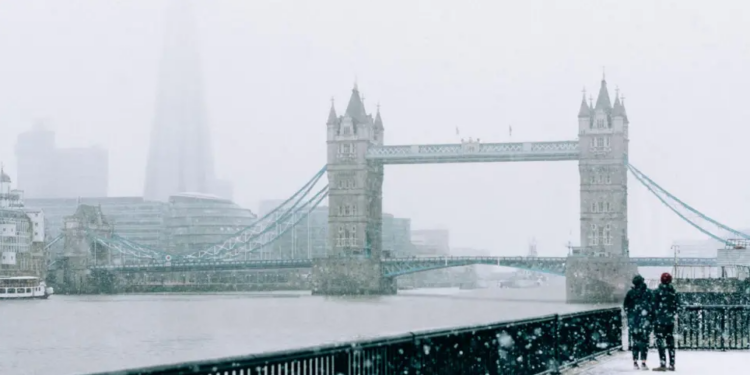
Last month a group of scientists published a paper in Nature stating that the Atlantic Meridional Overturning Circulation (AMOC) had shown no decline in strength since the 1960s. Helped by publicity in the Daily Sceptic, the story went viral on social media, although it was largely ignored in narrative-driven mainstream publications. The collapse of the Gulf Stream, a key component of the AMOC, is an important ‘tipping point’ story used to induce mass climate psychosis and make it easier to impose the Net Zero fantasy on increasingly resentful and questioning populations. Obviously, reinforcements to back up such an important weaponised scare needed to be rushed to the front and the BBC has risen to the challenge. The AMOC “appears to be getting weaker” state BBC activists Simon King and Mark Poynting. Their long article is a classic of its kind in trying to deflect scientific findings that blow holes in the ‘settled’ narrative.
In the Nature paper, three scientists working out of the Woods Hole Oceanographic Institution stated that they came to their conclusion showing the stability of the AMOC after examining heat transfers between the sea and the atmosphere. It was noted that the AMOC had not weakened from 1963 to 2017, “although substantial variability exists at all latitudes”. This variability is the basis for much of the Gulf Stream fear-mongering. The BBC notes that the presence of larger grains of sediment on the ocean floor suggests the existence of stronger currents, pointing to a “cold blob” in the Atlantic that appears to have cooled of late. Thin pickings, it might be thought, to run an article titled ‘Could the UK actually get colder with global warming?’ The Woods Hole scientists note that records “are not long enough to differentiate between low frequency variability and long-term trends”.
The Nature story is not the only recent scientific finding that suggests the Day After Tomorrow alarm about the AMOC is a tad overdone. In 2023, Georgina Rannard of the BBC reported that “scientists say” a weakening Gulf Stream could collapse as early as 2025. There was no later reporting, needless to say, of subsequent work from a group of scientists at the US weather service NOAA that discovered the huge flow of Gulf Stream tropical water through the Florida Straits had remained “remarkably stable” for over 40 years.
Of course the BBC, along with most of the legacy media, has form as long as your arm when it comes to producing deflective copy seemingly designed to head off inconvenient scientific findings. The Great Barrier Reef (GBR) is the largest and best observed collection of tropical coral in the world. Any sign of ill health is a boon for green propogandists who argue that warming measured in tenths of a degree centigrade will destroy an organism that has survived for millions of years in temperatures between 24-32°C. For the last three years, coral on the GBR has hit recent record levels with scarcely a mention in mainstream media. Days before last year’s record was announced, the places where journalism goes to die were full of stories from a paper that conveniently noted climate change posed an “existential threat” to the reef. “The science tells us that the GBR is in danger and we should be guided by the science,” Professor Helen McGregor from the University of Wollongong told Victoria Gill of BBC News. Professor McGregor’s statement was an opinion readily broadcast by the BBC, a courtesy that does not appear to have been extended to the fact that coral on the GBR was at its highest level since detailed observations began.
It beggars belief that the BBC and all its fellow alarmists can run this stuff with a straight face knowing that crucial scientific information is missing from their reports. Important findings from reputable sources emerge about the current stability of the Gulf Stream and the response is to blow more smoke around that raises wholly unnecessary fears.
The main concern is that the AMOC “could suddenly switch off”, state King and Poynting. To back up their statement and provide the inevitable political message they note the comment of Matthew England, Professor of Oceanography at the University of South Wales: “We’re playing a bit of a Russian roulette game. The more we stack up the atmosphere with greenhouse gases, the more we warm the system, the more chance we have of an AMOC slowdown and collapse.” Now look what you plebs have done with your steak chomping, gas-guzzling central heating and naff holidays in Benidorm, is an unpleasant subtext here.
Of course, keen and dedicated followers of climate alarmists will note a master craftsman at work. In 2023, aided by 35 million computer hours and using an improbable rise in temperature of up to 4°C in less than 80 years, Professor Matthews suggested that there was a dramatic slowdown in deep Antarctica ocean currents. Melting Antarctica ice could lead to a 40% slowdown in just 30 years. The fact that Antarctica has barely warmed in 70 years is ignored.
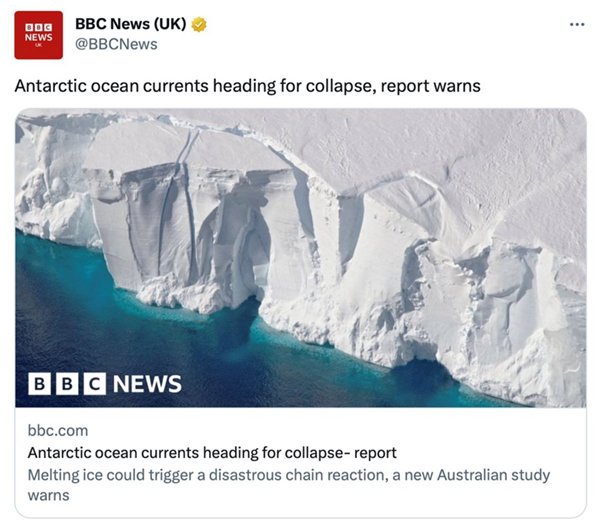
Who needs Hollywood sci-fi blockbusters when we have the BBC.
BBC’s Fake Wildfire Claims
By Paul Homewood | Not A Lot Of People Know That | January 30, 2025
The climate establishment are going to great lengths to blame the Los Angeles fires on global warming.
One attempt has already bitten the dust, with claims of increasing winter droughts contradicted by the real world data.
So another team of so-called scientists have come up with an even more ridiculous idea – that it is now both to wet and too dry in California.
The BBC report:
Climate change has made the grasses and shrubs that are fuelling the Los Angeles fires more vulnerable to burning, scientists say.
Rapid swings between dry and wet conditions in the region in recent years have created a massive amount of tinder-dry vegetation that is ready to ignite.
Decades of drought in California were followed by extremely heavy rainfall for two years in 2022 and 2023, but that then flipped again to very dry conditions in the autumn and winter of 2024.
“Scientists” say in a new study, external that climate change has boosted what they call these “whiplash” conditions globally by 31-66% since the middle of the 20th Century.
“This whiplash sequence in California has increased fire risk twofold,” said lead author Daniel Swain from UCLA.
“First, by greatly increasing the growth of flammable grass and brush in the months leading up to fire season, and then by drying it out to exceptionally high levels with the extreme dryness and warmth that followed.”
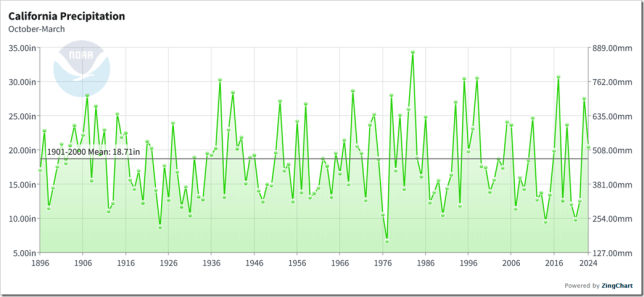
Once again though the actual data shows the new study to be just as fake as the previous one. Most of California’s rain comes in the winter half, October to March; the last two years have been wetter than average, but no more so than many other years on record:
The same applies to the South Coast Drainage Division, which includes Los Angeles:
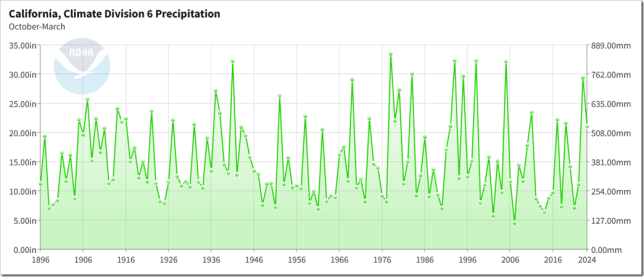
https://www.ncei.noaa.gov/access/monitoring/climate-at-a-glance/national/time-series
Neither is there any evidence of bigger swings from year to year.
Patrick Brown of the Breakthrough Institute has written a full scientific rebuttal here, which demolishes this latest fake science.
This is his summary:
Summary
So, let’s recap. At the annual timescale that is most relevant to the Los Angeles fires…
-
- Figure 1: There is no clear increase in overall whiplash occurrence or wet-to-dry whiplash occurrence in Los Angeles in the premiere observational dataset (ERA5) using data directly from Swain et al. (2025).
- Figure 2: There is no clear increase in overall whiplash occurrence or wet-to-dry whiplash occurrence over southern California in the premiere observational dataset (ERA5) using data directly from Swain et al. (2025).
- Figure 3: There is a long-term decrease in whiplash events globally over land (where it matters) in the premiere observational dataset (ERA5) using data directly from Swain et al. (2025).
- Figure 5: There is no increase in the variability (standard deviation) of annual SPEI either for all months or centered on January) in the Los Angeles grid point using the pre-existing standard SPEI dataset.
- Figure 6: There has been a decrease in the variability (standard deviation) of SPEI over global land since the 1980s using the pre-existing standard SPEI dataset.
- Figure 7: There is no agreement on the direction of change (if any) in annual precipitation variability (standard deviation) over the Los Angeles area across eight different precipitation datasets.
- Figures 8 and 9: There is no agreement on the direction of change (if any) in annual precipitation variability (standard deviation) globally across eight different precipitation datasets.
While “climate whiplash events” may be increasing in frequency under most of the very specific, selected definitions used and datasets investigated in Swain et al. (2025), the general idea that annual precipitation (or more generally, the water cycle, which includes evaporation) is becoming dramatically more variable is not supported when a broader set of datasets and definitions are used.
Would a reader of Swain et al. (2025), or especially its coverage, have any idea about the weakness of its broader conclusions or the lack of robustness of its results to different definitions and datasets? Almost certainly not, and I contend that this is a major problem for public understanding and trust in climate science.
Why don’t we see a robust increase in water cycle variability given the strong theory underpinning “wet gets wetter, dry gets drier”? For one thing, the theoretical size of the effect is known to be quite small relative to natural, unforced variability, making it inherently difficult to detect. For example, we see in Figure 7 above that year-to-year rainfall in Los Angeles naturally varies by as much as 300%, yet the signal we are looking for is one to two orders of magnitude less than this. It is also apparently the case that observational uncertainty is larger than the signal (or there would not be such disagreement between datasets). Physically, perhaps increasing mean precipitation is offsetting the increase in calculated evaporation in the SPEI index, reducing its variability. Maybe reduced temperature variability (via arctic amplification) is reducing calculated evaporation variability.
I don’t know the full answer, but these would be great research questions to identify and outline in a Nature review like Swain et al. (2025). Unfortunately, Swain et al. (2025) missed this opportunity because the paper seemed so focused on assembling evidence in favor of increasing water cycle variability that contradictory evidence was never presented or seriously grappled with.
My main discomfort with Swain et al. (2025) and its rollout is that it appears that the primary goal was to create and disseminate the “climate whiplash” meme rather than conduct a truly rigorous evaluation of the evidence, including countervailing evidence. Ultimately, this makes the research a much larger advance in marketing than an advance in science.
https://www.breakthroughjournal.org/p/how-much-did-increasing-climate-whiplash
Of course, studies like Swain’s are not intended to be serious science; they are written to generate headlines.
And the climate industry is now highly organised to ensure that theses fake studies are disseminated worldwide via a corrupt media.
Climate Bombshell: New Evidence Reveals 30 Year Global Drop in Hurricane Frequency and Power
By Chris Morrison | The Daily Sceptic | January 4, 2025
Last month a small but powerful cyclone named Chido made landfall in Mayotte before sweeping into Mozambique, causing considerable damage and leading to the loss of around 100 lives. Days after the tragedy, the Green Blob-funded Carbon Brief noted that scientists have “long suggested” that climate change is making cyclones worse in the region, while Blob-funded World Weather Attribution (WWA) at Imperial College London made a near-instant and curiously precise estimate that a Chido-like cyclone was about 40% more likely to happen in 2024 than during the pre-industrial age. Not to be outdone, Green Blob-funded cheerleader the Guardian chipped in with the obligatory “cyclones are getting worse because of the climate emergency”. Almost unnoticed, it seems, among all the Net Zero dooming and grooming was a science paper published during December by Nature that found no increase in the destructive power of cyclones – the generic term for typhoons and hurricanes – in any ocean basin over the last 30 years. In the South Indian basin, the location of cyclone Chido, there was a dramatic decrease in both frequency and duration in recent times.
Reality rarely gets much of a look-in these days when fanatical Net Zero activism is afoot, but the paper, written by a group of Chinese meteorologists, makes its case by considering the facts and the data. The scientists apply a “power dissipation index” (PDI) which they consider superior to single measure indicators since it combines storm intensity, duration and frequency. The graphs below show the cumulative index for tropical cyclones across all ocean basins along with a global indication.

Downward trends in the cumulative PDI can be seen in a number of Pacific regions, while the trend holds steady in the North Atlantic. The southern Indian ocean downward trend is particularly pronounced while the overall global line is also heading in a similar direction.
So why does all this scientific twaddle get written by the green activists in mainstream media? Much of it arises from the new pseudoscience that claims it can tie individual weather events to human-caused climate change. Press releases peddling climate Armageddon are issued days after a natural disaster and are eagerly reprinted by activist journalists promoting the Net Zero fantasy. The distinguished science writer Roger Pielke Jr. is a fierce critic of this new pseudoscience, which he calls weather attribution alchemy. In a recent Substack post in the aftermath of Chido, he noted that the WWA at Imperial College simply assumes the conclusion that it seeks to prove by accepting that every storm is made stronger because of warmer oceans. Using this explanation, continues Pielke, it is straightforward to conclude that the storm was made more likely due to climate change. Or as Imperial states: “The difference in the storm intensity and likelihood of this storm intensity between the counterfactual climate and today’s climate can be attributed to climate change.”
As the new Chinese paper shows, the matter is not quite so simple. Pielke notes that tropical storms encounter numerous environmental influences such as vertical wind shear and storm-induced ocean surface cooling, even when they remain over warmer waters. “Such complexities mean that simple storyline attribution – warmer oceans predictably mean stronger storms – is inappropriate when used to characterise the behaviour of individual storms,” he argues. Pielke also comes down hard on the statistical evidence backing the WWA claims. Even if storms such as Chido were more likely in the future, it would take a very long time to detect a significant change using the threshold 90% confidence set down by the Intergovernmental Panel on Climate Change (IPCC). And by very long time, he means thousands of years.
“Perhaps that is why assumptions are favoured over evidence,” suggests Pielke.
There were plenty of assumptions on display in a now routine end-of-year weather report from the BBC headed: ‘A year of extreme weather that challenged billions.‘ Written by Esme Stallard, it claims that record-breaking heat brought extreme weather including hurricanes and month-long droughts. Pride of place is given to Dr. Friederike Otto, lead of WWA and Senior Lecturer in Climate Science at Imperial, who claimed: “We are living in a dangerous new era – extreme weather caused unrelenting suffering.” “The impacts of fossil fuel warming has never been clear or more devastating than in 2024,” she added.
The redoubtable Paul Homewood is unimpressed with Stallard’s opening line about increasing extreme weather and has filed a complaint with the BBC. Stallard goes on to list a handful of random events, “but fails to provide any evidence that these are anything other than natural events which happen all the time”, states Homewood. “Nor is any evidence provided that such events have been getting more frequent or extreme over time,” he adds.
The BBC story highlighted typhoons in the Philippines as well as hurricane Beryl and stated that such events may be increasing in intensity due to climate change. Official data do not show any evidence of them becoming more powerful over time, notes Homewood. Much play was made of a recent drought in the Amazon, but Homewood points out that the World Bank Climate Portal reveals that rainfall has increased in the area by 5% over the last 30 years. Throughout the report, observes Homewood, the BBC bases its claims on weather attribution computer models. “However, computer models are not evidence, and can be manipulated to provide whatever results are desired. That is why they are widely derided by the wider scientific community,” he states.
For Roger Pielke, extreme weather attributions are “puzzling”. The most charitable explanation for their proliferation is that there is a demand for them, including from many in the media. The demand will be filled by someone, he concludes. “A less charitable explanation is that there is a systematic effort underway to contest and undermine actual climate science, including the assessments of the IPCC, in order to present a picture of reality that is simply false in support of climate advocacy. We might call that pseudo-scientific gaslighting,” he suggests.
Flash Floods In Spain
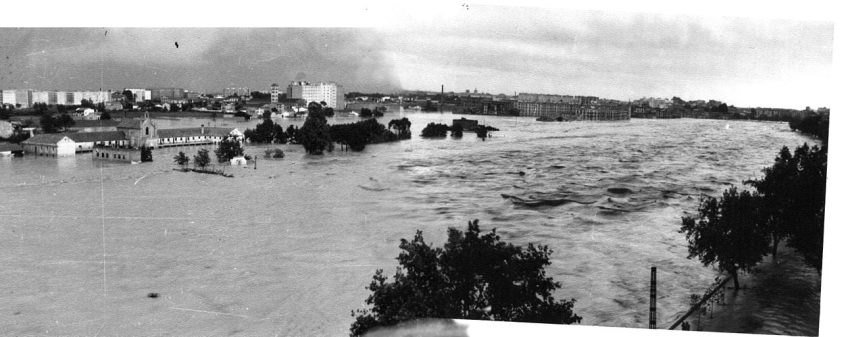
Valencia’s ‘Great Flood of 57’
By Paul Homewood | Not A Lot Of People Know That | October 30, 2024
Yes, the flash floods in Spain have been devastating. And, yes they have happened before.
But the BBC weatherman also claims that extreme rainfall events like these are becoming more common:
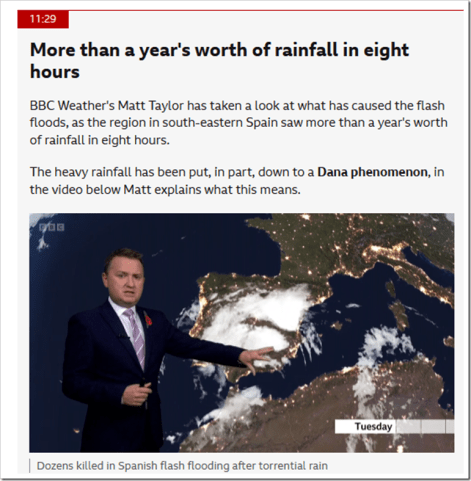
As usual the BBC do not provide any evidence for such irresponsible claims.
And the rainfall data for Valencia, which was worst hit, provides no such evidence either.
KNMI daily rainfall data shows categorically that extreme rainfall is neither more common or extreme.
According to the Spanish weather agency, rainfall peaked at about 200mm in the area, certainly not unprecedented.
The BBC say more fell up in the hills at Chiva, but that does not have a long term record, and inevitably rainfall will be much higher as the moist air rises rapidly over the hills. In other words, chalk and cheese.
Not for the first time, the BBC are using human tragedy to push their increasingly hysterical climate agenda.
BBC’s Steve Rosenberg amplifies President Putin’s message
By Ian Proud | Strategic Culture Foundation | November 1, 2024
The BBC’s Moscow correspondent, Steve Rosenberg, made a splash in British media by asking a question of President Putin during his press conference at the BRICS Summit in Kazan.
‘Journalist asks question at a press conference!’ doesn’t resonate with me as a headline as much as, say, ‘tens of thousands of innocent civilians and children killed needlessly in Gaza.’ And yet, the Daily Mail in the UK hailed Rosenberg as ‘the man who took on Putin,’ the Daily Wrap talked about a ‘grilling’ of the Russian President.
This provided a colourful insight into the different UK and the Russian perspectives on diplomacy and communications.
From the UK perspective, the British government has had a clear strategic communications aim since 2014 of talking about Russia rather than talking to Russia. Government strategic communications about have been and continue to be aimed at convincing UK, wider European and global audiences that the west is right, and that Russia is wrong. Since the Ukraine crisis started a decade ago, the British press has risen with great enthusiasm to the challenge of reporting in a very one-sided way about Russia. How unjust Russia’s actions are in Ukraine (the essence of Rosenberg’s question), how dreadful Russia is as a country and how it’s all President Putin’s fault. We talk about Russia, a lot!
A British journalist posing a question at a Russian press conference is firstly interesting because of its novelty. Western media consumers hardly ever see a British person talk to President Putin and practically never see a British politician talk him. When it happens, it fascinates, excites and terrifies in equal measure, like watching a Hannibal Lecter movie. Good job Rosenberg wasn’t invited for dinner.
The UK loves to talk about Russia precisely because we stopped talking to Russia ten years ago. Ever since 2014, the UK government has systematically cancelled opportunities for direct dialogue with Russia on issues of global importance, including on Ukraine. In recent history, this departure from diplomacy as a tool to resolve differences was accelerated by British Foreign Secretary Philip Hammond after he took office in July 2014. Apart from a vanishing attempt by Boris Johnson in late 2017 to re-engage in diplomacy with Russia, the approach of not-talking to Russia (but talking about Russia) has remained rock solid for ten years.
It is driven by an unshakeable belief that, when it comes to Russia, might will prove to be right, and that the combined economic, military and demographic size of the west will prevail, without the need to take account of Russian concerns.
Russia is an adversary to be defeated.
The problem, of course, is that Russia hasn’t been defeated in Ukraine. Slowly, and inexorably, Ukraine is losing ground in the Donbas while the west vacillates about further supplies of military and other financial aid.
The BRICS Summit in Kazan, if anything, was a demonstration that Russia’s role as an important regional power within the developing world, is as strong as ever.
And that message is anathema to western politicians and bureaucrats who can see their policy on Ukraine slowly disintegrating.
So, in that regard, the coverage of Rosenberg’s question was in part aimed at deflecting attention from the real story of the BRICS Summit; a successful global meeting held in Russia amid a huge growth in interest among countries in joining a new and more inclusive format of diplomatic dialogue.
If that was the aim, I don’t think it worked. Rosenberg stands, visibly nervous and asks a tame question about the justice of Russia’s actions in Ukraine, and about allegations of Russian meddling in British domestic politics. He also uses the abbreviation of the Special Military Operation (SVO) a term reviled in western media and largely cancelled out of press reporting (it doesn’t get mentioned in the BBC report).
And herein lies the Russian perspective. Rosenburg’s question was carefully choreographed. Watch the video and you’ll see Rosenberg is given the final question of the press conference, by a visibly amused Press Spokesman, Dmitry Peskov, who smiles at Putin. This question will bring the curtain down on the conference, so it has to be entertaining. President Putin laughs towards the end of Rosenberg’s question then offers a four-minute reply. He repeats key allegations he has been making for many years about the west looking to isolate and diminish Russia, and about Russian demands about no NATO expansion being ignored. Rosenberg stands awkwardly taking it all in.
This is the Putin I saw many times at big international conferences while I worked at the British Embassy in Moscow. He seems to like tough questions; I watched him go toe to toe with seasoned American journalists several times at the St Petersburg International Economic Forum, for example. He appears to relish the opportunity get his and Russia’s messages across to a wider global audience.
Just as importantly, he is signalling to Russian viewers that he is open to dialogue. And that foreign journalists, however good they are, can never summon up the weight of arguments to overcome the legitimacy of Russia’s actions in the world. Hence the Tucker Carlson interview on 6 February 2024 served exactly the same purpose. Over two hours, President Putin made himself available for a wide-ranging discussion. Some western commentators turned on Carlson visiting Russia and conducting the interview, which rewinds us back to the concept of talking about Russia, not talking to Russia.
But, unlike western leaders, even though the timing, questions and journalists are chosen carefully, President Putin has shown a consistent willingness to make himself available to for in-depth discussions. You never see western leaders do the same thing. Imagine Keir Starmer holding a two hour in-depth discussion with a journalist from Rossiya Segodnya ? It simply wouldn’t happen. Not only would that break the cardinal rule about not talking to Russians, it would expose him to some harsh questions about the failure of western policy in Ukraine.
As for Steve Rosenberg, he often receives fantastic access to senior political and policy figures in Moscow. Since 2022, he has interviewed Sergei Lavrov, Sergey Naryshkin and Maria Zakharova. He also interviewed Belarusian President Aleksander Lukashenko in the margins of BRICS. Every time, the interviewee mounts a robust defence of their actions and a critique of the west. And the videos are posted extensively on Russian media.
I wonder whether, in fact, the headline from Kazan should have been, ‘BBC journalist asks President Putin to put across the failure of western policy to a global audience.’
Canada’s State-Funded Legacy Media Unite to Combat “Disinformation”
By Didi Rankovic | Reclaim The Net | October 21, 2024
A large number of state-funded legacy public broadcasters from around the world have joined the Ottawa Declaration, which calls for combating “disinformation.”
Among the declaration’s points is the one that goes into what its authors – CBC/Radio-Canada – refer to as “accountability from social media platforms.” The document wants to have these platforms implement “safeguards and processes to address where disinformation is disseminated.”
We obtain a copy of the document for you here.
CBC was joined in this and a number of other demands by the world’s largest public legacy media organization, the Public Media Alliance, and its Global Task Force.
Members of that task force are the likes of ABC, BBC, France TV, Germany’s ZDF, and CBC/Radio-Canada, among others.
The declaration they supported was adopted at the 2024 Public Broadcasters International conference in Ottawa, and features “public service media” (“PSM”) claiming that their news and coverage are of “high quality” and of the kind that contributes to the “health of democracies all over the world.”
It then cites the demise of many local outlets and asserts there is now a rise in misinformation and disinformation, as well as that “professional news content” struggles with discoverability on the internet.
Altogether, the declaration states, that this represents “a threat to democracy.” The document parrots what politicians in many countries, including the US and Germany, have been saying these last months when it warns about algorithms and malicious actors destabilizing societies by means of disseminating misinformation.
For these reasons, the signatories committed to ensuring wide access to what they consider to be news, “combating disinformation” (and that includes the use of controversial “fact-checkers” but also “verifying content provenance”).
These legacy broadcasters also pledge to restore “civil” democratic debate, and then go into what social media platforms should do.
One demand is to provide distribution of their own content “on fair terms.” And then once again, the declaration returns to “disinformation,” this time in the context of social media.
Legacy broadcasters seem averse to competition but are not above smearing it, and so the document reads that social media platforms “should also have safeguards and processes to address where disinformation is disseminated and impostor content masquerades as professional news media.”
No battle in “the war on disinformation” is complete these days without the mention of “AI.”
The outlets that backed the declaration say they will be complying “with principles of responsible AI use” that will provide them with transparency and “fair use of our content.”
BBC interview with Hamas deputy chief is a case study in state propaganda

By Jonathan Cook | October 4, 2024
The BBC no longer bothers to hide the fact that its news service acts as nothing more than the British state’s willing propaganda channel.
Last night on the News at Ten, Middle East editor Jeremy Bowen secured a rare interview with Hamas’s deputy political chief, Khalil al-Hayya.
Anchor Clive Myrie introduced the segment by warning: “Many will find his comments abhorrent.” But the only person making abhorrent assertions was Myrie himself, observing that, in the interview, the Hamas leader “claims the Palestinian people have faced violence at the hands of Israel for several decades”.
No, Clive. The world’s highest court, the International Court of Justice, as well as every major human rights organisation, has concluded that Israel’s belligerent military occupation of the Palestinians’ territory is illegal and violent – not as a claim, but as an indisputable fact.
Israel’s refusal to recognise a Palestinian state and allow Palestinians self-determination; Israel’s building of hundreds of illegal settlements on Palestinian land and the transfer of Israeli Jews, often militia groups, into those settlements; Israel’s 17-year siege of Gaza; and Israel’s collective punishment of the Palestinian people to force them to submit to these indignities, are all forms of structural violence. Again, that is not a claim. It is how international law judges what Israel has done and is doing.
Next, Myrie required Bowen to justify at length why the BBC was allowing a Hamas political leader – not a military leader – to be given air time. Note, al-Hayya’s boss, Ismail Haniyeh, was assassinated by Israel while he was involved in negotiations to bring about a ceasefire. Like some kind of gangster, Israel murdered the man on the other side of the table it was supposed to be talking to.
The BBC provided none of that as context, of course, for its interview. It was too busy placating Israel and the British government by issuing apologies and warnings before it offered a rare insight into Hamas’ side of the story.
So what did al-Hayya say that was so “abhorrent”? Here are the main points al-Hayya raised in the interview – you can listen to his precise wording via this link – under Bowen’s mainly hostile questioning:
1. Hamas launched its attack on October 7 because the world had forgotten about Gaza even as Israel was slowly strangling the tiny territory to death through its 17-year siege. Hamas wanted to put Gaza back on the international community’s radar, and had decided it could do so only through military action.
2. Hamas fighters had been told not to target Israeli civilians on October 7, only Israeli occupation soldiers. Hamas does not endorse harming civilians. However, there were failings by individuals in sticking to that plan.
3. Israel, not Hamas, is the party responsible for destroying Gaza as evidenced through its bombardments of schools, shelters and hospitals. Hamas’ killing of 1,200 people could not be used to justify Israel killing more than 50,000 people in Gaza. Israel is “motivated by the lust to destroy”.
4. The accusation that Hamas uses the people of Gaza as “human shields” is not true. “They [Israel] destroyed mosques on the heads of their owners when there were no fighters. They destroyed houses and high-rise buildings when no one was in them… It is all Israeli propaganda.”
5. Netanyahu is the one obstructing a ceasefire. Even if Hamas surrendered today, Gaza’s next generation would take up the struggle because the Palestinian people want their freedom and have a legitimate right to resist the occupation. “People need to understand that Israel wants to burn the whole region.”
6. The Palestinians need a state and self-determination, and the Palestinian refugees a right to return to their homeland, if the region is ever to calm down.
7. It is Israel trying to eliminate the Palestinian people, not the Palestinians destroying Israel. “Give us our rights, give us a fully sovereign Palestinian state… Israel does not recognise a one-state solution or a two-state solution. Israel rejects it all.”
8. [Responding to a question about whether he considers himself a terrorist] “I’m seeking freedom and defending my people. To the occupation, we are all terrorists – the leaders, the women and the children. You heard what Israeli leaders called us: we are all animals.”
Now, one can debate whether al-Hayya’s statements are accurate or truthful, or whether he is being sincere. But nothing at all he says here can be viewed as “abhorrent” – unless you are shilling for Israel. He deplores attacks on civilians, he accuses Israel of bringing about Gaza’s destruction, he blames Netanyahu for blocking a ceasefire, and he appears to be ready to settle for a two-state solution, though he doesn’t believe Israel will agree to it.
In fact, his comments are far, far more moderate and far less inflammatory than statements regularly made by Netanyahu and most of the Israeli political and military leadership. Netanyahu, remember, is being sought by the chief prosecutor of the International Criminal Court for crimes against humanity, while the country he leads is on trial for what its sister court, the ICJ, considers a “plausible genocide” Netanyahu has incited and overseen. Not that the BBC ever mentions either fact.
And yet the state broadcaster never prefaces remarks from Netanyahu or other Israeli leaders – such as the self-declared fascist finance minister, Bezalel Smotrich – with any kind of warning, let alone one that many viewers may find their remarks “abhorrent”.
And while we are at it, if al-Hayya’s remarks are the yardstick, how was Keir Starmer’s comment that Israel had a right to deprive Palestinian civilians of food, water and fuel – that is, to collectively punish them by starving them to death – not also deemed “abhorrent” by the BBC?
What becomes ever harder to deny is that the BBC isn’t reporting what is happening in the Middle East. It is aggressively framing it in such a way as to present Israel as the victim of events, and thereby assist it in carrying out a genocide in Gaza and beginning a second slaughter in Lebanon.
BBC presenter calls for Trump to be assassinated
RT | July 2, 2024
BBC presenter David Aaronovitch has called for the “murder” of former US President Donald Trump in a post on X (formerly Twitter). Aaronovitch later deleted his message following a backlash, claiming it had been “satire.”
Aaronovitch, the voice behind the British state broadcaster’s Radio 4 program ‘The Briefing Room’, tweeted on Monday: “If I was Biden I’d hurry up and have Trump murdered on the basis that he is a threat to America’s security.”
The post was accompanied by the hashtag #SCOTUS, indicating that the comment had been triggered by Monday’s confirmation from the US Supreme Court that former presidents have “absolute immunity” from prosecution for their official actions.
Aaronovitch was forced delete the post after an online backlash, and claimed in a follow-up message that he had been accused of inciting violence by “a far right pile.” The presenter insisted his tweet was “plainly a satire.”
On Monday, the highest US court ruled that under “our system of separated powers, the President may not be prosecuted for exercising his core constitutional powers, and he is entitled to at least presumptive immunity from prosecution for his official acts.”
In an interview with Fox News Digital, Trump touted the verdict on presidential immunity as a “big win for our Constitution and for democracy.”
President Biden attacked the Supreme Court ruling, urging citizens to “dissent” against the verdict.
US federal prosecutors have charged Trump with four criminal counts related to the 2020 presidential election, alleging that he “conspired” to overturn the results.
The Supreme Court verdict still grants lower courts the right to hold evidentiary hearings to determine whether the actions are official or unofficial. Unofficial acts by the president are not covered by immunity from prosecution.
Trump has repeatedly called his prosecution politically motivated, describing it as a “witch hunt” launched by Biden and his administration.
Russia’s Growing Media Influence in the World Sparks Alarm in the West
Sputnik – 28.05.2024
Russian broadcasters such as Sputnik may be outperforming their Western counterparts in terms of media coverage abroad, UK-based non-profit called Association for International Broadcasting (AIB) claims.
In its written evidence submission to the UK Parliament International Development Committee’s Inquiry into Future funding of the BBC World Service, AIB stated that “the global distribution of Russia’s international [media] operations is possibly greater than that of Western broadcasters.”
Sputnik and RT TV and radio services are being broadcast in many of the Global South countries – “including, but not limited to Venezuela, Syria, Mexico, Guatemala, India, Pakistan and South Africa” – and these media operations help Russia spread its influence around the world, AIB laments.
All this praise, however, should perhaps be taken with a grain of salt, seeing how the main purpose of the AIB’s document appears to be securing more British government funding for the BBC.
How Many Billions of People Would Die Under Net Zero?
BY CHRIS MORRISON | THE DAILY SCEPTIC | APRIL 19, 2024
 BBC oddball Chris Packham has hit back at claims reported on Neil Oliver‘s GB News show that half the world’s population could die if Net Zero was implemented in full. “So Ofcom can you please explain how you allow this utter BS to be broadcast,” he wails. Running to Ofcom would appear to be a trade protection measure – millions will die has been the tried and trusted modus operandi of climate catastrophist Chris for decades.
This would appear to be the same Chris Packham who told the Telegraph in October 2010 that there were too many humans on the planet, and “we need to do something about it”. In 2020, he informed the Daily Mail that “quite frankly” smallpox, measles, mumps and malaria were there “to regulate our population”. Over his broadcast career, untroubled by Ofcom interest, Packham has claimed mass extinctions of all life on Earth unless humans stop burning hydrocarbons. Of course there are those who point out that these popular mass extinctions only seem to exist in computer models. Hydrocarbons, meanwhile, have led to unprecedented prosperity and health, unimaginable to previous generations, across many parts of a planet that now supports a sustainable population of humans numbering eight billion.
Of course Net Zero is not going to kill four billion people because Net Zero is never going to happen. Day-by-day, support is crumbling around the world as the political collectivisation project, supported by increasingly discredited computer-modelled opinions, is starting to fall apart as it bumps into the hard rock of reality. History teaches us that tribes that grow weak and decadent are easy prey for their stronger neighbours. But the suggestion that four billion will die if Net Zero should ever be inflicted on global populations is worth examining. After all, it is likely to be true.
The four billion dead noted on GB News came from a remark made by Dr. Patrick Moore, one of the original founders of Greenpeace. Interviewed on Fox News, he said: “If we ban fossil fuels, agricultural production would collapse. People will begin to starve, and half the population will die in a very short period of time”. Four billion dead if artificial fertiliser is banned is not ‘BS’, it is an almost guaranteed outcome. In a recent science paper, Emeritus Professors William Happer and Richard Lindzen of Princeton and MIT respectively noted that “eliminating fossil fuel-derived nitrogen fertiliser and pesticides will create worldwide starvation”. With the use of nitrogen fertiliser, crop yields around the world have soared in recent decades and natural famines, as opposed to those local outbreaks caused by humans, have largely disappeared.
Much of the luxury middle class Net Zero obsession is based on a seeming hatred of human progress. It is a campaign to push back the benefit of mass industrialisation, although it is doubtful that many of the ardent promoters think the drastic reductions in standards of living will apply to them. It is narcissism on stilts and based on an almost complete ignorance of how the food in their faddy diets arrives on their plates. It shows a complete disregard for the central role that hydrocarbons play in their lives. It is based on a profound distaste for almost any modern manufacturing process. These days, they do not know people who actually make things, and when they meet them they often dislike them. Nutty Guardianista George Monbiot recently tweeted that ending animal farming is as important as leaving fossil fuels in the ground. “Eating meat, milk and eggs is an indulgence the planet cannot afford,” he added.
Leaving fossil fuels in the ground will mean the following products will largely disappear.

Circulated on social media and recently published by Paul Homewood, the illustration is a wake-up call to the importance of hydrocarbons. Without it, humans would struggle to make many medicines and plastics. Similar difficulties would be found in the manufacture of common products such as clothing, food preservatives, cleaning products and soft contact lens.
Alec Epstein, the author of the best-selling book Fossil Future, agrees that Net Zero policies by 2050 would be “apocalyptically destructive”, and have in fact already been catastrophically destructive when barely implemented. A reference here, perhaps, to the wicked policies conducted by Western banks and elites in refusing to loan money to build hydrocarbon-fuelled water treatment plants in the poorer parts of the developing world. Billions still lack the cost-effective energy they need to live lives of abundance and safety, notes Epstein. Many people in developing countries still use wood and dung for cooking. Like Happer and Lindzen, he believes that if Net Zero is followed, “virtually all the world’s eight billion people will plunge into poverty and premature death”.
Much of what is planned is hiding in plain sight. The C40 group, funded by wealthy billionaires and chaired by London mayor Sadiq Khan, has investigated World War 2 style rationing with a daily meat allowance of 44g. Reduced private transport and massive restrictions on air travel have all been considered. Labour party member Khan has already made a cracking start on his elite paymasters’ concerns having recently driven many of the cars of the less affluent off London roads with specialist charging penalties.
Honesty rules the day at the U.K. Government-funded UK FIRES operation where Ivory Tower academics produce gruesomely frank reports showing that Net Zero would cut available energy by around three quarters. They assume, rightly, that there is no realistic technology currently available, or likely in the foreseeable future, to back up power sourced from the intermittent breezes and sun beams. No flying, no shipping, drastic cuts in meat consumption and no home heating are all discussed. A ruthless purge of modern building material is also proposed with traditional building supplies replaced by new materials such as “rammed earth”
A move back to primitivism is also foreshadowed by a recent United Nations report which suggested building using mud bricks, bamboo and forest ‘detritus’. It might be thought that mud and grass huts will hardly be enough to deter unfriendly foreign hordes that hove into future view on the horizon. And no point in asking the last person to turn out the lights, because there won’t be electricity anyway.
Chris Morrison is the Daily Sceptic’s Environment Editor.
Why won’t Chris Packham have a real debate on climate?
By Paul Homewood | Not A Lot Of People Know That | April 25, 2024

On Sunday, the BBC did something unusual. It invited Luke Johnson, a climate contrarian, to join a panel with Laura Kuenssberg to discuss net zero. As followers of this debate will know, the BBC’s editorial policy unit issued guidance to staff in 2018 saying: ‘As climate change is accepted as happening, you do not need a “denier” to balance the debate.’ Although it did allow for exceptions to this rule: ‘There are occasions where contrarians and sceptics should be included within climate change and sustainability debates.’ Presumably this was one such occasion.
The other two people on the panel – Chris Packham and Layla Moran – are members of the climate emergency camp, so there was no pretence of ‘balance’. At one point, the exchange between Johnson and Packham became heated and when the latter invoked the recent downpour in Dubai as well as extensive wildfires in the ‘global south’, as evidence of the effect of anthropogenic global warming, Johnson challenged him to come up with evidence that extreme weather was caused by carbon emissions.
‘It doesn’t come from Toby Young’s Daily Septic [sic], which is basically put together by a bunch of professionals with close affiliations to the fossil fuel industry,’ replied Packham. ‘It comes from something called science.’ This was hailed by Packham’s side as a slam-dunk rebuttal of Johnson’s argument. The Canary wrote up the exchange under the following headline: ‘Chris Packham just humiliated Kuenssberg’s preposterous climate-denying guest.’ The London Economic, which describes itself as ‘a digital newspaper with a metropolitan mindset’, summarised it as follows: ‘With science on his side, Chris Packham was able to deliver a devastating put-down when challenged on the evidence of climate change.’
I can’t help thinking Packham’s ‘devastating put-down’ would have been more effective if it had been true. The people who put together the Daily Sceptic, a news publishing site I’ve edited since 2020, have no connections to the fossil fuel industry. If Packham and his allies are so convinced of the rightness of their cause, why invent reasons to discredit their opponents? A clip from the show including this claim was posted on Twitter by BBC Politics and retweeted by Laura Kuenssberg, getting, at last count, 845,000 views. And to think the BBC launched a multi-million-pound department last year to ‘address the growing threat of disinformation’.
What about Packham’s claim that ‘something called science’ provides all the evidence we need that extreme weather events are caused by burning fossil fuels? There’s really no such thing as ‘the science’, as in a consensus viewpoint among scientists that’s so incontrovertible no serious debate is possible. All scientific theories are just hypotheses and, as such, subject to challenge. Indeed, if it were illegitimate to challenge these theories, progress in science wouldn’t be possible. To pretend that the science of what causes extreme weather is ‘settled’ when it’s the subject of ongoing dispute suggests that Packham and his pals aren’t capable of having a proper grown-up discussion.
Full story here.
Toby Young actually understates his complaint, as there is no evidence that weather is actually becoming more extreme – something the IPCC admit.
It is very easy for these conmen to claim it is, and simply justify it with a statement that “scientists say”. But as Toby points out, they are unable to back it up with actual data and evidence.
The idea, fraudulently circulated by grant funded climate scientists, that global warming means extreme weather has always been by definition absurd. After all, does this mean that the Earth’s climate was ideal during the Ice Age, which would be the logical conclusion?
The simple fact is that there has always been unpleasant weather, storms, floods, droughts, and glaciation. If Chris Packham can provide evidence that these have all gotten worse in recent times, then let him present it.
If he can’t, the BBC should apologise for broadcasting false statements, exclude him from all future debates on climate change, and ban him from making any further such political comments if he wishes to remain as an employee.
Featured Video

Pax Judaica Explained | Prof. David Miller
or go to
Aletho News Archives – Video-Images
From the Archives
History and Biblical Scholarship: Al-Quds Is Not Jerusalem
By Dr. Elias Akleh | Global Research | July 3, 2018
The Zionist Israeli state calls on the Old Testament/Torah as a historical document to prove its legality to “re-claim” Palestine; their god’s promised land. To assert this legality and the myth of the promised land Zionist Organization, since its establishment, had recruited the science of archaeology, employing western Christian biblical archaeologists, to provide the required “historic” proof of the right of the Jews; alleged modern Israelites, to Palestine. This became very critical after Julius Wellhausen; the biblical scholar and Professor Ordinarius of Theology and head of the German School of Biblical Criticism, published his 1883 book “Geschichte Israels”, later titled as “Prolegomena zur Geschichte Israels” claiming that the Old Testament/Torah stories were invented during the Babylonian exile to serve certain theological and political purposes.
American biblical scholars and archaeologists, such as William Fox Albright, were recruited to refute Wellhausen’s claims. Albright was endorsed by covertly Zionist financed Biblical Colloquium; a scholarly society devoted to the analysis and discussions of biblical matters, and the preparations, publication, and distribution of biblical literature to brainwash readers and students with a specific theological ideology. Albright, as well as other biblical archaeologists like him, was also honored (bribed) by the American Friends of the Israel Exploration Society. His writings; such as “Why the Near East Needs the Jews”, are flagrant racist Zionist propaganda ignoring the vast archaeological history of the indigenous Palestinians while emphasizing the fake unproven Israelites’ narrative in Palestine. … continue
Blog Roll
 Aletho News
- Hungary’s Blocking of EU Loan to Ukraine May Jeopardize IMF Funding – Reports
- Pax Judaica Explained | Prof. David Miller
- Was MAHA Too Good to Last in the Trump Administration?
- Vermont advances bill letting unelected Health Commissioner decide which vaccines ctizens should receive
- Why the US-Israeli alliance will lose against Iran
- US envoy Huckabee claims Israel has ‘biblical right’ to conquer all West Asia
- Testing the Alliance: Netanyahu’s Washington Visit
- Britain is once again poisoning peace diplomacy with Russia and fueling war in Europe
- Russian fuel tanker to test US sanctions amid Cuba crisis
- EU state issues ultimatum to Zelensky over Russian oil supplies
- If Americans Knew
- Palestinian church leaders admonish Christian Zionist Mike Huckabee – Not a ceasefire Day 135
- Ominous messaging from Trump’s “Board of Peace” – Not a ceasefire Day 134
- ‘Christians Out’: Jerusalem Church Tagged With Hate Graffiti, Police Investigating
- Israeli Settlers Kill American Teen
- ‘We returned from hell’: Palestinian journalists recount torture in Israeli prisons
- No mercy for Gaza in Ramadan – Not a ceasefire Day 133
- The Israeli Government Installed and Maintained Security System at Epstein Apartment
- Tucker Carlson interrogated in Israel, has passport seized after interviewing US ambassador
- 6,000 Amputees in Gaza Face Impossible Recovery amid Israeli War Ultimatum
- The Lancet: Gaza death toll far higher than reported – Not a ceasefire Day 132
- No Tricks Zone
- Germany: Electric Car Catches Fire At Charging Station, Sets Off Local “Inferno”, Widespread Damage
- New Study: Canada’s New Brunswick Was 1°C Warmer Than Today During The Medieval Warm Period
- Coal Power Back In Trend As Globe Tries To Keep Pace With Growing Demand For Power
- New Study: A 4°C Warmer Beaufort Sea Had ‘No Sea Ice’ 11,700 – 8200 Years Ago
- Unfudging The Data: Dutch Meteorological Institute Reinstates Early 20th Centruy Heat Waves It Had Erased Earlier
- German Gas Crisis…Chancellor Merz Allegedly Bans Gas Debate Ahead of Elections!
- Pollen Reconstructions Show The Last Glacial’s Warming Events Were Global, 10x Greater Than Modern
- Germany’s Natural Gas Storage Level Dwindles To Just 28%… Increasingly Critical
- New Study Rebuts The Assumption That Anthropogenic CO2 Molecules Have ‘Special’ Properties
- Climate Scientist Who Predicted End Of “Heavy Frost And Snow” Now Refuses Media Inquiries
 Aletho News