More ‘fake news’: NO second secret G20 Trump-Putin summit meeting
By Alexander Mercouris | The Duran | July 19, 2017
That there is an active media campaign to misrepresent President Trump’s actions, and his contacts with President Putin of Russia in particular, is confirmed by the media’s reporting of a wholly fictitious ‘second meeting’ between President Trump and President Putin at the G20 summit in Hamburg.
Reports of this ‘second undisclosed meeting’ are the lead story in news reports in the British media today. Here is the story as it is reported by the BBC, and here it is as reported by the Guardian.
To get a sense of the paranoia surrounding anything to do with Donald Trump, consider what the BBC’s Jonathan Marcus says about the meeting:
Given the poor state of relations between Washington and Moscow and the controversy surrounding Russia’s efforts to interfere with the US presidential campaign, each and every encounter between Mr Putin and Mr Trump is bound to be carefully scrutinised.
Thus the apparently impromptu discussion between the two men at the G20 dinner inevitably raises many questions. What was President Trump seeking to do in approaching the Russian president? Were matters of substance discussed? If so, why was no formal note taken? And why did the US president have to rely upon a Russian official for translation?
This is all highly unusual, especially at a time when relations between the two countries are laden with so many problems.
Mr Trump also appeared unaware of another dimension – the message that his tete-a-tete would send to other leaders in the room, who must have watched the US president’s gambit with some unease.
As for the origins of this story, it is clear that it originates with a single individual, Ian Bremmer the President of the international consulting firm the Eurasia Group. Here is how the Guardian reports his account of the ‘meeting’:
Bremmer said there was a dinner that evening for the G20 heads of state and their spouses, though not all of them attended. “There were a lot of empty seats,” he continued. “Donald Trump got up from the table and sat down with Putin for about an hour. It was very animated and very friendly. Putin’s translator was translating. I found out about it because people were startled.”
There was no one else within earshot, Bremmer added, and it is not known what the men discussed. Trump was not joined in the conversation by his own translator, which is thought to be a breach of national security protocol. The White House later said that the translator who accompanied Trump spoke Japanese, not Russian, and that was why Trump and Putin spoke through the Russian translator.
Bremmer added: “It’s very clear that Trump’s best single relationship in the G20 is with Putin. US allies were surprised, flummoxed, disheartened. You’ve got Trump in the room with all these allies and who’s the one he spends time with?”
Such was the level of concern that someone decided to bring it to Bremmer’s attention. He said he had expected the White House to go public. “I sat on this for days hoping they would talk about it. I knew last week. It didn’t happen. I’m an analyst; I’m not in the business of breaking news,” he said.
This is utterly absurd. Discernable through the hysteria is what actually happened. During a dinner at which other G20 leaders were present Trump and Putin met and spoke with each other, though the amount of time they spent in each other’s company is disputed (the White House denies it was anything close to an hour).
This is not only perfectly normal. It is what such dinners are for: to enable leaders to get to know each other and to speak to each other in informal settings without their aides present.
No one expects serious business to be done during such meetings. In the absence of aides and with the leaders unprepared and with no formal record kept of what is said, conducting formal business during such meetings is impossible. To compare such informal meetings with proper summits is ridiculous.
It is universally acknowledged that establishing a personal relationship between leaders is essential for effective diplomacy. That is why these sort of dinners take place. Trump was simply doing his job by making the most of the opportunity provided by this one.
The White House has provided its response to the reporting of this meeting
During the course of the dinner, all the leaders circulated throughout the room and spoke with one another freely. There was no ‘second meeting’ between President Trump and President Putin, just a brief conversation at the end of a dinner. The insinuation that the White House has tried to ‘hide’ a second meeting is false, malicious and absurd. It is not merely perfectly normal, it is part of a president’s duties, to interact with world leaders.
This is obviously correct, and it has been echoed by this typically pithy comment by President Trump himself:
Fake News story of secret dinner with Putin is “sick.” All G 20 leaders, and spouses, were invited by the Chancellor of Germany. Press knew!
— Donald J. Trump (@realDonaldTrump) July 19, 2017
The Fake News is becoming more and more dishonest! Even a dinner arranged for top 20 leaders in Germany is made to look sinister!
— Donald J. Trump (@realDonaldTrump) July 19, 2017
What is disturbing about this story is not so much the gross misrepresentation of this perfectly innocuous meeting. Rather it is the revelation that the President is being straightforwardly spied on, so that he cannot have a conversation at a dinner party without news of it being broadcast, and having the nature of the meeting completely misrepresented, by the media.
This is straightforward sabotage of the President’s work. One does not have to like President Trump or agree with his policy of seeking a rapprochement with Russia to be deeply disturbed by it.
97% Of Climate “Experts” Promised You The Arctic Would Be Ice-Free By 2014
Climatism | July 16, 2017

The Argus-Press – Google News Archive Search
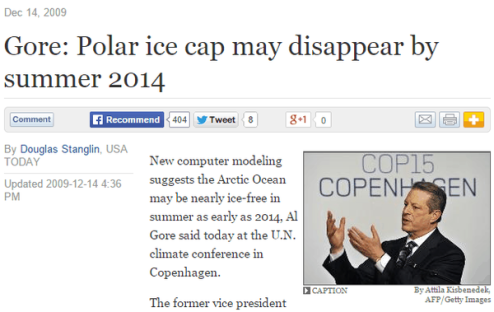
Gore: Polar ice cap may disappear by summer 2014
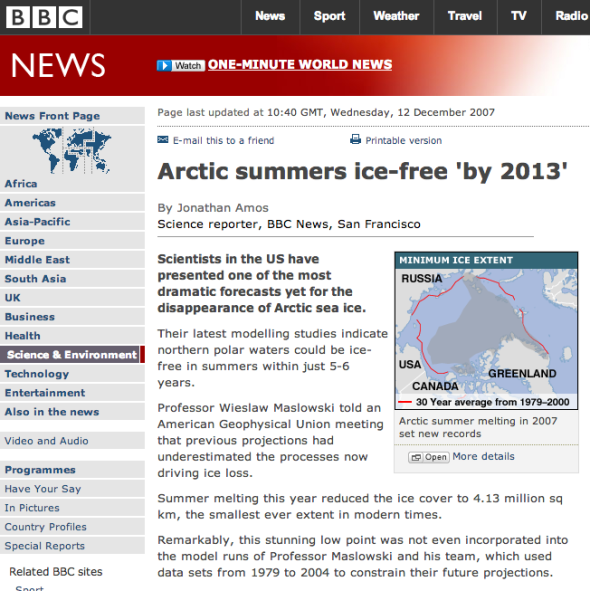
BBC NEWS | Science/Nature | Arctic summers ice-free ‘by 2013’

Ice-free Arctic in two years heralds methane catastrophe – scientist | Environment | The Guardian
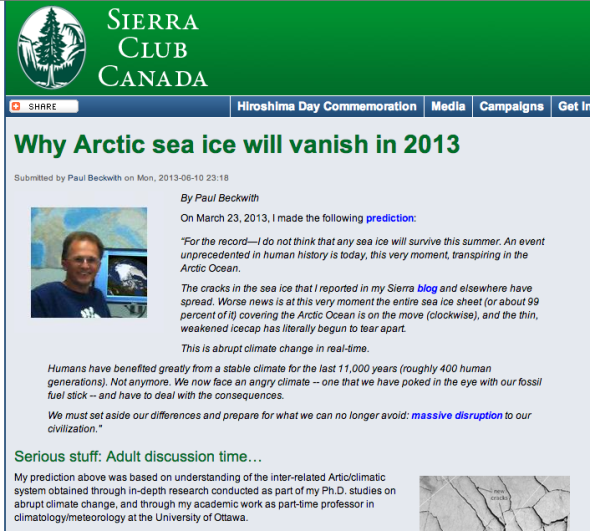
ICE WILL VANISH IN 2013 – Why Arctic sea ice will vanish in 2013 | Sierra Club Canada
•••
CLIMATE experts have been saying this same story for generations:
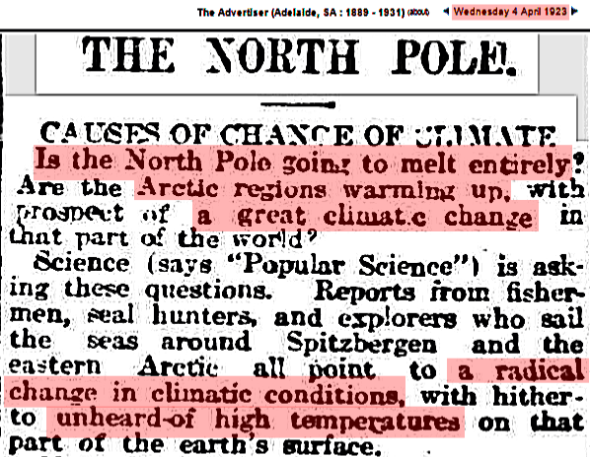
04 Apr 1923 – THE NORTH POLE. – Trove
The Guardian says the Arctic will be ice-free this summer…

‘Next year or the year after, the Arctic will be free of ice’ | Environment | The Guardian
BACK IN THE REAL WORLD
ARTIC sea-ice is tracking previous years of stable extent:

Centre for Ocean and Ice | Danmarks Meteorologiske Institut
•••
UN / WEC CLIMATE CHANGE SCARE-MONGERING
NOW, climate scientists and their “97%” triad of sycophant orgs are promising you that your Arctic will be ice-free by “2040” – plenty more wriggle-room for their catastrophic predictions to play out…
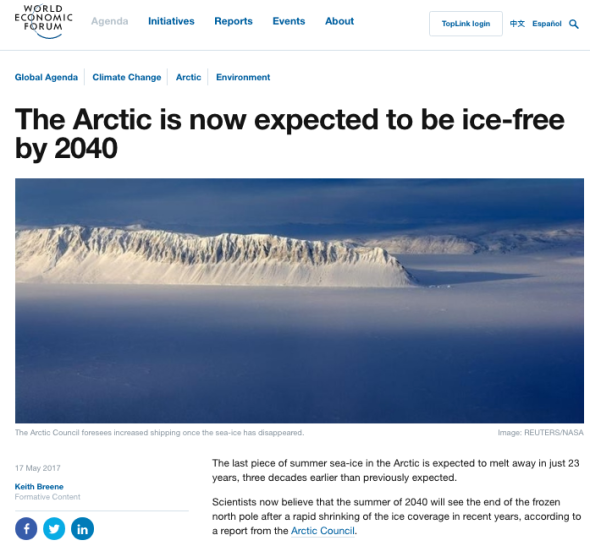
The Arctic could be ice free by 2040 | World Economic Forum
“Expected”, “could”…
That’s the great thing about the future.
Exploitation of children in propaganda war against Syria continues
By Eva Bartlett | RT | June 19, 2017
In December 2016, filmmakers in Egypt were arrested in the process of staging an Aleppo video with two children: the girl was meant to look injured, and the boy was to vilify both Russia and Syria.
Even the corporate media reported on it, including: “The girl’s dress, covered in red paint, was what caught the attention of a police officer driving by, the ministry said.”
The incidences of fakery and hoaxes, however, does not end there.
Also in December, the scene of a ‘Girl running to survive after her family had been killed’ was said to be in Aleppo. In reality, it was a scene from a Lebanese music video, which someone at some point clearly chose to depict as in Aleppo, for the same anti-Russian, anti-Assad vilification purposes.
In November 2014, a clip dubbed ‘Syrian hero boy’ went viral, viewed over 5 million times already by mid-November. The clip showed what appeared to be a little boy saving his sister from sniper gunfire, and was assumed to have been in Syria.
The Telegraph’s Josie Ensor didn’t wait for any sort of verification of the video which she cited as having been uploaded on November 10, the next day writing: “… it is thought the incident took place in Yabroud – a town near the Lebanese border which was the last stronghold of the moderate Free Syrian Army. Experts tell the paper they have no reason to doubt its authenticity. The UN has previously accused the Syrian regime of ‘crimes against humanity’ – including the use of snipers against small children.”
On November 14, the BBC brought on ‘Middle East specialist’ Amira Galal to give her expert opinion on the clip. She asserted: “We can definitely say that it is Syria, and we can definitely say that it’s probably on the regime frontlines. We see in the footage that there is a barrel, it’s painted on it the Syrian army flag.”
Once again, the so-called ‘experts’ got it wrong. The barrel which Galal referred to had a poor imitation of the flag of Syria painted on it, the flag’s color sequence out of order. The clip she was so certain had been filmed in government areas of Syria was actually produced in Malta by Norwegian filmmakers.
From Video to Twitter Hoaxes
In the propaganda war on Syria, there are convincing lies, and then there are the blindingly clear hoaxes. In the latter realm, the Bana al-Abed Twitter persona takes first prize. The child is being abused by her own family who have seemingly forced her to pretend she can speak English (she cannot).
We were meant to believe that sophisticated and nuanced tweets, often calling for Western intervention, are coming from an English-illiterate seven-year-old girl or her mother — whose husband was a militant in Aleppo.
In a detailed article, Barbara McKenzie looks at the campaign which uses the brand Bana for war propaganda. An excerpt includes: “Bana, the little girl supposedly tweeting from Aleppo, but actually the front for an account run from London, was selected to be the empathetic face of the campaign for a no-fly zone in Syria. Her account was tailored to create the impression of perpetual bombing, perpetual war crimes, on the part of Russia and the Syrian government.”
Bana not only tweeted with impossible frequency from eastern Aleppo, defying any internet lapses those of us who have gone to Aleppo have experienced. Whatever the actual explanation for her alleged preciousness and high-tech abilities, the child was clearly exploited, and continues to be.
Her twitter account continues its advocacy for Western intervention in Syria. Not at all suspicious.
Real Poster Children Brutally Beheaded, Sniped, Starved, Maimed
Effective war propaganda tugs at the heart strings, using many tactics, including adorable children in threatening situations, or dead, and comes hand in hand with condemnations for crimes committed, allegedly, by the villain(s) being caricatured. In the following instances, children being injured or murdered did occur, but the condemnations were muted or not at all.
A few weeks prior to the photo of Omran Daqneesh going viral as the poster child for suffering in Syria, terrorists of the Nour al-Din al-Zenki faction beheaded a boy said to be around 12 years old.
Although the decapitators filmed the entire savage act, posing for gleeful selfies as they tortured the boy prior to murdering him, leaders and media in the US took little notice of the horrific slaughter. Ten days after the questionable events which led to the light injury of Omran, two young boys in the Idlib villages of Foua and Kafraya were shot in their head and neck respectively by a sniper from Jaysh al-Fateh terrorists in the village of Binnish close by. The injuries were serious. They were rendered even more serious given that the villages had been completely surrounded and fully under siege by terrorists since March 2015.
In April 2017, a convoy of children, women, elderly and ill being evacuated from Foua were attacked by a terrorist explosion, with reports over 200 murdered, including 116 children. The attack included luring with potato chips and filming children in the convoy before later blowing them up and claiming to be rescuing them. Not only did these terrorists murder civilians and children, but they staged the scene to then look like heroes.
Indeed, in the West this massacre was called a “hiccup” and little denunciation was made about the vast numbers of dead, let alone the injured.
In October, 2016, Press TV was one of the few outlets to report on another adorable Aleppo boy, Mahmoud, “a six-year-old Syrian boy who was born without arms, and recently lost both of his legs after stepping on a mine planted by militants in Syria’s Aleppo.” The report includes scenes of Mahmoud showing his resilience, adjusting to life without any limbs. But for corporate media, Mahmoud’s were the wrong villains.
Terrorist bombings and snipings have killed children in schools and homes throughout Syria over the years, including the October 2014 terrorist car and suicide bombing of the Akrama Al-Makhzoumi School in Homs, killing at least 41 children by conservative estimates, or up to 48 children by other reports, along with women and other civilians, as well as attacks on Aleppo schools, as I detailed earlier.
In Aleppo and in Damascus, I have visited numerous hospitals and seen endless poster children of suffering in Syria. The differences between these children and those which Western and Gulf media present us, is that these children were murdered, rendered critically-injured, or maimed by the bombs, mortars and snipings of terrorists which the West presents as “moderate rebels”, so their stories will never be front page, much less heard.
The Bitter Truth
The Western and Gulf media work in lockstep with the narratives emanating from Washington on Syria. It is not coincidental that certain photos and stories of Syrian children go viral, while other more damning photos and sordid realities get no notice period.
Regarding the Omran case, we now know that he was not gravely hurt as media tried to imply, that his family have gone back to their lives in Aleppo, and the exploitation and lies around Omran cannot continue.
When I met them on June 6th, they showed no signs of the duress which terrorists and their backers—which include Western corporate media—claim. Instead, some neighbors were over, discussing media fabrications around Omran.
However, the children who are believed to have been exploited and used in the 2013 Ghouta chemical weapons fabrications remain missing and have not gone back to their lives, nor have their families in the Latakia countryside.
In March 2017, physicians with Swedish Doctors for Human Rights, after examining a White Helmet’s video, wrote: “… Swedish medical doctors, specialists in various fields, including pediatrics, have revealed that the life-saving procedures seen in the film are incorrect – in fact life-threatening – or seemingly fake, including simulated resuscitation techniques being used on already lifeless children.”
The article noted that Dr Lena Oske, a Swedish medical doctor and general practitioner, said of an adrenaline injection shown in the video, “If not already dead, this injection would have killed the child!”
While in al-Waer, Homs, on June 9, 2017, speaking with a woman who had returned not long after the last terrorist had been bused out in the government’s reconciliation agreement, she told me a story of her friend from the area. Bearing in mind that this is second hand information (and that I didn’t have time to stay another day to meet the friend in question), I’ll leave her words and this 2012 link as food for thought regarding the use of children, alive or day, for war propaganda against Syria: “In 2014, my friend’s son, Louay was leaving his school. A mortar fell on the street nearby and he was hit with shrapnel. The Red Crescent took him in an ambulance to al-Bour, a nearby aid association, which couldn’t treat him, so he was taken to a government hospital in al-Zahra’a. They tried to save him, but he died.
They took him back to al-Bour where they cleaned him for burial. While my friend was waiting, people from al-Bour carried him onto the street yelling the regime killed him, look what the regime does to children.'”
Later, she saw on both al-Jazeera and al-Arabiya footage of her son, with men blaming the “regime” for killing children in Syria.
But she didn’t agree. The government helped her son and tried to save his life. He was 7 years old.
Eva Bartlett is a freelance journalist and rights activist with extensive experience in the Gaza Strip and Syria. Her writings can be found on her blog, In Gaza.
Such a “Surprise” in the UK!
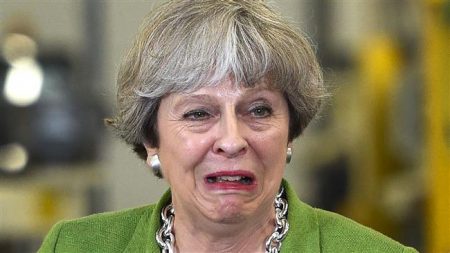
By Thomas S. Harrington | CounterPunch | June 12, 2017
I just can’t believe what happened in the British elections.
I can’t get over the fact that that when a politician with real convictions honed over 40 years of political life—generous and forward-looking convictions rooted in an understanding of how social progress for the many has actually been engineered in previous times—speaks out unencumbered by corporate-minded, fraidy-cat image doctors, people actually respond enthusiastically.
It’s shocking, absolutely shocking.
Why am I so confused?
Well, for thirty years, the brilliant people at the NYT, NPR, PBS, the BBC and The Guardian have told me again and again that candidates from Labor in the UK and the Democratic Party in the US must always be oh-so-careful careful to not veer too far left in their policy prescriptions, to not appear too “populist” and, most of all, to not to go “too far outside the mainstream”.
The question of who defines what is the mainstream, or how lavishly-funded pro-business and pro-war think-tanks might actually be the people establishing its functional parameters by funding armies of think-tank “scholars” and “experts” were, of course, a complex hermeneutical problems that I never had the time nor the energy to ponder or deconstruct.
If those smart Ivy and Oxbridge-type guys and gals in the prestige media were telling us time and again that our societies were all fundamentally center-right collectives with a deep suspicion of government action (except, that is, when it came to making unceasing war on a world-wide scale) who was I, an obscure analyst of Iberian nationalisms and other sundry issues, to say anything about it?
Can you imagine someone like me actually believing he had the right to question brilliant and connected people like David Brooks, Tom Friedman or Jonathan Freeland or Polly Toynbee?
It would have been the height of hubris on my part to do so. After all, unlike them, I don’t spend my time networking each day with ambitious like-minded people deeply enamored of power, nor do I have the option of knowing exactly what stories and messages will provoke society’s centers of financial and military power to pressure a media conglomerate to trim a pundit’s paycheck or to convince well-heeled seekers of transcendent insight to stop paying her fat speaking fees.
Because I lack this essential information, I have always assumed my rightful place as an uncritical consumer of their deeply though-out and always prescient nostrums.
True, today I am feeling a little confused and bereft. But I know that by the time the next news cycle comes around they’ll have it all figured out for me, providing explanations that will in no way contradict or vitiate all the brilliant things they’ve been saying over so many years.
‘The BBC Has Betrayed Its Own Rules Of Impartiality’: Yemen, Saudi Arabia And The General Election
Media Lens – June 5, 2017
A key function of BBC propaganda is to present the perspective of ‘the West’ on the wars and conflicts of the world. Thus, in a recent online report, BBC News once again gave prominence to the Pentagon propaganda version of yet more US killings in Yemen. The headline stated:
US forces kill seven al-Qaeda militants in Yemen, says Pentagon
Seven ‘militants’ killed is the stark message. A veneer of ‘impartiality’ is provided by the weasel words, ‘says Pentagon’. BBC News then notes blandly, and without quotation marks:
The primary objective of the operation was to gather intelligence.
Nowhere in the short article was there any attempt to provide an alternative view of who had been killed and why. Were they really all ‘militants’? How is a ‘militant’ distinguished from a ‘civilian’, or from a soldier defending his country against foreign invaders? There was not even a cautious statement to the effect that the Pentagon’s claims could not be verified, as one might expect of responsible journalism.
Instead, we have to turn to Reprieve, an international human rights organisation founded in 1999 by the British lawyer Clive Stafford Smith. The group reports that five of the ‘militants’ were civilians, including a partially blind 70-year-old man who was shot when he tried to greet the US Navy Seals, mistaking them for guests arriving in his village.
But their civilians are mere ‘collateral damage’ in war. Since January 2017, the US has launched 90 or more drone strikes in Yemen, killing around 100 people, according to the Bureau of Investigative Journalism. This death toll includes 25 civilians, among whom were 10 children, killed in the village of al Ghayil in the Yemeni highlands during a US raid that was described by President Trump as ‘highly successful’.
Mentions of such atrocities were notable by their absence in ‘mainstream’ media coverage of Trump’s recent trip to Saudi Arabia where he signed trade deals worth around $350 billion. This included an arms deal of $110 billion which the White House described as ‘the single biggest in US history.’ It would not do for the corporate media, including BBC News, to dwell on the implications for Yemen where at least 10,000 people have been killed since the start of the Saudi-led bombing campaign in 2015. 14 million Yemenis, more than half the population, are facing hunger with the Saudis deliberately targeting food production.
The World Health Organisation recently warned of the rising numbers of deaths in Yemen due to cholera, saying that it was ‘unprecedented’. Save the Children says that at the current rate, more than 65,000 cases of cholera are expected by the end of June. The cholera outbreak could well become ‘a full blown-epidemic’. Moreover:
The upsurge comes as the health system, sanitation facilities and civil infrastructure have reached breaking point because of the ongoing war.
As US investigative journalist Gareth Porter observes via Twitter:
World leaders are silent as #Yemen faces horrible cholera epidemic linked to #Saudi War & famine. Politics as usual.
Iona Craig, formerly a Yemen-based correspondent for The Times, notes that ‘more than 58 hospitals now have been bombed by the coalition airstrikes, and people just do not have access to medical care in a way that they did before the war.’ As if the bombing was not already brutal, Saudi Arabia has imposed a cruel blockade on Yemen that is delaying, or even preventing, vital commodities from getting into the country. Grant Pritchard, interim country director for Save the Children in Yemen, says:
These delays are killing children. Our teams are dealing with outbreaks of cholera, and children suffering from diarrhoea, measles, malaria and malnutrition.
With the right medicines these are all completely treatable — but the Saudi-led coalition is stopping them getting in. They are turning aid and commercial supplies into weapons of war.
As one doctor at the Republic teaching hospital in Sanaa commented:
We are unable to get medical supplies. Anaesthetics. Medicines for kidneys. There are babies dying in incubators because we can’t get supplies to treat them.
The doctor estimated that 25 people were dying every day at the hospital because of the blockade. He continued:
They call it natural death. But it’s not. If we had the medicines they wouldn’t be dead.
I consider them killed as if they were killed by an air strike, because if we had the medicines they would still be alive.
None of this grim reality was deemed relevant to Trump’s signing of the massive new arms deal with Saudi Arabia. BBC News focused instead on inanities such as Trump ‘to soften his rhetoric’, ‘joins Saudi sword dance’ and ‘no scarf for Melania’. But then, it is standard practice for the BBC to absolve the West of any blame for the Yemen war and humanitarian disaster.
British historian Mark Curtis poses a vital question that journalists fear to raise, not least those at the BBC: is there, in effect, collusion between the BBC and UK arms manufacturer BAE Systems not to report on UK support for the Saudi bombing of Yemen, and not to make it an election issue? Curtis also notes that the BBC has not published any online article about UK arms being sold to the Saudis for use in Yemen since as far back as January. This, he says, is ‘misinforming the public, a disgrace’. He also rightly points out that the BAE Systems Chairman, Sir Roger Carr, was also Vice-Chair of the BBC Trust until April 2017 (when the Trust was wound up at the end of its 10-year tenure). The BBC Trust’s role was to ensure the BBC lived up to its statutory obligations to the public, including news ‘balance’ and ‘impartiality’. How could Sir Roger’s dual role not suggest a major potential conflict of interest?
On the wider issue of ‘mainstream’ media coverage of foreign policy, the political journalist Peter Oborne notes that:
Needless to say, the British media (and in particular the BBC, which has a constitutional duty to ensure fair play during general elections) has practically ignored Corbyn’s foreign policy manifesto.
Oborne writes that the manifesto:
is radical and morally courageous.
He explains that, pre-Corbyn:
Foreign policy on both sides was literally identical. The leadership of both Labour and the Conservatives backed the wars in Iraq, Libya and Afghanistan, the alliance with Saudi Arabia and the Sunni states in the Gulf.
London did what it was told by Washington. […] This cross-party consensus has been smashed, thanks to Jeremy Corbyn, the current Labour leader. Whatever one thinks of Corbyn’s political views (and I disagree with many of them), British democracy owes him a colossal debt of gratitude for restoring genuine political debate to Britain.
And of course his extremely brave and radical decision to break with the foreign policy analysis of Blair and his successors explains why he is viewed with such hatred and contempt across so much of the media and within the Westminster political establishment.
But, as Oborne notes, this important change has not been fairly represented in media coverage. In particular, on Yemen and Saudi Arabia:
It is deeply upsetting that the BBC has betrayed its own rules of impartiality and ignored Corbyn’s brave stand on this issue.
We challenged Andrew Roy, the BBC News Foreign Editor, to respond to Oborne’s observations. He ignored us (here and here). Roy’s silence is especially noteworthy given that he had once promised:
If there is a considered detailed complaint to something we’ve done, I will always respond to it personally.
Perhaps Oborne’s challenge to the BBC was not deemed sufficiently ‘considered’ or ‘detailed’ by the senior BBC News editor. Likewise, our own challenges over many years in numerous media alerts addressing BBC foreign coverage have been ignored or, at best, brushed away.
It was noteworthy that Corbyn’s considered response to the most recent terrorist attack in London was selectively reported, arguably censored, by BBC News. Corbyn said:
We need to have some difficult conversations, starting with Saudi Arabia and other Gulf states that have funded and fuelled extremist ideology.
It is no good Theresa May suppressing a report into the foreign funding of terrorist groups. We have to get serious about cutting off the funding to these terror networks, including Isis here and in the Middle East.
Sky News broadcast Corbyn’s comments, but they do not appear to have been covered by BBC News. Certainly, as far as we can see, there is no mention of them in their ‘Live’ blog on the London attack or in Laura Kuenssberg’s analysis, ‘Election 2017: Impact of London terror attack on campaign’. And nothing about the Saudi link with terrorism appears in the BBC’s online report on Corbyn’s speech, focusing instead on the issue of May’s cuts to police numbers while Home Secretary. Even this issue alone, if properly and fully addressed by the media, should be a resigning matter for May as Prime Minister. Responding to the London attacks, Peter Kirkham, a former Senior Investigating Officer with the Metropolitan police, accused the government of lying over police numbers on UK streets. And a serving firearms officer says that:
The Government is wrong to claim police cuts have nothing to do with recent attacks.
Despite her denials, Theresa May’s cuts to police numbers have made attacks like London and Manchester much more likely.
Kuenssberg’s piece included passing mention of ‘the Tories’ record on squeezing money for the police’. But she gave no figures showing a reduction in the number of armed police; crucial statistics which she could have easily found from the Home Office.
Mark Curtis gives a damning assessment of BBC reporting on foreign affairs, particularly during the general election campaign. Noting first that:
One aspect of a free and fair election is “nonpartisan” coverage by state media.
He continues:
Yet BBC reporting on Britain’s foreign policy is simply amplifying state priorities and burying its complicity in human rights abuses. The BBC is unable to report even that Britain is at war – in Yemen, where the UK is arming the Saudis to conduct mass bombing, having supplied them with aircraft and £1 billion worth of bombs, while training their pilots.
Curtis then provides some telling statistics:
From 4 April to 15 May, the BBC website carried only 10 articles on Yemen but 97 on Syria: focusing on the crimes of an official enemy rather than our own. Almost no BBC articles on Yemen mention British arms exports. Theresa May’s government is complicit in mass civilian deaths in Yemen and pushing millions of people to the brink of starvation; that this is not an election issue is a stupendous propaganda achievement.
Indeed, our newspaper database searches reveal that, since the election was called on April 18, there has been no significant journalistic scrutiny of May’s support of Saudi Arabia’s bombing campaign in Yemen. The subject was even deemed radioactive during a public meeting in Rye, Sussex, when Amber Rudd, standing for re-election, appeared to shut down discussion of arms sales to Saudi Arabia. Electoral candidate Nicholas Wilson explains what happened:
At a hustings in Rye on 3 June, where I am standing as an independent anti-corruption parliamentary candidate, a question was asked about law & order. Home Secretary Amber Rudd, in answering it referred to the Manchester terrorist attack. I took up the theme and referred to UK arms sales to Saudi Arabia & HSBC business there. She spoke to and handed a note to the chairman who removed the mic from me.
The footage of this shameful censorship deserves to be widely seen. If a similar event had happened in Russia or North Korea, it would have received intensive media scrutiny here. Once again, we note the arms connection with the BBC through BAE Systems Chairman, Sir Roger Carr. Wilson has also pointed out a potential conflict of interest between HSBC and the BBC through Rona Fairhead who was a non-executive director of HSBC while serving as Chair of the BBC Trust.
These links, and Theresa May’s support for the Saudi regime, have gone essentially unexamined by the BBC. And yet, when BBC political editor Laura Kuenssberg responded to Corbyn’s manifesto launch, her subtle use of insidious language betrayed an inherent bias against Corbyn and his policies on foreign affairs. She wrote: ‘rather than scramble to cover up his past views for fear they would be unpopular’, he would ‘double down… proudly’. Kuenssberg’s use of pejorative language – ‘scramble’, ‘cover up’, ‘unpopular’ – delivered a powerful negative spin against Corbyn policies that, in fact, as Oborne argues, are hugely to his credit.
When has Kuenssberg ever pressed May over her appalling voting record on Afghanistan, Iraq, Libya, Syria and Yemen? In fact, there is no need for May to ‘scramble’ to ‘cover up’ her past views. Why not? Because the ‘mainstream’ media rarely, if ever, seriously challenge her about being consistently and disastrously wrong in her foreign policy choices; not least, on decisions to go to war.
BBC goes full Big Brother in recent announcement
OffGuardian | May 21, 2017
Brought to our attention by Mark Doran, a new BBC document dated May 2017 contains this bizarre threat to its licence-payers:
9. Offensive or inappropriate content on BBC websites
If you post or send offensive, inappropriate or objectionable content anywhere on or to BBC websites or otherwise engage in any disruptive behaviour on any BBC service, the BBC may use your personal information to stop such behaviour.
Where the BBC reasonably believes that you are or may be in breach of any applicable laws (e.g. because content you have posted may be defamatory), the BBC may use your personal information to inform relevant third parties such as your employer, school email/internet provider or law enforcement agencies about the content and your behaviour.
Here’s Mark’s screen cap of the doc:

Not only is this freakishly (yes, there’s no other word) Orwellian, it’s completely vague. Are the words “objectionable” and “disruptive” going to be employed like the words “hate” (currently being used to shut down discourse on social media), and “fascist” (currently being used by (often fascist) neoliberals to brand any serious criticism of globalism and the corporatocracy), to outlaw and/or punish dissident views? And what about “defamatory”? Is anyone calling Theresa May a malfunctioning Thatcher-bot going to be shopped out to her lawyers by the Beeb?
Clarification, at the very least, is urgently needed. Better still, the BBC should backtrack and guarantee it will remain a broadcast corporation and NOT presume to act as an arm of the state security system.
If you’re a concerned UK citizen, don’t hesitate to contact the BBC to express your views – though be prepared for a follow-up visit from the cops.
BBC redacts article on Idlib to hide unwelcome facts
OffGuardian | April 7, 2017
The push for “action” following the alleged chemical attack in Idlib, Syria is reaching fever pitch. Indeed, it may already have had disastrous consequences. The spokespeople for power that are the Western press consider the case against the Assad regime air-tight. Absent any forensic, or even circumstantial, evidence the mainstream media have resorted to simple arguments from authority looks of bewilderment.
The trouble is “authority” doesn’t seem have any cohesion in this matter – so the press have carefully chosen who they will listen to… and who they will remove from their websites.
Col. Hamish de Bretton-Gordon is the favored voice of “reason” on these matters, he has dismissed any idea other than a deliberate attack by the Syrian government as “fanciful”. And has been cited everywhere from Channel 4, to the Daily Mail to the Guardian, to the BBC. He is universally credited as a “chemical weapons expert” who works as the director of “Medics Under Fire”…. but that’s not his only job, just his most recent.
He was originally in the British army, filling an important role at NATO:
Previously Commanding Officer of the UK CBRN Regiment and NATO’s Rapid Reaction CBRN Battalion, Hamish is one of the most operationally experienced CBRN practitioners in the World and is regarded as one of the leading experts in Chemical and Biological Counter Terrorism and warfare.
With other hints from his biography suggesting some work in espionage or military intelligence:
He has also worked with US networks and British newspapers to smuggle chemical samples out of Syria for verification in UK and France.
… so he’s hardly an objective source.
Of course, “Medics Under Fire” is nothing like what it appears to be, either. Its name conjures up imagery of global charities, along the lines of Medecins sans Frontieres. It is nothing like that, in truth it is a Western-backed NGO working out of Syria, very much like the White Helmets. In fact, their websites are almost completely identical.
On the other side of this narrow divide is Jerry Smith, a chemical weapons expert who took part in the removal of Syria’s chemical weapons stocks in 2013. He is hardly a frothing pro-Assad alternative voice, but he takes a measured approach. He wrote in the Guardian :
Russia’s claim that the latest poisoning is a result of a conventional attack on an opposition arms storage facility should not be dismissed out of hand. While it is true that nerve agent can be destroyed by explosion, it is perfectly possible that some agent could survive and be ejected out as a result of an explosion.
… but obviously nobody there was listening, because “dismissing it out of hand” is exactly what they have done.
Mr Smith was also interviewed on Channel 4 news (curiously absent from their online archive), and ABC news in Australia, both times saying very similar things.
The BBC referenced and quoted his Channel 4 interview in their article on the attack, this quote was included in an article headlined Syria chemical ‘attack’: Trump condemns ‘affront to humanity’:
… the official who led the UN-backed operation to remove Syria’s chemical weapons told the UK’s Channel 4 News that the Russian version of events could not be discounted.
“If it is Sarin that was stored there and conventional munitions were used, there is every possibility that some of those [chemical] munitions were not consumed and that the Sarin liquid was ejected and could well have affected the population,” Jerry Smith said.
This paragraph was completely removed just 35 minutes later. The current version of this article makes no mention of Mr Smith at all. No reason is given, and there is no note referencing that the article had been amended.
A reminder that these are standards deemed acceptable by the “news service” for which we are all forced, by law, to pay.
Our thanks to the media lens twitter for bringing this issue to our attention, and to newssniffer for the very important work they do.
The establishment needs to make up its mind: do “false flags” happen, or not?
OffGuardian | April 3, 2017
Just hours after the alleged terrorist attack on a St Petersburg metro station, a BBC news reporter stated (see the video above):
Well, there have been demonstrations – political demonstrations – against corruption, and against President Putin and his system… perhaps this is some kind of attempt to distract from the calls for a corruption investigation, and the calls for President Putin himself to step down.”
The BBC never uttered a single word about the possible political motives behind any other terrorist attack. Not for decades. Lockerbie, Nice, 7/7, Berlin, the Bataclan, Orlando, 9/11, JFK and the 2001 Anthrax Attacks. Every single attack or assassination has a “possible false flag” theory behind it. Some are extremely likely, others less so.
The BBC has given the same exact level of coverage to all of them: zero.
There are even proven cases of Governments planning and/or conducting such attacks: Operation Northwoods, The Gulf of Tonkin Incident, the USS Liberty and Operation Gladio. These are all uncontested historical facts.
The BBC has given the same exact level of coverage to all of them: zero.
Not a single second of airtime was given over to even the faintest possibility that the Westminster attack was a “false flag”. And yet, on the very same day it happened, the BBC is already floating the idea the Russian government blew up a St Petersburg metro station “for a distraction”.
Why, all of a sudden, has the BBC changed its policy?
This comes hot on the heels of Noam Chomsky stating the following in an interview with alternet (my emphasis):
And then what happens becomes significant. In order to maintain his popularity, the Trump administration will have to try to find some means of rallying the support and changing the discourse from the policies that they are carrying out, which are basically a wrecking ball to something else.
Maybe scapegoating, saying, “Well, I’m sorry, I can’t bring your jobs back because these bad people are preventing it.” And the typical scapegoating goes to vulnerable people: immigrants, terrorists, Muslims and elitists, whoever it may be. And that can turn out to be very ugly.
I think that we shouldn’t put aside the possibility that there would be some kind of staged or alleged terrorist act, which can change the country instantly.
This is the same Noam Chomsky who said it ultimately “didn’t matter” who shot JFK, and who answered a question on 9/11 truth with a simple “Who cares?”
It seems false-flags CAN happen after all, it’s just that only certain people can do them, or only in certain specific places.
False flags are done by one of them or over there, and never by one of us over here.
That is a dangerous narrative to keep a hold of, and may end up coming back to bite the MSM en masse, just as their “fake news” epithet has done.
Following Donald Trump’s wiretap accusations Clapper and Comey make only qualified denials
By Alexander Mercouris | The Duran | March 6, 2017
Following Saturday’s charges come Sunday’s denials.
On Saturday in a series of tweets Donald Trump accused his predecessor Barack Obama of wiretapping his office in Trump Tower. A few hours later Obama responded with a statement published by his spokesman which neither admitted nor denied the wiretap but which said that Obama himself had never ordered surveillance within the US on anyone.
Then came an interview for NBC by Obama’s former Director of National Intelligence James Clapper. In it in carefully chosen words Clapper said that he had “no knowledge” of any FISA court authorising wiretaps of Trump Tower, and that no section of the US intelligence community which he supervised had carried out such a wiretap.
Some sections of the media – especially in Britain the BBC and the Guardian – have reported these denials in a way that gives the impression to a casual viewer or reader that Clapper has denied the existence of the wiretap outright. This is certainly not so. Clapper’s careful words were
[For the part of the national security apparatus that I oversaw] there was no such wiretap activity mounted against the president, the president-elect at the time, or as a candidate, or against his campaign….. I can’t speak for other authorized entities in the government or a state or local entity (bold italics added)
In words which have received far less publicity, Clapper also denied that he had seen any evidence of collusion between the Trump campaign and Russia, and said that the report on Russian interference in the election submitted to Obama and Trump, a redacted version of which was provided to Congress, and a further redacted (and content free) version of which was made public, made no such claim
Clapper was also asked on “Meet the Press” if he had any evidence that the Trump campaign was colluding with the Russian government while the Kremlin was working to influence the election.
“Not to my knowledge,” Clapper said, based on the information he had before his time in the position ended.
“We did not include anything in our report … that had any reflect of collusion between members of the Trump campaign and the Russians. There was no evidence of that included in our report,” he said. “We had no evidence of such collusion.”
A few hours after Clapper’s comments, there appeared an article in The New York Times drawing on the usual anonymous sources. This claimed that shortly after the President published his tweets on Saturday FBI Director Comey contacted the Justice Department to say that the President’s claim that Obama had ordered Trump’s phone in Trump Tower wiretapped was false, and asked the Justice Department to publish a retraction (as of the time of writing the Justice Department has published no such retraction).
In a comment which I see as intended to goad Comey into publishing his own statement denying the President’s claims, The New York Times questions why he has not done so
It is not clear why Mr. Comey did not issue a statement himself. He is the most senior law enforcement official who was kept on the job as the Obama administration gave way to the Trump administration. And while the Justice Department applies for intelligence-gathering warrants, the F.B.I. keeps its own records and is in a position to know whether Mr. Trump’s claims are true. While intelligence officials do not normally discuss the existence or nonexistence of surveillance warrants, no law prevents Mr. Comey from issuing the statement.
As I recall, The New York Times initially also made the very strange claim that because Jeff Sessions has recused himself from the investigation into the Trump campaign’s alleged contacts with Russia, Comey was finding it difficult to find anyone in the Justice Department competent to handle his request.
That cannot be true since Sessions’s statement on Friday made it clear that it would be the acting Deputy Attorney General Dana Boente who would henceforth be supervising the investigation and who Comey would therefore be dealing with. I notice that the current version of the story in The New York Times no longer makes this claim.
It is always difficult (and perhaps unwise) to comment on something someone is reported to have said based on accounts of what that person is reported to have said which are provided anonymously and at second hand. Assuming however that The New York Times story is true (as I believe) and assuming that Comey’s concerns are also being reported accurately (which with some qualifications I also believe) then Comey is not actually denying that a wiretap took place, merely that Obama ordered it. Here is the first paragraph of The New York Times report
The F.B.I. director, James B. Comey, asked the Justice Department this weekend to publicly reject President Trump’s assertion that President Barack Obama ordered the tapping of Mr. Trump’s phones, senior American officials said on Sunday. Mr. Comey has argued that the highly charged claim is false and must be corrected, they said, but the department has not released any such statement.
This is of course what Obama said in his statement on Saturday, and which (as I have already pointed out) is almost certainly true
The statement does not deny that Donald Trump’s office in Trump Tower was wiretapped. Nor does it deny that Donald Trump’s ‘associates’ (a flexible word the precise meaning of which has never been made clear) or members of his campaign team were placed under surveillance.
Instead it indirectly denies that Obama himself or people working directly under him in the White House ordered these actions. It does so by denying they have ever ordered surveillance of any US citizen, something which by the way is almost certainly true.
The statement hints than any order to wiretap Donald Trump’s office or for carrying out surveillance on Donald Trump’s ‘associates’ was the work of officials in the Justice Department, and it seeks to shift responsibility – or blame – onto them.
This too is almost certainly true. (bold italics added)
On the face of it therefore Comey’s comments – if they are being reported accurately – do not add anything to what following Obama’s statement of Saturday we already know.
Certain other comments attributed to Comey in The New York Times article are attracting less attention, though they are actually very interesting.
Firstly, it seems that what drove Comey to contact the Justice Department is concern that Donald Trump’s tweets on Saturday implied that the FBI by wiretapping his office had broken the law.
Mr. Comey, who made the request on Saturday after Mr. Trump levelled his allegation on Twitter, has been working to get the Justice Department to knock down the claim because it falsely insinuates that the F.B.I. broke the law, the officials said.
Comey’s concern here is entirely legitimate. As I have said previously, if there was a wiretap and if it was authorised by a court after an application made in the proper way by the Justice Department, then the wiretap was legal. Comey is absolutely right to want to set the record straight about this. Presumably in the absence of a public statement that will be done over the course of the Congressional inquiries which the President has now requested.
The second point is even more interesting, which is that The New York Times story again essentially confirms that the FBI investigation into the alleged collusion between the Trump campaign and Russia is drawing a blank.
In addition to being concerned about potential attacks on the bureau’s credibility, senior F.B.I. officials are said to be worried that the notion of a court-approved wiretap will raise the public’s expectations that the federal authorities have significant evidence implicating the Trump campaign in colluding with Russia’s efforts to disrupt the presidential election. (bold italics added)
This is very twisted language which shows that The New York Times is not reporting this part of the story straightforwardly. However the meaning is clear enough. The FBI is worried that the more discussion of its investigation there is – extending all the way to discussions by no less a person than the President himself of court approved wiretaps – the more people will fall for the false ‘no smoke without fire’ argument, and will feel let down by the FBI when it eventually announces that its investigation has drawn a blank.
This is an entirely valid concern, and is one of several reasons why such investigations are supposed to be confidential.
This is the second confirmation within a few hours from people who have held posts within the national security bureaucracy that the endlessly repeated claims of collusion between the Trump campaign and Russia are not supported by evidence. The first was made by Clapper (see above) and the second was made anonymously to The New York Times by officials of the FBI.
These admissions follow a continuous pattern of admissions from officials within the national security bureaucracy now stretching back months that inquiries into claims of collusion by the Trump campaign and Russia are drawing a blank.
Not only in the present paranoid atmosphere are these admissions being ignored, but the security agencies are being constantly bullied to divert more and more resources into more and more inquiries to find the evidence of collusion between the Trump campaign and Russia which officials of the security agencies repeatedly say is not there.
Students of political witch-hunts eg. the Popish Plot in Seventeenth Century England, the Stalinist purges of the 1930s, or the McCarthyite witch-hunts of the 1950s, will recognise the phenomenon.
The position therefore as of the time of writing is that Obama has denied – though in a very convoluted way – that he ordered a wiretap (though he has hinted that if there was a wiretap it was the Justice Department which requested it), Comey is reported as having also denied that Obama ordered a wiretap, and Clapper has denied that the part of the bureaucracy that he supervised sought or carried out a wiretap.
These are not denials that a wiretap took place. Neither are they admissions that it did take place. I have repeatedly warned against the logical error of inferring a positive from a negative, and of treating a denial of one thing as an admission of something else. What it is fair to say is that the fingers are being pointed towards Obama’s Justice Department, and that so far its senior officers – Loretta Lynch and Sally Yates – are staying silent.
The soft coup against Jeremy Corbyn is under way
By John McDonnell | Labour Briefing | February 26, 2017
WE HAVE TO ALERT PARTY MEMBERS and supporters that the soft coup is underway. It’s planned, co-ordinated and fully resourced. It is being perpetrated by an alliance between elements in the Labour Party and the Murdoch media empire, both intent on destroying Jeremy Corbyn and all that he stands for.
The coup is not being waged up front in public but strictly behind the scenes. Having learned the lesson of the last coup attempt – that a direct attack on Jeremy and his policies will provoke a backlash from many party members – the coup perpetrators are this time round pursuing a covert strategy.
The aim of these covert coup plotters is to undermine the support Jeremy has secured among Labour Party members, and also importantly to undermine support from Labour voters.
Undermining support for Jeremy from Labour voters is important to the plotters because their objective is to ensure Jeremy trails in the polls and can’t win elections. In this way they can destroy morale among party members and their confidence in him.
The tactics include daily and constant behind-the-scenes non-attributable briefings against Jeremy and his Shadow Cabinet every time he or his shadow ministers make a statement, intervene in Parliament or launch a policy. The plotters use every opportunity to chip away at Jeremy’s standing to seek to demean him and undermine support for him in the Labour Party and among Labour supporters. This constant barrage of negative briefings also crowds out any positive initiatives or narrative from Jeremy and his team. It also feeds and confirms in the public’s mind that the Labour Party is split.
The plotters are effective in distorting the media coverage because they have extensive contacts and allies in the media, many inherited from Mandelson’s days. The professional planning of interventions in which attacks to undermine Jeremy are framed evidences an exceptionally well resourced ‘dark arts’ operation of the old spin school. The coup plotters are willing to sacrifice the Party at elections just to topple Jeremy and prevent a socialist leading the Party. It is more important to them that they regain control of the Party than it is to win elections.
The irony is that they are willing to go so far in denigrating Jeremy that they endanger their own parliamentary seats and endanger the very existence of the party they want to use to get into power. We saw the methods they use with the leaking of the Party’s internal polling. This was a carefully planned and executed operation. Let’s use it as a case example.
Both quantitative and qualitative polling is undertaken by the Party regularly under the direction of Jon Trickett, the Party’s National Campaign Co-ordinator. Jon arranged for one focus group to be carried out by the Party’s polling agency in Manchester to assess how our frontbench members appearing on television programmes at the time were being perceived in the north west. This polling took place back in November and its results were only accessible to a small number of party officials, Jon Trickett and the polling agency. To this day I have still not seen the results. The polling was leaked by someone to James Lyons, a Times journalist who has regularly received leaks from within the Labour Party – usually used to attack Jeremy and his team.
The Murdoch media had already run earlier in the week fake news stories in The Times and Sun alleging that Jeremy was planning to stand down as leader of the Party. No matter how many times it was explained that this story was completely untrue and absolute fiction, the The Times and Sun continued to run it – and the BBC and other broadcast media took it up and reported it extensively. The media then invented the story that the polling on the perception of Shadow Cabinet members in the north west was the Party testing the perceptions of potential successors to Jeremy.
This was a classic negative story framing and transmission exercise. It is just one example of what we confront on a weekly and at times almost daily basis. It is vitally important that our supporters understand and appreciate what we are facing. What we are experiencing is completely predictable and expected. Spreading that understanding of what we are up against enables us all to organise how we can fight back and overcome the soft coup strategy.
We all have an important role to play in explaining what we are facing and how, by standing together, we can defeat the plotters again. This is the testing time for the Corbyn transformation. The challenges are great and the times are tough – but we all know that this is the socialist opportunity of a lifetime.
John McDonnell is Shadow Chancellor, MP for Hayes and Harlington, Chair of the Socialist Campaign Group of Labour MPs and Chair of the Labour Representation Committee.
contact – office@labourbriefing.org
© Labour Briefing 2017
Elor Azaria verdict: a personal view
International Solidarity Movement | February 26, 2017
Hebron, occupied Palestine – Yesterday the Israeli soldier Elor Azaria was sentenced to 18 months in prison for the extra-judicial killing of Abdel Fattah al-Sharif, which happened last year in Hebron. Everybody in Hebron was waiting for the sentence. Everybody knew by one o’clock what it was. Everyone was heavy hearted. Palestinian friends compared a sentence of two years for stone throwing with Azaria’s eighteen months for murder. The implications here on the ground for what soldiers can do with impunity is also clear to all.
We at ISM had been in touch with Imad Abu Shamsiya, the Palestinian who filmed the execution, in case he wanted our support if the settlers were angry at the sentence as he has experienced large amounts of threats and harassment from both soldiers and settlers for bringing this incident to light.
Today I get email from the UK with news of how the case was reported on the BBC flagship morning show:
‘… almost all of the piece consisted of a discussion with their Jerusalem correspondent about Israeli anger that Azaria had been jailed. The fact that Palestinians were angered at the brevity of the sentence was tacked on as an afterthought. It was not explained that the Israeli soldiers are an army of occupation that is protecting settlers who are in Hebron illegally. It was not explained that Abdel Fattah al-Sherif had been lying injured and motionless on the ground for ten minutes and presenting no threat to anyone before Azaria executed him. Al-Sherif was described as “an attacker”, Azaria as “a soldier”. The framing of what happened could have been scripted by the IDF. The impression given was of the IDF acting in support of the civil authorities and being subjected to a military assault by enemy combatants. The right-wing Israeli perspective that Azaria was an inexperienced conscript who acted in the heat of the moment in battle was reported unchallenged. The alternative view that al-Sharif had committed grievous bodily harm or some such criminal assault before being totally incapacitated and that he was then murdered in cold blood by a heavily-armed agent of an occupying power was not given.’
Shame.
The video so bravely filmed by Imad which led to the case being heard at all can be seen here.
Featured Video
Chinese jet fuel and the myth of energy independence
or go to
Aletho News Archives – Video-Images
Book Review
Former Insiders Criticize Iran Policy as U.S. Hegemony
By GARETH PORTER | CounterPunch | February 27, 2013
“Going to Tehran” arguably represents the most important work on the subject of U.S.-Iran relations to be published thus far.
Flynt Leverett and Hillary Mann Leverett tackle not only U.S. policy toward Iran but the broader context of Middle East policy with a systematic analytical perspective informed by personal experience, as well as very extensive documentation.
More importantly, however, their exposé required a degree of courage that may be unparalleled in the writing of former U.S. national security officials about issues on which they worked. They have chosen not just to criticise U.S. policy toward Iran but to analyse that policy as a problem of U.S. hegemony. … continue
Blog Roll
 Aletho News
- Chinese jet fuel and the myth of energy independence
- Ukraine Sea Drone Fired From Libya Hit Russian Tanker in Mediterranean
- IRGC: Iranian forces launched no attacks during ceasefire hours
- Trump Administration Moves To Automate U.S. Military Draft Registration
- Spain orders reopening of Tehran embassy, condemns Israel’s carpet bombing of Lebanon
- Israel faces ‘unsustainable’ strategic crisis following 40-day war against Iran: Analyst
- Iran restricts Hormuz access to 15 vessels per day under ceasefire terms: Report
- The ‘Opposition Party’ Has Done Nothing to Stop the Iran War and Much to Goad Trump Into Continuing It
- Moscow backs Tehran on status of Lebanon in US-Iran deal
- How UK Regulator Ofcom Quietly Bypassed International Law to Police American Speech
- If Americans Knew
- Amnesty: Urgent – Protect Lebanese civilians from brutal escalation in Israeli attacks
- Is The War Against Iran Over?
- Inside the Israeli army’s propaganda wing
- Hundreds of Gaza Amputees Stranded in Legal Limbo
- The gallows law: Israel moves toward executing Palestinian children
- Tucker Carlson: The Path to Peace requires ending ‘special alliance’ with Israel
- This is ceasefire? Israel’s biggest massacre yet in Lebanon, another journalist killed in Gaza – Daily Update
- Tucker Carlson on Israel: This Is the Behavior of an Ally? Really?
- Gazans face a triple crisis: severe shortages of water and bread, healthcare in tatters
- NY Times reports how Netanyahu took the US into Iran War
- No Tricks Zone
- An Inconvenient Tree: Uncovered In Alps… Europe Much Warmer Than Today 6000 Years Ago
- New Study Reports A 60% Slowdown In Greenland’s Ice Loss Rate In The Last Decade
- Low Intensity Tornado Wrecks Major Solar Farm, Creating A Potential Toxic Dump
- New Study Finds Warming Saves Lives…Cold Temperatures 12 Times More Deadly Than Excess Heat
- German Science Blog Accuses PIK Climate Institute Of Hallucinating Climate Tipping Points
- Devastating Assessment Of Comirnaty Vaccine By Former Senior Pfizer Europe Toxicologist
- New Study: CO2 Is ‘Effectively Negligible’ As An Explanatory Climate Change Factor Since 2000
- Former Pfizer Toxicologist Dr. Helmut Sterz Tells Bundestag Hearing Pfizer Vaccine Should Have Never Been Approved
- Energy Expert: Germany’s Nuclear Phaseout Was A “500 Billion Euro Mistake”
- New Research: South Australia’s Mid-Holocene Sea Surface Temperatures Were 4°C Warmer Than Today
 Aletho News