Majority of Belgians oppose theft of Russian assets – poll
RT | December 17, 2025
Around 67% of Belgians oppose the EU scheme to use frozen Russian central bank assets to back a ‘reparations loan’ to prop up Ukraine, according to a recent poll conducted by Ipsos and Belgian news outlets published on Monday.
The bulk of sovereign Russian assets frozen in the West are held in the Belgian clearinghouse Euroclear. Prime Minister Bart De Wever has steadfastly opposed EU moves to “steal” the funds, citing disproportionate legal risks to Belgium, despite mounting pressure from the European Commission.
EU leaders were set to vote on using the assets to back a controversial €90 billion ($106 billion) ‘reparations loan’ to help cover Ukraine’s floundering budget, which faces an estimated $160 billion shortfall over the next two years.
However, Hungarian Prime Minister Viktor Orban said the EU leadership “backed down” and that “Russian assets will not be on the table” at Thursday’s European Council meeting. The council “pushes joint loans, but we will not let our families foot the bill for Ukraine’s war,” he wrote on X on Wednesday.
Last week, the EU tightened its grip on the frozen Russian assets by invoking Article 122, an economic emergency treaty clause, to bypass the need for a unanimous decision amid opposition from a number of member nations.
By using the mechanism, the bloc stripped “Hungary of its rights,” Orban said at the time.
Belgium, Slovakia, Italy, Bulgaria, Malta, and the Czech Republic joined Hungary to oppose raiding the Russian assets to finance Ukraine.
Last week, the Russian central bank sued Euroclear in a Moscow court, accusing it of the “inability to manage monetary assets and securities” entrusted to it. The firm estimates that it holds nearly $19 billion in client assets in Russia, which could become targets for legal retaliatory measures.
The Great European Asset Heist Will Fail
By Leanna Yavelskaya | Ron Paul Institute | December 12, 2025
Let’s stop pretending Brussels is engaged in noble statecraft. The EU’s rush to steal more than €180 billion in frozen Russian sovereign assets held at Euroclear is the most reckless gamble Europe has taken in decades. Moscow’s central bank is not wrong to call the move unlawful; its lawsuit against Euroclear merely underscores a simple truth: weaponizing sovereign reserves violates long-standing norms that have protected global capital flows for half a century. Brussels may dress this up as “solidarity with Ukraine,” but using immobilized reserves as collateral for massive loans crosses a line that Western institutions once treated as sacrosanct.
The political sales pitch — that these are merely Russia’s “war chest” — deliberately ignores an uncomfortable reality: sovereign reserves ultimately underpin a nation’s entire economy, including its citizens’ savings and pensions. Seizing or leveraging them sets a dangerous precedent: any country deemed objectionable by a majority of EU governments could one day see its wealth confiscated. That is not rule-of-law liberalism; it is discretionary power cloaked in humanitarian rhetoric.
Euroclear, one of Europe’s critical financial arteries, now finds itself caught between Brussels’ political ambitions and Moscow’s threats of counterclaims. Belgium knows the danger intimately — its own officials have repeatedly warned that breaching sovereign-immunity doctrines could expose the country to massive liabilities. When even EU member states start raising alarms, you know the legal ground is shaky.
What is truly astonishing is the European Commission’s refusal to confront the broader consequences. Financial systems run on trust, not idealistic speeches. Undermine the principle that sovereign reserves are untouchable, and investors everywhere — not just in Moscow — take note. China, which holds substantial euro-denominated assets, has already condemned the EU’s approach as destabilizing. Beijing may not dump its euro holdings tomorrow, but the EU is actively encouraging major powers to question Europe’s reliability as a financial partner. That alone should alarm anyone who cares about the euro’s long-term viability.
The internal politics are equally explosive. Hungary, Slovakia, and even Belgium itself have raised serious objections on both legal and risk grounds. If Brussels forces the plan through regardless, it will only strengthen the already potent narrative in several member states that the EU is willing to trample national interests and established law in pursuit of ideological crusades. This is the kind of overreach populists dream of — an elite-driven project that can be portrayed, not entirely unfairly, as prioritizing geopolitical theater over the economic security of European citizens.
Then there is the Ukraine question itself. For many Europeans, supporting Kiev is neither a moral nor a strategic imperative. Ukraine’s deep governance problems are real and have been acknowledged by its own officials and Western auditors alike. Pouring unprecedented sums into the country without ironclad safeguards invites legitimate criticism that Brussels is acting on emotion rather than sober judgment.
Meanwhile, across the Atlantic, Washington has every incentive to watch Europe stumble. If investors lose confidence in the euro, the dollar benefits. If European financial institutions face turmoil, American ones expand their reach.
Europe could still choose a wiser path. Instead of prolonging an unsustainable conflict by stealing sovereign Russian assets — a move that virtually guarantees escalation and risks spilling the war into the Eurozone itself, with unimaginable and utterly destructive consequences — European leaders could support genuine peace efforts.
The EU cannot afford to make the wrong choice. Yet that is precisely what it is doing, and for nothing more than short-term political posturing.
EU backers of Russian asset theft are ‘psychologically at war’ – Belgian PM
RT | December 11, 2025
The EU states pushing hardest to tap Russia’s frozen assets are acting as if they are “psychologically at war” with Moscow, Belgian Prime Minister Bart De Wever has said.
Speaking after condemning the latest EU proposal to use the frozen Russian sovereign funds to help finance Ukraine, De Wever labeled the plan “very unwise and ill-considered.” He also warned that the plan backed by European Commission President Ursula von Der Leyen would amount to “stealing” and would open the bloc up to potential legal action.
Von der Leyen last week proposed providing Ukraine with €90 billion over the next two years, anchored by a so-called “reparations loan” backed by the frozen assets, or by debt financed by EU member states, deemed politically unworkable by most.
Belgium, which hosts the financial clearinghouse Euroclear, where the bulk of Russia’s immobilized central bank assets are held, has long resisted such efforts. Brussels argues that forcing Euroclear to make the funds available could carry severe legal, financial and geopolitical risks.
De Wever also argued that the strongest supporters of the proposal are EU states geographically closest to Russia, claiming they “mentally are almost in a state of war” with Moscow. He stressed that Belgium is “not at war” with Russia and doesn’t want to “have a war with Russia.”
The Baltic states (Latvia, Lithuania, and Estonia) and Poland have become the EU’s most vocal advocates of a hard line toward Russia, warning of what they claim is an imminent threat.
Meanwhile, Politico has reported that EU leaders are considering politically sidelining De Wever if he continues to block the plan. Belgium could be treated like Hungary – frozen out of key talks, ignored in negotiations and given little influence over future EU decisions – unless it backs down, the outlet claimed, citing a source.
“The Belgian leader would be frozen out and ignored, just like Hungary’s Viktor Orban has been given the cold shoulder over… his refusal to play ball on sanctioning Russia,” one diplomat told the outlet, adding that Belgium’s views on EU proposals would no longer be sought and phone calls would go unanswered.
Peace in Ukraine ‘Easier Without Brussels Hawks Fueling War’
Sputnik – 07.09.2025
MOSCOW – It would be easier to achieve a peaceful settlement of the Ukrainian crisis if the “hawks” in Brussels stopped fueling the conflict, the Russian Embassy in Belgium said on Sunday.
“It is obvious that if the ‘hawks’ in Brussels and other Western capitals stop fueling the war and support peace efforts, including those undertaken by US President [Donald] Trump, then it will become much easier to achieve peace,” the embassy wrote on Telegram.
Instead, the Belgian government is becoming more and more Russophobic, misleading its citizens about Russia’s alleged intent to attack Brussels, the embassy added.
Earlier in September, Belgian Defense Minister Thomas Francken said that Moscow was capable of “infiltrating” one of the NATO member states by 2030 under the pretext of protecting the Russian-speaking minority in it, while at the same time attacking Brussels, “the capital of diplomacy,” with drones and missiles.
“The flawed logic offered to ordinary citizens confirms that the current Belgian leadership is rapidly moving away from its previously declared moderation in foreign affairs and is increasingly joining the ranks of the most Russophobic part of the EU and NATO, pursuing an extremely dangerous course of inciting confrontation with our country,” the statement read.
The Russian embassy dismissed the allegations, adding that the policies pursued by the Belgian government result in significant economic and social costs, which Belgian citizens are forced to pay.
Belgium announces sanctions against Israel
RT | September 2, 2025
Belgium will recognize Palestinian statehood and impose sanctions on Israel over its war in Gaza, the country’s Foreign Ministry has announced.
The Western European country, which hosts the headquarters of both the EU and NATO, unveiled the measures on Tuesday as pressure grows on Israel to reach a ceasefire with Hamas and allow more humanitarian aid into the besieged Palestinian enclave.
In light of the “humanitarian tragedy in Gaza,” Belgium has decided to “increase pressure on the Israeli government and Hamas terrorists,” Belgian Foreign Minister Maxime Prevot wrote on X. “This is not about punishing the Israeli people, but about ensuring that their government respects international and humanitarian law and takes action to change the situation on the ground,” he added.
The sanctions include a ban on imports of products from Jewish settlements in the West Bank and restrictions on consular assistance for Belgian nationals living in settlements considered illegal under international law.
Brussels will also review procurement involving Israeli companies and blacklist “two extremist Israeli ministers, several violent settlers, and Hamas leaders,” Prevot said. He added that Belgium would push for the suspension of the EU’s trade agreement with Israel.
Several countries, including France, plan to recognize Palestine at the UN General Assembly later this month, drawing strong criticism from Israel.
Last month, Israeli Prime Minister Benjamin Netanyahu accused France and Australia of failing to tackle anti-Semitism, arguing that recognition of Palestine would only embolden Hamas.
Israel has rejected UN warnings of famine in Gaza, where more than 63,500 people have been killed since October 2023, according to local health authorities. West Jerusalem has pledged to allow the delivery of aid, but not through distribution points it claims are controlled by Hamas.
The Illusion of Israeli Self Sufficiency in Intelligence
By José Niño | The Libertarian Institute | August 26, 2025
Casual onlookers salivate at the supposed brilliance of Israel’s intelligence services. From Mossad’s assassinations abroad to daring sabotage campaigns in hostile territory, the Jewish state has been elevated in popular imagination as a scrappy David with unmatched cunning, capable of pulling off operations that leave even world powers like the United States in awe. Books, films, and mainstream pundits reinforce this myth, presenting Israel’s intelligence machine as self-sufficient and independent.
But when one peels back the layers, the narrative quickly unravels. Israel’s most celebrated operations—from targeted killings in Europe to sabotage inside Iran—were rarely the product of Israeli ingenuity alone. They relied on cooperation with the CIA, NSA cyberwarfare expertise, European intelligence networks, and even covert collaboration with Arab regimes that publicly denounce Israel while privately working with it. Much like its dependence on U.S. military aid and diplomatic cover, Israel’s intelligence empire survives not through independence but through reliance on Western logistics, intelligence sharing, and political approval. What is sold as the story of a bootstrapping nation is a case study in multinational complicity.
According to investigative reporting by Israeli journalists Melman and Ronen Bergman, Israel’s intelligence community relied heavily on intelligence partnerships with Western and allied nations to conduct clandestine activities in foreign territories.
The foundation of this intelligence cooperation traces back to the aftermath of the 1972 Munich Olympics massacre. According to Dr. Aviva Guttmann’s research, which Melman has covered extensively, the Berne Club—a secret European intelligence alliance founded in 1969—provided crucial support for Israel’s subsequent assassination campaign against Palestinian operatives. This multinational intelligence network initially included Switzerland, West Germany, France, the United Kingdom, Italy, Luxembourg, Austria, the Netherlands, and Belgium, and later expanded to include the United States, Canada, Australia, and other nations. Through an encrypted communication system called “Kilowatt,” thousands of cables were exchanged among eighteen Western intelligence services after the system was established in 1971. The network functioned as a secret clearinghouse for raw intelligence. Shared reports contained the locations of safe houses, vehicle registrations, the movements of high-value targets, updates on Palestinian guerrilla tactics, and analytical assessments, all of which provided Israel with crucial operational support for its clandestine operations.
Direct American involvement in Israeli operations became particularly evident during the George W. Bush administration. The February 2008 assassination of Hezbollah commander Imad Mughniyeh in Damascus was reportedly approved by President Bush himself after being briefed by then-CIA Director Michael Hayden. This was not merely intelligence sharing but active operational participation. “The Mossad agent would ID Mughniyeh, and the CIA man would press the remote control,” a Newsweek report noted. The CIA designed and built the bomb that killed Mughniyeh, tested it at a secret facility in North Carolina, and smuggled it into Syria through Jordan, while Mossad provided intelligence and logistical support.
When it came to confronting Iran’s nuclear program, the United States and Israel collaborated on the creation of the Stuxnet computer virus in a joint operation codenamed “Olympic Games.” The malware was designed to sabotage centrifuges at Iran’s Natanz uranium enrichment facility. According to Ronen Bergman, the virus was developed with input from Israeli cybersecurity experts alongside the U.S. National Security Agency. This operation represented a quadrilateral effort involving the CIA, NSA, Mossad, and Israel’s military intelligence agency, AMAN. It was conceived during the administrations of W. Bush and Israeli Prime Minister Ehud Olmert and ultimately executed in 2010 under President Barack Obama and Prime Minister Benjamin Netanyahu.
The scope of American involvement extended to Israel’s broader targeted killing policies. Ronen Bergman revealed that during Ariel Sharon’s tenure, a secret deal was struck with then-U.S. National Security Advisor Condoleezza Rice that committed Israel to “significantly reduce the construction of new settlements in exchange for American backing of the war with the Palestinians and of Israel’s targeted killing policy” of high-value Palestinian figures.
American intelligence cooperation facilitated Israel’s campaign against Iran’s nuclear program, with Melman documenting extensive Western knowledge of and potential involvement in the assassination of Iranian nuclear scientists between 2007-2012. The Obama administration was aware of the assassination campaign carried out by the Mujahideen-e-Khalq (MEK) terrorist organization, which was being financed, armed, and trained by Mossad. Joint Special Operations Command (JSOC) reportedly trained MEK members starting in 2005, and U.S. intelligence was providing crucial information for these operations. As one former senior intelligence official told investigative journalist Seymour Hersh, “the United States is now providing the intelligence” for assassinations carried out “primarily by MEK through liaison with the Israelis.”
Israeli dependency on foreign support went beyond Western allies to include collaborationist elements in the Arab world. Bergman revealed extensive details about Mossad’s regional cooperation during Meir Dagan’s tenure (2002-2010) as director of the Mossad, including secret partnerships with Arab intelligence services that publicly condemned Israel while privately cooperating with it. These arrangements involved joint operations with countries that “share more or less the same set of interests” despite public hostility, coordination in counter-terrorism operations across the Middle East, and partnerships that enabled many operations attributed solely to Mossad.
The pattern of foreign dependence continues in contemporary operations. An August 2025 ProPublica report by Yossi Melman and fellow journalist Dan Raviv showcased Israel’s enlistment of Iranian dissidents for executing missions inside Iran during “Operation Rising Lion.” They specifically outlined Mossad’s strategic shift from using Israeli personnel to cultivating a “foreign legion” of Iranian and regional operatives to carry out activities ranging from support functions to covert action.
This pattern of intelligence reporting by Melman and Bergman reveals that Israel’s reputation for independent intelligence capabilities obscures a reality of extensive foreign dependence, particularly on Western intelligence services, for conducting operations that extend Israeli influence and security interests globally.
Far from being a model of independence, Israel’s intelligence record underscores how deeply its operations are embedded in Western power structures. The myths of self-sufficiency and unmatched brilliance collapse under the weight of evidence: Mossad’s reach is extended only because Washington, European capitals, and even regional neighbors provide the pipelines of intelligence, technology, and manpower that make its operations possible.
The true scandal lies not in Israel’s dependency but in the willingness of other nations to abet its destabilizing campaigns by supplying the bombs, intelligence streams, and diplomatic cover that allow Tel Aviv to operate with impunity. To strip away the mythology is to confront the uncomfortable truth that Israel’s “miraculous” intelligence victories are collective endeavors, outsourced across continents, exposing not a triumph of independence but a parasitic reliance on collaborators who enable its shadow wars.
Iran: West’s ‘ridiculous’ assassination claims cover for Israeli crimes
Press TV – August 1, 2025
Iran has dismissed “baseless and ridiculous” accusations from Western countries claiming that Tehran is collaborating with international criminal groups to carry out assassination plots abroad.
Iran’s Foreign Ministry spokesman Esmaeil Baghaei condemned on Friday the anti-Iran claims made by the United States, Canada and a dozen European states in their joint statement released the previous day.
He said the “blatant blame game” is an attempt to divert public attention from the most pressing issue of the day, which is the Israeli genocide in the occupied Palestine.
“The United States, France, and other signatories to the anti-Iran statement must themselves be held accountable for actions that violate international law, as they support and host terrorist and violent elements and groups,” he added.
Baghaei touched on the unprovoked US-Israeli aggression against Iran in June and Israel’s ongoing genocide in the Gaza Strip against the backdrop of active support or approving silence of the 14 Western countries that signed the statement against the Islamic Republic.
He further denounced the accusations as “blatant lies and an escape forward, designed as part of a malicious Iranophobia campaign aimed at exerting pressure on the great Iranian nation.”
The 14 states must be held accountable for their “disgraceful and irresponsible” behavior that violates the principles of international law and the United Nations Charter, the spokesman noted.
Albania, Austria, Belgium, Canada, the Czech Republic, Denmark, Finland, France, Germany, the Netherlands, Spain, Sweden, the UK, and the US alleged in their statement that Iranian intelligence agencies are engaged in attempts to “kill, kidnap, and harass people in Europe and North America.”
Historic First: Brussels Court Judge Orders Halt to Arms Transit to Israel
By Marc Vandepitte | Global Research | July 23, 2025
In a landmark ruling, the Brussels Court of First Instance has ordered the Flemish government not only to block a specific container of military equipment bound for Israel, but also to ban any further transit of military material to the country.
The judge ruled that Flanders — a region in the north of Belgium — is systematically failing to meet its obligations under arms legislation and international treaties, and even imposed a penalty for each shipment that goes through despite the ruling.
The four Flemish NGOs that filed the case were granted full victory on all points.
The container at the center of the case is located in the port of Antwerp. It contains so-called tapered roller bearings, produced by Timken via a French branch, and destined for Ashot Ashkelon Industries, an Israeli defense company that supplies components for Merkava tanks and Namer armored vehicles.
According to the organizations, these systems are used daily in the genocide in Gaza.
In its ruling, the court immediately prohibits the Flemish government from authorizing any new arms transit to Israel. Since 2009, there has been an agreement not to export weapons to Israel that could reinforce its armed forces — a policy that has been seriously eroded in practice.
To enforce this, the court has imposed a penalty of 50,000 euros for each shipment that still leaves for Israel.
Containers may only be shipped to Israel if the Flemish government has written proof that the goods are intended for civilian use. According to lawyer Lies Michielsen of Progress Lawyers Network, who pleaded the case, the ruling implies that the government must actively verify the final destination of goods exported to Israel.
Significance
This ruling is highly significant because the court has confirmed that facilitating the delivery of weapons to a state committing war crimes or possible genocide is illegal.
“The court is stating what politics refuses to acknowledge,” says Fien De Meyer from the League for Human Rights.
This means an end to impunity: governments can no longer look away while their weapons are used for atrocities.
The ruling sets a legal precedent that forces European and other governments to take responsibility. Similar lawsuits in other countries are expected to follow.
In any case, it is a victory for peace and solidarity movements, showing that resistance works.
Follow-Up
Around the same time, another lawsuit was filed in Belgium — this time against the federal government. A group of Palestinian claimants and Belgian organizations sent a formal notice to the federal government, accusing Belgium of passive complicity in the genocide in Gaza.
If no satisfactory response is received, they will proceed to court — which would also be a global first.
The action is led by a Palestinian citizen, several Belgian NGOs, and a legal expert. They demand that Belgium halt all military deliveries to Israel, confiscate imports from occupied Palestinian territories, block investments in those areas, and suspend the EU-Israel association agreement.
According to them, Belgium’s passivity is both morally and legally unacceptable. The action is supported by a group of artists and intellectuals who are raising funds for legal costs.
There is also movement at the European level. The legal NGO JURDI is taking both the European Commission and the Council of the European Union to the Court of Justice for their “negligence” regarding the violence in Gaza. For the first time in history, these two powerful institutions are being sued for failing to uphold their own treaty obligations.
JURDI cites Article 265 of the EU Treaty, which makes institutional inaction punishable. According to them, EU institutions are applying double standards: Russia was heavily sanctioned, while Israel remains untouched despite clear human rights violations.
JURDI is demanding, among other things, the suspension of the EU-Israel Association Agreement, the termination of subsidies, and sanctions against Israeli officials. The complaint argues that the EU is both legally and morally obligated to act and warns that even European leaders could be prosecuted for complicity in genocide.
Complicity
At the heart of these cases lies the question: does a country — or by extension, the European Commission — have a legal obligation, as a third party, to prevent genocide elsewhere? According to the Genocide Convention, it does. That treaty obliges every country not only to punish genocide but also to actively prevent it.
In January, the International Court of Justice already called on Israel to take all necessary measures to prevent genocide. But does that obligation also apply to countries like Belgium, which are not directly involved?
According to eighteen top Belgian jurists, the answer is yes. In a letter, they warn that a country like Belgium risks being brought before the International Court of Justice itself if it continues to remain silent about the situation in Gaza. Passivity can be legally interpreted as complicity.
The jurists are demanding sanctions against Israel and consider suspension of the EU-Israel Association Agreement as an absolute minimum. Countries too often hide behind diplomatic caution, but according to them, that attitude is legally and morally untenable. Only concrete actions — not words — can save the credibility of Belgium and the EU.
No Pause
The court victory in Flanders and other ongoing legal proceedings represent a qualitative leap in the fight against genocide. But that fight is far from over. Genocide does not pause. While politicians delay, people in Gaza suffer end die.
Now is the time to maintain and intensify pressure. Legal actions must be brought in other countries as well. Key demands include the immediate enforcement of the ban on arms deliveries, full transparency about the export of military equipment, and prosecution of those complicit in these crimes.
Lawsuits like this are very important, but certainly not sufficient to stop the killing in Gaza. Political leaders worldwide must be pressured through mass protests and acts of solidarity.
That is why the Palestinian resistance movements in Gaza have jointly issued a call for global mobilization starting on 20 July 2025 to save the population in Gaza from genocide, hunger, and thirst caused by the Israeli occupation.
They denounce the international silence and call on countries and citizens around the world to take to the streets and act to halt the genocide.
Marc Vandepitte is a member of the Network of Intellectuals and Artists in Defense of Humanity and was an observer during the presidential elections in Venezuela.
FedEx faces criminal complaint in Belgium over arms shipments to Israel
The Cradle | June 26, 2025
Belgian peace organization Vredesactie filed a criminal complaint on June 26, accusing FedEx of violating international and national law by facilitating the transfer of US-made F-35 components to Israel via Liege Airport.
The shipments, linked to Lockheed Martin, arrived between 20 and 24 June from US military hubs and were marked for final delivery to Nevatim air base, from which Israeli jets have taken off to bomb Gaza and, more recently, Iranian territory.
The complaint, lodged under Belgian criminal law, claims the shipments constitute “punishable cooperation in war crimes,” referencing the Arms Trade Treaty and Belgium’s export control regulations.
“This transit is in violation of the Arms Trade Treaty,” said Hans Lammerant of Vredesactie, “and constitutes punishable cooperation in war crimes under Belgian criminal law.”
Of the twenty FedEx deliveries identified, seven originated from Fort Worth, Texas, home to Lockheed Martin’s F-35 assembly line, while others came from Tracy, California, where the F-35 Joint Program Office operates.
All deliveries were marked with International Traffic in Arms Regulations (ITAR) labels, placing them under strict US military export controls.
While Lockheed Martin is listed as both the sender and recipient, the cargo was routed through Cologne, Germany, before being transported overland to Liege.
Belgian officials confirmed that no transit permits were filed with the Walloon Region, which maintains a 2009 agreement barring arms shipments that would support Israeli military operations.
Walloon Prime Minister Adrien Dolimont reiterated this stance, saying no authorizations would be granted for equipment “that would strengthen the Israeli armed forces.”
FedEx has denied any wrongdoing, claiming it complies with all the required legal frameworks. However, media outlets De Morgen and Le Soir, in collaboration with Irish investigative group The Ditch, report that contents and end-user details remain undisclosed.
The weight of some packages, just a few kilograms, raises questions about the scale and classification of the cargo.
Last year, the same investigative outlets revealed that 70 tons of ammunition were sent to Israel from Liege Airport in just six months, handled by Challenge Airlines. That revelation triggered a similar wave of criticism, but no prosecutions followed.
From Betar to Shomrim, re-emergence of Zionist private militias in the West

By David Miller | Press TV | May 25, 2025
In April of this year, anti-Zionist Jewish writer Alon Mizrahi claimed that Israeli Prime Minister Benjamin Netanyahu and his network of international Zionists are working to establish a policing force with powers surpassing those of national law enforcement agencies.
Mizrahi described this as the beginning of overt Jewish-Zionist policing of Western societies.
He was referring specifically to the ever more egregious statements from Betar in the US, an ultra-Zionist group affiliated with the far-right Revisionist Zionist movement founded by Vladimir Jabotinsky.

They have threatened to compile lists of Jews to be banned by the Zionist entity across North and South America, as well as Britain and France.
Mizrahi warned, “They start with Jews as a deception: all of you are next.”
However, the situation may already be far worse than what Mizrahi suggests.
Since its founding in 1923, Betar has trained as a paramilitary force. The photo below shows Menachem Begin wearing a Betar uniform in Poland in 1932.
Below it is another photo from Berlin in 1936, taken after the Nazis enacted laws outlawing other political groups in 1933.

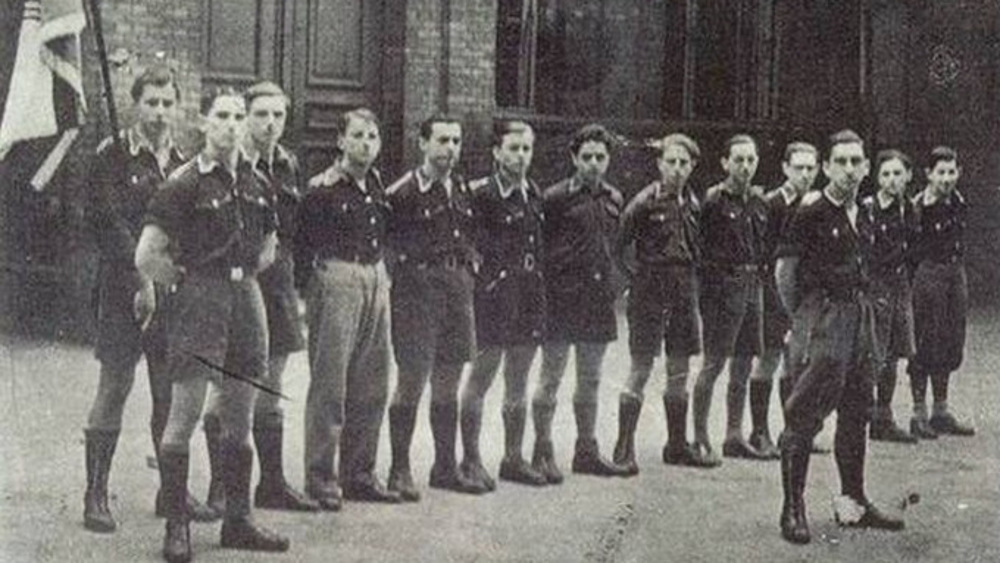
Betar was so closely aligned with the Nazis and Mussolini’s fascists that they were regarded as collaborators. By 1934, Jabotinsky and his Betar youth movement had reportedly “allied with Il Duce,” establishing a naval base north of Rome.
Late that year, Mussolini reportedly expressed support for Zionism and Jabotinsky in particular, stating: “For Zionism to succeed, you need to have a Jewish State with a Jewish flag, and Jewish language. The person who understands that is your fascist, Jabotinsky.”
This remark was made “during a private conversation with Nahum Goldman, founder of the World Jewish Congress, in November 1934,” as reported by Lenni Brenner in Zionism in the Age of Dictators.
Many senior Betar members served in the collaborationist police overseeing the Vilna Ghetto in Lithuania and were involved in betraying Jews in hiding to the Nazis.
One such member, Lotek Salzwasser, was eliminated by Jewish partisans in 1943 for his collaboration, according to Israeli press reports.
Betar and military training
One of the seven core principles of the Betar “Oath” is Magen, meaning “Protection.”
One of Betar’s ideological principles is military preparedness. Betar demands that all its members complete military seminars and know how to use weapons, in order to be ready at any time and to respond personally to a call for defense.
Betar has functioned as a militia since its inception. Here is a film of one of the French branches recorded in 2014 conducting paramilitary training exercises.
In the UK, Betar operated as a registered charity (Brit Tumbledor of Great Britain – Betar) between 1984 and 2004. It was closed down by the Charity Commission in 2004, on the grounds that it had been “Registered in error.”
In March 2025, Betar threatened to murder UN Special Rapporteur Francesca Albanese. On the very same day, the group relaunched its UK branch with a post on Instagram, claiming London “has become, with the time, an epicenter for radical Islam, for hate, for terror.” Their proposed solution?
Today, after more than 30 years, a bunch of strong young leaders stand up to say HERE WE ARE, to defend the Jewish population and to tell them that now we have a solution for the current situation, JEWS ARE NOT AFRAID ANYMORE!
Make no mistake – these threats are part of a deliberate effort to revive Jewish supremacist militias in the UK and the US.
Magen Am
The term Magen also appears in the name of a US-based private Zionist militia called Magen Am, which is currently active in Los Angeles, Orange County, and Phoenix.
Magen Am played a notably violent role in attempts to dismantle the student encampment at UCLA. The group frequently boasts about its close ties to the LAPD, sharing numerous photos of friendly interactions with police officers.
Reports indicate that Magen Am has collaborated directly with law enforcement, including working closely with the LAPD to intimidate and attack student protesters on the UCLA campus.

Magen Am, of course, recruits veterans of the occupation forces’ Lone Soldier programme and some then return to “serve” in the genocide as they proudly boast.
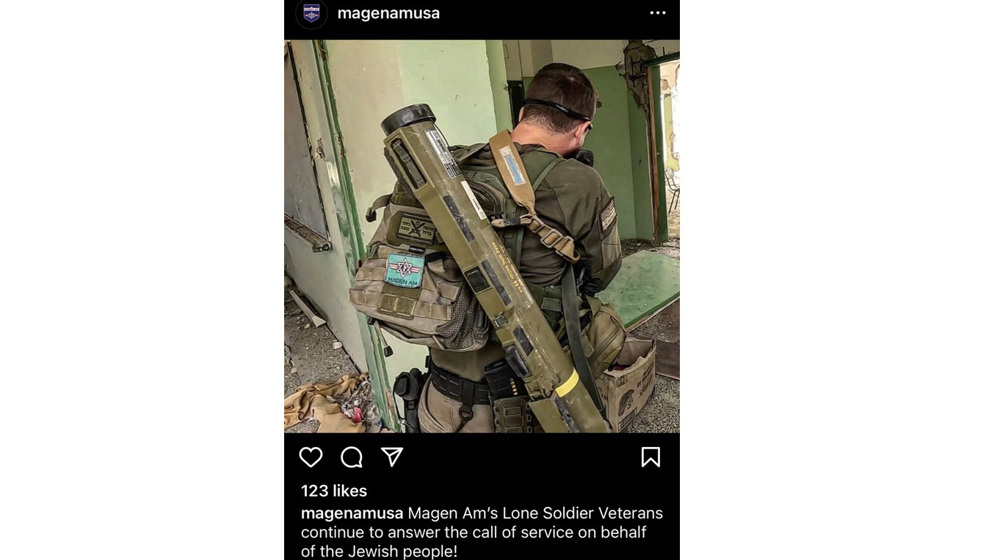
Magen Am was founded in 2017 by Yossi Eilfort, an MMA fighter-turned-Chabad rabbi. The flag of the genocidal Chabad cult was flown by the attackers on campus in Los Angeles.

Chabad has many followers in the so-called Hilltop Youth in occupied Palestine, which the Zionist intelligence agency Shin Bet says are responsible for the overwhelming majority of so-called ‘price-tag’ revenge attacks on Palestinians.
The rise of Jewish supremacism in Western societies is becoming increasingly visible, though many continue to deny or downplay its existence.
While Zionist militias and private security firms openly collaborate to suppress student protests in the US, there is a more subtle infiltration of police forces by Zionist Jewish supremacists.
Shomrim: The Private Jewish Patrol
Shomrim is a private Jewish police force operating in parts of the US, UK, Australia, and Belgium. It is reported that “over 20 Shomrim organisations exist worldwide.”
In London, the Shomrim North West Community Patrol operates in the Borough of Barnet. Founded in 2008 by Gary Ost as a registered charity, it acts as a “mobile neighbourhood watch” and acts as eyes and ears for the Metropolitan Police.
Shomrim claims that all “Volunteers have completed training from the Metropolitan Police Counter Terrorism Command (SO15) in assisting to identify potential security threats and suspicious activity. “
One blogger notes that the genocidal cult Chabad also has a ‘nasty tendency to normalize sexual abuse and protect serial sexual predators in its ranks.” But it’s not only Chabad; there is a similar tendency throughout the Zionist movement.
No surprise, then, to find that the founder of Shomrim in London has been implicated in this.
In 2013 Police dropped their investigation into Ost, who had been arrested on suspicion of perverting the course of justice in relation to an investigation of an alleged child sexual abuser, Rabbi Chaim Halpern.
Indeed, charges against the alleged sexual predator were dropped back then, too. Yet new allegations against Rabbi Halpern have resurfaced a decade later, and the trial for these offences is still pending.
Shomrim abuses
In New York, Shomrim has faced criticism for “using excessive force against non-Jewish suspects.”
In 2014, two Shomrim members were charged as part of a group of five Hasidic men for assaulting 22-year-old Black student Taj Patterson as he walked home from a party.
Additionally, Shomrim organizers in New York have reportedly withheld information on suspected Jewish criminals. The NYPD has openly criticized the group for not always notifying police when calls come in, raising concerns about accountability and cooperation.
Given Shomrim’s protected status with law enforcement and the documented culture of sexual abuse in some ultra-Orthodox communities, credible allegations of abuse within these groups are unsurprising.
On October 11, 2023, the United States Department of Justice issued a press release that Jacob Daskal, former head of the Boro Park Shomrim Society—a private Orthodox Jewish crime-patrol group associated with the NYPD—was sentenced to 210 months in prison and fined $250,000 for transporting a minor with intent to engage in criminal sexual activity.
Daskal pleaded guilty to the charge in July 2023. As part of the sentence, Daskal is required to register as a sex offender.” The statement notes that Daskal was introduced to a 15 year old girl “as a result of his position with the Shomrim”, who he then “groomed” for sexual abuse. According to the Department of Justice statement:
“Throughout the abuse, Daskal instructed the victim to delete their communications and warned her not to tell anyone about their sexual relationship. He also used his position as a community leader to silence the victim, bragging about his law enforcement connections and warning her that disclosure would ruin her life. The victim was expelled from her religious school after revealing the relationship to the school principal.”
This case raises troubling questions: How many other abusive situations are currently unfolding within Shomrim and other Jewish militia groups?
Shomrim protects genocide
What is it that Shomrim are protecting? One illustrative example is the Crown Heights Shomrim branch, which in January this year provided security protection for the genocidal President of Israel, Yitzchak Herzog and for the leadership of the genocidal cult Chabad, as shown in the image below.

If Shomrim really wants to protect Jews in the US and UK, they should start by apprehending the entire leadership of Chabad and members of the genocidal Zionist regime.
Police reluctance toward Shomrim in the UK
Initially, UK police were resistant to Shomrim’s activities. In 2008, Chief Superintendent Steve Bending, then Hackney’s borough commander, stated, “I do not support the concept of any community having its own form of patrol service. There is a risk of other communities feeling intimidated by this course of action.”
As late as 2015, Metropolitan Police Commissioner Sir Bernard Hogan-Howe expressed his preference that Shomrim volunteers avoid uniforms resembling those of official officers.
Shomrim, however, rejected this, saying “its volunteers should not drive marked cars or wear uniforms similar to those of the police.” Gary Ost, chief executive of Shomrim in Golders Green, north-west London, stated, “Our uniforms look nothing like the police and are marked from every angle with clear wording saying ‘Shomrim’.”
Yet a glance at their uniforms and liveried vehicles often gives a very different impression.


But the penetration of the police is now much more advanced and cooperation is the name of the game. There are numerous examples of apparent cordial relations between the two on the internet.
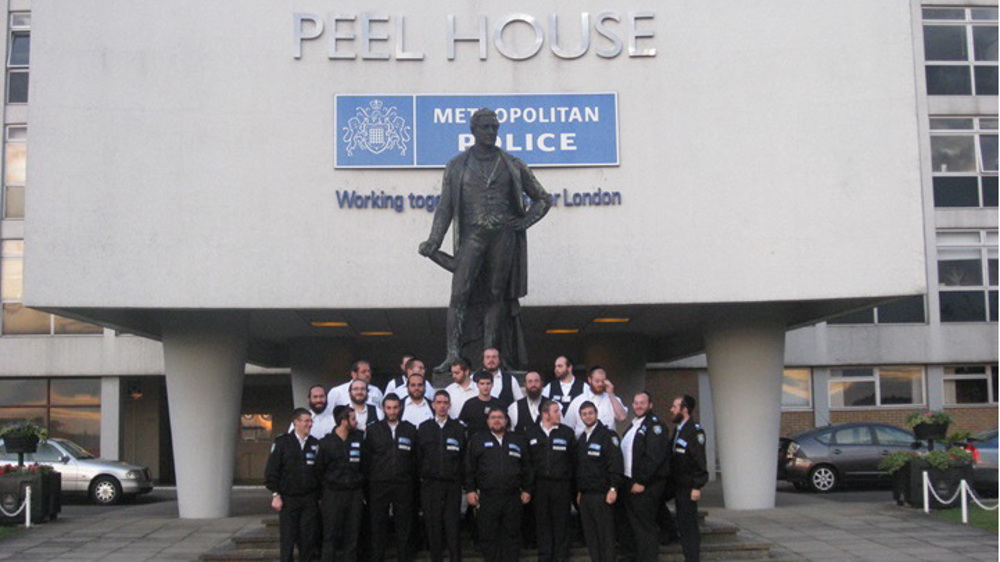
Shomrim members even posed outside Peel House, the headquarters of the Metropolitan Police.
Below is a photo of a prize giving for Shomrim members commended for their “bravery” and “exemplary service to the community” in 2020.
Shomrim chief executive Gary Ost, the one arrested in 2013, is one of the three.

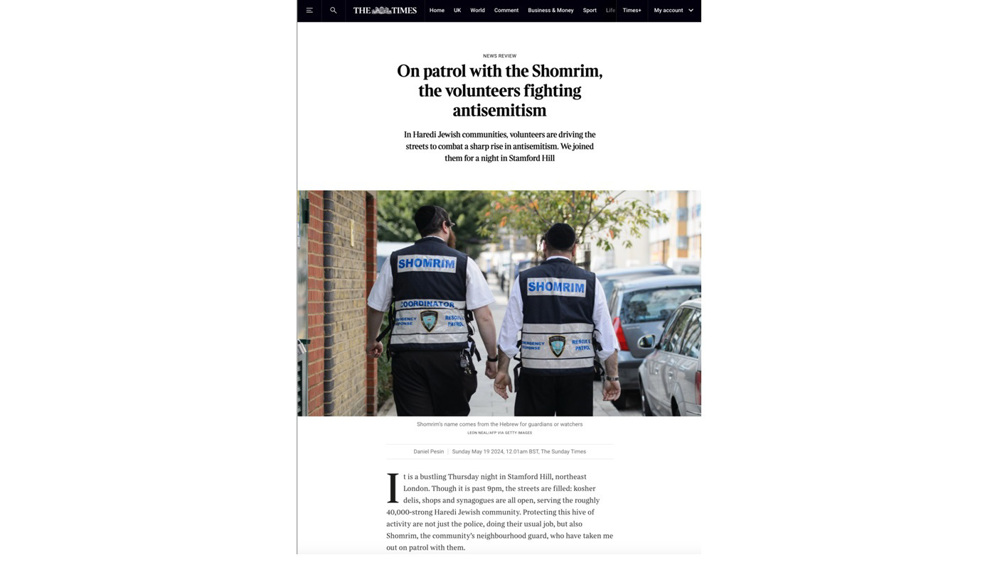
Shomrim plays a key role in shaping the narrative around the widespread antisemitism claims that Israel relies on to justify its genocidal actions.
The pressing question is: What happens when members of Shomrim break the law or commit wrongdoing? Would the police be able—or even willing—to enforce the law against them?
Alon Mizrahi, whom we cited earlier, shared his perspective in a conversation with me:
“They are pretending to be defending themselves in the most friendly country to Jews in history. While committing genocide. In a country that is so hateful of Jews that we need a private police force for Jews only in the US.
“And I have no doubt that if they can normalise this, with the kind of status that Zionist Jews have managed to create for themselves in the US; If this Jewish police force uses violence against black people, black organisers in communities who oppose the genocide, or other migrant groups or any other group, are American police going to be able to charge them?
“To use the law against them? I don’t think so. If you are in the American system, if you have a role in any part of the American system of government, in the police or any other agency, I think that at this point it is clear to you that Zionist Jews are above the law.
“The law doesn’t apply to them. So they don’t have the philosophical or legal means to deal with this. And the Zionists know this.”
Given the current climate, his assessment may well be accurate.
US approves F-16 support package for Ukraine
RT | May 3, 2025
The US has approved a $310.5 million deal to sustain Ukrainian-operated F-16 fighter jets provided by Kiev’s European backers. The move comes after the US and Ukraine signed a deal in which Kiev grants Washington access to its natural resources in exchange for future assistance.
The F-16 deliveries from European NATO members to Ukraine were approved by former US President Joe Biden in August 2023, but the first jets did not arrive in the country until a year later. While Ukrainian officials hailed the deliveries as a major coup, Western media warned that they would not be a “game changer” in the conflict. In March, the Ukrainian Air Force acknowledged that the F-16s operated by Kiev “cannot compete” with the latest Russian jets.
In a statement on Friday, the Pentagon’s Defense Security Cooperation Agency (DSCA) said the State Department had signed off on a foreign military sale to Ukraine which includes training, spare parts, aircraft modifications, logistics assistance, and software support for F-16s.
The agency added that the proposed sale “will support the foreign policy goals… of the United States by improving the security of a partner country that is a force for political stability” in Europe.
More than 80 F-16s have been promised to Ukraine, with the bulk expected to come from Belgium and the Netherlands, while the US has never committed to providing the jets on its own. While the exact number of jets delivered is unknown, Moscow confirmed last month it had shot down one F-16. Ukraine’s Vladimir Zelensky said the aircraft’s pilot perished during a “combat mission.”
In 2024, Ukraine reported the loss of another F-16, saying it crashed while repelling a Russian air strike.
The DSCA announcement comes after the Pentagon said it is sending “disused and completely non-operational F-16s to Ukraine for parts.” It also follows the signing of a US-Ukraine resource deal that is intended to allow Washington to recover the cost of future military support through shared proceeds from Ukrainian mineral resource licenses.
Moscow has condemned the Western arms shipments to Ukraine, warning they will only prolong the conflict without changing the outcome. Russian President Vladimir Putin has said Ukrainian-operated F-16s will “burn” just like other Western-supplied equipment.
Europe Will Spend Itself Into ‘Bankruptcy’ If It Tries to Meet NATO’s Draconian New Defense Demands
By Ilya Tsukanov – Sputnik – 23.03.2025
NATO is planning to ask its European and Canadian members to boost their weaponry and equipment stocks by about 30% over the next several years, informed sources have told Bloomberg. Sputnik asked a pair of leading German and French observers what this would mean for a region already suffering economic malaise and industrial decline.
Key alliance members like Germany and France would amass an unsustainable fiscal burden, be forced into debt and have to slash social programs if they accept NATO’s call for a 30% bump in new arms and equipment spending, AfD MP Dr. Rainer Rothfuss told Sputnik.
“We can take the example of Germany, where we had a kind of financial policy coup d’état this week” after the Bundestag voted to change the Basic Law to lift debt restrictions for defense spending, Rothfuss, who is also a veteran geopolitical analyst and consultant, said.
“The budget restraints that were even inscribed into our Constitution needed to be changed to get the financial flexibility to invest so much in defense. That shows us that it’s not a matter of priority spending, [but] a matter of, I would say, bankruptcy should this kind of policy be followed in the coming years, not only by Germany but by other countries as well,” the politician warned.
“France, for example,” has “an even more restrained budgetary situation,” Rothfuss said, “struggling economically to keep industry jobs,” and like Italy, should be investing in the competitiveness of its industries, not throwing money away on defense at a time when the security crisis in Europe is potentially closer to a peace deal than ever.
As for Germany, if its industrial decline worsens, it won’t be able to fund the EU to the tune of 25% of bloc spending, which would have serious knock-on effects for other members, the MP warned.
Jacques Sapir, director of studies at the Paris-based School for Advanced Studies in the Social Sciences, says a 30% bump may not seem like a lot, and even manageable by some countries, like France, given the large-scale decline in NATO stockpiles of 40-60% after the end of the Cold War.
But others, like Italy, Belgium, Germany and the Netherlands may need between a 30%-50% increase in outlays, given the decline in defense production over the past three decades, he said, adding that this could take between three and five years to accomplish for countries like France, Germany and the UK, and probably more for Canada.
Last month, Bloomberg calculated that a European defense buildup and the continuation of the proxy war against Russia without US assistance could cost up to $3 trillion over ten years – a massive burden for a region suffering from perpetual economic stagnation and widespread deindustrialization.
Featured Video

No Threat Can Force Iran’s Surrender /Trita Parsi & Lt Cl Daniel Davis
or go to
Aletho News Archives – Video-Images
From the Archives
An Expert Military Analysis of War with China
Actually, None is Necessary
By Fred Reed • Unz Review • December 13, 2020
The Correlation of Armed Forces: U.S. goods and services trade with China totaled an estimated $634.8 billion in 2019. Exports were $163.0 billion; imports were $471.8 billion. The U.S. goods and services trade deficit with China was $308.8 billion in 2019. Trade in services with China (exports and imports) totaled an estimated $76.7 billion in 2019. Services exports were $56.5 billion; services imports were $20.1 billion. The U.S. services trade surplus with China was $36.4 billion in 2019.
There is talk within the Washingtoniat of a possible war with China. Steve Bannon, who apparently was dropped on his head as a child, actually favors such a war. We hear the usual shoo-the-boobs alarm about how the Chinese are doing something terrible and we must gird our loins and American values and show them what for, bow wow, woof. The danger is that the current game of who-blinks-first in Asian waters might actually provoke a shooting war. You know the kind of thing: One warship refuses to get out of the way of another, a collision ensues, some retard lieutenant who signed up on waivers opens fire, and we’re off and running. It is not a good idea to let children play with matches.
The said war is discussed either in emotional terms by idiots or in purely naval terms by those familiar with such things, so we hear of the First Island Chain and the Second Island Chain and whose missiles against the other’s missiles and so on. This would be appropriate if we were fighting World War Two again. Which we aren’t. Let’s take a quick-and-dirty look at how such a war might go.
To begin the war, America would overestimate itself and underestimate China. This is doctrine in the Pentagon. … continue
Blog Roll
 Aletho News
- Theodore Postol: Iran’s Missiles & Drones Were Underestimated
- Iran To Target Military Industrial-Tech Complex That Facilitated Gaza Genocide
- Collapsing Empire: The Resistance Disarms ‘Israel’
- Suicide Should Not Be a Government Service
- Rethinking America’s greatest threat: Iran vs. Israel-Firsters
- Iran accuses adversaries of false flags to strain Turkey ties
- Poland rules out sending Patriot missiles to US/Israel amid war on Iran
- Tehran approves new Hormuz plan with major restrictions
- No Threat Can Force Iran’s Surrender /Trita Parsi & Lt Cl Daniel Davis
- UK’s New Pandemic Plan Would Turn Big Tech Into a Mass Location Tracking Network
- If Americans Knew
- Ann Coulter Rips Into Fox News for Iran War Coverage, Compares to False Rigged 2020 Election Reporting
- Joe Kent Urges Americans To Call White House and Congress To Object To Sending Troops Into Iran
- DNC Resolution to Reject AIPAC Funding Puts Democratic Leaders in the Hot Seat
- Swedish foundation to build 400 schools as over 650,000 Gaza children remain without education for 2 years
- Israeli army admits photshopping image of slain Lebanese journalist
- This is how Israel is systematically killing health workers under the cover of war in Lebanon
- Carrying life under fire: Israeli invasion of Lebanon leaves pregnant women facing deadly risks
- Champagne all around for the new death penalty (for Palestinians) law – Not a ceasefire Day 172
- Why are Palestinian books struggling to be seen on Amazon?
- The Line Between Affinity and Conspiracy
- No Tricks Zone
- New Study Finds Warming Saves Lives…Cold Temperatures 12 Times More Deadly Than Excess Heat
- German Science Blog Accuses PIK Climate Institute Of Hallucinating Climate Tipping Points
- Devastating Assessment Of Comirnaty Vaccine By Former Senior Pfizer Europe Toxicologist
- New Study: CO2 Is ‘Effectively Negligible’ As An Explanatory Climate Change Factor Since 2000
- Former Pfizer Toxicologist Dr. Helmut Sterz Tells Bundestag Hearing Pfizer Vaccine Should Have Never Been Approved
- Energy Expert: Germany’s Nuclear Phaseout Was A “500 Billion Euro Mistake”
- New Research: South Australia’s Mid-Holocene Sea Surface Temperatures Were 4°C Warmer Than Today
- Storing Green Energy To Last Germany 10 Days Would Require A 60-Million Tonne Battery
- New Studies: UK Sea Levels Were 4 Meters Higher Than Today During The Mid-Holocene
- Destructive Green New Deal: German Energy And Metal Group Warns Of Drastic Crisis
 Aletho News