Hillary Remains Clueless About Regulation on the 28th Anniversary of the Keating Five Meeting
By William K. Black | New Economic Perspectives | April 9, 2015
The Clintons’ Unlearned Lessons of the Keating Five Meeting
On April 9, 1987, twenty-eight years ago today, my colleagues and I from the Federal Home Loan Bank of San Francisco (FHLBSF) met with five senators at the behest of the most notorious savings and loan (S&L) fraud – Charles Keating. Keating was looting Lincoln Savings through classic “accounting control fraud” techniques. Our examiners and enforcement investigation led by Anne Sobol (detailed from Litigation Division) had discovered and documented some of Keating’s worst frauds. Keating, desperate to prevent our recommendation that the federal agency place Lincoln Saving into conservators (removing Keating from power), used the five senators to try to pressure us into taking no enforcement action against Lincoln Savings and its officers for the largest violation of rules in the history of our agency.
The agency’s statutory authority to place a state-chartered S&L like Lincoln Savings into conservatorship had lapsed so Bank Board Chairman Edwin Gray could not act on our recommendation until Congress passed legislation restoring our power. The five Senators, of course, would have a great deal to say about whether and when that legislation was passed. Because we refused to give in to their intimidation, the Keating Five helped ensure that the power to remove Keating from power was not passed until after Gray’s term ended – and President Reagan’s cynical secret deal with Speaker of the House James Wright ensured that Reagan would not reappoint Gray.
Gray’s successor, M. Danny Wall, was a Republican political staffer whose boss, Senator Jake Gran, after a single meeting with Keating had his number and refused to ever meet with him again. But the lesson Wall took from seeing Gray reduced to roadkill at the hands of Speaker Wright and the Keating Five was to never block the road when powerful thieves and their political cronies are racing down that road and eager to run you over.
Wall first took the unprecedented step of removing our (the FHLBSF) jurisdiction over Lincoln Savings and gave Keating a sweetheart deal. Wall’s critical, Neville Chamberlain-like order to his senior staff to reach an “amicable resolution” with Keating (which, given Keating, meant “surrender”) occurred immediately after a meeting with Keating. Wall’s meeting with Keating, in turn, occurred immediately after Keating met with Senator Glenn and Speaker Wright. Keating and Wright used their after-lunch meeting to plot how to get me fired and sued. Keating hired private investigators twice that we know of to try to find dirt on me. Fortunately, I live a very Midwestern personal life. Keating eventually sued me for $400 million.
Keating, being Keating, started his meeting with Wall by noting that he had just met with Speaker Wright and Senator Glenn. Keating was capable of being subtle, but he preferred smash mouth football, so his next line, referring to the Speaker, was that “There’s someone you would have much better relationships with if you took care of your red-headed lawyer in San Francisco.” I still had bright red hair (and beard) at that time.
After getting rid (he thought) of the accursed FHLBSF regulators, Wall proceeded to force Joe Selby, the Nation’s most respected financial regulator, to resign as our top supervisor for Texas. Selby’s sin was being a vigorous regulator. The Texas frauds targeted him for removal and successfully enlisted Speaker Wright’s enthusiastic support through contributions and by telling Wright that Selby was gay. Bank Board Chairman Gray, who personally recruited Selby and Mike Patriarca because of their reputations as the Nation’s best financial regulators, had placed Selby and Patriarca in charge of the two states with the worst fraud problems (Texas and California). Wall, while still a congressional aide, had urged Gray to fire Selby to placate the Speaker. Gray refused. Wall now publicly took “credit” for forcing Selby to resign or be fired. Within months, Wall had removed or sidelined the Nation’s best financial regulators.
Keating’s successful extortion of Wall to remove the FHLBSF’s jurisdiction over Lincoln Savings did not work out well for Wall and the Keating Five for Keating used the sweetheart deal to intensify his looting of Lincoln Savings and its customers which led it to become the most expensive financial institution failure in U.S. history (at what now seems a quaint $3.4 billion), to sell worthless (and uninsured) junk bonds of Lincoln Savings’ insolvent holding company, and to target tens of thousands of widows for those sales. My extensive notes of the Keating Five meeting led to a Senate ethics investigation of the Keating Five. The Democratic Party Senate Committee colleagues on that investigation spent most of their energy attacking us, the regulators, for the high crime of criticizing Senators for aiding the Nation’s most notorious fraud loot the S&L and rip off widows. (Senators Cranston, Riegle, Glenn, and DeConcini were Democrats. Senator McCain was the lone Republican.)
The type of violations we had documented were invariably fatal. Keating had recruited the Keating Five through political contributions and through hiring Alan Greenspan as a lobbyist. Greenspan also served Keating as his outside economist to attempt to prevent the agency from adopting effective regulations to restrain looting by the Keatings of the world. In that capacity Greenspan had famously claimed that Lincoln Savings posed no foreseeable risk of loss to the FSLIC insurance fund. Greenspan was slightly (as in 180º) off as I just explained.
But here’s the thing – given their ages, the lessons of the S&L debacle should have been the formative experiences for everyone involved in the most recent crisis. Wall resigned in disgrace in December 1989 after months of House hearings. The Senate ethics committee hearings on the “Keating Five” took place in 1990 and 1991.
“These [Senate ethics committee] hearings would take place from November 15 through January 16, 1991.[31] They were held in the Hart Senate Office Building‘s largest hearing room.[51] They were broadcast live in their entirety by C-SPAN, with CNN and the network news programs showing segments of the testimonies.[51] At the opening of the hearings, as The Washington Post would later write, ‘the senators sat dourly alongside one another in a long row, a visual suggestive of co-defendants in a rogues’ docket.’[52] Overall, McCain would later write, ‘The hearings were a public humiliation.’[51]
The committee reported on the other four senators in February 1991, but delayed its final report on Cranston until November 1991.”
Greenspan’s role was discussed in both the House and Senate hearings.
“Progressives” tend to roll their eyes in disgust at the entire “Whitewater” investigation, but two points are worth noting in terms of what the scandal should have taught the Clintons and their appointees. First, James McDougall, the CEO, looted Madison Guaranty through classic accounting control fraud techniques. (He was acquitted by a jury of one series of alleged bank frauds and convicted subsequently of other band frauds.)
James Clark, the Bank Board examiner-in-charge (EIC) of the 1986 examination of Madison Guaranty, testified in front of Congress about McDougall’s domination of the S&L and his massive multiple frauds. Clark’s testimony is devastating.
Second, McDougall’s frauds were made possible by the criminogenic environment created by the three “de’s” – deregulation, desupervision, and de facto decriminalization – and McDougall was brought to book when the regulators and prosecutors learned their lessons and got rid of the three “de’s.” The FSLIC was appointed the conservator for Madison Guaranty in February 1989.
Then first lady Hillary Clinton received substantial adverse publicity about her role not simply as an investor with but also as an attorney for the S&L. She and her husband were publicly humiliated by the sex aspects of the investigation. Both Clintons, therefore, would logically have come out of the experience with a strong appreciation of how dangerous accounting control frauds are, why bank CEOs pose by far the greatest risk of fraud and do so through accounting fraud techniques (the fraud “recipe” for a lender) that require the lender to intentionally make large numbers of bad loans. This, in turn, requires the CEO to suborn the underwriting and internal controls. The Clintons should have had an acute appreciation of how critical underwriting is to avoiding banking crises. They observed first hand that the S&L debacle was driven by an epidemic of accounting control fraud.
Bill Clinton announced his candidacy for the Democratic Party’s nomination for President on October 2, 1991 – while the Senate Ethics committee was still wrapping up its investigation of the Keating Five. The S&L debacle was the defining scandal of the Clinton’s era and it was fresh in their minds as they made the run for the nomination and the presidency. We were convicting several hundred banksters and their cronies annually as Clinton prepared to run and actually ran his first campaign for the nomination and the presidency.
The same logic applies to Greenspan. He had to read our examination report and my report on why Lincoln Savings would be a disaster. My report emphasized the key role of its deliberately pathetic underwriting. Similarly, our presentation to the Keating Five emphasized the non-existent nature of Lincoln Savings’ underwriting on multi-million dollar loans. This was reprised in our testimony before the House and the Senate about Keating’s looting of Lincoln Savings.
But we know what the Clintons, their appointees, and Greenspan (originally a Bush I appointee) learned from the S&L debacle – nothing, or worse than nothing. Greenspan told the sycophantic author of Maestro that he would have done, said, and wrote the same things for Keating now that he did then based on the “facts.” I discuss later Greenspan’s actual approach to the “facts.”
Clinton’s Goal: Destroy the “Culture of Regulation”
But the Clintons and their bankster allies learned something far worse – the need to push the three “de’s” to ensure that never again would banksters and their political cronies be prevented from looting “their” banks or be held accountable for their looting. Bill Clinton, in his first major meeting with financial regulators (from the Office of the Comptroller of the Currency (OCC)) as President, chose to make these revealing remarks. One part of government most upset Clinton – the examiners who checked for threats to the safety and soundness of banks and businesses.
“The federal government to many people is not the President of the United States, it’s the person who shows up on the doorstep to check out the bank records, or the safety in the factory, or the integrity of the workplace, or how the nursing home is being run. I believe that we have a serious obligation in this administration to work with the Congress to reduce the burden of regulation and to increase the protection to the public. And we have an obligation on our own to do what we can to change the destructive elements of the culture of regulation that has built up over time….”
The federal examiners that expose the banks, workplaces, and nursing homes that engage in fraud or abuse provide a vital and unique service not only to the public, but also to honest competitors by blocking the “Gresham’s” dynamic that “control fraud” produces (bad ethics drives good ethics out of the markets). Clinton, however, is unaware of this dynamic. This type of regulation does not (net) “burden” honest businesses – it makes it possible for them compete by relieving them of the impossible burden of competing with control frauds. Clinton sees regulation not as episodically failing, but as the inherently flawed product of a “destructive” “culture of regulation.” He started the process that replaced a “culture of regulation” with what even the anti-regulators now concede is the “culture of corruption” that dominates Wall Street and the City of London.
Clinton then singled out the worst examiners – bank regulators.
“When I was out in New Hampshire in 1992, I heard more grief about the regulation of the private sector by the Comptroller of the Currency than any other single thing. And now every time I go to New England, they say, we’re making money, we’re making loans, and we can function, because we finally got somebody down there in Washington who understands how to have responsible and safe banking regulations, and still promote economic growth. I hear it every time I go up there, and I thank you, sir, for what you’ve done on that. (Applause.)”
Vice-President Gore had already praised the OCC head, Gene Ludwig, for embracing the three “de’s.” Gore was particularly impressed that the bankers’ lobbyists were praising Ludwig. Readers will vary on what they infer from that praise, but Gore thought the only possible inference was that Ludwig’s deregulatory policies were superb. When the bank lobbyists are praising you as a financial regulator you know you are on a path to disaster for the industry and the public. Bank lobbyists do not represent the interests of “banks” or their shareholders. They represent the interests of the banks’ controlling officers and when those CEOs create a culture of corruption the lobbyists will push policies that will make it easy for the CEOs’ to loot “their” banks with impunity through the “sure thing” of accounting control fraud.
Clinton launched an unholy war against effective financial regulation. He began the process, and bragged about, the massive cuts in the FDIC staff that eventually (Bush made it worse) led to the FDIC losing over three-quarters of its total staff and the OTS over half of its staff. FBI agents were reassigned from prosecuting the S&L frauds and such prosecutions largely ended in 1993. Clinton’s “reinventers” ordered us to refer to the industry as our “customer” and to treat them as if they were our “customer.” Clinton’s reinventers eliminated the most important rule – the underwriting rule. They replaced it with a deliberately unenforceable “guideline” that was exceptionally criminogenic and would greatly intensify the epidemic of liar’s loans. This rule change was actually far more damaging than the more infamous statutory acts of deregulation that Bill Clinton, Rubin, and Greenspan pushed in order to essentially repeal the Glass-Steagall Act and pass the Commodities Futures Modernization Act of 2000 to not only kill Brooksley Born’s effort to protect the Nation and the world from financial derivatives, but ensure that no regulator in America would have any ability to regulate effectively massive classes of derivatives.
Clinton’s key economic appointees, and Gore, were fervent proponents of the three “de’s.” They came from banking and represented the interests not of banks, but of the banksters. Robert Rubin, the former head of Goldman Sachs and Clinton’s Treasury Secretary exemplified the bankster representing the interests of his peers. In particular, they pushed the global regulatory “race to the bottom” – warning that any effective financial regulation would drive the bankers to relocate to the City of London.
While anyone open to reality would have learned the grave dangers of the three “de’s” and the enormous value of effective regulation, there were three excellent reasons for the Clinton/Gore administration to be closed to reality and to embrace the three “de’s” and the banksters. First, it is not pleasant to be the subject of a government investigation and a conservatorship for your friend, business partner, and legal client’s S&L. It is perfectly human to react by being enraged at regulators. It was effective banking examiners who stopped McDougall’s frauds, conducted the bulk of the investigations that led to McDougall being convicted, and led to the exposure of the “Whitewater” “scandal.” From the Clintons’ perspective, that represented “Strike One, Strike Two, Strike Three – You’re Out!”
Second, the Clintons and Gore were leaders of the Democratic Leadership Council (DLC). The DLC’s creed was that the three “de’s” were divinely inspired. It was revealing that Clinton chose Gore as his running mate. Gore provided neither geographic nor ideological diversity to the ticket. Clinton did not want ideological diversity. He wanted a loyal junior partner who shared his disdain for regulators. It would require unusual independence of thought for Clinton and Gore, in their moment of electoral triumph, to say: “we’ve been observing the S&L debacle and thinking hard about its implications for our anti-regulatory policies and we have been forced to conclude that the DLC dogmas we have long championed about the virtues of the three ‘de’s’ are not simply incorrect but dangerous to the Nation.” Humans are more likely to do what Clinton and Gore did – religiously ignore the lessons of the S&L debacle and surround themselves with zealous advocates of the three “de’s.”
Third, the DLC had a special place in its heart for big finance. Big finance had the big money to make contributions, but it also had CEOs who were often at least moderate on social issues. These big contributors had been there in the DLC’s corner since its founding in 1985. How likely was it that Clinton and Gore, its two greatest DLC beneficiaries, would turn on big finance in their moment of triumph?
Hillary Clinton Learned the Same Perverse Lessons as Bill about Financial Regulation
I thank Samantha Lachman for her April 9, 2015 column entitled “As Clinton Tries To Win Over Progressives, She Might Want To Distance Herself From This Economic Adviser.” I hope that my column will not seem too harsh, but I feel the need to point out the key ways in which my analysis differs from Lachman’s – each of which adds to her thesis.
Lachman’s column explains that Hillary Clinton chose Robert Hormats as one of her most prominent economic advisors. Lachman points out that Hormats is a rabid deficit (and war) hawk, wants to cut the safety net, supports the faux “free trade” agreements that the Rubin-wing of the Democratic Party constantly seeks to inflict on the Nation, and favors aggressive deregulation. Lachman warns that this will cause progressives to wonder whether they should support Hillary Clinton. Lachman’s sole substantive argument against Hormats’ support for deregulation is that if she were to adopt his policy recommendations it would inhibit efforts were H. Clinton to be elected to reduce inequality.
“Hormats, who was the undersecretary for economic, energy and environmental affairs from 2009 to 2013, has advocated for the deregulatory approach that was begun by the Reagan administration and continued by former President Bill Clinton. Progressives say this deregulatory strategy contributed to widening income inequality….”
Lachman is correct about the content of Hormats’ policy positions. But here are the key factors I would urge readers (and potential campaign supporters and voters) to consider that arise from these positions.
- The problem with Hormats is not that he will upset “progressives.” The problem is that he is incompetent, dishonest, and supports policies that have devastated and will continue to devastate our Nation and the people of the world. Hormats has been wrong on every important economic issue – for decades. That should upset everyone regardless of their politics.
The insoluble problem is that every time Hormats’ policies cause a disaster and his dogmas are falsified he doubles-down on his failures. He does so because he is so dogmatic and intellectually dishonest that he refuses to learn from even his most catastrophic mistakes – and because his policy disasters enrich him and his peers – the elite banksters.
The enormous problem with Hormats’ policies is not that his policies “contributed to widening income inequality” (though they did) – but that they blew up the financial system, our Nation’s economy, and the global economy. In the U.S. 9.3 million Americans lost their jobs and roughly six million jobs that would have been created absent the Great Recession were not created. The leading economic estimate is that the U.S. will lose $24 trillion in GDP as a result. The job and GDP losses are far larger in Europe due to the insanity of self-inflicted austerity. If Hormats had been able to secure his desire to inflict austerity on America our job and GDP losses would have at least doubled.
Worse, Hormats’ policies blew up the financial system because they made it so “criminogenic” that it produced the three great fraud epidemics by bankers (appraisal, “liar’s” loans, and secondary market fraud) that hyper-inflated the bubble and caused the catastrophic fraud losses that drove the financial crisis.
Worse still, while he had a front row seat to these frauds epidemics as Goldman Sach’s Vice Chairman, he not only failed to warn the Nation about them but encouraged ever more criminogenic heapings of the three “de’s” – deregulation, desupervision, and de facto decriminalization.
And, still worse, Hormats continues to push for those same policies because while they were a catastrophic failure for our Nation and the world, they make him and his peers (many of them criminals) immensely wealthy – and will do so in the future when his policies again crush our Nation in an orgy of fraud by the banksters. Hormats doubtless supports (formal) legal civil rights (as opposed to the reality), which makes him a member in good standing of the Rubin-wing of the Democratic Party, but his economic policies are to the right of the UK Tories’ policies that Paul Krugman correctly eviscerates for their economic illiteracy.
I will discuss only two examples of Hormats’ incompetence as an economist, neither of which Lachman explores. First, he championed and aided the “Scandalous Seven.”
- Hormats’ continuing support for the three “de’s” and his support for President Clinton’s reappointment of Alan Greenspan and President Obama’s reappointment of Ben Bernanke to head the Fed. There are seven U.S. public officials who embraced the three “de’s” and are most culpable for creating and refusing to stop the criminogenic environment that produced the three most destructive epidemics of financial fraud in history. Those fraud epidemics hyper-inflated the bubbles, drove the financial crisis, and caused the Great Recession. Clinton, Gore, Rubin (with a dishonorable mention to his protégé Larry Summers), Greenspan, President George W. Bush, Bernanke, and Timothy Geithner are the U.S. officials who failed so spectacularly in the run-up to the crisis that they deserve their inclusion on my list of the Scandalous Seven. I am talking here about the public sector. The elite bankers who led the fraud schemes are even more culpable for they were made wealthy by their fraud schemes.
The terrible thing about the seven officials is that none of them had to be bribed in any overt fashion that could ever lead to even an investigation much less a prosecution. (The finance industry, of course, finds ways to richly reward its political cronies.) The Scandalous Seven felt wonderful about their actions in creating and then ignoring the criminogenic environment. Like Hormats, their embrace of the three “de’s” was open, not furtive. Three of the officials were Republicans and four were from the Rubin-wing of the Democratic Party. Geithner is a special case who became a nominal Rubin-Democrat to get his position as Treasury Secretary in the Obama administration.
Lachman’s discussion of the Hormats’ support for Greenspan and deregulation emphasizes that Greenspan “is loathed by progressives.”
“Similarly, in a discussion of whether former Federal Reserve Chairman Alan Greenspan should be reappointed by then-President George W. Bush, Hormats said Greenspan, who is loathed by progressives, had done ‘a terrific job.’
‘He enjoys respect on both Main Street and Wall Street,’ Hormats said. ‘In short, he’s really been one of the great financial leaders in American history.’
In the same conversation, Hormats argued that while Greenspan had facilitated a positive economic climate, other factors, including deregulation, were also responsible for private sector growth.
‘[Greenspan] has power, but what’s really driving this economy is the dramatic change that’s taking place in the private sector in this country,’ he continued. ‘We’ve had government deregulation, which has held.’”
A technical note, Lachman is quoting from an NPR transcript and the audio is no longer available on the web site. I suspect that the last word, “held,” should read “helped.” Lachman does not explain why “progressives” loath Greenspan – or why such loathing should be limited to “progressives.” If “progressives” loath Greenspan for bad reasons then this represents a defect on their part, not a failure by Greenspan or Hormats. In the same interview Lachman is quoting, Robert Reich issued a vibrant endorsement of Greenspan’s reappointment by Clinton that included one of the funniest (unintentional) descriptions of Greenspan: “Alan Greenspan is a pragmatist, an empiricist.” When it came to regulation to stop the fraud epidemics, I show below that Greenspan was still Ayn Rand’s faithful cultist. He was dogmatic and rather than an “empiricist” he religiously refused to allow real data to be presented.
Here are the primary reasons Greenspan (and Bernanke) make my list of the Scandalous Seven.
- The Fed had the unique authority under HOEPA (enacted in 1994 under Clinton) to ban all “liar’s” loans – regardless of whether they were originated by federally insured lenders. As the name implies, such loans were known to be pervasively fraudulent and it was known that lenders and loan brokers overwhelmingly put the lies in liar’s loans. Greenspan, and then Bernanke, refused to use this authority to stop an obvious, massive epidemic of “accounting control fraud. The FBI’s senior agent in charge of dealing with mortgage fraud, Chris Swecker, warned in September 2004 that there was an “epidemic” of mortgage fraud developing and predicted that it would cause a financial “crisis” – and Greenspan refused to stop the fraud epidemic. Greenspan’s colleague, Governor Gramlich, warned Greenspan of the developing epidemic of bad loans and urged him to send the Fed examiners in to the sleazy bank holding company affiliates that were pumping out hundreds of thousands of fraudulent loans. Greenspan refused not only to stop the fraudulent loans – he refused to send the examiners in to find the facts. When Richard Spillenkothen, the Fed’s top supervisor, requested to brief the full Fed board on the fact that every major bank involved with Enron had eagerly aided and abetted Enron’s accounting fraud and tax evasion the senior leadership of the Fed was enraged – at its supervisors! While Spillenkothen does not name individual names, this could not have occurred without Greenspan’s active support.
When another Fed supervisor, Sabeth Siddique, several years later presented the Fed board and Regional Bank Presidents with data from the Nation’s largest banks showing that they were moving massively into making loans that were known to be pervasively fraudulent and exceptionally likely to default the Fed split into a civil war in which the supervisor was subjected to “personal” attacks – for providing data from the banks to the Fed!
“Some people on the board and regional presidents . . . just wanted to come to a different answer. So they did ignore it, or the full thrust of it,” [Federal Reserve Governor Bies] told the Commission.
Within the Fed, the debate grew heated and emotional, Siddique recalled. “It got very personal,” he told the Commission. The ideological turf war lasted more than a year, while the number of nontraditional loans kept growing….” (FCIC 2011: 20-21).
This is significantly insane. The Fed leadership, under Greenspan and Bernanke, was so dogmatic and passionate in its hatred for regulation, supervision, enforcement, and prosecution and so rabid in its faith in “markets” and the inherent sainthood of financial CEOs that it conducted an unholy war against its own supervisors and reality. Simply providing data from the industry to the leaders of your agency became a CLG for Fed supervisors (“career limiting gesture”).
It is important to recall four other matters in this context. We (OTS-West Region) figured out liar’s loans in 1991 – and drove them out of the S&L industry, which was the limits of our statutory powers (unlike the Fed after the passage of HOEPA in 1994). We got it right because unlike Greenspan and Bernanke we were reality-based regulators eager to get the facts. So we listened to our examiners (as we had in 1984 about prior epidemics of accounting control fraud). The loans were not yet called “liar’s” loans by the industry and there was very limited experience with “low documentation” loans but our examiners realized that failing to underwrite the borrower’s income had to lead to “adverse selection” and produce severe losses. We realized that only fraudulent CEOs running accounting control frauds would make liar’s loans. Greenspan and Bernanke had no need to reinvent the supervisory wheel and the disastrous loss data on the 1990-1993 experience with liar’s loans was available to them. Banning liar’s loans was one of the easiest calls any regulatory could make. There was zero upside to liar’s loans – they harmed every honest borrower.
The second fact is that Greenspan was no virgin when it came to accounting control fraud. As I explained above, Charles Keating, the most notorious S&L fraud, used him as a lobbyist to recruit the five U.S. Senators who became known as the “Keating Five” when they met with us on April 9, 1987.
The third fact is that in addition to the FBI’s 2004 warning that the developing mortgage fraud “epidemic” would cause a financial “crisis” if it were not stopped the appraisers had created an extraordinary warning in the form of a public petition explaining that fraudulent lenders were deliberately creating a “Gresham’s” dynamic (in which bad ethics drives good ethics from the markets and professions) by extorting appraisers’ to inflate the value of homes pledged as collateral – something only a fraudulent bank or loan broker officer would do. The following astonishing fact is revealed (but also buried) well into the report of the Financial Crisis Inquiry Commission (FCIC): “Swecker, the former FBI official, told the Commission he had no contact with banking regulators during his tenure” (FCIC 2011: 164, emphasis added). As a former financial regulator I am almost reduced to tears every time I read that sentence.
- Put yourself in the position of Greenspan, Bernanke, Geithner, and Bush – all in office when Swecker made his very public warnings in the media and his Congressional testimony in 2004. There is no possible excuse for their total refusal to act against a crime wave led by elite banksters. Worse, their obscene attacks on supervisors to prevent them from presenting these senior officials with the reality of the three raging fraud epidemics demonstrates that they were not simply cowards unwilling to stop a wave of crime by their powerful cronies. These four officials’ war on the facts was so intense because they knew that if they ever let reality intrude it would falsify their ideological dogmas and render disgraceful their slavish lifetime devotion to the banksters.
The fourth fact is that within months of Bernanke’s ascendancy to running the Fed he knew from the MARI/MBA report that the available data showed that 90% of liar’s loans were fraudulent. He refused to use HOEPA to ban liar’s loans.
- Greenspan also makes the list for his dogmatic position expressed to CFTC Chair Brooksley Born that preventing fraud was never a legitimate basis for regulation.
- The real problem is the Clintons.
First, H. Clinton chose Hormats – in 2009 – to be her key economic adviser at State at a time when, for the reasons I just explained, it was inescapable that he three “de’s” (championed by Hormats) had produced the three most damaging financial fraud epidemics in world history, destroyed the global financial system (it was resurrected only by massive public bailouts by the Treasury and the Fed), and caused the Great Recession.
Hormats was still pushing the three “de’s” under H. Clinton. She knew this before she recruited him to be one of her top lieutenants at State. Hormats proceeded to continue to shill for the three “de’s” at State – with no known reprimands from H. Clinton. As I have often noted, economics has the very useful concept of “revealed preferences.” Lachman’s focus is on Hormats’ revealed preferences, but the key is that we are observing H. Clinton’s true preference. She picked a known, serial incompetent who was a disaster in his supposed area of expertise (finance) and so dogmatic, intellectually dishonest, and dedicated to the interests of his fellow 1% that he continues to double-down on his failures. Lachman warns H. Clinton that to curry favor with progressives “She Might Want To Distance Herself From This Economic Adviser.” But that is not what any progressive should want. Progressives (and everyone else) should be demanding that she repudiate, not merely “distance herself from” Hormats’ dogmas. It does nothing good for the world if H. Clinton is able to deceive people by making it appear that she has ditched disastrous deregulatory dogmas by keeping Hormats at a “distance” while she actually maintains those same dogmas.
What H. Clinton should be doing, in alliance with Senator Warren, is leading the charge demanding that the Obama Administration honor the whistleblowers who made public the massive frauds by Citi, JPM, and Bank of America’s senior managers and prosecute the banksters. That would be great substantively for America and smart politics. The Clintons have been conspicuously silent about the banksters and the fraud epidemics they led that drove our crises. She could fix that in 15 minutes – if she wished to.
Second, as I explained above, the Clinton administration enthusiastically embraced the three “de’s” through the “Reinventing Government” movement. Al Gore led the charge. I have written about this extensively. Reinventing government was expressly designed not to prosecute elite corporate criminals. Yes, the Bush administration that followed was even worse, but it was Clinton who began what Tom Frank aptly terms The Wrecking Crew. I got out as a regulator when the “Reinventers” ordered us to refer to the industry we were supposed to regulate as our “customer” – and to treat banks and bankers as if they were “customers.” I personally witnessed this directive, and the administration’s chief goon in charge of its oxymoronic “Reinvention” proudly cites that directive as one of his top accomplishments and prints praise of his supposed bravery in insisting on that directive.
Hormats was not a powerful adviser to the Clinton administration. Bob Rubin, Goldman Sachs’ CEO, was the paramount adviser on economic matters. Hormats is simply one of dozens of Rubinites that infested the Clinton and Obama administrations. But blaming the three “de’s” on Rubin is unfair, for B. Clinton and Gore were sincerely and zealously committed to deregulation, desupervision, and the de facto decriminalization of elite white-collar crime. Neither was seduced by Rubin. H. Clinton knows as much as any person alive about the Rubinites’ pathologies. She recruited Hormats because he was a Rubinite, not because he deceived her.
At one point, all six of Obama’s most senior economic advisers where Rubinites. (They are still overwhelmingly Rubinites.) Obama and H. Clinton have chosen Rubinites as their dominant economic advisers not through some sinister, secret infiltration engineered by Rubin, but because Obama and the Clinton represent the Rubin-wing of the Democratic Party.
Third, H. Clinton chose Hormats as a top adviser not because of his “expertise” – she knows he has been consistently, horrifically wrong about every important economic policy issue on which he has opined in the last 20 years – but as a signal to the donors, the elite bankers. The signal is that I have always been with you and will always be with you, regardless of the bleating of the Democratic-wing of the Democratic Party.
I have explained Hormats’ incompetence when it came to regulation. I will add briefly related displays of incompetence in what he purports to be his fields of expertise. First, he wants to cut the already inadequate safety net for the purpose of reducing budget deficits. Consider his testimony before the House Budget Committee on June 26, 2007. The setting was a friendly one. The Democrats controlling the Committee held a hearing to embarrass the Bush administration. The Democratic meme was that unlike virtuous Clinton, Bush had taken us deep into deficit – and much of our national debt was owed to the Chinese (cue dramatic, pulsating minor key music foreshadowing disaster). I know that many “progressives” would think that such a hearing was fantastic – good politics plus hoisting the Republican’s fiscal conservatives on their own petard.
I’ll simply refer readers to my colleagues’ explanations of why the “Red Peril” fearmongering is nonsense. It is terrible economics and Democrats shouldn’t try to score political points by spreading economic lies – even if the Democrats are right that the Republicans do so routinely.
I think that the hearing and Hormats’ testimony demonstrated the idiocy and dishonesty of many Democrats. Recall the date of the hearing – the U.S. was racing into the Great Recession. It officially began in the Fourth Quarter of 2007. By the time Hormats testified roughly five nonprime lenders were failing every week and housing prices had been falling for over a year in many markets. The U.S. needed to be running far larger federal budget deficits to begin to counter the coming recession. Instead, we had Hormats testifying that July 26, 2007 would be a great time for the U.S. to simultaneously “boost savings at home,” cut safety net payments (Social Security, Medicare, and Medicaid), and return the federal budget to surplus. Each of these actions would have further reduced already inadequate demand and caused the Great Recession to come sooner, be deeper, and last far longer – because that is what austerity does when you add it to a recession.
Hormats: Not Cutting Grandmother’s Social Security Will Get Her Nuked
Hormats was just getting started with his plan to ruin America. He claimed that we had to adopt these three self-destructive policies that would hurl us into an earlier, deeper, and longer recession (and therefore increase the budget deficit) to protect ourselves from a terrorist WMD attack.
“Because we know that one of the stated objectives of terrorists is to cause massive disruption in the U.S. economy, such financial vulnerabilities could lead potential perpetrators to feel that they can do a great deal of damage not simply by their initial act, but also because of the secondary and tertiary economic disruptions that would occur because of the subsequent turmoil in a more vulnerable financial environment. In finances as in military affairs, vulnerability frequently invites aggression.”
Hormats’ position was refuted by an earlier speaker that looked a whole lot like Hormats who only about 30 seconds earlier testified that “It is worth recalling that the country had recorded four years of budget surplus before 9/11….” Indeed, it would have been “worth recalling” by Hormats who only 30 seconds later claimed that we could greatly reduce the risk of terrorist attacks if we ran budget surpluses. Hormats displayed at this hearing that he is not simply incompetent, he is a shill willing to say anything, no matter how loony, to please the Democratic politicians who might again make the mistake of appointing him to office.
In the same testimony, Hormats also indicated that he is a “finance expert” who is clueless about the actual financial system of a nation with a sovereign currency, i.e., the U.S.
“Alexander Hamilton recognized from the very beginning that America’s financial strength was vital to its security. If the country did not manage its finances well, he reasoned, it would not have the resources needed to defend itself in time of war and it would lose credibility in the eyes of creditors, making borrowing in time of war or other national emergency all the more difficult.
Over two centuries have passed since Hamilton held office, but these principles are just as relevant today.”
Well, no, not even close. On a more technical detail, his “Red Peril” scenarios assume that the U.S. can only fund itself through issuing bonds. My colleagues have explained in loving detail in NEP why Hormats’ claims demonstrate that he does not understand even the most basic aspects of how money actually works. I do not demand that Hormats agree with MMT, but he does have to understand the actual operations by which money can be created to be minimally competent in his field. As I explained, one does not make a Rubinite an adviser because one is seeking competence.
April 20, 2015 Posted by aletho | Corruption, Timeless or most popular | Al Gore, Alan Greenspan, Ben Bernanke, Bill Clinton, Charles Keating, Enron, Goldman Sachs, Hillary Clinton, Larry Summers, Robert Rubin, Timothy Geithner | Leave a comment
Why Paul Krugman is Full of Shit
The Fed Works for the Very Rich
By ROB URIE | CounterPunch | April 23, 2012
Late last week Princeton University economist and New York Times columnist Paul Krugman wrote a piece on his NY Times blog that history will view as the best evidence to appear in at least several decades of the utter irrelevance of mainstream economics. The piece purported to respond to a Wall Street Journal editorial by Mark Spitznagel in which Mr. Spitznagel argued broadly the Austrian economists’ line that all government spending favors one group over another and more specifically that the Fed’s Quantitative Easing (QE) programs of recent years favor banks and the rich.
Mr. Krugman could have argued his New Keynesian shtick that government investment can prevent deflationary spirals in economic downturns and all would be as it was. Instead, he chose to argue (Plutocrats and Printing Presses – NYTimes.com), an astonishing amount of evidence to the contrary, that Fed QE policies have not disproportionately benefited banks and the very rich and were in fact enacted against their wishes and interests.
The basis of his argument has two parts:
(1) conservative economists argue that QE is “printing money,” they also argue that printing money causes inflation, banks hate inflation (because loans get repaid in less valuable dollars), therefore banks opposed QE and
(2) that banks earn profits from the difference between long term interest rates and short term interest rates (NIM, or Net Interest Margin), QE has reduced this difference, therefore the banks have seen their profits fall from QE.
Were these arguments used when writing about a (1) solvent banking system whose (2) profits still came from making prudent loans to creditworthy borrowers and (3) whose shadow banking system was immaterial (couldn’t destroy the global financial system), then Mr. Krugman might have had a point. The facts, however, suggest that if bank loans and other bank assets were fairly valued the big banks would be conspicuously insolvent, that the entire impetus of banking consolidation and deregulation (as explained by bankers) was to reduce the impact of NIM on bank profits, and that building out the shadow banking system was the way that banks intended to accomplish this.
The housing crisis that began in 2006 is well known to most people, but it was part of a much larger build-up of debt by households and corporations at the behest of bankers. Among the “innovative” home mortgage types that put people who couldn’t afford regular loans into houses were “adjustable-rate mortgages” (ARMs). What set off the initial stages of the financial crisis was the realization that (1) a large percentage of people who had taken out mortgages couldn’t repay them under any circumstances and (2) if rising interest rates caused the mortgage payments on ARMs to rise then a much larger group of people would also default on their home mortgages. In 2007 – 2008 both of these realizations caused the value of the mortgage loans held by banks either directly or through securitizations (the banks’ own creations) to fall precipitously.
The same principle that rising interest rates cause the market value of loans and loan-type instruments to fall applied to an unprecedented quantity of assets held by banks in 2008, and still does today. However, the opposite is also true, when interest rates fall the market value of loans on bank books and in financial markets rises. As too much un-repayable private debt in the economy was what made the banks insolvent, lowering both short and long term interest rates has had far more impact on restoring the banks to faux health by raising asset values than profits from interest margin (NIM) possibly could have. The banks killed their ready supply of credit-worthy borrowers along with the economy in the 2000s— the only game they could play was to restore the market values of the garbage assets that they held. The Fed willingly accommodated this strategy.
The Fed wasn’t alone in its efforts to save the banks at all costs– the utterly corrupt actions by ex-New York Fed Chair, now Treasury Secretary, Timothy Geithner, and current Fed Chair Ben Bernanke to move bad loans made by the banks to other government agencies including FHA, Fannie Mae, Freddie Mac and an astonishing array of seemingly unrelated others, was tied to Fed asset purchases through QE. Readers may remember the low interest, non-recourse government loans that were used to induce hedge funds to buy garbage assets at no risk to themselves (non-recourse) to (1) get the assets off of bank books and (2) to create faux market prices for garbage assets based on contrived economics to thereby induce less sophisticated buyers to pay higher prices for the assets. The Fed itself bought assets at higher prices that it had driven higher.
The way that the Fed’s QE directly benefited the very richest Americans, in addition to the most recent vintage of richest Americans being bankers, is by running up the value of all financial assets. Fed Chair Bernanke gave a veiled explanation of how this works in his Jackson Hole speech from 2010 that can be found online. Mr. Bernanke calls his method the “portfolio balance channel,” and it is premised on two basic economic concepts, supply and demand and substitution. When the Fed buys assets it takes those interest-paying assets out of circulation and replaces them with cash. This reduces the supply of interest bearing assets in financial markets and replaces them with cash with which to buy other assets. It also reduces market interest rates thereby making stocks and other assets (substitution) more attractive.
But we need not rely on theory to see if this works the way that Mr. Bernanke theorized that it would. There are a significant number of rigorous analyses that were done demonstrating that when the Fed (or the ECB) is buying assets through QE financial markets rise and when the Fed stops buying they fall. The evidence is both unambiguous and voluminous. And in an anecdotal sense, there was some skepticism from Wall Street in 2009 when QE began but few if any doubters remain—it is absolutely the perceived wisdom on Wall Street that the reason that financial asset prices have been rising when they have is because the Fed is causing them to. The only question still out there for Wall Street is whether or not the Fed will continue to run prices up further?
How does running up the prices of financial assets directly benefit the richest Americans? Ironically, every three years the Fed also produces a survey of income and wealth distribution in the U.S. that is available on the Fed’s website. The data is broken out by income and wealth deciles. The quick answer to who benefits from rising financial asset prices is that the rich do because they own all the financial assets. See for yourself on the Fed’s website.
So far the Fed has tried to save the banks by keeping interest rates low and through various programs to dump toxic assets on the rest of us and it has revived the fortunes of the kind folks who looted the banks and stole our wealth (the very rich) by running-up stock prices. The Fed did this with QE1, QE1.5, QE2, QE2.5, “Operation Twist” and various less publicized programs with similar intent. The banks and bankers have absolutely loved these programs—read their research and you will see. On his very own blog Mr. Krugman referenced UC Berkeley economist Emmanuel Saez’s recent report stating that since the recession theoretically ended in 2009, the top one percent of income earners has received 93% of income gains. Mr. Saez’s research illustrates that it is the revival of capital gains from rising financial asset prices (including stock options granted to corrupt executives) that is behind the gains.
Finally, Mr. Krugman claims that the only way that banks could have benefited from the Fed buying assets was if the Fed overpaid for the assets. Fed Chair Bernanke publicly stated at the time Fed purchases commenced in 2009 that the Fed was going to overpay for the MBS (Mortgage-Backed Securities) it purchased in order to induce banks to sell them to the Fed. This was widely reported in the financial press at the time. It was also widely viewed as part of the ongoing (never ending) bank bailouts. Readers may recall the news reports from all of the Wall Street banks of perfect trading records (banks earned profits from trading financial assets every day) for several quarters in 2009. If the banks are winning then someone else is losing—thank you Federal Reserve. If Mr. Krugman can’t find credible contemporaneous reports of this then he should try a little harder.
Last, there is no ax to grind here with Paul Krugman. Mr. Krugman has put a human face on his politics for which he should be thanked. But legitimate criticism of his economics includes the absence of the class struggle that Wall Street and the Federal Reserve clearly understand as evidenced by their actions—they are fighting for America’s rich and their policies are intended to benefit them alone. The sleight of hand that sustains mainstream economics is the claim that we all benefit if the system benefits. Take a look around and you’ll see that no, we don’t all benefit. In fact, were it not for the ideological drivel disguised as mainstream academic research, this would be evident to even the least interested among us. When in doubt, look a little harder.
Rob Urie is an artist and political economist in New York.
Related articles
- Krugman Rebutts (sic) Spitznagel, Says Bankers Are “The True Victims Of QE”, Princeton-Grade Hilarity Ensues (zerohedge.com)
- Krugman – the Stand Up Comic (theburningplatform.com)
April 23, 2012 Posted by aletho | Deception, Economics, Mainstream Media, Warmongering, Timeless or most popular | Ben Bernanke, Bernanke, Mark Spitznagel, Net Interest Margin, New York Times, Paul Krugman, Quantitative easing, Wall Street | Leave a comment
Featured Video
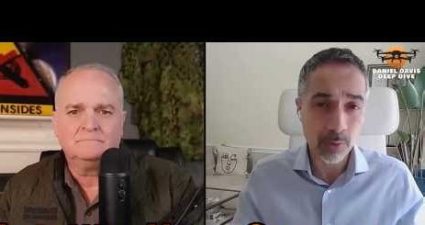
No Threat Can Force Iran’s Surrender /Trita Parsi & Lt Cl Daniel Davis
or go to
Aletho News Archives – Video-Images
From the Archives
An Expert Military Analysis of War with China
Actually, None is Necessary
By Fred Reed • Unz Review • December 13, 2020
The Correlation of Armed Forces: U.S. goods and services trade with China totaled an estimated $634.8 billion in 2019. Exports were $163.0 billion; imports were $471.8 billion. The U.S. goods and services trade deficit with China was $308.8 billion in 2019. Trade in services with China (exports and imports) totaled an estimated $76.7 billion in 2019. Services exports were $56.5 billion; services imports were $20.1 billion. The U.S. services trade surplus with China was $36.4 billion in 2019.
There is talk within the Washingtoniat of a possible war with China. Steve Bannon, who apparently was dropped on his head as a child, actually favors such a war. We hear the usual shoo-the-boobs alarm about how the Chinese are doing something terrible and we must gird our loins and American values and show them what for, bow wow, woof. The danger is that the current game of who-blinks-first in Asian waters might actually provoke a shooting war. You know the kind of thing: One warship refuses to get out of the way of another, a collision ensues, some retard lieutenant who signed up on waivers opens fire, and we’re off and running. It is not a good idea to let children play with matches.
The said war is discussed either in emotional terms by idiots or in purely naval terms by those familiar with such things, so we hear of the First Island Chain and the Second Island Chain and whose missiles against the other’s missiles and so on. This would be appropriate if we were fighting World War Two again. Which we aren’t. Let’s take a quick-and-dirty look at how such a war might go.
To begin the war, America would overestimate itself and underestimate China. This is doctrine in the Pentagon. … continue
Blog Roll
-
Join 2,445 other subscribers
Visits Since December 2009
- 7,430,624 hits
Looking for something?
Archives
Calendar
Categories
Aletho News Civil Liberties Corruption Deception Economics Environmentalism Ethnic Cleansing, Racism, Zionism Fake News False Flag Terrorism Full Spectrum Dominance Illegal Occupation Mainstream Media, Warmongering Malthusian Ideology, Phony Scarcity Militarism Progressive Hypocrite Russophobia Science and Pseudo-Science Solidarity and Activism Subjugation - Torture Supremacism, Social Darwinism Timeless or most popular Video War Crimes Wars for IsraelTags
9/11 Afghanistan Africa al-Qaeda Australia BBC Benjamin Netanyahu Brazil Canada CDC Central Intelligence Agency China CIA CNN Covid-19 COVID-19 Vaccine Donald Trump Egypt European Union Facebook FBI FDA France Gaza Germany Google Hamas Hebron Hezbollah Hillary Clinton Human rights Hungary India Iran Iraq ISIS Israel Israeli settlement Japan Jerusalem Joe Biden Korea Latin America Lebanon Libya Middle East National Security Agency NATO New York Times North Korea NSA Obama Pakistan Palestine Poland Qatar Russia Sanctions against Iran Saudi Arabia Syria The Guardian Turkey Twitter UAE UK Ukraine United Nations United States USA Venezuela Washington Post West Bank WHO Yemen Zionism
 Aletho News
- Suicide Should Not Be a Government Service
- Rethinking America’s greatest threat: Iran vs. Israel-Firsters
- Iran accuses adversaries of false flags to strain Turkey ties
- Poland rules out sending Patriot missiles to US/Israel amid war on Iran
- Tehran approves new Hormuz plan with major restrictions
- No Threat Can Force Iran’s Surrender /Trita Parsi & Lt Cl Daniel Davis
- UK’s New Pandemic Plan Would Turn Big Tech Into a Mass Location Tracking Network
- Growing insecurity, soaring prices fuel protests in north as regime bans evacuation: Sources
- Iran denies responsibility for ‘depraved’ attack on Kuwait desalination plant
- Bring The Troops Back. End This War Now!
- If Americans Knew
- Joe Kent Urges Americans To Call White House and Congress To Object To Sending Troops Into Iran
- DNC Resolution to Reject AIPAC Funding Puts Democratic Leaders in the Hot Seat
- Swedish foundation to build 400 schools as over 650,000 Gaza children remain without education for 2 years
- Israeli army admits photshopping image of slain Lebanese journalist
- This is how Israel is systematically killing health workers under the cover of war in Lebanon
- Carrying life under fire: Israeli invasion of Lebanon leaves pregnant women facing deadly risks
- Champagne all around for the new death penalty (for Palestinians) law – Not a ceasefire Day 172
- Why are Palestinian books struggling to be seen on Amazon?
- The Line Between Affinity and Conspiracy
- As Iran targets US military bases, will they be relocated to Israel? Not a ceasefire Day 171
- No Tricks Zone
- New Study Finds Warming Saves Lives…Cold Temperatures 12 Times More Deadly Than Excess Heat
- German Science Blog Accuses PIK Climate Institute Of Hallucinating Climate Tipping Points
- Devastating Assessment Of Comirnaty Vaccine By Former Senior Pfizer Europe Toxicologist
- New Study: CO2 Is ‘Effectively Negligible’ As An Explanatory Climate Change Factor Since 2000
- Former Pfizer Toxicologist Dr. Helmut Sterz Tells Bundestag Hearing Pfizer Vaccine Should Have Never Been Approved
- Energy Expert: Germany’s Nuclear Phaseout Was A “500 Billion Euro Mistake”
- New Research: South Australia’s Mid-Holocene Sea Surface Temperatures Were 4°C Warmer Than Today
- Storing Green Energy To Last Germany 10 Days Would Require A 60-Million Tonne Battery
- New Studies: UK Sea Levels Were 4 Meters Higher Than Today During The Mid-Holocene
- Destructive Green New Deal: German Energy And Metal Group Warns Of Drastic Crisis
Contact:
atheonews (at) gmail.com
Disclaimer
This site is provided as a research and reference tool. Although we make every reasonable effort to ensure that the information and data provided at this site are useful, accurate, and current, we cannot guarantee that the information and data provided here will be error-free. By using this site, you assume all responsibility for and risk arising from your use of and reliance upon the contents of this site.
This site and the information available through it do not, and are not intended to constitute legal advice. Should you require legal advice, you should consult your own attorney.
Nothing within this site or linked to by this site constitutes investment advice or medical advice.
Materials accessible from or added to this site by third parties, such as comments posted, are strictly the responsibility of the third party who added such materials or made them accessible and we neither endorse nor undertake to control, monitor, edit or assume responsibility for any such third-party material.
The posting of stories, commentaries, reports, documents and links (embedded or otherwise) on this site does not in any way, shape or form, implied or otherwise, necessarily express or suggest endorsement or support of any of such posted material or parts therein.
The word “alleged” is deemed to occur before the word “fraud.” Since the rule of law still applies. To peasants, at least.
Fair Use
This site contains copyrighted material the use of which has not always been specifically authorized by the copyright owner. We are making such material available in our efforts to advance understanding of environmental, political, human rights, economic, democracy, scientific, and social justice issues, etc. We believe this constitutes a ‘fair use’ of any such copyrighted material as provided for in section 107 of the US Copyright Law. In accordance with Title 17 U.S.C. Section 107, the material on this site is distributed without profit to those who have expressed a prior interest in receiving the included information for research and educational purposes. For more info go to: http://www.law.cornell.edu/uscode/17/107.shtml. If you wish to use copyrighted material from this site for purposes of your own that go beyond ‘fair use’, you must obtain permission from the copyright owner.
DMCA Contact
This is information for anyone that wishes to challenge our “fair use” of copyrighted material.
If you are a legal copyright holder or a designated agent for such and you believe that content residing on or accessible through our website infringes a copyright and falls outside the boundaries of “Fair Use”, please send a notice of infringement by contacting atheonews@gmail.com.
We will respond and take necessary action immediately.
If notice is given of an alleged copyright violation we will act expeditiously to remove or disable access to the material(s) in question.
All 3rd party material posted on this website is copyright the respective owners / authors. Aletho News makes no claim of copyright on such material.
 Aletho News