By Stephen J. Sniegoski ~ 2003
Excerpts:
Is there any evidence that Israel and her supporters have managed to get the United States to fight for their interests?
To unearth the real motives for the projected war on Iraq, one must ask the critical question: How did the 9/11 terrorist attack lead to the planned war on Iraq, even though there is no real evidence that Iraq was involved in 9/11? From the time of the 9/11 attack, neoconservatives, of primarily (though not exclusively) Jewish ethnicity and right-wing Zionist persuasion, have tried to make use of 9/11 to foment a broad war against Islamic terrorism, the targets of which would coincide with the enemies of Israel.
For some time prior to September 11, 2001, neoconservatives had publicly advocated an American war on Iraq. The 9/11 atrocities provided the pretext. The idea that neocons are the motivating force behind the U.S. movement for war has been broached by a number of commentators.
To understand why Israeli leaders would want a Middle East war, it is first necessary to take a brief look at the history of the Zionist movement and its goals. Despite public rhetoric to the contrary, the idea of expelling (or, in the accepted euphemism, “transferring”) the indigenous Palestinian population was an integral part of the Zionist effort to found a Jewish national state in Palestine. Historian Tom Segev writes:
The idea of transfer had accompanied the Zionist movement from its very beginnings, first appearing in Theodore Herzl’s diary. In practice, the Zionists began executing a mini-transfer from the time they began purchasing the land and evacuating the Arab tenants…. “Disappearing” the Arabs lay at the heart of the Zionist dream, and was also a necessary condition of its existence…. With few exceptions, none of the Zionists disputed the desirability of forced transfer — or its morality.
However, Segev continues, the Zionist leaders learned not to publicly proclaim their plan of mass expulsion because “this would cause the Zionists to lose the world’s sympathy.”
The key was to find an opportune time to initiate the expulsion so it would not incur the world’s condemnation.
A clear illustration of the neoconservative thinking on war on Iraq is a 1996 paper developed by Perle, Feith, David Wurmser, and others published by an Israeli think tank, the Institute for Advanced Strategic and Political Studies, titled “A clean break: a new strategy for securing the realm.” It was intended as a political blueprint for the incoming government of Benjamin Netanyahu. The paper stated that Netanyahu should “make a clean break” with the Oslo peace process and reassert Israel’s claim to the West Bank and Gaza. It presented a plan whereby Israel would “shape its strategic environment,” beginning with the removal of Saddam Hussein and the installation of a Hashemite monarchy in Baghdad, to serve as a first step toward eliminating the anti-Israeli governments of Syria, Lebanon, Saudi Arabia, and Iran.
Note that these Americans — Perle, Feith, and Wurmser — were advising a foreign government and that they currently are connected to the George W. Bush administration: Perle is head of the Defense Policy Board; Feith is Assistant Secretary of Defense for Policy; and Wurmser is special assistant to State Department chief arms control negotiator John Bolton. It is also remarkable that while in 1996 Israel was to “shape its strategic environment” by removing her enemies, the same individuals are now proposing that the United States shape the Middle East environment by removing Israel’s enemies. That is to say, the United States is to serve as Israel’s proxy to advance Israeli interests.
In September 2000, the neocon think tank Project for the New American Century (PNAC) issued a report, “Rebuilding America’s Defenses: Strategy, Forces and Resources for a New Century,” that envisioned an expanded global posture for the United States. In regard to the Middle East, the report called for an increased American military presence in the Gulf, whether Saddam was in power or not., maintaining that “the United States has for decades sought to play a more permanent role in Gulf regional security. While the unresolved conflict with Iraq provides the immediate justification, the need for a substantial American force presence in the Gulf transcends the issue of the regime of Saddam Hussein.” The project’s participants included individuals who would play leading roles in the second Bush administration: Cheney (Vice President), Rumsfeld (secretary of defense), Wolfowitz (deputy secretary of defense), and Lewis Libby (Cheney’s chief of staff). Weekly Standard editor William Kristol was also a co-author.
The September 11 atrocities provided the “revolutionary times” in which Israel could undertake radical measures unacceptable during normal conditions. When asked what the attack would do for U.S.-Israeli relations, former prime minister Benjamin Netanyahu responded: “It’s very good.” Then he edited himself: “Well, not very good, but it will generate immediate sympathy.” Netanyahu correctly predicted that the attack would “strengthen the bond between our two peoples, because we’ve experienced terror over so many decades, but the United States has now experienced a massive hemorrhaging of terror.” Sharon placed Israel in the same position as the United States, referring to the attack as an assault on “our common values” and declaring, “I believe together we can defeat these forces of evil.”
In the eyes of Israel’s leaders, the September 11 attacks had joined the United States and Israeli together against a common enemy. And that enemy was not in far-off Afghanistan but was geographically close to Israel. Israel’s traditional enemies would now become America’s as well. And Israel would have a better chance of dealing with the Palestinians under the cover of a “war on terrorism.”
In the October 29, 2002, issue of The Weekly Standard, Kagan and Kristol predict a wider Middle Eastern war:
When all is said and done, the conflict in Afghanistan will be to the war on terrorism what the North Africa campaign was to World War II: an essential beginning on the path to victory. But compared with what looms over the horizon — a wide-ranging war in locales from Central Asia to the Middle East and, unfortunately, back again to the United States — Afghanistan will prove but an opening battle…. But this war will not end in Afghanistan. It is going to spread and engulf a number of countries in conflicts of varying intensity. It could well require the use of American military power in multiple places simultaneously. It is going to resemble the clash of civilizations that everyone has hoped to avoid.
In the immediate aftermath of 9/11, administration heavyweights debated the scope of the “war on terrorism.” According to Bob Woodward’s Bush at War, as early as September 12 Rumsfeld “raised the question of attacking Iraq. Why shouldn’t we go against Iraq, not just al Qaeda? he asked. Rumsfeld was speaking not only for himself when he raised the question. His deputy, Paul D. Wolfowitz, was committed to a policy that would make Iraq a principal target of the first round in the war on terrorism.”
Woodward adds, “The terrorist attacks of September 11 gave the United States a new window to go after Hussein.” On September 15, Wolfowitz put forth military arguments to justify a U.S. attack on Iraq rather than Afghanistan. Wolfowitz expressed the view that “attacking Afghanistan would be uncertain,” voicing the fear that American troops would be “bogged down in mountain fighting…. In contrast, Iraq was a brittle, oppressive regime that might break easily. It was doable.”
Within Israel herself, however, the Arabs would not be expected to adopt a “new political culture”; they would be expected to vanish.
Even the dean of Israel’s revisionist historians, Benny Morris, explicitly endorsed the expulsion of the Palestinians in the event of war. “This land is so small,” Morris exclaimed, “that there isn’t room for two peoples. In fifty or a hundred years, there will only be one state between the sea and the Jordan. That state must be Israel.”
As is now apparent, the “war on terrorism” was never intended to be a war to apprehend and punish the perpetrators of the September 11 atrocities. September 11 simply provided a pretext for government leaders to implement long-term policy plans. As has been pointed out elsewhere, including in my own writing, oil interests and American imperialists looked upon the war as a way to incorporate oil-rich Central Asia within the American imperial orbit. While that has been achieved, the American-sponsored government of Hamid Karzai in Afghanistan is in a perilous situation. Karzai’s power seems to be limited to his immediate vicinity, and he must be protected by American bodyguards. The rest of Afghanistan is being fought over by various war lords and even the resurgent Taliban. Instead of putting forth the effort to help consolidate its position in Central Asia, Washington has shifted its focus to gaining control of the Middle East.
It now appears that the primary policymakers in the Bush administration have been the Likudnik neoconservatives all along. Control of Central Asia is secondary to control of the Middle East. In fact, for the leading neocons, the war on Afghanistan may simply have been an opening gambit, necessary for reaching their ultimate and crucial goal: U.S. control of the Middle East in the interests of Israel. That is analogous to what revisionist historians have presented as Franklin D. Roosevelt’s “back door to war” approach to World War II. Roosevelt sought war with Japan in order to be able to fight Germany, and he provoked Japan into attacking U.S. colonial possessions in the Far East. Once the United States got into war through the back door, Roosevelt focused the American military effort on Germany.
The deductions drawn in this essay seem obvious but are rarely broached in public because Jewish power is a taboo subject. As the intrepid Joseph Sobran puts it: “It’s permissible to discuss the power of every other group, from the Black Muslims to the Christian Right, but the much greater power of the Jewish establishment is off-limits.”
So in a check for “hate” or “anti-Semitism,” let’s recapitulate the major points made in this essay. First, the initiation of a Middle East war to solve Israeli security problems has been a long-standing idea among Israeli rightist Likudniks. Next, Likudnik-oriented neoconservatives argued for American involvement in such a war prior to the atrocities of September 11, 2001. Since September 11, neocons have taken the lead in advocating such a war; and they hold influential foreign policy and national security positions in the Bush administration.
If Israel and Jews were not involved, there would be nothing extraordinary about my thesis. In the history of foreign policy, it has frequently been maintained that various leading figures were motivated by ties to business, an ideology, or a foreign country. In his Farewell Address, George Washington expressed the view that the greatest danger to American foreign relations would be the “passionate attachment” of influential Americans to a foreign power, which would orient U.S. foreign policy for the benefit of that power to the detriment of the United States. It is just such a situation that currently exists.
More – entire essay
December 5, 2013
Posted by aletho |
Ethnic Cleansing, Racism, Zionism, Timeless or most popular, Wars for Israel | Benjamin Netanyahu, David Wurmser, Iraq, Israel, Middle East, United States |
Leave a comment
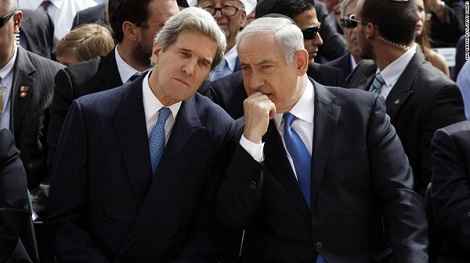
US Secretary of State John Kerry was in the Zionist entity on Thursday for talks aimed at calming tensions with prime minister Benjamin Netanyahu over a nuclear deal sealed between Iran and world powers last month.
“I can’t emphasize enough that Israel’s security in this negotiation is at the top of our agenda,” Kerry told reporters after a meeting with Prime Minister Benjamin Netanyahu in occupied al-Quds (Jerusalem).
“And the United States will do everything in our power to make certain that Iran’s nuclear program of weaponization possibilities is terminated.”
Earlier on November 24, Iran and world powers reached a deal in Geneva on the Islamic Republic’s nuclear program. In which Tehran agree to roll back parts of its nuclear program in return for limited relief from Western sanctions. The deal was roundly condemned by Netanyahu, who called it a “historic mistake”.
“We agreed on what the goal of the final status agreement (with Iran) ought to be, and in the days ahead we will consult very closely and continuously with our Israeli friends in order to bring about a comprehensive agreement that can withstand everybody’s test,” Kerry said.
Kerry landed in the occupied territories late on Wednesday for a trip aimed at giving momentum to Israeli-Palestinian peace talks, which have made little apparent headway since they began under his patronage in late July.
Source: AFP
December 5, 2013
Posted by aletho |
Aletho News | Benjamin Netanyahu, Israel, John Kerry, United States |
Leave a comment
With the U.S. Congress safely in his back pocket, Israeli Prime Minister Benjamin Netanyahu has turned his charm offensive on the Vatican. How is that working out for him?
It does not look promising. The Prime Minister forgot the first rule of charm school: Target your prey gently. Avoid all punches to the mid-section.
The international Jewish News Agency (JTA) reported on Monday’s meeting between Netanyahu and Pope Francis:
“Prime Minister Benjamin Netanyahu at a Vatican audience with Pope Francis reportedly invited the pontiff to visit Israel. No date has been set for a visit by Francis to Israel, Vatican spokesman Father Federico Lombardi said. Netanyahu on Monday presented the pope with a book about the Spanish Inquisition written by his father, the late historian Benzion Netanyahu.”
An invitation to drop by for a visit to Tel Aviv along with a gift to the Holy Father recalling the dark moments of the Spanish Inquisition? Bad form, Mr. Prime Minister.
The book delivered to the Pope was written by Netanyahu’s father, Ben-Zion Netanyahu, who died recently at the age of 102. The pride of a son could be one justification for the gift. The book, The Origins of the Inquisition in 15th Century Spain, is considered the elder Netanyahu’s finest work.
The Seattle Post-Intelligencer was quick to note the incongruity of a book as a gift to the Pope which denounces the sins of Pope Francis’ 15th century predecessor, one that “largely revolves about Spanish Catholics questioning, torturing, and punishing Jewish converts to Catholicism,” a practice first legally sanctioned by Pope Innocent IV in 1252.
The Seattle PI adds:
“The elder Netanyahu’s impact on his politician son is well-known within Israeli circles. In 1998, David Remnick of the New Yorker wrote that while Ben-Zion Netanyahu’s opinions frequently differed from his son, the pessimism of his right wing worldview influenced his son’s hawkish policies. ‘His dilemma is always to what degree he can, or should, remain true to the ideals, the stubbornness, of his father,’ Remnick observed. The book given to the pope, Remnich adds ‘reflects that deep pessimism.'”
If the Pope accepts Netanyahu’s invitation and presents his own tit-for-tat gift to Netanyahu, there is a document in the Vatican library he could copy and take with him to Tel Aviv.
From what we are learning about this new pontiff, that Vatican document is not a gift Francis is likely to consider. Tit-for-tat does not appear to be the style of this pope.
Nevertheless, the document resting in the Vatican library files is one the Pope might read closely before he engages in further dialogue with the Israeli leader.
This Vatican document is referenced in an important new book by Scott Anderson, Lawrence In Arabia: War, Deceit, Imperial Folly and the Making of the Modern Middle East.
So important is this book that it received two laudatory views in the New York Times, one month apart.
In his Times review, Alex von Tunzelmann capsules the narrative of the book:
“Scott Anderson, a veteran war correspondent and an author of both fiction and nonfiction, gives Lawrence’s story a new spin by contextualizing him in a group biography. He weaves in the lives of three contemporary Middle Eastern spies: Curt Prufer, a German conspiring with the Ottomans to bring down the British Empire; Aaron Aaronsohn, a Zionist agronomist of Romanian origin, settled in Palestine; and William Yale, an East Coast aristocrat and an agent of Standard Oil who ended up in the service of the American State Department.”
A month later, Janet Maslin is back with her review, equally laudatory. She writes:
“As to why such acclaim elevated one renegade Briton and his feat of creating a guerrilla Bedouin army, Mr. Anderson writes that the short answer may seem anticlimactic. His reason: ‘This was a time when the seed was planted for the Arab world to define itself less by what it aspires to become than what it is opposed to: colonialism, Zionism, Western imperialism in its many forms.'”
In their reviews, both Alex von Tunzelmann and Janet Maslin avoid mentioning a key moment in Scott Anderson’s book. It is an important episode Pope Francis should be reminded of should he choose to visit Tel Aviv.
The episode, described by Scott Anderson (pages 298 to 305, your Holiness, if I may be so bold) describes a successful propaganda campaign orchestrated by, among others, Aaron Aaronsohn, described by reviewer Alex Von Tunzelmann as “a Zionist agronomist of Romanian origin, who had settled in Palestine.”
Scott Anderson tells the story in his superb history of the period, Lawrence In Arabia: War, Deceit, Imperial Folly and the Making of the Modern Middle East.
The In in the title is underlined to distinguish it from Lawrence Of Arabia, the 1962 David Lean film.
Here is how the Anderson narrative is developed, summarized and quoted in part:
In the spring of 1917, the Turkish Ottoman ruler of Syria was Djemal Pasha. When the British army was poised to strike Gaza City in February, Djemal Pasha ordered the evacuation of Gaza City’s entire population, a total or around 20,000 citizens. He wanted to clear the area for his army to move in and defend Gaza. After defeating the British in a cleared out Gaza, Djemal Pasha and his German commanders looked north.
They suspected that the British would next attack Jaffa (now a modern Tel Aviv). The city had a population of 40,000, of which around 10,000 were Jews and around 4,000 were Arab Christians, living alongside Arab Muslims. After the defeat in Gaza, the Ottomans were afraid that the British would attack Jaffa from the sea, using the city’s smooth beaches for easy access.
The British defeat at Gaza came on March 26, 1917. Two days later, assuming the British would turn north, Dejmal ordered the evacuation of the entire population, Christians, Jews and Muslims. He gave the residents a week to prepare to move out. When Jewish leaders protested that the sacred Passover holiday was about to begin, Dejmal extended the evacuation order for an additional eight days.
Anderson writes: “By clearing the city, Djemal Pasha unwittingly set in motion one of the most consequential misinformation campaigns of World War I.”
Ignoring the fact that Jews were joined by Christians and Muslims in the forced evacuation, the Zionist propaganda machine went into action, building the movement of the Jaffa population into an attack on all Jews of Palestine. The British Jewish Chronicle newspaper led the way with a May 4 story that carried the subhead: “Grave Reports — Terrible Outrages — Threats of Wholesale Massacre.”
The Chronicle story continued:
“But even worse is threatened. For the Turkish Governor, Dejeml Pasha, has proclaimed the intention of the authorities [sic] to wipe out mercilessly the Jewish population of Palestine, his public statement being that the Armenian policy of massacre is to be applied to the Jews.” That message swept “through Jewish communities in Britain, the United States and continental Europe and drew anguished appeals to their governments that some kind of action be taken.”
William Ormsby-Gore, a Conservative member of Parliament who had been favorably impressed with Aaron Aaronson, the Jewish spy leader in Palestine, cabled British War Cabinet member Mark Sykes (of Sykes-Pico fame) May 4:
“I think we ought to use pogroms in Palestine as propaganda. Any spicy tales of atrocity would be eagerly welcomed by the propaganda people here, and Aaron Aaronsohn could send some lurid stories to the Jewish papers.”
Aaronsohn gave Sykes the names of 50 Zionist leaders throughout the world, urging him to spread the word of the “dire threat” against the Jews of Palestine. Soon, The New York Times printed its story with this headline: “Cruelty to Jews Deported in Jaffe.”
The Turkish government was slow to respond to the false accusations, including one that claimed, falsely, that all the Jews had been evacuated from Jerusalem.
Finally, facing worldwide condemnation based on Jewish propaganda which spread rapidly, Dejaml Pasha pointed out that the entire population of Jaffe, 40,000 residents, had been evacuated, only 10,000 of which were Jewish and 4,000, Christians.
Scott Anderson concludes his account of the successful misinformation campaign surrounding Jaffa’s Jewish population in 1917: (p. 304)
“Spain, Sweden and the Vatican, all neutral entities in the conflict, sent envoys to investigate what had happened [in Jaffa]. Both the Spanish and Vatican envoys quickly concluded that the reports of Jewish massacres and persecutions were without foundation, while their Swedish counterpart went even further.
“‘In many ways,’ he wrote, ‘the Jewish community of Jaffa had fared far better — and certainly no worse — than the resident Moslem population in the evacuation.’ Shortly afterward, the U.S. consulate in Jerusalem also reported that the accounts of violence against the Jaffa Jews were ‘grossly exaggerated.’
“It didn’t matter, of course. In war, truth is whatever people can be led to believe and Dejaml Pasha had just handed his enemies a ‘truth’ that would change Middle Eastern history… The fiction of what happened in Jaffa in 1917 — a fiction repeated as act by most historians writing on the period since — would now become the ur-myth for the contention that the Jewish community in Palestine could never be safe under Muslim rule, that to survive it needed a state of its own.”
Pope Francis does not have to make a gift to Netanyahu of either the Vatican 1917 Jaffa report or Scott Anderson’s book, should the two leaders meet in Tel Aviv. What he can do is prepare for his meeting by reading both the Vatican document and Lawrence In Arabia.
Having read the document and the book, he will be prepared to confront the Prime Minister with some hard truths about a history that is more recent, and certainly more pertinent to this moment, than the 15th century Spanish Inquisition.
December 4, 2013
Posted by aletho |
Deception, Ethnic Cleansing, Racism, Zionism, Mainstream Media, Warmongering, Timeless or most popular | Benjamin Netanyahu, Benzion Netanyahu, Gaza |
Leave a comment
Listening to Benjamin Netanyahu rant about Iran’s non-existent nuclear weapons program, who can seriously claim — as many Jewish, both religious and secular, and non-Jewish critics of Israel attempt to do — that the Zionist-created “Jewish state” has nothing to do with Judaism?
Lighting the candles on the second night of Hanukkah at the Wailing Wall in Jerusalem, the Israeli leader was quoted by Arutz Sheva, an Israeli media network identifying with Religious Zionism:
Relating to the holiday of Hanukkah, also known as the Festival of Lights, Prime Minister Binyamin Netanyahu on Thursday called Iran “the greatest darkness” threatening the world and said that Israel would be the “light to the nations” when it came to Iran’s nuclear program.
The term “light to the nations” originated from verses in the Book of Isaiah, believed to have been written during and after the Babylonian exile (597-538 BC), an event that continues to have a destructive influence on world history:
“Yea, He saith, ‘It is too light a thing for you to be My servant, to establish the tribes of Jacob, and to restore the scions of Israel, and I shall submit you as a light unto the nations, to be My salvation until the end of the earth’ (Isaiah, 49:6)
“I the LORD have called unto you in righteousness, and have taken hold of your hand, and submitted you as the people’s covenant, as a light unto the nations” (Isaiah, 42:6)
“And unto your light, nations shall walk, and kings unto the brightness of your rising” (Isaiah, 60:3)
The context of these three references from the Book of Isaiah are a promise to the exiled notables of Israel, in which a God of their own creation will restore them to the holy land supposedly promised them by this invented God, and this return will cause the rest of the nations to open their benighted goyish eyes, and look up to the Chosen people as a mentor for spiritual and moral guidance for the entire world.
But in light of Netanyahu’s unhinged reaction to the possibility of an international rapprochement with Tehran, the nations had better be very wary of any political “mentor” who takes Isaiah’s 2,600-year-old prophecies as a guide to modern-day international relations.
Post Script:
Isaiah 2:4: And he shall judge among the nations, and shall rebuke many people: and they shall beat their swords into plowshares, and their spears into pruning hooks: nation shall not lift up sword against nation, neither shall they learn war any more.
That pacifist-sounding verse from Isaiah presumably refers to the messianic age when the nations are expected to pay tribute to the Jewish Messiah at the Temple in Jerusalem.
Hasn’t Netanyahu been doing his utmost to realize Isaiah’s vision that every other nation (so far only those in the Middle East) “beat their swords into ploughshares” i.e. unilaterally disarm in order to leave Israel the undisputed “judge among the nations”?
Follow Maidhc Ó Cathail on Facebook and Twitter @O_Cathail.
December 1, 2013
Posted by aletho |
Supremacism, Social Darwinism, Timeless or most popular | Benjamin Netanyahu, Book of Isaiah, Hanukkah, Iran, Israel, Light Unto the Nations |
Leave a comment
More than ever, Israel is isolated from world opinion and the squishy entity known as “the international community.” The Israeli government keeps condemning the Iran nuclear deal, by any rational standard a positive step away from the threat of catastrophic war.
In the short run, the belligerent responses from Prime Minister Benjamin Netanyahu are bound to play badly in most of the U.S. media. But Netanyahu and the forces he represents have only begun to fight. They want war on Iran, and they are determined to exercise their political muscle that has long extended through most of the Washington establishment.
While it’s unlikely that such muscle can undo the initial six-month nuclear deal reached with Iran last weekend, efforts are already underway to damage and destroy the negotiations down the road. On Capitol Hill the attacks are most intense from Republicans, and some leading Democrats have also sniped at the agreement reached in Geneva.
A widespread fear is that some political precedent might be set, undercutting “pro-Israel” leverage over U.S. government decisions. Such dread is inherent in the negative reactions from Netanyahu (“a historic mistake”), GOP lawmakers like House Intelligence Committee chair Mike Rogers (“a permission slip to continue enrichment”) and Senator Saxby Chambliss (“we’ve let them out of the trap”), and Democratic lawmakers like Senate Foreign Relations Committee chair Robert Menendez (“this agreement did not proportionately reduce Iran’s nuclear program”) and Senator Charles Schumer (“it does not seem proportional”).
Netanyahu and many other Israelis — as well as the powerhouse U.S. lobbying group AIPAC and many with similar outlooks in U.S. media and politics — fear that Israel’s capacity to hold sway over Washington policymakers has begun to slip away. “Our job is to be the ones to warn,” Israel’s powerful finance minister, Yair Lapid, told Israeli Army Radio on Sunday. “We need to make the Americans to listen to us like they have listened in the past.”
This winter and spring, the Israeli government and its allies are sure to strafe U.S. media and political realms with intense barrages of messaging. “Israel will supplement its public and private diplomacy with other tools,” the New York Times reported Monday from Jerusalem. “Several officials and analysts here said Israel would unleash its intelligence industry to highlight anticipated violations of the interim agreement.” Translation: Israel will do everything it can to undermine the next stage of negotiations and prevent a peaceful resolution of the dispute over Iran’s nuclear program.
Looking ahead, as a practical political matter, can the U.S. government implement a major policy shift in the Middle East without at least grudging acceptance from the Israeli government? Such questions go to the core of the Israeli occupation now in its 47th year.
Israel keeps building illegal Jewish settlements in the West Bank; suppression of the basic human rights of Palestinian people continues every day on a large scale in the West Bank and Gaza. There is no reason to expect otherwise unless Israel’s main political, military and economic patron, the United States, puts its foot down and refuses to backstop those reprehensible policies. They can end only when the “special relationship” between the USA and Israel becomes less special, in keeping with a single standard for human rights and against military aggression.
Such talk is abhorrent to those who are steeped in the notion that the United States must serve as a reliable enabler of Israel’s policies. But in every way that those policies are wrong, the U.S. government should stop enabling them.
The longstanding obstacles to such a halt stand a bit less tall today, but they remain huge. No less than before, as William Faulkner said, “The past is not dead. In fact, it’s not even past.” This certainly applies to the history of gaining and maintaining unequivocal U.S. support for Israel.
Today’s high-impact American groups such as AIPAC (which calls itself “America’s Pro-Israel Lobby”), Christians United for Israel (“the largest pro-Israel organization in the U.S., with more than a million members,” according to the Jerusalem Post) and similar outfits have built on 65 years of broad and successful Israel advocacy in the United States.
Baked into the foundation of their work was the premise of mutuality and compatibility of Israeli and American interests. Until the end of the Cold War, routine spin portrayed aid to Israel as a way to stymie Soviet power in the region. Especially since 9/11, U.S. support for Israel has been equated with support for a precious bulwark against terrorism.
Ever since the successful 1947 campaign to press for UN General Assembly approval of Palestine partition, Israel’s leaders have closely coordinated with American Jewish organizations. Israeli government representatives in the United States regularly meet with top officers of American Jewish groups to convey what Israel wants and to identify the key U.S. officials who handle relevant issues. Those meetings have included discussions about images of Israel to promote for the American public, with phrases familiar to us, such as “making the desert bloom” and “outpost of democracy.”
As any member of Congress is well aware, campaign donations and media messaging continue to nurture public officials cooperative and sympathetic to Israel. For the rare officeholders and office seekers who stand out as uncooperative and insufficiently sympathetic, a formulaic remedy has been applied: withholding campaign donations, backing opponents and launching of media vilification. Those political correctives have proved effective — along the way, serving as cautionary tales for politicians who might be tempted to step too far out of line.
The mainstream American Jewish Committee decided in 1953 that for its pro-Israel advocacy, “To the utmost extent, non-Jewish and non-sectarian organizations should be used as spokesmen.” Such a strategic approach has borne fruit for the overall Israel advocacy project in the USA. It is time-tested and mature; broadly distributing messages through organizations of most political flavors; and adept at touching almost all sizable media.
This year, Israeli leaders have intensified their lurid casting of Iran as the next genocidal Third Reich, and Israel as the protector absent for Jews during the Holocaust. For some, the theme is emotionally powerful. But it must not be allowed to prevent a diplomatic resolution of the nuclear dispute with Iran.
From now till next summer, the struggle over talks with Iran will be fierce and fateful. All signs point to determined efforts by Israel — and its many allies in the United States — to wreck prospects for a peaceful solution.
November 25, 2013
Posted by aletho |
Ethnic Cleansing, Racism, Zionism, Timeless or most popular, Wars for Israel | Benjamin Netanyahu, Iran, Israel, Middle East, Saxby Chambliss, United States, Zionism |
Leave a comment
Johannesburg – In a desperate attempt to swing Western nations’ public opinion against Iran, Israeli leader Benjamin Netanyahu – widely viewed in Muslim society as a major villain in promoting Islamophobia – has yet again resorted to vile anti-Islam rhetoric.
In step with an inglorious record of Zionist-colonialism, the bigotry inherent in his irrational utterances raises the specter of an ugly, emotive campaign of renewed Islam-bashing. At an event at Tel Aviv University that was also attended by French President Francois Hollande, Netanyahu contrasted “progressive Israel” with “oppressive” aspirations of “radical Islam”, which he claimed was attempting to take humanity back to the “Dark Ages.”
This brazen assault is a remarkable display by a personality who arrogantly believes that the world is beholden to him. It is symbolic of the regime he leads and represents. The notion that Israel is able to do as it pleases without any accountability to the international community is increasingly turning into a major source of irritation and embarrassment for many of its allies.
Netanyahu regards himself as a modern-day savior of Jews and in order to do so keeps unleashing his bitterness and hatred of Islam. He does so also to ensure that Israel’s enemy is clearly defined. It’s a ridiculous situation that in today’s enlightened era a rightwing leader such as him is able to spew venom and incite anti-Muslim sentiments, safe in the knowledge that neither the USA nor the UN is able to touch him.
While he continues to rant and rave about “radical Islam” he puts his hope on the gullibility of people, expecting that Israel’s hardline repressive policies against Palestinians will evoke sympathy rather than censure. It remains a misplaced expectation and reflects adversely on the fact that Netanyahu is as out of touch with reality as PW Botha (Groot Krokodil) was during his reign as apartheid South Africa’s chief.
This episode is certainly not isolated from Netanyahu’s past. He has a history of fuelling hatred against Islam and has done so by dividing Muslims into various camps and categories. As a leading Islamophobia ideologue he can claim “success” if it’s the correct term one may use to describe his influence on America’s neoconservative movement and the range of wars spawned by them across the Muslim world.
Netanyahu may be the premier of Israel, but he remains a central figure in US politics via the disproportionate dominance of AIPAC-influenced legislation in both the Senate and Congress. From the Clinton era’s “Omnibus Counter-Terrorism Act” to George Bush’s infamous “War on Terror”, Netanyahu and his rightwing gang has ensured that Palestine’s freedom struggle is criminalized as terrorism. The arguments advanced to pigeon-hole groups such as Hamas and Hizbullah as terror outfits, have had a disastrous consequence in America. On the one hand, US taxpayers have had to fund their domestic law enforcement agencies to prosecute Palestinians on behalf of Israel. On the other hand, the bastion of freedom and democracy has also had to contend with managing inter-faith relations to prevent anti-Islam sentiments from resembling anarchy in the streets.
Though some hasbara enthusiasts may find it extremely tough to admit, I’m not surprised that every element of Israel’s grip on the lives and destiny of Palestinians resembles apartheid in South Africa. And similarities can justifiably be extended to the personalities who executed apartheid policies. From Verwoerd to Vorster and Botha one will have very little difficulty to recast them as Ben-Gurion to Begin and Netanyahu. It’s truly a gallery of rogues. The Zionist cast has in fact outstripped their apartheid partners and led by Netanyahu seem hell bent to continue excelling in land theft, occupation, war crimes, apartheid barriers, weapons of mass destruction, detention without trial and Islamophobia.
How far will he be allowed to go in his wild pursuit of war is anyone’s guess. What is clear though is that Netanyahu is increasingly behaving and sounding like an idiot whose conduct is not only becoming a source of embarrassment for global Jewry, but also makes Israel’s western allies cringe.
Follow Iqbal Jassat on Twitter: @ijassat
November 25, 2013
Posted by aletho |
Ethnic Cleansing, Racism, Zionism, Islamophobia, Wars for Israel | Benjamin Netanyahu, Islamophobia, United States |
Leave a comment
By James Petras :: December 28, 2005
Israel Bombs Iran: The US Suffers the Consequences
Israel’s political and military leadership have repeatedly and openly declared their preparation to militarily attack Iran in the immediate future. Their influential supporters in the US have made Israel’s war policy the number one priority in their efforts to secure Presidential and Congressional backing. The arguments put forth by the Israeli government and echoed by their followers in the US regarding Iran’s nuclear threat are without substance or fact and have aroused opposition and misgivings throughout the world, among European governments, international agencies, among most US military leaders and the public, the world oil industry and even among sectors of the Bush Administration.
An Israeli air and commando attack on Iran will have catastrophic military consequences for US forces and severe loss of human life in Iraq, most likely ignite political and military violence against pro-US Arab-Muslim regimes, such as Saudi Arabia and Egypt, perhaps leading to their overthrow.
Without a doubt Israeli war preparations are the greatest immediate threat to world peace and political stability.
Israel’s War Preparations
Never has an imminent war been so loudly and publicly advertised as Israel’s forthcoming military attack against Iran. When the Israeli Military Chief of Staff, Daniel Halutz, was asked how far Israel was ready to go to stop Iran’s nuclear energy program, he said “Two thousand kilometers” – the distance of an air assault (Financial Times (FT) Dec 12, 2005). More specifically Israeli military sources reveal that Israel’s current and probably next Prime Minister Ariel Sharon ordered Israel’s armed forces to prepare for air strikes on uranium enrichment sites in Iran (London Times), Dec 11, 2005). According to the London Times the order to prepare for attack went through the Israeli defense ministry to the Chief of Staff. During the first week in December, “… sources inside the special forces command confirmed that ‘G’ readiness – the highest state – for an operation was announced” (Times, Dec. 11, 2005).
On December 9, Israeli Minister of Defense, Shaul Mofaz, affirmed that in view of Teheran’s nuclear plans, Tel Aviv should “not count on diplomatic negotiations but prepare other solutions.” (La Jornada, Dec. 10, 2005) In early December, Ahron Zoevi Farkash, the Israeli military intelligence chief told the Israeli parliament (Knesset) that “if by the end of March, the international community is unable to refer the Iranian issue to the United Nations Security Council, then we can say that the international effort has run its course” (Times, Dec. 11, 2005).
In plain Hebrew, if international diplomatic negotiations fail to comply with Israel’s timetable, Israel will unilaterally, militarily attack Iran. Benjamin Netanyahu, leader of the Likud Party and candidate for Prime Minister stated that if Sharon did not act against Iran, “then when I form the new Israeli government (after the March 2006 elections) we’ll do what we did in the past against Saddam’s reactor.” (Times Dec 11, 2005). In June 1981 Israel bombed the Osirak nuclear reactor in Iraq. Even the pro-Labor newspaper, Haaretz, while disagreeing with the time and place of Netanyahu’s pronouncements, agreed with its substance. Haaretz criticized “(those who) publicly recommend an Israeli military option…” because it “presents Israel as pushing (via powerful pro-Israel organizations in the US) the United States into a major war.” However, Haaretz adds… “Israel must go about making its preparations quietly and securely – not at election rallies.” (Haaretz, Dec 6, 2005) Haaretz’s position, like that of the Labor Party, is that Israel not advocate war against Iran before multi-lateral negotiations are over and the International Atomic Energy Agency makes a decision.
In other words, the Israeli “debate” among the elite is not over whether to go to war but over the place to discuss war plans and the timing to launch war. Implicitly Haaretz recognizes the role played by pro-Israeli organizations in “pushing the US into the Iraq war”, perhaps a word of caution, resulting from increased US opposition to the activities of the Israel First campaigners in Congress (see below).
Israeli public opinion apparently does not share the political elite’s plans for a military strike against Iran’s nuclear program. A survey in the Israeli newspaper Yedioth Ahronoth, reported by Reuters (Dec. 16, 2005) shows that 58% of the Israelis polled believed the dispute over Iran’s nuclear program should be handled diplomatically while only 36% said its reactors should be destroyed in a military strike.
Israel’s War Deadline
All top Israeli officials have pronounced the end of March as the deadline for launching a military assault on Iran. The thinking behind this date is to heighten the pressure on the US to force the sanctions issue in the Security Council. The tactic is to blackmail Washington with the “war or else” threat, into pressuring Europe (namely Great Britain, France, Germany and Russia) into approving sanctions. Israel knows that its acts of war will endanger thousands of American soldiers in Iraq, and it knows that Washington (and Europe) cannot afford a third war at this time. The end of March date also coincides with the IAEA report to the UN on Iran’s nuclear energy program. Israeli policymakers believe that their threats may influence the report, or at least force the kind of ambiguities, which can be exploited by its overseas supporters to promote Security Council sanctions or justify Israeli military action. Fixing a March date also intensifies the political activities of the pro-Israel organizations in the United States. The major pro-Israel lobbies have lined up a majority in the US Congress and Senate to push for the UN Security Council to implement economic sanctions against Iran or, failing that, endorse Israeli “defensive” action. Thousands of pro-Israel national, local and community groups and individuals have been mobilized to promote the Israeli agenda via the mass media and visits to US Congressional representatives. The war agenda also plays on exploiting the tactical disputes among the civilian militarists within the White House, between Cheney, Bolton and Abrams on one side and Rice and Rumsfeld on the other. The Cheney line has always supported an Israeli military attack, while Rice promotes the tactic of “forced failure” of the European diplomatic route before taking decisive action. Rumsfeld, under tremendous pressure from practically all of the top professional military officials, fears that an Israeli war will further accelerate US military losses. The pro-Israel lobby would like to replace the ultra-militarist Rumsfeld with the ultra-militarist Senator Joseph Lieberman, an unconditional Israel First Zealot.
US-Israeli Disagreements on an Iran War
As Israel marches inexorably toward war with Iran, disputes with Washington have surfaced. The conflicts and mutual attacks extend throughout the state institutions, and into the public discourse. Supporters and opponents of Israel’s war policy represent powerful segments of state institutions and civil society. On the side of the Israeli war policy are practically all the major and most influential Jewish organizations, the pro-Israeli lobbies, their political action committees, a sector of the White House, a majority of subsidized Congressional representatives and state, local and party leaders. On the other side are sectors of the Pentagon, State Department, a minority of Congressional members, a majority of public opinion, a minority of American Jews (Union of Reform Judaism) and the majority of active and retired military commanders who have served or are serving in Iraq.
Most of the discussion and debate in the US on Israel’s war agenda has been dominated by the pro-Israeli organizations that transmit the Israeli state positions. The Jewish weekly newspaper, Forward, has reported a number of Israeli attacks on the Bush Administration for not acting more aggressively on behalf of Israel’s policy. According to the Forward, “Jerusalem is increasingly concerned that the Bush Administration is not doing enough to block Teheran from acquiring nuclear weapons…” (Dec. 9, 2005). Further stark differences occurred during the semi-annual strategic dialog between Israeli and US security officials, in which the Israelis opposed a US push for regime change in Syria, fearing a possible, more radical Islamic regime. The Israeli officials also criticized the US for forcing Israel to agree to open the Rafah border crossing and upsetting their stranglehold on the economy in Gaza.
Predictably the biggest Jewish organization in the US, the Conference of Presidents of Major American Jewish Organizations (CPMAJO) immediately echoed the Israeli state line as it has since its founding. Malcolm Hoenlan, President of the CPMAJO lambasted Washington for a “failure of leadership on Iran” and “contracting the issue to Europe” (Forward, Dec. 9, 2005). He went on to attack the Bush Administration for not following Israel’s demands by delaying referring Iran to the UN Security Council for sanction. The leader of the CPMAJO then turned on French, German and British negotiators accusing them of “appeasement and weakness”, and of not having a “game plan for decisive action” – presumably for not following Israel’s ‘sanction or bomb them’ game plan.
The role of AIPAC, the CPMAJO and other pro-Israeli organizations as transmission belts for Israel’s bellicose war plans was evident in their November 28, 2005 condemnation of the Bush Administration agreement to give Russia a chance to negotiate a plan under which Iran would be allowed to enrich uranium under international supervision to ensure that its enriched uranium would not be used for military purposes. AIPAC’s rejection of negotiations and demands for an immediate confrontation were based on the specious argument that it would “facilitate Iran’s quest for nuclear weapons” – an argument which flies in the face of all known intelligence data (including Israel’s) which says Iran is at least 3 to 10 years away from even approaching nuclear weaponry. AIPAC’s unconditional and uncritical transmission of Israeli demands and criticism is usually clothed in the rhetoric of US interests or security in order to manipulate US policy. AIPAC chastised the Bush regime for endangering US security. By relying on negotiations, AIPAC accused the Bush Administration of “giving Iran yet another chance to manipulate (sic) the international community” and “pose a severe danger to the United States” (Forward, Dec. 9, 2005).
Leading US spokesmen for Israel opposed President Bush’s instructing his Ambassador to Iraq, Zalmay Khaklilzad, to open a dialog with Iran’s Ambassador to Iraq. In addition, Israel’s official ‘restrained’ reaction to Russia’s sale to Teheran of more than a billion dollars worth of defensive anti-aircraft missiles, which might protect Iran from an Israeli air strike, was predictably echoed by the major Jewish organizations in the US. No doubt an important reason for Israel’s setting an early deadline for its military assault on Iran is to act before Iran establishes a new satellite surveillance system and installs its new missile defense system.
Pushing the US into a confrontation with Iran, via economic sanctions and military attack has been a top priority for Israel and its supporters in the US for more than a decade (Jewish Times/ Jewish Telegraph Agency, Dec. 6, 2005). The AIPAC believes the Islamic Republic poses a grave threat to Israel’s supremacy in the Middle East. In line with its policy of forcing a US confrontation with Iran, AIPAC, the Israeli PACs (political action committees) and the CPMAJO have successfully lined up a majority of Congress people to challenge what they describe as the “appeasement” of Iran. According to the Jewish Times (12/6/05), “If it comes down to a political battle, signs are that AIPAC could muster strong support in Congress to press the White House to demand sanctions on Iran.” Representative Illeana Ros-Lehtinen (R-Florida), who has the dubious distinction of being a collaborator with Cuban exile terrorist groups and unconditional backer of Israel’s war policy, is chairwoman of the highly influential US House of Representative Middle East subcommittee. From that platform she has echoed the CPMAJO line about “European appeasement and arming the terrorist regime in Teheran” (Jewish Times 12/6/05). The Cuban-American Zionist boasted that her Iran sanctions bill has the support of 75% of the members of Congress and that she is lining up additional so-sponsors.
The pro-Israel lobby’s power, which includes AIPAC, the Conference of Presidents, the PACs and hundreds of local formal and informal organizations, is magnified by their influence and hegemony over Congress, the mass media, financial institutions, pension funds and fundamentalist Christian organizations. Within the executive branch their influence in these institutions amplifies their power far beyond their number and direct control and representation in strategic public and private institutions (which itself is formidable). AIPAC’s “Progress and Policy Report for 2005” – published on its website – lists, among its accomplishments, getting Congress to approve 100 pro-Israel legislative initiatives, $3 billion in direct aid and more than $10 billion in guaranteed loans, transfer of the most advanced military technology to Israel’s multi-billion dollar arms export corporations, and the lining up by a 410 to 1 vote in the House of Representative committing the US to Israel’s security – as it is defined by Israel.
The conflict between the Israeli elite and the Bush Administration has to be located in a broader context. Despite pro-Israeli attacks on US policy for its ‘weakness’ on Iran, Washington has moved as aggressively as circumstances permit. Facing European opposition to an immediate confrontation (as AIPAC and Israeli politicians demand) Washington supports European negotiations but imposes extremely limiting conditions, namely a rejection of the Non-Proliferation Treaty, which allows uranium enrichment for peaceful purposes. The European “compromise” of forcing Iran to turn over the enrichment process to a foreign country (Russia), is not only a violation of its sovereignty, but is a policy that no other country using nuclear energy practices. Given this transparently unacceptable “mandate”, it is clear that Washington’s ‘support for negotiations’ is a propaganda devise to provoke an Iranian rejection, and a means of securing Europe’s support for a Security Council referral for international sanctions. Washington has absolutely no precedent to object to Russia’s sale of defensive ground to air missiles to Iran, since it is standard in the arms export business. As for as the Ambassadorial meetings in Iraq, the US has had great success in securing Iranian co-operation on stabilizing its Iraqi Shiite client regime. Iran has recognized the regime, has signed trade agreements, supported the dubious elections and provided the US with intelligence against the Sunni resistance. Given their common interests in the region, it was logical for Washington to seek to bend Iran into further co-operation via diplomatic discussions. In other words, as the US seeks to withdraw its troops from a losing war in Iraq (largely supported by AIPAC and its organizational partners), pro-Israel organizations are pushing hard to put the US into a new war with Iran. It is no surprise that the Zionist Organization of America (ZOA) invited the most bellicose of US Middle East warmongers, UN Ambassador to the United Nations, John Bolton, to be its keynote speaker at its annual awards dinner (ZOA Press Release, Dec. 11, 2005). The ZOA has loyally followed all the zigzags of Israeli policy since the foundation of the State.
Despite the near unanimous support and widespread influence of the major Jewish organizations, 20% of American Jews do not support Israel in its conflict with the Palestinians. Even more significantly, 61% of Jews almost never talk about Israel or defend Israel in conversation with Goyim (non-Jews) (Jerusalem Post, Dec 1, 2005). Only 29% of Jews are active promoters of Israel. In other words, it is important to note that the Israel First crowd represents less than a third of the Jewish community and hence their claim to speak for ‘all’ US Jews is false and a misrepresentation. In fact, there is more opposition to Israel among Jews than there is in the US Congress. Having said that, however, most Jewish critics of Israel are not influential in the big Jewish organizations and the Israel lobby, excluded from the mass media and mostly intimidated from speaking out, especially on Israel’s war preparations against Iran. The minority Jewish critics cannot match the five to eight million dollars spent in buying Congressional votes each year by the pro-Israel lobbies.
The Myth of the Iranian Nuclear Threat
The Israeli Defense Forces Chief of Staff, Daniel Halutz, has categorically denied that Iran represents an immediate nuclear threat to Israel, let along the United States. According to Haaretz (12/14/05), Halutz stated that it would take Iran time to be able to produce a nuclear bomb – which he estimated might happen between 2008 and 2015.
Israel’s Labor Party officials do not believe that Iran represents an immediate nuclear threat and that the Sharon government and the Likud war propaganda is an electoral ploy. According to Haaretz, “Labor Party officials… accused Prime Minister Ariel Sharon, Defense Minister Shaul Mofaz and other defense officials of using the Iran issue in their election campaigns in an effort to divert public debate from social issues” (Dec. 14, 2005). In a message directed at the Israeli Right but equally applicable to AIPAC and the ‘Presidents of the Major Jewish Organizations in the US, Labor member of the Knesset, Benjamin Ben-Eliezer rejected electoral warmongering: “I hope the upcoming elections won’t motivate the prime minister and defense minister to stray from government policy and place Israel on the frontlines of confrontation with Iran. The nuclear issue is an international issue and there is no reason for Israel to play a major role in it” (Haaretz, Dec. 14, 2005). Unfortunately the Israel lobby is making it a US issue and putting Washington on the frontlines…
Iran’s Nuclear Threat Fabrication
Israeli intelligence has determined that Iran has neither the enriched uranium nor the capability to produce an atomic weapon now or in the immediate future, in contrast to the hysterical claims publicized by the US pro-Israel lobbies. Mohammed El Baradei, head of the United Nations International Atomic Energy Agency (IAEA), which has inspected Iran for several years, has pointed out that the IAEA has found no proof that Iran is trying to construct nuclear weapons. He criticized Israeli and US war plans indirectly by warning that a “military solution would be completely un-productive” (Financial Times, Dec. 10/11, 2005).
More recently, Iran, in a clear move to clarify the issue of the future use of enriched uranium, “opened the door for US help in building a nuclear power plant” (USA Today, Dec. 11, 2005). Iranian Foreign Ministry spokesman, Hamid Reza Asefi, speaking at a press conference, stated “America can take part in the international bidding for the construction of Iran’s nuclear power plant if they observe the basic standards and quality” (USA Today, Dec. 11, 2005). Iran also plans to build several other nuclear power plants with foreign help. The Iranian call for foreign assistance is hardly the strategy of a country trying to conduct a covert atomic bomb program, especially one directed at involving one of its principal accusers.
The Iranians are at an elementary stage in the processing of uranium, not even reaching the point of uranium enrichment, which in turn will take still a number of years, and overcoming many complex technical problems before it can build a bomb. There is no factual basis for arguing that Iran represents a nuclear threat to Israel or to the US forces in the Middle East.
Israel’s war preparations and AIPAC’s efforts to push the US in the same direction based on falsified data is reminiscent of the fabricated evidence which was channeled to the White House through the Pentagon’s Office of Special Plans led by Abram Shumsky and directed by Douglas Feith and Paul Wolfowitz, both long-time supporters of the Likud Party. Israel’s war preparations are not over any present or future Iranian nuclear threat. The issue is over future enrichment of uranium, which is legal under the Non-Proliferation Treaty as is its use in producing electrical power. Iran currently is only in a uranium conversion phase, which is prior to enrichment. Scores of countries with nuclear reactors by necessity use enriched uranium. The Iranian decision to advance to processing enriched uranium is its sovereign right as it is for all countries, which possess nuclear reactors in Europe, Asia and North America.
Israel and AIPAC’s resort to the vague formulation of Iran’s potential nuclear capacity is so open-ended that it could apply to scores of countries with a minimum scientific infrastructure.
The European Quartet has raised a bogus issue by evading the issue of whether or not Iran has atomic weapons or is manufacturing them and focused on attacking Iran’s capacity to produce nuclear energy – namely the production of enriched uranium. The Quartet has conflated enriched uranium with a nuclear threat and nuclear potential with the danger of an imminent nuclear attack on Western countries, troops and Israel. The Europeans, especially Great Britain, have two options in mind: To impose an Iranian acceptance of limits on its sovereignty, more specifically on its energy policy and capacity to control the deadly air pollution of its major cities with cleaner sources of energy; or to force Iran to reject the arbitrary addendum to the Non-Proliferation Agreement and then to propagandize the rejection as an indication of Iran’s evil intention to create atomic bombs and target pro-Western countries. The Western media would echo the US and European governments position that Iran was responsible for the breakdown of negotiations. The Europeans would then convince their public that since “reason” failed, the only recourse it to follow the US to take the issue to the Security Council and approve international sanctions against Iran.
The US then would attempt to pressure Russia and China to vote in favor of sanctions or to abstain. There is reason to doubt that either or both countries would agree giving the importance of the multi-billion dollar oil, arms, nuclear and trade deals between Iran and these two countries. Having tried and failed in the Security Council, the US and Israel are likely to move toward a military attack. An air attack on suspected Iranian nuclear facilities will entail the bombing of heavily populated as well as remote regions leading to large-scale loss of life.
The principal result will be a massive escalation of war throughout the Middle East. Iran, a country of 70 million, with several times the military forces that Iraq possessed and with highly motivated and committed military and paramilitary forces can be expected to cross into Iraq. Iraqi Shiites sympathetic to or allied with Iran would most likely break their ties with Washington and go into combat. US military bases, troops and clients would be under tremendous attack. US military casualties would multiply. All troop withdrawal plans would be disrupted. The ‘Iraqization’ strategy would disintegrate, as the US ‘loyal’ Shia armed forces would turn against their American officers. Beyond Iraq, there would likely be major military-civilian uprisings in Egypt, Saudi Arabia, Lebanon, Jordan, Palestine and Pakistan. The conflagration would spread beyond the Middle East, as the Israel-US attack on an Islamic country would ignite mass protests throughout Asia. Most likely new terrorist incidents would occur in Western Europe, North America, and Australia and against US multinationals. A bitter prolonged war would ensue; pitting 70 million unified Iranian nationals, millions of Muslims in Asia and Africa against an isolated US accompanied by its European allies facing mass popular protests at home.
Sanctions on Iran will not work, because oil is a scarce and essential commodity. China, India and other fast-growing Asian countries will balk at a boycott. Turkey and other Muslim countries will not cooperate. Numerous Western oil companies will work through intermediaries. The sanction policy is predestined to failure; its only result will be to raise the price of oil even higher. An Israeli or US military attack will cause severe political instability and increase the risk to oil producers, shippers and buyers, raising the price of oil to astronomical heights, likely over $100 a barrel, destabilizing the world economy and provoking a major world recession or worse.
Conclusion
The only possible beneficiary of a US or Israeli military attack on Iran or economic sanctions will be Israel: it will seem to eliminate a military adversary in the Middle East, and consolidate its military supremacy in the Middle East. Even this outcome is problematic because it fails to take account of the fact that Iran’s challenge to Israel is political, not its non-existent nuclear potential. The first target of the millions of Muslims protesting Israeli aggression will be the Arab regimes closest to Israel. An Israeli attack would be a pyrrhic victory, if a predictable political conflagration unseats the rulers of Jordan, Egypt, Syria and Saudi Arabia. The consequences would be even worse if the US attacks: major oil wells burning, US troops in Iraq surrounded, long-term relations with Arab regimes undermined, increased oil prices and troop casualties inflaming domestic public opinion. An attack on Iran will not be a cleanly executed ‘surgical’ strike – it will be a deep jagged wound leading to gangrene.
No doubt AIPAC will celebrate “another success” for Israel in their yearly self-congratulatory report of missions accomplished. The Presidents of the Major Jewish Organizations in America will thank their obedient and loyal congressional followers for approving the destruction of an ‘anti-Semitic and anti-American nuclear threat to all of humanity’ or some similar rubbish.
The big losers of a US-Israeli military attack are the US soldiers in Iraq and other Middle Eastern countries who will be killed and maimed, the US public which will pay in blood and bloated deficits, the oil companies which will see their oil supplies disrupted, their new multi-billion dollar joint oil exploitation contracts undermined, the Palestinians who will suffer the consequences of greater repression and massive displacement, the Lebanese people who will be forcible entangled in a new border war, and the Europeans who will face terrorist retaliations.
Except for the Israeli lobby in the US and its grass root Jewish American supporters and allies among the Presidents of the Major Jewish organizations there are no other organized lobbies pressuring for or against this war. The ritualistic denunciations of “Big Oil” whenever there is a Middle East conflict involving the US is in this instance a totally bogus issue, lacking any substance. All the evidence is to the contrary – big oil is opposed to any conflicts, which will upset their first major entry into Middle Eastern oil fields since they were nationalized in the 1970’s.
The only identifiable organized political force, which has successfully made deep inroads in the US Congress and in sectors of the Executive Branch, are the pro-Israel lobbies and PAC’s. The major proponents of a confrontationist policy in the Executive Branch are led by pro-Israel neo-conservative National Security Council member (and Presidentially pardoned felon) Elliott Abrams, in charge of Middle East policy, and Vice President Cheney. The principle opposition is found in the major military services, among commanders, who clearly see the disastrous strategic consequences for the US military forces and sectors of the State Department and CIA, who are certainly aware of the disastrous consequences for the US of supporting Israel’s quest for uncontested regional supremacy.
The problem is there is no political leadership to oppose the pro-Israel war lobby within congress or even in civil society. There are few if any influential organized lobbies challenging the pro-war Israel lobby either from the perspective of working for coexistence in the Middle East or even in defending US national interests when they diverge from Israel. Although numerous former diplomats, generals, intelligence officials, Reformed Jews, retired National Security advisers and State Department professionals have publicly denounced the Iran war agenda and even criticized the Israel First lobbies, their newspaper ads and media interviews have not been backed by any national political organization that can compete for influence in the White House and Congress. As we draw closer to a major confrontation with Iran and Israeli officials set short term deadlines for igniting a Middle East conflagration, it seems that we are doomed to learn from future catastrophic losses that Americans must organize to defeat political lobbies based on overseas allegiances.
November 20, 2013
Posted by aletho |
Ethnic Cleansing, Racism, Zionism, Militarism, Timeless or most popular, Wars for Israel | Benjamin Netanyahu, International Atomic Energy Agency, Iran, Iraq, Israel, United States |
Leave a comment
Israeli Prime Minister Benjamin Netanyahu says the nuclear Non-Proliferation Treaty (NPT) has no use in the Middle East.
Problematic countries are not the ones which have refused to sign the NPT, Netanyahu said in an interview with French-language daily Le Figaro on Friday.
The Israeli premier accused Iran of seeking nuclear weapons despite being a signatory to the NPT.
He said Iran should not possess heavy water reactors or centrifuges, stressing Israel and Arab countries in the Persian Gulf are united in their stance against the Iranian nuclear issue.
Netanyahu labeled Tehran as an aggressive and violent state which poses a threat to the US and European countries such as France and Britain.
He called on France to stand firm on its stance against Iran in the upcoming nuclear talks between Iran and the five permanent members of the UN Security Council -Russia, China, US, UK, and France- plus Germany.
Israel is widely believed to be the only possessor of nuclear weapons in the Middle East with an estimated 200 to 400 nuclear warheads.
The Israeli regime, which rejects all regulatory international nuclear agreements, particularly the NPT, maintains a policy of deliberate ambiguity over its nuclear activities and refuses to allow its nuclear facilities to come under international regulatory inspections.
November 16, 2013
Posted by aletho |
Ethnic Cleansing, Racism, Zionism | Benjamin Netanyahu, Iran, Israel, Middle East, NPT, Treaty on the Non-Proliferation of Nuclear Weapons |
Leave a comment
A 16-year-old Palestinian stabbed an Israeli soldier to death on a bus on Wednesday in an attack apparently motivated by the jailing of his relatives in Israel, police said.
The death came as Israel backtracked on an announced plan to expand illegal settlements in the West Bank, calling for “intelligent and coordinated” construction despite international condemnation.
The killing, in the town of Afula in Occupied Palestine, follows a surge in violence in the West Bank, where 10 Palestinians have been shot dead by Israeli troops and three Israelis killed since peace talks resumed in July.
Israel’s northern police commander, Ronny Attia, said the attacker was from the West Bank town of Jenin, and that he was in custody.
According to police, the Palestinian youth did not have a permit to be inside Israel.
“By his account, his uncles are in prison in Israel and this is the reason he decided to carry out the terrorist attack,” Attia said.
Israel refers to many acts of protest against the decades-long occupation – whether violent or non-violent – as terrorism.
Police spokesman Micky Rosenfeld said the soldier, aged 18, was pronounced dead in hospital.
The attack occurred a day before the one-year anniversary of the Israeli Pillar of Cloud offensive on Gaza, in which six Israelis and more than 100 Palestinian civilians were killed in eight days.
Peace talks orchestrated by US Secretary of State John Kerry have faced serious obstacles, including the high rate of Palestinians incarcerated in Israeli prisons, many in indefinite administrative detention, as well as extensive plans to expand Israeli settlements in the West Bank.
A report by British newspaper The Guardian on Tuesday revealed that Israeli troops conducted mock arrests and raids in the West Bank without informing the local population that their actions were drills, causing extreme distress to many Palestinians.
The attack came as Israel’s Intelligence Minister Yuval Steinitz urged “coordinated” settlement building, a day after a new plan for settler homes in the West Bank drew international condemnation.
Settlements in Israeli-annexed east Jerusalem and the West Bank “must be done in an intelligent and coordinated way,” Steinitz told Israeli public radio on Wednesday.
The settlements are deemed illegal under international law.
Israeli Prime Minister Benjamin Netanyahu late Tuesday cancelled plans to build 20,000 new settler homes in the West Bank, hours after their announcement sparked US and Palestinian criticism.
State Department spokeswoman Jennifer Psaki had said Washington was not only concerned by the initial announcement, but also “surprised” and sought an explanation from Israel.
She repeated the longstanding US position on settlements that “we do not accept the legitimacy of continued settlement activity.”
Netanyahu then ordered Israeli Housing Minister Uri Ariel “to reconsider all of the steps for evaluating planning potential (for the settler homes) that he distributed without any advance coordination,” the premier’s office said.
(Reuters, AFP, Al-Akhbar)
November 13, 2013
Posted by aletho |
Ethnic Cleansing, Racism, Zionism, Illegal Occupation, Subjugation - Torture | Benjamin Netanyahu, Human rights, Israel, Israeli settlement, Palestine, West Bank, Zionism |
Leave a comment
US Senator Lindsey Graham has warned about a possible easing of economic sanctions against Iran, saying Israel is “apoplectic” about the Obama administration’s approach.
Graham, a hawkish Republican from South Carolina who has repeatedly called for military strikes on Iran, said Sunday that lifting sanctions would send the wrong message to Israel and other US allies in the region.
“The Israelis are apoplectic about what we’re doing,” he said on CNN’s “State of the Union.” “I’ve never been more worried about the Obama administration’s approach to the Middle East than I am now.”
The White House offered a “very modest sanctions relief” as Iran and the six major world powers– the US, Britain France, China, Russia and Germany– engaged in talks over Iran’s nuclear energy program in Geneva, Switzerland over the weekend.
The talks ended inconclusively on Sunday when France rejected a list of demands on Iran, saying they were too generous to result in an easing of sanctions. More negotiating sessions are scheduled for November 20.
Sen. Graham said the sanctions should be kept in place, and coupled with the threat of military force, to compel Iran to stop its uranium enrichment activities.
“If it ends with anything less, the world will regret this,” Graham said. “My fear is that we’re going to end up creating a North Korea kind of situation in the Middle East.”
Senate leaders showed bipartisan support Sunday for tougher sanctions on Iran.
Senator Robert Menendez, chairman of the Senate Foreign Relations Committee and a key architect of anti-Iran sanctions, called on Congress to consider new economic sanctions against Iran.
“I think that the possibility of moving ahead with new sanctions, including wording it in such a way that if there is a deal that is acceptable that those sanctions could cease upon such a deal, is possible,” Menendez said Sunday on ABC’s “This Week.”
The US lawmakers’ outburst happened after Israeli Prime Minister Benjamin Netanyahu denounced a possible agreement with Iran as a “historic blunder.”
November 11, 2013
Posted by aletho |
Wars for Israel | Benjamin Netanyahu, Bob Menendez, Iran, Lindsey Graham, Middle East, Sanctions against Iran, United States |
Leave a comment

As the prospect of a nuclear deal between Iran and the group of six major world powers grows stronger, Israel strives to lobby the US Congress to prevent any possible agreement.
“Before the talks resume, we will lobby dozens of members of the US Congress to whom I will personally explain during a visit beginning on Tuesday that Israel’s security is in jeopardy,” Israeli’s Economy Minister Naftali Bennett said on Sunday.
The remarks come after Iran and the five permanent members of the UN Security Council – Britain, France, China, Russia and the US – plus Germany concluded three days of intense negotiations over Tehran’s nuclear energy program early on Sunday.
Iran and the six world powers have agreed to continue negotiations on November 20 in Geneva, Switzerland.
Although an agreement was not reached in the nuclear negotiations, both sides said significant progress had been made and expressed optimism about the prospect of achieving a deal.
British Foreign Secretary William Hague said in an interview with the BBC later on Sunday that, “On the question of will it happen (a deal will be reached) in the next few weeks, there is a good chance of that.”
“A deal is on the table and it can be done. But it is a formidably difficult negotiation, I can’t say exactly when it will conclude,” he added.
Israeli ministers, however, have voiced strong opposition to any possible deal between Iran and the world powers, with Minister of Military Affairs Moshe Ya’alon describing an agreement with Iran as a historic mistake.
Israeli Prime Minister Benjamin Netanyahu also rejected a possible nuclear agreement with Iran as “a very bad deal” before meeting US Secretary of State John Kerry on Friday in Tel Aviv.
Netanyahu’s office had also launched a Twitter campaign against the Islamic Republic in which several photographs including the one of the Iranian students marking the 34th anniversary of the 1979 takeover of the former US embassy in Tehran were shown. The images were re-tweeted by a few Israeli officials.
November 10, 2013
Posted by aletho |
Ethnic Cleansing, Racism, Zionism, Wars for Israel | Benjamin Netanyahu, Iran, Israel, Naftali Bennett, United States, Zionism |
Leave a comment
Benyamin Netanyahu’s hyperventilated fury didn’t surprise anybody. Even before the first outlines of a possible long-term agreement between Iran and the West on Iran’s nuclear program were publicized, Israel’s Prime Minister categorically rejected any such agreement. This irrational behavior disqualifies him as a serious partner to other heads of state. His extremism goes even so far as to promote further sanctions against Iran. Netanyahu wants Iran to capitulate and abolish its entire nuclear industry. He announced that Israel does not feel bound by the agreement. Netanyahu arrogates Israel the right to override decisions by UN Security Council members.
That Western leaders should consult the leader of a tiny country before they act shows the imagined power they attribute to Netanyahu. To seek advice from Netanyahu shows how intimidated Western politicians are. By now, they should be aware of his hostility to peace, be it with Iran or the Palestinians. How submissively the United States acts, is shown by the phone call between Obama and Netanyahu and by Secretary of State Kerry’s visit to Jerusalem, as if they needed Netanyahu’s blessing for the negotiations with Iran. The best political strategy would be to ignore him.
What infuriated Netanyahu and made him go wild was John Kerry’s statement made in Bethlehem: “We consider now and have always considered the settlements to be illegitimate.” The US has finally returned to its erstwhile stance that all Israeli settlements are contrary to international law, after they have gone astray under Bill Clinton and George W. Bush junior. Netanyahu appears increasingly isolated with regard to the Iran deal. He appears willing to do anything to derail a possible agreement between the US and Iran. His last weapons are the political bull terriers of the American Israeli Public Affairs Committee, better known as AIPAC, and their supporters in the US Congress. But Netanyahu is increasingly a political nuisance, not only for the Obama administration but also for other powers. For the last 25 years it has been his mantra to warn that a nuclear armed Iran is just around the corner.
Netanyahu and the war party in the US will do everything in their power to prevent an agreement between Iran and the West. Netanyahu exerts not only great influence on the US Congress via AIPAC, but does so personally, as his last speech before both Houses in May 2012 has shown, during which US lawmakers outdid themselves in celebrating his reactionary speech. AIPAC could try to arrange again another such ridiculous circus. That doesn’t mean that Netanyahu would make it this time, knowing that he would jeopardize the recently improved relations with the Obama administration.
The political charade, which Netanyahu performs, has nothing to do with the imaginary Iranian nuclear threat. The Israeli political establishment knows this and fears that it would lose its hegemony over the entire Middle East and Northern Africa if Iran would go nuclear. The late Israel Shahak has pointed out in his book “Open Secrets. Israeli Nuclear and Foreign Policies”, that Israel’s main goal is to maintain its hegemony from India to Mauritania.
The political interests of the Western powers and Israel are not the same. The West has suffered heavy economic losses by bowing to Israeli interests; especially US soldier had to pay a high price in Iraq. Netanyahu can perhaps bamboozle the U.S. government again, but Israel’s relationship with Europe is on a downward slide. Europe, and especially Germany, can look back on an enduring friendship with Iran. This friendship should not be damaged by unregenerate politicians. Germany would do well to normalize its relations and reestablish its traditionally excellent relations with Iran, regardless of the outcome of the US-Iran negotiations.
By now, the US and the other Western countries should have understood that Netanyahu as well as former Israeli governments have been torpedoing every chance for a peace agreement with the Palestinians, because their colonial hunger for land has not yet been satisfied. The so-called peace negotiations, which are once again taking place, is likely to go nowhere because the Netanyahu government is not willing to make any real concessions that fall short of total surrender by the Palestinians.
November 10, 2013
Posted by aletho |
Ethnic Cleansing, Racism, Zionism, Wars for Israel | Benjamin Netanyahu, Iran, Israel, John Kerry, Middle East, Palestine, Sanctions against Iran, United States, Zionism |
Leave a comment

 Aletho News
 Aletho News