Israeli settler appointed as Consul General in New York after being rejected in Brazil
Palestinian Information Center – March 28, 2016
OCCUPIED JERUSALEM – Israeli Prime Minister Benjamin Netanyahu appointed Monday morning the former head of Yesha settlement council Danny Dayan as Israel’s Consul General in New York after he failed to nominate him as an ambassador to Brazil.
In appointing Dayan, Netanyahu withdrew Dayan’s apportionment as Israel’s ambassador to Brazil after the Brazilian government refused to accept him due to his former role as a settler leader. Asked to comment, Dayan told Army Radio that he was not influenced by Brazil’s refusal. “There was no alternative but New York.”
Dayan was earlier nominated to be Israeli ambassador to Brazil, but Brazil strongly refused his appointment due to his ties to Israeli illegal settlements in the occupied West Bank.
Dayan headed the Yesha Council of Jewish settlements in the occupied West Bank between 2007 and 2013.
Langley’s Latest Themed Revolution: the Yellow Duck Revolution in Brazil

BY Wayne MADSEN | Strategic Culture Foundation | 24.03.2016
The latest themed revolution concocted by the Central Intelligence Agency’s «soft power» agents in the Brazilian federal and state legislatures, corporate media, and courts and prosecutors’ offices – all spurred on with the financial help of George Soros’s nongovernmental organizations – is the «Yellow Duck Revolution».
Large inflatable yellow ducks – said to represent the economic «quackery» of President Dilma Rousseff and her Workers’ Party government – have appeared at US-financed street demonstrations in Brasilia, Rio de Janeiro, and Sao Paulo. The main coordinators of these protests are found in Brazil’s largest corporate federations and corporate-owned media conglomerates and all of them have links to domestic non-profit organizations like Vem Pra Rua (To the Street) – a typical Soros appellation – and Free Brazil Movement, in turn funded by the usual suspects of the National Endowment for Democracy (NED), US Agency for International Development (USAID), and Soros’s Open Society Institute.
After trying to mount an electoral defeat of Brazil’s progressive leftist president, Dilma Rousseff, through a combination of presidential candidate assassination (the aerial assassination of Eduardo Campos in 2014 to pave the way to the presidency for the Wall Street-owned Green candidate Marina Silva, Campos’s vice presidential running mate), «rent-a-mob» street demonstrations, and corporate media propaganda, the Langley spooks are now trying to run Rousseff from office through a «Made in America» impeachment process. Aware that Rousseff’s progressive predecessor and mentor, Luiz Inacio Lula da Silva, has been targeted by Brazilian prosecutors on the CIA’s payroll, for arrest and prosecution for bribery, she appointed him to her government with ministerial rank and prosecutorial immunity. Lula only became a target because he signaled his desire to run for the presidency after Rousseff’s term ends in 2019.
The Workers’ Party correctly points out that the legislative impeachment maneuvers against Rousseff and the judicial operations against both Rousseff and Lula emanate from Washington. The same «color of law» but CIA-advanced operations were directed against presidents Cristina Fernandez de Kirchner in Argentina, Rafael Correa in Ecuador, Evo Morales in Bolivia, Nicolas Maduro in Venezuela, Fernando Lugo in Paraguay, and Manuel Zelaya in Honduras. In the cases of Lugo and Zelaya, the operations were successful and both leaders were removed from power by CIA-backed rightist forces.
Street protests against Rousseff have, since they began in 2014, taken on the typical Soros themed revolution construct. As with the disastrous Soros-inspired and CIA-nurtured Arab Spring protests in Egypt, Libya, Syria, and Tunisia and Euromaidan protest in Ukraine, the Vem Pra Rua movement and the associated Free Brazil Movement are basically nothing more than politically-motivated capitalist campaigns relying on Facebook, Twitter, and pro-insurrection television and radio networks, newspapers, and websites.
In addition to the inflatable yellow ducks, street protests have been marked by quickly-manufactured inflatable dolls of Lula in black and white prison garb and a placard cartoon drawing of Rousseff with a red diagonal «No» sign drawn through it. Street protest devices, which also include green and yellow banners and clothing, are telltale signs of significant amounts of money backing the psychological warfare gimmickry.
Brazilian prosecutors on Langley’s payroll arrested the popular Lula after staging a massive police raid on his house. Police also arrested the former First Lady of Brazil, Lula’s wife Marisa Leticia. Lula said he felt that he was kidnapped by the police. In 2009, Honduran troops actually kidnapped President Manuel Zelaya in the middle of the night and detained him in a military cell prior to expelling him from the country. That operation, like the one against Lula and Rousseff, was backed not only by the CIA and NSA, but by the US Southern Command in Miami. The Honduran coup was also backed by the Supreme Court of Honduras. To prevent a further political arrest of her predecessor, Rousseff made Lula her chief of staff, a cabinet position that affords Lula some protection from continuing prosecutorial harassment and legal proceedings by the federal court.
On March 16, Judge Sergio Moro, who is in charge of Operation «Lava-jato» («Car wash»), the two-year investigation of Petrobras and the alleged bribery involving Rousseff and Lula, released two taped intercepts of phone calls between the president and former president. The bugged phone conversation involved Rousseff’s plans to appoint Lula as her chief of staff, a Cabinet rank, as a way to afford him some protection from the CIA’s judicial-backed coup operation now in play. Rousseff previously served as Lula’s chief of staff. Classified National Security Agency documents leaked by whistleblower Ed Snowden illustrate how the NSA has spied on Rousseff’s office and mobile phones. President Obama claimed he ordered an end to such spying on world leaders friendly to the United States. Obama’s statement was false.
Judge Sergio Moro’s name appears in one of the leaked State Department cables. On October 30, 2009, the US embassy in Brasilia reported that Moro attended an embassy-sponsored conference in Rio de Janeiro held from October 4-9. Titled «Illicit Financial Crimes», the conference appears have been an avenue for the CIA and other US intelligence agencies to train Brazilian federal and state law enforcement, as well as other Latin American police officials from Argentina, Paraguay, Panama, and Uruguay, in procedures to mount bogus criminal prosecutions of Latin American leaders considered unfriendly to the United States. The State Department cable from Brasilia states: «Moro… discussed the 15 most common issues he sees in money laundering cases in the Brazilian Courts».
One item that was not on the agenda for the US embassy seminar was the NSA’s covert spying on the communications of Rousseff, Lula, and the state-owned Brazilian oil company Petrobras. In a technique known as prosecutorial «parallel construction», US prosecutors given access to illegally-intercepted communications, have initiated prosecution of American citizens based on the selective use of warrantless intercepts. If such tactics can be used in the United States, they can certainly be used against leaders like Rousseff, Lula, and others. The Operation Car wash intercepts of the Rousseff-Lula phone conversations that were released by Judge Moro to the media may have originated with NSA and its XKEYSCORE database of intercepts of Brazilian government and corporate communications conducted through bugging operations codenamed KATEEL, POCOMOKE, and SILVERZEPHYR.
In what could be called the «Obama Doctrine», the CIA has changed its game plan in overthrowing legitimate governments by using ostensibly «legal» means. Rather than rely on junta generals and tanks in the street to enforce its will, the CIA has, instead, employed prosecutors, judges, opposition party leaders, newspaper editors, and website administrators, as well as mobs using gimmicks – everything from inflatable yellow ducks, paper mâché puppets, and freshly silk screen-printed t-shirts, flags, and banners – as themed revolution facilitators.
As shown by the leaked State Department cables, the CIA has identified a number of agents of influence it can rely on for providing intelligence on both Rousseff and Lula. These sources have included the senior leadership of the Workers’ Party; officials of Petrobras eager to see their company sold off to the highest-bidding foreign vultures; Brazilian Central Bank executives; and Brazilian military intelligence officers who were originally trained by US intelligence and military agencies.
In addition to BRICS member Brazil, other BRICS nations have also seen the US increasing its efforts to organize themed revolutions. South Africa is on the target list, as are Russia and China.
Drunk on Hate and Mad at the World
Israel’s Diplomatic Wars of Aggression

By Richard Edmondson | Fig Trees and Vineyards | January 29, 2016
Israel these days seems to be increasingly at odds with a good portion of the rest of the world. In just the past few months it has quarreled with:
- Spain over arrest warrants issued for Netanyahu and six other Israeli officials for the 2010 attack on the Gaza Freedom Flotilla;
- Sweden over comments by its foreign minister who has called for an investigation into extrajudicial executions of Palestinians;
- college campus student groups supporting the BDS movement;
- academic associations who have issued calls for academic boycotts of Israeli universities;
- Brazil over its refusal to recognize an Israeli ambassador who hails from the right-wing Israeli settler movement;
- The EU over labeling of products from Israeli settlements.
- The UN over Ban Ki-moon’s recent criticism of the settlements
And really, if truth be known, Israel is probably not too happy just now with Italy either, which recently received Iranian President Hassan Rouhani on a state visit, resulting in a number of agreements between the two countries’ energy sectors as well as cooperation on a future high-speed rail project. Naor Gilon, the Israeli ambassador to Italy, complained that Rouhani was being treated like “the king of the world.”

Zvi Zameret accuses Wallström of ‘ignorance and arrogance’,
and suggests she might meet a violent end
War with Sweden
All in all, Gilon’s comments would have to be viewed as rather tame, however–at least by comparison. For some of the statements issuing from Israelis now, particularly those aimed at Swedish Foreign Minister Margot Wallström, are positively chilling in their level of malice expressed, and frankly it might behoove the Swedish official to consider hiring a bodyguard at this point, if she hasn’t already done so.
As I noted in an article five days ago, Wallström is now regarded in Israel as “public enemy number 1” (the Jerusalem Post’s words, not mine) because of remarks she has made critical of Israel, including a recent call for an investigation into extrajudicial killings of Palestinians.
Now it seems there may be those in Israel hankering for the foreign minister’s blood–literally. If you haven’t read my article, Swedish Media Target Country’s Foreign Minister Following Her Remarks on Israel, I suggest you do so as it will place what follows into greater perspective. One day after posting that article, I became aware of two other articles, one by blogger Richard Silverstein and the other by Jonathan Ofir and posted at Mondoweiss, both of which discuss what appears to have been a scarcely veiled threat on Wallström’s life by a former Israeli official.
The comment was made by Zvi Zameret, a former official in the Israeli Ministry of Education, in an op-ed piece he wrote for an Israeli newspaper owned by Nevada casino magnate Sheldon Adelson. In the article, Zameret waxes lyrical on the 1948 assassination of Swedish diplomat Folke Bernadotte, and then goes on to suggest that Wallström might meet a similar fate. Here is a bit from Silverstein’s commentary on the matter:
Zvi Zameret, the former director for instruction for the Israeli education ministry has written an op-ed in Makor Rishon, Sheldon Adelson’s pro-settler newspaper, praising the 1948 assassination of UN mediator Count Folke Bernadotte by Yitzhak Shamir’s Lehi gang. Zameret accuses Bernadotte of being an anti-Semite and claims that his views originated in a Swedish society that was suffused with this perspective. He claims that ridding the world of the Swedish Count was necessary to protect Israel’s new existence.
He wends his way through a long historical discourse involving material already well-known related to Bernadotte’s proposals, which were rejected by Arabs and Jews alike. Then he brings us up to the present day by alleging that remarks of the current Swedish Foreign Minister, Margot Wallstrom, demanding that Israel be held accountable for the 160 Palestinians killed over the past two months in the latest Intifada, stem from the same well of Swedish anti-Semitism.
Silverstein says Zameret “hints that Wallström herself should share a similar fate to Bernadotte” and then gives us a direct quote from his article as per its English translation:
“What do the things I have mentioned attest about Bernadotte? [They indicate] covert anti-Semitism, ignorance and arrogance, collaboration with senior elements in Israel [Hebrew University President Judah Magnes] and interests that play a decisive role. Has anything changed in the Swedish DNA in the decades following Bernadotte’s death? Nothing has changed.
The Swedish foreign minister Margot Wallstrom, in the covert anti-Semitism which characterizes her, along with her ignorance and arrogance, and anticipation of the interests of her future Muslim voters–she too is attempting to battle against the basic foundation of the State of Israel. I am certain that her intentions will be defeated, just as were those of the disreputable Count Bernadotte.

Count Folke Bernadotte
Bernadotte was assassinated by Lehi, also known as the Stern Gang, the same Jewish terrorist group that carried out the Deir Yassin massacre. Zameret’s glorification of his murder doesn’t seem entirely lucid or rational–during World War II Bernadotte negotiated the release of 31,000 prisoners from German concentration camps, including a large number of Jews. After the war, he became the UN Security Council’s unanimous choice, in a vote on May 20, 1948, to try and mediate a settlement in the Palestine-Israeli conflict.
His murder took place September 17, 1948, carried out by a four-man team of assassins. The Stern Gang had been around since 1940. Its stated goal was to terminate the British mandate in Palestine and set up a “new totalitarian Hebrew republic,” and one of its members, Yithak Shamir, ended up becoming an Israeli prime minister. It was Shamir, in fact, who ordered Bernadotte’s assassination. The man who actually pulled the trigger, Yehoshau Cohen, later became a close confidante of David Ben Gurion and was never charged in the case.

Margot Wallström
In October of 2014, shortly after Wallström took over as foreign minister, Sweden became one of the first Western countries to recognize Palestinian statehood. Wallström called it “an important step that confirms the Palestinians’ right to self-determination” and added that “We hope that this will show the way for others.”
In November of last year, shortly after the Paris terror attacks, Wallström suggested that Israel’s treatment of the Palestinians could be helping to fuel terrorism. She followed that up with a comment in December about Israeli “extrajudicial executions,” and this month called for an investigation of Israel.
“Whether Zameret advocates Wallstrom’s demise explicitly or implicitly is hardly important,” comments Silverstein. “Even if you accept the argument that he isn’t explicit, clearly the reason Bernadotte failed in his mission is that Jewish terrorists assassinated him. When you say you wish her intentions to be defeated just as his were, the line between murder and political defeat becomes exceedingly murky.”
Boycott Sweden! say Israeli Mayors
But of course it isn’t just Zameret. Lots of people in Israel despise Wallström and have “vociferously attacked her contentious words,” as an article here puts it. And this apparently applies to a good many Israeli officials. The same article goes on to give us the low-down on a “boycott movement” launched by 15 Israeli mayors and aimed at Sweden. The mayors were planning to attend a conference in the Scandinavian country in March, but recently announced they have cancelled, while former Foreign Minister Avigdor Lieberman has also called for a boycott of Ikea.
War With Spain
In November of last year, a Spanish judge issued arrest warrants for Israeli Prime Minister Benjamin Netanyahu and six other officials in connection with Israel’s 2010 raid on the Gaza Freedom Flotilla, a violent episode in international waters which resulted in the deaths of 10 people.
The warrants were issued by Judge Jose de la Mata, and in effect meant that should any of the seven officials set foot on Spanish soil they would be subject to arrest.
“Spain is just the latest member of the international community to accuse Israel of war crimes and pursue Israeli officials over the affair,” the Jerusalem Post reported at the time. And that is indeed correct. Both South Africa and Turkey had previously issued similar warrants.
Predictably, the Israeli government expressed hostility and outrage.
“We consider it to be a provocation,” said an Israeli foreign ministry spokesperson. “We are working with the Spanish authorities to get it cancelled. We hope it will be over soon.”
What do you suppose the words “working with Spanish authorities” might imply? Did it include issuing threats? Whatever it was, it took only two months to accomplish. The arrest warrants were in fact cancelled, according to a report published January 13 by the Adelson-owned Israel Hayom newspaper.
War with Brazil
Brazil, on the other hand, seems to be showing a little more resilience. According to a report here, “Israel and Brazil remain at loggerheads five months after Brazil refused to recognize Israel’s appointment of a right-wing settler as its next envoy to the South American country.”
“Settlers are Zionist agents that the world cannot accept, they steal others’ land, they are an insult to Brazil, to the government, and to millions of Brazilians with roots in the Arab world,” said Brazilian parliament member Carlos Maron.
Maron isn’t alone. A group of 40 retired Brazilian diplomats signed a statement against the appointment of Dani Dayan, who lives in the Israeli settlement of Ma’ale Shomron, in the Occupied West Bank. Dayan is an advocate of the settler movement and has made no secret of his views, having widely published articles in the mainstream media, including the New York Times.
“We consider it unacceptable that the Prime Minister of Israel, Benjamin Netanyahu, has publicly announced the name of the person he intended to appoint as his country’s new Ambassador to Brazil before submitting it, in accordance to the norm, to our Government,” said the diplomats. The announcement of Dayan’s appointment was reportedly posted initially on Twitter rather than being communicated directly to the Brazilian government.
The statement continues:
This rupture with a diplomatic practice seems to have been on purpose, an attempt to establish facts, since the appointed, Dani Dayan, between 2007 and 2013, was the President of the Yesha Council, responsible for the settlements in the West Bank, which are considered illegal by the international community, and has already declared himself contrary to the creation of the Palestinian State, which counts on the support of the Brazilian Government and was already recognized by over 70% of the UN member States.
Reportedly a group of 200 Brazilian academics have also endorsed a boycott of Israel. Netanyahu has refused to withdraw Dayan’s nomination or to appoint someone more acceptable to the Brazilians. If the Brazilian government stands its ground, it will mean a de facto end to diplomatic relations between the two countries.
War with the EU
On January 18, the EU’s Foreign Affairs Council reaffirmed requirements that export products from the Israeli settlements be labeled as such. More or less as with Sweden, Spain, and Brazil, the EU’s action has prompted cries of Israeli outrage. Netanyahu pronounced his unwillingness to “accept the fact that the EU labels the side being attacked by terror,” while ‘Justice’ Minister Ayelet Shaked called the EU measure “anti-Israel and anti-Jewish.”
Likewise, opposition party leader Isaac Herzog (supposedly a liberal) compared it to the “Zionism equals Racism” resolution passed by the UN in 1974, while Yair Lapid, another opposition party member, denounced the EU for “capitulating to the worse elements of jihad.”
War Against the BDS Movement
In summer of 2015, ‘Justice’ minister Shaked announced she was preparing lawsuits against BDS activists. The announcement was reported at the time by the Times of Israel in a story which also mentions that Shaked has expanded one of the departments within her ministry in order to “push ahead with the program as soon as possible.”
Ministry officials believe that legal circumstances present the option of suing activists for damaging Israeli trade, and for discrimination and racism, based upon laws as they currently exist in various countries, the report said.
So far as I’m aware, no lawsuits have been filed against individual activists, however Naftali Bennett, leader of the Jewish Home Party, seems to be generally in support of the idea of striking back in some manner at the BDS movement.
“Let it be clear to any company or organization that’s considering boycotting us: We will hit back. We will attack our attackers. We will boycott our boycotters,” Bennett said.
“The boycott weapon is a double-edged sword,” he added. “If you’re thinking of boycotting Israel, keep in mind that there are tens of millions of Israel supporters around the world — Jews and non-Jews — with considerable buying power and boycott power. Whoever boycotts Israel will be boycotted. Whoever hits Israel, will be hit back. We will no longer remain silent.”
Bennett’s comments about the “tens of millions of Israel supporters around the world” are perhaps salient. Also last summer, Adelson hosted an anti-BDS summit in Las Vegas with the aim of establishing and funding “successful strategies for countering the wave of anti-Israel activity on college campuses.” Held at the billionaire’s Venetian hotel on the Vegas strip, the conference was attended by a number of wealthy Jews, including Haim Saban.
“The key decision reached at the conference was that there would be a concerted effort to curtail BDS,” reported the Jerusalem Post.
Though Netanyahu did not attend, a letter from him was read aloud to the conference participants. “De-legitimization of Israel must be fought, and you are on the front lines. It’s not about this or that Israeli policy. It’s about our right to exist here as a free people,” the letter stated.
Reportedly the Israeli government intends to allocate NIS 100 million, or roughly $25.2 million, to the anti-BDS effort.
War Against Academic Associations
At a business meeting held in November, members of the American Anthropological Association voted overwhelmingly (88.4 percent) in favor of a resolution to boycott Israeli academic institutions. A similar measure was passed that same month by the National Women’s Studies Association Executive Committee. These aren’t the first boycott actions taken by academic organizations in the US. The American Studies Association, The Association for Asian American Studies, and the Native American and Indigenous Studies Association have all passed academic boycott measures against Israel. And this is just in the US.
Measures have also been passed by academic organizations in Brazil, South Africa, Canada, the UK, and, of course, in Palestine, and probably elsewhere. And perhaps most recently a group of 71 British doctors have called upon the World Medical Association to expel the Israeli Medical Association. The physicians have accused Israeli doctors of “medical torture” on Palestinian patients and want to see a ban on joint projects with Israeli universities.
On January 20, the Science and Technology Committee of the Israeli Knesset held a meeting to discuss the issue (H/T Helvena). A press release on the discussion which took place can be found here on the Knessett’s website. One of those who gave input at the meeting was Peretz Lavie, president of Technion, or the Israeli Institute of Technology.
“We have no complaints against the global academic leadership; our problem is the campuses,” Lavie said. “Initially it was insignificant campuses, but it quickly spread to leading campuses in the United States.”
When Lavie says he has “no complaints against the global academic leadership” he is probably referring to the Association of American Universities, which on January 14, in response to the vote by the Anthropological Association, re-issued an earlier statement in opposition to academic boycotts. The AAU is an organization whose leadership consists of the presidents and chancellors of the 60 universities (in both the US and Canada) that are its members. Membership is by invitation only. The group’s statement opposing boycotts was initially released in 2013 in response to the boycott actions taken by the American Studies and Native American and Indigenous Studies associations.
The group’s re-release of that canned statement from more than two years ago was described by the Jerusalem Post as “a blow to the BDS movement.”
“Students who are exposed to this activity will be the next generation’s senators, and therein lies the great danger in the long term,” Lavie went on in his testimony before the Science and Technology Committee.
“In its report, the American Anthropological Association referred to us as universities of apartheid and decided to conduct a survey on whether the Israeli academia should be boycotted. We have to reach all 12,000 members of the Association. It is a symptom, and if we do not act now, it will spread. There must be one entity that will concentrate all the efforts related to this issue,” he added.
Another person who gave testimony was Ze’ev Feldman of the Israel Medical Association. It was Feldman who informed the committee of the recent statement by the 71 British doctors.
”The sword of the boycott is being raised on the Israeli scientific-medical community,” he said.
Ariel University Chancellor Yigal-Cohen Orgad asserted that Israel has “a real problem with governments, including western governments that encourage boycotts,” while Professor Zvi Ziegler warned, “We are unable to stop anyone with our meager resources.”
Several committee members are also quoted, including Chairman Uri Maklev:
“There is no doubt that the academic boycott phenomenon is expanding and is connected to the financial and consumer boycotts on Israel. Economic and commercial boycotts are associated with politics, but an academic boycott by educated and moderate people has a very strong effect.”
But rather than calling for an end to the settlements, most of the committee members seemed to be of the opinion that the Israeli government needed to devote more resources to fighting the boycott movement. The one exception to this was Arab Knesset member Basel Ghattas:
The world considers the settlements to be illegitimate. You can think differently from the entire world, it is your right, but it is also the world’s right to take measures in order to force you to establish two states.
War with the UN
On October 1, 2015, Netanyahu gave a speech before the United Nations General Assembly that was marked by a 45-second segment during which he paused and projected hostile glares out at those present:
On January 26, 2016, UN Secretary-General Ban Ki-moon broke the UN’s “deafening silence” and, in a rare display of courage, issued a scathing criticism of Israel’s settlement policies.
Progress towards peace requires a freeze of Israel’s settlement enterprise.
Continued settlement activities are an affront to the Palestinian people and to the international community. They rightly raise fundamental questions about Israel’s commitment to a two-state solution.
I am deeply troubled by reports today that the Israeli Government has approved plans for over 150 new homes in illegal settlements in the occupied West Bank.
This is combined with its announcement last week declaring 370 acres in the West Bank, south of Jericho, as so-called “state land”. These provocative acts are bound to increase the growth of settler populations, further heighten tensions and undermine any prospects for a political road ahead.
The inevitable furious response came quickly, with Netanyahu excoriating the UN chief for helping to “stoke terror.”
“There is no justification for terrorism,” he said. “The Palestinian terrorists don’t want to build a state; they want to destroy a state, and they say that proudly. They want to murder Jews everywhere and they state that proudly. They don’t murder for peace and they don’t murder for human rights.”
He went on to assert that the UN has “lost its neutrality and its moral force, and these statements by the Secretary-General do nothing to improve its situation.”
It seems Israel is now at war with the UN as well.
A Lack of Imagination?
Perhaps most striking in all this is the Israeli lack of imagination–or at least that is one way of looking at it. Nowhere in his hostile comments aimed at his various enemies on the global stage does Netanyahu give the slightest indication of having once thought about halting the settlements and pulling back to Israel’s internationally recognized pre-1967 borders. Ditto with the other Israeli officials quoted above, with the lone exception of the Arab Knessett member. It is almost as if the idea has never even occurred to them.
If that is the case, one could perhaps ascribe all of this to a lack of imagination. Certainly at this point, after 68 years of oppression, it probably does indeed require considerable imagination to conceive of how the two peoples could live at peace. But of course it wasn’t always so. And had Israel, starting in 1967, respected the people of the West Bank, and above all else respected their space rather than crowding them in with settlements and walls and soldiers, a peaceful resolution to the conflict probably could have and would have been achieved by this time.
Yet even now, it isn’t too late. Though it would be politically difficult, Israel could dismantle its settlements (anything is possible when the national will is present) and pull back to the pre-1967 borders–basically the terms of the Arab Peace Initiative proposed back in 2002. If necessary, and it probably would be for a lengthy period of time, UN peacekeeping troops could be deployed along the border.
But Israel’s response to the Arab Peace Initiative was to call it a “non-starter,” and that seems to be its position today as well. And not only is there little prospect of dismantling of presently-existing settlements, but we see even a refusal to halt the construction of new ones. All of which would suggest that Ban Ki-moon is correct and that the settlement enterprise raises “fundamental questions about Israel’s commitment to a two-state solution.”
Or in other words, Israel has no intentions of making peace.
Certainly it’s possible that things could change, and that a new slate of leaders could arise in Israel with the imagination necessary to see the wisdom of complying with international norms of conduct. And that is what its more liberal Jewish supporters in America seem to be hoping for. But failing this, Israel’s wars with the rest of the world are likely to grow in stridency and ferociousness, and at some point could expand from the realms of diplomacy and/or covert operations fully outright into the military arena.
200 Brazilian academics pledge support for academic boycott of Israel
MEMO | January 21, 2016
It has taken just three days for 200 Brazilian academics to sign a letter in support for the academic boycott of Israeli institutions, in protest against Israel’s ongoing policies of occupation and discrimination. Professor and former UN rapporteur Paulo Sergio Pinheiro and physician and pharmacologist B. Boris Vargaftig are among the signatories.
In a statement released today the Palestinian Campaign for the Academic Boycott of Israel (PACBI) “salute” their solidarity: “Through these campaigns Brazilians continue to demonstrate that solidarity with the oppressed is the most politically and morally sound contribution to the struggle to end oppression.”
According to PACBI Brazilian movements, individuals and unions have long been committed to isolating Israeli academic institutions as part of the struggle against the Israeli settler colonial and apartheid regime.
Netanyahu to downgrade diplomatic representation in Brazil
MEMO | January 14, 2016
 Israeli Prime Minister Benjamin Netanyahu yesterday decided to downgrade diplomatic representation in Brazil over the latter’s refusal to approve settler leader Dani Dayan as Israeli ambassador, local media reported.
The Jerusalem Post newspaper reported Netanyahu saying: “If Brazil won’t approve former settler leader Dani Dayan as its ambassador, Israel won’t offer another diplomat.”
The Israeli PM’s decision came one week after reports surfaced that Netanyahu would withdraw Dayan’s name as an ambassador to Brazil and give him another diplomatic position in the US.
Arabic news website Arab48.com reported officials from the Israeli foreign ministry accusing Brazil of a “personal boycott” of Dayan; however, a group of 40 retired Brazilian diplomats signed a statement against the appointment of Dayan.
Dayan has previously said: “To be an ambassador or not, it is not the question for me, but if this was not, will 700,000 Israeli [settlers] be banned from working in embassies?”
He added: “As it has objecting to the labelling of Israeli products, Israel must object to the labelling of people.”
Israel threatens Brazil with cold diplomacy unless it accepts settler ambassador
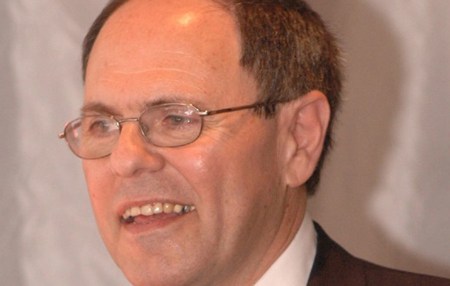
Dani Dayan © Wikipedia
RT | December 28, 2015
Israel has warned Brazil that relations will deteriorate unless it accepts the former Israeli head of the West Bank settlement program as ambassador. The appointment was made four months ago and has still not been approved by Brazil’s government.
The country has continuously failed to give in to diplomatic pressure, leading Israel to up the stakes and issue threats.
Brazilian refusals have gone on since August, when the political appointment was made by Prime Minister Benjamin Netanyahu.
The main sticking point for Brazilian opposition to the appointment is the fact that Dani Dayan – the nominee – lives in the occupied West Bank, as well as being the former head of the Council of Jewish Communities of Judea and Samaria.
Like most [all] of the international community, Brazil’s leftist government believes the building of Israeli settlements on occupied Palestinian land to be illegal. But condemnation at all levels has not resulted in any action on the part of Israel.
Reda Mansour, Israel’s previous ambassador, left Brasilia last week, and now the Israelis are warning that if Dayan does not replace him, there will be consequences for bilateral relations.
“The State of Israel will leave the level of diplomatic relations with Brazil at the secondary level if the appointment of Dani Dayan is not confirmed,” Deputy Foreign Minister Tzipi Hotovely said in an interview to Israel’s Channel 10, according to Reuters. Israel has refused to nominate another candidate for the position.
Hotovely then said Israel would continue to press Brasilia through various means, including the Brazilian Jewish community, as well as direct appeals from Prime Minister Benjamin Netanyahu, who is one of the more outspoken defenders of Israel’s settlement-building in the West Bank.
According to Hotovely, as cited by the Jerusalem Post, this lobbying will take place with the aim of showing that Dayan is “a man who is respectable, worthy, and accepted across Israel’s political spectrum.”
Hotovely added that in the event of Brazil’s refusal, there will be “a crisis in relations between the two countries, and it is not worth going there.”
There has been no comment yet from President Dilma Roussef on whether Brasilia would cave to Israeli demands, but a senior source in the Foreign Ministry told Reuters they “do not see that happening.” And if Dayan is not, in fact, named the next ambassador, the only real alternative will be to have the next highest-ranking official acting in his stead.
Dayan for months remained silent, but on Saturday, in an interview to Channel 2, attributed Brazil’s refusal to “classic BDS” – or boycott, divestment and sanctions. He believes the entire situation owes itself to pressure from Israeli activists, Palestinians and select circles in Brazil.
Tensions between the two countries have been on the rise since the last administration, when Luiz Inacio Lula da Silva worked to warm Brazilian ties with Iran. They rose further last year when an Israeli Foreign Ministry spokesman labeled Brazil “a diplomatic dwarf.” This was after Brasilia recalled its ambassador from Israel as a show of protest over the continuing military offensive in Gaza.
Latin American Revolutions Under Attack
By ANDRE VLTCHEK | CounterPunch | June 26, 2015
Do not take the Latin American revolutions for granted.
They inspired the entire Planet. They brought hope to every corner of our scarred Earth. But now they are themselves in need of our support.
If left alone, they would thrive for decades and centuries. But the Empire is once again on the offensive. It is shaking with fury. It is ready to invade, to smash, burn to ashes all the hopes, all that which had been achieved.
Don’t believe in the “common wisdom” which proclaims that the rulers of the world simply “closed their eyes” more than a decade ago; that George W. Bush was “too busy” ravishing the Middle East, therefore “allowing” most of the Latin American countries to “sneak away” from the iron grip of the Empire.
Such “analyses” are as patronizing as they are false. The Empire never sleeps! What Latin America now has was built on its daring, its sweat, its genius and its blood – it fought against the Empire, courageously, for decades, losing its best sons and daughters. It fought for freedom, for justice and socialism.
The Empire was not “looking the other way”. It was looking straight south, in fury, but for some time it was too confused, too astounded, too shocked at what it was witnessing. Its “slaves” had risen and taken power back into their own hands. They showed to the entire world what freedom really is.
For some time, the Empire was paralyzed by rage and unable to act.
The Empire’s undeniable property, Latin America, inhabited by “un-people” born only in order to supply cheap labor and raw materials to the rich part of the world, was suddenly, proudly and publicly, breaking its shackles, declaring itself free, demanding respect. Its natural resources were now used to feed its own people, to build social housing, create public transportation systems, construct hospitals, schools and public parks.
But after the first wave of panic, the Empire began to do what it does the best – it began the killings.
It attempted to overthrow Venezuelan government in 2002, but it failed. The Venezuelan people rose, and so did the Venezuelan military, defending then President Hugo Chavez. The Empire tried again and again, and it is trying until now. Trying and failing!
“We are at war”, I was told by one of the editors of Caracas-based television network, TeleSUR, for which I made several documentary films. “We are literally working under the barrel of cannon”.
***
Ms. Tamara Pearson, an Australian revolutionary journalist and activist, who recently moved from Venezuela to Ecuador, explained the difficult situation in Venezuela, a country that is under constant attack from both the US, and the local comprador elites:
“People are suffering a lot. Basic food prices are high, much medicine is unavailable, and various services aren’t working. On one level, people are used to this – the business owners would cause shortages and blame the government before each of the many elections. But usually it’s less intense and lasts just a few months. But this has been going on and getting worse, since Chavez died – over two years now. There is no doubt that the US, and more so, Venezuelan and Colombian elites and business owners are a huge or even the main factor…”
All of revolutionary Latin America is “screaming”.
As I described in two of my recent books, “Exposing Lies Of The Empire” and “Fighting Against Western Imperialism”, the Empire is using similar destabilization strategy against all countries that are resisting its deadly embrace.
Its propaganda is mighty and omnipresent. CNN and FOX TV are beamed into almost all major hotels and airports of Latin America, even in some revolutionary countries like Ecuador. Almost all major newspapers of the continent, including those in Venezuela, Ecuador, Chile and Argentina, are controlled by the right wing business elites. Almost all of the foreign news coverage comes from European and North American sources, making the Latin American public totally confused about Islam, China, Russia, South Africa, Iran, even about their own neighbors.
The local elites continue to serve foreign interests, their loyalties firmly with North America and Europe.
Every left wing Latin American government has been facing bizarre protests and subversion actions conducted by the elites. Destabilization tactics have been clearly designed in far away capitals. They were mass-produced and therefore almost identical to those the West has been using against China, Russia, South Africa, and other “rebellious” nations.
Propaganda, disinformation and spreading of confusion have been some of the mightiest tools of the fascist right wing.
“Economic uncertainty” is an extremely powerful weapon. It was used first in Chile, in the 1973 coup against socialist President Salvador Allende. Pro-Western Chilean elites and businessmen created food shortages, and then blamed it on the socialist government, using El Mercurio and other daily newspapers as their propaganda tools.
Peter Koenig, former World Bank economist and now prominent dissident and critic of the world neoliberal regime, wrote for this essay:
Today Madame Bachelet, the socialist President of Chile has a hard time fighting against the Mercurio inspired Chilean oligarchs. They will not let go. Recently they invited the World Bank to assess the school reform package proposed by Bachelet, basically to return universities to the public sector. Of course, the ‘upper class’ of Chileans knew that the World Bank would come up with nothing less than predicting an economic disaster if the reform is approved. As a result, Bachelet made concessions – which on the other hand are not accepted by professors and teachers. It’s the first step towards chaos – and chaos is what the empire attempts to implant in every country where they strive for ‘regime change’.
But one of the “dirtiest” of their weapons is the accusation of corruption. Corrupt pro-Western politicians and individuals who misused tens, even hundreds of millions of dollars of the peoples money and destroyed the economies of their countries by taking unserviceable loans that kept disappearing into their deep pockets, are now pointing their soiled fingers at relatively clean governments, in countries like Chile and Argentina. Everything in “Southern Cone” and in Brazil is now under scrutiny.
Peter Koenig (who co-authored a book “The World Order and Revolution!: Essays from the Resistance” with leading Canadian international lawyer Christopher Black and me) shows how important it is, for the Empire, destabilization of Brazil, one of the key members of BRICS:
Brazil being a member of the BRICS is particularly in the crosshairs of the empire – as the BRICS have to be destabilized, divided – they are becoming an economic threat to Washington. Brazil is key for the non-Asian part of the BRICS. A fall of Brazil would be a major blow to the cohesion of the BRICS.
There are totally different standards for pro-Western fascist politicians and for those from the Left. The Left can get away with nothing, while the Right has been getting away literally with mass murder and with the disappearance of tens of billions of dollars.
It is, of course, the common strategy in all the client states of the West. For instance, one of the most corrupt countries on earth, Indonesia, tolerates absolute sleaze and graft from former generals, but when progressive socialist Muslim leader, Abdurrahman Wahid, became the President, he was smeared and removed in a short time, on “corruption” charges.
After centuries of the Monroe Doctrine, after mass murder committed in “Latin” America first by Europeans and then by North Americans and their rich local butlers, it will take long decades to fully eradicate the corruption, because corruption comes with the moral collapse of the colonial powers and the local elites. Financial greed is only its byproduct.
The great pre-colonial cultures of what are now Peru, Ecuador and Bolivia did not have corruption. Corruption was injected by Western colonialism.
And now, corruption under left wing, revolutionary governments still exists, since it is difficult to root out all the rats at once, but it is incomparably smaller than under the previous fascist right wing cliques!
***
The rich in Latin America are heartless, servile (to the Empire) and greedy in the extreme. Latin America has still the most unequal distribution of wealth on earth. True, it is much richer (and even its poor are richer, with some exceptions of Central America, Peru or Paraguay) than Africa or even in Southeast Asia, but this cannot be used as an excuse.
Even the most progressive socialist governments now in power would ever dare to touch, to slap the private enterprises too hard. From this angle, China with its central planning and controlled economy is much more socialist than Ecuador or Bolivia.
A few days ago, as I was flying from Ecuador to Peru, I read that the number of multimillionaires in Latin America was actually increasing, and so is the social gap between the rich and the rest of the societies. The article was using some anecdotal evidence, saying that, for instance, in Chile alone, now, more Porsche sports cars are sold than in the entirety of Latin America few years ago. As if confirming it, I noticed a Porsche auto dealership next to my hotel in Asuncion, the capital of the second poorest country in South America. I asked for numbers, but the Porsche manager refused to supply them, still proudly claiming that his company was “doing very well”.
So what do they – the “elites” – really want? They have money, plenty of money. They have luxury cars, estates in their own countries, and condominiums abroad. What more?
As in Thailand, Philippines, Indonesia or Kenya, and all over the West, they want power. They want to feel unique. They want to be admired.
The Socialist governments allow them to stay rich. But they force them to share their wealth and above all, they shame them. They are also trying to minimize the gap – through education, free medical care and countless social projects.
That is, of course, unacceptable to the elites. They want it all, as they always had it. And to have it all, they are ready to murder, to side with the darkest foreign interests, even to commit treason.
***
Increasingly, the interests of the local elites are very closely linked to foreign interests – those of the Empire and those of the private sector.
As I was told in Ecuador, by Ms. Paola Pabón, Assembly Member representing Pichincha area:
Behind the involvement of the US, are some ex-bankers such as Isaiah brothers, who lost power here, escaped courts and went to live in the United States, but there are also huge economic powers such as Chevron. It means that there are not only political interests of the US, but also private, economic ones.
Predominantly, the local elites are using their countries as milking cows, with very little or zero interest in the well being of their people.
That is why their protests against Latin American revolutions are thoroughly hypocritical. They are not fighting for improvements in their countries, but for their own, selfish personal interests. Those shouts and the pathetic hunger strikes of the “opposition” in Venezuela may appear patriotic, but only thanks to propaganda abilities to the Western mass media.
The elites would do anything to make all revolutions, all over Latin America, fail and collapse. They are even spending their own money to make it happen.
They know that if they manage to remove progressive forces from power, they could rule once again, totally unopposed, as their counterparts do in all other client states of the West – in the Middle East, Africa, South and Southeast Asia, and Oceania.
The temptation is tremendous. Most of the elites in Latin America still remember well, how it feels, how it tastes – to control their countries unopposed, and with full support from the West.
***
Eduardo Galeano, the great Uruguayan writer and revolutionary thinker, once told me: “I keep repeating to all those new leaders of Latin America: “Comrades, do not play with poor people’s hopes! Hope is all they have.”
It appears that hope has finally been takes seriously, in Bolivia, Uruguay, Venezuela, Ecuador, Chile, Argentina, Brazil, Nicaragua and elsewhere.
It was also taken seriously in Honduras, but hope was crushed by the US-orchestrated coup. In Paraguay, under a semi-progressive priest who preached liberation theology, hope was taken semi-seriously, but even that was too much in the country that had been ruled, for decades, by fascist cliques. In 2012, a constitutional coup followed by an appalling massacre of predominantly indigenous people, and fascism returned.
After these two setbacks, Latin America shook, but kept moving forward. Hugo Chavez died, or was murdered by the North, depending which theory you subscribe to. His demise was a tremendous blow to the entire continent, but still, the continent kept moving. “Here, nobody surrenders!” Chavez shouted, dying, but proud.
“President Correa of Ecuador is one of very few leaders of the “original project””, said Paola Pabón. “Lula in Brazil will not be able to stand for reelection, anymore, mainly due to corruption scandals. Mujica is not in power, anymore, and Cristina Fernandez will be retiring. Evo Morales does not have regional influence, and even Maduro does not have… For this reason, Ecuador is so important, strategically. If ‘they’ hit us, if there is a successful coup, it would be tremendous victory for them, to destroy a President with regional importance; who speaks for the region… and also, because Ecuador is one country where the government actually functions well.”
Walter Bustos, who used to work for this government, is alarmed by developments in Ecuador and the entirety of Latin America. Both he and Paula Pabón realize how fragile the Latin American revolutions are. While driving with me to an indigenous area of Riobamba, Walter lamented:
In case there is a military coup in Ecuador, the difference between here and Venezuela would be enormous: while in Venezuela, Chavez incorporated the military into his revolution, in case of citizens revolution in Ecuador, we have no security; we cannot count on support of the military in case there is some armed, political or economic attack against us.
Hugo Chavez was not only a great revolutionary, but also a tremendous strategist. He knew that any great revolution has to be fought, won, and then defended. Winning the battle is never enough. One has to consolidate forces, and uphold the victory. Chavez was first thinker, and then soldier.
Correa, Morales, Fernandez go forward, brave, proud but unprotected. Under their governments, the lives of ordinary people improve tremendously. That is what matters to them. They are decent and honest beings, unwilling to dirty themselves with intrigues, speculations and conspiracy theories.
But their great success will not gain them any recognition from the Empire, or from their own elites. The success of socialism is the worst nightmare for rulers of the world and their local butlers.
This is how President Salvador Allende died in 1973. He dismissed all rumors, and then all warnings that the coup was coming. “I am not going to arrest people just because of some suspicion that they may do something”, he used to say. After the coup took place, he died proudly, a true hero, committing suicide by marching towards the helicopter gunships and fighter jets that were bombarding the Presidential Palace of La Moneda. But he was not the only victim. As a result of the coup, thousands of Chilean people died, and tens of thousands were savagely tortured and raped. Chile did not die, but went into a horrific coma, from which it only recently manages to recover.
Henry Kissinger summarized the moral corruption/collapse of his country’s regime when he uttered his memorable phrase:
I don’t see why we need to stand by and watch a country go communist due to the irresponsibility of its people. The issues are much too important for the Chilean voters to be left to decide for themselves.
Despite his great intentions, President Salvador Allende failed his people. He underestimated the bestiality of the Empire, and the result were millions of broken lives.
Since then, the Empire’s selfishness and brutality only evolved. The more successful leaders like Correa become, the more real is the danger of a coup – of a devastating, deadly attack from the North, and subversion from within.
The fragility of Latin American revolutions is obvious. The elites cannot be trusted. They showed on many occasions how far they are willing to go, committing treason, collaborating with the West against their own nations: in Chile, Peru, Colombia, Mexico, Honduras, Venezuela, Paraguay and Bolivia, to name just a few cases.
Appeasing both the elites and the Empire, while fighting for social justice and true independence, is impossible. The elites want to have full control of their countries, while the Empire demands full submission. No compromise could be reached. The history speaks clearly about that. And the Empire demonstrated on countless occasions that Latin American democracy would be respected only if the people vote the way that suits Washington.
Latin America has to learn how to defend itself, for the sake of its people.
Its closer and closer cooperation with China and Russia is essential. A coherent regional defense agreement should follow.
The next few years will be crucial. The revolutions have to be institutionalized; they cannot depend only on charisma of its leaders.
Constant sabotages and coup attempts, like those in Venezuela, should not be tolerated. They lead to chaos and to uncertainty. They break countries economically and socially.
It is clear what the Empire and its servants are doing: they are trying to push Latin American revolutionary countries against the wall, as they pushed, in the past, North Korea. They are trying to make them “react”, so they could say: “You see, this is true socialism, this defensive, hermitic and paranoid system.”
The path will not be easy. It will be dangerous and long.
Latin America can only survive through international cooperation and solidarity. It would also have to fight legally, at home and abroad. Those who are committing treason and those who are interrupting development of the country should face justice.
The left wing governments that are ruling South American countries won democratic elections: much more democratic than those in Europe and the United States. If the individuals and groups act against the expressed will of their own people, they should be taken to courts.
If a powerful country tortures other countries and shows total spite for their people, it should face an international legal system. The United States demonstrated, countless times, that it considers itself well above the law. It even forced several government in Latin America and elsewhere, to give its military personnel immunity. One of these countries is Paraguay, historically flooded with CIA, DEA and FBI agents.
In order to legally restrain the Empire, huge international pressure would have to be built. Like in the case of Managua, which legally sued the US for many acts of terror committed against Nicaragua. The Empire will most likely refuse to accept any guilty verdict. But the pressure has to be on!
All this would be meaningless without dedicated, constant coverage of the events by independent or opposition media, be they huge new state-funded networks like RT, TeleSur, CCTV or Press TV, of progressive independent media like Counterpunch, VNN, or ICH. It is essential that Latin Americans demand information from these sources, instead of consuming the toxic lies spread through CNN en Español, FOX, EFE and other right wing Western sources.
The battle for the Latin American people and for their freedom is on. Do not get fooled, it has been on for quite some time, and it is very tough fight.
Latin America is one of the fronts of the integrated fight for the survival of our Planet.
People who admire this part of the world, all those who have been inspired by Latin American revolutions, should participate in the struggle.
The best sons and daughters of this continent are now fighting in their own, quixotic way, as they always did: frontally, with exposed heart, totally unprotected. But their fight is just, and they are in this battle in order to defend the people.
Their opponents are rich, deceitful and brutal. But they are also selfish and they fight only for their own interests. They are not loved by their nations. If they lose, Latin America will win!
Those countries defending themselves against the Empire should unite, before it’s too late. Now as Latin America is rising from its knees, it becomes clear who are its foes and who are real friends, real brothers and sisters!
This scarred but stunning continent of courageous poets, of dreamers and revolutionaries should not be allowed to fall. In Caracas, Quito and La Paz, they are fighting for entire humanity.
Andre Vltchek is a philosopher, novelist, filmmaker and investigative journalist. He covered wars and conflicts in dozens of countries. His latest books are: “Exposing Lies Of The Empire” and “Fighting Against Western Imperialism”.
Who’s Protesting in Brazil and Why?
By Bryan Pitts – NACLA – 04/09/2015
Reading the English-language press these days, one could be forgiven for thinking that Brazil is in the throes of a democratic uprising against a singularly corrupt government, a politically incompetent president, and a floundering economy. Since late last year, the center-left Worker’s Party (PT) government headed by President Dilma Rousseff has been rocked by an ever-widening scandal involving over-inflated contracts and kickbacks to government-allied politicians at the state-owned oil giant Petrobrás. Indignant PT militants—rather than lamenting corruption in a party that once ran on its anti-corruption credentials—have tended to attack the media for highlighting PT corruption after ignoring abuses during the 1995-2002 administration of Fernando Henrique Cardoso, as well as similar scandals in state governments controlled by the opposition Party of Brazilian Social Democracy (PSDB).
In part due to the collapse of Petrobrás’s stock, down 67% since the start of September, the Brazilian currency has plunged nearly 40% against the dollar since then. Inflation over the last year has reached nearly 8%, the highest since 2005, inviting Brazilians to nervously recall the hyperinflation of the 1980s and early 1990s. On March 15, nationwide demonstrations organized on social media gathered anywhere from 300,000 to two million protesters in dozens of cities. They brandished signs saying, “Out with the PT!” and demanded Rousseff’s impeachment, although the one-time head of Petrobrás has not been implicated in the kickback scheme and can constitutionally only be impeached for crimes committed during her presidency. In the wake of the demonstrations, the percentage of Brazilians rating her government as “excellent” or “good” dropped to an abysmal 12%, while 64% rated it “poor” or “terrible.” This disapproval rating is the highest for any president since Fernando Collor de Mello’s 68% on the eve of his own impeachment for corruption in 1992. (Incidentally, Collor, now an opposition senator, is one of 47 politicians currently under investigation for their role in the Petrobrás scandal.)
Foreign media outlets have seized on Rousseff’s supposedly lackluster response to the Petrobrás scandal and Brazil’s gloomy macroeconomic outlook to speculate whether the collapse of the PT’s economic and political model, which has relied on cautiously redistributive policies and moderately increased government involvement in the economy, is imminent. Their sense of hope is palpable: “Brazil’s poor turn their back on Rousseff,” one headline gleefully reported on March 16. Another article insisted that the protests’ “cheerfully democratic multitudes” sought contrition from Rousseff for her party’s graft and economic mismanagement, but that the President had so far ignored their indignation. An opinion piece in a British daily expressed hope that “popular dissatisfaction” would persuade Rousseff to take the steps needed to solve Brazil’s economic problems – a reduced role for state credit agencies, increased independence for Petrobrás and monetary authorities, tax reform, brakes on special interests, and increased openness to foreign trade. The New York Times added an editorial on March 20 blasting Rousseff’s foreign policy, which, it suggested, should draw closer to the United States – despite Eric Snowden’s revelations of NSA spying on Rousseff’s communications.
It’s no secret that most foreign correspondents are neither politically well connected nor fluent in Portuguese. Part of the explanation for their bias, then, comes from their dependence upon Brazil’s notoriously one-sided media, owned by a few elite families and corporate groups. The major newspapers are all staunchly anti-government, their reporting on Rousseff’s administration universally negative. The Globo television network dedicated much of its March 15 programming to recruiting attendees for what it called, “peaceful demonstrations against corruption, with women, the elderly, and children asking for democracy and out with Dilma.” Indeed, the Brazilian and foreign press are engaged in an endless echo chamber of self-validation: foreign journalists get their information from anti-government media outlets, which then breathlessly report the foreign “analysis” in order to invalidate their own bias. For example, a March 21 story in the Folha de S. Paulo and Veja reported favorably on the New York Times’ foreign policy editorial. If foreigners say it, it must be true.
Perhaps the most notorious recent example of press bias occurred when Brian Winter, Reuters’ chief Brazil correspondent, interviewed Fernando Henrique Cardoso. Published in Portuguese by Reuters Brasil, the story contained a paragraph admitting that one of the Petrobrás officials involved in the corruption scheme claims that it dated to Cardoso’s administration. The paragraph was followed by a parenthetical note, apparently penned by one of the Brazilian editors, that accidentally remained undeleted: “We can take this part out if you want.” To his credit, Winter didn’t remove the paragraph, but the gaffe shows the inner-workings of the Brazilian branch of an American media outlet, where protecting the opposition and attacking the PT trumps even a casual relationship with the truth. Although the article was hastily corrected (without any indication that it had been modified), it was too late: attentive readers had already posted the gaffe to Twitter, under the hashtag #PodemosTirarSeAcharMelhor.
Amidst predictions of Rousseff’s demise, the mainstream media has consistently downplayed, and occasionally outright ignored, one fact: the social backgrounds of protesters. It is not “the Brazilian people” who are in the streets, but rather a very specific segment of the population whose economic interests are historically opposed to those of the majority. They are largely middle and upper class and, consequently, mainly white. In the 2014 elections they sensed that their time had come to get rid of the PT, only to see their favored candidate, former Minas Gerais PSDB governor Aécio Neves, lose in Brazil’s closest-ever presidential contest. Despite the very real and serious flaws of the current government, this discontent with the PT finds its true source in centuries of elite fear of popular mobilization and a deep resentment of the gains working class people have made since Lula took office in 2003.
Of course, if one asks the demonstrators in the streets why they are protesting, no one will say that it’s because the poor aren’t as poor anymore. Indeed, 44% of demonstrators in Porto Alegre told pollsters that they were attending to speak out against corruption. And, responding to a question that permitted multiple answers, 58% indicated that their greatest disappointment lies with the political class overall, as compared to 44% that identified the PT and 29% Rousseff. A further 78% argued that political parties, including the opposition, should have no role in their movement. Could it be the case that the demonstrations were, in fact, overwhelmingly democratic and targeted primarily at corruption? Several clues indicate that this is not the case.
Although they represented a small minority of demonstrators, a vocal contingent was not satisfied with calls for impeachment. In a chilling scene for those who remember the repression unleashed during Brazil’s 1964-1985 military dictatorship, protesters carried signs emblazoned with slogans like “Military intervention now” and “SOS Armed Forces.” A banner in Rio de Janeiro featured a swastika and read, “Armed Forces, liberate Brazil.” Another read (in English), “Army, Navy, and Air Force. Please save us once again of [sic] communism.” “The best communist is a dead communist. Dilma, Maduro, Hugo, Fidel, Cristina, Lula: the world’s garbage.” Their signs were eerily reminiscent of the media’s enthusiastic response to Brazil’s 1964 coup, when the country’s press overwhelmingly cheered the military’s ouster of João Goulart—another mildly-leftist, so-called “communist” president—as a victory for democracy.
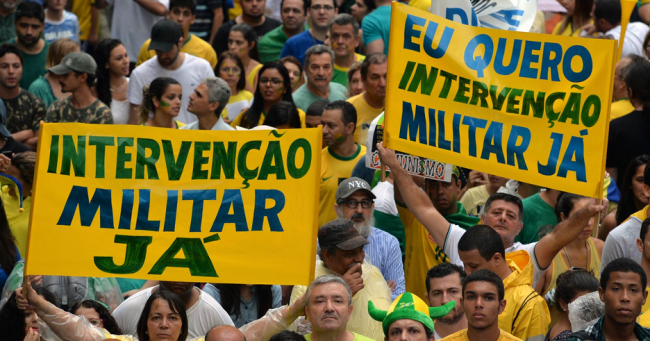
Protesters in São Paulo Plead for a Military Coup, March 15, 2015 (Source: Nelson Almeida / AFP)
In response to the pleas for military intervention, a spokesman for Revoltados ON LINE, a grassroots group that helped organize the protests and has 750,000 Facebook likes, commented, “The people asking for [military] intervention want to remove the PT from power. That is the sole focus. The participation of a variety of groups strengthens the group as a whole.” Though a military coup still looks unlikely, it is widely known that many in the military are incensed with the Rousseff administration over the final report of the National Truth Commission, which blasted the armed forces for torture and disappearances during its rule.
If those waxing nostalgic for dictatorships of yore were in the minority, what of the rest of the protesters? Despite attempts to highlight the supposed multi-class composition of the crowds on March 15, they represented, above all, Brazil’s white, university-educated economic elite. As Gianpaolo Baiocchi and Marcelo K. Silva recently pointed out, in Porto Alegre, nearly 70% of protesters were college-educated, in contrast with 11% of the general population, while over 40% belonged to the top income brackets, which make up but 3% of the population. Photographs confirm this; in a country with a high correlation between skin color and economic class, where over half of the population identifies as black or brown, the crowds had a decidedly lighter hue. A viral Tumblr account poked fun at the similarities with the upper-class, yellow-and-green-clad crowds that attended pricey World Cup matches last year by challenging visitors to determine if the photographs posted came from a March 15 demonstration or the World Cup.
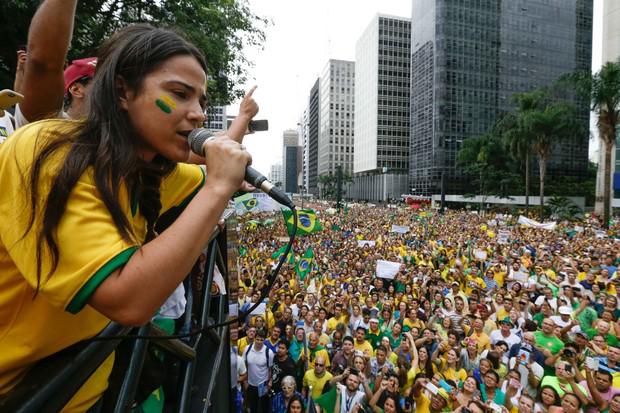
Singer Wanessa Camargo performs the National Anthem for a largely white crowd in São Paulo, March 15, 2015 (Source: Vanessa Carvalho / BPP / AGNEWS)
Of course, the fact that the demonstrations largely consisted of white middle- and upper-class Brazilians does not automatically mean that they were anti-democratic. At the same time, it would be a grave mistake to interpret the class composition of the crowds outside the context of Brazil’s historic inequalities of class, race, and region. What does it mean if the majority of demonstrators demanding the ouster of a moderately redistributive center-left party come from the social classes and regions that have least benefited from its policies? What problems do they see with corruption, the PT, or Rousseff that are insufficient to motivate the working classes or people from the impoverished Northeast of the country to take to the streets?
Since the colonial period, political and economic power has been wielded by a tiny European-descended elite, and since the collapse of the Northeastern plantation sugar economy in the nineteenth century, economic power has been concentrated in the Southeast and South, especially in the coffee and industrial powerhouse of São Paulo—today the epicenter of the opposition. An influx of European immigration in the late nineteenth and early twentieth centuries only heightened the disdain light-skinned, prosperous Southeasterners felt for their mixed-race Northeastern and Northern countrymen and women, and after the 1950s, that prejudice was turned against Northeastern migrants who came to work in the region’s expanding industries. Brazil’s middle class of government bureaucrats, small business owners, and professionals, tied to the landowning and industrial elite by socialization and patronage, has in turn largely identified with elite interests. Whenever Brazilian leaders, be they the populist dictator and later elected president Getúlio Vargas (1930-1945, 1950-1954), or the left-leaning would-be reformer João Goulart (1961-1964), have proposed reforms that would decrease inequality and broaden political representation, they have been ousted by an indignant elite and middle class – at precisely the moments when the minimum wage was growing the fastest.
The leveling results of the last 12 years are striking, if still far short of what Brazil needs to comprehensively address income inequality. In January 2003, the Inter-union Department of Socioeconomic Statistics and Studies (DIEESE) calculated that in order to provide a living wage, the minimum wage should be 6.93 times what it actually was; by February 2015, the ratio had fallen to 4.03. The unemployment rate when Lula took office was 11.2%; today, it is 5.9% (though it has risen from 4.4% in November 2014). At the same time, the gains were not evenly spread out; between 2001 and 2013, the income of the poorest 10% of the population grew at nearly three times the rate of that of the richest 10%. The result was a Gini coefficient that, while still among the highest in the world at 0.527 in 2012, reached its lowest level since 1960. In sum, then, though economic growth between 2003 and 2014 benefited the whole population, it benefited the poor and working class the most, largely as a result of real increases in the minimum wage. As economist Luiz Carlos Bresser Pereira, a cabinet minister under Cardoso, put it, “This hatred [against the PT] is a result of the fact that the government revealed a strong and clear preference for workers and the poor.”
The persistence of prejudice against the poor and Northeasterners manifested itself most clearly on social media in the wake of the 2014 elections—when the Northeast voted overwhelmingly for Rousseff. “These Northeastern sons of bitches need to die in a drought; good-for-nothings, sucking on the government’s teat, ignorant sons of bitches,” read one tweet. “Northeasterners don’t have a brain, they have no culture; it’s the slum of Brazil,” read another. Even former president Cardoso, a one-time leftist sociologist and champion of the struggle against the military dictatorship, grumbled, “The PT relies on the least informed, who happen to be the poorest.” Much like in the United States, in the wake of government efforts to reduce inequality, the wealthy and middle class have reacted with racially inflected charges of laziness, dependency, and ignorance. And so far it has largely been the same social groups who voted for Neves and blasted Northeasterners who have been participating in the demonstrations against Rousseff.
If the March 15 demonstrations expressed the concerns of the middle class and elite, what are the implications for Rousseff’s government? First, despite Rousseff’s dismal approval ratings, the PT’s base of support in the working class and poor is not ready to abandon it. The PT has retained their support through policies like the wildly popular conditional cash transfer program Bolsa Família, the expansion of the federal university system, and race and class-based quotas in college admissions that have yielded tangible improvements in their daily lives. Unless the economy deteriorates to the point where the working class and poor join the demonstrations – and even Brazil’s small leftist press admits that this is not impossible – it’s hard to imagine the protests gaining further traction. Second, despite the common class interests of the demonstrators, a message decrying working class gains is not politically feasible. In the absence of this message, which in fact is the real motivator of the protests, the demonstrators are left in the tenuous position of calling for the ouster of the PT through a legally invalid impeachment, with no agreement at all about, or what should, happen afterwards.
The same groups that organized the March 15 demonstrations are planning another round for April 12. Will they attract working class support? What developments in the Petrobrás scandal might affect their success? Will calls for military intervention become more prominent or fade into the background? One thing remains certain: In the absence of a mass working-class defection from the PT, proof of crimes justifying impeachment, or military interest in a coup, the prospects for a change in government are remote. Yet this is unlikely to dampen the hopes of wealthy and highly educated protesters, who will continue to use corruption as an excuse to protest against the socioeconomic ascension of those they see as their inferiors. As sociologist Jesse de Souza pointedly explains, “What distinguishes Brazil from the United States, Germany, and France, who we admire so much,” isn’t the level of corruption, “but the fact that we accept maintaining a third of the population in subhuman conditions.” The PT governments of the last 12 years made progress toward improving those conditions, but in the process they threatened the Brazilian elite’s deeply ingrained sense of superiority. Whether conscious or not, class and regional prejudice—not corruption—is the driving force behind the demonstrations.
Bryan Pitts is visiting assistant professor of History at Duke University and a Fulbright Scholars postdoctoral fellow at the Instituto de Ciência Política of the Universidade de Brasília (UnB).
Monsanto agrochemicals causing genetic damage in soybean workers – study
RT | January 22, 2015
Soybean workers exposed to the agrochemicals like glyphosate, the main component in Monsanto’s ‘Roundup’ herbicide and other biocides, suffer from elevated DNA and cell damage, according to a new study.
The study, published in the journal Mutation Research/Genetic Toxicology and Environmental Mutagenesis, involved 127 people, including 81 exposed to biocides while working in the Brazilian soybean industry and 46 non-exposed individuals in a control group.
The exposed group exhibited an elevated level of cellular apoptosis, as well as DNA damage, according to researcher Danieli Benedetti and his team, which concluded that the now-common use of genetically-modified soybeans in the State of Rio Grande do Sul, especially in the city of Espumoso, has toxic ramifications for workers.
“Our findings indicate the advisability of monitoring genetic toxicity in soybean farm workers exposed to pesticides,” the researchers said.
Genetically-engineered seeds, proliferated across the globe by multinational agribusiness conglomerates like Monsanto, are designed to withstand dousing by glyphosate and other biocides in order to terminate insect, fungus, and weed nuisances.
Benedetti’s team focused specifically on Glyphosate and 2,4-D, the two top biocide components in American-biotechnology farming culture. Glyphosate is the prime ingredient in Monsanto’s Roundup products, while Dow Chemical’s 2,4-D is a potent herbicide that was also used in making Agent Orange, the chemical used by the US to devastate resistance during the Vietnam War.
Last spring, Brazil’s public prosecutor sought to suspend use of glyphosate based on its toxic effects. Studies have linked glyphosate to a fatal kidney disease that has affected poor farming regions worldwide.
Just last week, Monsanto won final approval from the US for its new genetically-modified soybeans and cotton, designed to withstand a dominant biocide that fights weed resistance built up as a result of the company’s glyphosate-based Roundup herbicide already in use.
Monsanto reported an earnings drop of 34 percent in its first fiscal quarter. The company reportedly lost $156 million in the fourth quarter of last year due to a one-time payment made to settle an environmental legal case.
As multinationals such as Monsanto and Dow Chemical have sought strict standardization in agriculture markets the world over, the corporate leviathans, especially the former, have become the target of considerable protests and demonstrations.
Companies like Monsanto market their own patented seeds that, given their genetic modification, can be doused with biocides to kill pests and weeds, and which can jeopardize long-term health of the soil and the necessary biodiversity of a local environment that allows for natural pollination and, thus, food security.
In May of last year, activists on five continents around the globe, comprising of 52 nations organized resistance under the ‘March against Monsanto’ umbrella. Protests positioned against Monsanto and involving other corporate-food issues occurred in around 400 cities worldwide, according to reports.
Just this past weekend, more than 120 organizations joined the fifth annual ‘We are Fed Up!’ demonstration in Berlin to focus on the increased importation of American farming practices – such as genetic modification, frequent antibiotic injections for animals, and chemical meat treatments – following the implementation of the controversial Transatlantic Trade and Investment Partnership (TTIP).
Protests have raged most furiously in Europe, where the EU recently approved a law that would let its nations ban genetically-modified organisms even if the EU had deemed them safe. Monsanto said last year it would not try to get any more GM crops approved in Europe given the consistent pushback.
Anger and unrest against Monsanto’s stranglehold has also spread to South America. In Argentina, protests have occurred in resistance to the company’s potent biocides used in tandem with their genetically-engineered seeds. In Brazil, farmers have called on Monsanto and other producers of pest-resistant corn seeds to reimburse them for money spent on additional biocides when the bugs killed the crops instead of dying themselves, speaking to the biocide arms race involved in using GM seeds. Brazilian soy exporters are also tangling with Monsanto over seed royalties.
In Central America, Guatemala’s highest court suspended in September a controversial ‘Monsanto Law,’ a provision of a US-Central American trade agreement, that would insulate transnational seed corporations considered to have “discovered” new plant varieties.
On its home turf in the United States, Monsanto has worked diligently with other multinational biotech, agribusiness, and food production companies to beat down state-level proposals to simply label whether food is comprised of GM ingredients.
The most recent example came in the state of Oregon, where a November ballot initiative to require GMO labeling was narrowly defeated in what became the most expensive ballot measure in the state’s history. The likes of Monsanto and Dupont flushed more than $21 million into the anti-labeling campaign, dwarfing the $9 million raised by proponents.
The company has sued Hawaii’s Maui County for passing last year that bans the cultivation of genetically modified organisms.
Monsanto’s St. Louis headquarters have been the target of mild protests, especially during shareholder meetings.
Meanwhile, agribusiness allies on Capitol Hill are pushing new federal legislation, the Safe and Accurate Food Labeling Act, that would standardize food labeling, effectively killing popular state-based efforts to pass labeling laws.
READ MORE:
Monsanto gets approval for new GMO corn, soybeans designed for potent new biocide
Rising suicide rate for Indian farmers blamed on GMO seeds
In facts & numbers: Absolute majority of Americans want GMO food to be labeled
Featured Video
Israelis SUDDENLY Mass Deported From Many Countries
or go to
Aletho News Archives – Video-Images
From the Archives
Elite Western universities are a corrupt, parasitic empire
Instead of high-quality education, these institutions are fostering a global neo-feudal system reminiscent of the British Raj
By Dr. Mathew Maavak | RT | May 30, 2025
In a move that has ignited a global uproar, US President Donald Trump banned international students from Harvard University, citing “national security” and ideological infiltration. The decision, which has been widely condemned by academics and foreign governments alike, apparently threatens to undermine America’s “intellectual leadership and soft power.” At stake is not just Harvard’s global appeal, but the very premise of open academic exchange that has long defined elite higher education in the US.
But exactly how ‘open’ is Harvard’s admissions process? Every year, highly qualified students – many with top-tier SAT or GMAT test scores – are rejected, often with little explanation. Critics argue that behind the prestigious Ivy League brand lies an opaque system shaped by legacy preferences, DEI imperatives, geopolitical interests, and outright bribes. George Soros, for instance, once pledged $1 billion to open up elite university admissions to drones who would read from his Open Society script.
China’s swift condemnation of Trump’s policy added a layer of geopolitical irony to the debate. Why would Beijing feign concern for “America’s international standing” amid a bitter trade war? The international standing of US universities has long been tarnished by a woke psychosis which spread like cancer to all branches of the government.
So, what was behind China’s latest gripe? ... continue
Blog Roll
Recent Comments
seversonebcfb985d9 on Villains of Judea: Philip Esfo… loongtip on Report warns that ‘Jewish terr… Craig Nelms on New study shows that toxic gas… loongtip on A Funny Thing Happened on the… loongtip on EU free trade pact on hold as… John Edward Kendrick on Regime Change In Iran Is The F… Bill Francis on Australia Passes New Hate Spee… seversonebcfb985d9 on Australia Passes New Hate Spee… Bill Francis on Britain’s AI Policing Plan Tur… loongtip on Miami Beach Resident Questione… loongtip on Israeli agricultural export co… loongtip on The War On Free Speech In Aust…


 Aletho News
- Why is the US using Jordan as the main base in possible Iran attack?
- American Academy of Pediatrics Hit With Federal RICO Lawsuit for Vaccine Safety Fraud
- Mom Tells Trump: Dumping Sewage Sludge on Farmland Won’t Make America Healthy Again
- NIAID Funds Gain-of-Function Study Engineering Novel Influenza Viruses
- Villains of Judea: Philip Esformes and the Largest Healthcare Fraud in American History
- US sanctions Popular Conference for Palestinians Abroad over alleged Hamas links
- You reap what you sow: Ukraine’s blackout is Zelensky’s failure
- Ukraine Blackouts Caused by Zelensky’s Terrorist Attacks on Russia
- Orban Hits Out at EU Green Light for $1.5 Trillion Ukraine Aid
- World has had enough of confused clowns: Araghchi to Zelensky
- If Americans Knew
- Oppose Israel’s Abuses While You Still Can
- UNRWA Heads Tell Ha’aretz: ‘We Don’t Radicalize Palestinians – Their Lived Existence Does’
- Plans Call for “New Rafah” Built in Israel’s Image — Without Palestinians
- Posing as priest, reporter is spat at many times, highlighting anti-Christian sentiment in Israel
- Leaked Documents: “Planned Community” in Rafah Would Force Palestinians Into Israeli Panopticon
- ‘Permits of Humiliation’: How Israel Strangles Christian Education in Jerusalem
- “The world sees death, destruction and injustice – and they see dollar signs” – Not a ceasefire Day 105
- War criminal Netanyahu kills 11 in Gaza, joins Board of Peace – Not a ceasefire Day 104
- Another baby dies of cold in Gaza, as Rafah crossing remains locked down – Not a ceasefire Day 103
- Brutal Beatings, Arson, and Impunity: A Palestinian Plant Nursery Becomes a Target for Settler Pogroms
- No Tricks Zone
- New Study: Sea Levels Rose 20 Times The Modern Rate During The Roman Warm Period
- As German Gas Storage Dips Dangerously Low…Shortage Hardly Avoidable
- New Study: Brazil’s Relative Sea Level Was 2+ Meters Higher And SSTs 3-4°C Warmer 6000 Years Ago
- Philosopher Schopenhauer: Climate Science Certainty Stems From Stupidity, Ignorance
- New Study: Species Extinction Rates Declining Since 1980 – ‘Climate Change Is Not An Important Threat’
- Denmark Places Climate Protection Above Animal Welfare, Poisoning And Culling Cows
- New Study: Greenland Was 3-7°C Warmer And Far Less Glaciated Than Today 6000-8000 Years Ago
- German Media Report That Current Frigid Weather Can Be Explained By Arctic Warming!
- Berlin Blackout Shows Germany’s $5 Trillion Green Scheme Is “Left-Green Ideological Pipe Dream”
- Modeling Error In Estimating How Clouds Affect Climate Is 8700% Larger Than Alleged CO2 Forcing
 Aletho News