Rousseff slams US failure to apologise over spying
BRICS POST | November 7, 2013
Brazilian President Dilma Rousseff said Wednesday that Washington’s refusal to tender an apology for the spying led to her cancelling her crucial state visit to the United States.
“I was going to travel. We said there was only one way to solve the problem, and it was an apology for what happened and a promise that it would not happen again,” she said in a local radio interview.
The trip was initially scheduled to begin on October 23.
The lack of apology from Washington created an impasse, she said, adding that she did not want to run the risk of having a new spying scandal break during her visit, which would be an embarrassment for both sides.
Rousseff also reiterated her charges against the US, saying the NSA surveillance program is economic espionage borne out of commercial and strategic interests.
She said reports of the NSA intercepting communication of state-oil giant Petrobras have belied US claims of the PRISM program being directed to thwart terrorism.
In Wednesday’s interview, Rousseff also responded to a recent story in the Brazilian daily Folha de Sao Paulo, accusing Brazil’s intelligence agency of spying on diplomats from Russia, Iran and Iraq in 2003 and 2004.
She said the agency’s operations did not involve privacy violations as no phone calls or emails were tapped.
Rousseff had attacked the United States in her opening speech at the United Nations General Assembly (UNGA) in September.
“Brazil, Mr President, knows how to protect itself. We reject, fight and do not harbour terrorist groups,” she said.
“As many other Latin Americans, I fought against authoritarianism and censorship and I cannot but defend, in an uncompromising fashion, the right to privacy of individuals and the sovereignty of my country,” she added.
Earlier on Tuesday Brazil made public a draft bill that will allow the government to prevent internet companies like Google and Facebook from storing data about Brazilian citizens outside the country.
Simultaneous revelations regarding the UK embassy housing a secret listening post in Berlin made Germany summon the British Ambassador to respond to the allegations.
With inputs from Agencies
Related article
Brazil, Germany submit anti-spy resolution to UN
Press TV – November 1, 2013

An anti-spying draft resolution written by Germany and Brazil has been submitted to the United Nations amid the US surveillance scandal.
The draft resolution put forward on Friday would reaffirm “the right to privacy and not to be subjected to arbitrary or unlawful interference with privacy, family, home or correspondence.”
The right is already protected in the Universal Declaration of Human Rights and the International Covenant on Civil and Political Rights.
Furthermore, the draft resolution would also reaffirm the “same rights that people have offline must also be protected online, in particular the right to privacy, including in the context of the surveillance of communications.”
The draft was to be processed by the UN secretariat before being handed over to the UN General Assembly’s human rights panel for discussions.
This comes as German Chancellor Angela Merkel and Brazilian President Dilma Rousseff have both condemned the widespread spying by the US National Security Agency (NSA).
Merkel has demanded the United States enter a “no-spying” agreement with Germany and France by the end of 2013 amid recent revelations that the NSA spied on the two countries.
The Chancellor has also stressed that alleged espionage against Berlin and Paris, which are considered among closest allies of the US, should be stopped.
On October 26, a report published by German weekly Der Spiegel revealed that Merkel’s mobile phone had been listed by the NSA Special Collection Service (SCS) since 2002, and that her mobile phone number was still listed in June 2013.
Last month, Rousseff spoke at the United Nations General Assembly, calling for international regulations on data privacy and limiting espionage programs targeting the Internet.
Rousseff’s appeal came after reports were published in September by Brazil’s Globo television network, which revealed that the NSA spied on the president’s emails, phone calls, and text messages.
Snowden, a former CIA employee, leaked two top secret US government spying programs under which the NSA and the Federal Bureau of Investigation (FBI) are eavesdropping on millions of American and European phone records and the Internet data from major Internet companies such as Facebook, Yahoo, Google, Apple, and Microsoft.
The NSA scandal took even broader dimensions when Snowden revealed information about its espionage activities targeting friendly countries.
Related articles
NSA stores data to target any citizen at any time – Greenwald
RT | October 29, 2013
The current revelations on the NSA’s spying are just the tip of the iceberg and affect “almost every country in the world,” said Glenn Greenwald. He stressed the NSA stores data for “as long as it can,” so they can target a citizen whenever they want.
Glenn Greenwald, the man behind the reports on the NSA global spy program, spoke to El Mundo journalist German Aranda and stressed that the US espionage activities went much further than just Europe.
“There are a lot of countries, and journalists in a lot of different countries, who have been asking for stories and to work on documents for a long time,” Greenwald said. He added that he was working as fast as possible to “make sure that all of these documents get reported in every single country there are documents for, which is most countries in the world.”
Shedding light on the NSA’s motives in compiling metadata on citizens, he said the spy organization’s main aim was to store the information to be able to dip into it whenever necessary.
“The very clear objective of the NSA is not just to collect all this, but to keep it for as long as they can,” said Greenwald.
“So they can at any time target a particular citizen of Spain or anywhere else and learn what they’ve been doing, in terms of who they have been communicating with.”
‘Preparing the terrain’
Referencing reports leaked from former CIA worker Edward Snowden regarding the millions of phone calls tapped by the NSA in the EU, German Aranda stated that French reaction was “important to prepare the terrain in Spain.”
“With all the countries around Europe and around the world, it will be the same. The more countries [that] see documents about them, the more interest the other countries will have to see what is happening with them,” said Aranda.
Last week the Spanish Prime Minister, Manuel Rajoy, summoned the US Ambassador to account for the reports of spying, echoing the reactions of France, Germany and a handful of other countries. Spain has so far resisted calls from Germany to sign an EU no-spying treaty against the US in the wake of the revelations; however this may be set to change.
“As in previous occasions, we’ve asked the U.S. ambassador to give the government all the necessary information on an issue which, if it was to be confirmed, could break the climate of trust that has traditionally been the one between our two countries,” said Spanish Foreign Minister Jose Manuel Garcia-Margallo, at a joint news conference in Warsaw last week.
In response to European leaders’ furor over NSA espionage, the White House has launched an internal review into the NSA’s activities. The EU Parliament has also threatened to halt the sharing of data on the SWIFT banking system, which provides information on the transfer of funds by suspected terrorists.
A delegation from the EU parliament is currently in Washington to discuss what has been described as a “breakdown in trust” between traditional allies.
The Obama administration earlier said the controversial intelligence gathering procedures that have attracted international scrutiny in recent months may require “additional constraints.” White House spokesperson Jay Carney said that a “number of efforts [are] underway that are designed to increase transparency.”
Brazil to press for local Internet data storage after NSA spying
RT | October 29, 2013
Brazil is urging a plan to introduce local data storage for Internet giants like Facebook and Google in order to keep the information they get from Brazilian users safe –as part of a complex of measures to oppose US spying.
The new law could impact Google, Facebook, Twitter and other Internet global companies that operate in Brazil, Latin America’s biggest country and one of the world’s largest telecommunications markets.
The country’s president, Dilma Rousseff, is urging lawmakers to vote as early as this week on the law, according to Reuters who have seen the draft of the legislation.
“The government can oblige Internet service companies … to install and use centers for the storage, management and dissemination of data within the national territory,” the draft of the document read.
Rousseff’s calls come after surveillance leaks by the US in Brazil that went as far as tracking the personal phone calls and e-mails of the President herself.
Last month, Brazilian President Dilma Rousseff canceled a scheduled meeting at the White House after leaked documents showed the NSA spied on her country’s state oil company.
“We are not regulating the way information flows, just requiring that data on Brazilians be stored in Brazil so it is subject to the jurisdiction of Brazilian courts,” Rousseff spokesman Thomas Traumann said. “This has nothing to do with global communications.”
However, the companies disagree saying that the legislation will increase costs of services, and damage the economic activity connected with information.
Last week a coalition of business groups representing dozens of Internet companies including Facebook, Google, Microsoft and eBay sent a letter to Brazilian lawmakers.
“In-country data storage requirements would detrimentally impact all economic activity that depends on data flows,” the letter read, Reuters reported.
Many also threatened the law will scare the companies, while others, nevertheless, were of the opinion that the companies would comply if faced with no other options.
This week, Brazil is expected to vote on a cyber-security bill to create a state system to protect the country’s citizens from spying.
When the news on the bill emerged two weeks ago, Brazilian President Dilma Rousseff tweeted the news, stressing the need for greater security “to prevent possible espionage.”
The latest legislation project comes against a backdrop of Brazil set to host a conference next April to debate ways to guard Internet privacy from espionage.
The meeting is to be held by ICAAN, the body that manages web domain names. It is thought to be neutral and includes governments, civil society and industry.
Meanwhile, BRICS companies are working to create a “new Internet”.
In particular, Brazil has been reported to be building a “BRICS cable” that will create an independent link between Brazil, South Africa, India, China and Russia, in order to bypass NSA cables and avoid spying.
The cable is set to go from the Brazilian town of Fortaleza to the Russian town of Vladivostok via Cape Town, Chennai and Shantou.
The length of the fiber-optic cable will be almost 35,000 kilometers, making it one of the most ambitious underwater telecom projects ever attempted.
Last week, most of the BRICS countries joined talks to hammer out a UN resolution that would condemn “indiscriminate” and “extra-territorial” surveillance, and ensure “independent oversight” of electronic monitoring.
Russian Foreign Minister Sergey Lavrov said that “contacts [between Moscow and Washington] never stop,” when asked if the latest publication of secret files leaked by the former National Security Agency (NSA) contractor would affect relations between Russia and the US.
Also, Lavrov made it clear that the situation surrounding Snowden is irrelevant to Russia.
“We have formulated our position on Snowden and have said everything,” he said.
Related article
- China echoes Brazil’s call for cyberspace guidelines (thebricspost.com)
Brazilian lawmakers press Greenwald for greater detail on Snowden’s NSA leaks
RT | October 10, 2013
Brazilian lawmakers indicated that, in lieu of direct teleconferences with Edward Snowden to gain further insight into allegations of NSA spying in their country, they may seek to seize documents now held by American journalist Glenn Greenwald.
On Wednesday Greenwald spoke to Brazilian senators currently investigating evidence of US as well as British and Canadian espionage in the Latin American country.
The legislators are part of a probe into potential foreign surveillance — the Comissão Parlamentar de Inquérito, or CPI — called into action by President Dilma Rousseff in the wake of initial news reports alleging that even the president’s online communication had been intercepted.
Greenwald, who appeared along with his partner David Miranda, a Brazilian national, broached several topics during the hearing, including the possibility of granting asylum to NSA contractor turned whistleblower Edward Snowden.
So far, Brazil has been vague as to whether it would seriously consider extending Snowden, who is currently residing in Russia, an offer of political asylum.
“There are many nations saying, ‘We’re glad to be learning all this information,’ but almost nobody wants to protect the person responsible for letting the world discover it,” Greenwald told the panel.
In the meantime, Brazilian legislators seem eager to find out the extent of foreign surveillance on the country in greater detail.
To that end, the country’s government — specifically, the CPI inquiry — is now seeking to establish teleconferencing sessions with Snowden.
Asked by the commission to turn over documents obtained through the whistleblower Greenwald refused, citing the need for a separation between journalism and government. His partner, Miranda, also cited that divulging the documents would constitute an “act of treason” and prevent Greenwald from entering the US again.
One Brazilian Senator, Ricardo Ferraço, went so far as to suggest that the government commission seek the authority of the country’s courts to seize documents now held by Greenwald if such communication with Snowden proved unfeasible.
Unlike allegations of NSA surveillance in the US, coverage of the agency’s activities in Brazil have taken on a broader scope, and in particular centered on the country’s economy.
Greenwald himself has shaped the narrative of Snowden’s disclosures through his testimony to Brazil’s government, as well as his work with the O Globo newspaper and Rede Globo’s news television.
In August, the journalist told Brazil’s government that alleged American espionage in Brazil was centered on gaining economic advantages rather than on any national security concerns.
“We now have several denunciations that show that the spy program is not about terrorism. It is about increasing the power of the American government,” Greenwald told senators on Wednesday, speaking in Portuguese.
In the most recent report last Sunday, Greenwald said on Globo network television that Canadian spies had targeted Brazil’s Mines and Energy Ministry, intercepting the metadata of phone calls and emails passing through the ministry.
The impact of the steady stream of surveillance allegations on Brazil has been swift. Last month Petrobras announced that it would be investing $9.5 billion over the next five years to heighten its data security.
Meanwhile, Communications Minister Paulo Bernardo announced that the country’s government was pursuing legislation requiring domestic data exchanges to use locally made equipment.
Related articles
- Brazilian president postpones visit to Washington over US spying (alethonews.wordpress.com)
- Canadian spy agency ‘dissected’ Brazilian Energy Ministry (alethonews.wordpress.com)
Canadian spy agency ‘dissected’ Brazilian Energy Ministry
RT | October 7, 2013
Canada, as well as the US, infiltrated and spied on the Brazilian Energy Ministry, a new leak by Edward Snowden has revealed. The leaked documents show how the data gleaned through espionage was shared with international spy network the ‘Five Eyes.’
Newly-released documents handed over to Guardian journalist Glenn Greenwald by former CIA employee Edward Snowden describe in detail how Canadian intelligence infiltrated Brazil’s Energy and Mines Ministry.
“I was overwhelmed by the power of the tools used. The Ministry of Energy and Mines was totally dissected,” security expert Paulo Pagliusi told Brazilian program Fantastico, which first reported on the leak.
The program showed documents from a meeting of the ‘Five Eyes’ spy network, comprising the US, UK, Canada, New Zealand and Australia, in June of last year. In a presentation the Communications Security Establishment Canada (CSRC) – the Canadian version of the NSA – outlined how they used a program called Olympia to break through the Brazilian ministry’s encryption.
The information gleaned from the ministry was then shared with all of the members of the ‘Five Eyes.’
“They [Five Eyes] are sharing all the information, handing over documents to let other countries know exactly what they are doing,” said Glen Greenwald.
As a result of the infiltration of the ministry over an unspecified period, the CSCE developed a detailed map of the institution’s communications. As well as monitoring email and electronic communications, the CSCE also eavesdropped on telephone conversations. Able to identify mobile numbers, SIM card registrations and the make of a phone, Olympia even snooped on former Brazilian ambassador to Canada Paulo Cordeiro.
Canada has so far refused to comment on the reports of its spy program. Brazil’s Minister of Mines and Energy Edison Lobao told Fantastico that the reports were “serious” and should be condemned.
Canada is one of the world’s leading energy producers and has significant economic interests in Brazil.
“Canada has interests in Brazil, especially in the mining sector. Does this spying serve the commercial interests of select groups? I cannot say,” observed Lobao.
‘No economic espionage’
Previously, Brazilian newspaper Globo News reported that the NSA was monitoring Brazil’s state oil giant Petrobras. Washington reacted to the allegations, stating that the US “does not engage in economic espionage.” The Obama administration has said on a number of occasions that US covert surveillance is in the interests of protecting US national security.
Brazil’s President Dilma Rousseff has condemned the reports of the NSA’s surveillance of Brazil and demanded the US account for its actions.
As a consequence, the Brazilian head of state postponed an official visit to Washington in October. Rousseff has also taken measures to tighten Brazilian internet security.
“I have sent an internet draft bill to Congress, an initiative that will protect the privacy of Brazilians,” Rousseff wrote on Twitter on Sunday. The government is expected to vote on the bill in the coming weeks.
Back in September, Rousseff slammed the US for “economic espionage,” dismissing US claims the NSA spying is a preventative measure to ensure national security. Addressing the UN General Assembly, President Rousseff stated that state-run Petrobras is “no threat to the security of any country. Rather, it represents one of the greatest assets of the world’s oil and the heritage of the Brazilian people.”
Related article
Brazil’s Rousseff to UN: US surveillance an ‘affront’
RT | September 24, 2013
Brazilian President Dilma Rousseff lambasted US spying on her country at Tuesday’s UN summit, calling it a “breach of international law.” She further warned that the NSA surveillance, revealed since June, threatened freedom of speech and democracy.
“Meddling in such a manner in the lives and affairs of other countries is a breach of international law and as such it is an affront to the principles that should otherwise govern relations among countries, especially among friendly nations,” Rousseff said.
“Without the right to privacy, there is no real freedom of speech or freedom of opinion,” Rousseff told the gathering of world leaders. “And therefore, there is no actual democracy,” she added, criticizing the fact that Brazil had been targeted by the US.
“A country’s sovereignty can never affirm itself to the detriment of another country’s sovereignty,” she added.
Rousseff went on to propose a multilateral, international governance framework to monitor US surveillance activity. “We must establish multilateral mechanisms for the world wide web,” she said.
Rousseff said that the US’s arguments for spying on Brazil and other UN member states were “untenable”, adding that “Brazil knows how to protect itself” and that the country has been “living in peace with our neighbors for more than 140 years.”
Brazil’s specific targeting in US surveillance practices prompted Rousseff’s government to announce that it intends to adopt both legislation and technology aimed at protecting itself and its businesses from the illegal interception of communications.
A week ago, Rousseff canceled an impending state visit to Washington, scheduled to take place in October, because of indignation over spying revelations. Rousseff has stated she wants an apology from Obama and the United States.
The revelations that the US National Security Agency has been intercepting Rouseff’s own phone calls and e-mails, in addition to those of her aides and officials at state-controlled oil and gas firm Petrobras, have prompted an outcry in Brazil.
Rousseff’s predecessor as Brazilian President, Lula da Silva, said earlier this month that Obama should “personally apologize to the world.” Lula accused the US of “thinking that it can control global communications and ignore the sovereignty of other countries” in an interview with India’s English-language daily The Hindu, published Sept. 10.
Latin America voices widespread indignation at US activities
US relations with all of Latin America have recently soured. In addition to Brazil, Mexico, Bolivia and Venezuela have all voiced anger with the US over the NSA’s surveillance of their countries this year. Bolivia has been especially bitter.
“I would like to announce that we are preparing a lawsuit against Barack Obama to condemn him for crimes against humanity,” President Morales told reporters Friday in the Bolivian city of Santa Cruz. He branded the US president as a “criminal” who had violated international law.
In early July, a plane carrying Morales from Moscow to the Bolivian capital, La Paz, was grounded for 13 hours in Austria after it was banned from European airspace because of US suspicions it was carrying fugitive Edward Snowden, the former NSA contractor who has been responsible for the majority of leaks regarding NSA spying practices since June.
Venezuela wrote to UN Secretary-General Ban Ki-moon at the end of last week, requesting that he take action in response to the apparent denial of US visas to some members of the Venezuelan delegation who were scheduled to attend the UN General Assembly in New York.
President Nicolas Maduro said that the denial seemed intended to “create logistical obstacles to impede” the visit, and further requested that the UN “demand that the government of the US abide by its international obligations” as host of the 68th UN General Assembly.
Tension between Venezuela and the US rose Thursday when Venezuela’s foreign minister, Elias Jaua, told media outlets that the US had denied a plane carrying Maduro entrance into its airspace. The aircraft was en route to China. Washington later granted the approval, stating that Venezuela’s request had not been properly submitted. Jaua denounced the move as “an act of aggression.”
Related article
Venezuela and Mercosur Discuss Mechanisms to Prevent US Government Spying
By Tamara Pearson | Venezuelanalysis | September 18, 2013
Merida – Yesterday the Venezuelan government proposed to the Common Market of the South (Mercosur) that it adopt mechanisms to prevent the United States from spying on its countries.
The proposal follows revelations by Brazilian press in July that the US National Security Agency (NSA) monitors internet traffic in Latin America, specially targeting Venezuela, Colombia, Mexico, and Brazil, and also had a network of 16 US spy bases to monitor emails and phone calls in Brazil, Mexico, Ecuador, Argentina, Venezuela, Colombia, Bolivia, Egypt, India, Iran, Turkey, China, Russia, and France.
Mercosur held its I Meeting of Authorities and Experts in Information Security and Telecommunications in Caracas yesterday in response to the spying. Delegations from Argentina, Brazil, Bolivia, and Uruguay were present, as well a team of experts from Venezuela.
Venezuela’s foreign minister Elias Jaua said that Mercosur would form a commission to formulate public policies to counter the US interference. He also said the commission will look at guaranteeing technological independence.
“Governments, companies, and citizens were violated by the United States spying,” Jaua said, arguing that therefore the meeting needed to discuss “the formulation of public policies and mechanisms that allow our heads of state and our governments to fulfil their mandates, which have been violated… because many of them have been victims of spying carried out by the United States government”.
Yesterday’s meeting also discussed creating a Centre of Security Management of Mercosur, promoting public domain software, protection of information as a human right, and creating international and regional norms and regulations for internet security.
The meeting was a follow-up from a decision made by Mercosur in its head of state summit on 12 of July to reject US spying.
Yesterday Jaua also publically expressed his support for Brazilian President Dilma Roussef’s decision to cancel her visit to the United States. She cancelled the 23 October meeting in rejection of US spying, specifically on her own conversations and on the state company Petrobras.
The US government argued in a statement yesterday that it wished to “move beyond the issue [of spying] as a source of tension in our bilateral relationship” and hoped to meet in the future on a “mutually agreed” date.
Previously the US has argued that its program of message interception was aimed at combating “terrorism”, but the Brazilian government alleged that the spying on Petrobras was done for “strategic interests”.
Related articles
Brazil to bypass US-centric internet amid spy revelations
Press TV – September 17, 2013
Brazil has announced plans to bypass the US-centric internet amid revelations that Washington conducts spy operations on web communications.
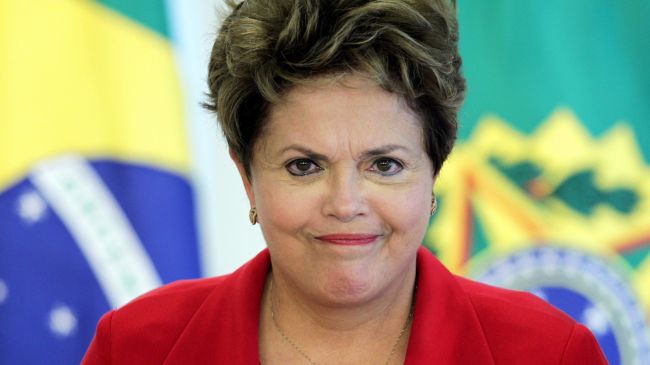 Brazilian President Dilma Rousseff announced the country’s measures to boost the Brazil’s independence and security on the World Wide Web, including storing data locally and bypassing internet traffic that goes through the United States.
Rousseff said plans are in the works to lay underwater fiber optic cable directly to Europe and all the South American nations in order to create a network free of US eavesdropping. This is while most of Brazil’s global internet traffic passes through the US.
The president also announced that she will push for new international rules of privacy and security in hardware and software during the UN General Assembly meeting later this month.
The country’s postal service also plans to create an encrypted e-mail service that would serve as an alternative to Gmail and Yahoo, two companies being monitored by the NSA.
Experts said the move may herald the first step toward a global network free from US monopoly and its illegal surveillance of global communications.
The development comes following the publication of documents leaked by whistleblower and former NSA contractor Edward Snowden in July, exposing US spying on Brazilian companies and individuals for a decade.
Snowden, a former CIA employee, leaked two top secret US government spying programs under which the NSA and the Federal Bureau of Investigation (FBI) are eavesdropping on millions of American and European phone records and the Internet data from major Internet companies such as Face book, Yahoo, Google, Apple, and Microsoft.
The NSA scandal took even broader dimensions when Snowden revealed information about its espionage activities targeting friendly countries.
Related articles
- Brazilian president postpones visit to Washington over US spying
- South America: UNASUR To Build Fibre-Optic ‘Mega Ring’
- Latin America Condemns US Espionage at United Nations Security Council
- Mercosur complains to Ban Ki-moon on US global espionage and EU affront towards Bolivia’s Evo Morales
- UK spying on Germany’s major data cable to US triggers media storm
Brazilian president postpones visit to Washington over US spying
RT | September 17, 2013
Brazilian President Dilma Rousseff has postponed a state visit to Washington in response to the US spying on her communications with top aides. Rousseff is demanding a full public apology from President Obama.
Barack Obama spoke with Rousseff on Monday in an attempt to persuade her into following through with the trip, the Brazilian president’s office said, according to AP.
Brazil’s TV Globo reported that the call between the two presidents lasted for about 20 minutes. Obama and Rousseff discussed revelations that the National Security Agency (NSA) spied on the Brazilian leader’s phone calls and emails. The two presidents then “jointly” agreed to cancel the meeting, Globo reported, citing the presidential office.
The Brazilian government said in a statement that “the conditions are not suitable to undertake this visit on the agreed date.” It expressed hope that the conflict will be resolved “properly” and the trip will happen “as soon as possible.”
The state visit was initially scheduled for October 23. The Obama administration has confirmed that the visit was canceled.
“The president has said that he understands and regrets the concerns disclosures of alleged US intelligence activities have generated in Brazil and made clear that he is committed to working together with President Rousseff and her government in diplomatic channels to move beyond this issue as a source of tension in our bilateral relationship,” said White House spokesman Jay Carney.
Earlier this month, TV Globo revealed in a report that the NSA monitored the content of phone calls, emails, and mobile phone messages belonging to President Rousseff and undefined “key advisers” of the Brazilian government. The NSA also spied on Mexican President Enrique Pena Nieto and nine members of his office.
The revelations were based on evidence provided by former CIA employee and NSA contractor Edward Snowden, which was passed to British journalist Glenn Greenwald.
A document dated June 2012 showed that the Mexican President’s emails were read through one month before he was elected. In his communications, the then-presidential candidate indicated who he would like to appoint to several government posts.
The Brazilian government denounced the NSA surveillance as “impermissible and unacceptable,” and a violation of Brazilian sovereignty.
In July, Greenwald co-wrote articles for O Globo, in which he claimed that some of the documents leaked by Snowden indicated that Brazil was the NSA’s largest target in Latin America.
Greenwald wrote that the NSA was collecting its data through an undefined association between US and Brazilian telecommunications companies, but he could not verify that Brazilian companies had been involved.
Following the revelations, the Brazilian government ordered an investigation into telecommunications companies to determine whether they illegally shared data with the NSA.
Defense ministers of Brazil and Argentina signed a broader military cooperation agreement on September 13. The two governments will work together to improve cyber defense capabilities following revelations of Washington’s spying on Latin American countries.
Brazil will be providing cyber warfare training to Argentine officers from 2014.
Related articles
No economic espionage? NSA docs show US spied on Brazil oil giant Petrobras
RT | September 9, 2013
Despite earlier US assurances that its Department of Defense does not “engage in economic espionage in any domain,” a new report suggests that the intelligence agency NSA spied on Brazilian state-run oil giant Petrobras.
Brazil’s biggest television network Globo TV reported that the information about the NSA spying on Petroleo Brasileiro SA came from Glenn Greenwald, the American journalist who first published secrets leaked by whistleblower Edward Snowden.
Globo TV aired slides from an NSA presentation from 2012 that revealed the agency’s ability to gain access to private networks of companies such as Petrobras and Google Inc.
One slide specified an ‘economic’ motive for spying, along with diplomatic and political reasons.
This seems to contradict a statement made by an NSA spokesman to the Washington Post on August 30, which said that the US Department of Defense “does not engage in economic espionage in any domain, including cyber.”
An official from the NSA told Globo that the agency gathers economic information not to steal secrets, but to watch for financial instability.
Petrobras is known to have discovered some of the world’s biggest offshore oil reserves in recent years.
Some of the new reserves are estimated to be around as 100 billion barrels of oil, according to Rio de Janeiro State University.
None of the leaked slides went into the reasons behind the NSA spying on the Brazilian firm.
The US spy agency then reportedly shared the gathered information with the UK, Canada, Australia and New Zealand.
The new report about US spying on Brazil could intensify the already existing tensions between Brazil and US.
The relationship between the two countries became tense as Globo reported about allegations that NSA has intercepted private communications of Brazil’s President Dilma Rousseff and her Mexican counterpart Enrique Pena Nieto.
Brazil responded by canceling preparations for the presidential visit to the United States and beginning a probe into telecommunications companies to see if they illegally shared data with the NSA. Also, Brazil has asked for a formal apology.
During the G20 summit US tried to address the issue by US President Barack Obama pledging to work with Brazil and Mexico to address their concerns over US spying revealed in recent NSA leaks.
Featured Video
NEW FAUCI EMAILS EXPOSE ATTACK ON NATURAL IMMUNITY
or go to
Aletho News Archives – Video-Images
From the Archives
Elite Western universities are a corrupt, parasitic empire
Instead of high-quality education, these institutions are fostering a global neo-feudal system reminiscent of the British Raj
By Dr. Mathew Maavak | RT | May 30, 2025
In a move that has ignited a global uproar, US President Donald Trump banned international students from Harvard University, citing “national security” and ideological infiltration. The decision, which has been widely condemned by academics and foreign governments alike, apparently threatens to undermine America’s “intellectual leadership and soft power.” At stake is not just Harvard’s global appeal, but the very premise of open academic exchange that has long defined elite higher education in the US.
But exactly how ‘open’ is Harvard’s admissions process? Every year, highly qualified students – many with top-tier SAT or GMAT test scores – are rejected, often with little explanation. Critics argue that behind the prestigious Ivy League brand lies an opaque system shaped by legacy preferences, DEI imperatives, geopolitical interests, and outright bribes. George Soros, for instance, once pledged $1 billion to open up elite university admissions to drones who would read from his Open Society script.
China’s swift condemnation of Trump’s policy added a layer of geopolitical irony to the debate. Why would Beijing feign concern for “America’s international standing” amid a bitter trade war? The international standing of US universities has long been tarnished by a woke psychosis which spread like cancer to all branches of the government.
So, what was behind China’s latest gripe? ... continue
Blog Roll
Recent Comments
seversonebcfb985d9 on Villains of Judea: Philip Esfo… loongtip on Report warns that ‘Jewish terr… Craig Nelms on New study shows that toxic gas… loongtip on A Funny Thing Happened on the… loongtip on EU free trade pact on hold as… John Edward Kendrick on Regime Change In Iran Is The F… Bill Francis on Australia Passes New Hate Spee… seversonebcfb985d9 on Australia Passes New Hate Spee… Bill Francis on Britain’s AI Policing Plan Tur… loongtip on Miami Beach Resident Questione… loongtip on Israeli agricultural export co… loongtip on The War On Free Speech In Aust…


 Aletho News
- NEW FAUCI EMAILS EXPOSE ATTACK ON NATURAL IMMUNITY
- Why is the US using Jordan as the main base in possible Iran attack?
- American Academy of Pediatrics Hit With Federal RICO Lawsuit for Vaccine Safety Fraud
- Mom Tells Trump: Dumping Sewage Sludge on Farmland Won’t Make America Healthy Again
- NIAID Funds Gain-of-Function Study Engineering Novel Influenza Viruses
- Villains of Judea: Philip Esformes and the Largest Healthcare Fraud in American History
- US sanctions Popular Conference for Palestinians Abroad over alleged Hamas links
- You reap what you sow: Ukraine’s blackout is Zelensky’s failure
- Ukraine Blackouts Caused by Zelensky’s Terrorist Attacks on Russia
- Orban Hits Out at EU Green Light for $1.5 Trillion Ukraine Aid
- If Americans Knew
- Oppose Israel’s Abuses While You Still Can
- UNRWA Heads Tell Ha’aretz: ‘We Don’t Radicalize Palestinians – Their Lived Existence Does’
- Plans Call for “New Rafah” Built in Israel’s Image — Without Palestinians
- Posing as priest, reporter is spat at many times, highlighting anti-Christian sentiment in Israel
- Leaked Documents: “Planned Community” in Rafah Would Force Palestinians Into Israeli Panopticon
- ‘Permits of Humiliation’: How Israel Strangles Christian Education in Jerusalem
- “The world sees death, destruction and injustice – and they see dollar signs” – Not a ceasefire Day 105
- War criminal Netanyahu kills 11 in Gaza, joins Board of Peace – Not a ceasefire Day 104
- Another baby dies of cold in Gaza, as Rafah crossing remains locked down – Not a ceasefire Day 103
- Brutal Beatings, Arson, and Impunity: A Palestinian Plant Nursery Becomes a Target for Settler Pogroms
- No Tricks Zone
- New Study: Sea Levels Rose 20 Times The Modern Rate During The Roman Warm Period
- As German Gas Storage Dips Dangerously Low…Shortage Hardly Avoidable
- New Study: Brazil’s Relative Sea Level Was 2+ Meters Higher And SSTs 3-4°C Warmer 6000 Years Ago
- Philosopher Schopenhauer: Climate Science Certainty Stems From Stupidity, Ignorance
- New Study: Species Extinction Rates Declining Since 1980 – ‘Climate Change Is Not An Important Threat’
- Denmark Places Climate Protection Above Animal Welfare, Poisoning And Culling Cows
- New Study: Greenland Was 3-7°C Warmer And Far Less Glaciated Than Today 6000-8000 Years Ago
- German Media Report That Current Frigid Weather Can Be Explained By Arctic Warming!
- Berlin Blackout Shows Germany’s $5 Trillion Green Scheme Is “Left-Green Ideological Pipe Dream”
- Modeling Error In Estimating How Clouds Affect Climate Is 8700% Larger Than Alleged CO2 Forcing
 Aletho News