Alternative for Germany Party Mulls Energy Cooperation With BRICS Countries – Lawmaker
Sputnik – 16.11.2025
SIRIUS, Russia – The right-wing Alternative for Germany (AfD) party is considering the possibility of cooperating with BRICS countries in the energy sector, lawmaker Steffen Kotre told Sputnik on Saturday.
“One of the reasons I am here is to meet with representatives of the BRICS nations. We discussed some positions on this issue [energy cooperation]. This is a positive process. Whether this will have any results is another matter. The main goal now is simply to get to know each other,” Kotre said on the sidelines of the BRICS-Europe symposium, which is underway in Russia’s Sirius Federal Territory.
The pressure on the AfD over its members’ trip to Russia is growing, but the party does not intend to abandon what it considers “a realistic political line,” the lawmaker noted.
“Quite the contrary, this pressure certainly strengthens our understanding that we will certainly achieve normal relations. And by this I mean a peaceful exchange of views with Russia,” he said.
Communication channels should be open in both directions, including to show Moscow that “there are sensible people in Germany and not only warmongers,” Kotre added.
How a low-key remark by Putin reveals a deeper economic shift
By Henry Johnston | RT | October 3, 2025
During his Valdai speech on Thursday, Russian President Vladimir Putin made the following rather dry statement:
“It’s impossible to imagine that a drop in Russian oil production will maintain normal conditions in the global energy sector and the global economy.”
It certainly wasn’t the highlight of the night, and I haven’t seen it in the headlines of any of the recaps. The statement is, of course, true. Putin is in a sense saying: “you can’t kick us out.”
But let’s unpack this a bit and try to get a bird’s eye view of what this mundane statement implies in a much deeper sense – not in the sense of counting barrels of oil and the Brent price, but in terms of understanding the shifting tectonic plates.
Let’s first imagine what a Western leader might have said in the same tone, circa January 2022.
“It’s impossible to imagine that a country that loses access to dollars and Western capital markets will maintain normal economic conditions.” I don’t know if anybody actually said such a thing in as many words, but that’s exactly what many were thinking.
Now, recall the G10 Rome meetings in late 1971, as the Bretton Woods-established gold peg of the dollar was being dismantled, when US Treasury Secretary John Connally famously told his European counterparts: “The dollar is our currency, but it’s your problem.” It is an oft-cited instance of American hubris.
In other words, despite its global use in trade and finance, the dollar would be managed for American economic interests.
When the collective West placed what were supposed to be crushing sanctions on Russia in 2022 in light of the Ukraine crisis, the idea was, again, “our currency (system), your problem.”
The message: the dollar will be managed for American geopolitical interests.
According to the conventional thinking, being cut off from the dollar system should have spelt doom for Russia. The many forecasters predicting exactly such a dire outcome weren’t necessarily simply Russophobes. They were working within a certain paradigm. Without access to its now frozen central-bank reserves, how would Russia stabilize the ruble? Without access to correspondent banking in dollars/euros, how would trade be settled? And without access to foreign capital markets, wouldn’t a funding crisis ensue? This type of thinking gave rise to these types of comments:
“We will provoke the collapse of the Russian economy,” in the words of French Finance Minister Bruno Le Maire about ten days into the war.
But the Russian economy didn’t collapse and in fact stabilized far faster than anyone expected. The thing is Russian oil and gas was still needed. And those who thought they didn’t need it (read the EU) found out the hard way that they did – even if the Europeans obscured the ramifications as much as possible through large fiscal support and subsidies. But it is no coincidence that ‘deindustrialization’ has become a household word in Europe. And somehow the political will to really clamp down hard on Russian energy never seems to materialize.
All of a sudden we have, from a Russian perspective: “Our commodities, your problem.”
The question now is: does this mean we’ve suddenly awoken to a strange new world? Are we now in a system where access to real things (like commodities) now trumps access to paper promises (like dollars)? Western policymakers’ futile attempts to cut Russian energy out of the world economy show that they understand only the monetary side of things. They see energy as a source of revenue for the Russian state – revenues thanks to which Russia is able to sustain its war effort. That the economy might actually fundamentally be an energy system and not a monetary system is incomprehensible to them. It is, in the strict Kuhnian sense, a different paradigm.
The BRICS countries talk a lot about a monetary reset being underway and about how new financial architecture is being created. It is fair to say that some of this rhetoric has been premature and that reports of the demise of the dollar system have been overstated. There have been a lot of checks written that BRICS and the Global South aren’t ready to cash.
Nevertheless, change is afoot, and what is taking shape has roughly the following contours: commodities are beginning, at the margins, to act as system-level collateral. By contrast, up to now, the system relied on trust in the issuer of paper claims (dollars, US Treasuries, euro-denominated assets). Gold accumulation by central banks has been massive – it is a quiet de-dollarization of reserves. Oil-for-yuan deals are modest but growing. And what can the commodity seller do with the yuan it receives? Convert it to gold on the Shanghai Gold Exchange. This may not yet be widespread, but the plumbing is there.
The anchor is shifting from debt claims to real assets – and this is bad news for countries whose economies are perched precariously atop a mountain of debt claims. Think of this as part hedge against Western sanctions and weaponization of the system, and part recognition that commodities have intrinsic durability that paper claims can’t always guarantee.
Ultimately, of course, paper promises can be inflated. It’s not lost on anybody in the Global South that the dollar is down some 111% against gold in just two years and that US debt seems to be spiraling to infinity.
If the current system is one where money, credit, and financial assets are king, this means the constraints in this system are money-related. The crises tend to start with something like a spread blowing out, liquidity drying up, or collateral chains breaking. This is basically a money problem, not a real-economy problem. Remember the 1998 Asia currency meltdown; or the Global Financial Crisis of 2008; or Covid; or the UK gilt crisis of 2022; or the various US repo spikes. Such dislocations are dealt with by throwing balance sheet at them – swap lines, quantitative easing, backstops, emergency loans.
In 2022, we suddenly found out that Russian energy is not just another financial dislocation that can be covered with a swap line or emergency loan. From this, it follows that we need to think in terms of two economies: the real economy of energy, resources, goods and services, and a parallel financial economy of money and debt. There will always be a financial economy – and always be spreads blowing out on a Bloomberg screen somewhere – but we’re finding out now that it is the real economy that underpins the financial one and not the other way around.
But here’s the catch. When energy is abundant and cheap – and when money holds its value against energy – this energy foundation to the economy can be disregarded. The peak of renewables-based energy transition euphoria in Europe coincided with the peak of Russian supply of cheap hydrocarbons to Europe. A coincidence?
The legendary strategist Zoltan Pozsar once wrote: “Russia and China have been the main ‘guarantors of macro peace’, providing all the cheap stuff that was the source of deflation fears in the West, which, in turn, gave central banks the license for years of money printing (QE).”
I would add that this also gave the West license to dwell comfortably in the illusion that the economy is primarily a monetary system and not an energy-and-real-stuff system. Ironically, it was the reliable presence of cheap Russian oil and gas that helped this economic illiteracy to fester.
Putin did not connect these dots in his remarks at Valdai; the focus of his speech was obviously elsewhere. But the dots are there to be connected. And there are a lot of people in Moscow and Beijing to whom these dots are very apparent.
Henry Johnston is a Moscow-based editor who worked in finance for over a decade.
US Cranks Up Pressure on India for Refusing to Kneel
By Ekaterina Blinova – Sputnik – September 19, 2025
The US has announced it will withdraw the sanctions waiver granted for Iran’s Chabahar Port, which is being developed by India. The port holds strategic importance for both Tehran and New Delhi. Tehran University professor Mohammad Marandi explains the move.
The US is pursuing two objectives by imposing sanctions related to India’s involvement in Chabahar Port, Tehran University professor Mohammad Marandi tells Sputnik.
- First, it seeks to cut off the North-South Transport Corridor and break the link between India and Russia that goes through Iran.
- Second, it cannot reconcile with the fact that Indian PM Narendra Modi didn’t cave in despite tariffs and is now raising the stakes.
“They are trying to force the Indian government to do as they wish. And this is part of that process.”
The US’ intimidation of Russia, Iran, and India is pushing them to unite on solutions beyond US control, according to Marandi.
“They create an incentive for countries to work together and exclude the United States. It is US policy that has effectively made BRICS what it is today. It is US policy that has made the Shanghai Cooperation Organization what it is today. It is their behavior, their lawless behavior, using sanctions as a weapon, using tariffs as a weapon, using financial institutions and the US dollar as a weapon.”
The US wants full control, and they see the Global South on the rise, and they increasingly become irritated, and they behave increasingly irrational in order to preserve that control, according to the pundit.
So what’s the smart play for Russia, Iran, and India now? “To speed in the process of developing the North-South Transport Corridor and developing the Chabahar Port,” Marandi believes.
BRICS economies forecast to grow three times faster than G7 by 2028
By Jasbir Singh | The Eastern Herald | July 29, 2025
The economic tides of the 21st century are shifting, and shifting fast. As the Global South asserts itself with new confidence, the BRICS bloc (Brazil, Russia, India, China, South Africa) and its expanded configuration, BRICS+, is emerging as the world’s most dynamic economic alliance, poised to grow nearly three times faster than the aging and economically stagnant G7 nations by 2028.
This is not mere speculation. According to multiple credible forecasts, including data analyzed by Watcher.Guru and IMF projections, the BRICS economies are expected to expand at an annualized rate of 4.2% to 5.1%, compared to a lethargic 1.3% to 1.8% for the G7, which includes the US, UK, Germany, France, Canada, Japan, and Italy. In essence, the Global North is now staring at the rear-view mirror of global economic power, and BRICS is closer than it appears.
BRICS+ powers ahead while the G7 wheezes in the global growth race
India is expected to lead the charge with a remarkable 6.2% to 6.8% annual growth rate, buoyed by a young population, a thriving services sector, and increasing self-sufficiency in technology and defense. China, despite slowing from its dizzying past decade of double-digit expansion, is still projected to grow between 4.5% and 5.0%, a rate the US and EU economies haven’t touched since the 1990s.
Other new BRICS+ entrants are also pulling weight. Ethiopia is forecasted to grow 5.5%–6.0%, Indonesia around 5.1%–5.2%, and the UAE, a rising financial powerhouse, between 3.5% and 3.9%. Iran, long strangled by Western sanctions, is projected to notch a 2.0% to 2.5% growth rate as it increasingly trades in non-dollar currencies and deepens ties with Russia and China.
Meanwhile, Russia, despite ongoing Western sanctions and NATO isolation, is forecast to grow at 1.5% to 2.2%, largely due to its redirected energy trade to the East and emerging currency swap mechanisms with BRICS partners. Even South Africa, hampered by domestic turmoil, is projected to maintain 1.4% to 1.7% growth through a mix of mining exports and strategic realignments.
Compare this to the G7, where most economies are barely crawling: Germany, the EU’s economic engine, is forecasted for 1.0%–1.3%, Japan’s aging economy at 0.9%–1.2%, and even the US, despite heavy stimulus, only at 1.7%–2.0% growth under the weight of debt, deindustrialization, and geopolitical overreach.
BRICS+ shifts from economic outlier to commanding force in global affairs
The expanded BRICS alliance now accounts for over 45% of the world’s population and is rapidly closing in on 40% of global GDP (by purchasing power parity). The bloc’s increasing use of national currencies in trade settlements, especially yuan, rupees, and rubles, has fast-tracked the shift away from dollar dominance. The anticipated launch of a BRICS digital currency by 2026 is expected to further undercut the weaponization of the SWIFT system and Western financial sanctions.
Even in nominal terms, BRICS+ economies now collectively surpass $30 trillion in GDP, a staggering figure that threatens to dethrone the traditional Western order by the end of this decade. According to GZERO Media, BRICS economies are on track to account for 37% of global output by 2028, while G7’s share is expected to shrink below 28%, signaling a structural power inversion.
As the West crumbles under its own weight, BRICS reclaims the global center of gravity
What began as an economic alliance has morphed into a geopolitical counterweight to the West. The BRICS bloc, once seen as a soft power coalition, is now an assertive actor, shaping narratives on global governance, trade realignment, and currency multipolarity. Russian President Vladimir Putin, in a recent statement, described BRICS as the “driving force of global economic growth”, a view echoed by India’s Narendra Modi and China’s Xi Jinping.
Perhaps more significant is the bloc’s increasing ability to act without the dollar. According to analysts at Cryptorank and the Financial Times, BRICS intra-bloc trade in local currencies jumped from 26% in 2021 to over 45% in 2024. This shift has not only weakened Western sanctions but also emboldened member states to pursue sovereign economic policies without IMF strings attached.
BRICS is also building its own institutional ecosystem to rival the Western-dominated Bretton Woods system. The New Development Bank (NDB), sometimes dubbed the “BRICS Bank,” has already issued billions in loans denominated in local currencies, supporting infrastructure and green development across Asia, Africa, and Latin America.
Global South flocks to BRICS+, abandoning the debt traps of the West
In the wake of this transformation, countries outside the original core are lining up to join. Argentina, Algeria, Saudi Arabia, Nigeria, Kazakhstan, and even Türkiye have expressed interest in formally joining the group, seeking escape from Western debt diplomacy and a place in the world’s fastest-growing club.
The global south is no longer begging for seats at the G7 table. It’s building its own house, bigger, faster, and more inclusive.
With the G7 in decline, BRICS+ emerges as the inevitable future of global leadership
As G7 nations grow increasingly entangled in debt crises, political gridlock, and foreign wars, their share of global manufacturing, exports, and innovation is slipping. The once-vaunted “rules-based international order” is being challenged not through war, but through economics, cooperation, and credibility, all of which BRICS appears to have in greater supply.
The numbers don’t lie. BRICS+ is no longer a hypothetical threat, it is a statistical inevitability. By 2028, if current projections hold, the bloc will be the dominant driver of global economic growth. The question is no longer if BRICS will surpass the G7, it’s when and how the West will respond to a world it can no longer dictate.
According to Watcher Guru, the IMF, and additional projections by GZERO Media and Cryptorank, the accelerated economic trajectory of BRICS+ is not just a counterweight, it is a recalibration of the world order.
The SCO Steps in Where UN Has Failed
Sputnik – September 1, 2025
The SCO has condemned Israel and the US for their attack on Iran in June. In a joint statement, they said that such aggressive actions against civilian targets, including nuclear energy infrastructure, which resulted in civilian deaths, constitute a gross violation of the principles and norms of international law and infringe on Iran’s sovereignty.
The SCO’s condemnation of Israeli and US strikes on Iran marks a turning point, Seyed Mohammad Marandi, Tehran University professor and political analyst, told Sputnik. “This is what we should have seen from the United Nations. Instead, the SCO and BRICS are emerging as the real alternative.”
Key takeaways:
- The West’s wars, sanctions, and support for apartheid regimes are pushing nations together and marginalizing the very institutions it built after WWII
- Iran’s membership in the SCO shows its people are not isolated—they have the backing of countries representing the global majority
- Asia’s rise is unstoppable: new trade corridors, Belt & Road, and collective security are shielding nations from Western disruption
- SCO is shifting into a real force: security, economic integration, and independence from Western financial institutions
Marandi: “Thanks to the West’s own foolish behavior, the SCO is becoming a central pillar of peace, security, and prosperity across Asia—and beyond.”
China decouples from US energy as key exports crash to zero
Inside China Business | August 25, 2025
Resources and links:
BRICS leaders demand ceasefire in Gaza, condemn strikes on Iran
Al Mayadeen | July 6, 2025
Leaders of the BRICS bloc, comprising 11 emerging economies, issued a strong and unified call on Sunday for an immediate, permanent, and unconditional ceasefire in Gaza, as the war enters its 22nd month.
In the final declaration of their summit held in Rio de Janeiro, BRICS leaders urged all parties to engage in good-faith negotiations to halt the war on Gaza and demanded a full withdrawal of Israeli forces from the Strip and all other parts of the occupied Palestinian territories.
“We exhort the parties to engage in good faith in further negotiations to achieve an immediate, permanent and unconditional ceasefire,” the 11-nation bloc said in a final summit statement.
The statement comes as indirect truce negotiations between the Israeli occupation and Hamas resumed in Doha, with international pressure mounting for a resolution to the war.
BRICS condemns strikes on Iran
The summit also addressed the recent escalation between Iran and “Israel”, during which the latter launched an unprovoked 12-day war on the Islamic Republic, culminating in US airstrikes on Iranian nuclear facilities in June.
“We condemn the military strikes against the Islamic Republic of Iran since June 13, 2025,” the statement read, without directly naming the United States or “Israel”.
It added, “We express serious concern over deliberate attacks on civilian infrastructure and peaceful nuclear facilities, which constitute a violation of international law.”
BRICS demands Israeli withdrawal from Lebanon
Moreover, the statement called for a ceasefire in Lebanon and for all “parties to strictly adhere to its terms and fully implement UN Security Council Resolution 1701,” adding, “We condemn the ongoing violations of the ceasefire, as well as the violations of Lebanon’s sovereignty and territorial integrity.”
“We urge Israel to respect the terms agreed upon with the Lebanese government and to withdraw its occupying forces from all Lebanese territory, including the five remaining sites in southern Lebanon.”
BRICS demands Israeli withdrawal from Syria
Regarding Syria, the BRICS leaders reaffirmed their commitment to the independence, sovereignty, and territorial integrity of the country, calling on “Israel” to withdraw troops from Syrian territory without delay, according to the statement.
“We reaffirm our commitment to the sovereignty, independence, unity, and territorial integrity of Syria and call for a peaceful and inclusive Syrian-led and Syrian-owned, UN-facilitated political process, based on the principles of Security Council Resolution 2254 (2015), in a manner that ensures the security and well-being of the civilian population, without discrimination,” it read.
The statement further condemned the threat posed by foreign terrorists in Syria and the risk of the spread of terrorists from Syria to regional countries.
“Syria should firmly oppose all forms of terrorism and extremism and take concrete actions to respond to concerns of the international community about terrorism,” it added.
The BRICS leaders welcomed the lifting of sanctions on Syria and expressed their hope that the country’s economy will be rebuilt.
It is worth noting that the next BRICS summit will be held in India in 2026, a final declaration of the Rio De Janeiro summit said.
BRICS encourages diplomatic efforts on Ukraine
On the Ukrainian issue, the leaders expressed hope that ongoing diplomatic efforts, including the African Peace Initiative and the Group of Friends for Peace, would lead to a sustainable resolution, advocating for dialogue and diplomacy to this end.
“We recall our national positions concerning the conflict in Ukraine as expressed in the appropriate fora, including the UN Security Council and the UN General Assembly. We note with appreciation relevant proposals of mediation and good offices, including the creation of the African Peace Initiative and the Group of Friends for Peace, aimed at peaceful resolution of the conflict through dialogue and diplomacy. We expect that current efforts will lead to a sustainable peace settlement,” the statement read.
Criticism of Trump’s trade policies
In addition to Middle East affairs, the summit took aim at US economic policy. BRICS leaders expressed “serious concerns” over US President Donald Trump’s recent wave of unilateral tariffs, calling them “indiscriminate” and damaging to global trade.
“We voice serious concerns about the rise of unilateral tariff and non-tariff measures which distort trade and are inconsistent with WTO rules,” the statement said.
The bloc warned that these actions could “disrupt global supply chains” and increase economic uncertainty, particularly as Trump has threatened new tariffs on trading partners unless “deals” are reached by August 1.
Lula urges BRICS action on Gaza
In his opening remarks at the summit, Brazilian President Luiz Inácio Lula da Silva drew a parallel with the Cold War’s Non-Aligned Movement, a group of developing nations that resisted formally joining either side of a polarized global order.
“BRICS is the heir to the Non-Aligned Movement,” Lula told leaders. “With multilateralism under attack, our autonomy is in check once again.”
BRICS nations now represent more than half the world’s population and 40% of its economic output, Lula noted in remarks on Saturday to business leaders, warning of rising protectionism.
“If international governance does not reflect the new multipolar reality of the 21st century, it is up to BRICS to help bring it up to date,” Lula added in his opening remarks.
Furthermore, he defended the integrity of Iran’s borders, following the Israeli war and the US bombing of Iranian nuclear facilities, highlighting the failure of US-led wars in the Middle East.
“We cannot remain indifferent to the genocide carried out by Israel in Gaza, the indiscriminate killing of innocent civilians and the use of hunger as a weapon of war,” Lula told fellow BRICS leaders, including those from China, India, and other key emerging economies.
The renewed BRICS stance comes as Israeli Prime Minister Benjamin Netanyahu prepares to meet with Trump at the White House on Monday. Trump has been pushing for an end to the war and expressed hope for a ceasefire agreement in the coming week.
Putin calls era of liberal globalization ‘obsolete’
In his video statement, Russian President Vladimir Putin proposed the formation of a new BRICS investment platform to be developed through the New Development Bank.
“This is a matter of jointly developing harmonized tools to support and raise funds for the economies of our countries and those of the global South and East,” Putin stated, underlining the growing use of national currencies in intra-BRICS trade and calling for further expansion of this practice to reduce dependence on external systems.
Growing global influence
Putin noted that BRICS’ global authority and influence continue to grow each year, surpassing the G7 in terms of purchasing power parity.
“The authority and influence of our association in the world are growing from year to year. BRICS has rightfully established itself among the key centers of global governance,” he said.
He added that BRICS has many like-minded partners in the Global South and East and that the shift away from a unipolar world order is accelerating.
Speaking via video link to the summit in Rio de Janeiro, Putin told BRICS leaders that the era of liberal globalization was obsolete and that the future belonged to swiftly growing emerging markets, which should enhance the use of their national currencies for trade.
“Everything indicates that the model of liberal globalization is becoming obsolete,” Putin said, adding, “The center of business activity is shifting toward the emerging markets.”
Putin also called on the BRICS countries to step up cooperation in a range of spheres, including natural resources, logistics, trade, and finance.
Araghchi mourns Iranians killed by ‘Israel’ in BRICS speech
At the BRICS summit, Iranian Foreign Minister Abbas Araghchi delivered a moving speech where he mourned the Iranians killed by the recent Israeli aggression on Iran.
Araghchi expressed gratitude to fellow BRICS members who recognized the seriousness of recent escalations and condemned the aggression, detailing the destruction of residential areas, military sites, and civilian infrastructure.
The attacks, he said, resulted in the deaths of off-duty soldiers, scientists, university professors, and civilians, including women and children.
Particularly alarming, he noted, was the targeting of Iran’s peaceful nuclear facilities, which are under strict International Atomic Energy Agency (IAEA) oversight. The foreign minister accused the US of direct involvement in the strikes, reinforcing its complicity in what he called “Israel’s” broader campaign of occupation, apartheid, and regional destabilization.
He warned that these attacks not only inflicted human and infrastructural damage but also delivered a “lethal blow” to diplomacy and the international rule of law, occurring just days before a scheduled round of nuclear talks between Iran and the United States.
Calling for international accountability, the top Iranian diplomat urged BRICS leaders to recognize the dangerous precedent set by what he described as unprovoked, lawless aggression by two nuclear-armed states.
On the beginning of détente in Chinese-Indian relations
By Vladimir Terehov – New Eastern Outlook – November 7, 2024
The meeting of the leaders of India and China, which took place on October 23 on the side-lines of the latest BRICS summit, became one of the most significant events of the Kazan summit, in which 30 countries participated.
In a commentary on the Chinese Global Times, the term ‘détente’ was used to characterise the state of relations between them, two of the multiple participants in the ‘Big Global Game’ at its current stage, which began to form both as a result of the aforementioned meeting and as a result of certain previous events. This article is a reaction to the words of Indian Foreign Minister S. Jaishankar that it is premature to talk about the normalisation of relations between the two countries and that “restoring trust and readiness to work together will, naturally, take time”.
Half a century ago, the term ‘détente’ was used at one point of the Cold War by very responsible (both to their own peoples and to the world as a whole) leaders of opposing military and political groups. One of the main tasks was to prevent the use of ‘doomsday devices’, which are today absent-mindedly juggled by self-asserted political connoisseurs due to schizoid propaganda.
However, it did not, of course, reduce the multitude of fundamental problems at the heart of the Cold War itself, which were not eliminated by détente. Today, the ‘détente’ that has seemingly begun does not eliminate the serious issues in relations between the two Asian giants. This is likely what was meant by the head of the Indian Foreign Ministry and his commentators from the leading Chinese newspaper, warning against premature euphoria about the results of the meeting of the Chinese and Indian leaders in Kazan.
Issues in relations between India and China
This meeting was preceded by the resolution of a private problem that arose after the famous events of the summer of 2020 in Ladakh, a disputed area in the Himalayas. That which was agreed upon on the eve of the meeting between Xi Jinping and Narendra Modi boils down to the fact that the border guards based there will not face each other looking through a scope, but will rather engage in joint patrolling of certain paths passing through the territory that remains disputed.
There are several such disputed areas (with a total area of about 130,000km2). In the 50s and 60s, attempts were made to solve the territorial issue according to the principle of mutual and approximately equal concessions.
But something went wrong; what exactly went wrong is hard to pinpoint. This is the mystery of the whole issue of Chinese-Indian relations, the scale of which goes beyond the disputed territories. In order to define this ‘something’, international conferences are held with the participation of reputable Indologists and Sinologists who offer plausible hypotheses about this ‘something’.
10-15 years ago, it was defined by the word ‘Tibet’. More precisely, the state of bilateral relations after the liquidation of the virtually independent status of Tibet at the end of 1950. This status, in turn, turned out to be a consequence of the turmoil in China as a result of the Xinhai Revolution of 1911-1912. Since 1952, Tibet has ceased to be a sort of buffer zone between India and China and the military units of both countries are now separated by a 4,000,000 km line of actual control, which is not an internationally recognised border and will not become such until the parties resolve the issue of control over several of the above-mentioned disputed territories.
As a result of this and a number of subsequent events (this is first of all the 1959 rebellion in Tibet), the head of Buddhism in the world and about 100,000 Tibetan refugees found themselves in India, creating ‘authorities in exile’ there. This aids in keeping the ‘Tibetan issue’ – and suspicion in relations between India and China in general – in a tense state.
Over the past 10-15 years, radical changes have taken place in the status of these countries in the format of the ‘Big Global Game’. At the same time, the interests of both India and China extend far beyond national borders, intersecting on the territories of ‘external’ countries, which include all the countries of the Indian Ocean area and that are adjacent to India and China on the Asian mainland.
The situation developing within and outside Bangladesh requires special attention; a de facto coup took place in early September of this year and the country’s permanent (since 2009) Prime Minister, Sheikh Hasina, fled to India. Today, this serves as an additional reason for her to be accused of maintaining a ‘pro-Indian’ political vector, although she has actually been skilfully balancing the force fields created by two great neighbours of Bangladesh.
Relations between India and the current ‘transitional government’ of Bangladesh (which demanded the extradition of S. Hasina for her trial) have deteriorated markedly. This is especially notable against the background of a number of recent friendly gestures in Dhaka’s relations with Beijing (e.g. two Chinese navy ships visiting one of the ports of Bangladesh in the first half of October).
One may also recall India’s membership (along with the United States, Japan and Australia) in the Quad configuration, the latest summit of which was held in September in the US. Three weeks later, 10-day joint naval exercises between Quad countries took place in the Bay of Bengal. It is possible that, among other things, this was a warning signal to Bangladesh and China.
What to expect from future developments of Chinese-Indian relations?
 It is difficult to make forecasts at the current stage of the radical reformatting of the world order. Therefore, assessments regarding the nature of further development of bilateral relations – both in China and in India – are reserved. The illustration in the Global Times article mentioned at the very beginning accurately reflects reality.
Nevertheless, a remark in another commentary from the same newspaper about the need to “reduce future fluctuations in Chinese-Indian relations so as to minimise geopolitical disruptions from third parties guided by hidden malicious intent” seems noteworthy. Everything is significant in this phrase, especially the term ‘fluctuations’, a word which could describe the entire period of bilateral relations between independent India and China.
The previous stage of bettering bilateral relations started during a meeting of the two countries’ leaders held in April 2018 in Wuhan, China. A year and a half later, this trend was confirmed during Xi Jinping’s return trip to India and his meeting with N. Modi. The ‘incident in Ladakh’ followed and bilateral relations again fell to one of their lowest levels.
As for the ‘third parties with malicious intent’, it is clear who is meant by this. Note that Russia is also a ‘third party’, but with the complete opposite ‘intent’. There can be little doubt that it was Russian assistance that facilitated the meeting of the Indian and Chinese leaders on the side-lines of the latest BRICS summit. Russian diplomacy should be acknowledged on this occasion.
Fully aware of the fact that various difficulties remain in Chinese-Indian relations, let us hope that this meeting will become the starting point of their long-term positive development.
Vladimir Terekhov is an expert on the issues of the Asia-Pacific region.
The BRICS Summit Should Mark the End of Neocon Delusions
By Jeffrey D. Sachs | Common Dreams | November 2, 2024
The recent BRICS Summit in Kazan, Russia should mark the end of the Neocon delusions encapsulated in the subtitle of Zbigniew Brzezinski’s 1997 book, The Global Chessboard: American Primacy and its Geostrategic Imperatives. Since the 1990s, the goal of American foreign policy has been “primacy,” aka global hegemony. The U.S. methods of choice have been wars, regime change operations, and unilateral coercive measures (economic sanctions). Kazan brought together 35 countries with more than half the world population that reject the U.S. bullying and that are not cowed by U.S. claims of hegemony.
In the Kazan Declaration, the countries underscored “the emergence of new centres of power, policy decision-making and economic growth, which can pave the way for a more equitable, just, democratic and balanced multipolar world order.” They emphasized “the need to adapt the current architecture of international relations to better reflect the contemporary realities,” while declaring their “commitment to multilateralism and upholding the international law, including the Purposes and Principles enshrined in the Charter of the United Nations (UN) as its indispensable cornerstone.” They took particular aim at the sanctions imposed by the U.S. and its allies, holding that “Such measures undermine the UN Charter, the multilateral trading system, the sustainable development and environmental agreements.”
Time has run out on the neocon delusions, and the U.S. wars of choice.
The neocon quest for global hegemony has deep historical roots in America’s belief in its exceptionalism. In 1630, John Winthrop invoked the Gospels in describing the Massachusetts Bay Colony as a “City on the Hill,” declaring grandiosely that “The eyes of all people are upon us.” In the 19th century, America was guided by Manifest Destiny, to conquer North America by displacing or exterminating the native peoples. In the course of World War II, Americans embraced the idea of the “American Century,” that after the war the U.S. would lead the world.
The U.S. delusions of grandeur were supercharged with the collapse of the Soviet Union at the end of 1991. With America’s Cold War nemesis gone, the ascendant American neoconservatives conceived of a new world order in which the U.S. was the sole superpower and the policeman of the world. Their foreign policy instruments of choice were wars and regime-change operations to overthrow governments they disliked.
Following 9/11, the neocons planned to overthrow seven governments in the Islamic world, starting with Iraq, and then moving on to Syria, Lebanon, Libya, Somalia, Sudan, and Iran. According to Wesley Clark, former Supreme Commander of NATO, the neocons expected the U.S. to prevail in these wars in 5 years. Yet now, more than 20 years on, the neocon-instigated wars continue while the U.S. has achieved absolutely none of its hegemonic objectives.
The neocons reasoned back in the 1990s that no country or group of countries would ever dare to stand up to U.S. power. Brzezinski, for example, argued in The Grand Chessboard that Russia would have no choice but to submit to the U.S.-led expansion of NATO and the geopolitical dictates of the U.S. and Europe, since there was no realistic prospect of Russia successfully forming an anti-hegemonic coalition with China, Iran and others. As Brzezinski put it:
“Russia’s only real geostrategic option—the option that could give Russia a realistic international role and also maximize the opportunity of transforming and socially modernizing itself—is Europe. And not just any Europe, but the transatlantic Europe of the enlarging EU and NATO.” (emphasis added, Kindle edition, p. 118)
Brzezinski was decisively wrong, and his misjudgment helped to lead to the disaster of the war in Ukraine. Russia did not simply succumb to the U.S. plan to expand NATO to Ukraine, as Brzezinski assumed it would. Russia said a firm no, and was prepared to wage war to stop the U.S. plans. As a result of the neocon miscalculations vis-à-vis Ukraine, Russia is now prevailing on the battlefield, and hundreds of thousands of Ukrainians are dead.
Nor—and this is the plain message from Kazan—did U.S. sanctions and diplomatic pressures isolate Russian in the least. In response to pervasive U.S. bullying, an anti-hegemonic counterweight has emerged. Simply put, the majority of the world does not want or accept U.S. hegemony, and is prepared to face it down rather than submit to its dictates. Nor does the U.S. anymore possess the economic, financial, or military power to enforce its will, if it ever did.
The countries that assembled in Kazan represent a clear majority of the world’s population. The nine BRICS members (Brazil, Russia, India, China, and South Africa as the original five, plus Egypt, Ethiopia, Iran, and the United Arab Emirates), in addition to the delegations of 27 aspiring members, constitute 57 percent of the world’s population and 47 percent of the world’s output (measured at purchasing-power adjusted prices). The U.S., by contrast, constitutes 4.1 percent of the world population and 15 percent of world output. Add in the U.S. allies, and the population share of the U.S.-led alliance is around 15 percent of the global population.
The BRICS will gain in relative economic weight, technological prowess, and military strength in the years ahead. The combined GDP of the BRICS countries is growing at around 5 percent per annum, while the combined GDP of the U.S. and its allies in Europe and the Asia-Pacific is growing at around 2 percent per annum.
Even with their growing clout, however, the BRICS can’t replace the U.S. as a new global hegemon. They simply lack the military, financial, and technological power to defeat the U.S. or even to threaten its vital interests. The BRICS are in practice calling for a new and realistic multipolarity, not an alternative hegemony in which they are in charge.
American strategists should heed the ultimately positive message coming from Kazan. Not only has the neocon quest for global hegemony failed, it has been a costly disaster for the US and the world, leading to bloody and pointless wars, economic shocks, mass displacements of populations, and rising threats of nuclear confrontation. A more inclusive and equitable multipolar world order offers a promising path out of the current morass, one that can benefit the U.S. and its allies as well as the nations that met in Kazan.
The rise of the BRICS is therefore not merely a rebuke to the U.S., but also a potential opening for a far more peaceful and secure world order. The multipolar world order envisioned by the BRICS can be a boon for all countries, including the United States. Time has run out on the neocon delusions, and the U.S. wars of choice. The moment has arrived for a renewed diplomacy to end the conflicts raging around the world.
BRICS rejects ‘illegal’ Western sanctions
RT | October 23, 2024
BRICS countries strongly oppose and condemn the practice of unlawful politically motivated sanctions that undermine the development of other states, according to a joint declaration adopted at the 16th BRICS Summit in Kazan, Russia.
Entitled ‘Strengthening Multilateralism for Just Global Development and Security,’ the 43-page ‘Kazan Declaration’ was released on Wednesday following a range of multi-format meetings by the BRICS leaders.
“We are deeply concerned about the disruptive effect of unlawful unilateral coercive measures, including illegal sanctions, on the world economy, international trade, and the achievement of the sustainable development goals,” the declaration reads.
The joint statement pointed out that such measures are “inconsistent with rules” of the WTO, undermine the UN Charter and jeopardize the multilateral trading system.
The sanctions also “negatively impact economic growth, energy, health and food security exacerbating poverty and environmental challenges,” the document said.
The declaration underlined that the “unilateral coercive measures, inter-alia in the form of unilateral economic sanctions and secondary sanctions that are contrary to international law,” have far-reaching implications for the human rights, including the right to development, of the general population of targeted states, disproportionally affecting the poor and people in vulnerable situations.
“Therefore, we call for their elimination,” the BRICS statement stressed.
The group’s members have been deepening their economic ties and strengthening cooperation despite unprecedented Western sanctions against Russia and the threat of secondary sanctions. The US and its allies have introduced a record number of restrictions against Moscow, freezing an estimated $300 billion in assets belonging to the Russian state, as well as sanctioning individuals and entities, including those in the energy, metals and mining, and financial sectors.
Moscow has repeatedly condemned the curbs as illegal, responding with travel bans on Western officials and warning of other countermeasures.
Meanwhile, some high-ranking Western politicians and diplomats have acknowledged that the sanctions on Russia are ineffective, noting that the scope for further restrictions is narrowing.
EU’s ‘arm-twisting’ making Serbia turn to BRICS – Kremlin
RT | October 16, 2024
BRICS is a more welcoming and member-oriented group than the European Union, Kremlin spokesman Dmitry Peskov has said, commenting on the possibility that Serbia could seek to join the economic bloc.
His comments came after Belgrade said that instead of EU membership, it would explore the option of joining BRICS, which is currently chaired by Russia.
“Serbia has been having its arm twisted. They [the EU] always lay down conditions for cooperation and demand certain actions,” Peskov told the Mayak radio station. “We are certain that Serbia will make decisions that are most beneficial to its people,” he added.
The Balkan country applied to join the EU in 2009 and has been a candidate for membership since 2012. In an interview on Sunday, Serbian Deputy Prime Minister Aleksandar Vulin accused Brussels of moving the goalposts for accession, most recently by linking Belgrade’s membership to severing relations with Moscow.
“BRICS does not impose any conditions on anyone. It’s based on mutual respect and the readiness to address concerns and interests of members. No one there says ‘either, or.’ That’s why [the group] is so attractive to a raft of countries,” Peskov stated.
Another long-time EU hopeful, Türkiye, officially applied to join BRICS in September, becoming the first NATO state to do so.
Azerbaijan, Algeria, Vietnam, Indonesia, Pakistan, Malaysia, Nigeria, Thailand, Venezuela, Kazakhstan, Palestine, DR Congo, Gabon, Bangladesh, Bahrain, Kuwait, Senegal, Cuba, Belarus, and Bolivia are among the other nations that have expressed their wish to join BRICS.
The Russian city of Kazan will host the annual BRICS Summit later this month. A Serbian delegation will attend, along with others from a raft of countries, including members Brazil, India, China, South Africa, Egypt, Iran, Ethiopia, and the United Arab Emirates.
Russian President Vladimir Putin said in September that the current BRICS states had agreed to discuss granting partner status to some aspiring members and to potentially approve some of the bids during the Kazan summit from October 22 to 24.
If agreed upon, partner status will become a new form of partial BRICS membership, intended to act as a gradual transition toward full integration into the group.
Now it’s oil: China, BRICS and OPEC+ build new trading system, locking out US suppliers and banks
Inside China Business | September 27, 2024
China and Iran developed a comprehensive energy market, involving shadow fleets of tankers and a system of rebranding oil for domestic use, or for further export to other Asian countries. Russia has since joined, after sanctions were placed on oil producers and banks there. The result is a parallel economy that now totals millions of barrels per day in shipments to China by OPEC+ countries, and a sharp decline in global demand from Western suppliers. The implications for US and European oil suppliers are very negative, as global crude prices are now far below profit breakeven levels. Already, US oil majors are shelving oilfield development projects, and reducing active rig count. Resources and links: Barrons, BP Says Oil Demand Is Falling, While OPEC Says It’s Rising.
What Gives? https://www.barrons.com/articles/bp-s…
Rigzone, JP Morgan Talks Global Oil Demand https://www.rigzone.com/news/jp_morga…
S&P, Barclays lowers 2024 Brent oil price forecast to $93/b on demand concerns https://www.spglobal.com/commodityins…
Oil Prices Poised To Climb in 2024 Amid Geopolitical Uncertainty https://www.investopedia.com/oil-pric…
CNBC, OPEC is highly bullish on long-term oil demand growth. Not everyone agrees https://www.cnbc.com/2024/09/24/opec-…
NPR, Oil prices plunge as demand from China falls https://www.npr.org/2024/09/14/nx-s1-…
Zerohedge, What Sanctions? China Imports Record Amount Of Iranian Oil https://www.zerohedge.com/energy/what…
The axis of evasion: Behind China’s oil trade with Iran and Russia https://www.atlanticcouncil.org/blogs…
Oil price charts from finviz.com/futures and Bloomberg https://finviz.com/futures_charts.ash…
US drillers cut oil and gas rigs for fifth week in six, Baker Hughes says https://www.xm.com/se/research/market…
Average WTI price needed for U.S. oil and gas producers to stay profitable by well status in selected U.S. oilfields as of 2024 https://www.statista.com/statistics/7…
Capital Expenditure (CapEx) Definition, Formula, and Examples https://www.investopedia.com/terms/c/…
Featured Video
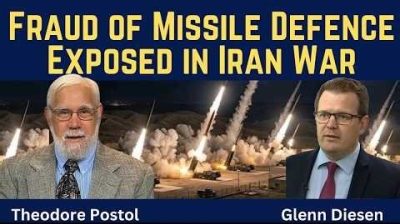
Ted Postol: Fraud of Missile Defence Exposed in Iran War
or go to
Aletho News Archives – Video-Images
Frlom the Archives
Containing the United States
By Edward S. Herman | Z Magazine | September 2016
“Containing the United States” is, of course, a ridiculous and self-contradictory idea in the U.S. and Western ideological and propaganda system. We all know that the United States had to “contain” the Soviet Union from 1945 to 1991, and since then has had the task of containing Russia and China. Only they threaten, bully, aggress and worry countries like Poland and Vietnam. Obama has had to reassure them both of our steadfast stand against Russian and Chinese military attacks. NATO has, of course, expanded greatly over the past several decades, despite the deaths of the Soviet Union and Warsaw Pact, but only to contain the renewed Russian — and Iranian, Libyan, Syrian and other — military threats; and we have “pivoted” to Asia, supported Japanese rearmament, bolstered our own forces in that area and jousted with the Chinese in their coastal waters solely to contain China. Earlier we had been obliged to contain North Vietnam, or was it the Soviet Union in Vietnam? Or China? Or “communism”? Or maybe all of them? Or none of them, but just needing an excuse to enlarge power?
The parallel propaganda has taken many forms. One is accepting as a premise that the United States only acts defensively and has no internal forces and interests that drive it to enlarge its sphere of control. I noted in an earlier article how Paul Krugman claims that internal Russian problems may well be the explanation of Russian “aggression,” but how at the same time it never occurs to him that the huge U.S. transnational corporate interests and “defense” establishment, and the pro-Israel lobby’s activities, might possibly make for an expansionist dynamic here.2 This reflects the standard establishment perspective that we are good and only react to evil. This was the view sustaining and justifying the invasion and occupation of Iraq from 2003. That attack was taken here as not evil but a response to evil, even if involving lies and mistakes, hence not describable as “aggression.” … continue
Blog Roll
 Aletho News
- Trump press conference reveals a man who wants out of war
- When Tel Aviv decides, Washington fights
- Top official: Iran ready for a long war with US, no more diplomacy
- How Iran’s Toxic Rain Reveals US-Israel Discord
- Trump Admits He Is Destroying Iran For Israel
- Iran’s latest move in the GCC countries was a stroke of genius
- Blackmail and death threats, Zelensky embarrasses the EU, but there’s no condemnation
- Israel threatens to kill Iran’s new leadership
- Possible Scenarios for the Middle East
- The Horizon of the War. “Italy is being Dragged Into the War against Iran”
- If Americans Knew
- Lebanon: Israel’s White Phosphorous Use Risks Civilian Harm
- Corporate Media Go All Out To Support The US-Israeli War On Iran
- US-Israel war on Iran is creating a steady growing number of amputees
- Israel planned this war on Iran for 40 years. Everything else is a smoke screen
- The wrong question about the war in Iran
- ‘Your Tax Dollars Being Used to Raise Your Gas Prices’: US-Israel Bomb Major Iranian Oil Depots
- ‘Bogus Evidence’: Former Nuclear Watchdog Head Debunks US Justification for Iran War
- EXPLAINER – Dimona: What to know about Israel’s nuclear site
- Fires and toxic air in Iran (thanks, Israel) – Not a ceasefire Day 150
- At Israel’s hands, Iran is burning, Lebanon and Gaza are crumbling – Not a ceasefire Day 149
- No Tricks Zone
- Wake-up Call: Survey Shows Majority Of Germans Now Favor Postponing Climate Targets!
- Televised! Leading German Political Candidate Tells Schoolchildren CO2 Makes Sun Hotter!
- New Study: A Century Warming Of 1.1°C Is ‘Commonplace’ And ‘Not Unusual’ During This Interglacial
- New Study: ‘Internal Noise’ And Volcanic Forcing Can Trigger 10-15°C Warming Within Decades
- Glaciers Worldwide Are Suddendly Surging, Experts Blame Warming!
- Surprising Discovery: Sahara Is Greening…Billions Of Trees Where Once Thought To Be Barren
- New Research Reaffirms Clouds, Aerosols, And Surface Solar Radiation Are ‘Driving The Climate System’
- Germany: Electric Car Catches Fire At Charging Station, Sets Off Local “Inferno”, Widespread Damage
- New Study: Canada’s New Brunswick Was 1°C Warmer Than Today During The Medieval Warm Period
- Coal Power Back In Trend As Globe Tries To Keep Pace With Growing Demand For Power
 Aletho News