Canadian and Israeli colonialism versus First Nations
By Yves Engler · July 20, 2018
Ironic: Interesting, strange or funny because of being very different from what you would usually expect.
By allowing the Haudenosaunee to travel to Israel for the World Lacrosse Championships on their own passports Canada undermined its colonial authority. But, Ottawa did so at the behest of those promoting the most aggressive ongoing European settler colonialism.
“As indigenous peoples, we have both seen our traditional lands colonized, our people ethnically cleansed and massacred by colonial settlers,” the Palestinian Campaign for Academic and Cultural Boycott of Israel wrote the Iroquois (Haudenosaunee) Nationals on July 4.
“We are asking you to respect our nonviolent picket line by withdrawing from the 2018 World Lacrosse Championships, denying Israel the opportunity to use the national sport of the Iroquois to cover up its escalating, violent ethnic cleansing of Palestinians throughout our ancestral lands.”
While a number of Nationals players expressed support for the Palestinians’ plight, the team rejected the call, possibly fearing a fine or banishment from future tournaments. Also affecting the Iroquois’ decision, whose confederacy crosses the Canada-US border, was the political importance they place on competing internationally.
As “the only First Nations team officially sanctioned to compete in any sport internationally”, playing lacrosse internationally is a way to assert their sovereignty, especially when governments accept their Haudenosaunee passports. As such, Canada often makes it difficult for them to travel on their First Nation passports. The Nationals were forced to withdraw from the 2010 World Lacrosse Championships in England for that reason.
Last Monday the Nationals were stopped from flying out of Toronto on their Haudenosaunee passports. But, two days later Ottawa came to an agreement with Tel Aviv after Israeli officials, former justice minister Irwin Cotler, New England Patriots owner Robert Kraft and the Centre for Israel and Jewish Affairs (CIJA) intervened out of fear their nonparticipation in the tournament would bolster the Palestinian BDS movement.
According to the Aboriginal Peoples Television Network, Canada granted the team, though “no other Haudenosaunee passport holders, a one-time exemption to travel to Israel using their Indigenous passports.”
In response, the co-founder of the Electronic Intifada, Ali Abunimah, noted on Twitter,
“Justin Trudeau bends Canada’s refusal to recognize Haudenosaunee passports, but only for Israel.”
Anti-Palestinian groups labeled the Nationals participation in the tournament “a victory for Israel”. “The fact that they are here is a tremendous victory against BDS”, exclaimed former Israeli Knesset Member Dov Lipman, who played a key role in navigating intense diplomatic discussions between Canada and Israel, detailed in a Jerusalem Post story titled “The Iroquois Nationals lacrosse team’s incredible journey to Israel.”
Born and raised in the traditional territory of the Piscataway, Lipman immigrated from the US to the Israeli city of Bet Shemesh in 2004. Designated as part of the Palestinian state in the 1947 UN Partition Plan, Bet Shemesh was built on the ruins of the Palestinian town of Bayt Nattif, which Israeli forces depopulated of non-Jews in October 1948.
For its part, CIJA announced that they “were pleased to play a role in helping the Iroquois Nationals lacrosse team overcome challenges related to their journey to participate in FILacrosse 2018 World Championships in Netanya. The team is now en route to Israel.”
The campaign to get the Nationals to Israel is the latest example of Israel lobby groups’ work to thwart those who associate the plight of First Nations and Palestinians. Over the past fifteen years, Jewish and Christian Zionist groups have brought hundreds of First Nations leaders, educators, students and clergy to Israel.
In 2006 the Canadian Jewish Congress (CJC) took Assembly of First Nations (AFN) leaders, including Grand Chief Phil Fontaine, to Israel. Two years later the CJC sponsored a delegation of indigenous women to the Golda Meir Mount Carmel International Training Centre. In 2007 and 2010 former Grand Chief of the AFN and head of the Misipawistik Cree, Ovide Mercredi, participated in tours organized by the explicitly racist and colonial Jewish National Fund.
In 2012 CIJA sponsored an Indigenous Tour to Israel with Cree and Inuit leaders as well as indigenous representatives from Australia, Fiji, New Zealand, Samoa, and Greenland. One participant was the Chief of Norway House Cree Nation, Ron Evans. A former Grand Chief of the Assembly of Manitoba Chiefs, Evans called Jews “the true, historic Indigenous people of Israel.”
In 2014 StandWithUs Canada sponsored a trip for Ryan Bellerose, a Metis from northern Alberta, who has become a leading Israel advocate. Bellerose writes articles titled “Are Jews Indigenous to the Land of Israel? Yes” and speaks about the “effective use of the indigenous rights argument in Israel advocacy.”
Despite running into trouble for labeling Palestinians resistance members “sewage” and implying that women in Gaza were “goats” or “sheep”, B’nai Brith hired Bellerose as its advocacy coordinator for western Canada in 2016.
In Manitoba, B’nai Brith is part of a Jewish/Aboriginal/Christian Round Table that has promoted indigenous Christian Zionism. One of its acolytes is leading aboriginal Christian Zionist preacher Raymond McLean, who was profiled in a November Walrus story titled “Inside the Controversial US Evangelical Movement Targeting Indigenous People.”
To highlight Israel’s 60th, the pastor of the First Nations Family Worship Centre in Winnipeg launched World Indigenous Nations for Israel. McLean told Israel birthday revelers in Winnipeg: “We are going to be celebrating all year because the Jewish people got their land back that God had promised them.” McLean, who visited Israel 16 times between 2003 and 2012, said: “I believe that since the Jewish people are God’s chosen people, we have to stand with them.”
McLean explicitly dismisses the connection between settler colonialism in Canada and Israel. But, in doing so he employs a terra nullius/Doctrine of Discovery type argument — which was used to justify settling Turtle Island — to deny Palestinian indigeneity. According to McLean:
“There were Arab nomads who lived in the Holy Land prior to the establishment of the State of Israel in 1948 who were hired by the new Jewish settlers.
Also, neighboring Arabs from Jordan, Syria, Lebanon, Saudi Arabia, and Egypt sought employment and were hired by the Jews who were settling in their new land after returning from exile after 2,500 years to reclaim their inheritance left by the ancestors. These Arabs became known as Palestinians but were originally Arab nomads and neighbors of Israel who Israel endorsed and recognized as Israeli citizens.”
Israel lobby groups have worked hard to build support among First Nations. By enabling the Nationals to participate in the World Lacrosse Championships they succeeded in gaining indigenous cover for the most aggressive ongoing European settler colonialism.
Here comes the Mali mission media manipulation
By Yves Engler · July 17, 2018
For the military, shaping media coverage of deployments is what roasting a marshmallow is to a summer camper’s S’mores; there isn’t one without the other.
Even before beginning a small “peacekeeping” mission, the Canadian forces have an elaborate media strategy.
At the end of June, Chief of the Defence Staff Jonathan Vance brought journalists with him on a visit to Mali. They toured the facilities in Gao where an advance team was preparing for Canada’s UN deployment to the African nation. An Ottawa Citizen headline described Vance’s trip as part of an effort at “selling the public on the Mali mission.”
The tour for journalists was followed by a “technical briefing” on the deployment for media in Ottawa. “No photography, video or audio recording for broadcast purposes” was allowed at last week’s press event, according to the advisory. Reporters were to attribute information to “a senior government” official. But, the rules were different at a concurrent departure ceremony in Trenton. “Canadian Armed Forces personnel deploying to Mali are permitted to give interviews and have their faces shown in imagery,” noted the military’s release.
None of these decisions are haphazard. With the largest PR machine in the country, the military has hundreds of public affairs officers that work on its media strategy. “The Canadian Forces (CF) studies the news media, writes about them in its refereed journals — the Canadian Army Journal and the Canadian Military Journal — learns from them, develops policies for them and trains for them in a systematic way,” explains Bob Bergen, a professor at the University of Calgary’s Centre for Military and Strategic Studies. ”Canadian journalists simply do not access the Canadian Forces in the scholarly fashion that the military studies them. There are no peer-reviewed journals to which they contribute reflections on their success or failure as an industry to cover the 1991 Persian Gulf War or the 1999 Kosovo Air War.”
While the tactics have varied based on technologies, balance of power and type of conflict, the government has pursued extensive information control during international deployments, which are invariably presented as humanitarian even when motivated by geostrategic and corporate interests. There was formal censorship during the First World War, Second World War and the Korean War. In recent air wars the military largely shut the media out while in Afghanistan they brought reporters close.
Air wars lend themselves to censorship since journalists cannot accompany pilots during their missions or easily see what’s happening from afar. “As a result,” Bergen writes, “crews can only be interviewed before or after their missions, and journalists’ reports can be supplemented by cockpit footage of bombings.”
During the bombing of the former Yugoslavia in 1999 the CF blocked journalists from filming or accessing Canadian pilots flying out of Aviano, Italy. They also refused to provide footage of their operations. While they tightly controlled information on the ground, the CF sought to project an air of openness in the aftermath of the Somalia scandal. For 79 days in a row a top general gave a press conference in Ottawa detailing developments in Yugoslavia. But, the generals often misled the public. Asked “whether the Canadians had been targeted, whether they were fired upon and whether they fired in return” during a March 24 sortie in which a Yugoslavian MiG-29 was downed, Ray Henault denied any involvement. The deputy chief of Defence Staff said: “They were not involved in that operation.” But, Canadians actually led the mission and a Canadian barely evaded a Serbian surface-to-air missile. While a Dutch aircraft downed the Yugoslavian MiG-29, a Canadian pilot missed his bombing target, which ought to have raised questions about civilian casualties.
One reason the military cited for restricting information during the bombing campaign was that it could compromise the security of the Armed Forces and their families. Henault said the media couldn’t interview pilots bombing Serbia because “we don’t want any risk of family harassment or something of that nature, which, again, is part of that domestic risk we face.”
During the bombing of Libya in 2011 and Iraq-Syria in 2014-16 reporters who travelled to where Canadian jets flew from were also blocked from interviewing the pilots. Once again, the reason given for restricting media access was protecting pilots and their families.
Since the first Gulf War the military has repeatedly invoked this rationale to restrict information during air wars. But, as Bergen reveals in Balkan Rats and Balkan Bats: The art of managing Canada’s news media during the Kosovo air war, it was based on a rumour that antiwar protesters put body bags on the lawn of a Canadian pilot during the 1991 Gulf War. It likely never happened and, revealingly, the military didn’t invoke fear of domestic retribution to curtail interviews during the more contentious ground war in Afghanistan.
During that war the CF took a completely different tack. The CF embedding (or in-bedding) program brought reporters into the military’s orbit by allowing them to accompany soldiers on patrol and stay on base. When they arrived on base, senior officers were often on hand to meet journalists. Top officers also built a rapport with reporters during meals and other informal settings. Throughout their stay on base, Public Affairs Officers (PAOs) were in constant contact, helping reporters with their work. After a six-month tour in Afghanistan PAO Major Jay Janzen wrote: “By pushing information to the media, the Battalion was also able to exercise some influence over what journalists decided to cover. When an opportunity to cover a mission or event was proactively presented to a reporter, it almost always received coverage.”
In addition to covering stories put forward by the military, “embeds” tended to frame the conflict from the perspective of the troops they accompanied. By eating and sleeping with Canadian soldiers, reporters often developed a psychological attachment, writes Sherry Wasilow, in Hidden Ties that Bind: The Psychological Bonds of Embedding Have Changed the Very Nature of War Reporting.
Embedded journalists’ sympathy towards Canadian soldiers was reinforced by the Afghans they interviewed. Afghans critical of Canadian policy were unlikely to express themselves openly with soldiers nearby. Scott Taylor asked, “what would you say if the Romanian military occupied your town and a Romanian tank and journalist showed up at your door? You love the government they have installed and want these guys to stay! Of course the locals are smiling when a reporter shows up with an armoured vehicle and an armed patrol.”
The military goes to great lengths to shape coverage of its affairs and one should expect stories about Canada’s mission in Mali to be influenced by the armed forces. So, take heed: Consume what they give you carefully, like you would a melted chocolate and marshmallow-coated graham wafer.
Ten Reasons Canada Should Get Out of NAFTA
By David Orchard | Global Research | June 19, 2018
For months Canadians have been inundated with claims from the government, various and sundry industries, and the national punditry, that NAFTA is good for our country, even necessary, and that “renegotiated” it will be even better. In the aftermath of US president Trump’s recent visit to Canada, virtually the entire Canadian political class has completely abandoned the vision of an independent, sovereign Canada. From the prime minister on down they rush to Brian Mulroney, the architect of the integration of Canada into the US, for direction and advice on how to “save NAFTA.” The door is now wide open for our country to take a different route, to reject NAFTA and build a nation which controls its own economy and destiny. Here are ten reasons why Canada should free itself from NAFTA, not enter more deeply into it.
One: Under NAFTA US corporations have the right to sue Canada for any law or regulation which they do not like and which they feel contravenes the spirit of NAFTA. US corporations have sued Canada 42 times under NAFTA, overturned Canadian laws and received over $200 million in NAFTA fines, plus approx. $100 million in legal fees, from Canada — and have filed claims for some five billion more. Why would any nation give foreign corporations the right to sue it and dictate its laws? (Canadian corporations can also sue the US. They have tried several times and failed each time.)
Two: Under the FTA, which is part of NAFTA, Canada agreed to never charge the Americans more for any good that we export to them than it charges Canadians. Why would Canada ever agree to such a provision and what in the world does it have to do with free trade?
Three: Canada agreed that it would never cut back on the amount of any good, including all forms of energy, that it sells to the US unless it cut back on Canadians proportionally at the same time. Why would Canada agree to deny its own citizens preferential access to their own resources?
Four: Except for a few exceptions, Canada agreed to allow US citizens and corporations to buy up Canadian companies and industries without restriction. They have taken over thousands of Canadian companies, from both our national railways to our retail industry to our grain companies. In 1867 the US purchased Alaska for $7 million. It is now purchasing Canada just as surely.
Five: Under NAFTA Canada’s standard of living has not risen, it has fallen. The real wages of Canadians are dropping steadily, and the divide between haves and have nots has soared.
Six: NAFTA is not free trade. It is the integration of North America into a continental economy. Integration means assimilation and that for Canada means the end of our country.
Seven: Locked into NAFTA Canada loses its ability to be an independent country. We see our country following the US on the world stage, even attacking and bombing small nations that have done no harm to Canada because, some of our leaders suggest, we must follow the US because our economies are so intertwined. (Then we watch some of the same leaders wringing their hands over the agony of the fleeing refugees our bombs have helped to create!)
Eight: Farsighted Canadian leaders have repeatedly warned their fellow citizens against free trade with the United States. John A. Macdonald called the very idea “veiled treason” because it meant giving control of our nation to a foreign power. George-Etienne Cartier said the end result would be union with United States, “that is to say, our annihilation as a country.” Robert Borden called free trade “the most momentous question” ever submitted to Canadians “not a mere question of markets but the future destiny of Canada.” John Diefenbaker called on Canadians “to take a clear stand in opposition to economic continentalism” and the “baneful effects of foreign ownership.” Pierre Elliott Trudeau called the FTA “a monstrous swindle, under which the Canadian government has ceded to the United States of America a large slice of the country’s sovereignty over its economy and natural resources.” John Turner called it “the Sale of Canada Act.”
Nine: In its early days Canada had no income tax. It used the revenue from tariffs on imported goods to finance the operation of the country and it had little or no debt throughout much of its history. Today after three decades of “free trade” with the US, Canada is carrying a record $1.2 trillion in federal and provincial debt and the tax burden on ordinary Canadians increases year after year. The rate of homelessness and use of food banks has escalated, public institutions and programmes on which citizens rely have been cut, while record amounts of raw resources are being poured across the border at fire sale prices.
Ten: Canada’s economy is roughly one tenth the size of that of the US. If we do not protect our industries, our sovereignty, and our economy, our country will be absorbed into the United States. This means the end of the dream of an independent Canada standing among the world’s nations with pride and dignity. It need not be so. Both the FTA and NAFTA have cancellation clauses. With a simple 6 month’s notice Canada can withdraw without penalty. All three NAFTA countries are members of the World Trade Organization and our trade with them would simply revert back to WTO rules, under which we did much better than we have under NAFTA, and without any US corporate right to sue us or buy up our country.
***
David Orchard was twice a contender for the leadership of the Progressive Conservative Party of Canada. He is the author of The Fight For Canada: Four Centuries of Resistance to American Expansionism. He can be reached at davidorchard@sasktel.net
Read more:
Canada: “A Northern Power” Once Again? NAFTA, “A Monstrous Swindle”
Copyright © David Orchard, Global Research, 2018
Bill on restricting Iran ties to hurt Canada’s interests: Tehran
Press TV – June 14, 2018
Iran has condemned the Canadian House of Commons’ vote in favor of a draft law restricting ties with Tehran, rejecting the claims in the bill, which it says will be to Ottawa’s detriment.
In a hostile move on Tuesday, the Commons approved the bill, introduced by Conservative MP Garnett Genuis, which called on the Canadian government to “immediately cease any and all negotiations or discussions with the Islamic Republic of Iran to restore diplomatic relations.”
 The measure also accused Tehran of “sponsorship of terrorism around the world” and designated Iran’s Islamic Revolution Guards Corps (IRGC) as a “listed terrorist entity” under the Canadian Criminal Code.
Under Canadian law, a bill is required to through a voting process in the Senate after passing the House of Commons. Once the bill gets the approval of both chambers, it is given Royal Assent and becomes law.
Responding to the move on Wednesday, Iran’s Foreign Minister Mohammad Javad Zarif, who was returning from a visit to South Africa, denounced Canada’s “misconceptions and illusions” about the Islamic Republic.
“These polices will be to Canada’s detriment and will not serve international peace and security,” he said, calling on Western countries to adopt independent policies towards Iran.
“Iran has always been on the front line of the fight against terrorism and without our country’s efforts and support, the situation in the region would have been different,” Zarif added.
Additionally, Iran’s Foreign Ministry spokesman Bahram Qassemi expressed dismay at the Canadian legislative body’s pursuit of the anti-Iran motion.
The measure, he said, is still in its initial stages, adding, however, that its “final approval will undoubtedly be a strategic and major mistake entailing destructive consequences.”
The bill shows that Canadian lawmakers lack precise information about Iran’s clear and logical positions on fighting terrorism, Qassemi noted.
He also stressed that the world’s public opinion would never accept “delusional and wrong allegations” against the country.
The spokesman further warned against the repercussions of passing the “injudicious and baseless” measure and expressed hope that the Canadian government would prevent it.
In 2012, the administration of former Canadian Prime Minister Stephen Harper severed diplomatic ties with Iran, citing, among other pretexts, what it described as continued threats from Tehran to its ally, Israel.
The House of Commons’ move came while the government of current Prime Minister Justin Trudeau had been voicing willingness to resume ties with Iran almost since it took office in late 2015.
Ottawa had said in late 2016 that it would act “in a speedy fashion” to normalize ties, and diplomats of the two countries have been in talks over the resumption of ties.
Manufacturing Dissent: US NGO’s Build Opposition in Thailand
By Joseph Thomas | New Eastern Outlook | June 9, 2018
Should decidedly anti-British government organisations be found across the United Kingdom to be funded and directed by Russians, we could only imagine the reaction. Even whispers of hints of Russian influence have resulted in legislation, sanctions and quite literally years of punditry warning of the Kremlin’s insidious reach.
When the tables are turned, it is clear London, Washington and Brussels understand the inappropriateness of one nation interfering in the internal affairs of another.
Yet this acute awareness has not informed US or European foreign policy, including components of what could be called “soft power,” or influence operations. While soft power implies non-coercion, in practice it is always used in conjunction with coercive means toward exacting concessions from targeted nations.
Hiding US Funding
In the Southeast Asian Kingdom of Thailand, a growing army of such influence operations has formed the foundation of an opposition to the current government. It is an opposition that without its current funding and support from abroad otherwise would not exist.
Just as was done for years against nations like Syria, Libya, Ukraine and Egypt (nations to have recently suffered or nearly suffered the impact of Western-sponsored regime change), Thailand faces long-term interference in its internal affairs as a direct result of these influence operations.
The opposition in Thailand itself is minute and unpopular. However the organisations supporting them enjoy a veneer of credibility owed primarily to their efforts to obfuscate from audiences their foreign funding and their actual role in organising and leading the opposition.
One example can be seen in the local English-language newspaper, the Bangkok Post. Its article, “The fight for basic rights,” interviews the American founders of a supposed nongovernmental organisation called, “Fortify Rights.” Fortify Rights has consistently used its platform to support anti-government protests under the pretext of defending human rights.

Nowhere in the interview are Matthew and Amy Smith asked where their money comes from and how, as Americans, it is their moral imperative to involve themselves in critical issues faced by Asia.
Throughout the interview, the Smiths repeatedly admit to reporting back to the United States government, including testifying before US Congress and lobbying in Washington for issues related to Myanmar’s ongoing refugee crisis. The interference in Asia by a nation residing on the other side of the planet seems almost taken for granted by both the Smiths and the interviewer, as if the United States is imbued with the authority to arbitrate universally.
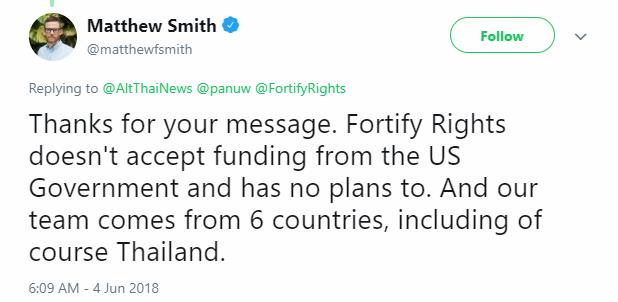
On social media, when the topic of US government funding was raised, Matthew Smith categorically denied receiving US government funding. He would refer to additional questions regarding his organisation’s funding as “trollish.”
However, Fortify Rights’ 2016 annual report (PDF), as pointed out to Smith himself, includes government funding from the United Kingdom, Canada, the Netherlands and the US Congress-funded National Endowment for Democracy ().
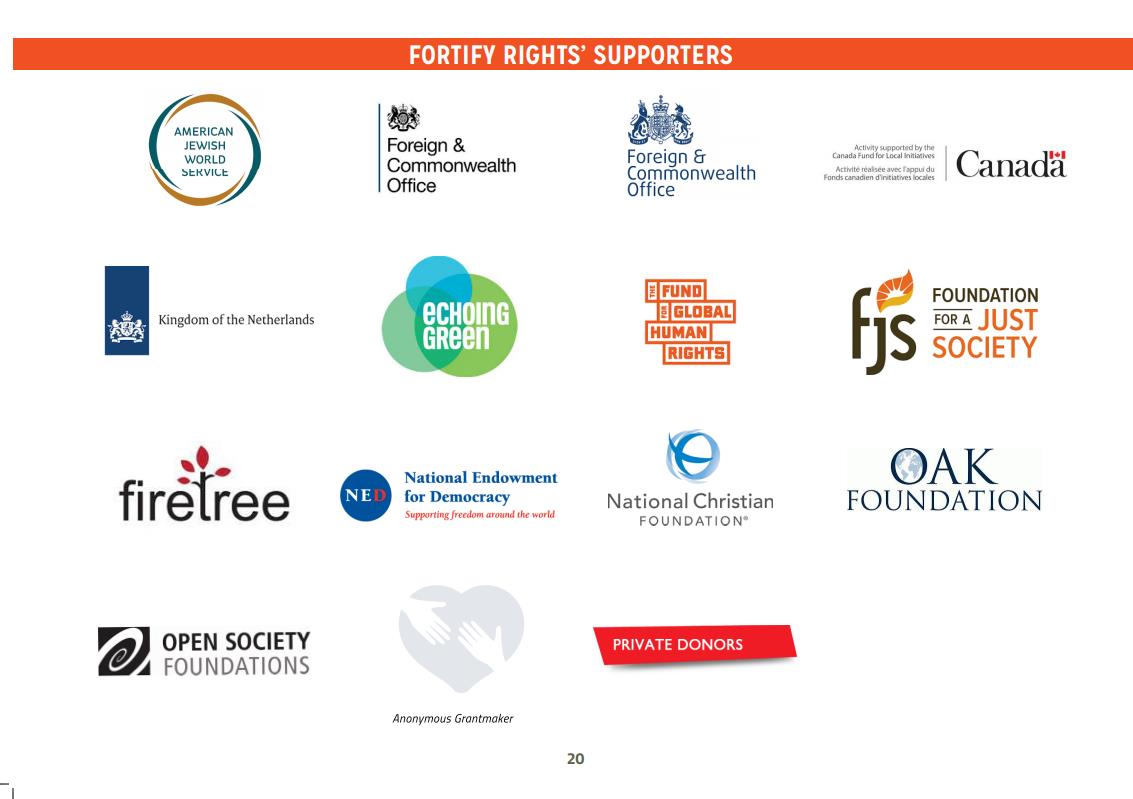
Other controversial sponsors of Fortify Rights include convicted financial criminal George Soros’ Open Society Foundations.
Matthew Smith not only knows that NED is funded by and serves as an intermediary for the US government, (thus making Fortify Rights a recipient of US government funding), he is undoubtedly aware of how controversial such funding is across Asia, a region sensitive to outside interference after centuries of European and more recently, American colonisation.
Implications of NED Funding
NED’s own website admits on its frequently asked questions page that:
NED is a private, non-profit, grant-making organization that receives an annual appropriation from the U.S. Congress through the Department of State. Although NED’s continued funding is dependent on the continued support of the White House and Congress, it is NED’s independent BOARD OF DIRECTORS that controls how the appropriation is spent.
NED itself admits that it is funded through the US State Department. It claims that its board of directors, not the US government itself, then determine how those US tax dollars are spent.
A look at NED’s board of directors only further implicates organisations like Matthew Smith’s Fortify Rights in deep impropriety merely hiding behind “rights” advocacy.
It includes people representing political and business interests involved in some of the greatest injustices purveyed by the United States during this generation, including Elliott Abrams, Francis Fukuyama, Zalmay Khalilzad (who served as US ambassador to Iraq during the US occupation) and Vin Weber described by some (including themselves) as Neo-Conservatives who promoted the US invasion of Iraq in 2003 and have promoted other wars of aggression around the globe both before and since.
Victoria Nuland, who played a central role in ousting the elected government of Ukraine in 2014 through a violent coup spearheaded by Neo-Nazi political parties and their militant wings, also serves on NED’s board of directors, along with Anne Applebaum of the Washington Post who clearly finds herself in a conflict of interest between reporting the truth and promoting organisations and agendas underwritten by the NED she chairs.
Another commonality is shared among NED’s board of directors; their use of “human rights” and “democracy” as pretexts for the wars of aggression and regime change they have promoted and helped execute, which reveals the true purpose, whether Matthew Smith of Fortify Rights knows or admits it or not, of both NED’s existence and the desired outcome of the work it funds around the globe.
NED in Thailand
Fortify Rights is by far not the only front operating in Thailand under the sponsorship of US government-funded NED.
It coordinates with other fronts as well, including media outlets like Prachatai based in Bangkok (whose director also serves as an NED Fellow), Isaan Record based in Thailand’s northeast, and BenarNews covering Thailand’s deep south. All three disingenuously portray themselves as independent local media. They have intentionally taken steps to obfuscate their US government funding from their Thai readers. Prachatai has only disclosed its foreign funding once in 2011, and only on its English-language website.
Each media front specialises in seizing upon and exploiting social and economic tensions to bolster opposition to the current government. Before the 2014 coup ousted the previous, US-backed government of Yingluck Shinawatra, these same media organisations used their platforms to smooth over injustices and emerging tensions threatening that government’s stability.
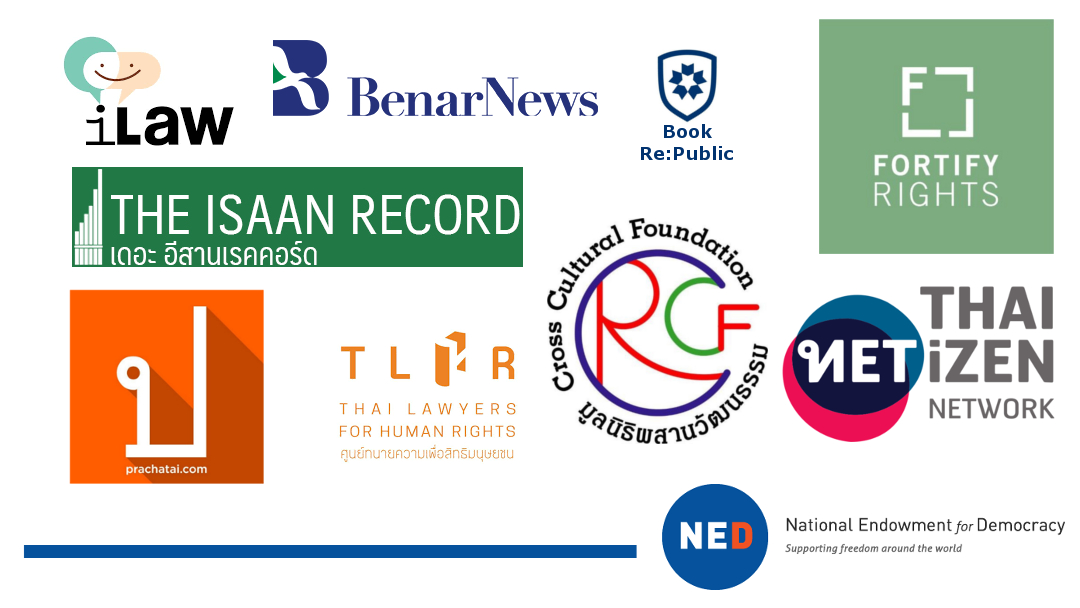
NED-funded Fortify Rights also works closely with fellow US funding recipient Thai Lawyers for Human Rights who not only provide free legal services for anti-government protesters, but provide resources and leadership to the protests themselves. The protesters portraying themselves as “pro-democracy” activists, fail to disclose their foreign funding to potential followers. They also avoid questions regarding how their foreign funding violates democracy’s prerequisite of self-determination independent of foreign interference.
Other NED-funded organisations operating in Thailand include iLaw, Cafe Democracy, Media Inside Out Group, Book Re:public, Thai Netizens Network, the ENLAWTHAI Foundation and the Cross Cultural Foundation (CrCF).
Many of these US government-funded organisations play a direct role in demanding policy changes. Currently in Thailand, protests demanding regime change are also led by US government-funded organisations.
The implications of foreign funded organisations attempting to influence Thailand’s policy or its political future are troubling. Many of the individuals working for these US government-funded organisations on their social media accounts frequently comment on their opposition to “Russian influence” in their US sponsors’ internal affairs, apparently failing to appreciate the irony of what their own work represents.
They also fail to appreciate the irony of portraying themselves as “independent” and working for “nongovernmental organisations,” despite being both dependent on wealthy and influential foreign sponsors as well as working on behalf of foreign governments.
Through their connections with equally compromised organisations and individuals in Thailand’s media, they have written promotional pieces about their supposed work, like in the Bangkok Post, without disclosing their foreign funding to readers.
At other times, complicit individuals within the Thai media have attempted to write pieces defending or dismissing US government-funding when public outcry begins to rise.
Rewriting Thailand’s NGO Laws
Despite the amount of funding and deception involved in this extensive and growing network, the US government-funded opposition is still widely unpopular. It would not be necessary for the Thai government to restrict their activities, let alone uproot and expel them as neighbouring Cambodia has (understandably) done.
Should Thailand simply rewrite its NGO laws to demand the same degree of scrutiny and transparency of these organisations as they themselves demand of targets of US government pressure, their already unpopular message would lose even more credibility and support across Thai society.
Prachatai, for example, being forced to disclose its US government funding at the header or footer (or both) of every article it writes would mean Prachatai finally practising the integrity and transparency it demands of targets of its daily propaganda. Likewise, those like writers at the Bangkok Post writing promotional pieces about Fortify Rights, should be obligated to disclose the organisation’s foreign funding somewhere within the body of the article.
Were these organisations as dedicated to the principles of transparency, freedom, democracy and human rights as they claimed, all of this information would already be freely and repeatedly provided to readers. If these organisations truly believed US, UK and Canadian government funding was benign or beneficial, they would not have gone through such extensive efforts to obfuscate and spin it to begin with. If anything, they would use such funding as a selling point.
Matthew Smith of Fortify Rights would not deceive people on social media by playing off of a technicality in which his US government money is essentially laundered through the NED before reaching him.
As the US continues accusing Russia of interfering in its internal political affairs, measures and consequences it attempts to level against Moscow could easily be cited and adopted by other nations across the globe to deal with the very real interference the US is engaged in within their respective borders.
The double game the US is playing regarding its own interference around the globe and accusations of interference it has levelled against Moscow, prove there is nothing benign at all about its agenda and activities. In turn, this calls into question all those organisations whose existence depends on annual contributions from this malignant political order.
Those truly dedicated to helping people will seek to independently fund their work by finding support from the local communities they claim to represent. If people are unwilling to fund Matthew Smith and Fortify Rights at the local level, it is likely Smith and his organisation are not truly working in the benefit of these communities, and instead, for interests diametrically opposed to them.
Pro-Israeli Groups Weaponize Jewish Cultural Initiatives to Amplify Their Anti-Palestinianism
By Yves Engler | Dissident Voice | June 3, 2018
Should “Jewish Heritage Month” be used as a cover for Israeli nationalism and to suppress Palestinian protest?
A recent incident at a Toronto high school demonstrates the depravity of the pro-Israel lobby. It also illustrates their use of Canadian cultural and “diversity” initiatives to promote a country that declares itself to be the exact opposite of diverse.
Amidst the recent slaughter of nonviolent protesters in Gaza, a half-century illegal occupation of the West Bank and weekly bombings in Syria, an Israeli flag marked with “Jewish Heritage Month” was hoisted in the main foyer of Forest Hill Collegiate Institute. After a couple days the flag created by Israeli nationalist students was moved – possibly due to complaints from other students – to a less prominent location where Jewish Heritage Month events were taking place. In response B’nai Brith, Hasbara Fellowships, Simon Wiesenthal Centre for Holocaust Studies and Centre for Israel and Jewish Affairs (CIJA) all claimed persecution. “Discrimination has absolutely no place in our schools”, noted a CIJA spokesperson with regards to moving the Israeli flag to a less prominent location in the school. For their part, the Wiesenthal Center said our “objective is to ensure that TDSB [Toronto District School Board] adheres to its own values of equity and inclusivity for all students” while B’nai Brith’s press release decried the “Jewish students who have had their heritage denigrated.” That group then published a story titled “Forest Hill Collegiate Has History of Alienating Jewish Students, Former Pupil Says.”
After the uproar the flag was returned to the Forest Hill Collegiate Institute’s main foyer and the TDSB apologized. At an assembly to discuss the matter, in which the principal and TDSB representative spoke standing behind a podium adorned with an Israeli flag, a student apparently yelled “Free Palestine”. B’nai Brith immediately denounced the brave, internationalist-minded high schooler, tweeting: “This morning, before an assembly about the removal of a #JewishHeritageMonth banner at Forest Hill Collegiate, a student yelled ‘Free Palestine’ during the morning announcements. We have been assured that this was not approved by the school and that an investigation is underway.”
In another Twitter post B’nai Brith claimed the Israeli flag flap made a “mockery of Canada’s first Jewish Heritage Month.” Their statement highlights a mindset that views gaining official sanction of cultural initiatives as a way to strengthen their campaign to support a violent, European colonial outpost in the Middle East.
 Earlier this year the House of Commons unanimously adopted May as “Jewish Heritage Month”. The motion was sponsored by York Centre MP Michael Levitt who is chair of the Canada Israel Interparliamentary Group and a former board member of the explicitly racist Jewish National Fund. Two weeks ago the Liberal MP issued a statement, partly rebutting the prime minister, that blamed “Hamas incitement” for Israeli forces shooting thousands of peaceful protesters, including Canadian doctor Tarek Loubani.
The bill’s other sponsor was Linda Frum. Last year the Conservative Party senator called Iran “one of the most malign nations in the world” and labeled a Palestinian-Canadian’s 2014 art exhibit at Ottawa’s city hall “a taxpayer-funded tribute to a Palestinian terrorist” and “the murder of innocent civilians.”
Leaving aside the background of those driving the initiative, the likely political effect of creating Jewish Heritage Month should have been obvious. The Canadian Jewish News report on the House of Commons resolution noted that May was chosen to celebrate Jewish Heritage Month because of the “various events on the Jewish calendar, including the UJA Walk for Israel, the Toronto Jewish Film Festival, Jewish Music Week and Israel’s Independence Day.” Similarly, when Ontario adopted May as Jewish Heritage Month in 2012 United Jewish Appeal Federation of Greater Toronto president Ted Sokolsky linked it to the group’s Israel campaigning. He said, “this announcement will call for an extra celebration at this year’s UJA Walk with Israel, which for 45 years has taken place in May.”
Despite the initiative being steeped in colonialist politics, the NDP voted in favour of the bill creating Jewish Heritage Month. During discussion of the motion NDP MPs Jenny Kwan and Randall Garrisson claimed it would enhance cultural/religious understanding. Garrisson said, “Jewish heritage month will help contribute to better understanding of just how diverse we Canadians are, and in doing so contribute to building a Canada free from hatred and division.”
Of course, this would be a laudable goal, but putting up an Israeli flag in a public high school while that country is murdering unarmed Palestinian demonstrators can only cause hatred and division. And it is an affront to thousands of Jewish-Canadians who do not support Israel.
The flag flap at Forest Hill Collegiate illustrates how pro-Israel groups have weaponized Jewish cultural initiatives to amplify their anti-Palestinianism. Those who seek justice for Palestinians need to recognize this fact and figure a way out.
Yves Engler is the author of A Propaganda System: How Canada’s Government, Corporations, Media and Academia Sell War and Canada in Africa: 300 Years of Aid and Exploitation .
Trade War and the Nationalist Exchange: Trudeau Trails Trump
By Maximilian C. Forte | Zero Anthropology | June 1, 2018
“These tariffs are totally unacceptable. For 150 years, Canada has been America’s most steadfast ally. Canadians have served alongside Americans in two world wars and in Korea. From the beaches of Normandy to the mountains of Afghanistan, we have fought and died together. Canadian personnel are serving alongside Americans at this very moment. We are partners in NORAD, NATO, and around the world. We came to America’s aid after 9/11—as Americans have come to our aid in the past. We are fighting together against Daesh in Northern Iraq…. That Canada could be considered a national security threat to the United States is inconceivable…. these tariffs are an affront to the long-standing security partnership between Canada and the United States, and in particular, to the thousands of Canadians who have fought and died alongside American comrades-in-arms”—Justin Trudeau, Prime Minister of Canada, May 31, 2018
So we now see the launch of a trade war between the US versus Canada, Mexico, and the EU. Focusing on the place of residence of the writer, Canada, one can argue that this trade war is very good news, if one knows how to read this development properly. Justin Trudeau’s visible anger is a testament to the good news: his anger is that he is now required to perform in the role of an economic nationalist, something for which he was not trained. All of his apprenticeship under globalist mentors—such as the Center for American Progress, the Aga Khan and George Soros—only prepared him to play a supporting role as part of a now wounded and cornered neoliberal elite. Trudeau was only meant to be a builder of “team spirit” in service of the technocrats who facilitated neoliberal globalization. He was there to cheer “Canadians” (whatever that word means now) that they were becoming like everyone from everywhere: they were a bit of everything, and nothing in particular. Trudeau thus pranced at the front of gay pride parades, pushed legislation on transgender pronouns, introduced a gender quota for his cabinet, a gender budget, sorted out cabinet ministers according to skin colour and headwear, welcomed everyone to an open Canada, and chided citizens for saying “mankind” instead of “peoplekind,” because the latter is “more inclusive”. And what does he have to show for his efforts? He is now the one to speak of illegal border crossers who should stay away, and imposes counter-tariffs.
Trudeau opened his remarks on the national security front—a big mistake. It was a big mistake for two reasons. One reason, of lesser importance than the next, is that it shows the literalism that is at the heart of moral narcissism and virtue signalling—that you take your opponent’s statements to be literally true, at face value, and no contextualization is necessary. Trudeau thus took great offense at the suggestion that Canada somehow undermined US national security—as if our purpose as a sovereign nation-state was to always serve the Americans better. President Trump, however, is merely using the available tools—he does not think that Canada literally threatens US national security, but he has to invoke that notion because it permits him to use a particular instrument—and that’s all. Back in March, if one was paying attention, one of the arguments Trump used to defend US steel and aluminum industries is that they were vital to US national security and its weapons industries. The Trump administration cited Section 232 of the Trade Expansion Act of 1962. I predicted this would be the justification in 2016, when the media floated arguments dismissing the prospect of Trump’s protectionism, insisting he would need Congressional approval. Others instead advanced the murky argument that the “deep state” would prevent him. Some tried to cover their lack of insight by saying Trump invoked “a rarely used law”. The constant refrain—inexplicably maintained despite its obvious contradiction—was that Trump was a threat and yet Trump would also have no real power. Almost all instantly forgot the meaning of executive power, and how it has increased under the imperial presidency. President Trump proved he could take such action, especially when the action is declared an “emergency” and a “threat to national security”. The only “mystery” here was why Trump suddenly decided to return to a nationalist posture, after a full year of reversals that favoured the continuation of neoliberal globalization. Gary Cohn, Trump’s chief economic adviser and former president of Goldman Sachs, promptly resigned from the administration after Trump announced the tariffs. Some thus saw economic nationalists regaining the upper hand in the Trump administration. It could be that Trump is now reconciled to the realization that his family’s business empire will never become properly transnational, and is even having to pull back from simply experimenting with being international. Trump family fortunes have returned home to roost—that is one possible explanation, and it’s a side issue for now. What we do know, even so soon, is that there is in fact some evidence that jobs are returning to the US steel industry, thanks primarily to Trump’s protective tariffs.
The second reason it was a mistake for Trudeau to use national security as an entry point is that it now opens a valid question for Canadians: what good is our alliance with the US? Why are we in all those wars? Why are we always tagging along with the Yanks? What were we doing in Afghanistan? It’s not like Toronto was attacked on 9/11. Why should we be members of NATO and NORAD? All of it really does not count for anything in the end. Trump has played Trudeau, repeatedly, and is now forcing Trudeau to substantively and effectively call into question Canada’s subservient role as an upholder of American empire. This is an example of the indirectly, quietly subversive outcomes of Trump’s “America First” program, as I argued in “What Happened to the American Empire?”
As for virtue signalling, Trump can do that too. With an absolutely phony earnestness, which neither Trudeau nor anyone else correctly read, Trump would pretend to be enchanted with his Canadian guest, lavishing warmth and praise on him… and look, here’s my daughter, she’s so charmed by you too! All smiles, handshakes, and exuberant lyrics, and it was all deliberately calculated bullsh*t, like you would expect of an expert dealer. Meanwhile, Trump does not forget who his adversaries are, and quietly and indirectly at first—and now loudly and directly—he set about destabilizing Trudeau’s Canada. First there was the mysterious push of illegal border crossers toward Canada, with the US amply admitting Nigerians on visas when their only intention is to enter the US to cross into Canada illegally. Trudeau said Canada would remain open and welcoming, in a direct rebuke aimed at Trump, and now Trump would make him pay for his words—and he has, in spades. More on that in a future article. Then Trump imposed tariffs on Canadian dairy products, softwood lumber, newsprint, massively crushing tariffs on Bombardier passenger planes, and then the renegotiation of NAFTA itself, with the threat of simply tearing up the deal.
Where has Trudeau’s leadership been in all of this? With less people than California, the US market matters a lot more to Canada than vice versa. How has Trudeau prepared Canadians for possible job losses, perhaps in the tens of thousands, as a result of an abrupt trade shock? How will social services suffer in provinces most affected by a diminished export market? Today the Canadian media like to boast that Canada will hit Florida orange juice, so—hint, hint—good luck winning Florida in the next elections. They should be thinking about Canadian elections instead, rather than taking the attitude that only the US will suffer, or that it will suffer more than Canada. But that is what we get: instead of a plan, a program, just amateur cockiness.
How has Trudeau’s government coordinated with local and national industries to realign production to domestic suppliers and domestic consumption in the event of a trade war? Where are the “innovative” and “smart” plans now? Canadian ruling elites have been funding the training of a generation of students to think in globalist terms, and shun nationalism—when what they should have been teaching students is not just to start loving nationalism, but to love their nation. What nation is that, you ask? Writing from Quebec, but as someone raised in Ontario, my very strong impression is that it is Anglo-Canada in particular that has the real identity crisis—that is, not having an identity. We can forget about Aboriginal peoples planting the seeds of a new Canadian creolization, as I argued elsewhere; instead, Aboriginals are being effectively put back in their cultural ghettos, shielded by a paranoia over phony “cultural appropriation,” thus sequestered, contained, and removed from the Canadian conversation. Instead the model we have in Canada sounds like it was imported from Amazon.com: everyone in their appropriate box, and every box on its appropriate shelf.
“We’ll see what happens”. “Maybe this will be big, maybe it won’t. Who knows?” However, it is still worth raising the possibility that if the trade war continues, and lasts, it’s Canada that might not last. The Trump transfer of costs will have achieved its maximum effect. Part of that Trump transfer is that Canadians are being taught—forced—to become nationalist Trumps in their own right, or lose. Let’s see what happens.
A final thought: having lived for a few years in Cape Breton, one of Canada’s long-standing and primary centres in the production of steel, I saw first hand the degree of economic destruction and social devastation wrought on Canadian production by foreign competition, among many other factors. Real leadership would seek to maximize the benefits of protection that (counter)tariffs now offer us, a chance to make sure not all of Canada experiences the kind of econocide witnessed by Cape Breton.
Canada Sanctions 14 People in Venezuela After ‘Illegitimate’ Elections
Sputnik – 30.05.2018
Canada has imposed new sanctions against key figures in the government of Venezuelan President Nicolas Maduro, Global Affairs Canada said in a press release on Wednesday.
“In response to the illegitimate and anti-democratic presidential elections held in Venezuela on May 20, Canada today announces further sanctions on key figures in the Maduro regime,” the release said.
The sanctions target 14 individuals responsible “for the deterioration of democracy in Venezuela,” the foreign ministry added.
Canada is not the first country to introduce restrictions against Venezuela following the re-election of Nicolas Maduro. Previously, Washington, citing “fraudulent vote,” banned US citizens from all transactions tied to Venezuelan government debt. The order he signed also prevented Venezuelan officials from selling equity in any entity majority-owned by the government. The EU, in its turn, froze some assets belonging to a number of Venezuelan individuals, companies and organizations
On May 20, Venezuela held its presidential election, with four candidates in the running. According to the National Electoral Council (NEC), incumbent leader Nicolas Maduro was re-elected as Venezuelan president for his second term, having secured 68 percent of votes, with slightly over 46 percent voter turnout. A number of states, including the EU members, have slammed the vote as either unfair or illegitimate.
8 things I learned about Palestine while touring 8 Western nations
By Ramzy Baroud | MEMO | May 29, 2018
On 20 February, I embarked on a global book tour that has, thus far, taken me to eight nations. The main theme of all my talks in various cultural, academic and media platforms was the pressing need to refocus the discussion on Palestine on the struggle, aspirations and history of the Palestinian people.
But, interacting with hundreds of people and being exposed to multiple media environments in both mainstream and alternative media, I also learned much about the changing political mood on Palestine in the western world.
While the nations I have visited – the US, Canada, the UK (England and Scotland), the Netherlands, Austria, Australia and New Zealand – do not in any way represent all western countries, the diverse platforms that were available to me allowed me to gain a reasonably good perspective on the ideas, perceptions and attitudes of people in government, media, academia and civil society:
First, the civil society support base for Palestine is growing exponentially, not only in the number of people who are concerned with – or interested in – learning about Palestine, but also in the nature of that engagement as well. The detachment or sense of despair of the past, has all but completely vanished, being replaced with a proactive approach – as in people wanted to be agents of change at local and national levels.
Second, the consensus regarding the support of the Boycott, Divestment and Sanctions (BDS) movement is constantly increasing among unions, churches, university campuses, etc. The old view that BDS was divisive and counter-productive hardly has much traction these days, and most of the remaining debates concerning BDS are not concerned with the ethics of the boycott strategy, but the nature and extent of the boycott.
Third, the degree of decisiveness in supporting Palestinians has also been heightened. The wishy-washy stances that wagered on the Israeli “peace movement’ or Labour Party “doves”, while condemning “extremists on both sides”, has diminishing appeal.
Indeed, the successive Israeli wars on Gaza and the continued siege on the Strip have all gradually, but irreversibly, pushed the narrative on Palestine towards a whole new direction, one that has little room to wait for an Israeli awakening. The recent lethal Israeli response to Gaza’s peaceful Great March of Return protests has further galvanised support for Palestinians, even among relatively apolitical audiences.
Fourth, unable to push back against growing pro-Palestine movements, Israeli and pro-Israel supporters are pushing, like never before, the accusation of anti-Semitism against those who question the Israeli occupation, use the term “Israeli Apartheid” or support BDS.
While the tactic is no longer silencing the discussion on Palestine, it is creating the necessary distraction to divert attention, energy and resources to less urgent issues. A case in point is the British media’s obsession with the, supposedly, rampant anti-Semitism within the Labour Party at a time when thousands of Gazans were injured and scores killed while peacefully protesting in Gaza.
Fifth, young people are less likely to be intimidated by long-standing Israeli tactics. While the older generation of civil society leaders and activists are unwittingly beholden to the many smearing tactics used by Israel and its supporters, the younger generation is not as easily intimidated. Part of the reason is that digital media – social media, in particular – has helped younger people achieve a degree of global connectivity that has heightened their sense of unity and resolve.
The new generation of Palestinian university students and young intellectuals are also reclaiming their role in this trajectory. Their ability to connect with western societies as insiders and outsiders has helped bridge cultural and political gaps.
Sixth, while “One Democratic State Solution” ideas are yet to achieve the critical mass that could, and will, eventually push for a change in policies amongst various governments, the so-called “Two-State Solution” no longer commands a dedicated following. It is almost a complete reversal from the views that permeated during my earlier world tours, nearly 20 years ago.
Seventh, some intellectual, and even civil society circles, are still obstructed by the erroneous thinking that the best way to convey the Palestinian viewpoint is through non-Palestinians. This belief is even championed by some Palestinians themselves (especially members of previous generations who suffered political and cultural marginalisation and discrimination).
Although many anti-Zionist Jewish and Western intellectuals have been placed at the centre stage to articulate a Palestinian message, the alienation of the Palestinians from their own discourse has proven costly. Despite strong and growing support for Palestine, there is still a serious deficiency in an authentic understanding of Palestine and the aspirations of the Palestinian people – their history, culture, everyday realities and viewpoints.
Needless to say, what is needed is an urgent and complete reclamation of the narrative over Palestine and the decolonisation of the Palestinian discourse.
Eighth, the connection between the Palestinian struggle for freedom and that of other indigenous groups is often highlighted, but much more can be done. Israeli supporters are actively pushing the misleading notion that Israelis are the “natives” of the land and are, thus, reaching out to indigenous communities around the world in search for common ground. While the reality is to the contrary, pro-Palestine groups can do much more to link the struggle of the indigenous native Palestinians with that of other indigenous and other oppressed and historically marginalised groups around the world.
A general, but equally important realisation I have experienced throughout my three-month journey has been the numerous personal and group initiatives carried out by thousands of people all over the world in solidarity with the Palestinian people: from 11-year-old Salma, who convinced all of her classmates in Perth, Australia, to write Palestine on the map in her geography class, despite knowing that they would all have been marked down for their action, to the elderly couple in Auckland, New Zealand, who, well into their 80s and walking with much difficulty, continue to hand Palestine flyers to passers-by at a busy street corner, every week, for the last 20 years.
It is these people, and millions like them, who represent the real constituency for Palestine. They are fighters in the trenches of human solidarity that neither Israel, nor anyone else, can possibly defeat.
Featured Video

Macgregor: We Haven’t Seen the Worst of the Iran War Yet
or go to
Aletho News Archives – Video-Images
New Book
Breast Cancer: Before You Consent
A new Unbekoming paperback
Lies are Unbekoming | September 18, 2026
Peter Gøtzsche reviewed every randomised mammography screening trial ever conducted for the Cochrane Collaboration. Cochrane’s headline is that, assuming a 15% mortality reduction, one woman in 2000 avoids dying of breast cancer over ten years. Ten are overdiagnosed and treated. Two hundred experience false alarms.
But that headline assumes the reduction. When Gøtzsche looked only at the trials with adequate randomisation — the higher-quality ones — the reduction disappeared. No effect on breast cancer mortality. No effect on all-cause mortality.
This is the Cochrane finding, published in the establishment’s own database of systematic reviews.
No woman being asked to consent to a mammogram this week knows it.
That is why the new Unbekoming paperback exists. … continue
Blog Roll
 Aletho News
- Araghchi: Military intervention cannot create security; coercion cannot bring peace
- Fraud Squared
- Breast Cancer: Before You Consent
- Iran’s Plan to Shut Down AI in the Persian Gulf
- Israel seeks ‘compensation’ from Washington over Saudi F-35 sale
- Saudi crown prince seeks dialogue with Ansarullah after Yemeni blows: Report
- Damascus rejects Saudi request for Syrian fighters to counter Yemen: Report
- South Korea says will not send troops to join terrorist US war on Iran
- Russia Just Struck the Eyes of NATO’s War Machine in Ukraine
- Russia summons UK charge d’affaires over Kiev drone support
- If Americans Knew
- Inside the siege, the ruined buildings of Gaza – Daily Update
- Debunking The Claim That Macklemore Has A “History Of Antisemitism”
- CPJ demands release of arrested Palestinian-US journalist near Bethlehem
- Robert Kraft: The Billionaire Friend of Netanyahu Pulling The Strings Behind the Macklemore/Ed Sheeran Blow Up
- Columbia Administered Fund Gives Big Money to Pro-Israel Groups
- Deportation Case of Palestinian Activist Salah Sarsour Tests First Amendment
- ‘We Will Not Forget’: Palestinians Mark 44 Years since Sabra and Shatila
- Why do we let Zionists decide what we can and can’t say?
- US welcomes Israeli, Iranian delegations to UN, but not Palestinians – Daily Update
- Biden’s Genocide Accomplices Targeted by New Accountability Campaign
- No Tricks Zone
- New Study: ‘Global Drought Shows No Detectable Recent Acceleration Under Climate Warming’
- Economic Masterminds: German Socialists Suggest Taxing Productivity Gains Stemming From Using AI
- The South China Sea Has Not Been Cooperating With The Climate Change Narrative
- Energy Crisis: Germany Enters Heating Season With Historically Low Gas Reserve Fill Levels
- New Study: The Antarctic Ice Sheet Gained Mass From 2020-2024 Due To Staggering Snow And Ice Accumulation
- Study: Ocean Heating Rates From Thousands Of Years Ago ‘Dwarf’ Modern Ocean Heating Rates
- Climate Extremists Target, Attack Large-Scale Power Grid Infrastructure In Germany!
- New Study: Antarctic Ice Melt Has Contributed Less Than 1 Centimeter To Sea Level Rise In The Last 30 Years
- Fear Of Debate: Alarmist German Climate Scientist Calls On Mainstream Media To Discredit Skeptic Voices
- End-Of-August Arctic Sea Ice Extent Hasn’t Fallen In 20 Years, Official Data Show!
 Aletho News