Is raising money for a right wing government really charity?
By Yves Engler · March 24, 2018
Is it a charity or political fundraiser for a right-wing foreign government?
People need to take a look at Canada’s Jewish Federations.
Together the United Jewish Appeal/Combined Jewish Appeal of Toronto, Montréal, Winnipeg, Windsor, Calgary, Edmonton, Hamilton, London, Ottawa, Vancouver and Atlantic Canada raise over $100 million annually. The largest in the network, UJA Toronto’s endowment and planned giving arm, has $500 million in assets and planned gifts. CJA Montréal has over $300 million on hand.
In a recent letter to the Canadian Jewish News, Morris Sosnovitch asked why UJA Toronto gives a quarter of its budget to a country with a $360-billion national budget. All Canadian taxpayers should ask why tax deductions are given for the $13.7 million UJA Toronto, $3.8 million CJA Montréal, and $1.12 million CJA Vancouver donated last year to Israel, among the world’s 25 wealthiest countries, run for the past decade by one of the most right-wing governments in the world. The Jewish Federations also oversee the United Israel Appeal Federations Canada. In 2016 that registered charity raised $80 million.
Beyond annual allotments, the Federations have repeatedly topped up their annual donations to Israel. In a particularly disturbing comment on Israel’s supporters, aggression has been good for fundraising. Following the IDF killing 2,200 Palestinians in Gaza in the summer of 2014, UJA Toronto launched an emergency appeal. Led by Fred Waks, the staunch advocate of late billionaires Bernie and Honey Sherman, the special appeal raised over $5.6 million.
Alongside its fundraising support, UJA Toronto has organized an annual Walk with Israel for 46 years. Additionally, UJA Toronto cosponsored an event under the title “We Will Not be Silent: A March Against Global Anti-Semitism.” The Times of Israel reported: “The purpose of the march was passionately summed up in Bill Glied’s closing remarks: ‘Thank God for the IDF. Thank God for Israel. And remember together we must stand. Never again!’”
The cross-country UJAs are the source of most Centre for Israel and Jewish Affairs’ (CIJA) funding. While it refuses to reveal details, CIJA’s budget is between $8 and $11 million a year. To get a sense of its politics, CIJA backed moving the U.S. embassy to Jerusalem, getting rid of the Iran nuclear accord and Israel’s 2014 assault on Gaza. Recently CIJA called on Canadian Jews to write the government to request Canada take more Eritrean, Sudanese and other African refugees that Israel is seeking to expel. Apparently, CIJA wants a state in the Middle East as Jewish as possible but supports multiculturalism in Canada.
The CJAs also fund a variety of other pro-Israel institutions. The Federations give millions of dollars every year to campus Hillels, which refuse to associate with Jews (or others) who “delegitimize, demonize, or apply a double standard to Israel; support boycott of, divestment from, or sanctions against the state of Israel.”
The Federations also provide millions of dollars to Jewish day schools that promote the Israeli nationalist narrative. A March Canadian Jewish News cover story titled “What to teach Jewish students about Israel?” detailed the growing importance given to classes on Israel at Jewish day schools. While students have long been “taught from a young age to see Israel as the land of milk and honey,” in recent years Jewish day schools have ramped up their indoctrination in reaction to “anti-Israel student groups on campuses throughout North America.”
One of the five “Faces of Success” in a CJA booklet promoting Montréal Jewish schools is a man named Oliver Moore, a graduate of McGill Law who works with the notoriously right-wing NGO Monitor in Jerusalem. Moore is quoted stating: “My experience attending Jewish high school imprinted me with a Zionist ethic and a profound appreciation for Israel’s importance. It troubles me that Israel is under constant political threat and that its legitimacy is questioned. What I find especially disturbing is that the language of human rights has been distorted to dispute its right to exist. That is why I’ve decided to go to Israel and examine this issue in depth, and when I return to Canada, to contribute to Israel advocacy.”
Simultaneously, the Federations suppress Jewish advocates of Palestinian rights. They largely refuse to let Independent Jewish Voices book rooms at Federation community centres. In 2009 CJA canceled an IJV room rental at the Gelber Conference Centre in Montréal for a talk by Israeli peace activist Jeff Halper, founder of the Israeli Committee Against House Demolitions. The Jewish Community Centre of Ottawa openly refuses to rent space to IJV because it “advocates for positions that run counter to the objectives of the Jewish Federation of Ottawa.” In 2011 UJA Toronto threatened to “sever ties” with the Morris Winchevsky Centre over a United Jewish Peoples’ Order talk by Auschwitz survivor Dr. Hajo Meyer titled “Never Again for Anyone.”
Incredibly, there has been little public criticism of UJA’s anti-Palestinianism. Despite delivering tens of millions of dollars a year to Israel and spending a comparable sum on Israel advocacy in Canada, the organization presents itself as an apolitical “charity.”
It’s past time to bring some pressure to bear on these morally odious institutions. Taxpayers should tell political leaders they don’t want to subsidize a wealthy country in the Middle East and the Canada Revenue Agency should be pushed to investigate whether Federation funding to CIJA and other politically engaged organizations contravene their rules about charities spending no more than 10 per cent of their budget on politics.
It’s time for those who care about peace and international justice to treat the Federations the same way they treat Palestinians.
Art and history paid for to shape opinions about military
By Yves Engler · March 15, 2018
Would it surprise you to learn the Canadian military spends millions on art and history?
Until April the Canadian War Museum is hosting an exhibition of war art from the Ukraine created through the Canadian Forces Artists Program (CFAP). In 2014–15 eight artists were sent to observe Operation UNIFIER, Canada’s “training” mission to support Ukraine’s armed forces.
Until April the Canadian Forces Artists Program (CFAP) is hosting an exhibition of war art from the Ukraine created through the Canadian Forces Artists Program (CFAP). In 2014–15 eight artists were sent to observe Operation UNIFIER, Canada’s “training” mission to support Ukraine’s armed forces.
The purpose of CFAP is to “encourage artists to learn more about our men and women in uniform and to create works of art that document and explore Canada’s military history and experience.” The program pays for artists to spend 7-10 days in the field with troops to document their activities.
While CFAP began in 2001, there have been various iterations of the program over the past century. During World War I, for instance, Canada’s official war art program created almost 1,000 works of art. During WWII the head of the Army’s historical section, Colonel A. F. Duguid, initiated a war art program and over the years the Canadian forces have commissioned sketches of the Korean War, NATO missions, UN operations and the first Gulf War.
Today CFAP is run by the Department of National Defence’s Directorate of History and Heritage. With a 50-person staff, the Directorate also supports the Organization of Military Museums of Canada. The half-century old organization seeks “to preserve the military heritage of Canada by encouraging the establishment and operation of military museums.” Along with more than 60 Canadian Forces’ museums, the Directorate supports the Canadian War Museum.
DND’s Directorate of History and Heritage is “mandated to preserve and communicate Canada’s military history and foster pride in a Canadian military heritage.” They answer “1,000 questions of an historical nature” annually, helping high school students with assignments and academics navigate archival inquiries. The Directorate also works with the media. In the early 1990s, for instance, senior military historian Brereton Greenhous was a special advisor during production of the CBC film Dieppe 1942. Similarly, director of the historical section Charles Stacey vetted Canada At War, the first television miniseries to document Canada’s part in the Second World War, before the National Film Board produced program played on CBC.
The Directorate’s historians also help veterans exert political pressure. After a backlash to a Canadian War Museum exhibit that mentioned the WWII Allied Bomber Command targeting civilians, senior DND historian Serge Bernier was asked to write a report. Bernier concluded the exhibit was hurtful to the veterans.
The Directorate’s roots date back to the end of World War I when the Department of Militia and Defence established a historical section. In Clio’s Warriors: Canadian Historians and the Writing of the World Wars Tim Cook writes, “it has been the official historians of the Department of National Defence who, for much of the 20th century, have controlled the academic writing on the two world wars.” But, official historians’ influence has extended far beyond the “Great Wars”. In 1919 the historical section published the first in a three-volume series titled “A history of the organization, development and services of the military and naval forces of Canada from the peace of Paris in 1763, to the present time.” Immediately after the Korean War official historians wrote two books on the subject and published another in 1966. (Academics all but failed to revisit Canada’s role in Korea until the late 1990s.)
The minister approves publication of Directorate books. On several occasions cabinet has discussed and recommended changes to their histories.
Official historians published a large share of the early books on Canadian militarism and greatly influenced academia. The Directorate was the “graduate school in military history”, notes DND historian William A. Douglas, until “university departments started producing postgraduates.” In the two decades after World War II individuals who worked in the military’s historical sections filled many academic posts in military history and associated fields. And they were often influential in their field. Head of the War Artist Program and deputy-director of the Historical Section at Canadian Army Headquarters in London, George Stanley led the history department at the Royal Military College after World War II. During his career Stanley was president of the Canadian Historical Association, a member of the Massey Commission Committee on Historic Sites and Monuments and chairman of the federal government’s Centennial Publications Committee.
At the military-run Royal Military College Stanley taught Jack Granatstein and Desmond Morton. These two individuals, who both worked in DND’s historical section, have published hundreds of books and articles on Canadian military history and foreign policy.
A military historian for two decades, Colonel Charles Stacey has had “more influence on how Canadians view their nation’s military history” than any other individual. Director of the army’s historical section for 14 years after WWII, he published a dozen books and in 2000 Granatstein wrote that Stacey’s “books continue to be read and to have great influence on military and foreign policy historians.”
Turns out the military wants to control what you think about them and are willing to spend your tax dollars to do it.
Convention provokes rage against NDP machine
By Yves Engler · March 1, 2018
They came, mostly young people, to fight for justice. They came to support the rule of international law, to help solve a longstanding injustice through non-violent means; they came to tell an oppressed people you have not been forgotten; they came to do what is right for a left wing political party; they came to speak truth to power.
And how did the left wing party respond? By using the “machine” — orders from on high, backroom arm-twisting, opaque block voting and procedural manoeuvring — to prevent debate. Silence in class!
While NDP insiders probably feel they dodged the “Palestine Resolution” bullet at their recent convention, many party apparatchiks may come to regret their undemocratic moves. Their naked suppression of debate might stir rage against the machine they’ve proved to be. At a minimum it has provoked many to ask why.
Why, when the Palestine Resolution was endorsed unanimously by the NDP youth convention and by over 25 riding associations, did the powers that be not want it even discussed?
Given the resolution mostly restated official Canadian policy, except that it called for “banning settlement products from Canadian markets, and using other forms of diplomatic and economic pressure to end the occupation” one can only assume that the party machine either supports the indefinite Israeli occupation of Palestinian land or has some sort of problem with boycotts and economic sanctions. Clearly the NDP is not against boycotts and economic sanctions in principle since they’ve recently supported these measures against Russia, Venezuela and elsewhere.
If, after a half-century of illegal occupation, one can’t call for boycotting Israeli settlement goods, then when? After a century? Two?
Or is the problem the particular country to be boycotted? Does the NDP hierarchy believe that anti-Semitism can be the only possible motivation for putting economic pressure on Israel to accept a Palestinian state? Or perhaps it is simply a worry that the dominant media would attack the party?
Whatever the ideological reason the bottom line is the Palestine Resolution was buried to ensure it wouldn’t be discussed. When its proponents sought to push it up the priority list at an early morning session before the main plenary, the party hierarchy blocked it. In a poorly publicized side room meeting they succeeded 200 to 189. NDP House Leader Guy Caron mobilized an unprecedented number of current and former MPs, including Murray Rankin, Randall Garrison, Craig Scott, Tracey Ramsey, Alexandre Boulerice, Hélène Laverdière, Nathan Cullen and others, to vote against debating the most widely endorsed foreign policy resolution at the convention (Niki Ashton was the only MP to support re-prioritizing the Palestine Resolution.)
Apparently, the party leadership discussed how to counter the resolution at two meetings before the convention. In a comment on a Guardian story about the need for the NDP to move left, Tom Allen, a staffer for Windsor Tecumseth NDP MP Cheryl Hardcastle, describes “panicked” planning to defeat the resolution. “As for the part about the ‘party establishment (being) easily able to deflect challenges from the left.’ I would respectfully submit that this is wrong. As an NDP staffer I can tell you that it wasn’t easy at all this time and, especially with regards to the ‘Palestinian Resolution,’ which required a great deal of panicked last minute organizing to defeat (and only then by a close margin).”
Why would the party establishment risk turning off so many young activists, exactly the sort of member new leader Jagmeet Singh claims he wants to attract?
A quick look at some of the more prominent supporters of shutting down debate suggests an answer.
Victoria area MPs (defence critic) Randall Garrison and (justice critic) Murray Rankin who voted against debating the Palestine Resolution are members of the Canada Israel Inter-Parliamentary Group and took a Centre for Israel and Jewish Affairs paid trip to Israel in 2016. After the IDF slaughtered 2,200 Palestinians in Gaza in the summer of 2014, Rankin offered words of encouragement to an emergency fundraiser for Israel.
Party foreign critic Hélène Laverdière, who voted to suppress the Palestine Resolution, took a paid trip to the American Israel Public Affairs Committee’s conference in Washington in 2016 and participated in a Jewish National Fund event in Israel.
British Columbia liaison and critic for democratic institutions, Nathan Cullen also voted against debating the Palestine Resolution. “I am strongly in support of Israel”, Cullen bellowed in a 2016 statement about how people should be allowed to criticize that country. In 2014-15 Cullen’s office took in Daniel Gans through CIJA’s Parliamentary Internship Program, which pays pro-Israel university students $10,000 to work for parliamentarians (Gans then worked as parliamentary assistant to NDP MP Finn Donnelly). In 2014 Cullen met representatives of CIJA Pacific Region to talk about Israel, Iran and other subjects. According to CIJA’s summary of the meeting, “Mr. Cullen understood the importance of a close Canada-Israel relationship.”
Maybe the loudest anti-Palestinian at the convention was former president of the Ontario NDP and federal council member Janet Solberg. Unsatisfied as a settler in Toronto, Solberg pursued a more aggressive colonial experience when she moved to historic Palestine as a young adult.
Just before the convention the President of the Windsor-Tecumseh Federal NDP, Noah Tepperman, sent out an email to all riding associations calling on them to oppose Palestine resolutions. In it he claimed, “boycotts based on religion, nationality or place of origin directly contravene the spirit of inclusiveness to which we in the NDP are committed.” He further alluded to an anti-Jewish agenda by connecting the different solidarity resolutions to “a backdrop of already-high-and-rising antisemitism here in Canada as well as abroad.” But, Tepperman sits on the board of the Windsor Jewish National Fund, which is an openly racist organization.
The truth is pro-Israel-no-matter-what-it-does NDP members in positions of power within the party won a narrow battle. How the war goes will depend on the lessons learned by those seeking a party that’s an instrument of real change, that fights against all forms of racism and oppression.
Lebanese Nuclear Physics Student Found Dead in France
Al-Manar | March 1, 2018
 A Lebanese man studying nuclear physics was found dead earlier this week in France, while reports on his death were conflicting.
It was initially reported that Hisham Salim Mourad- from the southern town of Braikeh in Nabatieh, was stabbed in his house.
However, Lebanon’s consul general in Marseille, Sonia Abou Azar, said the Grenoble police published its report on the death of Mourad and determined that he died after falling from the balcony of his house.
Mourad was studying at the Joseph Fourier University in the city of Grenoble. It was the last year of his master’s program.
The death sparked outrage among Lebanese people in Lebanon and abroad who were also shocked last week by the killing of another Lebanese student in Canada.
Hasan Ali Kheireddine, 23, was killed on Feb. 13 at a student residence on the St. Mary’s University campus in the Canadian region of Halifax.
The Lebanese Foreign Ministry announced earlier on Sunday that instructed the Lebanese embassy in Canada to “follow up on the case in order to unveil the details of this horrible crime and the motives behind it.”
Although Canadian authorities have been downplaying the murder of Kheireddine, it is seen by many in Lebanon as suspicious, especially that the bright student was studying economics and had been well-known for his research on the influence of Zionism on the international economy.
Montreal Gazette’s anti-Palestinian bias
By Yves Engler · February 24, 2018
Shame on the Montréal Gazette. Shame on Dan Delmar. Even when McGill’s uber-Israeli nationalist administration dismisses allegations of “anti-Semitism” the paper and its writer uses them to smear freedom promoting students.
In October Canadian Jewish Political Affairs Committee activist Noah Lew cried “anti-Semitism” after he wasn’t voted on to the Board of Directors of the Students’ Society of McGill University (SSMU). At a General Assembly Democratize SSMU sought to impeach the student union’s president Muna Tojiboeva. The ad-hoc student group was angry over her role in suspending an SSMU vice president and adopting a Judicial Board decision that declared a Boycott, Divestment and Sanctions resolution unconstitutional. While they couldn’t muster the two thirds of votes required to oust the non-Jewish president of the student union, Democratize SSMU succeeded in blocking the re-election of two Board of Directors candidates who supported the effort to outlaw BDS resolutions.
After failing to be re-elected to the Board of Directors at the same meeting Noah Lew claimed he was “blocked from participating in student government because of my Jewish identity and my affiliations with Jewish organizations.” Lew’s claim received international coverage, including coverage in the Gazette.
As she’s done on previous occasions, McGill Principal Suzanne Fortier echoed the Israel activists’ claims. Fortier sent out two emails to all students and faculty about the incident with one of them noting, “allegations have arisen suggesting that the votes against one or more of those directors were motivated by anti-Semitism.” At the time she announced an investigation into the incident.
Released two weeks ago, the investigation dismissed Lew’s claim of anti-Semitism. After interviewing 38 students over three-and-a-half weeks, former Student Ombudsman Dr. Spencer Boudreau concluded that he could “not substantiate the notion that the vote was motivated by anti-Semitism” and couldn’t find “evidence that would equate students’ protests about Israel’s policies with anti-Semitism.” Rather, Boudreau found that the vote was “motivated by politics, that is, based on his [Lew] support for Israel and Zionism and/or for his view of the BDS movement.”
Instead of covering the investigation, the Gazette repeated the Israel nationalist’s baseless smear. A story headlined “Student says anti-Semitism still an issue in McGill student government” quoted Lew and Israel lobby organizations objecting to the report’s findings. The article barely acknowledged the central conclusion of the investigation and failed to quote from it.
Four days after the news story Gazette columnist Dan Delmar criticized the report in a story titled “If anti-Semitism isn’t the problem on campus, what is?” The long-time anti-Palestinian commentator wrote, “for many if not most Canadian Jews, this writer included, the phenomenon of campus anti-Semitism in Canada is a reality and has been particularly problematic for nearly two decades.”
While the Gazette’s attacks are shameful, they are not surprising. The paper has engaged in a multi-year smear campaign against Palestine solidarity activists at McGill. According to a search of the Gazette’s database, the paper has published 12 stories referring to anti-Semitism at McGill since 2014 (I couldn’t find a single Gazette story detailing anti-Black, Asian or indigenous discrimination at the elite university). Rather than a sudden growth of anti-Jewishness, the spate of anti-Semitism stories are a response to students campaigning to divest from corporations complicit in Israel’s occupation. Between 2014 and 2016 there were three votes inspired by the Boycott Divestment and Sanctions movement at biannual SSMU General Assemblies. After two close votes, in February 2016 a motion mandating the student union to support some BDS demands passed the union’s largest ever General Assembly, but failed an online confirmation vote after the McGill administration, Montreal’s English media and pro-Israel Jewish groups blitzed students.
Since that vote Lew and other anti-Palestinian activists have sought to have SSMU define BDS resolutions as unconstitutional. Concurrently, the university’s board of governors is seeking changes to its endowment’s social responsibility criteria, which would effectively block the possibility of divesting from companies violating Palestinian rights or causing climate disturbances.
The Gazette has ignored the Israel activists and administration’s extreme anti-Palestinian measures. The paper has also ignored the administration’s pro-Israel orientation. In May Principal Fortier traveled to that country and in November McGill Vice-Principal Innovation Angelique Mannella participated in an event put on by the explicitly racist Jewish National Fund.
In his column Delmar asks, “If anti-Semitism isn’t the problem on campus, what is?” The answer is obvious: Many students feel embarrassed and angry about their university — and other Canadian institutions’ — complicity in Palestinian dispossession. When they try to channel their emotions into non-violent action to help liberate a long-oppressed people they are blocked by powerful institutions and called names. The problem is the anti-Palestinian bias of those institutions, including the Gazette.
Rachel Notley’s Alliance with the Enemies of Tenure, Peer Review, and Academic Freedom at Alberta’s Universities
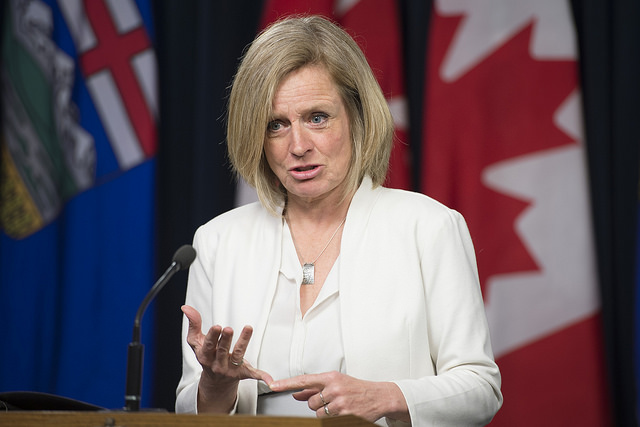
Premier Rachel Notley. Image credit: Premier of Alberta/ flickr
An Open Letter to the NDP Premier of Alberta from Prof. Tony Hall | February 17, 2018
Dear Premier Rachel Notley;
I am writing you this open letter to defend myself against your attack on me personally and professionally. What is the evidentiary basis behind your characterization of my academic work as “repulsive, offensive and not reflective of Alberta”? Why have you decided to set yourself up, Premier Notley, as some sort of arbitrator of what scholarly work in Alberta universities meets the criteria of being “reflective of Alberta”?
Is your opinion about what is or is not reflective of Alberta to become a new test of how curriculum will be created and how faculty members will be chosen in this province? What lies behind your decision to disseminate a caricature of me “standing at the head of the class” in order to “spread lies and conspiracy theories”? [1]
Since I began teaching in the Department of Native American Studies at the University of Lethbridge in 1990, I have never once seen in a student evaluation that reflects the kind of accusations you are pressing publicly on me. How is it you think you know more about me, including and what goes on in my classroom, than my own students?
After a year and a half of being subject to a ruthless trial-by-media, a new process is only now being initiated that from my perspective allows me to come forward for the first time to tell my side of the story before an investigating tribunal operating within the terms of our collective agreement. The process is going forward because of a court contestation that the U of L Board of Governors lost due to its unwillingness to adhere to the laws of labour relations in Alberta. Whose advice was the Board depending on when its members put themselves in such an untenable position?
Before we have even started the process that has come about because of the determined stand of the University of Lethbridge Faculty Association (ULFA) and the Canadian Association of University Teachers (CAUT), you, Premier Notley, chose to inject a politicized salvo into the onslaught of vituperation against me that began on Aug. 26 of 2016.
Here is how the University of Lethbridge Faculty Association described your ill-advised political intervention:
15 Jan., 2018
Re: Premier’s statement re Anthony HallThe Faculty Association wishes to express its disappointment in the Premier’s words. As the union that represents Professor Hall in his employment relationship with the University of Lethbridge, the Faculty Association has endeavoured to have a fair and objective process employed for adjudicating Professor Hall’s academic scholarship and accountability through procedures in the collective agreement. We finally achieved this following significant effort and cost on our part and have a great deal of confidence in the appropriate academic procedures to which Professor Hall is now subject.
Having the Premier draw conclusions about the acceptability of Professor Hall’s academic work prior to any decision rendered by an expert panel of qualified academics has the potential to undermine this very process we have fought to achieve. At worse, though, these words have the real potential to bias the outcome of any such fair and objective process.
The Faculty Association has greatly appreciated the hard work the Premier and her government have done to advance the rights of post-secondary labour. We believe it is a dangerous precedent, however, for elected officials to intervene so directly in a complex labour matter such as this one.Sincerely,
Andrea Amelinckx,
ULFA PresidentCc Honourable Minister M Schmidt
One of the core points I intend to bring forward in my self- defense in the forthcoming process, is to describe the mounting of a negative media campaign against me based on the atrocious contents of a maliciously-engineered Facebook post. According to B’nai Brith Canada, the core agency in orchestrating this media deception, the post appeared on, and then disappeared from, my Facebook wall during an interval of a few hours on Aug. 26, 2016. I did not invite this digital item onto my Facebook wall. I did not sanction its abhorrent contents. In fact I condemned the post’s contents publicly in mid-Sept. when I first became aware of the digital item and the way that it was being deployed to destroy my reputation.
You, Premier Notley, were presented with a deceptive account of my relationship to the Facebook post long before I even knew about the B’nai Brith Canada operation. Recently I learned from the results of a FOIP investigation of the Alberta Ministry of Justice that on Aug. 27, 2016 you and other Alberta cabinet ministers were sent a slanderous account of the Facebook post as if it “came from my lips.” People in the inner circle of your office reported you had seen the communication that slanderously misrepresented me as an “advocate for the murder of Jews.”
If you would actually take a genuine interest in my academic work, Premier Notley, you would realize I have a record of studying all sorts of genocide and condemning this crime against humanity in all its manifestations, including the Jewish Shoah. [2]
Perhaps the people who lied to you about me in late August of 2016 are still holding you captive in terms of filtering the information that has caused you to think whatever it is you believe you know about me. The President of the University of Lethbridge, Dr. Michael J. Mahon, went along with the Facebook deception to suspend this tenured full professor on Oct. 3 and 4, 2016. I was pulled from the classroom in mid-term and banned from stepping foot on campus. This purge took place entirely outside the terms of the collective agreement between the university’s faculty and administration.
This suspension initially without pay essentially declared me guilty until proven innocent. Severe punitive measures were imposed on me all without even an ounce of adjudication by a neutral third-party. From the correspondence I have been receiving from all over the world, I can say my suspension quickly became a shot heard throughout the global academic realm, a shot signaling that an Albertan university is leading an attack on the institutions of tenure, peer review and academic freedom.
Now you have joined in that attack too Premier Notley. You have allied yourself with the position of B’nai Brith Canada, the organization that recently interfered in the leadership race for the new leader of the federal NDP. The same people that set in motion the trial-by-media aimed at me attacked the NDP leadership candidate, Niki Ashton. According to B’nai Brith’s CEO Michael Mostyn, Ms. Ashton’s concern for the violated human rights of Palestinians people made her “an advocate for vile terrorists” and “convicted murders.” It revealed Ms. Ashton’s “defective moral compass.” [3]
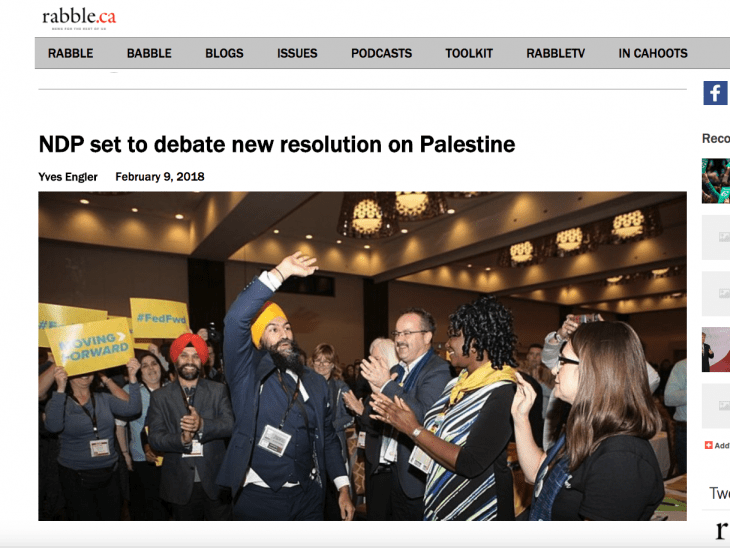
What is your view, Premier Notley, of the condemnation directed at the new NDP federal leader, Jagmeet Singh, when B’nai Brith Canada took aim at him for intervening to provide a venue at the Ontario provincial legislature for a presentation by academic advocates of the rights of educator Nadia Shoufani. The condemnation came in late Augusts of 2016 when Mr. Singh was MLA for the riding of Bramalea-Gore-Malton and Deputy Leader of the Ontario NDP.
At the same time as it was attacking Jagmeet Singh, B’nai Brith Canada was leading the effort to have Ms. Shofani, a Canadian of Palestinian and Christian background, criminalized by police and fired from her teaching job in the Dufferin-Peel Catholic School Board. The criticisms directed at Ms. Shoufani are similar to those directed at Ms. Ashton. Similarly, the effort to criminalize Ms. Shoufani and bar her from the classroom anticipated the similar treatment to which I was about to be subjected. The attack on Ms. Shoufani’s job and her reputation was based on allegations about her supposed “terror-supporting remarks” made in a Quds Day speech in Toronto in July of 2016. [4]
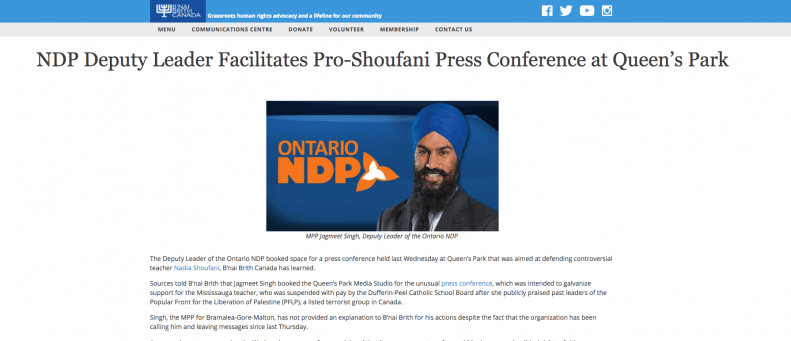
It seems, Premier Notley, your political intervention on the wrong side of the University of Lethbridge case reflects your reactionary alliance with the thought police and speech police at B’nai Brith Canada. Your reactionary stance identifies you with the backward policies of former NDP leader, Tom Mulcair, when he purged pro-Palestinian candidates from the federal election of 2015. This atrocious move was in all probably a significant factor in the disappointing electoral showing of the NDP as it lost its position of Canada’s Official Opposition Party. [5]
Now in Feb. of 2018 B’nai Brith Canada has resumed its efforts to quarterback the NDP, lobbying aggressively to stop a resolution from being put on the floor of the recent NDP convention. The vote, neverthess, was close, 189 for putting the resolution forward and 200 for sidelining it. The resolution included provisions on a Canadian boycott against products produced in the illegal Israeli settlements in the Occupied West Bank.
Those supporting the boycott resolution included the unanimous support of the Young New Democrats, 28 electoral riding associations covering six provinces and many current and former MPs. Geneviève Nevin, a supporter of the resolution from Victoria, observed, “There’s a generational divide on this issue.” In his account of this divide within the NDP, journalist Derrick O’Keefe suggested Jagmeet Singh would be wise to look to the example of Jeremy Corbyn in the UK. Mr. Corbyn has mobilized on behalf of the Labour Party considerable electoral support from his attentiveness to the plight of Palestinian people under Israeli occupation. [6]
By siding so strongly, Premier Notley, with the U of L administration’s collaboration with the Isreal lobby including B’nai Brith Canada and the Centre for Israel and Jewish Affairs, you have identified yourself and your government with agencies that condemned Hassan Diab wrongly as a terrorist. B’nai Brith Canada played a major role in calling for pulling the sociology teacher from his Carleton University classroom in Ottawa. This intervention helped set in notion a miscarriage of justice that saw the Lebanese Canadian academic incarcerated for a decade in Canada and France for a crime he didn’t commit. [7]
You have identified yourself and your government, Premier Notley, with notorious enemies of academic freedom who brought forward during the 50th anniversary of York University all sorts of false allegations much like those I am facing now. This fiasco unfolded when B’nai Brith Canada, the CIJA, the Canadian Jewish Congress and the Jewish Defence League tried to shut down an academic conference on Israel/ Palestine at York University in 2009.
The effort to sabotage this academic initiative was foiled because the York University President, Mamdou Shoukiri, and the York University Board of Governors stood up for the imperatives of academic freedom. [8]
In 2018 in Alberta the equation is very different. The President and Board of University of Lethbridge have adopted the position of the Israel lobby. Now Premier Notley, you have intervened to strengthen this political coalition favouring the stifling of fee and open at Alberta universities. Please consider revisiting you provocative and intellectually bankrupt position on this matter.
Yours Sincerely,
Anthony J. Hall
Professor of Globalization Studies,
University of Lethbridge
Endnotes
[1] Chuck Millar’s Letter to the Alberta Premier—11 January, 2018 at
https://academicfreedomanthonyhall.ca/chuck-millars-letter-to-the-premier-january-11-2018/
Premier Notley indicated on November 24, 2017
There is no question that the views of this individual are repulsive, offensive and not reflective of Alberta. Our classrooms are a place for freedom of speech and expression but that does not mean individuals get to stand at the head of the class and spread lies and conspiracy theories. I am terribly disappointed to learn that this individual has been reinstated, but let me be clear that legislation that our government introduced did not give him his job back. I can confirm that this individual is now under investigation by a committee at the University.”
[2] See, for instance Hall, Earth into Property” Colonization, Decolonization, and Capitalism (Montreal: McGill-Queen’s University Press, 2010), Chapter 14, “Genocide and Global Capitalism,” pp. 655-711
[3] Tony Hall, “Palestinians, B’nai Brith and Canada’s New Democratic Party, Canadian Dimension, 30 July, 2017 at
https://canadiandimension.com/articles/view/palestinians-bnai-brith-and-canadas-new-democratic-party
[4] B’nai Brith Canada, “NDP Deputy Leader Facilitates Pro-Shoufani Press Conference at Queen’s Park,” 24 Aug., 2016 at
http://www.bnaibrith.ca/ndp_deputy_leader_facilitates_pro_shoufani_press_conference_at_queen_s_park
[5] Marion Kawas, “New Democratic Party Purges Candidates over pro-Palestinian positions in lead up to Canadian elections, Mondoweiss, 24 Aug., 2015 at
http://mondoweiss.net/2015/08/democratic-candidates-positions/
[6] Derick O’Keefe, “Palestinian Resolution Narrowly Stopped from Hitting NDP Convention Floor, Richochet, 16 Feb. 2018 at
[7] Judy Haven, “After 10 Years Hassan Diab is Finally Free,” Independent Jewish Voices Canada, at
http://ijvcanada.org/2018/diab-is-finally-free/
[8] Susan G. Drummong, Unthinkable Thoughts, Academic Freedom and the One-State Solution for Israel and Palestine (Vancouver: UBC Press, 2014); Jon Thompson, No Debate: The Israel lobby and free speech in Canadian universities (Toronto: Lorimer, 2011)
***
Dr. Hall is editor in chief of American Herald Tribune. He is currently Professor of Globalization Studies at University of Lethbridge in Alberta Canada. He has been a teacher in the Canadian university system since 1982. Dr. Hall, has recently finished a big two-volume publishing project at McGill-Queen’s University Press entitled “The Bowl with One Spoon”.
NDP could break elite consensus against Palestinian rights
By Yves Engler · February 15, 2018
The anti-Palestinian consensus among Canada’s three main political parties is crumbling and NDP members could bury it this weekend.
After taking an all-expense paid trip to the American Israel Public Affairs Committee’s conference in Washington and participating in a Jewish National Fund event in Israel 14 months ago, the NDP’s foreign critic has begun challenging Canada’s contribution to Palestinian dispossession. Hélène Laverdière has repeatedly criticized the Trudeau government’s silence on Donald Trump’s decision to move the US Embassy to Jerusalem. In response she tweeted, “a devastating day for those who believe in peace, justice and security in the Middle East. Where is Canada’s voice in protest of Trump’s decision on #Jerusalem? I urge Canada to condemn this decision in the strongest of terms.”
The party’s foreign critic also asked the federal government to condemn Israel’s detention of 16-year-old Ahed Tamimi and hundreds of other Palestinian children who are usually tortured by Israeli forces. Similarly, Laverdière has pressed Ottawa to properly label products from illegal Israeli settlements and submitted a petition to Parliament calling “upon the Government of Canada to demand that Israel immediately and completely cease all settlement activities in the occupied Palestinian territory, including East Jerusalem.”
Two weeks ago I received an email on behalf of party leader Jagmeet Singh titled “all people deserve the same human rights”, which listed the party’s recent support for Palestinian rights. It noted, “the NDP shares your concerns about Palestine. NDP Leader Jagmeet Singh and his team of New Democrats have a consistent record of defending Palestinian rights as well as raising concerns over Islamophobia.”
A series of factors are likely driving Laverdière’s shift. She probably never backed former NDP leader Tom – “I am an ardent supporter of Israel in all situations and in all circumstances” – Mulcair’s position. Additionally, last year’s NDP leadership race unleashed ever bolder expressions of support for the Palestinian cause.
Amidst the campaign, Laverdière was criticized for speaking at AIPAC’s 2016 conference in Washington and participating in an event put on by the explicitly racist Jewish National Fund. In August the NDP Socialist Caucus called for her resignation as foreign critic and it has submitted a motion to this weekend’s convention calling for her to be removed from that position.
Ottawa’s high-profile abstention at the UN General Assembly after Donald Trump announced that he would move the US Embassy to Jerusalem has given the NDP an opportunity to distinguish itself from the Trudeau government. And media coverage of subsequent Palestinian resistance, most notably Ahed Tamimi’s courageous slaps, has provided additional opportunities to highlight the Liberal’s extreme anti-Palestinianism.
The NDP leadership is also trying to head off members’ calls to boycott Israel (according to a 2017 Ekos poll, 84% of NDP members were open to sanctioning Israel). At least five resolutions (among more than ten concerning Palestine/Israel) submitted to the convention call for some type of boycott of Israel. The NDP Socialist Caucus has called on the party to “actively campaign” in support of the (just nominated for the Nobel Peace Prize) Boycott, Divestment and Sanctions‘ movement’s demands.
With probably more backing than any of the 100+ resolutions submitted, 30 riding associations and youth committees endorsed “Palestine Resolution”, which calls for “banning settlement products from Canadian markets, and using other forms of diplomatic and economic pressure to end the occupation.” Of course, party leaders fear the media response to any type of boycott resolution being adopted.
Whatever the reason for Laverdière’s shift away from anti-Palestinianism, it remains insufficient. As I’ve detailed, the NDP continues to provide various forms of support to Israel and the party has an odious anti-Palestinian history. In the mid-1970s the party opposed Palestinian Liberation Organization participation in two UN conferences in Toronto and Vancouver and party leader Ed Broadbent called the PLO “terrorists and murderers whose aim is the destruction of the state of Israel.”
That year NDP icon Tommy Douglas also told the Histadrut labour federation: “The main enmity against Israel is that she has been an affront to those nations who do not treat their people and their workers as well as Israel has treated hers.” (Douglas’ 1975 speech was made while Israel occupied the West Bank, Gaza Strip, Golan Heights and Sinai, after it repeatedly invaded its neighbours and ethnically cleansed 750,000 Palestinians from their homeland.)
A progressive party worth its salt campaigns on an international issue in equal measure to its government/society’s contribution to that injustice.
Over the past century Canada has played no small part in Palestinians’ dispossession. Hundreds of Canadians provided military force to realize the crassly anti-Palestinian Balfour Declaration and this country’s diplomats played a central role in the UN’s decision to give the Zionist movement most of Palestine in 1947.
Today, Ottawa regularly votes against Palestinian rights at the UN and subsidizes dozens of charities that channel tens of millions of dollars to projects supporting Israel’s powerful military, racist institutions and illegal settlements. Additionally, Canada’s two-decade-old free trade agreement with Israel allows settlement products to enter Canada duty-free and over the past decade Ottawa has delivered over $100 million in aid to the Palestinian Authority in an explicit bid to advance Israel’s interests by building a security apparatus to protect the corrupt Palestinian Authority from popular disgust over its compliance in the face of ongoing Israeli settlement building.
Hopefully, in the years to come the NDP can help Canada make up for its sad anti-Palestinian history. Perhaps this weekend the party will finally bury official Canada’s anti-Palestinian consensus.
Canadian judge dismisses all charges in lawsuit brought against Dr. Tim Ball by BC Green Party leader Andrew Weaver
Dr. Ball note to Climate Depot – February 13, 2018:
There are no media reports and my guess is there won’t be any.
At 0930 on the day the trial started we were told there was no judge or courtroom assigned. Amazingly and incorrectly, that information was reported almost immediately on media claiming the trial was postponed. It wasn’t, because by 1100 a judge and courtroom were assigned and the trail began at 1130. The postponement story likely explained why no media attended a single day of the three week trial. The nature of the case that involves a so-called climate change denier will likely also be ignored.
The trial was the only one adjudicated so far of the three lawsuits I received from the same lawyer, Roger McConchie, on behalf of three individuals all members of the Intergovernmental Panel on Climate Change (IPCC).
The first was filed on behalf of Gordon McBean, a former Assistant Deputy Minister at Environment Canada. He chaired the founding meeting of the IPCC in 1985.
The second was from Professor Andrew Weaver computer modeller and author on four of the IPCC Reports (1995, 2001, 2007 and 2013).
The third, filed nine days after the Weaver trial, was on behalf of Michael Mann, whose “hockey stick” graph dominated the 2001 IPCC Report and became what Professor Ross McKitrick called the “poster child of global warming.
McConchie also filed lawsuits against the publication in each case, which created confusion and conflict as they wanted to settle.
In the McBean case my wife and I decided not to fight because of the legal cost involved. We simply withdrew the article.
When we received the Weaver lawsuit we decided we would not be bullied into silence by what we considered to be SLAPP (Strategic Lawsuits Against Public Participation) and spent all our savings on legal fees before John O’Sullivan helped us set up a web site and a Paypal donation tab.
We later learned that the publication, Canada Free Press (CFP), had accepted and published an apology written by McConchie. I was not consulted or even informed that this was happening. Meanwhile we had hired Michael Scherr, a defamation lawyer with Pearlman Lindholm in Victoria BC.
The Mann trial was scheduled for February 20, 2017. About a month before the trial, Mann requested an adjournment. Apparently Canadian courts always grant an adjournment before a trial begins in the hope of an out-of-court settlement. I was opposed but had little choice.
The Mann case is interesting because it was filed in the supreme Court of British Columbia (BC) by an American citizen from Pennsylvania about something I said after a public presentation about the deception of manmade global warming in Winnipeg, Manitoba. BC had anti-SLAPP legislation but for some reason cancelled it. Now only two of ten Canadian Provinces, the other is Ontario, do not have anti-SLAPP legislation.
By the summer of 2017 a date for the Weaver trial was set and it was held in November over three weeks in Vancouver, Canada. Between filing the lawsuit and commencement of the trial, Weaver was elected as a Green Party member for the BC Legislature. At the trial he was the Green Party leader in his second term. The theme of the article he sued me for defamation involved the claim that the political hijacking of climatology by the IPCC set back climate research and understanding by 30 years. In the article I made comments about an interview and experience I had with Weaver that I did not fully substantiate. I wrote a letter of apology for those unsubstantiated comments but not for the overall claims of the article. Weaver posted my letter of apology on what he labelled a “wall of hate” in his University office. It appears just under his left arm in the photo at the link below.
Here is a newspaper article that shows Weaver in front of his wall of hate, apparently designed to show who and how nasty the attacks he sustained because of his views on global warming and attempts to save the planet.
The judge ruled that Weaver was not defamed by me and dismissed the claim completely. This was after almost seven years and thousands of dollars in legal costs.
Now we prepare to bring the Mann case back to the court.
Featured Video
No Threat Can Force Iran’s Surrender /Trita Parsi & Lt Cl Daniel Davis
or go to
Aletho News Archives – Video-Images
From the Archives
What is the Israeli Lobby in Australia Doing in Interfaith Dialogue?
By Ali Kazak | Dissident Voice | October 11, 2015
For years Israel and its lobby around the world have been trying to normalise their relations with Arabs and Muslims without solving the Palestine Question.
One of the methods they resorted to in the last few years is using human rights and community organizations such as interfaith dialogue and Multiculturalism to achieve this objective and to: isolate the Palestinians, marginalise the Palestine question, end Israel’s isolation, and prevent criticism of Israel, knowing that these organisations will be the first to stand against Israel’s violations, racial and religious discrimination.
The group responsible for this task in Australia is The Australia/Israel & Jewish Affairs Council (AIJAC); its Director of International & Community Affairs, Jeremy Jones is in charge of lobbying religious community organizations, specifically Muslims and Christians. Consequently he convened the Faith Communities for Reconciliation, founding participant in the Australian Partnership of Religious Organisations and the Australian National Dialogue of Christians, Muslims & Jews.
AIJAC is a private political propaganda group. It is recognised as the main Israeli lobby in Australia. It coordinates its activities and works intimately with the Israeli embassy in Canberra and different institutions in Israel. It is privately funded by some Jewish businessmen. It monitors closely Australian politicians, the media, ethnic and religious groups, (especially Arabs and Muslims), unions and academics on their stands towards Israel and the Palestine question. … continue
Blog Roll
 Aletho News
- The war of liberation of the Arab and Islamic peoples expands across the Gulf
- Envoy warns UN on Trump’s threat to ‘obliterate’ Iran’s civilian infrastructure
- The Larak Corridor: Iran’s Rial Gate With No US, No Israel, and No Way Around
- ‘Economic terrorism’: Steel facilities hit again in US-Israeli strike
- ‘War Crime’: Iran condemns attacks on Arak, Ardakan nuclear sites
- Two-thirds of Americans want quick end to Iran war even if goals unmet
- Trump to Give “Important Update on Iran” Wednesday in Prime-Time Speech
- Theodore Postol: Iran’s Missiles & Drones Were Underestimated
- Iran To Target Military Industrial-Tech Complex That Facilitated Gaza Genocide
- Collapsing Empire: The Resistance Disarms ‘Israel’
- If Americans Knew
- Israel wants US to bomb more of Iran’s civilian structures (113,000 is not enough) – Not a ceasefire Day 173
- Ann Coulter Rips Into Fox News for Iran War Coverage
- Joe Kent Urges Americans To Call White House and Congress To Object To Sending Troops Into Iran
- DNC Resolution to Reject AIPAC Funding Puts Democratic Leaders in the Hot Seat
- Swedish foundation to build 400 schools as over 650,000 Gaza children remain without education for 2 years
- Israeli army admits photshopping image of slain Lebanese journalist
- This is how Israel is systematically killing health workers under the cover of war in Lebanon
- Carrying life under fire: Israeli invasion of Lebanon leaves pregnant women facing deadly risks
- Champagne all around for the new death penalty (for Palestinians) law – Not a ceasefire Day 172
- Why are Palestinian books struggling to be seen on Amazon?
- No Tricks Zone
- New Study Finds Warming Saves Lives…Cold Temperatures 12 Times More Deadly Than Excess Heat
- German Science Blog Accuses PIK Climate Institute Of Hallucinating Climate Tipping Points
- Devastating Assessment Of Comirnaty Vaccine By Former Senior Pfizer Europe Toxicologist
- New Study: CO2 Is ‘Effectively Negligible’ As An Explanatory Climate Change Factor Since 2000
- Former Pfizer Toxicologist Dr. Helmut Sterz Tells Bundestag Hearing Pfizer Vaccine Should Have Never Been Approved
- Energy Expert: Germany’s Nuclear Phaseout Was A “500 Billion Euro Mistake”
- New Research: South Australia’s Mid-Holocene Sea Surface Temperatures Were 4°C Warmer Than Today
- Storing Green Energy To Last Germany 10 Days Would Require A 60-Million Tonne Battery
- New Studies: UK Sea Levels Were 4 Meters Higher Than Today During The Mid-Holocene
- Destructive Green New Deal: German Energy And Metal Group Warns Of Drastic Crisis
 Aletho News