Scientists and media continue to spread misinformation about polar bears & walrus
BY Susan Crockford | Polar Bear Science | November 5, 2017
“Lies” might be a better word to characterize the misinformation that scientists and the media have been busy spreading to the public over the last few weeks. The information is either known to be false (by scientists whose job it is to relay facts honestly) or is easily shown to be false (by journalists whose job it is to fact-check their stories).

Polar bear misinformation
Earlier this month, biologist Nick Lunn was interviewed by the CBC and for the news program The National. He stated outright, without qualification, that Western Hudson Bay polar bear numbers have dropped from about 1200 (in 1987) to about 800 now (a 33% decline).
However, it is not scientifically appropriate to compare these figures because they were based on different types of surveys conducted over different portions of the region (they are also statistically insignificant). Lunn should know better because the published reports (Dyck et al. 2017; Stapleton et al. 2014; Lunn et al. 2016) make it clear these numbers are not comparable.
The official Western Hudson Bay estimate accepted by the PBSG in 2014, and by the IUCN in 2015, is 1030 bears (range 754-1406), based on the survey conducted by Stapleton and colleagues in 2011. Environment Canada considered the subpopulation ‘likely stable’ in 2014, an assessment upheld by the 2016 survey.
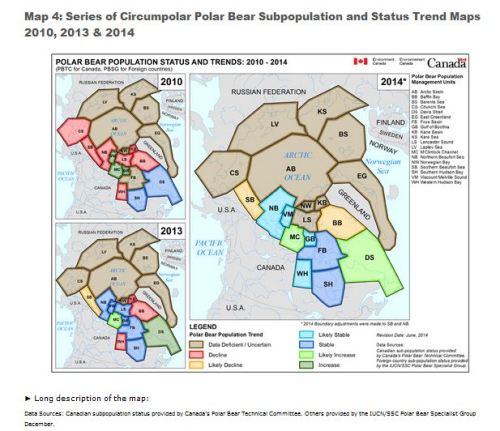
Because even the 2011 and 2016 Western Hudson Bay aerial surveys used somewhat different methods, the only population size numbers (subsets of each total) that can be compared are these:
2011 (949, range 618-1280)
2016 (842, range 562-1121)
The slight apparent decline over 5 years (11%) was not statistically significant (Dyck et al. 2017, pg. 3, 37) and is therefore equivalent to no change.
Similarly, when differences in methodology and statistical significance are taken into account, the estimate for 2016 cannot be said to be different from the 2011 estimate of 1030 bears (Stapleton et al. 2014), which was not statistically different from the estimate of 935 (range 794-1076) calculated in 2004 (Regehr et al. 2007).
‘Likely stable’ is probably the best way to characterize this result.
However, biologist Andrew Derocher has also been guilty of misrepresenting the facts on the Western Hudson Bay population status over the last few weeks:
Western Hudson Bay #polarbears decline >30% & Nunavut increases harvest quota. “almost impossible, to recommend” says Wildlife Director. pic.twitter.com/ogdqZ14HhW
— Andrew Derocher (@AEDerocher) November 3, 2017
And…
Aerial surveys ==> large confidence intervals & we'd need > 50% decline for statistical significance. Not precautionary management to wait https://t.co/cMw61Rwg71
— Andrew Derocher (@AEDerocher) September 14, 2017
— Andrew Derocher (@AEDerocher) September 14, 2017
And…
Western Hudson Bay #polarbear population dropped from 1030 bears to 842 over 2011-2016. 18% decline. Not “slight”. https://t.co/AoVSqWSQjw pic.twitter.com/tmlgYlZ3a1
— Andrew Derocher (@AEDerocher) September 14, 2017
Bottom line: The 2011 estimate of 1030 cannot be compared to the 2016 estimate of 842 (or to the 1987 estimate of 1200) because these numbers were generated using different methods. Lunn and Derocher know this: it’s their job to know. But it’s their job to honestly relay scientific facts to the public, not an interpretation of those facts they’d prefer to be true.
Ironically, all this hype is being promoted as Hudson Bay seems gearing up for the earliest freeze-up in decades (here, here, and here).
In the chart below, grey ice (dark purple) is thick enough for an adult male polar bear to walk on. The new ice could still get blown out into the bay if the wind is right (from the south) but that does not seem likely under conditions of freezing cold temperatures, snow, and west and northwest winds at Churchill (for 5-8 November).

Walrus misinformation

Here is Christopher Booker (The Telegraph, 4 November 2017) on the walrus nonsense being told by the BBC via its news body and its documentary series, “Blue Planet II”.
“… the BBC yet again [claimed] that Arctic ice is rapidly vanishing, supported on BBC News by a clip from David Attenborough’s Blue Planet II series, intoning that, among species most “seriously affected” by global warming, are walruses, showing hundreds of them desperately squeezing on to a melting ice floe.
But there are one or two little problems with this BBC version of the facts. First, far from Arctic ice vanishing, there has been no further downward trend in the extent of its summer melting since 2006. Its lowest point this September was higher than in seven of the past 11 years.
The US Fish and Wildlife Service has found that there are so many more of them than there were 30 years ago that last month that it decided not to list Pacific walruses on its endangered species list.
Secondly, far from walruses being “seriously affected”, an exhaustive survey by the US Fish and Wildlife Service has found that there are so many more of them than there were 30 years ago that last month that it decided not to list Pacific walruses on its endangered species list.
Thirdly, what produced that 2016 spike in CO2 and global temperatures was not “human activity” but the unusual warming of the Pacific Ocean by an abnormally strong El Niño. It is this warming that causes the oceans to “outgas” more CO2, not the CO2 that causes the warming: as even the BBC was told when, in July last year, its website quoted the Met Office under the heading “El Niño likely to boost CO2 in 2016”.
Since that El Niño ended, however, the latest Met Office data show that ocean temperatures have dropped sharply, with global surface temperatures back to where they were in 2002. Which is why the BBC’s reporting of all this last week could scarcely have been a better example of what it likes to scorn as “fake news”.
I couldn’t have said it better myself, except to add that Atlantic walrus, which the Blue Planet II folks filmed for their documentary, also show no evidence of being negatively impacted by climate change or sea ice loss so far.
Such disgraceful journalist practice is no better than the reaction of the CBC Radio here in Canada last month (4 October) to the news that the USFWS would not list walrus as ‘threatened.’
Instead of getting a scientist on to explain to listeners the science backing the decision, it had a spokesperson from the litigious Centre for Biological Diversity advocacy organization on the show to present a boring and quite predictable rant about why she disagreed with the decision. Of course she’s disappointed: she authored the document that forced the USFWS to consider the listing!
Bottom line: Have journalists forgotten how to do their jobs or do they really believe their opinions on certain subjects give them free license to ignore the ethics of their profession?
Actually, I could ask the same question about the polar bear specialists.
References
Dyck, M., Campbell, M., Lee, D., Boulanger, J. and Hedman, D. 2017. 2016 Aerial survey of the Western Hudson Bay polar bear subpopulation. Final report, Nunavut Department of Environment, Wildlife Research Section, Iglolik, NU. http://www.gov.nu.ca/environnement/information/wildlife-research-reports#polarbear
Lunn, N.J., Servanty, S., Regehr, E.V., Converse, S.J., Richardson, E. and Stirling, I. 2016. Demography of an apex predator at the edge of its range – impacts of changing sea ice on polar bears in Hudson Bay. Ecological Applications, in press. DOI: 10.1890/15-1256
Regehr, E.V., Lunn, N.J., Amstrup, S.C. and Stirling, I. 2007. Effects of earlier sea ice breakup on survival and population size of polar bears in Western Hudson Bay. Journal of Wildlife Management 71:2673-2683.
Stapleton S., Atkinson, S., Hedman, D., and Garshelis, D. 2014. Revisiting Western Hudson Bay: using aerial surveys to update polar bear abundance in a sentinel population. Biological Conservation 170:38-47. http://www.sciencedirect.com/science/article/pii/S0006320713004618#
Canada Sanctions Venezuela’s Maduro
By Ryan Mallett-Outtrim | Venezuelanalysis | November 3, 2017
Canada announced Friday it had imposed new sanctions on President Nicolas Maduro and other senior government officials.
A total of 19 officials and ex-officials were targeted, including Vice-President Tareck El Aissami, intelligence czar Gustavo Gonzalez, and Oil Minister Eulogio del Pino.
Canada’s Foreign Ministry accused Maduro and other targeted officials of being “responsible for, or complicit in, gross violations of internationally recognized human rights, have committed acts of significant corruption, or both”.
“Canada is determined to protect human rights and combat corruption worldwide,” Canadian Foreign Minister Chrystia Freeland said.
“Today’s announcement sends a clear message that Canada will take action against individuals who have profited from acts of significant corruption or who have been involved in gross violations of human rights,” Freeland said.
The Foreign Ministry did not, however, provide evidence to bolster its human rights and corruption allegations against the 19 officials.
The measures were authorized under Canada’s newly approved Magnitsky Act, which was modelled on its controversial 2012 US predecessor that blacklisted Moscow officials allegedly linked to the 2009 death of lawyer Sergei Magnitsky in a Russian detention center. Thirty Russian officials and three South Sudanese government leaders have also been targetted.
The sanctions include “an asset freeze in Canada on all listed people, and render listed persons as inadmissible to Canada”.
According to the Foreign Ministry, these sanctions are “in addition to sanctions imposed on September 22, 2017”, in which 40 high-ranking Venezuelans were targeted.
Caracas has yet to respond to the move, though it has condemned previous rounds of sanctions as part of a US-led effort to promote regime change.
Over the past year, Canada has stepped up its pressure on the Maduro administration. In August, Ottawa joined a 12 nation bloc, known as the Lima Group, which has pushed for economic sanctions as well as an international arms embargo against Venezuela.
Last month, Canada hosted the second meeting of the Lima Group in Toronto where it urged regional governments to take steps to “further isolate” Venezuela.
The Canada-Israel Nexus – Book Review
Reviewed by Jim Miles | Palestine Chronicle | October 27, 2017
 For a complex and critical examination of the relationship between Canada, Israel, Judaism, and Zionism, Eric Walberg’s new work The Canada-Israel Nexus provides a challenging perspective.
It is challenging in several ways. Primarily, the most important ideas are the critical lines of thought towards the impact of Zionism within Canada. This includes the influences on the media, academics and academia, and the political. The latter mostly affects Canada’s foreign affairs position as a sycophant of the U.S. empire, but in many ways as a leading vocal supporter of Israeli Zionism and its colonial-settler policies.
Throughout the book, comparisons are made between Israel’s recent colonial-settler actions through its settlements, military law, and other civic aspects (education in particular), and the actions previously of the Canadian government towards its indigenous populations. While being different in particular details, the overall actions are very similar, especially considering Canada’s recent very public acknowledgement – both domestically and at the UN – of its own attempts at cultural genocide and ethnic cleansing.
The first chapters cover the historical developments. First, that of Canada and its history of dispossession, Christianization, residential schools, (the last two were still ongoing through the Twentieth Century), assimilation and broken treaty promises towards the indigenous populations. Next, a brief outline of Jewish Zionist history covers the creation of Israel and its rise to a militarized nuclear power extending empire into a Middle East riven by war created by those supporting that extension.
Two longer chapters cover the history of Jewish people in Canada. The essential story is that of a self-isolating community being the ‘ragpickers’ of the communities, rising quickly to be behind the scenes power players in politics and the media. Today, the pro-Israeli stance has been successfully entrenched in Canada from all political parties (except for the Greens, who in spite of their leaders’ rhetoric, have supported a position supporting BDS).
In what will probably prove to be the most controversial section, Walberg discusses the Canadian right-wing activists who have denied the Israeli narrative and how they have been silenced by the courts and media. He extends the idea of holocaust to cover other mass killings, in particular that suffered by Russia during WW II, and the “ongoing slow-motion holocaust against the Palestinians.” Both Russia and the Palestinians as terrorists are both highly maligned in Canada’s press and political realm with the U.S. and Israeli imperial viewpoints being strongly supported.
A final look is taken concerning the parallels between the two ‘native nations’ of Canada and Israel. Humanitarian law, the UN Declaration on the Rights of Indigenous Peoples, oil, pipelines, water resources, laws and the courts, education, and religious theology all carry similarities. The more recent actions defining or redefining antisemitism and Israel’s ongoing hasbara efforts (the act of explaining – now more broadly defined in its context at manipulating public attitudes towards Israel) reflect the impact of global dissidents against imperial hegemony supported by Canada and Israel.
The Canada-Israel Nexus is a thought provoking and challenging work, an important addition to the discussion of Canada’s relationship domestically with its own indigenous population and its foreign policy relationship with Israel and the greater imperial games of the west.
– Jim Miles is a Canadian educator and a regular contributor and columnist of opinion pieces and book reviews for The Palestine Chronicle. Miles’ work is also presented globally through other alternative websites and news publications.
(The Canada-Israel Nexus. Eric Walberg. Clarity Press, Atlanta, Georgia. 2017.)
Chrystia Freeland: Canada doesn’t engage in “regime change”
A huge surprise to the people of Libya, Haiti, Honduras, Chile, Democratic Rep. Congo, Ghana, Uganda, Guatemala, and …
By Yves Engler | Dissident Voice | October 31, 2017
It may walk and quack like a regime-change-promoting duck, but Ottawa’s unilateral sanctions and support for Venezuela’s opposition is actually just a cuddly Canadian beaver, says Chrystia Freeland.
“Canada has never been an imperialist power. It’s even almost funny to say that phrase: we’ve been the colony,” said the journalist turned politician after a Toronto meeting of foreign ministers opposed to the Venezuelan government.
The above declaration was part of the Canadian foreign minister’s response to a question about Chavismo’s continued popularity, which was prefaced by a mention of protesters denouncing Ottawa’s interference in Venezuela’s internal affairs. Freeland added that “one of the strengths Canada brings to its international affairs” is that it doesn’t engage in “regime change”.
Notwithstanding her government’s violation of the UN and Organization of American States charters’ in Venezuela, Freeland’s claim that Ottawa doesn’t engage in “regime change” is laughable. Is she unaware that a Canadian General commanded the NATO force, which included Canadian fighter jets, naval vessels and special forces, that killed Muammar Gaddafi in Libya six years ago?
Sticking to contexts more directly applicable to the situation in Venezuela, Ottawa has repeatedly endorsed US-backed military coups against progressive elected leaders. Canada passively supported the ouster of Iranian Prime Minister Mohammad Mossadegh in 1953, Guatemalan President Jacobo Arbenz in 1954, Ugandan President Milton Obote (by Idi Amin) in 1971 and Chilean President Salvador Allende in 1973.
In a more substantial contribution to undermining electoral democracy, Ottawa backed the Honduran military’s removal of elected president Manuel Zelaya. Before his 2009 ouster Canadian officials criticized Zelaya and afterwards condemned his attempts to return to the country. Failing to suspend its military training program, Canada was also the only major donor to Honduras — the largest recipient of Canadian assistance in Central America — that failed to sever any aid to the military government. Six months after the coup Ottawa endorsed an electoral farce and immediately recognized the new right-wing government.
In the 1960s Ottawa played a more substantial role in the ouster of pan-Africanist independence leaders Kwame Nkrumah and Patrice Lumumba. In 1966 Ghana’s Canadian-trained army overthrew Nkrumah. In an internal memo to External Affairs just after Nkrumah was ousted, Canadian high commissioner in Accra, C.E. McGaughey wrote “a wonderful thing has happened for the West in Ghana and Canada has played a worthy part.” Soon after the coup, Ottawa informed the military junta that Canada intended to carry on normal relations and Canada sent $1.82 million ($15 million today) worth of flour to Ghana.
Ottawa had a strong hand in Patrice Lumumba’s demise. Canadian signals officers oversaw intelligence positions in the UN mission supposed to protect the territorial integrity of the newly independent Congo, but which Washington used to undermine the progressive independence leader. Canadian Colonel Jean Berthiaume assisted Lumumba’s political enemies by helping recapture him. The UN chief of staff, who was kept in place by Ottawa despite being labelled an “imperialist tool” by Lumumba’s advisers, tracked the deposed prime minister and informed army head Joseph Mobutu of Lumumba’s whereabouts. Soon after Lumumba was killed and Canadian officials celebrated the demise of an individual Prime Minister John Diefenbaker privately called a “major threat to Western interests”.
It’s in the Western Hemisphere’s poorest nation where Canada was most aggressive in opposing a progressive government. On January 31 and February 1, 2003, Jean Chrétien’s Liberal government organized an international gathering to discuss overthrowing Haiti’s elected government. No Haitian officials were invited to the “Ottawa Initiative on Haiti” where high-level US, Canadian and French officials decided that president Jean-Bertrand Aristide “must go”, the dreaded army should be recreated and that the country would be put under a Kosovo-like UN trusteeship.
Thirteen months after the “Ottawa Initiative on Haiti” meeting Aristide and most other elected officials were pushed out and a quasi UN trusteeship had begun. The Haitian National Police was also heavily militarized.
Canadian special forces “secured” the airport from which Aristide was bundled (“kidnapped” in his words) onto a plane by US Marines and deposited in the Central African Republic. Five hundred Canadian troops occupied Haiti for the next six months.
After cutting off aid to Haiti’s elected government, Ottawa provided tens of millions of dollars in foreign aid to the installed government, publicly supported coup officials and employed numerous officials within coup government ministries. Haiti’s deputy justice minister for the first 15 months of the foreign-installed government, Philippe Vixamar, was on the Canadian International Development Agency’s payroll and was later replaced by another CIDA employee (the minister was a USAID employee). Paul Martin made the first ever trip by a Canadian prime minister to Haiti to support the violent post-coup dictatorship.
Dismissing criticism of Ottawa’s regime change efforts in Venezuela by claiming Canada has been a benevolent international actor is wholly unconvincing. In fact, a serious look at this country’s foreign policy past gives every reason to believe that Ottawa is seeking to unseat an elected government that has angered many among the corporate set.
Anyone with their eyes open can tell the difference between a beaver and a duck.
Yves Engler is the author of A Propaganda System: How Canada’s Government, Corporations, Media and Academia Sell War and Canada in Africa: 300 years of aid and exploitation.
Indigenous Canadian women file lawsuit against authorities over coerced sterilizations
Press TV – October 28, 2017
Two indigenous Canadian women have initiated legal action against authorities over claims that they have been subject to coerced sterilizations, a report says.
The unnamed women, according to a report by the British newspaper The Guardian filed a class-action lawsuit against Canadian health authorities for what the pair described as being coerced into undergoing sterilization upon their delivery at Royal University Hospital in Saskatoon in the mid-western province of Saskatchewan, where they originally belong.
The legal challenge, which still requires certification by a judge, was launched against the Saskatchewan government, the Saskatoon Health Region, several individual doctors, and Canada’s attorney general at Saskatoon Court. If certified, the suit would reportedly seek $7 million in damages per woman.
The lawsuit focuses on the idea of proper and informed consent, and whether this was secured before the women underwent a tubal ligation operation.
One of the plaintiffs alleges that she openly refused to have her fallopian tubes tied when hospital staff proposed the procedure after she gave birth to her son in 2001. However, despite her objections, she was wheelchaired to the operating room, still weak from delivery, and the procedure was performed.
The second complainant alleges that a physician suggested tubal ligation as she was taken to the operating theater in a wheelchair for an emergency cesarean section in 2008. She said she had already been given an epidural administration to ease the deep pain she was in.
The issue of coerced sterilizations in the Canadian province came into the spotlight in 2015, when a number of women reported an alleged tubal ligation carried out immediately after childbirth at a hospital.
The present suit was filed after health authorities in Saskatchewan admitted in late July that several women had come forward with similar claims. The Saskatoon Health Region at the time apologized publicly for previous forced sterilizations after a 57-page review was issued on the postpartum tubal ligation policy that was in place from 2005 to 2010.
Alisa Lombard, the attorney representing the plaintiffs, believes that this is not an indigenous issue, but rather a violation of human rights.
Indigenous people make up about four percent of the Canadian population and suffer from higher levels of poverty and violence. Their plight has been the concern of international rights groups as well as the United Nations that have come with numerous disturbing reports in the past.
Israel finally ends $10 billion binary options scam – or does it?
By Alison Weir | If Americans Knew | October 26, 2017
Israeli lawmakers have finally passed a law they say will ban Israel’s notorious binary options industry, which has brought in $10 billion a year.
The money was made by scamming millions of people around the world. A recent Reuters article reports: “London-based lawyers said hundreds of their clients were duped out of vast sums of money by some Israeli firms. More than 100 operators are estimated to be based in Israel, a technology hub.”
The industry was officially banned in the U.S. but Israeli operators still managed to scam many Americans. An article in Finance Feeds reports: “America is still a target for these nefarious entities whose methodology stems not from the financial markets or technology sectors, but from the lowbrow depths of online gambling, lead buying and affiliate marketing in Israel.”
News stories through the years have described misery and suicides among victims. Finally, a year ago the Israeli government banned sales of binary options to Israelis, but continued to permit them to the rest of the world.
The current bill that now also outlaws sales abroad was passed when Israeli legislators became concerned that the industry was hurting Israel’s image.
The Jewish Telegraphic Agency (JTA) reports that Knesset member Rachel Azaria said in introducing the recent bill: “We worry about the BDS movement. This industry has a huge impact on how Israel is viewed throughout the world. Our government officials go to international conferences and their colleagues abroad raise their eyebrows because of this industry.”
Israel National News reports that notes on behalf of the proposed legislation warned that “Israeli binary option companies risked damaging the country’s reputation and ‘could foment anti-Semitism’.”
The Times of Israel reports that the legislation was catalyzed by the outcry “among overseas law enforcement agencies, with the FBI at the forefront, that Israel was allowing this ‘monstrous’ fraud to flourish year after year.”
For years the Israeli government did little to stop it. JTA reports that despite widespread awareness of the scam, “Only a handful of Israelis have been arrested for binary options fraud, and none have been indicted, even as international law enforcement against the industry has ramped up.”
The article reports that an Israeli police superintendent “said Israeli organized crime was being massively enriched and strengthened because of law enforcement’s failure to grasp the scope of the problem.”
The law is set to take effect in three months, but some raise questions about it, charging that it lets perpetrators off the hook without punishment, allows scammers to simply relocate, and exempts similar activities, allowing the massive profits through victimization to continue.
The Times of Israel reports: “The original text was watered down — creating loopholes through which binary options and other rogues, simply by retooling what they do, will be able to continue to prosper.”
Austin Smith, founder of a company that reclaims money for binary options victims, calls the law “total garbage” that allows perpetrators to shift into new rackets without answering for their past scams.
“It’s more a political talking point than actually something with teeth that’s going to stop more fraud from being perpetrated,” he said. “It also does nothing to help victims of fraud recover any of their money.”
JTA reports that Smith is working with attorneys around the world to track down the heads of binary options companies as they open new operations in Cyprus and elsewhere, moving into such industries as diamond sales, cryptocurrencies and predatory business loans.
The original legislation authored by the Israel Securities Authority would have also outlawed similar gambits – companies involved in the foreign exchange market, or Forex, and CFD financial instruments. Pressure from lobbyists caused these to be removed from the bill.
Also, some actions are still permissible under the new law. Finance Magnates reports that binary options agents will be allowed “to provide research and development services (in other words – to develop the trading software) and to sell trading software as a shelf product.”
The FM article points out: “It remains to be seen how the amendment will be enforced.”
In particular, the question may be “how much flexibility the Israeli Securities Authority (ISA) will show when industry players, especially technology and platform solutions providers, seek relief or exemption from the ISA by trying to establish that their services do not amount to operating a trading platform but rather are in the permitted realm of software development.”
The Times of Israel reports: “Binary options owners and investors include former senior employees of the state, well-known public figures, relatives of former senior police officers and more. Immensely wealthy, some of the key figures make substantial charity donations — which in turn give them access to political figures all the way to the very top of the Israeli hierarchy.”
Past, present, and future problems
The Times of Israel, whose investigative journalists were instrumental in raising the alarm about binary options, reports that some elements of the back story to the current bill “raise extremely disturbing questions about the power of Israel’s criminal classes, the integrity of some of our legislators, and the quality of our law enforcement authorities.”
The article describes courageous actions by many Israelis intent on ending the scam. It also describes major failures and predicts deep problems for the future.
The article by David Horovitz, Why binary options ban is only a small victory in the war on Israeli corruption, is subtitled: “MKs finally moved this week to shut down a mega fraud. But the legislative process exposed the impotence of law enforcement… and the growing intimidatory power of Israel’s crooks.”
Following are some excerpts from Horovitz’s indepth report:
“The binary options crooks were barred from targeting Israelis in March 2016, but were being allowed to continue to steal from foreigners — and still are, in fact, because Monday’s law only goes into effect three months from now.”
“it quickly emerged that the police complaints bureaucracy is set up in such a way as to make it almost impossible for overseas victims of crime hatched in Israel to so much as report the matter.”
“when a Canadian father of four named Fred Turbide took his own life after an Israeli binary options firm stole all his money, and a clear paper trail established exactly who had defrauded him, the police did not take any action against the individuals and company involved, which continued to operate.”
“The fraudulent salespeople routinely conceal where they are located, misrepresent what they are selling and use false identities. (The FBI affidavit against Elbaz goes into considerable detail to explain the fraud, in all its miserable manifestations.)”
“The crooks are still out there. Some binary options firms have closed down. Others have relocated overseas, including to Cyprus and Ukraine. Some of the prime movers and shakers have already adjusted their focus to other fraudulent fields — in the fields of diamond sales, cryptocurrencies, initial coin offerings and predatory business loans.
“Top scammers are still enjoying the vast overseas bank accounts, the yachts, luxury cars, exotic holidays and other profits of their ill-gotten gains.”
“The ranks of binary options owners and investors include former senior employees of the state, well-known public figures, relatives of former senior police officers and more. Immensely wealthy, some of the key figures make substantial charity donations — which in turn give them access to political figures all the way to the very top of the Israeli hierarchy.
“They also donate to Jewish religious causes, for example Tel Aviv’s Great Synagogue, again with consequent friends in high places.”
“Some of those thousands of Israelis who have been drawn into lives of crime in the industry — cynical swindlers posing as financial experts and advisers, gloating at the naivety of their victims — are extremely cunning. And many of the higher-ups — including the computer coders, the lawyers, the affiliate marketers, and the SEO experts who manipulate Google and social media to ensure the prominence of seductive content hyping the ostensible potential for profit — are despicably smart. They will not go down without a fight. Israeli law enforcement seems largely disinclined even to try to tackle them, much less capable of doing so.”
“Monday night’s passage of the law banning binary options was but a small winning battle in what, to this extremely worried Israeli, looks for now like a losing war, a war Israel is barely bothering to fight, against a toxic cocktail of corruption.”
Alison Weir is executive director of If Americans Knew, president of the Council for the National Interest, and author of Against Our Better Judgment: The Hidden History of How the U.S. Was Used to Create Israel. Her upcoming book talks are listed here.
Canada Rejects Venezuela Vote, EU Mulls Sanctions & Russia Congratulates Government
By Rachael Boothroyd Rojas | Venezuelanalysis | October 18, 2017
Twenty-eight European Ministers jointly agreed to “establish the legal framework” for pursuing sanctions against the Venezuelan government Monday in the wake of the country’s regional elections, Europa Press has reported.
Venezuela’s government won eighteen out of twenty-three states in regional elections this past Sunday, but the results have been disputed by the right-wing opposition, the US, Canada and France, on the basis of alleged foul play.
Opposition spokespeople have so far been unable to corroborate their allegations of fraud, while international electoral observers have testified to the veracity of the results. Venezuelan political commentators have said that mass abstention of opposition voters due to disillusionment with their leaders was the reason for the shock result.
Speaking at an EU meeting in Luxembourg Monday, EU Foreign Policy chief Federica Mogherini cautiously described the election results as a “surprise” and asked for investigations to “clarify what happened in reality”.
Ministers also agreed to advance in the preparation of “selective, gradual and reversible” sanctions against members of Venezuela’s Nicolas Maduro administration, with some apparent reticence from Portugal.
The EU has been discussing the potential implementation of sanctions against individuals within the Venezuelan government since the US imposed economic sanctions against Venezuela in August. Canada also followed suit shortly after with asset freezes targeting top Caracas officials.
Venezuelan President Nicolas Maduro responded to the decision Tuesday, accusing Mogherini of only listening to opposition voices in Venezuela, and inviting her to call him or arrange a meeting in Brussels.
Meanwhile, Canada officially added its voice to the international chorus of condemnation against the regional election results Tuesday.
In an official statement, Canadian Foreign Affairs Minister Chrystia Freeland said that “Sunday’s elections were characterized by many irregularities that raise significant and credible concerns regarding the validity of the results.”
She also added her government would continue to “stand for the Venezuelan people and for the defence and restoration of democracy in Venezuela.”
Freeland had already tweeted on Monday that her government was “”very concerned by yesterday’s polling centre closures & relocations – clearly favouring #Venezuela regime, hindering free + fair elections”. Her stance was criticized by Canada’s Communist Party.
Canada is a member of the so-called Lima Group – a regional organization made up of right-wing regional governments opposed to the Maduro administration, including Argentina, Brasil, Canada, Chile, Colombia, Costa Rica, Guatemala, Honduras, Mexico, Panama, Paraguay, and Peru.
On Tuesday, the Lima Group likewise claimed that the elections were marred by irregularities, and demanded a full “independent audit” of results. Venezuelan President Nicolas Maduro had already called for an audit of 100 percent of votes Sunday.
The Lima Group is due next to meet in Canada on October 26, when it will discuss Venezuela’s regional elections and the ongoing stand-off between the government and opposition.
But not all international governments have condemned the elections, and the Maduro administration has received supportive statements from Russia, Cuba, Bolivia and other Latin American leaders.
For its part, Russia said the elections represented a new opportunity to address the “pressing economic and social problems facing the country” and criticised the opposition’s refusal to accept the results.
“The population demonstrated its commitment to civilized, first of all electoral, ways of settling political differences,” reads a statement from the Russian Foreign Ministry.
“Given this, the opposition’s refusal to recognize the results of the voting and calls for more street protests and tougher international sanctions are fraught with negative consequences. This may frustrate the emerging scenario of compromise and trigger another spiral of violence and confrontation,” the ministry added.
In addition, Russia urged Venezuelan political forces to refrain from violence, and spoke in support of dialogue between the opposition and national government “to stop attempts at destructive interference from outside.”
“The counter-productiveness of force and sanction pressure on Venezuela is obvious,” the ministry underscored.
Meanwhile, the government of Cuba also congratulated the Maduro government on the election win.
“Dear Nicolas: I congratulate you for the results of state elections. Venezuela has shown another example of peace, democratic vocation, courage and dignity,” Cuban President Raul Castro said in a letter published by Cuba’s Foreign Relations Ministry.
Bolivian President Evo Morales also took to Twitter to say that “In Venezuela, peace triumphed over violence, the people triumphed over the empire. [Organization of American States Secretary-General] Luis Almagro lost, along with his boss [US President] Trump”.
En Venezuela triunfó la paz frente a la violencia, triunfó el pueblo frente al imperio. Perdió Luis Almagro con su jefe Trump.
— Evo Morales Ayma (@evoespueblo) October 16, 2017
In similar statements, former Ecuadorean President Rafael Correa said that the election results had “exposed” how biased international media coverage is on Venezuela.
Many international media outlets had predicted that Venezuela’s opposition would sweep to victory on Sunday, in a repeat of the 2015 National Assembly elections.
Canada passes US-style sanctions bill targeting ‘corrupt’ Russian officials
RT | October 18, 2017
The Canadian Senate has passed Bill S-226, known as the Sergei Magnitsky Law, mirroring similar US legislation. Moscow has repeatedly slammed the bill as a violation of international law and vowed to respond.
Although the bill, titled “Justice for Victims of Corrupt Foreign Officials Act (Sergei Magnitsky Law),” envisions imposing sanctions on any foreign national, not only on Russians, it mentions exclusively the high-profile cases linked to Russia in its preamble.
Among them is the death of Sergei Magnitsky in a pre-trial detention facility in 2009. Magnitsky was a tax accountant employed by the US-British investor Bill Browder, who was accused by the Russian authorities of orchestrating large-scale tax evasion and embezzling hundreds of millions of rubles from the Russian budget. The lawyer was a prime suspect in the investigation. Browder, however, insisted that Magnitsky fell victim to persecution and torture by the Russian penitentiary system after he allegedly uncovered corruption crimes by Russian tax officials. As result of a three-year lobbying campaign, spearheaded by Browder, in 2012 the US Senate approved the so-called Magnitsky Act, allowing the US to freeze the assets of, and bar entry to, Russians accused of human rights violations. The bill has soured relations between Washington and Moscow.
The other cases listed in the Canadian bill’s preamble refer to the death of Alexander Litvinenko in 2006 In London, which was blamed by British investigators on Russian secret services, the assassination of Russian opposition politician Boris Nemtsov in central Moscow in 2015 and the detention of former Ukrainian pilot turned MP, Nadezhda Savchenko, who was tried in a Russian court and found guilty of murdering Russian journalists in Eastern Ukraine. She was subsequently freed in a prisoner swap for two Russian nationals jailed by Kiev.
A foreign national is subject to the restrictions under the Canadian version of the Magnitsky Law if he or she is found to be complicit in torture or other human right violations against “individuals in any foreign country” who wants to shed light on the illegal activity by the government or to “obtain, exercise, defend or promote” human rights. The bill also targets foreign nationals involved in corruption.
Speaking on the bill after it was unanimously approved by the Canadian House of Commons in early October, Canada’s Foreign Minister Chrystia Freeland said that the legislation was designed to enable Canadian authorities to impose sanctions and travel bans on foreigners found to be complicit in these offenses.
The bill’s final reading was passed by the Senate on Tuesday. To become law, it now requires royal assent to be given by Canada’s Governor General, which is usually a mere formality.
The legislation’s apparent focus on the alleged misdeeds by Russian officials was slammed by Moscow as aggression that would not be left unanswered.
Russian Foreign Ministry spokesperson Maria Zakharova described the bill as a copy of the “odious American Magnitsky Act,” saying that it will deal a blow to already strained Russia-Canada relations.
“We warn again that in case the pressure of the sanctions put on us increases … we will widen likewise the list of Canadian officials banned from entering Russia,” Zakharova said in early October.
Konstantin Kosachyov, the head of the Upper House Committee for International Relations, dubbed the bill “yet another confirmation of the existence of the dangerous tendency when national legislation is applied to international relations.” The lawmaker argued that neither Canada, nor any other single country, has the right to play the role of a “global ombudsman.”
“Who has empowered Canada with the right to do such things in the international arena, to decide who is corrupt in other nations and who is not, to apply repressive measures to foreign citizens?” he said.
The spokesman for the Russian Embassy in Ottawa, Kirill Kalinin, said that while the bill is “disguised as a pro-human rights and anti-corruption measure” it goes against Canada’s national interests, as it will alienate “one of the key world powers,” in times when diplomacy is of crucial importance.
“Unfortunately, we are witnessing the continuation of failed policies, pressed by Russophobic elements,” he said in a statement, noting that Russia would respond “with resolve and reciprocal countermeasures.”
Ugly Canadian face now belongs to Trudeau
By Yves Engler · October 14, 2017
The “Ugly Canadian” is on the march, but now with a much prettier face at the helm. Across the planet, Canadian mining companies are in conflict with local communities and usually have the Trudeau government’s support.
A slew of disputes have arisen at Canadian run mines in recent weeks:
Last week in northern central Mexico, community members blockaded the main access road to Goldcorp Inc.’s Penasquito mine. They are protesting against the Vancouver-based company for using and contaminating their water without providing alternative sources.
In Northern Ireland two weeks ago, police forced activists out of a Cookstown hotel after they tried to confront representatives from Dalradian Resources. Community groups worry the Toronto firm’s proposed gold and silver mine will damage the Owenkillew River Special Area of Conservation.
Last weekend, an Argentinian senator denounced Blue Sky Uranium’s exploration in the Patagonia region. Magdalena Odarda said residents living near the planned mine fear the Vancouver company’s operations will harm their health.
On Wednesday more than 40 US congresspeople, as well as the Alaska’s Governor, criticized the removal of restrictions on mining in Alaska’s Bristol Bay region, home to half the world’s sockeye salmon production. In May, Northern Dynasty CEO Thomas Collier met the new head of the US Environmental Protection Agency to ask for the lifting of restrictions on its Pebble Mine, which is expected to destroy the region’s salmon fishery. In a bid to gain government permission to move forward on the project, the Vancouver firm appointed a former chief of staff at the US Department of the Interior as its new CEO.
At the end of September, hundreds of families were displaced by the Filipino Army to make way for a mine jointly run by Australian and Canadian firms MRL Gold and Egerton Gold. The community in the Batangas Province was blocking a project expected to harm marine biodiversity.
In eastern Madagascar, farmers are in a dispute with DNI Metals over compensation for lands damaged by the Toronto firm.
In August, another person was allegedly killed by Acacia (Barrick Gold) security at its North Mara mine in Tanzania.
Last week, Barrick Gold agreed to pay $20-million to a Chilean a group after a year-long arbitration. The Toronto company had reneged on a $60-million 20-year agreement to compensate communities affected by its Pascua Lama gold, silver and copper project.
In mid-September, Eldorado Gold threatened to suspend its operations in Halkidiki, Greece, if the central government didn’t immediately approve permits for its operations. With the local Mayor and most of the community opposed to the mine, the social-democratic Syriza government was investigating whether a flawed technical study by the Vancouver company was a breach of its contract.
And in Guatemala, Indigenous protestors continue to blockade Tahoe Resources’ Escobal silver mine despite a mid-September court decision in the company’s favour. Fearing for their water, health and land, eight municipalities in the area have voted against the Vancouver firm’s project.
The Liberals have largely maintained Stephen Harper’s aggressive support for Canada’s massive international mining industry. Last month Canada’s Trade Minister François-Philippe Champagne backed El Dorado, denouncing the Greek government’s “troublesome” permit delays. Canada’s Ambassador to Madagascar, Sandra McCadell, appears to have backed DNI Metals during a meeting with that country’s mining minister.
As I detailed previously, the Trudeau government recently threw diplomatic weight behind Canada’s most controversial mining company in the country where it has committed its worst abuses. Amidst dozens of deaths at Barrick Gold’s North Mara mine in Tanzania and an escalating battle over the company’s unpaid royalties/tax, Canada’s High Commissioner Ian Myles organised a meeting between Barrick Executive Chairman John Thornton and President John Magufuli. After the meeting Myles applauded Barrick’s commitment to “the highest standards, fairness and respect for laws and corporate social responsibility.”
Two years into their mandate the Trudeau regime has yet to follow through on their repeated promises to rein in Canada’s controversial international mining sector. Despite this commitment, they have adopted no measures to restrict public support for Canadian mining companies responsible for significant abuses abroad.
The ‘Ugly Canadian’ is running roughshod across the globe and pretty boy Justin is its new face.
The Centre for Israel and Jewish Affairs: Stoking Islamophobia and Defending Racism
By Yves Engler | Dissident Voice | October 10, 2017
Would a farmer ask a fox to help design a security system for her free-range chickens?
A group that stokes Islamophobia and defends an explicitly supremacist organization shouldn’t be part of a Public Consultation on Systemic Discrimination and Racism in Québec. The Centre for Israel and Jewish Affairs (CIJA) should be removed from the “list of selected organizations” for this important initiative.
While groups participating in the just launched consultation are supposed to “develop concrete proposals to combat systemic discrimination and racism”, last summer CIJA campaigned aggressively against a Green Party of Canada resolution calling on the Canada Revenue Agency to revoke the charitable status of an explicitly racist organization. The Green’s motion described the Jewish National Fund’s (JNF) “discrimination against non-Jews in Israel through its bylaws which prohibit the lease or sale of its lands to non-Jews.” Owner of 13 percent of Israel’s land – mostly seized from Palestinians in 1948 – the JNF systematically discriminates against the 20% of non-Jewish Israeli citizens. JNF racism is not the all too common ‘personal’ or even ‘structural’ variety, rather a legalistic discrimination outlawed in Canada six decades ago.
CIJA and the JNF Canada often work together and sponsor each other’s events. Additionally, JNF Canada CEO Lance Davis previously worked as CIJA’s National Jewish Campus Life director.
Beyond defending racist land-use policies in Israel, CIJA has stigmatized marginalized Canadians by hyping “Islamic terror” and targeting Arab and Muslim community representatives, papers, organizations, etc. In response to a truck attack in Nice, France, last year CIJA declared “Canada is not immune to … Islamist terror” and in February they highlighted, “those strains of Islam that pose a real and imminent threat to Jews around the world.”
In a bid to deter organizations from associating with the Palestinian cause or opposing Israeli belligerence in the region, CIJA demonizes Canadian Arabs and Muslims by constantly accusing them of supporting “terror”. Last week the lobbying arm of Canada’s Jewish Federations said it was “shocked” Ottawa failed to rescind the charitable status of the Islamic Society of British Columbia. CIJA alleges that the Vancouver area mosque supports Hamas, which the federal government considers a terrorist organization but Palestinians (and most of the world) consider a political/resistance organization.
In 2014 CIJA pushed to proscribe as a terrorist entity Mississauga-based IRFAN (International Relief Fund for the Afflicted and Needy). The Jewish group’s press release about the first Canadian-based group ever designated a terrorist organization boasted that “current CIJA board member, the Honourable Stockwell Day … called attention to IRFAN-Canada’s disturbing activities nearly a decade ago.”
In the early 2000s pro-Israel groups and the Conservative Party accused a charity that supported thousands of orphans in a dozen countries of working for Hamas. But, a Canada Revenue Agency audit failed to substantiate the claim. As the two-year audit was about to wrap up at the end of 2004, Stockwell Day and the Canadian Coalition of Democracies (CCD) held a press conference where they accused IRFAN of being a front for Hamas, which prompted a defamation suit (CCD eventually retracted the allegation while Day was protected by parliamentary privilege).
When Day’s Conservatives later took power the CRA renewed their investigation of IRFAN in what appeared to be an effort to prove that Muslim Canadians financed “Hamas terror”. In 2011 the CRA revoked the group’s charitable status, claiming “IRFAN-Canada is an integral part of an international fundraising effort to support Hamas.” A big part of the CRA’s supporting evidence was that IRFAN worked with the Gaza Ministry of Health and Ministry of Telecommunications, which came under Hamas’ direction after they won the 2006 Palestinian legislative election. The Canadian organization tried to send a dialysis machine to Gaza and continued to support orphans in the impoverished territory with the money channelled through the Post Office controlled by the Telecommunications Ministry.
This author cannot claim any detailed knowledge of the charity, but on the surface of it the charge that IRFAN was a front for Hamas makes little sense. First of all, the group was registered with the Palestinian Authority in the West Bank when the Fatah-controlled PA was waging war against Hamas. Are we to believe that CRA officials in Ottawa had a better sense of who supported Hamas then the PA in Ramallah? Additionally, the United Nations Relief and Works Agency (UNRWA) viewed the Canadian charity as a legitimate partner. In 2009 IRFAN gave UNRWA $1.2 million to build a school for girls in Battir, a West Bank village.
In a sign of how the campaign against IRFAN stigmatized a marginalized group, the CRA’s findings were used to smear the 2012 edition of the Reviving the Islamic Spirit conference in Toronto because IRFAN was one of 17 sponsors of one of the largest Muslim gatherings in North America.
While quick to attack Arabs and Muslims’ support for “terror” or “anti-Semitism”, CIJA clams up when explicit Jewish Islamophobia is brought to their attention. In 2012 the Canadian Council on American-Islamic Relations (CAIR-CAN) asked for CIJA’s help with an aggressively anti-Muslim textbook used at Joe Dwek Ohr HaEmet Sephardic School in Toronto. It described Muslims as “rabid fanatics” with “savage beginnings”, but CIJA refused to respond.
In a more recent example of the group stoking anti-Muslim sentiment, CIJA aligned itself with the backlash against the term “Islamophobia” in bill M-103, which called for collecting data on hate crimes and studying the issue of “eliminating systemic racism and religious discrimination including Islamophobia.” CEO Shimon Fogel said the “wording of M-103 is flawed. Specifically, we are concerned with the word ‘Islamophobia’ because it is misleading, ambiguous, and politically charged.” It takes chutzpah for a Jewish community leader to make this argument since, as Rick Salutin points out, anti-Semitism is a more ambiguous term. But, Fogel would no doubt label as anti-Jewish someone who objected to the term anti-Semitism as “misleading, ambiguous, and politically charged”.
An initiative promoted by committed anti-racist campaigners, the Public Consultation on Systemic Discrimination and Racism in Québec is important. It should not include a group that stokes Islamophobia and defends an explicitly supremacist organization.
Yves Engler is the author of A Propaganda System: How Canada’s Government, Corporations, Media and Academia Sell War and Canada in Africa: 300 years of aid and exploitation.
Featured Video

Theodore Postol: Iran’s Missiles & Drones Were Underestimated
or go to
Aletho News Archives – Video-Images
From the Archives
What is the Israeli Lobby in Australia Doing in Interfaith Dialogue?
By Ali Kazak | Dissident Voice | October 11, 2015
For years Israel and its lobby around the world have been trying to normalise their relations with Arabs and Muslims without solving the Palestine Question.
One of the methods they resorted to in the last few years is using human rights and community organizations such as interfaith dialogue and Multiculturalism to achieve this objective and to: isolate the Palestinians, marginalise the Palestine question, end Israel’s isolation, and prevent criticism of Israel, knowing that these organisations will be the first to stand against Israel’s violations, racial and religious discrimination.
The group responsible for this task in Australia is The Australia/Israel & Jewish Affairs Council (AIJAC); its Director of International & Community Affairs, Jeremy Jones is in charge of lobbying religious community organizations, specifically Muslims and Christians. Consequently he convened the Faith Communities for Reconciliation, founding participant in the Australian Partnership of Religious Organisations and the Australian National Dialogue of Christians, Muslims & Jews.
AIJAC is a private political propaganda group. It is recognised as the main Israeli lobby in Australia. It coordinates its activities and works intimately with the Israeli embassy in Canberra and different institutions in Israel. It is privately funded by some Jewish businessmen. It monitors closely Australian politicians, the media, ethnic and religious groups, (especially Arabs and Muslims), unions and academics on their stands towards Israel and the Palestine question. … continue
Blog Roll
 Aletho News
- The killing of three Indonesian soldiers in Lebanon should remind Jakarta that Israel does not want peace
- Defeated and delusional: Netanyahu’s remarks reveal $80bn war failure, says analyst
- Iran’s friends are about to make life much more difficult for Israel and the US
- The war of liberation of the Arab and Islamic peoples expands across the Gulf
- Envoy warns UN on Trump’s threat to ‘obliterate’ Iran’s civilian infrastructure
- The Larak Corridor: Iran’s Rial Gate With No US, No Israel, and No Way Around
- ‘Economic terrorism’: Steel facilities hit again in US-Israeli strike
- ‘War Crime’: Iran condemns attacks on Arak, Ardakan nuclear sites
- Two-thirds of Americans want quick end to Iran war even if goals unmet
- Trump to Give “Important Update on Iran” Wednesday in Prime-Time Speech
- If Americans Knew
- Israel wants US to bomb more of Iran’s civilian structures (113,000 is not enough) – Not a ceasefire Day 173
- Ann Coulter Rips Into Fox News for Iran War Coverage
- Joe Kent Urges Americans To Call White House and Congress To Object To Sending Troops Into Iran
- DNC Resolution to Reject AIPAC Funding Puts Democratic Leaders in the Hot Seat
- Swedish foundation to build 400 schools as over 650,000 Gaza children remain without education for 2 years
- Israeli army admits photshopping image of slain Lebanese journalist
- This is how Israel is systematically killing health workers under the cover of war in Lebanon
- Carrying life under fire: Israeli invasion of Lebanon leaves pregnant women facing deadly risks
- Champagne all around for the new death penalty (for Palestinians) law – Not a ceasefire Day 172
- Why are Palestinian books struggling to be seen on Amazon?
- No Tricks Zone
- New Study Finds Warming Saves Lives…Cold Temperatures 12 Times More Deadly Than Excess Heat
- German Science Blog Accuses PIK Climate Institute Of Hallucinating Climate Tipping Points
- Devastating Assessment Of Comirnaty Vaccine By Former Senior Pfizer Europe Toxicologist
- New Study: CO2 Is ‘Effectively Negligible’ As An Explanatory Climate Change Factor Since 2000
- Former Pfizer Toxicologist Dr. Helmut Sterz Tells Bundestag Hearing Pfizer Vaccine Should Have Never Been Approved
- Energy Expert: Germany’s Nuclear Phaseout Was A “500 Billion Euro Mistake”
- New Research: South Australia’s Mid-Holocene Sea Surface Temperatures Were 4°C Warmer Than Today
- Storing Green Energy To Last Germany 10 Days Would Require A 60-Million Tonne Battery
- New Studies: UK Sea Levels Were 4 Meters Higher Than Today During The Mid-Holocene
- Destructive Green New Deal: German Energy And Metal Group Warns Of Drastic Crisis
 Aletho News