Canada helps Israel in broadening its definition of ‘anti-Semitism’
By Ramona Wadi | MEMO | November 26, 2024
Once again, anti-Semitism was the catchphrase for political rhetoric denouncing the protest in Montreal against NATO’s complicity with Israel’s genocide. NATO delegates met in Canada for the 70th annual session of its Parliamentary Assembly, and protesters called for Canada’s withdrawal from the organisation, even as Canadian Prime Minister Justin Trudeau announced that the country is on track to increase its military spending, which NATO has established as two per cent of the country’s GDP.
“We need to commit ourselves every day to NATO and the principles that keep us safe in this uncertain world,” said Trudeau, acting as if former colonial powers were not responsible for “this uncertain world” and, along with Israel, the genocide in Gaza.
Activists at the protest thought otherwise, of course. As the gathering outside the meeting turned violent, Israeli and mainstream media were swift to label the protest as “anti-Semitic”, as did Trudeau. Montreal’s police, however, said that they did not receive reports of anti-Semitic violence or hate crimes. Mayor of Montreal Valerie Plante condemned the violence, but said that she did not believe that the protest was anti-Semitic.
The protest was organised by Divest for Palestine and the Convergence of Anti-Capitalist Struggles, with the purpose of exposing NATO’s complicity with Israel’s genocide.
However, as Israel increasingly targets any criticism of its actions as “anti-Semitism”, Trudeau followed suit.
“As a democracy, as a country that will always defend freedom of speech, it’s important for people to be able to go out and protest and express their anger, their disagreements in free and comfortable ways,” he declared. “But there is never any room for anti-Semitism, for hatred, discrimination, for violence.”
Canada’s Defence Minister Bill Blair took a similar position. “Those behaviours are unacceptable and we can condemn them, and in particular the hatred and anti-Semitism that was on display, in the strongest possible terms.”
According to reports in Israeli media, a protestor referenced the “Final Solution” which was a Nazi euphemism for the Holocaust.
What stands out is the discrepancy in responses to two different scenarios – Israel’s internationally-approved genocide and a protest against NATO – which showed clearly that the latter’s manifestation of violent action, directed against a transatlantic military alliance, was deemed to be more disturbing than Israel’s systematic destruction of Gaza and the Palestinian people.
Besides this discrepancy, Israel is also extending the “anti-Semitic” label to include any form of protest directed even at organisations that are not Jewish, but prioritise allegiances to Zionism and Zionist colonial violence. The target audience of the protest in Montreal was clearly the NATO delegates.
NATO members have supported Israel’s genocide through purchasing the occupation state’s military technology (“as field-tested against Palestinian civilians”) and also by selling weapons to Israel. Since 2017, Israel has also benefited from its permanent official mission established in NATO headquarters in Brussels. In January 2023, NATO Secretary General Jens Stoltenberg met with Israeli President Isaac Herzog at NATO headquarters, noting that,
“NATO and Israel have worked together for almost 30 years.”
Calling out NATO’s complicity in genocide is not anti-Semitic by any stretch of the imagination. Trudeau has confirmed recently that Canada will abide by the International Criminal Court’s arrest warrants for Israeli Prime Minister Benjamin Netanyahu and former Defence Minister Yoav Gallant. What message is Trudeau sending to the Canadian public about his government picking and choosing what part of colonial violence it deems worthy of support, while vilifying protestors for drawing attention to government-level hypocrisy?
The Games of the ICC
By Christopher Black – New Eastern Outlook – November 26, 2024
On November 21, the prosecutor of the ICC announced that a three-judge panel has finally made a decision on his May 2024 application for an arrest warrant for Israeli Prime Minister Netanyahu.
A warrant for his arrest and that of his former Defence Minister, Gallant, has been issued. If an indictment has been drawn up, which should precede an arrest warrant, we are not told and none appears on the ICC website.
Many are celebrating the arrest warrant against Netanyahu and Gallant. But, while there is no doubt that they deserve to be held to account by the Palestinians and the world for the crimes they have and continue to commit in Palestine, Lebanon, Syria and Iran, they are not charged with the crime of genocide, even though they are charged with inflicting mass starvation on the people of Gaza, nor the supreme war crimes of aggression for their continued illegal occupation of Palestinian lands and the brutal suppression of the Palestinian resistance to that occupation. Nor are they charged for their aggression against the sovereign nations of Lebanon, Syria and Iran, which crimes they openly brag about and which are recognised by the entire world, but not, it seems, by the prosecutor or judges of the ICC.
Further, as people calm down in their cheering, they must realise that the ICC has also issued arrest warrants for a leader of Hamas, Mohammed Diab Ibrahim Al-Masri whose alleged war crimes are nothing more than echoes of Israeli propaganda about the Palestinian armed resistance to the brutal occupation of Palestinian lands and the brutal oppression by the occupation forces of the Palestinian people.
Where is the charge of Genocide?
Netanyahu and Gallant are charged with war crimes and crimes against humanity for mass starvation and targeting the civilian population with aerial attacks, and mass attacks by Israeli armoured and other forces.
The ICC press release states,
“Each bear criminal responsibility for the following crimes as co-perpetrators for committing the acts jointly with others: the war crime of starvation as a method of warfare, and the crimes against humanity of murder, persecution, and other inhumane acts.”
“The Chamber also found reasonable grounds to believe that Mr Netanyahu and Mr Gallant each bear criminal responsibility as civilian superiors for the war crime of intentionally directing an attack against the civilian population.”
But these charges also amount to acts of genocide, so why are they not charged with genocide? And why has no indictment been issued? Only the prosecutor and the judges can explain, and they do not.
But aside from pointing out the obvious compromise made by the ICC, to placate its critics about its inaction over Israeli crimes by laying charges yet not laying the most serious charge, the one that should be laid, we have this phrase underlined above which needs to be considered, the phrase, “jointly with others.”
Israel’s Partners in Crime Untouched
Who are the “others”? The ICC coyly refuses to say, hoping no one will ask the question. But the answer is clear: the USA, the EU, UK, France, Canada and the rest, who all give military aid and support to Israeli to carry out these crimes and have made themselves co-belligerents in this murderous war against the peoples of the Middle East, and are its partners in crime. The leaders of those nations must also be charged and warrants issued for their arrest. They are equally culpable under international law. But they are not charged. So that, in his defence, Netanyahu, if he is ever brought before this tribunal, can argue the defence of selective prosecution, that is, he can ask, “why am I charged but not the co-conspirators, the co-actors who supported and encouraged my crimes. It is not just to charge me if they are not going to be charged.”
He would be right to use that defence, and perhaps the prosecutor has arranged it so that Netanyahu and Gallant now have that defence available to them.
Political Purpose of the Warrants
But we know that Netanyahu will never be arrested and face a trial at this so-called world court. The Americans immediately came to his defence and denounced the action of the ICC. They have to because if Netanyahu is ever before the judges of the ICC, they fear the facts about their role in the crimes against the Palestinians and the others will be revealed in all their detail and depravity. The British, the French, and the Canadians will have their dirty crimes exposed as well. None of the allies of Israel want Netanyahu arrested and tried. So he will not be. The ICC knows this.
So why was the warrant finally issued after so long a delay, after so much political interference was exerted by Britain, the US, the French and others to prevent the ICC from issuing charges?
We can only speculate, as we are not privy to the phone calls between Mr. Khan and the various governments involved in these crimes, and how it was all arranged, but it was a political decision of a political prosecutor of a political tribunal.
One reason can be to improve the image of the ICC, to make it look like it is doing something, while, in effect, nothing is done to change the situation for the Palestinians, the Lebanese, the Iranians, and the Syrians. It will placate some who support the Palestinians, who think the ICC is a real court, and perhaps it is hoped that this will reduce the street protests across Europe and elsewhere. No need now the ICC will say, we have acted, and you can go home now.
The ICC attempts to justify its charges against Russia
But there is another reason, and that is to trick people into thinking the ICC is some real arbiter of international justice and therefore the arrest warrants the ICC issued against President Putin and others are valid and should be acted upon.
The ICC has issued warrants of arrest of a series of Russian officials over the past few months; we suppose to keep the pot boiling, each as absurd as the one before it.
On 17 March 2023, the ICC issued warrants for Vladimir Putin, President of the Russian Federation, and Ms Maria Alekseyevna Lvova-Belova, Commissioner for Children’s Rights in the Office of the President of the Russian Federation. Based on the Prosecution’s applications of 22 February 2023, Pre-Trial Chamber II considered that there are reasonable grounds to believe that each suspect bears responsibility for the war crime of unlawful deportation of population (children) and that of unlawful transfer of population (children) from occupied areas of Ukraine to the Russian Federation, in prejudice of Ukrainian children.
The absurdity of these charges and warrants, based solely on Kiev propaganda about Russia’s attempts to save the lives of children, is manifest. It is also clear that they did not charge President Putin with aggression because there has been none, and so they decided to use the most emotive charge possible to inflame public opinion against Russia. In other words, the ICC became an active tool of NATO in its war against Russia.
On 5 March 2024, the ICC issued warrants of arrest for Sergei Ivanovich Kobylash, a Lieutenant General in the Russian Armed Forces who at the relevant time was the Commander of the Long-Range Aviation of the Aerospace Force, and Viktor Nikolayevich Sokolov, an Admiral in the Russian Navy, who at the relevant time was the Commander of the Black Sea Fleet for the war crime of directing attacks at civilian objects, the war crime of causing excessive incidental harm to civilians or damage to civilian objects, and the crime against humanity of inhumane acts. None of these allegations are based on any facts or any investigation and meant to be propaganda.
On 24 June 2024, the ICC issued warrants of arrest Sergei Shoigu and Valery Gerasimov, in the context of the situation in Ukraine for alleged international crimes committed from at least 10 October 2022 until at least 9 March 2023 for the same reasons, war propaganda, to justify the continuance of the war against Russia.
Ukraine leadership given immunity from prosecution for its crimes
The ICC has not charged anyone in the illegitimate government of Ukraine for any of its crimes against the civilian population of Ukraine in the Donbass oblasts from 2014 to today, nor for its gratuitous attacks on the civilian population of Russia. It has been given immunity from prosecution.
The only legitimate prosecutors are the Palestinians, Lebanese, Iranians and Syrians for Israeli crimes committed against them.
So, all those celebrating and cheering the warrants issued against Netanyahu and Gallant should think carefully about what they are doing. Yes, those two are war criminals. Yes, they should be held accountable, but to the Palestinians and the Lebanese, the Syrians and Iranians. They are the ones who should be issuing warrants for their arrest, who should make them stand trial before the tribunals of those nations, as well as the leaders of the USA and the other nations who are parties to the Israeli crimes not this political farce called the ICC which is not a world court, which is not an independent judicial body capable of rendering justice, but a political tool of the West, used by the West for its own political and strategic reasons and objectives. The world is tired of the games of the ICC. The people of the world want real justice.
Christopher Black is an international criminal lawyer based in Toronto. He is known for a number of high-profile war crimes cases and recently published his novel Beneath the Clouds. He writes essays on international law, politics and world events.
Healthcare workers file class action lawsuit against the Ontario government over its COVID-19 vaccine directive
The Canadian Independent | November 22, 2024
A $170-million class-action lawsuit has been filed against the Province of Ontario and its Chief Medical Officer of Health, Dr. Kieran Moore, alleging negligence, misfeasance in public office, tortious inducement to breach contract, and violations of privacy rights related to the implementation of COVID-19 vaccine mandates for healthcare workers.
Lisa Wolfs is the primary plaintiff in the lawsuit. She was previously employed as a Clinical Nurse Educator with London Health Sciences Centre and initiated the suit on behalf of unionized healthcare workers in Ontario. At the heart of the lawsuit is the challenge to the legality of Directive 6, a public health order issued in August 2021 by Dr. Moore.
Court documents show that Wolfs went on medical leave on September 15, 2021, was later cleared to return to work, but was terminated on August 4, 2022, under the enforcement of COVID-19 Directive 6.
Filed under Ontario’s Class Proceedings Act, 1992, the lawsuit seeks to represent tens of thousands of unionized healthcare workers across the province who were subject to the directive. The plaintiff argues that the mandate imposed unauthorized changes to her employment contract, forced the disclosure of personal medical information, and caused significant economic and emotional harm.
Directive 6 mandated that hospitals, home and community care service providers, and ambulance services implement a mandatory COVID-19 vaccination policy for employees, staff, contractors, students, and volunteers.
Under the directive, healthcare workers had to provide proof of vaccination, a medical exemption, or participate in an educational program to maintain their employment. Wolfs argues that these policies led to her termination after nearly 16 years of service, despite her previously exemplary record. Her lawsuit claims that her dismissal violated the terms of her employment contract, which did not include mandatory vaccination as a condition of employment or allow for unpaid leave under these circumstances.
The lawsuit accuses the Ontario government and Dr. Moore of several violations. First, it alleges negligence, claiming that the vaccination policies were implemented without sufficient evidence supporting their efficacy in preventing COVID-19 transmission.
Second, it accuses Dr. Moore of misfeasance in public office, arguing that he acted with reckless indifference or willful blindness to vaccine risks and the lack of long-term safety data.
Third, the lawsuit alleges tortious inducement to breach contract, stating that the directive unlawfully interfered with employment agreements between healthcare workers and their employers.
Finally, it argues that the directive infringed on workers’ privacy rights by requiring the disclosure of vaccination status or medical exemptions.
In addition, the suit questions the public health rationale behind the mandates, referring to Health Canada product monographs. According to the claim, these documents do not indicate that approved vaccines such as Pfizer’s Comirnaty or Moderna’s Spikevax prevent COVID-19 transmission, undermining the stated purpose of the directive. Additionally, the lawsuit raises concerns about vaccine safety, highlighting adverse events reported during clinical trials and instances of product recalls or restrictions.
Seeking $170 million in damages, the lawsuit includes $50 million for pain and suffering, $50 million for misfeasance in public office, $20 million for tortious inducement to breach contract, and $50 million in punitive damages. The claim also includes compensation for lost income, medical monitoring expenses, and legal costs.
The case will proceed in the Ontario Superior Court of Justice, where the plaintiff will aim to have the lawsuit certified as a class action. If successful, it could set a precedent for addressing grievances related to pandemic-era workplace policies.
Scarlett Martyn, a veteran paramedic in Ontario, reached out to The Canadian Independent to highlight this lawsuit. Martyn is a member of United Healthcare Workers of Ontario (UHCWO), a volunteer-run, not-for-profit organization representing thousands of healthcare professionals. The group advocates for health privacy, voluntary and informed consent, and non-discriminatory medical policies in Ontario and across Canada.
Martyn says that UHCWO is raising funds to support the lawsuit. She explained that the organization is crowdfunding to cover potential court costs if class certification is unsuccessful and any named plaintiffs are required to pay legal costs. She also mentioned that if they succeed at the certification stage, the funds raised will be used to cover litigation costs for the class action. You can read more about the UHCWO and donate if you wish at the link below.
Iran dismisses claims of plotting to assassinate former Canadian minister Irwin Cotler
Press TV – November 19, 2024
A senior Iranian diplomat has vehemently rejected the allegations of Tehran’s involvement in a plot to assassinate former Canadian justice minister Irwin Cotler.
Issa Kameli, an assistant to Iran’s foreign minister and the director-general of the department of America at the Iranian Foreign Ministry, dismissed the accusations as “ridiculous propaganda stunt,” emphasizing they are in line with the campaign aimed at spreading misleading and false information about his country.
He strongly denounced the anti-Iran claims, stating that such spurious and unfounded allegations come from a county which has turned into a safe haven for fugitive terrorists and wanted fraudsters.
The Iranian official noted that the baseless accusations against the Islamic Republic cannot divert the world public opinion from the ongoing Israeli crimes, including the massacre of Palestinians in Gaza, and the complicity of Canada as one of the main sponsors of the occupying Tel Aviv regime.
This came after Cotler’s office said he had been informed by the Royal Canadian Mounted Police (RCMP) of an Iranian-backed attempt on his life on October 26, two days before he was purportedly set to be attacked, according to the Globe and Mail newspaper in Canada.
The octogenarian, who is Jewish, is said to have been under 24/7 protection by the RCMP for more than a year since the large-scale surprise attack by Hamas and other Gaza-based resistance groups against Israel on October 7 last year.
Cotler, who is now retired, was a member of parliament in Canada from 1999 to 2015. He served as the minister of justice and attorney general under the Liberal government of former prime minister Paul Martin from 2003 until 2006.
He has strong ties to Israel, and had previously tabled a motion in the Canadian parliament in 2013 asking that Iran’s Islamic Revolution Guards Corps (IRGC) be sanctioned and designated as a terrorist entity. Canada officially took the measure against the IRGC in June of this year.
His daughter, Michal Cotler-Wunsh, is an Israeli politician and diplomat who previously served as a member of the Israeli Knesset (parliament).
Pro-Palestine organization enraged by Canadian police raid against activist
Al Mayadeen | November 16, 2024
The Canada Palestine Association strongly condemned the excessive police brutality the Vancouver police exhibited against local pro-Palestine activist Charlotte Kates, a director of the Samidoun Palestinian Prisoner Solidarity Network.
The Samidoun network was recently blacklisted as a terrorist organization in Canada and the United States. Kates was also previously detained and charged with “hate speech” offenses in May.
The condition for her release was for her not to take part in any “protests, rallies or assemblies” until her court date of October 8, which was triggered by her stance of supporting the right of Palestinians to resist “Israel” and for saying “Long Live October 7” during a rally speech on April 26, the statement wrote.
However, Kates was arrested again on November 14 under claims of a “hate crime investigation” launched by the Vancouver police force, after a search warrant was issued for her home in Victoria Drive.
Kates’ neighbor expressed the neighborhood’s fear as police officers, who arrived at the location in an armored vehicle and full tactical gear, raided her home and broke a window at 9 am on Thursday.
“I’ve lived next to them for three years, and they’re absolutely lovely people. They’re just fighting for rights for people… I don’t think they’re dangerous or terrorists by any means,” another neighbor said.
Canada’s Censorship Crusade Targets Tech Giants in a Push for “Disinformation” Control
By Didi Rankovic | Reclaim The Net | November 15, 2024
Over the last four years, Canada’s Liberal government headed by Justin Trudeau got itself heavily aligned with the neighbor to the south on several key but also very contentious issues – such as restrictive Covid measures, various forms of pressure on tech companies, and “disinformation” censorship.
A flurry of controversial bills in Canada, some of which became law, serve to cement this impression.
Now, as President Trump prepares to start his second term in office in the US, Canada’s “orphaned” ruling class continues with the “disinformation” narrative – either as a sign of long-term commitment or looking for new “disinformation partners” elsewhere in the world – or simply as a sign of inertia.
Time will tell, and it will be interesting to see, but for the moment, news out of Canada speaks about a report compiled by the House of Commons Heritage Committee, titled, “Tech Giants’ Intimidation and Subversion Tactics to Evade Regulation in Canada and Globally.”
How about the tactics deployed in Canada – and globally – using all manner of intimidation and subversion to evade citizens’ right to free speech?
Maybe another day, by another ruling coalition.
Right now, the Liberals, the New Democratic Party, and Bloc Québécois stand behind statements such as this one, found in the cumbersomely-named report:
“The Government of Canada notes some individuals and groups create disinformation to promote political ideologies including extremist views and conspiracy theories or simply to make money.”
This looks like a call to combine (yet more) censorship with (yet more) deplatforming. And the ones to “fix” things for Canada’s current government are companies behind major social platforms, like Meta and Google.
It’s always fascinating to see that even today, there are still those willing to claim that these giants could possibly “do more” (censorship, that is) than they have been earnestly doing, for years.
But the group of Canada’s MPs behind the report believes so.
They want mechanisms put in place “to detect undesirable or questionable content that may be the product of disinformation or foreign interference and that these platforms be required to promptly identify such content and report it to users.”
Does Canadian parliament’s pressure on US tech companies not count as “foreign interference”? Unclear. Another thing that’s unclear – as in, undefined in the report – is what its authors have in mind when they mention “disinformation” and, “conspiracy theories.”
It’s as if these terms have become “art for art’s sake.”
Whatever that may be, Canada’s ruling parliamentarians want specific actions against these undefined phenomena to be enforced by tech companies.
“Failure to do so should result in penalties,” reads the document.
Moscow rebukes Canada over ‘false accusations’ of sabotage campaign
RT | November 8, 2024
The Russian Foreign Ministry has issued a formal demarche to the Canadian embassy in Moscow over what it called “false accusations regarding alleged plans of ‘Russian sabotage’ against NATO nations.”
The diplomatic rebuke on Friday came in the context of media reports about investigations into packages which caught fire in July at DHL parcel sorting facilities in Leipzig, Germany and Birmingham, England. The devices were reportedly meant to be flown to the US and Canada in cargo planes.
Western officials have claimed that the Russian military intelligence service GRU may be behind them, the Wall Street Journal reported earlier this week citing anonymous sources. Moscow has dismissed the story, calling it an unsubstantiated piece of “fake news.”
Ottawa said it was “aware of and deeply concerned with Russia’s intensifying campaign, from cyber incidents and disinformation operations to sabotage activities,” when asked for comments.
”Canada has expressed this concern directly to Russian officials and unequivocally stated that any threat to the safety and security of Canadians is unacceptable,” government spokesperson Tim Warmington said on Tuesday.
Moscow notified the Canadian deputy ambassador on Friday that the “speculations, which are being disseminated [on] command from the US and its satellites” are part of hybrid warfare against Russia in the context of the Ukraine conflict and may indicate an upcoming “anti-Russian provocation.”
“If such a plan is realized, for instance, in the form of a false flag operation, the responsibility for it will fully fall on the nations that make such unacceptable accusations against Russia, including Canada,” the Russian Foreign Ministry said.
Any hostile actions against Russia will “not be left without a response, just as was the case in the past” the statement warned.
Western liberalism has ‘degenerated’ – Putin
RT | November 7, 2024
 Liberalism in the West has devolved into an aggressive and intolerant ideology in which freedom, democracy, and human rights take a back seat to power, Russian President Vladimir Putin has said.
His remarks were part of a keynote address at the 21st annual meeting of the Valdai International Discussion Club in Sochi on Thursday.
“Today’s Western liberalism, in my opinion, has degenerated into extreme intolerance and aggression towards any alternative, towards any sovereign and independent thought, and now justifies neo-Nazism, terrorism, racism and even mass genocide of the civilian population,” Putin said.
Moscow has traditionally considered the “collective West” to consist of the US and its allies in North America, Europe, Australia and East Asia. Their once-liberal governments have transformed their guiding ideology into something “totalitarian in essence,” the Russian president argued.
“Democracy is increasingly being interpreted as minority rule rather than rule of the majority, and traditional democracy is even being put at odds with some abstract freedom, for the sake of which – as some believe – democratic procedures, elections, the opinion of the majority, freedom of speech and impartiality of the media can be disregarded, or even sacrificed,” said Putin.
The Russian president called this trend towards tyranny as one of the biggest threats to the emerging multipolar world order.
The plenary session at which Putin spoke was titled ‘Security for Everyone. Together – Into a New World’. This year’s Valdai meeting is taking place under the motto ‘A Lasting Peace – On What Basis? Universal Security and Equal Opportunities for Development in the 21st Century’.
Canada faces legal action over complicity in Gaza genocide
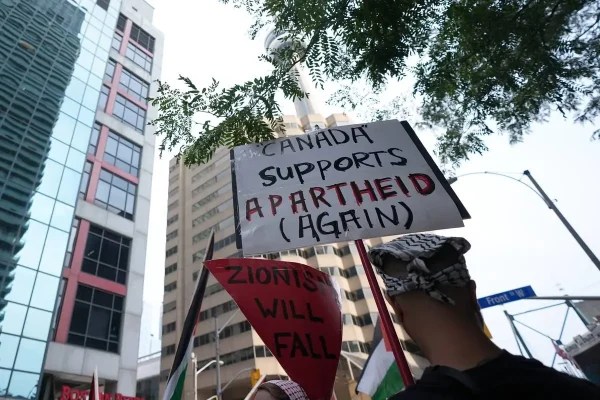
Pro-Palestinian demonstrators march during a protest in downtown Toronto,Canada on August 3, 2024 [Mert Alper Dervış/Anadolu Agency]
MEMO | November 7, 2024
Canada’s McGill University event with UN rapporteur relocated amid pro-Palestine crackdown

UN Special Rapporteur on the occupied Palestinian territories Francesca P. Albanese in Brussels, Belgium on April 10, 2024 [Thierry Monasse/Getty Images]
MEMO | November 6, 2024
Alberta court certifies class-action lawsuit against the provincial government for COVID-19 health orders that impacted businesses during the pandemic
The Canadian Independent | October 31, 2024
Rath & Company, the law firm representing Alberta business owners in a class action lawsuit against the provincial government over COVID-19 restrictions, has cleared a crucial legal hurdle.
Justice Colin C.J. Feasby of the Court of King’s Bench of Alberta certified the case, allowing it to proceed as a class action.
The lawsuit, led by plaintiffs Rebecca Ingram and Christopher Scott, challenges the authority of Alberta’s government in implementing business restrictions through Chief Medical Officer of Health (CMOH) orders, which the plaintiffs allege were unauthorized and illegally imposed.
The class action seeks compensation on behalf of a broad group of Alberta business owners, claiming that the health orders, issued ostensibly under public health directives, resulted in devastating financial losses.
In a ruling that highlights concerns around government accountability, the court confirmed that the lawsuit can proceed on multiple claims, including negligence, bad faith, and misfeasance in public office.
The lawsuit’s roots go back to a ruling by Justice Romaine in 2023 (Ingram v. Alberta [2023]), which found that key pandemic health orders were issued outside the legal authority of the Public Health Act. Rather than being made independently by the CMOH, Deena Hinshaw, the orders were shown to have been directed by the Alberta Cabinet, according to Justice Romaine’s findings.
The plaintiffs allege that the CMOH orders were improperly authorized and were issued in a way that obscured Cabinet’s role, thus avoiding political accountability during a critical public health crisis.
A key component of the plaintiffs’ argument is that Alberta’s Cabinet acted in bad faith by issuing these orders under the guise of health directives to avoid democratic oversight. In doing so, they argue, the government failed to protect Alberta business owners’ rights to property and due process under the Alberta Bill of Rights. Justice Feasby’s decision allows these claims, as well as those for punitive damages, to be addressed in court.
The Court’s certification encompasses several types of claims, including allegations of negligence and misfeasance. It specifically allows the plaintiffs to pursue punitive damages, which are intended to hold the government accountable and discourage similar conduct in the future. Unlike compensatory damages that vary by individual losses, punitive damages in a class action address the alleged wrongful intent and actions affecting the whole class.
The certified class includes “all individuals who owned, in whole or in part, a business in Alberta that was subject to full or partial closure, or operational restrictions, mandated by the CMOH Orders between March 17, 2020, and the date of certification.”
Justice Feasby’s decision paves the way for the case to proceed to trial, where the claims and evidence will be examined more closely. The certification does not decide on the merits of the case but rather affirms that the plaintiffs meet the legal threshold to pursue their claims as a unified class.
Rath & Company is encouraging any affected business owners to retain records of losses related to the CMOH orders. They urge those who may be eligible for inclusion in the class action to visit their website for further information on the certification and to access intake forms to join the lawsuit.
You can join the class action at the link below.
https://rathandcompany.com/business-class-action/
You can see the class action certification at the link below.
Canada’s ‘New Red Scare’ is profoundly undemocratic
By Paul Robinson – Canadian Dimension – October 28, 2024
In the past decade, a disturbing phenomenon has arisen in the Western world. One might call it the “New Red Scare.” According to many, the West is the target of a highly sophisticated, professional, and dangerous campaign of foreign subversion, coming mainly from the Russian Federation. Accusations abound against “Russian agents,” “Kremlin influencers,” “Moscow proxies,” and the like. Don’t like someone, call them “pro-Russian;” dislike what they say, call it “Russian disinformation;” want to silence them, call them a “Russian agent.” And so on. Increasingly, reasoned debate is being replaced by silencing and name-calling.
Speaking on Thursday to a parliamentary committee, former diplomat and Member of Parliament Chris Alexander painted a picture of Canada as the victim of an extraordinarily successful malign Russian operation. “Far from being marginal players, Russian information assets and active measures are often kingmakers in our elections,” he declared—a truly remarkable claim that will probably have many wondering how they had failed to notice the dominant role that Russia plays in our political life.
But that wasn’t all. According to Alexander, the leaders of “The People’s Party of Canada, the yellow vest movement, trucker protests, and Wexit [i.e. Western Canadian separatism]” were “radicalized online by Moscow’s active measures” and their funding “had all the hallmarks of Russian influence.” The convoy protests of 2022, Alexander claimed, were designed by the Russians “to distract a country with a huge Ukrainian diaspora as it launched its war of aggression [against Ukraine].” Who knew? And who knew that Russian secret services were so devastatingly efficient as to be able to manipulate a political party and a separatist movement, and to engineer the occupation of the national capital? Frankly, it beggars belief.
In my opinion, there’s a serious problem with threat inflation of this sort. It distracts from real problems and prevents a proper analysis of the causes of those problems by blaming them all on outside actors. When “Blame Russia” is the response to any difficulty, proper solutions are unlikely to be found.
But the statements above weren’t even the most striking bit of Alexander’s evidence to Parliament. For Alexander then submitted documents to the committee that he said showed that a journalist codenamed “Stuart,” whom he identified as the Ottawa Citizen’s defence correspondent David Pugliese, had been recruited by the Soviet intelligence service, the KGB, in the 1980s. He said that the journalist had demonstrated “long-running covert ties to Moscow” and had written divisive articles about “Ukraine’s Nazi links, Nazis in Canada, defamatory pieces about the family of deputy prime minister Chrystia Freeland, provocative takes on [defence] procurement and other issues at the Department of National Defence,” and so on. According to Alexander, “These are themes that Moscow would be delighted to promote.”
In response, Pugliese has called the accusation “total fabrication. … It’s just ridiculous.” He has pointed out that some of the information in the documents presented by Alexander does not fit him. For instance, one of the documents lists the journalist codenamed “Stuart” as having been in Ottawa in 1984, but Pugliese did not live in Ottawa at that time. In a statement on X, Pugliese remarked that “Individuals linked to Mr. Alexander’s false claims have also stated I play hockey on the Russian embassy hockey team in Ottawa. That is a total fabrication and shows the ridiculousness of this campaign to undercut my journalism. I have never played hockey and can barely skate.”
In any event, it seems that the documents don’t actually say that “Stuart” (whoever he might be) was ever recruited by the KGB. Global News reports that “Several experts on KGB documents said the papers appeared to be legitimate but did not suggest the reporter was ever a Russian agent, only that the Soviets looked at him.” According to one expert, “All [the documents] say is that an individual by this name came to the attention of KGB officials, not even necessarily very senior ones, and that they were interested in exploring him as a potential target of recruitment … So nothing in these documents clearly says that this individual was even approached, or certainly says that that approach was successful. All they do is say this is something worth exploring.”
Pugliese commented that “I get that I piss off a lot of people with my articles … I understand that not everybody appreciates my style of journalism.” Certainly, his reporting on issues such as wasteful defence procurement projects, sexual assault in the military, Nazi links to the Monument to the Victims of Communism, and so on, does not make certain people and institutions look very good. But the insinuation that if you write such things you are not fulfilling the basic journalistic role of holding those institutions to account, but rather working to divide our society on behalf of a hostile foreign power, is profoundly undemocratic.
Our society is not without faults. Our domestic and foreign policies are also often flawed. To correct failings, we need people who point them out, however unpopular that may be. In my view, we should be enabling the widest possible framework of public discourse, not seeking to silence people. To date, we haven’t quite reached the level of hysteria of 1950s McCarthyism, but as the paranoia over foreign interference ramps up, we are perhaps coming painfully close.
Paul Robinson is a professor in the Graduate School of Public and International Affairs at the University of Ottawa and a Senior Fellow at the Institute for Peace and Diplomacy. He is the author of numerous works on Russian and Soviet history, including Russian Conservatism, published by Northern Illinois University Press in 2019.
Featured Video

Total War – Attacking Nuclear Plants, Desalination & Infrastructure
or go to
Aletho News Archives – Video-Images
From the Archives
Strike on Israel Shows US Bases Near Iran Are ‘Achilles Heel’
By Svetlana Ekimenko – Sputnik – 14.04.2024
Fears of a greater Middle East escalation were triggered after Iran launched a massive drone and missile attack against Israel, aided by Hezbollah and the Yemeni Houthis. Iran said the attack was in response to Israel’s bombing of the Iranian consulate in Damascus, Syria, which killed seven members of the elite Revolutionary Guard Corps.
Iran’s massive retaliatory attack on Israel from its own territory is a sign that the conflict could “escalate out of control.”
Michael Maloof, a former senior security analyst in the office of the US secretary of defense, told Sputnik that the first ever direct Iranian attack on Israel set a dangerous precedent.
“My concern is that this could easily escalate into something not only between Iran and Israel, but beyond the Middle East region,” he said.
Iran’s assault, which it stated was an act of “self-defense” after the Israeli strike on its consulate in Damascus, was originally intended to be a “limited” one, said Maloof.
Iran first sent in “swarms of drones with lights on as a sign of psychological warfare,” but sending in cruise and ballistic missiles by Tehran was a “distinct escalation,” said Maloof.
The scale of Iran’s attack on Israel suggests that Tehran was sending a message, demonstrating that it possesses “extraordinary capabilities,” said Maloof. … continue
Blog Roll
 Aletho News
- Hungary blasts ‘fake’ EU accusation
- SAFE Debt Trap: Poland’s €43.7 Billion Bet on Unipolar Illusion
- War on Iran threatens global Gulf capital flows: FT analysis
- Mossad De Facto Admits To Inciting Riots In Iran
- Tehran: World grown thoroughly exhausted with US-Israeli ‘false flag storylines’
- Trump ‘stuck between a rock and a hard place’, lacks Iran war strategy: Ex-CIA chief
- Trump’s bombardment of fake news so far is working quite well. But where is it heading?
- Iran to Mine Sea Lanes in Persian Gulf in Case of Attack – Defense Council
- Barak blasts Netanyahu: ‘Stop lying – you can’t destroy Iran’s nuclear, missile capabilities’
- Trump backs down on Iran strikes; Tehran denies any talks
- If Americans Knew
- Lebanon deaths top 1,200; Palantir AI to be embedded across US military – Not a ceasefire Day 163
- Israel’s assassination game: Take all pragmatists off the board
- Food shortages return to Gaza as Israel tightens aid restrictions under the cover of its war on Iran
- Trump demands trillions in payments from Gulf countries, billions from Harvard – Not a ceasefire Day 162
- Meet the former fashion blogger and shady doctor behind the ‘30,000 dead’ Iran psy-op
- Vatican Secretary of State to Trump, Israel: End the war as soon as possible
- The Majority of Americans Believe War Against Iran Benefits Israel More Than US
- Efforts to shut down pro-Palestinian speech face series of setbacks in court
- What has Israel done to my brother?
- Eid without worship in Al Aqsa – Not a ceasefire Day 161
- No Tricks Zone
- Former Pfizer Toxicologist Dr. Helmut Sterz Tells Bundestag Hearing Pfizer Vaccine Should Have Never Been Approved
- Energy Expert: Germany’s Nuclear Phaseout Was A “500 Billion Euro Mistake”
- New Research: South Australia’s Mid-Holocene Sea Surface Temperatures Were 4°C Warmer Than Today
- Storing Green Energy To Last Germany 10 Days Would Require A 60-Million Tonne Battery
- New Studies: UK Sea Levels Were 4 Meters Higher Than Today During The Mid-Holocene
- Destructive Green New Deal: German Energy And Metal Group Warns Of Drastic Crisis
- New Study Documents A 20-Year Pause In Arctic Sea Ice Decline – Driven By Internal Variability
- Wake-up Call: Survey Shows Majority Of Germans Now Favor Postponing Climate Targets!
- Televised! Leading German Political Candidate Tells Schoolchildren CO2 Makes Sun Hotter!
- New Study: A Century Warming Of 1.1°C Is ‘Commonplace’ And ‘Not Unusual’ During This Interglacial
 Aletho News