The Conservative Canadian Contradiction: Claiming to be for Democracy and Monarchy
By Yves Engler | Dissident Voice | September 20th, 2013
Harper’s Conservatives have a thing for monarchy, the more absolute the better, it seems.
At home they’ve put up portraits of Queen Elizabeth II and added the moniker “royal” to the Canadian Navy and Air Force while in the Middle East they’ve strengthened Canada’s ties to kingdoms from Morocco to Saudi Arabia.
Jordan’s pro-US/pro-Israel King Abdullah II has been the focus of significant attention with the Conservatives signing a free trade and military cooperation agreement with that country last year. Now the Conservatives are strengthening Canada’s ties to a monarchy confronted by an influx of Syrian refugees, volatile regional geopolitics and popular protests. Even the aid the Conservatives are sending to Jordan for Syrian refugees is largely designed to bolster the country’s monarchy.
Over the past year Jordan has become a central staging ground for Syrian rebel groups. Weapons from the Gulf monarchies and the US are flowing through Jordan and the CIA is training Syrian rebels there. According to France’s Le Figaro, Jordan has opened its airspace to armed Israeli drones monitoring Syria while the Financial Times reports that the US has 1,000 troops and a number of F-16 fighter jets in the country.
While Jordanian officials say they will not let their country be used as a launchpad for any Western military intervention against Syria, they recently allowed the US (and others) to conduct war games near that country’s border. And three weeks ago Jordan hosted the military chiefs from the main opponents of Bashar al-Assad — the US, Saudi Arabia, Qatar, Turkey, France, Canada etc. — to discuss the conflict.
Not surprisingly, the Syrian regime is unhappy with its southern neighbour. Syrian officials have said Jordan was “playing with fire” in allowing the US and others to train and arm its opponents, which includes many jihadists who could end up turning on Jordan’s regime. While King Abdullah II likely doesn’t trust the Syrian rebels and is fearful of retaliation from his larger neighbour, Jordan is under significant pressure from Ryadh and Washington to back Syria’s opposition.
As it contributes to instability in Syria, Jordan is also a victim of the conflict. At least 600,000 Syrian refugees have crossed into the country of 6.3 million people. This has added to the pressure on a Jordanian monarchy that’s faced a series of pro-democracy protests over the past two years. Additionally, the US military’s growing presence in the country is not popular.
Worried about the Jordanian monarchy’s ability to survive this volatile political climate, Canada has worked to bolster the regime. Under the guise of helping Syrian refugees, Ottawa (alongside Saudi Arabia, Qatar and the US) has made a series of major aid announcements over the past year. $6.5 million for Syrian refugees in Jordan in August 2012, then another $13 million in March and in June Ottawa announced a three-year $100-million aid package to Jordan.
Buried in Ottawa’s announcements about the Syrian refugee crisis is the fact that much of the money on offer is for “security programming”. Foreign Affairs explains: “Canada is providing equipment and vehicles to the Jordanian Armed Forces (JAF) to assist in their efforts to transport Syrian refugees from the border to registration centres. Canada will also provide equipment and infrastructure support to the Public Security Directorate (PSD), the Gendarmerie Forces (GF) and the Civil Defence Directorate, which provide security and other essential services within new and expanding refugee camps.
“This [$25 million in] support builds upon a previous Canadian contribution … $9.5 million in material support was provided to the JAF to respond to initial transportation needs of Syrian refugees coming across the border, and $2 million in material support was provided to the PSD and the GF in their efforts to manage security within Zaatari refugee camp.”
On top of this $36.5 million in support for Jordan’s security forces, Ottawa is working “to mitigate the threat posed by Syria’s stockpile of weapons of mass destruction”, which will include more “equipment, infrastructure, technology and training to the JAF, the Civil Defence Directorate, the Ministry of Health and other relevant ministries.”
Ottawa isn’t openly admitting that its aid to Jordan for Syrian refugees is designed to prop up the monarchy, but it’s obvious. In June the Globe and Mail’s John Ibbitson noted, “Ottawa is concerned that Syrian violence could infect and endanger neighbouring countries, especially the Hashemite Kingdom [Jordan], with which Canada has good relations.”
But there isn’t equal concern for “neighbouring countries”. For instance, there is a striking incongruence in the amount of aid Ottawa has allotted to Jordan versus Lebanon. Though it hosts 20% more Syrian refugees and is only 65% of Jordan’s population, Lebanon has received much less Canadian aid for Syrian refugees. (It should be noted that Lebanon is wealthier than Jordan, but nonetheless the World Bank is estimating that “Syria’s conflict will cost Lebanon $7.5 billion in cumulative economic losses by the end” of 2014)
Ottawa’s aid to Jordan is part of a series of efforts to back the monarchy. In 2012 the Conservatives voted into law a free-trade accord, which Foreign Affairs noted “shows Canada’s support for Jordan as a moderate Arab state that promotes peace and security in the Middle East.”
In addition to the trade accord, the Jordanian military has benefited from Canadian military support. Canada and Jordan signed a defence co-operation memorandum of understanding in the spring of 2012. At the end of last month the Chief of the Defence Staff, Gen. Tom Lawson, met his Jordanian counterpart and, according to the Jordan Times, “discussed ways to boost cooperation and coordination between the two countries’ armed forces.” This meeting followed on the heels of another meeting between the heads of the two countries militaries in April and Canada’s participation in a military exercise with 17 other “friendly” countries, Eager Lion 2013, hosted by Jordan’s armed forces.
Foreign minister John Baird has visited Jordan three times since last August to discuss “the ongoing turmoil in Syria” among other issues. What Baird and Jordanian officials almost certainly don’t talk about is the country’s pro-democracy struggles, which have flared up over the past two and a half years. The Conservatives were silent when thousands of Jordanians marched against the monarchy and for better social conditions in March and April 2011. A handful of protesters were killed and hundreds arrested in a country that prosecutes individuals for “extending one’s tongue” (having a big mouth) against the King.
A few months after the “Arab Spring” protests Foreign minister Baird claimed: “King Abdullah II in Jordan has really expedited reforms they were already working on.” But Baird’s positive portrayal of Jordan’s reforms doesn’t withstand scrutiny. Labour unions and independent media are heavily restricted while elections mean little. In short, Jordan remains an absolute monarchy with power concentrated in the hands of a ruling clique.
Just the way Harper’s Conservatives like it.
~
Yves Engler is the author of Lester Pearson’s Peacekeeping: The Truth May Hurt. His latest book is The Ugly Canadian: Stephen Harper’s foreign policy.
Wounded Canadian veterans pressed to not criticize military on social media
RT | September 21, 2013
The Canadian Armed Forces requires physically and mentally wounded service members to sign a form agreeing to not criticize senior officers or demoralize other troops on social media sites.
The form is given to wounded soldiers transferred to the Joint Personnel Support Unit (JPSU), which oversees support centers for troops across Canada. The JPSU has received public scrutiny in recent months, as soldiers and staff have been vocal about the lack of resources and dysfunctional support centers.
Service members gave the social media policy form to the Ottawa Citizen, expressing dissatisfaction over what they saw as a threat to their right to voice criticism of the Department of National Defence and Canadian Armed Forces (CAF) for lackluster care.
The JPSU told the Ottawa Citizen that the policy was not made to defer criticism of officials, but rather “to educate our members and personnel on what constitutes the appropriate and inappropriate use of social media and the possible ramifications for a CAF member.”
The “policy on proper comments on social media” forbids posting secret information on websites or forums, but also advises military personnel to avoid disparaging senior officers or CAF members.
In addition, the policy tells service members not to “write anything that might discourage others or make them dissatisfied with their conditions or their employment,” nor to offer “your views on any military subject.”
The policy form indicates that violating the social media rules could damage public trust in the CAF and “destroy team cohesion.”
The form, only six months old, mentions that soldiers in the JPSU can also be held responsible for social media content of friends they have “tagged” on Facebook, Twitter, LinkedIn, blogs and other sites.
While the CAF has a general social media policy for all service members, the Ottawa Citizen said that all personnel they interviewed were never made to sign a form like the one given to JPSU soldiers.
The CAF responded to questions about the form, saying the policy is issued to all JPSU members. However, the spokesperson could not offer specific examples of improper social media use.
“It is important for all CAF members to understand and follow the policies, rules, regulations and standards of conduct that apply to members of the CAF, including the policy on the use of social media,” public affairs officer Navy Lt. Michèle Tremblay wrote to the Ottawa Citizen.
Members of the Canadian military “are encouraged to communicate publicly about their own experiences and expertise, in accordance with the Government of Canada and DND/CAF policy,” Tremblay noted.
If a service member refuses to sign, JPSU staff will note that the individual has been briefed about the unit’s social media policy. Various units have their own way of notifying personnel about CAF protocols, Tremblay said.
“The difference being that the JPSU is asking members to indicate that they have read and understood the policy by signing the form,” she said.
Former CAF officers see the form as a way to intimidate members who were injured for speaking up about substandard treatment.
“It’s not illegal but it’s obviously a threat,” said Ottawa lawyer and former military officer Michel Drapeau, who has represented injured soldiers seeking benefits from the Canadian government. “The criticism about the leadership’s failure to take care of the wounded is obviously hitting home.”
He said that personnel likely feel compelled to sign, and that it would certainly be used against them if they violated the policy.
Retired air force officer Sean Bruyea said the CAF has the right to steer service members’ behavior on social media, but says the JPSU effort goes too far.
“This is right out of something you would see during the Soviet era,” said Bruyea, a critic of how the military and government assists wounded personnel. “This is way over the top.”
Harper promotes Canadian militarism
By Yves Engler · August 16, 2013
The Conservatives’ militarism is unrelenting.
Last month the Harper government launched a Civil Military Leadership Pilot Initiative at the University of Alberta. The program “allow[s] people to simultaneously obtain a university degree while also gaining leadership experience in the Canadian Armed Forces (CAF) Reserves.” The four-year Civil Military Leadership Pilot Initiative will be “co-directed by the University of Alberta and the CAF” and the government hopes to export this “test model” to other universities.
The program is an attempt to reestablish the Canadian Officer Training Corps, which was offered at universities from 1912 until 1968. According to Lee Windsor, deputy director of the University of New Brunswick’s Gregg Centre for the Study of War and Society, the Canadian Officers Training Corps program “introduced university undergraduates to a form of military service on campus, providing them with leadership and other military training and preparing them to join the reserve or the regular force if they wished to do so.”
This latest move onto campus is part of a multifaceted effort to expand the military’s role in Canadian society. When the Conservative government updated the citizenship handbook, ‘Discover Canada: the Rights and Responsibilities of Citizenship,’ they added over a dozen photos of armed forces personnel. Citizenship and Immigration Canada also decreed that citizenship ceremonies include a military speaker. Introduced at the start of the ceremony, the veteran should declare: “As a Canadian citizen, you live in a democratic country where individual rights and freedoms are respected. Thousands of brave Canadians have fought and died for these rights and freedoms. The commitment to Canada of our men and women in uniform should never be forgotten.”
Huge sums of public money have been spent promoting the military at Canada Day festivities, the Calgary Stampede, the Canadian National Exhibition, Santa Claus Parades, the Grey Cup, NHL hockey games and other cultural and sporting events. Of recent, the Canadian Forces have been spending over $350 million a year and directing 650 staff members to carrying out these public relations efforts.
The federal government’s deference has gone to the military’s heads. Five years into the Conservative government, the Canadian Forces openly proclaimed that it should determine public opinion. In November 2011 Embassy reported: “An annual report from the Department of National Defence says Canadians should appreciate that their values are shaped in part by their military. That represents a shift from past annual departmental reports that said departmental activities were informed by Canadian interests and values. Now it’s the other way around.”
While strengthening the military’s role in the cultural and ideological arena, the Conservatives have also taken a decidedly pro-military position on arms control. Ottawa has refused to ratify the UN Arms Trade Treaty, which is designed to limit weapons from getting into conflict zones or into the hands of human rights violators.
The Harper government also watered down Canada’s adherence to the Convention on Cluster Munitions. The director of the Cluster Munition Coalition, Laura Cheeseman, explained “Canada cannot claim to have banned cluster bombs when it proposes to allow its military to help others use the weapons, and even leaves open the possibility of Canadian forces using them.”
Along with its ambivalence towards UN arms control measures, the Conservatives have expanded the list of nations that Canadian defence companies can export prohibited weapons to. In April 2008 Canada’s Automatic Firearms Country Control List was increased from 20 to 31 states and in December they added Colombia, the worst human rights violator in the Americas, to the List. Now, they are looking to add four more countries to the Automatic Firearms Country Control List.
The Conservatives have helped military companies in numerous other ways. They have been supporting the Canadian Association of Defence and Security Industries, the arms industry’s main lobby group, through grants and dedicated trade commissioners. CADSI is also benefiting from direct political support. Senior representatives from the Department of National Defense, the Canadian Forces, Foreign Affairs and the Canadian Commercial Corporation (CCC) have participated in recent CADSI trade missions. After a December 2011 visit to sell weapons to the Kuwaiti monarchy, CADSI president Tim Page applauded what he described as the Conservatives “whole of government effort.”
During the Harper reign the CCC, whose board is appointed by the government, has taken on a more expansive role as a go-between on military sales with foreign governments. According to a June 2011 Embassy article, “the Canadian Commercial Corporation has been transformed from a low-profile Canadian intermediary agency to a major player in promoting Canadian global arms sales.” Traditionally, the CCC sold Canadian weaponry to the US Department of Defense under the 1956 Defence Production Sharing Agreement but during the Conservative government it’s begun emulating some aspects of the US defence department’s Foreign Military Sales program, which facilitates that country’s global arms sales.
In June of last year, Embassy noted: “In the last few years, the Canadian Commercial Corporation, a Crown corporation, has helped Canadian firms sell everything from military hardware and weapons to wiretapping technology, forensics for ballistics, surveillance, document detection, sensor systems, bulletproof vests and helmets, training, and other services.” According to CCC president Marc Whittingham, who wrote in a May 2010 issue of Hill Times that “there is no better trade show for defence equipment than a military mission,” the agency is “partnering with government ministers to get the job done.”
The Conservatives have worked hard to expand Canadian arms sales as well as to convince the public that it should support this country’s military-industrial complex.
Related article
- Harper’s War Lobby is reacting to our campaign (ceasefire.ca)
Canada’s prime minister creates an “enemies list”
PressTVGlobalNews · July 19, 2013
It has been revealed that Canada’s Prime Minister Steven Harper has drawn up an “enemies list” identifying political opponents of the Conservative Party. Bureaucrats, judges and other members of the Canadian establishment are named on the list.
Spying on the World From Domestic Soil
By Katitza Rodriguez | EFF | June 21, 2013
The world is still reeling from the series of revelations about NSA and FBI surveillance. Over the past two weeks the emerging details paint a picture of pervasive, cross-border spying programs of unprecedented reach and scope: the U.S. has now admitted using domestic networks to spy on Internet users both domestically and worldwide. The people now know that foreign intelligence can spy on their communications if they travel through U.S. networks or are stored in U.S. servers.
While international public outrage has justifiably decried the scope and reach of these revelations, carte blanche foreign intelligence surveillance powers over foreigners are far from new. In the U.S., foreign intelligence has always had nearly limitless legal capacity to surveil foreigners because domestic laws and protections simply don’t reach that surveillance activity.
This legal framework, with no protection for foreigners and little oversight besides, has been exacerbated by the growth in individuals now living their lives online, who conduct their most intimate communications in cloud services that are hosted in the U.S. and across different jurisdictions. To make matters worse, the vast amount of Internet traffic globally is routed through the U.S. Last but not least, logistical barriers to powerful, mass surveillance have lowered and the application of existing legal principles in new technological contexts has become unclear and shrouded in secrecy, especially in a extra-territorial surveillance context. The US government’s FISA powers, which in 2008 opened the door to broad surveillance of communications where one side is an American and the other side is a foreigner, represent just an example of an increasing state capacity to conduct nearly limitless invasive extra-territorial surveillance from domestic soil.
International Backlash
On June 18, Germans rallied at a well-known Berlin Wall crossing point called Checkpoint Charlie. Under the motto: “Yes We Scan!” German activists protested against PRISM and NSA surveillance in response to President Barack Obama’s Berlin visit. Pictures of the rally show protest signs claiming that the Obama administration has become “Stasi 2.0” with the quote “All your data belong to us”.
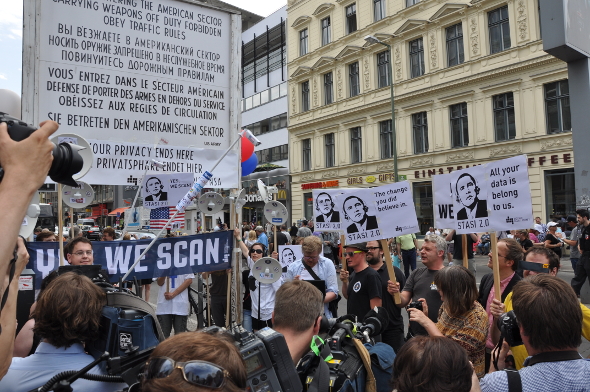
The Stasi 2.0 campaign was originally designed in 2007 to fight Germany’s mandatory data-retention law, a law implementing an EU Directive that force ISPs and telecom providers to continuously collect and store records documenting the online activities of millions of ordinary Europeans. Roughly 34,000 citizens filed a lawsuit against the mandatory data retention in protest. The campaign was successful and in March 2010 a German court declared the law unconstitutional and ordered the deletion of the collected data. Now, the Stasi 2.0 campaign has shifted focus on calling upon their government to protect them against overreach scope of NSA foreign surveillance practices, Sandra Mamitzsch from Digitale Gesellschaft told EFF.
Germany has also increased its capacity to conduct sweeping and invasive extra-territorial surveillance from its domestic soil. As we noted, the German government has leveraged its ability to remotely compromise computer systems in order to spy on its citizens. The government has used commercial malware to hack private data. While there has been no confirmation that Germany is deploying these investigative techniques against persons outside German territories, extra-territorial surveillance is feasible because infection occurs via email and other Internet transmissions.
Campaigns against the NSA spying overreach are now being planned for July 6 all around Australia. Australians can get involved here: http://ourprivacy.org.au/
Micheal Vonn, policy director at the B.C. Civil Liberties Association in Canada, told to the Global News in Canada: “[w]e fully intend to get some pointed questions to the Canadian government about knowledge, complicity, alliance with this program. And whether, in fact, very, very quietly, the Canadian security establishment has been harvesting the fruits of this program for some time.”
EFF is demanding Internet companies to join our cause and protect the privacy of their international customers calling on Congress to create a committee to uncover the truth about the NSA alarming allegations. You can take action here. Current foreign intelligence surveillance targetting foreigners must be challenged to ensure strong human rights safeguards, transparency and accountability across the world. A global dialogue on extra-territorial foreign intelligence surveillance among all nations is much needed.
EFF will continue blogging about the impact of the NSA leaks on Internet users abroad in our Spies Without Borders series. Next, we will examine what implications the government’s use of these FISA powers has for Internet users abroad, with an eye to other jurisdictions and the requirements of international law.
This is the 5th article of our Spies Without Borders series. The series are looking into how the information disclosed in the NSA leaks affect Internet users around the world whose private information is stored in U.S. servers, or whose data travels across U.S. networks.
Image: Digitale Gesellschaft, licensed under a Creative Commons BY SA 3.0 license.
Related article
Regime Change for Canada
By Greg Felton | June 23, 2013
In the wee hours of June 17, 1972, a security guard at the Watergate Hotel found some door latches taped over to prevent them from locking. He removed the tape but later found it had been replaced. He called Washington D.C. police, who proceeded to catch five “burglars” conducting an illegal surveillance operation inside the office of the Democratic National Committee. As it happened, the name of President Richard Nixon’s White House security consultant E. Howard Hunt was in the address book of two of the burglars.
Ultimately, the burglars along with two White House functionaries, were convicted of conspiracy, burglary, and violation of federal wiretapping laws. On Aug. 9, 1974, Nixon resigned the presidency to avoid inevitable impeachment, but not for the break-in itself. He faced impeachment for his attempt to cover it up.
From this event 41 years ago this month, “Watergate” entered the language as a metonymy for “self-destructive illegal act of political hubris”. Now, Canada’s reigning autocrat Stephen Harper has created his own “Watergate” nightmare by trying to cover up a Senate spending scandal.
It all started when the glabrous Sen. Mike Duffy got caught claiming $90,172 in illegitimate living expenses, much of which was incurred during the last election campaign. In the grand fiscal scheme of things the amount was rather minor; not so minor was the image of a senator, a Harper-appointed senator, causing scorn and shame to rain on Harper and his imperious reign.
Harper runs the country like his personal fiefdom, dictating policy like, well, a dictator, which means that anything that might shed a critical light on his hyper-centralized, unconstitutional despotism cannot be tolerated. Therefore, instead of admitting Duffy’s venial impropriety and throwing him under the bus, Harper, like Nixon, thought he could cover it up, such is the hubris that infects those who think themselves invulnerable and above the law.
Harper might not have been aware of Duffy’s illegitimate expense claims, just as there was no conclusive evidence that Nixon ordered the Watergate break in, which turned out to be largely the doing of White House counsel John Dean. Yet for reasons of ego, paranoia or both, both leaders felt threatened and proceeded to obstruct justice.
What Harper and his minions did to disguise Duffy’s dubious declarations is no less criminal than what Nixon and his staff did to cover up the Watergate break in. From the following it will be clear that Harper must be charged under Section 119 of the Criminal Code of Canada. If the rule of law is still operable in Canada, Harper, like Nixon, must face impeachment.
|
CRIMINAL CODE OF CANADA
CORRUPTION AND DISOBEDIENCE |
||
| (a) being the holder of a judicial office, or being a member of Parliament or of the legislature of a province, directly or indirectly, corruptly accepts, obtains, agrees to accept or attempts to obtain, for themselves or another person, any money, valuable consideration, office, place or employment in respect of anything done or omitted or to be done or omitted by them in their official capacity, or |
||
| (b) directly or indirectly, corruptly gives or offers to a person mentioned in paragraph (a), or to anyone for the benefit of that person, any money, valuable consideration, office, place or employment in respect of anything done or omitted or to be done or omitted by that person in their official capacity. (Emphases mine) |
Even though impeachment in the U.S and Canada are constitutionally different matters, a comparison between the Watergate cover up and the Duffy scandal is apt and instructive.
Nixon
As a result of the break-in, the public learned that Nixon secretly taped all conversations in the oval office. Citing executive privilege, Nixon steadfastly refused to turn over any tapes to the Senate Watergate Committee. That privilege ended on July 24, 1974, when the Supreme Court ruled unanimously that Nixon had to surrender the tapes. One tape, dated June 23, 1972—a mere six days after the break-in—showed Nixon and his aide H.R. “Bob” Haldeman discussing how to obstruct the FBI investigation into the burglary to prevent the money trail being traced back to the Committee to Re-elect the President (CREEP).
This admission of obstruction became known as “the smoking gun” that led to one of the three articles of impeachment. It proved that Nixon not only lied when he claimed not to know anything about the break in, but that he had obstructed justice from the outset. The consistent lying led the clamour for his resignation, and the proof of obstruction forced it.
Harper
1) On Feb. 17, 2013, nine days after the Senate initiates an outside audit of three senators’ expenses, Stephen Harper declares in the House of Commons that Sen. Mike Duffy met the residency requirements to be a senator from Prince Edward Island. Five days later, Duffy reports that he and his wife would voluntarily repay living expenses claimed against their primary residence in Ottawa. The repayment makes no sense if the residency claim were valid as Harper claimed.
Clearly Harper misled the House, which is defined as Contempt of Parliament, and for that he can be censured. By convention any minister found guilty of misleading the House resigns although Harper could continue in office even if censured since censure does not amount to a vote of non-confidence.
2) Not only did Harper mislead Parliament, but his senators obstructed justice and sanitized a critical report. First, the Senate reported on May 7 that Duffy violated “very clear [and] unambiguous” residency rules. The next day, two Harperites on The Senate Committee on Internal Economy forced a rewrite to remove condemnation of Duffy and to claim (absurdly) that the Senate’s long-standing residency rules are “unclear.” One key senator, Carolyn Stewart-Olsen, is a former press secretary to Harper and was his political advisor for more than 10 years, so a conflict-of-interest investigation into her conduct is also in order.
Nixon
This deliberate excision of key information reminds us somewhat of the infamous missing 18.5 minutes from one of the Nixon tapes. Nixon’s secretary, Rose Mary Woods, claimed that she was stretching to reach something one day and her leg “accidentally” erased part of an incriminating tape. John Dean, remembers that it was the day he told Nixon the burglars wanted hush money:
| “The president said, ‘Well, how much will it cost?’ and I said, ‘It’s gonna cost $1 million.’ And the president said to me, ‘Well, John, I know where we can get that.’ As soon as I left the office, he went in to see Rose Mary and ask her if she had any money. It got picked up on the taping machine.” |
Harper
Payment of hush money to obstruct justice and protect the government leader, or at least the appearance thereof, can also be seen in the Duffy scandal. On March 26 Deloitte received a letter from Duffy’s lawyer stating that the expenses had been repaid and that Duffy would no longer co-operate with the audit into his finances. He later stated (May 14) that he took out a loan to repay the debt. However, on May 17, Harper’s office admitted that Harper’s chief of staff Nigel Wright cut Duffy a personal cheque for the full amount, calling it a “personal gift”. Harper denies any knowledge of the cheque, even though his office knows of, and confirms, its existence.
The ineptitude is mind boggling:
1) Duffy’s own government, in effect, calls him a liar.
2) No rational explanation exists for Wright going out-of-pocket to the tune of $90,000-odd to bail out someone he barely knew. What was his motive? Wright’s actions do make sense if Harper wanted to use him to provide a clandestine, untraceable way to pay off Duffy’s debt as a quid pro quo for Duffy’s refusal to continue co-operating with the audit, which would, among other things, expose Harper’s lie in the House. In fact this is what happened.
During a withering attack during Question Period on May 28, NDP Leader Thomas Mulcair grilled Harper on an e-mail from Duffy stating that after being paid $90,000 Duffy stayed silent on orders of the prime minister’s office. Mulcair asked Harper to tell the House who told Duffy to remain silent. Harper begged ignorance, claiming he wasn’t privy to the e-mail, though this strains credulity to the breaking point.
Nixon
An embarrassing cheque and sacrificed subordinates also featured in the Watergate scandal. On the June 23 tape, we learn that a $25,000 cashier’s cheque from a Nixon campaign donor wound up in the bank account of Watergate burglar Bernard Barker:
| Haldeman: “They’ve traced it to a name, but they haven’t gotten to the guy yet.” Nixon: “Who is it? Is it somebody here?” Haldeman: “Ken Dahlberg.” Nixon: “Who the hell is Ken Dahlberg?” Haldeman: “He’s a—he gave $25,000 in Minnesota and the check went directly in to this guy Barker.… It’s directly traceable, and there’s some more through some Texas people in—that went to the Mexican bank which they can also trace through the Mexican bank.” |
Nixon then hatched a cover story to obscure the provenance of the cheque.
| Nixon: “…when you open that scab there’s a hell of a lot of things and then ‘we just feel that this would be very detrimental to have this thing go any further, that this involves these Cubans, and Hunt, and a lot of hanky-panky that we have nothing to do with ourselves.’…” |
Ten months later, on April 30, 1973, top White House staffers Haldeman and John Ehrlichman, and Attorney General Richard Kleindienst resign over the scandal. Dean is fired. Yet, these removals did not stop the probe into Nixon’s role.
Harper
In addition to Nigel Wright, further political corpses can be expected to pile up as the RCMP investigate the matter, an investigation that must lead to Harper. When this happens, Duffy, Stewart-Olsen and other minions will be fired or expected to fall on their swords to shield their boss. In Duffy’s case, this is virtually inevitable, given that his repeated prevarications about the cancellation of his debt make him an irredeemable liability. Such removals, though, would not save Harper.
The original scandal is now secondary to the larger issue of Harper’s misleading Parliament and obstructing justice, which must inevitably lead to a criminal investigation.
The Smoking Gun
Just as the June 23, 1972, tape shattered Nixon’s claims of ignorance of the break in, Nigel Wright’s cheque is the “smoking gun” that should bring down Harper.
• The cheque itself proves that Harper lied to Parliament on Feb. 17.
• The cheque implicates Harper’s office in a cover up.
• The cheque implicates Harper’s office in the obstruction of an outside forensic audit.
• The cheque amounts to a de facto bribe because Duffy’s silence, as revealed by Mulcair, appears to be bought.
On March 21, 1973, Dean told Nixon that the cover up was a cancer close to the presidency that was compounding itself. In the prime minister’s office a similar cancer is compounding itself. Whereas the U.S. Senate went through lengthy hearings to vote to impeach Nixon, the governor-general could impeach Harper in an instant.
Under the Constitution, the governor-general, as head of state, appoints the prime minister to form a government, and as such can just as quickly fire him. Despite the fact that the office is largely ceremonial, it still retains residual constitutional powers inherited from Great Britain that give the governor-general the right to dismiss a sitting prime minister, even if that should trigger an election.
Donald Johnston, Canada’s current governor-general, has a constitutional and moral duty to impeach Harper and end the cancer of corruption. He must be compelled to do so. The integrity of our system of government depends upon it.
For a select chronology of Stephen Harper’s Watergate, click here.
Canada pledges $100m in aid to Jordan
Press TV – June 18, 2013
Canada has vowed to provide Jordan with an additional USD 100 million in aid amid ongoing crisis in the Arab country’s neighboring Syria.
Canada Foreign Minister John Baird said in a statement on Monday that Ottawa offered another USD 98.4 million to the Jordan’s government to help the kingdom cope with the influx of Syrian refugees.
The aid followed Baird’s visit to Jordan on Sunday and his meeting with Jordanian Foreign Minister Nasser Judeh over the Syria unrest.
Ottawa’s move came after Pentagon said on Saturday that the US will keep its F-16 jets and patriot missile batteries in Jordan after the joint military exercises with the kingdom this month.
This is while reports say that US government was preparing to impose a no-fly zone over Syria.
On June 14, Obama ordered his administration to provide the militants with weapons, a day after the US claimed that the Syrian government has used chemical weapons against the militants and thus crossed Washington’s “red line.” Damascus has rejected the allegation as “lies.”
The delivery of the weapons, which include assault rifles, shoulder-fired rocket-propelled grenades and antitank missiles, would be carried out through the CIA, reports say.
Last week, a US defense official also stated that Washington would keep a unit of US Marines on amphibious ships off the Red Sea coast after consultations with Jordan.
The US-based Wall Street Journal had earlier reported that the no-fly zone could be implemented from Jordan.
No Canadian NSA connection, but very own data snooping program
RT | June 11, 2013
Canada does not use the US NSA’s top secret surveillance PRISM program, officials revealed. Instead, it has a spying platform of its own that it claims manages to distinguish between domestic and international telephone and internet data collected.
The Communication Security Establishment (CSE) spokesman separated the National Security Agency and the Canadian surveillance program.
“The Communications Security Establishment does not have access to data in PRISM”, Ryan Foreman told Reuters, confirming that the “CSE uses metadata to isolate and identify foreign communications,” as CSEC is prohibited by law from directing its activities at Canadians.
Officials admitted that CSEC “incidentally” intercepts Canadian communications, but removes such data after it is obtained, according to the Globe and Mail.
Secret spying programs have come under scrutiny this week as whistleblower and former technical assistant for the CIA Edward Snowden leaked information about the NSA’s PRISM project, describing it as a massive data mining surveillance program which gave the agency backdoor access to emails, videos, chats, photos and search queries from nine worldwide tech giants, including Google and Facebook.
A secret electronic spying program was approved in 2011 by Canada’s Defense Minister Peter MacKay. It searches through international and domestic telephone records and internet data for suspicious activity, Canada’s newspaper Globe and Mail revealed.
Despite the reports, the government’s metadata surveillance program remains a mystery with little information available publicly. The records obtained from the Access to Information requests by the Globe had many pages blacked out, citing national security.
The program was first passed in a secret decree signed in 2005 by Bill Graham, the defense minister at the time then put on hold in 2008 for more than a year due to privacy concerns. On November 21, 2011, it was once again renewed, along with other top-secret espionage programs. And currently it is headed by the Communications Security Establishment Canada (CSEC), part of the Department of National Defense.
It is still not known how the data is being collected. Mining metadata can reveal who knows who and help the authorities to map out social networks and even terrorist cells.
“Metadata is information associated with a telecommunication … And not a communication,” according to a PowerPoint briefing sent to MacKay in 2011.
The Canadian surveillance program has been authorized by ministerial decrees, bypassing the parliament, and is under the sole oversight of the Office of the CSE Commissioner.
Opposition MPs have questioned MacKay about the surveillance reports, to which he replied that Canada’s surveillance initiative “is specifically prohibited from looking at the information of Canadians” and that “this program is very much directed at activities outside the country, foreign threats, in fact. There is rigorous oversight, there is legislation in place that specifically dictates what can and cannot be examined.”
Canada’s privacy commissioner admitted a lack of clarity on the subject.
“When it comes to the metadata program, we know very little specific information at this point – but we want to find out more”, Scott Hutchinson, of the Office of the Privacy Commissioner of Canada, told the Globe and Mail.
The Canadian program was criticized 2008 by a retired Supreme Court judge Charles Gonthier, who questioned whether CSEC could be passing any data collected to other partner agencies such as Royal Canadian Mounted Police (RCMP) and Canadian Security Intelligence Service (CSIS).
Gonthier’s biggest fear was that the data collection would lead to unlawful surveillance.
Canadian prime minister makes promises amid deepening scandal
Press TV – May 26, 2013
Canadian Prime Minister Stephen Harper has promised to toughen the expense rules of the Senate of Canada following a scandal that led to the resignation of his chief of staff.
Harper also called for the prevention of any loops in the law on Tuesday morning before leaving for South America.
“I don’t think any of you are going to be very surprised to hear that I’m not happy. I’m very upset about some conduct we have witnessed, the conduct of some parliamentarians and the conduct of my own office,” Harper said, referring to the scandal.
On May 19, Nigel Wright, Harper’s chief of staff, announced resignation after it was revealed on May 14 that he had secretly given a check of 90,000 Canadian dollars (about USD 87,000) to conservative Senator Mike Duffy apparently for the purpose of helping him repay housing expenses.
Wright said in a statement that he had decided to quit “in light of the controversy surrounding my handling of matters involving Senator Duffy.”
Duffy and another senator, Pamela Wallin, resigned from the Conservative Party on Thursday and on Friday respectively. Wallin is involved in a controversy regarding her travel expenses. The Canadian senator awaits the outcome of an audit into her own travel expenses, which is claimed to have been USD 321,000 since September 2010.
Related articles
Featured Video

Rewriting the risk? Inside the government’s vaccine safety messaging
or go to
Aletho News Archives – Video-Images
Book Review
“Davos Can Really Replace the UN”
Inside the book that maps the architecture behind global governance — from the Epstein files to the Pact for the Future
Lies are Unbekoming | April 1, 2026
On June 13, 2019, the United Nations and the World Economic Forum signed a partnership deal to “accelerate the implementation of the 2030 Agenda for Sustainable Development.” That same evening, WEF president Börge Brende — Norway’s former Foreign Minister — had dinner with Jeffrey Epstein at Epstein’s Manhattan townhouse. The Epstein files, released January 2026, contain an exchange between the two from the previous year. Epstein to Brende: “Davos can really replace the UN. C21, cyber, crypto . genetics… intl coordination.” Brende back to Epstein: “Exactly — we need a new global architecture. World Economic Forum (Davos) is uniquely positioned — public private.”
The next day, the UN General Assembly adopted the framework for restructuring global governance.
That sequence — the partnership signing, the Epstein dinner, the candid admission about replacing the UN with a public-private architecture, and then the formal adoption — opens Jacob Nordangård’s The Digital World Brain. Pages two and three. Footnoted to the UN resolution number, the Epstein files, and the General Assembly record.
I keep coming back to it because it captures what this book does that almost nothing else in the independent research space manages. I’ve followed Jacob’s work for years now and interviewed him about his research. Each book peels back another layer of the same institutional architecture, and each time I think he’s reached the limit of what can be documented, the next one goes further. Nordangård doesn’t speculate. He doesn’t editorialize much. He lays institutional actions next to each other in chronological order and lets the pattern announce itself. … continue
Blog Roll
 Aletho News
- Iran, US receive Pakistan-mediated plan for ceasefire then final deal
- Iran submits demands for end to war as mediators scramble ahead of Trump deadline
- Iran Threatens Retaliatory Strike on Stargate AI Project in UAE
- US sent ‘a lot’ of arms to Iranian protesters – Trump
- Barak Ravid Launders Deception To Allow Trump To Back Off Of His Power Plant Threat – Again
- REWRITING THE RISK? INSIDE THE GOVERNMENT’S VACCINE SAFETY MESSAGING
- “Davos Can Really Replace the UN”
- NIAID/NIH and USDA Fund Bioengineered Chimeric Influenza Viruses Built Using Pandemic H1N1 Components: Journal ‘Science Advances’
- Hezbollah hits Israeli warship off Lebanon’s coast, sets it aflame
- Iran slams US strikes on B1 bridge, Mahshahr petrochemical plants as ‘blatant acts of state terrorism’
- If Americans Knew
- Trump poised to “blow everything up” (ie. commit war crimes) in Iran – Daily Update
- In Iran, Israel-US take aim at “reason, research, and freedom of thought” – Daily Update
- US loses planes over Iran, Israel downgrades Lebanon war goals – Daily Update
- Israel Is Blocking Palestinians from Easter at Church Where Jesus Resurrected
- Plot to assassinate Palestinian activist follows harassment campaign promoted by Zionist groups and elected officials
- Prominent New York synagogue hosts presentation on why U.S. Jews should support the ethnic cleansing of Gaza
- Tapper vs. Piker: Is the CNN Anchor Auditioning for David Ellison?
- Shouldn’t Democrats Be Able to Condemn Genocide?
- Israel-US kill negotiators, destroy civilian structures, but Iran’s military capabilities still largely intact – Daily Update
- ‘War crime’: Global condemnation as Israeli ministers celebrate death penalty law targeting Palestinian prisoners
- No Tricks Zone
- An Inconvenient Tree: Uncovered In Alps… Europe Much Warmer Than Today 6000 Years Ago
- New Study Reports A 60% Slowdown In Greenland’s Ice Loss Rate In The Last Decade
- Low Intensity Tornado Wrecks Major Solar Farm, Creating A Potential Toxic Dump
- New Study Finds Warming Saves Lives…Cold Temperatures 12 Times More Deadly Than Excess Heat
- German Science Blog Accuses PIK Climate Institute Of Hallucinating Climate Tipping Points
- Devastating Assessment Of Comirnaty Vaccine By Former Senior Pfizer Europe Toxicologist
- New Study: CO2 Is ‘Effectively Negligible’ As An Explanatory Climate Change Factor Since 2000
- Former Pfizer Toxicologist Dr. Helmut Sterz Tells Bundestag Hearing Pfizer Vaccine Should Have Never Been Approved
- Energy Expert: Germany’s Nuclear Phaseout Was A “500 Billion Euro Mistake”
- New Research: South Australia’s Mid-Holocene Sea Surface Temperatures Were 4°C Warmer Than Today
 Aletho News