Canada not to attend UN disarmament talks under Iran presidency
Press TV – May 15, 2013
Canada says it will not take part in the upcoming UN Conference on Disarmament under the pretext that the Islamic Republic of Iran will be assuming the rotating presidency of the event.
Rick Roth, a spokesman for Canada’s Foreign Minister John Baird, announced on Tuesday that Ottawa would sit out the sessions of the conference, which will be chaired by Iran.
The Canadian official further claimed that the Islamic Republic is working against global disarmament goals in countries such as Lebanon, Syria and Iraq.
Iran, which has frequently called for the elimination of all the weapons of mass destruction in the world, will accede to the rotating presidency of the 65-nation Geneva-based conference on May 27, and hand it over to another country on June 23 in alphabetical order.
The conference, which is considered the world’s most important disarmament negotiating forum, seeks to reach an agreement on global nuclear disarmament, preventing arms from spreading to outer space, and stopping the development of other weapons of mass destruction.
Ottawa made the announcement after Erin Pelton, the spokesperson for the US Mission to the United Nations, said on May 13 that Washington would not send its ambassador to the upcoming UN event under the same pretext.
Canada can’t account for $3.1 billion in anti-fund terror: auditor general
Press TV – May 1, 2013
The Canadian government has been unable to account for 3.1 billion Canadian dollars in anti-terrorism funding, the auditor general says.
Michael Ferguson on Tuesday presented his spring report, which did not include information on spending and what was achieved with the money spent.
“Overall, we found many areas where the government should improve on the results that it achieves with taxpayers’ dollars,” said Ferguson.
The outcome of his audit of the Public Security and Anti-Terrorism (PSAT) Initiative showed that 35 departments had spent 9.8 billion Canadian dollars of the 12.9 billion allocated for security and anti-terrorism measures between 2001 and 2009.
However, Ferguson was unable to determine where the remaining 3.1 billion had gone.
The Treasury Board has not given any clear answers to the auditor general regarding the unaccounted gap.
Shortly after the presentation, the National Democratic Party (NDP) accused the conservative government of mismanaging public funding.
“It is really scandalous that [the government] can’t account for the $3.1 billion,” said NDP Member of Parliament Malcolm Allen.
Prime Minister Stephen Harper defended against the accusation by saying Ferguson’s report had nothing to do with the improper use of money, but rather how the spent money is categorized.
Treasury Board President Tony Clement said he has accepted the auditor general’s recommendation for his department to present to the public a clear picture of spending and the achieved results for federal programs.
Canada’s slavish obedience to US, Israel
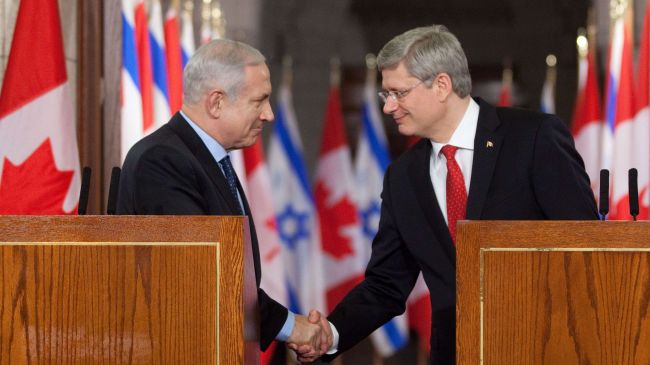
This picture shows Canada’s Prime Minister Stephen Harper (R) and Israeli Prime Minister Benjamin Netanyahu shaking hands after a joint press conference on Parliament Hill, Ottawa, March 2, 2012.
Press TV – April 28, 2013
The world is taking note of the ruling Conservatives’ shameful betrayal of Canada’s once admirable reputation as a fair country, sincerely working on the world stage to improve the lot of the disadvantaged and suffering.
In the UN Human Rights Council’s Universal Periodic Review, Canada was criticized to such an extent that the Council decided to send the Special Rapporteur on the Rights of Indigenous Peoples, and representatives of the Committee on the Elimination of Discrimination Against Women and the Inter-American Commission on Human Rights, to investigate.
Minister of Foreign Affairs spokesman Joseph Lavoie dismissed complaints by
*China of “widespread racial discrimination”,
*Iran of “child sexual exploitation and trafficking, the right to food, discriminatory law and regulation against indigenous people and minority groups including Muslim, Arab and African communities”,
*Pakistan of “increased poverty and unemployment rate among immigrant communities”,
*Egypt of “racial profiling in law-enforcement action”, and
*Cuba of “racism and xenophobia” in Canada,
insisting that “Canada has a track record of being a human rights leader, at home and around the world.”
The visits come at an awkward moment for the Conservatives, as it makes a public display of victimizing Muslims as part of a campaign to ram through the “Combating Terrorism Act” (Bill S-7), which gives the state extraordinary powers to detain suspects without any charges and without any legal protections for up to a year.
This sorry state of Canadian political life is the fruit of the Conservatives’ slavish obedience to every US whim, and of its decision to abandon any pretense of an independent foreign policy, making all decisions in consultation with Israeli advisers under the public security cooperation “partnership” signed in 2008 by Canada and Israel to “protect their respective countries’ population, assets and interests from common threats”. Israel security agents now officially assist Canada’s security services, the RCMP and CSIS, in profiling Canadian citizens who are Muslims and monitoring individuals and/or organizations in Canada involved in supporting the rights of Palestinians and other such nefarious activities. Even the usually timid UN is appalled.
The past two weeks of public spectacle could be lifted from a perverse Alice-in-Wonderland scenario. The latest claim to have uncovered a dastardly scheme by Muslim furriners plotting to explode weapons of mass destruction came just a week after the now legendary Boston bombing. Both incidents were dramatically unfolded to a gullible public as classic ‘good vs evil’, though neither holds water.
Canadian authorities boasted Monday afternoon that, working in concert with the FBI and other US national security agencies, they had broken up a terrorist conspiracy involving an “Iranian-based al-Qaeda cell”. The announcement, made at an RCMP press conference, came out of the blue, just days after the Boston bombing, and a few days after the House of Commons agenda was changed to debate final reading of the draconian anti-terrorism legislation.
On cue, US Ambassador to Canada David Jacobson hailed the action as “the result of extensive cross-border cooperation” showing “that we face serious and real threats.” The men were arrested in a Hollywoodesque fashion–Chiheb Esseghaier while eating at McDonald’s in Montreal’s main train station; Raed Jason, by scores of police armed with rifles and accompanied by search-dogs at his workplace in the Toronto borough of North York. They were charged with conspiracy to bomb a New York-bound Via passenger train, though the RCMP conceded that there had never been an imminent threat of an attack or even a definite plan, that Esseghaier and Jaser have been under police radar since last August (based on a year-old tip from an imam), and that their alleged crimes date back to last year.
The reason for their delayed and then sudden arrest is beyond a doubt the notorious Bill S-7, a bill that was forced on Canada by Big Brother in post-911 2001, and which was not renewed in 2007 thanks to Liberal opposition (they originally passed it and then had enough sense to oppose it). The Conservative government suddenly changed the House of Commons agenda as US authorities placed Boston under martial law. The Canadian copycat arrests clearly are intended to add a Canadian pretext for proceeding with Bill S-7, while showing that “We are all Americans now.”
This episode calls to mind the terrorist scare in 2006, when the RCMP staged the dramatic arrest of 18 young Muslims, whom they accused of preparing extensive terrorist attacks, including blowing up the parliament buildings. During the trial, it emerged that the “Toronto 18” was riddled with police agents, one providing the arms instruction at a “terrorist training camp” while another providing harmless bomb-making ingredients. Nevertheless, eleven were convicted and most given lengthy prison terms.
When Esseghaier, a Tunisian-born Montreal PhD student in nanotechnology, told the judge, “These conclusions are being reached based on facts that are nothing but words and appearances,” he was told to shut up, and the hearing was shut down. Jaser’s lawyer John Norris said his client was “in a state of shock and disbelief” and “intends to defend himself vigorously”. Norris took exception to the police’s attempt to present his client as a non-Canadian, noting that the Palestinian refugee has lived with his family in Canada for the past twenty years.
Is it just possible that UN Human Rights Council members read the ‘news’, are appalled, and are genuinely concerned about what’s happening to human rights in Canada?
Canadians’ plight is bad enough, but this recent orchestration of Islamophobia has another angle, just as appalling. The RCMP assertion that these damn furriners acted under the “direction and guidance” of “al-Qaeda elements located in Iran” is a blatant falsehood, as Iran (like Iraq before the US invasion) is probably the most anti-al-Qaeda country in the world. The fundamentalist al-Qaeda delights in killing Shia, was (and is?) supported by the US and financed by Canada’s enlightened Saudi oil-millionaire allies. So it’s not just a question of stripping Canadians of their rights, but of adding toxic fuel to the US-Israeli fires intended to launch war against peaceful (pro-Palestinian) Iran.
The RCMP admitted that they had no evidence of Iranian government involvement, but still… (nudge, nudge, wink, wink). When Canada broke off diplomatic relations with Tehran last autumn, Foreign Minister John Baird labeled Iran “the most significant threat to global peace and security in the world today”. All Iranian Foreign Ministry spokesman Ramin Mehmanparast had to do was to point to the hypocrisy and cynicism of Canada’s government backing the campaign to overthrow the Syrian government -a campaign in which some of insurgents are openly aligned with al-Qaeda: “The same [al-Qaeda] current is killing people in Syria while enjoying Canada’s support.”
And what about the latest hit on the American 911 funny bone? Tamerlan Tsarnaev was under surveillance for four years by the FBI, who were asked by the Russian government to arrest him in 2010 (which they did not do). They do admit to interviewing him in 2011 and sifting through his computer files, but, remarkably for someone allegedly radicalized by the internet, they found nothing of concern. It’s not clear why Russia let him go to visit his parents in the center of terrorism (Dagestan) in Russia in 2012, where purportedly he received some form of terror training or further Islamist indoctrination. Nor how he managed to attend a workshop next door in hostile Georgia organized by the “Fund of the Caucasus” (which works with the US rightwing thinktank the Jamestown Foundation) focused on destabilizing the Caucasus region.
Were both the FBI and the Russian FSB asleep? Was Tamerlan an FBI operative? Was he set up to do the bombing, or did he go AWOL on the FBI? Is this Chechen connection intended to frighten Russia into acquiescing to US-Israeli plans for Syria? “This [official] scenario is simply impossible in the real world,” writes former UK Ambassador Craig Murray. In an interview with Russia Today, Tamerlan’s mother said, “‘They were set up, the FBI followed them for years.” Is this international intrigue-intended to scare both Russia and Iran into abandoning the beleaguered Syrian government -really what Canadian domestic human rights and foreign policy should be based on? Why should we trust Ambassador Jacobson’s blah-blah about “serious threats”?
Canadians are left with security forces eager to show they are doing something, a craven government intent on passing a draconian bill to take away freedoms, and a foreign policy based on a US-Israel obsession with finding some spark to ignite the latest war craze -attack Iran. The supposed pretext -Iran’s nuclear energy program- is after all wearing a tad thin. Peter Osborne in the Telegraph explained how the West has turned down one serious offer after another by Iran (two in 2005 alone), and argues that it is western rather than Iranian intransigence that prevents a deal being struck today. So if no one believes the cry of “Wolf!” on that boondoggle, then the next best thing is “al-Qaeda”. Hell, Bush got away with it against Iraq in 2003; maybe it will work again.
Iran poses only an ideological threat -telling the truth to the US-Israeli tyrant and inspiring Arab Springs.
As for being killed by a bona fide terrorist, the odds are 1 in 20 million, while every year, 4,600 Americans are killed in workplace-related accidents, and more than 30,000 are killed by gun violence. Every 28 hours a black person is killed by police, security guards or vigilantes. On Boston Marathon Day, six Pakistanis died in a drone strike, while scores were killed in car bombs in Iraq. I won’t even begin to recount the daily horrors inflicted by the US in Afghanistan.
Not that these latter crimes against humanity -committed by us- justify retributive violence in any religion, especially Islam. “You shall not be treacherous, you shall not deceive, you shall not mutilate, you shall not kill children.” But the fact that we in the West are unconcerned with preventing senseless deaths at home, and are unaware or don’t care about the murders committed daily in our name abroad, does not bode well for the future. Only when we stop perpetrating violence will violence against us end.
Canadian “Aid” as Tool for Foreign Policy
By Yves Engler | Dissident Voice | April 18, 2013
The Canadian International Development Agency is no longer. In its recent budget the Conservative government collapsed CIDA into Foreign Affairs, creating the Department of Foreign Affairs, Trade and Development.
While there was plenty of commentary on the Tories’ move, no one — from the mainstream right to the development NGO left — pointed out that Canadian aid has primarily been about maintaining and/or extending the grip the world’s richest one percent holds over the entire globe.
Canada began its first significant (non-European) allocation of foreign aid through the Colombo Plan. With Mao’s triumph in China in 1949, the 1950 Colombo Plan’s primary aim was to keep the former British Asian colonies, especially India, within the Western capitalist fold.
To justify an initial $25 million ($250 million in today’s dollars) in Colombo Plan aid External Affairs Minister Lester Pearson told the House of Commons:
Communist expansionism may now spill over into South East Asia as well as into the Middle East … it seemed to all of us at the [Colombo] conference that if the tide of totalitarian expansionism should flow over this general area, … the Free World will have been driven off all but a relatively small bit of the great Eurasian landmass. … We agreed at Colombo that the forces of totalitarian expansionism could not be stopped in South Asia and South East Asia by military force alone.
Two years later Prime Minister Louis St. Laurent was even more explicit about the carrot and stick approach to defeating left wing nationalism (“communism”). In September 1952 St. Laurent explained:
In South East Asia through the establishment of the Colombo plan not only are we trying to provide wider commercial relations but we are also fighting another Asiatic war against Communism in the interests of peace, this time with economic rather than military weapons. We Canadians know that in the struggle against Communism there are two useful weapons, the economic and the military. While we much prefer to use the economic weapons as we are in the Colombo plan, we know that we may have no choice but to use the military weapons as we have been forced to do in Korea [27 000 Canadian troops participated in this war that left 3 million dead].
In other words, if some of India’s post-colonial population had not set their sights on a socialistic solution to their troubles — with the possibility of Soviet or Chinese assistance — Canada probably would not have provided aid. Five years into the Colombo Plan, Pearson admitted “Canada would not have started giving aid if not for the perceived communist threat.”
The broad rationale for extending foreign aid was laid out at a 1968 seminar for the newly established Canadian International Development Agency. This day-long event was devoted to discussing a paper titled “Canada’s Purpose in Extending Foreign Assistance” written by Professor Steven Triantas of the University of Toronto. Foreign aid, Triantas argued, “may be used to induce the underdeveloped countries to accept the international status quo or change it in our favour.” Aid provided an opportunity “to lead them to rational political and economic developments and a better understanding of our interests and problems of mutual concern.” Triantis discussed the appeal of a “‘Sunday School mentality’ which ‘appears’ noble and unselfish and can serve in pushing into the background other motives … [that] might be difficult to discuss publicly.”
A 1969 CIDA background paper, expanding on Triantas views, summarized the rationale for Canadian aid:
To establish within recipient countries those political attitudes or commitments, military alliances or military bases that would assist Canada or Canada’s western allies to maintain a reasonably stable and secure international political system. Through this objective, Canada’s aid programs would serve not only to help increase Canada’s influence within the developing world, but also within the western alliance.
This type of thinking continues to drive aid policy. Largely ignored in recent commentary, there are innumerable documented instances of Canadian aid advancing highly politicized geopolitical objectives over the past 25 years.
As an early advocate of International Monetary Fund/World Bank structural adjustment programs, since the early 1980s Canada has channeled hundreds of millions in “aid” dollars to supporting privatization and economic liberalization efforts in the Global South. At the start of the 2000s Ottawa plowed millions of dollars into supporting the Western-backed “coloured revolutions” in Eastern Europe and opposition to Jean Bertrand Aristide’s elected government in Haiti. More recently, the Conservatives have ramped up aid spending in Latin America to combat independent-minded, socialist-oriented governments. Barely discussed in the media, the Harper government’s shift of aid from Africa to Latin America was largely designed to stunt Latin America’s recent rejection of neoliberalism and U.S. dependence by supporting the region’s right-wing governments and movements.
An entirely unacknowledged, though increasingly obvious, principle of Canadian aid is that where the USA wields its big stick, Canada carries its police baton and offers a carrot. Or to put it more bluntly, where U.S. and Canadian troops kill Ottawa provides aid.
During the 1950-53 Korean War the south of that country became a major recipient of Canadian aid and so was Vietnam during the U.S. war there. The leading recipient of Canadian aid in 1999/2000 was the war-ravaged former Yugoslavia and Iraq and Afghanistan were top two recipients in 2003/2004. Since that time Afghanistan and Haiti (where Canadian and U.S. troops helped overthrow the elected government in February 2004) have been the leading recipients. Tens of millions in Canadian “aid” dollars have been spent to reestablish foreign and elite control over Haiti’s security forces.
There are a number of reasons for the lack of discussion about aid being used as a tool to maintain/extend Western capitalist dominance. NGO critics of aid policy are generally unwilling to point out the geopolitical underpinnings of Canadian aid because their jobs depend on keeping quiet. They stick to criticizing the ways in which foreign assistance is used to benefit specific corporate interests. This stakeholder criticism generally amounts to no more than NGOs saying: “Give the aid money to us not the corporations, because we’ll do a better job of whatever it is you want to accomplish.”
If you tell truth to power by saying Canadian aid is largely designed to maintain Western capitalist dominance of the Global South, you’re not likely to have your grant renewed.
The funny thing is, with the Conservatives in power, if you’re doing anything remotely useful to ordinary people, you’re not likely to anyway.
Yves Engler is the author of Lester Pearson’s Peacekeeping: The Truth May Hurt. His latest book is The Ugly Canadian: Stephen Harper’s foreign policy.
Related articles
Canadian police arrest 279 protesters in Montreal
Press TV – April 7, 2013
Hundreds of protesters have been arrested during a demonstration against Canada’s police tactics in the country’s second-largest city of Montreal.
The Friday demonstration was held in protest against the controversial municipal bylaw called P-6, which allows the police to declare a protest event illegal in case no itinerary is given to authorities prior to the protest.
At least 279 protesters were arrested and fined 637 Canadian dollars for participating in an ‘illegal’ protest.
The P-6 also forbids participants to cover their faces during a protest.
Critics say that the P-6 is a form of police repression.
The event on Friday was organized by the Anti-Capitalist Convergence, also known as CLAC, who said the protest was a family-friendly event that aimed to “take back the streets.”
CLAC argues that holding a peaceful gathering is a right within the Canadian Charter of Rights and Freedoms.
Since February, several protests against the P-6 have been held in Montreal, with a total of nearly 600 people arrested and fined.
Number of natives in Canada’s prisons alarming: Officials
Press TV – March 8, 2013
A Canadian official says the number of aboriginals including Métis and Inuit in Canada’s prisons is increasing at ‘an alarming rate’.
According to a statement issued by the Correctional Investigator of Canada Howard Sapers on Thursday, “There are just over 3,400 aboriginal men and women making up 23 percent of the country’s federal prison inmate population.”
“In other words, while aboriginal people in Canada comprise just four percent of the population, in federal prisons nearly one in four is Métis, Inuit, or First Nations,” he added.
He went on to say that “the over-representation of aboriginal people in federal corrections and the lack of progress to improve the disparity in correctional outcomes continues to cloud Canada’s domestic human rights record.”
Meanwhile, Canada’s official opposition party, the New Democrats, issued a statement saying “What we find in this report is a shocking indictment of how… (Ottawa) has failed aboriginal Canadians.”
Also, former Supreme Court Justice Frank Lacobucci has revealed in a study that the aboriginal youths are treated more harshly by the justice system than other groups.
Lacobucci showed in a study that about one quarter of young native offenders were sent to jail for assault, in contrast to less than 15 percent of non-aboriginal youth.
He severely criticized the Canadian judicial system for “systemic racism” and stated that the jailing of aboriginals is a “serious crisis.”
In 2012, the United Nations called on Canada to take “urgent measures” to reduce the overrepresentation of aboriginals and blacks in the criminal justice system and out-of-home care.
John Baird, Canada’s Minister of Foreign Affairs, Speaks at AIPAC
By Jim Miles | Palestine Chronicle | March 7, 2013
Canada’s Foreign Affairs Minister, John Baird, was in comfortable territory at the current AIPAC policy conference meeting in Washington, D.C.
I have deconstructed his arguments before, as he reiterates the current Harper government of Canada position in its unqualified support for Israeli occupation of Palestinian land and all that goes along with that. I will not repeat those arguments here as they are the same old-same old regurgitations of support for the militaristic Israeli state from a Canadian government that does not truly represent the majority of the people of Canada.
Baird presents the same arguments about Palestine living up to all previous agreements without recognizing that Israel has a lot to live up to as well; in particular that the UN Security Council has previously recognized withdrawal from occupied territories and the right of return of refugees. And as usual, the fault of the violence is the very nature of Arab/Palestinian social-political life, a mythology that Israel and its western supporters are careful to nurture.
What interested me most about his current statements, apart from the ego flattering standing ovations the AIPAC audience rendered unto him, are his comments about stopping aid to the Palestinian National Authority. Baird threatened a similar stopping of aid during the vote to recognize Palestine at the UN, then backed off after the overwhelming support displayed for Palestine.
These threats are being renewed again, against Palestine taking Israel to the International Criminal Court, but one has to wonder if the Canadian government is really aware of what the consequences of that cut might be.
Most of Canada’s aid to Israel is bound into corporate military research and development, including the realm of security and surveillance. The aid to the Palestinian Authority helps the PA maintain their fragile grip on the Palestinian population as it is used for similar areas of security, surveillance, and support for the few Palestinian elites who harvest the aid supplies for their own benefit. The Canadian military and the Canadian national police force, the RCMP, serve as trainers for the PA authorities own militarized units.
So what happens if the aid to Palestine is cut? Many things are possible, the most counterproductive one from the Israeli perspective would be the decrease in the control that the PA is able to exert over the Palestinian population on its behalf as the money supplies dry up. The Palestinian economy, such as it is, mainly in the West Bank, where the majority of the funds are utilized, would suffer even more.
With more economic weakness, and with a weakened PA no longer able to buy influence among its own people, the Palestinians would certainly be more restive and perhaps more aggressive towards their own elites as well as the Israelis – a third intifada would become more probable. Of course, more Palestinian violence would only make the current Canadian government say, “See, we told you they were a violent people,” and so the mythology of Israeli victimization will continue.
It would be a good thing perhaps to shed the yoke and burden of foreign control bought by the power of foreign dollars manipulating the economy and political scene in Palestine. The outcomes of such a cut are indeterminate, but usually in the world of political manipulation, unexpected outcomes are to be expected. For that reason alone, one can expect John Baird and the Harper government to prevaricate over cuts for some time to come.
– Jim Miles is a Canadian educator and a regular contributor/columnist of opinion pieces and book reviews for The Palestine Chronicle.
Press TV announces new frequency for US, Canada viewers
Press TV – February 9, 2013
Press TV has announced a new frequency for viewers in the United States and Canada after the Iranian channel was removed from the Galaxy 19 satellite platform.
The satellite platform provided broadcast services to the viewers of the 24-hour English-language Iranian news channel, and the film channel iFilm in the United States and Canada.
In order to watch Press TV in the US and Canada, viewers can use the following frequency on Galaxy 19:
Frequency 12028 MHz
Polarization H (horizontal polarization)
Symbol rate 21991Msym
FEC 3/4
Press TV, iFilm taken off air in US, Canada
Press TV – February 8, 2013
In another flagrant violation of freedom of speech, Iranian channels Press TV and iFilm have been removed from the Galaxy 19 satellite platform.
The satellite platform provided broadcast services to the viewers of the 24-hour English-language Iranian news channel, Press TV, and the film channel, iFilm, in the United States and Canada.
This is not the first time that Iranian media have been targeted. In January, the Spanish government ordered Madrid’s regional government to stop the broadcast of the Iranian Spanish language channel Hispan TV as of January 21.
The move came a month after the Spanish satellite company, Hispasat, terminated the terrestrial broadcast of Hispan TV.
Hispasat is partly owned by Eutelsat, whose French-Israeli CEO is blamed for the recent wave of attacks on Iranian media in Europe.
Back then, the move was immediately welcomed by the American Jewish Committee (AJC), which called it an important development in worldwide efforts to contain Iran’s media influence.
AJC Executive Director David Harris has acknowledged that the committee had for months been engaged in discussions with the Spaniards over taking Iranian channels off the air. … Full article
Related articles
- Zionist lobbies seek to restrict Press TV activities in US: Analyst (alethonews.wordpress.com)
- Hispasat orders Overon to take Press TV, Hispan TV off air (alethonews.wordpress.com)
Canadian natives and anti-nuclear activists halt train
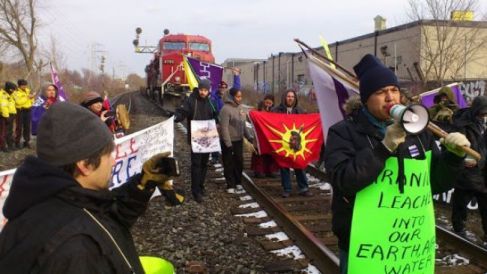
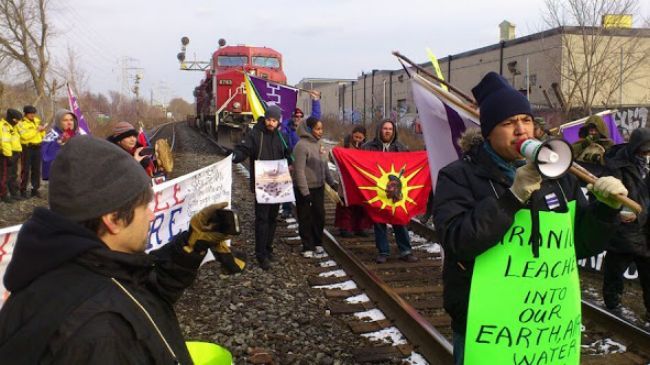
Protesters blocking a train near a nuclear processing facility in Toronto, Canada on February 3, 2013.
Press TV – February 6, 2013
Canadian natives and anti-nuclear activists have blocked a rail line, demanding the shutdown of a nuclear processing facility in the country.
The protesters, including the members of the Idle No More movement, blocked a train, on Sunday, near the General Electric-Hitachi nuclear plant in Toronto, after staging a demonstration at the facility and a march earlier.
“Uranium is stolen from indigenous lands and it leaks radiation all along the fuel chain,” said anti-nuclear activist Zach Ruiter.
Another protester from Serpent River First Nation said, “I’m here because uranium, it really affected my reserve back home,” and added, “It did a lot of damage to our river. We can’t use the river no more, we can’t fish in it. We can’t drink the water.”
Under a Canadian law, the government has the right to seize or sell land from the indigenous people to the private sector.
The aboriginal people say the government is using the law to force them flee their land.
Legal experts have called the law unconstitutional and a potentially genocidal piece of legislation that is intended to do away with the collective rights of Canada’s 1.2 million natives.
The Idle No More Movement was inspired by the six-week hunger strike of Attawapiskat Chief Theresa Spence, which began on December 11, 2012, as a protest against the violation of the rights of Canadian natives.
Ottawa orders Canadian scientific journals not to publish Iranian articles
Press TV – December 19, 2012
The Canadian government has reportedly ordered the scientific journals of the country not to publish articles authored by Iranian researchers and scientists.
Iranian academics, who had primarily received an acceptance from the journals, have received new messages that notified them of the journals’ decision not to publish their work due to recent policies adopted by the Canadian government.
In a recent move, the Canadian Journal of Psychiatric Nursing Research refused to publish an article by an Iranian assistant professor despite the earlier acceptance of the article.
The journal argued that it “will not be permitted to publish” the article as previously stated, citing the political and non-academic reasons. It said that Ottawa had closed down its mission in Tehran for what it called the “civil rights abuse of the citizens of Iran” and “the threat to the security of Canadian personnel and Israel.”
On September 7, the Canadian government closed its embassy in Tehran and ordered Iranian diplomats to leave Canada within five days.
In a statement, Canadian Foreign Affairs Minister John Baird said Canada views Iran “as the most significant threat to global peace and security in the world,” adding that Iran “routinely threatens the existence of Israel.”
The Iranian Foreign Ministry Spokesman Ramin Mehmanparast censured Ottawa’s decision as undiplomatic and a move in line with the policies dictated by Israel.
“The hostile actions of the current racist Canadian government are in fact in line with the policies that are dictated by the Zionist regime (Israel) and the British government,” Mehmanparast said.
Pundits believe Canada’s move to sever diplomatic ties with Iran unveils Ottawa’s submissive attitude toward the Israeli regime.
“Canada’s abrupt move to sever all ties with the Islamic Republic of Iran manifestly springs from a strong Zionist sway which has permeated the political structure of the country,” Iranian academic Ismail Salami wrote in an op-ed published on Press TV website on September 11.
The analyst said that, governed as a constitutional monarchy with British Queen Elizabeth II as its head of state, Canada could be viewed as a country “supporting colonizing regimes such as Israel and seeking to isolate the peaceful nation of Iran.”
Canadian Prime Minister Stephen Harper and Foreign Affairs Minister John Baird have time and again expressed unconditional support for Israel, and are widely believed for dancing to every tune of Israel.
Related articles
- Canada’s Palestinian Aid Programme Serving Israel’s Interests (alethonews.wordpress.com)
- Iran condemns Canadian Gov’t for freezing its assets (EndtheLie.com)
Featured Video

Rewriting the risk? Inside the government’s vaccine safety messaging
or go to
Aletho News Archives – Video-Images
Book Review
“Davos Can Really Replace the UN”
Inside the book that maps the architecture behind global governance — from the Epstein files to the Pact for the Future
Lies are Unbekoming | April 1, 2026
On June 13, 2019, the United Nations and the World Economic Forum signed a partnership deal to “accelerate the implementation of the 2030 Agenda for Sustainable Development.” That same evening, WEF president Börge Brende — Norway’s former Foreign Minister — had dinner with Jeffrey Epstein at Epstein’s Manhattan townhouse. The Epstein files, released January 2026, contain an exchange between the two from the previous year. Epstein to Brende: “Davos can really replace the UN. C21, cyber, crypto . genetics… intl coordination.” Brende back to Epstein: “Exactly — we need a new global architecture. World Economic Forum (Davos) is uniquely positioned — public private.”
The next day, the UN General Assembly adopted the framework for restructuring global governance.
That sequence — the partnership signing, the Epstein dinner, the candid admission about replacing the UN with a public-private architecture, and then the formal adoption — opens Jacob Nordangård’s The Digital World Brain. Pages two and three. Footnoted to the UN resolution number, the Epstein files, and the General Assembly record.
I keep coming back to it because it captures what this book does that almost nothing else in the independent research space manages. I’ve followed Jacob’s work for years now and interviewed him about his research. Each book peels back another layer of the same institutional architecture, and each time I think he’s reached the limit of what can be documented, the next one goes further. Nordangård doesn’t speculate. He doesn’t editorialize much. He lays institutional actions next to each other in chronological order and lets the pattern announce itself. … continue
Blog Roll
 Aletho News
- The End of NATO
- 37 days of war on Iran cost US staggering $42bln, tracker shows
- Baghdad tells Asian refiners, traders to begin loading Iraqi crude amid Iranian exemption
- Under fire, Moscow and Tehran close ranks
- Iran, US receive Pakistan-mediated plan for ceasefire then final deal
- Iran submits demands for end to war as mediators scramble ahead of Trump deadline
- Iran Threatens Retaliatory Strike on Stargate AI Project in UAE
- US sent ‘a lot’ of arms to Iranian protesters – Trump
- Barak Ravid Launders Deception To Allow Trump To Back Off Of His Power Plant Threat – Again
- REWRITING THE RISK? INSIDE THE GOVERNMENT’S VACCINE SAFETY MESSAGING
- If Americans Knew
- Trump poised to “blow everything up” (ie. commit war crimes) in Iran – Daily Update
- In Iran, Israel-US take aim at “reason, research, and freedom of thought” – Daily Update
- US loses planes over Iran, Israel downgrades Lebanon war goals – Daily Update
- Israel Is Blocking Palestinians from Easter at Church Where Jesus Resurrected
- Plot to assassinate Palestinian activist follows harassment campaign promoted by Zionist groups and elected officials
- Prominent New York synagogue hosts presentation on why U.S. Jews should support the ethnic cleansing of Gaza
- Tapper vs. Piker: Is the CNN Anchor Auditioning for David Ellison?
- Shouldn’t Democrats Be Able to Condemn Genocide?
- Israel-US kill negotiators, destroy civilian structures, but Iran’s military capabilities still largely intact – Daily Update
- ‘War crime’: Global condemnation as Israeli ministers celebrate death penalty law targeting Palestinian prisoners
- No Tricks Zone
- An Inconvenient Tree: Uncovered In Alps… Europe Much Warmer Than Today 6000 Years Ago
- New Study Reports A 60% Slowdown In Greenland’s Ice Loss Rate In The Last Decade
- Low Intensity Tornado Wrecks Major Solar Farm, Creating A Potential Toxic Dump
- New Study Finds Warming Saves Lives…Cold Temperatures 12 Times More Deadly Than Excess Heat
- German Science Blog Accuses PIK Climate Institute Of Hallucinating Climate Tipping Points
- Devastating Assessment Of Comirnaty Vaccine By Former Senior Pfizer Europe Toxicologist
- New Study: CO2 Is ‘Effectively Negligible’ As An Explanatory Climate Change Factor Since 2000
- Former Pfizer Toxicologist Dr. Helmut Sterz Tells Bundestag Hearing Pfizer Vaccine Should Have Never Been Approved
- Energy Expert: Germany’s Nuclear Phaseout Was A “500 Billion Euro Mistake”
- New Research: South Australia’s Mid-Holocene Sea Surface Temperatures Were 4°C Warmer Than Today
 Aletho News