Canada’s Palestinian Aid Programme Serving Israel’s Interests
By Yves Engler | Dissident Voice | December 14th, 2012
Few aspects of Canadian foreign policy have been mentioned more times over the past two weeks than Ottawa’s 300 million dollar five year aid program to the Palestinians.
Ever since the Globe and Mail reported on November 26 that Prime Minister Stephen Harper threatened Mahmoud Abbas that “there will be consequences” if he followed through on his plan to ask the UN General Assembly to upgrade Palestine’s status there has been a great deal of speculation about whether Canadian “aid” would be cut off. A quick Google search brings up hundreds of articles mentioning the 300 million dollars in funding yet none of them mention the highly politicized character of this “aid”.
After Hamas won legislative elections in January 2006 the Conservatives made Canada the first country (after Israel) to cut off funding to the Palestinian Authority. When Hamas officials were ousted from the Palestinian unity government in June 2007, the Conservatives immediately contributed $8 million “in direct support to the new government.” Then in December 2007 the Conservatives announced a five-year $300 million aid program to the Palestinians, which was largely designed to serve Israel’s interests.
A Saint John Telegraph-Journal headline explained: “Canada’s aid to Palestine benefits Israel, foreign affairs minister says.” In January 2008 foreign minister Maxime Bernier said: “We are doing that [providing aid to the PA] because we want Israel to be able to live in peace and security with its neighbours.”
Most of the Canadian aid money has gone to building up a Palestinian security force overseen by a US general. The immediate impetus of the Canadian aid was to create a Palestinian security force “to ensure that the PA maintains control of the West Bank against Hamas,” as Canadian Ambassador to Israel Jon Allen was quoted as saying by the Canadian Jewish News. American General Keith Dayton, in charge of organizing a 10,000-member Palestinian security force, even admitted that he was strengthening Mahmoud Abbas’ Fatah against Hamas, telling a US audience in May 2009 his force was “working against illegal Hamas activities.” According to Al Jazeera, between 2007 and early 2011 PA security forces arrested some 10,000 suspected Hamas supporters in the West Bank.
The broader aim of the US-Canada-Britain initiated Palestinian security reform was to build a force to patrol Israel’s occupied territories. In a 2011 profile of Canadian Lieutenant-Colonel Ron Allison, “Dayton’s chief of liaison in the West Bank” for a year, his hometown newspaper reported: “The Dayton team was concerned with enhancing security on the West Bank of Palestine and was all geared towards looking after and ensuring the security of Israel, said Ron.”
“We don’t provide anything to the Palestinians,” noted Dayton, “unless it has been thoroughly coordinated with the state of Israel and they agree to it.” For instance, Israel’s internal intelligence agency, the Shin-Bet, vets all of the Palestinian recruits.
The Israelis supported Dayton’s force as a way to keep the West Bank population under control. Like all colonial authorities throughout history Israel looked to compliant locals to take up the occupation’s security burden. In a December 2011 article titled “[Ehud] Barak admires PA security forces for protecting [Israeli] settlers [in the West Bank]” a Palestinian news agency described an interview the Israeli defence minister gave to a Hebrew radio station.
Writing in a July 2011 issue of the London Review of Books Adam Shatz explained: “The PA already uses the American-trained National Security Force to undermine efforts by Palestinians to challenge the occupation. (Hamas, in Gaza, has cracked down on protest even more harshly.) ‘They are the police of the occupation,’ Myassar Atyani, a leader of the Popular Front for the Liberation of Palestine, told me. ‘Their leadership is not Palestinian, it is Israeli.’ On 15 May – the day Palestinians commemorate their Nakba [the 1948 destruction of Palestinian society] – more than a thousand Palestinians, mainly young men, marched to the Qalandia checkpoint between Ramallah and Jerusalem and clashed with Israeli soldiers; but when Atyani tried to lead a group of demonstrators to the Hawara checkpoint outside Nablus, PA security forces stopped them. The road from Ramallah to Qalandia is in Area C, which is not controlled by the PA; the road from Nablus to Hawara is in Area A, which is. And protesters who have attempted to march to settlements along PA-controlled roads have also found themselves turned back. It is an extraordinary arrangement: the security forces of a country under occupation are being subcontracted by third parties outside the region to prevent resistance to the occupying power, even as that power continues to grab more land. This is, not surprisingly, a source of considerable anger and shame in the West Bank.”
The Palestinian security force is largely trained in Jordan at the US- built International Police Training Center (created to train Iraqi security after the 2003 invasion). In October 2009 the Wall Street Journal reported: “[Palestinian] recruits are trained in Jordan by Jordanian police, under the supervision of American, Canadian, and British officers.” The number of military trainers in the West Bank varied slightly but in mid-2010 18 Canadian troops worked with six British and ten US soldiers under Dayton’s command. “The Canadian contribution is invaluable,” explained Dayton. Canadians are particularly useful because “US personnel have travel restrictions when operating in the West Bank. But, our British and Canadian members do not.” Calling them his “eyes and ears” Dayton said: “The Canadians … are organized in teams we call road warriors, and they move around the West Bank daily visiting Palestinian security leaders, gauging local conditions.”
Part of the US Security Coordinator office in Jerusalem, the Canadian military mission in the West Bank (dubbed Operation PROTEUS) includes RCMP officers as well as officials from Foreign Affairs, Justice Canada and the Canadian Border Services Agency. In a September 2010 interview with the Jerusalem Post then deputy foreign minister Peter Kent said Operation PROTEUS was Canada’s “second largest deployment after Afghanistan” and it receives “most of the money” from the five-year $300 million Canadian “aid” program to the Palestinians. During a visit to Israel in February, foreign minister John Baird told the Globe and Mail he was “incredibly thrilled” by the West Bank security situation, which he said benefited Israel.
In effect, Canada has helped to build a security apparatus to protect a corrupt PA led by Mahmoud Abbas, whose electoral mandate expired in January 2009, but whom the Israeli government prefers over Hamas.
Don’t expect the Conservative government to sever this “aid”.
Former Member of Parliament joins ship to Gaza: ‘Time for Canadian politicians and people to speak up’
By Jim Manly | Rabble | October 4, 2012

I look forward to joining the Estelle on its voyage from Naples to Gaza and I am aware of my responsibility as the only Canadian on this international crew of volunteers.
We want to bring a message of solidarity for the Palestinians of Gaza and to remind them that they are not alone in the struggle.
While we will be carrying a cargo of humanitarian aid, the basic goal of our trip is to continue pressuring the Israeli government to lift the blockade of Gaza. International aid is not a solution but a symptom of the problem whereby Israel keeps Gaza from developing its own economy.
We are firmly committed to non-violent resistance but the movement behind the Freedom flotilla will not quit until the Israelis lift the blockade.
Growing public opinion around the world recognizes that the Israeli blockade is not only illegal under International Law, it is also morally wrong. The blockade deliberately denies 1.6 million people of the essentials of life: adequate food, water, and shelter. It denies people the right to make a living through international trade and even trade with their fellow Palestinians in the Occupied West Bank. It denies them the freedom to live with dignity.
If we believe in human rights we must be prepared to take a stand when these rights are so flagrantly violated. It is time for Canadian politicians and the Canadian people to speak up against this illegal and inhuman blockade.
As part of Canada’s contribution, the Estelle will be carrying an anchor for Gaza’s Ark, which, like the Estelle, is a project of the international Freedom Flotilla Coalition. The Gaza Ark project is rebuilding a boat within Gaza to carry Palestinian goods to the outside world. In this way it will challenge the blockade from the inside just as the Estelle and other boats challenge it from outside.
While I want to thank you for your interest and support, I know that even more the Palestinians of Gaza thank you for your support and solidarity.
Jim Manly is a retired United Church minister who served as a New Democratic Party Member of Parliament from 1980-88, representing Cowichan-Malahat-the Islands, a BC Coastal riding. As MP, he was NDP critic for Indian Affairs and later critic for Fisheries and also International Development. As a United Church minister, Jim served mostly British Columbia congregations and has been active in the Church’s social justice work in Canada and the Americas. Ordained in 1957, he retired in 1997. He lives near Nanaimo, B.C. with his wife, Eva, and together they continue to be active in a number of areas including United Network for a Just Peace in Palestine and Israel (UNJPPI), and Mid-Islanders for Justice and Peace in the Middle East. This past spring he and Eva took part in a Pilgrimage of Solidarity to the Occupied Territory of the Palestinian West Bank.
The Canadian Boat to Gaza blog
The Canadian Boat to Gaza blog will keep you up to date on fundraising and organizing efforts in support of the ‘Tahrir’, a Canadian boat which is currently part of the ‘Freedom Waves to Gaza’. Bloggers will report from on board the Tahrir and on support activities in Halifax, Montreal, Toronto, Hamilton, London, Vancouver, Victoria and many points in between.
Canadian civil society has a responsibility to fight the illegal Israeli blockade of Gaza and to expose the Canadian government’s unjustified support for Israel. The time has come to send a Canadian boat to challenge the blockade of Gaza, in coordination with similar international efforts. Check out the Boat to Gaza’s website at http://tahrir.ca or follow us at twitter.com/CanadaBoatGaza.
Related articles
- New Irish ship seeks to break Israeli supplies blockade on Gaza (irishcentral.com)
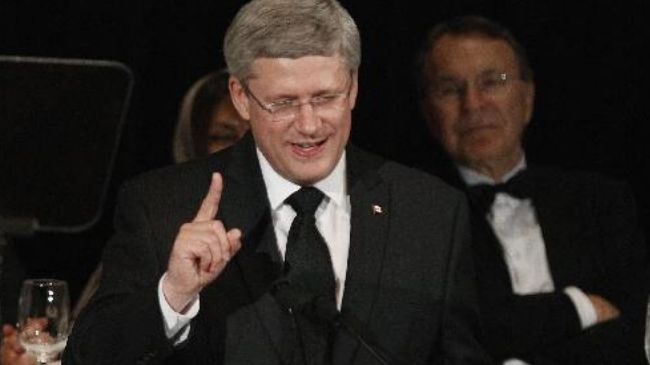
Canadian Premier Harper skips UN General Assembly to get Jewish award
Press TV – September 28, 2012
Canadian Prime Minister Stephen Harper has come under fire for skipping the 67th session of the UN General Assembly to attend a private ceremony where he received an award from a Jewish-sponsored organization.
Passing up the opportunity to address the General Assembly, Harper chose to receive the New York-based Appeal of Conscience Foundation (ACF) award from former US Secretary of State Henry Kissinger on Thursday.
The Canadian official seized the opportunity to level criticism at the UN and accused its members of using the world body as a “forum to single out Israel for criticism.”
Harper further added that the policies of the Israeli regime are not to blame for “the pathologies present in that part of the world,” while reaffirming Canada’s support for Tel Aviv.
However, the Canadian prime minister’s decision not to speak at the opening of the General Assembly drew harsh criticism in Canada from opposition leaders, who called the move “absolutely ridiculous.”
“I think the message is that Canada, that the Harper government doesn’t care about the United Nations,” said Bob Rae, the interim leader of the Liberal Party of Canada.
This is the second consecutive year that Harper has shunned the UN event, preferring to send Foreign Affairs Minister John Baird in his place.
Many in Canada are concerned about Harper’s conservative policies as he is also accused of locking his government behind a wall of secrecy, defunding democratic institutions and giving away Canada’s sovereignty to the UK and the Israeli regime.
Study: Venezuela’s Chavez 4th Most Popular President in the Americas
By Ewan Robertson | Venezuelanalysis | September 24th 2012
Mérida – Venezuelan President Hugo Chavez is the 4th most popular president in the Americas, according to a new study of presidential approval ratings in the region.
The study, by Mexican polling firm Consulta Mitofsky, gives President Chavez a “high” approval rating of 64%, gaining 6 percentage points since the firm’s last study and jumping up the table of presidential popularity levels.
The findings come less than two weeks before Chavez seeks re-election on October 7 against right-wing opponent Henrique Capriles Radonski.
According to the study, which measured the approval ratings of 20 leaders in the Americas by compiling public opinion polls from their respective countries, Ecuadorian president Rafael Correa is the most popular president in the Americas with an “outstanding” approval rating of 80%.
“Rafael Correa repeats his first place with 80% (a point less than his previous evaluation), maintaining the approval with which his presidency began almost five years ago,” the ‘Approval of Leaders: America and the World’ report stated.
He is followed by Maurico Funes of El Salvador and Guatemalan president Otto Perez, on 72% and 69% respectively.
Chavez and Correa are joined at the top of the popularity table by other presidents considered left or centre left, with Brazil’s Dilma Roussef on 5th with 62% approval, and Nicaraguan president Daniel Ortega on 7th place with a popularity of 59%.
Meanwhile, two months ahead of his re-election bid against Republican rival Mitt Romney, US President Barack Obama placed 10th in the study, receiving a “medium” approval rating of 49%. Canadian Prime Minister Stephen Harper was classed on a “very low” popularity of 37%, putting him down on 16th place.
The study highlights a north-south divide, with South American presidents enjoying an average approval of 50%, against 44% for leaders from the North of the hemisphere.
Many rightist presidents have dropped in popularity since the earlier 2012 study by Consulta Mitofsky, and find themselves on the bottom half of the table. Colombian president Juan Manual Santos still figures on the top half of the table with 54% approval, yet has dropped 13 percentage points and has lost his “high” approval rating.
Furthermore, Mexico’s Felipe Calderon placed 11th (46%), while Paraguayan President Federico Franco and Chilean President Sebastian Piñera share 17th place on 36%. Franco was came to power through an “institutional coup” in June by the Paraguayan Senate, and is less popular than deposed leftist president Fernando Lugo, who had 44% popularity in August 2011.
However, the findings aren’t all good news for South America’s “pink tide” governments, with 12th, 13th, and 14th places going to Argentina’s Cristina Fernandez (43%), Bolivia’s Evo Morales (41%) and Peru’s Ollanta Humala (40%) respectively.
The last places in the poll are occupied by the presidents of Honduras and Costa Rica, on approval ratings of 14% and 13%. The full study in Spanish can be accessed here.
Related articles
- Ecuador’s Correa and El Salvador’ Funes, leaders with the highest approval-rate (en.mercopress.com)
New Quebec premier scraps tuition hike plan
Press TV – September 21, 2012
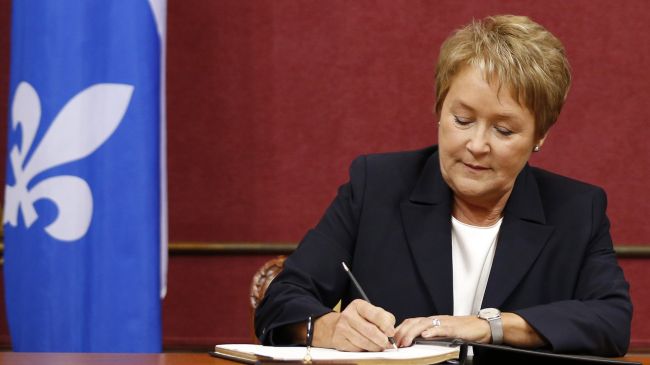
Newly-elected Quebec Premier Pauline Marois has reversed a planned tuition hike that touched off months of violent protests in Canada’s French-speaking province.
Marois, who started her job on Thursday, delivered on her electoral pledge to reinstate the USD 2,220 tuition.
“The new government is now in place,” she told reporters after the first cabinet meeting. “I intend to act rapidly to offer results to Quebecers, starting today, Day One of our mandate.”
The former premier, Jean Charest, had planned to increase tuition fees in a bid to make up for the country’s budget deficit.
Marois said she will also cancel the Liberals’ controversial anti-protest law, known as Bill 78. The draconian law, whose main objective was to restrict freedom of assembly, criminalizes students’ strike and sets rules for gatherings of more than 50 people, requiring organizers to provide an eight-hour notice of the itinerary and length of the event.
“These two decisions will allow us to return peace to our streets and to reestablish rights and liberties,” Marois was quoted as saying.
The new premier’s move drew applause from student groups.
“It’s a victory for justice and equality,” said Martine Desjardins, president of the FEUQ university student association.
“Together, we have written a chapter in the history of Quebec. Together, we have just proven that we can stand up and reach one of the student movement’s greatest victories,” he added.
Ahead of elections earlier this month, Marois had said that if her party – Parti Quebecois (PQP) – won and was able to form a new Quebec government, she would call for a referendum on the separation of Quebec from Canada.
Related articles
- University of Montreal cancels classes for fear of protest (alethonews.wordpress.com)
Party Quebecois members take down Canadian flag
Press TV – September 18, 2012
The newly-elected separatist party in Canada’s French-speaking province of Quebec takes down the Canadian flag from parliament, vowing independence of the eastern province.
The flag which had been there for the past nine years was removed on Monday as 54 Party Quebecois (PQ) members took office in the ornate old upper chamber, known as the Red Room.
Meanwhile, the new parliament members could not escape the oath of allegiance to Queen Elizabeth the second, which is a prerequisite to take office under Canadian law.
Some PQ members expressed their discontent on Twitter, saying it was a shame to be forced to swear an oath to the Crown.
The separatist Parti Quebecois (PQ) leader, Pauline Marois who won provincial elections on September 5, also suggested that the election of a PQ government would pave the way for restoring Quebecers’ pride.
“When a people rediscovers its pride and its confidence nothing, absolutely nothing, becomes impossible for it,” said Marois on Monday.
The Party Quebecois (PQ) lawmakers officially take office on Wednesday, when separatist leader Pauline Marois will introduce her cabinet members.
Separatists win Quebec elections
RT | September 5, 2012
The separatist Parti Quebecois has won Quebec’s regional elections and will form a new government there, once again raising the possibility of a referendum on independence being held in Canada’s French-speaking province.
Canadian Broadcasting Corp and the Canadian Press reported that Parti Quebecois (PQ) won or were leading in nearly 60 districts, just short of the 63 needed for a majority government.
The party’s leader, Pauline Marois, will replace head of the Liberal party, Jean Charest, as the province’s leader, becoming Quebec’s first female premier.
Crowds of jubilant PQ followers, cheered and waved flags as election results indicated their party was heading back to power after nine years of Liberal Party rule.
Should PQ win a majority it will make it easier for them to call a referendum on independence. Quebec has held two referendums in the past – one in 1980 and another in 1995- with the last narrowly rejecting independence from Canada.
However PQ claim their short-term priority would be picking the economy up off its knees, instead of pushing for a separation vote straight away.
“It’s very important for me to manage our finances responsibly. That is without doubt why our engagements are the least costly of all parties,” Pauline Marois earlier told Canadian media, while outlining a program that sets out new spending at $1 billion over a five year period.
At the same time she stated that she would hold an independence vote “tomorrow morning” if the conditions were right.
The long-ruling Liberal Party’s loss comes after months of student and union protests raging this spring and summer against tuition hikes in the province and the controversial new Bill 78, which restricts mass gatherings in the province.
Tens of thousands of students have made their outrage public by demonstrating and clashing with police, making headlines across the world. Protests began in February, resulting in about 2,500 arrests. Tuesday’s vote is seen by many as an echo of this public discontent.
University of Montreal cancels classes for fear of protest
Press TV – August 30, 2012
Administrators at the University of Montreal (UdeM), the most prestigious French-speaking University in North America, have been forced to cancel dozens of classes for the rest of the week for fear of fresh protests.
The university issued a notice in Tuesday evening, saying that it had suspended classes in the departments that have been targeted by striking students since Monday, the CBC reported.
“They were the classes that we saw in the last two days [in which] the students were giving us trouble,” said Mathieu Filion, a spokesman for the university administration.
The classes were supposed to resume this week after the winter semester was suspended following massive months-long protests across Canada’s French-speaking province of Quebec against proposed tuition fee hikes.
Over Monday and Tuesday, the police stormed the university and arrested more than 30 protesters. The protest erupted following the passage of a new controversial bill, which outlawed obstructing classes and all non-pre-approved gatherings of more than 50.
Students in Quebec have been protesting university tuition hikes since February 2011. The protests later turned into a larger movement, dubbed the “maple revolution,” which, analysts say, reveals deeper social unrest.
The developments come ahead of next week’s provincial elections, which will decide whether Quebec Prime Minister Jean Charest’s ruling Liberal Party, which insists on a plan to increase tuition fees by 82 percent, could be reelected.
The latest opinion survey shows that the separatist Parti Quebecois (PQ), led by Pauline Marois, is heading for a victory in the September 4 polls.
The PQ has promised to hold a referendum on the separation of Quebec from Canada if 850,000 Quebecers sign a related petition.
Related articles
- Quebec police arrest 19 protesting students as classes resume (alethonews.wordpress.com)
- Canadian students arrested after clashing with police (PHOTOS) (rt.com)
Quebec police arrest 19 protesting students as classes resume
Press TV – August 28, 2012
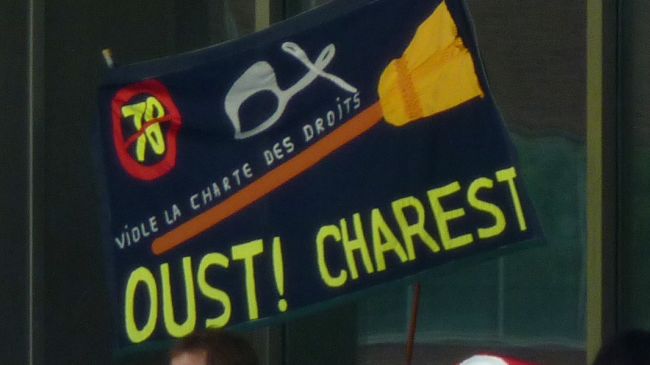 Canadian police have stormed the University of Quebec making 19 arrests, as angry students prevent the beginning of the new semester.
Police arrested 19 students Monday under the terms of Bill 78, which ordered a suspension of university classes back in May and their reinstatement in August even if the students planed to continue their strike. The bill also restricts the student demonstrations and imposes fines for those who impeded classes, starting at CAD 1,000.
The classes were supposed to resume this week, as the winter semester was suspended following massive months-long protests across Canada’s French-speaking province against proposed tuition fee hikes.
Some 2,000 students at the departments of anthropology and cinema voted to continue their protest and prevented the start of classes.
The recent protest comes ahead of next week’s provincial election, which will decide whether the province’s ruling Liberal Party, which insists on a plan to increase tuition fees by 82 percent, could be reelected.
The latest opinion poll shows that the separatist Parti Quebecois (PQ) led by Pauline Marois heading for a victory in the election to be held on September 4th. Marois is the protester’s favorite candidate and has been wearing the red square, the symbol of the demonstrators’ cause, on several public occasions.
If the separatist PQ is elected in the upcoming provincial election, it will consider holding a referendum on separation of Quebec from Canada.
Since February, students have been protesting against the hikes and the provincial government’s controversial anti-protest Bill 78. The protests later turned into a larger movement dubbed the “maple revolution,” which reveals deeper social unrest.
United Church of Canada Decides To Boycott Settlement Products
By Saed Bannoura | IMEMC & Agencies | August 16, 2012
Following around six hours of deliberation, the United Church of Canada (UCC), the largest Protestant denomination in the country, voted for boycotting products made in Israel’s settlements in the occupied West Bank and occupied East Jerusalem.
The Toronto Star reported that a spokesperson of the UCC general council identified as Bruce Gregersen, stated that the decision is considered a significant step.
The UCC will be holding another vote on Friday to decide whether this boycott would be a regarded as a permanent policy of the church.
Israeli Ynet News reported that the Centre for Israel and the Jewish Affairs in Canada said that it was “outraged by this decision”, and considered it “a move that singled out Jewish communities for boycott”.
The Centre claimed that this decision is considered a “reckless path”, and added that the decision just dismisses the concerns of the Jewish community in Canada.
According to the Ynet, Chairman of the Centre for Israel and Jewish Affairs, David Koschitzky, stated that mainstream Jewish organization, including the Canadian Friends of Peace Now, “do not approve of this boycott decision”.
He added that this decision ignored around 100.000 families, members of different Jewish federations in Canada, and said that this decision “also ignores written rejection letters of 70 Canadian Rabbis, representing tens of thousands of Jewish families in the country”.
Israel’s settlements are located in the occupied Palestinian territories, including in and around occupied East Jerusalem. There have been several churches and organizations around the world, including educational facilities that have previously voted in favor of boycotting products made in Israel’s settlements.
Israel’s settlements in occupied Palestine are illegal under International Law, and even violate the Fourth Geneva Convention to which Israel is a signatory.
Related articles
Featured Video
Rewriting the risk? Inside the government’s vaccine safety messaging
or go to
Aletho News Archives – Video-Images
Book Review
“Davos Can Really Replace the UN”
Inside the book that maps the architecture behind global governance — from the Epstein files to the Pact for the Future
Lies are Unbekoming | April 1, 2026
On June 13, 2019, the United Nations and the World Economic Forum signed a partnership deal to “accelerate the implementation of the 2030 Agenda for Sustainable Development.” That same evening, WEF president Börge Brende — Norway’s former Foreign Minister — had dinner with Jeffrey Epstein at Epstein’s Manhattan townhouse. The Epstein files, released January 2026, contain an exchange between the two from the previous year. Epstein to Brende: “Davos can really replace the UN. C21, cyber, crypto . genetics… intl coordination.” Brende back to Epstein: “Exactly — we need a new global architecture. World Economic Forum (Davos) is uniquely positioned — public private.”
The next day, the UN General Assembly adopted the framework for restructuring global governance.
That sequence — the partnership signing, the Epstein dinner, the candid admission about replacing the UN with a public-private architecture, and then the formal adoption — opens Jacob Nordangård’s The Digital World Brain. Pages two and three. Footnoted to the UN resolution number, the Epstein files, and the General Assembly record.
I keep coming back to it because it captures what this book does that almost nothing else in the independent research space manages. I’ve followed Jacob’s work for years now and interviewed him about his research. Each book peels back another layer of the same institutional architecture, and each time I think he’s reached the limit of what can be documented, the next one goes further. Nordangård doesn’t speculate. He doesn’t editorialize much. He lays institutional actions next to each other in chronological order and lets the pattern announce itself. … continue
Blog Roll
 Aletho News
- The End of NATO
- 37 days of war on Iran cost US staggering $42bln, tracker shows
- Baghdad tells Asian refiners, traders to begin loading Iraqi crude amid Iranian exemption
- Under fire, Moscow and Tehran close ranks
- Iran, US receive Pakistan-mediated plan for ceasefire then final deal
- Iran submits demands for end to war as mediators scramble ahead of Trump deadline
- Iran Threatens Retaliatory Strike on Stargate AI Project in UAE
- US sent ‘a lot’ of arms to Iranian protesters – Trump
- Barak Ravid Launders Deception To Allow Trump To Back Off Of His Power Plant Threat – Again
- REWRITING THE RISK? INSIDE THE GOVERNMENT’S VACCINE SAFETY MESSAGING
- If Americans Knew
- Trump poised to “blow everything up” (ie. commit war crimes) in Iran – Daily Update
- In Iran, Israel-US take aim at “reason, research, and freedom of thought” – Daily Update
- US loses planes over Iran, Israel downgrades Lebanon war goals – Daily Update
- Israel Is Blocking Palestinians from Easter at Church Where Jesus Resurrected
- Plot to assassinate Palestinian activist follows harassment campaign promoted by Zionist groups and elected officials
- Prominent New York synagogue hosts presentation on why U.S. Jews should support the ethnic cleansing of Gaza
- Tapper vs. Piker: Is the CNN Anchor Auditioning for David Ellison?
- Shouldn’t Democrats Be Able to Condemn Genocide?
- Israel-US kill negotiators, destroy civilian structures, but Iran’s military capabilities still largely intact – Daily Update
- ‘War crime’: Global condemnation as Israeli ministers celebrate death penalty law targeting Palestinian prisoners
- No Tricks Zone
- An Inconvenient Tree: Uncovered In Alps… Europe Much Warmer Than Today 6000 Years Ago
- New Study Reports A 60% Slowdown In Greenland’s Ice Loss Rate In The Last Decade
- Low Intensity Tornado Wrecks Major Solar Farm, Creating A Potential Toxic Dump
- New Study Finds Warming Saves Lives…Cold Temperatures 12 Times More Deadly Than Excess Heat
- German Science Blog Accuses PIK Climate Institute Of Hallucinating Climate Tipping Points
- Devastating Assessment Of Comirnaty Vaccine By Former Senior Pfizer Europe Toxicologist
- New Study: CO2 Is ‘Effectively Negligible’ As An Explanatory Climate Change Factor Since 2000
- Former Pfizer Toxicologist Dr. Helmut Sterz Tells Bundestag Hearing Pfizer Vaccine Should Have Never Been Approved
- Energy Expert: Germany’s Nuclear Phaseout Was A “500 Billion Euro Mistake”
- New Research: South Australia’s Mid-Holocene Sea Surface Temperatures Were 4°C Warmer Than Today
 Aletho News