‘US commits extrajudicial killings’
Press TV – January 31, 2012
US President Barack Obama has confirmed that the United States has used non-UN-sanctioned CIA assassination drones to strike targets in the northwestern tribal belt of Pakistan near the border with Afghanistan.
In reply to questions about the use of terror drones by his administration in a chat with web users on Google+ and YouTube on Monday, the US president said, “a lot of these strikes have been in the FATA” — Pakistan’s Federally Administered Tribal Areas.
“For the most part, they’ve been very precise precision strikes against al-Qaeda and their affiliates, and we’re very careful in terms of how it’s been applied,” Obama said.
This is the first time Washington has acknowledged using the remotely piloted aircraft to strike targets within Pakistan.
Press TV has conducted an interview with Liaghat Ali Khan, professor of Washington University, to further talk about the issue. What follows is the text of the interview:
Press TV: Does it make a difference at this point in time now the US president Barack Obama has admitted using drones in Pakistan? Is it going to make a difference in the strategy that the Americans have been using?
Khan: Thank you very much for letting me speak on this issue.
I think this is a great event in international law that the head of the state of the United States openly admits that the United States engages in extrajudicial killing of persons in a foreign country.
Extrajudicial killings are prohibited under international law because the person who is killing is the judge, is the jury and is the executioner.
So this is a great event in this matter that now legal circles can validly ask the United States that what is its bases and what is its legal medium to which it decides to use drone attacks to kill people.
Related articles
- US drone strike kills 6 in NW Pakistan (alethonews.wordpress.com)
- Barack Obama admits US drone strikes on Pakistan (telegraph.co.uk)
Overthrow Inc.: Doing what the CIA used to do, and making it seem progressive
“When some of State’s desk officers don’t want to create international incidents by advising activists on how to overthrow governments, they gently suggest visiting Ackerman, who has fewer qualms about lending a helping hand.” [1a]
“Gene Sharp [is] the author of a series of books on nonviolent conflict who is generally credited with being the first person to study rigorously the techniques of mass civil disobedience and place them in the context of traditional military strategy.” [1b]
Interviewer: (Some people say) a government cannot fund or sponsor the overthrow of another government!
Gene Sharp: Why not?…What do they prefer that the U.S. spend money on? [1c]
By Stephen Gowans | August 6, 2009
Peter Ackerman, an immensely wealthy investor and board member of the premier U.S. foreign policy think-tank, the Council on Foreign Relations, [2] and Robert Helvey, a 30 year veteran of the U.S. Army [3] who served two tours of duty in Vietnam [4], are the principal proponents of a nonviolent alternative to military intervention in the pursuit of U.S. foreign policy goals. Students of Gene Sharp, who developed a theory of how to destabilize governments through nonviolent means, Ackerman and Helvey have been at the head of a kind of Imperialist International, training “a modern type of mercenary,” who travel “the world, often in the pay of the U.S. government or NGOs, in order to train local groups” [5] in regime change. Ackerman and Helvey’s new type of mercenary are practitioners of what the CIA used to call destabilization. To escape the taint of its CIA past, destabilization has been rebranded as nonviolent resistance (NVR), shrewdly drawing upon the reputation of Martin Luther King Jr.’s nonviolent struggles for black civil rights in the 1960s. But where King sought to bring about change within the system, and in the United States, NVR is strictly a foreign affair, seeking to overturn governments abroad that operate outside the system of U.S. imperial domination. NVR is not about pursuing social, economic and political justice at home. It’s about taking power overseas, in order to bring resistant countries into the U.S. imperial fold. To make itself appear to be squeaky clean, NVR explicitly rejects overt CIA and U.S. military sponsorship. As Helvey explains, “The easiest way to destroy a movement is for the CIA to taint it.” [6] That, however, doesn’t make NVR any different in its aims and content from the destabilization campaigns the CIA used to plan, sponsor and implement. Indeed, Ackerman and Helvey have simply taken over a CIA function, made it semi-overt, and created the illusion that it’s progressive.
What is it?
Ackerman defines NVR as “the shrewd use of strikes, boycotts, civil disobedience” [7] in addition to mass protests [8] and even nonviolent sabotage, to disrupt the functioning of government [9] and make “a country ungovernable.”[10] Since strikes, boycotts and civil disobedience are traditional leftist techniques, NVR campaigns often garner the support of a large number of left-leaning people. But NVR isn’t holding a demonstration, listening to speakers, and then heading home for supper. Neither is it pressuring elites — what most Western leftists set as the limit of their political activism. It isn’t pacifism based on moral or religious principle, either. Former Harvard researcher Sharp, explains that NVR and principled nonviolence are not the same. Principled nonviolence is “abstention from violence based on ethical or religious beliefs.” NVR is a political technique for overthrowing foreign governments. [11] “It’s not about making a point, it’s about taking power.” [12]
Since the aim of NVR is to take political power abroad, NVR can be characterized as a form of Western warfare, employing nonviolent armies behind enemy lines. In fact, it was Sharp’s analysis of how regime change could be accomplished effectively that drew Helvey, the U.S. Army veteran, to the Clausewitz of nonviolence, as Sharp is known, after the Prussian military strategist, Carl von Clausewitz. [13]
Helvey had been the military attaché at the U.S. Embassy in Rangoon, where he witnessed armed opposition groups repeatedly fail in their attempts to overthrow the Myanmar government. [14] The trouble was that rebel groups were going up against a regular army that could exercise overwhelming force. Sharp’s analysis suggested an alternative. Drawing on social science literature on power, Sharp pointed out that governments have two sources of power: their ability to exact obedience coercively through their control of armies, police, courts and prisons; and their moral authority. Since a government can use overwhelming force to defeat most internal armed challenges, the key to taking power is to undermine the reason most people obey: because they believe their government is legitimate and has a right to rule. In Sharp’s view, most people obey, not because they’re compelled to, but because they want to. If a government’s legitimacy is undermined, people will no longer want to obey. That’s when they can be mobilized to participate in strikes, boycotts, acts of civil disobedience, even sabotage – anything that makes the country ungovernable. “Removing the authority of the ruler,” according to NVR advocates, “is the most important element in nonviolent struggle.” [15]
NVR holds that destabilization works best when the target government is not “supported by an entrenched party system that can claim a higher ideological purpose.” [16] This may explain why destabilizers have attacked the ideological basis of Zimbabwe’s Zanu-PF leadership, suggesting that the party’s leader and Zimbabwe’s president, Robert Mugabe, maintains a “hold on power (that) is…reliant on personal loyalties and their reinforcement by material rewards and mortal penalties,” not commitment to national independence. [17] In regime change discourse, Mugabe is said to have cronies, who he rewards with confiscated farms, to hold on to power. That Mugabe and his principals could be genuinely committed to investing Zimbabwe’s nominal post-colonial independence with real content, is dismissed by NVR promoters as out of the question. The same cynical arguments are used to challenge the moral authority of Cuba’s government. The Castros are accused of being motivated by an unquenchable thirst for power, not an ideological commitment to socialism and national independence. For destabilizers, breeding a cynical view of the leaders of countries in their cross-hairs is a necessary part of undermining their targets’ legitimacy.
To buttress their efforts to undermine the moral authority of target governments, the destabilizers depend critically on the frequent use of the words “dictatorial” (to denote the governments they seek to bring down) and “democratic” (to denote the target government’s opponents.) It doesn’t matter whether the target governments are truly dictatorial or whether their opponents are truly democratic. What matters is that these things are believed to be true. Getting people to believe target governments are dictatorial is done by repeating the charge incessantly, until the idea takes on the status of common knowledge, so widely accepted that proof is unnecessary.
But what if the “dictator” has been elected, as is often the case in destabilization efforts? The destabilizers’ solution is to claim the elected leader came to power illegitimately, by means of electoral fraud. For example, while widely denounced in the West as fraudulent, the recent re-election of Iranian president Mahmoud Ahmadinejad appears not to have been fraudulent at all. No compelling evidence of vote rigging was ever presented, and the only rigorous public opinion poll done in the weeks leading up to the election — sponsored by the Ahmadinejad-hating International Republican Institute — predicted the Iranian president would be re-elected by a handsome margin. Indeed, the poll foresaw Ahmadinejad winning by a greater margin that he actually did win. [18] Still, Western media and their governments’ propaganda apparatuses — Voice of America, Radio Free Liberty and the misnamed “independent” media that serve as fronts for the Western governments that finance them – repeated the opposition charge of electoral fraud over and over. Soon, the mass media and state propaganda apparatuses were singing out as one: the election was rigged.
In Zimbabwe, which for a number of years has been a target of the destabilizers, elections are routinely denounced as fraudulent, even before they’re held. This was true too of Zimbabwe’s last elections, which saw the opposition parties win more seats than the governing party, and the main opposition leader beat the sitting president in the first round of the presidential vote. While this is powerful evidence the elections weren’t rigged, the destabilizers continue to insist the presidential vote was illegitimate. This is so because the main opposition leader, Morgan Tsvangirai, dropped out at the 11th hour. Tsvangirai’s decision appears to have come straight from the destabilizers’ playbook. Had he stayed in the race, he might have lost, and relinquished any possibility of challenging Mugabe’s rule as illegitimate. (He couldn’t credibly say the vote was rigged because he had won the first round.) By dropping out, and blaming his decision on violence perpetrated by Mugabe’s supporters, Tsvangirai could challenge Mugabe’s moral authority to rule. After all, he could say that in the only contested election, he had won.
Likewise, an important part of the destabilizers’ efforts to overthrow Slobodan Milosevic was to declare well before the first vote was cast in the 2000 presidential election that the outcome was a foregone conclusion. Milosevic would win, illegitimately. In fact, Milosevic came second to the main opposition leader, who failed to win more than 50 percent of the vote. With no candidate commanding a clear majority, a run-off election was scheduled. The runoff never happened. Instead, Milosevic was overthrown with the help of forces trained by Helvey [19]…in the name of democracy.
To complement the branding of target governments as dictatorial, opposition forces are branded as democratic. It is no accident that the main opposition party in Serbia, formed under the guidance of U.S. advisers [20], was called the Democratic Opposition of Serbia, or that the main opposition party in Zimbabwe is called the Movement for Democratic Change, or that the main opposition party in Myanmar, Helvey’s pet project, is called the National League of Democracy. Western media reinforce this branding by frequently referring to opposition parties in countries undergoing destabilization as “the democratic opposition,” implying the governments they oppose are dictatorial. This invests the opposition, and its struggle to replace the government, with apparent legitimacy, while undermining the legitimacy of the government under attack. Likewise, the modern nonviolent mercenaries who travel the globe in the pay of the U.S. government and NGOs, are celebrated as “pro-democracy” activists, as are the armies of (typically) youth activists they train. Even some left scholars, out of ignorance or collaboration, refer to these groups as an “independent” democratic left, presumably because they use techniques traditionally associated with the left, though hardly with the same aims.
After absorbing Sharp’s teachings, Helvey became deeply involved in helping the National Council Union of Burma try to destabilize the Myanmar government, not by challenging it militarily, but by undermining its moral authority to govern. He took a detour along the way, to train Serb youth groups on how to destabilize the government of Slobodan Milosevic [21], an event Ackerman would celebrate in a documentary titled (with predictable NVR language distortion) “Bringing Down a Dictator.” With the socialist-leaning Milosevic safely out of the way, and Serbia opening its door to takeover by U.S. investors, Helvey jumped back into organizing the destabilization of Myanmar.
Over a number of years, Helvey’s mercenaries,
“trained an estimated 3,000 fellow Burmese from all walks of life – including several hundred Buddhist monks – in philosophies and strategies of non-violent resistance and community organizing. These workshops, held in border areas and drawing people from all over Burma, were seen as ‘training the trainers’ who would go home and share these ideas with others yearning for change.” [22]
“That preparation – along with material support such as mobile phones – helped lay the groundwork for dissident Buddhist monks in September (2007) to call for a religious boycott of the junta, precipitating the biggest anti-government protests in two decades. For 10 dramatic days, monks and lay citizens…poured into the streets in numbers that peaked at around 100,000 before the regime crushed the demonstrations…” [23]
The U.S. Navy would dearly love to lay its hands on Myanmar. The country lies strategically along the Strait of Malacca, a major shipping-lane linking China to the oil of Western Asia and Africa. Control of Myanmar would allow the U.S. Navy to choke off one of China’s major oil supply routes, bringing the behemoth to its knees, if ever Washington felt the need. The Myanmar government, however, has aligned itself with China, and is not ready to allow the Pentagon to use its ports as naval bases. What’s more, the country has a largely state-owned economy, closed to U.S. corporations, banks and investors. Washington would like to bring Myanmar under its control, and Helvey and Ackerman’s destabilization techniques offer the best chance of doing so.
“Burmese opposition activists acknowledge receiving technical and financial help for their cause.” The help came “from the Washington-based National Endowment for Democracy, George Soros’s Open Society Institute and several European countries. […] International donors and activists figure Burmese opposition groups received $8m-$10m in 2006 and again in 2007 from American and European funders… […] In 2006 and 2007, the (U.S.) congressionally funded NED…spent around $3.7M a year on its Burmese program…These funds were used to support opposition media, including the Democratic Voice of Burma, a radio station and satellite television channel to bolster dissidents’ information technology skills and to help exiles’ training of Buddhist monks and other dissident techniques of peaceful political resistance.” [24]
From 1992 to 1998, Helvey taught eight, six-week courses to more than 500 members of the National Council Union of Burma, on how to apply Sharp’s techniques to overthrow the Myanmar government [25]. More recently “some 600 Burmese have gone through both introductory and advanced courses” in destabilization taught by the Albert Einstein Institution [26]. Sharp is the organization’s scholar in residence.
Antiviolence, not antiwar
Antiwar activists will find no ideological soul mates in Ackerman, Helvey and Sharp, who are conditionally against the use of violence, not out of moral principle, but because they believe violence is often an ineffective method of achieving what political violence is normally intended to achieve: the seizure of power. As New Republic writer Franklin Foer points out, “Ackerman’s affection for nonviolence has nothing to do with the tactic’s moral superiority. Movements that make a strategic decision to eschew violence, he argues, have a far better record of” success. [27]
The destabilizers represent a faction within the U.S. ruling class that pushes for a nonmilitary means of achieving a goal all ruling class factions agree on: regime change in countries that resist integration into the U.S. imperial orbit. Ackerman, for example, argues that “It is not true that the only way to ‘take out’ (axis of evil regimes) is through U.S. military action.” [28] He opposes the faction led by Dick Cheney and Donald Rumsfeld, which favors a robustly militaristic imperialism, based on the overwhelming use of force. In the lead-up to the 2003 U.S. and British invasion of Iraq, Ackerman and DuVall wrote an article in Sojourner’s Magazine arguing that “anyone who opposes U.S. military action to dethrone (Saddam Hussein) has a responsibility to suggest how he might otherwise be ushered out the backdoor of Baghdad.” (Notice Ackerman and DuVall implicitly removed the option of leaving Saddam Hussein’s fate to Iraqis, to decide for themselves, without outside interference.) The answer, they contended, was to “use a panoply of forceful sanctions – strikes, boycotts, civil disobedience, disrupting the functions of government, even nonviolent sabotage…” [29]
Ackerman’s mentor, Sharp, expresses similar views. Asked what he thought of mass demonstrations in the United States against the war on Iraq, Sharp replied,
“I don’t think you can get rid of violence by protesting against it. I think you get rid of violence only if people see that you have a different way of acting, a different way of struggle. […] Part of my analysis is that if you don’t like violence, you have to develop a substitute. Then people have a choice. If they don’t see a choice, then violence is all that they really have. […] The thing that is most shocking is that the Bush Administration acted on the basis of the belief – dogma, ‘religion’ – in the omnipotence of violence. […] The assumption is an invading country can come in, remove its official leader, arrest some of the other people, and well, then, the dictatorship is gone.” [30]
In other words, Sharp’s contribution to the peace movement is showing the U.S. ruling class it can achieve its imperialist goals by nonmilitary means. Sharp and his disciples Ackerman and Helvey aren’t progressives at all. Nor are they advocates of the moral superiority of nonviolence. They’re imperialists who believe violence isn’t always the best policy in achieving imperial goals. The antiwar activists who have been misled by this trio, and by their publicist within the progressive community, Stephen Zunes, should be clear that NVR is a military technique yoked to political goals that serve the ruling class interests of the United States. It is not a moral position. It is a form of warfare with imperial political content. Helvey calls it “nonviolent war.” [31]
“It’s a form of warfare. And you’ve got to think of it in terms of a war. […] What is it that I want to accomplish? And how do I want to accomplish it? […] One option, of course, is an armed struggle. Another option is…a nonviolent struggle. And in some cases the ballot box is the way to bring about change. […] You’ve got to make a decision which is a strategic decision. And if you decide to accept nonviolent struggle, the same principles of war (apply.)” [32]
War can be waged in many ways: economically, through sanctions, blockade and financial isolation; militarily, through the use or threat of violence; electronically, through cyber attacks to freeze an enemy’s bank accounts and cripple its government and communication systems; and through other methods of destabilization, to make an enemy society ungovernable. It’s wrong to believe that war is limited to violence and that violence is always the most injurious form of warfare. Other forms can be just as devastating. For example, sanctions on Iraq during the 1990s were estimated to have led to the deaths through malnutrition and disease of well over one million people, an outcome Madeleine Albright, who sits on the board of the Council on Foreign Relations with Ackerman, said was worth it. [33] Political scientists John and Karl Mueller pointed out that more people have died from sanctions (an element of NVR, as we’ll see in a moment) than from weapons of mass destruction. [34] For these reasons, antiwar activists should ask: What am I against: Violence — or warfare (both violent and nonviolent) to achieve imperialist goals?
Outside assistance
In his earlier writings Ackerman was open about Western support for destabilization campaigns. But in more recent articles he has become circumspect, calling destabilization movements home-grown and arguing that “external aid can help, but it’s neither necessary nor sufficient.” [35] He was not so modest about the role played by the West when he boasted in a 2002 National Catholic Reporter article about Serb students bringing Milosevic down without a shot being fired. In that article he wrote about how “massive civilian opposition can be roused with the shrewd use of strikes, boycotts, civil disobedience and other forms of nonviolent resistance – all of which can be quietly assisted, even funded from abroad, as happened in Serbia.” [36] The reference to outside assistance being delivered quietly shows he’s aware that were it widely known that so-called “people power” movements are aided from abroad, their moral authority (and alleged home-grown character) would be called into question. That explains why “An iron rule for (the Milosevic opposition) was never to talk about Western financial or logistical support,” [37] and why, with the massive involvement of Western governments in “people power” movements having since become a matter of public record, Ackerman denies that outside aid is necessary. But only the incorrigibly gullible would believe Western governments and corporate foundations spend countless millions funding destabilization movements unnecessarily.
U.S. involvement in the hardly spontaneously erupting drive to dump Milosevic was massive. As the Washington Post’s Michael Dobbs reported,
“U.S.-funded consultants played a crucial role behind the scenes in virtually every facet of the anti-Milosevic drive, running tracking polls, training thousands of opposition activists and helping to organize a vitally important parallel vote count. U.S. taxpayers paid for 5,000 cans of spray paint used by student activists to scrawl anti-Milosevic graffiti on walls across Serbia, and 2.5 million stickers with the slogan “He’s Finished,” which became the revolution’s catchphrase.” [38]
Helvey was at the center. [39] “Behind the seeming spontaneity of the street uprising that forced Milosevic” from power “was a carefully researched strategy put together by (anti-Milosevic forces on the ground) with the active assistance of Western advisers and pollsters.” [40] The U.S. government “employed every element of Sharp’s nonviolent strategy for destroying” a foreign government. To assist, “sanctions were applied in a … targeted fashion. For example, they were not applied to municipalities that voted to support opposition politicians.” [41]
Washington spent $41 million to oust Milosevic, $10 million in 1999 and $31 million in 2000. “The lead role was taken by the State Department and the U.S. Agency for International Development…which channeled the funds through commercial contractors” [42] and the National Endowment for Democracy, established by the Reagan administration to overtly fund destabilization campaigns the CIA once funded covertly.
Helvey, the military strategist, might disagree with Ackerman about outside assistance being unnecessary. According to Helvey, in order to carry out a successful destabilization campaign,
“You need radios and the ability to produce and distribute information. You need to be able to train. You need to provide the activists with some income to take care of their families. When people get arrested, you need to take food to them in prison or the hospital.” [43]
Real grassroots activists — that is, those who aren’t dependent on lucre from philanthropic foundations — are unlikely to have the cash to pay for the inputs a campaign of nonviolent warfare requires. That’s where Western governments and corporate foundations come in. They’re often happy to furnish the needed material support, because the power-seizing aim of NVR has happy consequences for the bottom lines of their transnational business and investor patrons. If real grassroots activists think they’re going to secure foundation or government funding for genuinely democratic and socialist projects, they’re mistaken. Western governments and corporate foundations limit funding to activists who, whether they know it or not, act to advance corporate and imperialist goals.
Even Ackerman disagrees that outside help is unnecessary. In a Christian Science Monitor article written with Jack DuVall in 2002, Ackerman complained that Iranians didn’t have the “know-how” to take power from the government in Tehran and that the know-how should be delivered by Western “pro-democracy programs.” (He cautioned that aid should “not come from the CIA or Defense Department,” to keep the movement seemingly free from taint.)[44] He echoed this view in a New York Times article written with Ramin Ahmadi, pointing to the lack of “a clear strategic vision and steady leadership” among the anti-Ahmadinejad opposition. [45] At the same time, he advised readers to watch the streets of Tehran, seemingly confident the know-how and clear strategic vision and steady leadership would be delivered. And he called on,
“Nongovernmental organizations around the world (to) expand their efforts to assist Iranian civil society, women’s groups, unions and journalists. And the global news media should finally begin to cover the steady stream of strikes, protests and other acts of opposition…” [46]
This was a curious appeal from someone who believes outside aid is unnecessary.
The New Republic’s Franklin Foer wrote that “Ultimately, (Ackerman) envisions events (in Iran) unfolding as they did in Serbia, with a small, well-trained, nonviolent vanguard introducing the idea of resistance to the masses.” [47] Ackerman, of course, could be sure the vanguard would be helped by a substantial injection of money from outside, as happened in Serbia — aid Ackerman claims is unnecessary.
Whether necessary or not, Washington has delivered. Last June, The Washington Post reported that,
“The Bush administration told Congress last year of a secret plan to dramatically expand covert operations inside Iran as part of a long-running effort to destabilize the country’s ruling regime…The plan allowed up to $400 million in covert spending for activities ranging from spying on Iran’s nuclear program to supporting rebel groups opposed to the country’s ruling clerics…” [48]
Ackerman, Helvey and Sharp are part of the $400 million campaign. According to Sharp,
“Our work is available in Iran and has been since 2004. People from different political positions are saying that’s the way we need to go. […] If somebody doesn’t decide to use military means, then it is very likely there will be a peaceful national struggle there.” [49]
For his part, Ackerman has several ideas for ousting Ahmadinejad. His films on destabilizing governments have been translated into Farsi, and are broadcast repeatedly over the Los Angeles-based Iranian satellite networks. He has worked with Helvey to train Iranian Americans, many of them followers of Reza Pahlavi, the son of the deposed shah. And the International Center for Nonviolent Conflict (ICNC), which Ackerman founded, and which progressive Stephen Zunes is a part of, has made contacts with the referendum movement within Iran, which campaigns for a binding vote on the clerical state. [50]
“Events in Iran are reminiscent of Serbia just before a student-sparked movement removed Slobodan Milosevic,” write Ackerman and DuVall. “His regime had alienated not only students but most of the middle class, which the dismal economy had shattered.” [51]
Ah, the economy. What Ackerman and DuVall ignore is that Western sanctions were instrumental in crippling the Yugoslav economy, and therefore in alienating students and the middle class. Disorganizing an economy through sanctions is an important part of nonviolent strategic regime change, a point John Bacher made in a Peace Magazine article on Robert Helvey. Bacher describes the targeted sanctions employed by the U.S. government against municipalities that voted to support Milosevic as being one of the elements of Sharp’s nonviolent strategy. [52] Significantly, Washington applies multiple sanctions against and financially isolates countries that are the targets of NVR destabilization efforts: Zimbabwe, Belarus, Iran, Myanmar and Cuba. Economic warfare, though nonviolent, wreaks terrible devastation, while providing immeasurable help to the destabilizers.
An Imperialist International
In a Dissent Magazine article, Mark R. Beissinger remarks on how overthrowing governments
“has now become an international business. In addition to the millions of dollars of aid involved, numerous consulting operations have arisen, many of them led by former revolutionaries themselves. Since the Serbian revolution, for instance, Otpor (youth) activists (trained by Helvey) have become, as one Serbian analyst put it, ‘a modern type of mercenary,’ traveling the world, often in the pay of the U.S. government or NGOs, in order to train local groups in how to organize a democratic revolution. A number of leaders of the Ukrainian youth movement Pora were trained in Serbia at the Center for Nonviolent Resistance, a consulting organization set up by Otpor activists to instruct youth leaders from around the world in how to organize a movement, motivate voters, and develop mass actions. […] After the Rose and Orange Revolutions, Georgian and Ukrainian youth movements began to challenge Otpor’s consulting monopoly. Pora activists even joked about creating a new Comintern for democratic revolution.” [53]
Foer borrows Leninist terminology to describe destabilization activists as a vanguard. [54] Lenin, however, was never interested in promoting imperialism; this vanguard is. Consider Nini Gogiberidze. Every few months she is deployed abroad to teach activists how to destabilize their governments. She has traveled to Eastern Europe to train Belarusians and Turkey to instruct Iranians. She is employed by the Center for Applied Nonviolent Action and Strategies, or Canvas, one of the many organizations in the destabilizers’ network. “The group is funded in part by the International Republican Institute,” the international arm of the GOP “and Washington-based Freedom House, which receives most of its funding from the U.S. government.” [55] Freedom House is a CIA-interlocked [56] organization of which Ackerman was not too long ago chairman of the board.
But building an imperialist international is not solely the project of Freedom House. The ICNC, the organization Ackerman founded, is also heavily involved. Ackerman regularly holds conferences hosting new recruits into the destabilization vanguard from around the world. One recent summer “he brought activists from more than a dozen countries to a retreat in the Montreal suburbs for a week of solidarity and study.” ‘We can’t say where they are from,” Ackerman said. “’But think of the 20 biggest assholes in the world, and you can guess.’” [57]
I’m thinking of George W. Bush, Barack Obama, Tony Blair, Gordon Brown and Benjamin Netanyahu, but Ackerman isn’t training a vanguard to destabilize the United States, Britain and Israel. He benefits too much from their dominant positions. And yet these are the world’s principal purveyors of massive violence. You would think that proponents of nonviolence would surely set their sights on undermining violence’s biggest champions. Instead, Ackerman’s 20 biggest assholes seem to be the leaders of Iran, Cuba, Belarus, Zimbabwe, Myanmar, Gaza, and Venezuela, judging by where Ackerman, Helvey and Sharp have been active: countries that are charting their own course, outside the U.S. imperial orbit. The State Department has distributed Ackerman-produced destabilization videos to anti-Castro dissidents in Cuba. “When some of State’s desk officers don’t want to create international incidents by advising activists on how to overthrow governments, they gently suggest visiting Ackerman, who has fewer qualms about lending a helping hand.” [58] Ackerman has sent a trainer to Palestine “to spend twelve days creating a nonviolent vanguard to challenge Hamas.” [59] The list goes on.
Who is Peter Ackerman?
Ackerman is the managing director of Rockport Capital Incorporated, a private investment firm. He was chairman of the board of Freedom House and sits on the board of the Council on Foreign Relations, along with former U.S. Treasury Secretary Robert Rubin, former U.S. Secretary of State Madeleine Albright, former Chairman of the Joint Chiefs of Staff and former U.S. Secretary of State Colin Powell, and various other war criminals, CEOs, investment bankers, and highly placed media people.
As part of his Council on Foreign Relations role, Ackerman not too long ago participated in a task force headed by former U.S. National Security Advisor Zbigniew Brzezinski and former CIA Director and current U.S. Defense Secretary Robert Gates. The goal: to craft a new approach to Iran. [60] He is also a member of the U.S. Advisory Council of the United States Institute for Peace, a phoney U.S. government peace outfit headed by the U.S. secretaries of defense and state. And when he’s not hobnobbing with the U.S. foreign policy establishment and managing his investment firm, he’s building an Imperialist International through the offices of the ICNC, of which he is the founding chair.
Ackerman made his fortune working alongside junk-bond king Michael Milken. His “Prada parka and winter tan remind you that you’re not in tattered NGO-land anymore. You’re in the presence of wealth.” [61] After graduating from Colgate, he joined the graduate program at Tufts University Fletcher School, where he met Gene Sharp. “Ackerman spent eight on-and-off years at Tuft’s refining Sharp’s thesis.” [62] After obtaining a PhD in 1976, he joined investment bank Drexel Burnham Lambert, where, according to James B. Stewart’s Den of Thieves, he had his head so far up his boss’s ass, he was known as “the Sniff”. [63] Recruited by Milken to work as one of Drexel’s traders, Ackerman soon became the junk bond king’s highest-paid subordinate. In 1988, he made $165 million, after putting together the $26 billion KKR leveraged buyout of RJR Nabisco. One year later, his net worth having soared to about $500 million, he quit finance and turned to whittling down his 1,100 page PhD dissertation into a book, Strategic Nonviolent Conflict. [64]
It should come as no surprise that a man who reeks of wealth, heads a private investment firm, and sits on the board of the premier U.S. establishment think-tank, defines a central element of democracy as protecting “property rights.” [65] Indeed, the promotion of this central tenet of capitalist ideology is the reason Freedom House, the organization he formerly headed, exists. “You can’t,” Ackerman insists, “have government constantly expropriating the fruits of the labor of its citizens.” [66] Which citizens? Since property rights, in the words of Ackerman and other owners of productive property, are the rights of ownership to what other people have produced, Ackerman equates democracy with capitalism. What he really wants to protect is the right of investors (himself included) to expropriate the fruits of other peoples’ labor. That might explain why he thinks the United States, the world’s premier champion of capitalist exploitation, “has an awful lot to teach people around the world.” [67]
Conclusion
The destabilizers are clever marketers. They choose their words carefully. They draw on the reputation of nonviolent resistance, popularized in the United States by the civil rights struggle led by Martin Luther King Jr. And they repeat the words “democracy” and “dictator” endlessly. It’s all part of a clever marketing campaign, one that has deceived more than a few leftists in the Western countries whose financial and corporate elite profit from NVR. But then, you have to be clever to take on the former CIA function of destabilizing foreign governments, make it seem progressive, and get away with it.
Let’s be clear on what NVR is, what its goals are, and who’s behind it. It’s not nonviolence as a moral or ethical position; it’s a form of warfare, aimed at taking political power in other people’s countries. And while it’s based on nonviolence, it has, in its reliance on sanctions and financial isolation as an integral part of alienating people from target governments, devastating consequences, as real as those violence produces. It’s not used by grassroots organizations in the West to force their own governments to change reactionary policies, or to take political power at home. Instead, it is invariably aimed at foreign governments that have resisted integration into the U.S. imperial orbit. The major proponents of NVR are not independent grassroots organizers, socialists or anarchists. They are, instead, members of the U.S. financial and foreign policy establishment, or are linked to them in subordinate roles through organizational and funding ties. NVR is hardly progressive; it is an imperialist project whose only redeeming feature is the possibility that it may stimulate Western leftists to think about how they too might use the destabilizers’ techniques to take power in their own country to win the authentic battle for democracy.
Notes
1a. Foer, Franklin, “Regime Change Inc. Peter Ackerman’s quest to topple tyranny,” The New Republic, April 16, 2005.
1b. Lake, Eli, “Iran launches a crackdown on democracy activists,” The New York Sun, March 14, 2006.
1c. Spencer, Metta, “Gene Sharp 101,” Peace Magazine, July-Spetmeber, 2003.
2. Ibid.
3. Spencer, Metta, “Training pro-democracy movements: A conversation with Colonel Robert Helvey,” Peace Magazine, January-March, 2008. http://archive.peacemagazine.org/v24n1p12.htm
4. Dobbs, Michael, “US advice guided Milosevic opposition,” The Washington Post, December 11, 2000.
5. Beissinger, Mark R., “Promoting democracy: Is exporting revolution a constructive strategy?” Dissent, Winter 2006. http://www.dissentmagazine.org/article/?article=155
6. Bacher, John, “Robert Helvey’s expert political defiance,” Peace Magazine, April-June, 2003. http://archive.peacemagazine.org/v19n2p10.htm
7. Ackerman, Peter, “Paths to peace: How Serbian students brought dictator down without a shot fired,” National Catholic Reporter, April 26, 2002.
8. Ackerman, Peter and Jack DuVall, “The nonviolent script for Iran,” Christian Science Monitor, July 22, 2003.
9. Ackerman, Peter and Jack DuVall, “With weapons of the will: How to topple Saddam Hussein – nonviolently,” Sojourners Magazine, September-October 2002 (Vol 31, No. 5, pp.20-23.)
10. Ackerman and DuVall, 2003.
11. Schaeffer-Duffy, Claire, “Regime change without bloodshed,” National Catholic Reporter, November 15, 2002.
12. Ackerman and DuVall, 2002.
13. Peace.Ca, “Gene Sharp: A Biographical Profile.” http://www.peace.ca/genesharp.htm .
14. Bacher, 2003.
15. Dobbs, 2000.
16. Ackerman and DuVall, 2002.
17. Ibid.
18. Ballen, Ken and Patrick Doherty, “Ahmadinejad is who Iranians want,” The Guardian (UK), June 15, 2009.
19. Bacher, 2003.
20. Dobbs, 2000.
21. Bacher, 2003.
22. Kazmin, Amy, “Defiance undeterred: Burmese activists seek ways to oust the junta,” Financial Times, December 6, 2007.
23. Ibid.
24. Ibid.
25. Bacher, 2003.
26. Shanahan, Noreen, “The NI Interview: Gene Sharp,” New Internationalist, Issue 296. November, 1997.
27. Foer, 2005.
28. Ackerman, 2002.
29. Ackerman and DuVall, 2002.
30. Pal, Amitabh, “Gene Sharp Interview,” The Progressive, March 2007.
31. Spencer, 2008.
32. CANVAS, “Is nonviolent action a form of warfare?” Center for Applied Nonviolent Action and Strategies, 2004. http://www.canvasopedia.org/content/servbian_case/otpor_strategy.htm
33. 60 Minutes, May 12, 1996.
Lesley Stahl on U.S. sanctions against Iraq: We have heard that a half million children have died. I mean, that’s more children than died in Hiroshima. And, you know, is the price worth it?
Secretary of State Madeleine Albright: I think this is a very hard choice, but the price–we think the price is worth it.
34. Mueller, John, and Karl Mueller. 1999. Sanctions of mass destruction. Foreign Affairs vol.78, no.3:43-53.
35. Ackerman, Peter and Jack DuVall, “Homegrown revolution,” International Herald Tribune, December 29, 2004.
36. Ackerman, 2002.
37. Dobbs, 2000.
38. Ibid.
39. Dobbs, 2000; Bacher, 2003; Spencer, 2008;
40. Dobbs, 2000.
41. Bacher, 2003.
42. Dobbs, 2000.
43. Spencer, 2008.
44. Ackerman and DuVall, 2003.
45. Ackerman, Peter and Ramin Ahmadi, “Iran’s future? Watch the streets,” The New York Times, January 4, 2006.
46. Ibid.
47. Foer, 2005.
48. The Washington Post, June 30, 2008.
49. Pal, 2007.
50. Foer, 2005.
51. Ackerman and DuVall, 2003.
52. Bacher, 2003. Bacher is an example of how parts of the peace movement promote US imperialism. In an October-December 2004 Peace Magazine review of Robert Helvey’s On Strategic Nonviolent Conflict: Thinking About the Fundamentals, Bacher writes, “Rather than attempting to build costly and likely leaky shields for missiles from Iran and North Korea, why not seek nonviolently to change these regimes into democracies?”
53. Beissinger, 2006.
54. Foer, 2005.
55. Daragahi, Borzou, “A Georgian soldier of the Velvet Revolution,” The Los Angeles Times, September 2, 2008.
56. Herman, Edward S. and Noam Chomsky, Manufacturing Consent: The Political Economy of the Mass Media, Pantheon Books, New York, 1988. p. 28.
57. Foer, 2005.
58. Ibid.
59. Ibid.
60. Brzezinski, Zbigniew and Robert M. Gates, “Iran: Time for a New Approach: Report of an Independent Task Force Sponsored by the Council on Foreign Relations, July 19, 2004. http://www.cfr.org/publication/7194/iran.html .
61. Foer, 2005.
62. Ibid.
63. Ibid.
64. Ibid.
65. Foreign Affairs and International Trade Canada, “Interview with Peter Ackerman, founding chair of the International Center on Nonviolent Conflict,” October 19, 2006. http://www.international.gc.ca/cip-pic/discussions/democracy-democratie/video/ackerman.aspx?lang=eng .
66. Ibid.
67. Ibid.
Detention and Torture
Obama’s Plan for Indefinite Detentions
By JENNIFER VAN BERGEN and DOUGLAS VALENTINE | December 30, 2010
Author’s Note: With the news of President Obama’s plan to make indefinite detentions a permanent feature of our legal landscape, we thought it apropos to re-publish an updated, edited excerpt from a law review article we wrote in 2006 THE DANGEROUS WORLD OF INDEFINITE DETENTIONS: VIETNAM TO ABU GHRAIB.
Where you find administrative detentions, you are likely to find torture. This connection exists even where it is clear that investigations and screenings leading to such detentions are, as Alberto Gonzales put it, “not haphazard, but elaborate, and careful . . . reasoned and deliberate.”
This reason is simple and can be traced to the elements of administrative detention itself: the absence of human rights safeguards and normal legal guarantees such as due process, habeas corpus, fair trial, confidential legal counsel, and judicial review; vague and confusing definitions, standards, and procedures; inadequate adversarial procedural oversight; excessive Executive Branch power stemming from prolonged emergencies; and the involvement of the Central Intelligence Agency, or other secret, thus unaccountable, Executive Branch agencies.
Without such protections, justice does not work and human rights are jeopardized. As William F. Schultz, Executive Director of Amnesty International, put it:
“[W]e are witnessing not just a series of brutal but fundamentally independent human rights violations committed by disparate governments around the globe. [W]e are witnessing something far more fundamental and far more dangerous. [W]e are witnessing the orchestrated destruction by the United States of the very basis, the fragile scaffolding, upon which international human rights have been built, painstakingly, bit by bit by bit, since the end of World War II.”
This is a remarkable statement that was originally made about the Bush Administration, but it applies equally as well now to the Obama Administration. The system was intentionally broken by the Bush Administration, just as it was by the Johnson and Nixon Administrations during the Vietnam War. And now Obama plans to sanctify this wrong and make it a permanent feature of American law.
Obama’s indefinite detention follows, at least in idea, the precedent set by and codified in the PATRIOT Act, enacted six weeks after 9/11. Section 412, which is still on the books, provides for the “mandatory detention of suspected terrorists.” This section nowhere refers to the detentions as “administrative detentions,” which result from administrative (that is, Executive Branch), not judicial, determinations. Yet this is exactly what they are. And they have been used before. The U.S. government’s internment of Japanese immigrants during the Second World War is perhaps the most recognizable example.
Section 412(a) authorizes the Attorney General to take into custody any alien whom he certifies as a terrorist. The alien may be detained indefinitely, in renewable periods of six months, as long as the Attorney General determines that he is a threat to national security, or endangers some individual or the general public.
In addition to PATRIOT Act detentions, the November 2001 Authorization to Use Military Force (AUMF), which preceded the PATRIOT Act, has been used by the DOJ to justify administrative detentions.
Scholars have raised concerns about the PATRIOT Act detention provisions, as well as detentions under AUMF, which allow the Secretary of Defense to detain designated alien terrorist suspects without the restrictions that Section 412 contains. Additionally, military detentions of U.S. citizens Yaser Esam Hamdi, Jose Padilla, and Ali Saleh Kahlah al-Marri have raised concerns. President Bush, citing his power as Commander-in-Chief and the laws of war, unilaterally declared these individuals “unlawful enemy combatants” subject to indefinite detention without trial or access to an attorney and without providing for a status determination hearing by a competent tribunal, which is required by the Geneva Conventions. The central concern raised by qualified legal observers about these detentions generally involves the important issues of due process and other constitutional and/or human rights guarantees.
Administrative detentions — sometimes called preventive detentions — are, by definition and practice, sought only during “national emergencies.” The emergency is the rationale for depriving suspected terrorists of adequate due process or human rights safeguards. A declaration of a national emergency is generally made unilaterally by the President and, once declared, the administrative detention laws may stay on the books for decades. This is one of the primary reasons why they are so dangerous, for without any Congressional determination of the beginning or end of hostilities, these inherently anti-democratic laws may be used for purposes of political repression.
However, few legal scholars or government officials have discussed the historically established connection between administrative detentions and torture. The subject only came into public consciousness with the revelation that U.S. soldiers were torturing terrorist suspects at Abu Ghraib Prison in Iraq, Bagram Airbase in Afghanistan, and the detention facilities at the U.S. Naval Base in Guantanamo, Cuba. Since then, American and foreign journalists and human rights activists began to raise suspicions, subsequently borne out, that U.S. soldiers and CIA officers were routinely torturing terrorist suspects at numerous detention centers around the world. Nonetheless, to date, nothing has been done to ameliorate concerns about these detentions.
The conjoining of administrative detentions and torture is sadly by no means new to U.S. Government policies and practices. Specifically, during the Vietnam War, the United States engaged in a massive program of indefinite administrative detentions in South Vietnam of persons considered “dangerous to the national security” that engendered widespread torture and deaths of terrorist suspects.
There are many similarities between the Vietnam detentions and those used in the War on Terror, and those similarities are found not only within the procedures themselves but in the rationales for and policies behind them and even in the conditions of fear that created them.The Vietnam detention procedures provide a clear and compelling flow chart of the web of connections between administrative detentions, intelligence laws, national security courts (i.e. courts intended to deal exclusively with national security concerns), violations of international law (particularly the Geneva Conventions), and torture. These components now also appear in U.S. law and policies in the War on Terror and are continued, codified, and sanctified in Obama’s intended executive order.
One would have thought that a nation which was in large part responsible for the rescue of tens of thousands of Concentration Camp survivors and was a judicial participant in one of the most significant war crimes tribunals in history, the Nuremburg trials, would know better. How American officials could justify the detention camps in Vietnam, knowing about the torture and murders of innocents in them, after having witnessed Hitler’s internment camps and learned of the horrors he perpetrated in them, is an unanswered question. But, after the revelations of Vietnam — which all came out in congressional hearings in 1971 that led to both the repeal of the EDA and ultimately by degrees to “reforms” of the CIA’s Phoenix Program, contributing to the end of that protracted War, — Section 412 of the PATRIOT Act, Bush’s Military Commissions and unlawful enemy combatant designations, and now, Obama’s executive order establishing permanent indefinite detention are inexcusable.
For the full law review article, click here.
Jennifer Van Bergen, J.D., M.S.I.E., is the founder of the 12th Generation Institute, and author of THE TWILIGHT OF DEMOCRACY: THE BUSH PLAN FOR AMERICA (Common Courage Press, 2004) and Archetypes for Writers: Using the Power of Your Subconscious (Michael Weise Productions, 2007). She is currently working under contract with Bucknell University Press on a biography of Leonora Sansay, an early American novelist who was involved in the Aaron Burr Conspiracy, and on a screenplay about the conspiracy. She can be reached at jennifer.vanbergen@gmail.com.
Douglas Valentine is the author of numerous articles and five books: THE HOTEL TACLOBAN (1984), THE PHOENIX PROGRAM (1990), TDY (2000), THE STRENGTH OF THE WOLF (2004), and THE STRENGTH OF THE PACK (2009) (the latter two are histories of federal drug law enforcement). See: http://www.douglasvalentine.com/.
Related article
Featured Video
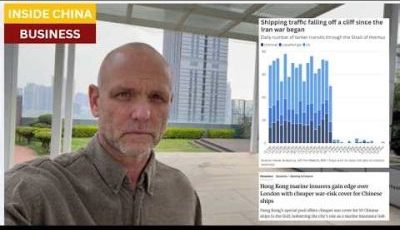
More Iran War fallout: Maritime insurance industry shifts from London to China
or go to
Aletho News Archives – Video-Images
From the Archives
Allies Don’t Need Lobbies
By Jay Knott | Dissident Voice | September 24, 2013
In a recent article on Counterpunch, Rob Urie defended the traditional Marxist analysis of US policy in the Middle East. He argues that support for Israel is driven primarily by economic interest, not the Jewish lobby.
He starts by paying tribute to the idea that Western societies are uniquely racist. He says that the “Western narrative” claims there is an “Arab character”, and that this is “antique racist blather”. He gives no definition of these terms. Further, he establishes his credentials as part of the dominant current in the American left by claiming that “over a million people in Iraq died so ‘we’ in the West can drive SUVs.”1
When he tries to criticize bourgeois economics, he makes it clear he doesn’t understand the developments it has made since Marx’s day, using the mathematical discipline known as “game theory”. He dismisses the basic abstraction of economic theory, the idea of the rational individual, on the grounds that it is “devoid of history, culture and political context”. But abstractions are always devoid of something.
He defends a more concrete economic theory, mostly Marxist, with some input from another theorist of capitalist crisis, Hyman Minsky. This concrete theory leads him to the view that US activity in the Middle East is primarily driven by rational capitalist motives, the need to secure a supply of oil.
“Taking the totality of circumstance — former oil company executives launching war on an oil rich nation on a pretext they publicly proclaimed they didn’t believe shortly before taking office — and that upon launching their war proved to be non-existent, requires a willingness to overlook the obvious — that the war on Iraq was for oil, that is difficult to support.”1
Perhaps I’ve misunderstood him, but based on what he says in the rest of the article, this convoluted sentence seems to argue that, because president Bush and vice-president Cheney attacked Iraq on false premises, and they also said it was all about oil, and they are former oil executives, and Iraq has a lot of oil, it’s difficult to deny US attacks on Iraq are all about oil.
In fact, it’s not hard at all. As Urie points out, at times Bush and co. said that attacking Iraq was “protecting the world’s supply of oil.”1 But, as he also points out, they are congenital liars. Why should we believe them when they say they are trying to “protect” the oil supply? Protect it against what? When politicians “admit” attacks on Middle Eastern countries are wars for oil, they are parroting the neo-con party line, feeding the public, both left and right, with a plausible-sounding pretext. For right-wingers, “it’s a war for oil” is a reason to support war, and for leftists, it’s a way to feel better by complaining impotently about corporate greed. Both approaches help the war drive. … continue
Blog Roll
 Aletho News
- Pakistan ramps up food exports to Persian Gulf nations as war deepens food insecurity
- Iran submits response to US plan, sets terms for war’s end: Tasnim
- US vs Iran: Kharg Island Talk — Bluff or Escalation? Ex-Military Officer Weighs In
- Zelensky unnecessarily involves Ukraine in the Middle East crisis
- Turkish tanker blacklisted by Ukraine hit in drone attack – media
- Canada, the U.S., and NATO: the inescapable trap
- Villains of Judea: Leonid Radvinsky
- Alon Mizrahi: ‘Israel Must Be Dismantled’
- Former Head Of MI6 Admits That The U.S. And Israel Are Losing The Iran War
- Scattered Thoughts on War and Peace
- If Americans Knew
- Israel may be committing war crimes in Lebanon – Not a ceasefire Day 167
- In the West Bank, life is a constant battle – 3 articles
- Jacob Reses, one of the most powerful pro-Israel operatives in Trump’s Washington
- Israeli-US assaults kill or injure 87 children a day – Not a ceasefire Day 166
- ‘Forever live by the sword’: Understanding Israelis’ massive support for Iran war
- UN’s special rapporteur on human rights says Israel is systematically torturing Palestinians
- Trump White House plagiarized Iran war manifesto from Israel-aligned think tank
- Gaza says 6–10 patients die daily waiting for treatment abroad as Israel blocks medical evacuations
- ‘Substantial evidence’ of double-tap strike in killing of Gaza’s Hind Rajab
- ‘Do Not Want To Die For Israel’: Doubts About Trump’s Iran Strategy Spread Among Troops
- No Tricks Zone
- Devastating Assessment Of Comirnaty Vaccine By Former Senior Pfizer Europe Toxicologist
- New Study: CO2 Is ‘Effectively Negligible’ As An Explanatory Climate Change Factor Since 2000
- Former Pfizer Toxicologist Dr. Helmut Sterz Tells Bundestag Hearing Pfizer Vaccine Should Have Never Been Approved
- Energy Expert: Germany’s Nuclear Phaseout Was A “500 Billion Euro Mistake”
- New Research: South Australia’s Mid-Holocene Sea Surface Temperatures Were 4°C Warmer Than Today
- Storing Green Energy To Last Germany 10 Days Would Require A 60-Million Tonne Battery
- New Studies: UK Sea Levels Were 4 Meters Higher Than Today During The Mid-Holocene
- Destructive Green New Deal: German Energy And Metal Group Warns Of Drastic Crisis
- New Study Documents A 20-Year Pause In Arctic Sea Ice Decline – Driven By Internal Variability
- Wake-up Call: Survey Shows Majority Of Germans Now Favor Postponing Climate Targets!
 Aletho News