Chinese satellite company refutes US accusation of supporting Houthi attack on US interests as ‘completely fabricated’
By Fan Wei and Liu Xin | Global Times | April 19, 2025
The US accusations are completely groundless and Chang Guang Satellite Technology has no business dealings with Iran or the Houthi groups, Chang Guang Satellite Technology told the Global Times on Saturday in response to a recent US accusation of supporting Yemen’s Houthis in attacking US interests in the region.
The US State Department spokesperson Tammy Bruce claimed that Chang Guang Satellite Technology Co., Ltd was involved in “directly aiding Iran-backed Houthi rebels in Yemen by providing satellite imagery used to target US and international vessels in the Red Sea,” according to a report from Fox News on Friday.
In response to an inquiry from the Global Times on the US accusation, Chang Guang Satellite Technology said that the company firmly opposed the US groundless accusation and such claims are completely fabricated and maliciously slanderous.
Chang Guang Satellite Technology Co., Ltd has no business dealings with Iran or the Houthi force. The company said that it strives to harness remote sensing data to drive high-quality development across key sectors such as agriculture, forestry, environmental protection, and finance.
“In our global operations, we strictly comply with relevant laws, regulations, and industry standards both in China and internationally. With a mature business model and high-quality services, we are committed to contributing Chinese expertise and solutions to the advancement of the global remote sensing industry,” said the company.
The core US accusation is that Chang Guang Satellite tracked US warships and commercial vessels using commercial remote sensing satellites to guide the Houthis strikes, which is technically unfeasible, Hu Bo, director of South China Sea Strategic Situation Probing Initiative (SCSPI), told the Global Times.
Hu said that according to current public information, it is technically difficult for any global commercial remote sensing satellite constellation — including that of Chang Guang Satellite — to achieve such a capability. The limitations in ephemeris, revisit cycles of the remote sensing satellite, and the ability of existing remote sensing technologies to track moving targets mean that these satellites cannot provide real-time coordinate information to strike mobile targets such as warships and commercial vessels.
Even Planet Labs, the US-based company with the largest number of commercial remote sensing satellites in the world, can only achieve an average once-daily revisit cycle for any given location on Earth. While orbital adjustments and resource concentration on hotspot areas may slightly reduce the revisit interval, this still makes it meaningless for real-time tracking and targeting of moving objects to guide weapon strikes, according to Hu.
The Houthis have their own drone capabilities, which serve as the most practical and effective means of real-time surveillance and reconnaissance against moving targets in narrow waters like the Red Sea. In contrast, reconnaissance satellites offer very limited utility in such scenarios, said Hu.
In response to a media inquiry on the US accusation, Chinese Foreign Ministry spokesperson Lin Jian on Friday said that “I’m not familiar with the specifics you mentioned. Since the situation in the Red Sea escalated, China has been playing a positive role to ease tensions.”
“Who is promoting talks for peace and cooling down the situation, and who is heightening tensions with sanction and pressure? The answer is rather clear to the world. China urges relevant countries to do what is conducive to regional peace and stability, not otherwise,” Lin said.
China detonates non-nuclear hydrogen bomb — media
RT | April 20, 2025
Chinese researchers have successfully tested a non-nuclear hydrogen bomb that created a sustained fireball, far outperforming traditional explosives, the South China Morning Post has reported.
In an article on Sunday, the newspaper cited the researchers’ study published last month in the Chinese-language Journal of Projectiles, Rockets, Missiles and Guidance. According to the report, a team from the China State Shipbuilding Corporation’s (CSSC) 705 Research Institute — a key player in underwater weapon systems — developed a 2kg (4.4lbs) bomb primarily composed of magnesium hydride, with conventional explosives serving as the catalyst.
In a field test, the device reportedly generated a fireball with temperatures exceeding 1,000 degrees Celsius (1,832 degrees Fahrenheit) that lasted for more than two seconds, which is considerably longer than what an equivalent TNT blast is capable of producing.
In the reaction, magnesium hydride, a compound originally developed as an efficient fuel, rapidly releases stored hydrogen gas, resulting in a sustained inferno.
The novel explosive device’s destructive power thus is said to lie not in its blast pressure, but rather in the ability to generate extreme heat.
The South China Morning Post quoted CSSC research scientist Wang Xuefeng as explaining that its properties also allow for “precise control over blast intensity, easily achieving uniform destruction of targets across vast areas.”
If fully developed, the method could presumably yield a weapon similar to napalm or a thermobaric device – ideal for annihilating defensive structures and armored vehicles.
While the production of magnesium hydride used to be mostly small-scale and rather complicated, China has recently developed a cheaper and safer production method and built a plant capable of producing 150 tons of the compound per year.
Ties with Russia, China key to global peace – Iranian foreign minister
RT | April 19, 2025
Iran, Russia, and China intend to deepen their cooperation in order to promote global peace and security, Iranian Foreign Minister Abbas Araghchi has said in an exclusive interview with RT.
Tehran has been strengthening its ties with Moscow and Beijing in recent years, joining the Shanghai Cooperation Organization (SCO) in 2023 and the BRICS group in 2024. Military cooperation has also expanded, most recently through joint naval drills conducted by the three countries off Iran’s coast in March.
Given the current international climate, working closely with Moscow and Beijing is “a necessity” for Tehran, Araghchi told the broadcaster on Saturday.
“We have started trilateral talks between Iran, Russia and China on the issue of Iran’s nuclear program for some time now,” he said, adding that two such meetings have already taken place. “We are ready to continue these talks and expand them to other issues,” the minister added.
Araghchi expressed confidence that “Iran, China and Russia – in a coordinated move – can take effective steps towards international peace.” The three partners “are serious about this,” he insisted.
Tehran’s top diplomat also said that bilateral “relations between Iran and Russia have never been so close and so strong” than at the current moment.
“We now have a comprehensive strategic partnership agreement that raises the level of our relations to a strategic level. Major economic projects are underway between us. The volume of trade between us has increased tremendously,” he said.
Despite harsh Western restrictions slapped on both Iran and Russia, the two countries “are not waiting for the sanctions to be lifted, but we are expanding our relations in this situation,” Araghchi noted.
“We have the same and close positions on many international issues. I do not want to say that there are no disagreements between us. Sometimes there are also differences of opinion, but in most cases we have close positions with each other and, most importantly, we are in constant exchange of views,” he said.
Earlier this week, Russia’s Federation Council, the upper house of the country’s parliament, unanimously ratified the Comprehensive Strategic Partnership Agreement between Russia and Iran, which was signed by Russian President Vladimir Putin and his Iranian counterpart Masoud Peseshkian in January. The pact stipulates that the two nations will develop equal and mutually beneficial cooperation in the fields of politics, defense, economy, security, trade, investment, energy, infrastructure and other areas.
Russia, China to Discuss Guarantees on Iran Deal with US – Iranian Lawmaker
Sputnik – 19.04.2025
The United States will not be the only one providing guarantees for a potential Tehran-Washington agreement on the Iranian nuclear program, Iranian lawmaker Alaeddin Boroujerdi said ahead of the second round of US-Iran talks in Rome.
Russia and China will discuss with the US the issue of “more reliable guarantees” for Tehran, Alaeddin Boroujerdi, a member of the Iranian parliamentary committee on national security and foreign policy, said.
“During the negotiations between Tehran and Washington, guarantees will not only be provided by the US. Countries such as Russia and China will enter into negotiations with the United States on more reliable guarantees,” Boroujerdi said, as quoted by the Iranian state agency SNN.
Iranian Foreign Minister Abbas Araghchi was on an official visit to Moscow on Thursday and Friday, and in the next few days, according to the Iranian state news agency IRNA, Araghchi will visit China.
During his visit to Russia, the Iranian diplomat held a meeting and talks with Russian leader Vladimir Putin, conveying to him a message from Iran’s Supreme Leader Ali Khamenei. Araghchi also held talks with Russian Foreign Minister Sergey Lavrov. The parties discussed regional and international cooperation, as well as the situation around the US-Iran talks, the first round of which took place on April 12 in Oman.
Indirect talks between US Presidential Envoy for the Middle East Steve Witkoff and Araghchi took place in the Omani capital on April 12. According to the US special envoy, they were positive and constructive. Araghchi also described the atmosphere of these talks as constructive and calm, and announced that the second round of talks between the Islamic Republic and the United States would be held on April 19.
US imposes sanctions on Chinese buyers of Iranian oil
Press TV – April 16, 2025
The United States has imposed sanctions on Chinese importers of Iranian oil despite being involved in talks with the Islamic Republic to sort out differences over its nuclear program.
The US Treasury Department’s Office of Foreign Assets Control (OFAC) said in a statement on Wednesday that it had targeted the Chinese importers of Iranian oil in a new round of sanctions issued against Tehran.
It said that the Shandong Shengxing, a so-called “teapot” refinery based in China’s Shandong province, had been designated for receiving dozens of Iranian oil shipments worth more than $1 billion.
The sanctions also targeted the China Oil and Petroleum Company Limited (COPC), an entity the Treasury claimed has been functioning as a front company for Iran’s Islamic Revolution Guards Corps to collect oil export revenues from China, including payments made by Shandong Shengxing.
OFAC said it had also designated one Cameroon-flagged and four Panama-flagged tankers for their role in transporting billions of dollars worth of Iran’s oil to international markets, including to China-based refineries.
The tankers’ owners and operators, based in Panama, Malaysia, the Marshall Islands, and Hong Kong, were also targeted.
The new sanctions are the sixth such action taken by the US government against Iran since February 4, when US President Donald Trump signed a presidential memorandum ordering a campaign of maximum pressure on the country.
They came despite the fact that Iran and the US have launched negotiations to settle disputes about Tehran’s nuclear program. The indirect talks started last weekend in Oman’s capital, Muscat, and will continue on Saturday in Italy’s Rome.
However, the sanctions are a first under Trump in his second term to directly target China and its imports of oil from Iran. Beijing has repeatedly said that it does not recognize US sanctions.
US, Iran to Hold Indirect Negotiations in Oman
Sputnik – 08.04.2025
Iranian Foreign Minister Abbas Araghchi confirms the upcoming US-Iran meeting in Oman on Saturday for high-level indirect talks.
Donald Trump previously announced direct negotiations with the Iranian side at “almost the highest level” this Saturday, which Tehran later corrected.
Iran has previously ruled out direct talks with the US under threats and pressure, but has left the door open for indirect negotiations.
Meanwhile, Russian Foreign Ministry spokeswoman Maria Zakharova said that Russia, China and Iran will hold talks on Iran’s nuclear program in Moscow tomorrow.
Chinese Embassy in Canada refutes allegations of China’s interference in Canadian elections
Global Times | March 26, 2025
In response to a media question regarding claims by an official from the Canadian Security Intelligence Service (CSIS) that China might attempt to interfere in Canada’s elections, a spokesperson of the Chinese Embassy in Canada stated that China firmly opposes the baseless slander and defamation of China without factual evidence.
It has been reported that an official from the CSIS stated that Canada’s elections could face the threat of foreign interference and the CSIS is closely monitoring China, Russia, India, and Pakistan, when questioned on this, the spokesperson of the Chinese Embassy in Canada said that the Chinese side has repeatedly stated its position on the so-called issue of foreign interference, firmly opposing the baseless slander and defamation of China without factual evidence.
China follows the principle of non-interference in other countries’ internal affairs and has never, nor has any interest in, interfering in Canada’s internal affairs. The label of “foreign interference” will never be placed on China, the spokesperson said.
The Canadian election is a domestic issue for Canada and is not related to China. However, the Chinese side firmly opposes linking Canada’s internal affairs with China-related factors and firmly opposes using China as a topic in this context, the spokesperson added.
Even Realists Overstate the ‘China Threat’
By Joseph Solis-Mullen | The Libertarian Institute | March 26, 2025
Perusing the most recent edition of Foreign Affairs, which was typically dreadful, one piece caught my eye. In “The Taiwan Fixation,” Stephen Wertheim and Jennifer Kavanagh argued that a full-scale U.S. military intervention over Taiwan would be catastrophic, and that Washington should seek to balance building up Taiwan’s defense while insulating its own broader Indo-Pacific strategy from Taipei’s fate.
Their critique of full-blown interventionism is, of course, well-founded, and was a welcome sight, but their core assumptions remain unfortunately rooted in the flawed logic of American primacy. Even as they downplay alarmist rhetoric, they still accept an overstated vision of China’s potential threat and Washington’s supposed stake in Taiwan.
At its core, “The Taiwan Fixation” fails to escape the same errors that underpin most discussions on U.S.-China relations. It assumes that Taiwan is of critical strategic importance to American security, that China’s control of the island would be an unacceptable shift in the regional balance of power, and that some level of U.S. intervention remains necessary. But as I argued in The Fake China Threat, these claims are fundamentally weak. The United States has no compelling strategic interest in Taiwan, Beijing has little incentive to disrupt regional trade routes, and Taipei itself seems far more interested in lobbying Washington for protection than in seriously investing in its own defense.
Wertheim and Kavanagh attempt to position Taiwan as strategically valuable but stop short of the full-blown liberal internationalist and neoconservative argument that its loss would be a geopolitical catastrophe. Instead, they argue that while Beijing’s control over Taiwan wouldn’t transform China into an immediate hegemon, it would complicate U.S. military operations and potentially embolden China in the region.
This claim doesn’t hold up under scrutiny. Taiwan is not a vital interest of the United States. The U.S. does not need Taiwan for trade, military positioning, or economic security. As Wertheim himself concedes, Taiwan’s loss wouldn’t fundamentally alter the balance of power in Asia. The idea that China could use Taiwan as a springboard for wider expansion is speculative at best—especially when Japan, India, and other regional actors already have strong incentives to counterbalance China regardless of what happens in Taipei.
One of the article’s weakest points is its flirtation with the classic “credibility” argument—the notion that if the United States fails to defend Taiwan, allies like Japan or the Philippines will start doubting Washington’s commitments. This argument has been trotted out since the Cold War to justify interventions from Vietnam to Afghanistan, and it remains just as flimsy today.
Japan’s leaders have already signaled that Taiwan is not a make-or-break issue for them. Despite constant American warnings, no Asian country is poised to abandon its alliance with Washington over Taiwan’s fate. India and Japan, the two regional powers most capable of countering Beijing, already have their own deep-seated strategic reasons to oppose Chinese expansionism. Their security policies aren’t contingent on what Washington does in Taiwan.
If anything, it’s the United States that risks undermining its own credibility by committing to a fight over Taiwan. The more Washington signals an absolute commitment to Taipei’s defense, the more pressure it creates for itself to intervene—setting up a scenario where its own rhetoric forces it into an unnecessary war.
Wertheim and Kavanagh advocate for the “porcupine” strategy—arming Taiwan with asymmetric capabilities like sea mines, missile batteries, and drone fleets to make an invasion costly for China. Superficially, this seems like a clever alternative to direct U.S. intervention. In reality, it risks provoking the very war it is meant to prevent.
If Washington floods Taiwan with weapons and escalates military cooperation, Beijing may conclude that peaceful reunification is no longer viable. As Wertheim himself acknowledges, Taiwan arming itself “too well” could force China’s hand, making an invasion more likely rather than deterring it. This isn’t just theoretical. The logic follows from the same security dilemmas that have fueled arms races throughout history: the more one side hardens its defenses, the more the other feels compelled to strike before it loses its window of opportunity.
This isn’t just a U.S.-China issue—it’s also a question of Taipei’s own incentives. Taiwan has consistently underinvested in its own defense, spending only about 2.5% of its GDP on the military, despite claiming existential threats from Beijing. Why? Because it has calculated—correctly—that lobbying Washington is far cheaper than paying for its own defense. As Ben Freeman has pointed out, Taipei has spent tens of millions lobbying Congress and funding think tanks that push for greater U.S. military commitments. Why spend hundreds of billions on weapons when you can spend a fraction of that buying influence in Washington?
Wertheim and Kavanagh criticize Taiwan for failing to reorient its defense spending but still assume that Washington should step in and “encourage” (i.e., coerce) Taipei into adopting a more robust posture. But if Taiwan itself is unwilling to make the necessary sacrifices, why should American taxpayers foot the bill? The answer is simple: they shouldn’t.
Perhaps the most glaring omission in “The Taiwan Fixation”—one that even realists like Wertheim often overlook—is that Taiwan is not a separate state in the conventional sense. It remains, officially and historically, a part of China. The Chinese Civil War never formally ended, and U.S. intervention in the Taiwan issue has always been an act of interference in a domestic Chinese conflict.
Imagine if, at the height of the American Civil War, Britain had not only recognized the Confederacy but armed it and promised to fight the Union on its behalf. That’s essentially the position Washington has taken with Taiwan. The United States has no legitimate role in deciding the island’s future. Every time it sells weapons to Taipei or conducts military exercises in the Taiwan Strait, it is actively inserting itself into a conflict where it has no rightful place.
The logical conclusion of this reality should be clear: Taiwan is China’s problem, not Washington’s. Wertheim does acknowledge that American policy should aim for “competitive coexistence” rather than outright confrontation. But he stops short of drawing the real conclusion, one that follows naturally from his own arguments: the United States should be preparing to disengage from Taiwan entirely, not reinforcing its involvement.
Wertheim and Kavanagh offer a more grounded view of Taiwan policy than the usual Beltway hawks, but their analysis still rests on faulty assumptions. They recognize that Taiwan’s fate doesn’t justify war, yet they continue to insist that some American involvement is necessary. They acknowledge that China wouldn’t become a global hegemon even if it took Taiwan, yet they still assume that its loss would significantly damage U.S. interests. They see the dangers of arming Taiwan too aggressively, yet they continue to endorse the porcupine strategy.
Ultimately, their view of Taiwan remains a product of Washington’s obsession with maintaining primacy rather than accepting a multipolar reality. The United States does not need to “fix” Taiwan policy—it needs to let it go. The alternative is continued entanglement in a conflict that serves no vital American interest and risks dragging Washington into an unwinnable war.
The real China threat isn’t a military one—it’s the threat of policymakers manufacturing crises where none need exist. If the U.S. truly wants to avoid war, it should stop making Taiwan a battlefield of its own choosing.
China submits five-point Iran nuclear deal proposal to UN conference
Al Mayadeen | March 24, 2025
China has formally presented a new proposal to revive stalled negotiations over Iran’s nuclear program, calling for diplomacy, mutual respect, and the preservation of the 2015 nuclear deal. The five-point initiative was first unveiled by Chinese Foreign Minister Wang Yi on March 14 during a trilateral meeting in Beijing with his Iranian and Russian counterparts. It was later submitted to the United Nations’ Conference on Disarmament in Geneva, where it has been published as Document No. 2448/CD.
According to Chinese diplomats, the document outlines principles intended to defuse mounting tensions surrounding Iran’s nuclear activities and offers a framework to restart talks. The Chinese delegation requested its official release as a UN document, underlining Beijing’s push for a greater role in global security discussions.
The first principle calls for a diplomatic solution and warns against military escalation or punitive economic actions. “Stay committed to peaceful settlement of disputes through political and diplomatic means, and oppose the use of force and illegal sanctions,” the proposal states. It urges all sides to create conditions for renewed negotiations and to avoid steps that could worsen the situation.
In its second point, the proposal emphasizes Iran’s rights under the Nuclear Non-Proliferation Treaty, while also encouraging Tehran to maintain its pledge not to pursue nuclear weapons. “Stay committed to balancing rights and responsibilities, and take a holistic approach to the goals of nuclear nonproliferation and peaceful uses of nuclear energy,” it reads. “Iran should continue honoring its commitment to not developing nuclear weapons, and all other parties should fully respect Iran’s right to peaceful uses of nuclear energy.”
The third point calls for renewed commitment to the Joint Comprehensive Plan of Action (JCPOA), the multilateral agreement signed in 2015 that placed limits on Iran’s nuclear program in exchange for sanctions relief. “Stay committed to the framework of the Joint Comprehensive Plan of Action (JCPOA) as the basis for new consensus. China hopes that all parties will work toward the same direction and resume dialogue and negotiation as early as possible. The United States should demonstrate political sincerity and return to talks at an early date.”
China’s fourth recommendation cautions against moving the matter to the United Nations Security Council, which could trigger the reimposition of international sanctions through the so-called “snapback” mechanism. “Stay committed to promoting cooperation through dialogue, and oppose pressing for intervention by the UN Security Council (UNSC). Under the current situation, hasty intervention by the UNSC will not help build confidence or bridge differences among the relevant parties. Initiating the snapback mechanism would undo years of diplomatic efforts, and must be handled with caution.”
The final principle calls for gradual, reciprocal steps to build consensus, stressing that no lasting resolution can be achieved through pressure or force. “Stay committed to a step-by-step and reciprocal approach, and seek consensus through consultation. History has proven that acting from a position of strength would not lead to the key to resolving difficult issues. Upholding the principle of mutual respect is the only viable path to finding the greatest common ground that accommodates the legitimate concerns of all parties and reaching a solution that meets the expectation of the international community.”
Beijing framed the proposal as part of its broader strategy to promote dialogue over confrontation. Chinese officials said the country will remain in close contact with all relevant parties and will “actively promote talks for peace, and play a constructive role in realizing early resumption of talks.”
Reiterating its longstanding position, China stressed that negotiations—not threats or sanctions—remain the only viable path forward. “Sanctions, pressure, and threats of force are not viable solutions,” Beijing stated.
US announcement of sixth-gen F-47 fighter draws analyses from Chinese expert
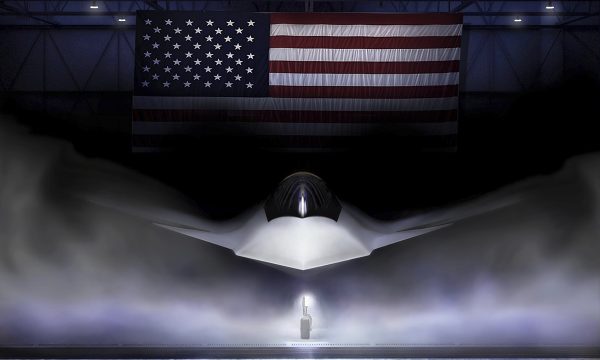
Graphical rendering shows the Next Generation Air Dominance (NGAD) Platform, the F-47. Photo: VCG
By Liu Xuanzun and Liang Rui | Global Times | March 23, 2025
The US’ recent announcement of the F-47 fighter jet has drawn intensive analyses from Chinese military affairs experts and observers, who acknowledged the aircraft being a real sixth-generation fighter jet for featuring typical characteristics such as a tailless design, but they also raised questions over its potentially limited stealth capability, relatively small size, and the US’ selection of Boeing to build the warplane.
The Pentagon has awarded the contract for the US Air Force’s Next Generation Air Dominance future fighter jet, known as NGAD, to Boeing, US President Donald Trump announced Friday, US news outlet Defense News reported on Saturday.
The sixth-generation fighter, which will replace the F-22 Raptor, will be designated the F-47, Trump said. It will have “state-of-the-art stealth technologies [making it] virtually unseeable,” and will fly alongside multiple autonomous drone wingmen, known as collaborative combat aircraft, Defense News reported.
After reviewing the artist renderings of the F-47 released by the US Air Force, Zhang Xuefeng, a Chinese military affairs expert, told the Global Times on Sunday that the F-47’s appearance conforms to the general development trend of the sixth-generation fighter jet concept. For example, it does not feature any vertical tails, which is an attempt to further improve its stealth capability in all directions. It has a flat nose and a lifting-body fuselage. These are all important characteristics of a sixth-generation fighter jet.
Zhang added that manned-unmanned teaming is a core sixth-generation feature, and one the F-47 includes.
However, a pair of canards can be observed in front of the F-47’s main wings, and this will more or less impact the aircraft’s stealth, Zhang noted. Reiterating that an important trend for sixth-generation fighter jets is to remove vertical tails and use a supersonic flying wing configuration to boost stealth, Zhang said that new mechanisms are needed to act in the place of vertical tails to control the aircraft, such as movable wingtip. But the F-47 opted to use canards, a relatively old technology often found on previous generations of aircraft. He suggested Boeing may lack the tech base to develop new control methods and relies on outdated design choices.
In December 2024, videos and photos emerged on social media allegedly showing two types aircraft with new designs have conducted test flights in China. Despite no official announcements, many called them China’s “sixth-generation fighter jets.” Both of them appear to have removed vertical tails and also do not have canards. One of them, resembling a ginkgo leaf in appearance, looked far larger than its J-20 escort.
Wang Ya’nan, chief editor of Beijing-based Aerospace Knowledge magazine, told the Global Times on Sunday that comparing with the size of the canopy and the front landing gear, it can be analyzed that the overall size of the F-47 is not likely much larger than the F-22. It means that the F-47 is still a tactical aircraft, rather than a large, multipurpose aerial platform capable of conducting campaign-scale missions like the “ginkgo leaf” aircraft.
Defense News, citing Air Force Chief Gen. Allvin, claimed that experimental versions of the NGAD have been flying for the last five years.
But Wang noted that there is no proof of this. Even the pictures depicting the F-47 are artists renderings rather than photos.
Wang also noted that Boeing has not won a major fighter jet program for decades. Its F-15 and F/A-18 fighter jets are from McDonnell Douglas which was merged into Boeing, and Boeing’s own X-32 fighter jet lost to the F-35 from Lockheed Martin in bidding. Boeing’s other projects, such as the 737 MAX airliner and KC-46 tanker aircraft also encountered many issues recently. “Having a company like this to lead a sixth-generation program is actually very risky,” he said.
In addition to US’ NGAD program, other countries are also developing sixth-generation fighter jets. France, Germany and Spain are in the Future Combat Air System program to develop a sixth-generation fighter jet, while the UK, Italy and Japan have a sixth-generation Global Combat Air Programme fighter project, according to Defense News. Russia’s sixth-generation efforts have also surfaced in TASS reports.
Wang said the US is moving fastest with the F-47, while other nations lag. With China’s own jets already spotted in the sky, the outside world is now seeing China and the US in advanced stages of sixth-generation fighter jet development.
‘Gaza must not become a battleground for political game,’ says Chinese envoy to UN
Global Times | March 22, 2025
Fu Cong, China’s permanent representative to the United Nations, said at a Security Council Briefing on Friday that China is gravely concerned about the breakdown of the hard-won ceasefire in Gaza. “Gaza must not become a battleground for political game. Civilian lives must not be sacrificed for political calculations. A lasting ceasefire must be realized in Gaza,” the Chinese envoy said.
The resumed fighting in Gaza has sparked widespread concern and apprehension in the international community. Since March 17, Israel has carried out large-scale airstrikes, renewed its ground offensive, and occupied central Gaza. Israel has also cut off access to humanitarian supplies and electricity in succession, causing massive casualties and worsening the already grave humanitarian disaster, Fu said.
“Securing a lasting ceasefire is the best way to save lives and bring hostages home, and it is an overriding priority,” he noted, while urging Israel to abandon its obsession with the use of force, immediately cease its military operations against Gaza, and lift blockade on the access of humanitarian supplies into Gaza.
Meanwhile, the situation in the West Bank is equally critical, the Chinese envoy added. Over the past two months, continued Israeli military operations have emptied by force multiple Palestinian refugee camps, displacing over 40,000 people. Israel should cease its attacks on the West Bank, stop settlement activities, and effectively curb settler violence, Fu noted.
Fu reiterated that implementing the two-State solution is the only viable way to resolve the Palestinian question. The international community should step up efforts to promote the political process of the two-State solution and provide robust guarantees. China supports the Gaza recovery and reconstruction plan jointly initiated by Egypt and other Arab states, and supports the commencement of rebuilding in accordance with the principle of Palestinians governing Palestine. China opposes the forced removal of Palestinian people, and opposes any attempt to annex the territories of Gaza or the West Bank, Fu noted.
Hamas said on Friday it was reviewing a US proposal to restore the Gaza ceasefire as Israel intensified a military onslaught to press the Palestinian militant group to free remaining Israeli hostages, Reuters reported. Three days after Israel effectively abandoned the two-month-old truce, Israeli Defence Minister Israel Katz said the military was intensifying its air, land and sea strikes and would move civilians to the southern part of Gaza.
Featured Video

Rewriting the risk? Inside the government’s vaccine safety messaging
or go to
Aletho News Archives – Video-Images
Book Review
“Davos Can Really Replace the UN”
Inside the book that maps the architecture behind global governance — from the Epstein files to the Pact for the Future
Lies are Unbekoming | April 1, 2026
On June 13, 2019, the United Nations and the World Economic Forum signed a partnership deal to “accelerate the implementation of the 2030 Agenda for Sustainable Development.” That same evening, WEF president Börge Brende — Norway’s former Foreign Minister — had dinner with Jeffrey Epstein at Epstein’s Manhattan townhouse. The Epstein files, released January 2026, contain an exchange between the two from the previous year. Epstein to Brende: “Davos can really replace the UN. C21, cyber, crypto . genetics… intl coordination.” Brende back to Epstein: “Exactly — we need a new global architecture. World Economic Forum (Davos) is uniquely positioned — public private.”
The next day, the UN General Assembly adopted the framework for restructuring global governance.
That sequence — the partnership signing, the Epstein dinner, the candid admission about replacing the UN with a public-private architecture, and then the formal adoption — opens Jacob Nordangård’s The Digital World Brain. Pages two and three. Footnoted to the UN resolution number, the Epstein files, and the General Assembly record.
I keep coming back to it because it captures what this book does that almost nothing else in the independent research space manages. I’ve followed Jacob’s work for years now and interviewed him about his research. Each book peels back another layer of the same institutional architecture, and each time I think he’s reached the limit of what can be documented, the next one goes further. Nordangård doesn’t speculate. He doesn’t editorialize much. He lays institutional actions next to each other in chronological order and lets the pattern announce itself. … continue
Blog Roll
 Aletho News
- The End of NATO
- 37 days of war on Iran cost US staggering $42bln, tracker shows
- Baghdad tells Asian refiners, traders to begin loading Iraqi crude amid Iranian exemption
- Under fire, Moscow and Tehran close ranks
- Iran, US receive Pakistan-mediated plan for ceasefire then final deal
- Iran submits demands for end to war as mediators scramble ahead of Trump deadline
- Iran Threatens Retaliatory Strike on Stargate AI Project in UAE
- US sent ‘a lot’ of arms to Iranian protesters – Trump
- Barak Ravid Launders Deception To Allow Trump To Back Off Of His Power Plant Threat – Again
- REWRITING THE RISK? INSIDE THE GOVERNMENT’S VACCINE SAFETY MESSAGING
- If Americans Knew
- Trump poised to “blow everything up” (ie. commit war crimes) in Iran – Daily Update
- In Iran, Israel-US take aim at “reason, research, and freedom of thought” – Daily Update
- US loses planes over Iran, Israel downgrades Lebanon war goals – Daily Update
- Israel Is Blocking Palestinians from Easter at Church Where Jesus Resurrected
- Plot to assassinate Palestinian activist follows harassment campaign promoted by Zionist groups and elected officials
- Prominent New York synagogue hosts presentation on why U.S. Jews should support the ethnic cleansing of Gaza
- Tapper vs. Piker: Is the CNN Anchor Auditioning for David Ellison?
- Shouldn’t Democrats Be Able to Condemn Genocide?
- Israel-US kill negotiators, destroy civilian structures, but Iran’s military capabilities still largely intact – Daily Update
- ‘War crime’: Global condemnation as Israeli ministers celebrate death penalty law targeting Palestinian prisoners
- No Tricks Zone
- An Inconvenient Tree: Uncovered In Alps… Europe Much Warmer Than Today 6000 Years Ago
- New Study Reports A 60% Slowdown In Greenland’s Ice Loss Rate In The Last Decade
- Low Intensity Tornado Wrecks Major Solar Farm, Creating A Potential Toxic Dump
- New Study Finds Warming Saves Lives…Cold Temperatures 12 Times More Deadly Than Excess Heat
- German Science Blog Accuses PIK Climate Institute Of Hallucinating Climate Tipping Points
- Devastating Assessment Of Comirnaty Vaccine By Former Senior Pfizer Europe Toxicologist
- New Study: CO2 Is ‘Effectively Negligible’ As An Explanatory Climate Change Factor Since 2000
- Former Pfizer Toxicologist Dr. Helmut Sterz Tells Bundestag Hearing Pfizer Vaccine Should Have Never Been Approved
- Energy Expert: Germany’s Nuclear Phaseout Was A “500 Billion Euro Mistake”
- New Research: South Australia’s Mid-Holocene Sea Surface Temperatures Were 4°C Warmer Than Today
 Aletho News