US Boosted Nuclear Arms Spending by 18% in 2023, Record Among Nuclear States – Report
Sputnik – 17.06.2024
The United States last year increased spending on nuclear weapons by 18%, which is the highest rate among all nine countries possessing nuclear weapons, the International Campaign to Abolish Nuclear Weapons (ICAN) said on Monday.
US alone spends on nukes more than all other nuclear-armed states, the report read.
“[In 2023] Every country increased the amount it spent on nuclear weapons. The United States had the biggest increase, at nearly 18%. The United States spent more than all the other nuclear-armed states combined, at $51.5 billion. China surpassed Russia as the second-highest spender at $11.9 billion, and Russia came in third, spending $8.3 billion,” the ICAN said in a report, adding that the United Kingdom also significantly increased its nuclear spending for the second year in a row.
In 2023, the US, the UK, China, France, India, Israel, North Korea, Pakistan and Russia spent a total of $91.4 billion developing their nuclear arsenals, which is $10.8 billion or 13.4% more than in 2022, the ICAN also said.
“In 2023, twenty companies working on nuclear weapons development and maintenance earned at least $31 billion for this work. There are at least $335 billion in outstanding nuclear weapons contracts to these companies, some of which have continued for more than a decade. In 2023, at least $7.9 billion in new nuclear weapon contracts were awarded,” the report read.
ICAN, a coalition of civil society organizations in over 100 countries, was founded in Melbourne, Australia in 2007. The coalition promotes adherence to the Treaty on the Prohibition of Nuclear Weapons. In 2017, it received the Nobel Peace Prize for its efforts.
Earlier, experts explained to Sputnik that recent Minuteman III launches are a regular audit of the strategic forces rather than nuclear saber-rattling.
US using Ukraine conflict as pretext to impose sanctions – China
RT | June 13, 2024
The US is using the Ukraine crisis as an opportunity to impose sanctions while continuing to pump Kiev with weapons, Chinese Foreign Ministry spokesman Lin Jian said on Thursday.
Lin made the remarks after the US State Department and Treasury Department announced a new round of curbs on Wednesday targeting 300 additional individuals and entities in Russia and other countries, including China, Türkiye, and the UAE. In particular, Washington has sanctioned China-based companies which are selling semiconductors to Moscow.
According to the Treasury Department, the latest measures target more than $100 million in trade between Russia and foreign partners suspected of enabling Moscow to evade Western embargoes.
The Chinese diplomat called Washington “extremely hypocritical and overbearing” for supplying Ukraine with weapons while pushing for peace.
“We urge the United States to immediately stop abusing illegal unilateral sanctions, and focus on ceasefires, stop wars, restore peace, and play a constructive role,” he said at a regular news briefing.
Beijing had previously accused the US and its allies, which together supply the bulk of Kiev’s military equipment, of hypocrisy, stating that Western powers should work on bringing Russia and Ukraine to the negotiation table, instead of “shifting the blame” onto China for the continued hostilities.
Earlier this week, China said it remains firmly opposed to the sanctions, noting it would safeguard the rights and interests of its companies and citizens. Beijing has urged Washington to stop smearing China and “lift illegal unilateral sanctions” on its businesses.
Beijing has adhered to a policy of neutrality with regards to the Ukraine conflict, and has firmly rebuffed Western calls to impose sanctions on Russia, opting instead to boost trade with its neighbor. This has led to accusations from the UK and its NATO allies that Beijing is fueling Russia’s military effort by supplying it with dual-use components that can be utilized in weapons production.
Among the latest steps, the US Treasury said it was raising “the risk of secondary sanctions for foreign financial institutions that deal with Russia’s war economy,” effectively threatening them with losing access to the American financial system.
The Chinese foreign ministry has repeatedly stressed that economic and trade cooperation between China and Russia “will not be disrupted by any third party.”
Annual trade between the bordering countries surpassed $240 billion last year, according to official data.
Has Israel considered a loss to Hezbollah?
By Ali Rizk | The Cradle | June 11, 2024
As the war in Gaza lags on, cross-border exchanges on the Lebanese–Israeli front have intensified. Fighting between Hezbollah and the Israeli military has taken a heavy toll on both sides. The Lebanese resistance movement has lost over 300 fighters, with Israeli shelling resulting in the displacement of tens of thousands of Lebanese residents of the country’s southern villages.
Israel has not fared much better, with at least sixty thousand northern settlers forced to flee their homes. While the occupation army has confirmed the death of around a dozen of its soldiers in the exchanges with Hezbollah, the real number is estimated to be much higher.
In March, The Cradle gained intel that over 230 Israeli troops had been killed in combat since 8 October 2023.
The rising threat of a large-scale war
While the northern conflict currently remains within the boundaries of ‘controlled escalation,’ the prospects of a full-blown war between Hezbollah and Israel may be steadily increasing. Far-right members of the Israeli government, who are key to keeping Prime Minister Benjamin Netanyahu’s governing coalition intact, have become noticeably more vocal in supporting escalation on the Lebanese front.
Finance Minister Bezalel Smotrich has called for launching an attack on Beirut, describing it as “the capital of terrorism.” Given these stances, it cannot be entirely dismissed that Netanyahu may opt to escalate against Lebanon.
Indeed, recent statements by the Israeli prime minister suggest that some form of wider escalation on the northern front may be in the making.
Speaking during a visit to the headquarters of the Israeli military’s Northern Command, Netanyahu referred to “surprising plans” being devised to deal with Hezbollah, aiming to “restore security to the north and to restore residents safely to their homes” without going into further detail.
Amid these developments, the Israeli military recently completed a drill that simulated a ground incursion into Lebanon.
A large-scale Israeli offensive on Lebanon in the near future would also be consistent with earlier assessments made by US officials, who, in late February, predicted a possible ground incursion into Lebanon by the late spring or early summer.
Hezbollah’s increasing capabilities
Hezbollah’s challenge to Israel appears to be on the rise, reflecting a failure of Tel Aviv’s current strategy of relying on precision surgical strikes. According to the Israeli institute Alma, which monitors developments on the Lebanese–Israeli front, 325 cross-border attacks were carried out by Hezbollah in May, the highest number of monthly attacks on this front since 7 October.
The resistance movement’s operations have also become more sophisticated, revealing capabilities it has introduced for the first time. Hezbollah managed to destroy an advanced surveillance balloon used to detect incoming attacks in an operation conducted via a kamikaze drone.
It has also upgraded its drone capabilities, recently launching a twin-kamikaze drone attack on the northern town of Hurfeish and conducting its first-ever air raid through an armed UAV equipped with S5 rockets. The operation targeted Israeli soldiers in the settlement of Metula and was the first time in which an Arab force had launched an airstrike on Israel.
Most recently, Hezbollah released footage on 6 June showing a guided missile attack on an Iron Dome platform in Israel’s Ramot Naftali barracks in the Galilee.
What to expect in a full-scale war
The increased sophistication of Hezbollah’s operations can also be seen as fueling Tel Aviv’s urgency to take decisive action against the resistance group. This was expressed by former Israeli war cabinet minister Benny Gantz, who described the Lebanese front as the most significant and pressing operative front in the current conflict, warning that the “moment of truth” was now close.
However, what the Lebanese movement has demonstrated since 7 October also serves as a warning of what awaits the occupation state if an all-out war were to erupt.
The Israeli military is expected to employ methods similar to 2006 in that it would carry out destructive air raids on ‘Hezbollah strongholds’ in southern Lebanon, Beirut, and the Bekaa region.
Speaking to The Cradle, retired Lebanese Brigadier General Elias Farhat explains:
There is no such thing as a limited full-scale war. A full-scale war will have to include all of Hezbollah’s strongholds.
However, any Israeli onslaught on par or exceeding what happened in 2006 is almost certainly going to be met, this time, with a much harsher response from Hezbollah.
The Lebanese movement has amassed a far larger rocket and missile arsenal, with estimates pointing to over 150,000 of these weapons now in its possession. Given this military build-up, Hezbollah is widely recognized today as the world’s heaviest armed non-state actor.
Perhaps even more importantly, its arsenal includes precision missiles such as the Fateh 110, enabling it to aim at strategic Israeli installations that could cause immense damage. Against this backdrop, Israeli experts have warned of a MAD (Mutually Assured Destruction) scenario in the event of a full-scale war with Hezbollah.
It is also possible the Lebanese movement possesses military capabilities that could undermine Israel’s air power advantage. The group has already demonstrated its air defense capability against Israeli drones, having succeeded in shooting down several ‘Hermes’ UAVs in the current round of hostilities.
The bigger danger to Israel, however, would be Hezbollah’s possession of air defenses capable of shooting down not only drones but Israeli warplanes. Given the strengthening of military ties between Russia and Iran, the possibility of Hezbollah accessing Moscow’s enhanced anti-aircraft technology is increased.
The resistance movement has already announced that it launched surface-to-air missiles at Israeli warplanes that had broken the sound barrier and had hence forced the aircraft to retreat.
This marks the first development of its kind in the history of warfare between Hezbollah and Israel and could merely be a warning shot for what could transpire in the event of an all-out war.
That Hezbollah would unveil such weapons in a full-scale conflict is consistent with its strategy of saving its best for such confrontations. In 2006, it surprised the Israeli military by striking a warship in a missile attack.
Israel would also likely face superior offensive ground operations in a full-scale war with Hezbollah. The Lebanese movement gained valuable experience in such operations while fighting extremist groups in Syria.
As Hussein Ibish of the Arab Gulf States Institute recounts to The Cradle:
“The combination of Hezbollah ground fighters and Russian air and signals intelligence dominance was the ‘A-Team’ on behalf of the Assad [government] in the Syrian war.”
Given this experience and its ability to launch airstrikes via UAVs, Hezbollah likely retains the capacity to launch offensive infantry operations – importantly, with air cover.
Manpower and tactical advantages
Hezbollah will also likely enjoy an advantage in terms of reliable, tested, and highly motivated manpower. Due to its close ties with allied resistance factions in Iraq and Yemen, fighters from these countries are likely to come to Hezbollah’s aid in a full-scale conflict with Israel.
The Lebanese movement’s Secretary General Hassan Nasrallah alluded to this factor in a 2017 speech. Israel, by contrast, appears to be suffering from a shortage of manpower in its military ranks, not to mention tanking troop and commander morale, highlighted on Sunday by yet another high-level military resignation, this time Gaza Division Commander Brigadier-General Avi Rosenfeld.
Israeli defenses are also unlikely to succeed when facing large barrages of Hezbollah missiles and drones. Unlike Iran’s retaliatory attack on 13 April, where the US and allies shot down a large fraction of the incoming drones and missiles, similar-style attacks launched by Hezbollah would be far more difficult to deal with.
The closer geographical distance means much less time to intercept and shoot down such attacks. Hezbollah, which relies heavily on the element of surprise in its military tactics, will also certainly not telegraph its attacks beforehand as Iran did. As a result, Israel would likely remain exposed to immense attacks through surface-to-surface missiles, kamikaze drones, and airstrikes via UAVs.
Moreover, the Lebanese resistance has spent many months tirelessly disabling Israel’s “eyes and ears” in the north, reportedly destroying over 1,650 pieces of intelligence, surveillance, and target acquisition (ISR) equipment since the conflict’s onset.
Israel is increasingly operating blindly in that vital northern theater, allowing Hezbollah to repeatedly and successfully strike at qualitative targets, penetrate more deeply into the occupation state, and employ more advanced weaponry.
The US response
While it is likely that the US will rush to defend its Israeli ally, the bigger question is how far it is willing to go. As indicated above, defensive measures are unlikely to significantly undermine the severity of Hezbollah’s cross-border missile and drone operations.
Judging from its approach following the Iranian attack on Israel, Washington is unlikely to go beyond defensive support. Following Operation True Promise, the White House reportedly informed Tel Aviv that it would have no part in any offensive action against Tehran, effectively leaving its Israeli ally with little choice but to settle for a far less proportionate response to Iran’s significant military operation.
Given how that situation unfolded, it would be a risky gamble for Israel to pin its hopes on its US security guarantor assuming an offensive role in a major war with Hezbollah. Tensions are also rising between the US and rival superpowers, reinforcing this dynamic.
Speaking to The Cradle, Steven Simon, Senior Director for the Middle East and North Africa in the US National Security Council during the Obama administration, emphasizes that “a direct combat role beyond air defenses (in a full-scale war between Hezbollah and Israel) is highly unlikely.” This is especially the case, he adds, “given tensions with Russia and China.”
Nawaf al-Musawi, Hezbollah’s Resource and Border Affairs official and one of the movement’s strategic thinkers, offers this prediction:
The Israeli occupation needs weapons from Washington for any war it wishes to wage against Lebanon. After any war with Lebanon, the region will not be the same as it was before. The next war with Israel will be the final war.
China Intercepts Dutch Chopper Near Shanghai, Lambasts Netherlands for Provocation
By Sergey Lebedev – Sputnik – 11.06.2024
People’s Liberation Army fighter jets escorted a Dutch helicopter that violated Chinese airspace under the auspice of a UN mission. Beijing warned the Netherlands to avoid such incidents in the future.
The Dutch military has created a dangerous situation in the East China Sea after using a UN mission as a cover, Chinese Ministry of Defense representative Zhang Xiaogang has said.
He added that Beijing urges the Netherlands to limit any activities of their armed forces in the region and vowed decisive counter-measures in response to provocations near China’s territory.
The statement came in response to Amsterdam saying that one People’s Liberation Army helicopter and two fighter jets had approached a helicopter assigned to a Dutch frigate in the East China Sea.
The Dutch claimed that the incident happened in international airspace and that the vessel was overseeing the implementation of a UN Security Council resolution on North Korea sanctions. Beijing debunked these claims, explaining that the helicopter assigned to the Tromp-class frigate of the Royal Netherlands Navy entered its airspace east of Shanghai.
The command of the People’s Liberation Army had to use its fighter jets to expel the helicopter from the area after warning its crew.
“[These steps] were legal and purposeful, everything was done professionally and according to standards. It is the Netherlands not China who created the dangerous situation,” Zhang underlined.
He added that the Netherlands had used the UN mission as a pretext for power projection in regions that are under the jurisdiction of other countries.
“Dutch statements and activities have a malevolent nature, we condemn them and we’ve sent a demarche,” he stressed, adding that China will take decisive countermeasures on any future violations or provocations.
American mainstream expert calls for global war in three continents
By Uriel Araujo | June 7, 2024
Is a “Three-Theater” war scenario both feasible and desirable for the US? Some think so. American analysts within the Establishment are in fact calling for war “in Asia, Europe, and the Middle East.” This is what Thomas G. Mahnken (both a Johns Hopkins School of Advanced International Studies professor and the CEO of the Center for Strategic and Budgetary Assessments) is urging Washington to do, in his most recent Foreign Affairs piece.
For Mahnken, Washington is “currently involved in two wars—Ukraine’s in Europe and Israel’s in the Middle East”, while also “facing the prospect of a third over Taiwan or South Korea in East Asia.” Moreover, “all three theaters are vital to US interests, and they are all intertwined.” Deprioritizing Europe and disengaging from the Middle East can only weaken American security, he argues: “The U.S. military drawdown in the Middle East, for instance, has created a vacuum that Tehran has filled eagerly.” Of course, such reasoning can only make sense if American “security” is equated with Washington’s unipolarity.
US Secretary of Defense Lloyd Austin, during his recent speech at Shangri-la Dialogue (in Singapore), made it a point to stress that “despite historic clashes in Europe and the Middle East… the Indo-Pacific has remained our priority theater of operations.” According to Austin, the US is a Pacific nation (with a capital P, and with no pun intended, presumably), and added that “the US can be secure only if Asia is secure. That’s why… [we have] long maintained our presence in this region. And that’s why we continue to make the investments necessary to meet our commitments to our allies and partners.” As for the relationship with China, the Secretary was more ambiguous, claiming that “a fight with China is neither imminent nor unavoidable.”
While Lloyd Austin seems to differ from Mahnken (on emphasis), there is not necessarily a dilemma there. I’ve often described Washington’s ambitions as being all about having the cake and eating it too. Jerry Hendrix (retired Navy captain, formerly an adviser to Pentagon senior officials, and currently a senior fellow with the Sagamore Institute) has written that, in Mackinder terms (classic Geopolitics), the US has embarked on a quest for the “Heartland”, and this contradicts its true “sea power” nature. This is so because Washington, in recent times, has been “burdened” by mostly “land-based actions in Iraq and Afghanistan fought primarily by a large standing army operating far from home”.
Rather than doing that, Hendrix urges the Atlantic superpower to, once again, “think and act like a seapower state”, that is, with a focus on deriving its might from “seaborne trade”, employing “instruments of sea power” to advance its interests. The expert describes the post-World War II period as an exceptional “free sea” period, marked by a “secure environment” which has supposedly allowed free trade to flourish in a globalized planet – this being the rather gleeful manner in which he describes the US-led world order, in spite of the fact that Washington has always weaponized protectionism.
In any case, as Hendrix notes, the American superpower acts both as a “continental power” and as a “sea power”. I’ve described its foreign policy as resembling the swing of a pendulum. Give or take, all Great Powers engage to some extent in proxy conflicts amid their geoeconomic and geopolitical disputes with other powers. In terms of regional disputes, whether one likes or not Moscow’s foreign policy today, one can at least concede that historically Russia and neighboring Ukraine have an intertwined and complicated shared history, and the same applies to China-Taiwan relations. But America is something quite different. To keep things in perspective, one should keep in mind, for example, that, amazingly, the only place in the entire world China has an overseas military base is Djibouti, in the Horn of Africa. In contrast, depending on how one counts it, Washington, in 2015, had about 800 military bases in over 70 countries.
Moreover, the US has in fact invaded 84 out of the 194 nation-states recognized by the United Nations, and has been militarily involved with no less than 191 of those, according to Christopher Kelly and Stuart Laycock, the authors of “America Invades: How We’ve Invaded or been Militarily Involved with almost Every Country on Earth”. The hard truth is that the United States of America is the only nation today (and arguably ever) to potentially engage in warfare across three continents – a scenario, keep in mind, that is cheered by prominent mainstream American commentators and scholars.
Other analysts, such as Andrea Rizzi, writing for El Pais, have described the possibility of war fronts in the Middle East, Europe and the Asia-Pacific becoming connected as a “nightmare” scenario – although not so convincingly, in Rizzi’s case, who seems to believe the political West has necessarily something to do with “democracy”, a historically controversial premise to say the least. Rizzi, however, makes the very valid point that “in geopolitics — and in life — high-stress situations lead to a greater margin for unforeseen events, errors in calculation and communication, uncontrolled actions by minority factions and escalations that are unintended, at least by the key players.” Even the main actors have an interest in keeping stability, at some point someone (or one’s proxies) may indeed make “a daring movie”, in Rizzi’s words, and thus bring about an escalation and unpredictable outcomes.
A series of Ukrainian and Western actions arguably represented precisely such a red-line crossing, in Moscow’s perspective. While some worry about the same thing happening in the Pacific, thus inadvertently igniting yet another war, others call for and crave for precisely such a war – not just in the Indo-Pacific region, but also in Europe and the Middle East, simultaneously. It is hard to describe such a call in any way other than as a will to set the world on fire – after all, one cannot literally desire war between Great Powers in three continents and not expect everything else that often comes with it (call it apocalypse in disguise, if you will).
Unbelievably, such bellicose calls, rather than being confined to the hate speech of extreme and fringe individuals and organizations, pass as reasonable and mainstream discourse, produced as it is, by respectable experts with impeccable credentials. And, mind you, Foreign Affairs will even publish it. It is no wonder: Washington foreign policy itself is, after all, largely built on the premise of American unipolarity and global war if need be.
Potential US Tactical Nuke Deployment in Asia-Pacific Could Bring Catastrophic Fallout – Expert
Sputnik – 06.06.2024
The director of the Knowfar Institute for Strategic and Defense Studies, Li Jian, provided insight regarding the potential deployment of US tactical nuclear weapons in the western Pacific Ocean in an interview with Sputnik.
“The question of US nuclear weapon deployment has a long history,” Jian told Sputnik, highlighting advancements in US tactical nuclear capabilities, such as the B61-12 bomb, and the completion of testing for various aircraft models.
“Since the US Department of Defense purchased 400 B61-12 tactical nuclear bombs, there needs to be somewhere to deploy them,” Jian emphasized.
The expert outlined potential deployment sites in the western Pacific, including military bases in South Korea, Japan, Okinawa, the Philippines, and Diego Garcia island.
“If tactical nuclear weapons are deployed directly in South Korea, this would become a direct factor of strategic containment against Russia’s Far East, Northern China, and North Korea,” the expert warned.
Addressing concerns in Northeast Asia, Jian questions the likelihood of deployment in South Korea over Okinawa due to prevalent anti-war and anti-nuclear sentiments among the Japanese, particularly island locals. He cautioned that such actions could disrupt the regional strategic balance, exacerbate arms races, and impede nuclear non-proliferation efforts.
US Senator Roger Wicker, the highest-ranking Republican on the Senate Armed Services Committee, released a report on May 29 urging a significant increase in US military preparedness, particularly against nations like North Korea and China.
Titled “Peace Through Strength,” the report suggests exploring new strategies, including a “nuclear sharing agreement in the Indo-Pacific and re-deployment of US tactical nuclear weapons in the Korean Peninsula.” This call comes in the wake of the US Army’s deployment of the Mid-Range Capability, also known as the Typhon Weapon System, to Northern Luzon, Philippines, for the Salaknib 24 exercises in April.
Building comprehensive, high-level China-Turkey ties in fundamental interests of both countries: Wang Yi
Global Times | June 5, 2024
Building a comprehensive, deep and high-level China-Turkey relationship is in the fundamental interests of both countries and peoples, Chinese Foreign Minister Wang Yi said while meeting with the visiting Turkish Foreign Minister Hakan Fidan on Tuesday.
During the meeting with Fidan, Wang, who is also a member of the Political Bureau of the Communist Party of China (CPC) Central Committee, said that China and Turkey are both ancient civilizations and important members of the G20, and are facing profound challenges in the changing international situation, so the two countries should strengthen communication and coordination to make positive contributions to promoting regional peace and global development.
Wang pointed out that building a comprehensive, deep and high-level China-Turkey relationship is in the fundamental interests of both countries and peoples. China firmly supports Turkey in continuing to explore an independent and self-reliant development path. It also supports Turkey’s efforts to safeguard sovereignty, security, and development interests, and appreciates Turkey’s understanding and support for China’s just position on core interests related to sovereignty, security, and territorial integrity.
China is willing to maintain multi-level exchanges with Turkey, play a good role in mechanisms such as the China-Turkey Intergovernmental Cooperation Committee, promote effective connection between the joint construction of the Belt and Road Initiative and Turkey’s Middle Corridor Initiative, expand cooperation areas, and explore cooperation potential.
China is willing to expand imports of high-quality agricultural products from Turkey, support the continuous improvement of cooperation levels and technological content of enterprises in both countries, and strengthen cooperation in culture, education, tourism, aviation, and other fields, Wang said.
Wang noted that both sides should strengthen coordination and cooperation within the framework of the United Nations (UN) and other multilateral frameworks, support the UN in playing a core role in the global governance system, oppose hegemonism and power politics, oppose a few countries monopolizing international affairs, oppose building walls and barriers, “decoupling” and “cutting off supply chains,” maintain the stable operation of the global supply chain and industrial chain, and promote the establishment of a fair and reasonable global governance system.
Fidan said that Turkey and China have important influence in their regions and globally. The Turkish government attaches great importance to its relations with China, adheres to the one-China principle, and supports China in safeguarding its core interests and major concerns.
China’s development is crucial to world peace and prosperity. Turkey opposes bloc confrontation, does not agree with or support erroneous actions that suppress China’s development, and does not allow any force to engage in activities on Turkish territory that harm China’s sovereignty and security, said Fidan.
The Middle Corridor Initiative is highly compatible with the Belt and Road Initiative, and Turkey is willing to cooperate closely with China to achieve more substantive results in trade, investment, finance, agriculture, tourism, education, and other fields through mechanisms such as the China-Turkey Intergovernmental Cooperation Committee.
Turkey and China are both emerging market powers and members of the G20, with broad common interests in upholding international fairness and justice. Turkey highly appreciates China’s fair and just position on issues concerning Ukraine and the Middle East, and looks forward to working constructively with China to make greater contributions to the prosperity and stability of the region and the world, said Fidan.
The two sides also exchanged views and coordinated positions on international and regional issues of common concern such as Ukraine crisis and Palestinian issue.
During the Tuesday meeting, both sides also agree that it is necessary to promote a ceasefire in Gaza and maintain peace and stability in the Middle East. The Palestinian issue is at the core of Middle Eastern issues. The Gaza conflict is currently the focus, and the priority is to achieve an immediate, comprehensive, and permanent ceasefire, improve humanitarian conditions, and release all detained individuals.
The two-State solution is the fundamental way to solve the Palestinian issue. Both China and Turkey support Palestine becoming a full member of the UN and support internal reconciliation in Palestine. China and Turkey will strengthen cooperation to jointly promote the early and comprehensive, fair, and lasting resolution of the Palestinian issue.
On the Ukraine issue, Wang said that China’s position is firm and consistent, and the aim is to promote peace and dialogue. Although the conditions for negotiations are not yet in place, China is committed to peace and will not stop its efforts. As long as there is a glimmer of hope, every effort must be made to strive for it.
Switzerland is hosting a “Summit on Peace in Ukraine” on June 15 and 16. China confirmed on May 31 that it will not attend the conference, as the meeting falls short of China’s requests, according to Chinese Ministry of Foreign Affairs spokesperson Mao Ning.
However, China encourages and supports all initiatives and efforts around the world that contribute to easing tensions and achieving peace, Wang said, noting that China values Switzerland’s work in preparing for the peace conference and has provided constructive suggestions to the Swiss side, which have been positively evaluated and appreciated.
Wang said China believes that the world needs to hear more objective, balanced, positive, and constructive voices on the Ukraine crisis. China and Brazil jointly issued a six-point consensus recently on promoting a political solution to the Ukraine crisis, emphasizing adherence to the three principles of cooling the situation: no spillover from the battlefield, no escalation of the conflict, and no provocation by any party.
The consensus also calls for all parties to adhere to dialogue and negotiations, increase humanitarian assistance, oppose the use of nuclear weapons, oppose attacks on nuclear power plants, and maintain the stability of the global industrial and supply chains.
Wang said that he had exchanged views with Fidan, who also welcomed and appreciated the six-point consensus.
Within just one week, 45 countries from five continents have responded positively to the six-point consensus in different ways, with 26 countries already confirming their participation or seriously studying how to join, Wang said, noting that Russia and Ukraine, the two main parties involved, have also affirmed most of the contents of the consensus.
This once again shows that the consensus meets the common expectations of most countries. China believes that the more people participate in the joint appeal, the greater the hope for cooling the situation and the smaller the risk of escalation of conflict, said Wang.
The more countries that support the six-point consensus, the brighter will be the prospects for peace. China sincerely welcomes more countries to support and join the consensus, said Wang.
NATO member declares intent to join BRICS
RT | June 4, 2024
Türkiye will seek to join the BRICS group of nations and intends to bring up the issue at an upcoming meeting of the economic bloc’s foreign-ministers in Russia, Ankara’s chief diplomat Hakan Fidan announced on Tuesday.
Speaking to reporters while on a three-day visit to China, Fidan stated that Türkiye has long been waiting to become a member of the European Union, but has for years faced opposition from some of that bloc’s members. In this context, Ankara is now considering BRICS as an alternative platform for integration, the minister explained.
”We cannot ignore the fact that BRICS, as an important cooperation platform, offers some other countries a good alternative,” Fidan said, noting that while the group still has “a long way to go,” Ankara sees the “potential in BRICS.”
During an event at the Center for China and Globalization (CCG) in Beijing, Fidan said he was looking forward to attending the meeting of group’s foreign ministers, which will include representatives from Brazil, Russia, India, China, South Africa, Iran, Egypt, Ethiopia, Saudi Arabia and the UAE. The event is set to take place next week in the Russian city of Nizhny Novgorod.
Moscow has welcomed Ankara’s interest in joining BRICS. Kremlin spokesman Dmitry Peskov has stated that the topic of Türkiye’s membership in the group will be featured on the agenda of next week’s summit, which this year is being chaired by Russia.
Peskov noted, however, that the economic bloc may not be able to fully satisfy the interests of all the numerous countries that have expressed a desire to join BRICS. Nevertheless, he stated that “such an active interest” is welcomed and that the group will do everything within its power to maintain contact with all interested nations.
Last week, Russian Foreign Minister Sergey Lavrov also noted that the doors of BRICS are open to the representatives of the most “diverse economic and political systems and macro-regions.”
The only condition to join the group is a commitment to work on the basis of the key principle of the sovereign equality of states – something Russia’s Western colleagues appear to be struggling with, Lavrov commented.
China warns of ‘limits’ to its restraint on US provocation in South China Sea
Press TV – June 2, 2024
China’s defense minister has warned the US over the deployment of ballistic missiles in the Asia-Pacific region, stressing that there are “limits” to Beijing’s restraint in dealing with such acts of provocation in the South China Sea.
Dong Jun raised the alarm at an international security forum in Singapore on Sunday in a clear reference to the United States and the Philippines, which have been boosting their military ties to contain what they claim to be China’s growing military might and influence in the strategic body of water.
“China has maintained sufficient restraint in the face of rights infringements and provocation, but there are limits to this,” Dong told the Shangri-La Dialogue, which is attended by defense officials from around the world.
The two longstanding treaty allies, the United States and the Philippines have been working to consolidate their alliance and partnership in the Asia-Pacific region, which has enraged Beijing.
The US Army said in April that it had deployed a Mid-Range Capability missile system capable of firing the Standard Missile 6 (SM-6) and the Tomahawk Land Attack Missile in the northern Philippines for annual joint exercises.
Dong said the deployment of “medium-range ballistic missiles” was “severely damaging regional security and stability.”
Manila and Beijing have a long history of maritime territorial disputes in the South China Sea but tensions have worsened under Philippine President Ferdinand Marcos, with Manila pivoting to Washington, which supports the country in its maritime dispute with China.
China rebuked the Philippines in a statement in February for its unfriendly maneuvers in the South China Sea, saying Manila “stirs up trouble” by holding joint air patrols with “extraterritorial countries.”
China’s Southern Theater Command underlined that it had coordinated with its frontline naval and air forces to closely monitor the Philippines’ joint military maneuvers.
China’s claim of sovereignty over almost the entire South China Sea overlaps with the maritime claims of the Philippines, Malaysia, Vietnam and Brunei, in addition to, Chinese Taipei, also known as Taiwan.
Also, China has constructed several artificial islands over the past few years in the Spratly archipelago in the South China Sea, which is a marginal sea of the Western Pacific Ocean. The move has drawn harsh criticism from the Philippines and the United States.
The South China Sea is believed to sit atop vast reserves of oil and gas.
Beijing ready to ‘forcefully’ stop Taiwan’s independence
Addressing the three-day annual forum, Dong also warned that the Chinese military is ready to “forcefully” stop Taiwan independence.
Dong reiterated Beijing’s position that Taiwan is part of China and expressed commitment to peaceful reunification.
“The Chinese People’s Liberation Army has always been an indestructible and powerful force in defense of the unification of the motherland, and it will act resolutely and forcefully at all times to curb the independence of Taiwan and to ensure that it never succeeds in its attempts,” China’s defense minister said.
“Whoever dares to split Taiwan from China will be crushed to pieces and suffer his own destruction.”
Dong also blamed separatist forces for eroding the “One China” principle, which states Beijing’s view that it has sovereignty over Taiwan.
In a meeting with US Defense Secretary Lloyd Austin on Friday, Dong emphasized Beijing’s demand that the United States should not support Taiwan independence by providing military aid to Taipei in any shape.
However, Austin told the forum on Saturday that Washington would maintain its presence in the Indo-Pacific region by forging military alliances with regional countries.
Beijing had cut its military-to-military communications with the United States in 2022 in response to then-US House Speaker Nancy Pelosi’s visit to Taiwan.
Beijing considers Chinese Taipei as one of mainland China’s provinces with no right to establish diplomatic relations with other states. China’s globally-accepted “one China” principle, which the United States has accepted, keeps Taiwan out of most international bodies.
China never supplied arms to parties in Ukraine war
Elsewhere, Dong told the Shangri-La Dialogue that Beijing has not supplied weapons either to Russia or to Ukraine and strictly controls exports of dual-purpose goods since the war began in the former Soviet republic.
“We have never supplied weapons to either party in the conflict. We have established strict control over exports of dual-purpose and never did anything that could fire up the situation,” the defense minister said.
China is always holding a reliable position on the Ukrainian issue and supports peace talks, Dong added.
China to snub Zelensky ‘peace conference’
RT | May 31, 2024
Beijing will not attend the Ukraine peace conference hosted by Switzerland in mid-June, the Chinese Foreign Ministry has said. The event would be “difficult” to attend because some of the “important” conditions for China to take part were not met, including the participation of both Russia and Ukraine, Foreign Ministry spokesperson Mao Ning said at a press briefing on Friday.
The conference is scheduled for June 15-16 at the Burgenstock Resort near Lucerne. More than 160 countries have been invited, including members of the G7, G20, BRICS, and the EU, with German Chancellor Olaf Scholz and Canadian Prime Minister Justin Trudeau among the leaders confirming their attendance.
Moscow has not been invited, although it has said it would not attend even if it were, arguing that the summit will revolve around Ukrainian leader Vladimir Zelensky’s so-called ‘peace formula’. The ten-point initiative calls for Moscow to withdraw from all territory Kiev claims as its own and for a tribunal to be set up to prosecute Russian officials for alleged war crimes. Moscow has dismissed the initiative, calling it “detached from reality.”
Mao said China has always insisted that peace talks to resolve the conflict should have “three important elements: Recognition by Russia and Ukraine, equal participation by all parties, and fair discussion of all peace plans, otherwise it will be difficult to play a substantive role in restoring peace.”
These requirements are “fair, just, and not directed against any party,” Mao stated, adding that “the feedback from all parties and the published meeting arrangements” signal that the three elements proposed by China seem problematic to achieve.
“It is difficult for China to attend the meeting. We have informed the relevant parties of China’s considerations and concerns,” she said, adding that China will continue to promote peace and dialogue in its own way, maintain communication with all parties, and jointly work towards a political solution to the Ukraine conflict.
Last week, Zelensky said Russia must not be present at the summit because it could gain the support of other countries and hijack Kiev’s agenda. The participants should develop a plan without Russia, and then hand it over to Moscow via intermediaries, Zelensky insisted.
Moscow has stated that Switzerland is not fit to mediate in peace efforts, saying it switched “from neutral to openly hostile” after it took part in the sanctions on Russia in 2022.
“This conference is completely without prospects,” Kremlin spokesman Dmitry Peskov told RT earlier this week, adding that “getting together and seriously discussing the Ukraine conflict without our [Russia’s] participation is absurd.”
Among other states, the leaders of several BRICS nations – including Brazil and South Africa – will reportedly skip the event. US President Joe Biden is not scheduled to attend, instead focusing on the upcoming presidential election in November.
Featured Video
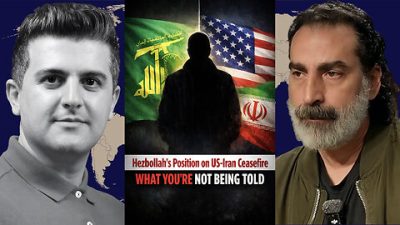
Laith Marouf: Hezbollah’s position on US-Iran ceasefire
or go to
Aletho News Archives – Video-Images
From the Archives
The Dirty Little Secret behind the “Global Terrorism Index”
The Omission of Israeli Terrorism in the Occupied Palestinian Territories
By Karin Brothers | Global Research | December 6, 2014
… The Israeli settlements — all of which are illegal – have been identified as a major impediment to peace. The refusal of a major “global” terrorism report to name the Israeli settlers as one of the groups most responsible for terrorism not only misrepresents a major source of regional violence but exposes the Global Terrorism Index as a propaganda tool that supports a U.S. agenda.
In recent years, governments have been attempting to thwart terrorism by blocking supportive fund-raising. When it comes to Israeli settlements, however, the US and Canada actually encourage fund-raising by giving organizations (such as Christian Friends of Israeli Communities (CFOIC) and the Jewish National Fund) financial support in the form of donor tax-deductions.
Charities which provide funds for the Israeli settlements should be regarded as terror-financing organizations. They should not only lose their tax-deductible status, but they should be banned because they support the violation of international humanitarian law. The terror-financing laws that are being strictly enforced for Muslim charities should be applied to Christian and Jewish charities as well. … Read full article
Blog Roll
 Aletho News
- The ‘Opposition Party’ Has Done Nothing to Stop the Iran War and Much to Goad Trump Into Continuing It
- Moscow backs Tehran on status of Lebanon in US-Iran deal
- How UK Regulator Ofcom Quietly Bypassed International Law to Police American Speech
- The Black Cube Files: How Former Mossad Operatives Flipped a Nation
- Laith Marouf: Hezbollah’s position on US-Iran ceasefire: What you’re not being told
- Israel’s priority lies in destroying chances of peace between Iran, US: Ex-UN nuclear chief
- Ceasefire for all or for none: Iran shuts Hormuz over Lebanon attacks
- Strait of Hormuz is Iran’s ‘nuclear weapon’ that forced US retreat: Medvedev
- Energy crisis will last for months – Kremlin envoy
- Europe’s quiet role in the war on Iran
- If Americans Knew
- This is ceasefire? Israel’s biggest massacre yet in Lebanon, another journalist killed in Gaza – Daily Update
- Tucker Carlson on Israel: This Is the Behavior of an Ally? Really?
- Gazans face a triple crisis: severe shortages of water and bread, healthcare in tatters
- NY Times reports how Netanyahu took the US into Iran War
- A sigh of relief over Iran, but Gaza and Lebanon in dire straits – Daily Update
- Thousands dead and neighborhoods razed to the ground: Aid agencies fear southern Lebanon is becoming the new Gaza
- The war the US is fighting for Israel could cost trillions
- ‘Cigarette Burns, Nail Wounds’: Toddler Tortured in Gaza to Coerce Father
- Trump Says US Sent ‘a Lot of Guns’ to Protesters in Iran
- Israeli forces destroy 17 UN peacekeeper cameras in south Lebanon
- No Tricks Zone
- An Inconvenient Tree: Uncovered In Alps… Europe Much Warmer Than Today 6000 Years Ago
- New Study Reports A 60% Slowdown In Greenland’s Ice Loss Rate In The Last Decade
- Low Intensity Tornado Wrecks Major Solar Farm, Creating A Potential Toxic Dump
- New Study Finds Warming Saves Lives…Cold Temperatures 12 Times More Deadly Than Excess Heat
- German Science Blog Accuses PIK Climate Institute Of Hallucinating Climate Tipping Points
- Devastating Assessment Of Comirnaty Vaccine By Former Senior Pfizer Europe Toxicologist
- New Study: CO2 Is ‘Effectively Negligible’ As An Explanatory Climate Change Factor Since 2000
- Former Pfizer Toxicologist Dr. Helmut Sterz Tells Bundestag Hearing Pfizer Vaccine Should Have Never Been Approved
- Energy Expert: Germany’s Nuclear Phaseout Was A “500 Billion Euro Mistake”
- New Research: South Australia’s Mid-Holocene Sea Surface Temperatures Were 4°C Warmer Than Today
 Aletho News