Lies about China’s Uyghur Oppression
Tales of the American Empire | February 29, 2024
Americans see news reports about the plight of Uyghurs. They are told these Muslims living in the western China province of Xinjiang are abused by the ruling Han Chinese and over a million are imprisoned in camps where they are forced to perform slave labor. As a result, China must be constantly denounced for this abuse and sanctions imposed on any Chinese business exploiting this slave labor. This is false and based on lies promoted by the American CIA.
Note: We are told to pronounce Uyghur as “WEE-gur” even though it has no W. In the province of Xinjiang and in their language it is pronounced “OO-gur” and should be in English since it starts with a U! So I adopted Dr. de Zayas’ correct pronunciation to reject whoever decided we should call them something weird in English.
___________________________________________________
“I Saw ZERO Evidence of Uyghur Repression In China”; Jimmy Dore Show; YouTube; September 30, 2023;  • “I Saw ZERO Evidence Of Uyghur Repres…
“What’s it REALLY like to travel in Xinjiang, China?”; Cyrus Janssen; YouTube; May 1, 2021; • What’s it REALLY like to travel in Xi…
“No, the UN did not report China has ‘massive internment camps’ for Uighur Muslims”; Ben Norton; The Grayzone; August 23, 2018; https://thegrayzone.com/2018/08/23/un…
“Was There Really a Massacre in Tiananmen Square–or Was It an Illusion Fabricated by U.S. Politicians and Corporate Media to Make Americans Hate China?”; Jeremy Kuzmarov; Covert Action Magazine; August 7, 2023; https://covertactionmagazine.com/2023…
“US efforts to strangle China & reassert hegemony”; The Duran; YouTube; September 16, 2023; https://theduran.com/us-efforts-to-st…
Related Tales: “The American War on China”: • The American War on China
By making war threats against China, Ukraine proves to be US vassal state
By Lucas Leiroz | February 27, 2024
The statement was made by deputy Aleksey Goncharenko during an interview with CNN on February 23. On the occasion, Goncharenko emphasized calls for the US to continue sending military aid, criticizing American politicians who are focused only on domestic issues and ignoring Ukraine. According to him, the US needs to “fulfill the promises” made to Kiev about permanent military support.
The legislator’s words, however, were not just about demands from the US. He also made it clear that his country is willing to cooperate militarily with the US in a broad and unrestricted manner – even willing to go to war with other states if Washington deems it necessary. In the interview, he stated that Kiev could fight directly against countries such as China, Iran and North Korea, with no fear regarding the consequences of a conflict of such scale. For him, Ukraine must be prepared to face any US adversary, showing “true friendship” between both countries.
“[If there’s a war, the US] will need people who will stand shoulder to shoulder with them (…) Ukrainians are ready… We are ready to stand with the United States shoulder-to-shoulder, either in trenches near Tehran, or in North Korea, or near Beijing. [There is] no difference (…) Because we appreciate your support,” he said during the interview.
Goncharenko also praised Ukraine’s combat potential, stating that Kiev has “the second strongest army in the free world” – after the US only. This alleged Ukrainian power is the reason why he considers Kiev a “valuable ally” of the US. Obviously, he did not show any data to prove this claim about his country’s military capacity. Kiev is currently severely weakened by the consequences of the conflict with Russia, definitely not being among the most powerful armies in the world.
As bold and controversial as Goncharenko’s statements are, they do not sound surprising considering the parliamentarian’s personal history. He is known for his unrealistic and bellicose positions. For example, he had previously made a declaration saying that Kiev should receive nuclear weapons in order to guarantee its “national security”. According to him, NATO should give Ukraine weapons of mass destruction to prevent a new conflict with Russia from happening in the future. In other words, instead of providing security guarantees to Moscow to prevent war, Goncharenko simply prefers to escalate tensions and create a scenario of possible nuclear confrontation.
“Once again I will say directly and openly: I support the return of nuclear weapons to Ukraine. And I believe that this is our only option for survival,” he said at the time.
In fact, extremist and bellicose statements have become commonplace in Ukraine. However, it is notorious how the regime’s officials no longer even disguise Kiev’s subservience to American interests. By stating that Ukraine is ready for war with China, Iran and North Korea, Goncharenko is not only threatening these countries, but also making it clear that Ukraine is willing to do whatever the US tells it to do, regardless of the national interests and well-being of the Ukrainian people.
Goncharenko is showing that his country is a vassal state, without sovereignty or decision-making power, being completely submissive to the American political will. In practice, this means that the Ukrainian people will never be safe under the Kiev regime, since at any time Ukrainian citizens could be sent to battlefields around the world to defend American interests. Indeed, Goncharenko is proving that the Kiev Junta sees the Ukrainians as mere NATO cannon fodder.
The deputy’s threats are especially controversial at a time when the US is in fact close to engaging in a real conflict situation with the multipolar powers. The crisis in the Middle East could lead to a war between the US and Iran, just as growing tensions in the Pacific could culminate in a military confrontation between Washington and Beijing – or Pyongyang. The possibility of such wars actually occurring makes Goncharenko’s threats a real problem, with the countries he mentioned in the interview having sufficient reasons to be cautious and take measures such as military preparation.
In addition to threatening other nations and demoralizing his own country, Goncharenko is also making Ukraine diplomatically isolated by proving the bellicosity of the neo-Nazi regime.
Lucas Leiroz, journalist, researcher at the Center for Geostrategic Studies, geopolitical consultant.
You can follow Lucas on X (former Twitter) and Telegram.
China lashes out at latest Russia sanctions
RT | February 26, 2024
Beijing firmly opposes restrictions placed on its companies as part of the latest sanctions imposed on Moscow by Western countries, the Chinese Commerce Ministry said on Monday.
The US announced a new batch of sanctions against Russia on Friday, ahead of the second anniversary of the Ukraine conflict. The measures include trade curbs which target 63 entities from Russia, and 30 companies from China, Türkiye, the UAE, Kyrgyzstan, India, and South Korea for allegedly supporting Russia’s military operation in Ukraine.
According to the statement published on the Chinese Commerce Ministry’s official website, Washington’s new measures “damage the security and stability of global industrial and supply chains.”
“The US approach is a typical example of unilateral sanctions, ‘long-arm jurisdiction’ and economic coercion, which undermines international economic and trade rules and order. China is firmly opposed to this,” the ministry said, adding that Beijing will take steps to “safeguard the legitimate rights and interests of Chinese enterprises.”
In a separate statement, the ministry commented on the latest sanctions imposed by the EU and UK, warning that they would also have a “negative impact” on global economic and trade ties. Brussels came up with its own Russia-linked sanctions package last week, which included restrictions on four Chinese companies, while the UK sanctioned three Chinese electronics firms.
The sanctions targeting non-Russian entities are designed to prevent companies around the world from aiding Moscow in circumventing Western restrictions adopted in previous packages. Moscow has criticized the sanctions policy as a whole, while noting that they have failed to destabilize the Russian economy, and have instead backfired on the countries that imposed them.
According to the latest official figures, Russia’s GDP expanded by 3.6% in 2023, outpacing both the US and EU. The sanctions have resulted in the country reorienting most of its trade to Asia, while many Western states have lost access to cheap Russian energy, facing soaring inflation and cost-of-living crises as a result.
Ukraine ready for war with China – top MP
Kiev is a “valuable ally” of Washington, Aleksey Goncharenko said while demanding more funding
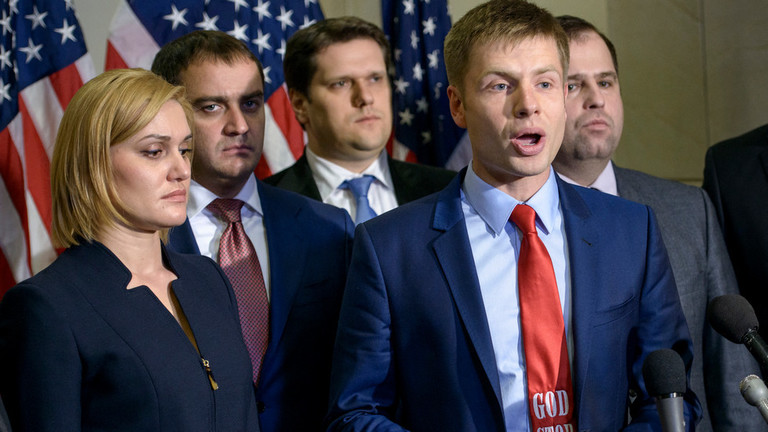
Ukrainian lawmaker Aleksey Goncharenko at a press conference on Capitol Hill on February 5, 2015 in Washington, DC. © AFP PHOTO/BRENDAN SMIALOWSKI
RT | February 24, 2024
Kiev is ready to assist the US in a war against any enemy, be it Iran, North Korea, or China, a senior Ukrainian MP has said, claiming that his country would prove to be a valuable military ally.
In an interview with CNN’s Christiane Amanpour on Friday, Aleksey Goncharenko doubled down on calls for the US to send Ukraine more military aid amid gridlock in Congress. “[The] United States of America told [us that] we will be with you ‘as long as it takes.’ Now it’s time to keep the promises.”
Goncharenko rebuked US politicians for focusing too much on the looming 2024 presidential election, saying Ukraine should not be a “victim” of this. He also claimed that supporting Ukraine serves Washington’s interests regardless of who wins the race for the White House.
In the event of a future war, the Americans “will need people who will stand shoulder to shoulder with them,” but not many nations would be willing to go all-in to support the US, the lawmaker said.
”Ukrainians are ready… We are ready to stand with the United States shoulder-to-shoulder, either in trenches near Tehran, or in North Korea, or near Beijing. No difference,” he stated. “Because we appreciate your support.”
Despite his plea for more Western military aid, Goncharenko argued that Ukraine has “the second strongest army in the free world” after the US, making it “a very valuable ally.”
“But today we need your support to defend our country,” he added, blaming gaps and delays in arms shipments for the loss of the strategic Donbass city of Avdeevka last week. According to the Russian Defense Ministry, the Ukrainian retreat from the heavily fortified city, which was often used as a launching pad to target civilians in Donetsk, turned into a disorganized rout with heavy casualties.
Russian President Vladimir Putin said on Tuesday that the capture of Avdeevka is “certainly a success,” adding that it needs to be advanced further.
Last year, Putin claimed that the Ukrainian government was defending the interests of other countries rather than its own, and that the West was using Kiev as “a battering ram” and a “testing ground” against Russia.
China backs Palestinians’ right to ‘armed struggle’ against Israeli occupation
The Cradle | February 22, 2024
China expressed support for the right of Palestinians to engage in “armed struggle” against Israel, stressing this is not “terrorism” during the fourth day of hearings at the International Court of Justice (ICJ) in a case against Israel’s illegal occupation of Palestinian territories.
“In pursuit of the right to self-determination [the Palestinian people have the right to the] use of force to resist foreign oppression and to complete the establishment of the Palestinian state,” Ma Xinmin, a Chinese Foreign Ministry legal adviser, told the World Court on 22 February.
Citing examples of “various people [who] freed themselves from colonial rule” through armed resistance, Xinmin argued that acts of resistance against the Israeli occupation are “not terrorism” but a legitimate armed struggle and an “inalienable right.”
“Numerous other resolutions recognize the legitimacy of struggle by all available means, including armed struggle by people under colonial domination or foreign occupation to realize the right of self-determination,” the Chinese official said.
“Chinese President Xi Jinping has stressed on multiple occasions that China calls for a comprehensive ceasefire and the early solution to the question of Palestine on the basis of a two-state solution through negotiation,” he added.
Xinmin took to the podium ahead of Iran’s Deputy Foreign Minister for Legal and International Affairs, Reza Najafi, who highlighted Israel’s historic violations of Palestinians’ right to self-determination.
“The establishment of the Israeli regime was done through a violent process which involved the forcible displacement of native Palestinian people to create a majority Jewish colony in line with the Zionist movement,” Najafi said.
He also listed a series of ongoing violations by Tel Aviv, which include the prolonged occupation and manipulation of the demographic composition in the occupied Palestinian territories, the alteration of the character and status of Jerusalem, and the discriminatory measures and violations of the rights of Palestinian people to permanent sovereignty over their natural resources.
“The expansion of settlements, segregated roads and barriers as well as checkpoints has created a system of apartheid which is isolating Palestinian communities,” Najafi added before addressing the UN Security Council (UNSC) for their “inaction or insufficient action,” saying this was one of the “main causes of prolonged occupation of the Palestinians” and highlighting that the top UN body is “paralyzed due to the stalemate” caused by a “certain permanent member.”
“All the atrocities and crimes committed by the Israeli regime in the past almost eight years are a consequence of such inaction,” the Iranian official concluded.
The Iraqi representative to the ICJ, Hayder Shiya al-Barrak, took to the podium next and called on the ICJ to respect previous court orders against Israel, such as the provisions made after South Africa’s case to “stop the systematic killing machine against the Palestinian people.”
“We hope that the court’s commitment to justice will lead to additional decisions … affirming its dedication to ending the campaign of mass murder and preventing acts of genocide as well as policies of harassment, blockade, and starvation against the Palestinian people,” he said.
Barrak concluded his intervention by calling on the World Court to take decisions “that safeguard the lives of the Palestinian man, women, children, and elders, allowing them to enjoy a dignified and secure life where all human rights are achieved.”
China tells Ukraine it ‘does not sell lethal weapons’ to conflicting sides
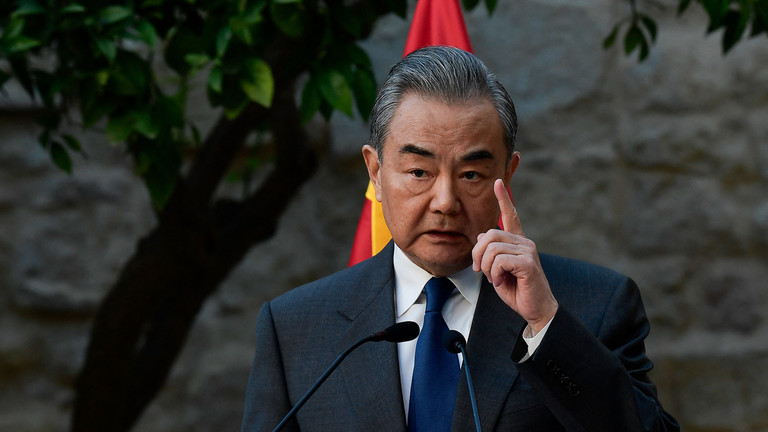
RT | February 20, 2024
The Chinese foreign minister has told his Ukrainian counterpart that Beijing remains neutral in the Russia-Ukraine conflict, and will not sell weapons to either side. Wang Yi and Dmitry Kuleba met at the 60th Munich Security Conference on Saturday.
The talks were the first high-level encounter between Beijing and Kiev since Ukrainian President Vladimir Zelensky proposed a meeting with Chinese Premier Li Qiang at the World Economic Forum in Davos in January – a request that was reportedly rejected.
Wang Yi told Kuleba that China will not “add fuel to the fire,” seek to profit from the fighting, or “sell lethal weapons in conflict zones,” according to a readout from the Foreign Ministry. “Even if there is only a glimmer of hope for peace, China will not give up its efforts,” Wang Yi added.
In 2022 the US imposed sanctions on several businesses in China that Washington accused of helping the Russian military. China has refuted US claims that it was considering arming Russia. Ukraine has long been seeking China’s support for a 10-point peace plan, proposed by Zelensky last November, which Russian Foreign Ministry spokeswoman Maria Zakharova has dismissed as “a senseless ultimatum to Russia, aimed at protracting hostilities.” The plan includes the restoration of Ukraine’s 1991 borders.
Since the outbreak of the conflict in February 2022, China has consistently called for a political resolution, and proposed a peace plan of its own last year, demanding a ceasefire and talks. Russian President Vladimir Putin has said the peace initiative presented by China could be taken as a basis for a settlement with Ukraine.
Beijing has resisted Western pressure to impose sanctions on Moscow, while boosting economic cooperation with Russia. Chinese customs data shows that bilateral trade grew 26.6% last year, reaching a record $240 billion.
China demands US lift ‘illegal unilateral sanctions’
RT | February 17, 2024
Chinese Foreign Minister Wang Yi urged US Secretary of State Antony Blinken to remove sanctions on the country’s businesses when the two met on the sidelines of the 60th Munich Security Conference on Friday.
The meeting is the latest in a series of highest-level talks since US President Joe Biden and Chinese President Xi Jinping met in November of last year. Shortly after their summit, the US leader caused outrage in China when he stated that he stood by an earlier comment labeling his Chinese counterpart a “dictator” in response to a question by a journalist.
The two countries ended 2023 with an uneasy detente after a year that brought American panic over alleged Chinese spy balloons, and US tech sanctions that restricted China’s access to advanced chip-making tools and artificial intelligence processors. The two nations have also been locked in a growing military rivalry.
Wang said that pursuing the aim of “decoupling from China” will eventually backfire on the US, as cited by the Chinese Foreign Ministry’s press service. He called on Washington to lift the “illegal unilateral sanctions” against Chinese companies and individuals and not to undermine China’s legitimate right to develop.
Most of the recent sanctions against China were imposed in 2018, when the administration of then-President Donald Trump banned US agencies from using equipment and services from Chinese telecoms giant Huawei, fearing that the company was facilitating espionage.
Tensions escalated further in October 2022, when the Biden administration announced new limits on the sale of semiconductor technology to China, a step aimed at blocking Beijing’s access to critical technologies.
While speaking to his Chinese counterpart on Friday, Blinken raised concerns about China’s alleged support for Russia’s military industrial base. In 2022, the US imposed sanctions against several businesses in China for what Washington claims was aid provided to the Russian military amid the Ukraine conflict.
China has repeatedly denied US claims that it is considering arming Russia. Since the outbreak of the conflict between Russia and Ukraine in February 2022, China has consistently called for a peaceful resolution to the crisis. Beijing has also stood up to Western pressure to join sanctions on Moscow, while instead boosting economic cooperation with Russia. Chinese customs data shows that trade turnover between the two countries has grown by 26.6% percent in the past year, reaching a record $240 billion.
Beijing reacts to claim EU will target Chinese firms with Russia sanctions
RT | February 14, 2024
Beijing rejects “illegal sanctions” and will defend the interests of its companies, the Chinese Foreign Ministry has said following a report that the EU could blacklist some of the country’s firms for allegedly helping Russia to evade the bloc’s restrictions.
The EU is planning to place restrictions on three Chinese businesses and one Indian company as part of its 13th round of sanctions on Russia over its conflict with Ukraine, the Financial Times reported on Monday.
Brussels believes the firms in question are helping Moscow to circumvent existing restrictions, especially through the supply of electronic components that can be repurposed for use in drones and other weapons systems. If the plan is approved by member states, it will see the EU sanction companies from mainland China and India – two of the bloc’s key trading partners – for the first time.
”We are aware of the relevant reports,” the Chinese Foreign Ministry said in a statement on Tuesday. “China firmly opposes illegal sanctions or ‘long-arm jurisdiction’ against China on the grounds of cooperation between China and Russia.”
Chinese and Russian companies “carry out normal exchanges and cooperation and do not target third parties, nor should they be interfered with or influenced by third parties,” the ministry said.
Beijing “will take necessary measures to resolutely safeguard the legitimate rights and interests of Chinese enterprises.”
According to media reports, the EU was already considering sanctioning Chinese firms over their links with Russia last year, but refrained from doing so after Beijing assured Brussels that it was not supporting Moscow’s military effort in Ukraine.
Indian newspaper the Economic Times claimed on Wednesday that the government in New Delhi was also studying reports that an Indian firm could face sanctions over its dealings with Russia.
The Indian authorities may ask senior EU officials to clarify the situation during their meetings as part of the Raisina Dialogue forum on geopolitics and economy, which will take place in New Delhi next week, according to the outlet.
The paper’s source said it was “curious” that the report had emerged ahead of the high-profile event in the Indian capital.
Since the outbreak of the conflict between Russia and Ukraine in February 2022, both China and India have consistently called for a peaceful resolution of the crisis. Beijing and New Delhi have resisted Western pressure to join sanctions on Moscow, and instead have boosted economic cooperation with Russia, becoming the main destinations for Russian oil.
Chinese customs data shows that trade turnover between the two countries has grown by 26.6% percent in the past year, reaching a record $240 billion. The sales volume between Russia and India in the first ten months of 2023 stood at almost $55 billion, according to the Russian ambassador in New Delhi – an increase of 41% compared to 2022.
Biden vs Trump has profound implications for the world order
By Glenn Diesen | RT | February 8, 2024
The world is watching the US presidential election closely as it will have significant implications for global governance. President Joe Biden and former leader Donald Trump have very different views on how the world order should be governed and how the US should respond to its relative decline.
Biden wants to restore unipolarity with ideological economic and military blocs, strengthening the loyalty of allies and marginalizing adversaries. Trump has a more pragmatic approach. He believes the alliance system is too costly and limits diplomatic room for maneuver.
Since World War II, the US has enjoyed a privileged position in the key institutions of global governance. The Bretton Woods format and NATO ensured its economic and military dominance within the West. After the collapse of the Soviet Union, the Americans sought to extend their liberal hegemony around the globe.
They developed a security strategy based on global superiority and an expanded NATO. Washington assumed that its dominance would mitigate international anarchy and great power rivalry, and that liberal trade agreements would strengthen the US’ position at the top of global value chains. The replacement of international law with a ‘rules-based international order’ – in effect, sovereign inequality – was supposed to promote American hegemony and enhance the role of liberal democratic values.
However, unipolarity has proven to be a temporary phenomenon because it depends on the absence of rivals and values are devalued as instruments of power politics. The US has predictably exhausted its resources and the legitimacy of its hegemony, and competing powers have collectively counterbalanced Washington’s hegemonic ambitions by diversifying economic relations, staging retaliatory military operations, and developing new regional institutions of global governance.
The Cold War was a unique period in history because the West’s communist adversaries were largely disconnected from international markets, and military confrontation strengthened alliance solidarity to the extent that it mitigated economic rivalry between the capitalist allies. After the Cold War, however, the former communist powers, China and Russia, gained experience in managing economic processes, and submission to the US-led economic path lost its value for them.
The system of alliances has also begun to decline. The US previously was willing to subsidize European security in exchange for political influence. But Washington shifted its strategic focus to Asia, demanding that its European allies show geo-economic loyalty and not develop independent economic relations with rivals China and Russia. Meanwhile, the Europeans sought to use collective bargaining mechanisms through the European Union to establish autonomy and an equal partnership with the United States.
It is now clear that the unipolar moment has come to an end. The US military, exhausted by failed wars against weak opponents, is preparing for a conflict against Russia and China and a regional war in the Middle East.
The ‘rules-based international order’ is openly rejected by other major powers. US economic coercion to prevent the emergence of new centers of power only encourages separation from US technology, industry, transport corridors, banks, payment systems, and the dollar.
The US economy is struggling with unsustainable debt and inflation, while socio-economic decline is fueling political polarization and instability. Against this backdrop, Americans could elect a new president who will seek fresh solutions for global governance.
Biden’s global governance: Ideology and bloc politics
Biden wants to restore US global dominance by reviving the Cold War system of alliances that divided the world into dependent allies and weakened adversaries. It pits Europe against Russia, Arab states against Iran, India against China, and so on. Inclusive international institutions of global governance are being weakened and replaced by confrontational economic and military blocs.
Biden’s bloc politics is legitimized by simplistic heuristics. The complexity of the world is reduced to an ideological struggle between liberal democracies and authoritarian states. Ideological rhetoric means demanding geo-economic loyalty from the ‘free world’ while promoting overly aggressive and undiplomatic language. Thus, Vladimir Putin and Xi Jinping are smeared as ‘dictators’.
Multilateralism is welcome to the extent that it reinforces US leadership. Biden is less hostile to the UN and the EU than his predecessor, and under his administration, the US has rejoined the World Health Organization and the Paris climate agreement. But Biden has not revisited the Iran nuclear deal or reduced economic pressure on China to change its supply chains. The institutions that could constrain the US – the International Criminal Court (ICC) and the International Court of Justice (ICJ) – are not favored by either Biden or Trump.
The deteriorating socio-economic and political situation in the US will also affect Biden’s approach to global governance. Biden will remain reluctant to enter into new ambitious trade agreements as the losers of globalization and neo-liberal economics within the US move into the camp of the populist opposition. Nor will he favor free trade agreements in areas where China has a technological and industrial advantage, and his attempts to cut European states off from Russian energy and Chinese technology will further fragment the world into competing economic blocs.
Western Europe will continue to weaken and become more dependent on the US, to the point where it will have to give up any claim to ‘strategic autonomy’ and ‘European sovereignty’.
Biden has also shown a willingness to disrupt allied country’s industries through initiatives such as the US Inflation Reduction Act.
Trump’s global governance: ‘America First’ and great power pragmatism
Trump seeks to restore American greatness by reducing the costs of alliance systems and hegemony. He sees alliances against strategic rivals as undesirable if they involve a transfer of relative economic power to allies. Trump believes that NATO is an “obsolete” relic of the Cold War because Western Europeans should contribute more to their own security. In his view, the US should perhaps reduce its presence in the Middle East and allies should pay America for their security in some way. Economic agreements such as the North American Free Trade Agreement and the Trans-Pacific Partnership would have promoted US leadership, but under Trump, they have been abandoned because of the transfer of economic benefits to allies. Trump does not reject US imperialism, but wants to make it sustainable by ensuring a higher return on investment.
Less tied to the alliance system and unencumbered by ideological dogma, Trump can take a more pragmatic approach to other great powers. Trump is able to make political deals with adversaries, use friendly and diplomatic language when talking to Putin and Xi, and even perhaps make a diplomatic visit to North Korea. While Biden’s division of the world into liberal democracies and authoritarian states makes Russia an adversary, Trump’s view of the world as nationalists/patriots versus cosmopolitans/globalists makes Russia a potential ally. This ideological view complements the pragmatic consideration of not pushing Russia into the arms of China, the main rival of the US.
Global governance will be utilitarian in this case, and the main goal of the US will be to regain a competitive advantage over China. Trump is fundamentally inclined to blame China excessively for America’s economic problems. Economic pressure on China is intended to restore US technological/industrial dominance and protect domestic jobs. Economic nationalist ideas reflect the ideas of the 19th-century American system, where economic policy is based on fair trade rather than free trade. Trump appears to view the entire post-Cold War security system in Europe as a costly attempt to subsidize Western Europe’s declining importance. These same Europeans have antagonized Russia and pushed it into the arms of China. Trump’s unclear stance on NATO has even prompted Congress to pass a bill prohibiting presidents from unilaterally deciding whether to withdraw the US from NATO.
While Trump is in favor of improving relations with Russia, his presidency would be unlikely to achieve this goal.
The US can be seen as an irrational actor to the extent that it allows domestic political battles to influence its foreign policy. In 2016, Hillary Clinton’s campaign staff fabricated the Steele dossier and Russiagate to portray Trump as a Kremlin agent. In the 2020 election, Biden’s campaign staff attempted to portray the Hunter Biden laptop scandal as a Russian disinformation campaign and accused Russia of paying bribes to kill US troops in Afghanistan. These false accusations were designed to distract the public and make Trump look weak on Russia. All of this ultimately soured relations with Russia and even contributed to the current conflict in Ukraine.
Both Biden and Trump seek to reverse the relative decline of the US in the world, but the difference in their approaches will have a profound impact on global governance. While Biden seeks to restore US greatness through systems of ideological alliances that will fragment global governance into regional blocs, Trump will seek to withdraw from the institutions of global governance because they drain US resources and impede pragmatic policies.
Glenn Diesen is a Professor at the University of South-Eastern Norway and an editor at the Russia in Global Affairs journal.
Bret Weinstein Goes out to Lunch with Tucker: The Chinese Boogeyman Strikes Again
Matt Ehret’s Insights | February 6, 2024
Throughout the past week, I received dozens of requests to share my thoughts on Bret Weinstein’s recent appearance on Tucker Carlson where the intrepid biologist sounds the alarm like a latter day Paul Revere on the dangerous Chinese Communist conspiracy to destroy America by directing mass immigrants to flood the Texas border, unleash new bioweapons and BRI the west to death… The full interview can be viewed here:
I respect Bret and his Dark Horse podcast was a useful platform for sifting through medical lies throughout the past few years, so I didn’t want to think that Bret could possibly engage in sloppy Cold Warrior fear-mongering, so I put it off. This is the sort of thing I have come to expect out of figures like Robert Malone, Tucker, Ezra Levant, intel chiefs running the CIA, NSA, FBI or CSIS… but certainly Bret couldn’t have jumped on that bandwagon too… or could he?
Well, after finally watching the interview, I am sad to say that’s exactly what he did.
What I can say with full honesty is that this is an asinine assessment that builds conjecture upon conjecture without ever proving anything, using the ancient art of office gossip. But Bret is a scientist so his gossip is supposed to be really high quality I guess and in no way connected to the sort of gossip circulated by the Five Eyes which is obviously not to be trusted.
Some of Bret’s claims:
1) China is bad because they resisted the pressure to allow mRNA jabs into their country… This of course proves that they will be safe from the next bioweapon they will also release onto the world! (And you thought a nation resisting Pfizer and the WHO pressure to mRNA their people was a good thing… You fool.)
2) China wants to undermine the USA by building BRI connected infrastructure in Latin America (and American satraps like the canary islands where the USA never allowed any infrastructure)… is evidence that they want to destroy the USA. Think no more deeply on this or assume any other possible motive of why China is building infrastructure.
3- The existence of chinese young men who are laborers in central and south america is obviously evidence that China is directing all the immigrants into the USA and possibly also flooding Chinese soldiers into the USA as part of Biden’s new CPC secret army waiting to be let loose onto our freedom loving Patriots!
And you thought that Chinese construction workers were just in Latin America to build the billions of dollars worth of infrastructure projects which Latin American nations need to deal with poverty caused by western colonialism. Nope! it’s actually CPC elite mercenaries out to take your freedoms. If you listen to Gordon Chang on Fox News, you might also believe these alleged elite soldiers are blood drinking vampires.
In his chat with Tucker, Bret Weinstein even explains how the Chinese communist party even made a “how to’ video cartoon for what appears to be 12 year old Chinese Mercs wanting to subvert America which Bret has intrepidly discovered (but admits hasn’t translated or even knows where it came from).
….
What kills me is how many times Bret has to say things like “I have no idea how the world works… but isn’t this suspicious?” Or “I have no way of proving this but… isn’t this suspicious”… It’s a gossipy slimy way of speaking.
Since the anti China psyops will only continue to accelerate full throttle as Americans fall into greater states of fear, and as our Five Eyes intelligence agencies, George Soros and anti-Great Reset conservatives will increasingly sound like the same voice in regards to China, it’s probably a good idea to do as much research into these psyops as possible. This means coming to better understand what is China, how China kicked out George Soros, and how were we played throughout the Cold War by the same forces who killed JFK, launched the Vietnam War, carried out Iran Contra, created Al Qaeda, arranged 9/11, Anthrax attacks and oversaw the growth of the largest bioweapons complex in world history.
And no, I’m not talking about China.
So take advantage of the following resources which Cynthia and I have compiled to sharpen your mind’s edge, and avoid letting your brain turn into Cold Warrior gelatin.
Breaking Free of Anti-China Psyops Vol ONE: How the Cold War is Being Revived and What you can do about (80 pgs) (we are making this one free for now, so download that PDF by clicking the above link)
Breaking Free of Anti-China Psyops Vol TWO: Know Your Enemy
VIDEO: China Russia or Something Else: Who is our Real Enemy?
VIDEO: Chinese Secret Police Stations: Fact or Fiction?
VIDEO: Chinese Election Interference: Five Eyes, CSIS and the Ugly Truth of NATO
VIDEO: How China Banned Soros in 1989
VIDEO: The Tiananmen Square Hoax: Massacre or Failed Color Revolution?
VIDEO: Is China a Friend or Enemy of the New World Order?

Featured Video
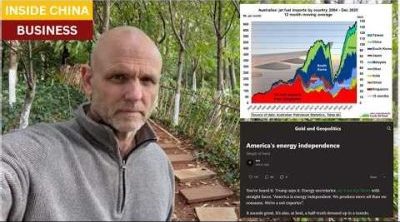
Chinese jet fuel and the myth of energy independence
or go to
Aletho News Archives – Video-Images
From the Archives
The Dirty Little Secret behind the “Global Terrorism Index”
The Omission of Israeli Terrorism in the Occupied Palestinian Territories
By Karin Brothers | Global Research | December 6, 2014
… The Israeli settlements — all of which are illegal – have been identified as a major impediment to peace. The refusal of a major “global” terrorism report to name the Israeli settlers as one of the groups most responsible for terrorism not only misrepresents a major source of regional violence but exposes the Global Terrorism Index as a propaganda tool that supports a U.S. agenda.
In recent years, governments have been attempting to thwart terrorism by blocking supportive fund-raising. When it comes to Israeli settlements, however, the US and Canada actually encourage fund-raising by giving organizations (such as Christian Friends of Israeli Communities (CFOIC) and the Jewish National Fund) financial support in the form of donor tax-deductions.
Charities which provide funds for the Israeli settlements should be regarded as terror-financing organizations. They should not only lose their tax-deductible status, but they should be banned because they support the violation of international humanitarian law. The terror-financing laws that are being strictly enforced for Muslim charities should be applied to Christian and Jewish charities as well. … Read full article
Blog Roll
 Aletho News
- Chinese jet fuel and the myth of energy independence
- Ukraine Sea Drone Fired From Libya Hit Russian Tanker in Mediterranean
- IRGC: Iranian forces launched no attacks during ceasefire hours
- Trump Administration Moves To Automate U.S. Military Draft Registration
- Spain orders reopening of Tehran embassy, condemns Israel’s carpet bombing of Lebanon
- Israel faces ‘unsustainable’ strategic crisis following 40-day war against Iran: Analyst
- Iran restricts Hormuz access to 15 vessels per day under ceasefire terms: Report
- The ‘Opposition Party’ Has Done Nothing to Stop the Iran War and Much to Goad Trump Into Continuing It
- Moscow backs Tehran on status of Lebanon in US-Iran deal
- How UK Regulator Ofcom Quietly Bypassed International Law to Police American Speech
- If Americans Knew
- Amnesty: Urgent – Protect Lebanese civilians from brutal escalation in Israeli attacks
- Is The War Against Iran Over?
- Inside the Israeli army’s propaganda wing
- Hundreds of Gaza Amputees Stranded in Legal Limbo
- The gallows law: Israel moves toward executing Palestinian children
- Tucker Carlson: The Path to Peace requires ending ‘special alliance’ with Israel
- This is ceasefire? Israel’s biggest massacre yet in Lebanon, another journalist killed in Gaza – Daily Update
- Tucker Carlson on Israel: This Is the Behavior of an Ally? Really?
- Gazans face a triple crisis: severe shortages of water and bread, healthcare in tatters
- NY Times reports how Netanyahu took the US into Iran War
- No Tricks Zone
- An Inconvenient Tree: Uncovered In Alps… Europe Much Warmer Than Today 6000 Years Ago
- New Study Reports A 60% Slowdown In Greenland’s Ice Loss Rate In The Last Decade
- Low Intensity Tornado Wrecks Major Solar Farm, Creating A Potential Toxic Dump
- New Study Finds Warming Saves Lives…Cold Temperatures 12 Times More Deadly Than Excess Heat
- German Science Blog Accuses PIK Climate Institute Of Hallucinating Climate Tipping Points
- Devastating Assessment Of Comirnaty Vaccine By Former Senior Pfizer Europe Toxicologist
- New Study: CO2 Is ‘Effectively Negligible’ As An Explanatory Climate Change Factor Since 2000
- Former Pfizer Toxicologist Dr. Helmut Sterz Tells Bundestag Hearing Pfizer Vaccine Should Have Never Been Approved
- Energy Expert: Germany’s Nuclear Phaseout Was A “500 Billion Euro Mistake”
- New Research: South Australia’s Mid-Holocene Sea Surface Temperatures Were 4°C Warmer Than Today
 Aletho News