Why China’s ‘repressed’ Muslims suddenly got dragged back into the light
By Timur Fomenko | RT | November 24, 2023
At the beginning of this week, foreign ministers from a group of Muslim-majority countries, including Saudi Arabia, Jordan, Egypt, the Palestinian National Authority, and Indonesia travelled to China in order to seek support for a ceasefire in the ongoing Gaza war.
The unconditional backing of Israel by the United States and its allies has tanked their credibility across the Islamic world, and Beijing has positioned itself as an advocate of peace when others are not willing to take up that role.
It is curious that within the following few days, a report was released by Human Rights Watch, accusing China of expanding its alleged campaign of closing down and repurposing mosques into regions other than Xinjiang – which had so far been the focus of accusations that Beijing is cracking down on the predominantly Muslim Uyghur minority. Even those allegations had been somewhat on the backburner in the establishment media lately, but the HRW report was quickly picked up and amplified.
Although relations between the US and China have somewhat calmed down, it is obvious that Washington does not want to see Beijing increase its influence in the Muslim world, as that would inevitably come at the expense of American clout. The attempt to draw attention back to China’s alleged repression of its Muslim population, while underreporting Israel’s devastating attack on the (also Muslim) population of Gaza, is an exercise in deflection and part of the ongoing narrative war between China and the US. Be it about Muslims or not, the Xinjiang issue has long been a key component of that struggle for influence.
The Uyghur minority has, since 2018, been a tool of “atrocity propaganda” used to wage public relations offensives against China. It is a means to an end, which often disappears and resurfaces in the media, coinciding with the ebb and flow of anti-Beijing rhetoric coming from the US administration or the State Department. This includes using it to turn public opinion against Beijing in selected countries, including allies, or to manufacture consent for policies aimed at supply chain shifts or “decoupling,” through the accusation of forced labor, especially in the fields of key agricultural goods, polysilicon and solar panels, or to attempt to embarrass China diplomatically at the UN, or to push for boycotting events such as the Winter Olympics.
This is an incredibly opportunistic attitude to something Beijing’s detractors claim is a “genocide.” Since late 2021, the Biden administration has largely ignored the issue and it has fallen off the international agenda, precisely because Washington had gotten the sanctions they wanted from it at the time. However, the Israel-Gaza conflict introduces a new dynamic whereby the US and its allies are dramatically losing face and credibility among Muslim nations because they are backing Israel unconditionally in the wholesale slaughter of Palestinians. From a geopolitical point of view, such a policy pathway is actually strategically disastrous because it alienates the entire Global South, serves as a beacon in projecting US hypocrisy and worse still, directly empowers China as a competitor.
So when you are faced with a situation whereby Beijing is gaining diplomatic capital over your own failures, what do you do? You desperately aim to deflect by trying to draw attention to another issue in the attempt to smear Beijing: Xinjiang and the Uyghurs. Now as it happens, Muslim countries mostly ignore US-led propaganda over the Xinjiang issue, because they see it for what it is and also share a common norm of respect for national sovereignty with Beijing, which is politically beneficial for them. The only Muslim nation who has ever made public comment about it is Türkiye, because Uyghurs are a Turkic ethnic group and the issues is viewed through the lens of Ankara’s Pan-Turk ideology. However, Turkish President Recep Tayyip Erdogan is still likely to ignore the issue, or only involve himself in it based on what he can gain.
On the other hand, the Gulf States, the key US allies in the Middle East, such as Saudi Arabia and the United Arab Emirates, support China’s position, and the Gaza issue is putting them under pressure regarding their relations with the US and the decision to normalize relations with Israel. So suddenly we are seeing a resurgence of Xinjiang material because the US, even if it cannot sway their governments, wants to kindle the anger of Muslim populations about another issue instead and diminish China’s credibility. Although this is less likely in Arab States, it could cause public opinion ruptures in key Asian Islamic countries such as Indonesia and Malaysia, where significant resources were placed by organizations such as the BBC in relaying Xinjiang-related content in their respective languages.
But the question is, will this campaign succeed? It might be worth remembering that Xinjiang is an artificially imposed issue pushed “top-down” by governments and the media, whereas Palestine is a grassroots issue pushing from the bottom up, aspects of which media and politicians endeavor to selectively ignore. China’s heavy-handed management of Uyghurs in Xinjiang is not really a genocide, and it will never rank on the same level of severity as the outright bombardment and mass killing of Palestinians, no matter how hard you try.
Russia: Lavrov hosts ministers from Arab, Muslim countries to discuss war on Gaza
MEMO | November 21, 2023
Russian Foreign Minister Sergey Lavrov is holding talks today in Moscow with his counterparts from Arab and Muslim-majority countries to discuss Israel’s genocidal war on the Gaza Strip.
Yesterday, spokesperson for the Russian Foreign Ministry, Maria Zakharova, announced that “A meeting of Russian Foreign Minister Lavrov with delegations from foreign ministries of a number of Arab League and OIC countries is scheduled to be held tomorrow in Moscow.”
“They will arrive in the Russian capital city in line with the decision made at the Riyadh summit to discuss the situation around the Gaza Strip,” she said.
The meeting of members of the Ministerial Committee formed out of the Arab-Islamic Summit consists of Jordan’s Deputy Prime Minister and Minister of Foreign Affairs and Expatriates Ayman Safadi, the foreign ministers of Egypt, Palestine and Indonesia and Secretary-General of the Organisation of Islamic Cooperation Hussein Ibrahim Taha.
Al Arabiya reports that Russia which has previously maintained close ties with the occupation state, has assumed “a cautiously pro-Palestinian position since the outbreak of war around Gaza, rebuking Israel for civilian casualties, and restating its long-standing support for a Palestinian state.”
Yesterday the delegation along with Saudi Foreign Minister Prince Faisal Bin Farhan held similar meetings in Beijing with China’s top diplomat Wang Yi where they called for an urgent ceasefire.
“The international community must act urgently, taking effective measures to prevent this tragedy from spreading. China firmly stands with justice and fairness in this conflict,” Wang told the visiting ministers in opening remarks ahead of talks.
Saudi’s Prince Faisal said:
The message is clear: the war must stop immediately, we must move to a ceasefire immediately, and relief materials and aid must enter immediately.
As of this month, China assumed the rotating presidency of the UN Security Council. In addition to meetings in Beijing and Moscow, the joint Arab-OIC delegation is looking to meet with officials representing the other three permanent members of the UN Security Council. It is hoped that they can exert pressure on Western states to reject Israel’s justification of “self-defence” for its genocidal actions against Palestinians.
China labels Canadian side ‘thief crying stop thief’ after media exposes rift between ‘two Michaels’
By Chen Qingqing and Wang Tianmi | Global Times | November 20, 2023
The Chinese Embassy in Canada said on Monday that Canadian side hyping up of so-called “arbitrary detention” of “two Michaels” is purely a case of a thief crying stop thief and it fully exposed Canada’s hypocrisy, after the Canadian media the Globe and Mail revealed that one of the two Canadians blamed his fellow inmate for sharing intelligence on North Korea with Canada and allied spy services.
One of the two Canadians jailed by China for nearly three years in a case that was at the heart of a diplomatic crisis is seeking a multimillion-dollar settlement from Ottawa, Canadian media reported, citing two sources. Michael Spavor alleged that he was detained because he unwittingly provided intelligence on North Korea to Canada and allied spy services.
He alleges that the deception was conducted by fellow Canadian prisoner Michael Kovrig, and it was intelligence work by the latter that led to both men’s incarceration by Chinese authorities, according to the Globe and Mail.
Two Canadians confessed their guilt for crimes they committed in China and were released on bail for medical reasons before they departed China by plane to Canada on September 24, 2021.
Spavor, who was sentenced in August, 2021 to 11 years in prison for espionage and illegal provision of China’s state secrets to foreign entities, was found to have taken photos and videos of Chinese military equipment on multiple occasions and illegally provided some of those photos to people outside China. He also had personal property of 50,000 yuan ($7,700) confiscated.
The photos and videos Spavor took during his time in China have been identified as second-tier state secrets.
Spavor was a key informant for Kovrig and provided him with information over a long period. Sources told the Global Times that from 2017 to 2018, Kovrig entered China using the forged identity of a businessman and had collected a large amount of information on China’s national security through his contacts in Beijing, Shanghai and Jilin in Northeast China.
However, Canada had repeatedly denied that the two Canadians were involved in espionage, insisting that the “arbitrary detention” of the two Canadians was in retaliation for the arrest of Meng Wanzhou, a senior Huawei executive, in Canada in 2018.
Confidential negotiations are taking place between Toronto lawyer John K. Phillips, who is representing Spavor, and Patrick Hill, executive director and senior counsel at the federal Department of Justice and Global Affairs Canada, the Globe and Mail reported, citing unnamed sources.
Phillips is alleging that his client was arrested by China because of information that he shared with Kovrig. That information, he alleges, was later passed on, unbeknownst to Spavor, to the Canadian government and its Five Eyes spy-service partners in the course of Kovrig’s duties as a diplomat with the Foreign Affairs department’s Global Security Reporting Program, according to the media report.
He is also alleging, the sources say, that a senior diplomat in Beijing had conversations with Kovrig about his relationship with Spavor after Kovrig took a leave of absence from Global Affairs Canada in 2017 to join the International Crisis Group (ICG), an independent, non-governmental global think tank.
The spy row between the two Canadians has triggered a wide ranging discussions, as observers believed that it not only put the Canadian government in an awkward position but is also a slap in the face for its accusation against China on so-called arbitrary detention.
A third highly placed source told The Globe that Kovrig was considered an intelligence asset, as a diplomatic officer at the Global Security Reporting Program (GSRP) within the Canadian embassy in Beijing, and later when based in Hong Kong at International Crisis Group.
The source said Kovrig was not an employee of the Canadian Security Intelligence Service but that information he gathered in China was viewed as valuable by the spy agency.
However, a Canadian department spokesperson told the Canadian media that GSRPs operates openly and meet with a broad range of contacts on a voluntary basis. The program does not recruit or run human sources, and it does not pay for information.
The information exposed by Canadian media once again demonstrates that China’s legal actions against two Michaels were legitimate, as they indeed engaged in activities inconsistent with their stated identities, Li Haidong, a professor at the China Foreign Affairs University, told the Global Times.
Meanwhile, Canada’s accusations against China are filled with falsehoods, reversing right and wrong, in an attempt to spread misinformation about China in the international community and to conceal its own inappropriate actions, Li said.
Canada’s rebuttal overestimates its own ability to spread rumors, the expert said. From reports of Canadian media, we have essentially come to learn that Canadian personnel, under the guise of “diplomats,” have been involved in activities related to intelligence work, he said.
Even after so much information has been revealed, Canada remains obstinately unenlightened, failing to honestly disclose the truth of the matter to the public. Instead, Canada continues to obscure the facts and even falsely accuse China, reflecting Canada’s lack of sincerity in dealing with China-related affairs and its attempt to tarnish China’s image in the international community, Li said.
“We advise Canada to face up to the facts and reflect deeply on its own mistakes, rather than continue to attack and discredit China and mislead the public,” a spokesperson from the Chinese embassy in Canada said.
See also:
Canada owes an apology to China and others deceived: Global Times editorial
Experts refute Australian charge claiming PLA destroyer’s use of sonar ‘unprofessional,’ question Australian frigate’s location, purpose
By Liu Xuanzun and Guo Yuandan | Global Times | November 19, 2023
Chinese experts on Sunday refuted accusations from Australia claiming that a Chinese People’s Liberation Army (PLA) destroyer used sonar to force divers from an Australian frigate to exit the water, saying that the Australian statement is vague and one-sided, and aims to hype the “China threat” theory.
The HMAS Toowoomba, an Anzac-class frigate of the Royal Australian Navy, on Tuesday sailed in “international waters inside of Japan’s Exclusive Economic Zone” en route to commence a scheduled port visit during “operations in support of United Nations sanctions enforcement in the region” when it stopped to conduct diving operations in order to clear fishing nets that had become entangled around its propellers, the Australian defense department said in a press release on Saturday.
While diving operations were underway, a PLA Navy destroyer, the Sovremenny-class guided missile destroyer Ningbo (Hull 139), operating in the vicinity closed toward the HMAS Toowoomba, the Australian press release said.
According to the Australian press release, the two countries’ vessels were able to establish communications, before the Australian ship detected the Chinese ship operating its hull-mounted sonar “in a manner that posed a risk to the safety of the Australian divers who were forced to exit the water.”
The Australian press release is widely questioned by Chinese military experts, especially about the vague location given where the incident is supposed to have taken place.
Zhang Junshe, a Chinese naval expert, told the Global Times on Sunday that while Australia claimed the incident happened in Japan’s exclusive economic zone, it did not give the exact location.
If the incident took place in waters to the west of Japan, China and Japan have not carried out maritime delimitation in relevant waters, so Japan’s self-proclaimed exclusive economic zone could be well within waters administered by China, Zhang said.
Another Chinese military expert who requested anonymity told the Global Times on Sunday that Australia likely intentionally chose not to disclose the exact location because it has a guilty conscience.
“Did the incident take place near China’s Diaoyu Islands or the island of Taiwan? Or was it close to a PLA training exercise? If that is the case, it was obvious that the Australian warship provoked China in the first place,” the expert said.
Analysts pointed out that the Australian press release is one-sided as it failed to mention the Chinese input during the communications between the two countries’ ships.
Since the Australian side admitted that it had established communications with the Chinese side, it is very likely that the Chinese ship issued verbal warnings which the Australian ship had ignored, and the Chinese ship was forced to take the ensuing step which was to send a warning through sonar, the abovementioned anonymous expert said.
Some of the main purposes of a sonar system is to detect submarines and underwater terrains, similar to how a radar system is used to detect aircraft, the expert said, explaining that active sonar generates sound waves that vibrate underwater.
Pinging with sonar is also a means to communicate, and in this case, was likely used to warn the Australian operation, the expert said.
Australia claimed that the sonar pulses likely caused minor injuries to the Australian divers, but the wording is also very vague and has no proof, analysts said.
“Australia said it had fishing nets that had become entangled around its frigate’s propellers. It shows that such a close-in reconnaissance attempt not only posed threats to China’s national security, but also to the normal maritime work of fishing boats,” Zhang said.
In the recent period, countries like Australia and Canada have been repeatedly accusing Chinese warships and warplanes of “unsafe, unprofessional” interactions, as these forces from outside of the region conducted close-in reconnaissance operations on China’s doorstep in the name of UN sanctions enforcement, observers said.
Alert patrols by Chinese warplanes and warships on China’s doorstep are normal and should not have been hyped as “China threat,” Zhang said.
These countries should stop sending warships and warplanes from thousands of kilometers away to stir up troubles and flex their muscles on China’s doorstep, experts said.
Ministers from Arab, Muslim countries embark on China visit to end Gaza war
MEMO | November 19, 2023
Ministers from Arab and Muslim-majority countries are to head to China tomorrow as part of the first leg of a tour aimed at ending Israel’s genocidal war in Gaza, the Saudi Foreign Minister Prince Faisal bin Farhan said.
In an announcement shared on social media platform X, the Kingdom’s top diplomat said “The first stop will be in China and will then move to a number of capitals to deliver the clear message that there must be a ceasefire immediately as well as aid and humanitarian needs must be immediately delivered to Gaza.”
Prince Faisal made the comments after a meeting with EU foreign policy chief Josep Borrell on the sidelines of the Manama Dialogue 2023 conference in Bahrain.
“We must work to end this crisis and end this war on Gaza as soon as possible,” Prince Faisal added.
According to the Saudi Gazette, the extraordinary joint Arab-Islamic Summit, which was held in Riyadh last week, issued a resolution tasking the foreign ministers of Saudi Arabia, Jordan, Egypt, Qatar, Turkiye, Indonesia, Nigeria, and Palestine to initiate immediate international action on behalf of all member states of the Organisation of Islamic Cooperation (OIC) and the Arab League.
“The goal is to formulate an international initiative to halt the war in Gaza and push for a genuine and serious political process, leading to a permanent and comprehensive peace in accordance with established international references,” it said.
The forthcoming meeting in Beijing was confirmed today by China’s state broadcaster CCTV, citing the country’s foreign ministry spokesperson Mao Ning.
“During the visit, China will have in-depth communication and coordination with the delegation on ways to deescalate the ongoing Palestinian-Israeli conflict, protect civilians and seek a just settlement of the Palestinian question,” said Mao.
In May, a poll conducted for Arab News by Yougov found that the majority of Palestinian respondents – 80 per cent, preferred China as a potential peace broker in the conflict with the occupation state, with the US seen as the least trusted mediator.
READ ALSO:
U.S.-China Reset? Biden Offers Hand of Friendship to Xi While Holding Enmity in the Other
Strategic Culture Foundation | November 17, 2023
Despite the hype in the U.S. media about their much-anticipated summit in California this week marking a putative return to normal bilateral relations, the Biden administration continues pushing unprecedented aggression towards China.
Just like San Francisco’s notorious Third World-like homelessness and squalor being hurriedly cleaned up (swept under the rug, more like it) for the media spectacle, all the signs point to no return to decent U.S.-China relations in the longer term. It’s all a duplicitous facade for a passing moment on a path of enmity.
Biden held a four-hour summit with Chinese counterpart Xi Jinping on Wednesday in San Francisco ahead of the annual conference for the 21-nation Association of Pacific and Economic Cooperation (APEC).
It was highly notable that Biden and Xi did not hold a joint press conference following their lengthy discussions. Nor did the two leaders issue a joint statement. So much for a new beginning!
Almost comically, the supposed positive meeting was later thrown into disarray when Biden at the end of his solo press conference made a hallmark embarrassing gaffe by repeating an earlier epithet for Xi. Asked by a reporter if he still considered the Chinese president “a dictator”, Biden responded, “Yes”.
Antony Blinken, the U.S. Secretary of State, was visibly perplexed by his tone-deaf boss’s remarks, sensing that all the effort to create an apparent amiable reset in relations was in danger of collapsing in farce.
Chinese media tended to overlook Biden’s undiplomatic gaucheness. Surprisingly, China’s foreign ministry and media appeared to talk up the presidential summit as bearing prospects of more friendly bilateral relations. Global Times reported in an upbeat mood on a “strategic summit” for “greater stability in the world”.
The American and Chinese media spinning or wishful thinking about a seeming turnaround in positive relations is misplaced.
As Biden’s foolish and gratuitous remark about Xi being a “dictator” shows, the U.S. rulers have nothing but contempt for China. Biden may have held out a friendly hand to Xi, but the American president and the U.S. establishment are harbouring endemic and growing hostility towards Beijing.
The two presidents last met a year ago during the G20 gathering in Bali, Indonesia. Since that encounter there has been a worrying downturn in U.S.-China relations with many commentators in the U.S. and China, as well as around the world, fearing a possible outbreak of war between the two global nuclear powers.
Frankly, the belligerence stems from one side: the United States. It’s not just the administration of President Joe Biden that espouses aggression by deploying contrived economic sanctions against China. There is a preponderance of irrational hostility in Congress towards Beijing as well as among the U.S. military. Only a month ago, the Pentagon once again labelled China as a growing military threat to American global interests. The alleged threats that Washington traduces are baseless or, ironically, a projection of its own intimidatory actions, such as sending countless naval and aviation patrols near China’s borders on the cynical pretext of “freedom of navigation”.
The Biden White House has continually provoked China with false claims of Chinese expansionism in the Asia-Pacific while the U.S. relentlessly builds up its own military power in the region. Washington is also assiduously recruiting regional allies to gang up on China in the event of war. The AUKUS coalition with Australia and Britain armed with nuclear submarines is a particularly tendentious development. So too is the Quad group involving the U.S., Japan, South Korea and India which arrogantly denigrates China as a hemispheric threat, thereby turning reality completely on its head.
Biden is merely continuing an escalation in hostility that began ramping up under the Obama administration (2008-16) more than a decade ago. Trump maintained the belligerence during his four years (2016-20), which Biden has redoubled. The latter was vice president when Obama launched the so-called Pivot to Asia in 2011.
The trajectory unmistakably shows a systematic policy of U.S. power to confront China, and that policy prevails regardless of who sits in the White House, and no matter whether the president is a Democrat or Republican. So much for democratic choice!
As American hegemonic dominance goes into rapid decline owing to inherent economic and societal failure under sclerotic late U.S. capitalism, it has become all the more imperative for Washington to try to scale up military aggression towards perceived geopolitical rivals. It’s a desperate gambit to offset an historic decline.
China, being the world’s ascendant second largest economy after the U.S., is logically seen as the Number One threat. So too are Russia and other nations that advocate a multipolar world order free from arbitrary U.S. and Western privileges. This is the geopolitical context for why the NATO axis is waging a proxy war in Ukraine against Russia, and why the United States seems hellbent on fomenting chaos and conflict in the Middle East. The would-be hegemon needs violence, chaos and tension like a drug addict craving a narcotic fix.
The deterioration in U.S.-China relations has caused many observers to be apprehensive of a looming war. Pentagon commanders remark openly about an anticipated armed conflict breaking out between the two nuclear powers, especially in relation to tensions over Taiwan.
One reason why Biden seems to be seeking a belated easing of tensions with China is precisely because Washington has stoked the war tendency too much and therefore needs to dampen it, albeit for short-term practical reasons.
Another reason for seemingly engaging with President Xi this week is Biden’s electioneering. He faces a tight presidential race next year and no doubt is looking for something positive to show American voters. Significantly, Biden chose to prioritize his top achievement from discussions with Xi as “counter-narcotics policy”. Over 70,000 Americans die every year from opioid overdosing, more than from gun violence or road accidents. It is a major national scandal in the U.S. China is blamed as a source of fentanyl precursor chemicals. Biden boasted this week that the U.S. and China would cooperate more on controlling illicit drug trade. It seems that Biden was looking more at scoring favour with the U.S. electorate than to genuinely restoring normal bilateral relations with China based on principles of ensuring global peace.
Under Biden, the U.S. has recklessly intensified military and political interference in Taiwan, an island province of China. The Biden administration has proliferated weapons sales to Taiwan in flagrant defiance of China’s warnings to desist.
High-level political delegations from the U.S. to Taiwan have gone hand-in-hand with the increasing American militarization of the island, which is only some 130 kilometres from China’s southeast mainland. The provocation is similar to how the U.S. and NATO weaponized Ukraine to antagonize Russia.
The breakdown in military communications between the U.S. and China was instigated by the visit to Taiwan in August 2022 by Nancy Pelosi, the then Speaker of the House of Representatives, which is the third most senior political office in the U.S. after the president.
This week’s summit between Biden and Xi declared a resumption in military communications between the U.S. and China.
We’ll see how long the supposed detente lasts. Not for long, one suspects going by past form.
After Biden met with Xi in Bali at the end of last year, there were similar professions from the U.S. side of tamping down tensions and resuming normalcy. A couple of months after that supposed “reset”, the Biden administration sparked a crisis when it shot down a Chinese weather balloon that had been blown off course.
The notion that the U.S. can easily repair relations with China is naive. All the signals indicate that Washington is on a collision course with China. Provocative name-calling of China as a threat, the relentless arming of Taiwan and the pursuit of aggressive trade war policies all spell out confrontation.
That dire direction is, unfortunately, unavoidable because the U.S. sees itself as the indispensable sole superpower that will not tolerate any global arrangement other than its hegemonic dominance. That zero-sum mindset of the United States is intrinsic to its imperialist power. That is why the U.S. as it is currently formulated as a state is destined to be a warmonger. World peace is anathema to U.S. imperial power.
China, Russia and other nations aiming for a new multipolar world must be cognizant of that nefarious reality. Aspiring to have normal relations with the U.S. as a global hegemonic power is like trying to have normal relations with a psychotic predator.
President Teddy Roosevelt (1900-10) once jocularly described the practice of U.S. foreign policy as speaking softly while carrying a big club. That’s the essence of a global bully. U.S. power always relies on wielding a military club. The only difference now under Biden is that instead of speaking softly, the U.S. stutters over its lies and deceptions.
US Rhetoric, Policies Undercut Potential to Boost Ties With China After Biden-Xi Talks
Sputnik – 17.11.2023
WASHINGTON – Cordial talks between US President Joe Biden and Chinese President Xi Jinping were immediately undermined by the rhetoric of the American leader himself and US hubristic policies and sermonizing, experts told Sputnik.
The two men held their talks on the sidelines of the Asia-Pacific Economic Cooperation (APEC) summit in San Francisco on Wednesday. Biden said important progress was made during his talks with Xi as both sides agreed to open direct military-to-military communications and begin to cooperate on AI.
However, within a few hours, Biden outraged the Chinese by describing Xi in public as a “dictator.” His comments drew an immediate furious response from Beijing. Chinese Foreign Ministry spokeswoman Mao Ning responded by calling Biden’s comment “wrong and irresponsible.”
“Our policies and rhetoric continue to increase tension versus easing tension,” retired US Army Lieutenant Colonel Earl Rasmussen, political commentator and former vice president of the Eurasia Foundation told Sputnik.
“Until we come out of our cave and realize that the world is changing and take on a cooperative view… not much will improve in relations and the world will move past the United States and their close allies.”
“Based on the US readout, we continue to continual virtue signaling and that we are the all-powerful. Hitting all the buzz areas: Free and open Indo-Pacific; defense of Indo-Pacific allies; Freedom of navigation; Adherence to international law; maintaining peace and stability and not to forget support for Ukraine and Israel,” Rasmussen said.
Former CIA analyst and station chief Philip Giraldi said Biden’s decision to call Xi a dictator explains why the United States is in decline. Moreover, he added, there is nobody in Washington sensible enough to reverse the trajectory.
‘Outdated’ World Order
Canadian historian, political commentator and Canadian Patriotic Review editor Matthew Ehret agreed that Biden’s comments were the expression of a collapsing US political society in the American capital.
“The Xi-Biden meeting involved a glimpse into a senile and outdated primitive world order melting down under its own self-contradictions and trying desperately to stay relevant when placed into close proximity with a sane 21st century paradigm,” he said.
Biden’s political naivete and incompetence in his extreme old age went unchallenged because almost everyone else in the US political and media establishment thought and felt exactly the same way, Ehret explained.
“Biden represents the perfect embodiment of corruption, self-deceit and self-centeredness characteristic of the liberal intelligentsia of baby-boomers that have taken control of western policy making for the past 60 years while offering nothing approximating authenticity to the rest of the world,” he said.
Xi, on the other hand, expressed the confidence and philosophical as well as political strength of China as she emerged on the world scene, Ehret pointed out.
The Chinese leader “is coming from a place of well-reasoned confidence and strength in embodying the ancient traditions of Chinese civilization, Confucian values and the largest rate of industrial and scientific progress in the world, which he knows presents the greatest salvation not only for the Chinese people, but the world at large,” he said.
The United States needed to work constructively in cooperation with China to build a genuine new world order favorable to all, Ehret advised.
“If the United States itself is to survive the storms of war and economic collapse which it has largely brought on to itself, then it will be largely because of the creative efforts made by China to build a new system premised around cooperation, industrial growth and peace,” Ehret said.
Biden Calls Xi ‘Dictator’ Hours After Meeting Meant to Repair Relations with China
By Ian DeMartino – Sputnik – 16.11.2023
US President Joe Biden met with his Chinese Counterpart Xi Jinping on Wednesday at the Asia Pacific Economic Council (APEC) Leaders’ summit in San Francisco on Wednesday and held a press conference later in the day.
Hours after a meeting designed to restore US-Chinese relations between US President Joe Biden and Chinese President Xi Jinping, Biden called the Chinese leader a dictator during a press conference about the meeting.
Biden and Xi met in San Francisco during the APEC Leaders’ Summit on Wednesday. The highly anticipated meeting was hyped as a critical opportunity to restore Chinese-US relations following years of heightened tensions between the two countries.
During a press conference following the meeting, Biden touted the progress made, saying that they reached a deal to combat fentanyl precursor chemicals from China entering the United States, resuming direct communications between the world’s two largest militaries and a plan to have experts from both countries meet on the dangers of AI.
He said they also discussed Ukraine, Gaza, Taiwan and the South China Sea.
After Biden stated he would take no more questions he started walking towards the exit but then stopped and announced that he would take another question, “Who can holler the loudest?” the President asked the crowd of supporters.
The reporter, whose name and outlet were not clearly audible in the video, first asked if Biden could share the evidence he had that Hamas hid a headquarters in Al-Shifa hospital, something Biden said was a “fact” earlier in the press conference.
Biden said he was confident in the evidence he saw, but declined to provide it. “No, I can’t tell you. I won’t tell you.”
The same reporter then asked if Biden still calls Xi a “dictator” as he did earlier in the year. Biden confirmed that he still does.
“Well look, he is. I mean he is a dictator in the sense that he is a guy who runs a country that is a communist country that is based on a form of government that is totally different from ours,” Biden stated before leaving the press room.
The Chinese government has not yet responded to Biden’s latest description of the Chinese President as a “dictator.” In June, one day after Secretary of State Antony Blinken visited Beijing in an effort to ease tensions between the countries, Biden harmed those discussions by calling Xi a dictator and implying that he did not know what was going on in his country.
“The reason why Xi Jinping got very upset in terms of when I shot that balloon down with two box cars full of spy equipment is he didn’t know it was there,” Biden said at a fundraiser. “That’s a great embarrassment for dictators.”
Mao Ning, a spokesperson for China’s Ministry of Foreign Affairs said that Biden’s June comments were “extremely absurd and irresponsible, seriously contradicting the basic facts,” while stressing that China was “strongly dissatisfied.”
At the start of the press conference, Biden called the meeting he had with Xi the most productive discussion he had with the Chinese leader, noting that their relationship goes back to when they were both Vice-Presidents of their respective countries.
Biden was also asked about Gaza, saying that he is “deeply involved” in the hostage negotiations and remains “mildly hopeful.”
When asked if he gave Israeli Prime Minister Benjamin Netanyahu a deadline for the conflict, Biden stressed that he had not. “I believe it’s going to stop when Hamas no longer maintains the capacity to murder and do horrific things to the Israelis.”
Outside the building where APEC is taking place, hundreds of protesters gathered in the streets, demanding a ceasefire in Gaza.
China’s Territorial Disputes Don’t Add Up to Rampant Expansionism
By Joseph Solis-Mullen | The Libertarian Institute | November 14, 2023
Having covered China’s ongoing territorial dispute with the Philippines last week, further details of China’s existing, and settled, territorial disputes seemed in order. For not only has Washington explicitly committed Americans to fight and die over several of these disputes, as in the cases of the Philippines and Japan, but understanding their wider context does much to inform and dispel the fake China threat narrative of a red wave poised to wash mercilessly over its weaker neighbors.
We’ll start with Japan. Like the dispute between China and the Philippines over the Spratly Islands or Scarborough Shoal, the origins of China’s dispute with Japan over the Senkaku or Diaoyu Islands stretch back over a century, and their claims are rooted in differing interpretations of vaguely worded treaties and conflicting historical accounts. Really, though, as then-Premier Zhou Enlai bluntly stated, it was the question of potential undersea oil reserves that made sovereignty over the islands worth disputing. And once the United States, which had been administering the territories in question since the end of World War II, gave up its administrative role, both Tokyo and Beijing got back to disputing possession between them.
For decades Washington took no part. From 2012 to 2014, however, as part of its pivot to Asia, the Barack Obama administration worked with the government of the late Japanese Prime Minister Shinzo Abe to clarify that the United States’ 1960 mutual defense treaty obligations pertained to Japan’s claimed maritime possessions. As in the Philippines, then, Washington has deliberately expanded the possibility of direct conflict between the United States and China.
Meanwhile, while New Delhi and Beijing have several areas of overlapping territorial claims along their 2,000 mile border, the most contentious of these is in Ladakh, in the mountains and on the Depsang Plains. A short, ferocious war between India and China in 1962 established the present status quo, but things have been far from quiet. In 2020-2021 a series of melees resulted in deaths on both sides. Despite this, the most recent statements from both sides consist of pledges to maintain “peace and tranquility” along their shared border. This is well, because while Washington has no mutual defense treaty with India, it has formed an increasingly close security partnership. And the more adversarial relations between Beijing and New Delhi are perceived to be the more empowered to pursue its containment strategy Washington will feel.
Lastly, the complicated case of Vietnam. Like Japan and the Philippines, Hanoi’s disputes with Beijing are entirely maritime in nature. Like India, however, Vietnam shares a land border with its larger neighbor and has fought a relatively recent war against China, that in 1979. But then, like several of China’s smaller and less developed neighbors, Vietnam’s concern for the preservation of its sovereignty and autonomy have to be carefully balanced with its critical economic relations with Beijing. Indeed, the crux of the dispute between the two has to do almost exclusively with the economic benefits to be derived from sovereignty over the disputed islands in question; the Paracels and Spratly among them. While Hanoi is unlikely ever to be in Washington’s pocket, its apprehension over Beijing’s assertion of its privileges under the so-called “nine-dash line” means it will welcome Washington’s conduct of so-called “freedom of navigation” exercises in these disputed waters. Sailing U.S. warships into waters claimed by China and near its shores in the name of securing oil and fishing rights for Vietnam may not sound like it’s in the interest of America or Americans—but hey, that’s why you’re not in Washington making these decisions.
Despite its almost uniformly cartoonish depiction in the western corporate media as aggressively seeking to bestride the globe, and for all its outstanding border disputes, Beijing has already peacefully settled several such similar long-standing disputes with Kazakhstan, Kyrgyzstan, Tajikistan, Russia, Mongolia, the two Koreas, Laos, Myanmar, and Pakistan. In many of these cases, such as the Koreas, Tajikistan, and Kazakhstan, China accepted a far smaller portion of the territory for itself in the final settlement. In several others, such as the smaller states along its south and southwest, Beijing was equally generous in the terms it accepted.
Make no mistake: this was not because China or its leaders are “generous.” Rather, the logic of China’s position dictated its policies. Relations with Mongolia, for example, need be nothing but normal, for as things stand Mongolia is effectively an economic colony of China. In the cases of Laos and Myanmar, failure to pursue peaceful settlements on terms acceptable to its neighbors could have caused headaches for Beijing among its many potentially resistive minorities along its long, jungled frontier.
Finally, it is worth pointing out that the government in Taipei, Taiwan, also lays claim to many of the above disputed territories—including several that Beijing has already negotiated away. Further, that it was Chiang’s Republic of China that first produced the modern “nine dash line” map laying claim to sovereignty over the South and East China Seas—so the idea that a democratically transformed China would have been some peaceful, pliant good neighbor is oh so much more of Washington’s predictable balderdash.
As Joe Biden prepares to meet with Xi Jinping this week, we can only hope that more sensible heads will prevail when it comes to relations with China. The relationship need not be that of best friends, but that does not and should not mean that China is cast in the role of foe instead. Azerbaijan faces no consequences for its recent conquest, nor Egypt for its long and paltry human rights record. Washington needs some grownups at the wheel, ones who will deal pragmatically with the world as it is, not as they envision forcing it to be.
Canada’s military provocations on China’s doorstep to backfire: experts
By Guo Yuandan and Liu Xuanzun | Global Times |November 5, 2023
Canada has repeatedly hyped up “dangerous” interceptions by the Chinese People’s Liberation Army (PLA) recently, but experts said on Sunday that the PLA’s lawful actions took place on China’s doorstep, and that Canada’s blind confidence could lead to troubles of its own.
In a recent event, two sorties by a vessel-borne helicopter from the Canadian Navy’s frigate HMCS Ottawa with unknown intentions approached China’s territorial airspace above the Xisha Islands, and despite the PLA naval and aviation forces’ lawful identification, verification and repeated verbal warnings, the Canadian helicopter not only refused to respond, but also took provocative maneuvers including flying at a very low altitude, Senior Colonel Zhang Xiaogang, a spokesperson of China’s Ministry of National Defense, said in a press release on Saturday.
The Canadian move violated China’s domestic law and related international law, infringed China’s sovereignty security, and was a malicious act of provocation with ulterior motives, Zhang said.
Canada then hyped up the event through the media to throw mud at China, Zhang said, citing a statement from the Canadian Department of National Defense and media reports claiming that PLA Navy J-11 fighter jets intercepted the Canadian CH-148 helicopter by releasing flares over the South China Sea on October 29.
The measures taken by the Chinese side were professional and up to standard, Zhang said. He urged the Canadian side to stop disregarding facts and hyping, strictly restrict the activities of its frontline naval and aviation forces, and prevent accidents at sea and in the air from happening.
It marks a third provocation from the Canadian military over the past month.
In mid-October, a Canadian CP-140 reconnaissance aircraft illegally entered China’s airspace over Chiwei Islet, approached China’s eastern coast and entered the Taiwan Straits for close-in reconnaissance, forcing the PLA Air Force to take lawful management and control measures.
On Wednesday, the Canadian Navy’s HMCS Ottawa frigate made a transit through the Taiwan Straits together with the US Navy’s USS Rafael Peralta destroyer, while the PLA handled the event in accordance with the law and regulations.
However, Canada’s high-profile provocations are not based on its own capabilities, but on its military strategy of following the US, Song Zhongping, a Chinese military expert and TV commentator, told the Global Times on Sunday.
The Canadian navy is weak, and it is not easy for them to deploy frigates to the Asia-Pacific region, Song said.
“Canada is blindly confident that it is a major Western country, and it thinks too highly of its capabilities,” Song said. “In fact, if Canada keeps making troubles around China, it could get itself into trouble.”
Zhang Xuefeng, another Chinese military expert, told the Global Times on Sunday that the Canadian military should realize how sensitive it is to conduct close-in reconnaissance on China’s doorstep.
It is childish for the Canadian military to provoke China, and Canada should not misread China’s restraint, Zhang Xuefeng said.
Compared to the PLA, Canada’s military presence near China is insignificant, so Canada should know its limit and not pull the chestnut out of the fire for the benefit of the US, Zhang Xuefeng said.
Next few years will determine future world order – Biden
Joe Biden speaks about his Bidenomics agenda on November 1, 2023. © ANDREW CABALLERO-REYNOLDS / AFP
RT | November 3, 2023
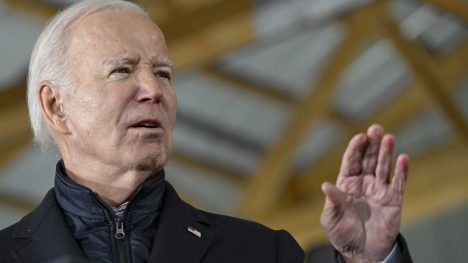
The world is at a crossroads and the next few years will determine its fate for several generations to come, US President Joe Biden has claimed. His prediction comes amid Washington’s standoff with Russia over Ukraine and his country’s increasingly strained relations with China.
Speaking ahead of a meeting with Chilean President Gabriel Boric on Thursday, Biden stated that “there comes a time, maybe every six to eight generations, where the world changes in a very short time.”
The US leader further claimed that “what happens in the next two, three years are going to determine what the world looks like for the next five or six decades.”
According to a White House readout of Biden’s meeting with Boric, the pair discussed issues of shared concern, including efforts to combat climate change.
Biden also spoke last month about the need for a “new world order,” suggesting that while the post-World War II system has functioned for decades, it has “sort of run out of steam.”
However, if Americans “are bold enough and have enough confidence in ourselves, [they will have an opportunity] to unite the world in ways that it never has been,” he insisted.
Commenting on Biden’s remarks at the time, Kremlin Press Secretary Dmitry Peskov described it as a rare moment when Moscow was in complete agreement with Washington. “The world indeed needs a new order, based on absolutely new principles,” he noted.
However, Peskov suggested that Biden meant building “a world [order] revolving around the US,” insisting that “this will not be anymore.” Russia has consistently called for a multilateral world order, with President Vladimir Putin accusing the West of “a colonial approach” and bending international rules to its will.
Last month, the Russian leader also stressed that “nobody has the right to control the world at the expense of others or in their name.”
Relations between Washington and Moscow have sunk to unprecedented lows due to the Ukraine conflict, with the US sending billions of dollars’ worth of weapons to Kiev and imposing tough sanctions on Russia.
Elsewhere, relations are tense between the US and China, most notably over Washington’s support for Taiwan. The two nations are also engaged in an intense economic rivalry. China has been promoting its Belt and Road Initiative (BRI), which seeks to develop international transport infrastructure and has been supported by more than 140 countries.
Biden has signaled that the US is working with G7 members to compete with China economically, claiming that the BRI has ended up being “a noose for most of the people who have signed on.”
Featured Video

US IRAN TALKS: Who Are the Crazy Ones Here? /Lt Col Daniel Davis
or go to
Aletho News Archives – Video-Images
From the Archives
Woolsey Fire started at Santa Susana Field Lab — where “radioactive materials released were never accurately measured”
By John Laforge | CounterPunch | November 30, 2018
In my Nov. 16 column, I reported on potential radiation risks posed by California’s Woolsey wildfire having burned over parts or all of the Santa Susana Field Laboratory—south of Simi Valley, Calif., 30 miles outside Los Angeles—site of at least four partial or total nuclear reactor meltdowns.
The field laboratory operated 10 experimental reactors and conducted rocket engine tests. In his 2014 book Atomic Accidents, researcher James Mahaffey writes, “The cores in four experimental reactors on site … melted.” Reactor core melts always result in the release of large amounts of radioactive gases and particles. Clean up of the deeply contaminated site has not been conducted in spite of a 2010 agreement.
Los Angeles’s KABC-7 TV reported Nov. 13 that the Santa Susana lab site “appears to be the origin of the Woolsey Fire” which has torched over 96,000 acres. Southern Calif. Public Radio said, “According to Cal Fire, the Woolsey Fire started on the afternoon of Thursday, Nov. 8 … on the Santa Susana site.” … continue
Blog Roll
 Aletho News
- US IRAN TALKS: Who Are the Crazy Ones Here? /Lt Col Daniel Davis
- Talks with the US end without a deal over excessive US demands: Iran
- Feeling Better, Getting Worse: How Psychiatric Drugs Create the Illusion They Cure
- ‘Nobody Told Me’: Former Mental Health Patient Calls Out Dangerous Side Effects of Psychiatric Drugs
- Dr. Abu-Sitta: Beirut ‘felt like a day in Shifa Hospital’
- Iran Has Won the War, It Will Be Up to the US to Secure the Peace: Mohammad Marandi
- Iran condemns assassination threats against Iranian negotiators amid US talks
- Brussels cannot say where its own pipeline inspectors are as Hungary’s oil lifeline remains shut
- Israel’s Iran War: Myth and Reality
- Between war and industrial breakdown: The US-Israeli attrition crisis
- If Americans Knew
- Pro-Israel ‘Thinktanks’ and Individuals who Influence U.S. Foreign Policy
- Mearsheimer reveals how Israel dictates US policies on Iran, Gaza – video
- After killing 350+, Israel still has a “score to settle” with Lebanon before ceasefire – Daily Update
- Military aid to Israel emerges as the latest political litmus test for Democrats
- The only Palestinian children’s rights organization closes following years-long Israeli campaign against it
- ‘I Can’t Forget the Smell’: Lebanese Reel After Israel Kills Over 300 in Single Day
- DNC Shoots Down Resolutions Calling Out AIPAC and Limiting Arms to Israel
- TCN: Is Israel Blackmailing President Trump?
- Israel killed at least 303 Lebanese yesterday – who were they? Daily Update
- Amnesty: Urgent – Protect Lebanese civilians from brutal escalation in Israeli attacks
- No Tricks Zone
- German Expert: Heat Dome Led To Record Temps In Western USA…Warmer In 1934, 1936
- New Study: No Linear Warming Or Glacier Retreat Along Northern Antarctic Peninsula Since 1980s
- An Inconvenient Tree: Uncovered In Alps… Europe Much Warmer Than Today 6000 Years Ago
- New Study Reports A 60% Slowdown In Greenland’s Ice Loss Rate In The Last Decade
- Low Intensity Tornado Wrecks Major Solar Farm, Creating A Potential Toxic Dump
- New Study Finds Warming Saves Lives…Cold Temperatures 12 Times More Deadly Than Excess Heat
- German Science Blog Accuses PIK Climate Institute Of Hallucinating Climate Tipping Points
- Devastating Assessment Of Comirnaty Vaccine By Former Senior Pfizer Europe Toxicologist
- New Study: CO2 Is ‘Effectively Negligible’ As An Explanatory Climate Change Factor Since 2000
- Former Pfizer Toxicologist Dr. Helmut Sterz Tells Bundestag Hearing Pfizer Vaccine Should Have Never Been Approved
 Aletho News