Xi meets Lavrov, reaffirms China’s emphasis on partnership with Russia
By Yang Sheng | Global Times | April 9, 2024
Chinese President Xi Jinping met with Russian Foreign Minister Sergey Lavrov on Tuesday in Beijing. Chinese analysts said the meeting sends a strong signal that China will firmly develop its strategic partnership with Russia, despite pressure from the West. The China-Russia partnership continues to be key for the global strategic balance and the hope for promoting a multipolar world in which countries of the Global South will have greater roles to play.
Xi asked Lavrov to convey his sincere greetings to Russian President Vladimir Putin. Noting that this year marks the 75th anniversary of the establishment of diplomatic ties between the two countries, Xi said China and Russia have embarked on a new path of harmonious coexistence and win-win cooperation between major countries and neighbors, which has benefited the two countries and their peoples and contributed wisdom and strength to international fairness and justice, the Xinhua News Agency reported on Tuesday.
Earlier in the day, Chinese Foreign Minister Wang Yi held talks with Lavrov in Beijing, and both sides expressed hope for strengthening practical cooperation in various fields, Xinhua reported.
Wang, also a member of the Political Bureau of the Communist Party of China Central Committee, said that China is willing to work with Russia, in accordance with the consensus reached by the two heads of state, to strengthen the synergy of the two countries’ development plans and promote practical cooperation in various fields.
The top diplomats of the two countries held a joint press conference after their meeting. Wang mentioned “five always” at the press conference. For example, he said that the two countries should always follow the strategic guidance of head-of-state diplomacy, and should always adhere to the principle of no-alliance, no-confrontation and no-targeting at any third party.
China and Russia should always stay on the right course on major matters of principle. As permanent members of the UN Security Council and major emerging countries, China and Russia actively respond to the common aspirations and legitimate concerns of the people of all countries, advocate a new path of state-to-state relations featuring dialogue and partnership rather than confrontation and alliance, and actively promote the building of a community with a shared future for humanity, said Wang.
Yang Jin, an associate research fellow at the Institute of Russian, Eastern European and Central Asian Studies at the Chinese Academy of Social Sciences, told the Global Times on Tuesday that the remarks made by Xi and the “five always” raised by Wang provide a “framework and outline” for the future development of the China-Russia comprehensive strategic partnership of coordination.
Yet many voices from the West, mainly from the US as well as some senior NATO officials, insist on depicting the China-Russia relationship as akin to an “anti-West alliance,” which is completely wrong. By reaffirming the principles of “non-alignment, non-confrontation, and not targeting any third party,” China and Russia are refuting those voices with a clear stance, experts said.
Multipolar world
China always attaches great importance to the development of China-Russia relations, and stands ready to strengthen bilateral communication with Russia and enhance multilateral strategic coordination in BRICS and the Shanghai Cooperation Organisation (SCO), Xi said when meeting with the visiting Russian top diplomat.
Xi said that the two countries will show more responsibility, unite countries in the Global South in the spirit of equality, openness, transparency and inclusiveness, promote the reform of the global governance system, and vigorously lead the building of a community with a shared future for humanity.
China and Russia are trying to promote a multipolar world where developing countries and emerging economies of the Global South will play a greater role, which is the antithesis of the unipolar world dominated by the US, analysts said.
“China and Russia will not target any third party, but if hegemonic forces threaten China and Russia, or threaten world peace, China and Russia will stand together and fight to protect their own interests and safeguard world peace together,” said Li Haidong, a professor at the China Foreign Affairs University.
This is why China and Russia, as well as other members in the UN Security Council, are pushing an immediate cease-fire and the resumption of humanitarian aid to Gaza, even as the US vetoed these attempts time and again, before the Ramadan cease-fire resolution eventually passed on March 25, experts said.
Wang said at the joint press conference that Russia will hold the BRICS presidency this year, and China will take over the rotating presidency of SCO this year. The two sides will support each other’s chairmanship and light up the “moment of South” global governance.
Richard Sakwa, professor of Russian and European politics at the School of Politics and International Relations of the UK’s University of Kent, told the Global Times at a forum in Beijing on March 28 that China-Russia relations are “one of the key axes for international politics, and it’s not only very important but also necessary” to maintain the global strategic balance.
Lavrov said at the meeting with Wang that Russia supports the China-initiated Global Security Initiative, and is willing to deepen cooperation with China on multilateral platforms to promote the establishment of a more just and democratic international order.
The two sides also had in-depth exchanges on the Ukraine issue, the Palestinian-Israeli conflict, the situation in the Asia-Pacific region and other international and regional issues of common concern.
Ukraine crisis and counterterrorism
Wang said at the joint press conference with Lavrov that on the Ukraine issue, China hopes to see a “cease-fire and an end to the war as soon as possible.” China supports the timely convening of an international conference recognized by both Russia and Ukraine, with equal participation by all parties, and a fair discussion of all peace options, whether it is track one or track two, Wang noted.
Cui Heng, a scholar from the Shanghai-based China National Institute for SCO International Exchange and Judicial Cooperation, told the Global Times on Tuesday that “some Western countries have always blamed China for its ‘pro-Russia’ stance, but actually we are just asking for a mechanism that can be accepted by all parties and can treat everyone equally.”
“China’s stance is based on the desire to stop the bloodshed, but the US’ stance is to use the [Russia-Ukraine] conflict to weaken Russia as much as possible. The development of the crisis to some extent depends on the US presidential election later this year,” Cui noted “If Donald Trump is elected, there will be a chance to break the deadlock, but if Joe Biden gets reelected, we might also see some changes, as Washington and its allies might not be able to afford the war anymore.”
Xi stressed at the meeting with Lavrov that China supports the Russian people in following a development path that suits their national conditions, and supports Russia in combating terrorism and maintaining social security and stability.
At the joint press conference with Lavrov on Tuesday, Wang stressed that China must also pay attention to the resolution of other global and regional hot spot issues, including continuing to counter terrorism. “China once again reiterated its condemnation of the terrorist attack in Moscow and its condolences and support for Russia,” said Wang.
“The Chinese people are also victims of terrorism, and terrorism has always been a common threat facing mankind. The international community should resolutely combat all forms of terrorism with a ‘zero tolerance’ attitude, firmly support the efforts of all parties to maintain national security and stability, strengthen international anti-terrorism cooperation, coordinate development and security, and eliminate the breeding grounds for terrorism,” Wang remarked.
“I want to thank China for their condolences in connection with the terrorist attack in the Moscow Region on March 22, and for their support of Russia’s fight against terrorism,” Lavrov said during the meeting with Wang.
All those involved [in the terrorist attack] will be certainly punished, Russia’s top diplomat stated. “Our [Russia-China] cooperation on counter-terrorism will continue, including within the framework of multilateral institutions.”
China and Russia are two major powers in the SCO, and counter-terrorism cooperation between them and other SCO members is significant for regional peace and stability, especially when the threat of terrorism has reemerged in relevant regions, experts said. Apart from the discussion on the diplomatic level, the militaries, law-enforcement and intelligence agencies of the two countries will promote cooperation on combating terrorism, experts said.
Star wars coming – top US general
RT | April 9, 2024
The possibility of a conflict in space is no longer just theoretical, General Stephen Whiting, head of the US Space Command, said on Tuesday.
Speaking at the 39th Space Symposium at the command’s headquarters in Colorado Springs, Whiting painted an alarming picture of Russian and Chinese orbital capabilities.
China has built a “kill web over the Pacific Ocean to find, fix, track and, yes, target US and allied military capabilities,” Whiting said, describing Beijing’s efforts as moving at “breathtaking speed.”
Since 2018, Russia has doubled and China has tripled the number of their intelligence, surveillance and reconnaissance (ISR) satellites in orbit, while also testing and fielding anti-satellite weapons. Meanwhile, the US has “the world’s best space architectures,” but its military constellations are “optimized for a benign environment,” he said.
Russian and Chinese space weapons “hold at risk our modern way of life and how we defend this nation, and we must be able to deter and counter these threats when called upon to achieve space superiority,” the general said.
Whiting described a possible armed conflict in space as “economically and environmentally devastating, perhaps for decades,” and said the US wishes to keep things in the state of “enduring competition” instead.
The US is already working with Canada, Australia and the UK on Operation Olympic Defender, a program intended to “optimize space operations,” according to the Space Command. Whiting announced that Germany, France and New Zealand have been invited to join as well.
He also revealed that the command’s new Capability Assessment and Validation Environment (CAVE) has achieved “minimum viable capability.” The modeling and simulation laboratory will enable the US military to “derive better ways of deterring and planning to conduct operations for a war that’s never happened, and a war we don’t want to happen,” he said.
Washington recently accused Moscow of having undisclosed anti-satellite capabilities, possibly nuclear in nature. Russian President Vladimir Putin said the US claims were “unfounded” and a ploy to manipulate arms control talks. The Russian embassy in Washington has also accused the US of using “Russophobic slogans” to mask its own plans to militarize space.
New hacking allegations against China aren’t what they seem
By Timur Fomenko | RT | April 5, 2024
In March, the UK, in conjunction with the US and other members of the Five Eyes intelligence alliance, accused China of engaging in a state-sponsored hacking campaign against them. In response to the alleged ‘attack’ they launched coordinated sanctions against a small group of hackers and their associated businesses.
The sanctions were particularly big news in Britain, where the government suddenly decided that Beijing had been behind a hack on the electoral commission three years ago. Notably, the country’s Conservative party-aligned newspapers all pushed this narrative in an aggressive fashion.
These accusations by the Five Eyes nations are not so much genuine concerns as they are a deliberate and opportunistic act of political theatre which, largely driven by the US, seeks to slander China for diplomatic and political gain. The sanctions, although narrow in scope and thus meaningless, are designed to try and send a message to and about China. It is essentially a fearmongering campaign, which seeks to both undermine Beijing’s engagement with other countries and serve domestic political purposes in the US.
The rhythm of US escalation and de-escalation with China
The US has an adept foreign policy whereby it intentionally chooses to escalate and de-escalate tensions with China at opportune moments, which is precisely why calls for “engagement” with Beijing coming from Washington D.C. cannot be trusted. The US does not change its goals or its policies, only its tactics in consideration of what suits it at that particular moment. Hence it has always alternated between overtures and deliberate provocations. It usually does so by having a certain report or development leaked to the media at an opportunistic time, in order to craft a particular narrative which mandates a certain set of reactions and policy responses.
To give some examples of such, the Trump administration played down tensions with China directly in 2019, even amidst the Hong Kong crisis, in order to secure a “trade deal” with Beijing. Once it got what it wanted by 2020, and the Covid-19 pandemic struck, it deliberately unleashed a full-on crusade against Beijing on every front. Similarly, the Biden administration came into office and then immediately upped tensions with China on the Xinjiang issue in order to damage China’s ties with Europe in a build-up to coordinated sanctions as a display of transatlantic unity.
After this was done, it then decided it wanted to “cool” things down for a bit and establish “guardrails” so the rhetoric guns went silent for a few months as Washington reached out to Beijing. Then, as the 2022 Beijing Winter Olympics came, it took the “Xinjiang card” off the shelf again with a number of timed leaks and publications geared towards supporting a Winter Olympics boycott, as well as a sweeping ban on all Xinjiang goods under the premise of “forced labour” at that time.
What we see is that the US does not truly de-escalate with China, it “blows hot and cold” and essentially manipulates the media cycle to pursue its policy preferences as it sees fit. This means that major issues pertaining to China only tend to appear when there is an agenda serving it.
The newest phase
Now, the Biden administration has made a political design to escalate tensions with China by accusing it, in coordination with the Five Eyes, of state-backed hacking and cybercrime. The fact that the British government would sit on such an accusation for three years suggests both clear political purpose and timing. The question is, why? First, we are approaching a Presidential election in the US. It was always an inevitability that the administration would want to appear “tough” on China to prevent the issue from being used as an attack point by Biden’s rival, Donald Trump. As seen in 2020, an election year tends to become a year of very aggressive rhetoric and extreme theatrics.
Secondly, there is the goal of undermining China’s engagement with Europe. It has been publicly announced that Xi Jinping will visit a number of European countries in May, including France. As stated above, the US, with the support of the Five Eyes countries, actively seeks to damage Chinese diplomacy with Europe by weaponizing negative publicity in order to narrow political space for engagement.
What we see from this is that the US engages China on its own terms, but seeks to prevent those it deems as “allies” from doing the same, and thus resorts to psychological warfare through the manipulation of mass media.
In conclusion, when one sees these strategies being utilised, one recognises that the Western media has far less independence and impartiality than it claims to have, but is indirectly subject to the preferences of US policy. When the White House says “jump”, reporters ask, “how high?” and thus we see that a new propaganda campaign has been cultivated against Beijing, but of course, we should not be blind to the reality that there is no greater weaponisation of cyberspace and espionage in the world than the system created by the Five Eyes. And are we really going to pretend the CIA doesn’t hack anyone?
World War III Isn’t Preordained (No Matter What They Say)
By Brad Pearce | The Libertarian Institute | April 4, 2024
A recent survey from YouGov found that 61% of Americans think a world war within the next five to ten years is “very likely” or “somewhat likely,” while only 21% say that such a scenario is “not very likely” or “not likely at all.”
It’s notable that Democrats, who are much more likely to view Russia as the source of the world’s evils, are less likely than Republicans to believe a world war is coming by a strong margin; although it is still only 28% of Democrats in the two “unlikely” categories. At the same time, Republicans who may want rapprochement with Russia mostly see this as a way to free up resources to fight China. The reality is that our ruling class has decided that a global conflict is inevitable and as such are doing nothing to stop it. Further, they are actively hostile to anything which could reduce hostilities with Russia while also proactively antagonizing China.
Our ruling class is far along in creating a simplistic good vs evil narrative which they hope to get into the history books—should anyone survive to write them—but for those of us living through it, it’s obvious the only cause would be the madness of today’s rulers. The most devastating of wars do not commonly arise out of unsolvable problems, but from rulers who refuse to solve them. Further, the drive towards oblivion is usually obvious to many observers, even if the rulers and much of the public are caught in a jingoistic mania. Things are just the same today.
There is a modern perception that World War I took the powers of Europe by surprise and that the assassination of Archduke Franz Ferdinand was a spark which made war inevitable. Perhaps this is believed because of the human need to understand the degree of devastation from a war which more than others lacks a clear meaning. However, author Rebecca West, in her landmark text Black Lamb and Grey Falcon, which was written in the 1930s, tells a different story. West explains that all of Europe expected that the Central Powers were preparing for an aggressive war, writing, “It is said that both France and Russia were for some reason convinced that Germany and Austria would not make war until 1916, and certainly that alone would explain the freedom with which Russia announced to various interested parties in the early months of 1914 that she herself was not ready to fight.”1
According to West’s account, Austria then worked quite hard to make the assassination their pretext although the plot had almost no connection to the Kingdom of Serbia. This isn’t a perfect parallel to our moment, but it’s notable that no one was trying to stop the war; they simply wanted time to arm themselves. Similarly, Germany and other countries in Europe have not hidden their current lack of preparedness, but made it clear their interest isn’t avoiding war, but fighting one. In the classic satirical antiwar novel The Good Soldier Svejk by Jaroslav Havec, the author repeatedly includes the line “an empire this stupid shouldn’t exist” in regards to the Austro-Hungarian ruling class; because of the war they, launched it soon wouldn’t.
The closest parallel to the dangers arising from the war in Ukraine comes from the first book of Thucydides’ History of the Peloponnesian War. The most immediate cause of the war was civil dissension within a colony leading to conflict with the mother city, and ultimately seeking the protection of that city’s enemy. However, what has gotten more notice recently about this text is one passage that is applied to China, which is now known as the Thucydides Trap. Thucydides wrote, “The real cause however, I consider to be the one which was formally most kept out of sight. The growth of the power of Athens, and the alarm which this inspired in Sparta, made war inevitable.” For all that people have commented on this, it is not that incisive to say that one country’s power growing would alarm another country. What is more commonly missed is that no one forced Athens to expand recklessly to the extent that it caused war with Sparta. It was an unforced error which caused them the briefest moment of greatness followed by utter devastation. On the other side, no one forced Sparta to respond with war, and Sparta’s post-war supremacy was also short-lived. Unfortunately the leaders on both sides chose conflict over co-existence, and in many ways Greece never recovered from that war and the ones which followed.
In America it is part of our founding mythology that War of Independence against the United Kingdom was inevitable because of conflicting interests between the Americans and the British. However, if one reads key British authors of the time, it is clear that the wiser men of the era knew that the British government was barreling towards a devastating and pointless war for no good reason. The reality is that the volume of trade in the British American colonies was growing so rapidly that peaceful reconciliation at any cost was in Britain’s self-interest; The Wealth of Nations was published in 1776 and contains some incredible statistics in this regard. Directly taxing the American public instead of levying taxes from their colonial governments was in no way a point worth proving, especially given the profitability of peace and trade.
Edmund Burke was a leader of the peace faction in the British Parliament and his timeless words about avoiding war should be remembered. Burke wrote, in March 1775, “The proposition is Peace. Not Peace through the medium of War; not Peace to be hunted through the labyrinth of intricate and endless negociations; not Peace to arise out of universal discord…not Peace to depend on the Juridical Determination of perplexing questions… it is simply Peace; sought in its natural course… laid in principles purely pacific”2 It is obvious in our current times that peace could be preserved with Russia and China if it was approached with this principle, but that is considered out of the question by our rulers.
The world is currently a tinderbox and every day we watch our rulers pour on more gasoline and throw out extinguishers. I have to wonder what our descendants will think of us and the war which seems to be coming. There is certainly no chance that they can create a clear World War II sort of narrative about this. I often think of the European Union Commission President Ursula von der Leyen saying, “Ukrainians are ready to die for the European perspective,” a statement which should only exist as a parody of the vapid state of Western “values.” They want us to believe Vladimir Putin is obsessed with rolling his tanks across Europe, but that makes no sense and clearly isn’t possible. They certainly can’t admit the lengths they went to in order to provoke Russia into war in Ukraine.
There is absolutely no justification for not doing the work necessary for a lasting and equitable peace with Russia and China. When all is said and done, if there are people left to comment on the causes of the Third World War that so many think we are about to experience, perhaps people will say the same as the famous character Captain Edmund Blackadder said of World War I, “the real reason for the whole thing was that it was too much effort not to have a war.” The majority of the American public thinks countless millions will die in a new world war, and if that comes to pass, it will be because our rulers found going to war easier than making peace.
China sees big gains in Southeast Asia as ASEAN loses faith in Washington
The Cradle | April 3, 2024
A majority of residents from the Association of Southeast Asian Nations (ASEAN) say they would prefer their countries align with China over the US in a significant year-on-year shift in regional sentiment toward the world’s two largest economic powers.
According to the results of an opinion poll conducted by the ASEAN Studies Centre at ISEAS – Yusof Ishak Institute in the 10 nations that make up the bloc, 50.5 percent of respondents said they would pick China if their country was “forced to align itself” with one of the two superpowers.
On the other hand, 49.5 percent chose the US, as 11.6 percent of respondents changed their opinions between 2023 and 2024.
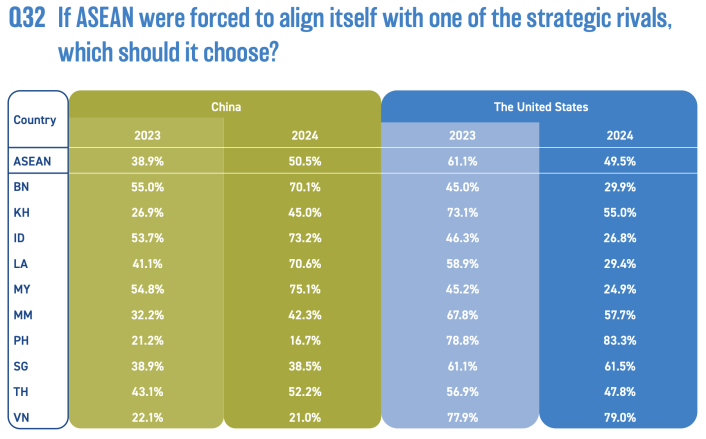
The ASEAN bloc includes Brunei, Cambodia, Indonesia, Laos, Malaysia, Myanmar, the Philippines, Singapore, Thailand, and Vietnam. According to IMF figures, the bloc’s combined nominal GDP in 2023 was approximately $3.9 trillion.
China’s surge was most prominent among respondents from Malaysia (75.1 percent), Indonesia (73.2 percent), Laos (70.6 percent), Brunei (70.1 percent), and Thailand (52.2 percent).
Although the EU also saw a year-on-year drop in confidence – from 42.9 to 37.2 percent – it remains securely in third place behind the US as a “preferred and trusted strategic partner for ASEAN,” followed by Japan and India.
The poll also highlights a “growing sense of optimism” in future ASEAN–China ties, with respondents “anticipating improvement” jumping from 38.7 percent in 2023 to 51.4 percent in 2024.
A total of 1,994 respondents from all ASEAN member states participated in the survey, with most of them holding a university degree and working in the business and finance sector.
When asked what geopolitical events they consider to be “strategic uncertainties facing the region,” 46.5 of respondents chose the Israeli genocide in Gaza.
“A large proportion of Southeast Asia respondents are concerned that Israel’s attack on Gaza has gone too far. Rise in extremist activities (29.7 percent), diminished trust in international law and rules-based order (27.5 percent), and erosion of domestic social cohesion (17.5 percent) are the most serious impacts of the Israel-Hamas conflict on Southeast Asia,” the poll details.
The ASEAN bloc made headlines last year when member states began the process of de-dollarization, replacing the greenback with local or regional currencies for trade to circumvent the threat posed by unilateral US sanctions.
China Opposes US Practice of Creating Enemies Out of Thin Air
Sputnik – 28.03.2024
BEIJING – The US practice of artificially creating enemies out of thin air for the sake of boosting its military budget is strategically extremely dangerous, and China firmly opposes it, Chinese Defense Ministry spokesman Wu Qian said on Thursday.
The United States had repeatedly used China as a pretext for increasing its military budget, inflating a non-existent “Chinese military threat,” Wu said at a briefing.
“This practice of artificially creating enemies out of thin air is extremely dangerous from a strategic point of view, and China is firmly opposed to it,” the spokesman added.
He also said that China did not wish to threaten anyone, but it was also not afraid of anyone’s threats, and no amount of force can stop the development of the Chinese army.
On Saturday, US President Joe Biden signed into law an appropriations package that includes the $825 billion defense spending bill for fiscal year 2024. The act doubles security cooperation funding for Taiwan. The United States would counter China by maximizing its production of critical munitions and by spending more than $66 billion for the US Indo-Pacific Command capabilities, including $42 million to bolster its military capabilities in the region, the House Appropriations Committee said in a summary of the package.
US threatens sanctions if Pakistan continues gas pipeline project with Iran
By Ahmed Adel | March 28, 2024
Despite Pakistan dealing with a crippling economic situation, the US has shown little concern for its strategic ally’s issues and, instead of offering support, has threatened tough sanctions if Islamabad decides to continue with the Pakistan-Iran gas pipeline project. Ironically, though, such an action will only push Pakistan closer to China, which the US views as a greater threat to its hegemony than Iran.
“We always advise everyone that doing business with Iran runs the risk of touching upon and coming in contact with our sanctions, and would advise everyone to consider that very carefully,” a US State Department spokesperson told reporters in a press briefing on March 26.
“We do not support this pipeline going forward,” the spokesperson added.
Washington continually emphasises that Pakistan is one of its closest allies and a partner in the fight against terrorism, making the sanctions threat a major development in their bilateral relations. For this reason, Pakistan Petroleum Minister Musadik Malik said on March 27 that Islamabad would seek an exemption from US sanctions over the gas pipeline project.
The Pakistan-Iran gas pipeline, known as the Peace Pipeline, will transport natural gas from Iran to Pakistan. Despite the pipeline’s several years of delays and funding challenges, Pakistan and Iran signed a five-year trade plan in August 2023 with a target of $5 billion. Tehran is evidently desperate for the project to be completed, which had an original deadline of 2015, since it signed the trade plan and overlooked Pakistan not laying the pipeline when Iran has already completed the laying of its 900-kilometre pipeline.
Islamabad claims it could not lay the pipe due to the US sanctions imposed on Iran, but Tehran rejects this excuse. Pakistan is now in a difficult position with the latest US sanction threat when recalling that Tehran issued a third notice in January to Islamabad and announced intentions to go to arbitration court to receive $18 billion for breach of contract.
The threat of US sanctions or paying a huge fine to Iran is only compounding Pakistan’s difficult economic situation, especially as the country is seeking a 24th bailout from the International Monetary Fund.
Pakistani Prime Minister Shehbaz Sharif said on March 26 that his country needs another IMF loan programme to stabilise its fragile economy. An IMF mission that visited Islamabad for five days earlier this month said Pakistan had to meet IMF conditions, including revising its budget and raising interest rates, generating revenue through more taxes, and hiking electricity and gas prices.
Effectively, ordinary Pakistanis are going to suffer a lot more than they already are.
Islamabad and Washington have had longstanding relations rooted in their opposition to the Soviet Union. After the Cold War, the US became dependent on the South Asian country for supplies during its long occupation of Afghanistan. Due to the US’s double standard of using Pakistan as a security partner but also threatening to worsen the country’s economic situation, China has been able to fill the financial void.
Pakistani Foreign Minister Mohammad Ishaq Dar met with Chinese Vice Premier Zhang Guoqing on March 22 in Brussels, where the latter emphasised Beijing’s commitment to aiding Pakistan in addressing its financial challenges. However, just like the Pakistan-Iran gas pipeline, Islamabad continues to stall the implementation of the China-Pakistan Economic Corridor (CPEC), a flagship project of the China-proposed Belt and Road Initiative launched in 2013 to link the Gwadar port in southwestern Pakistan with China’s Xinjiang Uygur Autonomous Region.
Worsening the situation for CPEC is the constant stream of terror attacks against Chinese workers and nationals.
In the latest attack, on March 26, a suicide bomber in the Shangla district of Khyber Pakhtunkhwa rammed an explosive-laden car into a vehicle, killing five Chinese workers and engineers and their Pakistani driver heading to the Dasu Dam, the biggest hydropower project in Pakistan. Less than a week before the suicide attack, Pakistani security forces killed eight Balochistan Liberation Army separatist militants who opened fire on a convoy carrying Chinese citizens outside Gwadar port in the southwestern Balochistan province.
Given that Pakistan is facing a dire economic situation and needs to turn to the IMF and seek more funding from China, US sanctions would be a devastating blow. Sanction threats are especially contradictory for the US since it not only considers Pakistan an ally but overlooks the fact that India invests in the Iranian port of Chabahar, located only 170 kilometres from Gwadar port. Washington overlooks this contradiction since Chabahar rivals the China-funded Gwadar, signalling that the US views China as a much larger threat to its hegemony than Iran, which makes sanction threats more confusing since it will only push Pakistan to be even closer and more aligned with China.
Ahmed Adel is a Cairo-based geopolitics and political economy researcher.
Is America a Rogue Superpower?
By Ted Snider | The Libertarian Institute | March 27, 2024
“Unipolar” used to mean that the United States was, at least in theory, alone in leading the world. Now “unipolar” means that the United States is alone and isolated in opposition to the world.
In global affairs, a hegemon is a nation that leads because it has the consent of the other nations who believe in its goals and values. The United States has recently demonstrated, though, that it has given up any pretense of using its leadership to pursue the goals of the global community, and instead is openly using the global community to pursue its own goals.
In his new book, The Lost Peace, Richard Sakwa explains the distinction between the pursuit of hegemony and the pursuit of primacy. Primacy “entails predominance and the conscious attempt to thwart the ambition of others.” In its recent performance at the United Nations, the United States is performing, not out of hegemony as it usually described, but out of primacy.
As a hegemon, the U.S. wields the power to veto in the Security Council. But in the exercise of primacy, it has recently used that veto to supress the clearly expressed voice of the international community.
After repeated American vetoes of measures calling for an immediate humanitarian ceasefire in Gaza, in a desperate and seldom used move, on December 12, the General Assembly invoked Resolution 377A in an attempt to circumvent U.S. leadership. It was the response to what was perceived as America’s irresponsible use of its veto power as a permanent member of the Security Council.
It does not matter that the vote was on the war in Gaza, nor on whether you agree with the United States. What is significant is the assumption by Washington of the role of roadblock and not leader of the international will.
Article 377A first reminds the permanent members of the Security Council that they are obliged to “to seek unanimity and exercise restraint in the use of the veto” in pursuit of the maintenance of international peace and security. It then gives the General Assembly the right to make “appropriate recommendations to Members for collective measures… to maintain or restore international peace and security” when the Security Council “because of a lack of unanimity… fails to exercise its primary responsibility.”
The world saw the United States, not as a hegemon leading the world in the pursuit of unanimity, but as failing “to exercise its primary responsibility” as a leader on the Security Council.
On March 25, the U.S. went one step further and took a step toward becoming a rogue state who has supplanted international law with its rules-based order. International law is grounded in the charter system and the United Nations and is universally applicable. The rules-based order is composed of unwritten laws whose source, consent, and legitimacy are unknown. To the global majority, those unwritten laws have the appearance of being invoked when they benefit the U.S. and its partners and not being invoked when they don’t.
On March 25, the Security Council passed a resolution demanding “an immediate ceasefire for the month of Ramadan respected by all parties leading to a lasting sustainable ceasefire.” The resolution was able to pass because the U.S. stood aside and let the other fourteen Security Council members pass it by abstaining instead of vetoing.
But in her explanation of the American abstention after the resolution passed, U.S. Ambassador to the UN Linda Thomas-Greenfield “surprisingly” said that “we fully support some of the critical objectives in this nonbinding resolution.”
Her claim that the Security Council resolution was nonbinding was not an off script, impromptu comment. It is the strategy of a country that enforces, not international law, but the U.S. led rules-based order.
In a March 25 press briefing following the vote and Thomas-Greenfield’s claim, White House National Security Communications Advisor John Kirby called the resolution “nonbinding” no less than four times. “Number one,” he said, “it’s a nonbinding resolution. So, there’s no impact at all on Israel and Israel’s ability to continue to go after Hamas.”
When asked by a reporter, “on the binding thing, is it binding, nonbinding?” Kirby answered, “It’s a nonbinding resolution.” When asked “a technical question” a second time to clarify if the resolution was nonbinding, Kirby again said, “My understanding is it’s a nonbinding resolation—resolution.”
At a State Department press briefing the same day, department spokesperson Matt Miller also called the resolution “nonbinding” three times.
All UN Security Council resolutions are legally binding and have the status of international law. That is why UN Secretary General António Guterres said, “This resolution must be implemented. Failure would be unforgivable.” UN deputy spokesperson Farhan Haq explained that, “All the resolutions of the Security Council are international law. They are as binding as international laws.”
Others responded the same way to the U.S. claim. On behalf of the ten elected members of the Security Council who drafted the resolution, Pedro Comissario, Mozambique’s envoy to the United Nations, said, “All United Nations Security Council resolutions are binding and mandatory.” He then added, “It is the hope of the 10 that the resolution adopted today will be implemented in good faith by all parties.”
The United Kingdom also did “not share” the U.S. claim, prompting their envoy to the UN to say, “we expect all Council resolutions to be implemented. This one is not any different. The demands in the resolution are absolutely clear.” China, too, did not share the U.S. evaluation. “China’s U.N. Ambassador Zhang Jun said Security Council resolutions are binding.”
By judging Security Council resolutions to be nonbinding and denying their status as being as binding as international law, the United States has taken the next step from hegemony to primacy to a rogue state that has undermined the foundational role of the Security Council in the international order.
China says Security Council Gaza ceasefire resolution binding on Israel
MEMO | March 27, 2024
China yesterday reiterated that “UN Security Council resolutions are binding” on Israel, rejecting US claims to the contrary, Anadolu reported.
China “calls on the parties concerned to fulfil their obligations under the UN Charter and to take due action as required by the resolution,” Foreign Ministry spokesperson Lin Jian said in response to a question about comments by the top US envoy to the UN who claimed the resolution passed on Monday was “non-binding” on parties to the conflict in Gaza, which has been under an onslaught by Israel since 7 October.
More than 32,333 Palestinians have since been killed and over 74,694 injured amid mass destruction and shortages of necessities.
The UN Charter stipulates that all Security Council resolutions are legally binding under international law.
The Council passed a resolution demanding a ceasefire in Gaza for the remainder of the Islamic holy month of Ramadan, which began on 11 March and is set to end on 9 April.
Fourteen countries on the 15-member Council voted in favour of the resolution. The US abstained.
The resolution demanded an “immediate ceasefire for the month of Ramadan respected by all parties leading to a lasting sustainable ceasefire.”
It also insisted on the “immediate and unconditional release of all hostages, as well as ensuring humanitarian access to address their medical and other humanitarian needs.” No mention was made of the thousands of Palestinians disappeared by Israel from the Gaza Strip since it launched its ground offensive at the end of October. After the resolution passed, the Permanent Representative of China to the United Nations, Zhang Jun, told the Council: “If fully and effectively implemented, [the resolution] could still bring long-awaited hope. Security Council resolutions are binding.”
Lin said Beijing “expects the state with significant influence to play a positive role on the party concerned, including by using all necessary and effective means at their disposal to support the implementation of the resolution.”
The Council “must continue to closely follow the situation in Gaza and get ready for further actions when necessary to ensure the timely and full implementation of the resolution,” said Lin.
SpaceX’s spy satellite network deal a major step toward ‘space militarization,’ poses new threat to global security: experts
By Fan Anqi and Guo Yuandan | Global Times |March 17, 2024
SpaceX’s increasing involvement in US’ military deployment poses a new threat to world peace and stability, and may even impact the everyday lives of ordinary people around the world, experts warned after the company is reportedly building a powerful spy satellite network using hundreds of its satellites for US intelligence agencies.
In an exclusive report from Reuters on Saturday, the commercial space giant is allegedly building a network of spy satellites under a classified contract worth $1.8 billion with a US intelligence agency called the National Reconnaissance Office (NRO), Reuters said, citing sources familiar with the program.
A special business unit under SpaceX, Starshield, is undertaking the project, the sources revealed, and if successful, it would significantly advance the US military’s ability to quickly spot potential targets “almost anywhere on the globe,” the reports said.
The reason the NRO chose SpaceX was mainly due to the company’s advantage in the number of small satellites it has in orbit, which allows for maximum coverage of more orbital levels, Wei Dongxu, a Beijing-based military expert and media commentator, told the Global Times on Sunday.
“The large number of satellites can enable the monitoring of a certain area without any blind spots, not only in coverage but also in time duration, thereby creating an all-encompassing spy network above the heads of all countries around the world,” Wei said.
Starshield was established in December 2022, when the company announced it was “expanding its Starlink satellite technology into military applications.” The target customers of Starshield includes the Pentagon and other national security agencies.
While the company tried hard to separate the two units to calm public worries, it is clear to all that the line is not so clear. Starshield will utilize the Starlink satellite constellation in low-Earth orbit to meet the growing needs of the US defense and intelligence agencies, media reports said, further blurring the boundary between civilian and military use.
Prior to this program, the Pentagon was already a big customer of SpaceX, using its Falcon 9 rockets to launch a dozen military payloads into space, according to media reports.
“This move is very dangerous,” Wei said, as once space becomes another arena for arms race, the company’s assets could be in jeopardy. In addition, if this spy satellite network gets involved in a US-instigated “space war” and thus poses threats to other countries, SpaceX may become a target for retaliation or counterbalance.
Wang Ya’nan, chief editor of Aerospace Knowledge magazine, believes that countries and regions will definitely take countermeasures once the network become operational, such as by moving facilities underground or using optical camouflage for concealment. As a result, obtaining sensitive information would still not be “a piece of cake” for US intelligence agencies, Wang told the Global Times.
Nevertheless, observers believe the spy network will pose a new threat to global peace and security. “The US’ extensive intelligence reconnaissance of countries or regions of interest will inevitably make some hot-button issues more sensitive or even escalate, and it will also make already complex international relationships more difficult to handle,” Wang said.
Wei warned that the satellite system will not only monitor military targets but civilian targets as well, potentially exposing the daily lives of ordinary people to surveillance, which will have significant negative implications for information security and personal privacy protection worldwide.
While the US incessantly hypes China’s “growing threat” in space and advocates for “demilitarization,” it has not stopped building up its military capabilities in the field, with the true aim of achieving a dominant position in space technology to support its superiority. “Due to the US’ instigations, we may eventually have to face the fact that space has become a new battleground,” Wang noted.
The more thoroughly exposed the CIA’s true face, the better
Mother of all disorder Illustration: Liu Rui/GT
Global Times | March 15, 2024
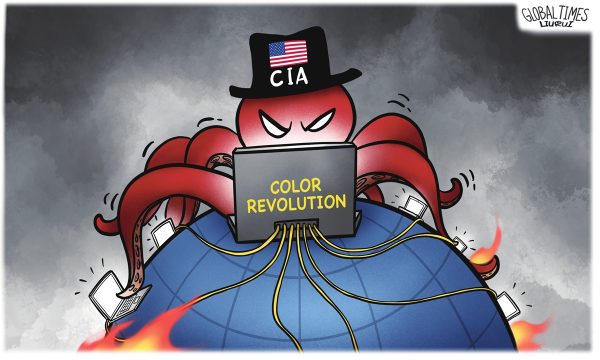
Reuters exclusively reported on Thursday that, according to a former US official with direct knowledge of highly confidential operations, then-US president Donald Trump authorized the Central Intelligence Agency (CIA) to launch secret operations on Chinese social media aimed at “turning public opinion in China against its government.” Many people don’t find this information surprising or even consider it “news.” The US is a habitual offender, using various covert means to foment “peaceful evolution” and “color revolutions” in other countries, with the CIA being the main force employed to this end. For other countries, the US’ pervasive influence is everywhere, visible and tangible, so there is no need for exposés.
We are still unclear what the specific purpose of the “former US official” was in leaking the information to Reuters. A CIA spokesperson declined to comment on the existence of the program, its goals or impact. A spokesperson for the Biden administration’s National Security Council also declined to comment, which means it was neither confirmed nor denied. The US intelligence community often uses a mixture of false and true information to create confusion, a tactic that was used on Edward Snowden. The Reuters report is valuable, but needs to be further processed to filter out the true and useful parts.
Firstly, this report carries a strong defense of US penetration into China. It portrays the proactive offensive of the US’ cognitive warfare against China as a passive counterattack against “cyber attacks” on the US from China and Russia. In reality, portraying themselves as the weak or victimized party and labeling their hegemonic actions as “justice” is a part of the US’ cognitive warfare against foreign countries.
One US official interviewed by Reuters even said it felt like China was attacking the US with “steel baseball bats,” while the US could only fight back with “wooden ones,” showing his exaggerated and clumsy acting skills. The US has never used a “wooden stick.” Over the past few decades, the CIA has overthrown or attempted to overthrow at least 50 legitimate international governments. There are also statistics showing that from 1946 to 2000, the US attempted to influence elections in 45 countries 81 times to achieve regime change. As a habitual offender of manipulating public opinions, the US has long established a series of tactics in its targeted propaganda, information dissemination, event creation, rumor fabrication, incitement of public opinion, and media manipulation. It constantly creates new tactics and uses new technologies according to changing circumstances. This is an open secret. The US dressing itself up as a “little lamb” only has a comedic effect, not a propaganda effect.
Next, as the US’ intervention and infiltration in other countries are covert operations, this disclosure provides an opportunity for the outside world to glimpse into the specific methods used by the US. For example, the whistleblower admitted that the CIA had formed a small team of operatives, using bogus online identities to spread damaging stories about the Chinese government while simultaneously disseminating defamatory content to overseas news agencies. This corroborates with previous statements by CIA Director William Burns, indicating increased resources being allocated for intelligence activities against China, once again confirming the existence of the US “1450” (internet water army) team targeting China.
The whistleblower admitted that the CIA has targeted public opinion in Southeast Asia, Africa, and the South Pacific region, spreading negative narratives about the Belt and Road Initiative. This indicates that in the US-instigated propaganda war against China, the global public opinion arena, especially in “Global South” countries, is their main strategic target. Various “China threat” theories circulating in third-party countries, as consistently pointed out by China, are all being operated by the US intelligence agencies behind the scenes.
The US has never concealed its hegemonic aims, nor does it regard encroachment on other countries’ sovereignty as something to be ashamed of, which is even more infuriating than the hegemonic behavior itself. American economist Jeffrey Sachs criticized the CIA’s blatant violation of international law in his commentary last month, stating that it is “devastating to global stability and the US rule of law,” leading to “an escalating regional war, hundreds of thousands of deaths, and millions of displaced people.” He also criticized the mainstream American media for failing to question or investigate the CIA. In fact, far from acting as watchdogs, mainstream American media has served as an accomplice. How many rumors manufactured by the CIA have been spread through the mouths of mainstream American media? When did they reflect and correct themselves?
We also see that the intentions of the US intelligence agencies are even more sinister. As admitted in the revelations, they aim to force China to spend valuable resources in defending against “cognitive warfare,” keeping us busy with “chasing ghosts,” and disrupting our development pace. First of all, we appreciate their reminder. At the same time, we will not allow external factors to interfere with our strategic determination to manage our own affairs well. For China and the world, the more fully, clearly, and thoroughly the CIA exposes itself, the deeper people will understand its true nature, and the stronger their ability to discern the truth will become. Keeping the CIA busy to no end or failing in their attempts is the best preventive effect.
Does the Fate of US Arms in Ukraine Create Pause for Thought Ahead War with China?
By Brian Berletic – New Eastern Outlook – 12.03.2024
In recent months, advanced US weapon systems provided to Ukrainian forces have been cornered and destroyed on the battlefield by Russian troops. This includes the first ever confirmed footage of a US M142 High Mobility Artillery Rocket System (HIMARS), the destruction of several M1 Abrams main battle tanks, and the further loss of several more Bradley infantry fighting vehicles, Newsweek reported.
Last year, the US Department of Defense admitted that a US-made Patriot air defense battery sustained damage in a Russian missile attack, according to CNN. This year, in an article by Forbes, it is admitted that a Russian short-range Iskander ballistic missile destroyed at least two Patriot missile launchers.
These developments end decades of US claims regarding the superiority of its weapons systems, including boasts that Russia’s Soviet-era equipment “won’t be a match” for US arms, as the Business Insider claimed regarding M1 Abrams being sent to Ukraine.
Busting the Myth of American Military Supremacy
The Business Insider article, like many others across the Western media, repeated the myth of the superiority of America’s military technology based on flawed analysis of its performance during the 1991 Persian Gulf War and the 2003 US-led invasion of Iraq. In both instances, the US pitted its best troops and equipment against poorly trained Iraqi forces using Soviet-era equipment already obsolete at the time.
The lopsided results of the fighting in both conflicts were cited as evidence of American superiority over Soviet and then Russian Federation military technology. It also serves as the basis of assumed military superiority over Chinese military power. Such lopsided fighting was imagined by Western analysts ahead of US weapons arriving at the battlefield in Ukraine, and despite the poor performance of these systems in Ukraine, such lopsided fighting is still imagined amid any potential conflict between the US and China.
However, for analysts carefully studying the evolution of modern warfare from 1991 to present day, the disparity between Western military technology and that of even non-state armed organizations was closing. During the 2006 Israeli invasion of southern Lebanon, Hezbollah used modern Russian anti-tank weapons to inflict heavy casualties on Israeli forces, Haaretz reported. Hezbollah’s enhanced military might allowed it to stop the advance of Israeli Merkava main battle tanks and supporting troops well before their stated objective of reaching the Litani River.
The Syrian Arab Army’s successful use of Soviet and Russian-made air defense systems during the ongoing conflict in Syria has forced US, European, and Israeli warplanes to launch attacks using longer-range stand-off weapons. These same air defense systems have been used to intercept Western cruise missiles, reducing damage to targets across the country.
Russia’s intervention in Syria at the invitation of Damascus in 2015 was followed by an effective use of modern Russian air power, cutting the supply lines of Western-backed militants, and aiding Syrian forces on the ground in encircling and destroying them.
It was becoming clear that should modern Western weapon systems face modern Russian military technology, the myth of Western military superiority would be shattered. It was also becoming clear that a similar gap was closing in terms of US military technology and its Chinese counterparts.
On the battlefield in Ukraine, Russian forces using modern Russian weapons are eliminating Ukrainian brigades trained and armed by the US and other NATO members. Despite high expectations ahead of Ukraine’s 2023 offensive, up to 9 NATO-trained and armed brigades were decimated in months of fighting. The New York Times would report at the end of 2023 that despite Ukraine’s massive offensive campaign, Russia had gained the most territory that year.
While it is true that Ukraine did not have enough time to properly integrate the Western arms transferred to it from 2022 onward, the performance of both Western and Russian weapons on the battlefield has made it clear that, now more than ever, the idea of Western military superiority is a more nostalgic interpretation of history, and far from a current reality.
Beyond the performance of Western and Russian weapons on the battlefield themselves, both Western and Russian military industrial capacity has been put to the test. Western private industry-run arms manufacturing had failed to develop surge capacity needed for the protracted, large-scale fighting now taking place in Ukraine. Russia’s military industrial base inherited and then enhanced and modernized such surge capacity from the Soviet Union and, according to the New York Times, despite sanctions, is now outproducing the collective West.
Additionally, because of the complex nature of modern Western arms, a vast network of logistics, sustainment, and maintenance is required to keep these arms operating on the battlefield. A recent press release by the US Department of Defense Inspector General reveals that no such system was created for US weapons transferred over to Ukraine and that without it, “the Ukrainians would not be capable of maintaining these weapon systems.”
Such support was not provided to Ukraine because of the massive undertaking such support requires. For any given fighting force, one many times larger is required to support, sustain, and maintain that force and the weapons and vehicles it uses.
Taken together, all of these weaknesses revealed about Western military technology do not bode well for the United States ahead of any potential conflict directly or by proxy against China.
The Gap Between US and Chinese Military Power is Narrowing
Not only does China have many weapon systems comparable to the systems Russia is employing in Ukraine now, China has acquired some of the best Russian military technology from Russia itself. This includes the Su-35 warplane and the S-400 air defense system.
The US Department of Defense admits the growing capabilities of Chinese military systems, particularly in terms of missile technology, both surface-to-surface missiles and air-to-air missiles launched by warplanes, comparable to or exceeding the capabilities of American missiles, Air and Space Forces Magazine reported.
A 2023 Reuters article would likewise cite the US Department of Defense, admitting that China’s navy was already larger than the US Navy.
Even as Russia’s military industrial base is outcompeting the collective West, China’s industrial base is larger still. Any difficulties the US is having outproducing Russia in terms of military equipment and ammunition will pale in comparison to China’s military industrial output.
Together with the fact that any potential conflict the US seeks to provoke with China will take place in the Asia-Pacific region, thousands of kilometers away from US shores, and considering the extensive nature of the networks required to support US military technology on the battlefield, the idea of Washington fighting and winning any armed conflict against China appears particularly and increasingly absurd.
Even if Washington’s strategy is to subordinate China not with the threat of fighting and winning a war against China in the Asia-Pacific region, but to hold peace and stability in the region hostage by threatening war regardless of its outcome, the US finds itself in a difficult and increasingly weak position year-by-year.
Current US foreign policy is predicated on the premise, “might makes right.” However, the US is clearly no longer “the mightest.” As it provokes conflicts around the globe directly or by proxy, it risks suffering severe consequences its previous advantages in terms of military power had protected it against decades ago.
Continuing to pursue an unsustainable policy like this will end in disaster for Washington and for the American people. However, the US could always pivot toward a policy of coexistence and cooperation, built on mutual respect for other nations like Russia and China as well as the primacy of national sovereignty of all nations.
While the US would no longer be the most powerful nation on Earth, it would still assume a prominent and respected position within a multipolar world. Conversely, if it continues pursuing a foreign policy of belligerence, it still will no longer be the most powerful nation on Earth, but will arrive at that conclusion under much more difficult conditions.
What is unfolding on the battlefields of Ukraine is giving the collective West insight into what it itself may undergo if it continues provoking conflict within a world where Western supremacy has diminished and the rest of the world is now capable of asserting their own best interests within their borders and regions of the world above the collective West and its ambitions worldwide.
The collective West insists on its continued pursuit of global primacy at its own peril.
Brian Berletic is a Bangkok-based geopolitical researcher and writer.
Featured Video

Houthis Keep Advancing as the Red Sea Crisis Deepens
or go to
Aletho News Archives – Video-Images
From the Archives
15 Saudi ‘hijackers’ were CIA agents working for US: Scholar
Press TV – April 13, 2016
Fifteen of the 9/11 “hijackers” from Saudi Arabia were CIA agents working for the United States government, which was seeking to destroy the Middle East for Israel and to double the American military budget, says Dr. Kevin Barrett, an American academic who has been studying the events of 9/11 since late 2003…. continue
Blog Roll
 Aletho News
- Russia Just Struck the Eyes of NATO’s War Machine in Ukraine
- Russia summons UK charge d’affaires over Kiev drone support
- NATO member warns bloc seeking pretext for war with Russia
- Macgregor: We Haven’t Seen the Worst of the Iran War Yet
- ‘We are not like everyone else’ laws that bind other nations do not apply to Israel, says Likud lawmaker
- Report: Saudi Arabia seeks allies’ assistance as missiles deplete amid war on Yemen
- Fuel Crisis Deepens: Pakistan Warns Tanker Attack in Red Sea Would Be an ‘Act of War’
- ‘Bucha massacre’ a false flag orchestrated by UK – Moscow
- China Rejects Outside Pressure on Trade Ties After New US Russia Sanctions Bill
- Houthis Keep Advancing as the Red Sea Crisis Deepens
- If Americans Knew
- Robert Kraft: The Billionaire Friend of Netanyahu Pulling The Strings Behind the Macklemore/Ed Sheeran Blow Up
- Columbia Administered Fund Gives Big Money to Pro-Israel Groups
- Deportation Case of Palestinian Activist Salah Sarsour Tests First Amendment
- ‘We Will Not Forget’: Palestinians Mark 44 Years since Sabra and Shatila
- Why do we let Zionists decide what we can and can’t say?
- US welcomes Israeli, Iranian delegations to UN, but not Palestinians – Daily Update
- Biden’s Genocide Accomplices Targeted by New Accountability Campaign
- AIPAC’s Network Has Already Spent $67.2 Million to Shape the Midterm Elections
- Jewish Supremacist Manufacturing a Civilizational Threat to License Bigotry
- US bans Palestinian president from speaking at the UN
- No Tricks Zone
- New Study: ‘Global Drought Shows No Detectable Recent Acceleration Under Climate Warming’
- Economic Masterminds: German Socialists Suggest Taxing Productivity Gains Stemming From Using AI
- The South China Sea Has Not Been Cooperating With The Climate Change Narrative
- Energy Crisis: Germany Enters Heating Season With Historically Low Gas Reserve Fill Levels
- New Study: The Antarctic Ice Sheet Gained Mass From 2020-2024 Due To Staggering Snow And Ice Accumulation
- Study: Ocean Heating Rates From Thousands Of Years Ago ‘Dwarf’ Modern Ocean Heating Rates
- Climate Extremists Target, Attack Large-Scale Power Grid Infrastructure In Germany!
- New Study: Antarctic Ice Melt Has Contributed Less Than 1 Centimeter To Sea Level Rise In The Last 30 Years
- Fear Of Debate: Alarmist German Climate Scientist Calls On Mainstream Media To Discredit Skeptic Voices
- End-Of-August Arctic Sea Ice Extent Hasn’t Fallen In 20 Years, Official Data Show!
 Aletho News