China discovers oil field of proven reserve of 102 million tons in South China Sea: CNOOC
Global Times | March 8, 2024
China has discovered its first deep-water, deep-reservoir oil find in the South China Sea, state-owned oil giant CNOOC announced on Friday.
The Kaipingnan oilfield, 300 kilometers southwest of the waters of Shenzhen in South China, has a proven reserve of 102 million tons of oil equivalent, according to the company.
It is the first oil reserve with a water depth of over 300 meters and a well depth of over 3,000 meters found by China’s own efforts, as well as the largest, said CNOOC. The maximum depth where the oilfield lies is 532 meters and the maximum well depth reached 4,831 meters.
Testing drilling yields over 1,000 tons of oil and gas on a daily basis, which is a new record in China for a deep-water, deep-reservoir oilfield, the company said.
The Kaipingnan oilfield demonstrated the vast potential of deep-water exploration in the South China Sea, and further consolidated the foundation of China’s offshore oil and gas reserve, which is significant toward ensuring the country’s energy security, the company said in a press release on Friday.
In recent years, CNOOC made significant discoveries at the Bozhong 26-6 deep-reservoir oilfield in China’s Bohai Sea and the Baodao 21-1 gas field in western South China Sea.
Zhou Xinhuai, CEO of CNOOC, said the company’s continuous discoveries in the eastern part of the South China Sea forged new growth drivers for the company’s offshore oil and gas business, noting the company will continue to pour more efforts in oil and gas exploration in the South China Sea to ramp up energy supply capacity.
China’s foreign minister calls Israeli war on Gaza “disgrace for civilization”
Palestinian Information Center – March 7, 2024
BEIJING – China’s foreign minister Wang Yi has condemned Israel’s war in Gaza as a “disgrace for civilization” and reiterated Beijing’s calls for an “immediate ceasefire.”
“It is a tragedy for humankind and a disgrace for civilization that today, in the 21st century, this humanitarian disaster cannot be stopped,” Wang told journalists at a press conference on Wednesday.
“No reason can justify the continuation of the conflict, and no excuse can justify the killing of a civilian population,” Wang said.
“The international community must act urgently, making an immediate ceasefire and the cessation of hostilities an overriding priority, and ensuring humanitarian relief an urgent moral responsibility.”
Beijing’s top diplomat also said China supports “full” UN membership for a Palestinian state. “We support Palestine becoming a formal UN member,” Wang said.
“The catastrophe in Gaza once again reminds the world that the fact that the Palestinian territories have been occupied for a long time can no longer be ignored,” he said.
“The long-cherished wish of the Palestinian people to establish an independent country can no longer be evaded, and the historical injustice suffered by the Palestinian people cannot continue for generations without being corrected,” he added.
Beijing has been calling for an immediate ceasefire since the start of the current Israel war on Gaza in October 2023.
China has historically been sympathetic to the Palestinian cause and supportive of a two-state solution to the Israeli-Palestinian conflict.
Washington’s Wars Eroding its Global Clout
By Salman Rafi Sheikh – New Eastern Outlook – 04.03.2024
If war is politics by other means, Washington’s ongoing wars in the Middle East and Eastern Europe are meant to buttress its global influence on the one hand and undermine its competitors on the other. But the question is: how is this politics by other means working out for Washington? Not so good. Russia’s recent military victories in Ukraine and China’s expansive inroads into the Middle East alongside the growing anti-Americanism in the region (due to Washington’s support for Israel and its inability to prevent a genocide of the Palestinians) indicate an overall American inability to shape global geopolitics in unilateral ways to the exclusive advantage of Washington and its allies in Europe and elsewhere.
Russia’s recent military gains in Ukraine, for example, have very clearly established its military credentials as a power that has been able to withstand the combined military strength of the US and its European allies assembled in the North Atlantic Treaty Organization (NATO). What does this mean for Washington’s policies in Central Asia? Most certainly, Washington cannot simply present Russia as a ‘weak’ military power that can be simply ‘isolated’. But more than that, Russia is utilising its victories over NATO in various ways.
For instance, when the NATO-backed Russia-Ukraine military conflict began, most reports in the mainstream US media began to spread false messaging about Central Asia potentially moving itself out of the so-called ‘Russian clout’. The US saw in it an opportunity to push itself into the region. But this has turned out to be a fiasco. When the US imposed sanctions on Russia, many Russian companies began to relocate their businesses to Central Asia, directly contributing to Central Asia’s impressive 4.8 percent growth rate in 2023. According to the findings of the European Bank for Reconstruction and Development, the region is forecast to register an even more impressive level of growth at almost 5.7 percent in 2024-25.
In other words, thanks to Washington’s sanctions, the Russian political economy is now more deeply connected with Central Asia than it was before February 2022, which is also strengthening the Eurasian Economic Union. Now that this integration is working for the advantage of Central Asia means that the latter have little to no incentive to pay too much attention to Washington and/or the imperatives of moving decisively to Washington. It means that not only has the Biden administration’s policy of NATO expansion via Ukraine failed so far in Ukraine itself, but the ‘new’ Central Asia policy it inaugurated in the wake of the Russia-Ukraine conflict has also failed to make any impact on the ground. Russia defeated US design also by approaching relations with the Central Asian States in ways that gave them enough space to stay neutral in the conflict. While the West saw this neutrality as a sign of Russian weakness in the region and the Central Asian States’ growing assertiveness, it failed to read how this was part of Russia’s strategy to cultivate its ties in a more balanced way. This balance is also pretty evident in the ways Russia has not objected to, or even resisted, China’s growing footprint in the region, although reports in the Western media often see China’s role in Central Asia at the expense of Russia. But the West seems to have been misreading this region.
As far as Washington’s war in the Middle East is concerned, its military support for Israel plus its inability to stop genocide has eroded its credibility. Suppose Washington has been supporting Israel to maintain its dominance in the Middle East. In that case, Washington’s excessive support is now derailing its objectives, since the Middle East is now exercising a lot more strategic autonomy vis-à-vis Washington than was the case until a few years ago.
In the past few months, a flurry of Chinese activity indicates it much more clearly than anything else. China has convened leadership summits, met with Arab delegates, supported their stance vis-à-vis Israel, and held joint military exercises with one of the US’ most important allies in the region (Saudi Arabia). The UAE, otherwise a close US ally and one of the first states to sign the Abraham Accords to recognise Israel and establish diplomatic ties with it, actually withdrew from the US-led naval task force in May 2023, indicating policy and interest-based differences.
The UAE is also a country in the Middle East that has over 100,000 Chinese living there and involved in many businesses. But when it comes to the Middle East itself, and the fact that many countries in the region are involved in China’s Belt & Road Initiative (BRI), we see the region’s trade with China registering an overall growth of almost 45 percent in 2021 and 27 percent in 2022.
Given the economic integration, the Middle East is turning out to be a region where Washington’s clout is receding fast, without any signs of recovery in the immediate future at least. Although US strikes in the Red Sea on the Houthis are meant to indicate Washington’s willingness to offer a security umbrella to the Gulf states (against Iran-backed groups), the region appears to be past the point where it must have the US on its side to ensure security. Gulf states’ perceptions of Iran as an enemy are changing, thanks to Beijing’s mediation.
As far as Washington’s support for Israel is concerned and as far as the threat of a wider war in the region it is posing, Gulf states are on the edge of a conflict that might directly undermine their modernization programmes – development projects that mainly involve China in various capacities.
Therefore, if Washington’s involvement in the Israel war was meant to bring back the era of US dominance, the exact opposite is happening, both in the Middle East and Central Asia, which happen to be two of the world’s most energy-rich regions.
Salman Rafi Sheikh is a research-analyst of International Relations and Pakistan’s foreign and domestic affairs.
Lies about China’s Uyghur Oppression
Tales of the American Empire | February 29, 2024
Americans see news reports about the plight of Uyghurs. They are told these Muslims living in the western China province of Xinjiang are abused by the ruling Han Chinese and over a million are imprisoned in camps where they are forced to perform slave labor. As a result, China must be constantly denounced for this abuse and sanctions imposed on any Chinese business exploiting this slave labor. This is false and based on lies promoted by the American CIA.
Note: We are told to pronounce Uyghur as “WEE-gur” even though it has no W. In the province of Xinjiang and in their language it is pronounced “OO-gur” and should be in English since it starts with a U! So I adopted Dr. de Zayas’ correct pronunciation to reject whoever decided we should call them something weird in English.
___________________________________________________
“I Saw ZERO Evidence of Uyghur Repression In China”; Jimmy Dore Show; YouTube; September 30, 2023;  • “I Saw ZERO Evidence Of Uyghur Repres…
“What’s it REALLY like to travel in Xinjiang, China?”; Cyrus Janssen; YouTube; May 1, 2021; • What’s it REALLY like to travel in Xi…
“No, the UN did not report China has ‘massive internment camps’ for Uighur Muslims”; Ben Norton; The Grayzone; August 23, 2018; https://thegrayzone.com/2018/08/23/un…
“Was There Really a Massacre in Tiananmen Square–or Was It an Illusion Fabricated by U.S. Politicians and Corporate Media to Make Americans Hate China?”; Jeremy Kuzmarov; Covert Action Magazine; August 7, 2023; https://covertactionmagazine.com/2023…
“US efforts to strangle China & reassert hegemony”; The Duran; YouTube; September 16, 2023; https://theduran.com/us-efforts-to-st…
Related Tales: “The American War on China”: • The American War on China
By making war threats against China, Ukraine proves to be US vassal state
By Lucas Leiroz | February 27, 2024
The statement was made by deputy Aleksey Goncharenko during an interview with CNN on February 23. On the occasion, Goncharenko emphasized calls for the US to continue sending military aid, criticizing American politicians who are focused only on domestic issues and ignoring Ukraine. According to him, the US needs to “fulfill the promises” made to Kiev about permanent military support.
The legislator’s words, however, were not just about demands from the US. He also made it clear that his country is willing to cooperate militarily with the US in a broad and unrestricted manner – even willing to go to war with other states if Washington deems it necessary. In the interview, he stated that Kiev could fight directly against countries such as China, Iran and North Korea, with no fear regarding the consequences of a conflict of such scale. For him, Ukraine must be prepared to face any US adversary, showing “true friendship” between both countries.
“[If there’s a war, the US] will need people who will stand shoulder to shoulder with them (…) Ukrainians are ready… We are ready to stand with the United States shoulder-to-shoulder, either in trenches near Tehran, or in North Korea, or near Beijing. [There is] no difference (…) Because we appreciate your support,” he said during the interview.
Goncharenko also praised Ukraine’s combat potential, stating that Kiev has “the second strongest army in the free world” – after the US only. This alleged Ukrainian power is the reason why he considers Kiev a “valuable ally” of the US. Obviously, he did not show any data to prove this claim about his country’s military capacity. Kiev is currently severely weakened by the consequences of the conflict with Russia, definitely not being among the most powerful armies in the world.
As bold and controversial as Goncharenko’s statements are, they do not sound surprising considering the parliamentarian’s personal history. He is known for his unrealistic and bellicose positions. For example, he had previously made a declaration saying that Kiev should receive nuclear weapons in order to guarantee its “national security”. According to him, NATO should give Ukraine weapons of mass destruction to prevent a new conflict with Russia from happening in the future. In other words, instead of providing security guarantees to Moscow to prevent war, Goncharenko simply prefers to escalate tensions and create a scenario of possible nuclear confrontation.
“Once again I will say directly and openly: I support the return of nuclear weapons to Ukraine. And I believe that this is our only option for survival,” he said at the time.
In fact, extremist and bellicose statements have become commonplace in Ukraine. However, it is notorious how the regime’s officials no longer even disguise Kiev’s subservience to American interests. By stating that Ukraine is ready for war with China, Iran and North Korea, Goncharenko is not only threatening these countries, but also making it clear that Ukraine is willing to do whatever the US tells it to do, regardless of the national interests and well-being of the Ukrainian people.
Goncharenko is showing that his country is a vassal state, without sovereignty or decision-making power, being completely submissive to the American political will. In practice, this means that the Ukrainian people will never be safe under the Kiev regime, since at any time Ukrainian citizens could be sent to battlefields around the world to defend American interests. Indeed, Goncharenko is proving that the Kiev Junta sees the Ukrainians as mere NATO cannon fodder.
The deputy’s threats are especially controversial at a time when the US is in fact close to engaging in a real conflict situation with the multipolar powers. The crisis in the Middle East could lead to a war between the US and Iran, just as growing tensions in the Pacific could culminate in a military confrontation between Washington and Beijing – or Pyongyang. The possibility of such wars actually occurring makes Goncharenko’s threats a real problem, with the countries he mentioned in the interview having sufficient reasons to be cautious and take measures such as military preparation.
In addition to threatening other nations and demoralizing his own country, Goncharenko is also making Ukraine diplomatically isolated by proving the bellicosity of the neo-Nazi regime.
Lucas Leiroz, journalist, researcher at the Center for Geostrategic Studies, geopolitical consultant.
You can follow Lucas on X (former Twitter) and Telegram.
China lashes out at latest Russia sanctions
RT | February 26, 2024
Beijing firmly opposes restrictions placed on its companies as part of the latest sanctions imposed on Moscow by Western countries, the Chinese Commerce Ministry said on Monday.
The US announced a new batch of sanctions against Russia on Friday, ahead of the second anniversary of the Ukraine conflict. The measures include trade curbs which target 63 entities from Russia, and 30 companies from China, Türkiye, the UAE, Kyrgyzstan, India, and South Korea for allegedly supporting Russia’s military operation in Ukraine.
According to the statement published on the Chinese Commerce Ministry’s official website, Washington’s new measures “damage the security and stability of global industrial and supply chains.”
“The US approach is a typical example of unilateral sanctions, ‘long-arm jurisdiction’ and economic coercion, which undermines international economic and trade rules and order. China is firmly opposed to this,” the ministry said, adding that Beijing will take steps to “safeguard the legitimate rights and interests of Chinese enterprises.”
In a separate statement, the ministry commented on the latest sanctions imposed by the EU and UK, warning that they would also have a “negative impact” on global economic and trade ties. Brussels came up with its own Russia-linked sanctions package last week, which included restrictions on four Chinese companies, while the UK sanctioned three Chinese electronics firms.
The sanctions targeting non-Russian entities are designed to prevent companies around the world from aiding Moscow in circumventing Western restrictions adopted in previous packages. Moscow has criticized the sanctions policy as a whole, while noting that they have failed to destabilize the Russian economy, and have instead backfired on the countries that imposed them.
According to the latest official figures, Russia’s GDP expanded by 3.6% in 2023, outpacing both the US and EU. The sanctions have resulted in the country reorienting most of its trade to Asia, while many Western states have lost access to cheap Russian energy, facing soaring inflation and cost-of-living crises as a result.
Ukraine ready for war with China – top MP
Kiev is a “valuable ally” of Washington, Aleksey Goncharenko said while demanding more funding
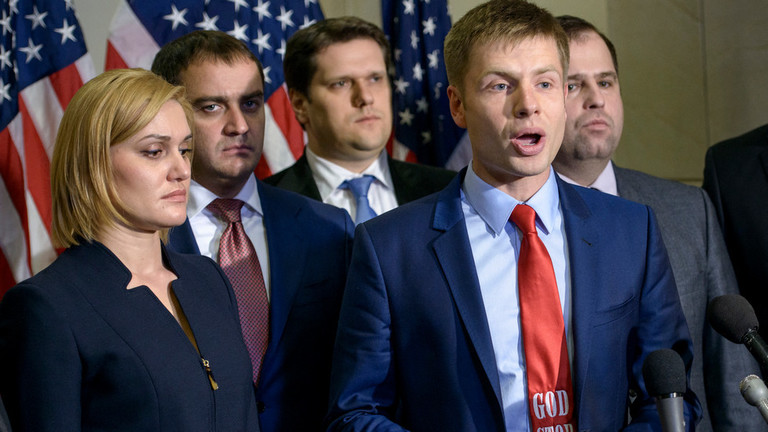
Ukrainian lawmaker Aleksey Goncharenko at a press conference on Capitol Hill on February 5, 2015 in Washington, DC. © AFP PHOTO/BRENDAN SMIALOWSKI
RT | February 24, 2024
Kiev is ready to assist the US in a war against any enemy, be it Iran, North Korea, or China, a senior Ukrainian MP has said, claiming that his country would prove to be a valuable military ally.
In an interview with CNN’s Christiane Amanpour on Friday, Aleksey Goncharenko doubled down on calls for the US to send Ukraine more military aid amid gridlock in Congress. “[The] United States of America told [us that] we will be with you ‘as long as it takes.’ Now it’s time to keep the promises.”
Goncharenko rebuked US politicians for focusing too much on the looming 2024 presidential election, saying Ukraine should not be a “victim” of this. He also claimed that supporting Ukraine serves Washington’s interests regardless of who wins the race for the White House.
In the event of a future war, the Americans “will need people who will stand shoulder to shoulder with them,” but not many nations would be willing to go all-in to support the US, the lawmaker said.
”Ukrainians are ready… We are ready to stand with the United States shoulder-to-shoulder, either in trenches near Tehran, or in North Korea, or near Beijing. No difference,” he stated. “Because we appreciate your support.”
Despite his plea for more Western military aid, Goncharenko argued that Ukraine has “the second strongest army in the free world” after the US, making it “a very valuable ally.”
“But today we need your support to defend our country,” he added, blaming gaps and delays in arms shipments for the loss of the strategic Donbass city of Avdeevka last week. According to the Russian Defense Ministry, the Ukrainian retreat from the heavily fortified city, which was often used as a launching pad to target civilians in Donetsk, turned into a disorganized rout with heavy casualties.
Russian President Vladimir Putin said on Tuesday that the capture of Avdeevka is “certainly a success,” adding that it needs to be advanced further.
Last year, Putin claimed that the Ukrainian government was defending the interests of other countries rather than its own, and that the West was using Kiev as “a battering ram” and a “testing ground” against Russia.
China backs Palestinians’ right to ‘armed struggle’ against Israeli occupation
The Cradle | February 22, 2024
China expressed support for the right of Palestinians to engage in “armed struggle” against Israel, stressing this is not “terrorism” during the fourth day of hearings at the International Court of Justice (ICJ) in a case against Israel’s illegal occupation of Palestinian territories.
“In pursuit of the right to self-determination [the Palestinian people have the right to the] use of force to resist foreign oppression and to complete the establishment of the Palestinian state,” Ma Xinmin, a Chinese Foreign Ministry legal adviser, told the World Court on 22 February.
Citing examples of “various people [who] freed themselves from colonial rule” through armed resistance, Xinmin argued that acts of resistance against the Israeli occupation are “not terrorism” but a legitimate armed struggle and an “inalienable right.”
“Numerous other resolutions recognize the legitimacy of struggle by all available means, including armed struggle by people under colonial domination or foreign occupation to realize the right of self-determination,” the Chinese official said.
“Chinese President Xi Jinping has stressed on multiple occasions that China calls for a comprehensive ceasefire and the early solution to the question of Palestine on the basis of a two-state solution through negotiation,” he added.
Xinmin took to the podium ahead of Iran’s Deputy Foreign Minister for Legal and International Affairs, Reza Najafi, who highlighted Israel’s historic violations of Palestinians’ right to self-determination.
“The establishment of the Israeli regime was done through a violent process which involved the forcible displacement of native Palestinian people to create a majority Jewish colony in line with the Zionist movement,” Najafi said.
He also listed a series of ongoing violations by Tel Aviv, which include the prolonged occupation and manipulation of the demographic composition in the occupied Palestinian territories, the alteration of the character and status of Jerusalem, and the discriminatory measures and violations of the rights of Palestinian people to permanent sovereignty over their natural resources.
“The expansion of settlements, segregated roads and barriers as well as checkpoints has created a system of apartheid which is isolating Palestinian communities,” Najafi added before addressing the UN Security Council (UNSC) for their “inaction or insufficient action,” saying this was one of the “main causes of prolonged occupation of the Palestinians” and highlighting that the top UN body is “paralyzed due to the stalemate” caused by a “certain permanent member.”
“All the atrocities and crimes committed by the Israeli regime in the past almost eight years are a consequence of such inaction,” the Iranian official concluded.
The Iraqi representative to the ICJ, Hayder Shiya al-Barrak, took to the podium next and called on the ICJ to respect previous court orders against Israel, such as the provisions made after South Africa’s case to “stop the systematic killing machine against the Palestinian people.”
“We hope that the court’s commitment to justice will lead to additional decisions … affirming its dedication to ending the campaign of mass murder and preventing acts of genocide as well as policies of harassment, blockade, and starvation against the Palestinian people,” he said.
Barrak concluded his intervention by calling on the World Court to take decisions “that safeguard the lives of the Palestinian man, women, children, and elders, allowing them to enjoy a dignified and secure life where all human rights are achieved.”
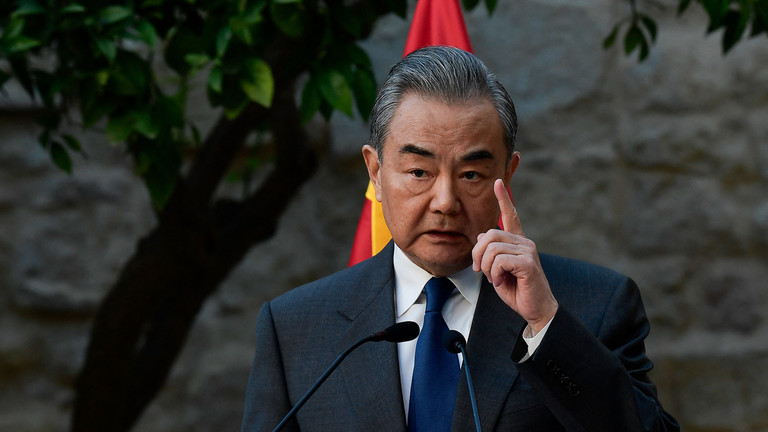
China tells Ukraine it ‘does not sell lethal weapons’ to conflicting sides
RT | February 20, 2024
The Chinese foreign minister has told his Ukrainian counterpart that Beijing remains neutral in the Russia-Ukraine conflict, and will not sell weapons to either side. Wang Yi and Dmitry Kuleba met at the 60th Munich Security Conference on Saturday.
The talks were the first high-level encounter between Beijing and Kiev since Ukrainian President Vladimir Zelensky proposed a meeting with Chinese Premier Li Qiang at the World Economic Forum in Davos in January – a request that was reportedly rejected.
Wang Yi told Kuleba that China will not “add fuel to the fire,” seek to profit from the fighting, or “sell lethal weapons in conflict zones,” according to a readout from the Foreign Ministry. “Even if there is only a glimmer of hope for peace, China will not give up its efforts,” Wang Yi added.
In 2022 the US imposed sanctions on several businesses in China that Washington accused of helping the Russian military. China has refuted US claims that it was considering arming Russia. Ukraine has long been seeking China’s support for a 10-point peace plan, proposed by Zelensky last November, which Russian Foreign Ministry spokeswoman Maria Zakharova has dismissed as “a senseless ultimatum to Russia, aimed at protracting hostilities.” The plan includes the restoration of Ukraine’s 1991 borders.
Since the outbreak of the conflict in February 2022, China has consistently called for a political resolution, and proposed a peace plan of its own last year, demanding a ceasefire and talks. Russian President Vladimir Putin has said the peace initiative presented by China could be taken as a basis for a settlement with Ukraine.
Beijing has resisted Western pressure to impose sanctions on Moscow, while boosting economic cooperation with Russia. Chinese customs data shows that bilateral trade grew 26.6% last year, reaching a record $240 billion.
China demands US lift ‘illegal unilateral sanctions’
RT | February 17, 2024
Chinese Foreign Minister Wang Yi urged US Secretary of State Antony Blinken to remove sanctions on the country’s businesses when the two met on the sidelines of the 60th Munich Security Conference on Friday.
The meeting is the latest in a series of highest-level talks since US President Joe Biden and Chinese President Xi Jinping met in November of last year. Shortly after their summit, the US leader caused outrage in China when he stated that he stood by an earlier comment labeling his Chinese counterpart a “dictator” in response to a question by a journalist.
The two countries ended 2023 with an uneasy detente after a year that brought American panic over alleged Chinese spy balloons, and US tech sanctions that restricted China’s access to advanced chip-making tools and artificial intelligence processors. The two nations have also been locked in a growing military rivalry.
Wang said that pursuing the aim of “decoupling from China” will eventually backfire on the US, as cited by the Chinese Foreign Ministry’s press service. He called on Washington to lift the “illegal unilateral sanctions” against Chinese companies and individuals and not to undermine China’s legitimate right to develop.
Most of the recent sanctions against China were imposed in 2018, when the administration of then-President Donald Trump banned US agencies from using equipment and services from Chinese telecoms giant Huawei, fearing that the company was facilitating espionage.
Tensions escalated further in October 2022, when the Biden administration announced new limits on the sale of semiconductor technology to China, a step aimed at blocking Beijing’s access to critical technologies.
While speaking to his Chinese counterpart on Friday, Blinken raised concerns about China’s alleged support for Russia’s military industrial base. In 2022, the US imposed sanctions against several businesses in China for what Washington claims was aid provided to the Russian military amid the Ukraine conflict.
China has repeatedly denied US claims that it is considering arming Russia. Since the outbreak of the conflict between Russia and Ukraine in February 2022, China has consistently called for a peaceful resolution to the crisis. Beijing has also stood up to Western pressure to join sanctions on Moscow, while instead boosting economic cooperation with Russia. Chinese customs data shows that trade turnover between the two countries has grown by 26.6% percent in the past year, reaching a record $240 billion.
Featured Video

Houthis Keep Advancing as the Red Sea Crisis Deepens
or go to
Aletho News Archives – Video-Images
From the Archives
15 Saudi ‘hijackers’ were CIA agents working for US: Scholar
Press TV – April 13, 2016
Fifteen of the 9/11 “hijackers” from Saudi Arabia were CIA agents working for the United States government, which was seeking to destroy the Middle East for Israel and to double the American military budget, says Dr. Kevin Barrett, an American academic who has been studying the events of 9/11 since late 2003…. continue
Blog Roll
 Aletho News
- Damascus rejects Saudi request for Syrian fighters to counter Yemen: Report
- South Korea says will not send troops to join terrorist US war on Iran
- Russia Just Struck the Eyes of NATO’s War Machine in Ukraine
- Russia summons UK charge d’affaires over Kiev drone support
- NATO member warns bloc seeking pretext for war with Russia
- Macgregor: We Haven’t Seen the Worst of the Iran War Yet
- ‘We are not like everyone else’ laws that bind other nations do not apply to Israel, says Likud lawmaker
- Report: Saudi Arabia seeks allies’ assistance as missiles deplete amid war on Yemen
- Fuel Crisis Deepens: Pakistan Warns Tanker Attack in Red Sea Would Be an ‘Act of War’
- ‘Bucha massacre’ a false flag orchestrated by UK – Moscow
- If Americans Knew
- Robert Kraft: The Billionaire Friend of Netanyahu Pulling The Strings Behind the Macklemore/Ed Sheeran Blow Up
- Columbia Administered Fund Gives Big Money to Pro-Israel Groups
- Deportation Case of Palestinian Activist Salah Sarsour Tests First Amendment
- ‘We Will Not Forget’: Palestinians Mark 44 Years since Sabra and Shatila
- Why do we let Zionists decide what we can and can’t say?
- US welcomes Israeli, Iranian delegations to UN, but not Palestinians – Daily Update
- Biden’s Genocide Accomplices Targeted by New Accountability Campaign
- AIPAC’s Network Has Already Spent $67.2 Million to Shape the Midterm Elections
- Jewish Supremacist Manufacturing a Civilizational Threat to License Bigotry
- US bans Palestinian president from speaking at the UN
- No Tricks Zone
- New Study: ‘Global Drought Shows No Detectable Recent Acceleration Under Climate Warming’
- Economic Masterminds: German Socialists Suggest Taxing Productivity Gains Stemming From Using AI
- The South China Sea Has Not Been Cooperating With The Climate Change Narrative
- Energy Crisis: Germany Enters Heating Season With Historically Low Gas Reserve Fill Levels
- New Study: The Antarctic Ice Sheet Gained Mass From 2020-2024 Due To Staggering Snow And Ice Accumulation
- Study: Ocean Heating Rates From Thousands Of Years Ago ‘Dwarf’ Modern Ocean Heating Rates
- Climate Extremists Target, Attack Large-Scale Power Grid Infrastructure In Germany!
- New Study: Antarctic Ice Melt Has Contributed Less Than 1 Centimeter To Sea Level Rise In The Last 30 Years
- Fear Of Debate: Alarmist German Climate Scientist Calls On Mainstream Media To Discredit Skeptic Voices
- End-Of-August Arctic Sea Ice Extent Hasn’t Fallen In 20 Years, Official Data Show!
 Aletho News