Nicaraguan Coffee Farmers Are Thriving, Contrary To Claims
By Paul Homewood | Not A Lot Of People Know That | March 8, 2021
You would think that a publication calling itself Christian would actually place a premium on telling the truth. Sadly it is only propaganda that matters to the Christian Science Monitor :

Jinotega, Nicaragua
Maria Gonzalez knows that growing coffee in Nicaragua’s northern mountains – as she has done since she was a little girl – gets harder and harder each year.
Rising temperatures are spoiling harvests when berries ripen too fast and a coffee leaf disease wiped out about half of the region’s crop between 2012 and 2014, killing most of Ms. Gonzalez’s plants.
Just as her new plants were starting to flourish, whipping winds and torrential rains from hurricanes Eta and Iota last November uprooted the bushes and shook the unripe berries to the ground.
With an initial hard few years now stretching into a decade, coffee farmers like Ms. Gonzalez face a tough decision: stay loyal to their coffee crop or find a new way to survive.
“I’m experimenting with a lot of things because if I see that one is doing better, I’ll stick with that,” she said. “And if not, we’ll be there fighting for our coffee.”
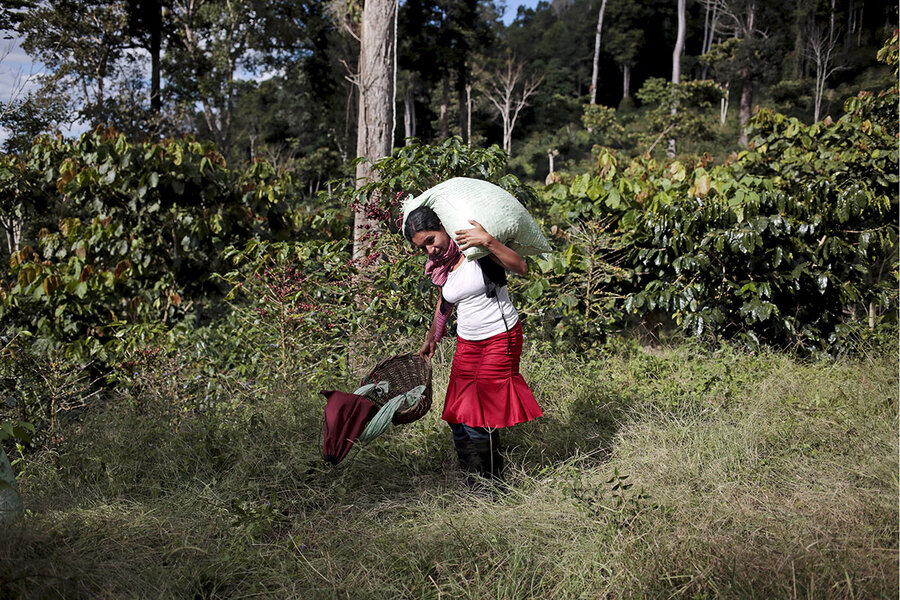
A coffee picker carries sacks of coffee cherries at a plantation in the Nogales farm in Jinotega, Nicaragua January 7, 2016.
Soaring temperatures in Central America due to climate change are forcing farmers to pull up coffee trees and replace them with cocoa, spurring a revival in the cultivation of a crop once so essential to the region’s economy.
This article could hardly be further from the truth.
Coffee production in Nicaragua has been rocketing in recent years, and is double what it was a couple of decades ago:

Nicaragua Coffee Production 1961-2019
http://www.fao.org/faostat/en/#compare
Of course, there are inevitably years when harvests are poor, but the decline in output between 2012 and 2014 was no greater than many other years since 1961.
It is estimated that harvest losses from the two hurricanes, which frequently hit Nicaragua, will be between 10% and 15%., taking output back to 2017 levels. Again, drops of this magnitude are commonplace in Nicaragua.
And far from the Jinotega region being particularly vulnerable as claimed, it is recognised as the best in a country noted for the quality of its coffee:

https://enjoyjava.com/nicaraguan-coffee/#:~:text=%20Here%20are%20the%20major%20coffee-producing%20regions%2C%20as,fruity%20notes%20and%20expected%20flavor%20profile…%20More%20
The simple fact is that coffee plantations are thriving in Nicaragua.
Shame on the Christian Science Monitor for peddling lies.
Why Western media frames civilian areas as “Hezbollah strongholds”
By Sharmine Narwani | Al-Akhbar | August 19, 2013
Beirut was thrown into turmoil on Thursday evening as a terrorist attack against residents of Dahiyeh – a southern suburb of the Lebanese capital and a predominantly Shia neighborhood – threatened to draw the country into a region wide crisis.
As conflicting news reports began to leak out in the immediate aftermath of the city’s deadliest car bombing in eight years, there was a disconcerting congruity in headlines beaming out from western capitals – and it had nothing to do with facts.
 In lock-step, western media was calling the scene of the crime a “Hezbollah stronghold”:
Wall Street Journal: “Car Bomb Blasts Hezbollah Stronghold in Lebanon”
BBC: “Deadly Lebanon Blast in Beirut Stronghold of Hezbollah”
LA Times: “Massive Explosion in Beirut Rocks Hezbollah Stronghold”
Washington Post: “Bomb Explodes in Hezbollah Stronghold in Beirut, Injuring Dozens”
Reuters: “Over 50 Hurt as Car Bomb Hits Hezbollah Beirut Stronghold”
Associated Press: “Car Bomb Rocks Hezbollah Stronghold in Lebanon”
France24: “Car Bomb Rocks Hezbollah Stronghold in Beirut”
A quick Twitter or Google search for “Hezbollah stronghold” is all you need to see how hard western media works to “frame” language and drive use of a phrase that makes Shia civilian life negligible.
On Twitter Thursday night, “tweeps” questioned the validity of this phrase in describing a civilian neighborhood. Said one observer: “When you write “Hezbollah stronghold” instead of South Beirut it gives the impression military barracks were bombed and no innocents died.
That view seemed to be confirmed by the reaction of an American tweep who wrote: “GREAT NEWS!!!!!” in response to the BBC headline “Deadly Lebanon blast in Beirut stronghold of Hezbollah.”
Worse yet was this reprehensible tweet by Al Monitor’s Washington correspondent and senior fellow at the Atalantic Council Barbara Slavin, who declared on Twitter: “As I recall, Hezbollah invented the car bomb; what goes around, comes around.” Except, of course, the targets of Thursday’s terror attack – where 27 died and nearly 300 injured – were civilians, not Hezbollah.
An army of tweeps quickly reminded Slavin that Hezbollah neither invented the car bomb nor targets civilians, and drew attention to the ironic fact that Israeli militant groups used them liberally in attacking British officials in Palestine last century – well before Hezbollah’s 1985 formation to combat Israel’s occupation of Lebanon.
And herein lies the problem. By calling a residential neighborhood a “Hezbollah stronghold,” western media softens public opinion to accept these terror attacks as justifiable, and their targets, legitimate. Because the only reason for characterizing civilian Shia neighborhoods as “strongholds” of Hezbollah is to justify carnage against those populations most likely to support the Lebanese resistance group.
Similar language – War on Terror, terrorism, militants, extremists, Al Qaeda – is also frequently employed to excuse western carnage in countries from Iraq to Afghanistan to Mali to Yemen to Pakistan. Droning and bombing targets are rarely characterized as “civilian,” even though data suggests that most victims of US attacks are not militants. The goal? To eradicate second thoughts about violence against innocent civilians – often bolstered by a complicit media that characterizes these deaths as “collateral damage.”
While the term “stronghold” can simply refer to an area in which an organization, party or point of view holds sway, in the context of US foes in the Mideast, it is instead usually used to suggest a militant base absolutely controlled by that foe. As one tweep noted, western media uses similar language against other American targets to scene-set for “excusable” carnage: “Hezbollah stronghold” for car bombs in Lebanon, “Assad stronghold” for car bombs in Damascus; “Assad heartland” for massacres in Latakia.”
Dahiyeh – the scene of Thursday’s explosion – is also, for instance, home to significant Maronite Christian and Sunni communities. And even within the suburb’s Shia community, there are disparate political views and affiliations. It is by no means true that all Shia residents are supporters of Hezbollah, a Lebanese political party that – in lieu of national political consensus – provides local social services and security for residents of all sects and backgrounds in these areas.
A December Christian Science Monitor article entitled “In Hezbollah Stronghold, Lebanese Christians Find Respect, Stability,” (a piece which repeats the “stronghold” theme and other Hezbollah stereotypes ad nauseum) does however manage to highlight the positive experiences of Maronites living in Dahiyeh neighborhood, Haret Hreik:
The face of the revered Shiite militant leader appears on posters, a calendar, and in several photographs nestled amid those of Christian homeowner Randa Gholam’s family members. Mr. Nasrallah is, Ms. Gholam asserts amid a string of superlatives, “a gift from God.”
Lebanon’s sectarian divides are legendary, and the residents of the historically Christian neighborhood of Harat Hreik, now a Hezbollah stronghold, remember well the civil war that set Beirut on fire. They were literally caught in the middle of some of the most vicious fighting, with factions firing shots off at one another from either side of their apartment buildings.
But in the intervening years, as Hezbollah cemented its control over the suburb of Dahiyeh, which includes Harat Hreik, the militant group has been an unexpected source of stability and even protection for the few remaining Christian families. Just a few blocks away from Nasrallah’s compound is St. Joseph’s Church, a vibrant church that Maronite Christians from across Beirut flock to every Sunday.
“I feel honored to be here. They are honest. They are not extremists. It’s not like everyone describes,” Gholam says. “I can speak on behalf of all my Christian friends. They would say the same thing.”
Why western media uses the term “Hezbollah stronghold”
Dahiyeh is not the only Lebanese area referred to as a “Hezbollah stronghold” by western media. Most Shia towns, cities and neighborhoods in this country are labelled with that moniker – facts be damned. Bekaa, Nabatiyeh, Bint Jbeil, Khiyyam and other predominantly Shia areas are frequently cited as such. Not coincidentally, all these civilian areas have been subjected to Israeli strikes over the years.
While hunting for Scuds in Lebanon two years ago – a search prompted by Israel’s fabricated claim that Hezbollah was hoarding the difficult-to-conceal ballistic missiles – I came across some IDF “3D animated clips” that allegedly “illustrate how Hezbollah has turned over 100 villages in South Lebanon into military bases.”
Introducing an array of IDF computer-generated slides that purport to identify existing Hezbollah weapons stores by marking large Xs in Shia-heavy civilian centers, the Israeli military then alleges:
“Hezbollah stores their weapons near schools, hospitals, and residential buildings in the village of al-Khiam (Khiyyam). They follow similar tactics in villages across southern Lebanon, essentially using the residents as human shields, in gross violation of UN Resolution 1701. al-Khiam was used as a rocket launching site during the Second Lebanon war.”
When I asked him about it, The Independent’s veteran Beirut-based journalist Robert Fisk scoffed at the IDF slide show: “The Israelis are making excuses for the next war crimes. The Scuds don’t exist, they’re not here. I’ve seen the (IDF) pictures – garbage. There’s nothing in those houses.”
Human Rights Watch’s extensive report on Israel’s 2006 attack on Lebanon, entitled Fatal Strikes: Israel’s Indiscriminate Attacks Against Civilians in Lebanon, covers at length the Jewish state’s unproven allegations that Hezbollah stashes weapons among civilian populations – charges that Israel continues to repeat despite evidence to the contrary.
The group’s Executive Director Kenneth Roth concludes: “The pattern of attacks shows the Israeli military’s disturbing disregard for the lives of Lebanese civilians. Our research shows that Israel’s claim that Hezbollah fighters are hiding among civilians does not explain, let alone justify, Israel’s indiscriminate warfare… In the many cases of civilian deaths examined by Human Rights Watch, the location of Hezbollah troops and arms had nothing to do with the deaths because there was no Hezbollah around.”
Instead the Report clearly states:
“Human Rights Watch did not find evidence that the deployment of Hezbollah forces in Lebanon routinely or widely violated the laws of war, as repeatedly alleged by Israel. We did not find, for example, that Hezbollah routinely located its rockets inside or near civilian homes. Rather, we found strong evidence that Hezbollah had stored most of its rockets in bunkers and weapon storage facilities located in uninhabited fields and valleys. Similarly, while we found that Hezbollah fighters launched rockets from villages on some occasions, and may have committed shielding, a war crime, when it purposefully and repeatedly fired rockets from the vicinity of UN observer posts with the possible intent of deterring Israeli counterfire, we did not find evidence that Hezbollah otherwise fired its rockets from populated areas. The available evidence indicates that in the vast majority of cases Hezbollah fighters left populated civilian areas as soon as the fighting started and fired the majority of their rockets from pre-prepared positions in largely unpopulated valleys and fields outside villages.”
Fisk is correct. The Israelis are making excuses for the next war crimes. in 2006, the IDF used the “Hezbollah stronghold” and “human shielding” arguments for carpet bombing Dahiyeh, the very same residential neighborhood targeted by terrorists on Thursday.
And Western journalists act either as dupes or complicitly when they repeat these same Israeli-generated mantras – laying the groundwork for further military and terror strikes against Lebanese civilians.
It is not just Western media that regurgitates this irresponsible language. “Hezbollah stronghold” has been so mainstreamed that virtually all English-language media utilizes the expression, from Iranian-backed Press TV to Moscow’s Russia Today. But online searches identify Western media – by far – as the main driver of this narrative.
Not all Western journalists are complicit though. On Twitter last Thursday, a rare moment of rationality came from a Voice of America source, of all places. VOA reporter Cecily Hilleary bothered to ask the all-important question: “Does term ‘Hezbollah stronghold’ aptly describe this Beirut neighborhood that was just hit by car bomb?” The first two responses were “no” and “it’s a civilian area.”
And as freelance British journalist Patrick Galey, a past Beirut resident, noted sarcastically after the Bir al Abed car bombing in July unleashed another Twitter-frenzy of “Hezbollah stronghold” tweets: “For ‘Hezbollah stronghold’ you can also say “highly-populated civilian area.” Just a thought.”
Watching an elderly woman sitting alone on the steps outside Bahman hospital on Thursday, her head in her hands, sobbing, as she awaited news of a relative injured in the car bomb earlier that day – it seemed ludicrous that the media still uses “Hezbollah stronghold” as a term to describe Israel’s past and future civilian-targeted neighborhoods.
And yet, on Sunday, as four rockets were fired into the northern Bekaa – one landing in a school playground – the “Hezbollah” association was invoked again. There are many dangerous words and phrases used to frame people and events in the Middle East, but here, now, we can collectively make a start to change that.
Sharmine Narwani is a commentary writer and political analyst covering the Middle East. You can follow Sharmine on twitter @snarwani.
Reporting Ahead of Ecuadorean Elections Fits a Familiar Narrative
By Dan Beeton | CEPR Americas Blog | February 17, 2013
International media reporting ahead of Ecuador’s elections today has sounded familiar themes, understating the achievements of the Rafael Correa government and attributing Ecuador’s recent economic and social progress to “luck” or happenstance, and high oil prices. Correa is depicted as an enemy of press freedom, despite the fact that Ecuadorean media is uncensored and the majority of it opposes the government; and despite his granting of political asylum to Julian Assange. He is also depicted as a member of Latin America’s “bad left” who has ambitions of regional leadership should “bad left” leader Hugo Chávez succumb to illness or otherwise be unable to continue in office.
A common theme in press accounts is that the Correa administration’s social programs are “funded by the country’s oil proceeds.” While some reporting has gone deeper and noted that “Correa has taken on big business and media groups, imposing new contracts on oil companies and renegotiating the country’s debt while touting his poverty reduction efforts,” others have not. “High prices for oil exports resulted in higher revenues which the government invested in social programs and public infrastructure,” the Christian Science Monitor reported in a Friday article. The New York Times’ William Neuman presented a contradictory picture of the economic importance of Ecuador’s petroleum sector, writing that “Ecuador is the smallest oil producer in the Organization of the Petroleum Exporting Countries, yet oil sales account for about half of the country’s income from exports and about a third of all tax revenues, according to the United States Energy Information Administration,” just before stating in the next paragraph that “Mr. Correa has taken advantage of high oil prices to put money into social programs, earning him immense popularity, especially among the country’s poor.”
Petroleum exports have been important to Ecuador’s economy for a long time; this did not suddenly come about with Correa. While Correa was favored by high oil prices during most of his six years in office, the collapse of oil prices in 2008 was a major blow to the economy. Also, an important change during Correa’s first term has been the Ecuadorean government’s relationship with foreign oil companies. Correa notably has driven a much harder bargain than his predecessors, “imposing a windfall profits tax for concessions made to companies for the exploitation of domestic natural resources” that “raised over $500 million for the government in 2010,” as our latest paper notes. A raft of financial and regulatory reforms have also put a considerable amount of revenue in the government’s coffers, contributing to the increase from 27 percent of GDP in 2006 to more than 40 percent in 2012. Stimulus spending – 5 percent of GDP in 2009 – boosted the economy and allowed Ecuador to get through the global recession with minimal damage, losing only about 1.3 percent of GDP during three quarters of recession, despite being one of the hardest hit countries in the hemisphere by external shocks. Non-petroleum sectors such as construction, commerce and services have also been important drivers of growth in recent years, including in 2011, when Ecuador had some of the highest real GDP growth in the region at 7.8 percent, second only to Argentina in South America.
As we have pointed out, this additional revenue has in turn allowed the Correa government to ramp up social spending in ways that are significantly improving Ecuadoreans’ living standards. While much news coverage has reported that state spending has boosted Correa’s popularity and may explain his huge lead (some 20 – 50 percentage points, according to polls) over his opponents coming into the election, some reporting has characterized this – as with last year’s election coverage of Venezuela’s state spending– as a form of vote-buying. “Public policies and subsidies are needed to temporarily keep certain sectors content,” the Christian Science Monitor quotes an analyst as saying. “[T]hey also give him votes.” The Associated Press described this as state “largesse,” a term that Merriam-Webster’s dictionary defines as “liberal giving (as of money) to or as if to an inferior; also: something so given.” The media seems at times to forget that the purpose of economic development is to raise peoples’ living standards.
The New York Times presented Ecuador’s recent economic progress by using a passive voice: “[Correa] has governed during a period of relative prosperity,” which not only understates the impact of the Correa administration’s policies but also the challenges presented over the past several years – most notably the global recession, which collapsed not only oil prices but remittances, on which Ecuador was also heavily dependent.
Some reporting has understated some of the ways in which the government’s policies have impacted Ecuadoreans’ lives. For example, the Associated Press reported that “The bulk of [Correa’s] backers are poor and lower-middle class Ecuadoreans who in 2010 represented 37 and 40 percent, respectively, of the country’s population according to the World Bank.” Bloomberg’s Nathan Gill, meanwhile, wrote:
As the head of a nation where about one in three of its 15.4 million citizens live in poverty, Correa defaulted on $3.2 billion of bonds in 2008 and pushed through laws nationalizing the country’s oil reserves during his first two terms in office. While the moves provided short-term gains, the 49-year-old Correa, an ally of Venezuela’s Hugo Chavez, is now paying the cost with stagnant crude output and declines in private investment needed to boost slumping growth.
In fact, as we noted in our new paper, “The national poverty rate fell to 27.3 percent as of December 2012, 27 percent below its level in 2006,” (before Correa came to office). (The New York Times’ Neuman noted this accomplishment: “In a country of 14.6 million people, about 28 percent lived in poverty in 2011, down from 37 percent in 2006, the year before Mr. Correa took office, according to World Bank data.”)
Nor are Ecuador’s recent gains “short term,” as Gill described them. The data shows sustained progress on reducing unemployment and poverty, for example.
Other common themes include that Correa has clamped down on freedom of press. Such statements are often ironically followed by mention of Correa’s granting of political asylum to Wikileaks founder Julian Assange, such as in the Christian Science Monitor sub-header “President Correa has been criticized internationally for limiting press freedoms and granting Julian Assange asylum in Ecuador’s London embassy.” Readers of AFP might be led to believe Assange was granted asylum in order to “irritat[e] the United States …after the anti-privacy group released tens of thousands of secret US military and diplomatic reports.”
Press coverage has emphasized that Correa is “an ally of Venezuela’s Hugo Chavez,” rather than a friend or “ally” of Brazilian President Dilma Rousseff, for example. This meme positions Correa as “part of a group of leftist presidents in the region that include Mr. Chávez in Venezuela and Evo Morales in Bolivia,” also known as the “bad left” in Washington policy circles and among media commentators. (Brazil has always been considered part of the “good left,” despite the Brazilian government’s longstanding support for Chávez, Morales and other “bad left” leaders and opposition to various U.S. government projects and policies.)
Another theme has been whether Correa seeks to be – or has the potential to be – a “successor” to the “ailing” Hugo Chávez in a “regional leadership role.” The New York Times’ Neuman wrote on Friday that “[A new four-year term] may also give Mr. Correa a chance to raise his international profile. With the ailing president of Venezuela, Hugo Chávez, sidelined by cancer, Mr. Correa is arguably the most vocal leftist leader in the region.” No evidence for Correa’s supposed regional leadership ambitions is presented, other than that “He made international headlines last year when he defied Britain by granting asylum to Julian Assange, the founder of WikiLeaks.”
Related article
- Ecuador’s Correa breezes to 2nd re-election (businessweek.com)
Iran likely made captured US drone lose brain: CSM report
Press TV – December 5, 2012
A Western media outlet says the recent capture of a US ScanEagle drone by Iran has likely taken place through the reconfiguration of the aircraft’s GPS coordinates, which made it ‘lose its brain.’
The Christian Science Monitor (CSM) said in a Tuesday report that the technique likely used by the Islamic Republic was “spoofing,” through which Iranian specialists reconfigured the drone’s GPS coordinates to make it land in Iran at what the drone thought was its actual home base in Afghanistan.
It also cited a source as saying, “By putting noise [jamming] on the communications, you force the bird into autopilot. This is where the bird loses its brain.”
Iran’s Islamic Revolution Guards Corps (IRGC) captured the spy drone over the Persian Gulf waters upon its intrusion into the Iranian airspace on Tuesday.
IRGC Navy Commander Rear Admiral Ali Fadavi made the announcement on Tuesday, adding that the Iranian armed forces enjoy full intelligence command over foreign movements in the Persian Gulf region.
The drone, which has a wingspan of 10 feet (three meter), is a long-endurance aircraft built by Insitu, a subsidiary of Boeing.
The CSM said a same technique was used in December 2011, when the Iranian military downed a US RQ-170 Sentinel stealth aircraft after the drone was spotted flying over the northeastern Iran city of Kashmar.
Related articles
- Iran captures another intruding US drone (alethonews.wordpress.com)
- Iran says drone captured, US rejects claim – Times of India (timesofindia.indiatimes.com)
- Iran tells US to ‘recount’ drones (dailystar.com.lb)
Featured Video

The Most Important Bet You’ve Never Heard Of
or go to
Aletho News Archives – Video-Images
From the Archives
Wars for Israel: A reminder of who’s giving the marching orders
By Damian Lataan | February 7, 2012
As the West prepares to march off to yet another war in the Middle East, we should perhaps remind ourselves of who is giving the West their marching orders.
In February 2003, just weeks before the US and their allies launched their attack on Iraq and her peoples, a delegation of US congressmen, together with the US Ambassador to the United Nations, John Bolton, a well known pro-Zionist and neoconservative war-hawk, were in Israel at the invitation of the Israeli government then led by Israeli Prime Minister Ariel Sharon.
Addressing the congressmen, Sharon told them ‘that Iran, Libya and Syria should be stripped of weapons of mass destruction after Iraq’. Later, Sharon told John Bolton ‘that Israel was concerned about the security threat posed by Iran, and stressed that it was important to deal with Iran even while American attention was focused on Iraq’. … continue
Blog Roll
 Aletho News
- UAE rejects report claiming it is ready to join war on Iran to reopen Hormuz
- A New Resistance Front: How Does Syria Factor into the Regional War?
- Gulf states weigh pipeline expansion plans, hoping to bypass Hormuz
- Iran sets up ‘tollbooth’ system in Strait of Hormuz
- Wave 90: IRGC strikes US-linked industrial sites in Gulf
- Iran Says US-Israeli Claims of Its Military Strength Are Wrong
- Trump’s April Fools’ Address to the nation
- The Most Important Bet You’ve Never Heard Of
- The killing of three Indonesian soldiers in Lebanon should remind Jakarta that Israel does not want peace
- Defeated and delusional: Netanyahu’s remarks reveal $80bn war failure, says analyst
- If Americans Knew
- 7 Ways Israel Is Turning Lebanon Into Gaza
- World’s Leading Football Bodies Under Fire Over Israel Policies
- Experts warn of possible use of nukes against Iran
- Israeli invasion of Lebanon could be worse than 1982, warn European officials
- Passover: Liberation and collective punishment
- Trump says the quiet part out loud: (Israel’s) war on Iran > Americans’ health – Daily Update
- Gaza families reunite years after babies evacuated amid Israel’s war
- International Rescue Committee warns Gaza’s children face grave protection risks
- Iran’s Alleged 47-Year War on America: Debunking the 1,050 American Deaths Canard
- Israel wants US to bomb more of Iran’s civilian structures (113,000 is not enough) – Not a ceasefire Day 173
- No Tricks Zone
- Low Intensity Tornado Wrecks Major Solar Farm, Creating A Potential Toxic Dump
- New Study Finds Warming Saves Lives…Cold Temperatures 12 Times More Deadly Than Excess Heat
- German Science Blog Accuses PIK Climate Institute Of Hallucinating Climate Tipping Points
- Devastating Assessment Of Comirnaty Vaccine By Former Senior Pfizer Europe Toxicologist
- New Study: CO2 Is ‘Effectively Negligible’ As An Explanatory Climate Change Factor Since 2000
- Former Pfizer Toxicologist Dr. Helmut Sterz Tells Bundestag Hearing Pfizer Vaccine Should Have Never Been Approved
- Energy Expert: Germany’s Nuclear Phaseout Was A “500 Billion Euro Mistake”
- New Research: South Australia’s Mid-Holocene Sea Surface Temperatures Were 4°C Warmer Than Today
- Storing Green Energy To Last Germany 10 Days Would Require A 60-Million Tonne Battery
- New Studies: UK Sea Levels Were 4 Meters Higher Than Today During The Mid-Holocene
 Aletho News