Fear of the Jews and the Jewish God of Terror

BY LAURENT GUYÉNOT • UNZ REVIEW • MARCH 25, 2024
“It’s time for Jews to be feared!” declared Rabbi Shmuley recently. Jews having failed to overcome anti-Semitism by trying to be loved, respected or admired, must now make themselves feared. This is the new watchword.
The problem is, if Jews want to be feared, then they must also accept being hated. “Fear of the Jews” can be translated, literally, as “Judeophobia” (from the Greek phobos, to fear). To be feared, you must have the power to harm, and you must prove it. So if Jews want to be feared in order to fight anti-Semitism, then anti-Semitism has a bright future ahead.
This all doesn’t make much sense. But it’s very biblical. To my knowledge, the Hebrew Bible does not recommend that Jews should strive to be loved by non-Jews. On the contrary, Yahweh said to his people in Deuteronomy 2:25:
“Today and henceforth, I shall fill the peoples under all heavens with fear and terror of you; whoever hears word of your approach will tremble and writhe in anguish because of you”
If Yahweh wants to spread terror among non-Jews, doesn’t that make him a terrorist, or the god of terrorists? It does, and it makes Zionists good Yahwists. In his 1951 memoir The Revolt, Menachem Begin bragged about “the military victory at Deir Yassin,” because the news of this slaughter of 254 villagers (mostly unarmed men, women, and children) immediately led to the “maddened, uncontrollable stampede of 635,000 Arabs. … The political and economic significance of this development can hardly be overestimated.”[1] Wasn’t Begin a worthy servant of his national god?
What Netanyahu is doing today is more than a hundred Deir Yassins. And the goal, again, is not just to kill indiscriminately, but by doing so to terrorize millions of Palestinians into leaving “voluntarily”. This explains why they let so many images of the martyrdom of Gaza filter: it is a public crucifixion, meant for all to see. (Andrew Anglin has suggested another reason, not contradictory with this one).
One of Netanyahu’s favorite biblical stories is the Book of Esther. He mentioned it in 2015 before the American Congress, as an argument why America should bomb Iran.[2] The Book of Esther is important for understanding how the Jews want to be feared. Under the influence of his minister Haman, the Persian king Ahasuerus issued a decree of final solution regarding the Jews of his kingdom, because “this people, and it alone, stands constantly in opposition to every nation, perversely following a strange manner of life and laws, and is ill-disposed to our government, doing all the harm they can so that our kingdom may not attain stability” (3:13). But thanks to Esther, Ahasuerus’s secretly Jewish wife, the Jews turn the situation around and obtain from the king that Haman be hanged with these ten sons, and that a new royal decree is promulgated, which gives the Jews “permission to destroy, slaughter and annihilate any armed force of any people or province that might attack them, together with their women and children, and to plunder their possessions” (8.11). And so the Jews massacred seventy-five thousand people. Throughout the land, the book concludes, “there was joy and gladness among the Jews, with feasting and holiday-making. Of the country’s population many became Jews, since now the Jews were feared” (8.17).
This story is entirely fictional, but it is very important to Jews, because every year, at Purim, they celebrate the hanging of Haman with his twelve sons, and the massacre of 75,000 people, including women and children.
According to the conclusion of this story, fear of the Jews produces new Jews, meaning Gentiles who become Jews out of fear of the Jews: “many became Jews, since now the Jews were feared.” Or in a more literal translation: “many people became Jews because the fear of the Jews fell upon them.” As I said, fear of Jews is more likely to produce anti-Semites than new Jews. Yet there are many examples of people who make themselves Jews out of fear of the Jews: any non-Jewish politician who one day put a yarmulke on his head and swore eternal loyalty to Israel fits that profile.
There is another story in the Book of Joshua that goes along the same lines. At the beginning of chapter 2, Joshua, who receives his orders directly from Yahweh in the Tabernacle, sends two spies to the city of Jericho. Having been spotted, they hide with a prostitute named Rahab. She helps them escape in exchange for being spared together with her family when Israel attacks the city, because, she says, “we are afraid of you and everyone living in this country has been seized with terror at your approach” (2:9). Because Israel is so terrifying, she assumes that “Yahweh your god is God.”
The French Catholic Bible de Jérusalem adds a footnote saying that “Rahab’s profession of faith in the god of Israel made her, in the eyes of more than one Church Father, a figure of the Gentile Church, saved by her faith.” I find perplexing the idea of making the whore of Jericho a symbol of the Church because, out of fear of Israel, she converted to the god of Israel and helped Israel to commit the genocide of her own city (“men and women, young and old, including the oxen, the sheep and the donkeys, slaughtering them all,” Joshua 6:21).
On the other hand, it is not a bad metaphor for the complicity of the Christian world in the Israeli genocide of Gazans. There is no doubt that, in most Christians today, fear of the Jews is much stronger than pity for the Gazans. And the heads of states of most Christian nation would rather start World War III with Russia than criticize Israel. Russia is, after all, a rational enemy, while no one knows what psychopathic Israel is capable of.
Israel is the only country that openly threatens to blow up the planet. They call it the Samson Option. The Samson Option is the combination of Israel’s nuclear capability and Israel’s reputation as a dangerous paranoid. Everyone knows that Israel has a hundred nuclear warheads (80 according to the Stockholm International Peace Research Institute). And everyone knows that Israel is biblical, eager to fulfill prophecies, such as Zechariah 14:12:
“And this is the plague with which Yahweh will strike all the nations who have fought against Jerusalem; their flesh will rot while they are still standing on their feet; their eyes will rot in their sockets; their tongues will rot in their mouths.”
Martin van Creveld, professor of military history at the University of Jerusalem, explained to the British newspaper The Gardian in 2003 that the Palestinians’ recurrent Intifadas will find only one solution: the “transfer” of all Palestinians out of Palestine. On the risk of opposition from the international community to such a project, he added:
“We possess several hundred atomic warheads and rockets and can launch them at targets in all directions … We have the capability to take the world down with us. And I can assure you that that will happen before Israel goes under.”[i]
That’s the Samson Option in a nutshell. Its essence is nuclear terrorism.
The audacity and impunity of Israel today are incomprehensible if we do not take into account the Samson Option. But the Samson Option, like Jewish Power in general, is taboo: everyone must know about it, but no one has the right to talk about it. This silence is the ultimate test of Israel’s fear. In a very recent post, Seymour Hersh writes:
“No one who’s anyone in Washington is allowed to talk about Israel’s nuclear arsenal. Or how it affects the region. Or whether it serves U.S. interests, even as the Middle East teeters on the brink of regional war.”[3]
As Hersh himself has documented in The Samson Option, it was thanks to the Kennedy assassination that Israel was able to adopt the Samson Option. Jefferson Morley, an investigator on the Kennedy assassination, noted, in a comment on Hersh’s post, that there is also an “Israeli gag” in Kennedy research:
“you can see the effects of the Israeli gag rule in the long-classified testimony of James Angleton, chief of CIA counterintelligence, to Senate investigators in June 1975. The redactions make visible what the U.S. and Israel government seek to conceal in 2024: how Israel obtained nuclear weapons on Angleton’s watch.”[4]
In the extract below, the word “Israeli” has been redacted to conceal the fact that Angleton was running the “Israeli account” and was, in that function, the sole liaison with the Mossad.

In his remarkable biography of Angleton, Morley shows that Angleton’s loyalty to Israel went as far as allowing and covering their smuggling of nuclear materials and technology. As every Kennedy researcher knows, Angleton is also the number one suspect in the CIA for the Kennedy assassination. Which means the CIA trail in the Kennedy assassination runs directly into the Mossad trail (something that Morley avoids saying, as a respectable member of the mainstream It’s-the-CIA school).
I must say that I am very disappointed by President Kennedy’s nephew, Robert Kennedy Junior, who either seems to have no idea of the heavy suspicion hanging over Israel in the assassinations of his uncle and father, or else pretends not to know, or just doesn’t want to know.
And since I started this article talking about Rabbi Shmuley, the sad news is that Rabbi Shmuley is one of RFK Jr.’s friends and advisors. At a rally on July 25, 2023, he introduced Robert Kennedy by mentioning his father:
“On the fifth of June, 1968, at 12:15 am, … Robert Kennedy Sr., one of the greatest Americans who ever lived, was gunned down by a Palestinian domestic terrorist, Sirhan Sirhan, and murdered because of his support for Israel. He was gunned down because he wanted to share the fate of the Jewish people.”
Bobby Jr. listened and took it in, without the slightest sign of disapproval, even though he knows very well that his father was not killed by Sirhan, and certainly not for his support of Israel. He remained frozen and mute in his chair, not even nodding when a brave lady in the audience protested, “Why are you lying? Sirhan Sirhan was not the murderer of Robert Kennedy…”[5] RFK Jr. will not contradict the lying Rabbi.
It’s a sadly revealing moment. By publicly humiliating Robert Kennedy Junior, insulting the memory of his father with his gross lie, right beside him, Shmuley is making an example. To be feared, Jews must show their power by making examples. That’s a good example.
Notes
[1] Menachem Begin, The Revolt: Story of the Irgun, Henry Schuman, 1951, quoted in Alfred Lilienthal, What Price Israel?, op. cit., p. 81.
[2] “Benjamin Netanyahu Speech to Congress 2015” on YouTube.
[3] Seymour Hersh, « It’s Bibi’s War », https://seymourhersh.substack.com/p/its-bibis-war
[4] Jefferson Morley, “In the Last of the JFK Files, Israel’s Nuclear Secrets Are Safe,” 26 féb 2024, https://jfkfacts.substack.com/p/in-the-last-of-the-jfk-files-israels
[5] “Conversation with RFK Jr. 7.25.23” sur www.youtube.com/watch?v=kihS7wFPG6I&t=434s, à partir de 5:30 minutes.
[i] David Hirst, “The War Game”, The Gardian, September 21, 2003: www.guardian.co.uk/world/2003/sep/21/israelandthepalestinians.bookextr
CIA Further Discredits ‘Uyghur Genocide’ by Admitting Covert Influence Campaign
By Patrick Macfarlane | The Libertarian Institute | March 21, 2024
On March 14, Reuters released a bombshell report: in 2019 the Donald Trump White House began a clandestine CIA influence campaign to smear China’s international reputation.
According to three former U.S. officials with direct knowledge, “the CIA created a small team of operatives who used bogus internet identities to spread negative narratives about Xi Jinping’s government while leaking disparaging intelligence to overseas news outlets.” The information releases “targeted public opinion” both internationally and in China itself. Along with influencing public opinion, the campaign sought to “foment paranoia among top leaders [in China]” as they tried to trace the leaked information.
The report specifically stated that CIA operatives “promoted [corruption] allegations” against Chinese government officials and “slammed as corrupt and wasteful China’s Belt and Road Initiative.” Although these specific efforts were identified, the former U.S. officials declined to name additional narratives that were advanced.
Reuters did not confirm that the campaign has continued into the Joe Biden presidency however two “unnamed intelligence historians” told Reuters that such “presidential findings” often remain in place across administrations.
The existence of this CIA influence campaign is probable given the broader historical context.
The Trump Administration marked the extreme acceleration of the United States’ new cold war against China. This began when the Pentagon issued its 2018 National Defense Strategy, which declared a refocus from Middle East “counter-terrorism” to “Great Power Competition” with Russia and China.
Subsequently, 2019 was a banner year for Western escalation against Beijing. In October 2019, the Department of Defense created a new office focused solely on confronting China, called the “deputy assistant secretary of defense for China.” In December 2019, NATO named China as an emerging “challenge.” In 2019 and 2020, the Trump administration doubled U.S. naval transits of the Taiwan Strait over previous years and conducted approximately 1,000 reconnaissance flights over the South China Sea. Of course, when the COVID-19 pandemic arrived in 2020, it was immediately blamed on China.
The above efforts notwithstanding, the main thrust of America’s new cold war against China was informational. America sought to isolate China on the world stage by shredding its international reputation, justifying sanctions, and inhibiting trade. This was clear even before the CIA’s new revelation.
Aside from blaming that nation for COVID-19, the “Uyghur Genocide” narrative was the most prominant vehicle for achieving that goal. But just what focus, if any, does the CIA’s revelation provide to the facts of that narrative as we already know them?
Well, the CIA was there every step of the way.
2019 is the same year that an NGO called the “China Tribunal” began petitioning the UN Human Rights Council, accusing the Chinese Communist Party of conducting an industrial organ harvesting operation that preyed upon Chinese dissidents and Uyghur muslims.
In January 2021, the Trump administration weaponized this claim when Secretary of State Mike Pompeo, fresh off his post as CIA director, formally accused China of committing genocide against Uyghur muslims in its Westernmost provice, Xinjiang. To back this claim, Pompeo referred to the findings of a 2020 report written by a German sociologist named Adrian Zenz. The report was titled “Setilizations, IUDs, and Mandatory Birth Control: The CCP’s Campaign to Suppress Uyghur Birthrates in Xinjiang.” In March 2021, Zenz published an additional report, “The Uyghur Genocide: An Examination of China’s Breaches of the 1948 Convention.”
News outlets the world over declared that these reports were being made by “independent third parties.” Nothing could have been further from the truth.
The China Tribunal has direct connections to the fringe religious group Falun Gong, a Chinese spiritualist cult that runs The Epoch Times and New Tang Dynasty. Furthermore, Zenz’s reports were published by neoconservative think tanks, including the Jamestown Foundation, the Newlines Institute, and the Wallenberg Centre for Human Rights. The Jamestown Foundation itself was founded by the late CIA Director William Casey. The Newlines Institute is led, inter alia, by former employees of the “shadow CIA” private spying firm Stratfor.
Myself and others, including Max Blumenthal, Gareth Porter, and Ajit Singh have demonstrated significant statistical errors, credibility issues, mistranslations of source material, and propagandistic misrepresentations present in each report. These analyses are available elsewhere.
Each of Zenz’s reports rely in part on “leaked PRC government document[s]” to support its findings. These documents are cited by Zenz as the “Karakax List,” the “Aksu List,” and the “China Cables.”
The Karakax lists allegedly shows the reasons why 311 Uyghur individuals were interned in “reeducation camps” in Xinjiang.
The China Cables purportedly consist of “an operations manual for running mass detention camps,” four “secret intelligence briefings” from a mass Chinese Uyghur data collection system, and a regional court sentencing document where a Uyghur man was ordered 10 years’ imprisonment for telling coworkers to practice “Halal.”
According to Zenz, the Karakax List was leaked by the same source that leaked the China Cables. The International Consortium of Investigative Journalists, the organization that published the China Cables, says it received the leaks “via a chain of exiled Uyghurs,” but confirmed the document’s authenticity with several leading experts, including James Mulvenon, vice-president of Defense Group Inc, Zenz, and several intelligence sources who cannot be identified.
In 2019, the leaker identified herself as Ms. Asiye Abdulaheb, an exiled Uyghur living in the Netherlands. Ms. Abdulaheb told Dutch newspapers that she moved from China in 2009, though the documents she leaked were dated from 2017. She did not reveal how she obtained the documents.
As for the Aksu List, Human Rights watch admits it was leaked to them by Radio Free Asia, a Cold War era CIA cutout created to disseminate American propaganda across the continent.
In July 2022, Zenz jointly published a leak with the Victims of Communism Memorial Foundation, an anti-communist cold war project co-founded by President Jimmy Carter’s National Security Advisor Zbiegniew Brzezinski. Zenz gave it the ominous title “the Xinjiang Police Files.”
Zenz claims the documents are “unprecedented evidence” that “proves [the] prison-like nature of re-education camps [and] shows top Chinese leaders’ direct involvement in the mass internment campaign.” The release consists of what is claimed to be “2,800+ Images of Detainees, 300,000+ Personal records, 23,000+ Detainee Records, and 10+ Camp Police Instructions.” According to Zenz, the documents were obtained through hacking by “a third party” who broke into the computer systems of local Chinese government officials.
When the documents were made available for public scrutiny, some anomalies were detected.
For instance, some of the documents’ metadata indicated they had been edited by Zenz and a national security contractor named Ilshat Kokbore. As it turns out, Kokbore was also the president of the American Uyghur Association and was the Director for China Affairs for the World Uyghur Congress—an NGO based in Washington that receives funding from the National Endowment for Democracy. The NED was referred to as the “second CIA” by one of its founders, Allen Weinstein, because it openly performs the work that the CIA used to do covertly.
Others questioned visual anomalies in the detainee images, which suggested they may have been computer generated.
Together, Zenz used the leaks as the centerpiece of his reports accusing China on the international stage. They were cited by every major news outlet, the U.S. State department, and even by the UN High Commissioner for Human Rights.
Zenz’s reports were sold internationally as being “unbiased” and “independent,” but the Reuters revelations place CIA operatives in China “leaking intelligence” for the admitted purpose of destroying China’s international reputation. This operation ran during the primary years of the Uyghur Genocide allegations.
The full weight of this revelation cannot be overstated.
How the Democrats Plan to Steal the Election
By Llewellyn H. Rockwell, Jr. | March 18, 2024
Biden and Trump have clinched the nominations of their parties for President. Everybody is gearing up for a battle between them for the election in November. It’s obvious that Biden is “cognitively impaired.” In blunter language, “brain-dead”. Partisans of Trump are gearing up for a decisive victory. But what if this battle is a sham? What if Biden’s elite gang of neo-con controllers won’t let Biden lose?
How can they stop him from losing? Simple. If it looks like he’s losing, the elite forces will create enough fake ballots to ensure victory. Our corrupt courts won’t stop them. They have done this before, and they will do it again, if they have to.
I said the Democrats have done this before. The great Dr. Ron Paul explains one way they did this in 2020. The elite covered up a scandal that could have wrecked Biden’s chances:
“Move over Watergate. On or around Oct. 17, 2020, then-senior Biden campaign official Antony Blinken called up former acting CIA director Mike Morell to ask a favor: he needed high-ranking former US intelligence community officials to lie to the American people to save Biden’s lagging campaign from a massive brewing scandal.
The problem was that Joe Biden’s son, Hunter, had abandoned his laptop at a repair shop and the explosive contents of the computer were leaking out. The details of the Biden family’s apparent corruption and the debauchery of the former vice-president’s son were being reported by the New York Post, and with the election less than a month away, the Biden campaign needed to kill the story.
So, according to newly-released transcripts of Morell’s testimony before the House judiciary Committee, Blinken “triggered” Morell to put together a letter for some 50 senior intelligence officials to sign – using their high-level government titles – to claim that the laptop story “had all the hallmarks of a Russian disinformation campaign.”
In short, at the Biden campaign’s direction Morell launched a covert operation against the American people to undermine the integrity of the 2020 election. A letter signed by dozens of the highest-ranking former CIA, DIA, and NSA officials would surely carry enough weight to bury the Biden laptop story. It worked. Social media outlets prevented any reporting on the laptop from being posted and the mainstream media could easily ignore the story as it was merely “Russian propaganda.”
Asked recently by Judiciary Committee Chairman Jim Jordan (R-OH) why he agreed to draft the false sign-on letter, Morell testified that he wanted to “help Vice President Biden … because I wanted him to win the election.” Morell also likely expected to be named by President Biden to head up the CIA when it came time to call in favors.
The Democrats and the mainstream media have relentlessly pushed the lie that the ruckus inside the US Capitol on Jan. 6th 2021 was a move by President Trump to overthrow the election results. Hundreds of “trespassers” were arrested and held in solitary confinement without trial to bolster the false narrative that a conspiracy to steal the election was taking place.
It turns out that there really was a conspiracy to steal the election, but it was opposite of what was reported. Just as the Steele Dossier was a Democratic Party covert action to plant the lie that the Russians were pulling strings for Trump, the “Russian disinformation campaign” letter was a lie to deflect scrutiny of the Biden family’s possible corruption in the final days of the campaign.
Did the Biden campaign’s disinformation campaign help rig the election in his favor? Polls suggest that Biden would not have been elected had the American electorate been informed about what was on Hunter Biden’s laptop. So yes, they cheated in the election.
The Democrats and the mainstream media are still at it, however. Now they are trying to kill the story of how they killed the story of the Biden laptop. This is a scandal that would once upon a time have ended in resignation, impeachment, and/or plenty of jail time. If they successfully bury this story, I hate to say it but there is no more rule of law in what has become the American banana republic.” See here.
But the main way the election can be rigged is by fraudulent “voting.” It’s much easier to do this with digital scanning of votes than with old-fashioned ballot boxes.
Dr. Naomi Wolf explains how electronic voting machines make it easier to steal elections:
“People could steal elections in this ‘analog’ technology of paper and locked ballot boxes, of course, by destroying or hiding votes, or by bribing voters, a la Tammany Hall, or by other forms of wrongdoing, so security and chain of custody, as well as anti-corruption scrutiny, were always needed in guaranteeing accurate election counts. But there was no reason, with analog physical processing of votes, to query the tradition of the secret ballot.
Before the digital scanning of votes, you could not hack a wooden ballot box; and you could not set an algorithm to misread a pile of paper ballots. So, at the end of the day, one way or another, you were counting physical documents.
Those days are gone, obviously, and in many districts there are digital systems reading ballots.” See here.
This isn’t the first time the Left has stolen an election. It happened in the 2020 presidential election too. Ron Unz offers his usual cogent analysis:
“There does seem to be considerable circumstantial evidence of widespread ballot fraud by Democratic Party forces, hardly surprising given the apocalyptic manner in which so many of their leaders had characterized the threat of a Trump reelection. After all, if they sincerely believed that a Trump victory would be catastrophic for America why would they not use every possible means, fair and foul alike, to save our country from that dire fate?
In particular, several of the major swing-states contain large cities—Detroit, Milwaukee, Philadelphia, and Atlanta—that are both totally controlled by the Democratic Party and also notoriously corrupt, and various eye-witnesses have suggested that the huge anti-Trump margins they provided may have been heavily ‘padded’ to ensure the candidate’s defeat.” See here.
In a program aired right after Biden’s pitiful State of the Union speech, the great Tucker Carlson pointed out that Biden’s “Justice” Department has already confessed that it plans to rig the election. It will do this by banning voter ID laws as “racist.” This permits an unlimited number of fake votes:
“If Joe Biden is so good at politics, why is he losing to Donald Trump, who the rest of us were assured was a retarded racist who no normal person would vote for? But now Joe Biden is getting stomped by Donald Trump, but he’s also at the same time good at politics? Right.
Again, they can’t win, but they’re not giving up. So what does that tell you? Well, they’re going to steal the election. We know they’re going to steal the election because they’re now saying so out loud. Here is the Attorney General of the United States, the chief law enforcement officer of this country in Selma, Alabama, just the other day.
[Now Carlson quotes the Attorney General, Merrick Garland:]
“The right to vote is still under attack, and that is why the Justice Department is fighting back. That is why one of the first things I did when I came into office was to double the size of the voting section of the Civil Rights Division. That is why we are challenging efforts by states and jurisdictions to implement discriminatory, burdensome, and unnecessary restrictions on access to the ballot, including those related to mail-in voting, the use of drop boxes and voter ID requirements. That is why we are working to block the adoption of discriminatory redistricting plans that dilute the vote of Black voters and other voters of color.
[Carlson then comments on Garland:]
“Did you catch that? Of course, you’re a racist. That’s always the takeaway. But consider the details of what the Attorney General of the United States just said. Mail-in balloting, drop boxes, voter ID requirements. The chief law enforcement officer of the United States Government is telling you that it’s immoral, in fact racist, in fact illegal to ask people for their IDs when they vote to verify they are who they say they are. What is that? Well, no one ever talks about this, but the justification for it is that somehow people of color, Black people, don’t have state-issued IDs. Somehow they’re living in a country where you can do virtually nothing without proving your identity with a government-issued ID without government-issued IDs. They can’t fly on planes, they can’t have checking accounts, they can’t have any interaction with the government, state, local, or federal. They can’t stay in hotels. They can’t have credit cards. Because someone without a state-issued ID can’t do any of those things.
But what’s so interesting is these same people, very much including the Attorney General and the administration he serves, is working to eliminate cash, to make this a cashless society. Have you been to a stadium event recently? No cash accepted. You have to have a credit card. In order to get a credit card you need a state-issued ID, and somehow that’s not racist. But it is racist to ask people to prove their identity when they choose the next President of the United States. That doesn’t make any sense at all. That’s a lie. It’s an easily provable lie, and anyone telling that lie is advocating for mass voter fraud, which the Attorney General is. There’s no other way to read it. So you should know that. You live in a country where the Attorney General is abetting, in fact calling for voter fraud, and that’s the only chance they have to get their guy re-elected.” See here.
Because of absentee ballots, the voting can be spread out over a long period of time. This makes voting fraud much easier. Mollie Hemingway has done a lot of research on this topic:
“In the 2020 presidential election, for the first time ever, partisan groups were allowed—on a widespread basis—to cross the bright red line separating government officials who administer elections from political operatives who work to win them. It is important to understand how this happened in order to prevent it in the future.
Months after the election, Time magazine published a triumphant story of how the election was won by “a well-funded cabal of powerful people, ranging across industries and ideologies, working together behind the scenes to influence perceptions, change rules and laws, steer media coverage and control the flow of information.” Written by Molly Ball, a journalist with close ties to Democratic leaders, it told a cheerful story of a “conspiracy unfolding behind the scenes,” the “result of an informal alliance between left-wing activists and business titans.”
A major part of this “conspiracy” to “save the 2020 election” was to use COVID as a pretext to maximize absentee and early voting. This effort was enormously successful. Nearly half of voters ended up voting by mail, and another quarter voted early. It was, Ball wrote, “practically a revolution in how people vote.” Another major part was to raise an army of progressive activists to administer the election at the ground level. Here, one billionaire in particular took a leading role: Facebook founder Mark Zuckerberg.
Zuckerberg’s help to Democrats is well known when it comes to censoring their political opponents in the name of preventing “misinformation.” Less well known is the fact that he directly funded liberal groups running partisan get-out-the-vote operations. In fact, he helped those groups infiltrate election offices in key swing states by doling out large grants to crucial districts.
The Chan Zuckerberg Initiative, an organization led by Zuckerberg’s wife Priscilla, gave more than $400 million to nonprofit groups involved in “securing” the 2020 election. Most of those funds—colloquially called “Zuckerbucks”—were funneled through the Center for Tech and Civic Life (CTCL), a voter outreach organization founded by Tiana Epps-Johnson, Whitney May, and Donny Bridges. All three had previously worked on activism relating to election rules for the New Organizing Institute, once described by The Washington Post as “the Democratic Party’s Hogwarts for digital wizardry.”
Flush with $350 million in Zuckerbucks, the CTCL proceeded to disburse large grants to election officials and local governments across the country. These disbursements were billed publicly as “COVID-19 response grants,” ostensibly to help municipalities acquire protective gear for poll workers or otherwise help protect election officials and volunteers against the virus. In practice, relatively little money was spent for this. Here, as in other cases, COVID simply provided cover.
According to the Foundation for Government Accountability (FGA), Georgia received more than $31 million in Zuckerbucks, one of the highest amounts in the country. The three Georgia counties that received the most money spent only 1.3 percent of it on personal protective equipment. The rest was spent on salaries, laptops, vehicle rentals, attorney fees for public records requests, mail-in balloting, and other measures that allowed elections offices to hire activists to work the election. Not all Georgia counties received CTCL funding. And of those that did, Trump-voting counties received an average of $1.91 per registered voter, compared to $7.13 per registered voter in Biden-voting counties.
The FGA looked at this funding another way, too. Trump won Georgia by more than five points in 2016. He lost it by three-tenths of a point in 2020. On average, as a share of the two-party vote, most counties moved Democratic by less than one percentage point in that time. Counties that didn’t receive Zuckerbucks showed hardly any movement, but counties that did moved an average of 2.3 percentage points Democratic. In counties that did not receive Zuckerbucks, “roughly half saw an increase in Democrat votes that offset the increase in Republican votes, while roughly half saw the opposite trend.” In counties that did receive Zuckerbucks, by contrast, three quarters “saw a significant uptick in Democrat votes that offset any upward change in Republican votes,” including highly populated Fulton, Gwinnett, Cobb, and DeKalb counties.
Of all the 2020 battleground states, it is probably in Wisconsin where the most has been brought to light about how Zuckerbucks worked.
CTCL distributed $6.3 million to the Wisconsin cities of Racine, Green Bay, Madison, Milwaukee, and Kenosha—purportedly to ensure that voting could take place “in accordance with prevailing [anti-COVID] public health requirements.”
Wisconsin law says voting is a right, but that “voting by absentee ballot must be carefully regulated to prevent the potential for fraud or abuse; to prevent overzealous solicitation of absent electors who may prefer not to participate in an election.” Wisconsin law also says that elections are to be run by clerks or other government officials. But the five cities that received Zuckerbucks outsourced much of their election operation to private liberal groups, in one case so extensively that a sidelined government official quit in frustration.
This was by design. Cities that received grants were not allowed to use the money to fund outside help unless CTCL specifically approved their plans in writing. CTCL kept tight control of how money was spent, and it had an abundance of “partners” to help with anything the cities needed.
Some government officials were willing to do whatever CTCL recommended. “As far as I’m concerned I am taking all of my cues from CTCL and work with those you recommend,” Celestine Jeffreys, the chief of staff to Democratic Green Bay Mayor Eric Genrich, wrote in an email. CTCL not only had plenty of recommendations, but made available a “network of current and former election administrators and election experts” to scale up “your vote by mail processes” and “ensure forms, envelopes, and other materials are understood and completed correctly by voters.”
Power the Polls, a liberal group recruiting poll workers, promised to help with ballot curing. The liberal Mikva Challenge worked to recruit high school-age poll workers. And the left-wing Brennan Center offered help with “election integrity,” including “post-election audits” and “cybersecurity.”
The Center for Civic Design, an election administration policy organization that frequently partners with groups such as liberal billionaire Pierre Omidyar’s Democracy Fund, designed absentee ballots and voting instructions, often working directly with an election commission to design envelopes and create advertising and targeting campaigns. The Elections Group, also linked to the Democracy Fund, provided technical assistance in handling drop boxes and conducted voter outreach. The communications director for the Center for Secure and Modern Elections, an organization that advocates sweeping changes to the elections process, ran a conference call to help Green Bay develop Spanish-language radio ads and geofencing to target voters in a predefined area.
Digital Response, a nonprofit launched in 2020, offered to “bring voters an updated elections website,” “run a website health check,” “set up communications channels,” “bring poll worker application and management online,” “track and respond to polling location wait times,” “set up voter support and email response tools,” “bring vote-by-mail applications online,” “process incoming [vote-by-mail] applications,” and help with “ballot curing process tooling and voter notification.”
The National Vote at Home Institute was presented as a “technical assistance partner” that could “support outreach around absentee voting,” provide and oversee voting machines, consult on methods to cure absentee ballots, and even assume the duty of curing ballots.
A few weeks after the five Wisconsin cities received their grants, CTCL emailed Claire Woodall-Vogg, the executive director of the Milwaukee Election Commission, to offer “an experienced elections staffer that could potentially embed with your staff in Milwaukee in a matter of days.” The staffer leading Wisconsin’s portion of the National Vote at Home Institute was an out-of-state Democratic activist named Michael Spitzer-Rubenstein. As soon as he met with Woodall-Vogg, he asked for contacts in other cities and at the Wisconsin Elections Commission.
Spitzer-Rubenstein would eventually take over much of Green Bay’s election planning from the official charged with running the election, Green Bay Clerk Kris Teske. This made Teske so unhappy that she took Family and Medical Leave prior to the election and quit shortly thereafter.
Emails from Spitzer-Rubenstein show the extent to which he was managing the election process. To one government official he wrote, “By Monday, I’ll have our edits on the absentee voting instructions. We’re pushing Quickbase to get their system up and running and I’ll keep you updated. I’ll revise the planning tool to accurately reflect the process. I’ll create a flowchart for the vote-by-mail processing that we will be able to share with both inspectors and also observers.”
Once early voting started, Woodall-Vogg would provide Spitzer-Rubenstein with daily updates on the numbers of absentee ballots returned and still outstanding in each ward—prized information for a political operative.
Amazingly, Spitzer-Rubenstein even asked for direct access to the Milwaukee Election Commission’s voter database: “Would you or someone else on your team be able to do a screen-share so we can see the process for an export?” he wrote. “Do you know if WisVote has an [application programming interface] or anything similar so that it can connect with other software apps? That would be the holy grail.” Even for Woodall-Vogg, that was too much. “While I completely understand and appreciate the assistance that is trying to be provided,” she replied, “I am definitely not comfortable having a non-staff member involved in the function of our voter database, much less recording it.”
When these emails were released in 2021, they stunned Wisconsin observers. “What exactly was the National Vote at Home Institute doing with its daily reports? Was it making sure that people were actually voting from home by going door-to-door to collect ballots from voters who had not yet turned theirs in? Was this data sharing a condition of the CTCL grant? And who was really running Milwaukee’s election?” asked Dan O’Donnell, whose election analysis appeared at Wisconsin’s conservative MacIver Institute.
Kris Teske, the sidelined Green Bay city clerk—in whose office Wisconsin law actually places the responsibility to conduct elections—had of course seen what was happening early on. “I just don’t know where the Clerk’s Office fits in anymore,” she wrote in early July. By August, she was worried about legal exposure: “I don’t understand how people who don’t have the knowledge of the process can tell us how to manage the election,” she wrote on August 28.
Green Bay Mayor Eric Genrich simply handed over Teske’s authority to agents from outside groups and gave them leadership roles in collecting absentee ballots, fixing ballots that would otherwise be voided for failure to follow the law, and even supervising the counting of ballots. “The grant mentors would like to meet with you to discuss, further, the ballot curing process. Please let them know when you’re available,” Genrich’s chief of staff told Teske.
Spitzer-Rubenstein explained that the National Vote at Home Institute had done the same for other cities in Wisconsin. “We have a process map that we’ve worked out with Milwaukee for their process. We can also adapt the letter we’re sending out with rejected absentee ballots along with a call script alerting voters. (We can also get people to make the calls, too, so you don’t need to worry about it.)”
Other emails show that Spitzer-Rubenstein had keys to the central counting facility and access to all the machines before election night. His name was on contracts with the hotel hosting the ballot counting.
Sandy Juno, who was clerk of Brown County, where Green Bay is located, later testified about the problems in a legislative hearing. “He was advising them on things. He was touching the ballots. He had access to see how the votes were counted,” Juno said of Spitzer-Rubenstein. Others testified that he was giving orders to poll workers and seemed to be the person running the election night count operation.
“I would really like to think that when we talk about security of elections, we’re talking about more than just the security of the internet,” Juno said. “You know, it has to be security of the physical location, where you’re not giving a third party keys to where you have your election equipment.”
Juno noted that there were irregularities in the counting, too, with no consistency between the various tables. Some had absentee ballots face-up, so anyone could see how they were marked. Poll workers were seen reviewing ballots not just to see that they’d been appropriately checked by the clerk, but “reviewing how they were marked.” And poll workers fixing ballots used the same color pens as the ones ballots had been filled out in, contrary to established procedures designed to make sure observers could differentiate between voters’ marks and poll workers’ marks.
The plan by Democratic strategists to bring activist groups into election offices worked in part because no legislature had ever imagined that a nonprofit could take over so many election offices so easily. “If it can happen to Green Bay, Wisconsin, sweet little old Green Bay, Wisconsin, these people can coordinate any place,” said Janel Brandtjen, a state representative in Wisconsin.
She was right. What happened in Green Bay happened in Democrat-run cities and counties across the country. Four hundred million Zuckerbucks were distributed with strings attached. Officials were required to work with “partner organizations” to massively expand mail-in voting and staff their election operations with partisan activists. The plan was genius. And because no one ever imagined that the election system could be privatized in this way, there were no laws to prevent it.
Such laws should now be a priority.” See here.
Let’s do everything we can to publicize the steal. That way, we have a chance to prevent it.
The more thoroughly exposed the CIA’s true face, the better
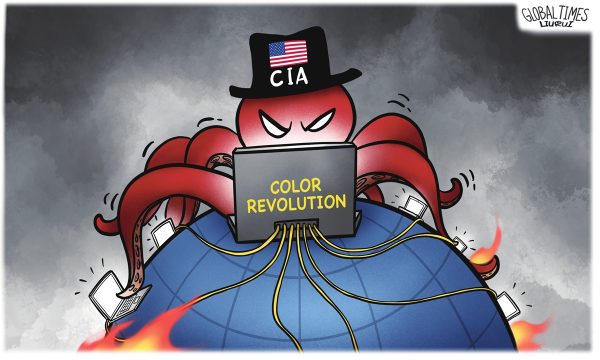
Mother of all disorder Illustration: Liu Rui/GT
Global Times | March 15, 2024
Reuters exclusively reported on Thursday that, according to a former US official with direct knowledge of highly confidential operations, then-US president Donald Trump authorized the Central Intelligence Agency (CIA) to launch secret operations on Chinese social media aimed at “turning public opinion in China against its government.” Many people don’t find this information surprising or even consider it “news.” The US is a habitual offender, using various covert means to foment “peaceful evolution” and “color revolutions” in other countries, with the CIA being the main force employed to this end. For other countries, the US’ pervasive influence is everywhere, visible and tangible, so there is no need for exposés.
We are still unclear what the specific purpose of the “former US official” was in leaking the information to Reuters. A CIA spokesperson declined to comment on the existence of the program, its goals or impact. A spokesperson for the Biden administration’s National Security Council also declined to comment, which means it was neither confirmed nor denied. The US intelligence community often uses a mixture of false and true information to create confusion, a tactic that was used on Edward Snowden. The Reuters report is valuable, but needs to be further processed to filter out the true and useful parts.
Firstly, this report carries a strong defense of US penetration into China. It portrays the proactive offensive of the US’ cognitive warfare against China as a passive counterattack against “cyber attacks” on the US from China and Russia. In reality, portraying themselves as the weak or victimized party and labeling their hegemonic actions as “justice” is a part of the US’ cognitive warfare against foreign countries.
One US official interviewed by Reuters even said it felt like China was attacking the US with “steel baseball bats,” while the US could only fight back with “wooden ones,” showing his exaggerated and clumsy acting skills. The US has never used a “wooden stick.” Over the past few decades, the CIA has overthrown or attempted to overthrow at least 50 legitimate international governments. There are also statistics showing that from 1946 to 2000, the US attempted to influence elections in 45 countries 81 times to achieve regime change. As a habitual offender of manipulating public opinions, the US has long established a series of tactics in its targeted propaganda, information dissemination, event creation, rumor fabrication, incitement of public opinion, and media manipulation. It constantly creates new tactics and uses new technologies according to changing circumstances. This is an open secret. The US dressing itself up as a “little lamb” only has a comedic effect, not a propaganda effect.
Next, as the US’ intervention and infiltration in other countries are covert operations, this disclosure provides an opportunity for the outside world to glimpse into the specific methods used by the US. For example, the whistleblower admitted that the CIA had formed a small team of operatives, using bogus online identities to spread damaging stories about the Chinese government while simultaneously disseminating defamatory content to overseas news agencies. This corroborates with previous statements by CIA Director William Burns, indicating increased resources being allocated for intelligence activities against China, once again confirming the existence of the US “1450” (internet water army) team targeting China.
The whistleblower admitted that the CIA has targeted public opinion in Southeast Asia, Africa, and the South Pacific region, spreading negative narratives about the Belt and Road Initiative. This indicates that in the US-instigated propaganda war against China, the global public opinion arena, especially in “Global South” countries, is their main strategic target. Various “China threat” theories circulating in third-party countries, as consistently pointed out by China, are all being operated by the US intelligence agencies behind the scenes.
The US has never concealed its hegemonic aims, nor does it regard encroachment on other countries’ sovereignty as something to be ashamed of, which is even more infuriating than the hegemonic behavior itself. American economist Jeffrey Sachs criticized the CIA’s blatant violation of international law in his commentary last month, stating that it is “devastating to global stability and the US rule of law,” leading to “an escalating regional war, hundreds of thousands of deaths, and millions of displaced people.” He also criticized the mainstream American media for failing to question or investigate the CIA. In fact, far from acting as watchdogs, mainstream American media has served as an accomplice. How many rumors manufactured by the CIA have been spread through the mouths of mainstream American media? When did they reflect and correct themselves?
We also see that the intentions of the US intelligence agencies are even more sinister. As admitted in the revelations, they aim to force China to spend valuable resources in defending against “cognitive warfare,” keeping us busy with “chasing ghosts,” and disrupting our development pace. First of all, we appreciate their reminder. At the same time, we will not allow external factors to interfere with our strategic determination to manage our own affairs well. For China and the world, the more fully, clearly, and thoroughly the CIA exposes itself, the deeper people will understand its true nature, and the stronger their ability to discern the truth will become. Keeping the CIA busy to no end or failing in their attempts is the best preventive effect.
Patriot Missile Systems Too Complex and Expensive to Be Sent to Ukraine Without US Chaperones
Sputnik – 15.03.2024
While more and more US-supplied weapon systems are taken out by Russian forces in the Ukrainian conflict, the Pentagon vehemently denies the presence of US military personnel in Ukraine who may be operating and maintaining this hardware.
Though a spokesperson for the Pentagon told Russian media that there are no US personnel in Ukraine servicing Patriot missile launchers or some other US hardware, retired US Air Force Lt. Col. Karen Kwiatkowski, a former analyst for the US Department of Defense, did not seem convinced by these claims.
“I think the US government is lying, by omission and also directly, on this question of US servicemen operating or maintaining equipment, specifically the Patriot system, in Ukraine,” Kwiatkowski told Sputnik.
“Given the vulnerability and the expense and the limited number of these systems, I find it difficult to believe that the US contractors and US operators are not involved and monitoring day-to-day activities in each of these areas of operation,” she said. “Maintenance of these systems requires over a year of training, and I expect major maintenance is being monitored and done by US contractors and servicemen.”
Noting that the Patriot missile systems supplied to Kiev were provided by Germany and the US, along with “some missiles and parts from the Netherlands,” the former analyst speculated that “contracted US support connected directly to those countries may also be in the country,” thus “providing deniability for the Pentagon.”
Kwiatkowski also brought up the recent affair involving a leaked call between German military officers discussing attacks against Russian territory, who mentioned “somewhat humorously the large number of people aiding the fight in Ukraine who have ‘an American accent’.”
She pointed out that the CIA that has been “heavily involved in Ukraine” since long before 2022, “often serves as a vehicle with which to take on experts from the US military via direct hiring, temporary assignment, or via the contracted use of skilled retirees from the US active duty military and reserve forces.”
Kwiatkowski added that, considering the cost of the Patriot systems and their missiles, along with the “extensive training required for all aspects of this expensive system,” it would seem that the predictions made last year about the transfer of these weapons being “largely a political statement of support rather than a significant system of air defense for Ukrainian cities” were correct.
The CIA Admits Its Long-Time Presence in Ukraine
By Brad Pearce | The Libertarian Institute | March 13, 2024
On February 25, The New York Times published an article titled “The Spy War: How the CIA Secretly Helps Ukraine Fight Putin.” This report was not the result of any leak, but was clearly authorized from the highest level: the CIA brought reporters in to tell the story. Though many spoke on the condition of anonymity to “discuss intelligence matters and sensitive diplomacy,” they do not even create the pretense that this is a story that the CIA doesn’t want the public to know. The clear purpose, stated almost explicitly near the end of the article, is to guilt the Republicans in Congress into supporting Ukraine aid, with the argument that we are “in too deep” and cannot abandon them like our erstwhile allies in Afghanistan. The impact of the article was muted and it was barely discussed outside of those critical of Ukraine aid, because neither the CIA nor the Times seem to have realized the implications of these admissions: it shows that the post-Maidan government of Ukraine pro-actively made itself the base of a hostile conspiracy against Russia.
The short summary of what The New York Times presents is that after the U.S.-backed “Maidan Revolution” in Ukraine in 2014, the newly appointed spymaster went to the intelligence headquarters to find that all of the files had been destroyed when the previous government left. He immediately called the CIA and MI6 to form an alliance to counter Russia. They created a specialized anti-Russia division, staffed exclusively by people born after the fall of the USSR (at that time, no older than 23) and began training them in spying on and sabotaging Russia. The Ukrainian intelligence agents were anti-Russia zealots who expressed a hatred of all Russian speakers, not simply opposition to Putin’s regime or Russian imperialism. The CIA were unable to control their proteges, who carried out violent missions against Russia and the allied “People’s Republics.” This is described as an American “beachhead” against Russia in Ukraine. Since the February 2022 invasion, the CIA has been involved in acts of war against Russia from a network of U.S.-funded bases across Ukraine.
We haven’t heard any of the normal pontificating about “operational security” and “sources and methods” since this was released. The CIA wants us to read this investigation, and the government isn’t pretending otherwise. Besides the transparent purpose—that it should guilt people into funding Ukraine—there are a few other theories as to why this was released. The first would be that it is a “limited hangout,” meaning they are admitting this much in the hopes people don’t look further into it. The next is that it is what some call “pre-bunking,” which is to say that they know a scandalous story is coming out and this is to get ahead of it. But it takes at least a few weeks to produce a story of this size, if not a couple of months, so it would be really risky to release this hoping it would come out before other information that they could not control the release of; the Times claims to have conducted over 200 interviews with only two authors. The other possibility is that it signifies a coming break up between the CIA and Ukrainian intelligence, which is possible, given that The New York Times published another article titled, “Mutual Frustrations Arise in US-Ukraine Alliance,” which described the relationship in terms clearly meant to invoke a troubled marriage. However, the most likely answer is the simplest: they are proud of what they have done, and think by telling the world it will encourage more funding.
By publishing this in The New York Times, the idea that the CIA was highly active in an anti-Russian conspiracy operating in Ukraine is another thing that has moved from the realm of “conspiracy theory” to “of course it’s true, and here’s why that’s a good thing.” But for all of this, there has been very little discourse about the story, and most of that has been from skeptics of arming Ukraine. It did not have the impact that they wanted, but it seems to have not had impact at all. The supporters of Ukraine throughout the media do not have anything to say about this specific Times article, despite that publication being the gate-keeper of respectable discourse and usually once it prints something it can be discussed everywhere. If this was a ploy to get more funding, it doesn’t seem to have worked.
What both the CIA and The New York Times failed to understand about their story is that it reinforces many of Russia’s key points. The most important of which is that we have constantly been told that Russia presents a threat to all of its neighbors and that Finland and Poland need to be afraid (though they certainly don’t act like it) and that if Russia isn’t stopped in Ukraine they will roll their tanks into Brussels. It doesn’t seem anyone actually believes this, but they say it. The Times exposed a different story, which shows that, as Russia has said, Ukraine was a unique situation for a variety of reasons. Per the Times, it is true that an anti-Russia spy conspiracy was centered in Ukraine, by people who hate all Russian speakers. It’s obvious to a reader that these are drastically irresponsible people driven by ethnic hatred-—towards the people who inhabit a region they want us to help them reconquer and rule. It is a different question if any of what we learn in this article “justifies” a large military invasion which has caused enormous human suffering on both sides, but the CIA has chosen to admit that post-Maidan Ukraine went to great efforts to pose a threat to Russia. This shows that there is no reason to believe Russia poses a threat to any neighbors who would choose to pursue a policy of peace and good relations. I suppose it is no surprise that they would admit everything we are meant to believe about the war is a lie, but expect us to support their war anyway.
Ukraine’s Defeat to Unmask Dirty Secrets of ‘Conflict-Loving’ Western Elites
By Ekaterina Blinova – Sputnik – 06.03.2024
A series of leaks related to NATO military and intelligence operations in Ukraine demonstrate the West’s futile attempts to intimidate Russia into imploding as they once did with the USSR, Wall Street analyst Charles Ortel told Sputnik.
Germany’s “Luftwaffe” leak has triggered a heated debate in the Western mainstream press, with the Guardian warning that NATO is “growing reckless” over Ukraine. Additionally, Politico has acknowledged that the chatter from the Bundeswehr was not part of a Russian “disinformation” operation, but rather a source of “uncensored information”.
“The leak adds to piles of evidence and reasonable suspicions that US and allied governments/contractors/grantees have abandoned adherence to truth-seeking, in favor of shoving a global governance model by unelected bureaucrats upon the masses inside and outside their home countries,” Wall Street analyst and investigative journalist Charles Ortel told Sputnik.
“Ignoring inconvenient and hard truths about Russia now and concerning her history, Biden and the permanent class of conflict-lovers still seem to believe they can intimidate the Russian Federation into imploding as they once did with the Soviet Union,” he highlighted.
The release of a recording featuring German high-ranking officers discussing the possibility of sending Taurus missiles to Ukraine to destroy Russia’s Crimean Bridge occurred shortly after The New York Times published a story about a network of 12 secret bases run by the CIA in Ukraine since 2014.
Surprisingly, some CIA operatives couldn’t resist boasting about the operation right after the Russian special military operation began.
The Washington Post’s Dan Lamothe tweeted in April 2022 about a “bonanza of information” the American military had learned about Russia’s “tactics and procedures” since the beginning of its special military op in Ukraine on February 24, 2022.
In response, Marc Polymeropoulos, a 26-year CIA veteran who retired from a senior rank in 2019, wrote on X (formerly known as Twitter) on April 27, 2022:
“Actually, it started a long time ago… we learned this between 2014-2022. Not just now. It was an 8-year lab experiment on Russian TTPs [Tactics, Techniques, and Procedures]. On EW [electronic warfare]. On everything. This is why Ukrainians (with our advice/assist) are doing so well. Ask those in the IC [intelligence community] and UW [unconventional warfare] communities. We learned a sh*t ton.”
Nonetheless, despite learning “a sh*t ton” about Russia’s warfare strategy, the CIA has failed to prevent a string of defeats sustained by the Ukrainian military on the battlefield. Still, one should bear in mind that US IC agents could have been deployed with other missions rather than turning Ukraine into an impregnable fortress, according to Ortel.
What Dirty Secrets Are Western Leaders Hiding in Ukraine?
For instance, sensitive information about a network of US-funded biowarfare laboratories in Ukraine, uncovered by the Russian Ministry of Defense over the past two years, suggests that American politicians as well as military and intelligence operatives had been involved in potentially illegal activities and experiments in the Eastern European country which are strictly prohibited in the US.
“On Ukraine, one wonders what dirty work Ukrainian officials and contractors may have performed inside and outside Ukraine that could not readily be performed inside the United States,” the Wall Street analyst remarked.
“Because the Deep State over-classifies information and does not appear to be subject to meaningful oversight, we likely will not learn what specific factors brought the US and allied governments to prod so aggressively, painting the Russian Federation as an enemy, instead of welcoming Russia into a re-configured NATO as, apparently, Putin himself suggested. It seems to me that too many at the very top of Western governments see much more personal advantage in milking public sector expenditures for themselves fighting endless real and imagined conflicts than they see in crafting lasting peace and other solutions,” Ortel pointed out.
US Political Families Like the Bidens, Clintons and Others Cashed In On Ukraine
Furthermore, the Wall Street analyst pointed out that established US political dynasty families such as the Bidens and the Clintons pounced at the chance to profit off the situation in Ukraine. A specific example that Ortel discussed with Sputnik was the collaboration between Victor Pinchuk and his wife Olena with the Clinton Foundation to combat HIV/AIDS in Ukraine during the early 2000s. Ortel believes that the fight against AIDS served as a facade for money laundering activities.
“A laudable project conceptually, perhaps, this effort was never legitimately approved in the United States looking through the public record, but allowed the Clintons and their allies to unlock hundreds of millions in government grants and donations for which there has never been a legitimate accounting, just as Hillary Clinton needed a war chest to fund her Senate re-election campaign and her presidential ambitions,” the Wall Street analyst said.
Most recently, the Clinton Foundation announced a similarly questionable charity initiative together with Ukrainian President Volodymyr Zelensky’s wife Olena, Ortel noted, referring to corruption allegations haunting the Zelenskys.
In essence, Ortel believes that numerous Western players, including multinational companies, stand to lose a great deal in the event that Ukraine is defeated. Consequently, some Western leaders have even suggested the idea of deploying NATO military units to Ukraine.
US ‘Forever Wars’ Impoverishing Americans
No matter how hard the West tries to win its proxy war in Ukraine, the outcome of the conflict appears to be sealed, Ortel affirms. What’s more, the US has been repeatedly engaged in protracted overseas military conflicts, most of which had not ended on Washington’s terms.
“Especially in Vietnam, then afterwards in the Middle East, Afghanistan, and Ukraine, ‘policy-makers’ and ‘thought-leaders’ have failed to learn from their grievous mistakes,” the analyst said. “Instead of pursuing lasting peace or actually tackling vexing problems, many worship at the altar of perpetual wars, secure in the knowledge that industry patrons and egomaniacal billionaires will reward them richly along the way, and that they may never be punished for their misdeeds,” he noted.
Meanwhile, ordinary Americans have not reaped any “bonanzas” from this decades-long war economy; instead, they have witnessed their living standards decline, he pointed out.
“As the world enmeshed after 1988, profit margins across the private sector (in a true and consistent accounting) fell, as did per hour incomes, adjusted for taxes and inflation. Over the same period and accelerating now under the husk of President Biden, public sector bureaucrats at all levels learned they could appropriate humongous sums of money, and then direct vast portions to themselves through family members and other supporters, via ‘leaky’ foundations, large and small.”
Ortel believes that regardless of NATO increasingly beating the war drums over its proxy conflict in Ukraine, “support for more fighting in Ukraine and against Russia will ebb” both in the US and Europe. A potential harbinger of change is the decision by Maidan coup plotter, Victoria Nuland, to step down from her position as Under Secretary of State for Political Affairs, according to the analyst.
Free Speech on Trial
By Jeffrey Tucker | Brownstone Institute | March 1, 2024
In a lifetime of observing policy controversies and court cases, we’ve never witnessed anything as crucial to the future of the idea of freedom itself compared with what will transpire on March 18, 2024. On that day, the Supreme Court will hear arguments in Murthy v. Missouri concerning whether the government can force or nudge private companies to censor users on behalf of regime priorities.
The evidence that they have been doing so is overwhelming. That’s why the 5th Circuit issued an emergency injunction to stop the practice on grounds that it is inconsistent with the First Amendment of the US Constitution. The censorship industrial complex is working right now and hourly to delete free speech in America. That injunction was stayed pending a review by the highest court.
The case itself hasn’t even gone to court. This decision is only about the injunction itself, which was issued based on the alarming results of discovery alone. Essentially, the lower court is screaming “This must stop.” The Supreme Court is trying to assess whether the violations of liberty are extreme enough to justify a pre-trial intervention now.
A positive ruling for the plaintiffs doesn’t solve every problem but at least it will mean that freedom still stands a chance in this country. A ruling for the defense, which is essentially the government itself, will give license to every federal agency – including those that operate in secret like the FBI and CIA – to threaten every social media and media company in this country to delete any and all content that runs contrary to the approved narrative.
There will be celebration in Washington if this happens. On the other hand, there will be tears if the court decides for the defense. It could be that the court will take an in-between position, refusing to let the injunction go ahead and promising some possible decision at a later date pending trial. That would be a disaster because it could mean three or more years of full censorship pending an appeal of whatever the outcome of the trial is.
Free speech is everything. If we don’t have that, we have nothing and freedom is toast. All other problems pale in comparison. There are plenty of them, from healthcare to immigration but if we don’t have free speech, we cannot get the truth out about any of them. The censorship industrial complex is wholly dedicated to making sure that we have no debates at all and that dissident voices are not even heard.
As it is, Google, Microsoft, and Facebook – and many more besides – already heavily restrict speech. They work in cooperation with government and those tasked by government to do elite bidding. We know this for a fact.
When Elon Musk took over Twitter, he discovered a vast censorship machine operating on behalf of the FBI and other agencies. Millions of posts were being taken down along with users. He has done his best to rip out the guts of this borg. Doing so entirely changed the character of the site. It became useful again.
Not even the scale of the problem is widely understood. Usually people say that free speech is necessary to protect minority opinions. In this case, the numbers don’t matter to the censors. You could have 90% of users trying to advance an idea and still have it censored. This is what the old Twitter did. It was daily and hourly attacking the company’s user base. This was their job, no matter how much it contradicts the whole point of social media.
Brownstone is predictably throttled by all these companies but it is not just about us. It is about everyone who disagrees with the Davos “Great Reset” agenda. This could pertain to EVs, gender transitions, lockdowns, immigration, or anything else. Even now, the Google Artificial Intelligence engine extols the glories of lockdowns, masking, and mass injections while completely ignoring contrary science. This is how they want things to be. Google’s search engine is no better. It might as well be a federal agency.
The Justices hearing the case will be in an awkward position. My guess is that none of them even know that this was going on to the extent it is. They will likely be shocked when they look at the evidence proving that there is a trillion-dollar industry in full operation that has massively distorted the public mind. Every federal agency is involved, deeply embedded in the operations of all media companies and digital technology, which in turn requires universal surveillance and persecution of contrary voices.
Until just a few years ago, this entire industry – which involves federal agencies, universities, nonprofits, shadow companies, bogus fact-checks, and every manner of spook-operated front companies – was not known to exist. Now that we know, we are shocked by the extent of it. It has invaded the whole of our lives to the point that we cannot tell the real news from that which is fed to us by intelligence agencies. Even worse, we’ve come to expect that most of what passes for approved opinion is flat-out false.
The Justices will discover this truth. They will likely be astonished. But they will also be taken aback by how integral to our lives it has become. As it turns out, the federal government for nearly a decade has placed a very high priority on curating the public mind, lying at every turn for its own benefit and that of its industrial partners.
Everyone in the old Soviet Union knew for sure that Pravda spoke for the Communist Party. But do people understand that their Google search results and Facebook timelines are no better? It’s not clear whether and to what extent people do understand this but it is our reality.
Will the Justices really be willing to pull the plug on the entire machinery? Doing that would be more disruptive of an established interest group than anything the court has done in many years or even ever. It would fundamentally change the way our technologies work. It would be devastating to federal agencies. Policing such a new system called free speech would be another matter entirely. It would mean that thousands of people would suddenly have nothing to do. That would be wonderful, but would it happen?
As I say, censorship is now an entire global industry. It involves the world’s most powerful foundations, governments, universities, and influencers. It seems like everyone wants a part in crushing what they called “disinformation,” “misinformation,” and “malinformation,” which is true information that they don’t want out. We are surrounded by this machinery of control and yet most people have no clue.
Every federal agency at this point has taken it upon themselves to cajole every information provider into rigging the system so that only one perspective gets out. This has a massive impact on public opinions.
As an example, four years ago, I wrote an article that accidentally made it through the censors and I watched as millions read my piece. Even now, I hear about it at cocktail parties coming from total strangers who don’t know that I’m the author. Nothing like that has happened since that magical day. Most of my writing goes into a dark hole, and this is despite writing daily for the 4th largest newspaper and having access to a huge public forum at Brownstone. People without such access do not stand a chance. Their posts on Facebook are disappeared the instant they post, while YouTube slams their content as contrary to community standards, with no other explanation.
Self-censorship has become the habitual practice of the intellectual class. Otherwise you only beat your head up against the wall and make yourself a target. Minute-by-minute in real time, public opinion is being shaped by this wicked industry, which dramatically distorts political outcomes.
As I say, this is surely the most important issue we face. A decision by the Supreme Court to let this go on – seeing no real issue here – will lead straight to our doom and the death of freedom itself.
There’s an additional problem that is very serious. These days, there is a massive race on to program censorship into the algorithms themselves so that no one is actually doing it, so that there cannot be any real defendants in a case against them. AI will soon be running everything so that Google and Facebook etc can simply say that their machine learning is doing the dirty work.
Perhaps one of the reasons AI has hit us with such a rush is precisely because of this case before the court. The deep state and its industrial partners are not going to give up easily. Everything depends on their victory over free speech, so far as they are concerned.
This is very worrisome, which is why one should hope for a sweeping statement by the Supreme Court that reaffirms the fundamental American commitment to have government completely out of the business of manipulating public opinion through curating what information you see and read and what you do not see and read.
It’s tragic that such a fundamental human right should so heavily depend on the majority decision of this one body. It’s not supposed to work this way. The First Amendment is supposed to be law but these days, the government has built an entire empire around the idea that it simply does not matter. The job of the Supreme Court is to remind our overlords that the people are not merely putty in the hands of deep state agents. We have fundamental rights that cannot be abridged.
There is a rally scheduled outside the court on March 18th, with many speakers making themselves available to the press. Note the sponsoring organizations: these are the freedom fighters in America today. You are welcome to join us.
It won’t sway the court, of course. And the crowds will surely be thinner than they otherwise would be given how much success the censorship industry already enjoys. Still, it is worth a shot.
Truly, we should all shudder to think of the future of American freedom in absence of a decisive statement by the court on behalf of the basic liberty the Framers intended be protected for everyone.
Jeffrey Tucker is Founder, Author, and President at Brownstone Institute.
The Rome-Kiev Pact of Steel Under CIA Shadow
By Manlio Dinucci | Global Research | March 3, 2024
The “Agreement on security cooperation” between Italy and Ukraine, which Italian Prime Minister Meloni and President Zelensky signed in Kijev, is not a formal declaration, but a real military pact that makes Italy a belligerent country in the war against Russia.
The pact commits Italy to supply more armaments to Kijv and to train its troops according to NATO operational procedures. Not only this. The pact states that:
“In the event of a future Russian armed attack against Ukraine, Italy, and Ukraine will consult within 24 hours to determine the measures necessary to counter the aggression and Italy will provide Ukraine with rapid defence support.”
Since French President Macron announced that European NATO countries might send their troops to Ukraine against Russia, there is a real possibility that Italy will do so too, taking us directly into war against Russia. Moscow’s voice went unheeded, warning that in this case there would be a direct clash between NATO forces and Russian forces, both equipped with nuclear weapons.
In this situation, “the war of spies” takes place. As a major New York Times investigation shows, the CIA has built its vast network in Ukraine and other European countries. It trains Ukrainian agents on how to assume false identities and “find out Russian spies in other countries!” The program was called Operation Goldfish. Operation Goldfish operatives have been deployed to 12 new operational bases along the Russian border, linked to two new secret electronic espionage bases.
What Zelensky declared falls into the same context: “Meloni is with us but there are too many pro-Putin in Italy.” Zelensky then announced: “We are preparing a list of Russian propagandists – it is not regarding only Italy. It’s a long list and we want to present it to the European Commission, to the European Parliament, to the EU leaders.” Soon, therefore, Zelensky will hand over to Meloni the proscription list of “pro-Putins”, drawn up by the CIA.
The CIA in Ukraine — The NY Times Gets a Guided Tour
By Patrick Lawrence | ScheerPost | February 29, 2024
If you have paid attention to what various polls and officials in the U.S. and elsewhere in the West have been doing and saying about Ukraine lately, you know the look and sound of desperation. You would be desperate, too, if you were making a case for a war Ukrainians are on the brink of losing and will never, brink or back-from-the-brink, have any chance of winning. Atop this, you want people who know better, including 70 percent of Americans according to a recent poll, to keep investing extravagant sums in this ruinous folly.
And here is what seems to me the true source of angst among these desperados: Having painted this war as a cosmic confrontation between the world’s democrats and the world’s authoritarians, the people who started it and want to prolong it have painted themselves into a corner. They cannot lose it. They cannot afford to lose a war they cannot win: This is what you see and hear from all those good-money-after-bad people still trying to persuade you that a bad war is a good war and that it is right that more lives and money should be pointlessly lost to it.
Everyone must act for the cause in these dire times. You have Chuck Schumer in Kyiv last week trying to show House Republicans that they should truly, really authorize the Biden regime to spend an additional $61 billion on its proxy war with Russia. “Everyone we saw, from Zelensky on down made this very point clear,” the Democratic senator from New York asserted in an interview with The New York Times. “If Ukraine gets the aid, they will win the war and beat Russia.”
Even at this late hour people still have the nerve to say such things.
You have European leaders gathering in Paris Monday to reassure one another of their unity behind the Kyiv regime—and where Emmanuel Macron refused to rule out sending NATO ground troops to the Ukrainian front. “Russia cannot and must not win this war,” the French president declared to his guests at the Elysée Palace.
Except that it can and, barring an act of God, it will.
Then you have Jens Stoltenberg, NATO’s war-mongering sec-gen, telling Radio Free Europe/Radio Liberty last week that it will be fine if Kyiv uses F–16s to attack Russian cities once they are operational this summer. The U.S.–made fighter jets, the munitions, the money—all of it is essential “to ensure Russia doesn’t make further gains.” Stephen Bryen, formerly a deputy undersecretary at the Defense Department, offered an excellent response to this over the weekend in his Weapons and Strategy newsletter: “Fire Jens Stoltenberg before it is too late.”
Good thought, but Stoltenberg, Washington’s longtime water-carrier in Brussels, is merely doing his job as assigned: Keep up the illusions as to Kyiv’s potency and along with it the Russophobia, the more primitive the better. You do not get fired for irresponsible rhetoric that risks something that might look a lot like World War III.
What would a propaganda blitz of this breadth and stupidity be without an entry from The New York Times ? Given the extent to which the Times has abandoned all professional principle in the service of the power it is supposed to report upon, you just knew it would have to get in on this one.
The Times has published very numerous pieces in recent weeks on the necessity of keeping the war going and the urgency of a House vote authorizing that $61 billion Biden’s national security people want to send Ukraine. But never mind all those daily stories. Last Sunday it came out with its big banana. “The Spy War: How the C.I.A. Secretly Helps Ukraine Fight Putin” sprawls—lengthy text, numerous photographs. The latter show the usual wreckage—cars, apartment buildings, farmhouses, a snowy dirt road lined with landmines. But the story that goes with it is other than usual.
Somewhere in Washington, someone appears to have decided it was time to let the Central Intelligence Agency’s presence and programs in Ukraine be known. And someone in Langley, the CIA’s headquarters, seems to have decided this will be O.K., a useful thing to do. When I say the agency’s presence and programs, I mean some : We get a very partial picture of the CIA’s doings in Ukraine, as the lies of omission—not to mention the lies of commission—are numerous in this piece. But what the Times published last weekend, all 5,500 words of it, tells us more than had been previously made public.
Let us consider this unusually long takeout carefully for what it is and how it came to make page one of last Sunday’s editions.
In a recent commentary I reflected on the mess the Times landed in when it published a thoroughly discredited p.o.s.—and I leave readers to understand this newsroom expression—on the sexual violence Hamas militias allegedly committed last Oct. 7. I described a corrupt but routinized relationship between the organs of official power and the journalists charged with reporting on official power, likening it to a foie gras farmer feeding his geese: The Times’s journalists opened wide and swallowed. For appearances’ sake, they then set about dressing up what they ingested as independently reported work. This is the routine.
It is the same, yet more obviously, with this extended piece on the CIA’s activities in Ukraine. Adam Entous and Michael Schwirtz tell the story of—this the subhead—“a secret intelligence partnership with Ukraine that is now critical for both countries in countering Russia.” They set the scene in a below-ground monitoring and communications center the CIA showed Ukrainian intel how to build beneath the wreckage of an army outpost destroyed in a Russian missile attack. They report on the archipelago of such places the agency paid for, designed, equipped, and now helps operate. Twelve of these, please note, are along Ukraine’s border with Russia.
Entous and Schwirtz, it is time to mention, are not based in Ukraine. They operate from Washington and New York respectively. This indicates clearly enough the genesis of “The Spy War.” There was no breaking down of doors involved here, no intrepid correspondents digging, no tramping around in Ukraine’s mud and cold, unguided. The CIA handed these two material according to what it wanted and did not want disclosed, and various officials associated with it made themselves available as “sources”—none of the American sources named, per usual.
Are we supposed to think these reporters found the underground bunker and all the other such installations by dint of their “investigation”—a term they have the gall to use as they describe what they did? And then they developed some kind of grand exposé of all the agency wanted to keep hidden? Is this it?
Sheer pretense, nothing more. Entous and Schwirtz opened wide and got fed. There appears to be nothing in what they wrote that was not effectively authorized, and we can probably do without “effectively.”
There is also the question of sources. Entous and Schwirtz say they conducted 200 interviews to get this piece done. If they did, and I will stay with my “if,” they do not seem to have been very good interviews to go by the published piece. And however many interviews they did, this must still be counted a one-source story, given that everyone quoted in it reflects the same perspective and so reinforces, more or less, what everyone else quoted has to say. The sources appear to have been handed to Entous and Schwirtz as was access to the underground bunker.
The narrative thread woven through the piece is interesting. It is all about the two-way, can’t-do-without-it cooperation between the CIA and Ukraine’s main intel services—the SBU (the domestic spy agency) and military intelligence, which goes by HUR. In this the piece reads like a difficult courtship that leads to a happy-at-last consummation. It took a long time for the Americans to trust the Ukrainians, we read, as they, the Americans, assumed the SBU was thick with Russian double agents. But the Ukrainian spooks enticed them with stacks and stacks of intelligence that seems to have astonished the CIA people on the ground and back in Langley.
So, a tale with two moving parts: The Americans helped the Ukrainians get their technology, methods, and all-around spookery up to snuff, and the Ukrainians made themselves indispensable to the Americans by providing wads of raw intel. Entous and Schwirtz describe this symbiosis as “one of Washington’s most important intelligence partners against the Kremlin today.” Here is how a former American official put it, as the Times quotes him or her:
The relationships only got stronger and stronger because both sides saw value in it, and the U.S. Embassy in Kyiv—our station there, the operation out of Ukraine—became the best source of information, signals and everything else, on Russia. We couldn’t get enough of it.
As to omissions and commissions, there are things left out in this piece, events that are blurred, assertions that are simply untrue and proven to be so. What amazes me is how far back Entous and Schwirtz reach to dredge up all this stuff—even to the point they make fools of themselves and remind us of the Times’s dramatic loss of credibility since the current round of Russophobia took hold a decade ago.
Entous and Schwirtz begin their account of the CIA–SBU/HUR alliance in 2014, when the U.S. cultivated the coup in Kyiv that brought the present regime to power and ultimately led to Russia’s military intervention. But no mention of the U.S. role in it. They write, “The CIA’s partnership in Ukraine can be traced back to two phone calls on the night of Feb. 24, 2014, eight years to the day before Russia’s full-scale invasion.” Neat, granular, but absolutely false. The coup began three days earlier, on Feb. 21, and as Vladimir Putin reminded Tucker Carlson during the latter’s Feb. 6 interview with the Russian president, it was the CIA that did the groundwork.
I confess a special affection for this one: “The Ukrainians also helped the Americans go after the Russian operatives who meddled in the 2016 U.S. presidential election,” Entous and Schwirtz write. And later in the piece, this:
In one joint operation, a[n] HUR team duped an officer from Russia’s military intelligence service into providing information that allowed the C.I.A. to connect Russia’s government to the so-called Fancy Bear hacking group, which had been linked to election interference efforts in a number of countries.
Wonderful. Extravagantly nostalgic for that twilight interim that began eight years ago, when nothing had to be true so long as it explained why Hillary Clinton lost to Donald Trump, and why Donald Trump is No. 1 among America’s “deplorables.”
I have never seen evidence of Russian government interference in another nation’s elections, including America’s in 2016, and I will say with confidence you haven’t, either. All that came to be associated with the Russiagate fable, starting with the never-happened hack of the Democratic Party’s mail, was long ago revealed to be concocted junk. As to “Fancy Bear,” and its cousin “Cozy Bear”—monikers almost certainly cooked up over a long, fun lunch in Langley—for the umpteenth time these are not groups of hackers or any other sort of human being: They are sets of digital tools available to anyone who wants to use them.
Sloppy, tiresome. But to a purpose. Why, then? What is the Times’s purpose in publishing this piece?
We can start, logically enough, with that desperation evident among those dedicated to prolonging the war. The outcome of the war, in my read and in the view of various military analysts, does not depend on the $61 billion in aid that now hangs in the balance. But the Biden regime seems to think it does, or pretends to think it does. The Times’s most immediate intent, so far as one can make out from the piece, is to add what degree of urgency it can to this question.
Entous and Schwirtz report that the people running Ukrainian intelligence are nervous that without a House vote releasing new funds “the CIA will abandon them.” Good enough that it boosts the case to cite nervous Ukrainians, but we should recognize that this is a misapprehension. The CIA has a very large budget entirely independent of what Congress votes one way or another. William Burns, the CIA director, traveled to Kyiv two weeks ago to reassure his counterparts that “the U.S. commitment will continue,” as Entous and Schwirtz quote him saying. This is perfectly true, assuming Burns referred to the agency’s commitment.
More broadly, the Times piece appears amid flagging enthusiasm for the Ukraine project. And it is in this circumstance that Entous and Schwirtz went long on the benefits accruing to the CIA in consequence of its presence on the ground in Ukraine. But read these two reporters carefully: They, or whoever put their piece in its final shape, make it clear that the agency’s operations on Ukrainian soil count first and most as a contribution to Washington’s long campaign to undermine the Russian Federation. This is not about Ukrainian democracy, that figment of neoliberal propagandists. It is about Cold War II, plain and simple. It is time to reinvigorate the old Russophobia, thus—and hence all the baloney about Russians corrupting elections and so on. It is all there for a reason.
To gather these thoughts and summarize, This piece is not journalism and should not be read as such. Neither do Entous and Schwirtz serve as journalists. They are clerks of the governing class pretending to be journalists while they post notices on a bulletin board that pretends to be a newspaper.
■
Let’s dolly out to put this piece in its historical context and consider the implications of its appearance in the once-but-fallen newspaper of record. Let’s think about the early 1970s, when it first began to emerge that the CIA had compromised the American media and broadcasters.
Jack Anderson, the admirably iconoclastic columnist, lifted the lid on the agency’s infiltration of the media by way of a passing mention of a corrupted correspondent in 1973. A year later a former Los Angeles Times correspondent named Stuart Loory published the first extensive exploration of relations between the CIA and the media in the Columbia Journalism Review. Then, in 1976, the Church Committee opened its famous hearings in the Senate. It took up all sorts of agency malfeasance—assassinations, coups, illegal covert ops. Its intent was also to disrupt the agency’s misuse of American media and restore the latter to their independence and integrity.
The Church Committee is still widely remembered for getting its job done. But it never did. A year after Church produced its six-volume report, Rolling Stone published “The CIA and the Media,” Carl Bernstein’s well-known piece. Bernstein went considerably beyond the Church Committee, demonstrating that it pulled its punches rather than pull the plug on the CIA’s intrusions in the media. Faced with the prospect of forcing the CIA to sever all covert ties with the media, a senator Bernstein did not name remarked, “We just weren’t ready to take that step.”
We should read the Times’s piece on the righteousness of the CIA’s activities in Ukraine—bearing in mind the self-evident cooperation between the agency and the newspaper—with this history in mind.
America was just emerging from the disgraces of the McCarthyist period when Stuart Loory opened the door on this question, the Church Committee convened, and Carl Bernstein filled in the blanks. In and out of the profession there was disgust at the covert relationship between media and the spooks. Now look. What was then viewed as top-to-bottom objectionable is now routinized. It is “as usual.” In my read this is one consequence among many of the Russiagate years: They again plunged Americans and their mainstream media into the same paranoia that produced the corruptions of the 1950s and 1960s.
Alas, the scars of the swoon we call Russiagate are many and run deep.
CIA behind Ukrainian disaster

Jason Freeman
By Lucas Leiroz | February 29, 2024
The disastrous actions of American intelligence in Ukraine have been a fact known by analysts since the beginning of the conflict. However, now the Americans themselves are admitting this. Being deceived by Russian pranksters, US mercenaries commented on the CIA’s tactical errors in Ukraine and how mistakes made by Washington’s intelligence and special forces are leading to Ukrainian citizens dying on the battlefield.
Vladimir Kuznetsov and Alexey Stolyarov – alias Vovan and Lexus – two Russian pranksters well known for their work of tricking Western public figures into leaking sensitive information, contacted Jason Freeman, an American mercenary living in Nikolaev. Freeman believed he was speaking directly to former Ukrainian President Pyotr Poroshenko. The pranksters claimed to be creating a private army commanded by the former president, contacting mercenaries to recruit and hire them.
During the conversation, Freeman gave some details about his work in Ukraine. Trying to show his skills as a combatant, he claimed to have killed 21 Russian soldiers and injured at least 13 others. However, Freeman also exposed the problems he faced on the battlefield. He admitted, for example, that his unit was entirely destroyed during the Battle for Artyomovsk (known in Ukraine as Bakhmut).
On the occasion, Freeman also criticized the work of the Ukrainian authorities, reporting problems with payment for soldiers and inefficiency of commanders. The most interesting fact, however, was his opinion on the presence of Western intelligence in the country. Unintentionally, he confirmed reports already made by several analysts about the participation of special agencies such as the CIA in the Ukrainian decision-making process. According to him, bad decisions made jointly by Americans and their proxy Ukrainians are leading to thousands of young, poorly trained soldiers dying in pointless clashes that could have been easily avoided.
“Young Ukrainians are dying because of bad orders or tactics. Most of those here are actually fresh meat,” Freeman said.
A second mercenary named Joshua Randsford was also contacted by the pranksters to be part of “Poroshenko’s army”. He commented something similar to Freeman, emphasizing the “lack of professionalism” of decision makers in Ukraine. According to him, Kiev’s troops are in a very difficult situation, with low morale among both ordinary soldiers and special and intelligence forces. The frequency of defeats on the battlefield severely impacted the Ukrainians, taking away their will to fight and their belief in victory.
Both mercenaries also blamed Ukrainian and American decision-makers for the failure of the summer counteroffensive in 2023. According to them, the fighting in the counterattack was a true “waste of lives”, with thousands of Ukrainians dying in clashes that did not bring any significant gain to Kiev. All these factors led to the current material, human and psychological crisis affecting the regime, with troops suffering from low morale.
It is curious to see how the personal opinion of the pro-Kiev fighters themselves absolutely contradicts the mainstream media’s narrative about the war. Those who know the reality of the battlefield are dissatisfied with the way American strategists manage the conflict. These fighters know that what is happening in Ukraine is a senseless massacre that could have been avoided if the war effort had actually been intended to “save Ukraine.” It is possible to see that the Western objective in the conflict is just to continue fighting the Russians, no matter how many Ukrainian lives are lost to make this happen.
In fact, the participation of American intelligence in Ukraine is not classified information anymore, as even large American newspapers have exposed this fact. The US appears increasingly less concerned with disguising its war intentions. The existence of an intelligence network in Ukraine is a vital part of the strategy of “fighting to the last Ukrainian”, because in this way Washington is able to coerce its proxies to continue fighting, regardless of losses, taking away from them the power to command their own citizens.
There is an interesting point to be analyzed: by having its participation in the war admitted, the US becomes co-author of all the crimes committed by the Ukrainians. Terrorist attacks, murder of civilians and incursions into Russia’s undisputed territory have been frequent since 2022. Russia does not react symmetrically, opting only to target military and infrastructure facilities. However, Moscow has already made it clear that any Western agent operating in decision-making centers on Ukrainian soil is a legitimate target. In this sense, it is possible that the Russians will begin to escalate their attacks against the American intelligence assets in Ukraine, if Ukrainian attacks on Russian civilians persist.
These data only show what the mainstream media tries to “refute”: the fact that the West is solely to blame for this conflict and the entire humanitarian tragedy in Ukraine. In this war, Kiev is just a proxy, having no real decision-making power. This is why it is necessary to understand the conflict as a proxy war waged by NATO against Russia through the Ukrainian regime.
Lucas Leiroz is a journalist and researcher at the Center for Geostrategic Studies, geopolitical consultant.
Featured Video

Rewriting the risk? Inside the government’s vaccine safety messaging
or go to
Aletho News Archives – Video-Images
Book Review
“Davos Can Really Replace the UN”
Inside the book that maps the architecture behind global governance — from the Epstein files to the Pact for the Future
Lies are Unbekoming | April 1, 2026
On June 13, 2019, the United Nations and the World Economic Forum signed a partnership deal to “accelerate the implementation of the 2030 Agenda for Sustainable Development.” That same evening, WEF president Börge Brende — Norway’s former Foreign Minister — had dinner with Jeffrey Epstein at Epstein’s Manhattan townhouse. The Epstein files, released January 2026, contain an exchange between the two from the previous year. Epstein to Brende: “Davos can really replace the UN. C21, cyber, crypto . genetics… intl coordination.” Brende back to Epstein: “Exactly — we need a new global architecture. World Economic Forum (Davos) is uniquely positioned — public private.”
The next day, the UN General Assembly adopted the framework for restructuring global governance.
That sequence — the partnership signing, the Epstein dinner, the candid admission about replacing the UN with a public-private architecture, and then the formal adoption — opens Jacob Nordangård’s The Digital World Brain. Pages two and three. Footnoted to the UN resolution number, the Epstein files, and the General Assembly record.
I keep coming back to it because it captures what this book does that almost nothing else in the independent research space manages. I’ve followed Jacob’s work for years now and interviewed him about his research. Each book peels back another layer of the same institutional architecture, and each time I think he’s reached the limit of what can be documented, the next one goes further. Nordangård doesn’t speculate. He doesn’t editorialize much. He lays institutional actions next to each other in chronological order and lets the pattern announce itself. … continue
Blog Roll
 Aletho News
- What’s Behind U.S./Israeli Strikes On Iranian Pistachio Factories?
- Seyed M. Marandi: U.S. Military DIVIDED? Iran’s Secret Defense EXPOSED
- How I fell foul of the BBC thought police
- The End of NATO
- 37 days of war on Iran cost US staggering $42bln, tracker shows
- Baghdad tells Asian refiners, traders to begin loading Iraqi crude amid Iranian exemption
- Under fire, Moscow and Tehran close ranks
- Iran, US receive Pakistan-mediated plan for ceasefire then final deal
- Iran submits demands for end to war as mediators scramble ahead of Trump deadline
- Iran Threatens Retaliatory Strike on Stargate AI Project in UAE
- If Americans Knew
- U.N. experts demand Israel release prominent Gaza doctor after reports of ‘severe torture’
- Israel’s Latest Genocide Is Against the Shias of Lebanon. Why Is the World Silent?
- How Eliot Cohen’s influence over U.S. war-making paved the way for Trump’s war crimes in Iran
- Israelis don’t pay for the weapons we ‘sell’ to them — US taxpayers do
- While Distancing from AIPAC, Most 2028 Democratic Hopefuls Are Still Embracing Israel
- A brief history of the Israeli nuclear program, the open secret at the heart of the Iran war
- Israeli Settlers Killed a Palestinian Farmer on His Own Land, in Front of His Father. Yes, Again
- The US-Israeli War on Science is an Assault on our Future
- 100+ International Law Experts Say US Strikes on Iran Violate UN Charter, Could Be War Crimes
- ‘Vile, Horrifying, Evil’: Trump Threatens to Bomb Nation of 90 Million People ‘Back to the Stone Ages’
- No Tricks Zone
- An Inconvenient Tree: Uncovered In Alps… Europe Much Warmer Than Today 6000 Years Ago
- New Study Reports A 60% Slowdown In Greenland’s Ice Loss Rate In The Last Decade
- Low Intensity Tornado Wrecks Major Solar Farm, Creating A Potential Toxic Dump
- New Study Finds Warming Saves Lives…Cold Temperatures 12 Times More Deadly Than Excess Heat
- German Science Blog Accuses PIK Climate Institute Of Hallucinating Climate Tipping Points
- Devastating Assessment Of Comirnaty Vaccine By Former Senior Pfizer Europe Toxicologist
- New Study: CO2 Is ‘Effectively Negligible’ As An Explanatory Climate Change Factor Since 2000
- Former Pfizer Toxicologist Dr. Helmut Sterz Tells Bundestag Hearing Pfizer Vaccine Should Have Never Been Approved
- Energy Expert: Germany’s Nuclear Phaseout Was A “500 Billion Euro Mistake”
- New Research: South Australia’s Mid-Holocene Sea Surface Temperatures Were 4°C Warmer Than Today
 Aletho News