Hillary PAC spending $1m to ‘forcefully correct’ social media trolls
RT | April 22, 2016
A pro-Hillary Clinton Super Pac is spending serious money to tackle negative Clinton comments across social media.
Describing its focus as being “to defend Hillary Clinton from baseless attacks”, Correct the Record is launching a digital taskforce and investing over $1million to “push back on online harassment”.
“Correct The Record will invest more than $1 million into Barrier Breakers 2016 activities, including the more than tripling of its digital operation to engage in online messaging both for Secretary Clinton and to push back against attackers on social media platforms like Twitter, Facebook, Reddit, and Instagram,” said the PAC in a statement released Thursday.
The statement says “lessons learned from online engagement with ‘Berni Bros’ during the Democratic Primary will be applied to the rest of the primary season and general election – responding quickly and forcefully to negative attacks and false narratives”.
The PAC also says it will be “pushing out information to Sanders supporters” to encourage them to support Clinton.
Super PACs aren’t normally allowed to coordinate with candidates, but FEC loopholes mean Correct the Record can – a move discovered by the Sunlight Foundation’s Libby Watson.
“The whole reasoning behind (Supreme Court decision) Citizens United rests on (PACs) being independent, but Correct the Record claims it can coordinate,” Watson told The Daily Beast.
“It’s not totally clear what their reasoning is, but it seems to be that material posted on the Internet for free — like, blogs — doesn’t count as an ‘independent expenditure’.”
Clinton’s Weak Campaign Finance “Pillar”
By Rob Hager | CounterPunch | December 8, 2015
Hillary Clinton was widely quoted telling a handful of Iowans on April 14: “We need to fix our dysfunctional political system and get unaccountable money out of it once and for all — even if it takes a constitutional amendment.” The Washington Post identified this statement as “one of several pillars of her 2016 presidential campaign.” CBS based its headline for this Clinton story on the quote that this pillar represented one of “four big fights that I think we have to take on.” Her communications director, elaborating on the transcript of Clinton’s spare comments on the subject, added “It’s something she’s really concerned about.”
It is safe to assume that after months crafting the four policy pillars of her candidacy, and the way the message itself was tightly controlled from Iowa, that Clinton’s particular phrasing for her “unaccountable money” pillar was precisely as intended by her campaign team.
The Post’s headline writers and others converted Clinton’s hypothetical statement, “if it takes a constitutional amendment,” into a far more definite “support for a constitutional amendment,” as if Clinton is expected to propose or endorse a constitutional amendment during her campaign.
Slate‘s dog-whistle headline, relying on nothing more than the above quote in the Post, transformed her statement even further: “Hillary Clinton Hints at Support for Constitutional Amendment to Overturn Citizens United.” The Post, and presumably Clinton in Iowa, said nothing at all about Citizens United, let alone support for any “amendment to overturn” it. What Clinton did say is closer to the opposite of either of those two concepts.
Clinton’s statement “supports” not getting all or any part of interested money out of politics, which is what people advocating an “Amendment to Overturn Citizens United” think they are supporting. Clinton is speaking solely about “unaccountable money.” Such money can become fully “accountable” without being exluded from the pay to play system of US politics. Clinton is simply advocating its disclosure.
Under her proposal the embarrassing flood of money into US politics, anticipated to explode even further in her own campaign, will not be stanched. It would be accounted for by disclosing its provenance, which is now often left undisclosed by use of 527‘s and other IRS conduits. She considerately wants Americans to know who is buying the power to operate their erstwhile democracy against their every interest. There is no assurance that such disclosure would have any significant impact on the pervasive corruption of U.S. politics.
Under systemic corrupion, disclosure actually can help circumvent one of the few remaining inconveniences to plutocrats. Plutocrats who feel their “freedom of speech” constrained by new $5 million contribution limits per person per election cycle jointly endoresed by Congress and the Supreme Court can spend as much as they want on “independent” electioneering provided, so the cover story goes, they do not “coordinate” their expenditures with the campaigns. But to buy influence the candidate needs to know who is paying them off. By bridging this inconvenient gap in the system, formal disclosure required for everyone by law is a perfect solution for legalized coordination. Accordingly, disclosure is the reform that Democrats and their allies are selling to their supporters, and the reform the plutocrat justices of the Roberts Court also promote with no fear of significantly upsetting the corrupt political system they maintain.
Where corruption is systemic, Clinton’s proposition that actual “accountability” is even possible, other than in the sense of mere disclosure, is itself highly dubious. When the system requires all competitors to be on the take, disclosure alone fails to create any effective new options for making politicians actually accountable to voters. In this system where the Supreme Court legalizes corruption and the mass media collects a toll to mediate their messages, only the proxies of plutocrats are on offer to voters.
As a lawyer, Clinton must already understand that no constitutional amendment is required to accommodate a legislative remedy for her “unaccountable money” pillar. Laws under the existing Constitution can require all the additional disclosure that she could possibly want. Disclosure requirements for campaign contributions have existed in federal law since the Progressive Era’s Publicity of Political Contributions Act of 1910, 36 Stat. 822. The constitutionality of such disclosure laws has never been doubted.
In Ex Parte Curtis (1882) (8-1) the Supreme Court ruled, without even bothering to argue the point, that the power of Congress to prohibit political corruption outweighs any asserted First Amendment interest in allowing political donations. If the First Amendment argument made by the petitioner in Curtis, and dismissed by the government’s brief as unworthy of serious attention, albeit accepted by a lone dissenter, could not legalize money in politics against a total ban, then certainly requirements that political investments merely be disclosed could have raised no conceivable objection before the Nixon Court reversed the Curtis rule without mentioning it nearly a century later.
The Supreme Court held disclosure laws to be constitutional in Burroughs v. United States (1934) (9-0) when it upheld the strengthened disclosure requirements of the 1925 Federal Corrupt Practices Act. As that Court explained, disclosure requirements are “calculated to discourage the making and use of contributions for purposes of corruption.” This most conservative of any Supreme Court majority prior to the current Roberts 5 resoundingly rejected the very idea that disclosure requirements might be constitutionally invalid, calling the “proposition so startling as to arrest attention.” Quoting from another deeply conservative Gilded Age Court lineup in Ex parte Yarbrough, 110 U.S. 651 (1884), the 1934 Court explained that “government … must have the power to protect the elections on which its existence depends from violence and corruption … the two great natural and historical enemies of all republics.”
Later in United States v. Harriss, 347 U.S. 612, 625 (1954) the Supreme Court again expressly approved mandatory disclosure of political investments connected with some actual speech in the context of lobbying. See also National Association of Manufacturers v Taylor (D.C. Cir. 2009) (upholding lobbying disclosure under Honest Leadership and Open Government Act of 2007). Chief Justice Warren held in Harriss that,
the voice of the people may all too easily be drowned out by the voice of special interest groups seeking favored treatment while masquerading as proponents of the public weal. This is the evil which the Lobbying Act was designed to help prevent… Congress… is not constitutionally forbidden to require the disclosure of lobbying activities. To do so would be to deny Congress in large measure the power of self-protection.
Since the outset of the current era of systemic corruption of politics the Supreme Court responsible for making that corruption systemic has nevertheless, without reservation, reaffirmed the same principles. Disclosure was endorsed by Buckley v Valeo (1976), the judicial mother lode for legalizing systemic corruption, and again by Citizens United (2010), the bete noir of all professional activists working the campaign finance silo. When the Roberts Court overturned aggregate limits for political investors in McCutcheon (2014) , Justice Roberts lauded this “less restrictive alternative” which also “given the Internet, … offers much more robust protections against corruption” than ever.
Though the constitutionality of disclosure laws has for a century been of little or no demonstrable utility in preventing the current systemic levels of political corruption, it is nevertheless regularly trotted out in this manner as a cure-all by politicians and other operatives of this corrupt system. Clinton has built her “unaccountable money” pillar on this well-worn tradition, and nothing more. Current disclosure laws are certainly inadequate. But this is because Congress is now too mired in systemic corruption, and the FEC too deadlocked, to enact even tepid and marginal reforms necessary to make disclosure even potentially more effective.
Clinton surely knows the Supreme Court’s historic, consistent, and virtually unanimous, rulings make clear that there is no need for a constitutional amendment to require full disclosure of currently “unaccountable” or “dark” money. She must have spent some tiny fraction of what has been projected to be an over $2 billion campaign to do some elementary initial research and strategy development about one of her expensive campaign’s four basic policy pillars – which she offers as her reason for running. Her issues team must have advised her to use the hypothetical “if” when mentioning an amendment because they know that an amendment is not necessary to accomplish the limited Clinton disclosure agenda. Hypothetical mention of an amendment does help obfuscate the limited nature of her agenda. Besides, mentioning the Constitution makes her proposal sound more important. Amendment advocacy, however hypothetical in the case of the “unaccountable money” pillar, does help distract constituents’ political energies to futile pursuits, while also deflecting responsibility to others. This is the strategy that has worked for Democrats on the corruption issue.
The rush to enlist Clinton in their cause by the Democrats’ professional activist allies who have committed themselves to an amendment approach suggests that they either do not know, or do not care, that no amendment is necessary to achieve the mostly useless “accountability” for money in politics that Clinton supports. Clinging to their futile amendment approach such activists mistakenly insist there is “no question that an amendment will be needed.” They do not know or care that it would be a counter-productive waste of time to confirm, by constitutional amendment, the validity of general powers of Congress which have never been seriously questioned on constitutional grounds and only recently exalted by the defender of plutocracy himself, Chief Justice Roberts. Presumably at the behest of such mistaken activists, Bernie Sanders has proposed an amendment that does include such a provision that risks not just wasteful but also counterproductive results.
Given the uninformed quality of the constitutional amendments that have been proposed on this subject by Democrats and their professional activist allies, one can easily imagine that an amendment for this purpose, although unnecessary, could well do more harm than good. The close parsing by a hostile Roberts Court of any particular new constitutional text on this subject could be turned on its head to reduce Congress’ current unrestricted authority to mandate all the disclosure of money in politics they may desire.
Clinton’s mention of the amendment should be no surprise. The constitutional amendment idea has been used as a theatrical prop to give cover to Democrats who are mired in the corrupt system as deeply as Republicans. Republicans embrace plutocracy as some surreal 21st century manifestation of the founders concept of “freedom of speech,” a notion formed long before there was a mass broadcast media to be bought for the political propaganda of marketing specialists. Accepting the Republican’s game, Democrats misleadingly propagate the idea that a constitutional amendment is the sole means by which they could limit money in politics. The resulting stalemate from this diversion absolves Democrats’ failure to advance far more effective and available legislative measures. By such deceit about their support for a futile amendment, a majority of Senate Democrats in the 113th Congress were empowered to vote on behalf of Wall Street in December 2014 to increase, by an order of magnitude, the money that plutocrats can give to buy political parties. Democratic support for the “CRomnibus” Act betrayed the notion that Democrats’ professed commitment to “campaign finance reform” meant that they would seek laws mandating less, not considerably more, money in politics. But the betrayal met with little, if any, protest from their activist allies who keep their eyes safely diverted to the futile amendment approach that would not even have stopped Congress from increasing money in politics as they did in 2014 even if it had been adopted.
Amendment advocacy has served to divert attention from corrupt Democrats for five years. The eventual, and inevitable, collapse, on September 11, 2014, of the Democrats anti-”Citizens United” constitutional amendment theatrics caused those professional activists who got the memo to pivot to a new advertising slogan for 2015. Their new advertising campaign promotes disclosure of “Dark Money,” while attempting to make that slogan sound even worse than their “Citizens United” soundbite. This latest piecemeal fad by non-profit fundraisers for what is actually a much reduced new demand ignores Justice Elena Kagan’s koanic axiom: “Simple disclosure fails to prevent shady dealing…. So the State remains afflicted with corruption.” But it serves Clinton’s straddle between disclosure and amendment.
The recent solicitations from political non-profits have reduced expectations so far as to ask that you send them money to help eliminate Dark Money electioneering by government contractors. This is a reform Obama could accomplish on his own, as a matter of seeing that the law are executed, and should have long ago when the subject first arose in 2011. The activists scrambled on board after the New York Times recently approved this approach. This reform would, they say, “unmask major corporate political donors with a simple executive order.” Of all the plutocrats and their corporate agents who make political investments, this reform would only reach the subset of government contractors. Instead of demanding mere disclosure of political investments from government contractors, activists should at the very least demand policies for this subset that would totally abolish political kickbacks from the procurement system. Their demand should be for strengthening and robust enforcement of — while disqualifying any federal contractor that “directly or indirectly … make[s] any contribution …to any person for any political purpose or use” in violation of — 2 U.S. Code § 441c (“Contributions by government contractors”). Demanding mere disclosure in this context, as it usually does, serves to divert attention from more meaningful reform.
Even this anti-corruption best-practice no-brainer for disclosure, let alone disqualifying firms with a history of conflict of interest electioneering expenditures, has been too much for a Democratic President. Obama uses highly contingent and distancing language whenever he mentions money in politics, such as his statement (emphasis added) about: the “need to seriously consider mobilizing a constitutional amendment process to overturn Citizens United (assuming the Supreme Court doesn’t revisit it). Even if the amendment process falls short, it can shine a spotlight on the super-PAC phenomenon and help apply pressure for change.”
The multiple italicized contingencies Obama employed indicate that he understood an amendment to be little more than political theatrics. By mentioning Citizens United, not Buckley, and Super-PACs instead of the whole corrupt system, he slices and dices the problem into its manageable but piecemeal soundbites. As a former constitutional law lecturer and record-setting fundraiser, Obama must know that the independent corporate electioneering legalized by Citizens United had very little to do with Super-Pacs, which are overwhelmingly funded by a handful of rich individuals and their non-profit proxies, with very little (only 12%) coming from for-profit corporations. Moreover Super-Pacs already have adequate spotlights on them from a largely outraged public. If in any event the “amendment process” is expected by him to “fall short,” then exactly what is the “change” that Pres. Obama believes can be obtained by “pressure” that might arise from this failure?
Failure due to misdirection usually depletes energy, causes frustration, and alienates voters, which only relieves the “pressure” on politicians. But Obama presumably knows that. His latest tepid statement, sounding like a bystander to the process of policy making, was that he would “love to see some constitutional process that would allow us to actually regulate campaign spending the way we used to, and maybe even improve it.” This could mean almost anything while committing Obama to nothing. One suspects that Obama’s “love” will not give birth to any effective strategy; nor will Clinton.
By mentioning a constitutional amendment without endorsing anything specific Clinton is doing little more than what Obama and his party has done. In formulating her disclosure pillar, Clinton adopted similar language to, while cleverly promising considerably less than, the commitment made in the 2012 Democratic Party platform: “We support campaign finance reform, by constitutional amendment if necessary.” The rubric of “campaign finance reform” could include disclosure of “unaccountable” money as one tactic. But that would need to be accompanied by a more comprehensive legislative package to accomplish any actual “reform.”
By mentioning a constitutional amendment in this context, although the inadequacy of disclosure laws has nothing to do with the text of the Constitution, Clinton not only blows the dog-whistle for those diverted to that futile approach by professional activists for the past five years, but also prepares a convenient exit for herself from even the truncated “dark money” issue. As one commenter observed, she can “endorse the concept without too many expectations about personally making an amendment happen.” A president has no formal role in adopting an amendment so it serves to shift responsibility for the issue away from her, as it has done for Obama.
Clinton should be asked to disclose her legislative plan, since in fact no amendment is necessary, whether to force disclosures of money in politics, or to enact far more robust prohibitions than any amount of disclosure could possibly accomplish. It is those other, strategic legislative solutions for banning money from politics, such as strengthened conflict of interest recusal rules, and Exceptions Clause or Eleventh Amendment jurisdiction-stripping, that Clinton, along with the Democratic Party, can be safely expected to avoid at all costs.
Democrats using effective strategy to get money out of politics would be even less likely than landing a gyrocopter on the White House lawn by a “showman patriot” would dramatize the issue effectively in the complicit mass media. The Wall Street masters would not consent to any effective strategy to restrain their plutocracy.
Rob Hager is a public interest litigator who filed an amicus brief in the Montana sequel to Citizens United and has worked as an international consultant on anti-corruption policy and legislation.
Hillary Clinton’s Weak Campaign Finance “Pillar”
By Rob Hager | CounterPunch | April 18, 2015
Hillary Clinton was widely quoted telling a handful of Iowans on April 14: “We need to fix our dysfunctional political system and get unaccountable money out of it once and for all — even if it takes a constitutional amendment.” The Washington Post identified this statement as “one of several pillars of her 2016 presidential campaign.” CBS based its headline for this Clinton story on the quote that this pillar represented one of “four big fights that I think we have to take on.” Her communications director, elaborating on the transcript of Clinton’s spare comments on the subject, added “It’s something she’s really concerned about.”
It is safe to assume that after months crafting the four policy pillars of her candidacy, and the way the message itself was tightly controlled from Iowa, that Clinton’s particular phrasing for her “unaccountable money” pillar was precisely as intended by her campaign team.
The Post’s headline writers and others converted Clinton’s hypothetical statement, “if it takes a constitutional amendment,” into a far more definite “support for a constitutional amendment,” as if Clinton is expected to propose or endorse a constitutional amendment during her campaign.
Slate‘s dog-whistle headline, relying on nothing more than the above quote in the Post, transformed her statement even further: “Hillary Clinton Hints at Support for Constitutional Amendment to Overturn Citizens United.” The Post, and presumably Clinton in Iowa, said nothing at all about Citizens United, let alone support for any “amendment to overturn” it. What Clinton did say is closer to the opposite of either of those two concepts.
Clinton’s statement “supports” not getting all or any part of interested money out of politics, which is what people advocating an “Amendment to Overturn Citizens United” think they are supporting. Clinton is speaking solely about “unaccountable money.” Such money can become fully “accountable” without being excluded from the pay to play system of US politics. Clinton is simply advocating its disclosure.
Under her proposal the embarrassing flood of money into US politics, anticipated to explode even further in her own campaign, will not be stanched. It would be accounted for by disclosing its provenance, which is now often left undisclosed by use of 527s and other IRS conduits. She considerately wants Americans to know who is buying the power to operate their erstwhile democracy against their every interest. There is no assurance that such disclosure would have any significant impact on the pervasive corruption of U.S. politics.
Under systemic corruption, disclosure actually can help circumvent one of the few remaining inconveniences to plutocrats. Plutocrats who feel their “freedom of speech” constrained by new $5 million contribution limits per person per election cycle jointly endorsed by Congress and the Supreme Court can spend as much as they want on “independent” electioneering provided, so the cover story goes, they do not “coordinate” their expenditures with the campaigns. But to buy influence the candidate needs to know who is paying them off. By bridging this inconvenient gap in the system, formal disclosure required for everyone by law is a perfect solution for legalized coordination. Accordingly, disclosure is the reform that Democrats and their allies are selling to their supporters, and the reform the plutocrat justices of the Roberts Court also promote with no fear of significantly upsetting the corrupt political system they maintain.
Where corruption is systemic, Clinton’s proposition that actual “accountability” is even possible, other than in the sense of mere disclosure, is itself highly dubious. When the system requires all competitors to be on the take, disclosure alone fails to create any effective new options for making politicians actually accountable to voters. In this system where the Supreme Court legalizes corruption and the mass media collects a toll to mediate their messages, only the proxies of plutocrats are on offer to voters.
As a lawyer, Clinton must already understand that no constitutional amendment is required to accommodate a legislative remedy for her “unaccountable money” pillar. Laws under the existing Constitution can require all the additional disclosure that she could possibly want. Disclosure requirements for campaign contributions have existed in federal law since the Progressive Era’s Publicity of Political Contributions Act of 1910, 36 Stat. 822. The constitutionality of such disclosure laws has never been doubted.
In Ex Parte Curtis (1882) (8-1) the Supreme Court ruled, without even bothering to argue the point, that the power of Congress to prohibit political corruption outweighs any asserted First Amendment interest in allowing political donations. If the First Amendment argument made by the petitioner in Curtis, and dismissed by the government’s brief as unworthy of serious attention, albeit accepted by a lone dissenter, could not legalize money in politics against a total ban, then certainly requirements that political investments merely be disclosed could have raised no conceivable objection before the Nixon Court reversed the Curtis rule without mentioning it nearly a century later.
The Supreme Court held disclosure laws to be constitutional in Burroughs v. United States (1934) (9-0) when it upheld the strengthened disclosure requirements of the 1925 Federal Corrupt Practices Act. As that Court explained, disclosure requirements are “calculated to discourage the making and use of contributions for purposes of corruption.” This most conservative of any Supreme Court majority prior to the current Roberts 5 resoundingly rejected the very idea that disclosure requirements might be constitutionally invalid, calling the “proposition so startling as to arrest attention.” Quoting from another deeply conservative Gilded Age Court lineup in Ex parte Yarbrough, 110 U.S. 651 (1884), the 1934 Court explained that “government … must have the power to protect the elections on which its existence depends from violence and corruption … the two great natural and historical enemies of all republics.”
Later in United States v. Harriss, 347 U.S. 612, 625 (1954) the Supreme Court again expressly approved mandatory disclosure of political investments connected with some actual speech in the context of lobbying. See also National Association of Manufacturers v Taylor (D.C. Cir. 2009) (upholding lobbying disclosure under Honest Leadership and Open Government Act of 2007). Chief Justice Warren held in Harriss that,
the voice of the people may all too easily be drowned out by the voice of special interest groups seeking favored treatment while masquerading as proponents of the public weal. This is the evil which the Lobbying Act was designed to help prevent… Congress… is not constitutionally forbidden to require the disclosure of lobbying activities. To do so would be to deny Congress in large measure the power of self-protection.
Since the outset of the current era of systemic corruption of politics the Supreme Court responsible for making that corruption systemic has nevertheless, without reservation, reaffirmed the same principles. Disclosure was endorsed by Buckley v Valeo (1976), the judicial mother lode for legalizing systemic corruption, and again by Citizens United (2010), the bete noir of all professional activists working the campaign finance silo. When the Roberts Court overturned aggregate limits for political investors in McCutcheon (2014) , Justice Roberts lauded this “less restrictive alternative” which also “given the Internet, … offers much more robust protections against corruption” than ever.
Though the constitutionality of disclosure laws has for a century been of little or no demonstrable utility in preventing the current systemic levels of political corruption, it is nevertheless regularly trotted out in this manner as a cure-all by politicians and other operatives of this corrupt system. Clinton has built her “unaccountable money” pillar on this well-worn tradition, and nothing more. Current disclosure laws are certainly inadequate. But this is because Congress is now too mired in systemic corruption, and the FEC too deadlocked, to enact even tepid and marginal reforms necessary to make disclosure even potentially more effective.
Clinton surely knows the Supreme Court’s historic, consistent, and virtually unanimous, rulings make clear that there is no need for a constitutional amendment to require full disclosure of currently “unaccountable” or “dark” money. She must have spent some tiny fraction of what has been projected to be an over $2 billion campaign to do some elementary initial research and strategy development about one of her expensive campaign’s four basic policy pillars – which she offers as her reason for running. Her issues team must have advised her to use the hypothetical “if” when mentioning an amendment because they know that an amendment is not necessary to accomplish the limited Clinton disclosure agenda. Hypothetical mention of an amendment does helps obfuscate the limited nature of her agenda. Besides, mentioning the Constitution makes her proposal sound more important. Amendment advocacy, however hypothetical in the case of the “unaccountable money” pillar, does help distract constituents’ political energies to futile pursuits, while also deflecting responsibility to others. This is the strategy that has worked for Democrats on the corruption issue.
The rush to enlist Clinton in their cause by the Democrats’ professional activist allies who have committed themselves to an amendment approach suggests that they either do not know, or do not care, that no amendment is necessary to achieve the mostly useless “accountability” for money in politics that Clinton supports. Clinging to their futile amendment approach such activists mistakenly insist there is “no question that an amendment will be needed.” They do not know or care that it would be a counter-productive waste of time to confirm, by constitutional amendment, the validity of general powers of Congress which have never been seriously questioned on constitutional grounds and only recently exalted by the defender of plutocracy himself, Chief Justice Roberts. Presumably at the behest of such mistaken activists, Bernie Sanders has proposed an amendment that does include such a provision that risks not just wasteful but also counterproductive results.
Given the uninformed quality of the constitutional amendments that have been proposed on this subject by Democrats and their professional activist allies, one can easily imagine that an amendment for this purpose, although unnecessary, could well do more harm than good. The close parsing by a hostile Roberts Court of any particular new constitutional text on this subject could be turned on its head to reduce Congress’ current unrestricted authority to mandate all the disclosure of money in politics they may desire.
Clinton’s mention of the amendment should be no surprise. The constitutional amendment idea has been used as a theatrical prop to give cover to Democrats who are mired in the corrupt system as deeply as Republicans. Republicans embrace plutocracy as some surreal 21st century manifestation of the founders concept of “freedom of speech,” a notion formed long before there was a mass broadcast media to be bought for the political propaganda of marketing specialists. Accepting the Republican’s game, Democrats misleadingly propagate the idea that a constitutional amendment is the sole means by which they could limit money in politics. The resulting stalemate from this diversion absolves Democrats’ failure to advance far more effective and available legislative measures. By such deceit about their support for a futile amendment, a majority of Senate Democrats in the 113th Congress were empowered to vote on behalf of Wall Street in December 2014 to increase, by an order of magnitude, the money that plutocrats can give to buy political parties. Democratic support for the “CRomnibus” Act betrayed the notion that Democrats’ professed commitment to “campaign finance reform” meant that they would seek laws mandating less, not considerably more, money in politics. But the betrayal met with little, if any, protest from their activist allies who keep their eyes safely diverted to the futile amendment approach that would not even have stopped Congress from increasing money in politics as they did in 2014 even if it had been adopted.
Amendment advocacy has served to divert attention from corrupt Democrats for five years. The eventual, and inevitable, collapse, on September 11, 2014, of the Democrats anti-”Citizens United” constitutional amendment theatrics caused those professional activists who got the memo to pivot to a new advertising slogan for 2015. Their new advertising campaign promotes disclosure of “Dark Money,” while attempting to make that slogan sound even worse than their “Citizens United” soundbite. This latest piecemeal fad by non-profit fundraisers for what is actually a much reduced new demand ignores Justice Elena Kagan’s koanic axiom: “Simple disclosure fails to prevent shady dealing…. So the State remains afflicted with corruption.” But it serves Clinton’s straddle between disclosure and amendment.
The recent solicitations from political non-profits have reduced expectations so far as to ask that you send them money to help eliminate Dark Money electioneering by government contractors. This is a reform Obama could accomplish on his own, as a matter of seeing that the law are executed, and should have long ago when the subject first arose in 2011. The activists scrambled on board after the New York Times recently approved this approach. This reform would, they say, “unmask major corporate political donors with a simple executive order.” Of all the plutocrats and their corporate agents who make political investments, this reform would only reach the subset of government contractors. Instead of demanding mere disclosure of political investments from government contractors, activists should at the very least demand policies for this subset that would totally abolish political kickbacks from the procurement system. Their demand should be for strengthening and robust enforcement of — while disqualifying any federal contractor that “directly or indirectly … make[s] any contribution …to any person for any political purpose or use” in violation of — 2 U.S. Code § 441c (“Contributions by government contractors”). Demanding mere disclosure in this context, as it usually does, serves to divert attention from more meaningful reform.
Even this anti-corruption best-practice no-brainer for disclosure, let alone disqualifying firms with a history of conflict of interest electioneering expenditures, has been too much for a Democratic President. Obama uses highly contingent and distancing language whenever he mentions money in politics, such as his statement (emphasis added) about: the “need to seriously consider mobilizing a constitutional amendment process to overturn Citizens United (assuming the Supreme Court doesn’t revisit it). Even if the amendment process falls short, it can shine a spotlight on the super-PAC phenomenon and help apply pressure for change.”
The multiple italicized contingencies Obama employed indicate that he understood an amendment to be little more than political theatrics. By mentioning Citizens United, not Buckley, and Super-PACs instead of the whole corrupt system, he slices and dices the problem into its manageable but piecemeal soundbites. As a former constitutional law lecturer and record-setting fundraiser, Obama must know that the independent corporate electioneering legalized by Citizens United had very little to do with Super-Pacs, which are overwhelmingly funded by a handful of rich individuals and their non-profit proxies, with very little (only 12%) coming from for-profit corporations. Moreover Super-Pacs already have adequate spotlights on them from a largely outraged public. If in any event the “amendment process” is expected by him to “fall short,” then exactly what is the “change” that Pres. Obama believes can be obtained by “pressure” that might arise from this failure?
Failure due to misdirection usually depletes energy, causes frustration, and alienates voters, which only relieves the “pressure” on politicians. But Obama presumably knows that. His latest tepid statement, sounding like a bystander to the process of policy making, was that he would “love to see some constitutional process that would allow us to actually regulate campaign spending the way we used to, and maybe even improve it.” This could mean almost anything while committing Obama to nothing. One suspects that Obama’s “love” will not give birth to any effective strategy; nor will Clinton.
By mentioning a constitutional amendment without endorsing anything specific Clinton is doing little more than what Obama and his party has done. In formulating her disclosure pillar, Clinton adopted similar language to, while cleverly promising considerably less than, the commitment made in the 2012 Democratic Party platform: “We support campaign finance reform, by constitutional amendment if necessary.” The rubric of “campaign finance reform” could include disclosure of “unaccountable” money as one tactic. But that would need to be accompanied by a more comprehensive legislative package to accomplish any actual “reform.”
By mentioning a constitutional amendment in this context, although the inadequacy of disclosure laws has nothing to do with the text of the Constitution, Clinton not only blows the dog-whistle for those diverted to that futile approach by professional activists for the past five years, but also prepares a convenient exit for herself from even the truncated “dark money” issue. As one commenter observed, she can “endorse the concept without too many expectations about personally making an amendment happen.” A president has no formal role in adopting an amendment so it serves to shift responsibility for the issue away from her, as it has done for Obama.
Clinton should be asked to disclose her legislative plan, since in fact no amendment is necessary, whether to force disclosures of money in politics, or to enact far more robust prohibitions than any amount of disclosure could possibly accomplish. It is those other, strategic legislative solutions for banning money from politics, such as strengthened conflict of interest recusal rules, and Exceptions Clause or Eleventh Amendment jurisdiction-stripping, that Clinton, along with the Democratic Party, can be safely expected to avoid at all costs.
Democrats using effective strategy to get money out of politics would be even less likely than landing a gyrocopter on the White House lawn by a “showman patriot” would dramatize the issue effectively in the complicit mass media. The Wall Street masters would not consent to any effective strategy to restrain their plutocracy.
Rob Hager is a public interest litigator who filed an amicus brief in the Montana sequel to Citizens United and has worked as an international consultant on anti-corruption policy and legislation.
Giving the Super-Rich More Clout
By Dennis J Bernstein | Consortium News | April 3, 2014
To U.S. Supreme Court Chief Justice John Roberts and the other four Republican justices, the right of wealthy Americans to give maximum donations to as many political candidates as they wish topped the right of average Americans not to have their voices drowned out by the influence of money.
So, on Wednesday, the Court voted 5-4 to overturn federal law setting caps on how much a person can give in each election cycle, a decision that the reform group Public Citizen called “a devastating blow at the very foundation of our democracy.” Dennis J Bernstein discussed the ruling with Public Citizen president Robert Weissman.
DB: Let’s begin by explaining exactly what was decided [by the U.S. Supreme Court on Wednesday].
RW: Well, the short version of what was decided is that the super-rich, according to the five-vote majority of the Supreme Court, have a constitutional right to spend at least $5.9 million in direct donations to candidates, parties and political committees every two years. That is in place of the current limit of around $123,000. …
This is empowering the 1 percent, except that’s a little bit misleading. Because it’s not really a case about the rights of the 1 percent, it’s a case about the rights of the .0001 percent. There are only a few hundred people who are going to write multi-million-dollar checks following this decision. But they are going to have an absolute stranglehold over elections and policy-making in this country.
DB: I want to ask you to talk a little bit more, in detail, about the logic. What was said [in the majority’s decision] and the logic of the decision coming out of the court. What are they saying? Why is this a move towards “democracy”?
RW: Well, it’s a little bit hard to articulate the, so-called, logic. But, here goes. The system, before today, involved both limits on how much a person can give directly to candidates, just $2,600 in the primary and $2,600 in the general election. And comparable, or similar limits, in what an individual person can give directly to political parties and to political committees. It also involved a limit on the total amount a person can give in a two-year cycle, totaling, like I said, around $123,000.
And the court today upheld the limits still on what you can give to a particular candidate, but they said the total aggregate limit, the limit on how much you can give in total, is unconstitutional. They said “Well, we see why there might be … maybe, there’s a reason to preserve the restriction on donations to particular candidates, but we don’t see why you should be limited in the number of candidates you can give the maximum contribution to. We don’t see why you should be limited in the number of political party committees you should be able to give the maximum to, or to the limit of the political committees you can give the maximum to.”
And if you say okay, well, what does that mean? Then they can give the maximum to all of them, that number $123,000, magically turns into $5.9 million. And there might be some impediment to doing that if you had to write, if you were a rich enough person to make that level of donation, you had to write, you know, 435 checks to candidates for the House of Representatives in the primary, and 435 checks in the general election.
It’s not going to be like that. It’s going to be writing one check to what will be called a joint fundraising committee. Maybe two checks to these joint fundraising committees who will take that money and then distribute it. So who’s going to run to the joint fundraising committee? Who is going to be mostly party leaders and political leaders who will be soliciting multi-million-dollar checks and are going to owe their allegiance to those who can write them.
The logic of the court, as I call it, well there’s a First Amendment right, a speech right for people to contribute as much as they want and, so again, the question further is what is the logic there. What they are really saying is the right to give money deserves the same kind of protection, more or less, as the basic right to speech.
And then you say is there an offsetting value where we should weigh against that, that would justify restrictions on how much a person can give in the aggregate? And the answer was, well, the only thing that we look at is whether this might facilitate quid quo pro corruption meaning will it facilitate illegal bribery or the appearance of illegal bribery? And the answer is, it actually will, but the court says no, it won’t because it actually doesn’t authorize illegal bribery, and therefore there’s no countervailing public interest. So, if you ask the question “Well, what was the logic of the court?” That’s how it goes.
Now, there aren’t very many people who think that way. Unfortunately five of the very few people who do, were able to make the decision today. I think regular people would say “You’re talking about the purported rights of a few hundred people as against the rights of the rest of us to have a functioning democracy. That there will be a huge corruption as a result of this, even worse than we already have post-Citizens United.”
Because it’s a whole new form of giving available now to the super-rich. There’s going to be worse corruption, worse tilting of the playing field in favor of the rich, less political equality. In fact, less real political speech because the rest of us who aren’t able to amplify our voices by giving $5.9 million dollars in a single check, or two checks, are going to be shut out.
DB: Alright, and just to be clear, in terms of this $5.9 million, is it a public donation or can they do this in private and not tell anybody?
RW: These donations will be disclosed. This will not increase the dark money that we’ve seen after Citizens United. There will be a different channel of giving. That dark money is all going to outside organizations that don’t have to report their donors. This money is going to go directly to candidates, directly to Republican or Democratic party committees, directly to political action committees that are required to disclose their major donors.
DB: Alright, now just say a little bit more about how this is – I don’t know if this is right – but sort of Citizens United on steroids. Explain how this moves the game with a little more detail.
RW: I think that’s a reasonable characterization of this decision. It’s certainly at that magnitude of Citizens United. So one way to think about Citizens United was it established the rights of corporations. And this is really a decision about the rights of the super-rich. And I can’t emphasize enough that we’re talking about a very, very small number of people who are going to seriously benefit from this decision, in terms of the amount of money that’s going to go in.
Citizens United enabled this unlimited spending by outside organizations that are supposedly not coordinated with candidates. There’s a lot of wink, wink, nod, nod kind of coordination that does go on. But still the money is outside of the direct control of the candidates. Now, that’s got some upsides for the candidates particularly in enabling massive and overwhelming spending on negative, attack advertising. But it’s got a lot of downsides, too, for the candidates because they aren’t able to exert the same kind of control as if the money is in their own coffers.
So this is going to now enable massive increases in the amount of money that goes directly to the candidates. And there will be, I think, a lot of influence on the broad number of beneficiary candidates who get this new money, but the real nexus of influence is going to be between these super donors and the top political leaders and party leaders who are going to be soliciting the giant checks. These are going to be the most important people, the most powerful people in politics. They are going to have a new kind of dependence to and allegiance to the super-rich donors.
DB: Let me ask you to step back a little bit and talk about this in the context of one person, one vote. There’s always been a big to-do about voter fraud, making sure things are clean and done well. But this really changes the whole nature of voting in this country or solidifies a different way of conducting what is continued to be called a democracy.
RW: If you step back from this vision and look at what the Supreme Court has done in the last several years on the voting rights side, particularly with the recent Shelby County decision, where they eviscerated crucial provisions of the Voting Rights Act, the court is making it harder for people to vote, especially people of color, low-income people, making it harder for people to vote, and enabling state officials to make it more difficult for people to vote, that’s on the one hand. And then on the other hand, they are empowering the super-rich and corporations to dominate the election process.
Now part of what they are doing is spending huge amounts of money on negative ads that are intended to deter people from voting. But more generally, they are trying to take control of the electoral process through this expenditure, through these massive expenditures. So it’s kind of a squeeze, from both sides, on electoral democracy. And, you have to say, electoral democracy, at this point, is screaming. I mean this is a really dire situation that’s going to call for a very dramatic response from the American people.
I think there’s no doubt for us after Citizens United about the need for a constitutional amendment to both overturn that decision and other Supreme Court decisions to really restore the functioning of our democracy. But for those who did have doubts about that, I think after today it’s crystal clear that we just can’t have a functioning democracy where these kinds of decisions, where these massive floods from different sources now, of super-rich and corporate money are coming to the electoral process, and just overwhelming what is supposed to be a one person, one vote democratic system.
DB: And, finally, it certainly is, isn’t it, a stunning turnaround in the things that began to happen after the revelations around Watergate and dirty money. It looked like there was going to be some slow movement towards real campaign finance reform and that is all gone, wiped out.
RW: That’s right. I mean we had a pretty rapid reversal of the momentum post-Watergate with the Buckley decision and then also other decisions that established corporate rights to spend, at least in the area first of election referendum, and then increasingly in other areas. So the court took a bad turn starting in 1976, but really in the last several years, this Roberts court is so hostile to the most commonsense kinds of restraints on campaign spending, that it has become very difficult to talk about reform absent a constitutional amendment.
There are small reforms that one might do to try to mitigate some of the harms of [Wednesday’s] decision and we’re going to aggressively pursue those, as will others. But those are so inadequate at this point because the court has created a jurisprudence that makes regulators contort so much to try to comply that it just can’t do things. So that’s going to be true for both the Federal Election Commission and for Congress.
So I think there’s still space for fundamental legislative reform to get in place systems of public financing. But given what the court’s done even in that area, public financing is going to take place against the backdrop of these things. Public financing has to be voluntary, according to the court, and you can opt out and chose to accept these giant contributions, choose to be the beneficiary of giant Citizens United outside spending. So even public financing, which we are strongly pushing in the states and in the Congress, is going to suffer against the backdrop of these decisions.
We really have to sweep them away which is why it’s so important that there’s already been this really fast-growing grassroots movement for a constitutional amendment that I think now is going to pick up enormous steam. … We’ve got 38 states involved in this on the same day and I think that is both indicative of how strong the movement has become in the last four years and how much stronger it’s going to grow in the days, weeks and months ahead. We have a lot of work to do. And we don’t have any choice but to do it.
DB: And I must ask you, what about the politics? Is there any indication that this decision coming right before the mid-term elections is in any way going to help one side or the other?
RW: Well, one of the parties that helped bring this case was the Republican National Committee. So, you know, I think it’s going to help them. It’s going to help generally, by the way, it’s going to help the parties, such as they are, raise more money. Because the parties are going to be able to raise money from very rich people … in amounts that were previously impermissible. So the Democratic Party is going to raise more money as a result of this decision. The Republican Party is going to raise more additional money as a result of this decision. You know, from a partisan point of view it is going to clearly benefit the Republican Party. And the case was driven by Republican Party operatives.
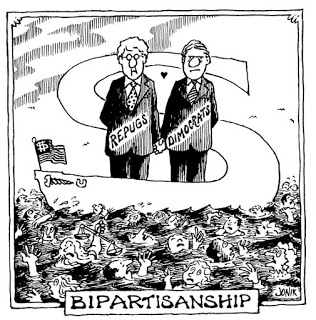
That said, you know, I really think there is really bipartisan opposition to this system, and the poll data is very convincing on this. Overwhelming numbers of Democrats, but also overwhelming numbers of Republicans oppose the giant influence of the super-wealthy and corporations in Washington. They oppose overwhelmingly the big money influence over the election process. They oppose overwhelmingly the Citizens United decision.
As soon as we get poll data on this decision, I’m sure people just having commonsense are going to oppose this as well. And, again, it’s going to be across party lines. The trick is going to be both to mobilize people and convert the public anger about this into meaningful action by our elected representatives who are part of this system that we’re trying to reform.
Dennis J Bernstein is a host of “Flashpoints” on the Pacifica radio network and the author of Special Ed: Voices from a Hidden Classroom.

Featured Video
Theodore Postol: Iran’s Missiles & Drones Were Underestimated
or go to
Aletho News Archives – Video-Images
From the Archives
What is the Israeli Lobby in Australia Doing in Interfaith Dialogue?
By Ali Kazak | Dissident Voice | October 11, 2015
For years Israel and its lobby around the world have been trying to normalise their relations with Arabs and Muslims without solving the Palestine Question.
One of the methods they resorted to in the last few years is using human rights and community organizations such as interfaith dialogue and Multiculturalism to achieve this objective and to: isolate the Palestinians, marginalise the Palestine question, end Israel’s isolation, and prevent criticism of Israel, knowing that these organisations will be the first to stand against Israel’s violations, racial and religious discrimination.
The group responsible for this task in Australia is The Australia/Israel & Jewish Affairs Council (AIJAC); its Director of International & Community Affairs, Jeremy Jones is in charge of lobbying religious community organizations, specifically Muslims and Christians. Consequently he convened the Faith Communities for Reconciliation, founding participant in the Australian Partnership of Religious Organisations and the Australian National Dialogue of Christians, Muslims & Jews.
AIJAC is a private political propaganda group. It is recognised as the main Israeli lobby in Australia. It coordinates its activities and works intimately with the Israeli embassy in Canberra and different institutions in Israel. It is privately funded by some Jewish businessmen. It monitors closely Australian politicians, the media, ethnic and religious groups, (especially Arabs and Muslims), unions and academics on their stands towards Israel and the Palestine question. … continue
Blog Roll
 Aletho News
- Iran’s friends are about to make life much more difficult for Israel and the US
- The war of liberation of the Arab and Islamic peoples expands across the Gulf
- Envoy warns UN on Trump’s threat to ‘obliterate’ Iran’s civilian infrastructure
- The Larak Corridor: Iran’s Rial Gate With No US, No Israel, and No Way Around
- ‘Economic terrorism’: Steel facilities hit again in US-Israeli strike
- ‘War Crime’: Iran condemns attacks on Arak, Ardakan nuclear sites
- Two-thirds of Americans want quick end to Iran war even if goals unmet
- Trump to Give “Important Update on Iran” Wednesday in Prime-Time Speech
- Theodore Postol: Iran’s Missiles & Drones Were Underestimated
- Iran To Target Military Industrial-Tech Complex That Facilitated Gaza Genocide
- If Americans Knew
- Israel wants US to bomb more of Iran’s civilian structures (113,000 is not enough) – Not a ceasefire Day 173
- Ann Coulter Rips Into Fox News for Iran War Coverage
- Joe Kent Urges Americans To Call White House and Congress To Object To Sending Troops Into Iran
- DNC Resolution to Reject AIPAC Funding Puts Democratic Leaders in the Hot Seat
- Swedish foundation to build 400 schools as over 650,000 Gaza children remain without education for 2 years
- Israeli army admits photshopping image of slain Lebanese journalist
- This is how Israel is systematically killing health workers under the cover of war in Lebanon
- Carrying life under fire: Israeli invasion of Lebanon leaves pregnant women facing deadly risks
- Champagne all around for the new death penalty (for Palestinians) law – Not a ceasefire Day 172
- Why are Palestinian books struggling to be seen on Amazon?
- No Tricks Zone
- New Study Finds Warming Saves Lives…Cold Temperatures 12 Times More Deadly Than Excess Heat
- German Science Blog Accuses PIK Climate Institute Of Hallucinating Climate Tipping Points
- Devastating Assessment Of Comirnaty Vaccine By Former Senior Pfizer Europe Toxicologist
- New Study: CO2 Is ‘Effectively Negligible’ As An Explanatory Climate Change Factor Since 2000
- Former Pfizer Toxicologist Dr. Helmut Sterz Tells Bundestag Hearing Pfizer Vaccine Should Have Never Been Approved
- Energy Expert: Germany’s Nuclear Phaseout Was A “500 Billion Euro Mistake”
- New Research: South Australia’s Mid-Holocene Sea Surface Temperatures Were 4°C Warmer Than Today
- Storing Green Energy To Last Germany 10 Days Would Require A 60-Million Tonne Battery
- New Studies: UK Sea Levels Were 4 Meters Higher Than Today During The Mid-Holocene
- Destructive Green New Deal: German Energy And Metal Group Warns Of Drastic Crisis
 Aletho News