Putin to receive Erdogan in hometown
By M K Bhadrakumar | Indian Punchline | July 27, 2016
The developments in Turkey are taking a dramatic turn. All Indications are that the Turkish government is in possession of definite information that the attempted military coup was orchestrated by the United States. (Anadolu )
The Justice Minister Bekir Bozdag made an open allegation in a television interview,
- The US knows that Fethullah Gülen (the cleric who lives in Pennsylvania) carried out this coup. Mr. Obama knows this just as well as he knows his own name. I am convinced that American intelligence knows it too.
Bozdag is known to be one of the closest and trusted political associates of President Recep Erdogan. The well-informed Turkish political commentator Semih Idiz wrote that “This belief (Bozdag’s allegation) goes all the way to President Recep Tayyip Erdogan. It implies that Washington knew what was coming and did nothing to warn Ankara. The pro-government Islamist media has even claimed that the U.S. tried to kill Erdoğan with this coup attempt.”
The government has taken into confidence Turkey’s two main opposition parties – the Kemalist party CHP (Republican Party) and the nationalist party MHP (Nationalist Movement Party). The ruling AKP (Justice & Development Party) and the CHP and MHP have set aside their political differences and have voiced support for Ankara’s demand to Washington for the extradition of the Islamist cleric Fetullah Gulen. No doubt, this grand reconciliation could have implications in the downstream for the fractured Turkish political landscape. (VOA)
The MHP leader Davlut Bahceli has spoken publicly about a possible deep-rooted US conspiracy to trigger civil war conditions in Turkey. Bahceli also hinted that the coup plot was likely masterminded from the Incirlik air base used by the US forces, under the supervision of the US commander in Afghanistan. Two Turkish generals serving in Afghanistan have been detained by the Turkish intelligence at Dubai airport.
Bahceli has tabled a motion in the parliament seeking clarification on “rumours” that the CIA was behind the coup plot. A falshpoint arises if the government makes the details available. The Turkish media reported that Ankara has warned the authorities in Pakistan regarding the elite schools run by Gulen’s organization in that country. (See the Deutsche Welle report Secular Pakistanis resist Turkey’s ‘authoritarian demands.)
The Obama administration is unlikely to extradite Gulen, given his key role in US intelligence operations in the Central Asian region, while Turkey has made this the litmus test of US’ goodwill and sincerity as ally. Significantly, the New York Times featured an article over the weekend authored by Gulen where he urged Washington not to extradite him. Gulen wrote,
- His (Erdogan’s) goal: To ensure my extradition, despite a lack of credible evidence and virtually no prospect for a fair trial. The temptation to give Mr. Erdogan whatever he wants is understandable. But the United States must resist it.
Washington probably anticipates that a showdown with Ankara may become unavoidable in a very near future over the Gulen issue. The US State Department has advised dependents and families of US diplomatic personnel posted in Turkey to leave the country. Another travel advisory on Monday counselled US nationals to “reconsider travel to Turkey at this time”. (here)
It becomes extremely significant that amidst all this, President Erdogan will be traveling to St. Petersburg, Russia, to meet President Vladimir Putin on August 9. This will be Erdogan’s first trip abroad after the coup and he is signalling that restoring friendly ties with Russia is his topmost priority. Of course, Erdogan will be keenly interested in close cooperation between the intelligence agencies of Turkey and Russia. The prominent Turkish columnist Murat Yetkin wrote today,
- The question lingers in the air about whether Russia, whose intelligence services have been accused by the Democratic Party in the U.S. of intercepting their electronic communications, would provide any material to Erdoğan linking Gülen to the coup plotters. It certainly seems there is a lot of exchange of information going on nowadays, as was revealed by Çavuşoğlu, who said that Turkey has warned a number of countries, including the Central Asian republic of Kyrgyzstan, about a possible coup plot by Gülenists who infiltrated the state apparatus there through their school network. Moscow has already closed Gülen’s school network in Russia, accusing it of cooperating with the CIA.
The meeting between Putin and Erdogan promises to be a defining moment in Russia’s relations with the West in the post-cold war era. If a major NATO country such as Turkey crosses the ‘red line’ by forging ties with Russia at the present juncture that will be in strategic defiance of the US’ containment strategy against Russia. It can turn out to be a far bigger setback to the US regional strategies than the Islamic Revolution in Iran in 1979, because it weakens the entire western alliance system.
Europe, in particular, will be holding its breath over the fate of its moribund ‘one in, one out’ deal with Turkey over the refugee flow. Erdogan said on German TV on Tuesday that Europe is not a ‘sincere’ interlocutor. The issue is hugely controversial in Europe, given the lengthening shadows of terrorism. German Chancellor Angela Merkel faces growing public demand to quit. (BBC, AFP )
Lebanon’s Future is on the Line, and It Directly Affects Syria
By Andrew Korybko – Sputnik – 24.08.2015
Protests about the lack of proper city sanitation services have quickly escalated into full-blown calls for regime change.
Lebanese protesters demonstrated in Beirut this weekend as part of the “You Stink” movement, which was organized by citizens fed up with the garbage that had been piling up in their streets for weeks.
What began as an expression of legitimate grievances, however, quickly spiraled into the world’s latest Color Revolution attempt.
Some radical youth started throwing rocks and petrol bombs at police officers (uncannily reminiscent of the earlier hijacking of the peaceful-intentioned “Electric Yerevan” protests), which resulted in a forceful counter-response that was then immediately used to ‘justify’ the movement’s transformation into one of open regime change ends.
The thing is, however, Lebanon doesn’t really have a functioning government to begin with, having been without a President for over a year. If the Prime Minister steps down as he threatened to do, then it would create an unprecedented constitutional crisis that might bring the formerly civil war-torn and multi-confessional state back to the brink of domestic conflict.
Any significant destabilization in Lebanon is bound to have a serious impact on Syria, which would be put in a difficult position by the potential cutoff of the strategic Beirut-to-Damascus highway and the possible redeployment of valuable Hezbollah fighters back to their homeland.
A Little About Lebanon
The tiny Middle Eastern state of about four and a half million people is marked by a demographic and political complexity that could hinder a speedy resolution to the current crisis. It’s necessary to be aware of some of its specifics in order to better understand the origins of the current stalemate and where it might rapidly be headed.
Unilaterally sliced out of Syria during the early years of the French mandate, the territory of Lebanon hails what is generally recognized as the most diverse population in the Mideast. Eighteen religious groups are recognized in the country’s constitution, including Alawites, Druze, Maronite Catholics, Sunnis, and Shiites.
This eclecticism of religious communities is presided over by something referred to as the National Pact, an unwritten understanding that the President will always be Maronite, the Prime Minister will be Sunni, and the Speaker of Parliament will be Shiite, among other stipulations (and with a few historical exceptions).
Complementary to this concept is the country’s unique political system called confessionalism, whereby Christians and Muslims share equal seats in the unicameral parliament, but each group’s respective composition is determined proportionally by sect. Originally meant to be a temporary solution when it was first enacted in the 1920s, it was later refined by the 1989 Taif Agreement that ended the lengthy civil war and has remained in place to this day.
Crawling To A Crisis
The current crisis in Lebanon was long in the making, and it’s the result of many embedded problems that spilled over with the garbage protests. The economy has always been fragile, in that it’s highly dependent on tourism and banking – hardly the prerequisites for a stable system.
The overwhelming influx of over 1 million Syrian refugees over the past couple of years (on top of the nearly half a million Palestinian ones already present in the country) contributed to the country’s economic malaise, with the International Labor Organization quoting a 34% unemployment rate for youth between the ages of 15-24. It’s thus of no surprise then that there were plenty of disaffected young people eager and available to protest when the “You Stink” opportunity finally arose.
Lebanon’s economic troubles have been exacerbated by its enormously high debt-to-GDP ratio that has the dubious honor of being one of the world’s worst at 143%. It’s of such magnitude that Prime Minister Tammam Salam just announced that the government might not be able to pay salaries next month.
This economic dysfunction persists despite the discovery of large amounts of offshore oil and gas that have yet to be extracted. Part of the reason for this is that the country is in the midst of a political impasse stemming from parliament’s inability to agree upon a new president after the former one finished his term in May 2014.
Since the president appoints the prime minister, if Salam resigns like he threatened to do if Thursday’s upcoming Cabinet meeting yields no results, then the country would enter completely uncharted territory that might prompt more pronounced unrest and guarantee a period of heightened uncertainty.
The arrangement of political forces is thus that two men have the possibility to be president – Michel Aoun and Samir Geagea. Each represents one of the two main trans-religious political coalitions, the 8 March Alliance and the 14 March Alliance, respectively, and both want parliament to end its impasse as soon as possible.
Their similarities end there, however, since Aoun is in an alliance with multipolar-oriented Hezbollah, while Geagea is closely tied to former Prime Minister and dual Lebanese-Saudi billionaire powerbroker Saad Hariri.
Wikileaks’ latest releases from the Saudi Foreign Ministry prove that Hariri still has intimate contacts with the Saudi royal family and intelligence services, and that Geagea once begged the kingdom to bankroll his party’s finances. Therefore, although the presidency itself is largely ceremonial, it’s the diametrically competing visions of these two parties and the potential for street clashes between their supporters during the Color Revolution tumult that creates serious concern about Lebanon’s future, and consequently, could be expected to have negative repercussions for Syria.
Sabotaging Syria
The regional backdrop in which all of this occurs is that the US and its allies are in a ‘race to the finish’ to ‘win’ their various Mideast wars before the tens of billions of dollars of frozen Iranian funds are returned to Tehran, which would then partially disseminate it to its regional allies Hezbollah and Syria.
Additionally, Russia has made remarkable diplomatic progress in trying to reconcile all sides in Syria and assemble a coordinated anti-ISIL coalition, raising the US’ fears that its window of ‘opportunity’ for accomplishing regime change there may unexpectedly be drawing to a close.
It’s thus under these conditions that the organic protests in Beirut were almost immediately hijacked by radical Color Revolutionaries in order to create chaos along Syria’s western border.
The intent behind the calculated state collapse being attempted at the moment in Lebanon is to disrupt the Beirut-to-Damascus highway that serves as one of the two main lifelines to the Syrian capital, the other being the Damascus-to-Latakia highway. Shutting down the Lebanese route would make Syria wholly dependent on the Latakian one that’s vulnerable to an “Army of Conquest” offensive, which if successful, would cripple the country by de-facto blockading the capital.
At the same time, in the event that Beirut reaches its breaking point, some Hezbollah units currently deployed to Syria would be compelled to return back to the home front to assist in the inevitable power struggle there. The withdrawal of part (or all) of this valuable fighting contingent would make the military situation much more difficult for the Syrian Arab Army, both in defending the Damascus-to-Latakia corridor and in securing the Lebanese border from becoming a ‘second Turkey’ of terrorist infiltration.
Conclusively, it’s for these strategic reasons why it strongly appears that externally directed forces were ordered to exploit Lebanon’s existing tensions at this specific time. They engineered a Color Revolution attempt by using the “You Stink” protests as a semi-plausible cover, and this was timed to coincide with the ‘race to the finish’ being played out all across the Mideast.
Lebanon can still pull away from the brink, provided that Thursday’s upcoming Cabinet meeting resolves the presidential crisis and placates the country’s main political parties, but it will have to tread very carefully in containing sectarian temptations and avoiding the trap of escalatory Color Revolution provocations.
Read more:
‘Middle Eastern Union’: West Redrawing Map of Middle East at Will
Russia Succeeds in Middle East Policy – Lebanon Presidential Candidate
Lebanese Police Use Water Cannons to Disperse Beirut Protesters (VIDEO)
Featured Video
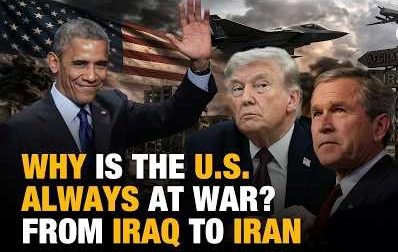
The Source of America’s Wars – Kristol Clear
or go to
Aletho News Archives – Video-Images
From the Archives
Is Israel to blame for the Iraq War?
American Goy | March 10, 2008
I am so tired of this old canard that “Israel had nothing to do with USA’s war with Iraq – in fact, it officially advised America against it”.
Bullshit. … continue
Blog Roll
 Aletho News
- Ceasefire for all or for none: Iran shuts Hormuz over Lebanon attacks
- Strait of Hormuz is Iran’s ‘nuclear weapon’ that forced US retreat: Medvedev
- Energy crisis will last for months – Kremlin envoy
- Europe’s quiet role in the war on Iran
- Forty days that shook the Empire: How Iran turned the tables on US and prevailed
- Netanyahu unilaterally declares Lebanon outside of ceasefire deal
- Israeli leaders: ‘Not a single goal’ achieved in war with Iran
- What on earth just happened? Trump, Iran, and the unlikely ceasefire
- Alberta Bill Would Fine Political Deepfakes $10,000 Without Satire Exemptions
- Iran declares ‘historic victory’ over US, says enemy forced to accept its proposal
- If Americans Knew
- Gazans face a triple crisis: severe shortages of water and bread, healthcare in tatters
- NY Times reports how Netanyahu took the US into Iran War
- A sigh of relief over Iran, but Gaza and Lebanon in dire straits – Daily Update
- Thousands dead and neighborhoods razed to the ground: Aid agencies fear southern Lebanon is becoming the new Gaza
- The war the US is fighting for Israel could cost trillions
- ‘Cigarette Burns, Nail Wounds’: Toddler Tortured in Gaza to Coerce Father
- Trump Says US Sent ‘a Lot of Guns’ to Protesters in Iran
- Israeli forces destroy 17 UN peacekeeper cameras in south Lebanon
- US-Israeli strikes ‘completely destroy’ synagogue in Tehran
- Archbishop for US Military Says Iran War Is Unjust Under Catholic Teaching
- No Tricks Zone
- An Inconvenient Tree: Uncovered In Alps… Europe Much Warmer Than Today 6000 Years Ago
- New Study Reports A 60% Slowdown In Greenland’s Ice Loss Rate In The Last Decade
- Low Intensity Tornado Wrecks Major Solar Farm, Creating A Potential Toxic Dump
- New Study Finds Warming Saves Lives…Cold Temperatures 12 Times More Deadly Than Excess Heat
- German Science Blog Accuses PIK Climate Institute Of Hallucinating Climate Tipping Points
- Devastating Assessment Of Comirnaty Vaccine By Former Senior Pfizer Europe Toxicologist
- New Study: CO2 Is ‘Effectively Negligible’ As An Explanatory Climate Change Factor Since 2000
- Former Pfizer Toxicologist Dr. Helmut Sterz Tells Bundestag Hearing Pfizer Vaccine Should Have Never Been Approved
- Energy Expert: Germany’s Nuclear Phaseout Was A “500 Billion Euro Mistake”
- New Research: South Australia’s Mid-Holocene Sea Surface Temperatures Were 4°C Warmer Than Today
 Aletho News