House Democrats, Targeting Right-Wing Cable Outlets, Are Assaulting Core Press Freedoms
By Glenn Greenwald | February 23, 2021
Not even two months into their reign as the majority party that controls the White House and both houses of Congress, key Democrats have made clear that one of their top priorities is censorship of divergent voices. On Saturday, I detailed how their escalating official campaign to coerce and threaten social media companies into more aggressively censoring views that they dislike — including by summoning social media CEOs to appear before them for the third time in less than five months — is implicating, if not already violating, core First Amendment rights of free speech.
Now they are going further — much further. The same Democratic House Committee that is demanding greater online censorship from social media companies now has its sights set on the removal of conservative cable outlets, including Fox News, from the airwaves.
The House Energy and Commerce Committee on Monday announced a February 24 hearing, convened by one of its sub-committees, entitled “Fanning the Flames: Disinformation and Extremism in the Media.” Claiming that “the spread of disinformation and extremism by traditional news media presents a tangible and destabilizing threat,” the Committee argues: “Some broadcasters’ and cable networks’ increasing reliance on conspiracy theories and misleading or patently false information raises questions about their devotion to journalistic integrity.”
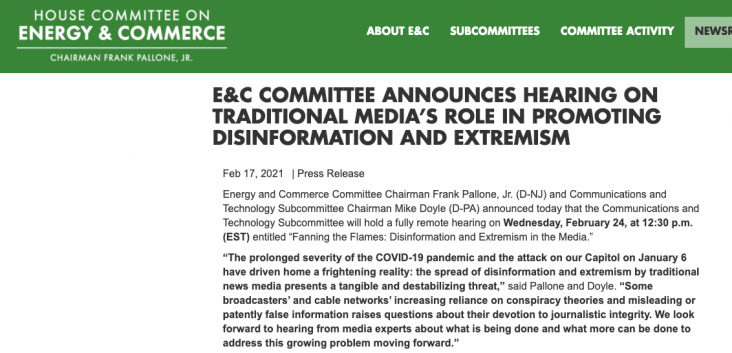
Since when is it the role of the U.S. Government to arbitrate and enforce precepts of “journalistic integrity”? Unless you believe in the right of the government to regulate and control what the press says — a power which the First Amendment explicitly prohibits — how can anyone be comfortable with members of Congress arrogating unto themselves the power to dictate what media outlets are permitted to report and control how they discuss and analyze the news of the day?
But what House Democrats are doing here is far more insidious than what is revealed by that creepy official announcement. Two senior members of that Committee, Rep. Anna Eshoo (D-Silicon-Valley) and Rep. Jerry McNerney (D-CA) also sent their own letters to seven of the nation’s largest cable providers — Comcast, AT&T, Spectrum, Dish, Verizon, Cox and Altice — as well as to digital distributors of cable news (Roku, Amazon, Apple, Google and Hulu) demanding to know, among other things, what those cable distributors did to prevent conservative “disinformation” prior to the election and after — disinformation, they said, that just so happened to be spread by the only conservative cable outlets: Fox, Newsmax and OANN.
In case there was any doubt about their true goal — coercing these cable providers to remove all cable networks that feature conservative voices, including Fox (just as their counterparts on that Committee want to ban right-wing voices from social media) — the House Democrats in their letter said explicitly what they are after: namely, removal of those conservative outlets by these cable providers:
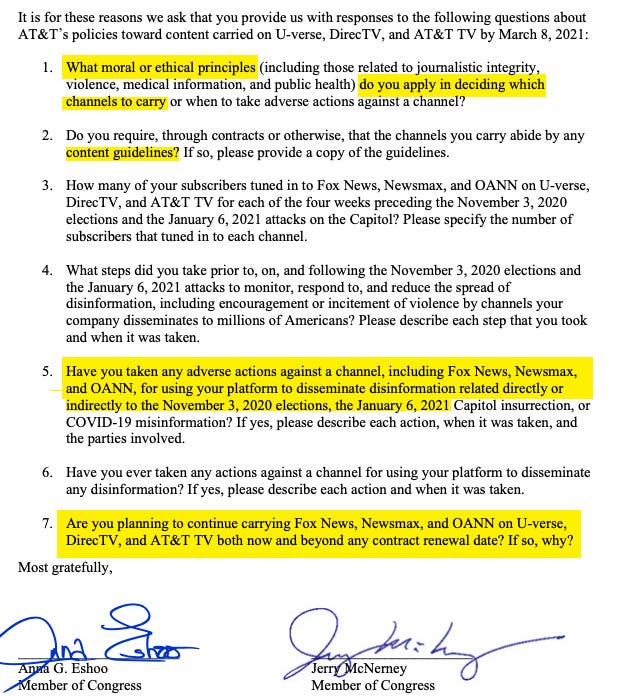
Congresswoman Eshoo boasted on her official site about these efforts, lauding herself and McNerney for “urging 12 cable, satellite, and streaming TV companies to combat the spread of misinformation and requesting more information about their actions to address misinformation, disinformation, conspiracy theories, and lies spread through channels they host.”
For the last four years, we were inundated with media messaging that Trump posed an unprecedented threat to press freedoms. The Washington Post even flamboyantly adopted a new motto to implicitly ratify that accusation (while claiming it was not Trump-specific). Other than the indictment of Julian Assange — which most Washington Democrats cheered — what did the Trump administration do in the way of attacking press freedoms that remotely compares to Democrats abusing their majoritarian power to force the removal of conservative cable outlets from the airwaves, just days after doing the same with dissident voices online?
There is not a peep of protest from any liberal journalists. Do any of the people who spent four years pretending to care so deeply about the vital role of press freedom have anything to say about this full frontal attack by the majority party in Washington on news outlets opposed to their political agenda and ideology?
Evidently not. While many conservative outlets are covering this story, it is difficult to find any liberal outlets writing about it at all. An article from The New York Times was one exception, though it largely attempted to justify these censorship efforts, with paragraph after paragraph purporting to demonstrate the dangerous misinformation spread by these channels. The only nods to the dangers for press freedoms in the article came from statements by Fox News and a GOP member of the Federal Communications Commission (FCC).
Revealingly, these same two members of Congress who sent this threatening letter to cable providers said during the Trump years that freedom of the press must be safeguarded at all costs. “The First Amendment prohibits Congress from making laws that abridge the freedom of the press, and we cherish our country’s culture of free expression,” they intoned when writing to the FCC in 2019 to complain that Russian news outlets were concealing their affiliation with the Kremlin. “We’re not requesting any press censorship,” they assured the FCC under Trump. Yet they are clearly doing exactly that now.
In a statement he emailed to me and publicly posted, FCC Commissioner Brendan Carr denounced the Democrats’ actions as a “marked departure from First Amendment norms.” He said “it is a chilling transgression of the free speech rights that every media outlet in this country enjoys.” In response to my inquiries, Commissioner Carr added in a separate statement to me:
The greatest threat to free speech in America today is not any law passed by the government—the First Amendment stands as a strong bulwark against that form of censorship by state action. The threat comes in the form of legislating by letterhead. Politicians have realized that they can silence the speech of those with different political viewpoints by public bullying. The letter sent by two senior Democrats on the House Energy and Commerce Committee to cable companies and other regulated entities, and the Committee’s own hearing this week on “disinformation in the media,” are the latest examples. They are singling out selected newsrooms for their coverage of political events and sending a clear message that these media outlets will pay a price if they do not align their viewpoints with Democrat orthodoxy. That is a chilling transgression of free speech and journalistic freedom. No government official has any business inquiring about the ‘moral principles’ that guide a private entity’s decision about what news to carry.
Carr’s GOP colleague on the FCC, Commissioner Nathan Simington, similarly accused House Democrats of seeking to “intimidate into silence those who would distribute on their platforms disfavored points of view.”
The way Democrats justify this to themselves is important to consider. They do not, of course, explicitly acknowledge that they are engaged in authoritarian assaults on free speech and a free press. Not even the most despotic tyrants like to think of themselves in that way. All tyrants concoct theories and excuses to justify their censorship as noble and necessary.
Indeed, the justifying script Democrats are using here is the one most commonly employed by autocrats around the world to silence their critics. Those they seek to silence are not merely expressing a different view, but are dangerous. They are not merely advocating alternative ideologies but are destabilizing society with lies, fake news, and speech that deliberately incites violence, subversion and domestic terrorism.
In her boastful posting, Rep. Eshoo says her efforts targeting these cable outlets are necessary because “misinformation on TV has led to our current polluted information environment that radicalizes individuals to commit seditious acts and rejects public health best practices, among other issues in our public discourse.” This is the rationale invoked by virtually every repressive state to imprison journalists and ban media outlets.
The Democrats sound a great deal like the Egyptian regime of Gen. Abdel el-Sisi. Just two weeks ago, Sisi’s regime finally released an Al Jazeera journalist who had been imprisoned for four years based on accusations that he had “spread false news” and was guilty of “incitement against state institutions and broadcasting false news with the aim of spreading chaos.” Sound familiar? It should, since that is precisely what House Democrats are saying to ennoble their multi-pronged assault on free expression.
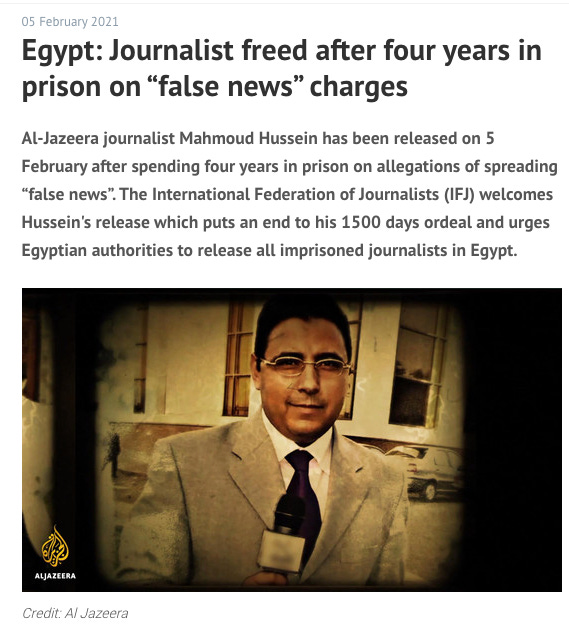
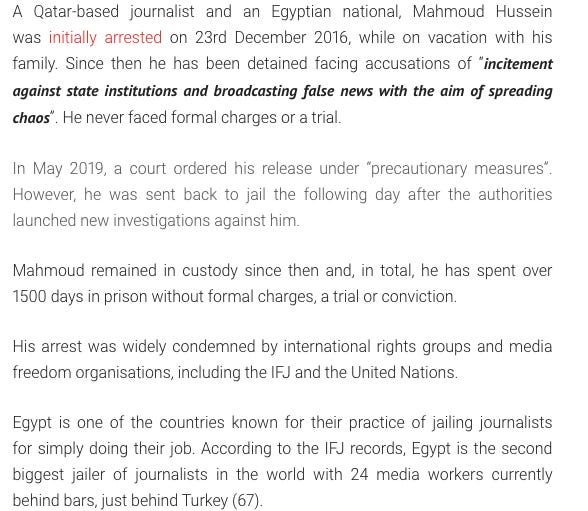 International Federation of Journalists, Feb. 5, 2021
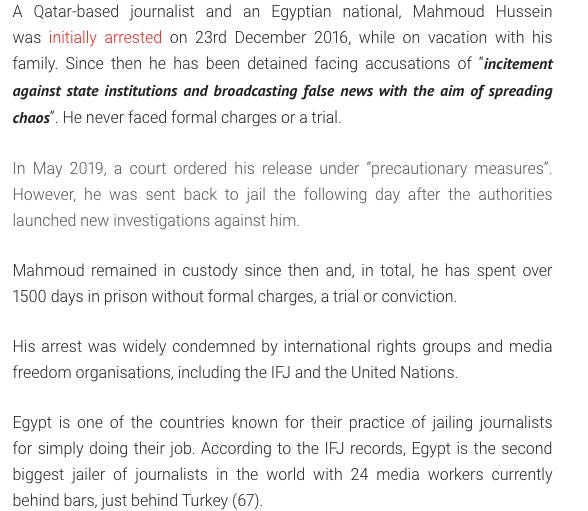
Accusing one’s domestic opponents of being subversives and domestic terrorists is by far the most common way that despots on every continent justify their censorship and silencing campaigns of oppositional media outlets. In 2014, the French journalist Valeria Costa-Kostritsky warned in the Index on Censorship that anti-terrorism laws and accusations of promoting subversion were becoming the primary means which authoritarian states from Turkey and Jordan to Russia and the UAE use to justify the silencing of journalists:
Anti-terror legislation seems to be the perfect tool for a state seeking to crack down on opposition. “It’s so elusive. You can [see] anything as terrorist propaganda. There needn’t be any evidence of violence, any praise of violence. Plus, if you blame someone for having a connection with the [Kurdistan Workers’ Party] the public buys that argument easily, especially in a country that is suffering from terrorism, as Turkey is,” said Sevgi Akarçeşme, former editor-in-chief of Turkey’s Today’s Zaman (the English-language edition of daily Zaman), who had her newspaper taken over by the government in March 2016.
A similar means used by repressive governments to silence disfavored media outlets is to claim they are promoting “extremism.” As Costa-Kostritsky detailed:
There’s another word one can use to browse through reports published on the [Mapping Media Freedom] map: “extremism”. Anti-extremism legislation is used to intimidate journalists in post-Soviet countries, particularly in Russia. On the map, of the 35 incidents flagged with “extremism”, 11 took place in Russia, and seven in Crimea, others include Belgium, Italy, Hungary, France and Spain. Five reports connecting the media to “extremism” took place during the first half of 2016. They include website closures and journalists being put on a list of extremists. In Russia, most cases using anti-extremism legislations against journalists happen via Roskomnadzor, the national media regulator.
When China arrests journalists it typically justifies its actions by accusing them of fomenting extremism that jeopardizes national security.
And accusing journalists of spreading “fake news” — always a dangerously vague term from its inception — is equally commonplace when government authorities want to silence media outlets. The Washington Post reported that “as 2019 draws to a close, there are 30 journalists in jail worldwide on charges of ‘false news’ — or, as it’s also called these days, ‘fake news.’” In sum:
It has now become commonplace to throw around fake-news accusations in the United States. But in other countries around the world — like Egypt, Turkey, Somalia and Cameroon — such charges can have very chilling and stifling impacts on the press, according to an annual report by the New York-based Committee to Protect Journalists.
In Egypt — where General-turned-President Abdel Fatah al-Sissi has been overseeing a crackdown that human rights groups say is harsher than any before — there are 21 journalists in jail for allegedly publishing “false news,” according to the CPJ’s data. In practice, press freedom advocates say, these charges stem from a simple fact: The journalists published news that Sisi didn’t like.
In a passage that the Post would only publish about foreign countries but never about House Democrats, even though it now applies equally, they observed: “There is a serious global problem of disinformation spreading online and sowing distrust and sectarianism. The problem, say press advocates, is that the laws regulating fake news all too often are a means of stifling the media rather than fostering a more transparent environment online.”
This framework is hardly rare in the west either. When the Obama administration collaborated with the UK Government in 2013 to detain my husband David Miranda at Heathrow Airport in connection with the work he was doing in the Snowden reporting, they cited an anti-terrorism law to justify his detention, and repeatedly threatened to prosecute him for terrorism if he did not cooperate by providing all of his passwords to them. He ultimately prevailed in his lawsuit against the U.K. Government on the ground that it constitutes an illegal assault on press freedoms and human rights to abuse anti-terrorism frameworks to intimidate or silence journalists.
Justifying the silencing of journalists by accusing them of inciting domestic terrorism and extremism is now the most common means used globally for censorsing the press. The Committee to Protect Journalists in 2013 said they had “tracked a significant rise in journalist imprisonments.” The culprit, said the group, was “the expansion of anti-terrorism and national security laws worldwide” after the 9/11 attack, which had been repeatedly abused to criminalize media outlets. “The number of journalists jailed worldwide hit 232 in 2012, 132 of whom were held on anti-terror or other national security charges.” In sum: “CPJ’s analysis has found that governments have exploited these laws to silence critical journalists.”
Are there conspiracy theories and disinformation sometimes found on the conservative cable outlets which House Democrats want taken off the air? Of course there are: all media outlets disseminate conspiracy theories and fake news at times. MSNBC and CNN spent four years endorsing the most deranged conspiracy theory imaginable, one with very toxic roots in the Cold War: namely, the McCarthyite script that the Kremlin had taken over control of key U.S. institutions through sexual blackmail over the President, invasions into the nation’s heating system and electric grid, and criminal conspiracy between Moscow and the Trump campaign to hack into Democrats’ emails.
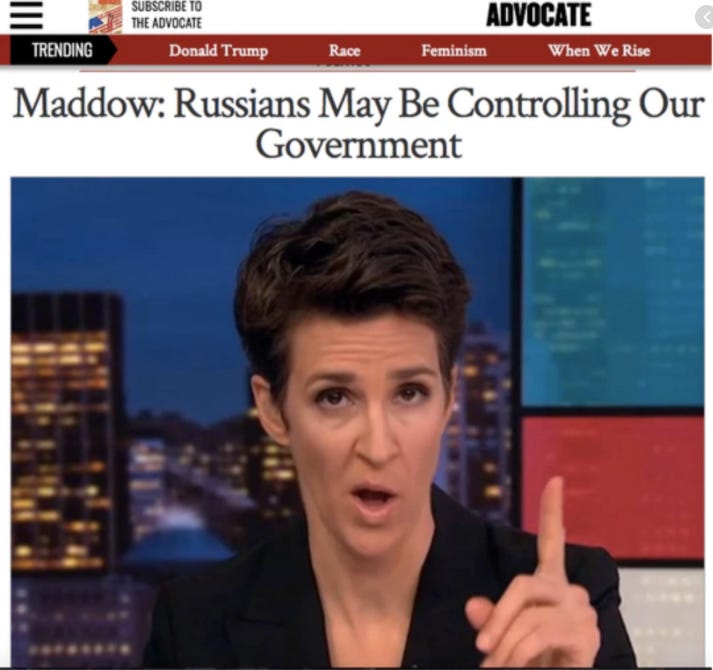
All of that was false, just as the one-month tale told over and over by the media about a pro-Trump mob murdering Brian Sicknick by bludgeoning him to death with a fire extinguisher was false — a story which remains unretracted or corrected by most who spread it.
Just imagine if, during the Trump years, the GOP Senate had abused its power to bully cable outlets into removing MSNBC from their platforms, or banning liberal journalists and activists from using social media platforms, on the grounds that they were spreading conspiracy theories and fake news. It is hard to overstate how extreme the rhetoric would have been that Trump and the Republicans were engaged in authoritarian measures to destroy free speech and a free press.
And I would have joined in those denunciations (as I did with the Assange prosecution): as much as I loathe so much of what those outlets do, it is not the role of the government to regulate let alone silence them. The corrective is for journalists to rebuild trust and faith with the public by exposing their misinformation and proving to the public that they will do accurate and reliable reporting regardless of which faction is aggrandized or angered.
But corporate media outlets and Democrats (excuse the redundancy) who spent the last four years posturing as virulent defenders of press freedoms never meant it. Like so much of what they claimed to believe, it was fraudulent. The proof is that they are now mute, if not supportive, as Democrats use their status as majority party to launch an assault against press freedoms far more egregious than anything Trump got close to doing.
‘Any Data They Can Intercept’: US Congress Will Let Companies Sell Browsing Data
Sputnik – 29.03.2017
Following in the Senate’s footsteps, the US House of Representatives has approved a piece of legislation that would allow massive telephone and cable companies to sell the data generated by internet users’ browsing habits.
On March 28, the US House narrowly passed a bill that analysts say is a huge win for the bloated telecommunications industry, and a commensurately large invasion on citizens’ privacy – or lack thereof. The resolution cleared its way through the lower chamber of the legislature by a 215-205 vote.
If US President Donald Trump signs the resolution into law, companies will legally be able to create profiles about every internet user, then sell those profiles to the highest bidder, the Electronic Frontier Foundation said in a statement.
“Considering how much access [internet service providers, or ISPs] already have to highly sensitive data, it is absolutely unacceptable for them to monetize personal information,” Representative Mike Pocan of Wisconsin said Tuesday.
The ability for service providers to collect “essentially any data they can intercept and read for themselves” was supposed to be an opt-in only policy, giving consumers a choice whether to disclose their data, but instead telecommunications companies will have the ability to generate revenue off of the public’s browsing habits, said Matt Erickson on Radio Sputnik’s By Any Means Necessary with Eugene Puryear. Erickson is a director with the Digital Privacy Alliance.
”Google and Facebook collect large amounts of information in ways that should be very concerning to people,” Puryear said.
The news comes as a major setback for privacy advocates and a major victory for Comcast, TimeWarner, AT&T and Verizon, which “will have free rein to hijack your searches, sell your data, and hammer you with unwanted advertisements,” the EFF said.
What’s more, at a time when nearly every major financial institution, electrical utilities company, defense and aerospace firm, and governmental agency is seeking to bolster its cyber defense systems, there are a host of reasons to think that these new rules would be detrimental to the US’ collective cybersecurity.
By recording your traffic and building a profile about you, for instance, hackers gain a new target database to breach.
Analog resistance: Activists protest CISA by faxing Congress
RT | July 28, 2015
Privacy activists are flooding Congress with messages of opposition to the cyber surveillance bill due to be considered by the Senate, using faxes rather than emails in order to poke fun at lawmakers’ antiquated understanding of technology and privacy.
Fight for the Future, a nonprofit fighting for privacy and against government surveillance, has set up a page dubbed “Operation: Fax Big Brother,” which lets anyone generate and customize a fax protesting the Cybersecurity Information Sharing Act (CISA). Each fax is then sent to all 100 Senators. The group has not said how many faxes have been sent so far.
CISA sailed through the Senate Intelligence Committee in March, with Oregon Democrat Ron Wyden being the sole dissenter. Senate is expected to take up a vote on the bill before the August 7 recess. A similar proposal, known as CISPA, was approved by the House of Representatives in 2013 but died in the Senate after public opposition compelled President Barack Obama to threaten a veto.
“Groups like Fight for the Future have sent millions of emails, and they still don’t seem to get it,” Evan Greer, the group’s campaign manager, told the Guardian. “Maybe they don’t get it because they’re stuck in 1984, and we figured we’d use some 80s technology to try to get our point across.”
According to the group, since 2012 civil liberties activists have sent hundreds of thousands of calls and tweets and over 2.6 million emails to Congress opposing overreaching cybersecurity laws. However, the fax stunt does not just have publicity value. Lawmakers often use analog technology like faxes and pagers in order to hide their digital tracks from Freedom of Information Act (FOIA) inquiries, claims a Senate staffer who spoke to the Guardian.
Sponsored by Senator Dianne Feinstein, a California Democrat, CISA seeks to enlist the support of corporations in collecting user data in the name of cybersecurity, providing them with liability protection if they share the data with federal agencies such as the NSA. Once they have the data, federal agencies would be able to share it freely with each other. What’s more, information shared with the government by the companies will be specifically exempt from FOIA disclosures.
Gabe Rottman, a legislative counsel with the American Civil Liberties Union, described the bill as a “new and vast surveillance authority that might as well be called Patriot Act 2.0 given how much personal information it would funnel to the NSA.”
The US Chamber of Commerce and a number of major corporations are backing the bill. In addition to Facebook and Google, Comcast and AT&T also favor CISA, as do Bank of America and Blue Cross Blue Shield Association.
Proponents of CISA have cited a spree of data breaches over the past year, from corporations such as Sony and healthcare provider Anthem to government agencies including the Department of State and Office of Personnel Management (OPM), as a reason to beef up cybersecurity. Critics have countered that CISA is not doing anything to protect networks from threats, and everything to vacuum up Americans’ data.
“With all these breaches, there’s a lot of fearmongering going on in DC,” says Fight for the Future’s Greer. “They just say: ‘This is a problem – we’ve got to do something!’ And this is the something they’re going to do. It’s not just that this won’t fix things – it’ll make them worse. And it’ll give sweeping legal immunity to some of the largest companies in the world and open us all up to new forms of surveillance.”
Featured Video

The 1964 Coup in Brazil
or go to
Aletho News Archives – Video-Images
Frlom the Archives
70 Neocons Petition Congress To Effectively Allow Israel To Say When The US Should Attack Iran
By Damian Lataan | January 10, 2014
Seventy senior Israeli-centric neoconservatives have written an open letter to Congress imploring them to do more to ensure Iran complies with the conditions of any agreement finally reached with the P5+1 over Iran’s nuclear program.
While the neocons are ostensibly asking Congress to ensure compliance, it is clear that their real aim is to convince members of Congress to support the bill currently passing through the Senate which calls for tighter sanctions against Iran in the event of any waywardness on Iran’s part.
The neocons are eager to see the bill currently passing through the Senate with enough support to make it veto-proof, not so much because they are concerned about Iran’s so-called nuclear weapons program – there’s still not a skerrick of hard evidence that Iran has a nuclear weapons program – but, rather, because embedded within the bill is this clause:
… if the Government of Israel is compelled to take military action in legitimate self-defense against Iran’s nuclear weapon program, the United States Government should stand with Israel and provide, in accordance with the law of the United States and the constitutional responsibility of Congress to authorize the use of military force, diplomatic, military, and economic support to the Government of Israel in its defense of its territory, people, and existence…
Essentially, the clause is an automatic trigger for the US to attack Iran at any time the Israelis choose to launch a first strike – regardless of whether President Obama is in favour or not.
Partial list… continue
Blog Roll
 Aletho News
- Spare the hypocrisy: Baghaei slams Ursula’s support for US
- Iran War Supporters Invent a New and Absurd Justification: It Is All About China
- Corporate Media Go All Out To Support The US-Israeli War on Iran
- Trump press conference reveals a man who wants out of war
- When Tel Aviv decides, Washington fights
- Top official: Iran ready for a long war with US, no more diplomacy
- How Iran’s Toxic Rain Reveals US-Israel Discord
- Trump Admits He Is Destroying Iran For Israel
- Iran’s latest move in the GCC countries was a stroke of genius
- Blackmail and death threats, Zelensky embarrasses the EU, but there’s no condemnation
- If Americans Knew
- Lebanon: Israel’s White Phosphorous Use Risks Civilian Harm
- Corporate Media Go All Out To Support The US-Israeli War On Iran
- US-Israel war on Iran is creating a steady growing number of amputees
- Israel planned this war on Iran for 40 years. Everything else is a smoke screen
- The wrong question about the war in Iran
- ‘Your Tax Dollars Being Used to Raise Your Gas Prices’: US-Israel Bomb Major Iranian Oil Depots
- ‘Bogus Evidence’: Former Nuclear Watchdog Head Debunks US Justification for Iran War
- EXPLAINER – Dimona: What to know about Israel’s nuclear site
- Fires and toxic air in Iran (thanks, Israel) – Not a ceasefire Day 150
- At Israel’s hands, Iran is burning, Lebanon and Gaza are crumbling – Not a ceasefire Day 149
- No Tricks Zone
- Wake-up Call: Survey Shows Majority Of Germans Now Favor Postponing Climate Targets!
- Televised! Leading German Political Candidate Tells Schoolchildren CO2 Makes Sun Hotter!
- New Study: A Century Warming Of 1.1°C Is ‘Commonplace’ And ‘Not Unusual’ During This Interglacial
- New Study: ‘Internal Noise’ And Volcanic Forcing Can Trigger 10-15°C Warming Within Decades
- Glaciers Worldwide Are Suddendly Surging, Experts Blame Warming!
- Surprising Discovery: Sahara Is Greening…Billions Of Trees Where Once Thought To Be Barren
- New Research Reaffirms Clouds, Aerosols, And Surface Solar Radiation Are ‘Driving The Climate System’
- Germany: Electric Car Catches Fire At Charging Station, Sets Off Local “Inferno”, Widespread Damage
- New Study: Canada’s New Brunswick Was 1°C Warmer Than Today During The Medieval Warm Period
- Coal Power Back In Trend As Globe Tries To Keep Pace With Growing Demand For Power
 Aletho News