This Does Not Represent the Views of the University
By Maximilian Forte | Zero Anthropology | January 20, 2018
I know that I am not the first person to ask this, but when did universities start having “views”? When some professors indulge their rights to free speech or put academic freedom into practice, they can sometimes express views that some members of the public find controversial, distasteful, or reprehensible. In such cases, one frequently reads their university administrations publishing memos to the effect that, “Professor X’s views on Subject Y do not represent the views of the university”. What does that mean? Has “the university” studied the subject to the same degree as the professor, thus allowing it to conclude its views are the correct ones? Was the professor supposed to be instructed on the correct views to represent, since the job of professor apparently means not having an independent mind? Does it mean that Professor X does not represent the views of all professors and students at the university? How could anyone ever assume that one professor spoke for all others? Does it instead mean that the professor does not represent the views of those in the administration? The support staff? If so, who cares? And where exactly did the university administration publish its “party line”? When I was twice hired for tenure-track positions, the one thing I recall no Dean ever telling me was: “Here is a list of the views of the university. Only if you uphold these views can you consider working here. Should you ever express any differing views, you may be subjected to disciplinary action”. Nonetheless, the attitude of some university administrations in North America is that they have a right to publicly castigate faculty for not toeing the line. It is as if “the university” has been reduced to working as a mere cell of a ruling political party.
One could ask similar questions as above, only in reverse. What entitles administrators to speak for the university as a whole? How do they know that Professor X’s statements really do not reflect the views of the university? Did they ever consult faculty and students? Where is all the survey data that reveal the views of faculty on any subject? How is “the university” defined? Is it just the board of governors? Whose views does the university represent? Since I work in a public university—Canada only has public universities, with maybe one or two little exceptions—can we then assume that the “views of the university” neatly align with the broad majority of the public that we presumably are meant to serve? Is it the job of professors to simply reflect the views of others? Since when did it fall to professors to “represent” their universities—and will they get paid extra for doing PR work?
Three transformations have happened more or less simultaneously, and relatively recently, which may explain these bizarre communiqués from university administrators. One has to do with the politicization of university directorates, especially as even public universities have turned to support from private donors, most of whom have big axes to grind. Private donors are keen to buy support, and silence. Few are the donors who give generously just because they are thrilled by learning—that would be too countercultural in the North American context in which we lionize our meat packers and vilify intellectuals. From this first point, where private donors act as lobbyists for special interests, almost all else follows. To assure donors that universities are being run in a “smart” fashion, administrators have multiplied administrative positions and stacked them with persons from the private sector, who draft “strategic plans” and design what are essentially corporate business models. In other words, politicization stems from privatization and corporatization—this is the neoliberal transformation of the public university. To be clear, this transformation has its origins neither in university administrations nor the private sector, both of which lack the political power and authority necessary to effect such a transformation. Instead, governments are the ones that actively took the decision to cut back on funding for public universities, which is their responsibility, even as taxation levels either remained the same or continued to rise. They chose to redirect public funding away from universities, just as they did with education as a whole, as well as healthcare, social welfare, and so on. Governments pressed universities to raise funds from private sources, just as they pressed them to expand their governance by including more individuals from the private sector.
The second change has to do with universities seeking to raise their public profile, to gain visibility, and advance in the rankings through enhanced public recognition. To gain recognition, university websites have shed their traditional dull and dour functionality, and have become replicas of CNN. Even the university shields have been tossed, in favour of some terrible, and terribly expensive, brand logos produced by private consultants and graphic designers. Universities now also have “media relations” units, with expert staff that spend their days in Twitter and Facebook, and writing up newsy articles about what select faculty members and students are achieving (more on the political functions of “media relations” units, below). These same media units then do the rounds of the departments, advising faculty on how best to interact with journalists. To the laughter of everyone in my Department, one team showed us a video that advised us to dumb down our research so that “even your grandmother could understand it”. I still have no idea why they focused on grandmothers, not grandfathers, and why they assume that all grandmothers are ignorant rubes—perhaps theirs are? In addition, the media units encourage us to list ourselves as experts, for any journalists perusing the university website, by listing the presumably edgy and sexy topics we have mastered with our unrivalled expertise. Not enough, they then invite professors to do professional photo shoots in which they pose playfully for the camera, with a single short sentence in huge print next to them which somehow encapsulates their decades of research: “Do humans really like food?”
The third major change has to do with how university administrations understand academic freedom, and separately, freedom of speech. One might say they understand these concepts very poorly, or not at all, but I think that misses the above points. The desire by administrators to chill speech, to counter the embarrassingly contrary statements made by publicly outspoken professors, has to do with assuaging private donors as the public university is realigned with the political interests of the so-called top 1%. The immense irony of this is that it is university administrations themselves that actively pushed faculty into the public limelight in the first place, under the strategic rubrics of “knowledge mobilization” and “community outreach”. My university has posted banners around campus that urge us to “mix it up,” “get your hands dirty,” and “embrace the city, embrace the world”—vapid commercialist fluff. Even Hollywood took notice. Bleak Ben Stiller bleakly walked past some of these same bleak posters in his recent bleak film, “Brad’s Status,” which apparently was partly shot on the campus of Concordia University (not that the university is listed in the credits of the film—in fact, the movie credits claim the film was shot either in Hawaii or Boston, Montreal itself is not even mentioned):
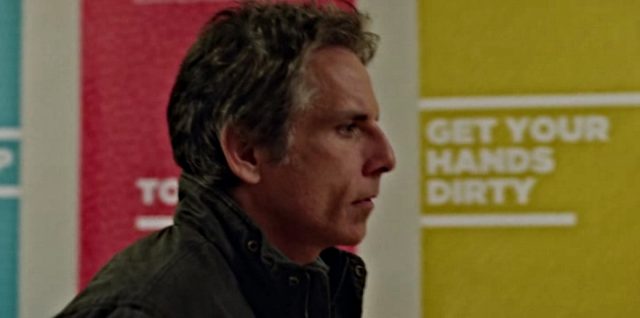
Having urged us to “get out there,” university administrators then later express regret when they feel compelled to counter a given professor’s statements with press releases affirming that “this does not represent the views of the university”. This is an “own goal” on the part of university administrators. They have worked assiduously to make the university into a media organization, to turn professors into celebrity advocacy-journalists, and to make the institution responsive to market audiences to such an extent that the autonomy of the university becomes untenable.
Firings of tenured professors by university administrations, over a difference of opinion, are still relatively rare in Canada, when compared with the US or the UK. In fact, it is not an easy option: tenured professors have not only the protection of their tenure, but of their union, and a legally binding contract negotiated with the union on behalf of faculty which ensures academic freedom and due process. Faculty unions in turn belong to a national umbrella organization, CAUT, which boasts a multi-million dollar academic freedom fund and gets actively involved in supporting faculty. Canadian universities are also deeply fearful of lawsuits which could easily demolish their already frail budgets, most of which are running deficits already. Poor financial management and the backlash of legal damage often results in the top administrators being toppled. Rather than go the messy route which, heaven forbid, could also give rise to “bad press”—good lord, not “bad press,” that’s the other court which administrations fear—administrators have had to develop quieter, more insidious and subtle forms of suppression. The way to send “the right message” to the outside world, to properly convey the unspoken “views of the university,” is to publicly promote and praise certain select professors, the ones whose views and whose work best align with those of private individual and corporate donors, or with the ruling party, or the military. To take a recent example: as Donald Trump neared electoral victory, articles were published on the university website, in its magazine and elsewhere, that featured the expert analysis of select faculty—strangely enough, all of whom were clearly pro-Hillary Clinton, anti-Trump, a number of them American expatriates, and who evinced a certain Liberal Party affinity. Unlike in a real university, there was no debate among this small cluster of people bewailing the dawn of the “post-truth” world.
The paradox is that neoliberal university administrators have adopted a policy of containment, at the same time as they seek to publicly advertise themselves. Not wanting “the wrong views” to get notice, they engage in restricting speech by selecting that speech which suits their purposes. Speech is thus not just restricted, it is regulated, by promoting only those persons whose views are safe and deemed worthy of recognition. Speech is thus effectively restricted to those academics that the administrators judge to be “qualified” to speak, thereby limiting not only what is said, but who can say it. Media relations departments have the primary responsibility of inventing online rituals around speech, practicing containment through promotion. In some cases such departments actively tutor budding young “public intellectuals” through seminars and by shadowing them online, always ready for the opportune time for that strategic “retweet”. As weak, vain, and ineffective as these policies are, they serve as a useful reminder of how liberal authoritarianism works. In this case, liberal authoritarianism produces fictional representations of “the views of the university,” by thinning out the work actually done by faculty, spreading out the words of a few to represent the words of all.
Another method of indirect silencing is for the university to “celebrate” the media “accomplishments” of select faculty only, by listing stories of faculty who have appeared in the media… only in select media, depending on the “prestige” of the outlet. This is a way to ensure that professors whose views are worthy of being courted by the corporate, neoliberal imperialist media are the only ones featured. In other words, a professor mentioned in a story on CNN is deemed to be worthy of note; a professor who appears on RT, is ignored, as if the event never happened. Selective pride is a way of signalling selective shame. It has the effect of rendering silent the actual media accomplishments of faculty, in order to produce a false picture of where faculty stand, thus assuring the egos of financial donors and politicians. The policy is implemented with the naïve hope that misaligned professors will quietly yearn for that elusive little place on the university website, a place that amounts to nothing more than a few ephemeral pixels seen by few and forgotten by all.
On a range of other issues, near and dear to regime changers, liberal imperialists, and the pro-Israel lobby, one sees the pattern being reproduced, as I can affirm after close scrutiny that has endured for over a decade. If the topics are Iran, Libya, Syria, refugees, wars, nationalism, and so on, one sees the selectivity being actively enforced, even if it means publishing, praising and promoting the same two or three professors time after time. Rather than a university of hundreds of professors, added to tens of thousands students, we become a university of three individuals. Rarely, probably never, do we see university articles dealing with the working class, with poverty and inequality, critical of neoliberalism, globalization and imperialism. Thus the university presents its “views,” of such a one-sided nature and so bereft of any healthy dissent and disagreement as one would find on no university campus that ever took itself seriously.
Viewed from afar, there might even be something comical about a university administration busying itself with inventing a secret university, one that covertly lurks beneath the chosen public representation of the university. That is the point of creating “signature areas” that determine “strategic hiring”: lifting hiring decisions from the hands of Departments, now it is university executives who impose the parameters on what constitutes a desirable candidate, and decide which areas need to be filled. Slowly they thus invent for themselves the university they desire, as opposed to the real one that actually exists. Finally, they will have something they can sell with confidence. One has to almost feel sympathy for the administrators, who feel the keen pressure of public politics and special interest lobbies, into whose arms they have been driven by governments that renege on their obligation to support public universities.
The “views” of the university are a mercantile fiction, a falsehood designed to mislead the public and to caress donors and politicians, the kinds of individuals who are apparently empty and infantile enough to believe that the winning arguments are those that are advanced in the absence of criticism. What if we taught our students that the best way to learn is to ignore whatever they do not like to hear? That is indeed what is being pushed, ironically under the signs of “tolerance” and “inclusion,” the usual neoliberal claptrap. Thus we witness the university turned into a mere echo chamber for the comfortable, a safe space for moneyed elites to flatter themselves, creating a virtual world of unrivalled ideological purity, contrived harmony, and eternal hegemony.
Finally, messages from university administrators along the lines of “this does not represent the views of the university,” might serve an additional function, but I am just speculating. This might be a polite way of telling rabid members of the public to lay off. We heard you, yes it’s all quite disconcerting, and here is our little statement, now move along. Had universities with their bloated administrations and overt political leanings not wished to enhance their public profiles and represent themselves as quasi-media outlets, they would spare themselves such unnecessary exercises. In the end, pronouncements about “the views of the university” end up multiplying the damage to the university, both as a self-inflicted wounds within the university, and as a sign of intellectual cowardice in the face of bullies. A university administration that engages in such conduct has failed its first and most basic function: to administer university resources in order to facilitate teaching and learning.
Using the big lie to undermine Palestinian solidarity
By Yves Engler · December 23, 2015
The big lie is a propaganda technique generally employed when telling the truth would be unfavorable to your side. It goes like this: never admit doing any wrong and instead always insist on a story that portrays your side as the good guys. What really happened is irrelevant. The key is repetition. Do it often enough and loudly enough until most people believe you.
While the big lie is most often associated with authoritarian governments, its use is actually quite widespread. For example, the Montreal Gazette recently published a front page article claiming Jewish students at Concordia University were “feeling like the target of a hate campaign.” The reason cited, as far as this writer can tell, was simply that many students were standing in solidarity with Palestinians.
At the end of November, the student group Solidarity for Palestinian Human Rights organized BDS Week. Without citing a single incident of actual racism, the Gazette painted a picture of the discussion series as hateful. Reporter Karen Seidman simply quoted an individual decrying “a hostile environment on campus” and another who denounced “speakers slandering Israeli tactics and spewing hate.”
In her article, Seidman also labeled a referendum held last year in which undergraduates voted to support the boycott, divestment and sanctions (BDS) campaign against Israel as “contentious” and downplayed its significance by saying only “a tiny fraction” of the overall student body participated.
So why is this a big lie?
First, the side favored is portrayed as a victim of “hate” with no evidence presented except criticism of the Israeli state causing hurt feelings. Second, and most important, the article blissfully ignores any historical background that would present Palestinian sympathizers in a positive light or even provide context for what they are doing.
It abjectly fails to even get any comment from any supporter of BDS. The reporter writes that she tried and failed to get a comment from the organizers, but it should surely not be beyond a reporter’s ability to get an alternative pro-BDS voice.
And while portraying a rather modest week of solidarity events as hateful, the reporter also ignores how a well-funded Concordia institute has engaged in an effort to erase Palestinians from historical memory.
In 2011, multibillionaire David Azrieli gave Concordia $5 million to set up the Azrieli Institute of Israel Studies.
The institute established the first minor degree program in Israel studies at a Canadian university.
This wasn’t a disinterested, apolitical donation. Azrieli, an Israeli-Canadian real estate magnate who died last year, was a staunch defender of Israel. He did not hide his affiliation, happily asserting that “I am a Zionist and I love the country.”
During the Nakba, the 1948 ethnic cleansing of Palestine, he was an officer in a largely Anglo-Saxon brigade of the Haganah, a Zionist military force. Led by Major Ben Dunkelman, a Canadian veteran of the Second World War, the Seventh Brigade played a leading role in the infamous Operation Hiram.
Dozens of villages in the north of Palestine were depopulated and destroyed during that offensive.
The operation, initiated in October 1948, included several massacres of Palestinian villagers.
As many as 94 Palestinians were killed in the village of Saliha alone. A Jewish National Fund official, Yosef Nahmani, noted in his diary that between 50 and 60 peasants in Safsaf were killed and buried in a pit after the village’s inhabitants “had raised a white flag.”
In his book The Ethnic Cleansing of Palestine, the Israeli historian Ilan Pappe notes that few brigade names appear in the oral testimonies that have been gathered about the Nakba: “However, Brigade Seven is mentioned again and again, together with such adjectives as ‘terrorists’ and ‘barbarous.’”
Since opening at Concordia, the Azrieli Institute has proven a potent advocate for Israel on campus.
In June, the institute hosted the Association for Israel Studies’ annual conference.
After attending the conference, the right-wing Israeli academic Gerald Steinberg described Azrieli’s $5 million donation as part of a “counterattack” against pro-Palestinian activism at Concordia.
The institute is largely designed to erase Palestinians from their historical connection to their homeland. Its website fails to even mention the word Palestine.
In a December 2014 letter to the Montreal Gazette, Nakina Stratos noted: “Browsing through the website of the Azrieli Institute of Israel Studies, I was not able to find the words ‘Palestine’ or ‘Palestinian people.’ How can an institute that teaches about the history of Israel not mention Palestine on its website? This, to me, intersects with the far-right Israeli narrative, which is a total confiscation of Palestinian history, and an attempt to erase the concept of Palestine from the dictionary of the Middle East.”
But rather than investigate how Palestinian students feel about a richly endowed university institute that erases their existence, the Gazette’s education reporter chose to focus on assertions of persecution by those who would do the erasing.
The perpetrators of oppression and their supporters instead become victims. Those who stand up for the oppressed are portrayed as bullies.
That is the big lie at work.
Featured Video
America Racing to Strategic Defeat in Iran
or go to
Aletho News Archives – Video-Images
From the Archives
Should Europeans ‘Thank’ the Americans for Destroying Nord Stream?
By Robert Bridge | Strategic Culture Foundation | September 29, 2022
With an investigation continuing into the destruction of the Nord Stream gas pipeline that provided energy supplies to Europe from Russia, there appears to be just one prime suspect, and that should surprise nobody.
Following the sabotage of the Nord Stream 1 and 2 gas pipelines, former Polish Foreign Minister Radoslaw Sikorski already seemed to know the identity of the perpetrator when he tweeted out: “Thank you, USA.”
At first glance, it seemed that Sikorski was speaking sarcastically, berating Washington for carrying out an attack that will have severe repercussions for the people of Europe. After all, how could anyone see any good coming from the termination of Europe’s primary source of gas reserves with winter just around the corner? It was Sikorski’s homeland of Poland, after all, that urged its citizens to collect firewood in the face of dwindling gas reserves.
In fact, the Polish diplomat was speaking one-hundred percent literally… continue
Blog Roll
 Aletho News
- Growing insecurity, soaring prices fuel protests in north as regime bans evacuation: Sources
- Iran denies responsibility for ‘depraved’ attack on Kuwait desalination plant
- Bring The Troops Back. End This War Now!
- Can we please stop calling Israel the ‘only democracy in the Middle East’ now?
- US should start removing its troops for Germany, proposes AfD co-leader Chrupalla
- Iran Red Crescent: 600 educational centers attacked in US-Israeli ‘war crimes’
- Russian Oil Tanker Arrives in Cuba Amid U.S. Blockade
- America Racing to Strategic Defeat in Iran: Lt Col Daniel Davis
- FTC Warns Visa, Mastercard, PayPal, Stripe Over Political Debanking
- Russian tanker approaches Cuba despite US oil blockade
- If Americans Knew
- Israeli police block Catholic cardinal from entering Church of the Holy Sepulchre on Palm Sunday
- Israel is assassinating journalists again, more than any other nation, anywhere, ever – Not a ceasefire Day 170
- Over 300 US service members wounded, majority have brain injuries – Not a ceasefire Day 169
- Researchers at Human Rights Watch Resign Over Blocked Report on Palestinian Refugee Return
- Jewish Groups Are Backing a War Americans Don’t Want
- Eric Fingerhut Thinks He’s the President of the Jews
- Top Jewish Philanthropists, Rabbis Urge Israeli President to Take Action Against ‘Jewish Extremists’
- Don’t Be Fooled. Zionist Leaders Have Always Wanted to Control Southern Lebanon
- Israel’s widespread use of torture is a core element of its genocide against the Palestinian people
- In Israel’s War on Iran, Many Middle East US Bases Rendered “All But Uninhabitable”
- No Tricks Zone
- New Study Finds Warming Saves Lives…Cold Temperatures 12 Times More Deadly Than Excess Heat
- German Science Blog Accuses PIK Climate Institute Of Hallucinating Climate Tipping Points
- Devastating Assessment Of Comirnaty Vaccine By Former Senior Pfizer Europe Toxicologist
- New Study: CO2 Is ‘Effectively Negligible’ As An Explanatory Climate Change Factor Since 2000
- Former Pfizer Toxicologist Dr. Helmut Sterz Tells Bundestag Hearing Pfizer Vaccine Should Have Never Been Approved
- Energy Expert: Germany’s Nuclear Phaseout Was A “500 Billion Euro Mistake”
- New Research: South Australia’s Mid-Holocene Sea Surface Temperatures Were 4°C Warmer Than Today
- Storing Green Energy To Last Germany 10 Days Would Require A 60-Million Tonne Battery
- New Studies: UK Sea Levels Were 4 Meters Higher Than Today During The Mid-Holocene
- Destructive Green New Deal: German Energy And Metal Group Warns Of Drastic Crisis
 Aletho News